



Abstract
This article employs the labyrinth as an analytical and interpretive tool for thinking about Minoan architectural and especially palatial space with a particular focus on Knossos. Whether or not Minoan ruins inspired later Greek mythical narratives, Knossos can be examined as a kind of a labyrinth towards developing new perspectives on Knossos as an experienced environment and how it was entangled with broader cultural and cosmological ideas. A labyrinth perspective enables bringing together multiple spatial, material and cultural forms for the heuristic purposes of exploring palatial space in relation to how the environment and world were perceived in Minoan Crete. Knossos afforded participants a mystical experience that provided glimpses of, or openings into, different dimensions of a layered reality—the richness of the world extending beyond the readily perceivable surface of reality—in a literally and figuratively labyrinthine experienced palatial environment.
Keywords
Introduction
Aegean Bronze Age archaeology has a complicated relationship with myths. Excavations at Troy, Mycenae, Knossos and elsewhere proposed that there might be some reflections of a historical reality behind the Homeric epics and other mythical accounts recorded centuries after the Bronze Age. While the Iliad and Odyssey seemed most readily to have a connection to the Mycenaean world, the discovery of the palace of Knossos suggested that mythical narratives of King Minos and his world could provide insights into the Cretan Bronze Age. This connection to Greek myths has cast a long shadow on modern perceptions and receptions of the Minoans, who have long lingered between classical myths and Bronze Age realities on the one hand and ancient and modern myths on the other (Gere, 2009; Papadopoulos, 2005).
Arthur Evans was a central figure in the creation of the mythical Minoans. Musing on Knossos, he reckoned that ‘this huge building, with its maze of corridors and tortuous passages, its medley of small chambers, its long succession of magazines with their blind endings, was in fact the Labyrinth of later tradition’ (quoted in MacGillivray, 2000: 191–192; see further Sherratt, 2009 and Schoep, 2018 on the early uses of the term ‘labyrinth’ in Minoan archaeology). Subsequent scholarship has taken divided views on the Knossos labyrinth and the relationships between Bronze Age Crete and classical myths. But whether Knossos or its ruins had any direct bearing on the classical labyrinth myth or not, the palace of Knossos has long been regarded ‘labyrinthine’ and we employ the labyrinth as a heuristic tool or lens for exploring some functions and meanings of palatial space. The labyrinth has fascinated people for thousands of years and there is a substantial body of literature on the idea, design, metaphor and material manifestations of the labyrinth from different perspectives and in different contexts (e.g., Artress, 1995; Conway, 2013; Doob, 1990; Harris, 2014; Kern, 2000; McCullough, 2005; Schmidt Di Friedberg, 2017). This literature, both scholarly and popular, opens up perspectives on several curious features of Knossos as an architectural and experienced space.
In this article, we examine Knossos as a kind of a labyrinth, inspired by diverse views of what the labyrinth is and what it does. We argue that Knossos was labyrinth-like in different ways and senses, which in turn offers perspectives on Minoan perception and understanding of the environment and cosmos. In this line of thought, Knossos was confusing by design, and this was one purpose of the palace—it was a ‘device’ for manipulating perception and cognition (Figure 1). We trace (‘functional’) similarities between the labyrinth and palatial space at Knossos towards bringing together several—and perhaps seemingly unrelated—features and aspects of the palace and broader characteristics of Minoan culture and cosmology. A key characteristic of the labyrinth (and the palatial space of Knossos) is that it is disorienting, but also a place of spirituality and transformation where boundaries are dissolved and the ‘ordinary’ order of the world collapses into a dream-like state. The labyrinth is a place of dissonances, uncertainty, non-linearity and the otherworldly, and it readily connects ‘inner’ mental and ‘external’ material realms. Plan of the Knossos palace. Map modified from McEnroe (2010: Figure 7.2).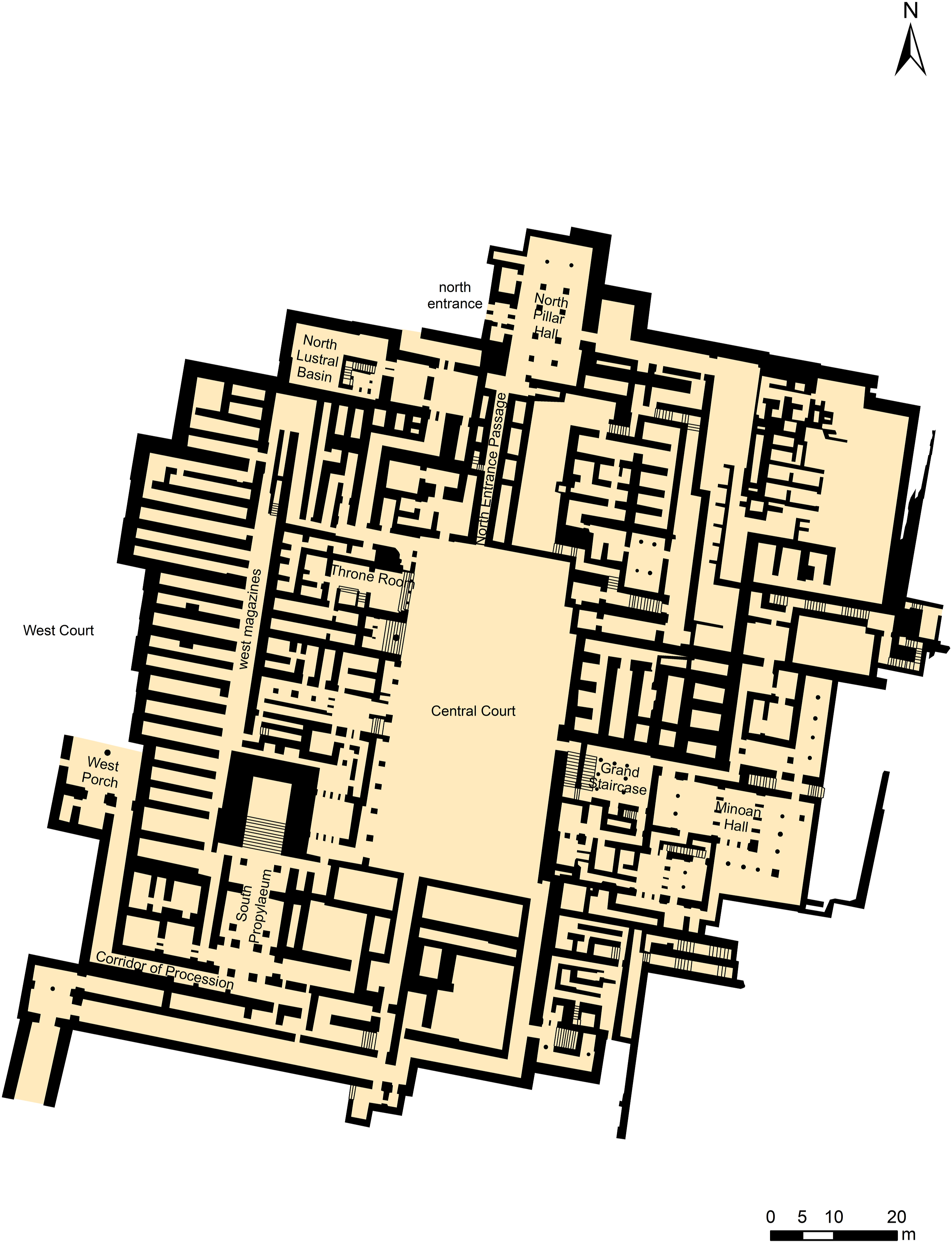
Our approach is two-fold. First, we have conducted GIS-based analyses of Knossos and four other palaces in regard to spatial and material configurations of palatial space. We have examined the accessibility of different parts of the palaces from the proposed main entrances and the associated circulation patterns inside the palaces. We have also analysed visual accessibility and manipulation of palatial space in relation to how various architectural elements (potentially) guide perception and movement in the palaces, and accordingly the sense of place. The analyses were carried out in ArcMap 10.7.1 (© ESRI). Accessibility was analysed using the Cost Distance tool, which calculates physical accessibility of space from a chosen starting point. Visibility was analysed using the Viewshed tool, which assesses visibility patterns (visible, not visible) from chosen observer points within a site.
Second, we have studied the labyrinth as a spatial and cultural form in different contexts and use this literature-based research with our GIS-informed and other observations of palatial space in Knossos. Some connections and associations between the labyrinth and Knossos emerging from our study are strong and others perhaps coincidental or tenuous (not necessarily intentionally or consciously meaningful in the Minoan world). It is, however, our overall tracing of a network of connections and associations between different architectural and cultural elements that seeks to show Knossos in a somewhat new light as a ‘portal’ to otherworlds—a tool for revealing something about people themselves and the world around them. Metaphorically, our approach has similarities to Debord’s (1956) dérive (‘drifting’) as a mode of ‘open’ and ‘free format’ encountering and interacting with the environment, which befits the non-linear and dream-like realms of the labyrinth and the Minoan lived world where (we propose) intentional ambiguity and uncertainty were culturally and cosmologically important.
Our approach is synchronic in orientation with the focus on the architecturally most well-documented Neopalatial phase (c. 1750–1490 BC). The palace was in use approximately between 1900–1200 BC and subject to various changes over the centuries. Architectural modifications took place also during the Neopalatial phase (e.g., McEnroe, 2010: 81–82), but our focus is on a host of general characteristics of the Neopalatial complex rather than specific elements and their specific combinations at any given moment. We engage with the experiential dynamism of the palace as a place of interaction between different dimensions or reality rather than diachronic change or the development of the palace over time. Knossos and other Cretan palaces have been subject to much research—much more than can be acknowledged in a single article—and we examine their complex nature from one viewpoint. Also, little is known about the people who experienced the palatial space of Knossos and we refer to them simply as ‘participants’ (see below).
Knossos, Crete and the labyrinth
Knossos and other Cretan palaces have been subject to extensive research from myriad perspectives, but palaces continue to be enigmatic in many ways even regarding their function(s). There is quite some uncertainty as to different interpretations of Knossos and other palaces, which in part illustrates their enigmatic (or unfamiliar) nature. Minoan palaces were arguably at least communal ceremonial buildings, but their exact socio-political role is subject to debate and not tackled here (see e.g., various contributions in Driessen et al., 2002; Driessen, 2018; Schoep, 2010; Soar, 2014). Different (groups of) people possibly used and experienced Knossos differently and had varying access to palatial spaces, but very little is known about that with any certainty.
Hence, any examination of Knossos or other palaces as experienced places necessarily operates on a general level, that is, postulates generic or hypothetical individuals and/or groups participating in whatever specific activities unfolded in palaces. This is the case with previous studies of palatial space, for instance in the light of perception psychology (e.g., Vansteenhuyse and Letesson, 2013), as much as our more culturally and cosmologically inclined ‘landscape phenomenological’ exploration of Knossos and how it affected the people engaging with it. It is well established with a vast body of research that built environments mediate people’s behaviour and thinking in myriad ways and this comprises a general foundation for our examination, along with the widely held view that (communal) ceremonial and performative practices took place in palaces.
Opinions vary on whether Knossos has any historically meaningful connection to the classical myth of the labyrinth. A labyrinth-like visual design was nonetheless familiar to the Minoans, as exemplified by the so-called ‘Labyrinth Fresco’ from Knossos and a similar fresco design from Tell el-Dab’a (Egypt) with possible connections to Knossos (Shaw, 2012; Figure 2). The Labyrinth Fresco possibly decorated a floor (instead of a wall) of the so-called ‘Labyrinth Corridor’ (Shaw, 2012). We regard Knossos as a labyrinth for analytical and interpretive purposes, which does not imply that it was consciously and intentionally built as a labyrinth, but rather that it has various similarities with both ‘formal’ labyrinths and in the colloquial meaning of labyrinth as ‘a place constructed of or full of intricate passageways and blind alleys’ and ‘something extremely complex or tortuous in structure, arrangement, or character’ (Merriam-Webster Dictionary). The Tell el-Dab’a ‘bull-leaping’ fresco, possibly produced by Minoan artists and inspired by frescoes at Knossos. Image: Wikimedia Commons.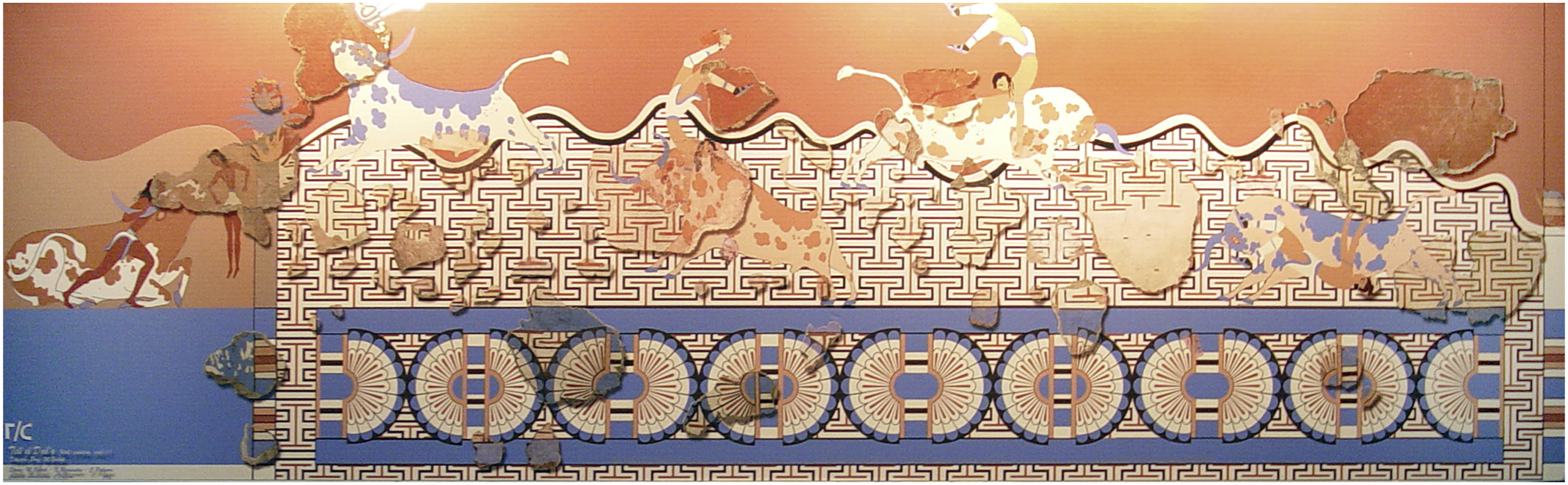
Kotsonas (2018) has recently argued that Knossos was not associated with the labyrinth of the classical myth in the ancient world, but given the layered and multiple cultural lives of the labyrinth, it is entirely possible that (the ruins of) Knossos had some contribution or connection to later ideas of the Cretan labyrinth (see Momigliano, 2020: 9–10, 23–25). For D’Agata (2013: 57–59), the monumental ruins of the Knossos palace could have been explicitly associated with the mythological labyrinth already by the classical period of Greece and into the Roman period. She postulates that the ruins would have been visible in antiquity and their perplexing arrangement of rooms and corridors could have contributed elements to the myth of the labyrinth and the Minotaur. Be that as it may, activities in the ruins of the palatial area continued into the Iron Age and the Kephala Hill was not built over in Greek and Roman times but remained outside the later urban area of Knossos. Thus, the monumental ruins possibly remained observable for a long time after their active use was discontinued.
Moreover, given the very long and significant (pre)history of the Kephala Hill, it conceivably remained a place of cultural memory even after its active use. Indeed, Soles (1995) argues that Knossos was regarded as the cosmological centre of the world in the Bronze Age. Day and Wilson (2002) suggest that the Kephala Hill was perceived as a place of origins and ancestral powers already when the first palace was built. The palace was literally constructed on a sedimented past and hidden underground, which resonates with some subterranean or underground dimensions of the palatial space, as discussed later. Overall, then, Knossos was likely a place of transgenerational memories with some elements passed on—in however historically inaccurate and mythical form—long after the palace fell out of use. This is also suggested by the mental imprint that the Bronze Age world left in the eastern Mediterranean mindscapes, as evidenced by the classical mythologies and their afterlife into the present.
Palatial design and the labyrinth
Spatial organization is the most obvious labyrinthine characteristic of Knossos, with the prominent presence of long and winding corridors a case in point. The Corridor of Procession in Knossos (e.g., Adams, 2017: 76) and the corridor leading to the Lustral Basin in the west wing of Phaistos (e.g., Hitchcock, 2007: 94) exemplify this curious aspect of Minoan palatial space. Our GIS-based analyses indicate that participants were made to circulate in palatial space so that, for instance, reaching Central Courts and spaces beyond them from entrances often involved a purposeful ‘lengthening of access’, and the same applies to many other loci within palaces as well. For instance, the east magazines in the palace of Malia are located next to the Central Court in plan but their physical accessibility from the latter is inhibited by locating the entrance to the magazine block in its far end. In brief, more circulation was involved in accessing certain places than would have been necessary for any ‘practical’ reason (Rapakko, in press; and see below). This is a characteristic of the labyrinth as well (Falahat, 2013: 67).
The relationship between the entrances and the Central Court in Knossos differs substantially from other palaces. In Phaistos, there is a direct access from the west entrance to the Central Court and in Malia from the south entrance to the Central Court, whereas in Zakros the palace is visually accessible from the surrounding town that is located on higher ground. In Knossos, by contrast, the proposed main entrances, the West Porch and the north entrance, both lead to an indirect and twisting path towards the Central Court. This is more pronounced when entering from the West Porch and through the meandering Corridor of Procession, but the path from the north entrance is not direct either. One needs to choose between going from the North Pillar Hall to the spaces to the east of it or alternatively turn to the North Entrance Passage; and even then the Central Court would have been obscured from view due to the entrance ramp, and revealed only when ascending to the passage that leads to the court. In both cases, access to the Central Court and the inner parts of the palace is clearly intentionally lengthened (see Figure 3(a) and (b)). The inner palatial spaces of Knossos were visually and physically isolated from the world outside and Knossos has indeed been interpreted as a distinctively ‘inward-looking’ palace (Adams, 2017: 76). Illustration of accessibility at Knossos from (a) the West Porch, (b) the north entrance. Map modified from McEnroe (2010: Figure 7.2).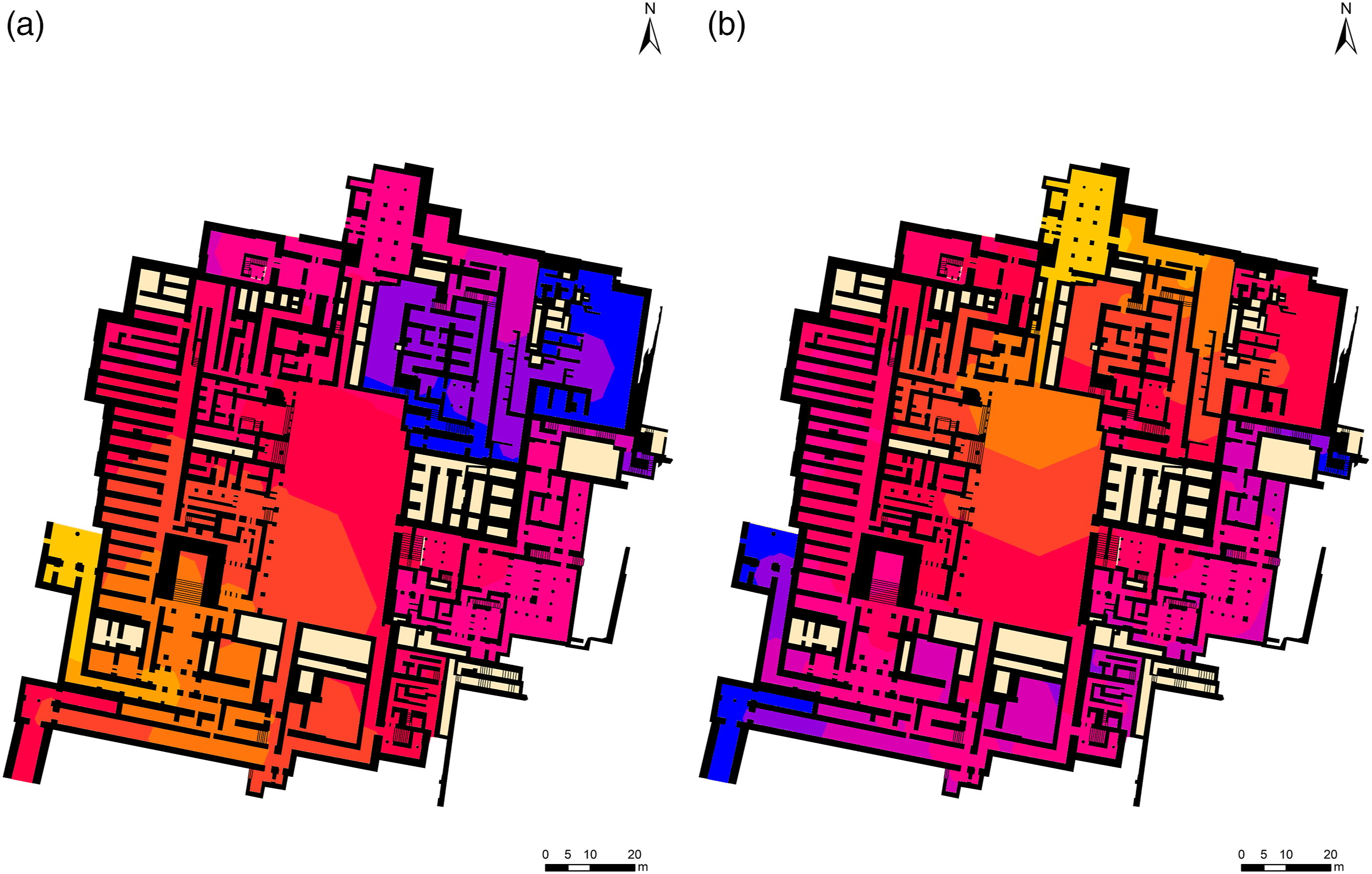
The long and winding corridors had a disorienting impact similar to the turns in a labyrinth (see below). The prominence of corridors and the lengthening of access suggest that movement was an integral element of experiencing palatial space in the broadly same manner as movement is central to the meaning and functionality of the labyrinth—that is, what a labyrinth ‘does’ to people. Interestingly, the sunken rooms known as Lustral Basins are also accessed by staircases with a turn. Overall, palatial design employed various features that manipulated physical and perceived distances and views, which made the organization and experience of palatial space disorienting with complex arrangements of rooms, walls, corridors, windows, porticoes and other elements. Discussing the ‘snake goddess’ statuettes found in the Temple Repositories, Alberti (2001: 202) proposes that the presence of the figurines in particularly isolated and controllable areas, lend[s] support both to the idea of the figures as efficacious partly through limited access and also to the idea that the entire complex, in some sense, was designed for procession and display. As such, an integral part of seeing and/or touching the images would have involved the sensory (haptic and motor) experience of manoeuvring through the spaces of the Palace, themselves richly adorned with static wall paintings and grand passageways.
He continues that the overall impact of the palace as a visually and experientially dense and dazzling environment, a place of ‘enchantment’, enhanced the power of the figurines (Alberti, 2001: 202, inspired by Gell, 1998: 83–95). Walking a labyrinth can produce a similar sense of enchantment or spirituality (Artress, 1995). For Alberti (2001: 202), the perceptually disorienting character of Knossos ‘was undoubtedly by design rather than accident’. The palatial space thus compares to the labyrinth-like designs in the two frescoes from Knossos and Tell el-Dab’a whose ‘pattern is so dense and intricate that it is not difficult to imagine it inducing disorientation, or dizziness’ (Shaw, 2012: 1).
Besides spatial organization and circulation patterns, various architectural features contributed to a sense of disorientation. Stoas, column halls, porticoes, light wells and other openings created built environments where the interchange between indoors and outdoors was constant (Palyvou, 2000). The openings in the walls and the incorporation of open courts into architecture connected the buildings to their surroundings in a very concrete sense: they permitted the flow of light and smells into architectural spaces and thus changes in weather conditions were reflected inside the buildings (Palyvou, 2000). A non-linear organization of space is reflected in that ‘doors seldom face each other’ (Palyvou, 2018: 60), which contributed to the visual fragmentation of the built environment that afforded only partial glimpses of spaces to the observer. Our GIS analysis illustrates how visibility from the Central Court to inner palatial spaces was manipulated between open, partial and blocked views (publication forthcoming).
Our analysis shows that fragmented, partial views or glimpses of palatial spaces beyond Central Courts were common and open views rare in Knossos compared to other palaces. Porticoes were selectively used to cover some—but never all—façades of Central Courts and arranged asymmetrically (i.e., not facing each other across the court). The portico that hides the polythyron hall in the otherwise relatively open west wing of Knossos, for instance, covers only the southern half of the western façade of the Central Court, leaving the entrances to the hall hidden from the view (see Figure 4). Fragmented spaces and controlled visibility contributed to a sense of mystery of Knossos as an experienced place. Visibility analysis at Knossos from the centre of the central court. Map modified from McEnroe (2010: Figure 7.2).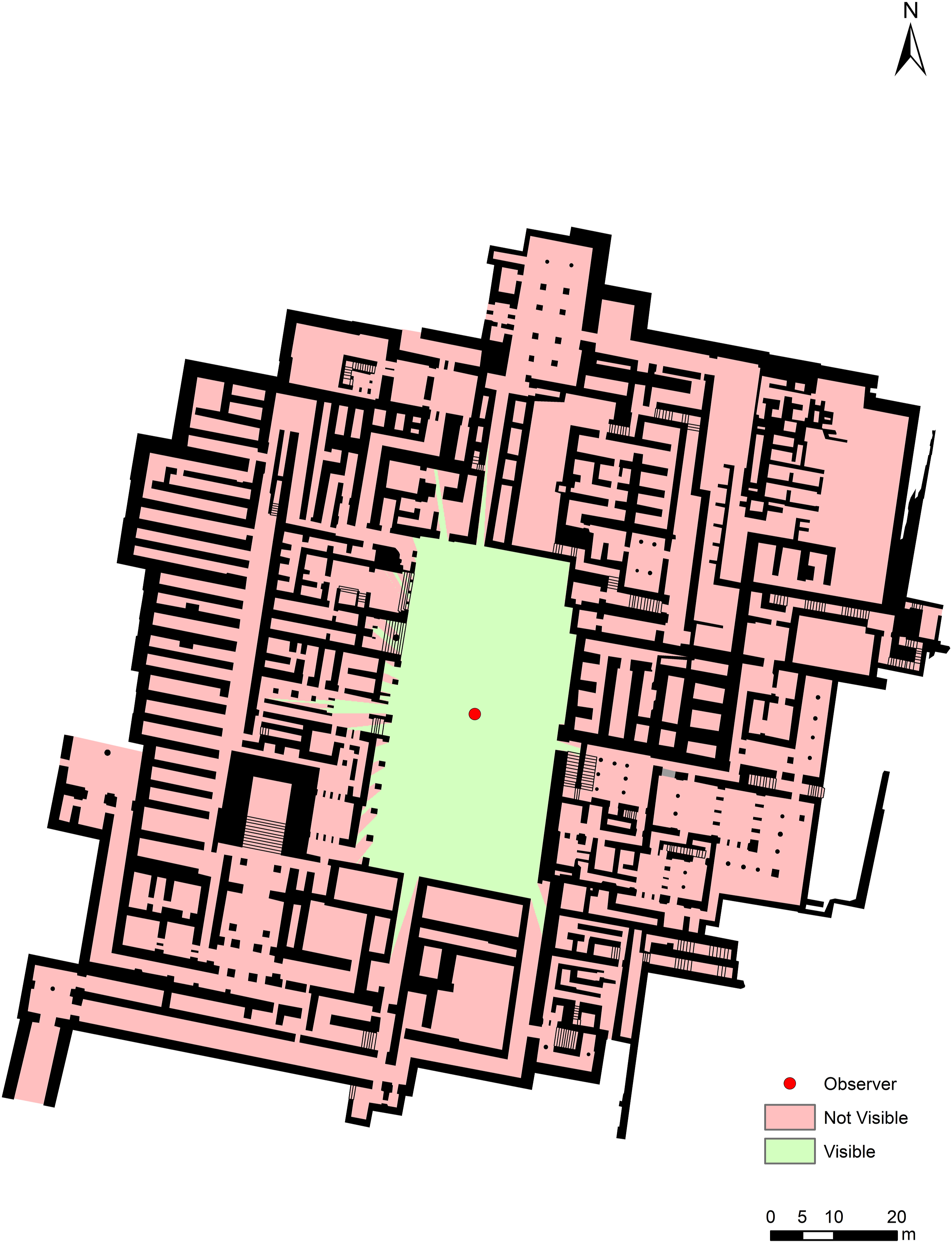
Light is central to wayfinding (Potamianos, 2017) and thus also to a sense of (dis)orientation. Various Minoan architectural designs fragmented form through the manipulation of light and shadow, which makes it difficult to recognize ‘true’ shapes of things (cf. Potamianos, 2017). This broke down or rendered uncertain boundaries between things, which resonates with how the labyrinth breaks down boundaries between, for instance, insides and outsides (Ingold, 2007: 53). The so-called pier-and-door partition, or the polythyron hall system, comprises a particularly interesting way of manipulating inside-outside and open-closed relations, as pier-and-door systems can be used to make a closed wall or a wall with one or several doorways in multiple configurations (Palyvou, 2018: 62–64).
This mutability of space and its effects on circulation and the perception of one’s surroundings produced yet another disorienting effect (Hitchcock, 2000: 176), which has also supported the traditional interpretation of polythyron halls as ritual spaces (e.g., Marinatos and Hägg, 1986). In Minoan Palaces, polythyron halls usually opened to the outside, possibly to gardens (see Palyvou, 2018: 105). Our GIS analysis shows that by opening and closing the doors of the polythyron it was also possible to alter the axiality, orientation and character of architectural spaces, which in some cases entails incorporating outdoors into the built environment or alternatively closing off the outside world. Polythyron halls could thus be either ‘inside-oriented’ or ‘outside-oriented’.
The manipulation of light had significant impact on the experience of palatial spaces with the altering between the darkness of confined corridors, the play of light and shadows in column and polythyron halls, and the openness of sunlit Central Courts. Dissolving and confusing the physical and perceptual boundaries of space amplified disorientation. Manipulation of perception and cognition, including the boundary between oneself and the world, is integral to spiritual experience and among the effects that the labyrinth produces, which is also why the labyrinth has been regarded as a powerful tool of spiritual awareness and transformation (see Artress, 1995; Conway, 2013; Greenwood, 2009; Ingold, 2007: 53). Walking a labyrinth induces a degree of an altered state of consciousness (Eichberg, 2009), which may have religious-spiritual implications: Small miracles can happen in the labyrinth. We can strengthen ourselves by shedding tears, feeling the anger and hurt that keep us from experiencing our soul level [...] people on the labyrinth seem to gravitate toward what I have come to call a process meditation [...] We enter the terrain of memory and dreams [...] It works through the imagination and the senses, creating an awareness of how we relate to ourselves, to others, and to the Holy. (Artress, 1995: 75, 77, 97)
Journeying through the labyrinth is simultaneously a bodily and psychological-spiritual experience which provokes detachment from ‘this world’ and can be a transformative experience—rebirth—in restructuring relationships between oneself and the surrounding world (see e.g., Conway, 2013). For Potamianos (2017), the sense of disorientation is persistently present [in a labyrinth] and may cause, in turn, certain psychological states, such as the loss of connection to the environment, the inability to conceive the structure of the surrounding world; states which eventually lead to the alienation from one’s own identity.
Knossos as experienced space potentially produced similar impacts. Like the classical unicursal labyrinth, the palaces had a clear centre—the Central Court—that has been regarded as the ‘final destination’ of the people entering the palatial complexes (Driessen, 2002: 9; cf. Falahat, 2013: 67). The Central Court was supposedly a setting for communal ceremonies, but ‘getting there’ required a journey through the experiential and symbolic palatial space that had the power to spiritually renew the community, thus echoing rebirth in the centre of a labyrinth.
Art, architecture and (supernatural) nature
Knossos was the only Cretan palace that was rich in mural art and mural art affected the perception of the palatial space in similar ways as the architectural forms discussed above. Wall paintings contributed to the blurring of inside/outside relations and boundaries between spaces and even different dimensions of reality—that is, between ‘here’ and ‘elsewhere’ or ‘this worldly’ and ‘otherworldly’. For instance, Minoan art is famously nature-centred, but representations of nature frequently feature hybrid and fantastic elements. The ‘inward-looking’ Knossos with its rich and disorienting perceptual environment comprised, we propose, a ‘wormhole’ or a portal that afforded glimpses of other dimensions of reality ‘here and now’.
When mural art is understood as an integral part of architectural form, rather than a superficial addition to it (Palyvou, 2000: 413–414), it becomes possible to regard wall art panels as (‘virtual’) openings into realms beyond the walls. Miniature wall-paintings, for instance, can be conceived as windows into some worlds that were not necessarily thought to exist geometrically in the space behind the painted walls, but instead open into some other dimension of reality. Likewise, the life-sized human figures painted in the Corridor of Procession in Knossos visually eradicated the wall to some degree and created an illusion of walking with people incorporated into the very structure that participants were walking through. The painting provoked a strong sense of involvement, feeling like being part of the very fabric of the palace (Palyvou, 2000: 429).
The mural art in Knossos arguably emphasised horizontal lines, reflecting the wooden beams of the underlying architectonic structure, and this ‘X-ray technique’, as Palyvou (2000: 429) observes, ‘implies that the wall surface is treated as transparent, showing its inner structure’, which comprises a means of dissolving boundaries and obscuring inside/outside relations in a physical and metaphysical sense (see also Günkel-Maschek, 2020; Palyvou, 2012 on the relationship between Minoan mural art and reality). Mural art enhanced the sense of the palatial environment as permeable and ‘rich’, which manipulated participants’ consciousness and sense of time and place. Knossos comprised an experienced environment that emphasized a porous, ‘mysterious’, spiritual and layered character of reality, with the palatial space providing connections to otherworlds beneath the immediately perceivable surface of things. It was a place where relationships between things were uncertain and the world ‘here and now’ was intertwined with other dimensions of reality which were incorporated in the very structure of the palace, hence constituting a kind of a ‘hyper-environment’.
Palaces as landscapes and journeying through them
The view developed above resonates with the idea of Knossos as the cosmological centre in Bronze Age Crete (Soles, 1995) and it also echoes the idea that palaces were symbolic or microcosmic constructions of the surrounding landscape (Hitchcock, 2007). Myriad correspondences between palaces and the landscape have been identified, including the orientation of palaces to sacred mountains (or cave sanctuaries and peak sanctuaries), as well as celestial phenomena, especially the passage of the sun across the sky through the year (e.g., Goodison, 2001, 2004; MacGillivray, 2004; Peatfield, 1987; Ridderstad, 2009). Hitchcock proposes that the intentionally lengthened walk through the palatial space to the Lustral Basins at Phaistos could have been symbolically associated with, or analogous to, traversing an actual landscape to reach a particular location (perhaps a cave that the Lustral Basin as a sunken space may represent), ‘orchestrating the symbolic re-creation of a journey in an artificial landscape’ (Hitchcock, 2007: 94). This is but one example of Hitchcock’s (2007) broader thesis that various features of palatial design had a meaningful relationship with actual landscapes. For instance, higher building masses and the so-called ‘horns of consecration’ perhaps symbolized mountains whereas sunken rooms, such as Lustral Basins and Pillar Crypts, were associated with caves and the subterranean world that had been of a ritual and spiritual interest on Crete since the Neolithic. Also, incorporating living rock in buildings perhaps reflects a broader principle of creating a ‘harmony with the landscape’ (Preziosi and Hitchcock, 1999: 63).
Conceiving palaces as symbolic landscapes adds another dimension to the significance of circulation in palatial space. Circulation and movement were integral to experiencing palatial space. Like the labyrinth, palatial space implies movement and not only in a physical space but also between different dimensions of reality, which involved a sense of mystery and possibly altered states of consciousness (partly) induced by the experienced built environment. Renaissance ‘magic gardens’ comprise a historical example of how constructed landscapes can be considered to alter perception and consciousness (see Godwin, 2002). Altered states of consciousness range from trance to disorientation, bewilderment and dream-like states, such as the ‘flow’ state. Manipulation of the senses and consciousness is associated with shamanistic-type journeying into otherworlds and this resonates readily with Knossos as an experienced space, however mild its impacts may have been in comparison to deep trance.
The correspondences between palaces and landscapes also lead us to the significance of journeying to actual nature sanctuaries. This required effort, as Peatfield and Morris (2012) point out, and involved sensory and performative engagement with the landscape, moving across it in an anticipation of the ‘rituals’ at peak sanctuaries. They compare this experience to journeying to mountain chapels in the contemporary Greek landscape: The participants, including old ladies and children, start at first light. The whole process generates intense sensory and somatic input—the climb over rocks and along stony paths; changing light and spectacular vistas as one ascends to the summit; smells of the summer herbs and incense approaching the chapel; sounds of voices, wind and the birds, distant bells of sheep and goats; the texture and feel of the offerings carried in hand. All this further generates intense emotional excitement and expectation, together with the evocation of memories of past festivals, even before the rituals on site are engaged. (Peatfield and Morris, 2012: 233)
Walking to peak sanctuaries involved bodily activities ‘where the physical and emotional experiences enhance and integrate with the spiritual’ (Peatfield and Morris, 2012: 233) in a broadly similar manner as we proposed above for sensing and experiencing Knossos.
Journeying with its spiritual associations is central to the labyrinth myth. Theseus embarks on a journey from Athens to Crete to slay the Minotaur, in addition to which venturing into the labyrinth is an otherworldly journey with a transformative potential (see Conway, 2013; Kern, 2000; McCullough, 2005), which ‘recalls initiation rites seen as a journey through underworld and the kingdom of death, ending in rebirth’ (Brunon, 2010: 505).
The labyrinth is associated with subterranean realms and the very idea of the labyrinth has possibly been inspired by caves (see e.g., Kotsonas, 2018) (Figure 5). This association with the underworld and the dead is illustrated by stone labyrinths made at medieval or early modern indigenous Sámi burial grounds in Arctic Norway (Olsen, 1991). In the medieval tradition, the labyrinth symbolized the course of human life, a narrow path that a good Christian was to follow, which explains the presence of the motif in churches, most famously in Chartres Cathedral (Brunon, 2010: 505). Finally, travelling is an important mythological theme, as exemplified by Odysseus’s wanderings, and there was an ‘esoteric’ dimension to journeying in premodern world in general (e.g., Helms, 1988). Psychro Cave in north-central Crete. Image: Wikimedia Commons.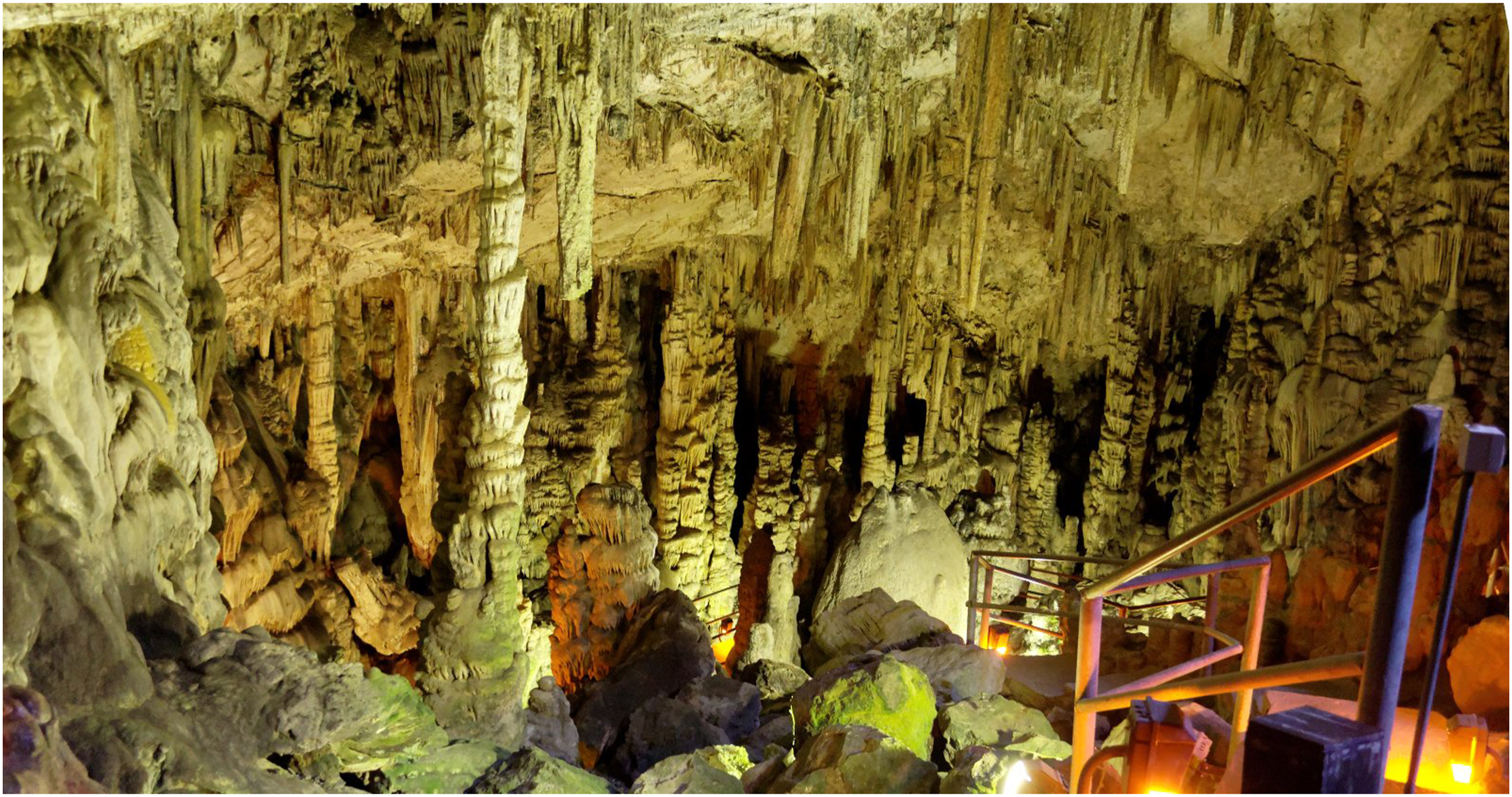
In addition to its subterranean and otherworldly connotations, the labyrinth design may have been inspired by a dance pattern, which readily resonates with Theseus’s crane dance (Kern, 2000). This highlights the significance of movement again and invokes dance scenes in Minoan art, such as the ‘Sacred Grove’ fresco from Knossos, which supposedly represents dancing in the West Court of the palace. It has been long recognized that dancing was part of Minoan spirituality and had an ecstatic dimension to it, which can be linked to the ‘shamanistic’ element of Minoan cosmology (see further Herva, 2006a; Morris and Peatfield, 2004, 2021; Tully and Crooks, 2015).
Some scholars have taken up the significance of shamanism and altered states of consciousness in Minoan spirituality, but as Peatfield and Morris (2012) observe, the broader implications of shamanistic dispositions have not been considered in much depth, largely because the deistic model has dominated the understanding of Minoan religion. Nonetheless, scenes on gold rings appear to portray ‘dancing’ human figures possibly in altered states of consciousness which in turn can be linked to broadly animistic-shamanistic modes of perceiving and engaging with the environment (Herva, 2006a; Morris and Peatfield, 2004; Tully and Crook, 2015). Altered states of consciousness can be understood as a means of accessing or experiencing ‘hidden’ dimensions of reality beneath the surface of the ordinary everyday world, with caves and labyrinths also providing a gateway into these hidden realms. This leads us to the symbolic and experiential presence and incorporation of the underworld in palatial space.
Palatial space and the underworld
A chthonic realm features prominently in Minoan culture and spirituality, as exemplified by cave sanctuaries but also the ‘snake goddess’ figurines from Knossos, while Cretan limestone cavern systems may have inspired the mythical labyrinth. If palaces were microcosmic landscapes in some sense, with higher building masses and the ‘horns of consecration’ alluding to mountains (Hitchcock, 2007; also Marinatos, 2010: 103–113; but the ‘horns of consecration’ have quite possibly been a polysemous and ambiguous symbol), then entering palaces, or some sections of them, had allusions to going underground and venturing into its materially, perceptually and experientially wondrous and otherworldly realms (cf. Herva et al., 2022).
This adds another element to the layered ‘shamanistic’ cosmos embodied by Knossos along the same lines as Lewis-Williams (2004) argues for the material and experienced built environment of Neolithic Çatalhöyük. The underground world is a disorienting and extraordinary space like the palace of Knossos was. In some sense, then, entering and circulating in the palace ‘revealed’ new dimensions of reality under the surface of the ordinary world. Like shamanistic travelling (and the associated altered states of consciousness) affords perceiving things that are ordinarily hidden, so too Knossos afforded a different perspective on the world and how other dimensions of reality are entangled with the ‘this-worldly’. Palatial space was a tool for ‘seeing’ and becoming aware of the surrounding world in new ways, which afforded restructuring the relations between oneself and the world similarly as labyrinths do.
The underworld is a complex cultural construction with myriad meanings and associations, but it tends to be associated with death and the dead. Intriguingly, Knossos has sometimes been interpreted as a place of the dead (Castleden, 1990; Wunderlich, 1974). While archaeologists have generally dismissed such interpretations, chthonic symbolism, sunken rooms and the general labyrinthine character of Knossos all suggest that an underworld was incorporated in the very fabric of palatial space. Circulation and dancing at Knossos also strike a resonance with circular tombs (tholoi) and circular dancing in burial contexts, exemplified by the dancing figurines discovered in the Kamilari tholos (Figure 6). In later folklore traditions, circular movement is sometimes associated with entering the underworld, a practice that ‘unscrews’ the ordinary world (Menefee, 1985). Labyrinths can also function as contact or transition points between life and death (Olsen, 1991: 53), wayfaring into the world of the dead and ‘portals that take the traveller to someplace else’ (Ingold, 2007: 56). Or as Olsen (1991: 55) puts it, ‘in the labyrinth a person is outside normal time and place and outside society’, which is to say that they are liminal spaces. Dancing clay figurines from the circular tomb of Kamilari. Image: Wikimedia Commons.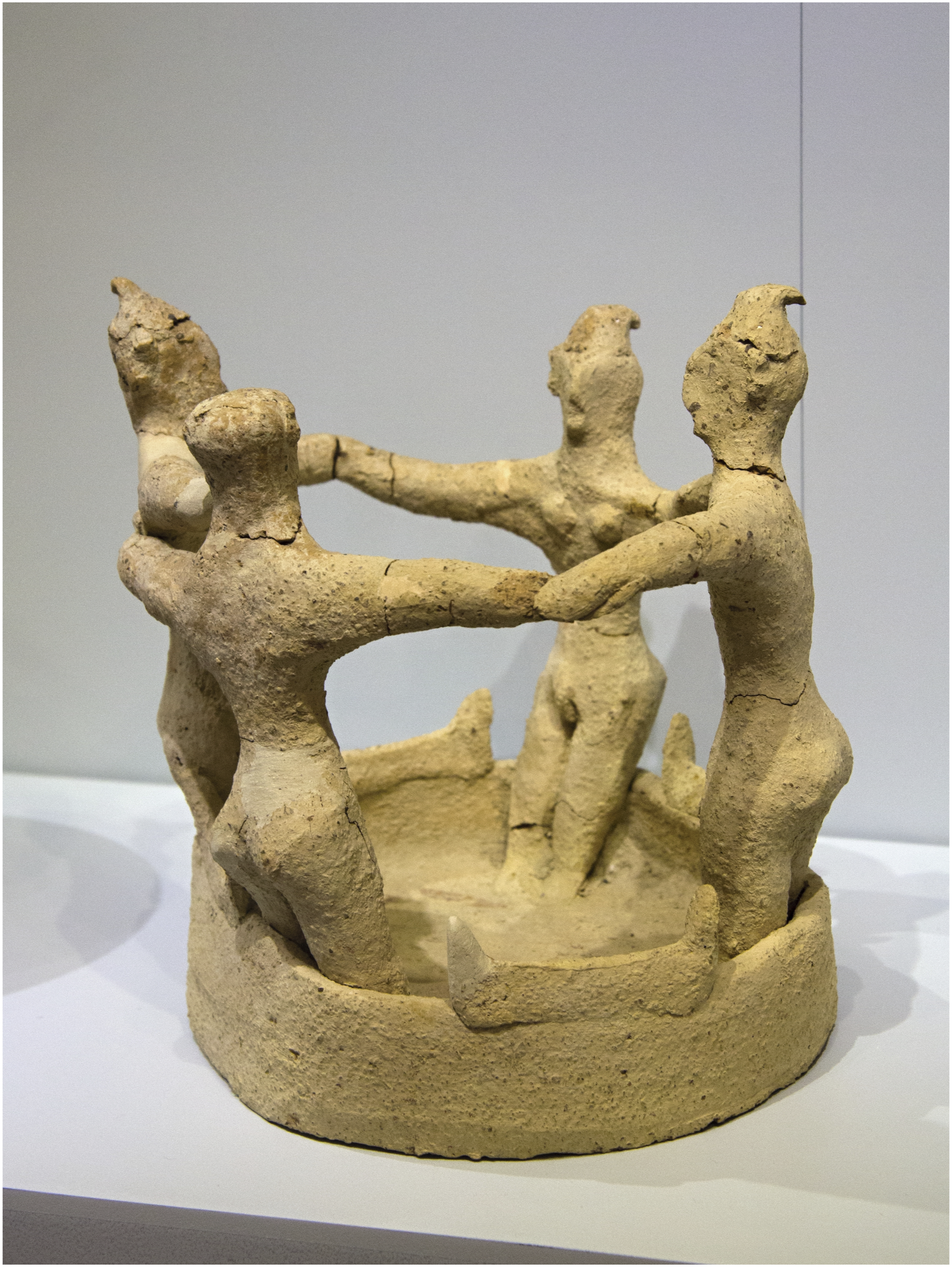
Whether or not these later examples have any direct bearing to the Minoan world, it is noticeable here that Knossos, located on Kephala Hill, had a very long history of human inhabitation already at the time when the first palace was constructed. This again emphasizes the proposed cosmological significance of Knossos (cf. Soles, 1995), Knossos as a place of ancestors and ancestral powers (Day and Wilson, 2002). Thus, one reason for incorporating the ‘underworldly’ in the architectural and experiential fabric of the palace may have been to connect to the past worlds that the Kephala Hill represented and embodied. In this view, circling in the labyrinth-like palatial space afforded connecting with and perhaps bringing to life something of the ancestral domain, the world under the surface of the ground on which the palace(s) were built.
Knossos and the sun connecting the worlds below and above
The labyrinth, for Falahat (2013: 64), is ‘a link between earth and heaven, the world and metaphysics’ and ‘not [merely] an object, but a lived experience’. Our discussion above proposes that Knossos was partly oriented to the underworld, but it was also connected to upper worlds, which of course befits the idea of Knossos as the cosmological centre. Mountains and mountain symbolism comprised one connecting element between different realms of existence ‘here’, ‘above’, and ‘below’. Mountains represented an axis of the world for the Minoans (Marinatos, 2010: 103–113) similarly as Yggdrasil connected different layers of reality in Germanic and Norse cosmologies. The Minoan ‘horns of consecration’ at Knossos and elsewhere can be interpreted in different ways and may have had multiple meanings related to mountaintops, heavenly spheres and the passage of the sun (see Banou, 2008; MacGillivray, 2004; Marinatos, 2010: 103–113). Indeed, the difficulties of interpreting Minoan symbolism may at least partly echo the ambiguous, polysemous and ‘indeterminate’ nature of various elements in Minoan art, spirituality, culture and world, which also cut across our above discussion of Knossos as an experienced space.
Be as it may with regard to the ‘horns of consecration’, the upper (astral) realm was apparently as important in Minoan culture as the underworld, as indicated by solar symbolism and solar alignments of palaces and tombs (Banou, 2008; Goodison, 2001, 2004; MacGillivray, 2004; Ridderstad, 2009; Rethemiotakis, 2017). The roughly north-south orientation of Knossos rendered the west façade of its Central Court as a ‘theatre of the Sun’, along with the potential solar alignment of the polythyron doors in the Throne Room to solar solstices and equinoxes (Goodison, 2001, 2004). This duality between the underworld and the celestial world was possibly expressed in the architecture of Knossos: The two kinds of ‘throne’ rooms [the Throne Room and the Hall of the Double Axes] and the Pillar Crypt indicate that the rituals performed in Knossos had a two-fold nature: one closer to the earth (the ‘dark room’), as well as one closer to the sky (the ‘light room’). (Ridderstad 2009, emphasis ours)
The Throne Room and the Hall of the Double Axes both have pier-and-door partitions and polythyron halls may thus have been a part of the broader cosmological scheme of the palatial environment.
Various scholars have identified a connection between the sun and the underworld in Minoan religion (e.g., Goodison, 1989 see also Marinatos, 2010; Ridderstad, 2018) and it is plausible that the sun and its daily and annual cyclical movement connected upper and lower planes of the Minoan cosmos. Speculations on a Minoan ‘sun goddess’ have sometimes emphasised her role as the ‘goddess of death associated with the underworld, earth, caves, snakes and regeneration’ (Ridderstad, 2018), which also brings us to the ‘snake goddess’ figurines from Knossos. Whatever the identity of these female figures (see Bonney, 2011), snakes had a cultural-cosmological significance and underworldly allusions in Minoan Crete (Ogden, 2013). The labyrinthine and ‘meandering’ circulation patterns in Knossos might be metaphorically connected to ‘moving like snakes’ in the underworldly dimension of the palace; indeed, shamanistic journeys can involve transformations into animals. Snakes have a dualistic character and in many world cultures, including the ancient eastern Mediterranean, and are often associated—like the labyrinth—with rebirth (see Ogden, 2013).
In this symbolic, cultural and cosmological setting, moving through and experiencing the palatial space of Knossos afforded penetrating deeper into reality and becoming aware of its different aspects and dimensions and how things in the world are interconnected. All kinds of things revolve, circle, circulate and/or ‘dance’. Movement—and especially moving in certain ways—thus connects things and worlds symbolically or binds them together through correspondences between them. Whatever other functions it may have had, the palace of Knossos can be understood as a place for cultivating attention and awareness of the structures, layers and dynamics of reality (also cf. Herva, 2006b).
Conclusion
We have argued in this paper that moving in palatial space, in Knossos in particular, afforded participants with a mystical experience that provided glimpses of different dimensions of a layered reality, the richness of the world extending beyond the readily perceivable everyday world. Knossos was a labyrinth-like generator of spiritual experiences based on ‘the holistic interaction of body, mind, and spirit [that] creates a conduit to mystical experience’ (Morris and Peatfield, 2004: 36) and unfolding in relation to the environment, rather than some purely inner cognitive phenomenon. Knossos manipulated people’s perception and consciousness of the world in a similar manner as labyrinths do. Knossos was a cosmological centre not just symbolically but experientially, in that it was a device for unveiling different dimensions of reality and their intersecting and entanglement with the material world. Knossos exposed the layered nature of reality and brought, among other things, the underground world onto the surface of the world, hence juxtaposing different dimensions of reality into a literally and figuratively labyrinthine environment with physical and metaphysical openings into dimensions beyond the material surface of things.
Footnotes
Acknowledgements
The idea of Knossos as a porous hyper-environment came to VPH many years ago but began to crystallize in a new way with JR’s research and in collaboration with him. In particular, VPH wishes to thank Emily Anderson and Marian Feldman for the invitation to talk in the Ancient Studies Colloquium at Johns Hopkins University, which provided a concrete reason for developing the ideas discussed in this article. We also thank Tuuli Matila and the three JSA referees for their helpful comments on the manuscript and Jari Okkonen for his technical help and guidance with ArcMap.
Declaration of conflicting interests
The author(s) declared no potential conflicts of interest with respect to the research, authorship, and/or publication of this article.
Funding
The author(s) received no financial support for the research, authorship, and/or publication of this article.