



Abstract
Spanning c. 1050–1500 CE, a burgeoning Swahili community called Chwaka built a sequence of four mortared coral mosques in their town of wattle-and-daub houses on Pemba Island, Tanzania. The mosques’ placement, construction, and use played an active role in creating and strengthening an Islamic community and help us define changes in social practice within the town and the larger polity in which it existed. It is argued that the construction of each mosque was an act of assembling, drawing people, other-than-human things and affective social practices together in ways that help tell an urban story. This research provides insights into the residents’ socioeconomic and cultural priorities and the town’s changing relationship with villagers from the surrounding region, contributing to understandings of Swahili urbanism and urban practice.
Keywords
Introduction
This paper charts an urban story on the eastern African coast from the mid-11th to early 16th century CE. It is anchored in developments seen through a series of mosques located at the archaeological site of Chwaka on Pemba Island in the Zanzibar archipelago, Tanzania (Figure 1). The mosques’ placement, construction, and use, we will argue, were active in creating and strengthening an Islamic community and help us understand changes in social practice within a Swahili town and the polity in which it existed. Fleisher (2019) has made the wider argument that Swahili mosques are assemblages, characterizing early second-millennium mosques on the coast as “[entangling] materials, humans, affects, texts, postures, performances, and directionality.” Here we extend Fleisher’s argument by looking closely at a sequence of mosque assemblages in one settlement and providing a window into how these assemblages were vital to the constitution of an urban community, and to changes in that community over time. Following Pauketat (2019: 6, 10) and Harris (2014), we recognize that communities and urban places are not just groupings of people or things, but rather dense relational fields that include people, of course, but also other-than-human things, non-things, and landscapes (see also Deleuze and Guattari, 1987; Latour, 2005; DeLanda, 2006). As Harris (2014: 92) notes, “communities are not something people and materials have; rather, they are what people and materials do.” This means that urban places—the “stonetowns” that we discuss here—are assemblages themselves and, as such, are “always subject to rearrangement and dissolution” (Pauketat, 2019: 5; Harris, 2017). In this essay we seek to explore those rearrangements and dissolutions through the building, dismantling, and rebuilding of four mosques at Chwaka, following the genealogy of mosques as well as people, materials, things, and other agential beings (see Weismantel and Meskell, 2014). Map of Pemba Island situated on central Swahili coast with sites mentioned in the text.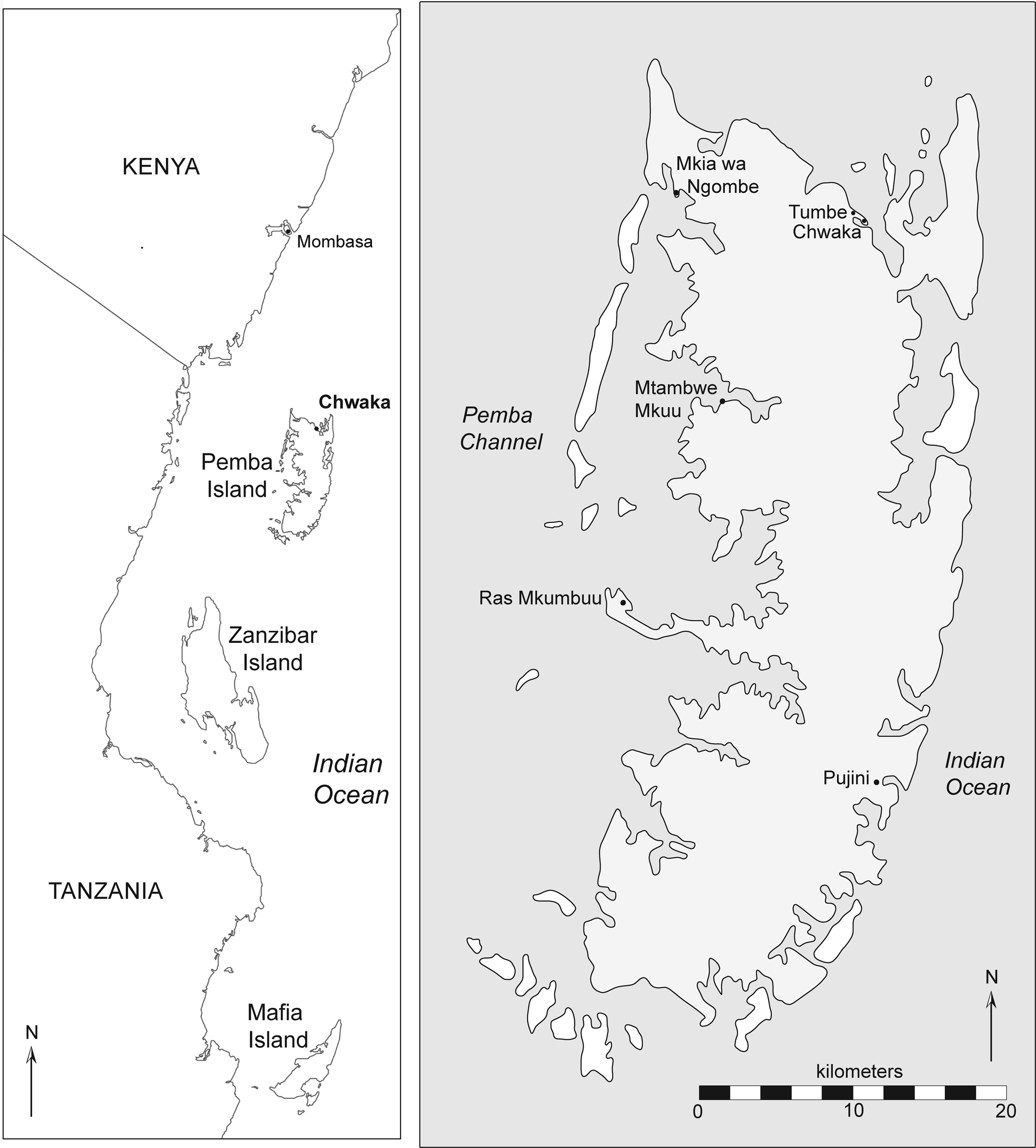
Over 450 years, Chwaka shared Pemba Island, a prominent and densely populated Swahili region, with a half-dozen other towns and numerous villages and hamlets. Our research provides insights into this community’s socioeconomic and cultural priorities and changing relationship with villagers from the surrounding countryside, contributing to understandings of Swahili urbanism and urban practice (LaViolette and Fleisher, 2009, 2018; Fleisher, 2010a; Horton et al., 2017). During its lifespan as documented by up to 3 m of cultural deposits, Chwaka developed into a town of wattle-and-daub houses with a small component of mortared coral and stone buildings; it thus joins many other settlements known as stonetowns that feature prominently in second-millennium Swahili life.
The present analysis arises out of a study of Swahili households in northern Pemba Island from 600 to 1400 CE sited at Chwaka and a contemporary village (Kaliwa), and two first-millennium settlements (Tumbe and Kimimba; LaViolette and Fleisher, 2018). Pemba lies 75 km east of Tanzania’s mainland coast and extends 1000 km2. Iron-using farmers/fishers from the mainland established villages there as early as the 7th century; beginning c.1000 CE, some grew into small and mid-sized stonetown polities on the island’s jagged shore (Fleisher, 2010a). Chwaka began as a village in northeast Pemba, growing to 8 ha within its first century. It reached its largest size by 1300 CE: densely packed wattle-and-daub neighborhoods extending over 12 ha, a size maintained until abandonment c.1500. In this mid-sized town, as noted, residents invested in multiple examples of spectacular ritual architecture—some equal to the finest on the eastern African coast—and a single stone dwelling (Figure 2(a)). This uncommon ratio is undoubtedly important to Chwaka’s history, in which local and long-distance commerce played a role, but where residents living in wattle-and-daub houses prioritized creating an urban landscape featuring stone mosques and tombs. Although stonetowns vary greatly, it is more typical to see at least a small group of stone-built merchants’ houses in addition to ritual architecture. a) View of Chwaka showing location of mosques and stone houses within the town; b) offering left in mihrab of second congregation mosque in the 17th–18th century.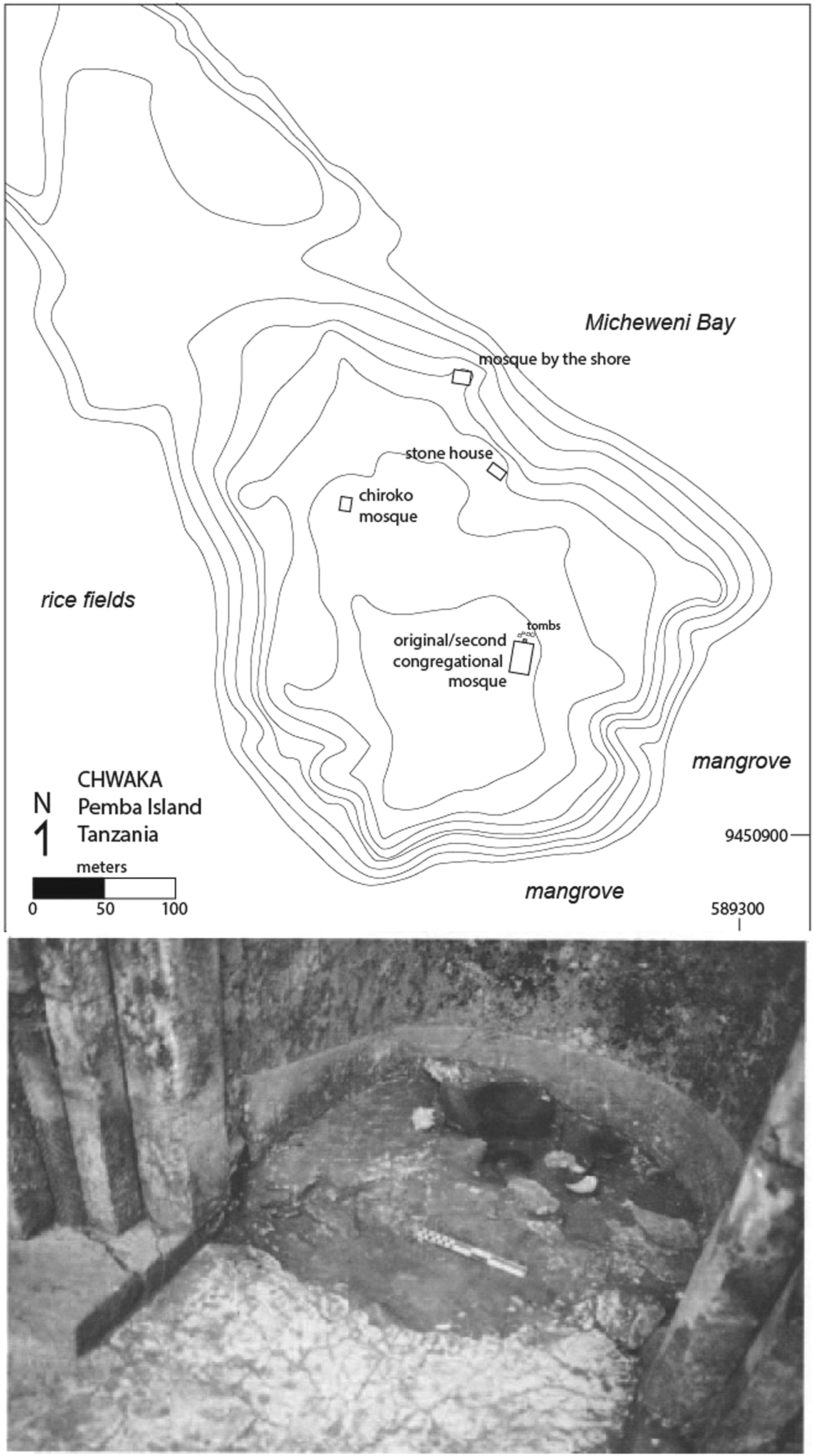
At the site of Chwaka we see in the mosques’ placement, forms, overlap, and associated deposits evidence for shifts in how mosque assemblages worked. First, they offered contexts in which people carried out communal social practices entangled with specific objects, affects, and other-than-human agents. In later periods, these assemblages harnessed certain vistas, spaces, and things, and became increasingly dominated by the concerns of powerful families, as they sought to build reputations and networks beyond the stonetown. Finally, toward the end of the town’s occupation, we see in the assemblages the way that the material and affective elements enabled powerful families to link their authority and legitimacy to public forms of devotion and coastal networks of power (see Gokee, 2016). We argue that the construction and use of mosques at Chwaka represent a growing Muslim population, and more: that different assemblages of people, materials, and practices (Fleisher, 2019) served to construct changing forms of community. Mosques extended the influence of local forms of power, displaying them to people elsewhere in the region and eventually to other Swahili coastal centers and the Indian Ocean world. In this sense, mosques at Chwaka grounded and literally helped assemble what Wynne-Jones (2016: 84–85) calls the “communal identity of the community” and the town’s civic authority over almost five centuries.
Mosques on the eastern African coast
A recent study of mosques at Songo Mnara (Horton et al., 2017), a 15th–16th-century stonetown off the southern Tanzanian coast, argues for placing mosques within their urban landscapes. It compares the town’s multiple mosques to investigate the pattern of Islamic practice across neighborhoods and communities. Our approach is similar, but with the temporal dimension provided by Chwaka’s longer lifespan. Both studies depart from how architecture scholars have often examined mosques, where particularly grand examples dominate the literature (e.g., Creswell and Allan, 1989; Finster, 1992; in East Africa, see Garlake, 1966; Kirkman, 1954; cf. Insoll, 2003).
Interpreting mosques requires an understanding of local styles and meanings; we should not understand them primarily as variations on a dominant style in what are viewed as Islamic heartlands in southwest Asia and the Indian subcontinent. Just as Lambourn (2017: 773) has argued for understanding the “complexity and variety of processes behind each [mosque in India],” so must we interrogate the architectural record through a local lens. As Horton et al. (2017: 164) note, because the Swahili “existed at the edges of Islamic political formations” they had “a greater degree of religious autonomy, and the physical existence of the mosque was an important aspect of the ways that dispersed Islamic communities demonstrated and experienced their existence as part of a community of believers.” Work that begins by assuming that “hypostyle” or “Arab plan” mosques are the standards against which to examine structures at the Dar al-Islam’s edges can overlook the mosque diversity in Swahili towns, and how these forms, sometimes grand but usually at a modest scale, were “regionally and temporally specific” (Lambourn, 2017: 763).
The recording of pre-16th-century mosques has been a central concern since the dawn of coastal archaeology, with most research focused on the congregation or “Friday” mosque (Chittick, 1961, 1974, 1984; Garlake, 1966; Horton, 1991, 1996; Kirkman, 1954), and on standing 14th–16th-century remains. Horton’s research on Pemba and Pate Island (Kenya) has revealed the mosque forms evolving in place. He demonstrated that mosque styles developed locally, inspired in form by 9th–10th-century family mosques at Siraf in the Persian Gulf (Horton, 2017: 259). The example of eight superimposed mosques at Shanga (Horton, 1991, 1996) in the Lamu Archipelago is the best-attested developmental sequence, with first-millennium compact wattle-and-daub structures giving way to larger stone ones after 1100 CE. Wattle-and-daub mosques certainly existed alongside increasing numbers of stone-built structures up to the present. Later stone mosques increased in size through the addition of east/west bays and saw the introduction of domes and barrel vaults, occurring at places in the late 13th century. It has been proposed, and seems likely, that architectural specialists moved among coastal settlements, providing expertise not always available locally (Garlake, 1966; Horton, 2018). A few early second-millennium mihrab designs incorporated trefoliate arches although most had simpler designs. After the 12th century, the majority of mihrabs were what Garlake (1966: 60) called the “classic” form: carved from fine-grained Porites coral with a simple arch and apex nick, framed by a basic architrave with niches, herringbone designs, and perhaps inset glazed Chinese and Islamic bowls. A technology from the Red Sea area, using Porites required divers to cut it from reefs; once brought to shore, artisans shaped it into building blocks and decorations before it dried and hardened (Horton, 1996). Porites contrasts with fossilized limestone or coral rag (which we refer to as “stone”) quarried from the coastal landscape, used widely by Swahili in later construction along with ever-present wattle-and-daub. Construction material differences play a role in other mosque, community, and cultural transformations, returned to below.
Mosque research has been key to understanding the timing and pace of conversion to Islam. The appearance of small, centrally located mosques in late 1st-millennium towns suggests that Islamic practice was carried out by a minority component of the population. Beginning in the 11th century, many coastal people constructed mosques of Porites. The first well-documented Friday mosques—which could accommodate the entire (male?) community of the faithful—date to the early 12th century (Horton, 2018), marked with dated inscriptions at Barawa in southern Somalia and Kizimkazi on Unguja (Zanzibar) island (Kleppe, 2001). Generally, researchers regard this as the onset of when most Swahili were practicing Islam. These 12th–13th-century mosques show a shift in cultural practice, from building in Porites to building in coral rag with Porites finishes: mihrab architraves, window and door frames, niches for lamps and prized objects.
Further, archaeologists have studied Swahili mosques as evidence for variable town practices and demonstrations of piety and power. Horton et al. (2017) add a spatial dimension to studying pre-colonial Swahili mosques, describing funerary, neighborhood, and waterfront structures in addition to the congregation mosque (see also Horton, 2018). Their research emphasizes how communities constructed certain mosques for specific audiences, as part of movement and performance in town life, and for ships passing and approaching the town (see Pollard, 2008 for a similar argument about Kilwa Kisiwani mosques). Fleisher (2010b) examined the materiality of coastal mosques: how the incorporation of certain materials and artifacts created powerful assemblages. Based on excavated material and Chwaka’s later congregation mosque, his study explored how incorporation of imported bowls into the architrave may have recalled community members’ use of such vessels in communal feasting and other practices (Donley, 1987; Meier, 2016).
While all these studies attended to constellations of objects, architecture, and people, the present approach (and in Fleisher, 2019: 159) views mosques as structures that not only gather people to pray (Wheatley, 2001), but entangle “materials, humans, affects, texts, postures, performances, directionality” (also Deleuze and Guattari, 1987; Hodder, 2012; Pauketat, 2013). Assemblages are “compositions that act” (Due, 2002: 132); as Harris (2017: 129) notes, they are “made up of … heterogeneous components … gatherings that act back on, but do not totally define, their constituent parts.” We argue that how mosque assemblages gather such a rich and powerful set of humans, places, and things offers insights into how communities emerged and functioned at Chwaka.
Harris (2014: 89) has argued for a view of communities that “begins with the relationships amongst humans, animals, plants, places and material things.” Following this, we see mosque assemblages as loci for emergent forms of community. According to Fleisher (2019: 159), a set of 11th-century coastal mosques brought together materials from the intertidal zone with Islamic practices and architectural forms, representing Swahili efforts “to create a new type of stability in an increasingly fluid and changing world, while remaining firmly connected to it.” While Chwaka’s earliest Porites mosque is one of these structures, the three later mosques represent different types of assemblages, and here we explore all four for how they brought the town’s community into being, reflecting and shaping its priorities over time (Harris, 2017: 129).
Chwaka and Swahili towns
Archaeologists have documented diversity among the eastern African coast’s 50-plus stonetowns (Abungu, 1998; Chami, 2002; Chittick, 1974, 1984; Fleisher, 2010a; Horton, 1996; LaViolette, 2008; Pawlowicz, 2012; Wynne-Jones, 2007), which are nonetheless united by shared cultural practices and visual tropes. While the individual town identities may have been associated with their showpiece stone architecture demonstrating variations on shared traditions, residents built most of the town in wattle and daub with thatched roofs (Wynne-Jones and Fleisher, 2014). The latter thus links all Swahili towns to each other and to all smaller coastal settlements and contextualizes the power of stone structures. It also ties coastal dwellers to neighboring hinterland societies (Kusimba et al., 2013).
Uniquely in stonetowns, however, the Indian Ocean mercantilism for which Swahili are known (Horton and Middleton, 2000) is attested through buildings of plastered and mortared stone: as noted, the first were mosques and tombs starting c.1000 CE, and eventually came multistoried houses which proliferated after c.1200. Stone building extended to some villages; single, small mosques or a handful of tombs can be present in small, otherwise wattle-and-daub settlements (Garlake, 1966; Horton and Clark, 1985; Wilson, 1980). But research shows that the immense investment of building stone houses was linked to long-distance trade (Wynne-Jones, 2013). That trade is documented by a range of materials such as imported pottery and glassware, metalwork, books and personal items, and other perishables from the Middle East and East, Southeast, and South Asia. The latter included food, oils, perfumes, and cloth known archaeobotanically and ethnohistorically. Stone houses, many argue, were made possible by successful long-distance trading in Indian Ocean networks and acted as physical symbols of business-worthiness in critical, highly personal relationships (Allen, 1979; Donley, 1987; Wynne-Jones, 2013; also Bishara, 2017 on more recent centuries). When a town’s stone houses were numerous, they helped make the town prominent in the world of long-distance trade and the people who could build them important. Certain towns and houses were the destinations of mostly Muslim visiting traders, whom Swahili families hosted in guest-oriented spaces in their homes (Allen, 1979; Freeman-Grenville, 1962; Fleisher and LaViolette, 2007). Yet we know that many people of means must also have lived in wattle-and-daub houses, as archaeology reveals the widespread and abundant access people had to imported goods (LaViolette and Fleisher, 2009, 2018; Pawlowicz, 2019). Although always small (often 2–4% of all ceramics), the ratio of imports to local goods across stonetowns shows consumer power distributed throughout (LaViolette and Fleisher, 2009).
While stone houses undeniably indicated a level of wealth and status in Swahili society since the early second millennium CE, something different was happening at Chwaka. We suggest that Chwaka exemplifies an under-recognized type of stonetown: densely occupied, economically dominant in its region (LaViolette and Fleisher, 2018), but with few merchant families investing in stone houses. Instead, merchant wealth and/or the town’s collective wealth supported the building and maintenance of ritual architecture and likely the ritual specialists associated with it. We return to this in our discussion.
The mosques at Chwaka
We identify the four stone mosques built at Chwaka between 1050–1500 as: the original congregation mosque, mosque by the shore, second congregation mosque, and Chiroko mosque. As we begin, we note a “spirit” deposit (Horton, 2004), a literal assembly of four elements exposed during excavation (Figure 2(b)), placed in the ruined mihrab of the second congregation mosque abandoned in c.1500 CE. Ritual offerings like this occur widely on Pemba as elsewhere on the coast, often in caves or smaller fissures in the ground, hollows in trees, or hidden amongst stone ruins. Here a seashell, grindstone, and sherd of Chinese celadon had been placed together, the latter likely part of a bowl once cemented in the architrave (Horton, 1996: 310). With them was a 17th–18th-century lidded earthenware pot, reminiscent of an eastern African offering practice called a fingo (Allen 1993), which offers spiritual protection. Horton (2004) observed that this one appears to bring together elements of land and sea, near and far—if not more. As an intentional act it bridges ritual space from the medieval to modern period, attesting to a community of practice that began here a millennium earlier.
The architectural and excavation descriptions that follow draw heavily from Horton’s (in prep.) book manuscript, “Zanzibar and Pemba: The Archaeology of an Indian Ocean Archipelago.”
First: The original congregational mosque
Within the earliest years of its early-11th-century founding, Chwaka’s residents constructed a centrally located stone mosque (Figure 2) which we uncovered beneath the ruins of the second congregational mosque. This original mosque’s floor lies a mere 1.5 cm below the overlying structure’s plaster floor, with small sections of the east and west wall stumps visible as rises in that later floor. We left the latter mostly intact but were able to detect some of what lay below by digitally mapping contours of the later floor. We excavated small units in three places that revealed the size and plan of the first building and recovered artifacts that dated it (Figure 3; Table 1). Plan of the original congregational mosque with three excavations revealing architectural features. Summary of Chwaka’s mosques.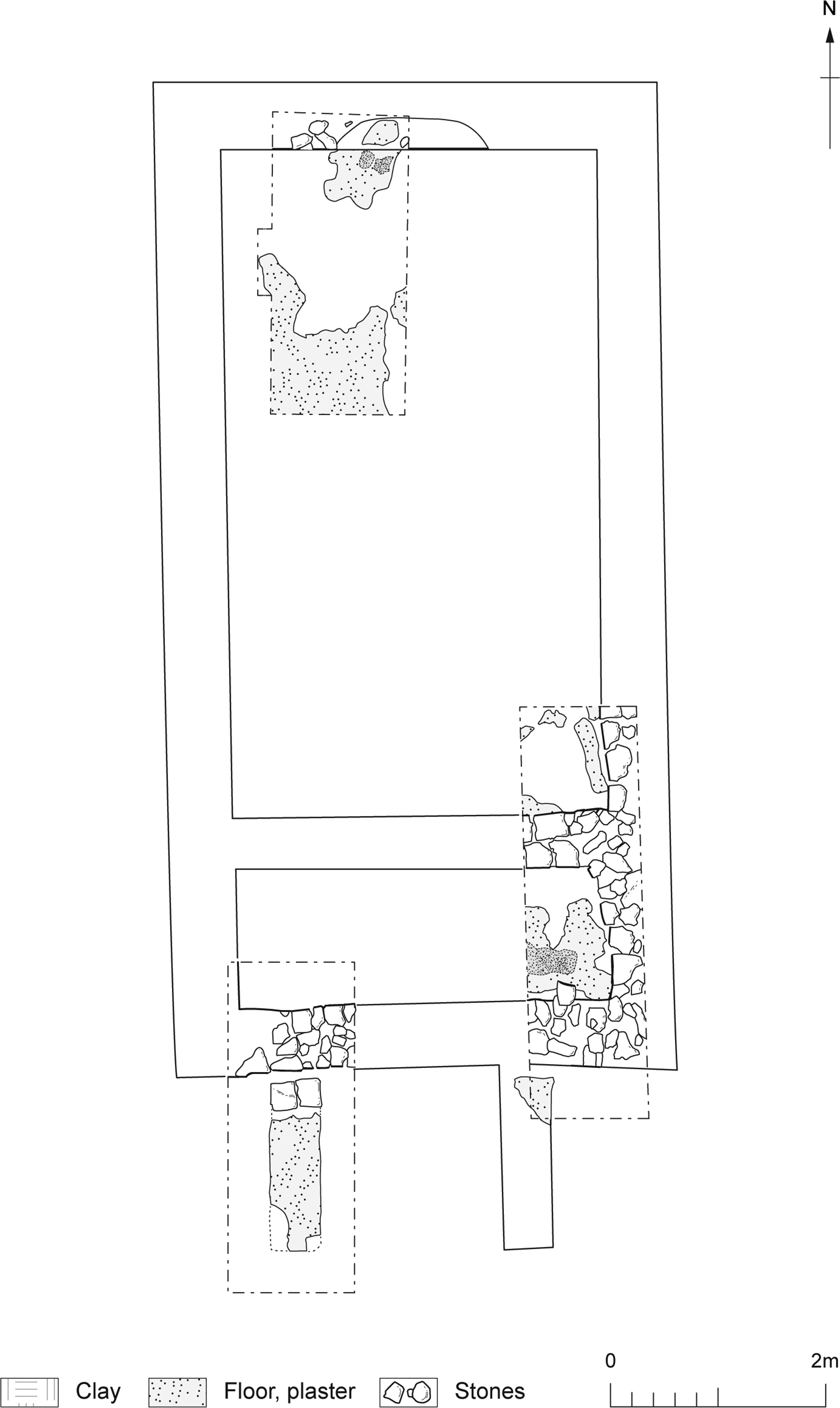
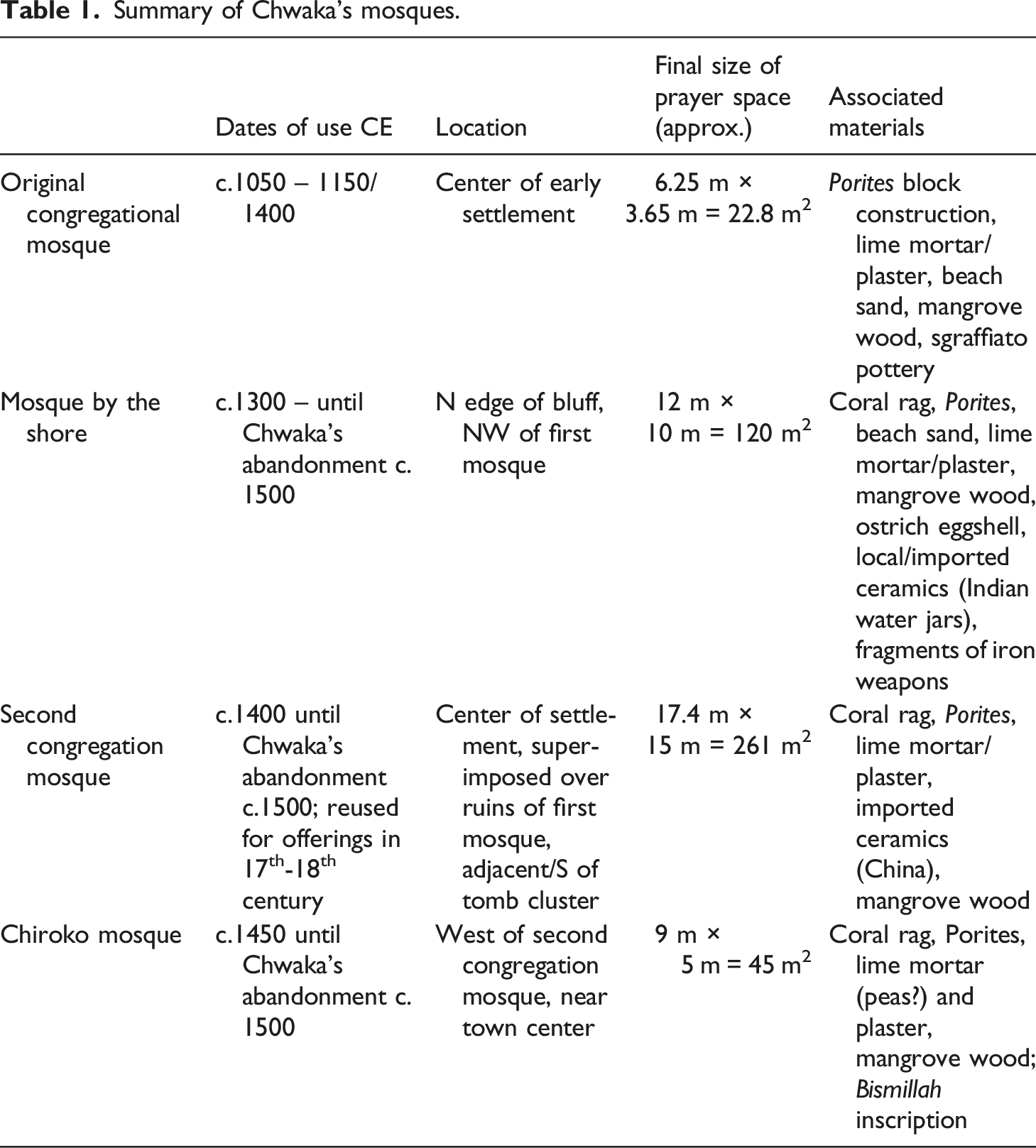
Builders placed the original mosque on a white sand platform 1.7 m deep, sand carried by the basketful from the beach below; this assembling task could have been shared by everyone in town. The builders used Porites coral blocks for the structure, creating a main prayer hall 6.25 m by 3.65 m and a southern room 1.4 m wide. Notable is the shallow mihrab, c.30 cm deep, identified in a curved lip of plaster set into the thickness of the building’s north wall. The shallow mihrab compares with other early examples at towns on the coast (e.g., at Kaole, Sanje ya Kati, and Tumbatu; Horton, 2018: 492). Horton (1996) has suggested this might represent the practice of Ibadi Islam, with its restrained treatment of niches and decoration (Insoll, 2003: 203), on the coast in this period. The building’s south end was entered via a monumental Porites staircase, likely flanked by a well on its southwest side. This mosque apparently had a mangrove timber roof supporting either a mat of woven palm fronds or a layer of small fragments of coral rag mortared in place. Two burned areas on the floor by the mihrab and in the southern room suggest destruction by fire, possibly right before it was rebuilt in the early 15th century.
We see in this structure an assemblage of old and new materials, other-than-human agents, and efforts by local people to negotiate new forms of devotion. Fleisher (2019) has emphasized how early Swahili mosques drew most construction materials (sand, mangrove wood, Porites) from the intertidal zone and reefs, and that this assemblage may have entangled religious practices and new forms of directionality with non-human actants. The latter include sea spirits, long considered in Swahili and particularly Pemban lifeways (Giles, 1987; Horton, 2004; Lambek, 1981; Uimonen and Masimbi, 2021). Chwaka’s first stone mosque was likely built slightly later than others on Pemba, including those at Ras Mkumbuu, in the early 10th century, and Mtambwe Mkuu, in the later 10th (LaViolette, 2018: 232–233; see Figure 1). If it is likely that only some island dwellers were practicing Islam by the 11th century (most coastal people were practicing Muslims by the 12th), the investment of resources in this mosque established Chwaka as a settlement whose most powerful residents were committed to a public Islamic identity.
The only stone building in the settlement’s early years, this mosque anchored the new town and its “center,” perhaps not only expressing adherence to Islam, but helping change the community from rural to urban. A physically centered ritual building contrasts with the site of Tumbe, abandoned c.50 years before Chwaka’s founding: a larger settlement (c.30 ha), with dispersed houses across twice as much landscape (Fleisher and LaViolette, 2013). New, 11th-century Chwaka, therefore, was notable for this religious/public building made with materials from spiritually rich locales, surrounded by densely packed houses. Fleisher noted (Fleisher, 2019: 158), citing Middleton (1992: 60), that “a [Swahili] settlement without a mosque is not a ‘founded’ town, … a city that has been constructed/designed/composed.” Middleton’s comment refers to recent centuries but resonates with the human labor that went into the act of building. To organize the workforce to dive for coral and carve it expertly, transport sand, cut and haul mangrove, and quarry and burn limestone for mortar and plaster are symbolic acts beyond the resulting building itself which would stand for centuries. Establishment of Chwaka, by people with perhaps ancestral ties to Tumbe or who were very likely aware of it, was accomplished through this building project: a small and handsome Porites mosque raised on a platform above ground level, with a monumental staircase. This assemblage—its placement, materials, affective qualities—likely helped attract new settlers from the countryside, which saw a reduction in population as Chwaka grew (Fleisher, 2010a). Many new settlers, perhaps seeking urbanity over life in villages, would have brought their mixed farming/fishing subsistence practices with them. Now, however, they would have used and enjoyed this architecture and benefitted from its attending religious specialists. The mosque-as-assemblage was a relational field that brought together particular materials, location, other-than-human agents, and affective qualities, shaping people as they moved in and out of the space to pray, study, and interact.
Second: The mosque by the shore
Chwaka’s residents built a second stone mosque while the original was still standing. The mosque by the shore sits at the northern edge of the bluff overlooking Micheweni Bay. Construction once again began by depositing a thick bed of beach sand, over a midden containing late 13th-century pottery; we thus place the construction date at c.1300 CE. Consistent with period coastal trends, builders switched to coral rag as their main building material, quarried from multiple outcrops nearby and shaped with metal tools into irregular blocks. They mortared and plastered the blocks with lime-based mixtures (we excavated a plaster-making pit in the settlement’s center) and reserved Porites for door/window frames, assembling materials from the local landscape with the nearshore. The plan (Figure 4(a) and (d)) included a central prayer hall (c.10 m × 5 m) and two side halls to the west (10 m × 2.5 m) and east (10 m × 2 m). While the mihrab of the original mosque was modest and set within the wall thickness, this one, likely still plain in design, extended significantly beyond the north wall; most of it had fallen downslope to the water and was lost. Finds inside the mihrab include a crushed ostrich eggshell, likely suspended in the mihrab as in a modern nearby example (Figure 4(c) and (d)); ostrich eggshells were used widely in the ancient and Classical worlds in association with sacred spaces (Green, 2006) and are associated with African mosque architecture as well (e.g., LaViolette, 2000). a) Mosque by the shore after excavation (bottom); b) plan view (top left); c) ostrich eggshell suspended in modern Micheweni mihrab (top right), 2004; d) excavated ostrich eggshell (center right)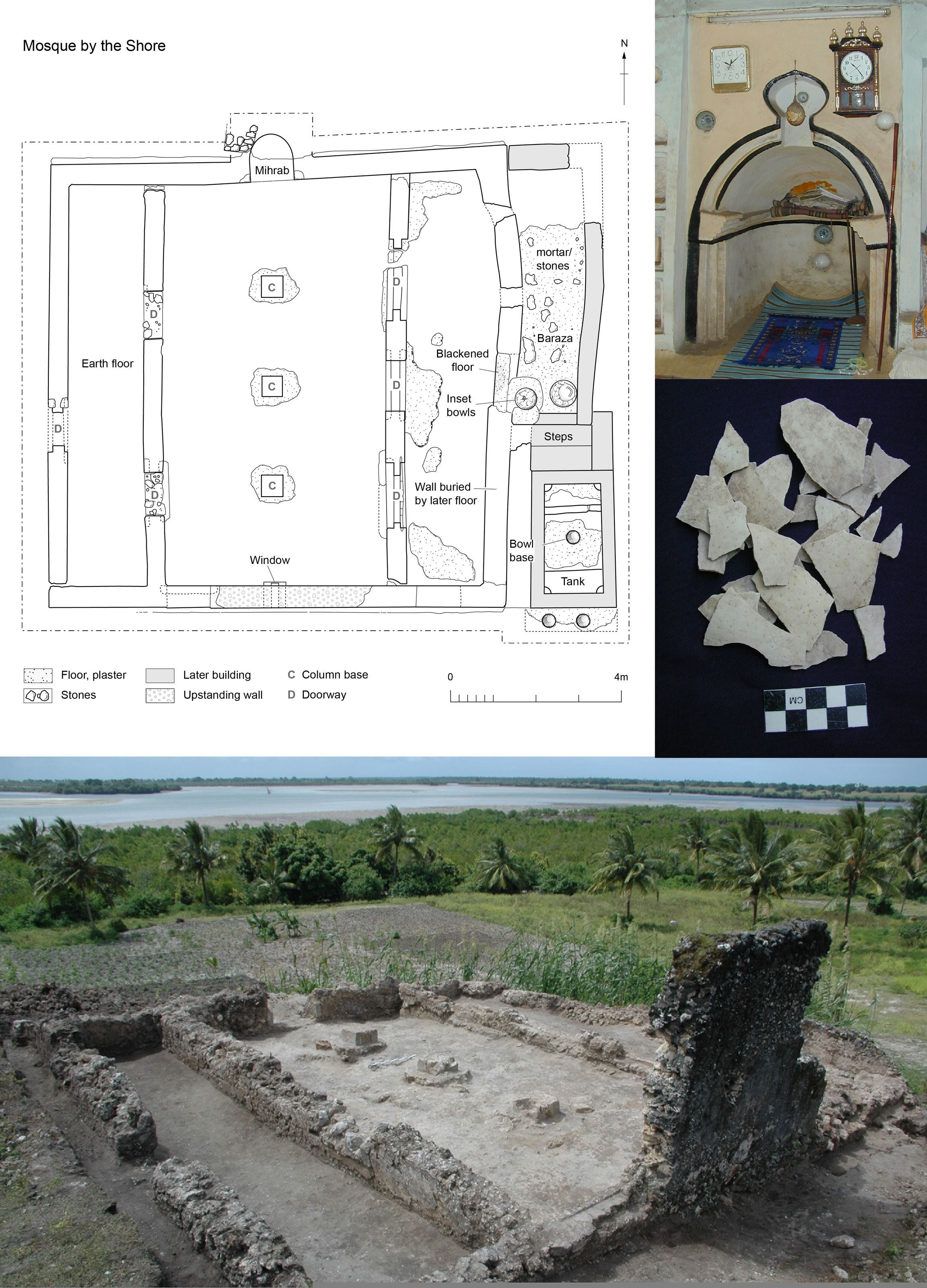
A flat mortared-stone roof was supported by three timbers set upright on stone bases. Two simple doorframes connected the main hall with the west, but three fancier doorframes, perhaps arched as at Ras Mkumbuu, served on the east side. On the east, builders added a baraza or platform outside the mosque, and the southern part of the east wall was taken down to floor level. In the southeast corner a rectangular water tank was added, with a bowl once inset in its floor. Between the platform and tank were steps perhaps leading down to the shore. Two water jars of Indian origin, common imports at this time, sat next to these features, and two more jars or bowls sat south of the new tank. There is no evidence of a well, so water was likely collected from the roof (a spout survived on the south wall) or carried up from shore.
Along with the east/west additions were renovations of unclear date that tell us about changing values and practices. The western hall had its two doors blocked off from the central prayer hall with mortared stone. Meanwhile, at the rear of the central hall, an outer door likewise was filled in; a small space left open at the top made it possible to look through from outside and hear prayer. This may have been intended for women, perhaps until the doors of the western room were renovated to create privacy. In Chwaka, men and women may have originally been allowed to pray together but may have eventually aligned their practice with that in other world regions. Alternatively, the community may have disallowed women from using the mosques early on but later created prayer rooms to accommodate them.
These changes showcase a dynamic population of practitioners that invested in increased space and modifications (at its largest the mosque by the shore was six times larger than the original mosque). Changes also reflect and make concrete the transforming ideas about practice. An increasing emphasis on ablution, for example—with the addition of a water tank and jars—is attested in a mosque built without a formal washing facility.
We can see how this mosque assembled a different set of people, both familiar and new materials, and a new location. About 200 m from the first mosque, the second would have been visible to anyone approaching Chwaka by water, acting as a beacon to draw them into the town. Building mosques in visible waterfront locations increased in popularity in Swahili stonetowns after 1200 CE (Fleisher et al., 2015). This in effect brought the extended maritime world closer, widening each community’s purview of its own maritime connections.
The coral rag construction serves to highlight the uniqueness of the earlier mosque in Porites. As Fleisher (2019: 178) notes: … changes made to mosques after the 13th century indicate the decreasing importance of materials from the fore/nearshore [intertidal zone] in the construction of these religious structures—Porites coral was replaced with coral rag, foundation fills contained a greater variety of sands and soils … these later mosques bundled different elements … that served to widen the networks that mosques marked.
In the mosque by the shore, such bundling incorporated Porites alongside coral rag; an ostrich eggshell from the mainland interior; large imported jars in a washing area; new configurations of who could pray in a mosque and where; and a location reaching out from town to the ocean beyond. The mosque also allowed assembly of greater numbers of Muslim faithful, with possible accommodations for women.
Fleisher (2019: 178) has argued that earlier Porites mosques are about “building in” local materials and forms of religious practice, with later mosques built to be more demonstrative and powerful … the stripping away of elements of the sea might have been an effort by the Swahili of creating distinctions between the religiosity of Islam and the practices related to the powerful forces of the intertidal zone.
The centuries in which coral rag construction began on the coast were ones with shifting trade patterns, emergence of many new competitive coastal towns, and possibly greater influence of religious leaders from other Indian Ocean ports, concerned about Islamic heterodoxy in eastern Africa. For example, Wilkinson (1981) documents how 12th-century Omani religious scholars remarked on what they deemed unorthodox Islamic practices in Kilwa Kisiwani, on the southern Tanzanian coast, and their efforts to address them.
The mosque’s final days involved violence. The smashed eggshell lay on the floor as well as the imprint of burning roof timbers. It was never repaired, and it is tempting to see this destruction as contemporary with Chwaka’s abandonment c.1500 CE. We recovered incense burner fragments and a complete pot from post-abandonment levels, suggesting ritual activity continued in the ruins of the mosque, here as in the example of the ritual deposit above.
Third: The new congregation mosque
Sometime in the 14th century, the original mosque—now c.250–300 years old—was itself damaged by fire. This dating is based on Chinese blue-on-white ware of the late 14th century from a well-sealed context below the mihrab, and a building style for the replacement consistent with coastal architecture from that period. The original was razed with its floor left intact. Over that first floor, enclosing the earlier structure’s remains, people built a new mosque in coral rag (Figure 5(a) and (b)), with door frames and lintels, window casings, and mihrab architrave features in Porites. a) Congregation mosque after excavation, showing fallen dome fragment (upper right) and wall stumps from earlier mosque (lower right); b) plan view; c) mihrab as photographed by Pearce (1920: 397).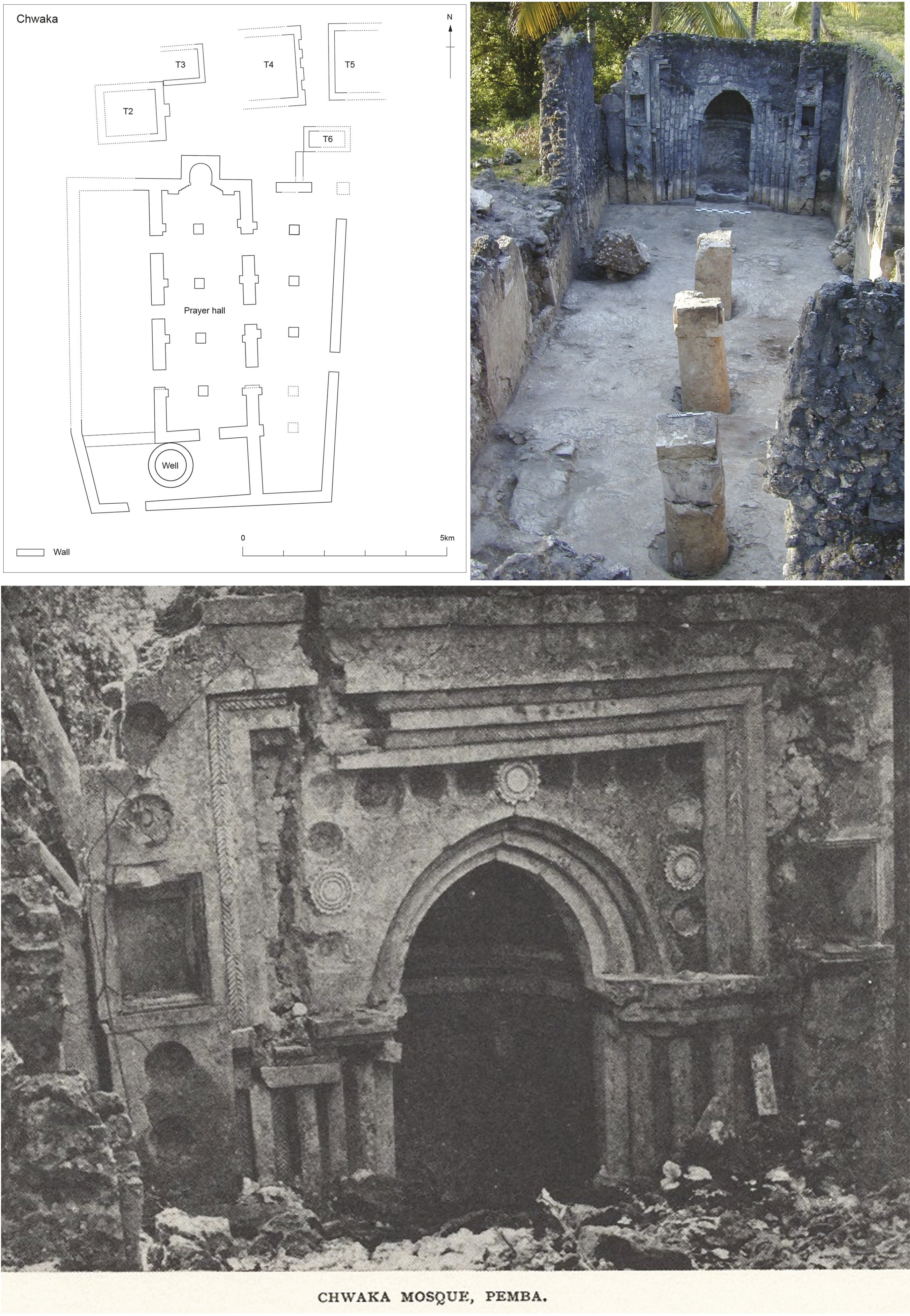
It likely began as the narrow, main prayer hall. It eventually expanded to four rooms—the main, east, and west halls, and a smaller room to the south with a cistern—a total of c.17.4 × 15 m, aligned on 009° as was the mosque below it. With its numerous standing walls, it was photographed and dug into by Pearce (1920), drawn by Garlake (1966: 143), conserved by Zanzibar Antiquities in the 1960s, and documented by Horton and Clark (1985). We excavated it extensively (except for the west hall) in 2004, after which the floor of the main hall was conserved (the Zanzibar government did further work on the mosque in 2022). The main hall was organized around five bays and framed by three sets of opposing arched doorways that provided access to two side halls. The side walls of the main hall contained remains of opposing pilasters to support the roof, situated adjacent to four central, square column bases with rounded shafts down the centerline. The structure originally supported a vaulted roof of mortared coral rag, with three pairs of two cupolas over the center of the room, a barrel vault over the north end of the room, and possibly another over the south end. Buchanan (1932: 14) noted evidence of cupolas in the building debris, and we exposed one large block with a cupola’s curve that had fallen onto the floor. Builders had leveled the front column base almost to the floor during the mosque’s use (and rebuilt the second column), suggesting the northernmost vault was replaced by a flat wood and mortar roof, providing an opened space for a wooden minbar or speaking platform.
Although the roof design was uncommonly fancy, the mosque’s most dramatic feature was its extraordinary mihrab (Figure 5(c)). While much has fallen and conservation has altered it, photos and descriptions by Pearce (1920: 387–397) and Kirkman (1964: Plate 19a) and a drawing by Garlake (1966: 143) allow detailed reconstruction. Entirely of Porites, much was carved in delicate herringbone. It once included 22 inset Chinese bowls, three inset Porites sunburst-style bosses, and rectangular niches to hold lamps, copies of the Koran, and other objects. This mihrab, along with the building’s scale at its largest and its ceiling, distinguished it from all other mosques on Pemba and put it in line with those at Kilwa Kisiwani; a terminus for a major southern gold route from the interior, Kilwa is known for its large-scale stone mosques and civic architecture. That this mosque bears comparison to Kilwa is notable given Chwaka’s enormously different history and status. It recalls the possibility of expert architects moving around on the coast, available to communities who could support their work. In any case, some bowls from the architrave here are represented in the deposits as sherds; others may have been removed and taken by colonial-era visitors as occurred at many Swahili sites. In an act of assembling from sometime in the late 19th or early 20th century, people in the nearby village of Tumbe Mjini removed several of the bosses from the ruins and inserted them into the mihrab design of the village’s 19th-century mosque, only recently demolished.
The mosque’s south room was for washing, where a filled-in circular well sits today. Horton suggests that the west/south rooms may have been added contemporaneously, and that the well was outside the mosque in a courtyard and possibly brought inside during a renovation. The main entrance to the mosque thus may have been through that southern door (as in the underlying first mosque), though a grand staircase was added on the east. The side hall additions virtually tripled the prayer space—making it more than twice as large as the mosque by the shore—allowing us to imagine Chwaka’s ever-growing population of practicing Muslims and the pride they would have taken in this building. Fleisher has argued (Fleisher, 2010a) based on survey data that populations moved into young towns from the countryside in the early second millennium, which is consistent with this greatly expanded prayer space. A major difference between village life and living in Chwaka in this period must have been the presence of two beautiful mosques helping to define the visual landscape of the town and its identity. Chwaka’s religious specialists would have offered Koranic training and mentorship, and the town was replete with goods and services that supported and marked a well-appointed Islamic lifeway. Detailed planning of contours and cracks in the mortared floor revealed edge impressions of densely placed prayer mats evoking the heavy use of this space.
The eastern side of the mosque went through multiple renovations. In its final phase, it was an enclosed room with perhaps five stone columns and opposing pilasters supporting a roof. Buchanan (1932) thought this was also vaulted with cupolas and reported debris indicating this, although we found no supporting evidence; one row of domes might have been possible along the east wall, acting as a veranda. In an earlier phase, this veranda was open to the east, reached by four steps running along the length of the building, with a washing tank at the north end. This would have provided gracious entry from multiple doors along that wall, and a place to socialize before and after praying. These three phases suggest a significant period of use for the mosque and ongoing effort and expense to optimize it as a place of assembly.
Chwaka’s population, living in their wattle-and-daub houses, thus built, renovated multiple times, and enjoyed one of the most beautifully decorated 14th-century mosques in the Swahili world. The bowls cemented into the mihrab (echoing such placements into mosque, tomb, and house walls elsewhere) have been interpreted by Donley (1987), Wynne-Jones (2013), and others as a layered symbolic act, providing talismanic protection and displaying the aesthetics of a community’s cosmopolitanism and maritime reach. Fleisher (2010b) has suggested it also may have symbolized the feasting associated with each of these architectural forms: reminders of meals eaten and yet to provide, the moment of food consumed. The presence of feasting evidence in wattle-and-daub houses at Chwaka dating to the same period as the congregation mosque, and the display of bowls, together suggest a pattern in the life history of the town where commensality linked spiritual and social practice.
These details provide us with tangible evidence of the “rearrangement and dissolution” (Pauketat, 2019: 5) of the original mosque assemblage at a time when the town itself was expanding. Chwaka of the 14th century was much larger than it had been three centuries earlier, to be sure, and multiple expansions of this mosque surely represent that fact. As an assemblage of people, materials, spaces, and affects, the mosque also offers dramatically changing notions of the Chwaka community. The return to the place of the original, centrally situated mosque to reconstruct, expand, and enhance the structure may have served to rearrange and alter long-standing notions of community. The new structure broke with the one beneath it by having coral rag walls; whether the elements of the sea that once saturated the original mosque permeated this new assemblage is not known, but the new mosque surely represented a break from those notions materially.
The major rebuilding at the settlement’s central mosque likely represented a significant rearrangement of elements of the mosque assemblage. It may have been a rededication to the founding community mosque, albeit with new material elements (highly embellished mihrab decoration) and a transformed affective space. The small, undecorated original mosque was replaced after 300–400 years by a substantially larger space, with new plaster floors and other stylistic embellishments such as domes and vaults. For the people associated with this mosque assemblage, it likely worked to codify new notions of power and authority. It pulled together distant styles, ideas, and materials to do so, showing an understanding of and taste for the finest mosque architecture on the coast, displaying public grandeur and monumentality. It was spatially linked to monumental tombs just north of the mihrab (below). In these ways, this congregation mosque helped construct a community invested in powerful individuals—religious leaders, generous townspeople, ancestors in the cemetery (a new other-than-human component of the assemblage). While the mosque by the sea was positioned to beckon and represent a widening power, the new congregation mosque solidified it. As Fleisher (2010b: 211) notes regarding the Chinese bowls set in the architrave: “As the men of the town submitted themselves in prayer to Allah, they were also tacitly accepting their subservience to the generosity of the king.” Indeed, they were praying on the surface of the founding mosque as well: the past pressing up to the present as the devoted knelt to pray.
Clustered around the congregation mosque are 10 tombs built in mortared coral rag, most in poor condition (Buchanan, 1932; Garlake, 1966; Horton and Clark, 1985; Kirkman, 1964; Pearce, 1920). Unmarked burials far outnumber other kinds on the coast, so stone tombs or markers are rare, including in stonetowns; when they occur, they are often near mosques. Chwaka’s sizeable group is thus notable and includes two pillar tombs: a Swahili architectural idiom from the 15th century onward (Beaujard, 2018: 374) associated with high-ranking people. Towns often have none, but some have quite a few (e.g., Kaole; Chami, 2002). Here, the more intact pillar tomb is 20 m northwest of the mosque and has been called Haruni’s Tomb since at least the early 20th century (Pearce, 1920; cf. Buchanan, 1932). It is a roofless rectangular enclosure entered on the west with the pillar at its eastern end. The 10-sided pillar was embellished with shallow niches, glazed tiles (now gone), and various bas-reliefs in mortar including a siwa: a side-blown horn associated with large Swahili (and interior eastern African) settlements, including elsewhere on Pemba (LaViolette, 2018). Oral traditions link it to the same person honored by the fourth mosque (below). The ruins of a second pillar tomb sit just north of the congregation mosque’s mihrab; the pillar bears some recessed panels and other small elaborations.
The remaining eight tombs—low rectangular mortared enclosures—sit near the latter pillar tomb and in a second, mostly buried cluster directly east of the mosque. All the tombs likely date to the time of the second congregation mosque if consistent with tomb-building traditions elsewhere. As the faithful came to the mosque multiple times daily, they passed by those tombs. In their placement, the tombs can be understood as part of the mosque assemblage, lending the power of Islam and its materialization in the mosque to memory of the deceased, and their status and ancestry to the local power of the mosque. The tombs also clarify that certain persons were emerging there who were now commemorated publicly, creating an enduring monument to elite status: something represented in other towns by stone houses as well as tombs.
Fourth: The Chiroko mosque
Sometime in the late 15th century, a fourth, small coral rag mosque with column-supported mortared cupolas (Figure 6) was constructed. As the structure remains unexcavated, the material elements of it are less understood than those of the previous mosques. Oral traditions credit this structure, known locally as Mskiti Chiroko, or “Mosque of the Peas” (referring to a mortar ingredient), to a widow’s commemoration of her late husband, Mfalme Haruni (Ingrams, 1931: 143), the person buried in Haruni’s Tomb. Domed mosques are rare in the Swahili world, and the presence of two at Chwaka is remarkable. This memorial’s presence serves as an epilogue to the centuries of mosque assemblages at Chwaka. In this example, the assemblage honors and commemorates a single person. Pearce (1920) notes it as largely intact in the early 20th century. The roof had fallen in since but its large fragments remained visible, allowing an architectural reconstruction (Garlake, 1966). It was recently reconstructed by Zanzibar Museums. Although it has been attributed to later centuries (Kirkman, 1964: 183; Garlake, 1966: 41), it dates to the 15th due to its similarities to examples at Mwana, Jumba la Mtwana, Kongo (all in Kenya), and at Kilwa. We think it overlapped in time with the mosque by the shore and second congregation mosque. Plan of Chiroko mosque.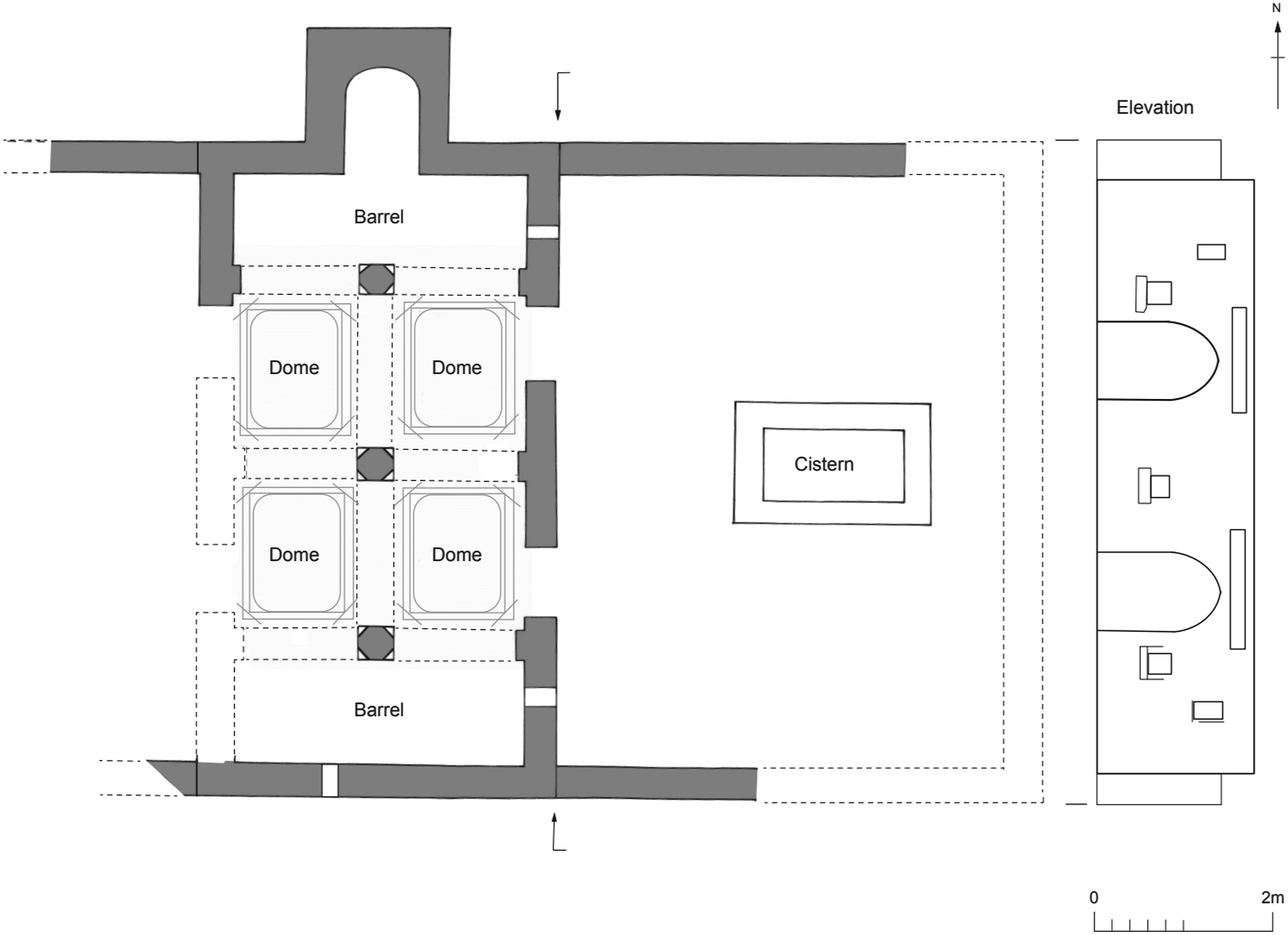
It measures c.9 × 5 m (Garlake, 1966: Fig 38), with an alignment of 009°. The rectangular prayer hall has doorways in the east and west walls. The roof supported four cupolas and northern and southern barrel vaults like we reconstruct in the second congregation mosque. Three octagonal columns standing on square bases supported the roof. The plain mihrab has a pointed arch and two small windows above it; on the east wall, Bismillah (“in the name of Allah”) is cut into the plaster. The east and west walls have two additional windows and a niche, and lead to a small courtyard on each side. A cistern sits on the east side of the courtyard. The cupolas are, once again, comparable to those at Kilwa, making them extraordinary for Pemba and among the most ambitiously conceived from the entire coast. This mosque had a sightline to both the mosque by the shore and congregation mosque (Figure 2(a)) and sat at a short distance from them, framing the town’s core, which includes the tombs, high-density neighborhood of earthen houses, and single stone house we identified. Did Haruni, uniquely commemorated in oral traditions by the mosque and pillar tomb, live in the stone house? We cannot know but note that both the Chiroko mosque and extraordinary Haruni’s Tomb, which draw attention to an individual and family, appear late in the town’s history. The oral tradition that the mortar contained peas, not evident archaeologically, is curious; could it be a specific nod to something about Haruni’s family, meant to further separate this structure from the three that came before and from others on the coast?
Discussion and conclusion
What we now call Swahili society was emerging in the eastern African Iron Age before Islam was an important sociocultural force on the coast, but Swahili and Islam became deeply intertwined more than a millennium ago. Our research at Chwaka and three neighboring village sites focused on households to understand the development of an urban polity and the intersection of local and Indian Ocean socioeconomic spheres (LaViolette and Fleisher, 2009, 2018). It incorporated a study of the mosques because we understood ritual practice, as framed by those structures, as critical to other social transformations of the region’s urban and rural life from 1050 to 1500 CE and helpful to telling this medieval town’s life history. Here we have pushed further, arguing that the multiple mosques of Chwaka are more than a story of the establishment and growth of Islam in the town. Our description of the genealogy of mosques over the 500 years of Chwaka’s occupation describes how they served as assemblages that drew together a wide range of agentic forces. Each mosque assemblage marks new rearrangements of these, and thus new forms of community. The first mosque assemblage entangled people with materials from the intertidal zone and reefs and likely associated spirits, marking a novel rearrangement of sacred space from sea to the land. Later mosques drew together other types of materials (coral rag) in new forms, maritime vistas, animal products (ostrich eggshells), imported goods, and other materials in ways that may have allowed for particular people to build local power, altering the community itself. These were likely families that sought to build reputations and networks beyond Chwaka. While mosques may have been instrumental in this regard, they were much more than that; their ongoing building and rebuilding, and the complex assemblage of their composition, offers clues to how mosques were vital to constituting community.
We have said that this is an urban story, and the four mosques discussed here allow us to tell that story in a way that does not simply privilege human agents, and to think about how a genealogical approach shows how urban assemblages take form and are rearranged over time. The people in this story, those living in wattle-and-daub houses, and a small number of families that sought to build and extend their power in the town and beyond, were part of an ever-changing relational community of vital forces: objects, spirits, ancestors, spaces, affects, landscapes. This approach allows us to look beyond questions of who sponsored the mosques, although that is an important question, and see ways that less-wealthy members of the community were active parts of mosque assemblages: through their labor, their prayers, and as just one part of these complex assemblages.
This brings us back to study of the Swahili more generally. The importance of mercantilism in medieval Swahili society is undeniable and has led to the argument that early conversion to Islam was a practical step by coastal dwellers to gain recognition and secure economic trustworthiness in the Indian Ocean world. This was certainly part of the story. But when we begin to decenter coastal people and explore the multiple vital forces of community assemblages, we can think about how orthodox notions of Islamic practice may be obscuring material, substantial, and phenomenal relationships that were part of early Swahili urban life.
The widespread practice of Islam did not provide the sole ritual vocabulary that Swahili people used (Insoll, 2003). Likewise, Islamic practice affected Swahili lifeways more broadly, including evolving second-millennium urbanity, cosmopolitan tastes (LaViolette, 2008; Wynne-Jones, 2016), and an increasingly maritime orientation (Fleisher et al., 2015). Archaeologists and historians, with at-times dissonant evidence, will continue to debate the top-down history of the coast’s practice of predominantly Sunni Islam, on the one hand, and agent-centered, heterodoxic spiritualities, on the other, that continue to this day (Pouwels, 1987; Insoll, 2003; Uimonen and Masimbi, 2021). We have sought to side-step this debate by exploring a broader range of agents and recognizing the role that non-human, agentic forces play alongside humans in the constitution of community.
We have described the historical processes and networks through which mosques as assemblages served to compose Chwaka’s emerging community. And, as such, the image of the post-abandonment ritual deposit punctuates the long history of mosques as assemblages in this town. While the physical scale of the deposit was small, the affects it drew together can be seen as extensive. Mosques work in similar ways: the earliest assembling local coastal ecologies, people and practices; the later, larger networks and territory, with links to other coastal towns, long-distance exchange, powerful people and practices of elite consumption, and larger and more diverse communities of religious practitioners. We can thus situate this final personal deposit as part of a long history of Swahili assemblages that are part of the historical process in which a Swahili community was shaped and transformed.
Footnotes
Acknowledgements
We extend our thanks to Bertram Mapunda, Principal of Jordan University College, Tanzania, who co-directed with AL and JF the project upon which this paper is based, as well as the many specialists, students, and other contributors from Pemba and elsewhere who worked with us in the field. We offer our gratitude to the late Hamad Omar, former Director, Department of Archives, Museums, and Antiquities, Zanzibar, and to Salim Seif, Antiquities Representative on Pemba during our field seasons, for their many kinds of support. Abdallah Khamis Ali participated in the Chwaka project, and in his more recent position as Head of Antiquities on Zanzibar continues to be a wonderful collaborator. We thank him warmly for both. The research at Chwaka was funded by the US National Science Foundation (#BCS0138319), with additional support from the Universities of Virginia and Dar es Salaam and the British Institute in Eastern Africa. AL and JF are grateful to MH for answering our call to supervise the mosque excavations and for bringing his expertise in coastal architecture to the project. We are grateful to Jeff Hantman and Rhiannon Stephens for reading drafts of this manuscript. Finally, thank you to editor Lynn Meskell for her guidance and to three anonymous reviewers for their many thoughtful comments.
Declaration of conflicting interests
The author(s) declared no potential conflicts of interest with respect to the research, authorship, and/or publication of this article.
Funding
The authors disclosed receipt of the following financial support for the research, authorship, and/or publication of this article: This work was supported by the National Science Foundation [Grant #BCS0138319]; the Universities of Virginia and Dar es Salaam; and the British Institute in Eastern Africa.

Author biographies
Adria LaViolette is Professor of Anthropology at the University of Virginia. She has been conducting archaeological research into Swahili society based on the Tanzanian mainland and in the Zanzibar archipelago since 1989, including recent work on Portuguese colonial settlements.
Jeffrey B. Fleisher is Professor and Chair of Anthropology at Rice University. His contributions to Swahili archaeology are based on research in the Zanzibar Archipelago and on the southern Tanzanian coast since the 1990s. He recently has been researching the Zambian Iron Age.
Mark C. Horton is Director of Research and Enterprise at the Royal Agricultural University. He has been researching Swahili archaeology through multiple projects in Kenya, Tanzania, and Madagascar since the 1980s, and has worked in the US, UK, Caribbean, Europe, and Mongolia.