




Abstract
Iron Age studies in South Africa are dominated by Huffman’s (1982, 1986, 1993, 2001) ethnographically derived Central Cattle Pattern model, which identifies the cattle-based bridewealth institution of South Eastern Bantu-language speakers by the spatial distribution of specific archaeological features. The idea of the spatial expression ‘on the ground’ of a variety of symbolic codes was Adam Kuper’s (1980, 1982) interpretation of predominantly Swazi ethnography. Surprisingly, Kuper’s work has never been interrogated and consequently his misunderstanding of the ethnography was carried into the Central Cattle Pattern and interpretations of the last 1600 years of Iron Age, farmer archaeology in southern Africa. Two particular features, burials and subterranean grain storage pits, and their relationship to cattle-kraals are explored. Because cattle are central to the Central Cattle Pattern, much archaeological attention has been given to looking for evidence of cattle at archaeological sites, either by dung, bones or cattle-kraals. The paper presents the views of contemporary Swazi, Xhosa and Mfengu people that suggest the symbolic importance of cattle-kraals; in the extreme they may not reflect the presence of livestock at all, yet their persisting presence demonstrates the continuing importance of cattle, real or imagined.
Introduction
Contemporary African indigenous worldviews cannot tell archaeologists what the past was like, but they are invaluable in broadening the way we think about the past and in enriching the pool from which we draw our interpretations. Items of excavated material culture from the last 1600 years, such as clay pottery, grinding stones, dung flooring, mud and pole house structures, and cattle-kraal storage pits persist into the present (Figure 1). Contemporary traditional farmers in southern Africa provide valuable comparative material for southern Africanist archaeologists. Such continuities, with their potential to affect land claims, were noticed and ignored by colonial authorities anxious to deny Africans their past—a sentiment that can still be found in South Africa today: ‘if you tell them about their past, they will think they have a future’ (see Schmidt and Pikirayi, 2018).
1
Dung-plastered floor with grinding stone (A) and grinding stone (B) as an example of technological continuities (Eswatini, 2019).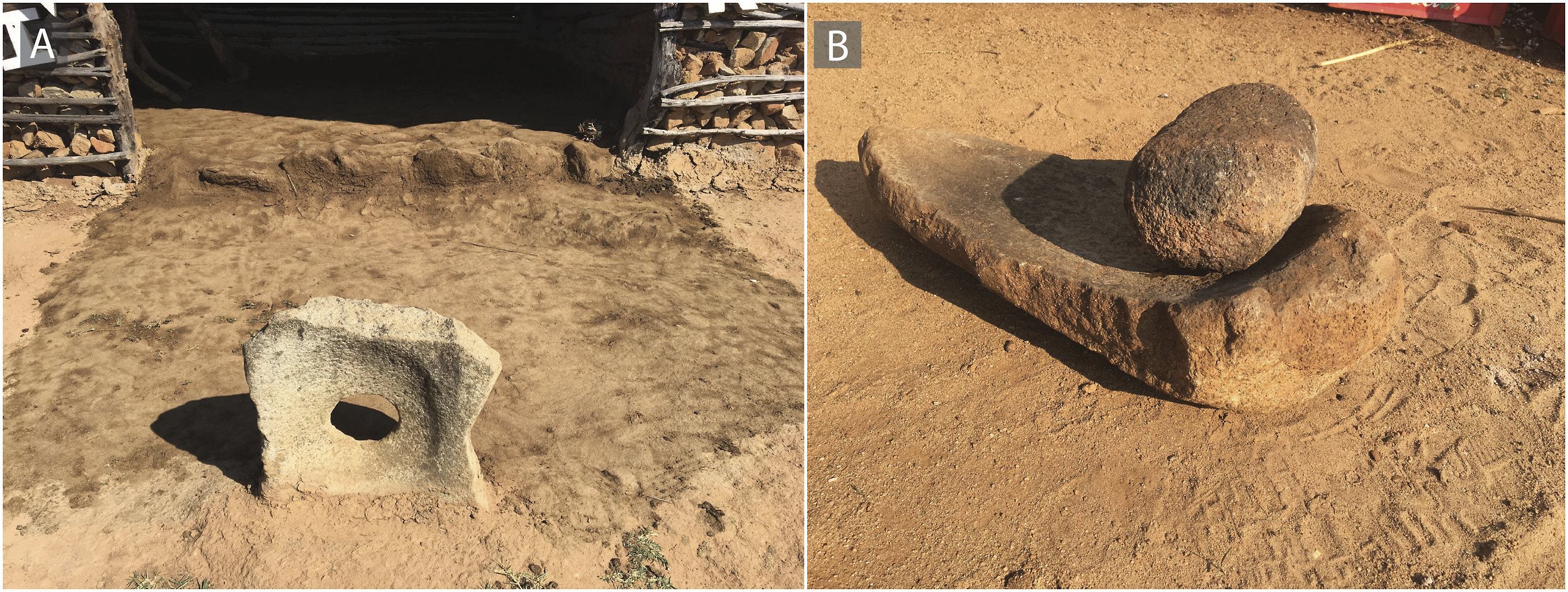
Continuities between past and present should not, however, be confused with stasis (see for example Fewster, 2006). The challenge to southern Africanist archaeologists, in particular, given the rich ethnographic record, is to avoid the temptation of thinking that continuities in material culture mean that the past was like the present (see Jolly, 1996; cf. Huffman, 2001). The value of Africans’ insights into their past has been slow to be recognised, but is now firmly acknowledged as African participation in archaeology and related disciplines increases (see Lane, 2011; Katsamudanga and Manyanga, 2013). This does not imply ignoring past White southern Africanist ethnographers. Despite their inevitable and unavoidable colonial location, most ethnographies, carefully written and read, provide valuable insights into the recent past.
This paper’s focus is on agro-pastoralist, subsistence farmers, speaking South Eastern Bantu languages, 2 who traditionally settled in the summer rainfall areas of southern Africa, growing first sorghum and millet, and later maize. These are the descendants of the first iron-using farmers who settled in southern Africa from approximately the 4th century AD onwards.
Fieldwork in Eswatini, 2017 to 2022
In April 2018, Swaziland was renamed the Kingdom of Eswatini (‘land of the Swazis’), marking 50 years since the end of British colonial rule in 1968. This small, landlocked, independent kingdom, bordered to the east by Mozambique and to the north, south and west by South Africa, is ruled by the increasingly unpopular King Mswati III and his mother. The World Bank (2021) ranks it as a lower-middle-income country, on a par, in Africa, with Kenya, Egypt and Angola. My most recent fieldwork took place in June 2022, the anniversary of violent pro-democracy protests the previous year. Anticipating renewed unrest, one of my Swazi research assistants messaged me, ‘Democracy is starting again on Wednesday. So plz try to be go back before Wednesday for safety’ (27 June 2022).
My fieldwork in Eswatini commenced in July 2017, with further fieldwork in November 2017, March 2018, July 2018, April 2019 and June 2022. The intention was to understand precolonial farming practice by: (1) recording endangered indigenous knowledge of crop cultivation; (2) sourcing, growing and carrying out isotope analysis on indigenous varieties of sorghum and millet; and (3) through excavation and field survey, uncovering contemporary and historic farming practices.
Eswatini is made up of four physiographic zones that run longitudinally from west to east. Altitude and rainfall drop from the Highveld in the west through the Middleveld to the flat, dry Lowveld, whereupon the land rises again to the Lebombo plateau, a high altitude and high rainfall area, on its eastern border with Mozambique. Research is focussed in two areas: Nsangwini in the Highveld and Siteki in the Lowveld. This paper reflects information from 23 individual and four focus group interviews, all adult Swazi subsistence farmers, both male and female. The interviews were in SiSwati, with an interpreter, and took place at the homestead (umuti) of each farmer. 3
The origins of the Central Cattle Pattern
Huffman first presented the Central Cattle Pattern (then named the ‘Bantu Cattle Culture System’ or Bantu cattle pattern) in 1982. He wrote: Now I turn to a different kind of data to demonstrate continuity in culture. This time we must start from the present. Adam Kuper (30) has recently shown that the various Sotho-Tswana and Nguni speaking peoples in southern Africa share one common culture system. This Southern Bantu Culture System incorporates interconnected attitudes about the political role of men, the spiritual role of ancestors, and the importance of cattle. Cattle are the main avenue to wives and children—and therefore to power, success, and status—and they almost exclusively belong to the domain of men. Most importantly, this culture system is expressed in a specific settlement pattern. The main characteristics of this pattern are: (a) a central cattle byre which contains grain storage pits and elite burials; (b) a men's court next to or in the byre; (c) an outer arc of houses with the principal house upslope of the byre and the remainder arranged to the right and left according to seniority; and (d) within a house a right-male/left-female distinction which is usually oriented at right angles to a front-secular/back-sacred dichotomy A traditional, wooden cattle kraal at a homestead (Eswatini, 2019).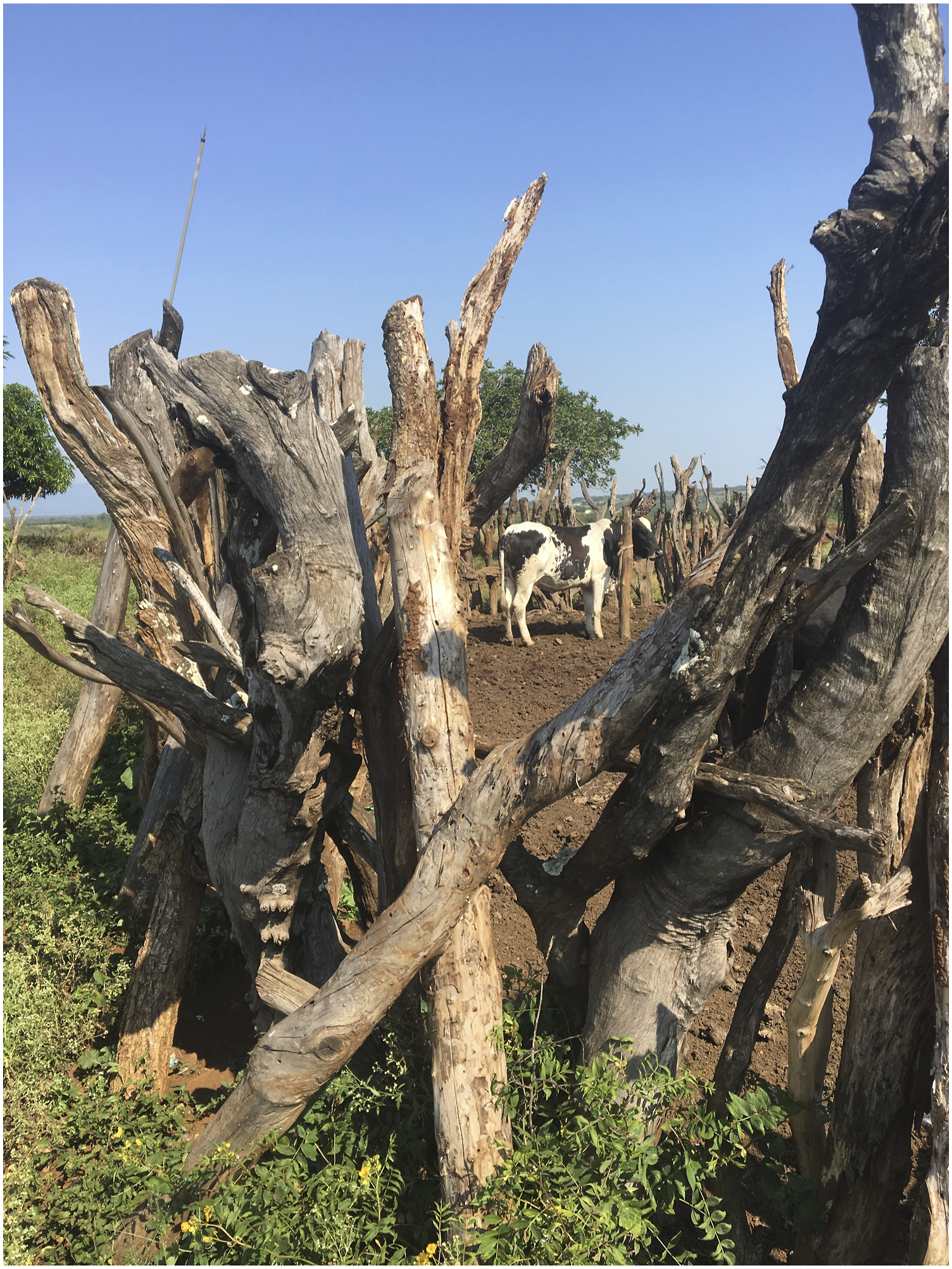
The pattern was modelled directly on Adam Kuper’s (1980) Symbolic Dimensions of the Southern Bantu Homestead, published two years earlier. Although Kuper applied his model to all Nguni-language speakers and the Sotho-Tswana, his analysis was predominantly based on evidence collected on the Swazi, because ‘the ethnography is particularly rich’ (Kuper, 1980: 11).
I draw attention to the first of Huffman’s (1982) four main characteristics of the central cattle pattern: namely, that both elite people and grain are buried in the central cattle byre. This erroneous connection between cattle byres and graves is first presented in Kuper (1980: 12): ‘Dead headmen are buried in the byre, and their spirits are invoked there by day as they are in the indlunkulu by night’. He gives no reference here, but his use of the SiSwati-language term indlunkulu (‘great house’) suggests that he is referring to Swazi ethnography (see Hilda Kuper, 1947: 38).
I could find no evidence that the Swazi have ever buried anybody in the cattle byre, either in ethnographic texts (including those cited in Kuper, 1980, or in interviews). Of the burial place of the elite, Hilda Kuper (1963: 60, 162) describes Swazi kings and princes buried in caves in high mountains (see also Kuper, 1947: 194). Interviews in 2022 confirmed that Swazis had been buried in caves in the past. Ziervogel (1957: 39–41), too, records the burial of a homestead head in the mountains in a cavern and notes that it was an old custom. In the 1980s, I personally remember the prohibition of the public from parts of the Mdzimba mountains where King Sobhuza II’s embalmed body was placed.
Asked whether Swazis were ever buried in cattle-kraals, the answer was emphatically no: the headman of the homestead was buried outside the cattle-kraal, in the area just outside his entrance gate (inshungusho) at the ‘top of the kraal’ (opposite the main cattle entrance, insango) (see Ziervogel, 1957: 19). This is confirmed by Marwick (1966: 23). One interviewee said that this is also a place where communication with the homestead head’s ancestors may take place. Hilda Kuper’s (1963: 21) observations are the same: ‘When a headman dies, he is buried at the entrance to the cattle-byre’.
A wider literature search for burial location among other South Eastern Bantu-language speakers confirms a consistent pattern of burial of headmen—always near to, but outside of, the cattle-kraal. Of the Zulu, Bryant (1949: 700) notes, ‘The elder man having pointed out the proper position for a Kraal-head’s grave (viz. at the top of the cattle-fold, outside the fence and slightly to the left)’. This is echoed by Ngubane (1977: 84): ‘the grave was dug just above the cattle-fold within the homestead by neighbours and brothers of the deceased’. In a further account of the Zulu, Wells (1933: 196) notes that Zulu are buried under the walls of the kraal which are then re-built, whilst Krige (1936: 160) says that the homestead head is buried in front of the chief hut, close to the fence of the cattle fold. Similarly, among the Pondo (Hunter, 1936: 228), The owner of an umzi is buried at the entrance to his kraal (isibaya), the old kraal pulled down, and a new one erected, the grave being under the fence at the middle of the back of the new kraal … Also the owner can be buried at the side of the kraal close to the fence and the kraal not moved.
Among the Bomvana, Cook (1931: 90) records that ‘In the case of the head of kraal his grave is always dug just outside the cattle-kraal gate on the left-hand side looking from inside the kraal’. According to Soga (1931: 321), writing of the AmaXhosa, ‘On the death of a chief his grave is dug near the gate of his cattle kraal, to the left as a person faces the gate from the outside’. Similar observations are made more generally by Willoughby (1928: 70), ‘Headmen were buried beside their cattle kraals’, and Kidd (1904: 248), ‘The neighbourhood of the cattle kraal is the place chosen for burying the father of a family; other members of the family may be buried close by in the bush, or else just outside the kraal’. Shaw (1937: 105) says of the Bantu-language speakers of southern Africa that ‘The correct place for burial of the head of the homestead was at the gate of the cattle kraal’. Among the Thonga, chiefs are buried in sacred woods (Willoughby, 1928: 70).
The ethnographic evidence for burial inside cattle kraals amongst South Eastern Bantu-language speakers is very slight—only three descriptions were found. One is for the Tswana (Willoughby, 1928: 57), one for the Basuto (Casalis, 1861: 203) and one for the Pedi (Mönnig, 1967: 139). Willoughby’s (1928: 57) account is contradicted by Dornan (1925: 278), who records that chiefs are buried at the entrance to the cattle kraal and commoners under its walls. For the Basotho, Lindsay Fairclough (1905: 204) gives a different account: ‘the old burial custom was to breakdown the wall of the cattle kraal, to the right of the entrance if a male, to the left if female … the breach in the kraal wall was rebuilt’. Mabille (1906: 357) also states that the Basuto bury under the stone wall of the cattle-kraal as close to the gate as possible.
I suggest two possible explanations for the mistaken perception that cattle-kraals were burial places. One is a misunderstanding of the meaning of the Afrikaans term kraal. The other may simply be a careless readings of the texts, assuming the edge of the kraal (the common site of headmens’ graves) to be the same thing as ‘in the kraal’. The Afrikaans word ‘kraal’, widely used in English, can mean either a cattle byre or the collection of (indigenous) people living together, a homestead. Thus burial ‘at the kraal’ might mean that the burial takes place at the homestead; but it might equally plausibly mean that burial takes place within the cattle kraal. Kidd explained more than a century ago: The word kraal does not connote a single hut; it is a collection of huts. It is sometimes called a village; but, for no manifest reason, people speak of kraal in one district and a village in another. The terms are interchangeable … the true Zulu type of kraal is built in a circle, with the cattle kraal in the centre. (Kidd, 1904: 12)
This distinction is of course very clear in South Eastern Bantu languages. In SiSwati the cattle kraal is the sibaya, whereas the homestead is the umuti (plural imiti) (Ngubane, 1983: 95).
Kuper’s (1980) and Huffman’s (1982) perception that high-status male corpses are symbolically linked to grain among South Eastern Bantu speakers—and that both are, significantly, buried in the cattle-kraal—runs counter to the South Eastern Bantu-language speakers’ belief that the corpse is a ritual pollutant. For example, among the Zulu, Krige (1936: 160) records that ‘[a]fter a death, the first thought of those left behind is to get rid of the corpse, which is a source of pollution contaminating the whole kraal’. Similarly, Hunter (1936: 227) states that among the Pondo, ‘the corpse is regarded as contaminating and dangerous, and is buried as quickly as possible’. Similar attitudes to the corpse and its polluting presence are recorded for the Zulu (Ngubane, 1977: 82), the Basuto (Casalis, 1861: 256), and the Xhosa (Soga, 1931: 320).
This error is further embedded into Kuper’s model (1980: 19), as it is repeated and then related to the symbolic-spatio inter-relationships that he proposes between the dead, the living and the ancestors. He asks (1980: 19), How deep does this inter-penetration of symbolic codes go? The evidence now becomes less easily available, but some preliminary observations are worth making, certainly with reference to the comparatively rich Swazi material. Here one sees clearly the spatial expression of a variety of symbolic modes and relationship systems. There is, for example, a critical spatial dimension in the relation between the dead, the living, and the ancestors. The dead headman is buried beneath the cattle-byre. His spirit may be approached there by day, but at the end of the mourning period it is ‘brought inside' the great hut, where it is approached particularly by night.
A summary of Adam Kuper’s (1980, 1982) Swazi symbolic-spatial dimensions.
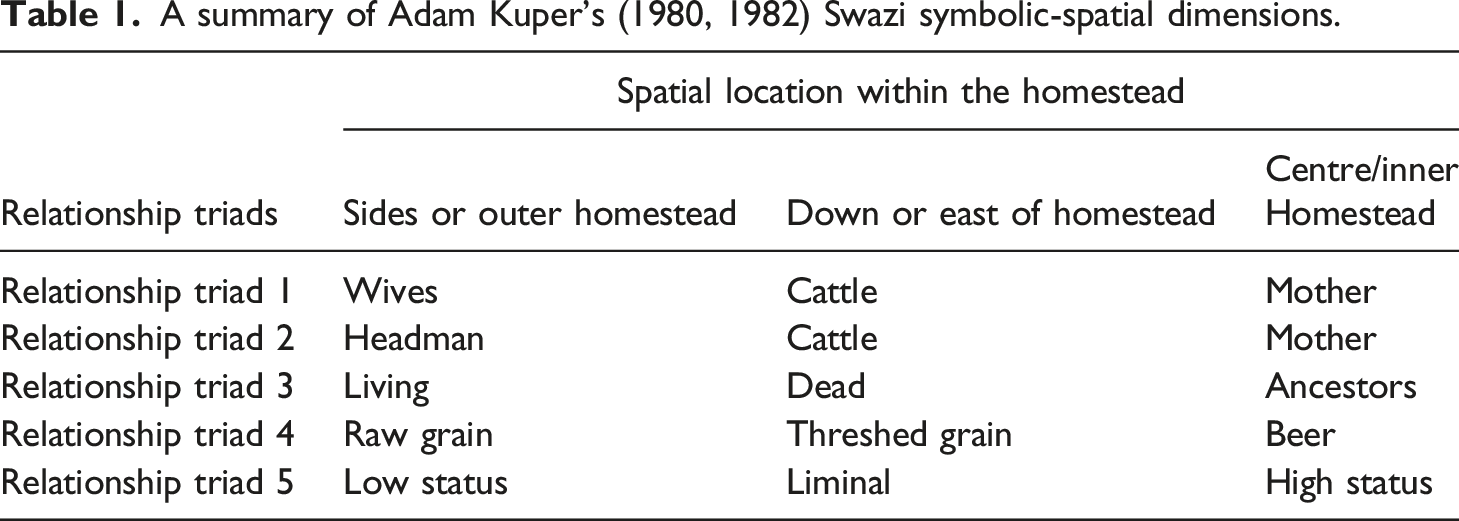
These allocations seem quite arbitrary, perhaps because of what he described as ‘the sketchiness of some of the data’ (Kuper, 1980: 21). The neatness of the perceived relationships begins to unravel when we place the dead headman’s grave correctly, outside the cattle-kraal.
Besides the coupling of buried grain and corpses in the cattle kraal, there are other obvious problems with this model. Kuper places the headman with his wives (column 1, Table 1). According to Swazi patrilineal descent, the headman cannot be placed with his wives (Hilda Kuper, 1963: 18). The distinction between threshed grain and beer, made on the basis that beer is given as libations to the ancestors, is also questionable. Contact with the ancestors is usually made through food, meat or beer (Kuper, 1963: 63). The notion that raw grain is placed ‘outside the homestead’, based on Marwick’s (1966: 23) text, ‘Behind the village are the grain platforms …’, is incorrect. Grain platforms are located behind the huts but not outside the homestead, as witnessed during fieldwork in Eswatini. In Krige’s (1936: 43) description of the arrangement of a Zulu homestead, all grain storage, whether raw or threshed, is within the homestead boundaries. The ranking of these three groups into status categories is highly subjective. The headman’s ranking in the low status apex of the triad seems flawed. His high status is reflected in both his position as homestead head and the placement of this burial, close to the cattle-kraal (Ngubane, 1983). Why are cattle not high status, give their importance among South Eastern Bantu-language groups?
Conundrums for interpreting the archaeological evidence
The ethnography and recent in situ interviews show that it might be very difficult for archaeologists to locate where burials and storage pits are placed in relation to cattle kraals. There are a number of reasons for this. 1. Livestock pens built on top of graves
In 2022, I was told that once the headman had been buried outside the cattle kraal, then a small kraal (sibuya in SiSwati) for calves was built around the grave site. This was done to harden the ground on top of the grave. This building of a cattle-kraal over a burial site is recorded in Willoughby (1928: 262): ‘over and around the grave in which Dhlambi, chief of a section of the Amaxosa was buried in 1828, a circular cattle-fold was built and stocked with 10 oxen and some cows, which, by trampling out all traces of the grave, foiled any alien sorcerors who might plan to work magic with some portion of the chief’s corpse’. According to Willoughby (1928), the livestock were kept penned above the grave for a year. 2. Shifting of cattle-kraals’ boundaries as a result of burial and for other reasons
A number of references are made in the ethnography to the shifting of the cattle kraal after a burial outside of or on the edge of the cattle-kraal, for example, by Soga (1931: 321) among the Xhosa and by Cook (1931: 91) with reference to the Bomvana, who recount that, after burial of the headman just outside the cattle-kraal, ‘the cattle kraal is moved so that the grave now comes at the back of the new kraal’. Swazis told me that the cattle kraal changed size according to the number of cattle held by the homestead. Marwick (1966: 23) observed that a homestead’s cattle kraal size had decreased because of restrictions imposed on the keeping of cattle due to East Coast Fever. Underground grain storage pits, originally within the cattle kraal, were now outside it.
Symbolic kraals not cattle corrals
Livestock kraaling is widespread among African livestock-keepers. The material used in their construction varies, dependent upon what is locally available. In contemporary southern Africa cattle-kraals are made either of wood (felled trimmed tree trunks and stout trimmed branches), or thorn brush or stone (Figure 2). The surviving archaeological evidence in southern Africa is, as expected, mainly of stone walls (Sadr, 2012), and to a lesser extent concentrated dung layers, taken as a proxy for now-invisible wooden cattle kraals.
A dilemma for advocates of the Central Cattle Pattern, centred on the social importance of cattle, is that the evidence of cattle bones is very slight, particularly in the early Iron Age (circa AD 300 to 900) (Huffman, 1990, 2001, 2007; Badenhorst, 2011; Russell and Lander, 2015). This has driven a search to identify cattle by their dung: ‘Because this complex was the basis of Iron Age society, identifying cattle dung deposits has been an archaeological priority’ (Huffman et al., 2013: 3553). But there are difficulties, particularly in separating cattle dung from that of sheep and goats (Badenhorst, 2009). Layers of dung, or vitrified dung, are crucial to pinpoint where livestock were corralled for long periods. Without this evidence, it becomes difficult to argue for the centrality of cattle.
Surprising evidence for the importance of the idea of cattle amongst a small, contemporary Bantu language-speaking community in South Africa emerged in a survey in 2003 to measure wild resource use in 146 households (100% census, 745 people) in the rural village of Woodlands in the Eastern Cape, South Africa (Cocks and Wiersum, 2003). The informants were all Black South Africans, identified as Xhosa and Mfengu (South Eastern Bantu-language speakers). 4 The most-cited reason for collecting wood was for cattle-kraal construction. Eighty-four per cent of households reported collecting some 19 different species of wood for cattle-kraal building (of these 98% collected wood from indigenous trees only). What is interesting and surprising is that of 123 households collecting wood to build cattle-kraals, only 23 households actually owned livestock. One hundred households who built cattle-kraals had no livestock.
Cocks and Wiersum (2003: 46) record that these cattle-kraals are ‘conspicuously sited in front of the homestead’ and that they are primarily a place for traditional rituals, performed regularly, where the family can speak to the ancestors. Amongst the minority who own livestock, cattle-kraals also function as livestock enclosures each night (Cocks and Wiersum, 2003: 46). They conclude that it would be erroneous to think of the building of cattle-kraals as a utilitarian activity; that rather, ‘the ownership of a kraal holds a strong cultural value and is not simply a means of enclosing livestock; the construction of a kraal can foremost be considered as an activity demonstrating one’s cultural identity’ (Cocks and Wiersum, 2003: 51). These findings are all the more surprising given that the Woodlands community had been displaced by the Apartheid authorities from their original homesteads and were living on newly allocated, non-traditional land, in the former homeland of Ciskei (see McClendon, 1997).
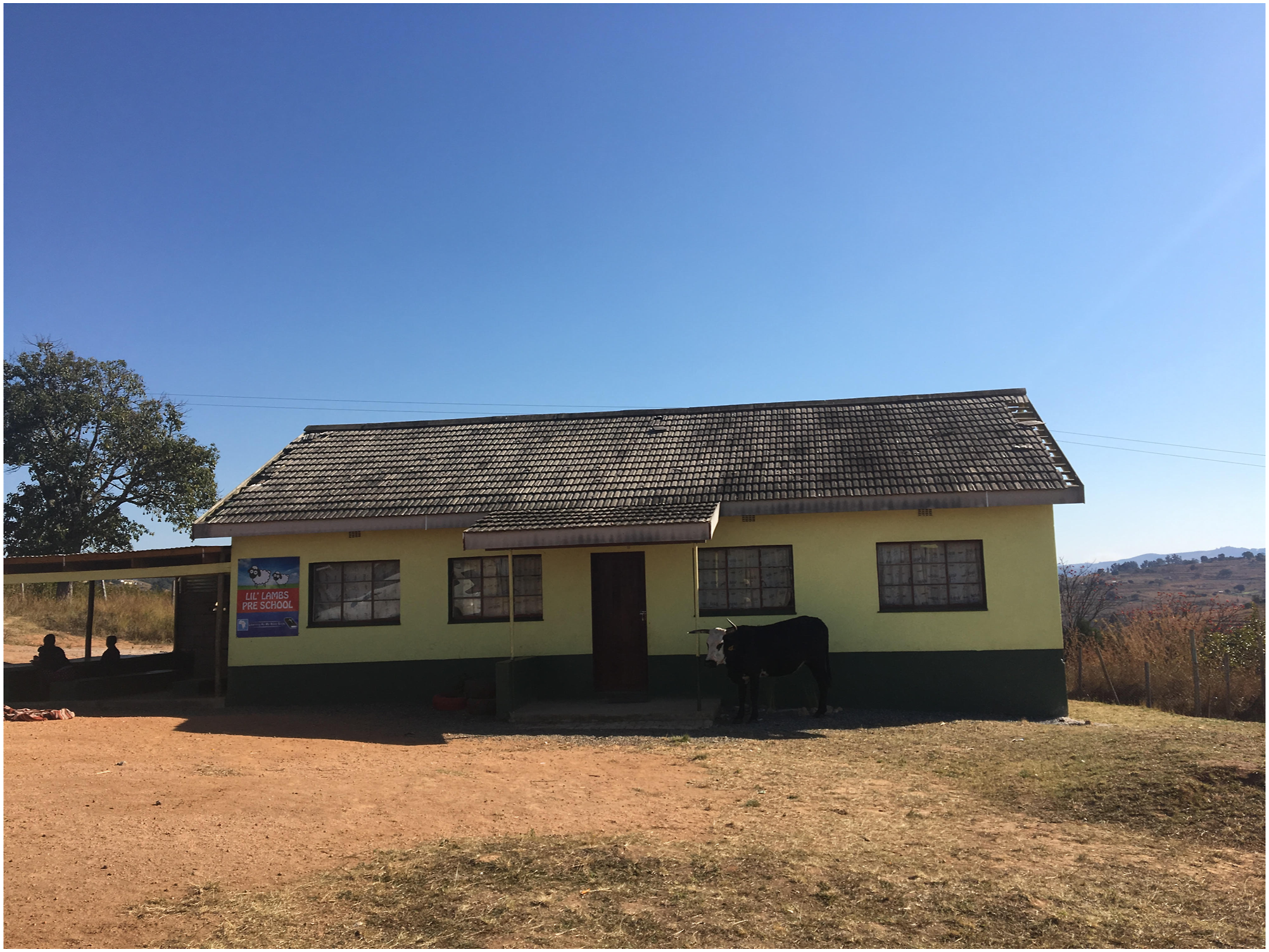
In contemporary Eswatini each chieftaincy (umphakatsi) is marked by a cattle-kraal. Hilda Kuper (1972) describes the royal cattle-kraal (sibaya in SiSwati) at the capital, Lobamba, as ‘a large open-air arena crudely glossed in English as “cattle byre,” but which is also the site of important national gatherings and royal rituals’. A functionally similar place, but very much smaller, was the site of focus group discussions in Eswatini in 2018 at Nsangwini. This was marked by a small, wooden-pole cattle-kraal, the homestead of the chief, and a pre-school (Figure 3). The community of Nsangwini meet the chief’s council here twice weekly to raise any matter needing adjudication. In July 2018, examples of the issues raised to the council were disputes involving cattle grazing in a neighbour’s field, a neighbour who had ploughed across their neighbour’s boundary, and a case of adultery. The small, symbolic wooden cattle-kraal at Nsangwini measures approximately 8 m in diameter; it is overgrown and it has not been used for livestock recently, nor for meetings. Community meetings with the council are held in the adjacent preschool building (Figure 4). Maggs (1976: 23) drawing on Sotho-Tswana ethnography, makes a similar observation that the kgotla, the men’s meeting place, used as an administrative centre, may be in or near a ‘cattle-pen’, and that ‘sometimes it is a symbolic cattle pen, taking the same form but not being used as such’. The symbolic kraal at Nsangwini marking the umphakatsi (chieftancy) (Eswatini, 2019). The Lil Lambs Preschool at Nsangwini umphakatsi, where meetings are held with the local community and the chief’s council (Eswatini, 2019).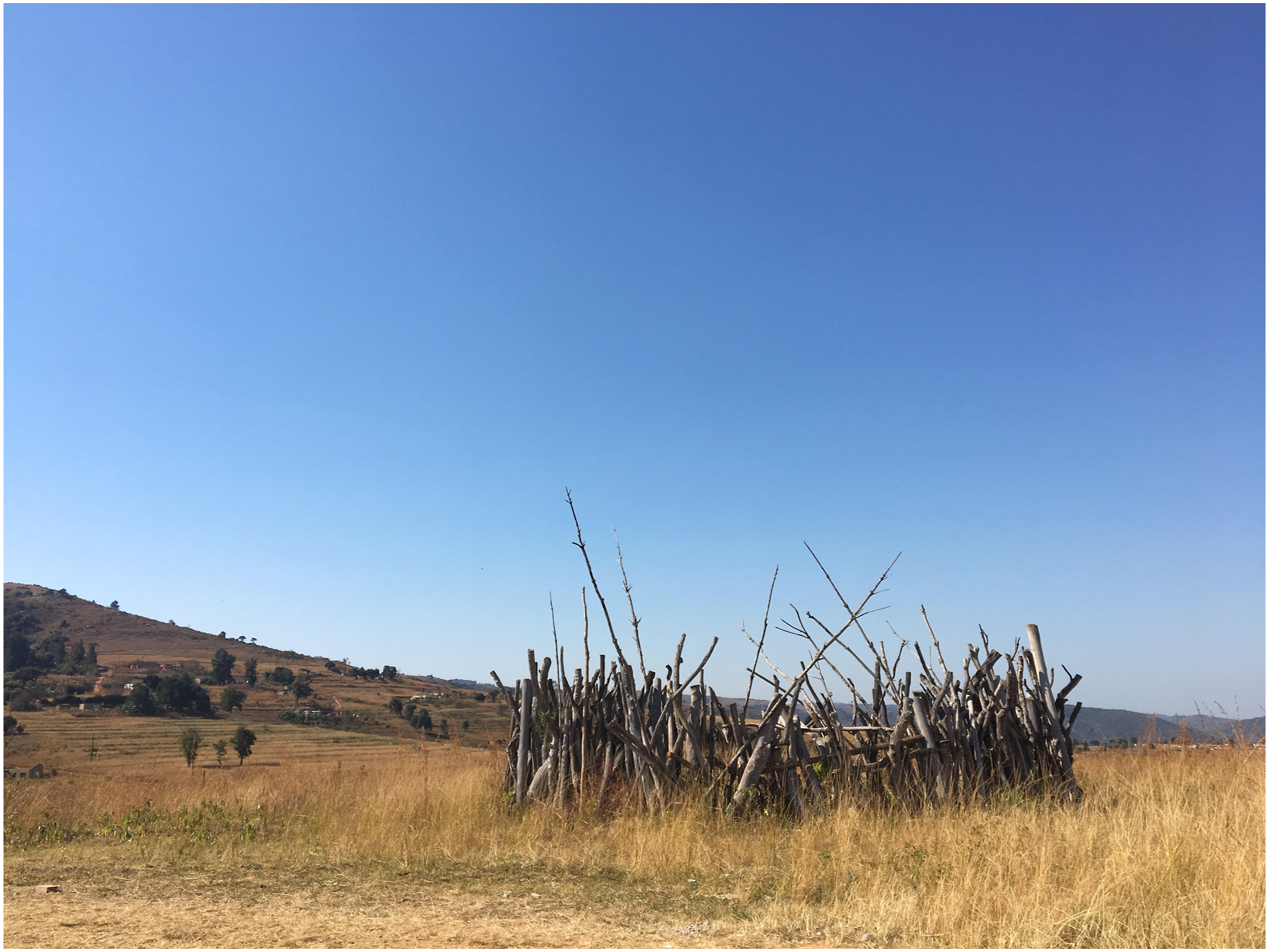
Further evidence of the discordance between the construction of cattle kraals, cattle counts and corralling was captured in interviews among Tswana cattle-keepers in Botswana. Ndobochani (2022) records informants saying that the size of constructed kraals reflects future aspirations for large herds rather than actual stock numbers. Similarly in an interview in 2022, an elderly Swazi woman said that the size of the kraal was based on the cattle that one hoped to own in the future.
Subterranean grain storage pits beneath cattle-kraals
In the dry lowveld of Eswatini it was a common practice, before the introduction of metal storage tanks, to store the homestead’s dried and threshed sorghum in cow-dung-lined or fire-baked storage pits, ingungu (singular), dug out underneath the homestead’s cattle-kraal, and left to dry out completely before they were packed with the homestead’s communal food supply (commonly maize or sorghum). They were then sealed for months, sometimes with the bark from the marula tree (umganu) or wood from a fig tree (umkhiwa) and a big flat stone (Figure 5). The sealing of the pit with wood/stone and cow dung prevented water and cattle urine ingress. This practice of cattle-kraal grain storage still persists today among Swazi farmers on the Lebombo Plateau (Maphungwane). When asked whether these pits could be made anywhere other than the cattle-kraal, I was told that they could never be made outside the cattle-kraal. So important is the location that if a neighbouring homestead did not have a cattle-kraal, they would ask to make a storage pit in their neighbours’ cattle-kraal. So a single cattle-kraal might contain the storage pits of a number of homesteads. This might explain the many storage pits recorded at a single homestead by Marwick (1966: 12, Diagram A). A Swazi farmer shows us the location of an underground storage pit within the homestead’s cattle-kraal (Eswatini, 2019).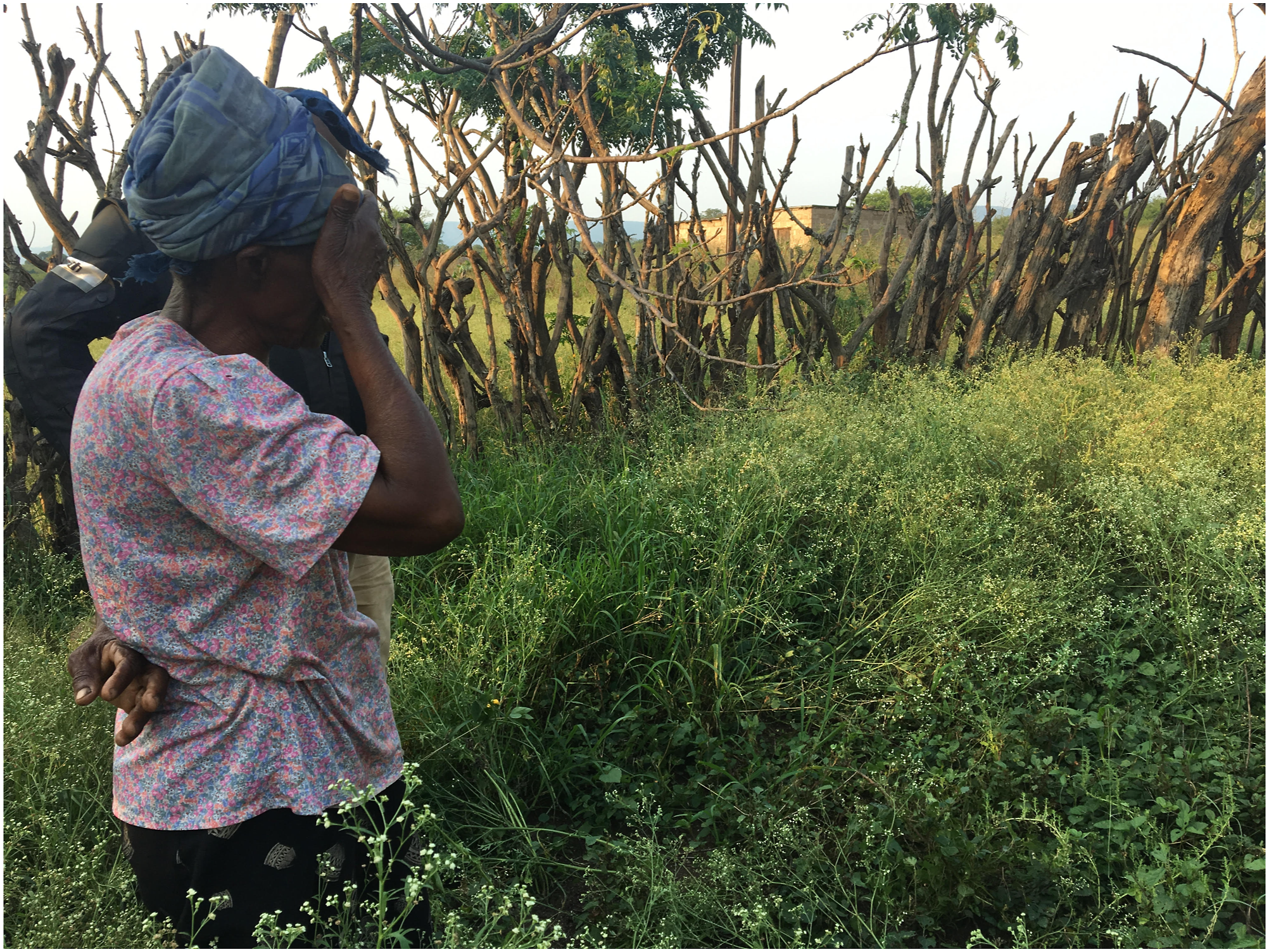
Swazi subsistence farmers interviewed in 2019 and 2022 said that grain stored in this way for a year or more fermented slightly, giving it a nice taste and smell. Any grain, sorghum or maize, with this distinctive smell and taste is referred to as sancoti in SiSwati. The reason is that the warm cow dung in the cattle-kraal above heats the stored grains, causing them to ferment. The farmers said the primary advantages of the underground storage of grain were that it was protected against pests such as rats and weevils and that this was more important than their affection for this particular taste.
These large, deep pits require skill in their making. Sometimes the homestead will call upon someone from outside the homestead to construct the pit for them. In interviews I learnt that when their personal grain supplies are running low, the wives will tell the homestead head, who then opens the pit. Once the pit is opened it is left for some hours to allow the buildup of toxic gas to escape. Grain from the pit is shared into woven grass baskets to be stored in the wives’ individual huts. Each mother will have such a temporary store. This sorghum is for porridge, for household consumption, and also to brew beer (cf. Huffman and Schoeman, 2011). It is not to be confused with the sorghum stored for planting the next season, which is placed under thatch on the rafters of a hut in which a fire burns, the smoke of which would prevent it being spoilt by pests.
Kuper (1963: 21) records these storage pits among the Swazi: Dug into the sibaya (cattle pen) are deep flask-shaped pits for storing the best grain from the fields. Informants state that the pits were devised in the days of tribal warfare to hide food from the enemy, and the fenced sibaya served also as a stockade against attack. Siting the main granaries in the sibaya enables the headman to keep some check on the food supplies used by the wives.
A similar practice of underground cattle-kraal storage is described amongst South Eastern Bantu-language speakers of the eastern Cape (Hebinck and van Averbeke, 2007: 39). In older ethnographies, the most detailed account of the use of such pits is by Hunter (1936: 86) among the Pondo, of the Eastern Cape, where the use of kraal pits persists (Lewis and Mrara, 1986). Berglund (1976: 112) also makes reference to their use in the Zulu past: A limited number of informants drew the lines of comparison rather more to the relation of the traditional grain-pits which were dug in the centre of the byre and the hearth, both being ‘places of food’ … Any further information on thought-patterns related to the grain pits, imidogi, was practically impossible to obtain, due mainly to the fact that these have wholly fallen into disuse today.
Their use among the Zulu is also noted by Bryant (1949: 303): ‘The grain being ready, it was stored in a pit (umGódi) dug into the cattle-fold, and shaped like a huge calabash, some four feet in diameter’ (see Krige, 1936: 44). Casalis (1861: 167) describes their construction and use amongst the Basuto: They make deep excavations in the enclosures where cattle are penned. The walls of these pits are carefully plastered. The opening, which is only large enough to admit a man, is even with the ground. When the subterranean granary is filled, the opening is hermetically sealed, and the whole is covered with a thick coat of dung and earth. If these depots happen to be shut for a long time, great precaution is required in opening them: persons have been known to be instantly suffocated by the gas which is there generated. If left there too long the grain acquires a musty flavour, which is does not lose even when cooked.
Jenkinson (1882: 52) describes this too: ‘Underneath the cattle kraal are pits for storing grain, with a small secret aperture covered with a stone’.
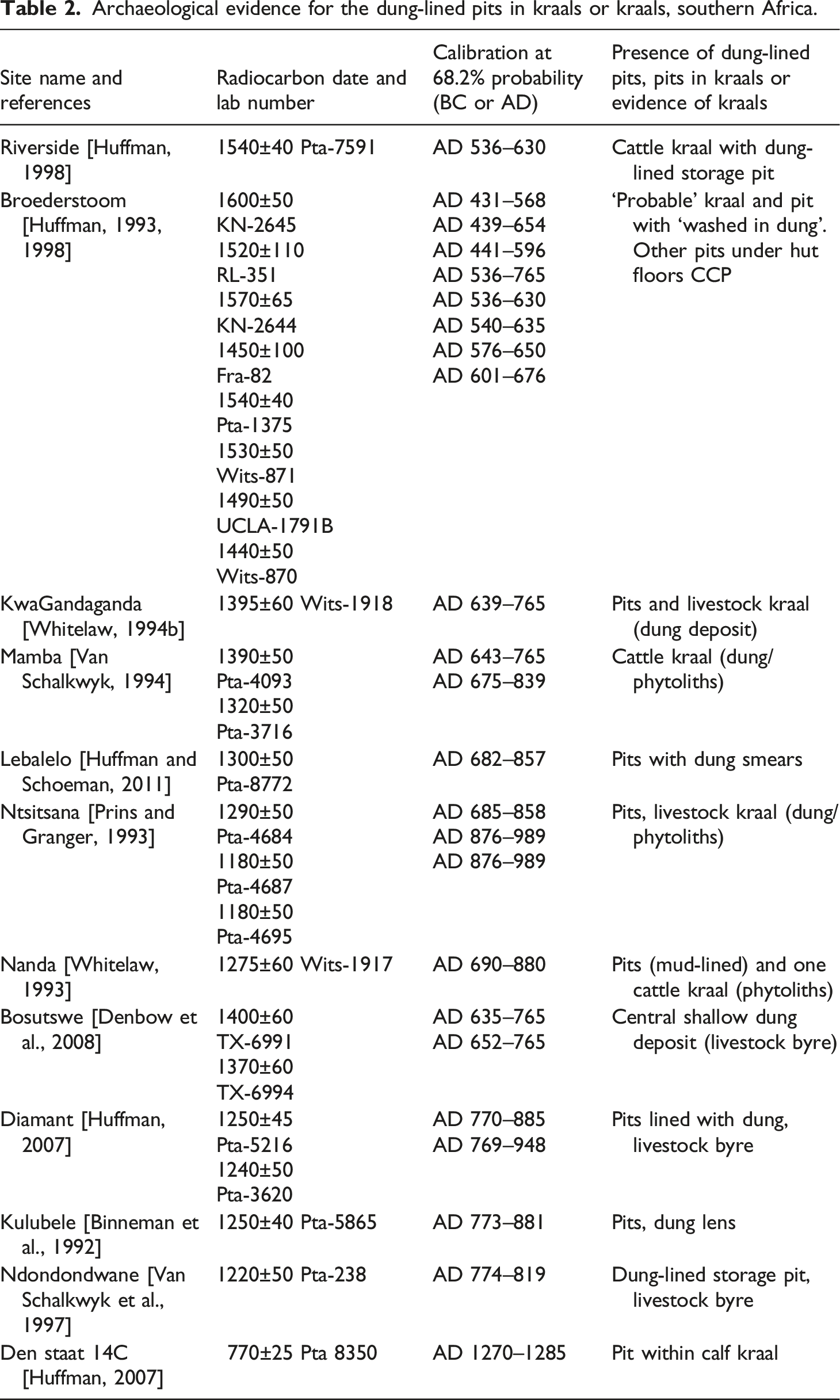
Figure 6 shows the archaeological evidence of three items from sites associated with early farming communities: livestock byres, storage pits in kraals and storage pits outside the kraal (when dung-lined) (Table 2). Unlined pits and pits in other contexts have been excluded from this map (for a full list see Lander and Russell, 2018). The archaeological evidence for kraals and/or underground storage pits within kraals. Areas A and B are places where underground storage pits are still used. Grey shading represents the distribution of contemporary South Eastern Bantu language speakers. Archaeological evidence for the dung-lined pits in kraals or kraals, southern Africa.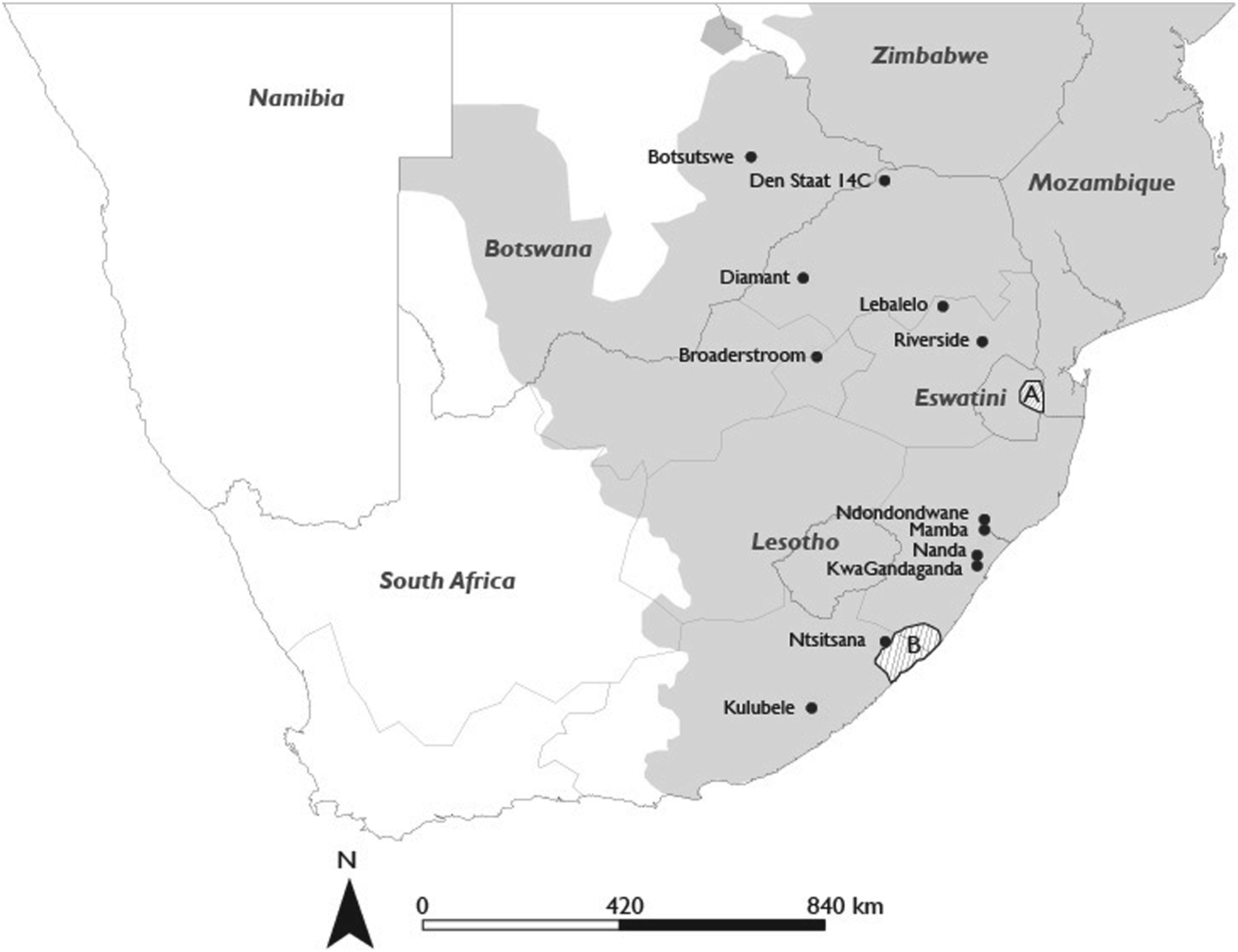
Inconspicuous consumption: Empty cattle kraals, hidden wealth
Among many African peoples, a relatively empty cattle kraal is an asset. It prevents jealousy from one’s neighbours, no small matter in societies which believe in witchcraft, like the Swazi who identify jealousy as a major source of personal disaster (Kuper, 1963: 49; Marwick, 1966: 74; Ashforth, 2005: 34). Excess cattle are dispersed to carefully chosen kinsmen and descendants. This custom (ukusisa) is not casual but formal; the keeper has rights (to milk, dung and limited progeny) but also the responsibility for the health and well-being of the animals (McClendon, 1997; Jiyane and Ngulube, 2014). This dispersal and circulation of livestock has advantages to both parties. Risk, productivity and wealth are shared; social ties are formed and reinforced around reciprocity. It also allows a viable breeding herd to be maintained amongst people with few livestock (cf. Huffman, 1998: 57). Such institutions are widespread across Africa (McClendon, 1997; Shipton, 2007; Russell 2017a).
Subterranean storage pits are a further way to hide excess. There, buried beneath the cattle kraal, the homestead’s food supply is concealed. Kuper (1963: 21) draws our attention to the social symbolism of the ‘empty’ kraal among the Swazi: ‘Rich conservatives divide their homesteads, lend out their surplus cattle, bury their grain in underground pits, and hide their money in the ground’.
Differences missed: Concluding discussion
Neither the proponents of the Central Cattle Pattern model (Huffman, 1982, 1986, 2001, 2012; Whitelaw, 1994a, 2012) nor its critics (Badenhorst, 2009; Fewster, 2006; Hall, 1984; Stahl, 1993; Lane, 1994, 2005) have carefully examined the soundness of interpretations that Kuper (1980, 1982) made of the ethnographically derived data upon which it was built. In Huffman’s (1982: 141) own words, ‘… if the ethnographically derived pattern is correct, the presence of that pattern in the Iron Age archaeological record is conclusive evidence for a distinctive Bantu culture system’. A careful examination of the ethnographically derived pattern shows a number of flaws in Kuper’s (1980, 1982) reading of the data. We have to question the model and its widespread application to the interpretation of southern African farmer sites.
A fallout of using Kuper’s model to interpret Iron Age farmer archaeology is that potentially important differences in the archaeology of this period have been missed. In the archaeology of the last 1600 years of agro-pastoralist farming in southern Africa there are sites with combinations of cattle kraals, various types of pits, and of burials. The exact spatio-temporal relationship of these features has frequently been assumed, rather than proven, by the application of the Central Cattle Pattern model to their interpretation (e.g. Huffman and Schoeman, 2011). This ignores the ethnography of South Eastern Bantu-language speakers that separates subterranean cattle-kraal, grain storage pits and human burials. There was not a single account from the ethnography indicating that grain pits and burial ever occurred together in the cattle kraal. Rather than imagining early Iron Age farmers as having a shared worldview, this suggests the possibility of divergent worldviews, for which archaeological evidence might be found: farmers who buried their dead in cattle kraals versus those who used cattle kraals as food stores. The challenge to archaeologists will be to identify pits that are definitively grain stores, and to grapple with the slight shifting of homestead boundaries every time a headman dies (see Fewster, 2006). A further difficulty for archaeologists is to distinguish the homestead cattle kraal from temporary livestock kraals constructed above graves.
I also draw attention to the ways in which the ethnographers might misconstrue accounts of where people are buried. The idea of the burial of important people in the cattle kraal is widespread, and yet a more careful reading of ethnographic text reveals that burials are on the edge of the cattle kraal, just outside it. This subtle distinction becomes relevant when considering the pollution beliefs held around death and the corpse. Here, too, further fieldwork among Swazi subsistence farmers became important in probing this point.
Another bias in the Central Cattle Pattern is the focus on quantification, a position that contrasts markedly with some southern African agro-pastoralists’ total aversion to counting their livestock or being seen to have big herds. An approach led by African indigenous insights might move away from a focus on quantification, since kraals cannot always be equated to ownership of cattle (cf. Huffman, 1993); size of kraal may not signal status (cf. Huffman, 1998); more kraals do not necessarily imply bigger herds (cf. Huffman, 1993); and unused kraals do not necessarily reflect a lack of cattle ownership. Shenjere-Nyabezi et al. (2013) remind us of the further complications that ethnography throws up to archaeologists interested in cattle: in daily and ritual transactions, cattle can be replaced with small stock, hoes and labour. Among the Zulu, McClendon (1997) notes that horse, goats or cash can be substituted for cattle (see Russell, 2017b). The subterranean storage of food is a further way of concealing one’s wealth.
African knowledge enriches the pool of ideas from which archaeologists draw their theories about the African past. The prevailing Central Cattle Pattern is derived from the work of White ethnographers studying South Eastern Bantu-language speakers. The Pattern is shaped not only by the ethnographers’ biases, but by those of their readers. The reality of powerful men and dependent women has permeated their own recent Western history and culture. Born into the 20th century, as Western women began to resist their inferior status, they readily assumed the pasts of all people to be naturally male-dominated (cf. Ngubane, 1983). Placing African ways of seeing and doing at the forefront of archaeological explanations might shape a different understanding of past material culture (Katsamudanga and Manyanga, 2013; Jopela and Fredriksen, 2015). This is not simply a call to use ethnography in Africa, but rather to use it in a way that reflects meaning in the societies from which it is taken (see for example indigenous ways of classifying ceramics: Mtetwa et al., 2013).
The Central Cattle Pattern rigidly separates male from female domains (Huffman, 2012; Whitelaw, 2012; Huffman et al., 2020). Yet among the Swazi, the important distinction between people is not gender, but patrilineal descent. It is this which determines one’s ancestors. Unlike his wife, the sisters and daughters of the male homestead head share his ancestors, as do his brothers and sons. Only his wife is, or wives are, the perpetual resident outsider(s). It is patrilineal descent rather than gender that excludes people from entering the cattle-kraal. Wives can only enter the cattle-kraal on special occasions (e.g. for marriage). Amongst the Zulu, ‘No woman who is not a “child of the house” may enter the cattle kraal, except on special occasions’ (Krige, 1936: 42).
The paper presents evidence for varying symbolism of the cattle kraal among some South Eastern Bantu-language-speaking groups, from place of ritual, to signal of status, to homestead food store. To see these enclosures mainly as cattle byres misinterprets their purpose. Hilda Kuper (1972: 149) called it a cultural distortion. Contrary to Western assumptions, there may be no relationship between the size of stock enclosures and cattle holdings. Indeed, they may not reflect the presence of livestock at all. I have called these empty enclosures symbolic kraals because of their central function in parts of contemporary southern African society. Their persisting presence demonstrates the continuing importance of cattle, real or imagined. I suggest this has relevance for assumptions about the place of cattle in past African societies. In some contexts, the archaeological remains of cattle kraals, and their contents, may be a more sensitive indicator than bone and dung of the worldview of past societies.
Footnotes
Acknowledgements
The fieldwork in Eswatini benefitted from the assistance of Melusi Vilakati and Ngeti Masuku, to whom I am grateful. Nandi Masemula, Octavia Maphalala and Faye Lander accompanied me on various field trips. Margo Russell provided thoughtful insight and comment on various drafts. I thank Faye Lander for her mapping skills.
Declaration of conflicting interests
The author(s) declared no potential conflicts of interest with respect to the research, authorship, and/or publication of this article.
Funding
The author(s) received no financial support for the research, authorship, and/or publication of this article.
