




Abstract
This paper discusses what it means to label heritage as being ‘at risk’ in post-disaster landscapes in the city of Banda Aceh, Indonesia, following the 2004 Indian Ocean tsunami. It questions the relevance of a ‘heritage at risk’ framework, pointing out the issues associated with starting from this popular threat-based model of preservation in the aftermath of near or total destruction. By challenging the hegemony of a ‘heritage at risk’ rhetorical device that constructs heritage typologies, this debate focuses instead on the emergence and mastering of new heritage in post-tsunami Aceh, and the ways in which a shift in focus is able to document and preserve the emergence of unique heritage constructs and priorities. This paper promotes the study of heritage as a performance that transcends an emphasis on victimhood, toward framing a heritage construct that is productive and dynamic, a steward for post-disaster identities.
‘At risk from what?’
Tension was high in the hallways of the 2008 General Assembly of the International Council for Monuments and Sites (ICOMOS), in Quebec, as Italy was rumored to be mismanaging its heritage resource. Informally, a delegate of ICOMOS Italy questioned the validity of these claims on the grounds that they had been heard from a member of the Sri Lankan delegation. This accusation was likely part and parcel of ongoing concerns with some of Italy's most iconic heritage sites, such as the many ‘archaeo-emergencies’ of Pompeii that were reported that year (Nadeau, 2011). In a network of experts such as is ICOMOS, it is not rare for delegations and delegates themselves to disagree on the state of conservation and fate of different heritage sites (Meskell, 2012). However, the norm is for more heritage-savvy nations to place judgment on the state of conservation and management of nations less experienced in terms of heritage expertise and resources. This awkward reaction to an expert opinion originating from or endorsed by the Global South reflects a perception of heritage expertise across the globe that is predominantly biased against the expertise of specific regions, perpetuating a very rigid geography of heritage authority that may be subjective and chronologically antiquated.
In this imagined map and predominant rhetoric, Asia is naturally and firmly situated as a territory whose heritage is anticipated to be at risk. The landscape of post-tsunami reconstruction in Banda Aceh, Indonesia, with visible and widespread destruction of the urban and natural fabric, and a growing concern with risk assessment and mitigation in humanitarian work, provides an inviting context for concerns with ‘heritage at risk’. Precisely because of this, I opened one of my field seasons with a simple question to one of my most trustworthy and respected informants, a heritage expert himself: ‘is heritage at risk?’ He replied, almost amused by the ruinous surroundings, ‘at risk from what?’ This exchange suggests that, however well-founded the concept of ‘heritage at risk’ appears to be through expert languages and instruments at the core of disciplinary networks, the transmission of this concept to the peripheries of these networks may be ineffective for understanding and contributing to the construction of heritage. With this ethnographic moment as a starting point, this discussion questions the validity of transporting an expert conversation and rhetoric unchecked into the unique concerns of a post-disaster heritage landscape.
Theoretically, this paper discusses the operational limitations of conceptualizing heritage within a framework dominated by threat assessment and management, challenging the validity of blanket ‘at risk’ categorizations that are not constructed locally. It considers therefore how risk assessment may be irreconcilable with local constructions of cultural heritage that are rooted in specific understandings of destruction, decay, and impermanence that would require a re-definition of risk categories altogether. I argue that an unquestionable embrace of a lingua franca driven by risk constructs is potentially destructive to emerging heritage discourses in a post-disaster re-description of heritage value, which may deviate from established sets of concepts, categories, and priorities, in which the emphasis on risk is key.
I set this debate on the heritage developments taking place in the city of Banda Aceh in westernmost Indonesia, a city hit by the worst natural disaster in its history in late 2004, the Indian Ocean earthquake and tsunami. The combined damage of this catastrophe left much of the city in ruins, making the question of the extent of ‘heritage at risk’ one that required significant repositioning in specific temporal, geographical and contextual scales. I argue throughout this paper that the uncritical deployment of a ‘heritage at risk’ rationale marginalizes the emergence of places of heritage value in the process of legitimization of the reconstructed cultural landscapes of Banda Aceh. An emphasis on heritage that is perceived to be at risk may prevent the valorization and protection of locally grown heritage incarnations that do not comply with established global understandings of heritage constructs. The discussions in this paper take place in a changing landscape of ongoing structural, political, and cultural reconstruction, as re-interpreted identities are formally and informally embedded into the palimpsest of an Acehnese tradition of adaptation and resilience. I use as examples several monuments that have over a short time escalated to have status as places of heritage significance and performance.
Post-disaster heritage discourses
The statements circulated by heritage preservation organizations in the days after the 2004 tsunami reflected a set of objectives that is familiar: an urgency to save historic landscapes, highlighting the contribution that cultural heritage preservation can have to emotional well-being. This argument often invokes a psychological and socio-cultural need of communities to experience familiar environments, the importance of the preservation of memory through the restoration of urban landscapes, and the role of heritage as an anchor that retains identity and engenders and strengthens a psychology of survival and recovery in the face of great destruction (U.S. National Committee of the International Council on Monuments and Sites [US/ICOMOS], 2005). Yet, however much this role has been bestowed on cultural heritage in post-disaster and post-conflict contexts, contributing to the dominant understanding and management of heritage at risk, it is a role whose specific relevance to cultural heritage has been marginally explored, for example, through the significance of space and the built environment in the re-emergence of community identity following a natural disaster (Oliver-Smith, 2006).
Comparatively, the study of cultural heritage in the context of man-made disasters has garnered and continues to garner significantly more attention. The role of heritage in post-conflict and war has yielded rich debates, particularly ones that challenge the universality of heritage appraisals, revealing with more transparency the politics of destruction and reconstruction in which the context of heritage exists. In fact, destruction in the context of conflict and war may be seen as a catalyst for the growing awareness of the politicization of cultural heritage and an increased theorization of the heritage construct. In particular, challenges have been raised to authenticity (for example, the reconstruction of Mostar Bridge), the role and authority of expert knowledge (for example, the Ayodhya/Babri Masjid debates, see Shaw, 2000), and the question of stewardship and rights (for example, the fate of the Buddha statues of Bamiyan, see Meskell, 2002). Among other case studies, these examples reveal that, contrary to universalist beliefs in the dominant heritage framework that make heritage an unanimous victim of processes of change, heritage places and objects can be and have been specifically targeted for destruction in the context of cultural and religious conflicts (Layton et al., 2001).
It could be said that the ‘heritage at risk’ framework promotes an emphasis on the vulnerability of heritage in the context of destruction, as a construct that is prone to being considered to be ‘at risk’. However, this natural perception of heritage is challenged by increasing understanding of the variety of ways in which heritage value is created and managed on different types of material and immaterial culture. A counter-argument proposes that cultural heritage, in its ability to preserve histories and traditional knowledge, has the ability to help construct and enhance resilience. In this sense, heritage is far from a passive victim of destruction. Such a proposition challenges the idea that the sole purpose of heritage constructs is to promote the continuation of pre-existing identities and/or historical projects, promoting instead a consideration of its role in historical redirections, identity redefinitions, or simply voluntary and strategic erasure (Byrne, 2007; Johnson, 2001). Hence, a cultural heritage at risk framework – a perspective that focuses on assigning or refuting ‘at risk’ status – may not be fully applicable to all heritages worldwide. To challenge this dominant framework is not to deny that the built and natural environment are instrumental to our sense of place, but rather to suggest that this relationship may have been overly naturalized to support the preconception that cultural heritage is inevitably and always in need of repair and rescuing.
Post-disaster heritage is therefore a productive avenue for the examination of the way that cultural heritage is constructed in relation to its vulnerability, in specific contexts. Due to their high visibility and global translatability, disasters mobilize concerns for cultural heritage and amass large-scale support for the preservation mission. It is difficult to address cultural heritage as being a specific target for destruction in the event of natural disasters, as it has been argued for post-conflict heritage. Disaster is a process of destruction that can be more easily perceived to be apolitical (as distinct to processes of recovery and aid), lacking a perpetrator and therefore placing heritage as a coincidental victim of unfortunate conditions. The question of politicization can then turn to the construction of heritage in the wake of its ruination. How heritage is constructed and reconstructed by the idea of vulnerability comes center stage, and in association, how a risk-value of sorts is mobilized by an expert heritage force.
The heritage construct is able to represent and be embedded with values that are perceived to be destructive of its very ability to be recognized as heritage of universal significance, debated through ‘negative heritage’ (Meskell, 2002), ‘difficult heritage’ (Logan and Reeves, 2009), and ‘ambivalent heritage’ (Chadha, 2006). These debates suggest that heritage may constitute not a passive but an active witness of collective historical and often traumatic moments and processes. But it should be argued that this ability is only revealed as long as localized heritage construction and discourses are not obscured by firm typologies, values and traditions that are already in circulation. In this argument, the tendency to frame heritage within ‘at risk’ frameworks should be seen as an instrumental arm of an ‘Authorized Heritage Discourse’ (AHD, Smith, 2006: 11), a dominant discourse that has been argued to operate globally and locally, privileging monumentality and grand scale, expert judgment, social consensus, and nation-building agendas, among other things. The AHD derives from and promotes specific understandings of materiality and permanence in cultural heritage that may not be representative of all heritage constructs (see, in particular, Karlström, 2005, 2009; Byrne, 2005). As a self-referential and Western-led discourse, it marginalizes heritage that falls outside of strict temporally and spatially situated performances. I argue therefore that the ‘heritage at risk’ framework acts as a rhetorical device used to communicate objectives, methods, and achievements associated with the AHD.
A brief history of heritage and disaster
An international concern with the loss of the legacies of the past could be traced historically to the large-scale destruction of the world wars (1914–1919 and 1939–1945), and the success of the Modernist movement in urban planning and architecture which threatened to bring about excessive transformations of the built landscape (Valderrama, 1995). In this context, the drafting of the Hague Convention for the Protection of Cultural Property in the Event of Armed Conflict (United Nations Educational, Scientific and Cultural Organization [UNESCO], 1954) represents a triumph of coordinated efforts of international scale led by UNESCO through a series of international safeguarding heritage projects that began in the 1950s. The early history of the global institutionalization of cultural heritage preservation suggests that a ‘heritage at risk' framework played a key role in the definition of UNESCO's mission, at a time when heritage places could be perceived to be a sort of cultural refugee with a role to play in post-traumatic cultural recovery and peace-building efforts in the wake of destruction caused by the two wars. Amongst high profile international projects associated with this growing mission are the relocation of the Nubian monuments in Egypt (1960–1980; Vrioni, 1964), the preservation of Moenjodaro in Pakistan (1973, 1983) and Boroburur in Indonesia (1973), and the launching of the International Safeguarding Campaign of the City of Venice, announced by UNESCO in 1966. The latter reflects early concerns associated with a natural phenomenon, in this case, flooding. A key instrument created by these organizations for the mapping of heritage at risk is the identification and display of heritage priorities through lists. The World Heritage in Danger List was established at the 1972 Convention to run in parallel to the World Heritage List, to highlight properties that require further assistance in order to be preserved from particular threats. A biannual World Monuments Watch List, established in 1996, aims to focus global attention on cultural heritage sites around the world that are at risk (Calame, 1998).
The topic of disasters emerges and grows in the heritage literature as awareness of natural disasters gains strength as a rhetorical device of unanimous global concern and an academic topic of discussion, supported and strengthened by a concern with ‘heritage at risk'. A global concern with disasters was formalized in the launching of the UN International Decade for Natural Disaster Reduction (IDNDR) in 1990, which provided a dedicated framework for raising questions about the fate of cultural heritage at risk in the context of natural phenomena. Before IDNDR, few major publications 1 had considered loss as the result of disasters (Feilden, 1987; Jones, 1986). After its launch and during this decade, however, there has been an emergence of institutional action plans for different types of threats and vulnerabilities (Council of Europe, 1992; Donaldson, 1998; Hunter, 1994; Spennemann and Look, 1998; Thiel, 1992). The importance of considering a ‘heritage at risk’ framework in heritage management was particularly highlighted in the ICCROM-sponsored manual Risk Preparedness: A Management Manual for World Cultural Heritage (Stovel, 1998), which reflects that, although disasters are a rarity and thus a phenomenon of limited interest, the scale of their destruction far outweighs the cumulative impacts of daily wear and tear with which conservation management is more often concerned.
In 1992, ICOMOS hosted the first international roundtable of experts concerned with accelerating losses in cultural heritage, particularly as the result of natural disasters and armed conflicts. Two years later, this organization established an inter-agency task force to better coordinate international action in the field (Saito, 1999). In 1996, a coalition of ICOMOS, the Coordinating Council of Audiovisual Archives Association (CCAAA), the International Council on Archives (ICA), ICOM and the International Federation of Library Associations and Institutions (IFLA) joined to create the International Committee of the Blue Shield (ICBS), founded as a cultural equivalent of the Red Cross for the management of heritage emergencies (Van Nispen, 1999). In addition, the International Symposium on Risk Preparedness for Cultural Properties in Kobe and Tokyo in 1997 resulted in the drafting of the Kobe/Tokyo Declaration on Risk Preparedness for Cultural Heritage (Saito, 1999), establishing the goals for international collaboration in post-disaster contexts.
The end of the IDNDR came with an increased awareness of the need to integrate cultural heritage concerns in disaster preparedness planning and awareness, as recommended by the Torino Declaration of 2004 (ICBS, 2004). Soon after the 2004 tsunami catastrophe, moreover, a 2005 Kyoto Declaration on the Protection of Cultural Properties, Historic Areas and their Settings from Loss in Disasters emphasized, once more, the need to improve disaster preparedness for places of cultural significance, constituting the first time that a conference whose focus is on risk management took cultural heritage at risk into consideration (Abungu, 2005). More recent initiatives within this focus have extended this framework to the context of climate change as a destructive or damaging agent (UNESCO, 2007; Rössler, 2006). A common denominator in the development of expert understandings and experience in the study of heritage in the context of natural disasters is the emphasis on a pre-disaster heritage value and integrity. The processes of heritage construction and legitimization in post-disaster Banda Aceh suggest that such a focus marginalizes the magnitude of a recent history in the construction of a memorable and significant heritage landscape.
Post-tsunami heritage at risk
According to the global mobilization of heritage concerns that were outspoken through global networks of stakeholders, the fate of cultural heritage sites following the late 2004 Indian Ocean tsunami was varied, as described in a detailed statement that was circulated globally in January 2005 by the International Center of Conservation in Rome (ICCROM, 2005). This document summarized and brought clarity when possible to the heritage landscape in the aftermath of a disaster of unprecedented transoceanic reach. A comprehensive report on the condition of cultural heritage in the affected countries was made possible by the Australian National Committee of ICOMOS, through the circulation of an ICOMOS Asia Regional Tsunami News, Issues 1–7 (Australian National Committee of the International Council for Monuments and Sites [ICOMOS Australia], 2005 2 ), conveying news from other national committees and organizations, including reports of eyewitnesses across the region that experienced the chaotic aftermath.
This collection of fragmentary, and at times understandably contradictory, reports describes the status of different heritage landscapes in those countries that were in contact with heritage international networks and their members. It also exemplifies the difficult task of mapping heritage concerns in the immediate aftermath of a natural disaster. For example, the UNESCO World Heritage Sites of Mahabalipuram and Konarak Sun Temple in India were reported to be affected, but official sources later claimed that they were actually undamaged by the waves (ICOMOS Australia, 2005: Issue 1). Similarly, in Thailand, the cultural landscape of the fishing villages of Phang-Nga and Krabi provinces were initially reported to be seriously damaged (ICOMOS Australia, 2005: Issue 1), but both ancient port city and fisherman villages were later observed to be only slightly damaged, being located primarily inland.
The majority of these early communications appeared to center on concerns for the heritage of Sri Lanka, where communication with the ICOMOS Headquarters in Paris seemed to be the strongest. Moreover, institutional reactions as they were voiced in these forums suggest that much of the attention was focused on the existing network of World Heritage Sites, and how these were affected by the incident. For example, early communications demonstrated a concern with the UNESCO World Heritage Site of the Old Town of Galle in Sri Lanka. Reports detailed that, while the walls of the fort contained the rising waters, shallow flooding of the area affected the displays of the National Maritime Museum located inside, and some coastal vernacular houses were badly damaged. On the other hand, the Prince Claus Fund announced that they would not be focusing on the safeguarding of World Heritage Sites, but rather on a small number of modest pilot projects for the safeguarding, rescuing, and repairing of monuments and sites. To this end, the ‘Cultural Emergency Response’ program of the Prince Claus Fund and the ICBS looked for potential projects through a call for proposals, to be circulated by the presidents of National Committees of ICOMOS in affected countries.
Throughout this time, Indonesia remained a low-pressure region for heritage concerns, with minimal attention paid to recognized World Heritage Sites, as suggested in these communications. The Ujung Kulong National Park was reported to be safe (ICOMOS Australia, 2005: Issue 1), even though it is located in the distant island of Java. Gunung Leuser National Park, which expands mostly towards the central highlands of Sumatra, was reported to have suffered only minor earthquake damage to their offices. On the northernmost end of Sumatra, ICOM reported earthquake damage to the Aceh Museum, affecting part of its ceramics collection. No other heritage news was circulated about Sumatra during this time. The relative institutional confusion that was noted in the immediate aftermath to the tsunami emphasized the challenging conditions in which decisions had to be made. The task was made difficult by the need to coordinate international partners and their different objectives, but above all, the problem of a subjective nature that is involved in condition assessments together with a lack of experience in dealing with a catastrophe of this scale – how much damage is significant damage?
In the province of Nanggroë Aceh Darussalam (NAD), the region closest to the epicenter of the earthquake and the first to be hit by the tsunami waves, concerns were instead focused on providing basic human needs, such as housing, foodstuffs, medicine, clothing, and emotional support. Local heritage initiatives in Aceh were spearheaded by the Aceh Heritage Community Foundation (AHCF). Founded by a young Acehnese architect who had returned to Aceh during its recovery efforts, the organization was supported by the Lestari Heritage Network based in Penang, Malaysia. AHCF carried out a pilot Inventory of Heritage Sites and Buildings in Aceh following the tsunami, as part of the ‘Aceh, Soul, Soil and Society Project’. The project identified a need to locate and document the heritage of Aceh, particularly the tsunami-affected areas, in order to raise support for the safeguarding of sites, and consisted of before-and-after photographs of façades, design details, construction details, cross-sections, and descriptions of the state of conservation. AHCF also launched the Heritage Post-Tsunami Alert, which was founded on the belief that heritage in Aceh contributes to the psychological well-being, social pride and identity of the Acehnese and must therefore be identified and rescued during the rebuilding process. In addition, the AHCF set out to replace lost archival and cultural information stored at the Pusat Dokumentasi Aceh (Aceh Documentation Center) and the Lembaga Kebudayaan Aceh (Aceh Cultural Foundation) – both institutions damaged in late 2004.
The state of conservation of heritage places in Aceh was established through a pilot inventory in 2005 and then monitored through a survey of tangible heritage during March and April of 2008. With the support and partial coordination of the Asian Research Institute of the National University of Singapore (ARI-NUS), it also aimed to identify the parties (aid agencies, government institutions, communities) who were involved in the rehabilitation projects of the 152 sites that were identified in this initiative. During this time, the AHCF also concerned itself with collecting data from those who were involved in the rehabilitation of reconstruction efforts, especially those who were interested and trained in reviving traditional practices. A survey of intangible heritage was carried out in February 2008, with the aim of associating heritage reconstruction with livelihood rehabilitation issues. Although the Foundation's focus was on the built heritage of Aceh, they kept their ‘eyes open to including other forms of cultural heritage’ (Lestari Heritage Network, 2005).
Banda Aceh, the tsunami city
Ethnographic fieldwork for the present research project in Banda Aceh, the capital city of NAD, began in 2007, when the reconstruction efforts in the region were fully underway, and heritage significance and needs had begun to be identified, but only marginally. None of the international heritage organizations that could be said to be key interlocutors of a ‘heritage at risk’ framework were overseeing the cultural reconstruction of Banda Aceh and its environs. Therefore, the process of heritage recovery in this period could be seen as taking place outside of the realm of the international preoccupation for heritage safeguarding already described. Moreover, it could be said that the tsunami hype had already expired well before 2007, with attention having moved rapidly to other catastrophes, such as hurricane Katrina in the south of the USA, in August 2005.
An initial field visit to Banda Aceh, guided by an influential Acehnese architect and heritage interlocutor, began on the most unlikely of heritage places: the barren west bank of the mouth of the Aceh River in Gampông Pandé. Contrary to the modus operandi customary of disciplinary exchanges amongst heritage experts, which would have us focus on an overview of historical monuments and colonial architecture, we spent an hour discussing a non-existent sultan's fortress, over the unexcavated coastal soil on this area now covered in tsunami debris and trash. We imagined this landscape based largely on historical data and visions of a future direction for heritage debates in the city. It was clear in 2007 that in this vision, many of the heritage sites of Aceh still needed to be built, rather than re-built. The only authority to witness the existence of this imaginary site in this moment was a plaque that read in three languages: ‘This mark[s] the origin of Kota Banda Aceh, where Sultan Johansyah established the Sultanate of Aceh Darussalam on the 1st of Ramadhan 601 H (April 22, 1205 AD)’. The plaque was one of many plaques created and placed by the Pustaka Bustanussalatin Foundation over the years following the tsunami, an organization in which my colleague and guide was a prominent and active figure as the head of the executive board.
Meanwhile, in other areas of Banda Aceh, a more recognized cultural heritage resource had survived the devastation of the tsunami at large, as suggested by the ongoing inventories. Some of these assemblages were formalized through a series of heritage trails. An earlier initiative by AHCF showcased the inner city as part of the national ‘Archipelago Trails 2007’ project, and later the Kerkhof Heritage Trail in 2008 aimed to demonstrate the rainbow of communities represented in the historic graveyard complex at the center of the city, and in the history of Aceh. A later project of heritage trails was launched in 2010, coinciding with the release of a volume that could be seen as a companion to the interpretation of the heritage landscape of the city, Banda Aceh: Historic Interpretation, Collective Memory and Architectural Archetypes (Arif, 2009). These trails showcased a re-ordering of significance in the landscape after its widespread destruction, with the unique ability to intertwine historically significant sites already recognized as heritage, and imagined heritage resources for the future of Banda Aceh. Amongst the re-valuation of places of heritage significance was a type of heritage that was situated comfortably between past and future identities. A ‘tsunami heritage’ for the city showcased the memorialization of the tragedy, joining the heritage assemblage in the form of ‘tsunami boats’. These tsunami memorials as commemorations of the tragedy are separate and distinct from a much more internationally recognized and large-scale effort, the Aceh Tsunami Museum, although the latter is not the focus of this discussion.
Places of pain are increasingly regarded as heritage sites, reflecting dramatic changes within a heritage typology that becomes more inclusive in order to reflect destruction as well as magnificence in human history (Logan and Reeves, 2009). More frequently, these types of sites have been referred to as sites of memory (lieux de mémoire, Nora, 1989). There are too many parallels between the construction and circulation of heritage sites and sites of memory: both foster memories to maintain a sense of connection with the past, both are engaged in history and its remembrance, traditions and their inventions, and political agendas (and as such are subject to contestation and commodification), and ironically, both are also complicit in the making of silences (Byrne, 2007; Sider and Smith, 1997). To articulate a definition that separates them seems artificial. However, sites of memory should be singled out as less able to sustain global heritage values, and in this deficiency they raise key questions for the validity of heritage assemblages to act as historical witnesses. Inherent dissonance, ambivalence, and subjectivity in these sites are pronounced, making their significance often incompatible with the universal values that are required for them to be discursively attached to global heritage. This conflict was particularly featured in the troubled inscription of the Genbaku Dome of Hiroshima to the World Heritage List in 1996 (Rico, 2008; Utaka, 2009), but is known to exist at the global and national level.
In Indonesia, practices of commemoration have often been at odds with the mobilization of its past (Zurbuchen, 2005a), considering the private and often dangerous place of trauma (Schreiner, 2005), a dominance of the theme of violence that obscures other pasts (Stoler, 2002), and in general the inability of a heritage construct to become a vehicle for painful events under long-lasting regimes of censorship (Byrne, 2007). Mary Zurbuchen has argued that the challenges of addressing Indonesian historical absences and silences are nowhere more evident than in Aceh, where the immortalization of the Indonesian state ousts local memory (Zurbuchen, 2005b), while Anthony Reid noted ambivalence in the remembrance of some periods in Aceh's history (Reid, 2005). It has been said that the urban fabric of Aceh reflects a history of conflict, relived every day in various ways (Martinkus, 2004). Banda Aceh was not always ‘the tsunami city’. A region self-defined as ‘the Verandah of Mecca’, it was originally oriented to the Indian Ocean rather than the rest of the archipelago, forging connections with a transoceanic Islamic network (Reid, 2006). The Sultanate of Aceh became the target of colonial interests at the end of the 16th century, a relationship that led to the Dutch Wars (1873–1942), and the eventual surrender of the sultanate in 1903 (Feener, 2011: 17). Resistance in Aceh became endemic, against the Dutch, the Japanese (Reid, 1979), and the Dutch again after 1949. Aceh's incorporation into the new Indonesian Republic came alongside anti-Jakarta sentiment through the Darul Islam Movement, and later the Gerakan Aceh Merdeka (Free Aceh Movement, GAM). Struggles for independence continued against intense Indonesian counterinsurgency campaigns through the late 1990s. Anthony Reid tragically characterized Aceh in this period as ‘the Verandah of Violence’ (Reid, 2006), a period followed by momentary lapses of peace but generally remaining in a state of emergency until the tsunami-induced Helsinki Peace Process of 2005.
Tsunami boats
Although the tsunami boats seemed initially destined to be abandoned and fall victim to the re-ordering and cleansing of city spaces by humanitarian efforts, gradual upkeep and maintenance of these boats marked them as sites of emerging heritage value, becoming some of the most iconic and recognizable monuments of post-tsunami Aceh that were featured in heritage trails and tourist brochures. It is difficult to ascertain the exact number of boats that were initially relocated from their moorings by the power of the waves, from Ulee Lheue harbor and the Aceh River to various locations of Banda Aceh. Many of these were removed as soon as it was logistically possible, but others became the epitaph for both pre-tsunami and post-tsunami Banda Aceh. The fate of these monuments was always uncertain. In conversations, an influential preservationist disclosed that he had personally asked the governor to leave the boat across from Medan Hotel in situ but it was removed in 2005 for blocking one of the entrances to the military base in the center of town. Despite the difficulty of distinguishing ruin from relic in post-disaster Aceh, he hoped this boat could become a monument decorating the city center, where the night food market came to life every evening. But this area was revamped in 2009 using modern architecture, and named after a former Dutch theatre, the Rex, instead of the iconic post-tsunami object. My colleague's vision could be easily interpreted as one that looked to replace the scars of colonialism with authentically Acehnese icons, aiming to accentuate the city's maritime past through the reordering of space in the city. His vision was not a work of architectural imagination in so far as it summoned a forgotten but real relationship to the waterfronts of the river and the sea, a relationship perceived to have been severed by the modernization of transportation that subdued the ‘ocean spirit’ and ‘killed’ the river with the advent of colonial built infrastructure. According to him, the city had been given a unique opportunity to resurrect its proud maritime legacy, and it should take advantage of all such opportunities.
There was hope in his ongoing efforts in Aceh that the remaining tsunami boats in 2006 could be nominated to achieve World Heritage List status, but feared that their removal was a matter of time and resources. Much to our surprise, not only were some tsunami boats preserved in situ, but also their condition was gradually improved as they earned the status of tsunami icons. The larger ship, PLTD Apung 1, in Punge Blang Cut, and the smaller fishing boat in Lampulo, firmly moored on the second storey of a house, were the focus of this transformation. Their initial and ongoing preservation efforts demonstrate a strong interest in recognizing these sites as places of heritage value in Aceh, thus assuring their protection. PLTD Apung 1 (Figure 1) had been brought in from Kalimantan and used as an electric generator to supply Aceh from Ulee Lheue port, its journey ending unpredictably approximately 4 km inland from where it was moored. In 2007, there was logistical talk about returning it to sea, but by mid-2008, the land adjacent to the ship had been secured for the construction of a Tsunami Educational Park. Informal guided tours began to be offered on the ship's decks, from which the entire city could be observed.
PLTD Apung 1 in 2010 (Source: author).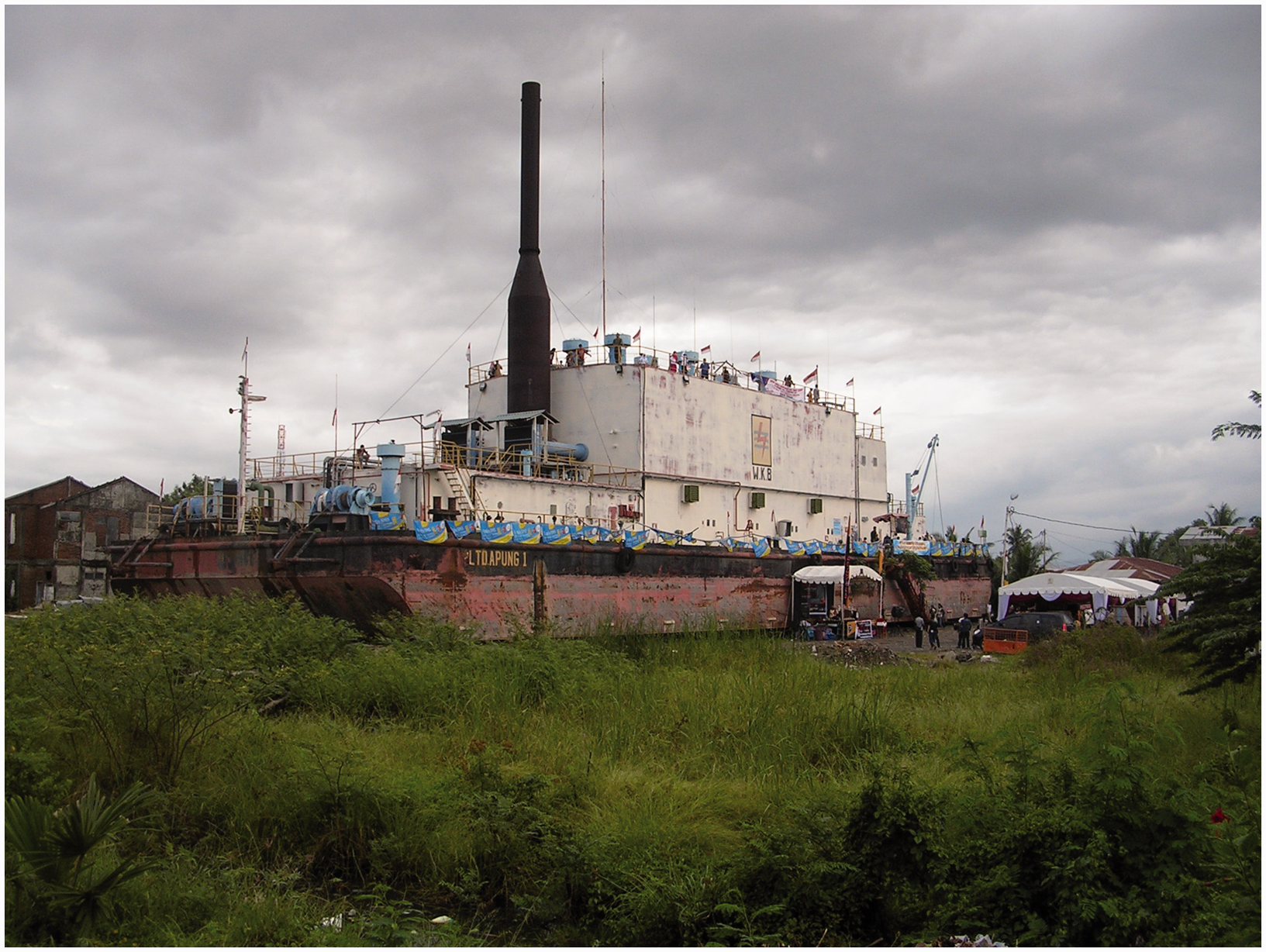
The smaller of the famous boats had landed on the second level of a home in Lampulo (Figure 2). It was precariously reinforced with wooden beams towards improving stability in situ in 2007, and later stabilized with concrete supports. One of the partial walls of the house on which it stands reads, in graffiti: ‘Don’t broken. Tsunami Minggu 26 Des 2004, jam 8:27’, a caption that marks the exact moment in time when the boat became more than a boat, and also defined the space of the boat as a valuable object to be distinguished, and eventually protected, from the rest of the rubble. By 2008, a new monolith featuring a copper plaque was placed in front of the same wall with graffiti. It explained in Acehnese, Indonesian and English: ‘This fishing boat is located here after being carried by the force of the tsunami on 26 December 2004. The boat's current position is a very real symbol of the mighty force of the tsunami's wave. The boat saved 59 people in this incident’.
Lampulo tsunami boat in 2010 (Source: author).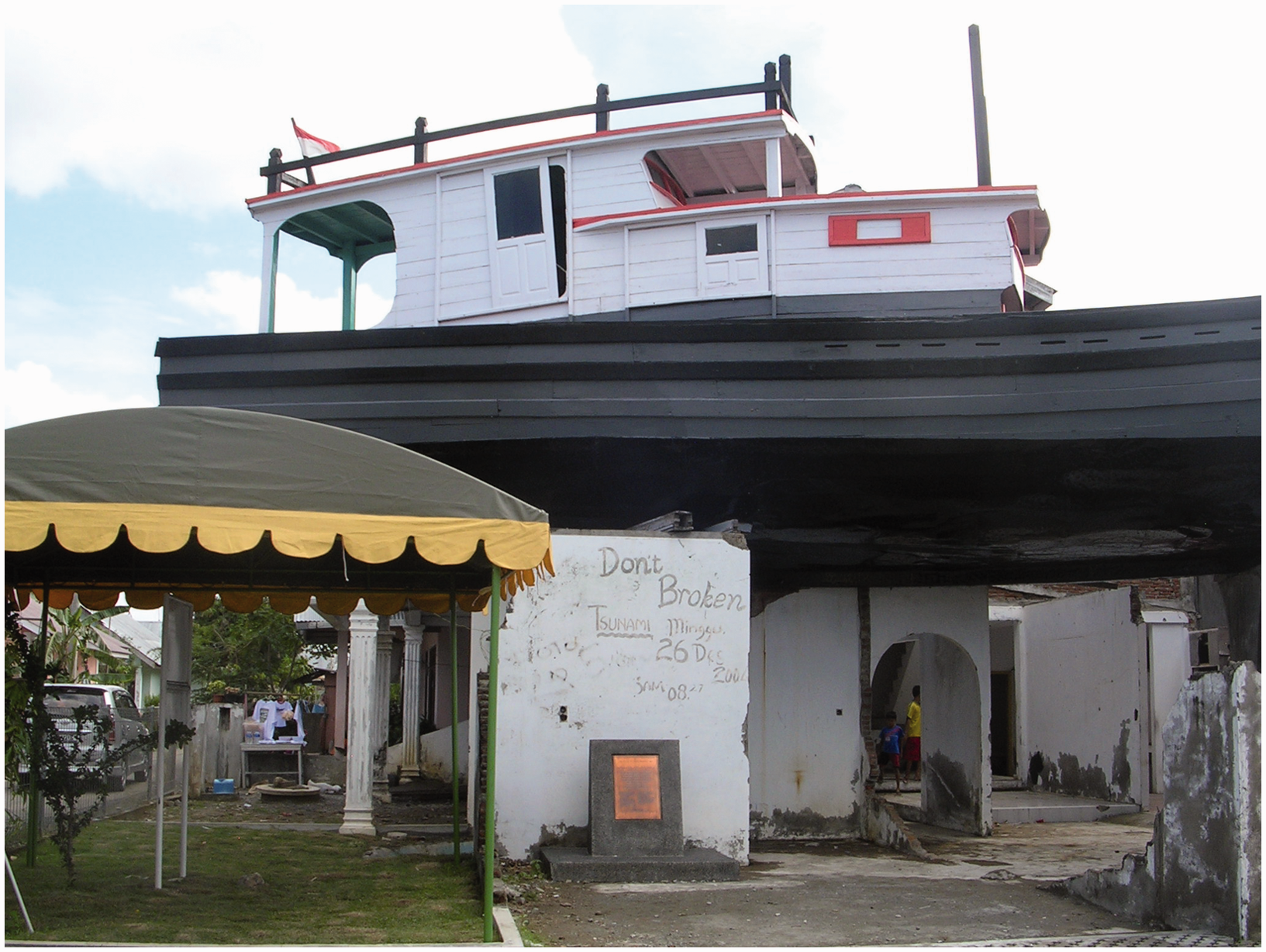
In this way, these sites were transformed into tourist and tsunami pilgrim destinations. There was not only a fence around the property to officially delineate the territory for this memorial, but the surrounding land had also been cleared and paved, including the construction of a ramp to enable the visitor to walk up to and experience the city literally from the deck of the ship. By 2009, both boats exhibited an authentic weathered look, characteristic of the unforgiving Sumatran weather. A few houses surrounding PLTD Apung 1 had become gift shops where one could buy souvenirs, a scene that was not matched anywhere else in the tourist-starved city. The access leading to this site from the main Ulee Lheue road now featured a mini boat statue marking the entrance to the site and rebranding the character of a neighborhood. For the following years, these sites would show signs of age, but also signs of dedicated preservation and maintenance applied to them, progressively reinforcing their heritage significance through these simple practices.
Although the enduring presence of the boat-ruin could have been interpreted as a failure to reorganize the post-tsunami landscape, it represents in fact the strength of a collective local narrative of the disaster, embedded with nostalgia for a lost livelihood and lifestyle as it is contrasted with the vast number of fishing boats destroyed in the tsunami. My colleague saw the significance of the tsunami boats in Aceh as the perfect example of Aceh's unique interpretation of heritage, particularly as they challenged the dominant interpretation of heritage value that permeated throughout Indonesia, one that relies on a chronological determinism that only assigns heritage value to material culture of a certain age, as is frequently the case with heritage constructs. He often said that the boats should be one of the wonders of the world, likening them to a sort of Noah's ark. Regardless of their undeniable uniqueness, we both agreed that it was unlikely, if not impossible, for the current global heritage discourse, focused on a loss of times past, to acknowledge the heritage status of a recently created heritage place.
It is not clear whether current global heritage discourses are able or will ever be able to legitimize the heritage that this moment in Aceh is recommending for preservation, primarily due to the strict ageism that this framework espouses and promotes. My colleague had experienced this obstacle first hand, when a year after the tsunami struck Aceh he was invited to speak in front of Comisi Sepuluh (Ten Commissions) in Jakarta, on the matter of a new undang-undang (law) for heritage. With the development of a restored image for Aceh in mind, he protested against the national definition of heritage that operates within a boundary of 50 years to date, which is quite a typical chronological benchmark for national legislation. As he pointed out at the time of this presentation, PLTD Apung 1 was already in dire need of preservation, as it may not survive another 49 years. That is a long time to wait for legislation to legitimize the site as having heritage value. The heritage trails project that he spearheaded, therefore, aimed to break away from these problematic restrictions, proposing to blur typologies and chronologies into one ensemble of heritage significance. The boats also provide an opportunity to observe the practices that act as indicators of growing heritage significance, that is, management strategies and conservation planning that constitute key instruments of the construction of heritage value.
Discussion
In conservation debates of the early 20th century, Alois Riegl aimed to emphasize the difference between deliberate and unintentional monuments bestowed with commemorative values. Because commemorative values in deliberate monuments were seen as dictated by their makers, Riegl argued that the fundamental requirement of these monuments is restoration (Riegl, 1996). Unintentional monuments, in opposition, were discussed as inferior as they were the result of invention. The study of post-disaster monuments and how they acquire heritage value reveals how far the expert heritage discourse has come since then, as it acknowledges different processes of heritage-making at different stages in history. Less work has been put towards the study of specific processes of construction of heritage, and in this absence post-disaster, like post-conflict, heritage developments offer an opportunity to witness the interplay of destruction and construction, contexts in which the idea of ‘heritage at risk’ is often deployed.
The critique of a dominant heritage discourse proposes to address heritage discourse as a phenomenon of cultural and historical practices worthy of analysis and enquiry in and of itself (Smith, 2007), and considers heritage as a cultural tool that can facilitate, but is not necessarily vital for, this process (Smith, 2006: 44). An anti-hegemonic framework sustains that heritage discourse is shaped by sets of practices that are constantly in conversation with each other and therefore enjoy significant fluidity. This paper argues that it is within this theoretical context that the study of post-disaster heritage should be debated, as a temporally and spatially situated practice that goes beyond the disciplinary imagination of heritage as an endangered species. Discussions in this paper aimed to present, on one hand, the global and globally informed efforts at addressing post-disaster heritage with a focus on a ‘heritage at risk’ model, as it is created and spread through disciplinary and institutional practices, and on the other, the localized emerging heritage approaches in Aceh that challenge the validity of these established frameworks in specific ways. This paper argues that the predominance of the ‘heritage at risk’ emphasis in all aspects of heritage management conceals a much more productive line of inquiry that focuses on the mechanisms through which the perceptions and constructions of locally informed ideas of heritage are brought to fruition and protected, through the formalization of local heritage concepts and networks.
This paper suggests that the role of emerging spaces of cultural heritage value in Aceh goes beyond a search for aesthetic or historical legitimacy. A city that has since been referred to as ‘the tsunami city’ overlays the catastrophic effects of a natural phenomenon over an existing yet mostly invisible landscape of conflict, both of which speak of a strong theme of resilience and adaptation in Acehnese identity. The heritage of disaster is not only bestowed with the responsibility of reconciling the past and present in Acehnese history, but its survival should also be seen as necessary for the perpetuation of a widespread disaster awareness. It is therefore important to consider the shortcomings of embracing fully a ‘heritage at risk’ framework that refutes the role of risk and vulnerabilities in shaping heritage value, as these can be quintessential to the construction of value of certain forms of heritage.
As described in a report from the Badan Rehabilitasi dan Rekonstruksi (BRR) NAD-Nias, the Agency for the Rehabilitation and Reconstruction of Aceh and Nias, in December 2005, the tsunami is a ‘virtuous circle’ (BRR, 2005: 15): it can be seen as an event that created an opportunity for peace, a peace that is strengthened by a reconstruction effort that brings the entire community together to plan for their future. Reconstruction processes operate within a delicate balance between past and future imaginations and expectations. On one hand, reconstruction can be criticized for focusing excessively on a mission of improvement, contributing to the marginalization of past forms of livelihood, style and traditional practice, as has already been discussed in reference to BRR's own ‘Build Back Better’ program (Daly and Rahmayati, 2012). But on the other hand, a reconstruction process that aims to erase a destructive event by hoping to return to a pure pre-disaster landscape and livelihood may fail to contribute to disaster mitigation strategies, which require a preservation of knowledge about the threat and an effective transmission of this knowledge, as pointed out in post-tsunami research as well (McAdoo et al., 2006). Emerging or damaged cultural heritage in this case has a unique opportunity to perform not simply as a victim, but as a witness and key interlocutor of a historical turning point.
This challenge under discussion here speaks of an epistemic issue in heritage-related methodologies that construct heritage as a category globally and locally. The dominant heritage discourse and its methodologies still take as a point of departure the assumption that heritage already exists and has been readily and consensually identified. As this approach leaves the voice of the expert unchallenged, the methods used would therefore struggle to identify and incorporate new interpretations of heritage constructs by making constant reference to a previous interpretation of heritage value that may or may not hold relevance at the time, or in a specific context. In a context of post-disaster cultural heritage management, this challenge becomes crucial, as recent historical events and post-disaster identities that may be attached or are in the process of being attached to reconstructed landscapes are key avenues for localized post-disaster heritage debates. Moreover, the re-imaginations of cultural heritage as integral for the manifestation and operation of a ‘culture of disaster’ (Bankoff, 2003: 3) should be considered, as hazards and disasters become accepted or naturalized, historically situated, and remembered. It then remains to be further discussed whether heritage can ever be constructed separately from its state of ongoing and inevitable decay, considering the mobility of heritage value as it is able to migrate in and out of a state of tangibility. The debate presented in this paper asks that risk be considered as a fluctuating and constructive force (Rico, forthcoming), especially considering the role of risk perceptions in the project of modernity that informs modern heritage constructs and related practices (see Harrison, 2012).
Footnotes
Acknowledgements
I am grateful to my colleagues in Banda Aceh, Yenny Rahmayati and Kamal Arif, for their support and generosity throughout the fieldwork stages of this project. Moreover, Lynn Meskell at Stanford University provided valuable feedback at different stages of this manuscript. Finally, I thank the peer reviewers assigned to this manuscript, who contributed their time and expertise to make this a better piece of work through their comments.