



Abstract
In this article, we ask, how does the materiality of sound drive the affective experience of musical taste making? We answer this question with ethnographic data collected in the context of electronic dance music (EDM). Prior research has explored the role of cultural intermediaries, consumers’ identity work, and status marking in taste regimes and taste-making. It has examined taste formation primarily at the meso level of product categories. We further these insights by foregrounding the relational and performative features of material agency within taste making at a more micro-level. Building on actor-network theory, our investigation shows how things’ sensual capacities explicates the mediating role of materiality unfolding within a nested assemblage, with each phase illustrating a succession of material mediations facilitating the qualification of cultural products. By doing so, we provide an understanding of the role of materiality in taste making, that is, bridging the production and consumption of cultural products.
Keywords
Introduction
Research on taste making has largely focused on cultural intermediaries’ role in bridging the gap between the production of goods (supply) and the consumption of meaningful products (demand) (Cayla and Eckhardt 2008; Ferreira and Scaraboto 2016; Maciel and Wallendorf 2017; Pomiès and Arsel 2023; Smith Maguire 2010). This study shifts the focus towards the role of material agents in taste making through the assemblage theory concept of translation, which considers how relationships between material agents may “qualify” objects (Callon et al., 2002; Ferreira and Scaraboto, 2016; Morris, 2015) and simultaneously alter consumers’ taste. We acknowledge human influence and accept Hennion's (2007, 98) assertion that taste is a “collective technique” and accomplishment, but this research focuses on material agents and situations in which goods become “qualified,” that is, tasteful objects of consumer desire through object agency (Callon et al., 2002; Ferreira and Scaraboto, 2016; Morris, 2015). Consequently, the research question is: how does the materiality of sound drive the affective experience of musical taste making?
This research employs ethnographic data collected in the context of the electronic dance music (EDM) scene (Peterson and Bennett, 2004) to demonstrate how translation through a succession of socio-technical assemblages qualifies meaningful cultural products, with vinyl records as the exemplar. The analysis highlights how things and affect act as mediators, transforming vinyl records into meaningful, marketable cultural products. At the micro level, this qualification is taste making.
This article makes several contributions to research. Firstly, prior cultural intermediary research emphasizes discourses and discursive strategies in shaping cultural products’ meaning. By contrast, this study focuses on translation, a network process by which objects’ status changes, thus offering a material perspective on taste making on a micro level.
Second, Bourdieu’s theoretical tenets emphasize the agentic human body as a carrier of practices, it backgrounds objects’ sensual capacities to affect consumers (Rocamora, 2002). In contrast, this study shows objects sensual capacities are integral to taste making, including those involving cultural intermediaries.
Third, this research differs from prior studies which analyze the emergence of taste at a meso level for a product category like barista coffee or craft beer, or a product type like “ugly” sneakers. By underscoring material mediation in cultural production processes, we show how tasteful cultural products are qualified at a micro level through a succession of dynamic, affecting socio-technical assemblages. A dance club and DJ events are two key socio-technical assemblages through which products are qualified and taste made. This unique, dynamic, nested, and contingent perspective on taste making at the micro level through translation perhaps corrects a linear bias in some ANT work (Entwistle, 2006).
Lastly, this research contributes to consumer culture research by integrating affect into actor-network theory (ANT). In ANT, translation describes changes in assemblages through the interaction of heterogeneous actors, influencing their meanings and order (Callon 1986; Law 1999, 2008; Müller, 2015). By merging the concept of affect (Reckwitz, 2016) with translation, we better account for the impact of unexpected events on the shaping of cultural products.
Taste making
Our focus is taste making, a concept largely shaped by Bourdieusian theory. Bourdieusian-informed works provide accounts of cultural intermediaries’ roles and influence over taste and market dynamics in various cultural contexts (Dolbec and Fischer, 2015; Maciel and Wallendorf, 2017; McQuarrie et al., 2013; Picaud, 2022; Pomiès and Arsel, 2023; Skov, 2002; Smith Maguire, 2010, 2013). These works emphasize how cultural intermediaries deploy cultural capital (or cultural competence) to transform markets (Diaz Ruiz and Makkar, 2021; Maciel and Fischer, 2020). For example, Pomiès and Arsel (2023) show how baristas have contributed to the diversification of the French coffee market by attracting culturally omnivorous consumers to aesthetically redefined coffee consumption. Prior research shows how these intermediaries drive various consumer markets at a meso level. This perspective attributes agency primarily to human intermediaries in cultural production.
Some research does emphasize materiality in taste making, complementing the focus on cultural intermediaries. In this view, “materiality involves exploring the dialectic of people and things, engaging with the material world as a dynamic entity that influences human behavior and practices” (Mardon and Belk, 2018: 544). This corpus highlights the collective nature of taste formation. This research examines key objects like MP3 players (Magaudda, 2011), cassette tapes (Duester and Bennett, 2023), music-curating technologies like algorithms (Morris, 2015), fancy plastic shoes (Ferreira and Scaraboto, 2016), or designer trainers (Zanette et al., 2022), showing how formats and objects’ forms shape consumer taste and practices.
We extend prior work by flipping the predominant perspective to show how goods acquire the qualities that make them desirable products (Callon et al., 2002: 197). Consumer products have a “biography” (Kopytoff, 1986), of which one process is the qualification through taste making, for example. Thus, we foreground material agency in the process of product qualification (Morris, 2015), shifting away from the focus on human agency (consumer identity, meaning-making, status signalling, or market creation) in prior research.
Materiality and cultural production
In the Bourdieusian view, cultural products are largely seen as symbols of status, but as Rocamora (2002: 343) notes, “Bourdieu’s work has…shown some difficulties overcoming its fixation on status differentiation and on the role of objects as signs.” Thus, this approach overlooks the material mediations and their role within a broader network of actors shaping the outcome of cultural intermediary work.
Moor (2012: 565) asserts, “non-human and/or material forms of agency can be just as significant contributors to ‘intermediary’ or mediating activities as human ones, and that they should be acknowledged as such.” (See also Morris, 2015). Similarly, consistent with Ferreira and Scaraboto (2016, 195), objects should be recognized for their capacity to elicit affect, which we posit precedes taste making. In this way, Woodward (2011: 367) sees materiality as an unfolding sequence of material engagements that allows “strong links between embodied practices, imagination, and emotion [affect].” In this view, material mediations create beliefs, and some of those beliefs are preferences (Hennion, 2007: 98).
Some things decisively shape (and limit) the way goods are qualified as cultural products. For example, Entwistle (2006) demonstrates how garments’ materiality mediates their qualification in fashion buyers and sales representatives’ interactions. Similarly, Goulding and Derbaix (2019) argue that the spatial affordances of vintage record shops (along with market professionals’ scene-specific cultural capital) mediate the qualification of vinyl records’ authenticity. Morris (2015) argues for a decisive role of algorithms in qualifying music recommendations. These works focus on material influences on acquisition and value-creating practices. They do not address taste making at the micro level as we do.
Consumer research has recognized the agency of things (Akdevelioglu et al., 2022; Butt and Ahmad, 2023; da Silveira et al., 2022; Morris, 2015; Santana and Botelho, 2019; Valtonen and Närvänen, 2015). Ferreira and Scaraboto (2016) and Zanette et al. (2022) examine how material interactions, driven by strong emotional responses to the “ugly shoe” and Melissa plastic shoes, respectively, afford the transformation of these commercial goods into desired consumer products. These works show “direct contact with things, uncertainty of sensations, methods and techniques used to become sensitive to, and to feel the feeling of, the object...produce the [fetishistic] collective belief that what is preferable” lies in these objects (Hennion, 2007, 98). Nevertheless, the predominant focus in these papers is on consumer identity work. Similarly, Karakayali, Kostem and Galip (2018) show consumers’ interaction with online music recommendation algorithms enters into their self-cultivation practices.
Some literature suggests that affectively charged events, disruptive of routine may activate material affordances in qualifying cultural products (Cronin, 2004). Examples include beer tastings (Maciel and Wallendorf, 2017), barista contests (Pomiès and Arsel, 2023), or targeted musical performances (Picaud, 2022). However, these studies focus on the meso-level events that legitimize product categories, rather than on events that shift the qualification of cultural products within those categories, as we do.
Actor-network theory
Actor-Network Theory (ANT) provides a framework to emphasize material mediation alongside human agency in taste-making (Giesler, 2012; Martin and Schouten, 2014). ANT is also known as the sociology of translation (Callon, 1986). Translation commences with problematization, where certain actors (things or people) emerge to define problems and establish themselves as an obligatory point of passage to a solution. The second step, interessement, aims at convincing actors they share the problem, that they are aligned to the suggested aim, that their roles in solving a problem are important, and that collective efforts will benefit everyone. The third stage of translation, enrolment, establishes the relationships between actors to resolve the problem identified in problematization and interessement. Enrolment involves the commitment of the actors to roles identified in the previous steps. The final stage of translation is mobilization, which involves actively engaging actors within the actor-network to work toward the goal identified in problematization.
Pertinent to micro-level changes in taste, Latour (1994) views translation in terms of displacements and changes in quality as an object moves through an actor-network, generating new relations that modify the actors involved. ANT explains how actors (people and things) interact to produce or transform an assemblage, such as a cultural field like EDM, and divulges how the generative effects of those relationships shape cultural products (Giesler 2012; Law 1999). Like Hennion (2007), Magaudda (2011: 21) notes that change in materiality inside a specific assemblage is contingent and, to some degree, an unpredictable process, where elements constituting the assemblage constantly influence each other.
Translation can occur at different scales of observation. From an ANT perspective, the emergence of cassette or vinyl enthusiasts, plus-sized models, craft-beer brewers, and professional baristas, the cultural products they promote, and the consumers who appreciate the (novel) qualified cultural products are all the assemblage outcome of meso-level translation (Duester and Bennett 2023; Goulding and Derbaix, 2019; Maciel and Wallendorf 2016; Pomiès and Arsel 2023; Scaraboto and Fischer 2013).
We examine the translation of cultural products at a micro-scale. In this translation process, we view DJing events as a nested assemblage that affords product qualification. Unlike prior studies focusing on a single plane of taste formation for “authentic vinyl,” “ugly” or plastic designer shoes, our findings show how assemblages are composed of dynamically linked translation chains.
While ANT often overlooks the sensory aspects of translation contexts (Müller and Schurr, 2016), Callon (1986: 26) notes that interessement and enrolment may be achieved through affective “seduction,” clearly the aim of the music promoters Picaud (2022) describes, and the action of Melissa shoes on consumers (Ferreira and Scaraboto, 2016). However, the possibility for actors to become aligned through forces such as pleasure or desire has been largely neglected in ANT scholarship (Hill et al., 2014; Newton, 2007). This is an oversight in studies of translation because affect and emotion are powerful motivating forces in consumption (Kuruoğlu and Ger, 2015; Reckwitz, 2016).
To overcome this shortcoming, we combine ANT with elements from other branches of assemblage theorizing, particularly embodied affect (Hill et al., 2014; Müller and Schurr, 2016). Affects shape experiences by influencing bodily sensations and interactions beyond conscious cognitive representations. Affect contributes to the production of spatial atmospheres (Rokka et al., 2025) and mediates the formation of socio-material relations, bringing them together through desire. As a productive force, affect shapes encounters and configurations within a cultural system (Müller and Schurr, 2016), guiding attention towards certain people, objects, or ideas (Reckwitz, 2016). In expressive aesthetic fields like music, musical objects and sound sequences generate affect which cultural intermediaries employ them to accomplish their cultural production goals (Venkatesh and Meamber, 2006). However, at the same time, as Reckwitz (2016) maintains, objects serve as “symbolic-imaginary affect generators,” meaning that they evoke emotions and imaginations that transcend the immediate context or human intermediaries’ intent. In this sense, we investigate affect as an “animate circuit that conducts force and maps connections and disjunctures” (Stewart, 2007), linking clubbing practices with those of product qualification.
Affect brings an embodied dimension to translation processes and helps explicate how relationships between actors are sustained, challenged, or transformed through affective forces circulating within an actor-network. Problematization is not necessarily first experienced as a calculative, clearly formulated demand (Müller and Schurr, 2016) but as an inchoate desire. Affect sometimes stimulates problematization, foregrounding the absence of what could be, which, in turn, stimulates the affective capacity to fill that absence. Affect helps frame a problem by generating an emotional, embodied response. For example, the surge of excitement from a musical track can spark clubbers’ interest and influence how the problem stimulates translation.
As mentioned, affect also manifests as a seductive force in generating relationships during interessement stages, driving “assembling, however without relying on larger structural forces” (Müller and Schurr, 2016: 224). Affect interests actors by fuelling the enthusiasm DJs feel when engaging with DJ equipment or when clubbers discover a novel track. For the latter, this affectual resonance encourages actors to adopt a new role (see below), beyond the one assigned by the event organizers.
Similarly, mobilization occurs when the affective intensities within the club resonate with clubgoers’ desires and identities, granting legitimacy and power to its organizers. At the same time, however, micro-events or disruptions can bifurcate mobilization - one aligned with the clubbing experience, and another with product qualification.
The EDM scene and Helsinki’s underground dance music culture
Electronic Dance Music is a cultural space in which diverse musical practices coexist, interact, and unfold in multiple ways (Peterson and Bennett, 2004: 1). Originating as an underground subculture in the late 1970s, EDM became mainstream in the late 1990s. This evolution led to two sub-scenes: the underground scene(s) of small-scale production, and the mainstream scene of large-scale production. Rooted in counterculture, the underground EMD scene views the mainstream as straying from its authentic values. This has led the underground to re-imagine itself as a boutique club movement (Goulding et al., 2009, 2013), emphasizing curated DJing programs and sound at the core of its cultural production and positioning against the low-quality digital music files and music practices of the Napster era (Giesler, 2008).
Helsinki’s underground EDM scene is one of the pioneers in this cultural move (Arsel and Thompson, 2011; Corciolani et al., 2020; Thornton, 1996). Originating in the 1990s with boutique bars, clubs, and record stores, the scene was influenced by DJ T, who founded club KAIKU over a decade ago. Inspired by the legendary Loft parties of New York City during the late 70s and early 80s, DJ T established this sonic environment emphasizing music curation, high-end sound systems, and analogue DJ gear. Today, Helsinki’s underground EDM remains vibrant, with multiple stakeholders shaping its direction.
Methodology
We adopt an ethnographic approach informed by ANT (Arnould and Wallendorf, 1994; Baiocchi et al., 2013; Kozinets, 2002). ANT views meanings and uses of consumption resources as the “continuously generated effect of the webs of relations within which they are located” (Canniford and Shankar, 2013: 1053). Since this approach emphasizes material agency in cultural production (Moor, 2012), the ethnographer’s role is to ‘follow an object’ or actors in their interactions (Bennett, 2010; Latour, 2006). This entails “cultivated, patient, sensory attentiveness to nonhuman forces operating outside the human body” Bennett (2010: xiv).
Our ethnographic fieldwork took place from 2016 to 2019 in and in Helsinki’s gentrified Kallio neighborhood, centered around the “Complex Block,” (see Figure 1), this area features club KAIKU as well as other music, bar, and restaurant venues. The complex block—in the picture: club KAIKU.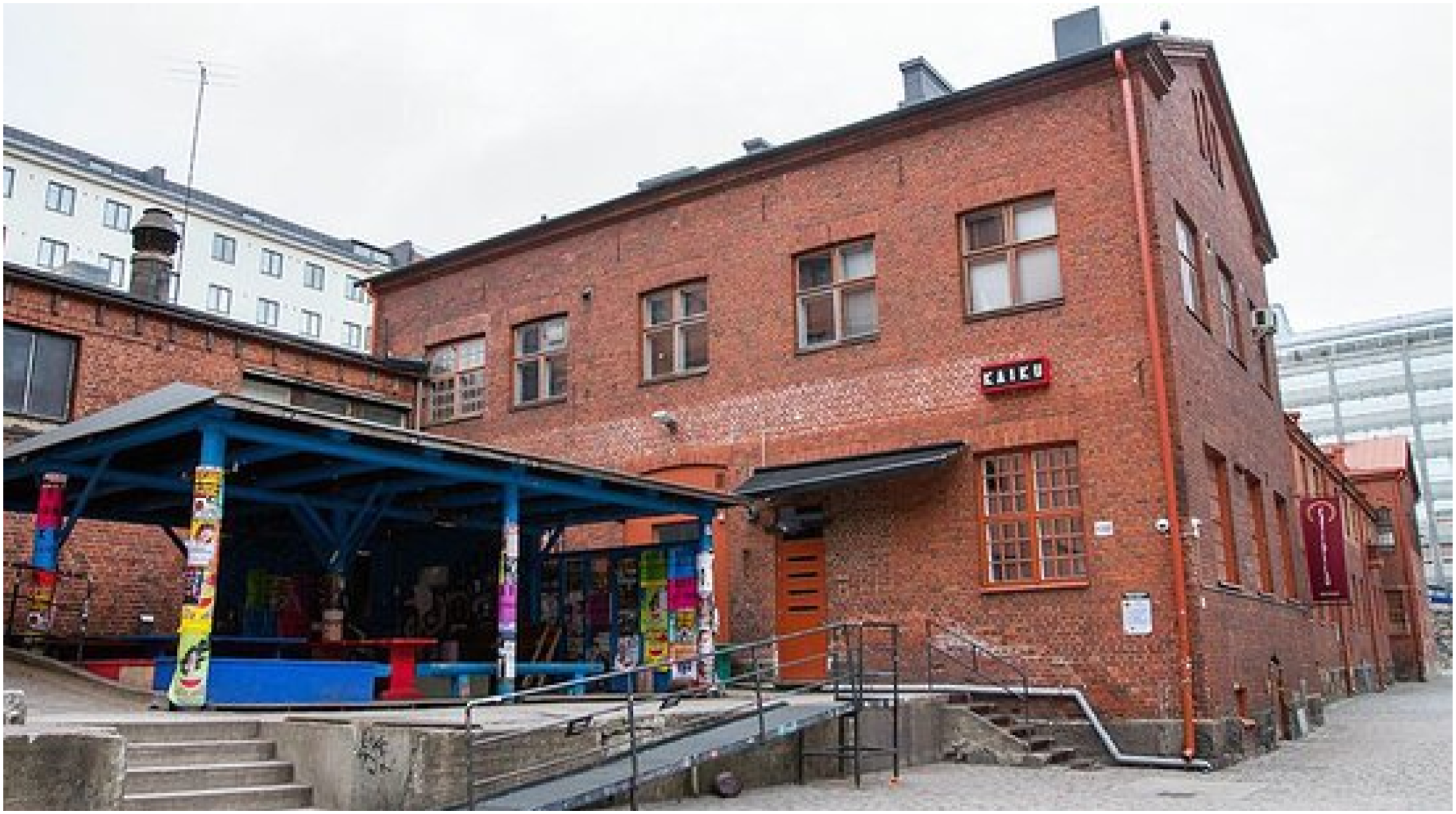
An overview of the data.
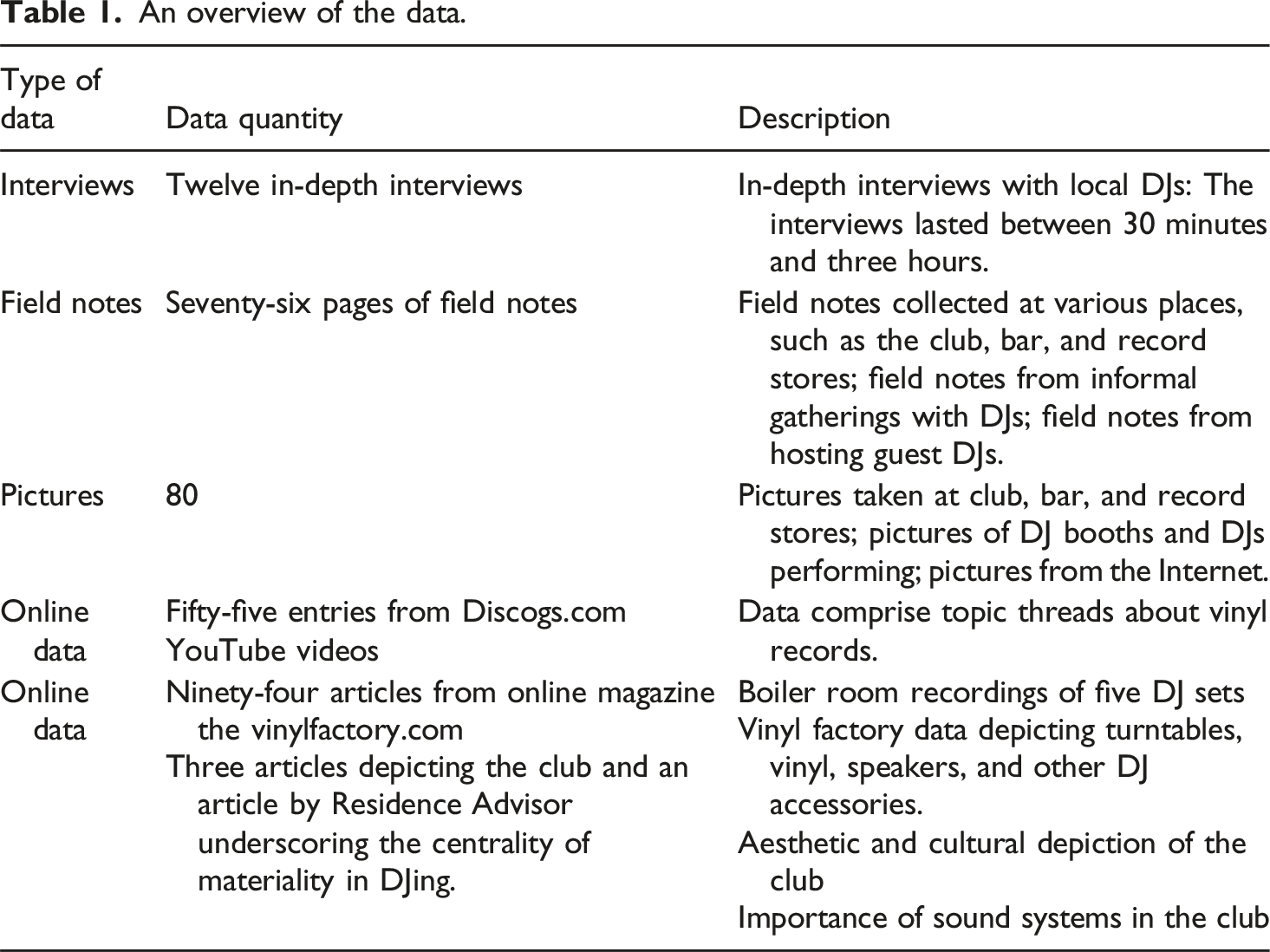
To structure the translation process derived from our ethnographic work, we divide our analysis into two phases: behind-the-scenes translation and manifest-scene translation. Through long interviews and prolonged engagement with the club’s owner and promoters—all practicing DJs— we interrogated the intricacies of organizing DJ events. We aimed to understand the role of materiality in DJ event planning. The first author hosted guest DJs during this fieldwork, giving us access to a key moment: the “sound check.” Observing sound checks offered insights into how material elements mediate taste in the clubbing experience.
The manifest scene data came from participant observation in the club, with a focus on the DJ gig, which we conceptualize as an eventful event loaded with emotional energy (Winnicott, 1971), capable of sparking affect. These affectual moments animate socio-material relations that drive translation, i.e., circulation, and the qualification of musical cultural products. We observed how affect not only brings to life social hierarchies among DJs but central to our investigation, triggers qualification processes for the tracks DJs play.
Overview of interview participants.
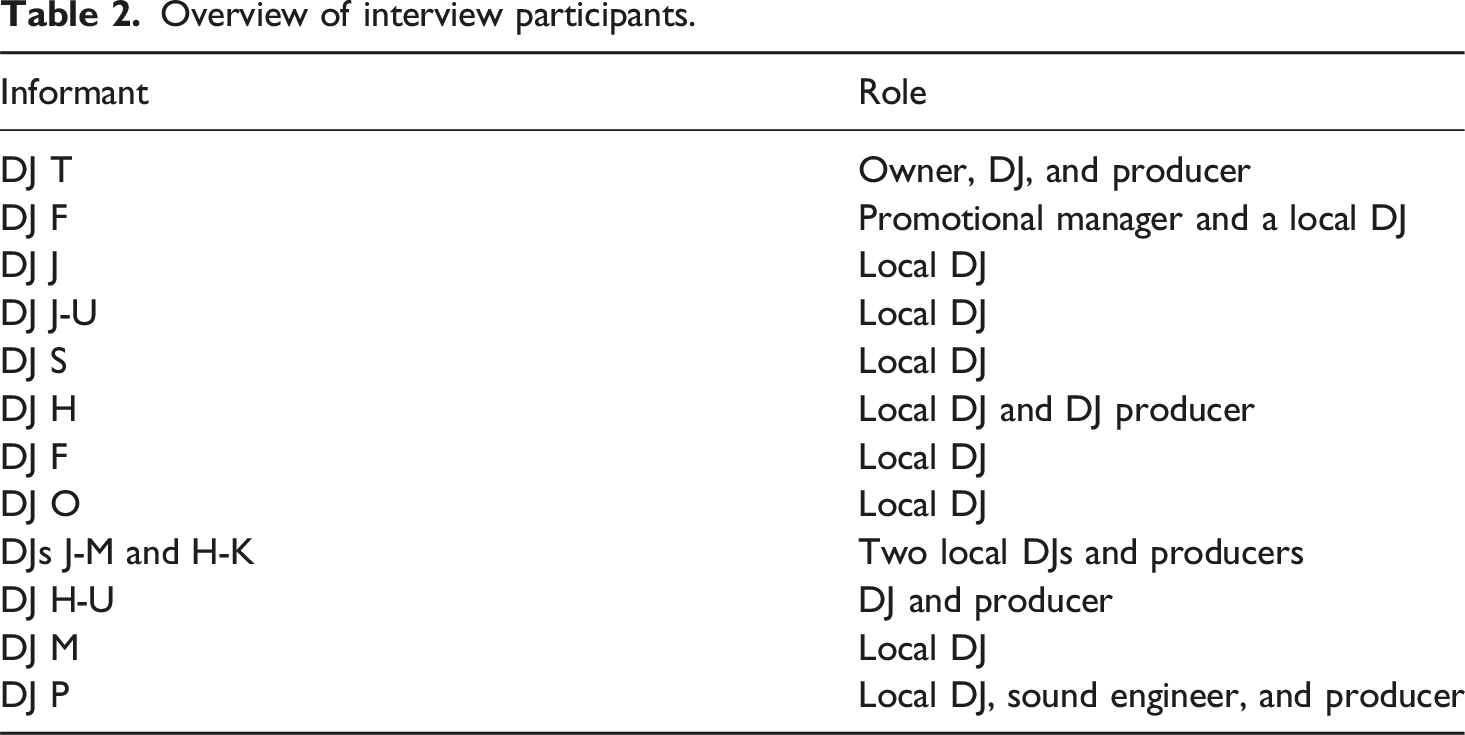
The first author, a vocational DJ, brought insider insights into the DJ club culture and market dynamics (Hietanen and Rokka, 2015). The second author evaluated the findings and solved coding disputes. Per assemblage theorizing tenets (Latour, 2006), we engaged in iterative coding and story construction (Parmentier and Fischer, 2015). As our research question evolved, the focus shifted from cultural intermediaries to material actors, which became central to qualification in this cultural production process. Next, we describe the phases of this process that emerged from our analysis.
Materiality in cultural production
We demonstrate that underground EDM culture involves translation process where both sonic material and DJs act as mediators. Echoing Cronin’s (2004) notion of “regimes of mediation” and Callon et al.’s. (2002) notion of qualification, these phases translate a good—one of many records or musical tracks—into a desirable, tasteful cultural product, thereby modifying the EDM taste regime.
Behind-the-scenes translation: Assembling actors
Following Latour (2006), the behind-the-scenes phase acts as an oligopticon–a center of distributed governance and material potential. It sets the context for aesthetic problematization, material potentiality, and identifies the actors necessary for interessement and enrolment. Like the aesthetic discrimination practices in other indie consumption scenes (Arsel and Thompson, 2011), crucial to KAIKU’s status and competence as oligopticon is the problematization of other clubs as deficient regarding a desired sonic ecology (Bartmanski and Woodward, 2015, 2018). At KAIKU, this process entails underscoring the club’s superior sonic quality and curation programs relative to other clubs. KAIKU claims this cultural competence via its commitment to the underground EDM ethos, premium sound quality, and rejection of the large-scale, impersonal aesthetics of mainstream clubs (Goulding et al., 2009). To the discerning eye, all this is embedded in the minimalist layout of KAIKU (Figure 2). The Interior layout of club KAIKU. Photo credit: Maija Astikainen.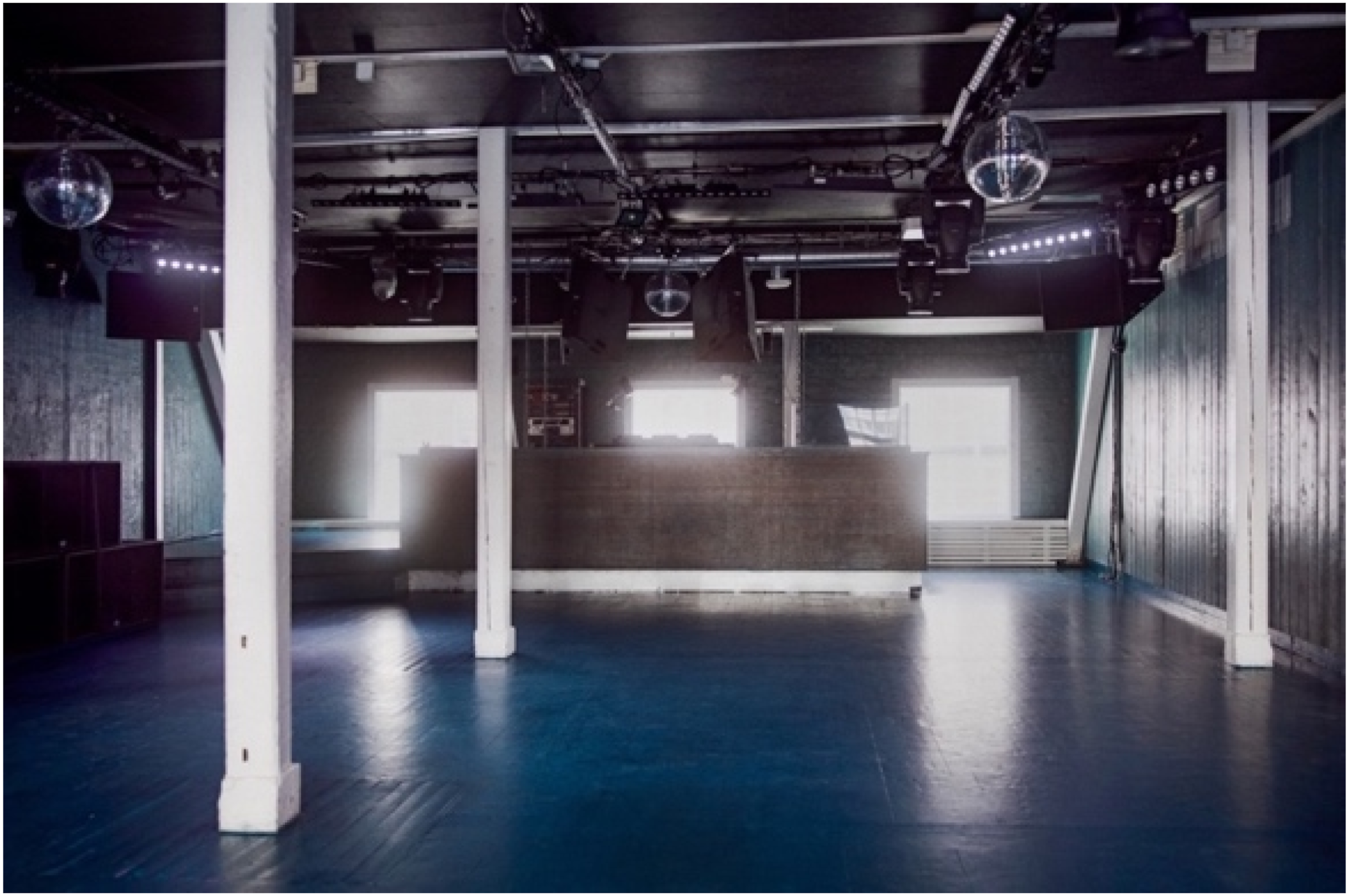
KAIKU’s sonic ecology is the material means through which aesthetic problematization occurs. DJ T underscores the pivotal role of the club’s sound system in fostering immersive sonic experiences and engaging audiences (Bartmanski and Woodward 2015, 2018) in recounting the club’s history: A super good sound system became standard in all our places. It is still different from any other clubs here. We spend too much money on systems. […] So, it is better to invest and I think when I play with a good sound system I can really play stuff that I love cause you can tweak out the bass. If you have a bad system you play mainly for the heads, what you hear, but when you have a good system you can play deep bass stuff and it’s the most important thing for underground music to have a good system and a good mixer and everything, and the acoustics is my main goal always. (DJ T)
DJ T emphasizes that KAIKU’s sound system is “different” from mainstream clubs, allowing enhancement of the club’s acoustic properties. This sonic materiality extends beyond discursivity into the embodied register in which consumers can not only hear but also feel the music (Patterson and Larsen, 2019), as we will see later, a prerequisite for mediating taste and product qualification. Underscoring sonic ecology, DJ T contrasts “for the heads” referring to cultural insiders, with “deep bass stuff,” which elicits affect among ordinary clubgoers.
The affect embodied in KAIKU’s sonic ecology problematizes the mainstream taste regime, while facilitating the DJs’ work and stimulating an audience, not only those with high levels of technical know-how in the EDM scene: It is much easier to play with a big system when you really know how to work with it. So, [in my clubs] I always try to put in a bigger system and amplifiers. I don't want to break people's ears, but I always try to keep it, the bass, and everything on the level that you really feel the music, you need to feel it on your body. If the system is not good, it is super hard to play your set. Because you know [the sonic quality] some records, ... you know when I play this one it will hit your chest. Or this one, it will shake your shoes. (DJ T)
DJ T emphasizes that ‘hitting your chest’ or ‘shaking your shoes’ is key to affective appeal and effective sonic mediation. Moreover, DJ T notes that the club’s sonic ecology doesn’t just amplify but also enhances the experience of musical tracks, another prerequisite for product qualification.
KAIKUS’s sound system and DJ setup play a crucial role in bringing key actors together, drawing them into the network of distributed governance. Negotiations with guest DJs often centre on the club’s “set-up”—the technical DJ gear and the sound system. The importance of the set-up to interessement is vividly highlighted in the quote below from Resident Advisor, a magazine on DJ culture, emphasizing the centrality of sound systems to performance: ”If, for instance, the sound system isn’t properly dialled in to the acoustics of the space, the performer, regardless of his or her talent, is going to sound like crap. The result is a lethargic dance floor and an angry performer who will not only expect to get paid but will never come back.” (https://ra.co/features/1095?fbclid=IwAR1YfwMOAIGvK45_xYJKYwhOaoBR2_O47Ruo50dN_JwyLDdBw1dLq47FZts).
The excerpt highlights the centrality of sonic affordances to experience, underscoring that even a DJ with superior skills and cultural capital can’t guarantee a successful party.
Given the centrality of sonic affordances to experience, we found guest DJs often request specific technical setups. An excerpt from an email exchange with DJ M’s agent (Figure 3), details the technical requirements: A guest DJ’s technical requirements.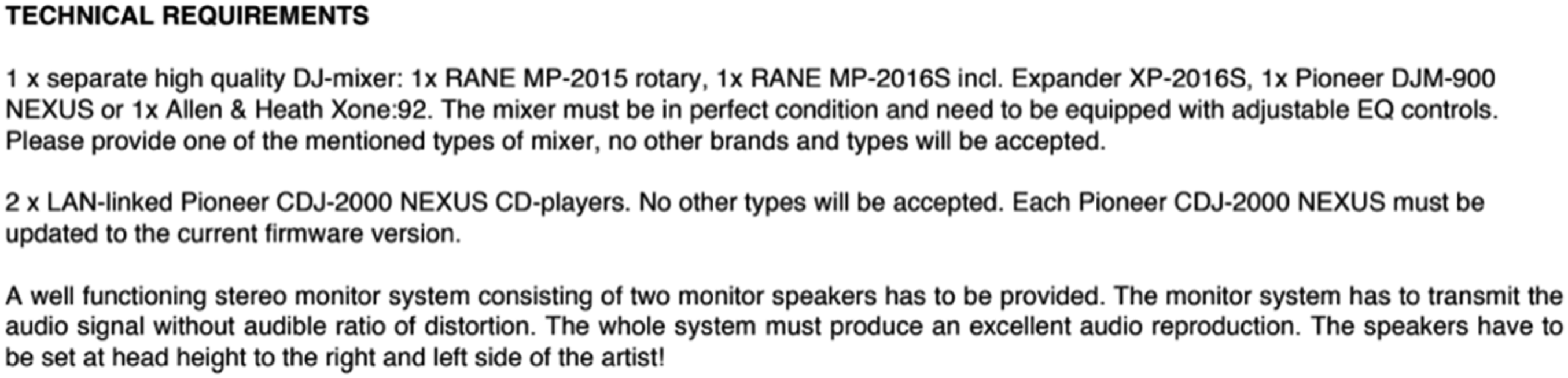
Agreement on the set-up ensures compatibility between the guest DJ and the venue and is central to fostering spatial atmospheres (Reckwitz, 2016). Figure 3 suggests the required mixers, turntables, CD players, and monitors and their precise arrangement is central to delivering a seamless DJ performance and achieving the desired sonic experience. In this phase of interessement, KAIKU seduces DJs through the material qualities of the club, such as the Danley™ sound system and top-tier analogue DJ gear pictured in Figure 2. From an ANT perspective, the “right” technical set-up is central for interessement of key actors. This material mediation is necessary for DJs to excel and commit to problematization of the mainstream, facilitating the next stage of translation: enrolment.
Behind-the-scenes activities, such as hosting and sound checking, are key for the enrolment process. Hosts are intermediaries, recruited to accompany and escort guest DJs between airports, hotels, and the club. Hosts’ conversations with guest DJs frequently focus on the materiality of the set-up and sound system, reflecting their tacit understanding that “sound is always mediated,” and that cultural meaning relies upon the material affordances of sonic ecologies (Patterson and Larsen, 2019). Guest DJs primarily ask, “How does it sound?”
After being seduced by the setup during interessement, the host’s role in enrolment is to affirm the promised sonic quality of the club through the sound check. Sound checks are always a sensuous activity though varying in length and detail. After an initial tour of the club, guest DJs are left to familiarize themselves with the set-up, checking the functionality of the mixers and the turntables. DJs using vinyl often spend considerable time on the sound check due to the significant impact of different venues’ sonic ecology on sound reproduction. DJ P, also a sound engineer at KAIKU, details this material practice: The club is made for playing vinyl. So, these kinds of settings, this kind of weight, you need to calibrate on the turntable, needle to land on the disc [vinyl record], make a lot of pressure or too little pressure, and this would also help with the problem of needle skipping which happens also when there is no correct pressure of the needle on the disc, the tonearm, especially when the turntable is not well isolated then bass frequency can make the needle jump and you would hear bass frequency going on a loop. And you don’t want that at all.
After placing a vinyl record on the turntable, DJs observe the record as it spins for a few revolutions and pay attention to tonearm adjustment and the cartridge for potential stylus damage. Imbalanced turntables frustrate vinyl DJs. Excessive tracking force can damage both the record and the stylus, while too little force can cause the stylus to skip, which they believe disrupts the musical experience. Similarly, the anti-skating knob is crucial for maintaining balance, preventing distortion and potential damage to the vinyl. DJs carefully attend to the turntable and seek to avoid these problems.
The most sensorily significant moment of the sound check is when the guest DJ plays records, adjusts the equalizer (EQ) knobs on the mixer, and walks around the dance floor to gauge how the sound system and records interact with the venue’s acoustics. In other words, the sound check is a sensory activity, an affective evaluation aimed at assessing and adjusting the sound to create a spatial atmosphere that will yield the desired auditory experience (Reckwitz, 2016). As DJ Ron Trent vividly underscores: You get out what you put in… Soundcheck, learning your craft, and staying open for communication. These are some of the keys for intention and deliverance. No shortcuts. Reflection on @djharveysgeneralstore and crew’s efforts. Building a musical room takes time and craftsmanship that most others won’t bare because of lack care and plain lack of know how, unfortunately. When you experience sound done correctly you won’t want anything else. (See the video of this manifestation in practice, https://www.instagram.com/p/C5qM-hEASmI/?fbclid=IwAR0g3TeiJFS1J4QjM_-MJLO19J94GEiO_BdWN4TdyO0HRbjnXD8D_gLF5Ns&img_index=1).
The behind-the-scenes processes highlight the crucial role of materiality in organizing club events. At this phase, material enrolment entails a process of trials and negotiations and aims at inducing material actors (speakers, turntables, cartridge and needle, tonearm, mixer) to participate as intermediaries—in the Latourian (2006) sense—in accomplishing the goal articulated in problematization, that is, enacting the underground EDM ethos and organizing a successful DJ event. As Latour (2006) underscores, actors may betray their roles defined during interessement and enrolment and thus turn from intermediaries who sustain the stability of the assemblage, into mediators who destabilize it, effectively bifurcating the outcomes of taste performances in the club.
In sum, KAIKU is a socio-technical assemblage where the material sonic ecology is crucial for problematizing actors, including other clubs, DJs, customers, and vinyl tracks. While specialized equipment is also present in contexts like coffee shops, brewery tasting rooms, and winemaking (Maciel and Wallendorf, 2017; Pomiès and Arsel, 2023; Smith Maguire, 2010), its role in problematizing taste regimes, interessement and enrolment is less documented. Next, we show how the material aspects of spaces like KAIKU enable mediation by mobilization (following problematization, interessement and enrolment) of a network of actors.
Manifest scene translation: Transformative effects of DJing events
Once the behind-the-scenes translation is set, the manifest scene is a DJ performance where clubbers dance to the music. Successful enrolment of heterogeneous actors should lead to the goal of a good party, meaning that intermediary actors contribute to the event’s success. For Latour (2006, 39), intermediaries “transport… meaning or force without transformation.” For KAIKU, mobilization results when key actors–sound system, tracks, DJs, and clubgoers—actively contribute to achieving the common goal. Figure 4 represents a successful manifest scene assemblage. Club KAIKU DJing event. Photo credit: Kristiina Mänikö.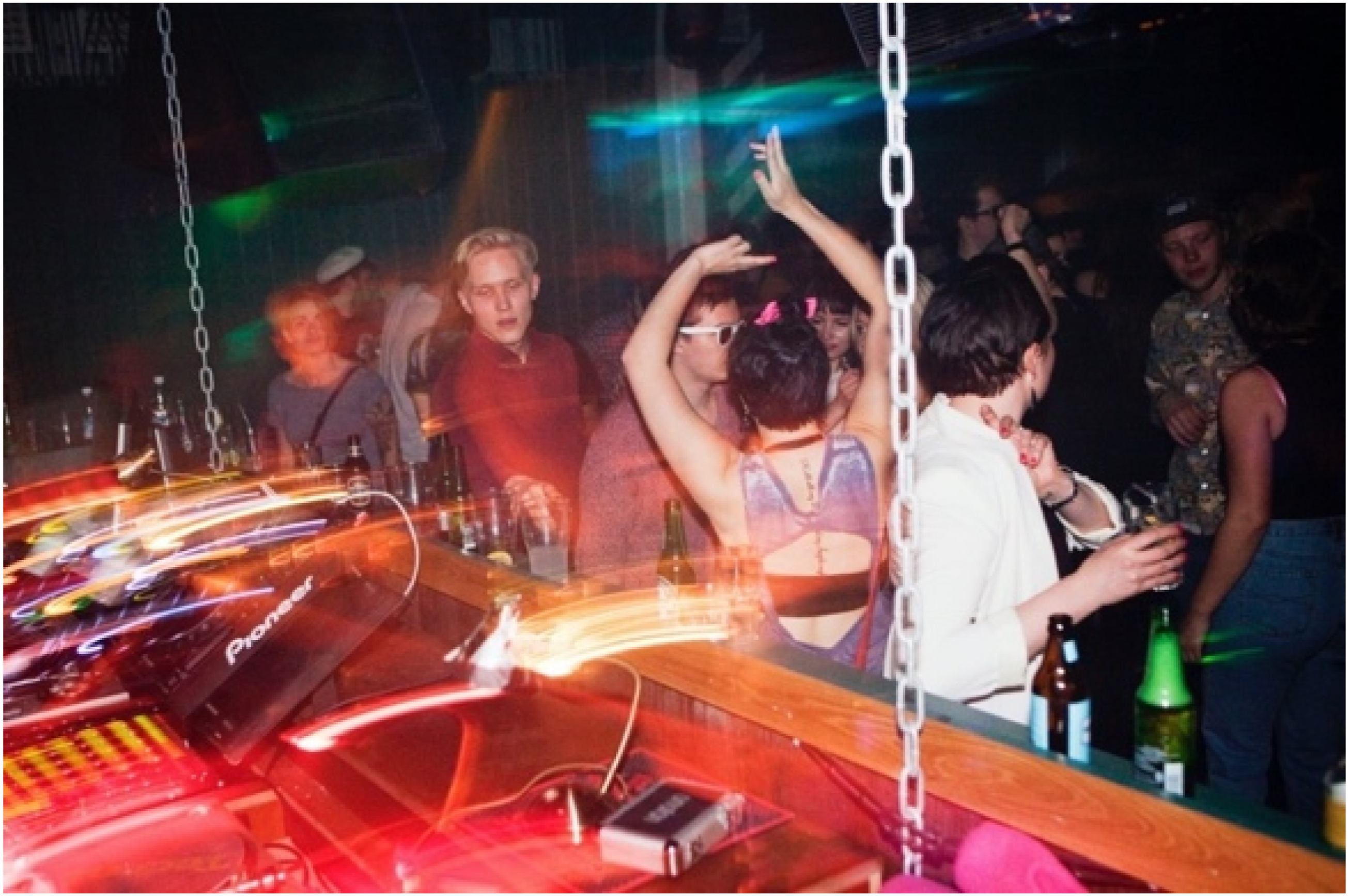
Our analysis shows that while KAIKU enrols and mobilizes DJs and material actors as intermediaries, they rarely perform in a static, predictable way. DJ events are affectively dynamic, with intermediary actors often shifting into mediators, transforming the meaning of taste performances in the club. Mediated by the club’s sonic ecology, “novel tracks” or “new finds” emerge that can elicit an affective response that problematizes the existing EDM assemblage at the micro level and provoke desire for sonic knowing. In this sense, the club’s materiality influences the DJ’s ongoing “quest for the right [track] at the right moment, for what would please in this situation, now,” (Hennion, 2004: 111). But this can lead to indeterminate effects, with outcomes contributing to subtle reconfiguration of taste. DJ F well articulates the indeterminacy of the DJ set: There are so many things that have an effect on the final path of the music. From the moment it comes from the player. The route to the speaker, there’s so much stuff in between that can have an effect. So, you cannot just say this is going to absolutely sound better. It always depends on the sound system and on the mixer and even probably acoustic [of the venue]. There are so many things that can have an effect.
The quote highlights the complex sonic relations in a successful DJ set. Similarly, DJ P emphasizes the complexity of room feedback, turntable calibration, and isolation, and emphasizes how the gear necessitates active work to prevent material betrayals. [Room] feedback is one of the biggest problems on a turntable set-up, because in a nightclub we would like to play loud. When you play loud that little microphonic effect becomes a bigger microphonic effect and especially if [the turntable] is not isolated meaning that most of the vibration would come from, eeh…, if it’s very loud it would feedback anytime, but if it is not very isolated where the turntable is standing on, then the bass frequencies would come from the table and … you start to hear feedback effect which is the same when you put a microphone near to a speaker that is connected in the same circuit. […] So … the only way that I could resolve that on the go, would be to calibrate the turntable again [while the DJ is playing], I would feel like a formula uno, formula one, when they are changing the tires very quickly I need to do it before the record finishes on the other side, I need to check if the turntable is ok… Interviewer: and you do this while the DJ is playing? Yes, because the DJ would have only two records and one record is playing and maybe at one point you start to hear a problem on that song so when the DJ mixes out to another record then it is my time to check. Ok, what is this? Is it the record, or is it that someone has moved the weight, the setting, or the turntable broke [...]. I need to check this, I need to check before the record that is playing finishes. Very fast. Make sure that you leave some time for the DJ to mix, to make a good mix, because it could be that our issue may affect the DJ performance.
DJ P highlights the fragility of the assemblage during a DJ set, framing potential material betrayal negatively. Betrayal here means the assemblage does not seamlessly play the role of intermediary actor. The latter is important given the “good party” goal of clubbing events.
During the set, DJs focus on the sonic environment, other DJs and musically invested consumers engage in “record spotting”— discovering or finding apparently or actually new musical tracks. This reflects the idea (Hennion, 2007: 105) that eventful events are characterized “by the surge of an intensified contact, provoking a shift between the self towards the object, and a shift of the object towards the self.” During our observation, we frequently observed eventful events when specific disruptive tracks in DJ sets stood out, triggering record spotting. For example, a field note highlights an affective response to sound shaped by the sonic ecology during one DJ performance: […] The guest DJ started playing at around 00:45. His first few tracks were in the same vibe as the warmup DJs. Especially the first three tracks. Soon after the third track, he drops more dancefloor tracks. Immediate Shazaming between me and DJ F to see what he is playing. I notice others around the booth doing the same thing. DJ F tells me that the sound is so much better now that the guest DJ is playing, no wonder he asked for this particular mixer [E&S 400]. Apparently, he knows the mixer very well. One could feel that the sound was better.
Thus, this excerpt shows someone is orchestrating a sequence of tracks: someone else is fiddling with the mixer in search of a “better” sound; but others feel compelled to inquire or use the Shazam app to identify an unknown track. Such moments highlight Hennion's (2007: 108–109) view that taste is “a corporeal practice, collective and instrumented, settled by methods that are discussed endlessly, oriented around the appropriate seizing upon of uncertain effects.”
The eventful event in manifest scene translation of taste is when tracks subtly problematize consumer taste expectations. For example, a fieldnote might say, “…I played this record elsewhere, and it didn’t sound like this.” Such utterances reveal the mediating role of materiality (Zanette et al., 2022), specifically Hennion’s (2007: 101) idea that taste is “a situated activity…not so pre-established: it points toward… a situation of ‘between-the-two’, the place and the moment of the uncertain upsurge of sensation.”
After encountering apparently or actually novel tracks that subtly critique the taste assemblage, interessement ensues in discussion and efforts to classify and qualify the music in terms of genre, style, and production era. For example, field notes might include: “What is this? Sounds like early 90s Chicago House … A very good 303 [analogue drum machine] baseline. I wonder who it is… Sounds familiar. Let’s Shazam it.” It is worth noting that using Shazam tends to be done discreetly. Being seen using Shazam in public can imply a lack of cultural capital related to music, which is why many DJs and music enthusiasts tend to keep it hidden in the club setting. However, discussions about the use of Shazam are quite prevalent on platforms like Discogs.com and Reddit forums. These conversations highlight a shift in how music is sought after within contemporary DJ culture. A DJ posting on Reddit would say: I’m a shameful shazammer and I think every dj is. Whether is pretending to be on the phone, tucking my iPhone between my girl or holding it to my chest. I make a playlist of songs I’ve heard on the night that I liked or got the crowd going.
This Shazam app is part of that “material equipment that permit[s] taste to deploy itself beyond the here and now of the interaction” (Hennion, 2007: 109). It is “connected with a whole reconfiguration of the materiality of listening” (Magaudda, 2011: 28) that facilitates both stabilization (through rapid assimilation to the existing taste assemblage) and destabilization (when initial assimilation fails, and requalification begins) of a taste regime.
Consumers rely on the configuration of the materiality of listening in the club to qualify records based on some previous “experience of desiring” (Ferreira and Scaraboto, 2016: 199). Shazam, now part of the manifest scene materiality, aids interessement, by helping enthusiasts to identify songs, artists, and labels—all of which are qualification cues. As Hennion (2007: 105) remarks, “there is no taste without this minimal ordering of experience that makes the experience appear… which opens a parenthesis in the course of what is happening, modifies it, orients it, makes it enter into a frame, even if all these small events are adumbrated, occurring without effort or calculation.”
Truly unfamiliar songs, which resist assimilation to the existing taste assemblage are approached differently than recognizable ones. From fieldnotes: “What is this? … It’s an Italo disco song, … I don’t know this one… may be from the early 80s, lets Shazam it, … can’t find it, … should I ask the DJ?” Such disruptive tracks prompt adjustments and reconfiguring the taste regime’s structure (Zanette et al., 2022). When Shazam fails to identify rare tracks, invested consumers often turn to the DJ for more information, reinforcing the DJ as a key mediator of taste for invested consumers,. Consider the quote by DJ J: [I]f you hear some really good track, of course, you wanna know about it. And you want to find it out. And usually, if it is something that you ask somebody, then you’ll remember that. For instance, first I heard this really good Italo [Disco] track, Evita by Coco Bill, and I remember it, was played by Intergalactic Gary, and I went to ask him you know, what was the track? This is f**** good, this is amazingly nice. And I still remember it, this is like eight years ago. So in a way is about, it could have some kinda, not almost as a status, but then you know, if you are asking from somebody, like wow, what was this track and that track, and that person, he knows. So he’s nerding out even more than you [laughter], which is awesome […].
The excerpt highlights the DJs’ role in introducing new music and how the club’s sonic ecology shapes the dance tunes that align or not with the club’s taste regime. Novel and new sounds not readily assimilable to the existing taste regime, cut through consumers’ affective register, and induce desire and curiosity, leading to “sonic knowing,” (Patterson and Larsen, 2019), where people share and discuss, or “nerd out,” over an “amazingly nice” track. Our observations reveal transformative moments in which disruptive musical tracks are qualified as desirable cultural products. The utterances above indicating “What is this, … sounds like this and that…” and other utterances, “I played this track in another place, and it did not sound like this,” or DJ T’s dissatisfaction with the sound system in other cities “even if they say it is the best system in the city, but I know that it is not possible with these speakers,” illustrates the material feedback Hennion underscores. These qualifying utterances above play a performative role and enact what Deleuze and Guattari (2013) refer to as “incorporeal transformations.” Induced by material affordances in the manifest scene assemblage, these utterances reflect shifts in bodily positions and situations in the club, prioritizing new valuations and thereby transforming taste. These moments of sonic knowing by which novel tracks (good) become desirable cultural products reflect Hennion's (2004: 136) positing evaluation as “engagement by the body that tastes.” Moments of heightened aesthetic appreciation during the DJ set transform a “clubber” into a consumer “connoisseur;” who qualifies novel tracks “in terms of abstract aesthetic properties and high levels of expertise” (Ahuvia (2005, 175). Our example of sonic knowing triggered by an affective eventful event on the dance floor shows that something beyond discourse and language is involved in taste making (McFall, 2009).
These dynamics show materiality plays a role in mediating object qualification. Groups, situations, material devices, techniques of presentations, bodies, and feedback from the experienced object drive translation in the DJ set (Hennion, 2007). The DJ set, rich in affect and eventfulness, animates the qualification of the cultural good (the track) by incorporating it in a socio-technical assemblage. Although initially stable in meaning, insofar as the DJ deems it worthy to include in the set, the track becomes a preferred cultural product as consumers evaluate, desire, and qualify it, illustrating how cultural products are dynamic processes of constant becoming (Callon et al., 2002).
Discussion
In this article, we investigate how the materiality of sound drives the affective experience of musical taste making, which we conceive as a translation process. Our analysis identifies two dynamically interlinked assemblages in which materiality-driven qualification of tasteful cultural products occurs. We demonstrate how material mediation is crucial to the development and qualification of cultural products, contributing to the concept of extended or agentic materiality (Zanette et al., 2022). In the behind-the-scenes, we show how the arrangement of the club’s extended materiality is central and affords the conditions for qualifying activities during the DJ performance. In the manifest scene, we show how materiality mediates taste performances and qualification processes in the club. We emphasize the role of affect in eventful events in transforming goods into tasteful cultural products. This understanding allows us to advance cultural intermediary and market work theory by foregrounding the role of the material in taste making. Our innovation is to frame taste making as an assemblage effect that resides in material relationships (Morris, 2015), rather than as the work of human market professionals, linking specific stakeholders to specific cultural products within a specific scene or field.
In the behind-the-scenes part of our findings, we show how certain objects become constitutive of subsequent, affectively charged, mediating events. The materiality of the club that problematizes mainstream club environments also acts to interesse and enrol local and international DJs. In turn, through the sound check in which the DJ makes subtle modifications to the setup, materiality mobilizes the club’s socio-material affordances. The club’s socio-material affordances frame musical goods as potentially desirable cultural products (Smith Maguire, 2013).
In the manifest scene phase, the DJ set becomes an eventful event where the club’s materiality prompts problematization and transformation of new and old musical tracks. The club’s socio-technic assemblage is affect conducive, foregrounds the conditional and the pre-deliberative aspects of qualification and evaluation like an immediate, reactive, and instinctual response to tracks. When the materiality affords (the right sound system and turntable cartridge and needles, for example), new music interesses and enrols consumers in redefining the new track as desirable. In other words, musical objects’ productivity within the assemblage is an outcome of material mediation. Together, our analysis of manifest and behind-the-scenes shows how sequences of mediating events are formative of a cultural product.
The club assemblage can be viewed as a recommendation system (Karakayali et al., 2017; Morris 2015). However, one difference from algorithmic systems is in the phase of mediation. The club precedes the online recommendation system. Karakayali et al. (2017) and Morris (2015) provide evidence of a further (re)qualification, another phase of qualification we might call the afterparty. Unlike Karakayali et al. (2017) and Morris (2015) we assert that taste is not shaped primarily by the dynamic between consumers and the device, i.e., the algorithm. Instead, as we have shown, it is a generative effect of heterogeneous relationships with materiality and affect, which become key drivers in shaping musical taste in the club. This is central to understanding the manifestation of demand and search processes in online recommendation systems where taste for a similar musical genre and style is further shaped by algorithmic devices.
To the cultural intermediary and market work literature, our analysis makes two specific contributions. In contrast to the perspective that shows how cultural intermediaries bridge realms of production and consumption, this research foregrounds the active role of materiality in the process of translating goods into desirable cultural products (Moor, 2012; Rocamora, 2002). This is because rather than a signifying body carrying out practices on objects, we imagine a receptive, sensual consumer body experiencing and interpreting interactions with agentive things in an affective field (Kuruoğlu and Ger 2015; Massumi, 2002; Rocamora, 2002).
Second, many studies on cultural intermediary work (e.g., Pomiès and Arsel 2023; Smith Maguire, 2010) show them deploying discursive devices to frame and qualify cultural products. In contrast, our investigation shows that objects’ sensual capacities are necessary and co-constitutive, and thereby, mediate cultural production performances. In clubs like KAIKU, the affective impact of sound on the body—sensed via the aural and proprioceptive registers, problematizes, interesses, enrols, and mobilizes consumers. Discursive aspects of qualification follow, i.e., efforts to name, valuate, categorize, and situate the track in space and time. Consequently, we posit materiality as an affective driving mechanism in the processes of qualifying cultural products.
For taste, our analysis has several theoretical implications. First, highlighting the role of materiality in the underground EDM culture offers an “interobjective” perspective (Latour, 1996) on taste making in consumer culture. If the gear in the club is not “right”, qualification and valuation of goods into products cannot succeed, regardless of the DJs’ or clubgoers’ musical capital. Thus, the qualification of cultural products is not only the work of market professionals as tastemakers (Dolbec and Fischer, 2015; Maciel and Wallendorf, 2016; Pomiès and Arsel 2023).
Second, by foregrounding the desire-inducing impact of a specific track played in a specific club in a specific set, it underscores the non-representational aspects of cultural intermediary activity. In other words, the non-discursive aspects of product qualification precede the commercial, algorithmic process of product qualification. By marrying the concept of affect (Reckwitz, 2016) with ANT (Newton, 2007), we show how actors become aligned through forces such as pleasure and desire, aspects neglected in ANT (Hill et al., 2014; Murphy et al., 2023).
The centrality of materiality points to two future research directions. First, to address this study’s main limitation, future work could trace a specific vinyl track from its initial performance to recording, distribution, and inclusion in a DJ’s playlist, to its eruption into an affectively charged event in a club like KAIKU, and finally to its requalification on market mediated platforms like Discogs.com. This would deepen our understanding of how materiality mediates and bridges the realms of production and consumption. One could imagine a similar project embracing other specific taste redefining consumer cultural icons.
Pomiès and Arsel (2023) point out that market professionals’ efforts to entrain consumers in coffee connoisseurship are often ineffective but do not explain why. Our research suggests the reliance on discursive rather than the affective engagement characteristic of the vinyl record aficionados may be explanatory. Thus, future research should examine examples in addition to plastic shoes (Ferreira and Scaraboto 2016) or ugly sneakers (Zanette et al., 2022) where affective engagement leads to compelling new consumer assemblages.
Footnotes

Funding
The authors received no financial support for the research, authorship, and/or publication of this article.
Declaration of conflicting interests
The authors declared no potential conflicts of interest with respect to the research, authorship, and/or publication of this article.