



Abstract
Current calls for deep societal transformation stress the need to go beyond green consumption and aim for the reduction of material consumption. Such a shift is enacted by grassroots initiatives around reuse, repair and sharing. However, the possibility of postconsumerist perspectives and practices to reach a broader audience is affected by discursive opportunity structures (DOS) formed in public debate. To understand the DOS it is relevant to pay attention both to the continuous normalisation of consumption and to the ways in which alternatives are represented. To develop new analytical tools for examining what postconsumerist initiatives are up against, we introduce the concept of banal consumerism: mundane, habitual expressions that reproduce consumer culture. Through an empirical study of Swedish daily newspapers, we construct the basis for a typology of different expressions of banal consumerism. We find several expressions, of which the massive advertising of consumer goods is the most common but editorial material also plays an important role. This largely disabling DOS is then put in relation to the potentially enabling opportunities entailed in the existing media coverage of postconsumerist initiatives, practices and perspectives. The results show that postconsumerist initiatives and practices are newsworthy and presented as commendable. The fact that high levels of material consumption negatively impact the environment and life on the planet is widely accepted. To argue for degrowth or criticise consumerism is, however, controversial. Thus, support for postconsumerist practices coexist with massive expressions of banal consumerism, creating a complex set of DOS for the postconsumerist initiatives to navigate.
Introduction
Engaging in practices of reuse, repair and sharing, grassroots initiatives across the globe have begun to interrupt the entrenched connection between well-being and material consumption. Often embedded in local contexts and responding to community needs, initiatives such as bike kitchens, clothing libraries and repair cafés may have the capacity to inspire bottom-up sustainability transformations through everyday practices (Gernert et al., 2018; Laforge et al., 2017; Landholm et al., 2019; Seyfang and Longhurst, 2016; Temper et al., 2018). In a context where policymakers have largely shied away from potentially unpopular measures to reduce levels of material consumption, despite calls to urgently curb resource use to reach climate goals (IPCC, 2022), a challenge for these initiatives to have an impact beyond a dedicated niche is how to diffuse their message within overwhelmingly consumerist cultures.
In this article, we explore the discursive opportunity structures (DOS) for postconsumerist practices and perspectives in mainstream media. To advance a composite understanding of the DOS, we argue that attention needs to be paid both to the continuous normalisation of the purchase of new products when existing items could be reused, shared or repaired and to the ways in which initiatives, practices and perspectives that either facilitate reuse, sharing or repair, or promote reduced material consumption are represented. To examine what a broader dissemination of postconsumerist practices and perspectives is up against, we introduce the concept of banal consumerism (BC). Inspired by Michael Billig’s ‘banal nationalism’, we use this concept to capture the mundane practices and cultural expressions that engrain consumer capitalism into the foundations of social relations and identities, at the same time neutralising how the overuse of resources seriously threatens life on the planet. Based on a typology that we develop of different expressions of BC, this largely disabling DOS is then put in relation to the potentially more enabling opportunities entailed in the media coverage of postconsumerist practices and perspectives. While we claim no categorical connections between media representations and impact on actual consumption practices (cf. Jack, 2022), we do consider media a key arena where unsustainable consumption can be both upheld and contested.
Empirically, we analyse press content in Sweden – a country that has declared itself a forerunner in the fight against climate change (United Nations, n.d.), in addition to being the original home of the now-global ‘Fridays for Future’ movement. Current public debates in Sweden, as well as elsewhere, highlight the role of media in downplaying the problems related to climate change (Holden, 2019). In response, several media outlets have followed the pledge of The [British] Guardian to use the terminology of ‘crisis’ or ‘emergency’, rather than ‘change’ (Kunelius and Roosvall, 2021: 4). The article presents the results of a press study conducted from June 2016 to May 2021, exploring the following research questions: 1. To what extent, and in what ways, was banal consumerism expressed in large Swedish dailies? 2. How do the papers represent postconsumerist initiatives, practices and perspectives? 3. What do the results tell us about the DOS for the diffusion of postconsumerist practices?
The contribution of this article is firstly theoretical, through coining the concept of banal consumerism – which may be useful in other studies of attempts (and barriers) to diffusing sustainable consumption practices. Secondly, the paper contributes to empirical knowledge about the DOS that movements and individuals promoting postconsumerist practices and perspectives have to negotiate in contemporary Sweden.
In the next section, we provide an account of previous research dealing with critiques of and alternatives to consumerism and develop our understanding of BC. Previous research about media representations of environmental concerns is reviewed, and the DOS concept is presented. Thereafter, methods and corpora are accounted for, followed by a presentation of our results. Finally, we sum up our findings and contributions in a concluding section.
Previous research and theoretical approach
Critiques of and alternatives to consumerism
For long, consumer society has been scrutinised and contested both by researchers and social movements. Various analytical concepts have been used to critically engage with high levels of consumption of goods and associated lifestyles: conspicuous consumption (Mason, 1981; Veblen, 1899-1973), the consumer society (Baudrillard, 1998), consumer capitalism (Klein, 2000; Lewis, 2013; Silla, 2018) and over-consumption (De Graaf et al., 2014; Schor, 1998), to name a few. According to Silla (2018) a mark of consumer capitalism is the connection between desires and commodities: ‘the increasing importance of goods and consumer practices for structuring experiences, defining and moulding identities, social values and social relations’ (Silla, 2018, unpag.).
Analytical concepts have also been developed to challenge consumer capitalism and highlight alternative forms of provisioning. Lorek and Fuchs (2013) distinguish between weak and strong sustainable consumption perspectives. Weak perspectives include green consumption, emphasis on technological development and market-based solutions such as circular economy strategies, eco-labelling and green taxation (Hobson, 2013; Lorek and Fuchs, 2013, 2019). Strong sustainable consumption perspectives adopt a more systemic critique. Oriented towards degrowth, post-growth or sufficiency, they emphasise ecological limits, social and environmental justice and argue for the reduction of extractivist politics and over-consumption among affluent groups (Lorek and Fuchs, 2013).
The term postconsumerism is often used to signify perspectives that strive for well-being beyond materialism and away from a consumption-driven growth economy. In an everyday context, postconsumerist perspectives are mirrored in practices of voluntary simplicity, do-it-yourself, reuse, repair, sharing of skills and resources, commoning or different forms of non-commercial means of provisioning (Cohen, 2013). In this paper we refer to initiatives that promote such practices as ‘postconsumerist initiatives’ and to views and ideas that support them as ‘postconsumerist perspectives’.
Haenfler et al. (2012) use the term ‘lifestyle movements’ to highlight how what might be perceived as individualistic ways of living can in effect constitute social transformation strategies. The motivations for participating in contemporary movements around sharing, repair or reuse vary, however, from largely practical to a conscious political struggle to cultivate alternatives to consumer capitalism (Mont et al., 2020; Zapata Campos et al., 2021). Numerous previous studies of these contemporary postconsumerist movements have focused on their differing rationales (ibid.); their strategies for scaling (Marletto and Sillig, 2019; Persson and Klintman, 2022; Seyfang and Haxeltine, 2012); their effects beyond the already engaged (Zapata Campos and Zapata, 2017); their role in public policy and planning (Callmer and Bradley, 2021; Hult and Bradley, 2017); and their social stratification (Schor et al., 2016). Our contribution to this field consists in exploring to what extent postconsumerist perspectives and practices are able to break into mainstream media discourse.
Banal consumerism as a parallel to banal nationalism
Parallels between banal nationalism and banal consumerism.
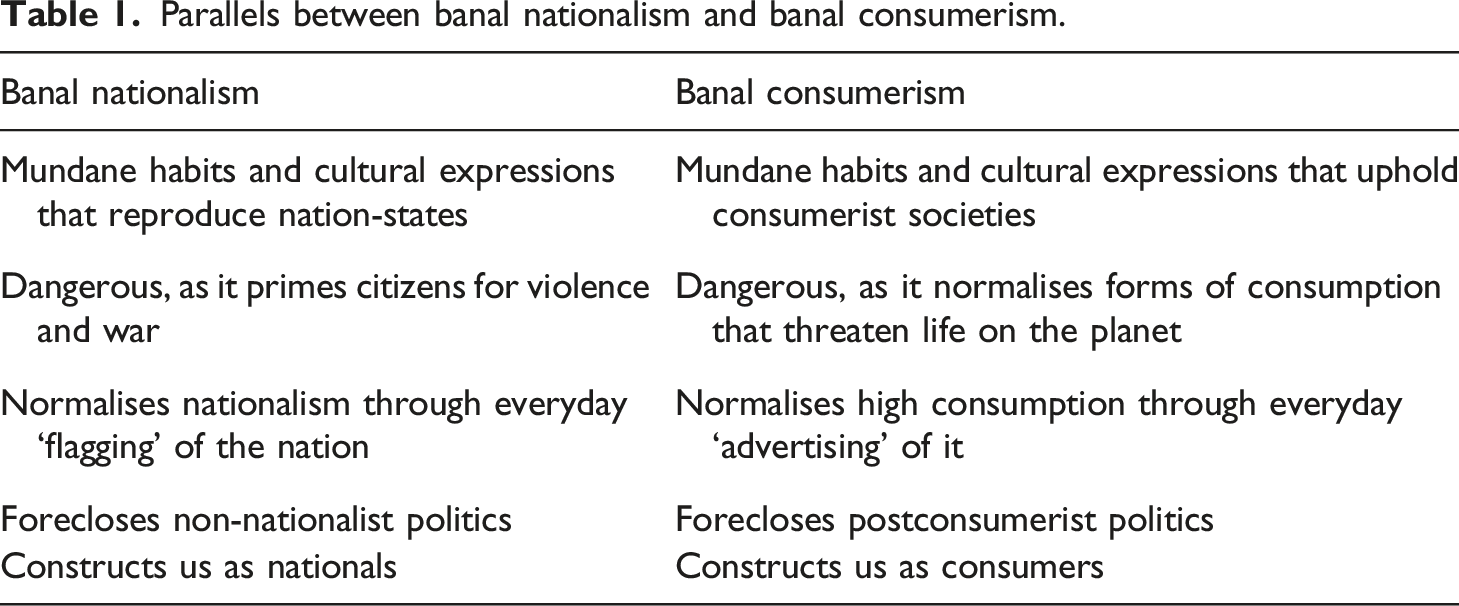
First, for Billig banal nationalism is a widely diffused ideology; established nations are reproduced through omnipresent and repeated habits (Billig, 1995). Specific nations are maintained by border controls and the entire state apparatus, as well as by a set of behaviours and ideas that normalise the world as a world of nation-states. Such habits and ideas – for example, currency with national symbols or the journalist’s proud ‘we won!’ when the national sports team wins a game – Billig refers to as ‘flagging’ the nation. In a similar way, specific forms of consumer capitalism are supported by institutions and legal frameworks and by the ideology of consumerism, being reinforced through associations to values such as individual freedom and democracy and by belief in the need for perpetual economic growth. Like nationalism, consumerism is upheld through numerous daily routines and cultural manifestations that we call BC and whose expressions we begin to explore in this article.
Second, Billig points to the dangers of banal nationalism. Billig’s book from 1995 was written when the declining importance of nation-states and their possible future replacement by globalised post-national structures were discussed (Billig, 2017; Duchesne, 2018: 842). Billig, however, pointed to the hidden strength of subtle expressions of nationhood in political discourses – banal nationalism. Perceptions of overtly violent forms of nationalism, not least on the far right, make banal nationalism appear non-threatening. However, a main argument of the book is that it is precisely in established nations, which see themselves as largely exempted from aggressive nationalism, that the ideology of nationalism with its violent potential has been upheld (Billig, 1995: 7). Similarly, we make the argument that present levels of consumption constitute a serious threat to life on the planet, and yet in everyday discourse and practices, high consumption is continuously ‘flagged’ – or ‘advertised’.
Third, Billig describes banal nationalism as an ideology which imposes one particular truth as the only possible truth, foreclosing other political imaginaries through ‘determining what politics is to be seriously practiced and what can only be nonseriously imagined’ (Billig, 2017: 319). Similarly, (banal) consumerism structures and gives legitimacy to political decisions. Political alternatives that seriously go against principles of consumerism are difficult to imagine.
A fourth parallel is less easily drawn: how the two –isms shape identities. Whereas banal nationalism encompasses the crucial exclusion of the foreign ‘them’ from the national ‘us’, a corresponding mechanism cannot be said to characterise BC. Nevertheless, this ideology too creates ideal subjects (the consumer-citizen) and profound exclusions of those who ‘fail’ to live up to consumerist standards. Thus, citizens are addressed as nationals in media, and likewise, we argue, they are reminded of their identities as consumers – which structures their agency, relations and self-perceptions. In a related vein, Gerth (2011) and others use the concept of consumer nationalism to highlight how consumption practices are used to support nationalist projects – this could be in explicit political senses, for example, the yellow ‘flagging’ by pro-democracy retailers during the 2019 conflicts in Hong Kong (Li and Whitworth, 2022), as well as in less politicised everyday practices of buying domestic foods (Castelló and Miheij, 2018).
The merit of the concept of BC, we argue, is that it emphasises mundane, low key and routine practices and cultural expressions that turn constant purchases of new goods into naturalised practices. As such, they do not require further justifications, despite widespread knowledge about the devastating effects of high levels of production and consumption. This bears resemblance with Shove and Warde’s (2002) use of the concept of inconspicuous consumption in terms of routinised consumption of for instance energy and water. Not explicitly used for social comparison, it nevertheless has notable environmental impacts. However, with BC we refer to material consumption that to some extent is used for social stratification, albeit in mundane ways.
A question begged is how to distinguish between banal and non-banal consumerism. We understand expressions to be banal when they appear as routine rather than novel and are implicit rather than explicit. There is, however, no clear line to be drawn. An example of banal consumerism is the repetitive format of advertisements that we are confronted with daily, while novel forms of advertising would be non-banal expressions of consumerism. Likewise, presupposing messages about the necessity of consumption would be considered banal, while explicit political support of constant novel consumption would be non-banal. Hence, what is banal changes with time. What is new and stands out turns into routine with repetition and becomes unnecessary to spell out, thus turning banal.
In the next section, we turn to media as an important arena for expressions of BC as well as for postconsumerist messages.
Media representations of climate change and consumerism
The critical role of media in shaping public understandings and a sense of urgency in relation to environmental issues and climate change is covered in an expanding body of literature (Olausson and Berglez, 2018; Schäfer and Schlichting, 2014). While attention has grown in recent years, a significant time lag can be noticed between media engagement and the establishment of a solid scientific consensus in the late 1980s on climate change due to human activities (Doyle, 2011: 28). Climate change has also been mediated with various degrees of certainty in different contexts. In the US, climate sceptics have been given a large media coverage (Boykoff and Boykoff, 2004), whereas climate change in European contexts have been largely framed in terms of scientific certainty (Olausson, 2009). A mapping of the frequency of terms used in English-language literature between 1970 and 2019 reveals a steady rise of attention paid to climate issues as well as an increasing use of the term ‘climate crisis’ (Kunelius and Roosvall, 2021). In Swedish media in 2019 the climate was, for the first time, the most covered issue, largely attributed to the ‘Greta Thunberg-effect’. The year after, however, the climate issue fell far behind coverage of the COVID-19 pandemic (Vi-Skogen, 2020, 2021).
Undeniably, media is also crucial for the reinforcement of consumerist culture and ‘the growth orthodoxy’, implying that positive effects of economic growth are depicted as self-evident (Lewis, 2013). Elevated levels of both conspicuous and inconspicuous consumption are prompted through mediated connections with values such as security, health, well-being, care and motherly love (Foster, 2007). For instance, Jack (2020) analyses Swedish media representations of cleanliness as a case of inconspicuous consumption, displaying norms of clean homes and selves, requiring not only a steady purchase of products but also the ‘hidden’ consumption of water and energy. However, the link between media representations and everyday practices is not straightforward, as media audiences attempt to navigate conflicting messages around sustainability transitions and normalised but unsustainable consumerist conventions (Jack, 2022).
While some Swedish media have developed their climate journalism, it potentially clashes with consumerism, not least due to press media’s economic dependency on advertising. Even though technological changes have significantly reduced the total advertising income of Swedish dailies, about 451 million Euro was still spent on press advertising in 2019 (Facht and Ohlson, 2021). Morning papers remain a good medium for advertising as they enable producers to reach large groups of consumers (Bergström, 2021: 50).
Discursive opportunity structures
The concept of DOS is a tool for analysing the discursive contexts that social movements have to consider when developing their own frames for convincing the public or persuading authorities (Mccammon, 2013). Media content constitutes an important part of the DOS for any movement or individual trying to diffuse new perspectives and practices. Their opportunities are shaped by discourses, understood here as semiotic practices, that is, how people express themselves (speaking, writing, depicting, etc.) concerning some particular theme in a defined social context (Boréus and Seiler Brylla, 2024). The term DOS may refer both to dominating ideas that appear as sensible, natural and legitimate in a particular context, and to the organisation of public debate. Here we use the first meaning of the term to assess what is taken for granted and represented as realistic, sensible and legitimate (cf. Koopmans and Statham, 1999: 228). In line with the discussion above, the DOS for postconsumerist initiatives are likely to be shaped, on the one hand, by editorial and journalistic policies of the mainstream press that take the environmental and climate crises seriously and, on the other hand, by the prevailing consumerist culture and the papers’ economic dependency on consumer item advertisement. We here assess the outcome of the cross-pressure on the papers in terms of how and to what extent BC is expressed and how postconsumerist initiatives, practices and perspectives are presented.
Method and material
The Swedish press
This study focusses on Swedish dailies. A first reason for focussing on the press is that despite the technological development that is changing the media landscape, it is still an important source of information in Sweden. Even though the reading of morning papers has declined, 51% still read one such paper, online or hard-copy, during an average day in 2019. 45% also read an evening paper during an average day in 2019 (Facht and Ohlsson, 2021). A second reason for analysing press content is, as explained above, that newspapers harbour both expressions of BC and – sometimes – of climate and environmental crises awareness. Advertising, as a kind of BC, is certainly present in both morning and evening papers. A third reason for the choice of newspapers rather than other media is that Swedish archives make the press especially well-suited for a study of this kind.
Corpora and methodology
Two newspaper corpora, drawn from morning and evening papers with large circulations and of different political leanings, were collected. The chosen morning papers were Dagens Nyheter (DN), the second biggest daily paper that identifies as ‘independent liberal’; Göteborgsposten (GP), also liberal; and Svenska Dagbladet (SvD), which describes itself as ‘independent moderate’ (referring to the name of Sweden’s largest mainstream conservative/liberal party). No widely circulated social democratic/labour or left-wing morning paper exists. The evening papers included were Aftonbladet (AB), with the largest circulation of all Swedish daily papers, a tabloid that declares itself ‘independent social democrat’, and the liberal Expressen (Ex).
To answer the first research question about the extent and kinds of BC in the Swedish dailies, a corpus consisting of in total nine newspaper weeks (63 issues) was assembled. Since only editorial material and not advertising can be searched in the database used for the rest of the empirical study, this collection had to be manual. Hence, 2 weeks, one in September 2016 and one in May 2021, of AB, DN and SvD, were gone through manually from first to last page. To capture additional BC expressions, the same three papers were examined during ‘Black Week’ in November 2021 – the extension of ‘Black Friday’. This resulted in the ‘BC corpus’.
To answer the second research question about how Swedish dailies have reported postconsumerist initiatives, practices and perspectives, searches for three kinds of terms were conducted in the full-text database Retriever Research (for details, see below). After irrelevant texts had been excluded, a ‘postconsumerism corpus’ of 362 texts published between June 2016 (the summer before Sweden ratified the Paris Agreement) and May 2021 remained. ‘News items’, for example, reports as well as short notices, opinion pieces of various kinds and reviews of books, films, etc., were included. If some left-wing papers with a smaller circulation had been included, the corpus would have been larger.
The collected texts were downloaded and coded in the qualitative data analysis program NVivo11 in a qualitative content analysis (Boréus and Kohl, 2024). Most of the coding was inductive, while a few codes, such as coding of the genre of the text (e.g. news item or letter to the editor) were decided on from the start.
Results
Expressions of banal consumerism
Our mapping revealed several different forms of BC: direct as well as indirect advertising, semi-advertorial texts, as well as advice to consumers. We classify them as expressions of BC because they directly or indirectly promote the purchase of consumer goods in a routinised manner that normalises a lifestyle of high consumption.
Extent of direct advertising for consumer goods in three Swedish papers.
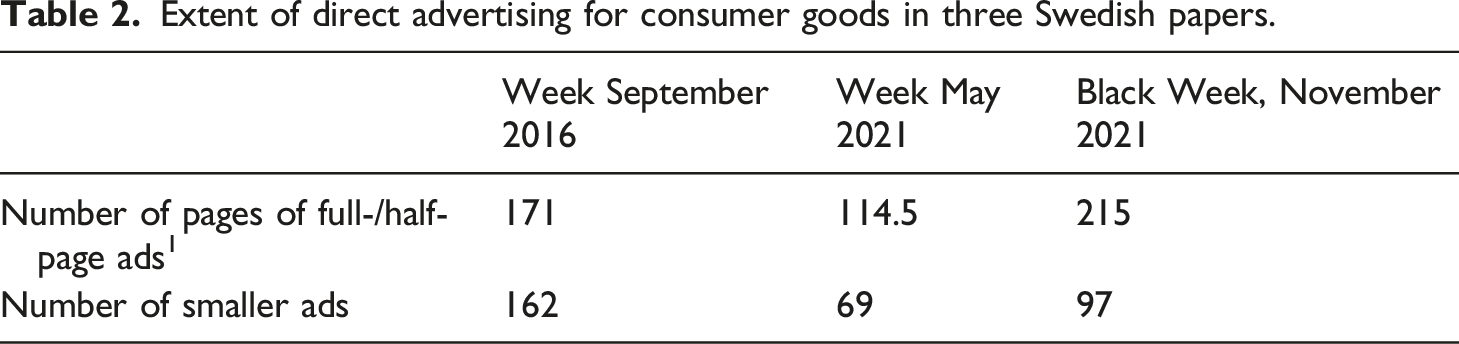
Thus, a reader of these three papers during these particular weeks would be confronted with several hundred ads for new consumer items that could in principle be shared, repaired or reused. On top of this, several issues included extra advertising supplements with ads for consumer goods which are not counted in Table 2. The advertisers obviously turn to different groups of consumers through different papers. Most striking was the difference between the daily SvD, which targets a well-off segment of consumers, and the tabloid AB, which reaches out to broader groups. As shown by the examples below, SvD promotes products for expensive, conspicuous consumption, while the products presented in AB are more suitable for ordinary wallets.
Indirect advertising is not included in Table 2. This category covers advertising for services such as mobile phone and TV channel subscriptions (which in themselves obviously demand the ownership of consumer items), as well as neutral or positive information on locations where advertising or selling are central activities, for example, the programme schedules for TV channels with direct advertising that all three papers publish daily.
As Hardy (2022) points out, the demarcation between media and marketing is increasingly blurred. Advertorials are paid-for commercial messages, in which characteristics of the advertising genre are mixed with common characteristics of editorials or news reports (Deng et al., 2020). All advertorials found were included in the count for Table 2 since we see such texts as direct (if sly) advertising. However, we also found a number of news reports or reportages by named journalists that included the promotion of consumer goods without (as far as we know) being paid for. They share the traits of advertorials by mixing the characteristics of news reports with characteristics of promotional texts. We refer to these texts as semi-advertorials. One kind of semi-advertorial presents a number of consumer items with brand names, prices and where to buy them. Some texts in the tabloid AB advised readers on the best buys during Black Week and also encouraged them to hurry: A tip is to hurry. Most offers are valid up until 28 November. But, and this is an important proviso, as long as they are in stock. So there is a risk that what you want is sold out on Black Friday (…) if you find what you want for a price that seems sensible, this is the opportunity to make it happen. (AB, 22 November 2021a)
All texts that presented consumer goods with brand names were not as explicit in advising readers to ‘make it happen’; yet, they did promote consumer goods, for example, with tips about different woolen garments, their prices and where to buy them (AB, 22 November 2021b). The larger morning paper recurrently published extensive information about cars. The launch of a new SUV, for example, was treated as a news item.
A semi-advertorial that illustrates BC particularly clearly is a two-page article about how to decorate your home for the Advent holiday with plates, furniture, candlesticks and textiles of particular brands. The piece stated that it is possible to ‘make a tradition out of putting out the same Christmas stuff every year’ since then there is no need to ‘buy new things all the time’. Buying new things to decorate your home is what is taken for granted, while the idea of using the same things several times is introduced as an alternative. Not to decorate at all at Christmas, to make your own decorations or to buy second-hand ones are not presented as options (DN, 26 November 2021).
The semi-advertorials referred to above are expressions of BC that explicitly recommend consumer goods of certain brands. Another kind of semi-advertorial embeds the product presentation. An example is an interview with the owner of a jewellery house who tells her story while several of her products are displayed (SvD Perfect Guide, 27 November 2021a). This resembles the advertorials analysed by Deng et al. (2020), which often pictured high-status people, such as CEOs.
Texts that could also be classified as semi-advertorials are some interior decoration articles where the reporter visits somebody’s home. An example is an article on a nine-room flat at an upmarket Stockholm address in which one of its inhabitants/owners is interviewed. It embeds branded products that affluent readers could buy: a design vase or hand-painted wallpaper from a particular company. Several presented objects (inherited furniture and particular paintings) could, however, not be bought (SvD Perfect Guide 27, November 2021b). Arguably, the article promotes a lifestyle of spending time and money to create homes filled with expensive, carefully chosen objects. Even though the consumption in this kind of article is rather conspicuous, the consumerism it expresses can be regarded as banal: the implicitly endorsed lifestyle suggests that filling a home with (exclusive) products is a central goal.
Expressions of banal consumerism with regard to consumer goods over three weeks of three Swedish newspapers.
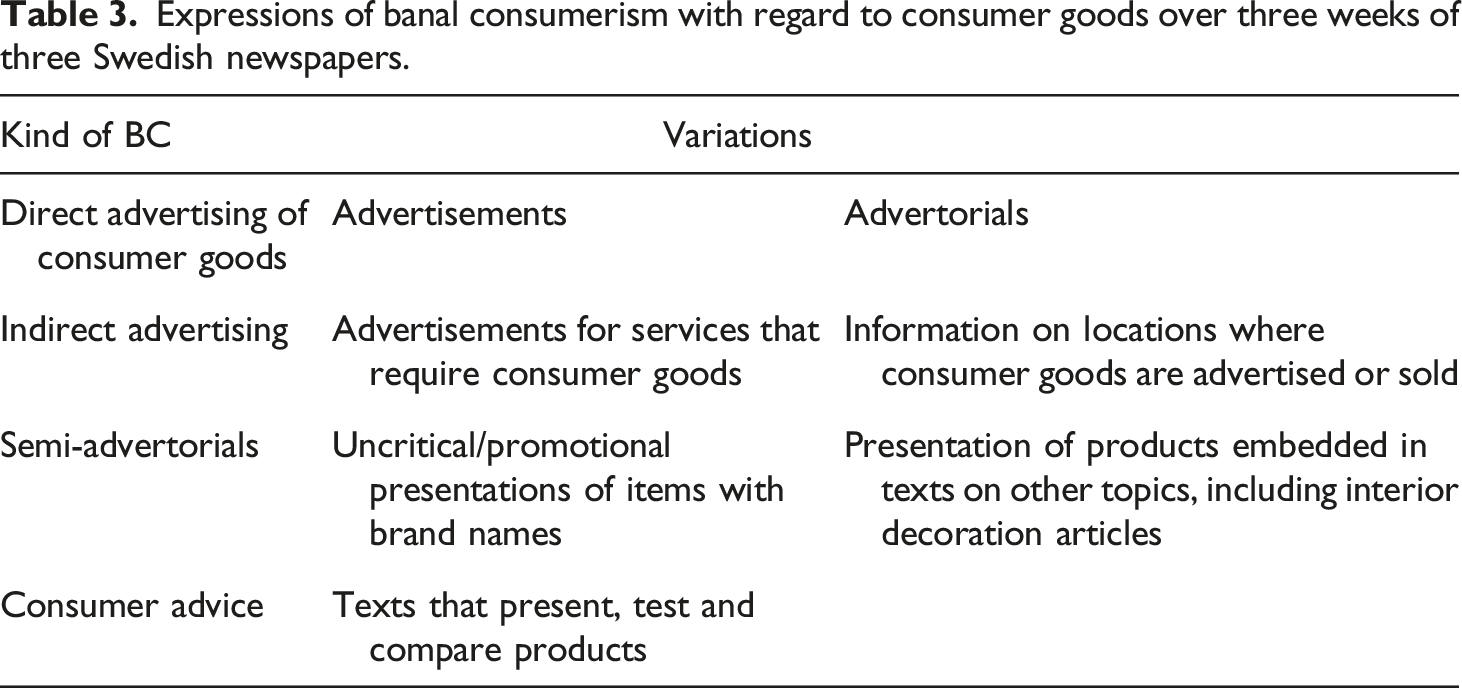
To summarise the results from this part of the empirical study, it is obvious that readers face a large amount of texts that express various forms of BC. The kinds of texts expressing BC listed in Table 3 have in common that they address the readers as consumers. They represent the purchase of new products as satisfying (in the case of direct advertising), or at least as a normal thing to do (in the case of semi-advertorials and the consumer-advising texts). The interior decoration texts take BC a step further by implying that spending a lot of time and money on decorating your home is a lifestyle to strive for.
Table 3 lays the basis for a typology of BC expressions in the press. A wider study might find additional types but those presented here are recurrent and constitute part of the DOS that postconsumerist initiatives have to negotiate. To the extent that these overt and subtle inducements to consume have an effect on their audiences (cf Jack, 2022), the practices of reuse, sharing and repairing are prone to be discarded when perceived needs are instead met by the consumption of new goods.
Discourse on postconsumerist initiatives, practices and perspectives
In addition to the largely inhibiting DOS described above, the DOS in the analysed media material also consists of representations of postconsumerist practices and ideas. The five papers were searched for the names and the terms used for postconsumerist initiatives, which resulted in 58 relevant texts. 2 To study representations of the practices of repairing and reusing, a further search that combined words for repair and reuse with the word climate was made, which resulted in 64 texts that were non-overlapping with the ones found by the first search. 3
In several articles found by the search for initiatives’ names, the journalist had visited particular initiatives and interviewed people present (e.g. GP, 19 January 2019). Other texts centred on the phenomena of the sharing economy and sustainable consumption, especially in Gothenburg (e.g. GP, 20 November 2017, 15 November 2019), while yet others offered ideas on how to keep the costs of winter holidays down (use sports libraries, e.g. Ex, 15 February 2019) or service your bike yourself (use the local bike kitchen, e.g. GP, 28 June 2020). A number of short notices reported on the opening of new sports and toy libraries. Information on the initiatives was provided in a factual way: ‘There are bike kitchens, or do-it-yourself-repair shops for bikes, in a few more than 10 places around Sweden, among them Borås, Jönköping, Alingsås and Malmö. In Gothenburg they are located…’ (GP, 28 June 2020). Some texts included addresses and opening hours.
The 64 texts found on postconsumerist practices covered many different topics. A recurrent kind of text was the reporting on individuals who had decided to live in more low-impact ways by repairing, reusing or just refraining from buying new things, or who had started to work in a different way. The fact that their choices differed from the majority is probably why they were considered newsworthy. Hence, they were sometimes described as having taken significant individual steps, which made them seem special and perhaps initially misunderstood. About ‘[t]he star architect’ who ‘makes houses out of waste’, readers were told: Of course, everybody loves it, then when a dunce comes riding into the scene. Someone who shows that it is actually possible to do things in different and unexpected ways. (…) In 2019, Anders Lendager was appointed role model in the building and real estate industry. The Danish Arts Foundation awarded him a ‘Price for boldness’. (SvD, 15 March 2020).
Similarly, it was said about the ‘biking plumber’, whose business idea it was to cycle instead of driving to his customers and to reuse spare parts when repairing, that: Initially he and the colleagues were criticised (…) – We were called stupid (…) In 2018 the business was awarded Craftsman of the year. The critique was all of a sudden replaced with praise. (DN, 9 October 2019)
Neither the initiatives, nor the practices they promote, were explicitly questioned or criticised in the press material. The closest anyone came to problematising their activities was an organiser who told the reporter that the free shop she worked in was so popular that it sometimes resulted in conflicts between visitors (GP, 30 May 2021). Another text raised the issue that insurances do not cover all aspects of the sharing economy, which results in poor protection of its users (GP, 15 November 2019). The only instance of implicit critique found was expressed as a question to a Green Party minister: how much would certain enterprises lose if more consumer goods were repaired instead of bought new, the reporter inquired (DN, 1 May 2021). Here, practices of repairing are, in line with BC, apparently weighed against the primacy of buying for the sake of economic growth.
But the material also contains explicit criticism of consumerism. Many news items and opinion pieces clearly stated that high consumption negatively impacts the environment: We Swedes consume as if we had four planets. Low prices continuously speed up consumption and Black Friday is the ultimate expression for this structural over-consumption. (DN, 22 November 2018)
Other examples are an article about consumer goods being designed not to last (AB, 13 September 2019) and a text about attempts to reduce the climate impact of clothes production (DN, 14 February 2020). It was frequently asserted that reuse and repair is better for the environment than buying new goods, for example, ‘[a good way] to decrease the climate impact of the telephone is to see to it being reused’ (Ex, 6 September 2019), or ‘[r]euse and re-design is one of the most efficient ways to reduce the climate footprint’ (DN, 4 May 2021).
The third search, which was conducted to collect texts that expressed or discussed critiques of consumerist society and possible solutions to the problems (like the sharing economy) without necessarily mentioning concrete initiatives or practices, resulted in 240 texts.
4
A higher proportion of these texts are opinion pieces and not news items or review texts – 42%, as compared to the texts on the initiatives or practices of which 23% were opinion pieces – which indicates that the topics they cover are more controversial. Indeed, many of them clearly expressed postconsumerist ideas, while some took the opposite stance. Degrowth was advocated: …that Earth’s resources are (…) running out. It is simply not possible to build or construct us out of the problem, since every new machine or new technology demands more resources. All that remains is to slow down the speed of the economy. The concept of the day ought to be degrowth, not green growth. (GP, 25 March 2021)
but also criticised: Anyone who wants to prevent the expansions and operations that are able to make the current system sustainable, must reasonably see it as an alternative to instead start to press stop buttons and shrink the economy. Then they must reasonably be prepared to concreticise a broad political programme that clarifies how Sweden materially and socially would be able to handle degrowth in a global growth economy. There is no such thing. (AB, 5 December 2020)
Likewise, critique of consumerism was expressed in several texts, as when a Green politician was quoted as saying that the Greens ‘dare express critique of consumerism and speak honestly about how we need to transform our societies’ (DN, 22 May 2018). But such ideas were also contested: Sweden is an exporting country. The critique of Black Friday is hollow. A sale has the same effect as when people get higher wages, but only the sale is criticised. If there is no shopping on a Buy Nothing Day the prices go down another day. This is called a market economy (SvD, 25 November 2018).
The discursive opportunity structures for postconsumerist perspectives
In this section, we discuss the third research question: what the results presented above tell us about the DOS for diffusing postconsumerist practices in Sweden.
Expressions of BC appear very frequently in the corpus, especially as direct advertising, and are likely to obstruct postconsumerist perspectives and practices in two principal ways. First, they directly incite people to buy new products rather than look for postconsumerist alternatives. Abundant research shows that if properly designed, advertising often succeeds and also contribute to normalising consumerist lifestyles (Fennis and Stroebe, 2021). Fennis and Stroebe (2021) refer to a study which shows that children exposed to more television advertising developed not only an increased desire for the advertised objects, but also an increased tendency to value material possessions highly.
The texts we refer to as semi-advertorials may have a strong disabling effect on postconsumerist practices and perspectives. People tend to turn to others for assessing the merits of a point of view or a behaviour, particularly in ambivalent contexts (Fennis and Stroebe, 2021: 323). Although all of the analysed papers recognised that postconsumerist practices are preferable to high consumption, expressions of BC are far more present, hence creating ambiguity. Semi-advertorials could be of importance in this context, as they let interviewees, often in authority positions (CEOs, journalists and writers), suggest that buying new goods is a positive and desirable thing to do. They thereby implicitly contradict the postconsumerist oriented texts. Authority, known to influence behaviour, is at work.
The analysis of the postconsumerist corpus indicates that Swedish media discourse also harboured enabling traits for promoting postconsumerist practices. The initiatives were presented as newsworthy and beneficial for the environment and the detailed information about them could also be enabling. The texts on the practices as such also constitute a facilitating part of the DOS. In some of them, experts and others state that postconsumerist practices are important to mitigate global warming. The reports about individuals who have chosen to live in more postconsumerist ways may also enable, as they take the issues to a concrete level and let enthusiasts tell their stories, potentially inspiring others. Yet, these individuals are presented as the exceptions that they in fact are. Their unusual way of living is exactly what makes them newsworthy.
Both the representations of the initiatives and of individuals bear certain resemblances with the advertorials and semi-advertorials discussed in the BC section: they inform readers about the where and when of offerings and zoom in on particular individuals’ relations to their material surroundings, whether bought or self-created. But in comparison to their BC counterparts, the postconsumerist representations are likely to be less assimilated since they are not, we argue, backed-up and reified by any equivalent to the countless and familiar routines through which consumer capitalism is reproduced.
Part of the corpus generated by the search for postconsumerist buzzwords explicitly calls for alternatives to consumerism and can therefore be seen as straightforward examples of enabling DOS. In this polarised corpus, we also find examples of the overt defence of consumption as a prerequisite for economic growth and, by extension, well-being.
Conclusion
The intention of this article is to make a theoretical contribution by the introduction of the concept of banal consumerism: this could be used to map various kinds of consumerism expressed in different media and cultural spheres, and in the study of everyday practices related to consumption. It could also be used to study how consumerist identities are constructed and reinforce social hierarchies. As a parallel to banal nationalism, it could be used to theorise the relations between the two global systems of nationalism and consumer capitalism.
This article has furthermore unfolded the DOS that grassroots initiatives, as well as other actors in Sweden, need to negotiate if they want to diffuse postconsumerist practices to a wider public. Whereas BC constitutes a strong political imaginary, representations of postconsumerist perspectives largely figure as rare and isolated cases, not ideologically anchored or routinely enacted.
Discourses on consumption, as well as expressions of BC, are of course present in all sorts of media arenas, including social media, where advertising is abundant and ripe for further study. Whereas our focus is delimited to contemporary press representations in Sweden, media audiences elsewhere are likely to be exposed to the tensions between on the one hand attention to the severity of the environmental and climate crises and, on the other hand, the normalisation of unsustainable consumption patterns.
In conclusion, the answer to the question posed in this article’s title – whether postconsumerist perspectives are in the process of breaking through BC in mainstream press media – leans towards the negative. While postconsumerist perspectives are occasionally promoted, they are also explicitly questioned, and when such practices are featured they are reduced to curious exceptions within an overall context where life beyond consumerist society remains difficult to imagine. The widespread and manifold expressions of BC contribute to this state of affairs.
Footnotes
Acknowledgements
This article is based on the study ‘Grassroots Initiatives for Energy Transition’ (GRIT). Dr Martin Emanuel and Dr Rikard Warlenius have contributed as members of the GRIT research team. Many thanks to the participants of the workshop 'Exploring grassroots initiatives for transitions' at the Nordic Environmental Social Science Conference in Gothenburg 2022 for comments on an earlier version. The thoughtful comments and advice of two anonymous reviewers greatly helped sharpening this paper.
Declaration of conflicting interests
The author(s) declared no potential conflicts of interest with respect to the research, authorship, and/or publication of this article.
Funding
The author(s) disclosed receipt of the following financial support for the research, authorship, and/or publication of this article: This work was supported by Formas (2019-02020) and Energimyndigheten/Swedish Energy Agency (EM 2019-006739).

Notes
Author Biographies