




Abstract
Recent research indicates that the economic downturn brought by the COVID-19 pandemic has bolstered a “climate delay” discourse. This has led environmental scholars and policymakers to express concern over how the relationship between economic recovery and decarbonization is being framed in current public discussions about post-pandemic economic recovery. To better understand how the climate delay discourse is mediated by local media and its potential impact on public support for green transformation, this article examines relevant coverage published by popular Toronto local media throughout 2020. A qualitative thematic analysis reveals a rising public demand for decarbonizing the Canadian economy. However, this demand has also been challenged by a counter storyline that seeks to divert public attention from the severe structural crisis underlying the fossil fuel sector. The study concludes by cautioning against “climate delay” narratives’ potential suppression of public support for green economic recovery.
Introduction
Since the initial global outbreak of COVID-19 in early 2020, numerous climate hazards (e.g., heatwaves, floods, wildfires) have collided with the government’s pandemic responses. Yet, the COVID-19 pandemic’s unprecedented scope and severity have captured the lion’s share of global media attention and overshadowed public reckoning with the climate crisis (Atanasova, 2022; Rauchfleisch et al., 2023; Stoddart et al., 2023). This temporary decline of public attention to climate change, however, contradicts the intensifying climate emergency worldwide.
Meanwhile, lower economic and social activities resulting from public health measures have also led to notable reductions in air pollutants and greenhouse gas (GHG) emissions. Inspired by such unexpected environmental benefits, there is a growing consensus among environmental scholars and policymakers that, if the world embraces post-pandemic economic recovery plans that prioritize green stimulus and fossil fuel divestment, then the pandemic could serve as a turning point for current political gridlock on decarbonization.
Achieving a green recovery requires effective mobilization of public support via a wide range of communication channels, especially news media. Despite the growing influence of social media in mediating public discourses in recent years, news organizations and their online extensions continue to play a major role in agenda-setting (Hansen, 2019). Admittedly, in the current era of intensifying political polarization, media choices increasingly reflect partisan considerations, which, by escalating the fragmentation of media consumption, hinders the likelihood of attitude shifts in response to news media’s public agenda-setting efforts (Bennett & Iyengar, 2008). This said, for many members of the lay public with limited expert knowledge about climate change, news media continue to be their primary source of information. Accordingly, analyzing the thematic content of media coverage of climate change remains a critical research topic for determining whether the public is adequately informed about the gravity of the planetary climate crisis (Arnold, 2018; Stoddart et al., 2023).
This article contributes to the ongoing scholarly discussions on the research topic by examining local media narratives concerning the relationship between post-pandemic economic recovery and decarbonization in the context of Toronto. This focus is based on two considerations. First, Canada’s resource-dependent economy is distinguished by exceptionally high GHG emissions per capita. In 2019, Canada’s average GHG emissions per capita were 15.4 metric tons, while China’s were approximately 7.6 metric tons (Climate Watch, 2020). This has sparked heated public debates among the Canadian public regarding the role of the fossil fuel industry in the country’s future economic growth (Gunster & Neubauer, 2018; Hackett & Adams, 2018). Second, as Canada’s largest metropolis, the Greater Toronto area has a vibrant local media environment, which includes broad-sheet and tabloid newspapers, as well as trending online media. To date, there has been limited research on Canada’s climate change discourse since COVID-19’s global outbreak, which warrants the current case study. Below, my analysis will begin with a brief review of how the COVID-19 pandemic has influenced current environmental debates.
Climate change and COVID-19: competing crises?
The nexus of the COVID-19 pandemic and climate change has brought compound risks that pose tremendous challenges to ongoing global climate mitigation and adaptation efforts. As Phillips et al. (2020) note, these risks are likely to “exacerbate and be exacerbated by the unfolding economic crisis and long-standing socio-economic and racial disparities, both within countries and across regions, in ways that will put specific populations at heightened risk and compromise recovery” (p. 586).
Disconcertingly, both the post-Paris trajectory of climate policy and the media coverage of climate change have been eclipsed by the COVID-19 pandemic’s vast dominance of public discourse since early 2020. On news outlets and social media, the pandemic has appeared as a critical event diverting public attention from the emergency of climate change (Atanasova, 2022; Rauchfleisch et al., 2023; Stoddart et al., 2023). For example, a recent analysis of Swiss news media and Twitter data found that, during the first few months of the COVID-19 pandemic, it dominated up to 70% of media coverage, transforming the routine issue of climate change into a struggling issue with a lower baseline of media attention (Rauchfleisch et al., 2023). Echoing this finding, Atanasova (2022) calls for more solution-oriented journalism practice addressing the synergistic effects of climate change and COVID-19.
Furthermore, the pandemic-induced economic downturn has contributed to the rise of a “climate delay” discourse, which, by framing climate change as a secondary issue, threatens public support for mitigation efforts. A recent experimental study (Ecker et al., 2020) on how ordinary people weigh climate change against economic recovery revealed that portraying the pandemic as a “trial run” for an imminent global climate crisis does not enhance public support for future globally collaborative efforts on climate change. By contrast, framing climate change as a secondary concern compared with the urgent need for economic recovery significantly reduces climate change concerns and mitigation support.
Yet, recent research also indicates that the pandemic offers new opportunities for forming new environmental discourses. Notably, environmental groups strive to make the case that COVID-19 and climate change should be viewed and addressed as parallel crises requiring coordinated solutions. For example, Augé’s (2023) analysis of the global environmental movement Extinction Rebellion’s communications following the COVID-19 global outbreak suggests that the pandemic has revitalized the “ecosystem health” metaphor, which links the distress people have experienced during the pandemic to the effects of an unhealthy environment due to climate change. Similarly, Sorce and Dumitrica (2023) examined how the pandemic shifted the protest communication frames of Fridays for Future (FFF)—an international student-led climate movement founded by Greta Thunberg—and identified three framing processes underlying European FFF collectives’ social media narratives about the pandemic: “adaptation (fostering compliance and solidarity), reframing (highlighting the climate crisis, reclaiming the crisis), and mobilization (calling for participation and sustained engagement with the cause)” (p. 11).
Despite activist discourses connecting COVID-19 and climate change, it remains highly uncertain whether the lessons the world has learned from lockdown experiences will result in long-term environmental benefits. A recent analysis by Forster et al. (2020) on current and future global climate impacts resulting from COVID-19 revealed that direct GHG emissions reduction brought by pandemic-driven responses will be negligible. Gaining sufficient public support for this sustainable path to recovery, however, necessitates the creation and dissemination of compelling public narratives about the urgent need for decarbonization. As Arnold (2018) asserts, such narratives are essential for effective climate change communication because they enable the facts, numbers, and urgent appeals surrounding complex phenomena like climate change to be understood as persuasive stories.
In the case of Canada, given its economic inclination toward the fossil fuel sector, a post-pandemic green economic recovery entails redirecting socioeconomic resources previously allocated to fossil fuel projects to sustainable sectors such as clean technology and renewable energy. In Canada, climate change is a divisive issue among citizens with opposing political beliefs, but the situation is not as dire as in the United States, where relevant public debates are characterized by partisan antagonism. According to a 2021 national survey conducted by the Angus Reid Institute (2021, November 9), 71% of Canadians believe that climate change is a fact primarily caused by human activities.
Echoing this trend in public opinion, the mainstream Canadian media rarely publish articles promoting climate change skepticism, regardless of their political leanings. According to Stoddart et al. (2023), climate change news in Canada has exhibited a series of peaks and troughs over the past several decades, coinciding with major national and international climate events (especially United Nations Climate Change Conferences). Canada’s overall stance at these events can be described as “strategic ambiguity”: it has pledged significant reductions in GHG emissions but has been reluctant to discuss the fate of its fossil fuel industry.
Consequently, domestic proponents of the fossil fuel industry resort to discursive strategies that question the feasibility and urgency of decarbonization (Lamb et al., 2020). A major outcome of these strategies is climate change cynicism: Despite broad public consensus on the importance of climate change mitigation, many Canadians “appear resigned to the fate of a warming planet and the ecological crisis unfolding” (Angus Reid Institute, 2021, November 9, para. 4).
The prevalence of climate change cynicism among the Canadian public also results from politicizing public discussions about the country’s fossil fuel industry. For example, Hackett and Adams’ (2018) analysis of the political turmoil surrounding the Trans Mountain pipeline expansion project in British Columbia showed how media coverage problematically simplified it into a binary narrative pitting economic growth and environmental protection against each other. Meanwhile, when environmental activists attempt to use concepts such as “social license” to hold polluting fossil fuel projects accountable, they encounter concerted opposition from conservatives (Gunster & Neubauer, 2018).
While “fossil fuel phase-out” was an idea viciously attacked by conservatives and their allies in Canadian legacy media (Gunster & Neubauer, 2018), the climate hazards and unexpected climate benefits during the pandemic have prompted more critical reflections on green transformation. In Europe, a 2020 survey of participants from 28 countries found that deep COVID-19 concerns reinforced public awareness of climate change and its negative impacts (Stefkovics & Hortay, 2022).
Back in Canada, repeated extreme wildfire seasons in the Province of British Columbia have not only been scientifically linked to human-induced climate change (Kirchmeier-Young et al., 2019) but have also significantly increased public awareness of the cascading costs of climate emergencies (Stacey, 2021). Similarly, Stoddart et al.’s (2023) comparative analysis of COVID-19 and climate change news frames in national and regional (Atlantic Canada) newspapers found a significant presence of pro-climate narratives proposing that policy responses to COVID-19 present an opportunity for climate action via a green recovery.
In response to the observation of Stoddart et al. (2023) that the pandemic has exhibited substantial regional variation in Canada, which may have resulted in different regional media responses, this case study focuses on Toronto’s local media, which received notably less attention than national news outlets in the existing literature. Local media play an essential role in bridging the gap between global climate concerns and community-level awareness and action (Bowden et al., 2021; Mocatta et al., 2023). Their coverage of topics such as local weather events, ecosystem changes, and regional policy developments makes the impact of climate change more tangible and immediate.
Recent studies conducted in the Australian context (e.g., Bowden et al., 2021; Mocatta et al., 2023) indicate that normative ideas about journalism and polarized community views on climate change have hindered local media from making vocal advocacy for strong climate change policies. Given the parallels between Canada and Australia regarding the role of the fossil fuel industry in exacerbating divisions over climate change adaptation and mitigation, it is imperative to examine whether the local media’s hesitancy in taking an advocacy stance on climate change is also observable within the Canadian media landscape. In short, this study seeks to advance current research on the extent to which COVID-19 has altered Canadian media narratives about climate change.
Research method
The research questions guiding this study are as follows:
RQ1: How did Toronto’s local media address climate change mitigation in relation to post-pandemic economic recovery throughout 2020?
RQ2: What overarching narratives concerning sustainability and Canada’s economic future emerged from Toronto’s local media sphere?
To answer both research questions, I analyzed texts published by the following media sources: Toronto Star, Toronto Sun, Now Toronto, BlogTO, Daily Hive (Toronto Edition), NarCity (Toronto Edition), and Toronto Life. The selection of these sources aimed to capture voices that are representative of Toronto’s local media landscape, from newspapers to blogs. Toronto Star is the city’s primary daily newspaper and one of Canada’s leading legacy media. Toronto Sun is a daily tabloid owned by the Postmedia network—a media conglomerate controlling numerous local titles across Canada and having an overt conservative political leaning. Now Toronto, by comparison, is a free alternative weekly newspaper known for its offering of local content such as culture, life, and real estate. The remaining sources—BlogTO, Daily Hive (Toronto Edition), NarCity (Toronto Edition), and Toronto Life—are popular online media with curated content targeting Torontonians, especially millennials.
As most of the target sources are not indexed in news databases, I hired a research assistant to conduct the data collection by manually searching their websites using the string “COVID recovery AND climate change.” We tested additional keyword combinations such as “post-pandemic recovery AND global warming” and obtained identical search results. Each search result was verified to ensure that it includes substantive discussion (i.e., more than one to two sentences) on the nexus of the pandemic and climate change.
The study’s finalized corpus includes a total of 127 articles. As shown in Table 1, the Toronto Star published more than half of the articles, which is expected considering the size of its editorial team as well as its focus on both national and local news. In contrast, three of the online media—BlogTO, Daily Hive (Toronto Edition), and Toronto Life—only published a total of five articles, which indicates an overall lack of attention to the topic.
Corpus composition by media.
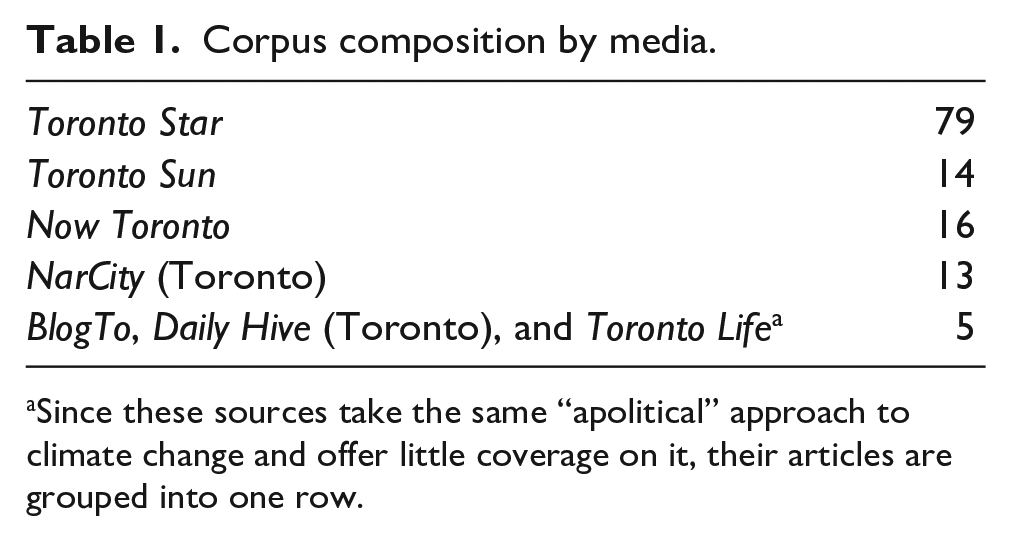
Since these sources take the same “apolitical” approach to climate change and offer little coverage on it, their articles are grouped into one row.
Notably, 54 of the 127 collected articles are opinion pieces (e.g., editorials, columns, and guest comments) authored by writers from a wide range of backgrounds (activists, columnists, lobbyists, scholars, etc.), whereas the remaining articles are hard and soft news stories (news updates, features, interviews, etc.) authored by professional journalists. As indicated by the abundance of opinion pieces in the corpus, climate change is a politically charged topic in the Toronto media sphere, resulting in more opinionated narratives. Even the editorial board of the Toronto Star, the only established newspaper in the corpus with firm commitment to accuracy, fairness, and quality journalism, published an opinion piece criticizing the Ontario government for failing to “live up to its targets for reducing carbon emissions” (“On Climate, Ontario is Driving Fast Down the Wrong Road,” 2020, December 3, para. 3).
To analyze the news themes embedded in the corpus, I adopted an inductive and open-ended approach typical of qualitative media studies (Hawkins, 2018; Hesse-Biber, 2017; Stoddart et al., 2023). The analysis involves three major steps. First, a research assistant coded the corpus by assigning each article a single manifest theme. This interpretative coding process generated an initial list of themes (e.g., “environmental protests,” “call for reviving resource sectors,” “federal economic and climate policies,” etc.).
Second, I reviewed and refined the initial coding results in accordance with Ryan and Bernard’s (2003) “cutting and sorting” strategy, which emphasizes a balance between the creation of new coding categories and the consolidation of existing ones. Informing the process of refining the initial interpretations were previous literature (e.g., Lamb et al., 2020; Stoddart et al., 2023) and my own research expertise on environmental communication in the Canadian context. The first two steps achieved an inter-coder reliability of 69.3%.
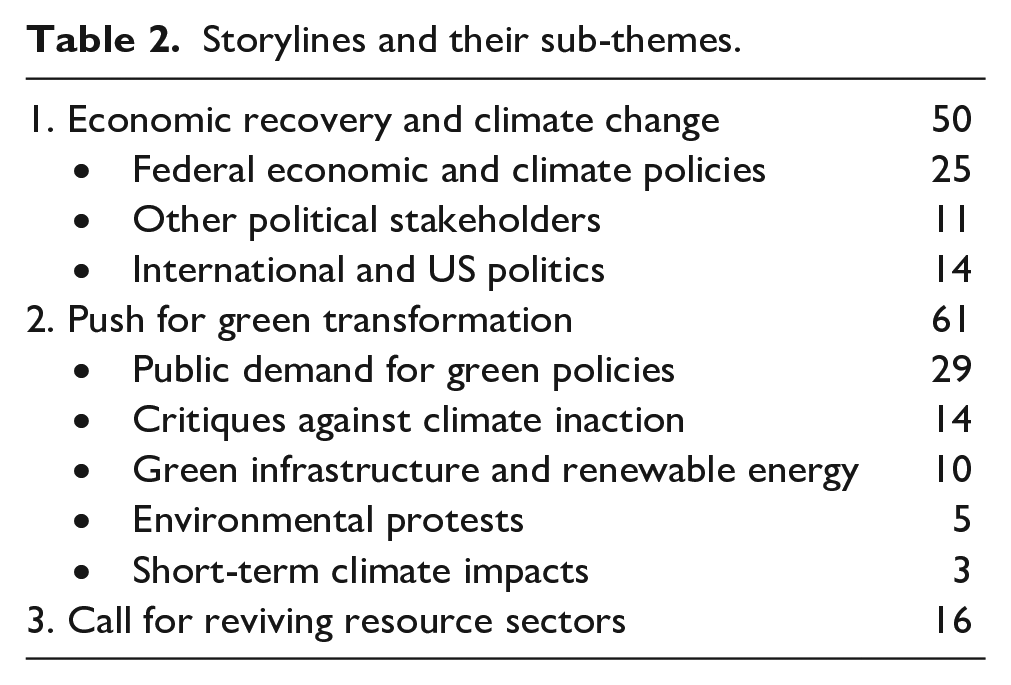
Third, the refined coding results were returned to the research assistant for final validation in order to improve the inter-coder reliability. The research assistant and I discussed the inter-coder disagreements that arose during the preceding steps, and I ultimately decided how to code ambivalent articles. As shown in Table 2, the finalized coding results identified three storylines. The next section will elaborate on their discursive details.
Storylines and their sub-themes.
Findings
The thematic analysis identified three competing storylines envisioning different futures for Canada’s fossil fuel sector during the post-COVID economic recovery. The “economic recovery and climate change” storyline focuses on the political challenges of decarbonization, which frames green recovery as a desirable yet difficult policy goal. The “push for green transformation” storyline, by contrast, prioritizes the grassroots voices calling for a green recovery. The third storyline “call for reviving resource sectors” consists of conservatives’ opinions advocating for additional federal financial support for extractive industries, which echoes the “climate delay” discourse (Ecker et al., 2020). Below, I elucidate each storyline’s key messages with its representative narratives found in the corpus.
Economic recovery and climate change
Given the significant implications of Alberta’s oil sands industry for Canadian climate policymaking, it has been a focal point of conflicts and debates between political parties. The first storyline (50 out of the 127 articles) captures how political tension over oil sands pervaded Toronto’s local media sphere. It primarily features political discord between the federal Liberal government and political oppositions, especially the federal and Alberta Conservatives. This stems from two perspectives on climate policy and the oil sands industry. The federal Liberals advocate a center-left agenda that seeks to condition the future expansion of the oil sands industry on stricter regulations and emissions targets, while the federal and Alberta Conservatives push for less regulation and the prioritization of the economic benefits of the oil sands.
The first subset of articles within the storyline frequently highlighted the competing interests and perspectives among stakeholders. According to their narratives, the future of Alberta’s oil sands sector hinges upon the back-and-forth negotiations of economic and political elites and is currently mired in a “political gridlock.” The following comment offered by Heather Scoffield (2020, September 14), the Toronto Star’s Ottawa bureau chief and economic columnist, exemplifies the storyline’s framing of decarbonization as a political dilemma.
As COVID-19 cases move in the wrong direction in many regions across the country, it’s clear that sooner or later, policymakers need to do it all—get people, especially low-income people, back to work, while also reorienting our industries and our lifestyles to cut emissions and deal with climate change. But doing it all at the same time would just exacerbate that anxiety that [Gerry] Butts [the principal secretary to Prime Minister Justin Trudeau] so aptly put his finger on (para. 20–22).
Besides arguments like Scoffield’s, this storyline also consists of 14 articles on international and US politics. These articles, by discussing the uncertainty surrounding the 2020 US presidential election, reminded readers that the outcome would have far-reaching implications for Canada–US collaboration on economic recovery and climate policy. Notably, the Toronto Star was the only newspaper surveyed that expressed a clear preference for a Biden presidency, believing that it would be beneficial for Canada. When speculating the outcomes of a Biden win, for instance, the newspaper’s columnist David Olive (2017) considered both Justine Trudeau and Joe Biden as internationalists committed to “the same mega-project: domestic economic recovery within a framework of fighting climate crisis” (para. 37).
The third subset of articles within the storyline consists of 11 articles published by the Toronto Star and NarCity (Toronto Edition), which showcased opinions offered by other political party leaders (e.g., Jagmeet Singh, leader of the federal New Democratic Party). These opinions were critical of the unwillingness of both Liberals and Conservatives to advance a rapid phase-out of oil sands. Given the limited amount of media attention such opinions received, however, the storyline implies that they have little impact on the political gridlock.
Push for green transformation
The second storyline, followed by nearly half of the articles in the corpus (61 out of 127), promotes grassroots voices urging the escalation of public pressure for immediate climate actions. Probably because of this clear focus on bottom-up political actions, only three articles focus on COVID-19’s climate impact (e.g., reduced air pollution). Alongside typical environmental media coverage on environmental protests and critiques against current federal and provincial climate policies, the storyline offers three reasons justifying full-fledged government support for a green recovery.
First, the storyline suggests that the scope and severity of a global crisis like the pandemic present a “trial run” for the enormous challenges to be brought by climate change. Accordingly, there is no way to return to previous carbon-intensive modes of economic development. Only by establishing a circular economy can Canada ensure a sustainable recovery from the pandemic. For example, a petition letter delivered the Toronto City Hall signed by dozens of local organizations argued that “Toronto must rebuild itself with a ‘bold, green, and just recovery plan’ that shrinks the growing gap between rich and poor, fights climate change and combats racial inequity” (Rider, 2020, April 29, para. 1).
Second, the storyline advocates that as a crisis can serve as an opportunity for growth and change, funding support offered by COVID-19 fiscal recovery packages should prioritize growing sectors offering green jobs. This approach pays special attention to workers in the resource and energy sectors. As Bruce Wilson—director of the progressive worker group Iron & Earth—pointed out (Meyer, 2020, November 4), pipefitters, ironworkers, and others currently working in the fossil fuel sector can be quickly retrained to launch new careers in fields such as renewable energy infrastructure construction, manufacturing, and forest restoration.
In line with the second reason, the third reason offered by the storyline concerns the specific benefits of investing in green infrastructure. In the context of the Greater Toronto area and Ontario, relevant articles in the corpus focus on topics such as public transit, clean tech, public buildings with smaller GHG footprints, and infrastructure supporting the wider adoption of electric vehicles.
Call for reviving resource sectors
The third storyline, albeit including only 16 texts, offers counterarguments to what it deems as “reckless advocacy for dumping oil.” Notably, 10 out of the 16 articles following this storyline are published by the Toronto Sun and exhibit a critical stance toward the federal liberal government. Their critiques of federal economic recovery policies form two narratives. First, the government’s fiscal policies indicate a left-leaning ideology that would introduce a record deficit. Greening the Canadian economy would hinder its competitiveness.
Second, given how unreliable and expensive renewable energy is, the public should be skeptical about claims that denounce the fossil fuel sector’s key role in post-pandemic recovery. The following comment offered by Jocelyn Bamford (2020, October 25), who leads the Coalition of Concerned Manufacturers and Businesses of Canada, exemplifies how the combination of both narratives reinforces the storyline’s push for climate delay: Many thousands of Canadian workers have felt the devastating effects of lost manufacturing jobs during the pandemic. . . . But what led manufacturers, especially small and medium manufacturers to pull up stakes in the first place? The 2008/2009 Green Energy Act in Ontario . . . led many manufacturing companies to leave in search of affordable energy in order to survive. The COVID-pandemic has provided an opportunity for the federal government to enact policies that might bring back manufacturing. Instead, the Trudeau government is using the crisis to push its radical green agenda (para. 1–7).
The above expert foregrounds “the suffering of the working class” to undermine the legitimacy of green transformation. Workers are unquestionably vital constituencies for public policymaking. Nonetheless, as Hackett and Adams (2018) stated, the public must be mindful that corporations often invoke the threat of job loss to bolster their own economic and political power, which is then used against social programs and public infrastructure that benefit the working class. As for the “call for reviving resource sectors” storyline, it only pays lip service to workers’ livelihoods by failing to give adequate voice to the perspectives of workers and their unions.
Concluding remarks
The three storylines identified by the thematic analysis manifest an ongoing ideological struggle within Toronto’s local media sphere. The first storyline resonates with the federal Liberal government’s center-left ideology, which advances a pragmatic, balanced approach to economic recovery and climate mitigation. The second storyline demonstrates the growing acceptance of left-leaning ideologies among some segments of the public, which casts doubt on whether current institutional mechanisms’ capacity to act quickly on decarbonizing the Canadian economy. By contrast, the third storyline aligns with conservative ideologies and strongly opposes the idea of green economic recovery.
Before delving into the implications of these storylines, it is necessary to recognize how the current study’s research design constrains the findings’ generalizability. The sampling of media and news articles excludes how green recovery is discussed across social media platforms. In addition, Toronto, like other Canadian metropolises, is known for its progressive political leaning. If follow-up studies are undertaken on media outlets located in Canada’s prairie provinces where resource extraction plays a vital role in the local economy, the results are likely to be markedly different. There is a pressing need for future research to examine in greater detail how the differences between urban and rural media environments influence public discourses about post-pandemic economic recovery.
All being said, this study contributes in two ways to the existing literature on environmental communication. Theoretically, the detailed analysis of how the relationship between decarbonization and post-pandemic economic recovery in the Toronto context complements ongoing scholarly discussions on how COVID-19 altered the trajectory of climate policy since the Paris Agreement. Practically, the study urges a greater focus among policymakers on decarbonization prospects during post-pandemic economic planning.
In response to RQ1 and RQ2, the thematic analysis reveals a wide range of contentious political interests—establishment, radical, and corporate. This finding is consistent with recent research (Ecker et al., 2020; Rauchfleisch et al., 2023; Stoddart et al., 2023), indicating that climate change often falls victim to media issue attention cycles, particularly when breaking news captures media attention. In the current case, pro-climate perspectives emphasizing the structural vulnerability of Canada’s oil-dependent economy were disadvantaged by narratives about the urgency of reviving the Canadian economy. The extensive coverage of the competing interests and debates among oil sands stakeholders frequently diverted public attention away from such perspectives.
Thus, although in this study, the “push for green transformation” storyline turns out to be the most trending one, judging by the number of articles following it (Table 2), this finding should be interpreted with caution. Unlike social media platforms, where environmental activists could use direct interactions with followers to amplify their voices (Augé, 2023; Sorce & Dumitrica, 2023), conventional media continue to favor political parties and their affiliates over alternative voices, as evidenced by the “economic recovery and climate change” storyline.
Despite receiving limited media attention, the “call for revitalizing resource sectors” storyline could capitalize on the public’s frustration over Canada’s ongoing policy gridlock on decarbonization to generate more economic arguments against decarbonization. This is an inevitable consequence of the federal Liberal government’s ambiguous stance regarding the future of the bitumen industry.
The present findings align with previous research conducted in the Australian context (Bowden et al., 2021; Mocatta et al., 2023). Apart from the Toronto Star, the other media outlets examined in this study contribute, to varying degrees, to reinforcing the public perception that climate change is an unavoidable political gridlock dominated by economic interests. Put differently, the hegemony of economic value limits the capacity of local media to function as an arena for public discussion and constructive debate. This ultimately impedes various regions’ efforts to strike a balance between their immediate recovery needs and their long-term sustainability targets. Thus, it is crucial for future research to investigate the extent to which the contradictions arising in the post-pandemic period, as identified in the current analysis, are commonly observed across different social and geographical settings.
Considering the current study’s exploratory nature, three additional lines of inquiry are worth pursuing. First, as the pandemic-induced economic challenges are still evolving, future research could trace the temporal changes of climate delay rhetoric in an increasingly hybrid media environment since early 2020.
Second, given that online media such as BlogTO and Toronto Life—whose millennial readers would be ideal target audiences of climate action messages—only published a small number of articles on the urgency of green transformation, how to mobilize such “apolitical” media and their audiences to engage in public conversations on climate change mitigation and adaptation presents another pressing challenge for environmental communication scholars and practitioners.
Third, future research needs to take into account how cultural nuances influence regional media narratives about climate change. Public consciousness in both Canada and Australia is dominated by anthropocentrism, which strengthens the hegemony of economic value. In addition, this study’s finding of a preference for grassroots political action is closely related to the activism tradition of Canadian local politics. In light of these factors, it would be interesting to examine whether local media environments in countries that emphasize a holistic view of the human–nature relationship or a top-down, state-led approach to environmental governance foster different climate change narratives.
In conclusion, this article has provided new insights into the ongoing discursive struggles over energy transition. Given the continuing dominance of the petro-bloc’s voices in major Canadian news outlets such as the Globe and Mail and the National Post (Hackett & Adams, 2018; Stoddart et al., 2023), there is an urgent need for environmental groups and their allies to explore alternative communication channels to engage the public with inspiring stories about the promises of the green economy. Accordingly, future research could build on the current study by evaluating the potential of new media (e.g., TikTok, Instagram, and podcasts) in facilitating public conversations about decarbonization.
Footnotes
Declaration of conflicting interests
The author(s) declared no potential conflicts of interest with respect to the research, authorship, and/or publication of this article.
Funding
The author(s) disclosed receipt of the following financial support for the research, authorship, and/or publication of this article: This work was supported by an Explore Grant from Social Sciences and Humanities Research Canada.
