



Abstract
This paper develops the concept of access to arts consumption as a necessary link connecting cultural taste and actual consumption. I present a theoretical model that deconstructs access to arts consumption into four dimensions of access: rights, opportunity, participation, and reception. I operationalize and test the model in the context of access to physical cultural consumption using Eurobarometer data on barriers to such access from a sample of respondents from 27 European countries. Utilizing regression analyses, I examine how different types of access are socially distributed. The results reveal the individual and country-level variables that shape physical access to art. The findings highlight the importance of using a multi-dimensional concept of access in the study of arts consumption. They also have implications for planning arts policies designed to increase access to art, both physical and online, especially post-COVID-19.
Keywords
Introduction
The sociological literature studies cultural consumption (Bourdieu, 1984; Katz-Gerro, 2002; Lena, 2019) and cultural tastes (Childress et al., 2021; Daenekindt and Roose, 2017; Peterson and Kern, 1996). However, the direct study of access to arts as a necessary link connecting cultural taste and consumption has been somewhat neglected. Scholars have certainly not overlooked the fact that individuals face different opportunity structures for cultural consumption. However, access was usually considered a subsidiary issue that was tacitly proxied by socio-demographic characteristics and treated as a control variable for the main variables of interest. In this paper, I present a hierarchical model of cultural access that combines the theories of O’Hagan (1998) and Einsenstraut (2012). I test it empirically in a comparative context of 27 European countries using data that have previously been rarely analyzed statistically and, if so, only descriptively.
The term “cultural consumption” (or “arts consumption”), as used in sociological research, is defined as the consumption of arts-related goods, services, and experiences such as visiting a museum, reading books, watching movies, or attending a performing arts event (Katz-Gerro, 2004; Rössel et al., 2017). Accordingly, the terms access to art(s) and access to culture, which are used interchangeably in this paper, are defined as the prospects of realizing a desired act of cultural consumption. Cultural consumption itself is a function of both taste and access, as can be summarized schematically in the equation:
The notion of access to art can be linked to Weber’s concept of life chances that was originally limited not only to economic factors but also defined as the “typical chance for a supply of goods, external living conditions, and personal life experiences” (Weber, 1978: p. 114, italics mine). Accordingly, we can use the term aesthetic life chances specifically in relation to cultural goods and aesthetic experiences. Later, Merton introduced the notion of accessibility as synonymous with life chances. He commented on the difficulties of measuring access directly, noting that in the study of access, “sociologists have had to work with… rough and imperfect measures” (Merton, 1968: 229). Dahrendorf (1979) developed the notion further when discussing access to art (namely theater) as a component of the life chances of urban residents.
Still, it was another Weberian concept, that of lifestyles, that guided most of the subsequent sociological literature on arts consumption, especially following Bourdiue’s (1984) influential oeuvre on cultural taste. Access to art was studied mostly by economists and cultural policy scholars due to its importance as a rationale for public arts funding and a cultural policy goal (Feder, 2020; Laaksonen, 2010; O’Hagan, 1996). These studies have two main caveats. First, the terms “access” and “accessibility” are used in different and sometimes unrelated contexts. For example, “access” has been used in connection with arts education (Heilig et al., 2010), transportation to art venues (Johnson et al., 2011), and the participation of minorities in the arts (DiMaggio and Ostrower, 1990). This ambiguity suggests that access to art is a multi-dimensional notion that requires the theoretical elaboration of the different types of access as I propose in this paper. In addition, previous research has usually estimated levels of access to art by looking at levels of cultural consumption. However, as Merton noted above, these indirect measures are only partial because consumption involves both preferences and access. Therefore, direct measurements cannot substitute for them (O`Hagan and Duffy, 1994).
Accordingly, I analyze direct measures of access to arts consumption in Europe to explore two research questions. In the first part of the paper, I investigate the different dimensions that make up access to arts consumption. In the second part, I examine how the different types of access are distributed in society and identify the factors that affect them at the individual and country levels. By exploring these questions, I aim to establish a rigorous, operational definition of access that encompasses its various meanings and lays the groundwork for an in-depth study of the factors that influence cultural access and structure its inequalities.
What is access to arts consumption? – Types of access
This section presents a theoretical framework that differentiates among four dimensions or types of access to the arts: rights, opportunity, participation, and reception. In doing so, I draw mainly on the works of O’Hagan (1998) and Eisentraut (2012). O’Hagan (1998) considers access to art a prerequisite for equality in cultural consumption. He distinguishes among three levels of access to cultural consumption: equality of rights, opportunity, and participation. Eisentraut (2012) focuses on the accessibility of music, but his approach is more widely applicable. Eisentraut distinguishes between access as the tangible exposure to art and access as personal receptivity and the ability to enjoy art or decode it in a meaningful way. I integrate these works into a single theoretical model with four access levels, represented schematically in Figure 1. Each of them is linked to different types of barriers that may limit arts consumption. Usually, for a certain level of access to be attained, one must overcome previous, more elementary levels. Four types of access. Based on O’Hagan (1998) and Eisentraut (2012).
Rights – The fundamental types of barriers that may prevent the consumption of art are formal barriers—laws, legal prohibitions, or discriminatory institutional practices that block some individuals or groups from realizing their intention to engage with the arts. The groups most vulnerable to such restrictions are underprivileged groups that are discriminated against and individuals labeled as social deviants. For example, the Jim Crow laws in the US restricted the attendance of African-Americans in art and entertainment venues (Murray, 1997). Restrictions on the right to access art could also be collective, as in the case of the ban on the public performance of music in Saudi Arabia during the 1950s (Otterbeck, 2008). Such restrictions on access can be directed towards a specific group, a particular type of art, or a combination of both.
Opportunity – The right to consume art is a necessary but not sufficient condition. I define opportunity as the physical possibility of an individual to consume art with a reasonable effort. Lack of artistic supply within a reasonable distance from one’s residence is an example of a lack of opportunity. An absence of cultural venues in rural areas can make the consumption of live performing arts impossible, regardless of any other individual entitlement.
Participation – Even when the opportunity for consumption exists, participation does not always, or even commonly, occur. An individual has limited participation access when the barriers that constrain engagement are linked to the individual resources needed to realize it. Unlike the obstacles associated with opportunity, those involving participation are individual and related to social position rather than being collective and spatial. In addition, they are likely to be more dynamic than permanent. A common barrier to participation is the shortage of the financial means of engaging with art. It affects people differently because the same ticket price can be too expensive for one and tolerable for another. It also involves the question of priorities and opportunity costs because “too expensive” is relative to the importance and utility of the activity as opposed to other available alternatives. The availability of time may also create a barrier to participation. This is particularly the case for the performing arts, which take place at a specific time and place. In contrast, the non-performing arts (e.g., books, visual arts) or digitized media (e.g., music albums) are more flexible with respect to time.
Reception – I refer to reception as the ability to appreciate, enjoy, decode, and understand art. In the case of music, for example, we can distinguish between the basic act of attending and hearing a concert and the ability to be cognitively or emotionally engaged with the music by recognizing its basic components and structures (Eisentraut, 2012). The sociological literature has pointed to the reception of art as an individual resource in and of itself, referring to it as cultural capital (Bourdieu, 1984) whose level affects how individuals engage with the same art event (Rössel, 2011). The possession and acquisition of cultural capital does not necessarily require cultural consumption. However, cultural capital does structure consumption practices in several ways and in different social contexts (Holt, 1998; Peterson and Kern, 1996). The access to the reception of art relies mainly on education, acquired in formal institutions or by family socialization and the development of cognitive skills (Katz-Gerro et al., 2007; Notten et al., 2015). Reception also depends on contextual aesthetic elements such as language and artistic style. In culturally diverse societies, cultural tastes differ significantly between ethnic and cultural groups. Having a foreign or minority ethno-cultural background may also act as a barrier to the reception of the available art supply. Indeed, studies have established that ethnicity and race affect the taste and breadth of cultural preferences even when controlling for status and education (Katz-Gerro et al., 2007; Rossman and Peterson, 2015). For example, studies in the US found differences between racial groups in their cultural preferences (DiMaggio and Ostrower, 1990) and cultural consumption (National Endowment for the Arts, 2015).
The arrows in Figure 1 indicate a hierarchy in the levels of access. Each type of access is independent of the other, and people may experience uncorrelated levels of access of each type. However, if they do encounter lower-level barriers to access, they are less likely to benefit from higher-level access. For example, participation (e.g., being able to buy a ticket to the opera) is possible only if there is an opportunity (e.g., availability of an opera venue).
In the next section I will link the different types of access to specific barriers and their determinants. Since the European data I use in my model do not include information about barriers related to rights (which are uncommon in liberal context), I will limit my presentation to the three other types of access.
Determinants of access to art and culture
Access to art is distributed unevenly in society. However, its social stratification is difficult to observe because access is latent and exists even when it is not being exploited. Having more or less access becomes evident when the intention to engage with art encounters a barrier that prevents its realization. Potential art consumers may face different barriers at varying levels, dependent on a set of social positions they occupy. Other than personal characteristics, country-level contextual factors may also affect levels of access.
Determinants of opportunity
The opportunity to access art is limited by the lack of supply of arts consumption activities. Within the confines of a single country, supply is linked mainly to the spatial dimension. Recent studies have argued that academic research has somewhat neglected the spatial effect on arts consumption, ignoring the fact that the distance from arts venues plays a crucial role in attendance at museums and galleries (Widdop and Cutts, 2012), libraries (Delrieu and Gibson, 2017), and opera (Brook, 2013). Another factor that reflects the spatial element is the size and centrality of the locality. Studies in Europe and the US have demonstrated the positive impact of living in a metropolitan area on arts attendance and the positive effect of the size of the population on the probability of consuming art (Alderson et al., 2007; Novak-Leonard and Brown, 2011). Accordingly, we can expect that residents in peripheral and non-urban areas will have fewer opportunities to engage in cultural activities. The distance between urban centers and rural regions is important too. Residents of smaller countries with larger populations are likely to be closer to arts venues in urban centers than residents of countries with a more dispersed population. Therefore, population density may also serve as an indicator of access based on opportunity.
Determinants of participation
Even when the opportunity for consumption exists, potential arts consumers may encounter barriers to participation such as costs or time constraints. Previous studies have established a positive correlation between income and consumption of both highbrow and non-highbrow arts, and cultural omnivorousness (Chan, 2019; Novak-Leonard and Brown, 2011; Van Hek and Kraaykamp, 2013). This correlation is often attributed to differences in lifestyle based on status and class that, like income, are dependent mainly on occupation and education (Katz-Gerro, 2004). Nevertheless, income is expected to affect arts consumption also through the consumers’ ability to pay for the expenses linked to arts consumption (Yaish and Katz-Gerro, 2012). Intuitively, the cost of art is expected to pose a problem for low-income individuals. However, when looking at costs as a barrier to consumption, the link is not self-evident. Wealthier people may find the costs prohibitive as well because they may develop an elite taste in art that makes their consumption more costly than that of less wealthy individuals (Chan & Goldthorpe, 2007). Moreover, having the time required for engaging with art is closely linked with financial resources. The literature has linked the privilege of leisure time and arts consumption with the higher economic classes, and anticipated that leisure time grows as work hours decline (Keynes, 2010; Veblen, 2005). Recent time-use studies found that although leisure time has generally expanded, it is still distributed unevenly across occupation types, education, gender, and locality (Gershuny and Sullivan, 2003; Gronow and Southerton, 2010), with high-income individuals showing a preference for leisure over work (Towse, 2019). However, at the same time, low-income levels are also associated with fewer working hours, which may suggest that those on the lower side of the income curve also enjoy increased leisure time (Aguiar et al., 2017).
Determinants of reception
Having the means to actualize arts consumption still does not guarantee the ability to be able to understand, decode, and enjoy it. According to the theoretical model, reception is expected to be linked to educational level and foreign cultural background. Research has established positive correlations between education and arts consumption in Europe, the US and other countries (Alderson et al., 2007; Chan, 2019; Falk and Katz-Gerro, 2016; Rössel and Weingartner, 2016). These studies show that higher education is linked to the consumption of highbrow and non-highbrow art forms and to cultural omnivorousness. Individuals who spend more time in the educational system are more likely to be exposed to art education and art activities and develop cognitive skills relevant to the engagement with art. Accordingly, less educated people are more likely to encounter barriers linked to cultural background and knowledge.
Cultural background can also act as a reception barrier and is expected to affect mainly the cultural consumption of ethnic and cultural minority groups. Indeed, immigrants and ethnic minorities exhibit lower rates of cultural consumption (Novak-Leonard and Brown, 2011). Individuals who were brought up and socialized in a different cultural environment are likely to have different aesthetic dispositions than those who were raised in the local society. The language spoken in a theater, or the genre of music played in a concert may be unfamiliar to immigrants or members of minority groups, limiting their ability to appreciate and enjoy the available cultural supply. Studies in the UK found that individuals from ethnic minorities reported language barriers and difficulty understanding artistic performances (Jermyn and Desai, 2000; Kottasz, 2015). 1
Method
Data and Variables
To test the proposed multi-dimensional model of access to art and its determinants, I use data from the 2007 Eurobarometer survey. The Eurobarometer is an annual survey that is conducted regularly to monitor public opinion and political and social attitudes in the European Union. The 2007 Eurobarometer survey was carried out in the 27 countries of the EU 2 and included a special section that contained questions about the level of involvement in cultural activities and the barriers to accessing culture. There were between 500 and 1534 respondents in each country, totaling 27,466 respondents. 3
The Eurobarometer 2007 Cultural Access and Participation special module is a unique dataset containing detailed data on cultural access barriers from a large group of countries. This data structure allows me to conduct a comparative study of contextual factors that shape access in a way that is not possible with other available data sources. The European setting is an excellent example of a well-established market for art audiences with diverse cultural institutions. A second advantage of the survey is its timing, in 2007, just before the economic recession and when the creative industries activity was at its peak (Pratt 2009). However, focusing the empirical analysis on European data might limit the findings' generalizability. Future studies should attempt to explore the conceptual model suggested here in other geographical, cultural, and political settings.
The data contain the respondents’ self-reports regarding their barriers to cultural consumption. I focused my analysis on four barriers: no choice, too expensive, no time, and lack of knowledge or cultural background, and limited it to the subsample of respondents who did not report having “no interest” in extending their cultural consumption (N = 19,515). As a robustness check, I also estimated the models for the entire sample and found no substantial differences from the models presented here.
The individual-level independent variables in the models I estimated were taken from the Eurobarometer survey:
Locality – rural area, small or medium town, or large town (baseline category).
Affluence – the survey does not contain a direct measure of income level. In line with previous studies that made use of the Eurobarometer data, I used an aggregated variable of the number of household goods as a proxy for income level (Van Hek and Kraaykamp, 2013). I computed and standardized this variable separately for each country to account for the differences between countries.
Education – measured as the age of completing one’s full-time education. I merged extreme low and high values. Individuals still studying were not included in the analyses.
Immigrant background – a binary variable indicating whether one or more of the respondents’ parents were born outside the country where they currently live.
Gender – male/female
Age – in years
Children under 10 – a binary variable indicating the existence of children under the age of 10 in the household.
I added country-level characteristics that are likely to be correlated with barriers to access. The country-level data was obtained from Eurostat. In cases where data were not available for the year of the survey, 2007, I took the information from the closest year available.
Population density – in 1000 residents per km2.
GDP per capita – in 100,000 Euros per capita in current prices.
Foreign-born (2009) – number of residents born outside the country divided by the population size (2007).
Cultural employment (2008) – number of workers in the cultural sector per 100,000 residents (2007).
Cultural price index – harmonized price index of cultural services (divided by 10).
Analysis
I estimated two multi-level logistic regression models for each barrier. One model with individual-level variables and country fixed effects and a second model with both individual and country-level variables with random country intercepts that allowed me to estimate the effect of the country-level variables. I conducted a Hausman test to compare each pair of models in order to ascertain which model fits the data better. Even in the models where the Hausman tests indicated that the fixed effects model was preferable to the random intercept models, the introduction of the country-level controls had a negligible impact on the size of the individual coefficients. Therefore, I included both model specifications to present the country-level determinants of the barriers to access as well.
Findings
The results show that the two most common barriers to arts consumption are related to participation (see Table A1 in the online appendix). Almost half (47%) of the respondents interested in consuming more art indicated that lack of time was an issue for them, and about a third (34%) stated that cost was a barrier for them. In addition, others reported barriers related to opportunity and reception. Of the respondents, 21% noted the lack of supply of cultural activities and 10% indicated lack of cultural background as a barrier. However, there are considerable discrepancies between countries in the level of the barriers. We can see that, in general, richer countries with democratic traditions and a relatively high level of public spending on culture such as Great Britain and Denmark have fewer barriers, while poorer, former Eastern bloc countries such as Slovakia and Romania have a larger percentage of respondents reporting being faced with barriers to arts consumption. However, such a comparison provides only a partial picture of the situation. Therefore, we should first explore the factors that affect access at the individual level. In addition, as the model posits, the prevalence of higher-level barriers depends on the presence or lack of lower-level barriers. If this is true, then a simple comparison of each type of access is problematic too, and requires additional analyses that are beyond the scope of this paper.
Before exploring the determinants of access, I conducted several analyses to test the underlying hierarchical logic of the model I proposed, which asserts that the different levels of access are ordered in such a way that lower levels of types of access are a prerequisite for higher levels of access (see Table A2 in the online appendix). Although the model cannot establish a causal link between the different levels, the results support the suggested hierarchic logic of the model. Respondents who encountered opportunity barriers were less likely to report participation and reception barriers, and respondents who reported participation barriers were less likely to report reception barriers.
Results of logistic regressions of barriers to arts consumption on individual-level variables with country fixed effects and on individual and country-level variables with country random effects.
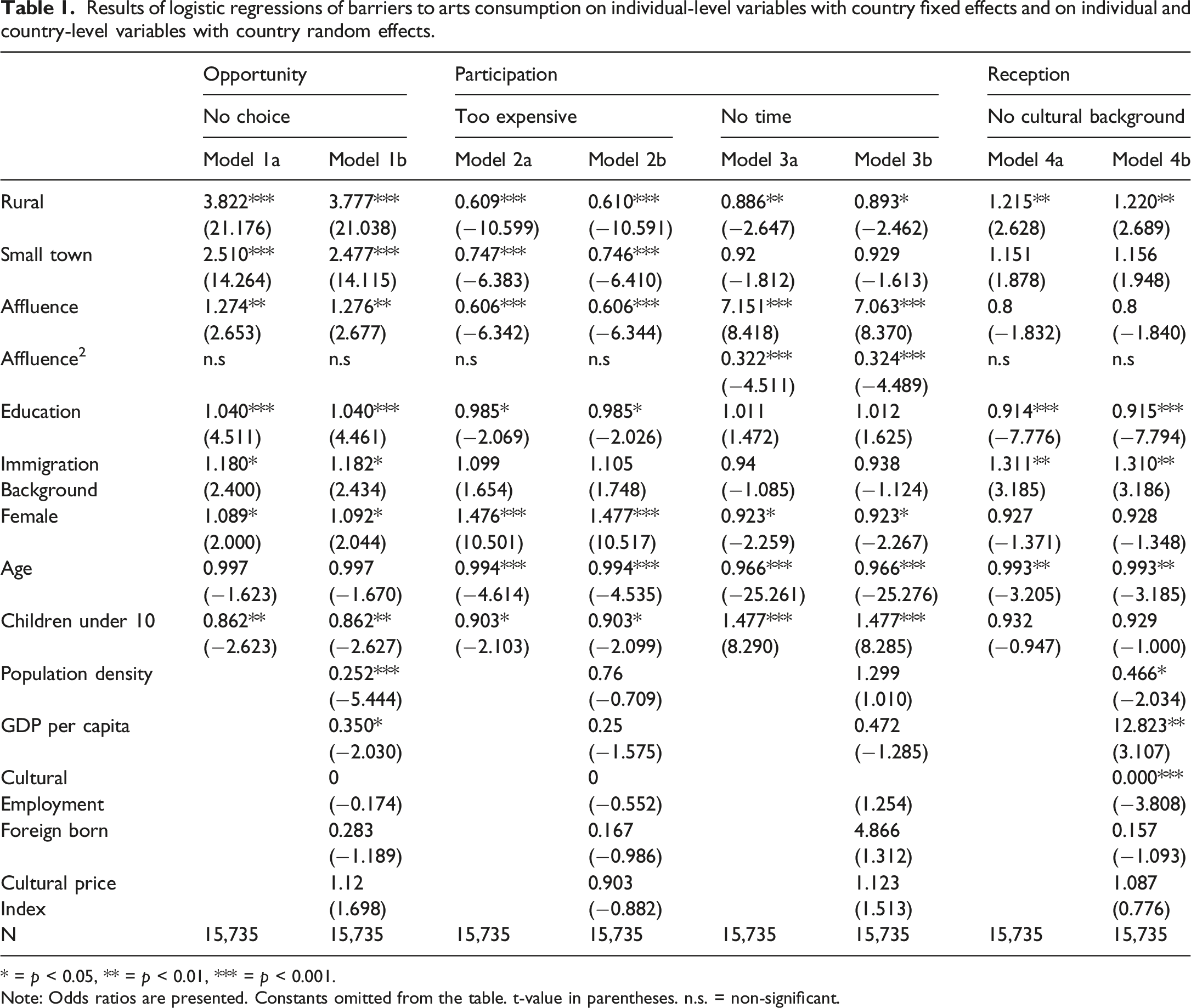
* = p < 0.05, ** = p < 0.01, *** = p < 0.001.
Note: Odds ratios are presented. Constants omitted from the table. t-value in parentheses. n.s. = non-significant.
Opportunity barriers
The analysis indicates that residing in peripheral localities strongly affects the opportunity to access art. The results of Model 1a show that residents of small or medium-size cities are more than twice as likely (b = 2.510***) to encounter problems of limited cultural choice than residents of large cities. This likelihood increases to almost four times (b = 3.822***) among those living in rural areas.
Individuals with an immigration background are also more likely to report not having an adequate supply of cultural consumption opportunities. Privileged individuals are also more likely to encounter opportunity limitations—wealthier and more educated individuals are more inclined to be dissatisfied with their opportunities for cultural consumption.
Model 1b shows which country-level variables play a part in shaping the opportunity to access arts activities. Both population density and GDP per capita have a negative effect on the prevalence of the lack of choice of cultural consumption. Again, the geographic element emerges as a central determinant of access. The results indicate that residents of more densely populated countries whose urban centers, where art production tends to cluster, are closer to each other encounter fewer opportunity barriers.
Participation barriers
Cost – When the choice and availability of cultural activities are less of a constraint, other barriers may limit the possibility of consuming art. I expected that the level of income, proxied by the economic affluence variable, would be a key participation barrier. The results of Model 2a show that economic affluence indeed has a negative impact on the likelihood of reporting the cost of attendance as a barrier. Respondents in the top percentile of economic affluence in their country were almost half less likely (b = 0.606***) to mention cost than those in the bottom percentiles. The inclusion of the affluence 2 variable in an alternative model was not statistically significant, indicating that the relationship between affluence and the cost barrier is better approximated as linear.
Model 2a demonstrates that the cost of attendance is not a significant barrier once the more basic barrier of opportunity is overcome. Residents of geographically peripheral areas were not more likely to indicate the cost of attendance as a barrier. On the contrary, urban residents were more likely to mention the cost of attendance, a result that accords with the hierarchical logic of the model. The inclusion of country-level variables in Model 2b did not yield significant results.
Time – Model 3a shows a positive effect of economic status on the likelihood of mentioning lack of time as a barrier, indicating that, higher-income earners are more prone to limit their arts consumption due to a shortage of leisure time. However, the negative coefficient of the affluence 2 variable is significant in this model, indicating that the relationship between the two is curvilinear and takes the form of an inverted U shape. In other words, both low and high-income earners are less likely to report a lack of leisure time as a barrier than respondents from the middle of the distribution.
For respondents living in peripheral locations and having few opportunities to engage in arts activities, lack of time is not a problem. Rural residents were less likely to report a shortage of time as a barrier (b = 0.886**), and the coefficient for small-town residents was not significant. These results again corroborate the model’s logic that the barrier of lack of time will be more ubiquitous in places where there are more opportunities to access art such as urban centers. As Model 3b illustrates, no country-level variables had a significant impact on the time barrier.
Reception barriers
Being receptive to art depends on having a suitable cultural background that is linked to one’s education and cultural dispositions. Indeed, Model 4a confirms that individuals with less education are more likely to report limited access to arts consumption due to their lack of cultural background. For each year of education, the likelihood of mentioning the lack of cultural background as a barrier to arts consumption declined by around 9% (b = 0.914***). Model 4a also shows that the national or ethnic origin of the respondents affects their consumption. Having one or more parents born outside the country of residence increased the probability of not having a suitable cultural background for consuming art by around 30% (b = 1.311**) compared to respondents whose parents were both born in their country of residence. The fact that affluence level does not affect the reception type of access demonstrates the independence of this type of access from the others.
On the country level, the size of the cultural sector, as measured by cultural employment, has a positive effect on the reception barrier. The negative coefficient in Model 4b indicates that residents of countries with a larger cultural sector are less likely to report a lack of cultural background as a barrier. Interestingly, GDP per capita had a positive effect, indicating that the likelihood of cultural background being a barrier was greater in more prosperous countries. Additionally, the population density had a negative effect on that barrier. Finally, gender, age, and having young children in the household were also significantly related to some access barriers. Generally, women and younger respondents reported encountering more barriers.
In the next section, I will discuss the general implications of these results for understanding the mechanisms that shape access to arts consumption in light of its distinct dimensions as described in the model suggested above. I will summarize the findings from the different models and situate them in the broader field of the study of cultural consumption.
Discussion
The presence of barriers to engaging in cultural consumption, or the lack thereof, determines one’s aesthetic life chances—the likelihood of consuming and enjoying cultural goods, services, and experiences. I proposed a theoretical model that depicts the relationship between the different barriers to access as structured according to a hierarchical sequential logic, where the likelihood of encountering higher-level barriers depends on the presence of lower-level access barriers. I demonstrated how European countries vary in the prevalence of different access barriers and that both individual-level characteristics and country-level contexts influence people’s aesthetic life chances.
Access to opportunity was operationalized as the supply of a selection of arts activities available for consumption. The analysis showed that the geographical factor is key in determining this availability. Lack of choice is more prevalent in rural areas and smaller cities than in large urban zones. Art production tends to cluster in metropolitan areas (Borowiecki, 2013). The greater the distance from these centers, the less likely that residents will commute to attend art events or that artists from those centers will travel to perform or exhibit in peripheral locations. The results also indicate that, net of the effect of personal residence, access to opportunity is greater in more densely populated countries, where the distance between the center and the periphery is smaller.
Access to participation was operationalized as having the economic means and available time to consume art. The findings indicate that, consistent with previous literature, lower economic status has a marked effect on the affordability of cultural consumption (Yaish and Katz-Gerro, 2012). However, lack of time is correlated with income in a complex way—both low and high economic classes report fewer time constraints than middle-class respondents. Could it be that the new leisure class is divided between the two extremes of the distribution? One possible explanation is that cost and time are mutually exclusive participation barriers. The negative correlation found between these two factors provides support for this explanation. Costs limit the ability of less affluent people to consume art. Therefore, they put less emphasis on time constraints and are less likely to report it. More affluent middle-class consumers can more readily afford to consume art but are limited by time constraints. Finally, the wealthiest, the traditional leisure class, is not limited by either cost or time. Another potential explanation is that in the current labor market, higher-income occupations usually involve more demanding work schedules that limit leisure time, whereas middle-income jobs have limited working hours, thus allowing better use of leisure time (Sullivan and Gershuny, 2018).
Access to reception was operationalized as having the cultural background and knowledge required for meaningful engagement with art. I assumed that two factors would be crucial here: education and cultural proficiency, measured by years of schooling and immigration background, respectively. Both factors had the expected effect. People with less education or who have an immigration background report less access to the reception of art. These findings are compatible with explanations that link limited cultural consumption with the development of cognitive ability or cultural capital (Chan and Turner, 2017). The findings do not necessarily indicate an objective cultural deficit on the part of the respondents. Nevertheless, whether the deficit is real or only in the minds of potential cultural consumers with limited educations or an immigration background, the consequences are similar. Their self-perception of having a limited ability to engage with art and their feeling of exclusion from legitimate art venues appear to be tangible barriers (Maxwell, 2015).
Recent reports show that higher GDP per capita in European countries is positively correlated with more public spending on culture (Čopič et al., 2013; Pere et al., 2019). I found a negative effect of GDP per capita on the opportunity barrier, suggesting that spending more on the arts provides more consumption opportunities across a wider area. Public support for the arts is an important income source for art organizations located in peripheral regions where revenue from sales is smaller than in large central cities (Feder and Katz-Gerro, 2015). GDP per capita also has a positive effect on the salience of the lack of cultural barriers. This result is consistent with research showing that more public funding encourages the production of unconventional artworks, which are generally regarded as elitist or avant-garde (Neligan, 2006; O’Hagan and Neligan, 2005).
Net of the effect of GDP, the relative size of the cultural sector has a positive impact on access to reception, suggesting that a larger cultural sector can be more diverse and cater to consumers with different cultural and educational backgrounds. This finding again underscores the role that cultural policy can play in supporting the cultural sector and its employees to promote access to art. The findings suggest that the breadth of support for the reception barrier is more significant than its volume.
I applied my theoretical model of access to regular physical (in person) cultural consumption data. However, its generalizability can be demonstrated by its relevance also to online access to cultural consumption. The pivot to digital cultural consumption, accelerated by the COVID-19 pandemic, brought new access opportunities to art consumption. Nevertheless, recent findings show that digital arts consumption does not eliminate inequalities in cultural consumption (Feder et al., 2021; Mihelj et al., 2019; Weingartner, 2021). These findings are intelligible in light of the multi-dimensional structure of access. Online consumption may have lifted the barriers to the opportunity to consume art by eliminating the need for one’s physical presence. Nevertheless, other access barriers, such as reception that is dependent on education and ethnicity, still remained unaffected. Moreover, the pivot to online arts consumption created new online-specific access barriers such as the availability and cost of having a broadband Internet connection necessary for online consumption. Not coincidentally, this online opportunity barrier is more common in those non-urban areas that are also likely to face physical opportunity barriers to cultural consumption (Early and Hernandez, 2021).
From a policy perspective, there is a danger that the promise of online consumption will obliterate the need to take public measures to reduce disparities in physical, in-person cultural access. There are still differences in the experience of online and physical arts consumption. Reliance on online cultural consumption as a substitute for physical access can make the in-person consumption of the arts even more unequally distributed and fertile ground for reinforcing and reproducing social inequalities (Reidy et al., 2016).
Conclusion
This paper set out to answer two research questions: what are the different dimensions that make up access to arts consumption, and how access is socially distributed and stratified along those dimensions. I argue that access to art is an important and somewhat overlooked concept. Previous research did not make an explicit distinction between different dimensions of access and study them in tandem. Moreover, researchers often examine the access to arts consumption through a single perspective relevant to the specific study and estimate it indirectly by analyzing cultural consumption figures (e.g., DiMaggio and Ostrower, 1990; Heilig et al., 2010; Johnson et al., 2011). My goal is to present a more holistic theoretical model of access to arts consumption. The model serves as the basis for operationalizing the concept using direct measures of the prevalence of barriers to access by analyzing data from European countries that previously was analyzed only rarely and descriptively. Since the model was built on the theoretical distinction between barriers to cultural consumption and tested using information from 27 European countries with diverse economic and social contexts, it is very likely generalizable and applicable to other contexts such as non-European countries or different types of cultural products. I discuss access as a multi-dimensional construct of aesthetic life chances and demonstrate its structure and applicability with regard to the consumption of the physical arts. However, the model can also be used to explain online arts consumption because the barriers of opportunity (e.g., access to the Internet), participation (e.g., cost and time), and reception (e.g., language and genre) are also relevant for non-physical arts consumption.
Against the backdrop of increasing emphasis on the social values that guide arts organizations in their organizational vision and public-facing activities, this research may also provide guidelines for their ongoing practice. Access is a component in the often-used quadruple of Inclusion, Diversity, Equity, and Access. While the literature on this issue is developing (Butler et al., 2007; Cuyler, 2020), especially around the notion of diversity, the concept of access still merits more development and this paper seeks to contribute to it. Understanding the different dimensions of access and their determinants can help clarify this concept, develop achievable goals, and devise better tools for ensuring that they are met.
More specifically, cultural organizations might want to reflect on methods for improving access. Examples include a museum creating traveling exhibitions or lending artwork to more remote regions (opportunity), extending its opening hours, offering reduced-price tickets (participation), and adding captions in foreign languages to descriptions of artwork (reception). Due to the hierarchical nature of the dimensions of access, increasing access of one type might reveal other access problems. For example, reducing admission fees (participation) may bring new consumer groups to the museum with diverse cultural backgrounds, which may require adjusting the descriptions of the artwork (reception). Just as this research can inform the practice of cultural organizations, it can also be helpful in the training of art managers as practitioners in the cultural field and in developing knowledge frameworks to broaden the potential audiences and promote cultural justice.
Since the provision of access to arts consumption is a central raison d’etre of cultural policy and an important goal of the public support for the arts, this study is relevant to policymakers too. It suggests that any policy promoting access to art should design specific strategies to deal with the four access types I outlined. Policymakers should be aware that the provision of access is an ongoing task. Access may take several forms and actions to remove barriers related to more elementary access types has to be followed, as described above, with actions that deal with higher-level access types. The findings I presented can help policymakers to focus policy actions on specific social groups that are more likely to face lower aesthetic life chances. It also shows that there are no “magic solutions.” For example, the results suggest that public art support can help increase the opportunity to consume art, but at the same time may sustain the reception barriers. Moreover, although variables such as geographical location, income, immigration background, and education level are correlated, I found that their effect on different types of access to art is relatively distinct. This finding is an additional reminder of the importance of incorporating access to art in research about cultural taste and consumption.
In this paper, I suggest a new model of access to arts consumption that offers greater depth and nuance into the relationship between taste and access and the way they influence cultural behavior. Its conceptual contribution can help us better understand the tranformations that have been taking place in cultural consumption over the last few years and that will continue to shape it in the future. Additionally, it can be applied to analyze other domains of consumer culture, such as culinary or fashion consumption, and their relationship with social inequality.
Supplemental Material
Supplemental Material - Access to arts consumption: The stratification of aesthetic life-chances
Supplemental Material for Access to arts consumption: The stratification of aesthetic life-chances by Tal Feder in Journal of Consumer Culture.
Footnotes
Acknowledgments
This research was supported by THE ISRAEL SCIENCE FOUNDATION (grant No.110/19). I thank Prof. Tally Katz-Gerro and the anonymous reviewers for their helpful comments on earlier drafts of the manuscript.
Declaration of conflicting interests
The author(s) declared no potential conflicts of interest with respect to the research, authorship, and/or publication of this article.
Funding
This research was supported by THE ISRAEL SCIENCE FOUNDATION (grant No.110/19). I thank Prof. Tally Katz-Gerro and the anonymous reviewers for their helpful comments on earlier drafts of the manuscript.

Supplemental Material
Supplemental material for this article is available online
Notes
Author Biography
References
Supplementary Material
Please find the following supplemental material available below.
For Open Access articles published under a Creative Commons License, all supplemental material carries the same license as the article it is associated with.
For non-Open Access articles published, all supplemental material carries a non-exclusive license, and permission requests for re-use of supplemental material or any part of supplemental material shall be sent directly to the copyright owner as specified in the copyright notice associated with the article.
