



Abstract
How do omnivorous consumers perceive co-creation in cultural consumption? In this article, we combine observation data on co-created cultural productions, focus groups and field interviews to investigate omnivorous consumers’ perceptions of artistic experiences characterized by different degrees of co-creation. We explored this topic in the context of co-creative theatre, an emergent theatrical genre that provides for the active involvement of omnivorous consumers in the staging of a theatrical performance. Our findings reveal new dimensions of what it means for omnivorous consumers to be culturally open by showing their perceptions of interactive and participatory art, two distinct co-creative artistic experiences. While interactive art encourages consumers to intervene in the artistic experience by following the precise direction of the professional artists on stage, participatory art entails an even more active and autonomous role of consumers in the design of the experience. Our findings indicate that there are differences between the way in which consumers perceive interactive art and participatory art and that two distinct dimensions of cultural consumption – novelty and authenticity – emerge from different co-creative dynamics. The observed co-creation experiences portray the transformation of the omnivorous consumers from spectators or visitors to co-authors of the experience and mark the dissolution of the existing boundaries between production and consumption.
Introduction
Cultural omnivorousness has commonly been defined as high-status cultural consumers’ tendency to consume the fine arts and also be involved in a wide range of low status activities (Peterson, 1992; 1997; 2005; Peterson and Simkus, 1992; Peterson and Kern, 1996). Beginning with the seminal article by Peterson and Kern (1996), several studies have shown that cultural consumers, especially those from the upper social classes, have become more omnivorous than in the past (Bryson, 1996; Van Eijck, 2001; Coulangeon, 2005; Jaeger and Katz-Gerro, 2010). In this view, high-status individuals exhibit ‘an openness to appreciate everything’ (Peterson and Kern, 1996: 904), which is the signature of a culturally open minded individual (Ollivier, 2008) and a new form of distinction based on multidimensional involvement in a wider range of cultural products (Warde et al., 2008).
The concept of cultural omnivorousness inspired a multitude of studies conducted in several countries through a variety of methodological approaches (Brisson, 2019). Studies in this tradition have drawn attention to the characteristics of omnivorous consumers (Peterson and Kern, 1996; Hahl et al., 2017) and of their cultural tastes and consumption practices (Bryson, 1996; Peterson and Kern, 1996; Van Eijck, 2001; Sintas and Álvarez, 2002; Chan and Goldthorpe, 2007; Coulangeon and Lemel, 2007). These studies share an interest in omnivorous consumers’ openness to like and dislike different types of cultural products and investigate the hierarchical boundaries between highbrow and lowbrow genres (Flemmen et al., 2018: 5).
However, there is still limited understanding of how omnivorous consumers perceive other types of boundaries, those that separate active cultural production and passive consumption. While a few studies on cultural omnivorousness have separately considered the areas of taste and participation (e.g., DiMaggio and Mukhtar, 2004; Sintas and Álvarez, 2004; Warde and Gayo-Cal, 2009), these studies have primarily concentrated on passive participation forms, such as attending jazz concerts and visiting art museums (DiMaggio and Mukhtar, 2004). This is a significant shortcoming for two main reasons.
First, recent studies show that omnivorous consumers increasingly manifest an appetite for new, authentic, and intense emotional experiences and seek out interactions and knowledge from cultural producers to enhance their status distinction (Sullivan and Katz-Gerro, 2007; Ollivier, 2008). Importantly, omnivorous openness to cultural diversity is linked to the possession of competences, know-how and personal qualities that translate into an ability to deal with change and into a positive disposition towards active and authentic cultural participation (Chan and Goldthorpe, 2007; Ollivier, 2008; Hedegard, 2013).
Second, cultural consumers are often being encouraged to take on more active roles in co-creating artistic experiences, and the borders between production and consumption are becoming more porous (Johanson et al., 2014; Bonet and Négrier, 2018). Increasingly, consumers are invited to engage in the arts in new, active, and co-creative ways. Co-creation requires consumers to be actively involved in the coproduction of their consumption experiences and in the co-creation of the value derived from those experiences (Vargo and Lusch, 2004; White et al., 2009; Ranjan and Read, 2016; Colbert and Ravanas, 2018). In this study, we focus on omnivorous consumers’ perceptions of different types of co-creative artistic experiences through an examination of their active engagement in experience development processes characterized by distinct degrees of co-creation.
We decided to design our research on the specific genre of co-creative theatre to examine the co-creative dynamics that are expressed in it. Co-creative theatre is an ideal field for this research. Indeed, co-creative theatre is a less established theatrical genre that provides for the active involvement of users in the staging of performance. As opposed to what happens in more traditional theatrical events, in the context of co-creative theatre, the omnivorous user can assume new characteristics based on participation and co-creation and move within a space in which the distinction between the ‘front stage’ and the ‘backstage’ seems to disappear (Goffman, 1959). In proximity to and in the absence of physical and architectural boundaries, which are typical characteristics of participatory performances, the spectator becomes a fulcrum and an active part of the performance. In particular, we considered co-creative theatrical performances shaped by different degrees of co-creation. Specifically, we focus the attention on both co-creative performances where cultural consumers intervene following the precise direction of the leading artists on stage (i.e., interactive art) and co-creative performances where consumers take on an even more active role in the creative process and jointly develop the plot of the performance to express their feelings and emotions (i.e., participatory art) (Bishop, 2006).
Theoretical background
Cultural omnivorousness
Although cultural omnivorousness can be conceived as a manifestation of openness (Roose et al., 2012), it is also a status marker (Peterson, 1997). For Peterson and Kern (1996: 904), ‘while by definition hostile to snobbish closure, omnivorousness does not imply an indifference to distinctions’. Similarly, Johnston and Baumann (2007: 168) suggest that ‘on its surface, the omnivorousness era appears to support a more inclusive and democratic notion of what counts as good or prestigious culture […]. However, omnivorousness seems to function as an alternative strategy to snobbery for generating status’ (Peterson and Kern, 1996; Bryson 1996; Emmison 2003). While greater tolerance of difference and understanding of the co-existence of multiple values have become virtues that social elites are expected to possess (Chae, 2021), the inclusive taste and openness to novelty displayed by elites have become ‘a new cultural logic of distinction’ (Goldberg, 2011: 1411), a way of differentiating themselves from other social groups.
Regardless of the rationale, however, openness is thought to be a central characteristic of cultural omnivores. 1 Research in cultural consumption has demonstrated that the openness of elite omnivores can take different forms, ranging from a passive tolerance of different genres to an active desire to discover new, authentic and challenging items (Roose et al., 2012; Chae, 2021). In other words, elite individuals' openness entails both ‘the capacity and willingness to learn and choose as opposed to the inability or unwillingness to do so’ (Ollivier, 2008: 125). For example, Prieur et al. (2008) argue that today’s elites, or members of the upper-middle class, draw a boundary between themselves and others in terms of being mobile, open minded, creative and reflexive versus being closed, stuck, narrow minded, traditional, and nonreflexive. Importantly, openness to cultural diversity is linked to the possession of not only cultural resources such as knowledge, competences, and know-how but also personal qualities such as tolerance, adaptability, mobility and searching for self-improvement (Bryson, 1996). These qualities and resources in turn translate into the omnivorous consumers’ selective ability to deal with change, to learn new things and to acquire knowledge. Accordingly, omnivorous consumers’ openness has been found to foster interest across many domains, thereby providing a strong motivation to discover and learn (Silvia and Sanders, 2010). This is in line with psychological notions of openness as a personality trait that is linked to curiosity and to finding things more interesting in general, allowing people to thrive on novelty and challenge. For example, in her study on the relationships between consumer education and the propensities of firms to span multiple market categories, Chae (2021) showed that, in addition to their ability to better understand novel offerings, omnivorousness leads educated elites to develop a preference for such offerings. Combined with their openness towards novelty, omnivorousness paves the way for the elites to find hedonic value in consuming innovative hybrids that span different categories (Ollivier, 2008; Roose et al., 2012). Holt (1998) also shows that educated elites search for and desire ‘consumption objects far removed conceptually from what is considered to be normative within a category’ (p. 13) while those with lower levels of education ‘find comfort in objects that are familiar’ (p. 13).
Omnivorous consumers concretely express their openness to cultural diversity through their ability and willingness to learn what is unknown to them, to entertain new ideas and to appreciate atypical product offerings (Chae, 2021). This in turn supports a positive disposition towards new and more active forms of cultural consumption such as co-creative ones.
Co-creative cultural consumption
Research on arts participation has built an increasingly nuanced picture of what arts participation entails and the spectrum of activities it encompasses. Specifically, arts participation may range from spectating (receptive participation) to audiences as artists, whereby the latter requires active participatory involvement (Novak-Leonard and Brown, 2011) and the new possibility for cultural consumers to become co-creators of the artistic experience (Johanson et al., 2014). Co-creation practices are an integral part of the artistic experience, as consumers engage in cognitive and emotional practices to appropriate and make sense of cultural products (Capelli and Dantas, 2012; Walmsley, 2016). Consumers increasingly participate in co-creative experiences because they ‘want something that is not available in the market’, and they value ‘the enjoyment or learning that it brings’ (Von Hippel, 2005: 5). In addition, experimentation and the search for authentic consumption experiences are other motivations for consumers to co-create (Anderson et al., 2006; Thyne and Hede, 2016). Co-creative cultural consumption allows individual customers to actively co-construct their own consumption experiences through personalized interaction, thereby co-producing unique value for them (Grayson and Martinec 2004; Leigh et al., 2006). Furthermore, co-creation innovates art participation as it implies a shift towards active cultural engagement and an invitation to connect with other people, to share and create new knowledge in a process that is highly collaborative.
Interestingly, consumers can cooperate with an experience development process to a greater or lesser extent, which suggests the existence of different degrees of co-creation. Specifically, research on co-creative experiences in cultural industries shows the existence of different degrees of cultural consumers’ involvement in the experience development process (Grissemann and Stokburger-Sauer, 2012). For example, Bishop (2006, 2012) distinguished between interactive and participatory art, whereby the former is a closed process where consumers intervene in cultural production following cultural producers’ directions, whereas the latter is an open process where consumers take on more active roles in the process until they become co-authors of the experience.
The characteristics of omnivorous consumers are well suited to the emergence of an active participation trend in the arts (Bonet and Négrier, 2018) and make them the ideal target of co-creation. Indeed, not only are omnivores open to a wide variety of cultural genres (Peterson and Kern, 1996; Warde, 2005), but their openness to cultural diversity encourages them to search for novel artistic experiences as antidotes to experiential standardization and homologation (Ollivier, 2008; Kovács and Johnson, 2013). Furthermore, the same psychological trait makes it likelier for them to enjoy enriching art experiences based on the discovery of novel and authentic features (Ollivier, 2008; Kovács and Johnson, 2013; Chae, 2021) together with self-improvement and knowledge acquisition opportunities. As suggested by Hedegard (2013), omnivores may indeed seek out significant experiential consumption, as they ‘may search for interactions with artists, musicians, authors, and chefs at cultural events rather than being satisfied with attendance alone’ (p. 19). 2
Nevertheless, the understanding of how omnivorous consumers perceive co-creative artistic experiences is still limited. To address this limitation, we shed light on how omnivorous consumers perceive co-creation, by focusing specifically on their personal understanding and evaluations of artistic experiences shaped by different levels of consumer involvement in co-creation. Moreover, we aim to explore how omnivorous consumers evaluate the presence and relevance of different dimensions of innovations and authenticity in different types of co-creative experiences.
Research methodology
A qualitative approach was selected for this study due to the exploratory nature of the work and the scarcity of previous studies in the area (Myers, 2009). We adopted a case-based methodology (Yin, 2009) and we employed multiple data collection methods to exploit opportunities for triangulation (Jick, 1979). This approach was particularly useful because it allowed us to conduct a comparative study among the different kinds of co-creative theatrical events, each of which may be viewed as a case. The use of multiple cases allows for more robust results compared to using a single case and allows for a safer saturation of the study object.
Data collection
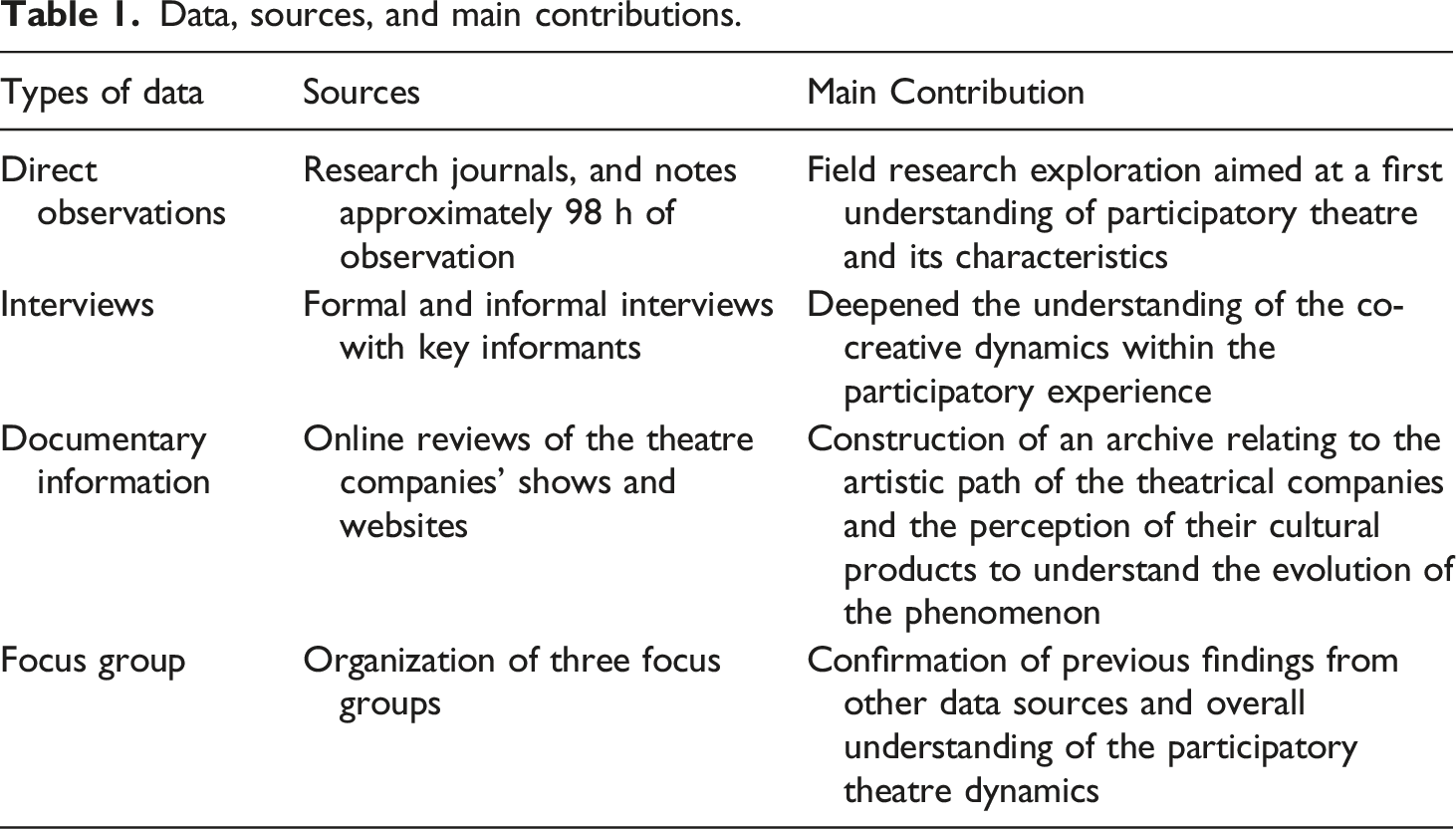
Data, sources, and main contributions.
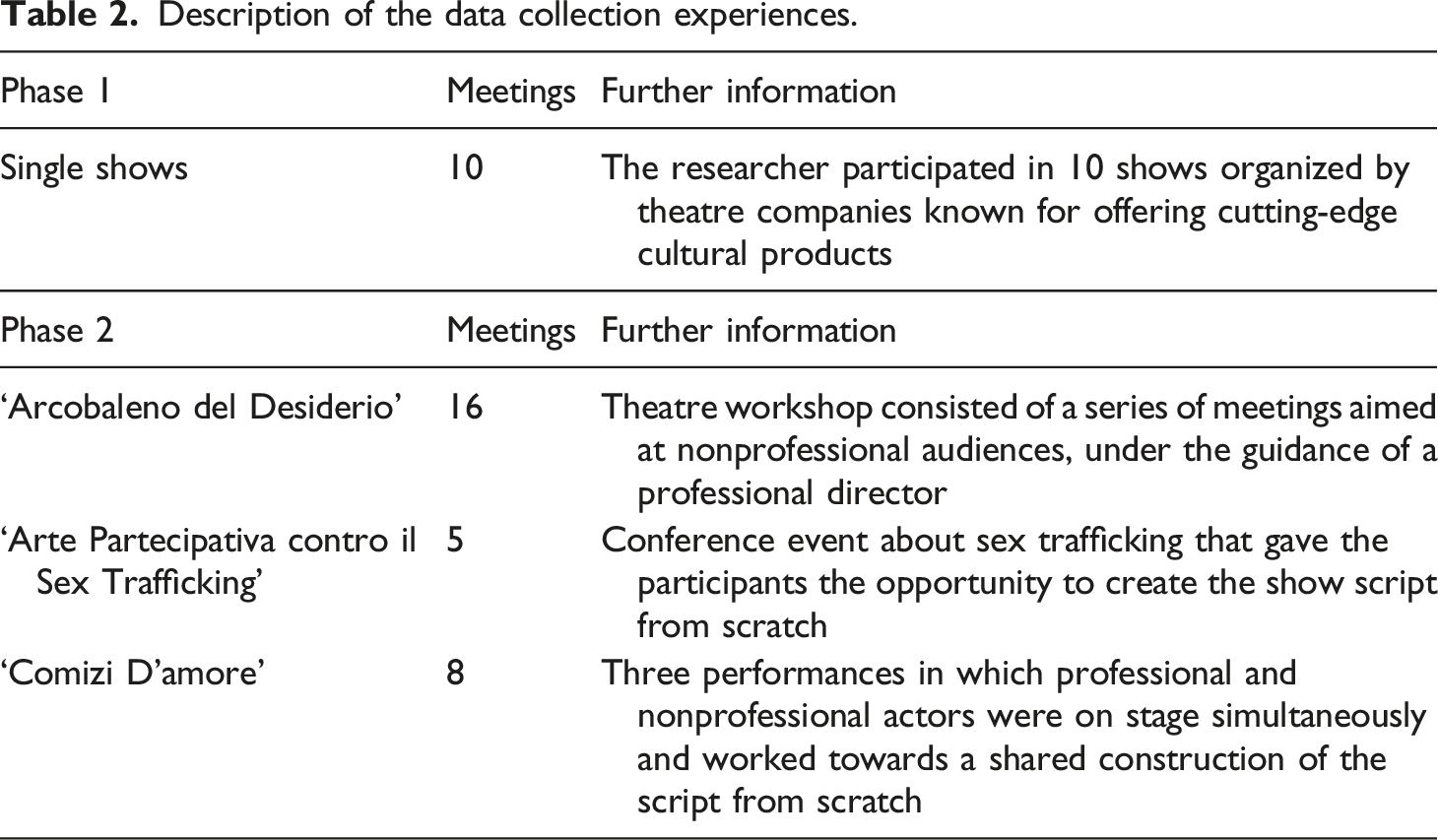
Description of the data collection experiences.
The diversified cultural consumption tastes and practices of participants were confirmed by a questionnaire that we gave them after the co-creation experience. The goal was to involve users who had participated in theatrical workshops and/or participatory art shows by expanding the scope of research. Following Peterson and Kern (1996), we operationalize omnivorousness as the number of middle-brow and lowbrow art forms that highbrow respondents choose from a list of different types of cultural activities. The questionnaire was disseminated through Google Forms from 29/01/2020 to 29/03/2020, collecting 93 responses. The respondents showed diverse cultural and consumption preferences over the past 12 months. The majority visited museums or art galleries (88%) and monuments or archaeological areas (90%). The respondents also showed interest in various music genres, including classical (80%), jazz (71%), pop (89%), and rock (87%). The sample displayed a preference for refined activities such as attending prose shows (68%) and listening to gospel/blues music (62%) as well as mass consumer experiences like attending sporting events (64%) and exhibitions/festivals/fairs (97%). Regarding education, 48% of participants had a high level of education, with 23% holding a master’s degree, 25% a master’s degree or PhD, and 10% a 3-year degree. Additionally, 58% of the sample had completed at least one university course. The favourite activities of the respondents over the last 12 months included visiting museums or art galleries (50.5%) and attending prose shows (43%). Nevertheless, the respondents also participated in lowbrow activities such as listening to rock music (45.2%) and attending sports events (36.6%). Finally, visiting monuments/archaeological areas and listening to pop music both received similar values of 29%, underlining the sample’s basic eclecticism in their choices.
Documentary information
We used participant observation to analyse the social dynamics of the fruition process from the inside through direct involvement with the investigated subjects. This technique allowed us to study the internal dynamics of fruition by immersing oneself in the context (Denzin and Lincoln, 2005). We collected 99 h and 5 min of direct observation. In addition to direct observation, we conducted three focus groups with a total of 18 participants.
We also consulted archival sources, materials linked with the events, and conducted interviews to gain further insights into the co-creative dynamics in the theatrical field and the involvement of omnivorous consumers in participatory events.
The data analysis was an inductive and iterative study of the qualitative data we collected (Eisenhardt, 1989; Strauss and Corbin, 1990).
Findings
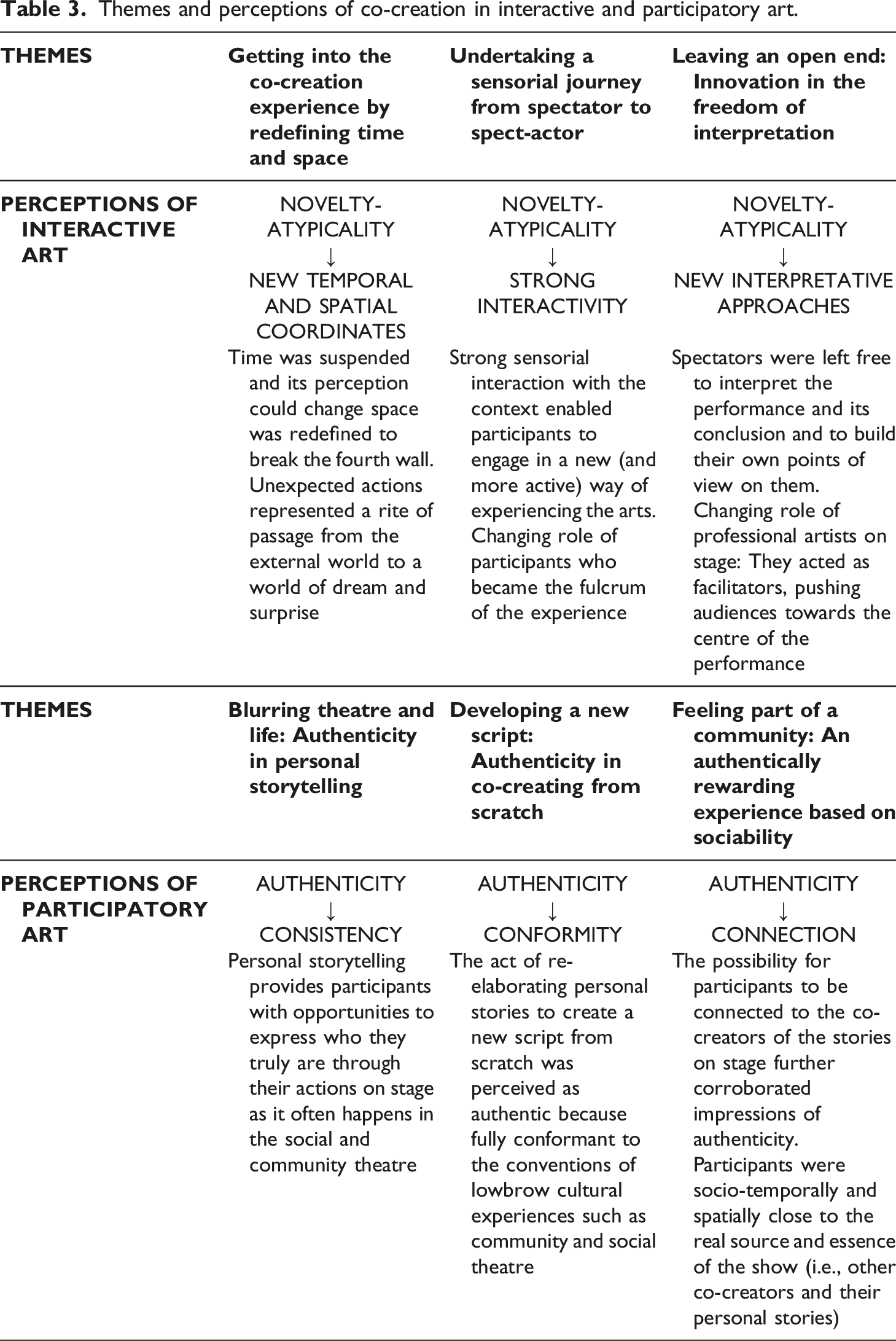
Themes and perceptions of co-creation in interactive and participatory art.
Co-creation 1: interactive art
Interactive shows are presented as one-off events that provide for the active involvement of participants in the staging of the performance, leading to an interaction between artists and spectators, who become part of the performance following the instructions of the director and making choices on the basis of a preordained path. These are highly emotional experiences created to leave the viewer with a sense of physical and dreamlike involvement. Being brought to the stage makes the whole experience a journey, albeit short-lived, alienating individuals from everyday life. Interactive theatre violates some of the rules of traditional theatre and results in atypical product offerings (Chae, 2021) which recombine elements from high-status theatre and lowbrow theatrical experiences such as community and social theatre. 3 The classical theatre space, for example, is remodelled to encourage user involvement. Another discordant element is that, despite its being a predetermined path, the interaction between actors and spectators is a foundational and essential aspect for the performance. Although interactive art introduces these innovative elements borrowing them from lowbrow theatrical genres, it also maintains other aspects of traditional theatre. As these features are preserved, traditional theatre remains the point of reference that guides the perception and evaluation of omnivorous consumers. It is in comparison with traditional theatre that interactive art is judged by this audience. The elements that unite interactive art and traditional theatre are, for example, the use of original texts in some plays, the role of the director in constructing the script, and the professional actors putting artistic directives into practice. Interactive art, indeed, allows audiences to actively participate in the performance but does not give the opportunity to negotiate on the construction of the show, which is entrusted to the performers and remains their full responsibility. Participants can therefore make choices during the performance, but these are always based on an obligatory path created in advance. In other words, they follow a shared structure throughout the co-creation process.
Three main themes shape omnivorous consumers’ interventions in interactive art and influence their perceptions.
Theme 1.1: Getting into the co-creation experience by redefining time and space
At the beginning of each show, participants were invited to gradually immerse themselves into the co-creation experience by forgetting their real life and entering a surprisingly unusual context. This context was perceived as new and different from more conventional theatrical settings. Specifically, the redefinition of time and space that characterizes the first stage of interactive art immediately conveyed the idea of being engaged in an unconventional theatrical experience which departs from an established genre. In all art forms, genres are formed by sets of conventions and are useful categories that bridge multiple concerns (Kawin, 1987). By redefining the temporal and spatial conventions of traditional theatre, interactive art deviates from an existing genre and brings novel and unfamiliar offerings to the market. While genres usually have clear, stable identities and borders, in most cultural industries, genre innovation is fundamental to the sustaining of demand, product variety, and differentiation (Lampel et al., 2000). Different types of actions undertaken by participants contributed to the redefinition of time and space. For example, participants were invited to leave watches and cell phones in the anteroom with the aim of cancelling and redefining the perception of time. Time was suspended, and its perception could change as a result of the participants’ personal interpretation. This temporal suspension was inevitably conceived as novel by individuals who knew the rules of traditional theatre. This was clearly expressed by key informant 9: ‘I perceived, on stage, a different idea of time... I was not able to realize its passing... it seemed almost a dream’.
Importantly, participants were encouraged to reinterpret the space: ‘We were brought into a main room where we were invited to sit on the ground and become the border space within which the two dancers Roberto and Luca would have moved’.
The conventional theatrical space was redefined to break the fourth wall that separates the actors from the spectators, as pointed to by our key informant 4: ‘It gave me the idea of a square in which to intervene …’
However, these actions also reinforced perceptions of novelty. The unexpectedness and originality of these actions, which were absent in traditional theatrical experiences, evoked feelings of novelty through enchantment: the perception of entering a world of dream, magic, and surprise. These actions set the stage for the second phase of this co-creation journey.
Theme 1.2: Undertaking an active sensorial journey from spectators to spect-actors
Participants also undertook a series of actions based on their active intervention into the performance that followed the director’s instructions. These actions reinforced perception of novelty by enabling participants to change their role from spectators to spect-actors. More precisely, participants got into the story and the characters by experiencing the story through the five senses and actively took part in the performance by following a script elaborated by the stage director. The strong sensorial interaction with the context represented a shift from traditional theatrical events by enabling participants to engage in a new (and more active) way of experiencing the arts. A central characteristic of this sensorial journey, indeed, is that participants intervened in the performance by following a script elaborated by the stage director. Participants’ involvement in the performance at the sensorial level encouraged them to behave as actors on stage and feel themselves as the fulcrum of the experience. The active intervention of participants in the performance is not only considered as a genre innovation but also as a form innovation. The latter, indeed, refers to innovative ways of presenting, performing and interpreting a work of art (Castañer and Campos, 2002). One dimension of innovative product form is interactivity, that is the way organizations and individual artists design an interaction with their audiences during a performance.
It was precisely this interactivity that made participants perceive the theatrical production as shaped by unique features. Indeed, it gave them an opportunity for self-improvement by expanding their knowledge and helping them become aware of their unexplored and unexpected potentialities. This was also clearly emphasized by participants 3 and 5: ‘I have never participated in an event like this’. ‘By seeing yourself doing something different you can realize that your potentialities are much broader than what you experience in your daily life. You can become truly aware of them (…)’
We can conclude that, in addition to the redefinition of time and space, the changing role of participants from spectators to spect-actors contributed to raise perceptions of novelty with respect to traditional theatre.
As suggested by a report, the perception of novelty that stemmed from participants’ physical involvement in the performance also triggered intense emotional reactions from the beginning to the closing act of the show.
Theme 1.3: Leaving an open end: Innovation in the freedom of interpretation
In interactive art, the ending remains open because the spectator is left free to interpret the performance and its conclusion. This atypical element contributes to further accentuate the innovativeness of interactive art as compared to traditional theatre experiences. New approaches to interpretation, indeed, are key dimensions of form innovation (Castañer and Campos, 2002; Cancellieri et al., 2022). Examples of reinterpretations of traditional products can also be found in several contexts. For example, over the last few years there has been a movement towards reinterpreting some classic ballets from new perspectives to preserve heritage and, at the same time, express contemporary values (Sagiv et al., 2020). Take the case of the Italian opera houses. Leaving an open end is an innovative act which concerns the interpretation of an existing work of art by offering to theatregoers the possibility to discover their own personal point of view about the theatre piece on stage and by engaging them in an intellectual challenge. In interactive art, professional actors on stage did not search for extrinsic rewards (e.g., public recognition and acclaim). Instead, they seemed to be focused on developing the vision of a participatory show that consists in putting the audience in the centre of the performance. As such, they offered to audiences the task of interpreting the shows and finding their own personal points of view.
According to one of our reports: ‘As always happens there was no applause. The director explained that since a bond was created between the actors and the audience, there was no need for applause; what remained was the bond’.
Co-creation 2: participatory art
Participatory art experiences serve the purpose of building and creating a common and collective space of shared social commitment that is central to the activation and co-authoriality of an audience. A participative audience differs even more from the consumption of a passive spectator, as they are able to negotiate and closely collaborate with all the other participants who take part in the creative process. The peculiarity of these events is that nonprofessional actors work together for a shared construction of the show to create a new script from scratch. In this case, participants jointly produce a new theatrical performance from scratch and without being guided by professional artists. As such, participatory art is no longer comparable to traditional theatre and other highbrow experiences. From the point of view of audiences, it falls within the boundaries of community and social theatre because it is fully conformant to the codes of this theatrical genre. First of all, it includes the social and educational objectives of activating the growth of participants and their relationship with their socio-cultural context of reference. Second, it relies on theatre workshops aimed at creating a performance involving all participants and an audience. Third, it is marked by a sense of foreignness because it does not impose limits to participation in terms of cultural capital, and it is often aimed also at socially disadvantaged segments of the population. Finally, it relies on the commitment, motivations and skills of people who are nonprofessional artists, who work together to create a new theatre show from scratch. By incorporating some of the most important elements of social and community theatre, participatory art leads omnivorous consumers to change their reference points in evaluating co-creative experiences. The benchmark is no longer the traditional theatre experience but theatrical events that are outside the mainstream culture and are infused with lowbrow features. Participatory art started from and developed through the work of nonprofessional artists who blended and reinterpreted their own personal stories as well as the ones of other participants to jointly create a new theatrical production. Omnivorous consumers’ involvement in participatory art is characterized by three main themes that influence their perceptions.
Theme 2.1: Blurring theatre and life: Authenticity in personal storytelling (authenticity as consistency)
Individuals who took part in participatory art events were first asked to extemporize through personal storytelling. This process started with a series of questions posed by the actors to the participants, concerning their personal life and intended to blur the differences between theatre and life by leading participants to talk about themselves on stage. Then, the actors on stage developed a format based on the spect-actors’ ability to improvise through their personal storytelling. The improvisation process was supported by the actors’ efforts to foster the spect-actors’ ability to tell their own stories and experiences on stage. This in turn leads to the emergence of another dimension of authenticity, which refers to the consistency between an actor’s ‘front’ and ‘backstage’, between an entity’s internal values and its external expressions. In this respect, authenticity has been defined as ‘the unobstructed operation of one’s true, or core, self’ (Kernis and Goldman, 2006: 293) and ‘a behaviour that is experienced as being authored by the self’ (Sheldon et al., 1997: 1381). Setting participants free to tell their own stories and experiences on stage reinforced the perception of authenticity based on the possibility for the spectators to express who they truly are through their actions and to find an alignment of their internal experiences with their external expressions, thereby acting in accordance with their own sense of self, emotions, and values. According to participants 11, 5, and 13: ‘(…) I am on a path where I am finding myself (…) it is a search for my true self’. ‘(…) the fact that you are interpreting something different from yourself does not mean that you don’t feel yourself…you can discover that your words and actions on stage are in line with your true self (….)’. ‘The power of theatre is that you can work on yourself, which becomes important even for those who do not want to become actors (…)’.
The actions undertaken at this stage of the process were evaluated as authentic because they were oriented to the self-expression of the participants who had the opportunity to manifest their own feelings, emotions, and personal points of view.
As expressed by participants 11: ‘I think I speak for all of us when I say that this experience was so emotional and amazing. It gave us a space of freedom (…), freedom of emotions (…) I am spontaneous, I do everything that comes to my mind (…) freedom, this is the right word. In this space, I found my freedom, the freedom to do what I like, what makes me happy’.
The personal storytelling was a fundamental ingredient of this co-creation and a prerequisite to participants’ joint efforts to develop a new script from scratch.
Theme 2.2 Developing a new script: Authenticity in co-creating from scratch (authenticity as conformity)
The experience of participatory art encouraged participants to co-create a theatrical production starting from nothing or from very few elements. This objective was achieved through the arrangement of all the different phases of the production from scratch or from a scenic plot, the participants’ joint efforts and their strong emotional involvement in the co-creation. Participants, indeed, were asked to re-elaborate their personal stories to jointly develop new scripts. This process was particularly challenging, as it required them to tell first-hand stories and to rework other people’s stories: ‘The shared draft of the script was jointly developed by us. This second meeting was aimed at producing the first draft of the script. We decided together where and how to insert the interventions of the various actors and guests. At the end, we also decided that a further meeting was necessary for the preparation of the concrete details and to validate the draft’.
The act of re-elaborating personal stories to create a new script from scratch was perceived by omnivorous consumers as authentic because it conformed to the conventions of lowbrow cultural experiences such as community and social theatre. These genres are excitingly different and distinct from the expectations and experiences of traditional theatre goers and passive spectators. By following the rules of community and social theatre, participatory art provides individuals and amateur artists with a platform in which they can express themselves without judgements and become cultural producers. A dimension of authenticity, indeed, interprets it as conformity to a category. According to this meaning of authenticity, an entity is authentic to the extent that it conforms to the social category which it has claimed for itself and to which it has been assigned by relevant audiences. This definition of authenticity refers to whether or not an entity conforms to ‘the conventions of a category or genre’ (Rao et al., 2005: 969) or ‘is true to its associated type or category or genre’ (Carroll and Wheaton, 2009: 257). Audience members use categories as a way to locate and evaluate authenticity and tend to reward entities that are deemed authentic because of category membership. Omnivorous consumers play a central role in determining whether or not participatory art is authentic by assessing its position within lowbrow theatrical genres. The presence of this dimension of authenticity was highlighted by most of our key informants. As observed by participant 3: ‘For me, it was authentic because it started from scratch (…)’.
The co-creation of a new script from scratch was undoubtedly facilitated by the strong social, temporal, and spatial proximity between participants who jointly created the show.
Theme 2.3 Feeling part of a community: A socially rewarding experience (authenticity as connection)
Participatory art was evaluated as a socially rewarding experience because it provided participants with opportunities for sociability that stemmed from the possibility to feel part of a community and to establish social ties based on a sense of reciprocity. The latter was experienced by participants thanks to their social interaction with the context of the performance and their engagement in activities that require their mutual understanding and support. Reciprocity in turn nurtured a community-building process thanks to the social, temporal, and spatial proximity between participants and the sharing of the risk related to their engagement in an unconventional, experimental artistic experience. Interestingly, the socio-temporal and spatial proximity between participants was also identified as another source of authenticity. By simultaneously working together in close proximity for the construction of a new script from scratch, each participant made efforts to understand and re-elaborate what happened to other participants. This point was clearly illustrated by participant 9: ‘We trusted each other (…) It was really a matter of trust towards those who were with you’.
Our key informants 2 and 11 reported that this connection to other individuals was authentic because it enabled participants to feel themselves closer to the real source of the production that they were building together, that is the personal stories of other co-creators. ‘We know the work each participant did individually, and then we saw everything come together in this event (…)’. ‘Everyone gave me strength and we supported each other (…) there is always one who feels down and one who cheers them up and this helps strike a balance (…) We knew we were not alone anyway’.
This reflects a meaning of authenticity as connection to other people who are the creators or co-creators of a product or experience (Newman and Bloom, 2012). Authenticity studies, indeed, have shown that entities are considered authentic to the extent in which they can be physically or spatiotemporally connected to their origins (Lehman et al., 2019; Grayson and Martinec, 2004). Accordingly, participatory art is perceived as authentic because it enables individuals to occupy the closest positions to other co-creators of the stories on stage and, therefore, to fully understand the real source and essence of the show. Participatory art contains the essence of its producers and this aspect contributes to reinforce perceptions of authenticity.
Discussion and conclusions
In this article, we investigated how omnivorous cultural consumers perceive co-creation. We explored this topic in the context of participatory theatre, an emergent theatrical genre that provides for the active involvement of omnivorous consumers in the staging of a theatrical performance. We examined the co-creative dynamics that are expressed in this genre and specifically focused on distinct levels of omnivorous consumers’ involvement in the co-creation. We focused on different levels of involvement and found that interactive and participatory art are evaluated differently. Interactive art is seen as novel because it redefines time and space, transforms passive spectators into active participants, and allows for new approaches to interpretation. Participatory art is seen as authentic because it reflects consistency, conformity, and connection (Lehman et al., 2019). Participants are able to act in accordance with their true selves, adhere to the norms of lowbrow genres, and form connections with co-creators and their personal stories. Interactive art is atypical due to its genre and form innovation, while participatory art is judged to be more authentic due to its combination of different dimensions of authenticity.
Our study contributes to several streams of research.
First of all, it enriches and extends prior research on cultural omnivorousness. Previous studies have convincingly shown omnivorous consumers’ disposition to be culturally open, which has been mainly attested by their participation and/or appreciation for a broad variety of cultural genres ranging from highbrow to lowbrow. Our findings reveal new dimensions of what it means for omnivorous consumers to be culturally open by showing their perceptions of different strategies of active intervention into an artistic experience. The idea that omnivorous consumers appreciate cultural activities that are perceived as innovative, intellectually challenging, authentic or socially rewarding is not completely new (Chae, 2021). However, our study extends and enriches this idea by a) showing how these perceptions can emerge from different strategies of co-creation b) highlighting in which types of co-creative experiences omnivorous consumers find innovative and authentic product attributes c) detailing how distinct dimensions of novelty and authenticity characterize omnivorous consumers’ evaluations of those experiences. Unpacking omnivorous consumers’ perceptions of different co-creative dynamics is important to deepen our understanding of how this segment of consumers can be actively involved in cultural consumption activities and encouraged to overcome existing boundaries between production and consumption.
Our findings indicate that omnivorous consumers are not only open to novel and authentic artistic experiences but also capable of identifying, understanding, and appreciating different aspects of novelty and authenticity in co-creative cultural consumption. Therefore, cultural producers can use different dimensions of novelty and authenticity to design co-creative experiences that appeal to omnivorous consumers. These findings should be of particular interest to scholars and practitioners looking at omnivorous cultural consumption and the co-creative strategies that cultural producers can develop to attract this segment of consumers.
Second, our findings also contribute to co-creation in cultural consumption research. One stream of this literature has shown the existence of interactive and participatory art, but has paid little, if any, attention to how specific segments of consumers perceive these experiences and, importantly, how distinct dimensions of novelty and authenticity emerge in their evaluation. Our study contributes to this stream by digging deeper into how omnivorous consumers evaluate their active intervention in the construction of these experiences. Our findings indicate that this segment of consumers perceives interactive art differently from how it perceives participatory art: the former is evaluated as novel and the latter is primarily perceived as authentic. Interestingly, different dynamics characterize consumers’ involvement in the co-creation process and affect the overall evaluation of their experiences. Perceptions of novelty emerge from the redefinitions of time and space that characterize interactive art. Engaging physically with the context by following a script and experiencing a story through the five senses shape the transformation of omnivorous participants into spect-actors and reinforce their impressions of novelty. Furthermore, perception of novelty is strengthened by participants’ ability to develop a personal interpretation of the show.
At the same time, extemporizing through personal storytelling and co-creating from scratch help omnivorous consumers experience authenticity in participatory art. Also, the possibility for participants to be connected to the co-creators of the stories on stage further corroborated impressions of authenticity together with the social rewards provided by the co-authorship of the experience. These findings suggest that higher degrees of involvement of omnivorous consumers in co-creation strengthen impressions of authenticity.
Finally, our results also contribute to innovation and authenticity studies in cultural and creative industries. Previous studies have focused on different ways through which cultural producers can introduce novelties in their product offerings (Camarero and Garrido, 2012). While most of these studies have focused specifically on genre or content innovations (Kim and Jensen, 2011), recent studies have pointed to the emergence of new or experimental forms of presenting and interpreting a cultural product (Cancellieri et al., 2022; Castañer and Campos, 2002). Our findings recombine these perspectives by showing the presence of both genre and form innovations in different interactive co-creation dynamics.
Regarding authenticity, previous studies suggest the existence of different criteria or meanings through which it is possible to judge whether or not an entity can be considered as authentic (Lehman et al., 2019). By showing that omnivorous consumers adopt different criteria to evaluate the authenticity of participatory art, we shed light on how the same type of audience simultaneously uses different conceptions of authenticity to evaluate a cultural product. In doing so, we show that different points of view on authenticity can be combined and that perceptions of authenticity are accrued by the use of multiple meanings in evaluation. Participatory art, for instance, might be considered as more authentic as it not only conforms to a category (authenticity as conformity) but also provides individuals with opportunities to authentically express themselves (authenticity as consistency) and connect to other co-creators and their personal stories (authenticity as connection).
Footnotes
Declaration of conflicting interests
The author(s) declared no potential conflicts of interest with respect to the research, authorship, and/or publication of this article.
Funding
The author(s) received no financial support for the research, authorship, and/or publication of this article.
Data availability statement
The datasets generated during and/or analysed during the current study are available from the corresponding author at
