



Abstract
By focussing on Imma – a virtual influencer from Japan – this article provides a critical examination of Japanese raciality and gender within the context of virtuality, (im)materiality and digital consumption. This piece has two key concerns. Firstly, the article proposes the idea of semiotic immaterialism as a way to theorise the ‘virtual influencer’, a relatively new phenomenon in ‘the West’ to emerge from the consumer-driven world of social media and online influencers. Here, the discussion will focus predominantly on the various racialised and gendered (im)materialities involved in the digital consumption of virtuality, and its relationship to prosumerist practices online. Secondly, this study also problematises the ways in which ‘Western’ popular media texts present Japanese virtuality to consumers. It is argued that these constitute digital-Orientalist discourses of racialised and gendered Japanese Otherness. How does virtuality complicate the idea of (im)material consumption? How do virtual influencers challenge and/or reinforce normative ideologies of race and gender? Taking an interdisciplinary approach, the study addresses these questions through textual analyses conducted on Imma’s Instagram images and captions, alongside ‘Western’ popular media texts about Imma. Ultimately, it is argued that Imma, as a virtual influencer, represents how the (im)materiality of Japanese race and gender is materialised through the digital- and self-Orientalist commodification of Japanese virtuality.
Introduction: #あたしCGらしい (‘I think I might be CG’)
Wrapping kawaii pop culture in bubble-gum irony, Imma, the ‘Japanese CGI model’ (as she is often referred to in ‘Western’ popular media texts) made her first debut on Instagram in 2018. A product of Aww Inc., a Tokyo-based Japanese CGI company specialising in ‘virtual humans’ or ‘VHumans’, she has collaborated with international brands (e.g. Porsche, Calvin Klein, Magnum, IKEA) and graced the covers of various magazines from the world of fashion to computer graphics (e.g. i-D, Bazaar, CGIworld). Imma’s Instagram introduces the pink-haired virtual influencer using first-person descriptors (Figure 1): ‘I’m a virtual girl. I’m interested in Japanese culture, film and art’. Imma’s account does not state directly that she is Japanese, only that she likes to consume Japanese-ness. Yet, ‘Western’ popular media texts about Imma never fail to mention she is Japanese. How can a virtual influencer be Japanese? Imma’s Instagram profile (imma.gram). Available at: https://www.instagram.com/imma.gram/?hl=en (accessed: 30 March 2021).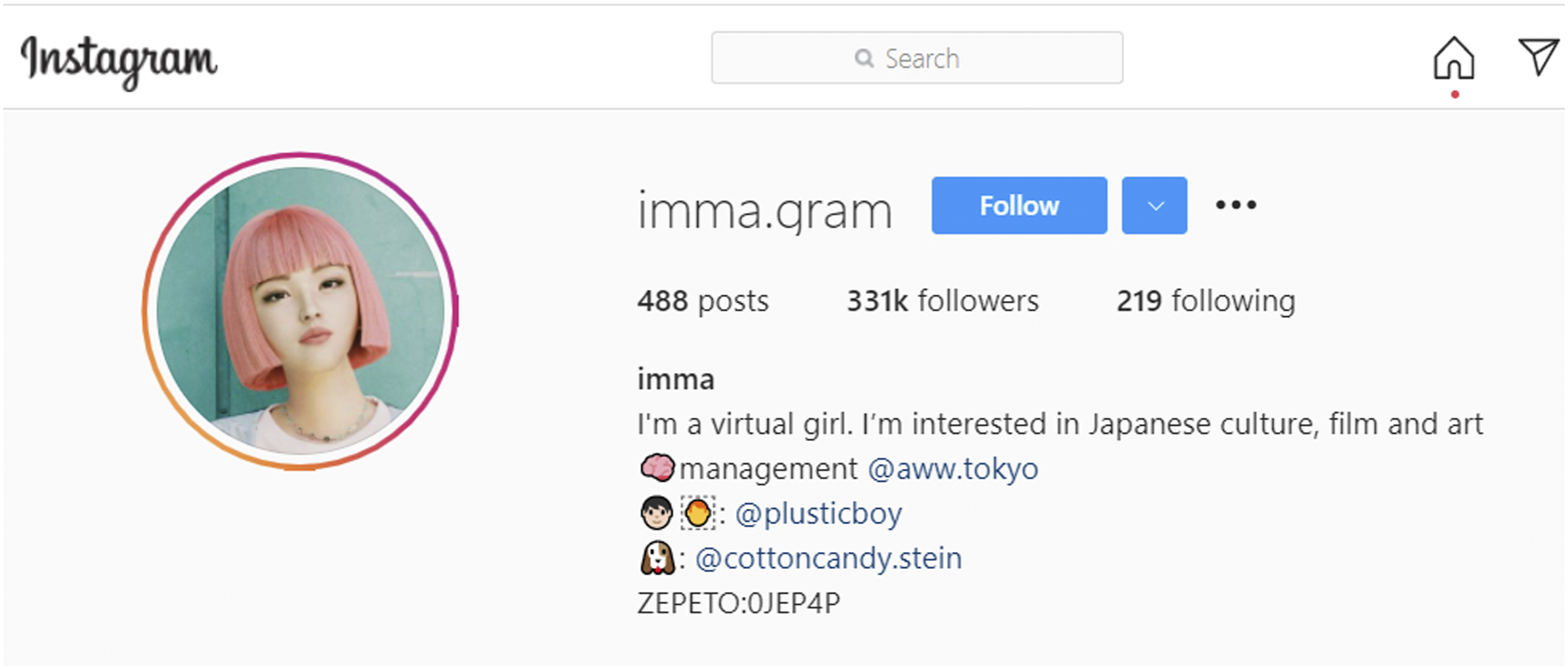
The phenomenon of virtuality and its consumption in Japan is not new, and a pop cultural genre in its own right. For example, the figure of the bācharu aidoru 1 (‘virtual idol’) (Black, 2012; Finan, 2021; Yoshida, 2016) is one which has now existed for over two decades in Japan, part of a wider fascination with aidoru (idol), who are intensely manufactured singers, models, and media personalities who exist across a series of highly industrialised and interconnected entertainment platforms in Japan (Condry, 2011; Galbraith and Karlin, 2012). In the context of this aidoru genshō (idol phenomenon) – which has been defining a major aspect of Japanese pop culture since the 1970s – Japan has been producing and consuming virtual, female idols since the 1990s: Yuki Terai, a worryingly busty 17-year old Japanese virtual popstar who released her debut album in 1997, complete with a backstory and physical measurements (166 cm tall, 86 cm bust, 59 cm waist, 85 cm hips) (Galbraith/Japan Today, 2009); perhaps more recognised outside of Japan, Hatsune Miku, initially a consumer product – a vocal synthesiser software (vocaloid) – personified as a 16-year old anime-style illustration in 2007, the success of which has led to her holographic resurrection as a bācharu aidoru performing live concerts around Japan.
Emerging from a culture that capitalises on bācharu aidoru, we have Imma, a bācharu infuruensā (‘virtual influencer’), who clearly follows her virtual siblings in being part of a now well-established market for the pop cultural consumption of the feminised virtual (virtual female?). However, bācharu aidoru like Yuki Terai and Hatsune Miku are on the whole, marketed towards Japanese audiences, situated within the context of a traditional entertainment industry to have created aidoru genshō. What happens when a figure like Imma, created from a tech company, is taken outside of this context and presented bilingually (English and Japanese) on a global social media platform like Instagram? How can we understand Japanese virtuality, one which emerges out of a specifically Japanese subgenre of the bācharu aidoru, but has been moved beyond it into the more global, micro-celebrity subgenre of the English-speaking virtual influencer 2 ?
In being presented on Instagram as a self-aware virtual being (‘あたしCGらしい (trans. ‘I think I might be CG’)), this complicates the very notion of the virtual, as her virtual self-awareness links to questions of selfhood, agency and irony. Such qualities emerge out of an increasingly prevailing culture of smart technologies and AI on the one hand (self-sensing, self-learning), and that of influencers and micro-celebrities on the other (self-branding, self-marketing): both depart from the bācharu aidoru, a figure who is perhaps more aligned with traditional concepts of celebrity and mass media, rather than those of micro-celebrities and social media. As shall become clear later on, one of the key differences between bācharu aidoru and bācharu infuruensā is the virtual product for consumption being offered, especially within the context of a contemporary globalised digital culture.
In discussing the production and consumption of digital femininity in Japan, Black (2012) argues that Japanese bācharu aidoru culture consists overwhelmingly of relationships built between ‘artificial woman and a male consumer, crucially depend[ing] upon the commodification and mass-production of a certain kind of femininity’ (2012: 209). This might still be the case with Imma as bācharu infuruensā, where Self (male consumer) and other (artificial woman) are gendered. But Imma is more consciously marketed beyond Japan – outside the context of aidoru genshō – through her collaborations with well-known, international ‘Western’ corporations like Porsche and Calvin Klein, even acting as a ‘virtual ambassador’. 3 As a ‘Western’-facing virtual influencer with an interest ‘in Japanese culture, film and art’, Imma further complicates this gendered notion of self and Other in that the consumption of difference is no longer just about Japanese virtuality and gender, but also, about Japanese raciality. Imma forces us to re-conceptualise and reconfigure what lies at the theoretical nexus of virtuality, gender and race.
This article is thus underpinned by two key concerns. Firstly, although academic studies have recently begun to emerge regarding the virtual influencer, these so far have considered the ethical, ontological or behavioural aspects of human-virtual interactions, rather than attempting to specifically theorise the virtual influencer itself as a cultural commodity: Robinson (2020) considers the ethical and ontological implications of virtual identity construction online; Batista da Silva Oliveira and Chimenti (2021) and Arsenyan and Mirowska (2021) focus more on impacts of human-virtual influencer interactions. As such, this article offers ways of conceptualising the virtual influencer in the context of contemporary digital culture, particularly in relation to prosumerist practices online. Here, the concept of semiotic immaterialism is proposed, to unpick the idea of virtuality and consumption in relation to the (im)materiality of race and gender.
Secondly, the piece also critiques how ‘Western’ popular media texts racialise and engender Japanese virtuality. Here, the piece re-thinks techno-Orientalist theories by exploring ‘Western’ fears and fascinations towards Japanese virtuality (not just technology), in the context of ‘creepy’ AIs and smart technologies. It is argued these ‘Western’ popular media texts become part of a digital-Orientalist technology for the racialised and gendered Othering of Japan through the consumption of difference. Furthermore, the discussion will also explore some of the tensions regarding Imma as a self-Orientalising cultural product, the result of Japan’s own self-commodification of Japanese virtuality aimed for global consumption.
This article draws from theories surrounding micro-celebrities and consumer culture; cyborgs; simulation and virtual realties; postfeminist media culture and techno-Orientalism. Virtual influencers are situated at this theoretical intersection, within which questions of race, gender and virtuality are considered. This article ultimately argues that Imma, as a virtual influencer, represents how the (im)materiality of Japanese race and gender is materialised through a complex digital- and self-Orientalist (self)commodification of Japanese virtuality.
Methodology
Taking a qualitative approach, the findings of this study are based on textual analysis (Fürsich, 2009; Lehtonen, 2000; McKee, 2003) conducted on data drawn from social media (Instagram posts) and online news media (newspapers/magazines in English). Textual analysis is defined as a form of qualitative analysis that involves the ‘reading’ of text as cultural object or practice, focussing ‘on the underlying ideological and cultural assumptions of the text (Fürsich, 2009: 240)’. Because this study is interpreting and critiquing the underlying ideological and cultural implications surrounding virtuality, race and gender in media texts offered for consumption, textual analysis was adopted. ‘Text’ is thus understood to mean ‘media text’ (McKee, 2003), 4 which in this study, refers to social media and news/magazine media, as two different forms of media text.
Regarding the social media data, an initial review was conducted on Imma’s Instagram posts made between July 2018 (Imma’s very first post) and July 2020 (325 posts). Instagram was chosen, as during this period, it was Imma’s most active social media account: at the time of writing, Imma’s Instagram account still has the most followers compared to other social media platforms that followed (Facebook, Twitter and TikTok). Once preliminary themes were identified, a purposive sample was selected for analysis – mostly visual (Lister and Wells, 2004; Wagner 2020a, 2020b) – of images posted and accompanying captions made. This was done to examine the ideological implications of Imma’s (self)presentation as a virtual influencer within these media texts/social media posts. Furthermore, this method was adopted as Imma belongs to a predominantly visually oriented world of influencers, fashion and lifestyle; and also, Instagram itself is a visually driven social media platform.
To understand the ways in which such images were consequently presented during this period to English-speaking audiences, a further review was conducted on online news and magazine media. Here, search terms to match Imma’s own self-description (“Imma”; “Japan”; “Tokyo”; “virtual”) were used via popular search engines and LexisNexis. Again, after an initial review, a purposive sample was selected in order to analyse meaning-construction of Imma by others, within English-speaking popular media texts. As such, the data reflects predominantly Anglo-American media presentations of Imma. The following discussion will focus on the key theoretical themes and ideological implications to emerge from the combined analyses of these two data sets, that is Imma as (self)presented via social media, and Imma as presented via ‘Western’ news and magazine media.
Because this research focuses on the ideological dimensions of media texts as presented for consumption, it does not consider issues relating to audience reception (i.e. consumer trends, perception and behaviour). Therefore, data on this (e.g. social media comments, focus groups, interviews) was not examined; future research can include such data. Similarly, this study examined Anglo-American popular media texts written in English; future research should include different cultural interpretations of Imma outside of this media context.
Semiotic immateriality: Consuming virtuality, commodifying the virtual influencer
Mainstream lifestyle magazine DAZED ran an article in December 2018 with a headline, ‘2018 was the year AI influencers and digital models took over fashion’ (Graham/DAZED, 2018). Referring to Lil Miquela – one of the first popular CGI Instagram personas in ‘the West’ – the article discusses the general rise of digital models in the fashion industry, including the digital modelling agency, The Diigitals. Numerous similar online blogs and commentaries appeared around the same time, questioning the very concept and phenomenon of virtual influencers. Such popular media texts reflect the ongoing fascination with online fame and virtuality, part of what Marshall (2016: 1) defines as a ‘pandemic obsession with constructing personas’. But how can we understand the virtual influencer, when there is only a persona, no person?
The concept of ‘celebrity’ and media (Evans and Hesmondhalgh, 2005; Rojek, 2001; Marshall, 1997, 2010; Driessens, 2013; Redmond, 2014; Turner, 2014) has shifted dramatically with the proliferation of social media and the rise of micro-celebrities and influencers (Abidin, 2018; Jerslev, 2016; Marwick and boyd, 2011; Marwick, 2013; Senft, 2008). On the one hand, we have the world of celebrities as institutionally represented via mass media, as per the Hollywood star system (Dyer, 1986; De Cordova, 1991). This is where traditional aidoru and bācharu aidoru are situated, being heavily manufactured and regulated by the entertainment industry in Japan. On the other hand, we now also have the world of micro-celebrities and influencers as individually self-presentational via social media, part of an increasingly neo-liberal, individualised culture where fame is embedded within techno-practices in everyday life.
Virtual influencers pose a tension within this configuration, as they are self-presentational figures like influencers whose profitability lies in their self-promotional personas; yet, in being computer-generated by humans, they are also like traditional celebrities as they are manufactured by others for profitability. The difficulty here is how to conceptualise this hybrid state of digital fame. From traditional celebrities and aidoru/bācharu aidoru, to more recent micro-celebrities and influencers, there is an expectation that somewhere in all this, there is a person behind the persona: because the celebrity sign is ‘the embodiment of media construction, audience construction, and the real, living and breathing human being’ (emphasis mine, Marshall, 1997: xi). A virtual influencer might have the same role as an influencer, but being CGI, the crucial difference is that there is no ‘“real” person housed in the sign construction’ (ibid). So what exactly are followers of virtual influencers consuming if not a ‘real, living and breathing human being’? Let us unpack this question by exploring Imma’s virtuality, especially in relation to questions of Japanese raciality and gender.
One way to understand the ‘lack’ of person behind persona is through Baudrillard’s (1994) concept of the simulacra. For Baudrillard, simulacra is ‘a real without origin or reality’, a hyperreal which substitutes the signs of the real for the real (1994: 2); an empty sign which fills itself with meaning of the real: that is its meaning and cultural value. Indeed, Lam (2016) describes the aforementioned bācharu aidoru, Hatsune Miku, through the Baudrillardian lens as ‘a fundamentally empty signifier, so the boundaries between reality and the imaginary have fallen apart’ (Lam, 2016: 1112). One could relate these ideas to Imma and her Japanese virtuality too. The collapsing of these ‘boundaries between reality and imaginary’ – be they symbolic, experiential and/or conceptual – extend beyond ‘real’ and ‘imaginary’ as they are also cultural demarcations that define the self/real against Japan as the Other/imaginary.
In reading the countless images of Imma containing stereotypically Japanese locations and items (Japanese tea, shrines, local street food), one could indeed argue that Imma becomes nothing more than a simulacra of Japanese culture, what Ueno (2002) would describe as ‘Japanoid’: what is ‘not actually Japanese’; exists neither inside nor outside of Japan; and functions as a ‘surface controlling the relationship between Japan and the Other’ (Ueno, 2002: 228). Imma does indeed inhabit Japanoid sites, existing upon the ‘unreal’ digital surface, a virtual and imaginary ‘Japan’, where ‘a sense of yearning for a particular country evoked through the consumption of cultural commodities is inevitably a monological illusion since it is little concerned with the complexity of “real” culture’ (1998: 178). Yet, Imma complicates this configuration too, for she exists in a hybrid world of mixed reality (she is built from virtual and real images) that forms the commodified sign value. In occupying this hybridity – between ‘real’ and ‘unreal’, ‘outside Japan’ and ‘inside Japan’ – Imma’s virtuality simultaneously embodies these dualisms whilst destabilising them in the process.
For example, one of the images from a series consists of Imma lying next to a cyborgesque figure (Figure 2). Imma’s seamless skin contrasts that of the other, who is composed of visibly different synthetic parts. The image is accompanied by a post, ‘Human meets Robot’. The irony of Imma being neither human nor robot destabilises both, questioning indeed what and where the virtual empty sign is situated whilst revealing the virtual performativity of both. In this context, we can understand Imma as not just relating to the idea of Baudrillard’s simulation – as an interplay between ‘true’ and ‘false’, or ‘real’ and ‘imaginary’ – but as a cousin once-removed of the post-modern, post-identity Cyborg (Balsamo, 1995; Featherstone and Burrows, 1995; Haraway, 1991 [2000], 1997; Hovenden et al., 1999; Kennedy and Bell, 2000). The cyborg who is ‘fluid, both material and opaque’ (Haraway, 1991 [2000]: 294). The virtual human Imma states, ‘Human meets Robot’. Available at: https://www.instagram.com/p/BxpUgOBHxkG/ (accessed: 16 February 2020).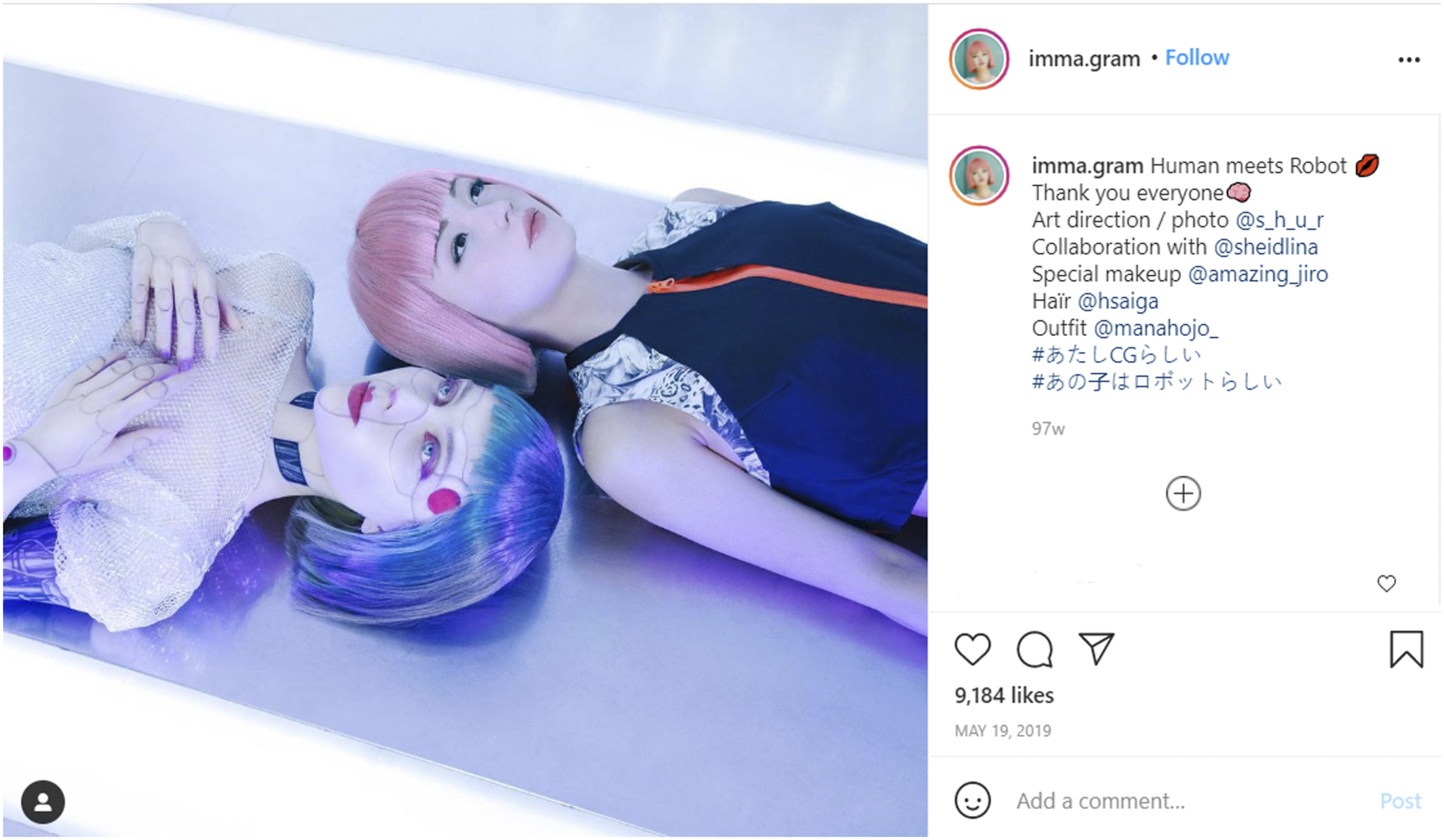
In the same way the cyborgs call into question the naturalisation of sex, gender and identity through the transgression of im/material boundaries, so too does the virtuality of Imma. In this light, a virtual influencer can be read as transgressive; like Aqua’s Barbie Girl song that self-mocks and subverts the Western ideal of femininity, one could argue that Imma deconstructs Japanese-ness through her virtuality, as though her raciality is about the digital performativity in a post-human, post-cyborg world of hyperreal ironic re-identity. Similarly, she also deconstructs that liminal space of ‘real’ and ‘virtual’ in that she exposes the constructions of both, being a CG model dependent on both.
However, perhaps what is different from the 1990s Cyborg and cyberculture is how contemporary digital society is defined predominantly through an internet-centric culture (Morozov, 2014), where the ‘real’ and the ‘virtual’ are fast becoming indistinct through its digital dependency for operating real life. From chatbots helping consumers buy products, to smart homes that can disconcertingly predict our behaviour: ‘virtual’ is increasingly defining ‘real’, rather than the other way around. As shall become apparent later, there is a rising discourse – often uneasy – surrounding the ‘creeping in’ of these sentient technologies, part of a new uncanny valley (Ciechanowski et al., 2019; Kim et al., 2019; Stein and Ohler, 2017) of an algorithmic era. By comparison, cyborgs seem almost archaic, representing a time when humans still had control over machines.
Despite of, or even because of this culture, digital society has also become intensely tied to online consumer culture, especially within the realms of social media (Hearn, 2008; Khamis et al., 2016; Marwick, 2013; Senft, 2013). It is no coincidence that Imma exists on Instagram, a social media platform that is driven by the visual consumption of highly aestheticised everyday life and consumer culture. Within this context, how can we then understand consumption of the virtual? In discussing Hatsune Miku, Jorgensen et al. (2017) refer to the idea of an ‘uncertain image’ where the image represents again, a ‘lack’, one that can only be fulfilled by her fans, whether they are attending her 3D concerts or using the software to create their own music. As such, another related way to conceptualise Imma could be through the concept of a ‘lack’ into which the desires and fears of the online social media gazer can be poured.
However, as mentioned in the introduction, there are differences in the very virtual product being offered for consumption by the bācharu aidoru and bācharu infuruensā. Black (2012: 216) argues that an important part of Japanese idol fandom is the consumption of aidoru guzzu (‘idol goods’, or merchandise); with bācharu aidoru, this manifests as the purchasing of the digital raw materials necessary to reproduce their virtual idols (as is the case, for example, with Hatsune Miku as a vocal synthesiser). Unlike bācharu aidoru like Hatsune Miku, in the case of bācharu infuruensā like Imma, the emphasis and value lie less on the immaterial aidoru guzzu, and more on their ability to influence consumers into buying other material guzzu in ‘real life’. In the case of Imma as a ‘Western'-facing bācharu infuruensā, the guzzu being offered are predominantly her images and words, persuasive sign-vehicles that carry aesthetic and exotic meaning for: the immaterial consumption of her as a racialised and gendered Japanese, virtual female online; and the eventual consumption of ‘real’ material goods, from real ice-creams (she is ‘virtual ambassador’ for Magnum after all), cars, to even Japan as a tourist destination.
As such, ‘lack’ in itself alone does not sufficiently explain these nuances surrounding the commodification of the virtual in the world of virtual influencers, as these point to a tension and destabilisation between the virtual/immaterial and real life/material. In other words, virtual influencers might be virtual but this often involves both the commodification of immateriality and materiality. This article thus proposes yet another way to conceptualise the consumption of virtuality: through the idea of the semiotic (im)materiality. Graddol and Boyd-Barrett (1993) use the term ‘semiotic materiality’ of a text to describe the relationship between immaterial signifier and material signified, a materialism of meaning behind the immaterialism of semiotics (Graddol and Boyd-Barrett, 1993: 42). But a virtual influencer relies on the relationship between immaterial signifier and immaterial signified, its materialisation realised through the commodified sign of virtuality. Imma thus represents an instance of semiotic immateriality, where the immaterial points both to her CG-ness on social media, but also to the semiotic immateriality of a racialised and gendered myth of ‘Japan’: the materiality arises from the commodification of Japanese virtuality. This in itself is a familiar Japanoid trope appearing in ‘Western’ popular media texts: think of the female hologram pop idol, Rei Toei, in William Gibson’s Idoru (1996); the iconic, ethereal geisha in Ridley Scott’s Blade Runner (1982).
Furthermore, Lam (2016) states in her discussion of Hatsune Miku, ‘contemporary society [is] immersed in consumption, creative production and intense involvement with digital technologies’ (2016: 1121). Our digital and social media dependence have paved the way for an actively virtual and ‘immaterial’ life lived through digital filters and the daily self-production and self-consumption of meaning via digital technologies and social media. In this sense, Imma is indeed a product of her age. The ‘immateriality’ is part of a broader state of affairs in contemporary digital culture immersed in social media, augmented reality and the incorporation of the virtual as part of everyday life, a symptomatic metaphor of the neo-liberal Instagram generation engaged in prosumerism: to consume digitality, we must produce our own meanings into commodified virtual vessels that gain semiotic materiality through our very consumption.
Nowhere is the prosumerist generation of immateriality as practiced and embodied more apparent than in recent consumer products that are beginning to enable the ‘ordinary user’ to make their own digital human. For example, Unreal Engine (part of the famous American video games company, Epic Games Inc.) released the consumer-oriented ‘MetaHuman Creator’ in 2021: a cloud-streamed app which enables the consumer to draw from ‘an ever-growing library of variants of human appearance and motion, and enabling you to create convincing new characters through intuitive workflows that let you sculpt and craft the result you want’ (Unreal Engine, 2021). As Nakamura (2008) argued more than a decade ago before Instagram was anywhere near as prevalent as it is today, ‘the users of the Internet collaboratively produce digital images of the body […] in the context of racial and gender identity formation’ (Nakamura, 2008: 5). Whilst the practice of creating our own digital doppelgangers has thus been a longstanding practice – from video game avatars to initial social media profiles – this recent phenomenon moves a step further into the immersive and osmotic world of digital-bio hybridity, the use of actual biometric data that ‘blends between actual examples in the library in a plausible, data-constrained way’.
In this sense, we are moving away from a world where digital immateriality is no longer just a part of a vicarious, visual consumption of lifestyle (e.g. ‘I wish I driving that Porsche in Tokyo’) as produced by others like Aww Inc. Instead, we are now moving towards a moment in time when the ordinary consumer can potentially participate in a world where the material body provides the virtual body with biodata, a means for prosuming the digital; the labouring, productive ‘original’ human body that generates and surrenders biodata – the literal ‘data double’ (Haggerty and Ericson, 2000) – in the name of prosumer culture: humans feasting off human features to create new humans, a virtual data cannibalism of sorts.
Within this context, CGI and software/databases like the MetaHuman Creator become the very playground for the ordinary consumer, shifting meaning-constructions of ‘human’; yet it does not necessarily shift the ideological surfaces – the ‘flesh’ – that stretches over data to create meaning. In fact, they can reinforce dominant and normative flesh through the naturalisation of what is supposedly ‘actual examples’ drawn from ‘real life’. Lam (2016: 1114) argues Hatsune Miku is ‘a nonorganic embodiment of an organic subjectivity that is ultimately lost in the process of the construction of the android’. By contrast, virtual influencers like Imma – or other ‘digital humans’ which can be created using software like the MetaHuman Creator – differ in that their biodata remains, where this ‘organic subjectivity’ is racialised and gendered subjectivity is not lost, and in fact, a crucial part of the prosumption process. In a world of algorithmic bias and determinism (Gillespie, 2014; Seaver, 2017) which generates and propagates further racialised and gendered data responses (Amrute, 2020; Lambrecht and Tucker, 2019; Noble, 2018), what are the socio-cultural and ideological implications of such a digital culture in which generating East Asian ‘body doubles’ for consumption is becoming increasingly commonplace?
Racialising and gendering virtuality: ‘Oriental’ flesh and skin
Japan is often the leader in technological advances, they have done it again this time introducing the world’s first CGI fashion model. Imma is not entirely unusual in Japan though. As a country obsessed with manga and anime admiring virtual beauty comes fairly naturally to them. (Miley/Interesting Engineering, 2019)
As the above quote demonstrates, it is often the case whereby the relationship between ‘Japan’ and ‘technology’ become naturalised in ‘Western’ texts (‘leader in technological advances’, ‘comes fairly naturally to them’). The excerpt is an example of techno-Orientalist discourses that materialise the fears and fascinations of ‘the West’ towards East Asia, manifested through its cultural, political and economic relationship with East Asian technology, originally theorised through Japanese technology (Morley and Robins, 1995; Roh et al., 2015).
In the case of Imma as a CG influencer, it is less Japanese technology but virtuality, which forms the lens through which ‘the West’ projects its fears and fascinations towards Japan as the exotic Other. In effect, what we encounter here is a re-iteration of techno-Orientalism, a new digital-Orientalism as embedded within the world of social media; one which relies on both the technological production of immateriality (applying filters, constructing digital skin and backgrounds) and the digital consumption of its meaning (consuming images, biodata and even consuming related goods/guzzu through social media). Digital-Orientalism thus emerges from a digital culture that relies on the perpetual prosumption of the Other, that further produces difference through its discursive and digital production of racialised and gendered virtuality. Let us thus explore how Imma represents this gendered and racialised commodification of Japan virtuality, and the ideological implications of this as situated within digital-Orientalist discourse.
In her discussion of biology and scientific discourse, Haraway (1991) argues that ‘no natural object-world speaks its metaphor-free and story-free truth’, and instead, rests within a ‘complex web of semiotic-material practices that emerged over the past 200 years or so, beginning in “the West” and traveling globally’ (Haraway, 1991: 217). Indeed, as virtual and as computer-generated as Imma might be, her semiotic-(im)materialism still involves metaphors and stories which tell the story of ‘Japan’ and ‘woman’ in culturally intelligible ways that reinforce hegemonic constructs of Japanese raciality and gender. One of the first images of Imma released on her Instagram account consist of close-up images of various parts of her face (Figure 3). On the one hand, one gets the feeling these are to showcase the realism of the CGI detail, from individual eyelashes to the moisture on Imma’s lips. But on the other hand, beyond the flexing of technical muscle, these images can also be read as interpellating the viewer to consume Japanoid raciality and femininity, an ‘Asian-ness’ that rests upon gendered fragmentation. One of the first images of Imma released on Instagram in 2018. Available at: https://www.instagram.com/p/Bo3C5MkhTWS/ (accessed: 12 February 2020).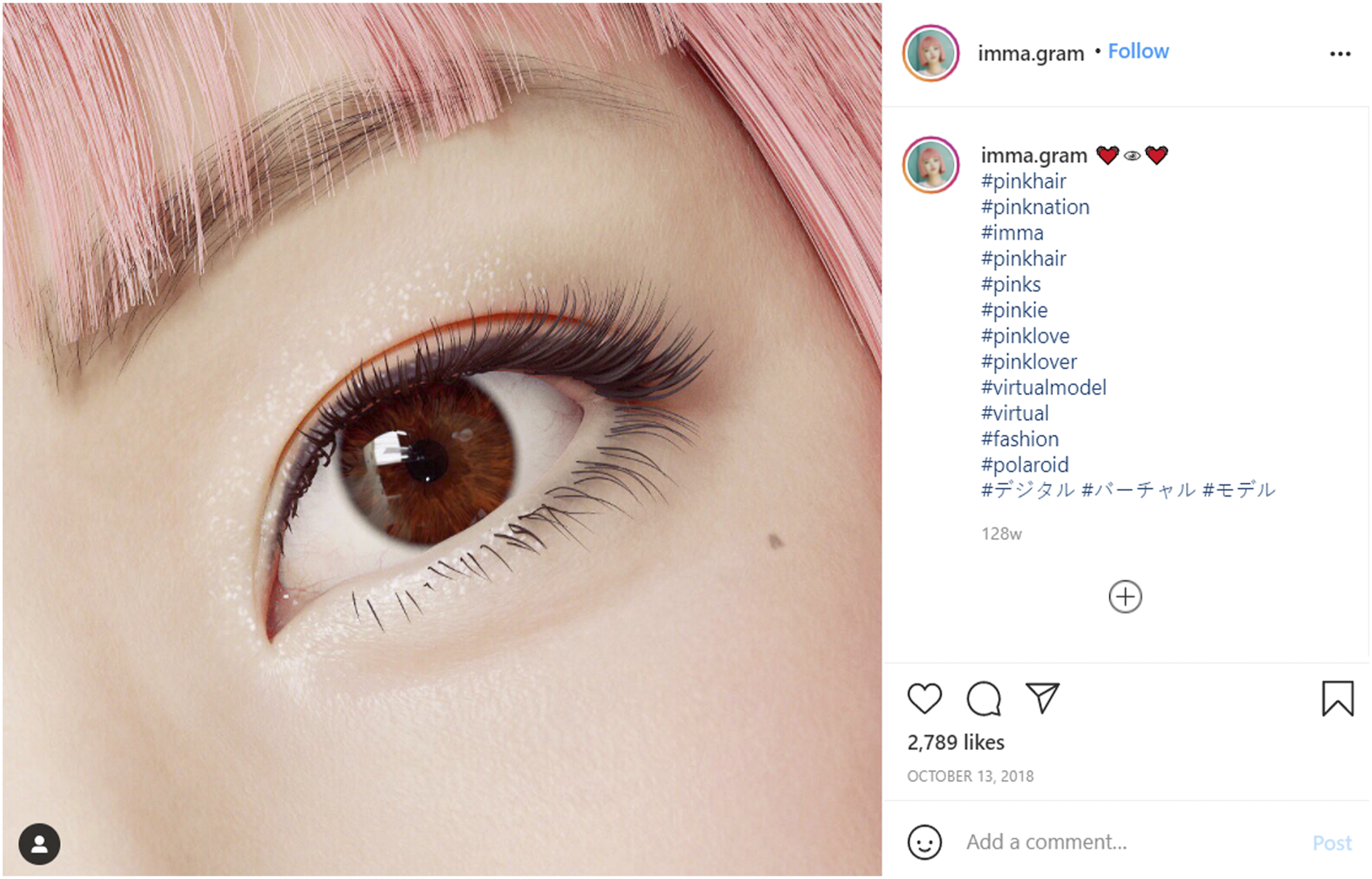
As Mulvey (1975) argued almost 50 years ago, ‘the beauty of the woman as object and the screen space coalesce; she is no longer the bearer of guilt but a perfect product, whose body, stylised and fragmented by close-ups, is the content of the film and the direct recipient of the spectator’s look’ (Mulvey, 1975: 14). This scopophilic gendered fragmentation of the female body is then further essentialised through the reductionist signifiers of Japanese raciality. A good example of this is the image of Imma’s eye. From attempts to ‘yellowface’ Hollywood actors, to the ‘almond-shaped eye’ (at best) ‘slitty/slanty eyes’ (worse): the discursive ‘Asian eye’ (Palumbo-Liu, 1999) materialises exotic Otherness, and in the case of Imma, Japanese-ness. It is precisely these virtual signifiers – immaterial skin – that materialises the semiotics of Japanese-ness; it is what makes Imma an embodiment of Japanese virtuality and virtual Japanese-ness, an entity which inadvertently naturalises the connection between the two, a self-referential being without a being yet burdened by racialised and gendered reference. Sure enough, these virtual signifiers have been picked up and exoticised in ‘Western’ media texts: With her expressive eyes, flawless skin, luscious lips and perfect hair, it’s easy to see why people can’t stop gushing over Japanese model Imma. But one thing most people don’t realize is that she’s not a real person. (Spooky/Oddity Central, 2019)
As the above quote demonstrates, Imma’s exoticisation follows a history of ‘the West’ commodifying and consuming the myth of Japan through the immaterial Japanese female body. Yet, one could also argue as discussed earlier, that surely, idealised virtuality and the immaterial skin is now globally commonplace on social media, ‘East’ and ‘West’? In the highly filtered, curated and stylised world of Instagram, one does not have to be a CGI model to also have ‘expressive eyes, flawless skin, luscious lips and perfect hair’. The millions of Kardashian wannabes around the world demonstrate that increasingly, social media human flesh is quite literally prosumed through filters superimposed by digital skin.
Recent feminist discourse has of course problematised the detrimental effects of such postfeminist social media practices (like digital alteration) on girls and young women seeking digital empowerment online (Dubrofsky and Wood, 2015; Shields-Dobson, 2015; Tiggemann, 2022). Similarly, as the recent social media campaign for the removal of filters (and its predecessor, the ‘No Makeup Selfie’ in 2014) demonstrates, not only does there seem to be a social fatigue towards the highly performative, aestheticised and impossibly beautiful digital world of social media, but these are also part of an increasingly suspicious risk culture that constantly questions the validity and reality of ‘fake’ media: from catphishing, fake news to recent moves by advertising standard agencies to regulate digital deception in ways that further consolidate influencer and consumer culture together. She’s Faux real - ‘Virtual’ Instagram star Imma poses in fashion mag with real models - but she’s completely FAKE […] A Japanese model who’s taken Instagram by storm has just landed her first big shoot, with one small catch – she doesn’t actually exist [..] The pink-haired impostor is part of an experiment by computer whizzes at Tokyo graphics firm ModelinCafe [sic.]. (Pettit/The Sun, 2019) Virtual humans are gradually scaling the uncanny valley, and like artificial intelligence, they’re coming for our jobs. A case in point is Imma, a digital Instagram model who has garnered over 50,000 followers thanks to her (its?) trendy, street-style selfies and photos. (Dent/Engadget, 2019)
As the above excerpts demonstrate, despite the appearance of the material, the knowledge of a ‘lack’ and ‘real’ person behind the digital flesh is what makes the CGI both a Freud (1919) uncanny figure (or as Pettit/The Sun later describes, ‘her creepily real social media posts’, then asking readers, ‘Do you find Imma creepy?‘), who is simultaneously exotic and something to be distrusted: such is the tension of semiotic immateriality, and the difference between a ‘real’ person applying an artificial digital filter on Instagram, and a ‘lack’ applying a ‘real’ digital filter. It is this exact tension that forms both the appeal and anxiety towards CGI models, and also, becomes a technology of engendered and racialised Othering.
Words like ‘impostor’ and ‘completely FAKE’ in the first excerpt work in conjunction with the idea of ‘Japanese’ and ‘computer whizzes’. On the other hand, the idea of a ‘lack’ of person (‘she doesn’t actually exist’) feeds directly into contemporary fears and anxieties surrounding digital ‘impostors’ like chatbots that trick us into investing time, money and emotions into what is ultimately ‘not real’. The language used in the second excerpt has xenophobic undertones towards the digital Other and reflects very material concerns: ‘they’re coming for our jobs’ is remarkably close to the rhetoric used against immigrants. Here, distrust towards the Other is both racialised and engendered – the fear expressed towards racialised immigrants; fear expressed towards the monstrous feminine (Creed, 1993) or more aptly the ‘monstrous “Other” feminine’ (Mubarki, 2014) – made material through the immaterial semiotics of meaning that construct Imma. Questioning the validity of Imma’s gender (‘her (its?)’) is less about a queer, non-binary post-gender politics, and more about the heterosexualist, patriarchal fear towards sexual and gender Others, often manifested through the idea of artificiality and deception.
Imma thus represents the paradoxical embodiment of both the desired eternally youthful perfection that surpasses filters and modification (‘expressive eyes, flawless skin, luscious lips and perfect hair’), as well as contemporary distrust towards digitalised artificiality and affective performativity of ‘creepy’ digital technologies. The paradoxical reaction towards Imma also correlates with the very tensions within postfeminist digital culture, where women must be ‘heterosexy’ and appealing, but also subject to distrustful public debates and regulatory discourses of over-sexualisation online (Shields-Dobson, 2015: 40). Similarly, such ‘Western’ popular media texts become regulatory discourses that materialise racial and gender difference through the consumption of virtuality.
‘I’m interested in Japanese culture, film and art’: the commodification of self-orientalism
This last section begins with a quintessentially ‘Japanese’ image of Imma (Figure 4) in which she wears a traditional kimono, holding a Japanese drink, ramune,
5
as she walks on the historical island of Enoshima. There are countless of similar images of Imma in typically Japanese places – traditional shrines, trendy backstreets of neon Tokyo, shops with Japanese manga paraphernalia – places for the vicarious and visual consumption of ‘Japan’ as a myth. Although it might be tempting to read these images as being Japanoid as discussed earlier, ultimately, we must not forget that Imma is a bācharu infuruensā, produced by a Japanese company in Tokyo, a globally marketed, Western-facing product ‘made in Japan’. How does this self-Japanising, self-commodifying Japanese virtuality challenge and complicate the process of digital-Orientalism and Othering as discussed so far? Imma walking in Enoshima, drinking ramune in her kimono. Available at: https://www.instagram.com/p/B148YP3DxSu/ (accessed: 11 April 2022).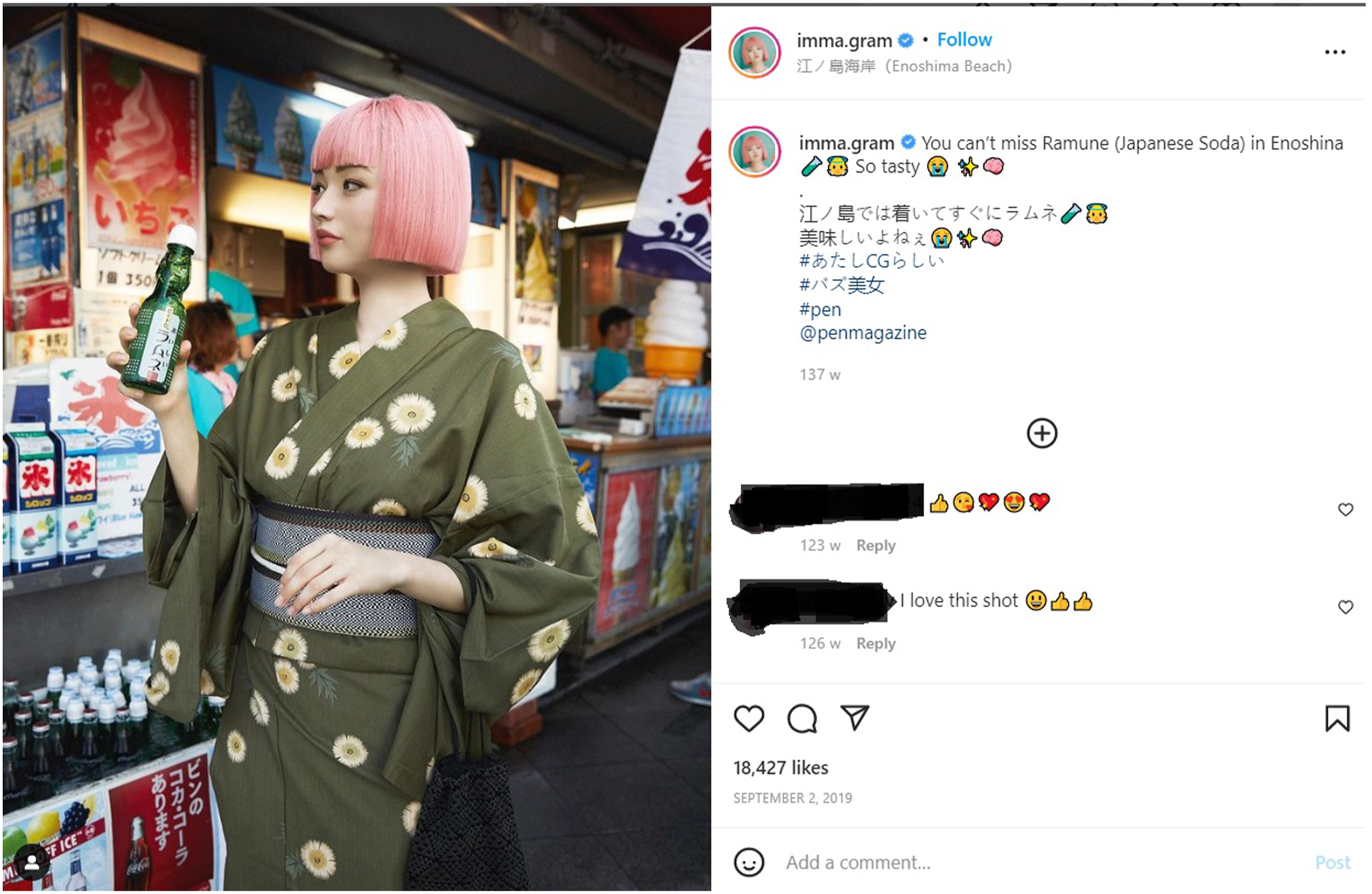
There is a history of Japanese self-Orientalistisation 6 (Miller 1982; Iwabuchi, 2002; 2008; Moeran, 1996; Kikuchi, 2004), often involving a complicit self-exoticism as part of Japan’s ‘transnationalist ambivalence’ in defining its own Japanese-ness (Iwabuchi, 2002: 448), and also, as part of Japan’s larger cultural and marketing strategy (Moeran, 1996; Iwabuchi, 1998). In this light, Imma’s Japanese-created CGI scenes of Japan can be read as being part of nihonjinron – discourses of Japanese-ness in Japan (Yoshino, 1992; Iwabuchi, 1994; Kawamura and Iwabuchi, 2022) – repackaged, ready for global consumption on Instagram, following Japan’s historical post-war strategy for kokusaika (internationalisation). Imma thus represents Japanese ‘soft power’, the conscious global exportation of Japanese ‘Japanese-ness’.
Within this context, Imma’s self-Orientalism and self-Othering might suggest a reversal of the power equilibrium tipping the scales of the Self/other, West/East, Subject/object. Perhaps this is what is most troubling for ‘the West’ with CGI-led Japanese virtuality: the racialised and gendered Other object is staring back, just like Imma’s eye. As Tan (2015) argues, ‘Japan’s mimicry of the Western techno-Orientalist gaze destabilizes the notion that the East is a passive object of the West’s gaze’ (Tan, 2015: 144). Similarly, as a virtual influencer who hints at agency and self-awareness through virtuality, Imma represents an active subject, reverting and challenging the West’s objectifying gaze: the ‘Western’ fear of this counter-active gaze is also one that is directed at unruly AIs that can no longer be controlled by humans as technologies once were. Imma perhaps represents a new ‘Western’-facing Japanese femininity, a self-aware, self-branding, bācharu infuruensā: debunking Western conceptualisations of both Japanese-ness and Japanese femininity as being subservient and passive; and is also an active global participant within the online visual economy, unlike the bācharu aidoru who is trapped within the institutionalised and traditional world of aidoru genshō in Japan.
Yet, like the very tensions found in postfeminist culture, one could also argue that this empowerment is ultimately reduced to replicating and re-perpetuating normative ideologies of gender and race. Imma is a carefully created VHuman who embodies an idealised virtual Japanese femininity with essentialised, reductionist markers of race and gender. In this sense, she is no different to the equally manufactured bācharu aidoru who represents normative ideals of Japanese beauty. Furthermore, as the popular media excerpts have demonstrated, Imma’s images – the ‘virtual product’ that is consumed on social media – become the very technology for Othering Japan in ‘the West’ through the consumption of difference.
To conclude this section, let us go back to Imma’s profile description: ‘I’m a Virtual girl. I’m interested in Japanese culture, film and art’. Imma acts as a cultural intermediary between the immateriality of digitally consuming ‘Japan’, and the materiality of Japan as a transnationalist country producing and promoting Japanese commodities. Imma as a virtual influencer thus relies on relationship between the immaterial signifier and immaterial signified, materialised through the gendered and racialised (self)commodified sign of Japanese virtuality, in itself, part of a digital- and self- Orientalist semiotics of Japanese-ness.
Conclusion
By focussing on Imma, a virtual influencer from Japan, this article critically examined Japanese raciality and gender within the context of virtuality, (im)materiality and digital consumption. Two key points were presented. Firstly, proposing the idea of ‘semiotic immaterialism’, this piece offered a way to conceptualise the figure of the ‘virtual influencer’; through this figure, the study demonstrated how certain (im)materialities involved in the digital consumption of virtuality can lead to the digital propagation of dominant ideologies surrounding gender and raciality. The discussion was situated and problematised within the broader context of contemporary digital culture and practices of prosumption, such as the easy creation of ‘virtual humans’ that use gendered and racialised digital data. From augmented reality shopping to hybrid entertainment shows, consumption increasingly occurs at the social mediatised intersection of virtuality and (im)materiality, as an experience in its own right. Understanding the ideological implications of this intersection between consumption, virtuality and (im)materiality online – which the virtual influencer embodies and offers as an experience – will become even more necessary as AI and smart technologies further proliferate all aspects of consumer culture in ways which marginalise Others in deeply problematic ways.
Secondly and related, this article also challenged how ‘Western’ popular media texts further reinforce existing digital-Orientalist discourses of racialised and gendered Japanese Otherness through the naturalisation of ‘Japanese-ness’ and virtuality. In the context of postfeminist sensibilities and media, the piece argued how ‘Western’ popular media texts become regulatory discourses that materialise racial and gender difference through the consumption of virtuality. Furthermore, the article explored the tensions involved when the Other strategically uses these same mechanisms of materialising racial and gender difference through virtuality: in this context, a gendered and racialised (self)commodification of Japanese virtuality, part of a digital- and self- Orientalist semiotics of Japanese-ness. As other East Asian countries like South Korea and China play a progressively significant role in the global consumer landscape, it will be crucial for future studies involving Japanese commodities and/or consumer culture to examine how digital- and self-Orientalist ideologies structure the two-way systems of meaning-making between not only Japan and ‘Western’ consumer cultures, but also, between Japan and other East Asian consumer cultures. In the middle of this busy consumer traffic, ‘Japanese’ virtual influencers like Imma arise, helping us to understand and critique Japan’s specific semiotic place and identity – and its intersectionalities – within an increasingly globalised culture that values the (im)material consumption of virtuality.
Footnotes
Acknowledgments
The author would like to thank Aww Inc. for kindly granting permission to include images/screenshots from Imma's Instagram profile in this article.
Declaration of conflicting interests
The author(s) declared no potential conflicts of interest with respect to the research, authorship, and/or publication of this article.
Funding
The author(s) received no financial support for the research, authorship, and/or publication of this article.
