



Abstract
There is a fervent belief that culture is, among other desirable ideals, “good for you.” This has been the baseline of the cultural policies in many countries. Through cultural policies, some forms of cultural participation over others are subvented through public funding, which makes it yet more important to ask which groups intentionally withdraw—or are left out—from which forms of it. We address the debate on cultural non-participation by scrutinizing nationally representative and longitudinal survey data from Finland, a Nordic welfare country with allegedly low social and cultural hierarchies, for years 2007 and 2018. We explore the changes in cultural non-participation by asking whether the main frequencies of cultural non-participation have changed between 2007 and 2018, what forms of different cultural non-participation patterns can be distinguished, and which socioeconomic factors best predict which form of cultural non-participation most in both years. Finally, we ask whether certain everyday forms of participation would compensate or complement non-existing cultural participation. We find three main cultural non-participation patterns: highbrow avoidance, mainstream avoidance, and nightlife avoidance. While the changes in non-participation look small from the macro level, their internal dynamics face a steep change between 2007 and 2018. Especially higher education becomes a continuously more significant factor for any kind of cultural activity. We also show that cultural participation is not compensated by everyday activities as often claimed in the literature, but that cultural and everyday non-participation overlap. Our results indicate that the alleged egalitarianism in Finland does not reach cultural participation: avoiding most forms of participation is more and more related to socio-economic differences reflecting social and cultural hierarchies.
Keywords
Introduction
Coined as one of the three dimensions of cultural practices since Bourdieu (1984), cultural participation has been understood to contribute to the reproduction of inequality and cultural domination just like cultural tastes or knowledge. Bourdieu holds that participation in traditional “highbrow” cultural activities such as going to the opera or attending a classical music concert belong to the territory of the dominant classes, for whom the knowledge and practice of highbrow culture is second nature since childhood. This thus generates them cultural capital and a “legitimate taste” that school curricula further corroborate, rewarding upper-and middle-class pupils for skills that are products of intergenerational status transmission (Bourdieu, 1984; Bourdieu and Passeron, 1979; Levine, 1988).
Bourdieu’s theory on fundamentally class-based cultural practices has been contested during several decades. The perhaps most criticized issue is that Bourdieu’s theory, embedded in 1960s France, claims to be universal. The main critique has been that national contexts are essential for cultural stratification (Katz-Gerro, 2002), and that in some societies, socio-economic boundaries might be more relevant than cultural ones, like Michèle Lamont shows through comparing upper-middle classes in France and the United States (Lamont, 1992). It has also been claimed that Bourdieu’s view on the “popular aesthetic” of the working or popular classes was overly simplistic (Bennett, 2011) and that cultural lifestyles stem primarily from individual life courses and socializations instead of inherited class positions (Lahire, 2004).
Unlike the two other dimensions of cultural practices, cultural participation is essentially connected to cultural policy—which we understand in this article as state involvement and public infrastructures that regulate and subsidize activities related to culture and the arts (Mulcahy, 2006). Cultural policy research has long paid attention to the complicated relationship between cultural hierarchies and power (Hadley and Belfiore, 2018): participating in culture is presented as beneficial and as yielding positive impacts, but at the same time it is debatable how equal cultural policy implementation really is and whether cultural elites have too much power in policymaking (Jancovich, 2017). In the research literature, public funding is considered to either reproduce the existing socio-economic hierarchies of society by subventing the cultural consumption of groups already high in the hierarchy (Feder and Katz-Gerro, 2012) or to try to ease these social hierarchies by funding culture consumed by groups low in the hierarchy (Belfiore, 2002).
In this paper, we explore cultural non-participation using Finnish survey data on cultural consumption collected both in 2007 and 2018, which allows us to analyze our research questions as longitudinal trends. We ask (1) whether the main trends of cultural non-participation have changed in Finland between 2007 and 2018, (2) what different cultural non-participation patterns can be distinguished and whether these differ over time, (3) how different socio-economic and other factors have shaped cultural non-participation over time, and (4) whether certain everyday forms of participation compensate for non-existing cultural participation. Our aim is to scrutinize cultural non-participation as a multifaceted phenomenon of its own and not just as the negative mirror image of participation
Finland is an interesting case to study cultural non-participation: it belongs to the Nordic welfare states with small income differences, a still fairly large public sector and free public education from pre-school to university, factors that could be linked to small differentiation regarding cultural participation (cf. van Hek and Kraaykamp, 2013; Virtanen, 2007). In this light, Finland could be a perfect case for demonstrating very small levels of social stratification regarding cultural non-participation. Nevertheless, recent scholarship suggests that Finland’s cultural differentiation is organized according to similar hierarchies as in other Western societies (Purhonen et al., 2011, 2014). Accordingly, Finnish debates on cultural policy have been largely similar as elsewhere in the Global North: while historically cultural policy has gone through the stages of nation-building and a welfare state focus, in recent decades, a “participatory turn” has taken place, emphasizing competitiveness, the social impact of the arts, and a strong tension between social cohesion and inclusion on the one hand, and the responsibility of the individual on the other hand (Sokka and Kangas, 2007).
Conceptualizing cultural non-participation
Cultural participation and non-participation have been approached in different ways. While most studies simply use attendance to measure participation and distinguish active from passive participation patterns (Alderson et al., 2007; Chan and Goldthorpe, 2007; López-Sintas and Katz-Gerro, 2005; Reeves and de Vries, 2018), others use expressing likes (García-Álvarez et al., 2007) or a combination of participation, consumption and different leisure activities (Leguina and Miles, 2017) to operationalize participation. The groups not participating in culture have been characterized, for instance, as “passives” (López-Sintas and Katz-Gerro, 2005), “inactives” (Alderson et al., 2007), and “disengaged” (Gayo, 2017; Heikkilä, 2021; Leguina and Miles, 2017).
Most cross-national research has proven convincingly that cultural participation and non-participation are highly stratified according to class position. Technically all scholarly literature concludes that cultural activeness is linked to better education, income, and status, whereas non-participation is linked to lower education, income, and class status (Bennett et al., 2009; Chan and Goldthorpe, 2007; García-Álvarez et al., 2007; Leguina and Miles, 2017; Reeves and de Vries, 2018; Virtanen, 2007). While this general tendency is solid, the stratification of cultural participation varies across countries according to their wealth and levels of social mobility: there is less differentiation in highbrow cultural participation in wealthy countries and in countries with large social mobility (van Hek and Kraaykamp, 2013). The reasons of not participating in specific leisure activities are also extremely stratified (Gayo, 2017), with high-class individuals lamenting their lack of time and low-class groups referring to their absence of money. Regarding gender, the feminization of highbrow culture is observed repeatedly in the literature (Bihagen and Katz-Gerro, 2000; Katz-Gerro, 2002; Katz-Gerro and Jaeger, 2015; Lizardo, 2006).
Several scholarly debates from the recent decades have questioned the permeability of highbrow-oriented cultural participation as a measure of high status. For instance, according to the much-debated omnivore thesis (originally coined by Peterson, 1992) the traditional highbrow snobbery of the high-status groups is gradually being replaced by more eclectic and tolerant taste and participation patterns, blurring class-related taste cultures. In a similar vein, the meltdown scenario (DiMaggio and Mukhtar, 2004; van Eijck and Knulst, 2005) suggests that the status and legitimacy of highbrow culture is “melting down” mainly because of the decline of the importance of highbrow culture for the youngest age groups, especially vis-à-vis the highly educated older groups.
Finally, the scholarly literature on cultural participation and non-participation seems to strongly agree that the division between activity and passivity is more relevant than that of “highbrow” and “lowbrow” participation, also in Finland (Miles and Sullivan, 2012; Purhonen et al., 2014; Roose et al., 2012). At the same time, it has been claimed that cultural non-participation should not be linked to “passivity” as such—it has even been suggested that cultural non-participation could be a methodological artefact or a by-product of surveys biased towards measuring middle-class cultural practices (Heikkilä, 2021; Flemmen et al., 2018; Taylor, 2016). The consensus has been that where there is not highbrow cultural participation, there is practical, local and social activity: “(l)ack of cultural engagement is compensated for by considerable informal involvement in kin-based and local circles, and in home-based cultural activities” (Bennett et al., 2009, 64).
Our exploration is motivated through a set of hypotheses. In line with the arguments about the omnivore thesis and meltdown scenario, we expect (H1) that cultural non-participation in Finland could be decreasing between 2007 and 2018. Regarding the different factors affecting cultural non-participation, based on the theoretical discussions sketched above we expect (H2) that across both time points and possibly progressively, low income and education will predict cultural non-participation, that younger age groups will withdraw increasingly from highbrow-oriented cultural participation, and that the feminization of cultural participation will be seen in our data. Finally, when it comes to the different patterns of cultural non-participation, we believe, according to the literature reviewed above, that (H3) different patterns of avoiding different types of cultural participation will complement each other, that is, that avoiding highbrow cultural participation will not equal to avoiding informal everyday forms of cultural participation.
Data and analytic strategy
Our article draws on a nationally representative Finnish survey on cultural practices and leisure collected both in 2007 and in 2018. The original 2007 survey yielded 1388 returned questionnaires with a response rate of 46.3%. The latter survey was collected in 2018 with 1425 responses and a response rate of 40.8%. The surveys are comparable in terms of their sample (Finnish citizens of between 18 and 74 years of age, excluding the inhabitants of the Åland Islands) and imbalance between particular population groups are corrected by weights. The questionnaires themselves are practically identical to allow for comparison in time, with some additions for 2018. For this article, the main addition is that for 2018, one question on everyday activities such as crafts and outdoors activities was included.
Variables
Our dependent variable measures the respondents’ participation in the following 14 cultural domains: cinema, museums, pubs, karaoke, rock concerts, opera, bingo, classical music concerts, jazz concerts, musicals, theaters, art galleries, night clubs, and dinner restaurants. An additional cultural domain, attending the library, is included for 2018, as it was not available in the 2007 data. In the later steps of the analyses, the dependent variable is summated from various forms of non-participation into a dichotomy. From the original five alternatives of attendance (every week, every month, a couple of times per year, rarely, never), we have dichotomized the attendance into non-participation (“never”) and participation (any other alternative). All missing values in participation are excluded in the analyses. The proportions of the cultural non-participation categories and the observed change are presented in the Appendix Table A1.
The independent variables analyzed—age, gender, education, personal net monthly income and residential area—are standard socio-economic characteristics all connected to the scholarly discussions cited above. All variables are categorical. Appendix Table A2 shows the distribution of the used socio-demographic variables both years.
Age is divided into three categories: 18–34, 35–54, and 55–74. Gender is a dichotomous variable, with females used as the reference category. Education is recoded into four categories: “no/basic”
As an additional independent control variable, unfortunately available only for 2018, we use a measure of “everyday participation.” We understand everyday participation as a large phenomenon composed of informal leisure pursuits outside of the scope of narrowly defined culture and, importantly, the realm of state-supported activities (see Miles and Gibson, 2016). Drawing on the survey’s only question combining these factors, we operationalize “everyday participation” as the respondent’s participation in the following 11 activities: gardening, baking, handwork, crafts, fishing, hunting, berry/mushroom picking, doing crosswords/sudoku/puzzles, playing cards, playing board games, and playing yard games
Analytic strategy
Our analysis proceeds in the following way: first we observe simple frequencies of cultural non-participation in 2007 and 2018 to find out whether and how cultural non-participation has changed (RQ1). As a second step, in order to find out how non-participation is structured and changed over time (RQ2), we conduct categorical principal component analyses (CATPCA) for both years. This method considers the categorical (dichotomous) nature of our dependent variable (absolute non-participation = 1, at least some participation = 0), and has a similar logic and scaling process as factor analysis or principal component analysis
Finally, we examine which attributes explain the non-participation patterns and observe what role everyday non-participation plays for cultural participation (RQ3 and RQ4). Since our dependent variable is dichotomous, we use logistic regression. Logistic regression analyses are conducted for three non-participation types for both years. The analyses of non-participation to “marginal” activities were omitted (extremely few respondents had participated in them). Our analyses estimate the “likelihood” of non-participation to a specific form of culture. We first enter the socio-demographic variables in model 1, and then add everyday non-participation in model 2. The effects of the independent variables with the odds ratios (OR) are reported. We also report the chi squares (χ2) for each independent variable
Results
The change in non-participation between 2007 and 2018
We first observe the frequencies of non-participation of all cultural domains covered by the surveys. The cultural participation items are the same both years, except that library attendance was not probed for in 2007. The percentages presented represent the respondents who indicated never attending
The levels of non-participation for different cultural items are strikingly different (see Appendix Table A1). More than two-thirds of all Finns never attend the opera, jazz concerts or bingo, whereas almost everyone goes to the cinema at least sometimes. All in all, the differences between 2007 and 2018 are surprisingly small, although cinema, museums, theater, and rock concerts have significantly more attendance in 2018 than in 2007. A significant increase of non-participation has occurred in night clubs and theaters. Participation in domains such as pubs, opera, and bingo have faced basically no change. In general, it looks as if the non-participation levels have dropped between 2007 and 2018—in other words, Finns have increased their average participation.
Patterns of non-participation
So far, we have seen that cultural non-participation has remained largely similar between 2007 and 2018. In order to find out how non-participation is structured (and how its structure has changed over time), our next step is to conduct a categorical principal component analysis (CATPCA) for both years.
Our non-participation items produce four principal components both years (Appendix Tables A4 and A5). Departing from the idea that the fine arts are well-established indicators of highbrow culture (Bourdieu, 1984; DiMaggio and Mukhtar, 2004), we call the first component “highbrow music avoiders” for 2007 and “highbrow avoiders” for 2018: attendance of opera, classical music, and jazz concerts are its main building blocks, and attending musicals is an interesting addition with a less strong loading. The second component, composed of non-participation of theater, museums, the cinema and art galleries, is labeled “mainstream avoiders,” as all the activities of the second component are fairly common among more than half of the population. The third component that we call “nightlife avoiders” is radically different from the two previous ones: it consists of avoiding cultural activities with connotations to entertainment and outgoing, such as attending nightclubs, pubs, and rock concerts, of which some are more common than others (having dinner out is far more widespread than attending nightclubs). Finally, the last component was loaded only with bingo avoiders. Finally, the last component included only bingo non-participation which is so popular (i.e., the large majority of the respondents never attend bingo) that its further analysis is not considered worthwhile.
The principal components for non-participation remain fairly similar between 2007 and 2018. In 2018, there is a slight change in the composition of the non-participation components from what was observed in 2007. Again, four patterns of non-participation are observed. The most notable change regards the first component, which now highlights more generally highbrow cultures and not only music: in 2018, avoiding art galleries (which still in 2007 was part of mainstream avoidance) stands firmly in the league of highbrow avoidance. At the same time, karaoke has shifted from nightlife avoidance to avoiding “marginal activities”
Proportions of the non-participation patterns based on the CATPCA components, 2007 and 2018, % (n).
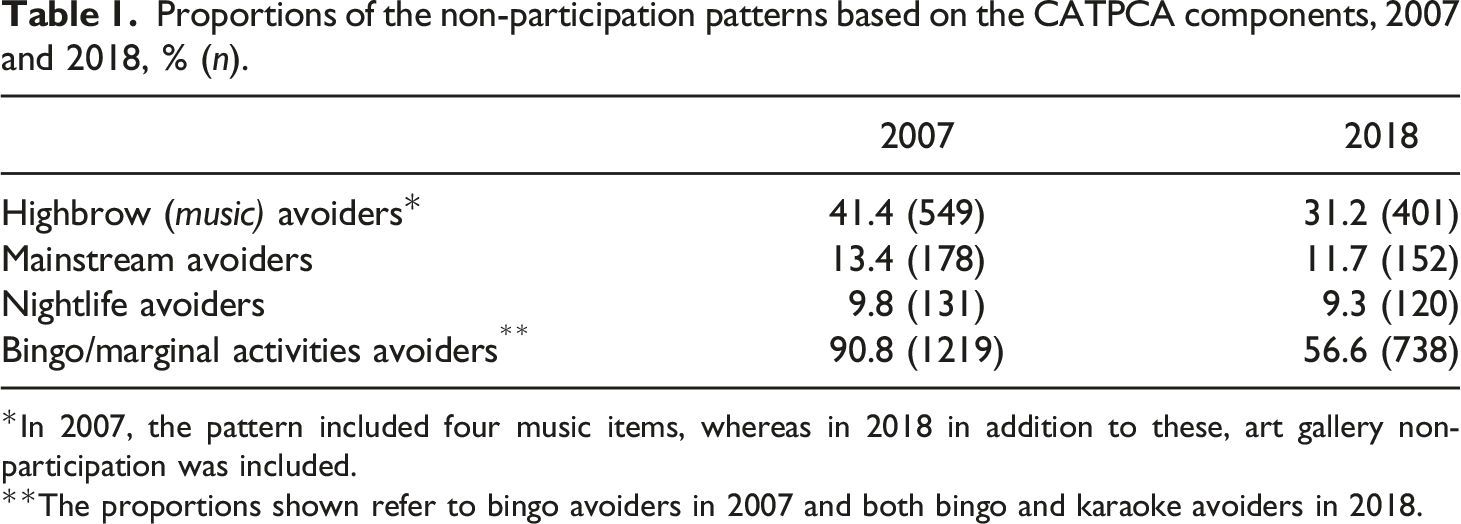
In 2007, the pattern included four music items, whereas in 2018 in addition to these, art gallery non-participation was included.
The proportions shown refer to bingo avoiders in 2007 and both bingo and karaoke avoiders in 2018.
Exploring factors behind different patterns of non-participation
Logistic regressions models for cultural non-participation patterns in 2007, adjusted effects, odds ratios, pseudo R2 coefficients.
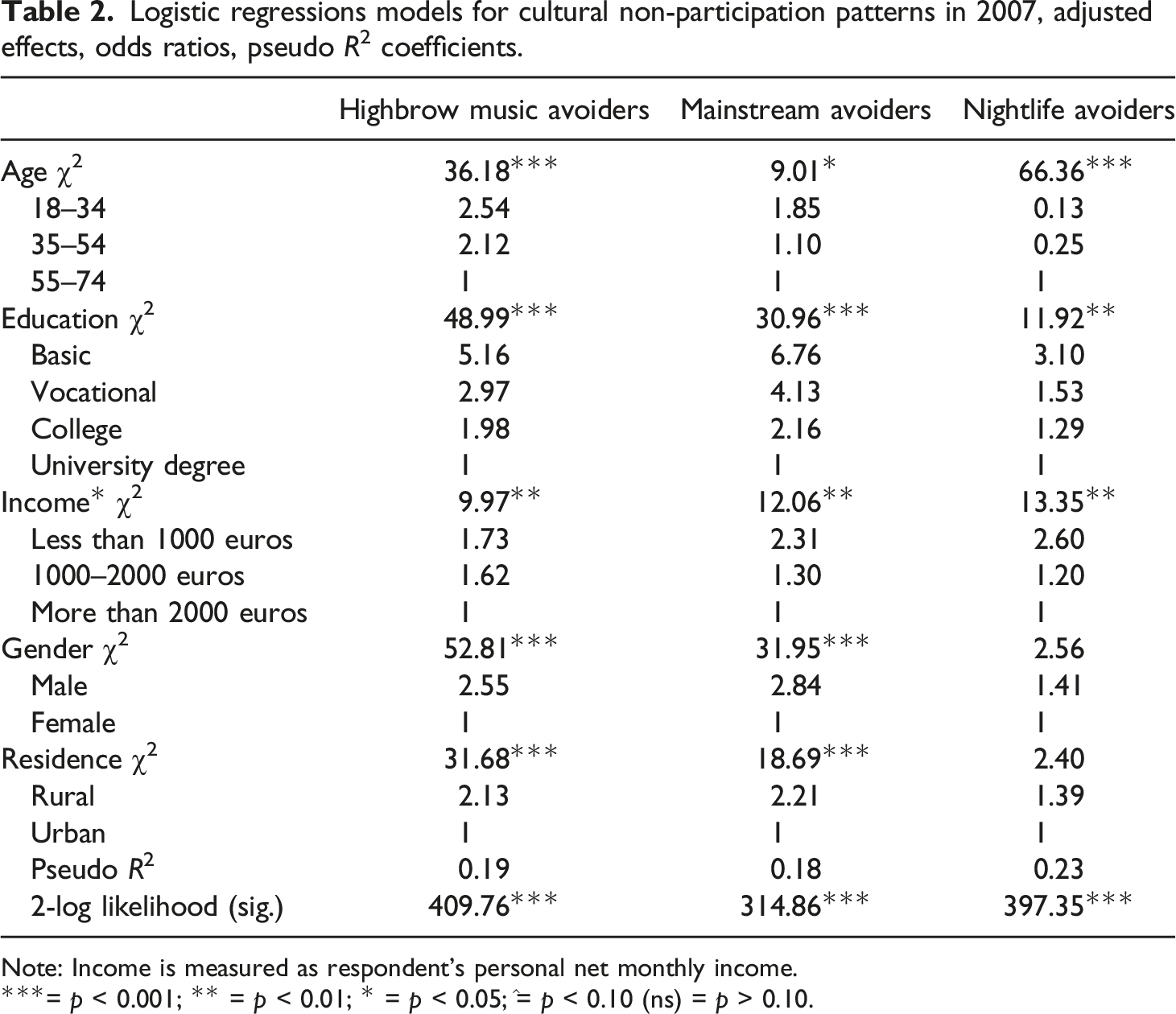
Note: Income is measured as respondent’s personal net monthly income.
***= p < 0.001; ** = p < 0.01; * = p < 0.05; ^= p < 0.10 (ns) = p > 0.10.
Logistic regressions models for cultural non-participation patterns in 2018, adjusted effects, odds ratios, pseudo R2 coefficients.
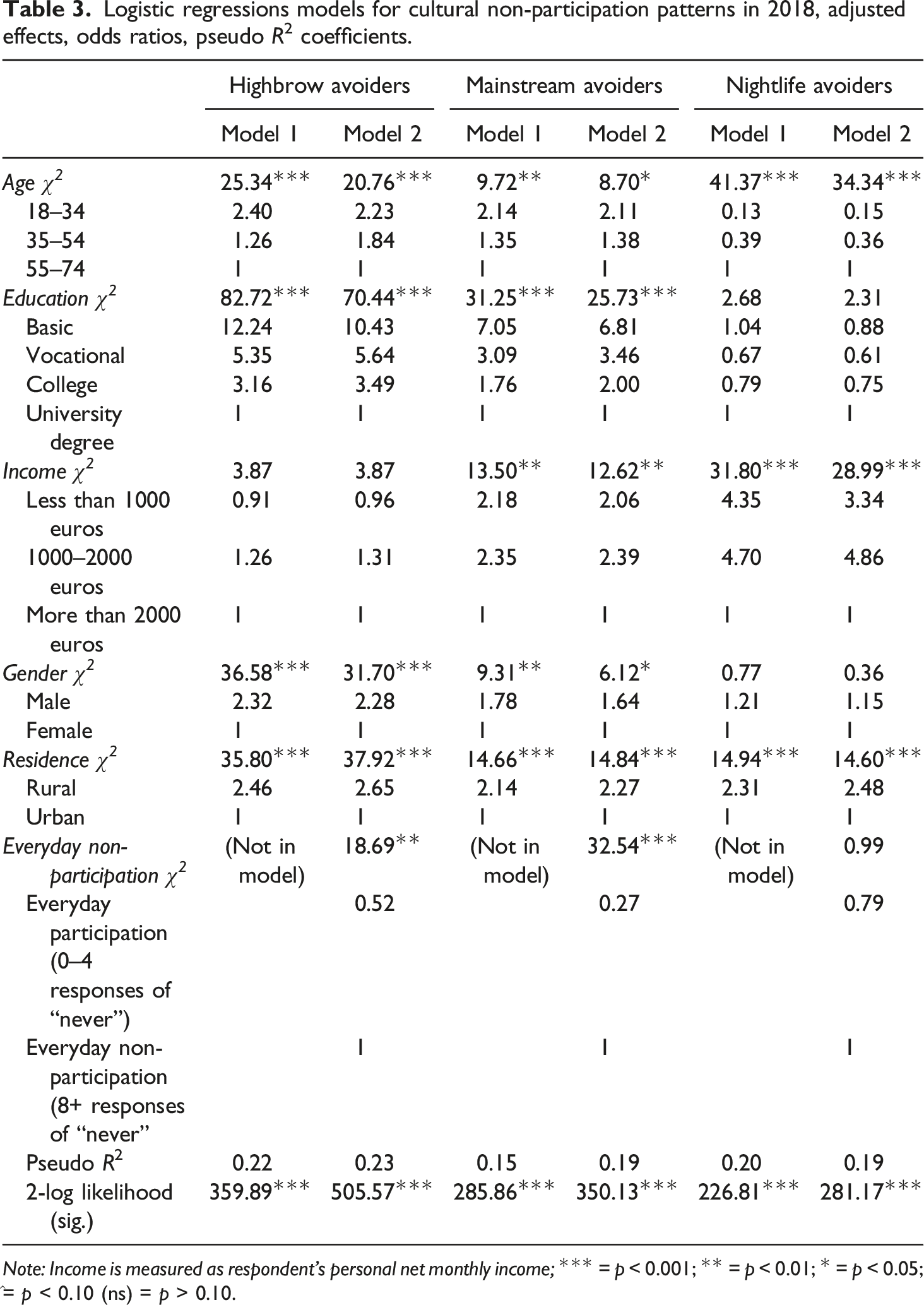
Note: Income is measured as respondent’s personal net monthly income; *** = p < 0.001; ** = p < 0.01; * = p < 0.05; ^= p < 0.10 (ns) = p > 0.10.
In 2007, all the full model non-participation patterns are rather well explained by the selected independent variables (Table 2; unadjusted effects for each independent variable not shown here: they can be obtained from the authors). For highbrow music non-participation, all five independent factors are significant in the full model. The variable contributing most to the variation detected in highbrow avoidance is gender, men being more likely avoiders. The next most significant variable is education
When it comes to mainstream avoidance in 2007, all the five independent variables are still significant, though their effects are somewhat smaller if compared to highbrow avoiders. Gender and education are still the most significant factors. Men are nearly three times more likely to avoid mainstream culture than women. Regarding education, the group with the lowest education is over six times more likely to avoid mainstream culture compared to those with highest educational credentials—perhaps surprisingly, the gap between the education groups is even wider here than for highbrow avoidance. Place of residence explains mainstream non-participation to a certain degree: rural dwellers are twice as likely to avoid mainstream culture than those living in cities. This is in line with our finding regarding highbrow avoidance. Age plays a clearly less important role in explaining mainstream non-participation, but differences still persist: again, like in the case of highbrow avoidance, younger age groups are less likely to participate.
The nightlife avoidance component of 2007 is clearly different from the two previous forms of non-participation. Only three factors—education, income, and especially age—are statistically significant in explaining it
The first note we can make regarding the models between 2007 and 2018 is that they are explained to somewhat similar degrees by the independent variables. It is also useful to keep in mind that in 2018 the highbrow avoidance model includes, apart from highbrow music, also visiting art galleries.
In 2018, the model that most resembles the effects of 2007 is highbrow avoidance (see Model 1 in Table 3). The most significant independent variable has become education, with a far greater chi-square coefficient than in 2007, or than with any other variable in all models for both years. For 2018, the gap between the highest and lowest education groups is much larger than in 2007, the lowest group being over 12 times more likely to avoid highbrow culture than the university-educated group. Gender is the second-best predictor for highbrow non-participation
The mainstream avoidance model for 2018 was rather weakly explained by the selected independent variables. Still, education has taken over as the main explanatory factor: while gender explained most of the mainstream culture non-participation in 2007, in 2018 the effect of education is similar than regarding highbrow non-participation, with the groups with least education being seven times more likely non-participants than the university-educated groups. Gender, income, place of residence and age explain only a marginal share of the mainstream non-participation: still, men are almost twice as likely to avoid mainstream culture than women. Low income, rural place of residence and young age all predict not participating in mainstream culture.
Only three factors were significant for the nightlife avoidance in 2018: age, income, and place of residence. The effect size of age decreased
Finally, we added our variable of non-participation in everyday activities to the models (model 2’s in Table 3) to observe whether different everyday forms of participation would compensate for lacking cultural participation. Adding everyday non-participation to the models increases R2 coefficients only to a small degree, yet its impacts are visible. Table 3 shows that everyday non-participation is a significant predictor for highbrow and mainstream non-participation, yet it has no impact on nightlife non-participation. The greatest effect is observed regarding the mainstream non-participation model; in fact, non-participation in everyday activities has the largest effect size in the mainstream model, making its significance even greater than that of education. In other words, those who report much non-participation in everyday activities are also much more prone to avoid mainstream cultural participation. The same effect with smaller odds ratios is observed also with highbrow avoidance. This suggests that cultural participation is not compensated by everyday activities, but that non-participation actually tends to accumulate across both cultural and mundane spheres of life.
Discussion
In this article we set out to ask, first of all, whether the levels of cultural non-participation had changed in Finland between 2007 and 2018, what forms of different cultural non-participation patterns could be distinguished, what socio-economic factors affected which form of cultural non-participation most in both years, and finally, whether everyday participation would in some way “compensate” for lacking cultural participation. We have seen that while the frequencies of non-participation were fairly similar in 2007 and 2018, there were many differences between cultural domains. Secondly, we found three rather stable patterns of cultural non-participation between 2007 and 2018: these were highbrow avoidance
Returning to the theoretical discussions and hypotheses presented in the second chapter, it looks like our hypothesis regarding a general decrease of non-participation, thus a rise in cultural participation in general, only receives slight support. Most areas of culture have more non-participation in 2007 than in 2018, but trends are next to insignificant. Regarding more specifically the omnivore thesis and meltdown scenario, it looks as if the highbrow sphere remains the most polarized area of non-participation in both years, especially in 2018, and that it is extremely differentiated by both education and gender. It thus can be postulated that the omnivore thesis or meltdown scenario look unlikely in the light of our findings. This resonates with the latest debates on the artifactuality of the thesis of omnivorousness (cf. Brisson, 2019); like recent research suggests (Nault et al., 2021), it could even be that omnivorous cultural practices are located in the middle positions of the social structure.
Regarding the second hypothesis on low education, low income, young age and being male affecting negatively participation, we have strong support for all of these factors as predictors for cultural non-participation, but in differing degrees. The importance of education expands exponentially between 2007 and 2018 for both highbrow and mainstream avoidance, making less educated groups increasingly more excluded from both highbrow and mainstream culture. This echoes other recent findings about the enduring significance of education as a key structuring factor for engaging in highbrow culture (Falk and Katz-Gerro, 2016; Purhonen et al., 2011; Suarez-Fernandez et al., 2020; Willekens and Lievens, 2016).
Meanwhile, the importance of income disappears regarding highbrow avoidance and diminishes significantly for mainstream avoidance as well, showing that Finnish highbrow and mainstream cultural non-participation is still first and foremost a question of cultural, not economic capital. The weak effect of income emphasizes Finland’s relative income equality compared to less egalitarian national contexts (cf. Alderson et al., 2007; Reeves and de Vries, 2018). Nightlife avoidance is a curious exception in this case: the significance of education disappears totally for 2018, while the significance of having high income grows. It could be summarized that while slipping out of the reach of highbrow and even mainstream culture is more and more linked to low education, avoiding nightlife is in this sense more equally distributed.
Our expectation that young age would predict withdrawing from culture does not receive direct support, either. The almost intact highbrow avoidance component shows, though, that in both years, age is highly significant for avoiding highbrow culture, and expectedly young people avoid it more often than older groups. This reflects the findings on the important role of age for structuring cultural participation: for instance, Leguina and Miles (2017) demonstrate the important difference between young people’s digital pursuits and older groups’ more traditional practices. On the other hand, young peoples’ cultural practices can be expected to mature with time (Nault et al., 2021; see also Ma, 2020). Still, the dynamics of the different age groups show that the polarization between different groups dissipates to some extent in the highbrow component between 2007 and 2018, and for the latter year, age loses its significance in the mainstream component. Meanwhile, age expectedly continues being the main explanatory factor of the nightlife component.
Finally, we clearly see that men dominate the non-participation of both highbrow and mainstream culture: in practically all cases, they are around twice as likely to avoid these forms of culture as women. This finding broadly supports earlier observations on the role of gender on cultural practices in which women are typically associated with cultural and arts activities and men with sports and exercise (Miles and Sullivan, 2012); a similar difference is found even when observing only sports, with women participating remarkably more in dance and aesthetic oriented sports than men (Mutz and Müller, 2021). Still, our expectation about feminization does not receive support: on the contrary, between 2007 and 2018 the gender gap emphasizing men’s non-participation slightly decreases regarding both highbrow- and mainstream-related activities. This largely echoes the findings of Falk and Katz-Gerro (2016) who showed, in the light of cross-national data, that gender (along with age) has much weaker effects on cultural participation than for instance education. It could also be a possibility that in an egalitarian context such as Finland the decreasing gender gap reflects the suggestion that gender-equal countries would show higher numbers of both men and women participating in culture due to higher rates of more equally shared housework and childcare (Lagaert and Roose, 2018).
Finally, our third hypothesis about different forms of cultural non-participation complementing each other, more specifically that cultural non-participation would be compensated for by everyday participation like for instance Bennett et al. (2009) have claimed, received no support. On the contrary, we showed that cultural and “everyday” non-participation basically overlapped. This finding is in line with the argument about general activity versus non-participation as an increasingly relevant structuring principle of cultural stratification (Miles and Sullivan, 2012; Purhonen et al., 2014; Roose et al., 2012) but at the same time it nuances the current debate by pointing out that forms of everyday participation do not compensate or complement for lacking cultural non-participation. Rather, it points out that even mundane everyday participation stands firmly in the league of participation. This is a worthy reminder that instead of lamenting “decreasing” cultural participation (cf. Stevenson et al., 2015), the worry should be focused on groups that fall outside the scope of any kind of participation.
Our article has several restrictions. First of all, while recent research has repeatedly shown that significant amounts of people withdraw from formal legitimate culture but engage actively in informal social life, blurring the division between “highbrow” and “lowbrow” and pointing out that withdrawing from formal culture does not mean “passivity” (Bennett et al., 2009; Heikkilä, 2021; Miles and Sullivan, 2012; Purhonen et al., 2014; Roose et al., 2012), our control variable on everyday participation touched upon a limited number of everyday leisure activities situated very far from narrowly defined cultural participation, and only covered the latter time point because the questions on informal everyday activities were only available in the survey for 2018. Moreover, adding for instance information on the respondents’ civic and political activity could shed additional light on the dilemma of why everyday activities do not seem to compensate for cultural participation, and why some groups are excluded not only from cultural but also other forms of participation.
Second, adding new forms and layers of cultural participation to the puzzle might be able to shed even more light on the compensatory nature of some forms of cultural participation over others. Scrutinizing for instance participation and non-participation in different culturally oriented participative hobbies (such as singing
A related limitation linked to the survey format is the fact that survey questionnaires inevitably simplify peoples’ complex participation patterns. Like Bunting et al. (2019) note, survey questions measuring cultural practices are typically negotiations between expert and “ordinary” understandings of culture, and measured participation keeps its role as the indicator of the eventual success of cultural policies (see also Belfiore, 2004). Surveys capture poorly “how or why” questions (cf. Bunting et al., 2019); even if our survey purposely had added a question measuring “everyday participation” for the 2018 questionnaire, the list was restricted to 11 relatively common items. Adding a qualitative approach would allow asking people what they do in their free time without predefined alternatives.
Conclusion
Our results resonate strongly with other research that has shown that cultural non-participation is indeed extremely differentiated on many levels (Bennett et al., 2009; Chan and Goldthorpe, 2007; Gayo, 2017; Leguina and Miles, 2017; Katz-Gerro and Jaeger, 2013), also in Finland (Heikkilä, 2021; Heikkilä et al., 2020). Our contribution to the existing discussions is threefold. First of all, we have identified three different clusters of cultural non-participation. Second, we have shown that these different clusters of non-participation are strongly stratified according to socio-economic differences and that especially education stands out as an increasingly strong structuring factor. Third, we have been able to extend the understanding of non-participation through providing empirical evidence about the overlap of cultural and everyday non-participation. The theoretical implication we can draw from this is that cultural non-participation, just like cultural participation, can be seen as a socially stratified gradient, not just as a passive black-and-white counterpoint of active participation.
In this way, our findings contribute also to the debates on different public participation agendas and the challenges of redistributing funding in a way that could alleviate social exclusion or reduce the power of the elites (Belfiore, 2002; Hadley and Belfiore, 2018; Jancovich, 2017). It seems extremely difficult to engage the most disengaged publics; research on participatory decision-making shows that even the people engaged through different kinds of cultural participatory programs are mainly already existing users (Jancovich and Ejgod Hansen, 2018). The fact that cultural and everyday non-participation seem to overlap makes this task even more complicated.
One can also ask whether Finnish cultural and educational policy functions well enough if we can conclude that low education is an increasingly more significant factor for withdrawing from formal cultural participation
Finally, our results do not reveal why education seems to be an increasingly important factor for non-participation, while income seems to lose importance: we can only speculate that perhaps digitalization has been able to lower the economic barriers of cultural participation. Future research would be needed to shed more light especially on why education stands out regarding highbrow culture, which is especially surprising in egalitarian Finland with a completely public education system. In this scenario, our empirical findings invite to think more about their practical implications for Finnish cultural and educational policy. If education seems to be the main background factor preventing people from falling out of the reach of cultural or even informal everyday participation, it could be speculated that strongly emphasizing different forms of culture in the public and universal school system since early childhood education could prevent strong polarization in participation later. This is especially important to keep in mind in the context of growing school segregation in Finland, which previously had an extremely non-segregated educational system (Bernelius and Vaattovaara, 2016). On the other hand, building on the classical theories on the accumulation of cultural capital, the unequal distribution of capitals is an unavoidable structuring factor of the social space (Bourdieu, 1986): cultural capital is a priori a scarce resource, which is why it would be logical that only certain groups higher in the hierarchy are able to appropriate profits and generate returns from possible strong public investments in culture. This is a worthy reminder for policymakers in the wake of the COVID-19 restrictions that have significantly influenced both cultural industries and everyday life.
Footnotes
Declaration of Conflicting Interests
The authors declared no potential conflicts of interest with respect to the research, authorship, and/or publication of this article.
Funding
The authors disclosed receipt of the following financial support for the research, authorship, and/or publication of this article: This work was supported by the Academy of Finland grant numbers 307756 and 309181.

Frequencies of cultural non-participation according to year (%),change in non-participation (sig).
*na = not available.
2007 (n = 1388)
2018 (n=1425)
Sig. of change 2007–2018
Cinema
10.1
6.6
**
Museums
18.5
12.9
***
Library
(na)
9.8
(na)
Pubs
23.0
21.9
ns
Karaoke
57.0
54.5
ns
Rock concerts
45.9
38.1
**
Opera
71.2
65.6
ns
Bingo
87.8
81.1
*
Classical music concerts
66.5
64.0
ns
Jazz concerts
73.0
69.9
ns
Musicals
49.7
49.7
ns
Theater
20.0
23.4
**
Art galleries
43.1
40.7
ns
Night clubs
38.5
40.4
*
Restaurants (dinner)
16.7
15.1
ns
Frequency distribution of the independent socio-demographic variables,2007 and 2018.
0.4% (n = 6) respondents reported their gender as “other.” This alternative was not presented in 2007. Personal monthly net income.
2007 (n = 1388)
2018 (n = 1425)
Gender
Male
48.1
49.8
Female
51.9
49.8*
Age group
18–34
29.7
28.0
35–54
38.2
34.5
55–74
32.1
37.5
Education
No/Basic level
17.4
10.0
Vocational
39.0
39.3
College
29.4
33.1
University
14.2
17.6
Income**
Under 1000 EUR per month
31.0
18.8
1000–2000 EUR per month
45.6
43.8
Over 2000 EUR per month
23.4
37.4
Area
City + suburb
68.0
74.0
Countryside
32.0
26.0
Total
100 (N = 1388)
100 (N = 1425)
Frequencies of non-participation in everyday activities,2018 ( n = 1425).
Not participating (“I never do this activity”)
“I do this activity occasionally”
“I do this activity frequently”
Gardening
35.4
42.4
22.2
Baking
28.3
54.3
17.4
Handwork
46.1
37.4
16.6
Crafts
49.3
40.9
9.8
Fishing
51.5
40.1
8.4
Hunting
89.9
6.5
3.6
Berry/mushroom picking
26.1
51.0
22.8
Crosswords, sudoku, puzzles
39.0
43.7
17.3
Playing cards
33.4
60.5
6.2
Board games
25.1
68.3
6.5
Yard games
34.3
63.2
2.5
Cultural non-participation patterns in 2007: CATPCA components,component loadings,Eigenvalues,Cronbach’s alpha.
Highbrow music avoiders
Mainstream avoiders
Nightlife avoiders
Bingo avoiders
Opera non-participation
0.762
Classical concerts non-participation
0.836
Jazz concerts non-participation
0.755
Musicals non-participation
0.549
Art galleries non-participation
0.561
Cinema non-participation
0.613
Museum non-participation
0.725
Theater non-participation
0.772
Night clubs non-participation
0.807
Dinner restaurant non-participation
0.624
Pubs non-participation
0.763
Rock concert non-participation
0.722
Karaoke non-participation
0.645
Bingo non-participation
0.819
Eigenvalue (% of variance)
2.486 (28.8%)
2.240 (25.9%)
2.746 (31.8%)
1.163 (0.0%)
Cronbach’s alpha
0.73
0.70
0.71
0.00
Cultural non-participation patterns in 2018: CATPCA components,component loadings,Eigenvalues,Cronbach’s alpha.
Highbrow avoiders
Mainstream avoiders
Nightlife avoiders
Marginal activities avoiders
Opera non-participation
0.792
Classical concerts non-participation
0.823
Jazz concerts non-participation
0.753
Musicals non-participation
0.613
Art galleries non-participation
0.646
Cinema non-participation
0.586
Museum non-participation
0.717
Library non-participation
0.715
Theater non-participation
0.520
Nightclubs non-participation
0.804
Dinner restaurants non-participation
0.710
Pubs non-participation
0.788
Rock concert non-participation
0.684
Karaoke non-participation
0.615
Bingo non-participation
0.882
Eigenvalue (% of variance)
2.967 (34.0%)
1.922 (22.8%)
2.613 (29.9%)
1.223 (14.0%)
Cronbach’s alpha
0.75
0.62
0.70
0.29