




Abstract
Investigating unconscious human behaviours is a complex issue, given that people have hardly access to their unconscious. Food-related behaviour is one of these behaviours in which the unconscious plays a central role. Therefore, the connection of the unconscious and food-related behaviour is difficult to comprehend. Hence, our exploratory study deals with the relationship between implicit motives as an important part of the unconscious and their relationship with food-related behaviour. For this purpose, we used the Operant Multi-Motive Test (OMT), which offers information about implicit motives of individuals. Based on 37 qualitative problem-centred interviews conducted in Bavaria, Germany, we identified seven eating action types that we combined with the results derived from the OMT. These deliver profound insights into how people eat due to their identity. The approach of this study is explorative and provides a first insight into a possible relationship between implicit motives and food-related behaviour that are presented descriptively. Our initial results show that a relationship between implicit motives and food-related behaviour can be assumed, although it cannot be directly deduced from the sole analysis of food-related behaviour. However, nutrition consultancies, food companies, policy makers and advisors may be interested in these insights related to understanding the impact of the unconscious on food-related behaviour.
Keywords
Introduction
According to Köster (2009) and Wansink and Sobal (2007), most of our decisional processes regarding food-related behaviour take place unconsciously. Nonetheless, in food-related consumer and sensory studies, this fact does not play a relevant role: ‘[…] findings about intuitive reasoning and the clear demonstration of the unconscious nature of most of our decision-making do not seem to have touched sensory and consumer research, although they probably play a more important role in food-related behaviour than anywhere else’. (Köster, 2009). In culturally/sociologically oriented consumer research, the situation is different. Here, the view of the exclusively rational consumer has been largely abandoned. Instead, practice-theoretical approaches are increasingly receiving attention (e.g. Plessz and Wahlen, 2020; Warde, 2016), in which the unconscious plays an essential role. Eating, as everyday action, is understood as ‘cultural activity par excellence’ (Warde, 2016), and the impact of the unconscious on everyday actions is strongly supported in cultural and sociological consumer research.
Besides, from an empirical position, researchers mainly applied questioning techniques to examine food-related behaviour (Costa et al., 2007; Nielsen et al., 1998; Rejman and Kasperska, 2011). Nonetheless, because of the at least partial unconscious nature of food-related behaviour, asking people about the reasons for that particular behaviour furthers storytelling, since people do not know about their unconscious principles and therefore tend to comply with social desirability (Köster, 2009). According to Wilson (2002), we respond to such questions with narratives, which we invent partly based on what we infer from recalled past behaviour, but which are only weakly related to our actual behaviour (Köster, 2009; Wilson, 2002). This is one reason why the causes of individual food-related behaviour are still a complex issue from a scientific point of view. Therefore, Köster (2009) and Hanna et al. (2013) call for the development of a new methodology, which works with implicit approaches in order to better retrace human food-related behaviour. Additionally, Köster (2009) calls for more interdisciplinary research in this field.
Dealing with food-related behaviour means dealing with the behaviour of individuals. To analyse the behaviour of individuals, motivational theory is particularly interesting since it aims to answer questions such as ‘what drives people?, how does motivation arise? and how do motivated people take decisions?’ (Felser, 2015). Motivation theory is premised on implicit motives, which every human being carries within him or herself and which are relevant drivers of our behaviour because they want to be satisfied, otherwise the human being is dissatisfied. Implicit motives (also referred to as operant motives) are affect-based and unconscious preferences, which are learnt through affective experiences in pre-speech early childhood. They respond to intrinsic incentives since they refer to the individual frame of reference. It is the way of behaviour coming from personal initiative, without many thoughts and which is repeated over a longer period (Brandstätter et al., 2013). These implicit motives have a huge impact on behaviour patterns of human beings since they occupy a lot of space in the individuals’ world of thoughts and need to be satisfied (Krug and Kuhl, 2006). In addition, the term ‘motive’ is frequently used by food scientists in their search for the reasons behind food-related behaviour (Costa et al., 2007; Martins and Pliner, 1998; Nielsen et al., 1998; Prescott et al., 2002; Renner et al., 2012).
In summary, food-related behaviour is a very important but often unconscious human behaviour, but the exact effect of the unconscious behaviour on food-related behaviour has not yet been fully understood by science due to methodological difficulties (Köster and Mojet, 2007). Implicit motives in turn have a strong influence on human behaviour and form an important part of the unconscious (Krug and Kuhl, 2006; Kuhl, 2013). We therefore assume that implicit motives have an impact on the food-related behaviour of individuals. Accordingly, our study addresses the question of whether there is a relationship between implicit motives and food-related behaviour and how this relationship is shaped. To answer this question, we look at people’s food-related behaviour using seven eating action types developed in a previous study (Lampmann et al., n.d.) and applied the Operant Multi-Motive Test (OMT) to determine their implicit motives. For the development of the eating action types, we have addressed, among other topics, the importance and significance of shared (family) meals (Danesi, 2018; Moisio et al., 2004; Plessz and Wahlen, 2020), adaption processes and demarcation processes based on special eating styles and their justifications (Grauel, 2016; Papaoikonomou et al., 2016) and the importance of buying local food products as support for the local economy (e.g. Schoolman, 2020). With this use of methods, we are applying an interdisciplinary study design, as Köster (2009) requests. In the discussion section, we try to embed our findings on the relationship between food-related behaviour and implicit motives in relevant theories. However, it is important to understand that our approach is an explorative one as the targeted question has not yet been investigated in this way. Therefore, we do not aim at quantitative statistical analyses to show, for example, significant influences between the variables. Rather, we offer a descriptive analysis of the data by comparing the eating action types with the results of the OMT.
Theory
In the following section, we present our understanding of the relationship between the individual and society, their interaction and the unconscious located therein.
Theoretical positioning
Our understanding of human beings in relation to their environment is based on Hurrelmann and Bauer’s (2015) socialisation theory described in ‘Introduction to socialisation theory’ (‘Einführung in die Sozialisationstheorie’, Hurrelmann and Bauer, 2015). There, they describe the development of personality as a definitional component of socialisation, which is ‘the lifelong acquisition of and engagement with the natural endowments, especially the basic physical and psychological characteristics, which constitute the “inner reality” for human beings, and the social and physical environment, which constitute the “outer reality” for human beings’ (Hurrelmann and Bauer, 2015). The realities are not created and invented, rather people have methodical and epistemological access to the inner and outer realities. Therefore, both inner and outer realities are individually coloured. In this theory, motives are understood to be located in the individual.
Successful socialisation is described as the successful assertion of subjectivity and identity after engagement with social structures through participation (Abels and König, 2016; Hurrelmann and Bauer, 2015). Hence, dealing with both the inner and the outer realities plays a decisive role for personality development. In our research, we have chosen the perspective of the individual as the starting point and thus the inner reality of individuals. Committed to qualitative research, we advocate a humanistic view of human beings, in which people have free will and the need for self-realisation (Rogers, 2020). However, unconscious processes are by no means denied in this view (Abels and König, 2016; Hurrelmann and Bauer, 2015; Rogers, 2020; Schumann, 2018). Especially concerning food-related behaviour, the unconscious seems to play an important role (Klotter, 2015; Köster, 2009; Wansink and Sobal, 2007). Thus, conscious processes do not exclude unconscious ones and the transitions are sometimes fluid.
Eating as action, action as motivation
Since food-related behaviour is a specific type of human behaviour, it is useful to look more closely at what motivates people to be active in general and how the implicit motives come into play.
Motivation is that which causes people to behave at all (Brandstätter et al., 2013). Motivational psychology deals with target-oriented human behaviour and analyses the orientation, endurance and intensity in the pursuit of goals. Action orientation refers to the reasons that lead a person to pursue a particular goal. These reasons indicate what is important to a person. They are incentives to act that are inherent in the activity itself or functional incentives that only arise when the goal is achieved. The unmanageable variety of individual incentives can be arranged according to thematic content, commonly referred to as incentive classes. These incentive classes describe thematically distinguishable, positively evaluated target states (Brandstätter et al., 2013). Individual preferences for certain target states are referred to as motives (McClelland et al., 1989). Thus, they form the behavioural determinants of a person. People differ in how important certain classes of incentives (positively rated target states) are to them and they differ in how they pursue their goals (Brandstätter et al., 2013).
In addition to individual preferences, a second determinant of behaviour comes into play: the environment. Thus, behaviour is guided by factors that lie within the person and factors that lie within the environment (opportunity, demands and incentives). Behaviour is only motivated when a person with preferences encounters an environment in which the desired incentives are available. Therefore, behaviour is absent if one of the two factors is missing. Another aspect of goal-oriented behaviour, endurance, describes the action that remains on target despite interruptions or distractions. Intensity of goal pursuit as the third factor concerns the effort and concentration that a person puts into pursuing a goal (Brandstätter et al., 2013).
Implicit motives
Implicit motives are the individual preferences for certain target states. In this study, we refer to the definition of motives as ‘networks of experiences, stored in pictures (not in terms), which a person has made in his or her life (particularly formative in early childhood) in connection with the satisfaction of a need, for example, which actions he or she has tried out in which situations with which (satisfaction) success’ (Kuhl, 2013 – own translation). Needs are understood as the core of the respective motive that wants to be satisfied. Accordingly, motives form an action portfolio of how a need can be satisfied. Thus, needs are caused by the discrepancy between what is and what should be (Kuhl, 2001).
According to McClelland (1985), the fantasy of every human being is predominantly occupied by three motives, namely affiliation, achievement and power (Krug and Kuhl, 2006). These motives occupy a lot of space in the individual’s world of thoughts. The stronger a motive, the more it outweighs the other motives and the more it dominates the individual’s thinking, perception and experiences: strong motives thus control our behaviour (Krug and Kuhl, 2006). The definition of motives is based on the assumption that perception and identification with a certain situation set free significant components of a personality, since ‘people tend to interpret an ambiguous social situation in accordance with past experiences and current needs’ (Murray, 1943). Thus, if a person comes into a situation similar to a past situation in its motive-relevant attributes, then the experienced pictures appear automatically, for example, what the person did in this situation and how successful the action was. Therefore, motives especially influence the interpretation of a current situation as it is perceived which need could be satisfied in which way. However, the appearing pictures are represented non-verbally and do not have to become conscious. Accordingly, these motives are described as implicit motives, in contrast to explicit motives, which are represented verbally and consciously. Explicit motives are not considered in this study. Implicit motives are defined as being of operant nature (i.e. spontaneous behaviour) while forecasting behavioural trends over a long period (Kuhl, 2013).
Stabile needs, as being the core of motives that want to be satisfied, develop amongst others from confrontation with motive-relevant natural stimuli. These become visible through family structures and their mechanisms. Hence, the extent of warmness defines the development of the affiliation motive (‘hunger for love’). The extent of guidance from parents and their demands for early independence influences the achievement motive (‘hunger for self-efficacy’). The extent of dominance within a family is critical to whether a need for power develops (‘hunger for influence’) and the extent to which basic needs such as free self-development become frustrated in early childhood increases the need for a free authentic self. Thus, the development of implicit motives is highly connected to reactions of socialisation conditions, which varies within individuals due to their personality dispositions (Kuhl, 2013). Hurrelmann and Bauer (2015) state in this context that external reality has always been mediated and made accessible by the family as the ‘primary socialisation instance’, since it has a targeted influence on the way external reality is appropriated and processed. Parents in particular have a corresponding influence on the personality development of their children. Finally, Kuhl (2013) summarises with references to Kornadt et al. (1980) ‘Together, these four motive systems form basic motivational equipment that is common to all people on the one hand, but at the same time, it is based on differential differences’. (Own translation).
The natural stimulus of the affiliation motive is to establish friendly relationships with others, to maintain and cultivate these relationships and to restore disturbed relationships (Krug and Kuhl, 2006). The motive for affiliation is unintentional (Kuhl, 2013). Achievement-motivated people are driven by the joy of perfect and the dislike of emergency solutions. They enjoy their own abilities and are annoyed by their own inability. They strive to become better and want to avoid stagnation (Krug and Kuhl, 2006). Thus, this motive is effect-oriented (Kuhl, 2013). Power is based on the natural stimulus of having influence. It is therefore effect-oriented too (Kuhl, 2013; McClelland, 1985). The subjective feeling of strength marks the connected condition. The function of the power motive is to move instinctively within hierarchical structures and is associated with formal social influence as well as with impulsive, uninhibited, aggressive behaviour and extreme willingness to take risks (Kuhl, 2013; McClelland, 1975; Winter, 1973). Additionally, Alsleben and Kuhl (2010) discuss an extended form of the motive structure and consider a fourth motive, the motive for individual liberty (‘Freiheit’, Alsleben and Kuhl, 2010), which refers to the need for free, authentic selfhood (Alsleben and Kuhl, 2010). The needs of this motive are self-preservation, self-differentiation and self-growth. Thus, this motive stands for freedom from self-alienating inner or outer influences and is correspondingly unintentional (Kuhl, 2013).
Materials and methods
Data collection
The empirical bases for the study at hand are 42 qualitative interviews, which were conducted by the first author (Self-identifying initials) in 2017. These interviews took place in three smaller as well as larger cities in Bavaria, Germany, at the university or at the home of the respondents. The recruitment of participants was conducted by means of a university email distribution list, a newspaper advertisement or by contacting participants from previous studies.
We used an interview guideline, which was developed based on a detailed literature review on the connection between motives and food-related behaviour. It covered five thematic sections: 1. the introduction with the informed consent, 2. the OMT, 3. a section about eating action, which included a 24-hour recall and a problem-centred interview, 4. the Personality Research Form (PRF) and subsequently 5. a short questionnaire about socio-demographic characteristics. The guideline was pretested and adjusted accordingly. With the exception of one interview, all interviews were tape-recorded and then transcribed verbatim. During the interview in which the respondent refused to be audiotaped, notes were taken (Flick, 2017; Witzel, 1985).
The Data Protection Officer of the (Self-identifying institute) approved the data privacy statement and the documentation of the procedure. All participants gave their written informed consent, and their participation was voluntary. Additionally, we adhered to the ethical principles of the Helsinki Declaration, the German Research Foundation (DFG) and the German Society for Sociology (DGS). All data have been anonymised to ensure that participants are not identifiable through given information.
The only criterion for inclusion was an age above 18 years, given that for younger participants parental consent is needed. During the sampling process, we aimed to receive a relatively heterogeneous group of participants concerning age and gender. Because of two incomplete OMTs, uselessness, a different nationality and a disclosed eating disorder, 37 of the 42 conducted interviews were used for the study. Nonetheless, saturation was reached as during the interviews no new food-related themes emerged, which was confirmed by the analysis of the data (Saunders et al., 2018). In the end, all originally invited persons participated in the study, and there were no cancellations during the interviews. Interviewees received €15 as incentive. The age of the interviewees was between 18 and 83 years. Consolidated, the study was realised with 19 men and 18 women with a BMI range between 19.0 and 35.4 (Lampmann et al., n.d.). Accordingly, 26 people were of normal weight, eight were pre-obese and three were obese (World Health Organization Europe, 2020). All participants were German natives and accordingly socialised with Western European culture. Three participants (all female) were vegan, another three were vegetarian (1 male and 2 female) and 31 were omnivore.
According to our understanding, eating takes into account the subjective interpretation of one’s own food-related behaviour (Spiekermann, 2004). In this respect, Spiekermann suggests that eating should be understood as eating action (‘Esshandeln; Spiekermann, 2004), defining this term as the combination of interpretation and action processes of active and self-thinking people. It also takes into account the experiences of individuals and their self-contained rationality (Spiekermann, 2004). Thus, eating action considers what people do (action processes; ‘Handlungspozesse’, Spiekermann, 2004) as well as how people interpret their action processes (interpretation processes; ‘Deutungsprozesse’, Spiekermann, 2004).
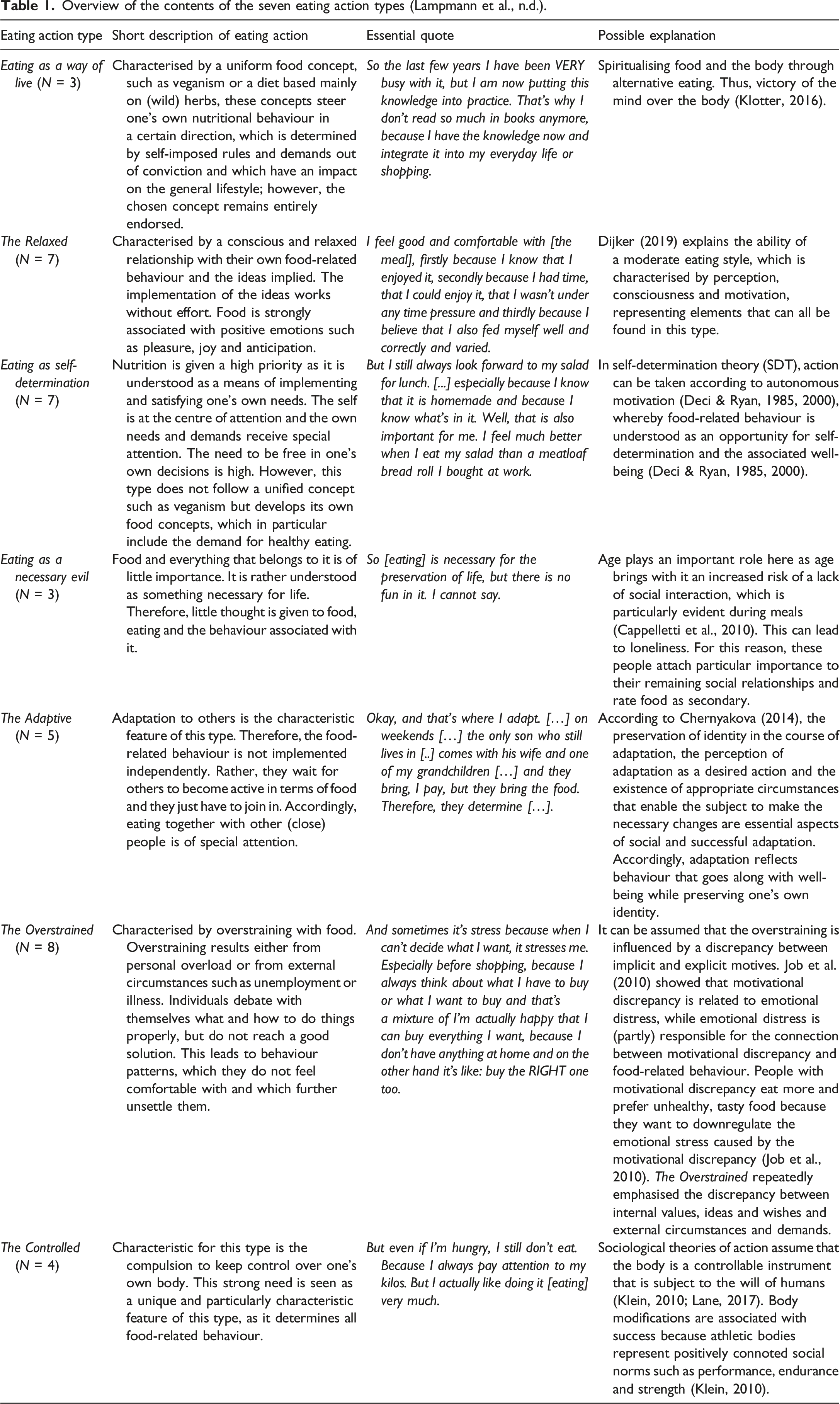
The present study concentrates on the data derived from the OMT in conjunction with seven qualitative eating action types: Eating as a way of life; The Relaxed; Eating as self-determination; Eating as a necessary Evil; The Adaptive; The Overstrained and The Controlled (described in detail in Lampmann et al., n.d.). These were developed based on the data of the problem-centred interviews using the qualitative method of typing (Kuckartz, 2016) and are based on the eating action approach.
Overview of the contents of the seven eating action types (Lampmann et al., n.d.).
OMT procedure
To identify the predominant motive(s) of the respondents in this study, we applied the OMT. We chose the OMT because it is less time-consuming to administer and evaluate than the other two implicit motive tests (Picture Story Exercise (PSE); the Multi-Motive Grid). In addition, it has already been tested more extensively for its validity (Schüler et al., 2015) and it is available in German language.
The OMT is based on the Thematic Apperception Test (TAT) (Murray, 1943) and its motive key (‘Motivschlüssel’, Kuhl, 2013), representing a projective psychological test (Kuhl, 2013). Since the motive for individual liberty was added, the OMT represents an extended version of the TAT.
The OMT is a procedure developed by IMPART (Institute for Motivation, Personality, Assessment, Research and Training) GmbH (Impart GmbH, 2020), requiring a licence in order to use it for scientific purposes (G. Ritz, personal communication, 06 November 2017).
The OMT consists of 15 pictures depicting different situations involving at least one person. Next to each picture are three questions: 'What is important for the person in this situation and what is he or she doing?’, 'how does the person feel?’ and 'why does the person feel this way?’ The participants had to reflect their subjective interpretation of the depicted situation in written form with keywords or short sentences (Kuhl, 2013).
So far, the OMT, or similar procedures for the collection of implicit methods, has been used for basic research (Quirin et al., 2013a, 2013b; Scheffer et al., 2007) but also in the field of nutrition (Job et al., 2010).
OMT – data analysis
The data derived from the OMTs was systematically coded by IMPART GmbH as well as by the first author 1 according to the evaluation key generated by IMPART GmbH. This implies empirically proven thresholds that divide the motives into low-level motives, motives of the lower average range, motives of the upper average range and high-level motives. The sum of categories divided by the number of answered pictures (∑Ki 1/n) provides information about the peculiarity of the motive (Kuhl, 2013). According to that evaluation key, a dominant motive is defined as a motive of the upper average or high-level motive. According to Krug and Kuhl (2006), international studies showed that the dominance of one motive occurs for about 60% of people, the dominance of two motives for 30%, for 5% all three motives are dominant and for the other 5% none of the motives are prevailing. Subsequently, the first author reviewed the coding. The compliance rate was about 60%. Based on the expertise of IMPART GmbH, their assessment was relied upon in case of disagreement. The motive dominance of the interviewed individuals was identified with that procedure.
Subsequent to the coding, the eating action types (Lampmann et al., n.d.) were analysed for similarities and differences in their motivational structure within a type as well as among the types using the MAXQDA software (Rädiker and Kuckartz, 2019). For this purpose, it was examined how often the respective motives occur within a type. In each case, we first looked at the most dominant motive of each individual belonging to the respective eating action type. In addition, we considered the second strongest motive of the individuals of each type, but only if it exceeded the threshold of a dominant motive. Afterwards, we used the absolute frequencies of dominant motives per individual as an indicator to describe the motive structure of a certain eating action type. In addition, we also consider the particularly weakly pronounced motive, if it exists, within one eating action type.
Results
As mentioned above, this study uses a preliminary approach and must be understood as exploratory research. Therefore, the analysis of the relationships between implicit motives and eating action types is presented in a descriptive form.
In our study, most of the eating action types are strong only in one motive (Eating as a way of life; Eating as self-determination; Eating as a necessary Evil; The Adaptive and The Controlled) and two are strong in two motives (The Relaxed and The Overstrained). This statement is based on the following procedure: each individual in our sample has one or two dominant motives. Applying this to the eating action types, the question is whether the majority of assigned persons are dominant in one or two motives. If the majority of the members of one eating action type are dominant in only one motive, the whole type is understood as dominant in only one motive. If the majority of individuals of a specific eating action type are dominant in two motives, the type is also dominant in two motives. It is not surprising that the majority of eating behaviours are associated with only one dominant implicit motive as this result is in line with the findings of international studies according to Krug and Kuhl (2006).
Based on the described analysis one of our main findings is that people of one particular type do not automatically have the same motive structure as we initially assumed.
Eating as a way of life is only dominant in one motive, whereby the prevailing motive is either power or individual liberty. The particular weak motive of this type is affiliation. According to Klotter (2016), individuals of this type are to be understood as ‘alternative eaters’, whereby the food and the body are spiritualised, tied into a web of meaning, whereby the mind wins over the body. Hence, the motive for individual liberty fits well into this picture, since eating differently can be interpreted as a distinctive need for independence. By emphasising this otherness, the power motive can also be interpreted as fitting, since the emphasised otherness towards others can create a feeling of influence.
The Relaxed is rather strong in two motives considering the amount of individuals belonging to it, which is power as the most frequent one, followed by affiliation and achievement. However, achievement appears merely as the second dominant motive. A particular weak motive is not identifiable for The Relaxed. Compared to the other eating action types, the motive of affiliation only plays a dominant role for The Relaxed. It is conceivable that this type implements a moderate way to eat (Dijker, 2019; Lampmann et al., n.d.). Considering the motives of achievement and affiliation, this can be explained. The moderate way to eat implies perception as a care-based approach towards other people and food (affiliation) and motivation in terms of cooking skills (achievement). The presence of these concepts can result in moderate eating without self-control and without abandoning the pleasure of eating (Dijker, 2019).
The type Eating as self-determination is only dominant in one motive, which is either power or achievement. The motive for individual liberty is particularly weak within this type. However, neither power nor achievement can be associated with the eating action of this type.
The majority of Eating as a necessary Evil has only one prevailing motive, which is either power or individual liberty. For this type, achievement is particularly weak. As mentioned above, behaviour is only motivated when a person with its preferences encounters an environment in which the desired incentives are available. Since eating has no particular relevance for this type, we assume that it does not work as incentive for motive satisfaction.
The Adaptive is characterised by an unusually high need to adapt to others and to represent accordingly no (value) conceptions of its own. Nonetheless, this type feels comfortable with its style. Considering the number of individuals with a dominant motive, this type is strong in two motives, which are achievement and individual liberty. Due to its motive structure, this type is not fully comparable to the other eating action types but rather seems relatively specific. Particularly weak is this type in its endeavour for power. This result was to be expected, being characterised by its adaptation to others. Accordingly, the type is constantly under the influence of others. This means that this type is influenced deliberately, but there is no interest in influencing others. However, individual liberty is one dominating motive for this type. In Lampmann et al. (n.d.), we have stressed the need for subjects to preserve their identity in the process of adaptation. The adaption must be perceived as a desired action, and the existence of appropriate circumstances must be given in order to enable the subject to implement the required changes (Chernyakova, 2014). Thus, adaptation to others only takes place if it is one’s own wish and if it happens voluntarily.
The Overstrained is only dominant in one motive, whereof the most frequent one is power, followed by achievement and is particularly weak in affiliation. It can be assumed that the overstraining within this type is influenced by a discrepancy between the implicit and the explicit motives. Explicit motives, in contrast to implicit ones, are those that are cognitively elaborated and can be verbalised. They stand for the image that is to be presented of oneself to the outside world (McClelland et al., 1989). If implicit and explicit motives diverge, this leads to malaise. Job et al. (2010) showed that motivational discrepancy is related to emotional distress, while emotional distress is (partly) responsible for the connection between motivational discrepancy and food-related behaviour. The results support the idea that people with motivational discrepancy eat more and prefer unhealthy, tasty food because they want to downregulate the emotional stress caused by the motivational discrepancy (Job et al., 2010). Hence, this explanation leads to the fact that the dominant motives found here have no further meaning for the time being. They would then be significant if there were no overstraining and people of this type could be assigned to another eating action type to which they would belong without suffering from overstraining.
The Controlled is only strong in the motive for power. With that, it differs from all other types. The particular weak motive for this type is individual liberty. Holding control over one’s own body can represent effects of social power (Foucault, 2007; Klein, 2010) by exercising strong control over one’s own body and thus receiving social recognition. Through social recognition, individuals influence others by representing role models, strength or the common ideal of beauty (Görtler, 2012). Thus, the strong need to control one’s own behaviour can be explained by the prevailing power motive in this type.
Discussion and conclusions
Our research design should be understood as a first exploratory approach. Since there is a lack of suitable methods for qualitatively investigating the relationship between implicit motives and other factors, we developed the present approach. To do this, we had to develop our own principles and decide how to analyse the relationship between implicit motives and eating action types. In this context, we see our approach as a starting point and there is a need for methodologically oriented studies on this relationship in the future.
In this study, we have committed ourselves to Hurrelmann and Bauer’s (2015) socialisation theory and a humanistic view of the human being. Besides this, behaviour in connection with consumption has increasingly been examined from a practice-theoretical perspective in recent decades (Bourdieu, 2011; Giddens, 1997; Warde, 2005, 2014). The focus of these studies was primarily on cultural consumption research. Accordingly a new, comprehensive and particularly recognised theory by Alan Warde ‘The Practice of eating’ (Warde, 2016) as well as empirical studies on eating as practice (Connolly and Prothero, 2008; Halkier and Jensen, 2011; Wahlen, 2011) have emerged. However, practice-theoretical perspectives do not place the origins of unconscious behaviour within the individual, as perceived by Hurrelmann and Bauer (2015), Krug and Kuhl (2006), Kuhl (2001) as well as by Köster (2009). Instead, it is brought to the individual by the external reality, by means of the habitus (Bourdieu, 2011) or teleoffactive structures (Welch, 2020). In this respect, the view of the individual differs in our study.
Moreover, it might be interesting in future studies to focus on a narrower group of participants, for example, in relation to certain types of implicit motives and then to explore in depth the food-related behaviour of these consumers. In this context, it would also be interesting to analyse the variation that can exist over a certain period in food-related behaviour. For example, it could be investigated what happens when people experience major changes in their lives. It is assumed that during these transition phases a change in food-related behaviour is also possible (Chung et al., 2007; Hopkins et al., 2014; Mathur et al., 2008; Wolf et al., 2014), and it could be investigated how this affects or can be explained by implicit motives.
In addition, it could be interesting to investigate the differences in implicit motive structure between men and women and how this affects food-related behaviour as it is commonly known that men and women eat differently (Max-Ruber-Institut, 2008; Nestlé Deutschland AG, 2019).
With this study, we were dealing with an exploratory approach, the combination of food-related behaviour and psychological approaches by using qualitative methods to elicit the reasons behind behaviour. As the results of this study suggest that implicit motives have an influence on food-related behaviour, they may be of particular interest to interdisciplinary researchers who want to understand the relationship between individual and social behaviours, between unconscious and conscious behavioural contexts or who want to understand (un)well-being or (in)consistent behaviour due to implicit and explicit motive discrepancies. Accordingly, nutrition consultancies, food companies, policy makers and advisors may be interested in the insights gained in this study about the influence of the unconscious on food-related behaviour.
Footnotes
Author Contributions
The first author conceived, designed and performed the experiments, analysed the data and wrote the article. All authors contributed to the writing process.
Declaration of conflicting interests
The author(s) declared no potential conflicts of interest with respect to the research, authorship and/or publication of this article.
Funding
The author(s) disclosed receipt of the following financial support for the research, authorship and/or publication of this article: The preparation of this article was supported by the enable Cluster and is catalogued by the enable Steering Committee as enable 05 ( ). This work was financially supported by the German Ministry for Education and Research (BMBF) (grant number: FKZ01EA1409D). The authors highly acknowledge this financial support but are solely responsible for the content of this manuscript.
Ethical Approval
Ethical approval was not required because no questionable (medical or morally reprehensible) research was conducted on the participants of this study.