




Abstract
Feminist porn can be defined as pornography that is infused with feminist values and ideals when it comes to what the product looks like, how it is produced, and also consumed. Still, as a segment of the pornography industry, feminist porn is a cultural product made for profit. In this paper, focusing on feminist pornographers, we expand on limited discussions of pornography in management and organization studies by exploring how the inclusion of feminist ideals in pornography practices might be reconciled with the constraints of operating in a for-profit market. At the intersection of business ethics and the sociology of morality we ask: What morality do feminist pornographers construct for their practice? To answer this question, we analyze a media data corpus consisting of articles, podcasts, and videos where feminist pornographers are interviewed, alongside supplementary interviews and archival data. On this basis, we reconstruct three evaluative norms that constitute a morality of feminist porn: (1) Enabling diversity and difference; (2) Ensuring quality and care; and (3) Connecting values and valuation. We show the variations and tensions in these and discuss the implications for a feminist (re)organizing of pornography.
“I am not against dirty sex, I am for clean values”
Pornography is a global industry, yet it is difficult to assess the industry’s size and annual turnover given its illicit aspect, which leads to a chronic lack of documentation. Pornography takes up to one third of all internet traffic and estimates of the industry’s turnover run to 97 billion US dollars (Cookney, 2019). By comparison, the movie industry generated 38 billion US dollars globally in 2016 (Altman and Watson, 2018). Explorations of the intersection of sex, gender, and business typically focus on sex work (Miller-Young, 2014) or the concept of dirty work (Mavin and Grandy, 2013; Toubiana and Ruebottom, 2022). These studies investigate activities such as erotic dancing, striptease, pole dancing, working in brothels, and other kinds of sexual(ized) labor (Blithe and Wolfe, 2017; Dalton and Jung, 2019; Hales et al., 2019; Hong and Duff, 1977; Leybold and Nadegger, 2023; Wood, 2000). Other studies do characterize pornography’s effects on consumers (Attwood et al., 2021) or else explore how it has been become part of the collective consciousness and/or various social movements (Kirkpatrick, 1975). Finally, a few researchers have looked at pornography as an industry (Bakker and Taalas, 2007; McKee, 2016; Ruiz et al., 2023; Voss, 2012). It should be noted that pornography is a prime example of a stigmatized industry or market (Slade Shantz et al., 2019; Vergne, 2012), where the stigma is shared widely, if not universally, by a range of stakeholders (Weitzer, 2009). Also, it is worth noting that such topic- or industry-related stigma can transfer to the researchers (Brewis, 2005).
In this article, we focus on a distinct category, or genre, of pornography that has emerged since the late 1980s and gained popular exposure in recent years, yet remains to be examined, not least in management and organization studies: feminist pornography. Developing out of a third-wave, sex-positive feminist ideology (Liberman, 2015), feminist pornography celebrates sex and presents it as a free choice and a form of empowerment, reclaiming the “authentic” representation of sexuality beyond the male gaze (Atwood, 2009; McNair, 2002). Feminist porn centers women’s desires and pleasure (Stewart, 2019) and sets out to depict diversity in gender, race, ethnicity, sexuality, body size, ability, and age (Taormino et al., 2013). Feminist porn can thus be defined as pornography that is infused with feminist values and ideals (however these are to be defined and understood) when it comes to what the product looks like, as well as how it is produced and consumed. Yet, as an “industry within an industry” (Taormino et al., 2013: 12), feminist porn is still a cultural product made for profit. However, discussions of feminist pornography as a site of management and organization in a neoliberal market are scant (Berg, 2021; Danaher, 2019; Ryberg, 2014) and, to the best of our knowledge, absent from management and organization studies.
Focusing on feminist pornographers, we seek to expand on existing limited discussions of pornography and sex work in management and organization studies by taking an interest in how feminist ideals are incorporated into pornography. We ask: What morality do feminist pornographers construct for their practice? By feminist pornographers, we mean industry participants producing and directing pornographic motion pictures and who publicly self-identify as feminist pornographers. In turn, the term practice refers to their ways of being and acting as feminist pornographers. Finally, we define morality as what individuals or social groups understand as being right/good versus wrong/bad in relation to a particular context or issue at hand. To answer our research question, we analyze a media data corpus consisting of articles, podcasts, and videos where feminist pornographers are interviewed, alongside supplementary interviews collected by the lead author and archival data. On this basis, we reconstruct evaluative norms (Shadnam, 2015) that constitute a morality for feminist pornography.
We contribute to management and organization studies by studying a taboo topic, and by engaging with a stigmatized industry that distils a number of issues, including the capitalist exploitation of bodies, sexism, and (feminist) ideological contentions, and that is surprisingly absent from discussions, not least in critical management scholarship. We situate our work at the little explored intersection of business ethics and the sociology of morality (Shadnam et al., 2021), studying feminist pornography as a (set of) practice(s) where the body is at the center of business ethical concerns, and showing the multifaceted ways in which feminist pornographers infuse the pornography industry with a feminist morality. Our findings also open research avenues for the field of corporeal ethics (Pullen and Rhodes, 2015; Shadnam et al., 2021), for studies of market destigmatization (Leybold and Nadegger, 2023), including via moralization (Slade Shantz et al., 2019) and more broadly discussions of the locus between morality and markets (Schiller-Merkens and Balsiger, 2019).
Theoretical framework
Feminist pornography: Between emancipation and commodification
Feminist porn started to develop as an alternative offer at the height of the “porn wars” (or sex wars) in the 1980s in the United States (Ferguson, 1984). The porn wars emerged out of the debate between different feminist groups about the sexualized representation and/or exploitation of women and “grew into a full-scale divide that lasted over three decades” (Taormino et al., 2013: 10), leaving the feminist movement deeply divided (Duggan and Hunter, 2014). On the one hand, feminist porn was—and still is—criticized for legitimizing the sexualization of women and thus “delegitimizing any feminist fight against such sexualization” (Just and Muhr, 2020: 8); it has also been accused of objectifying women’s bodies and sexualities for profit (Gill, 2003; Just and Muhr, 2020; McRobbie, 2009). On the other hand, feminist porn has been praised for reintroducing the woman’s point of view into representations of sex(uality), as well as regaining control over the female body and female sexuality (Berg, 2017; Ryberg, 2014). Thereby, feminist porn creates “its own iconography [. . .] committed to depicting diversity in gender, race, ethnicity, sexuality, class, body size, ability, and age” (Taormino, 2013: 262).
The sex-positive feminist movement both critiques how pornography otherwise looks and is made and also aims to for example, improve labor conditions, safe sex practices, and consent (Tibbals, 2014). From such a perspective, pornography and feminism are thus not mutually exclusive (Danaher, 2019; Ryberg, 2014). Still, critics of feminist porn warn against commodifying sex, bodies, and fantasies, as this may jeopardize feminist emancipation, especially if the industry continues to function according to its current exploitative and oppressive norms (Berg, 2017; Whisnant, 2016). Furthermore, feminist porn “is still subject to the logics of media power and industry” (Liberman, 2015: 188). For example, what is included in a scene or how much autonomy performers have on set is embedded in cost–benefit analyses and with a sales market in mind (Berg, 2017). Thus, the commercial aspect “is not put aside in feminist porn” (Taormino et al., 2013: 16).
In summary, feminist pornography is sexually explicit media sold on the pornography market, presenting itself as an alternative offer infused with feminist values. Overall, previous discussions have tended to focus on the empowering, positive elements of feminist porn, or, on the contrary, on the oppressive and exploitative dimensions that are reproduced in such work. We are yet to understand in a more nuanced way how industry participants articulate feminist values and capitalist logics. Such an understanding also contributes to broader debates about how a feminist emancipatory agenda can be furthered in a neoliberal world of work (Villesèche et al., 2022). To do so, we must take the commodification of sex and the exploitation of bodies in the neoliberal order seriously, while also taking feminist pornographers’ reflections on their practice seriously and not reducing them to “cultural dopes.”
Infusing a for-profit industry with feminist ideals
Feminist pornographers seek to incorporate feminist ideals and values into a cultural product where such values had previously been absent (Stewart, 2019). Importantly, people working in feminist porn are not arguing that pornography is immoral—that is, that pornography needs to be condemned as wrong or bad—as would be the contention for anti-porn feminists (Stewart, 2019). Instead, feminist pornographers support a view of pornography as being amoral: if sexuality is a practice that is a natural part of being human, one cannot be judged ex-ante for participating in its depiction in pornographic movies. At the same time, by using the epithet feminist, workers engaged in this genre signal that there are specificities in their practice that sets it apart in the pornography industry.
For sociologists of morality, “morality is not an unmediated given that naturally exists or should exist”; it is thus inseparable from context and from the individual agents operating in that context (Shadnam, 2015: 457). In this article we argue that, while being “subject to the logics of media power and industry” (Liberman, 2015: 188), feminist porn is organized around a feminist morality, that is, a values-based critique of the dominant ways to define, produce, and consume porn. Feminist morality can be defined in various ways, as different moral arguments can be brandished as feminist. Rather than theoretically pre-defining what feminist morality is, we investigate the arguments put forward by industry participants aiming to attach a feminist morality to their practice.
This means that what each feminist pornographer says about her practice both expresses an individual sensibility and participates in shaping a shared morality. We understand this moral shaping as a form of organizing of feminist pornography. Moreover, as a socially situated endeavor, the morality constructed for feminist porn is likely to feature variations, in line with general theory about the interactional dimension of morality (Shadnam, 2015). It is thus also crucial to be attuned to differences in the way feminist ideals are related to feminist pornography as a product and production process, as well as to the question of pornography consumption and how it may influence sexual behavior and gender relations more broadly.
Shadnam et al. (2021) furthermore call for better integration of the sociology of morality with business ethics, as “we still lack a sufficient and thoroughly sophisticated account of the manifestations of morality in organizational settings that can shed light on the contextualized and nuanced character of making moral judgments and implementing ethical principles” (p. 201). We contend that the tie between morality and business ethics is especially important to consider in the case of pornography, where bodies, not least women’s bodies, are the nodal point in the product, its production, and its consumption. As the writer Virginie Despentes argues in her feminist essay King Kong théorie (2006), women’s bodies are not just a possible variable to include in pornography, but are “necessary to the success of the enterprise.” The values at play are thus social and economic values, as for example discussed with regard to fair trade or green(er) production standards (Balsiger and Schiller-Merkens, 2019) and the market moralization literature more broadly (Balsiger, 2021; Suckert, 2019).
Research design
To explore what morality feminist pornographers construct for their practice, we collected data in which industry participants self-identify as feminist pornographers and/or explain how their professional practices relate to feminist aims. In line with this, since we are interested in feminist pornography as a collective endeavor in a for-profit industry rather than in individual-centered, inward-looking phenomena such as identity work, we were keen to collect data that is public, where moral claims are made to a wide audience, including other feminist pornographers. In this article, we focus more specifically on producers and directors of feminist porn, as central organizing figures in that genre. The collected data includes press articles, videos, and podcasts. Press articles and other news media are relevant data sources as they “both [. . .] reflect and construct social reality” (Tienari et al., 2009: 506), while videos and podcasts are a popular, contemporary alternative to interviews in print. This media corpus is complemented by interviews with industry participants and archival data to enrich our understanding of working in feminist pornography.
Data collection
For reasons of linguistic proficiency and familiarity with key figures in feminist porn in the francophone context, the lead author started by collecting data in French. While there can be cultural specificities in particular markets and sub-markets, pornography is a global industry and feminist porn follows a similar trend, with the main “hubs” currently including Barcelona, Berlin, San Francisco, and Sydney. The materials were collected through Factiva, Europresse, and Google searches with keywords such as feminist pornography, ethical pornography, or names of major companies and producers known to the author. A purposive sampling strategy was followed, based on two main criteria. First, we looked for press articles that featured interviews or direct statements made by key figures of the feminist porn industry to hear their voices directly, rather than for example, cover stories about feminist porn. In other words, we were interested in the discourses of feminist pornographers rather than discourses about feminist porn produced by observers.
Second, acknowledging the limitations of studying secondary data, we sought to create variety in our corpus of press articles, by including print and online media which represented a range of ideological orientations, so as to account for a number of possible editorial choices (questions asked to pornographers, what part of their discourses are reported on, etc.). As this research project developed, additional data was collected in English, mainly in the form of podcasts and videos, with a view to enrich the corpus across different media types (rather than e.g. to triangulate the data or make cross-cultural comparisons). We thus collected the public discourse of 14 feminist pornographers on feminist porn. Additional articles about feminist porn (without interviews) were used to familiarize ourselves with the public discussions of feminist porn. See Table 1 for an overview.
Secondary data corpus.
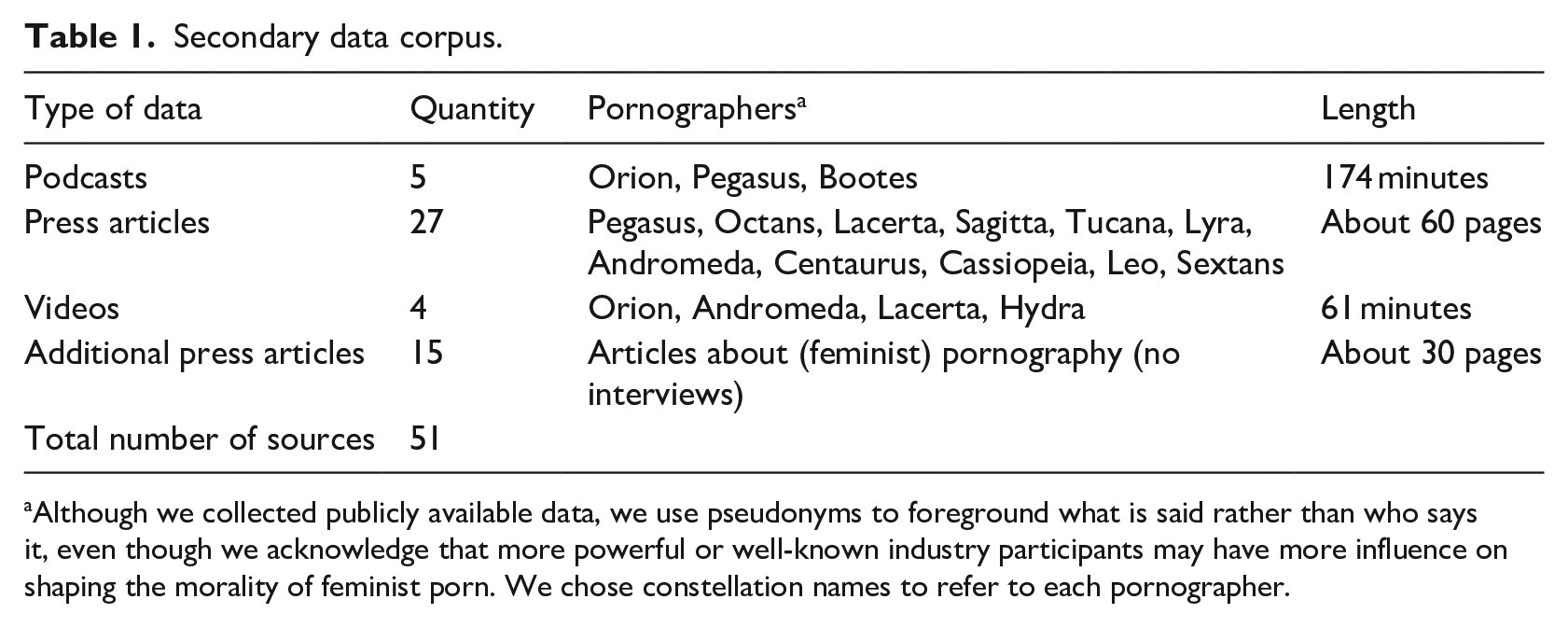
Although we collected publicly available data, we use pseudonyms to foreground what is said rather than who says it, even though we acknowledge that more powerful or well-known industry participants may have more influence on shaping the morality of feminist porn. We chose constellation names to refer to each pornographer.
Finally, through a fellow researcher, the lead author was introduced to and interviewed a person working in feminist porn, and additional interviews were obtained through snowball sampling. Due to this approach, several of them had ties to one of the leading feminist porn producers in Europe; however, most people in the industry are freelancers, including in other pornographic genres, other forms of sex work, or other industries such as advertisement or fashion. Five interviews were conducted with four feminist pornography industry participants in fall 2022—these included two with a marketing and product manager, one with a couple who are actors/performers, one with an intimacy coordinator, and one with a commissioned director who is starting out in the industry. The interviews lasted between 25 minutes and 1.5 hours. We used them to get a better understanding of the feminist porn industry from the perspective of figures who occupy roles other than producer/lead director. They are occasionally referred to in the findings in order to extend or contrast points made in our analysis, and we refer to such diverse voices when outlining research avenues in the concluding section.
Data analysis
The analysis was conducted in two stages. In the first stage, we reconstructed the discursive repertoires that feminist pornographers draw on to characterize feminist porn. Inspired by Tibbals (2014), who proposes different categories in broader pornographic work (production, distribution, and consumption), we related interview content in our corpus to the market-related categories of product, production, and consumption. Here, we follow Kelan and Jones’ (2010) argument that discourse is a social practice through which social issues are negotiated. The aim is to make feminist perspectives visible and at the same time keep them under critical scrutiny (Baxter, 2003). The outcomes of Stage 1 are presented in Table 2 with quotes illustrating that feminist pornographers see feminist as an alternative product, produced ethically, and that may constitute a form of socio-political activism.
Discursive repertoires of feminist porn.
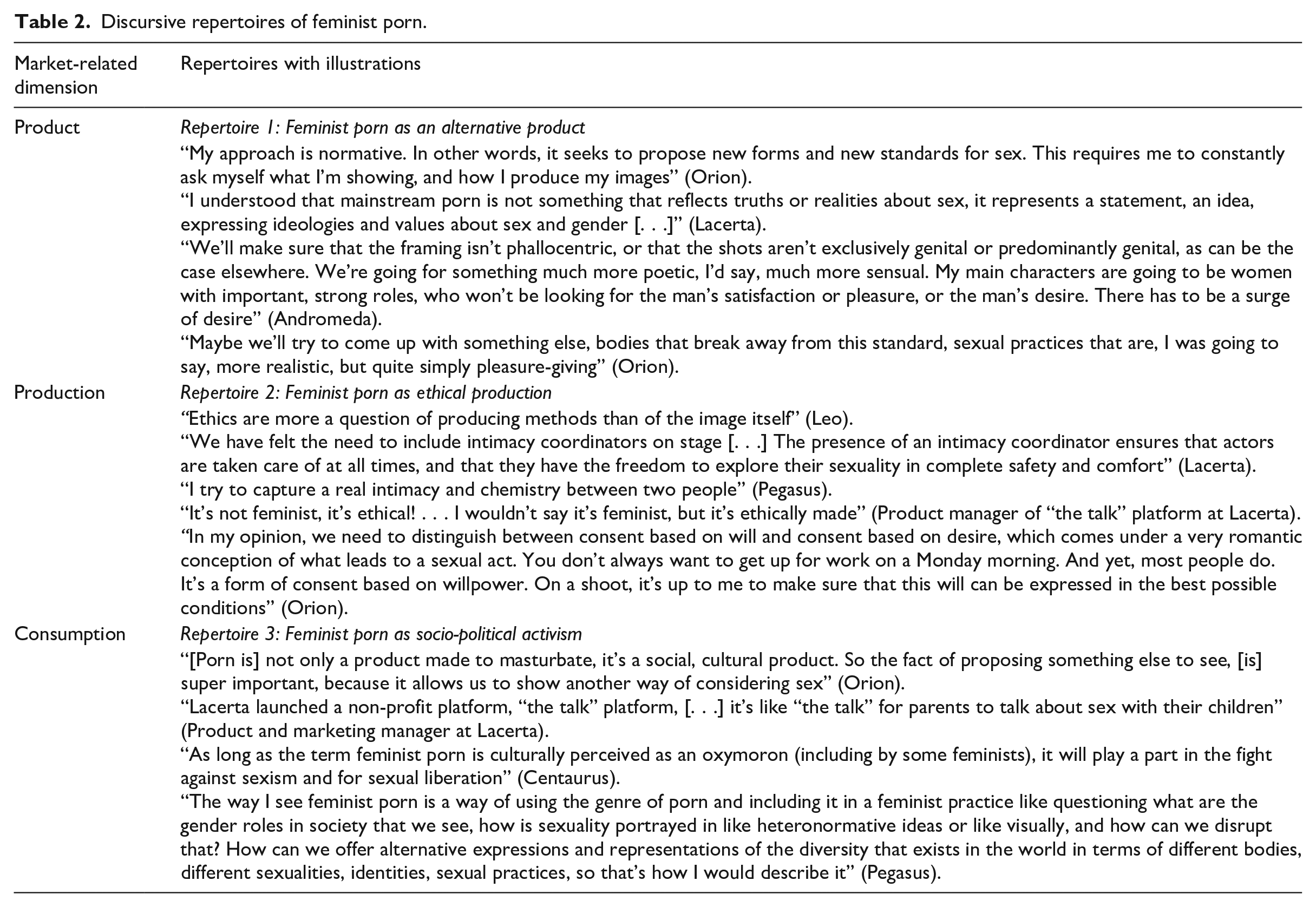
We then moved to a second stage of analysis, in which we delineated what constitutes the morality of feminist porn across these repertoires. We conducted an open coding within and across these discursive repertoires to reconstruct evaluative norms. In moral sociology, morality is defined as “a set of evaluative norms. . . at the collective level that people consciously reflect upon, question, revise, and appropriate in a living way” (Shadnam, 2015: 462). Evaluative norms are thus the product of people’s reflections, that is to say norms that are “neither too normalized to be adopted automatically nor imposed by an outside force” (Shadnam, 2015: 463).
To help identify such norms, we applied Shadman’s three-dimensional framework of morality in context (2015) to guide our coding of the data. First, we considered feminist pornographers as the narrating subjects, that is, the subjects who are prompted to narrate themselves, to present a self-account of who they are and what they do in a given context. Second, we examined the symbolic forms in which the accounts are made, the ways in which their views on morality and practice are presented in our data, which for Shadnam is a broad dimension that can include stories, idioms, action templates, logics of causation, and so on (2015: 467). Third, we defined the scenes of address, that is, the reason for the subjects to present a self-account, the audience that prompts the feminist pornographers’ self-account in relation to morality. Here, we define these scenes to be potential customers with feminist leanings, as well as a broader audience concerned with or having stakes in the pornography industry.
Examples of open codes include: a moral duty to represent diverse bodies and practices; the quality of the product; a quest for authenticity; the price of good working conditions for performers; emphasis on consent; paying for quality porn; legitimacy of fantasies; and emancipation. In an iterative process involving all authors, we aggregated data pertaining to these inductively identified topics across the moralized dimensions into three evaluative norms: (1) Enabling diversity and difference; (2) Ensuring quality and care; and (3) Connecting values and valuation. In the findings section, we present these norms, including the variations and tensions we found in them.
Findings
Evaluative norm 1: Enabling diversity and difference
First, we find that across product, production, and consumption, feminist pornographers evaluate their practice in relation to an identified necessity to do things differently, to establish a (moral) distance and difference between what they do and what is otherwise happening in the pornography industry and in the consumption of the industry’s outputs.
As we know from previous research—and as we can see in the “product” dimension in Table 2, reporting on our first step on analysis—feminist porn aims at representing a wider range of bodies and sexualities than conventional porn. Moreover, it creates an offer that can appeal to consumers who were previously “unfairly” neglected. However, providing a new product on the porn market is not simply a commercial strategy, but has a broader moral ambition to emancipate and educate. In short, the ambition is to bring about change via a feminist agenda. Thus, feminist porn is a genre that not only entertains a different/broader audience in a different way, but also a “Trojan horse” which has the potential to change dominant views of sex and its depiction in pornography. Overall, we find that feminist pornography has a mission to share a different, alternative message about sexuality and its consumption as a cultural product compared to the dominant iconography of our times: What one could say about alternative porn is that its main objective is not profit, but rather to deliver a message. [. . .] I think that in this patriarchal and sexist society, women are very limited in their sexual aspirations. They don’t have control over their sexuality. Through porn, they learn to become a sexual subject, which is liberating (Pegasus).
Moreover, “feminist porn seeks to empower the performers who make it and the people who watch it” (Tucana, Cosmopolitan, 2013). This entails conscious decisions regarding how to produce porn differently. Notably, consent and the centering of women’s sexual desire are central in feminist porn. Authenticity or realness as another important criterion for feminist porn is embedded in the perception of what viewers (with a strong emphasis on female viewers) want to see—“active desire, consent, real orgasms, power, and agency”—versus the typical “passivity, stereotypes, coercion, or fake orgasms” (Taormino et al., 2013: 12). This change is an important one, as this is how feminist pornographers believe they represent a variety of “real” sexual practices, including some that might be considered violent and disturbing to some, and empowering and liberating to others: I am not against dirty sex, I am in favor of clean values. That is to say: reciprocity, consent, realism, and the fact that each and every one finds pleasure in it, it can be a brutal fantasy or hugs in rose petals (Lacerta).
As suggested by previous work (Berg, 2017; Scott, 2016), consent is also reflected in behind-the-scenes videos and performer interviews that are often published together with the pornographic movie. Notably, this may lead to such consent being staged or exaggerated to make a normative point. When we interviewed a performer couple, they stressed this element. Even though they are a real-life couple who have more implicit ways to signal consent, “for the movie [with Lacerta’s company] we were asked to emphasize consent more clearly in the sequence where [the female performer] was seemingly sleeping [. . .] when I engage with her, as it could be misunderstood.” They were also asked to emphasize the woman’s sexual pleasure. In contrast, in a media statement from another feminist pornographer, insisting on staging explicit consent was equated to having car chase scenes where actors would first take the time to buckle their seatbelt. There seems to be a tension here between the quest for authentic sexual scenes and the moral commitment to promote and represent sex based on consent, safety, and pleasure for every person involved.
Relatedly, the extent to which feminist pornography should be more than a conventional adult entertainment product or have educational aims toward their audience is widely disputed (Pegasus). Some feminist pornographers consider that porn does de facto constitute the sexual education of many young people, and that this further heightens the importance of what they do: It’s about representation on screen and how we are showing gender roles, not only women but also men. We know that women are being objectified. But men are also being reduced to penetrative sex machines (Lacerta).
The quest to combine the entertaining, pleasure-conducive aims of pornography with the impetus to film more diverse or “real sex” has led some feminist pornographers to consider this a prime way of distinguishing feminist porn from mainstream porn, and have this feature recognized institutionally: The [Berlin Porn Film Festival] jury found it interesting that there were subjects that were a bit “educational,” especially on sex work and gender (Andromeda).
Some pornographers go even further in that logic and approach their work as documentary work: I produce and direct documentary porn. Instead of constructing a fictional scenario, with actors playing characters, I’m interested in existing sexuality. I’m looking to capture real intimacy and chemistry between two people. I ask couples who know each other, who love each other, and who have sexual relations, and I give them a camera (Pegasus).
In addition, one of the pornographers featured in this study has set up a course to help adults develop a healthy relationship with porn, as she could only find content explaining how to stop watching porn. Another producer launched a newsletter that includes links to tutorials for a range of sexual practices, as well as a platform dedicated to sexual education for parents. This idea emerged after the pornographer was asked how she talked to her daughters about her job.
Evaluative norm 2: Ensuring quality and care
In this second norm, turning to feminist porn is framed as a moral duty to oneself, related to self-care and to broader societal injunctions to consume better products that are better produced. In order to realize this, feminist pornographers must consider self-respect, fairness, and care at every stage of the porn’s production.
As remarked in previous scholarship (Tibbals, 2014), and as identified in relation to the production dimension in Table 2, feminist pornographers are eager to improve labor standards in the pornography industry, especially when it comes to working conditions and pay. Feminist porn producers, for example, claim to offer higher wages than elsewhere in the industry, and to pay by day rather than by scene to promote equity. Acknowledging that performing in such movies is very exposing, some pornographers try to have as few people in the room as possible to create a feeling of intimacy: “During the sex scene, we had to be in the same room as [the actors] as little as possible, so there were just the technicians, the intimacy coordinator who was there, the set photographer, but otherwise, everything else, we were in another room behind the monitor, and we had walkie-talkies to talk to the cameraman” (Susie, director of a pornographic movie for Lacerta). Most productions also offer the services of an intimacy coordinator to ensure that the actors are fully informed and can formally consent to the sexual practices that happen during the filming (Lacerta).
We find that this drive for more ethical work practices also intertwines with the product. It affects the content and esthetics of the movies that are produced, and relates to a broader drive for care—for the industry participants, for the movies as a creative industry product (Scott, 2016), and for the audience’s moral standings vis-à-vis their sexuality. Focusing on the well-being of performers also makes for a more intuitive, personal style of pornography, where the concern for the “real” is not only about authentic representation, but also related to the esthetics of the movies: I wanted something esthetically pleasing, but with a more personal message. [. . .] I wanted to do something simpler, more authentic. There are four of us in the team: two on camera, a photographer, and a sound engineer, who also handles music and post-production. As far as the subject matter is concerned, I can’t see myself making a film on a subject I don’t like or have never fantasized about (Lyra).
This care for the performers, which also extends to the kind of movie that is made, can be expressed in a number of ways. Some directors write all the sex scenes in advance, to make sure everyone can consent, and also establish a detailed timetable and working plan. Others, on the contrary, find it is better to let the performers do what they feel like doing, so that the film conveys freedom, desire, and real pleasure, while also centering the agency of the performers as co-creators of the content: I don’t write the sex scenes, only the context, and the rest is improvisation. Everyone has a storyboard, and we talk between performers: “What do you feel like doing today? How do you feel?” are the first questions I ask. [. . .] The dialogues are improvised, and I let the sex come as naturally as possible. Writing the minimum avoids imposing practices (Cassiopeia).
However, feminist pornographers are aware that gender roles in relation to sexuality are driven by cultural scripts, including the ones found in other porn movies, as well as by cultural products linked to love and intimacy such as romcoms. Feminist pornographers are thus trying to develop an esthetics that both differs from “mainstream” pornography and from other gendered cultural products: I’m resisting against mainstream culture in general. And specifically, I’m resisting against rom coms. I have a huge hatred against romantic comedies, I think they show a very negative idea of sexuality and relationships. I think they relativize masculine toxic behavior, I think there is a lot of wrong messages that are being delivered, you know everything like what is love, what is a romantic relationship and so on (Pegasus).
Realizing this moral dimension in a porn film’s esthetics is not easy, and letting people do what they feel like doing is not always the best solution. Actors and performers, but also directors, tend to be active in different parts of the pornography industry and beyond. Their other work might involve shooting scenes for “mainstream” or other porn genres, personal content creation on OnlyFans (a user-generated content subscription service and streaming platform), or performing other types of sex work, with different practices and evaluative norms that may clash with the feminist agenda. In one of the videos analyzed, the director lucidly expresses this push and pull: Performers who are used to work in the mainstream porn industry, I need them to understand that I’m not interested in them “doing porn.” I want to show sex, which is much more emotional. [. . .] It is definitely a challenge when someone works a lot in the mainstream porn industry because they tend to reproduce what they learned in the industry. You have of course the hair pulling, that’s always in there. We did a few of those things [in today’s shooting], but with the material that we have, I have enough to choose what I want to show and what I don’t want to show. Because in the end, even if it is real sex, this is a film, and it’s an illusion and I create the image that I want you to see as an audience (Lacerta).
This concern about esthetics also manifests itself in the quality of the final product. It is worth mentioning that some directors release their movies in 4K/HD quality and organize premieres in art cinemas or cinematheques. Two directors featured in one of the videos in the corpus express a shared intention to do something more elevated than a short movie without a story, shot with a handheld camera on a dirty sofa: Another thing that I didn’t like about pornography was that the most of it was so badly done. It didn’t feel like they cared about the cinematic vision of it. [. . .] I realized that I wanted to see something made for women where you could actually see female pleasure, but at the same time, I wanted to see something esthetically interesting (Lacerta).
This drive for quality ties back to how pornographic movies were historically made back in the 1970s, before the internet both democratized but also deeply changed what pornography looks like (Bakker and Taalas, 2007). We thus see how ethical concerns have esthetic implications.
Furthermore, some argue that consuming this alternative type of pornography is a matter of self-respect. Pegasus, referring to the “horrible” content available at the top of movie lists on free tubes, asks “is that what you want to give yourself, like is that how much you care for your sexuality?”. Here, we see care for the consumer, for how individual morality is also shaped by the products and services we consume on the market. In that sense, caring about the type of porn you consume means self-care. We should think carefully about the quality of the porn we consume, just as we consciously evaluate the things we habitually consume in other domains.
Evaluative norm 3: Connecting values and valuation
Finally, a third evaluative norm centers on the relationship between feminist values and choice of business model. With this norm, the feminist pornographers interpret their activity vis-à-vis the idea that the values of a product or service relate to the way transactions are set up by content producers and understood by consumers. That is to say, feminist porn is a good (feminist) product if it is treated as such by all stakeholders in the market.
First, it is important for feminist pornographers that porn content should be paid for and distributed on dedicated platforms, platforms that do not feature ads for legally and morally problematic content, such as movies with teenagers (Lacerta). This preference for proprietary distribution modes is furthermore deemed to be a way to prove that their content is accessed by choice and not by chance: The fact that my penultimate feature, Blow Away, attracted the same audience as a Dorcel Premium movie on [a private channel] is telling. The demand is there. And the fact that new platforms where you can buy ethical porn are multiplying is a good sign (Andromeda).
Nevertheless, producing feminist porn is not an easy path. Often, it is barely profitable. Despite keeping budgets low compared to the industry standards, producers sometimes work for free to break even (Andromeda). As well as dealing with the competition of “mainstream” production companies with bigger financial means, feminist pornographers are also battling against the fact that porn is an industry where free access has become normalized. Therefore, one of their primary goals is to convey their standards of fair business to consumers. They hope to raise awareness of the implications of thinking that it is OK to look for free content: . . .to find porn that you know is ethical and know you can consume ethically is like basically: rule number one is pay for it. Because the moment that you’re not paying for porn and that you’re consuming it on a platform that is not the dedicated platform that porn was made for, you’re pirating, so obviously it’s a copyright issue, but I would say it’s more than that. [. . .] When you’re pirating the content from single content creators, I would argue that you’re literally abusing their autonomy (Pegasus).
Paying for feminist porn thus means respecting the law, respecting the industry workers, and enjoying yourself, safe in the knowledge that “everyone was treated respectfully, everyone was paid, remunerated respectfully and you can have a good conscience” (Pegasus). However, when considering business model choice, it should not be overlooked that this makes feminist porn a high-end product that only a few people can afford—or even find when searching in the usual places people look for porn. There are parallels here with discussions about the consumption of organic or fair trade food (Guthman, 2004): People become responsible and think more and more about the way they spend their money [. . .] Our clients like the fact that the videos are HD on the website, that there is new content every week, subtitles in various languages, and making-ofs. They know that it comes with a price (Lacerta).
Paying for your porn is a way to ensure quality, and therefore consumer satisfaction (in all senses!). As shown in the second evaluative norm, many feminist pornographers aim to produce content of high quality, when it comes to both ethics and esthetics. By paying more for the “quality certification” of feminist porn, “it’s actually good for you as a consumer: you know, not because of ethics, and because of course you should be, you’re gonna be a better person, no: you as a consumer, when you pay for your porn, you’re gonna be getting good quality porn, a lot of it, and you’re gonna spare yourself the time to spend hours trying to surf through really disgusting pop ups” (Pegasus).
Still, some feminist pornographers have made the choice to share some of their content on free tubes, with the hope of attracting new customers to their own platforms. This approach has been criticized by other feminist pornographers: “I just received this email from the production company for which I have been a performer in two movies. And this email explains that they will open an official channel on PornHub and other tubes. [. . .] And it raises a big consent issue. My consent. This email doesn’t ask for my consent to appear on PornHub” (Orion). This producer and former actor furthermore suggests that the paywalls are not only for commercial protection, but also a protection of the rights and well-being of everyone involved: “When I decided, after age 30, to be a performer for feminist directors [. . .] it was important for me to be protected by a pay wall: for people to pay to see my videos. These viewers would be more likely to share my values” (Orion). While sharing feminist porn through free tubes is understandable as a commercial strategy, and may eventually generate more profit to sustain the genre, this creates a tension with the question of consent that feminist pornographers center in their work, as witnessed in the first evaluative norm.
Discussion
In this paper, we examined what morality feminist pornographers construct for their practice. Across product, production, and consumption, we have delineated three evaluative norms (Shadnam, 2015) that constitute this morality, and in which the feminist and business aspects of feminist porn are entangled. We first showed how changing porn is argued to be a necessity, and that infusing feminist values into pornography is seen as a way to achieve such change for the better. Also, making such porn with an esthetic that reflects its high moral standard is seen as a way to stand apart on the for-profit porn market. Similarly, the fact they monetize their work—and that people pay for it—might be said to show that there is demand for feminist porn and for its level of quality, following the “consumer logic” that nobody pays for a product that is not “worth it.” Overall, we show that feminist pornographers are cognizant of the tight entanglement of morality and business in feminist porn, and that they relate self-reflexively to the opportunities and constraints arising from this sometimes uneasy combination.
Furthermore, these findings allow us to discuss the business ethics of making feminist porn that is to be sold on a market. Given the centrality of the body in this, we link discussion to work in management and organization studies that engages with corporeal ethics. We also see within and across the evaluative norms that there are varied, nuanced ways to construct a morality for feminist pornography. This indicates that, although they operate under a shared label of feminist porn, feminist pornographers may choose different ways to further their agenda, in terms of “mainstreaming” a feminist approach to pornography versus developing something akin to a market for feminist products, including pornographic ones. This puts one in mind of questions in adjacent realms of study such as: should organic chocolate be sold alongside “regular” chocolate or in the organic produce aisle (or shop), with the caveat that there are particular ethical stakes in pornography relating to (women’s) bodies. We extend this discussion by outlining avenues for research that arise when we move from feminist pornography as a genre or category of porn to questions of market moralization and destigmatization.
Morality and business ethics in feminist porn
Given that we took an interest in feminist pornographers who sell feminist porn on the market, the morality for feminist porn that we outline grounds a business ethics. Through business ethics, ways of being and acting in the conduct of work—not least for-profit work—are delineated (Shadnam et al., 2021). Accordingly, we understand business ethics here as a shared understanding, among feminist pornographers, of how to organize and carry out their work. We thus contribute to research at the intersection of the sociology of morality and business ethics, as well as to studies of pornography as an industry.
The evaluative norms reveal the shared claim that feminist porn ought to promote elements such as self-respect, respect for others, openness to sexual alternatives, consent, and fair practices. This is notably the case in the first norm we identified: Ensuring Diversity and Difference. Doing so means responding to feminist aims and values, but also responding to unfulfilled market demands. This quest for “realness” contributes to a representation of bodies that are not objectified or racialized in the way they otherwise can be in dominant genres of pornography (Berg, 2017; Miller-Young, 2014). It is feminist pornographers’ premise that doing so is, ultimately, better for consumers. Thus, the consumers can, arguably, reconnect to their authentic selves: by seeing themselves represented on screen, they can recognize themselves as sexually worthy, arousing bodies.
This is also at play in the second norm, Ensuring quality and care. This norm is applied for example, with filmmakers promoting non-penetrative sex or letting actors film themselves, in order to emulate lived experiences. The circle is complete when the consumer responds to the injunction “Pay for your porn,” as this connects the values and valuation, and validates that there is a consumer base willing to support feminist porn and the morality with which it is infused.
Our findings are also linked to calls for further attention to corporeal ethics in relation to business ethics (Shadnam et al., 2021). In feminist porn, the body that is the object of interest in the product is first considered as the body of a subject that will enter into (indirect) relationship with a number other bodies during the production of movies and later their consumption. There is, in the morality of feminist porn that we have outlined, an explicit concern about the ethics of how the bodies of consumers and producers relate to the bodies of actors/performers at every step of the production and consumption of the product. Corporeal ethics have previously been discussed in relation to (feminist) organizing (Kenny and Fotaki, 2015; Mandalaki and Fotaki, 2020; Pullen and Rhodes, 2015), questioning purely cognition-based accounts of ethical reasoning. Such work reflects on the body and the relation between bodies—here, the carnal, phenomenological relation to the “other”—and how this corporeal focus affects ethics.
The proposed morality, or business ethics, for feminist porn that we delineate with our findings could thus, in future work, be discussed vis-à-vis corporeal ethics. In the case of feminist pornography, then, corporeal ethics are not a mere “layer” that can be added or removed at will from business ethics; rather, they extend discussions of relational, situated moral sensemaking more broadly (Shadnam, 2015). Exploring such avenues would help to develop the existing scant research into business and corporeal ethics in relation to sex work (Hofmann, 2010; Scott, 2016).
Variety in and limits of evaluative norms
Moreover, we saw that there are variations in how the different evaluative norms we reconstructed are foregrounded or justified in relation to business concerns. This could possibly undermine the sense of a shared morality among feminist pornographers, and thus the constitution of a shared understanding and organizing of feminist porn. This risk can be related to previous research showing how a competition for standards on a given market can arise, as Reinecke et al. (2012) show for the coffee industry.
Besides variation, there are limitations to the norms themselves. As we could see across the norms, feminist pornographers are keen to claim that they follow and represent their values in their work, and that the desires they represent are legitimate by way of being authentic to themselves or the performers. But wouldn’t someone who has very dark fantasies also be authentic and have a real, true sexuality? Writers such as Virginie Despentes have pointed out that women are the product of patriarchal society, and that some women may, for example, have rape and/or other violent fantasies too (Despentes, 2006). We saw that, for some pornographers, prioritizing consent is a way to differentiate between fantasies that can “count” and be sold as feminist porn.
At the same time, softer movies versus, for example, gang bang movies may be produced and distributed via different channels, suggesting that there is not a unified consumer base for feminist porn. Also, it begs the question if it is actually better for the consumer when someone “interferes” in their fantasies. It is therefore important to study further such tensions and the struggles to promote freedom and emancipation while trying to agree on a shared moral horizon around which to organize.
The solution, moreover, may not be to blame solely the commodification aspect, since individualism and self-realization, including through the market, are widely shared aspirations in our societies:
. . .this was the dream of various revolutionary movements, for instance Marxism. Once one abolishes capitalism, only the great and admirable fruits of modern freedom would flower; the abuses and deviant forms would wither away. But that’s not how it can ever be in a free society, which at one and the same time will give us the highest forms of self-responsible moral initiative and dedication and, say, the worst forms of pornography (Taylor, 1991: 77–78).
Thus, claims about authenticity or about the validity of values and desires may also become relativist and self-referential, which is itself a typical characteristic of contemporary Western society (Taylor, 1991) and postfeminism (Zaeemdar, 2024). This echoes Butler’s (1990) view in Gender Trouble that there is no way to define essential truths about bodies, gender, and sexualities, and that doing so is a closing rather than an opening of the possible. More theoretical or philosophical discussions of feminist porn may thus be warranted.
Feminist pornography: Between business and emancipation
Given the commercial ambitions of the feminist pornographers we studied, it is to be understood that this segment of the pornography market aims at producing enjoyable fictions rather than quasi-documentaries about human sexuality. We acknowledge the exception of some by-products that may be free or flagged as sexual education tools. We also saw how the focus on esthetics and ethical practices leads to a hefty price tag, thus aligning feminist porn with certain evaluative norms but excluding a wide audience. It is therefore unclear how selling entertainment for money can be entirely reconciled with realizing emancipation. While the ambition of sex-positive feminists is to represent a large array of sexualities and bodies, the movies still need to sell. If we follow the marketing adage “the customer is always right,” the market may have to focus on a fairly normative understanding of the kind of porn people want to see, not least if men remain the core consumer group.
In that sense, integrating consent into a video with violent practices or practices that reproduce tropes of female submission and objectification may not be sufficient to decenter the male gaze and to undo inequalities and exploitation in pornography (Berg, 2017). One runs the risk of producing some sort of feminist infotainment or becoming the equivalent of the Dior t-shirt that proclaims it is “Feminist”—but is critiqued for being expensive and non-performative, and for hiding other exploitative issues in the fashion industries. Similar reasoning has been applied to other industries where a feminist morality is deployed, notably regarding the body-positive discourse in the fashion and beauty industries with for example, plus-sized models on the runway showcasing different body shapes. At the same time, promoting feminist values in a presumed non-feminist field can in itself already be considered a successful enterprise.
Feminist pornographers could thus be seen as initiators of a moralized market, that is, the organizers of a sector whose raison d’être is to create social value. In this context, conflicts between opposing notions of morality are inevitable (Georgallis and Lee, 2020; Suckert, 2019). Furthermore, by criticizing and presenting an alternative to “mainstream” pornography (Schiller-Merkens, 2022), feminist pornographers may be seen as participating in boundary struggles around the “right” way to pursue a market moralization (Balsiger, 2021) in the porn industry. There is a fine line between creating an alternative to mainstream porn and simply being a category or genre in the porn market without creating changes in the “bigger picture.” This would be an avenue to explore in future work, and would involve a more systematic comparison to other moral(ized) markets.
Moreover, inspired by and expanding on our contributions in this article, future research could investigate whether feminist pornographers are using a “moralizing tactic” (Slade Shantz et al., 2019) to disrupt the stigma of pornography. If so, they would, however, risk being “contaminated” by association with the highly stigmatized porn industry (Slade Shantz et al., 2019). As we saw in the variations or even tensions at play in each evaluative norm, going for a moral discourse that antagonizes all other pornography segments could also lead feminist porn to be stuck between a rock and a hard place. In other words, feminist porn risks being subsumed into anti-porn feminist discourse which depicts the pornography industry as anti-feminist and calls for its abolishment (Maina, 2014), or else, on the other hand, commodifying feminism into a product that is not only contaminated but co-opted by commercial motives.
Concluding remarks
In this article, we have taken an interest in feminist pornography from a management and organizational perspective, and we have investigated what morality feminist pornographers construct for their practice. Through our analysis of self-accounts taken from public media and interviews, we have delineated three evaluative norms that further our understanding of how feminist ideals and values can be incorporated into for-profit pornography—thus, we contribute to the intersection of the sociology of morality and business ethics. Moreover, in the feminist tradition, by showing how feminist pornographers have an explicit, self-reflexive, and multifaceted take on their practice in relation to morality we affirm that it is not only academics who think “conceptually” but also practitioners. We show how this theorizing—or this “way of seeing”—and constructing the morality of the practice encompasses the product, as well as its production and consumption. It thus (re)organizes pornography from a feminist perspective.
Nonetheless, we note that we have focused on dominant forms of feminist porn that are crafted and sold following a relatively traditional for-profit business model, as made explicit in the third evaluative norm. Future research would also need to examine not only the discourses but also the practices in feminist porn, with for example, ethnographic methods or visual content analysis, and include the voices and experiences of a wider range of industry participants, not least performers/actors. Besides pornographic movies, other aspects of sex work and capitalism could be studied further in relation to corporeal and business ethics, for example via the concept of corporeal entrepreneurialism and erotic capital (Hofmann, 2010). In addition, as we have discussed, the commodification of bodies leads to particular moral constraints. Similar issues related to commodification have been discussed in relation to other areas of dirty work where foregrounding morality can be particularly challenging yet vital for industry participants—a key example would be corporate lawyers (Chow and Calvard, 2021). A comparative discussion could be warranted here.
We also recognize that there are alternative, albeit marginal, approaches to producing and diffusing feminist porn. Notably, there are associative or collective-based approaches to feminist porn where the focus is on sociocultural change and sexual freedom alongside contribution to the “commons” of sexual education (Wood, 2008). We hope to see future research on how alternative business models, such as social enterprises or public–private partnerships could make strides in that direction. In the same vein, the role of consumers in transforming pornography deserves further scrutiny. For example, Kim and Pénin (2018) show how user communities financially support the production of alternative online pornography, where earning from traditionally copyrighted work on the market makes for quite a vulnerable business model. Finally, we also acknowledge that the “mainstreaming” of sex (Atwood, 2009) is generally only a phenomenon in Western nations, and that feminist porn is predominantly produced in a few Western countries and by Western producers, although race/ethnicity is expressed as a concern in terms of representation. For feminist pornography to become a global emancipatory phenomenon, scholarship, conversations, and practices would have to be extended to non-Western contexts and voices.
Footnotes
Acknowledgements
We thank the special section editors and the three reviewers for their valuable comments and guidance. We also thank the following people for their input, advice and support during this project: Ana Alakovska, Alexander Dobeson, Amélie Gabriagues, Arthur Gauthier Penhirin, Lea Reiss, and all the interviewees.
Funding
The author(s) received no financial support for the research, authorship, and/or publication of this article.
