




Abstract
This article explores the creation process and the subsequent meaning development of vibrators within a framework consisting of various theories of material culture. The conceptual scheme is based on the view that four underlying junctures of meaning creation and vibrator consumption, namely (1) vibrators as a medical implement, (2) vibrators as a household appliance, (3) vibrators as a liberating political object and (4) vibrators as a post-feminist ‘toy’, interact to (re)produce and change the meaning of this sexually imbued product. First, existing research is reviewed on the history and consumption of vibrators, and findings are synthesized concerning product functions. Theories of material culture and product meaning are then incorporated as a means to gain ontological and epistemological insights into the nature of this sexual product. Finally, a framework is presented that builds on these foundational theories, including a discussion of its benefits for the sociology of consumption. The article concludes that the meaning of vibrators can be seen as being intricately bound up with processes of social movements, individual interpretation and identity politics as well as with historical, economic and cultural phenomena.
Introduction
This article draws on theories of product meaning to explore the subsequent meaning development of sex toys with a particular focus on vibrators. Since there have been a number of interpersonal, normative and social influences on the consumption of vibrators over the last few years, it is important to look at representational theoretical approaches in sociological consumer research to understand how goods, especially vibrators, acquire meaning. Even though vibrators are now visible in the popular media; are available on the market in different sizes, colours and shapes; and contemporary attitudes towards masturbation are more and more liberalized, current approaches to market sex toys are still constrained by controversial views on vibrators (Lieberman, 2016b). Hence, this article focuses on vibrators to examine whether the meaning of these products may shift from an object that should be kept secret to a conspicuous accessory that improves sexual pleasure. While it cannot be denied that the purchase and use of vibrators are prevalent (Herbenick et al., 2009; Walther and Schouten, 2016; Waskul and Anklan, 2019), how is this phenomenon accounted for by a sociology of consumption?
The aim of this article is to establish a theoretical foundation for a meaning-based framework in a sociological analysis of vibrator consumption. It argues in particular that research on the purchase of vibrators can be enhanced by applying a theoretical framework of product meaning. First, existing research is reviewed on the history and consumption of vibrators and findings are synthesized concerning product functions. Theories of material culture and product meaning are then incorporated as a means to gain ontological and epistemological insights into the nature of a sexual product that is influenced by various historical, social, cultural and normative conventions and concerns that can have a wide variety of meanings for different people. Finally, a framework is presented that builds on these foundational theories, including a discussion of its benefits for the sociology of consumption. The perspective that this article wishes to offer here is informed by symbolic interactionism (Blumer, 1969). This theoretical interactionist framework provides rich potential for the theories concerning product meaning which this article wants to draw attention to. The main question that guides this article is, how is the meaning of vibrators (re)produced and changed from an individual, social and material perspective?
Vibrators in modern consumer culture
Given the rudimentary historical documentation of sex-toy consumption in general (Lieberman, 2016a), a detailed analysis of the history of vibrators can be found in Lieberman’s approaches to examining historical traces of sex toys from 30,000 years ago to the 21st century (Lieberman, 2016b, 2017). Although sex toys have been discovered from much earlier than the Victorian era, they were not manufactured industrially until the 1800s. A brief glimpse at their history reveals that early vibrators and their technological predecessors were first used as medical implements to cure various male and female disorders. Later on, vibrator manufactures started to advertise these devices as household appliances for health and beauty treatments. In the 1960s, when issues of sexual liberation arose, vibrators were explicitly marketed as pleasure-stimulating sexual devices. Accompanied by a revolutionary ‘sex wave’ as well as by the establishment of the first sexual mail-order catalogues, the public significance of the vibrator was transformed from a disguised household appliance to a politically liberating object and later to a post-feminist sex toy.
Facing ambivalent discourses in the course of time, vibrators still seem to be a delicate topic. Now, vibrators are easily accessible and widely marketed to consumers through adult stores, the Internet, erotic boutiques, in-home sex-toy parties and mainstream retail channels such as drugstores. However, the link to sex and masturbation still brands vibrators as a taboo subject in sexual behaviour and everyday conversation. While there are only a handful of studies that have examined sex toys from a sociological perspective (Better, 2011; Waskul and Anklan, 2019) and a few exceptions from an economic-related perspective (Evans and Riley, 2015; Lieberman, 2017; Walther and Schouten, 2016; Wood, 2018), what little research there is has still revealed that the consumption of vibrators represents an important avenue for enriching their sex lives to a wide variety of consumers.
Most of the studies that cover vibrators concluded that sexual consumption strongly correlates with body expression, body exploration and body awareness, thus providing women with a more knowledgeable understanding of themselves (Scott, 2017) and their sexual preferences (Evans and Riley, 2015; Walther and Schouten, 2016) as well as giving them the opportunity to present themselves as an autonomous, ‘self-for-itself’ consumer who shops for her sexual desires (Evans et al., 2010). Besides, vibrators can be linked positively with many other aspects of an individual’s sex life. Literature from the field of sex research advocates vibrators to enhance sexual desire, to contribute to an intense orgasm and to lead to high levels of sexual satisfaction (Herbenick et al., 2009, 2010a; Rullo et al., 2018). However, studies on vibrator consumption do not only indicate individual benefits and solo use. Vibrators also represent a very intimate and special domain in various forms of relationships and sexual orientations (Döring and Pöschl, 2019; Herbenick et al., 2010b, 2017; Reece et al., 2010).
Despite their prevalence as well as individual and mutual benefits, it seems that less research has focused on the meaning of vibrators at an individual and social level. Understanding the interplay between vibrators, their acquisition, their role in a consumer’s sexual identity, their integration in a couple’s sex life, and their socio-historically constructed meaning attributions will yield a fuller appreciation of the consumption complexities and embeddedness of sexual products in people’s everyday lives and the modern market economy. Taken as a whole, the research on vibrators has largely ignored the influence of the social structures in which people interact and consume products. Although the majority of studies identified both positive and negative socio-cultural connotations for vibrators, they lack a theoretical framework that could aid an understanding of the individual, social and economic meaning creation of vibrators in contemporary Western society. A deeper understanding of the purchase of a sexual product requires research that examines how people perceive these somewhat unconventional consumption practices.
Product meaning and consumer behaviour
Various authors have laid the foundations for an examination of symbolic elements in consumer research (Belk et al., 1982; Holbrook and Hirschman, 1982; McCracken, 1986; Mick, 1986; Solomon, 1983). In symbolic interactionist terms, the meaning of a product is defined and enacted within particular ways of life. We need to look at how people act towards things in a variety of practices in order to understand the social systems of meanings within which things signify. Consumers interpret, reflect on and evaluate the social meanings assigned by others to products and forms of consumption and incorporate this interpreted appraisal of others into their self-concept (Blumer, 1969). Consumer goods can therefore be seen as being intricately bound up with processes of social interaction, individual interpretation and identity creation as well as with economic and social phenomena. In this material culture, consumers engage and are engaged by objects and meanings that have the potential to constantly create, shape or transform self-narratives (Giddens, 1991). This underlines Miller’s (2010) assertion that ‘objects make us, as part of the very process by which we make them’ (p. 60).
For sociological research into consumer behaviour, perhaps the most useful and insightful product-meaning theories are those that reveal the essence of the relationship between the individual consumer, the product and social influences. An integration and synthesis of theories that recognize the functional, experiential, identity, social and cultural functions can yield a more comprehensive product meaning that directly considers the nature of the consumer-object interaction. In this article, the encounter between meaning-creation theories and vibrator consumption takes place at four junctures: (1) vibrators as a medical implement, (2) vibrators as a household appliance, (3) vibrators as a liberating political object and (4) vibrators as a post-feminist ‘toy’. This article explores product-meaning creation within a framework that focuses on various theories relevant to consumer culture: Kopytoff’s (1986) biography of things, actor–network theory (ANT; Cochoy and Mallard, 2018; Latour, 1996), Consumer Culture Theory (Arnould and Thompson, 2005), Miller’s (1987, 2010) dialectical theory of things, Belk’s (1988) theory of the extended self, McCracken’s (1986) concept of displaced meaning and Featherstone’s (2007) theory of aestheticization.
Vibrators as a medical implement
Vibrators are widely sold today. But, the question is how they became ubiquitous during the early 20th century when masturbation was still considered ‘the solitary vice’. If objects like vibrators accumulate histories over time, it should be possible to reveal meaning attributions by unravelling the object’s biography. The biographical approach was first put forward by Igor Kopytoff (1986) and proposes a processual view of things, whereby the status of objects undergoes transformations in category and associated meaning. Looking at the biography of the first electromechanical vibrator in the late 19th century reveals a history of utility, concealment, oppression and empowerment which has left its mark on its appropriation.
British physician J. Mortimer Granville invented the first electric vibrator. However, in contrast to assumptions of vibrator use for treating female hysteria (Maines, 1998), a doctor-assisted orgasm-inducing vibratory massage was never mentioned in gynaecological textbooks or doctors’ manuals (Lieberman, 2017; Lieberman and Schatzberg, 2018). Although Granville knew about the potentially sexual-stimulating function of vibrators, he created the device to treat a variety of disorders in both men and women. In line with Kopytoff’s biographical approach, things become more meaningful, sociologically, when we address how social interactions between people and objects create meaning. This is the way in which the biography of things helps us to understand how meanings can change and are renegotiated throughout the life of an object.
Although early vibrators ostensibly started out as simple physical items for medical purposes, they were deeply interwoven in social, normative and cultural conventions. The view of the American Medical Association (AMA) surely reflects mainstream criticisms, scepticism and medical attitudes towards vibrators at that time: ‘the vibrator business is a delusion and a snare. If it has any effect, it is psychology’ (AMA, 1915). Although Granville initially recommended using vibrators on male patients for sexual purposes (Lieberman, 2016b, 2017), it seemed counterintuitive to suggest a sexual function for vibrators to doctors. In the early 20th century, the medical profession regarded vibratory stimulation of the genitals as a treatment for erectile dysfunction or ejaculatory difficulties with suspicion.
Criticism of vibrators as a medical implement seems to indicate that almost all objects are culturally meaningful and that even mere functions are culturally and socially defined (Slater, 2008). If the medical community did not fully appreciate vibrator therapy, it would not have been because of its functional medical implementation for a cure, but because of the power over its meaning that was embedded in social systems. Public discussion of masturbatory practices or of sex in general was highly taboo and a major concern for physicians (Engelhardt, 1999). A 19th-century reflection on the medical community’s ‘lukewarm reception’ (Lieberman, 2016b: 401) of vibrators reveals at least some connections to the pathologizing of masturbation. Vibratory stimulation of a patient’s genitals, even for mere functional medical purposes, was not value free but structured by medical and social expectations concerning what should be appropriate treatment. A use for sexual therapy could have been hinted at once vibrators were given medical legitimacy. Thus, an emphasis on the dual use of vibrators as a medical device to cure both sexual and nonsexual disorders was essential in order to legitimize its meaning in medicine (Lieberman, 2016b).
Gradually, however, the meaning of vibrators as explicit medical implements has gained more attention. Recent studies on current sex therapy point to a possible efficacy of vibrators when treating sexual difficulties and improving sexual functioning (Rullo et al., 2018). Although positive health benefits related to vibrators have revolved around approaches to commercializing sex toys before (Heineman, 2011; Lieberman, 2016b), its ostensible contribution to sexual health and therapy has only been recently acknowledged in society. This is not surprising given that many, including sexual educators, public health professions and consumers in general, may not have previously considered sexual health promotion to be a function of vibrators because they primarily exist as consumer objects today. Consequently, vibrators as medical implements, conflicting or not, seem to be an eloquent example of how meaning ascriptions to a product are embedded in prevailing medical, cultural and social systems.
In sum, the theorization of object ‘biographies’ provides a constructive framework that calls attention to the ‘total trajectory’ (Appadurai, 1986) of vibrators. Thus, if we delve deeper into the ‘biography’ of those sex toys, we can see that their role and meaning within a society is socially constructed, can be challenged and changed in the context of their use. Even though early electromechanical vibrators derived their origins from medical purposes, their associated function can, in practice, be questioned, adapted or used in ways that go beyond their original meaning. As this article will show, the ‘biography’ of vibrators points to partially expected and unexpected effects when used in practice in the context of time and space. Exploring the interactions between subject and object, the article indicates the different ways of adopting vibrators and how their meaning is continuously redefined and reworked by taking individual and social conventions into account.
Vibrators as a household appliance
A key approach in the study of meaning ascriptions to vibrators has been the drive to commoditization. In the first three decades of the 20th century, vibrators became domestic devices. In early attempts to commodify vibrators, retailers endeavoured to shape the meaning of vibrators through marketing strategies that presented them as a nonsexual household appliance while strategically concealing their sexual use. By advertising vibrators as both a pleasant home appliance and an electrotherapeutic health device, companies could sell them on the marketplace without fearing prosecution (Heineman, 2011; Lieberman, 2016b). Together, the coded language and discreet way of conveying sexual purposes demonstrate how the meaning of a product can change depending on how it is marketed. Vibrator manufacturers positioned the dual-use capabilities of their electrical products by deliberately emphasizing their nonsexual aspects and hiding the sexual function. This allowed them to influence the way in which vibrators were perceived in public.
By desexualizing and pairing the vibrator with other electrical home appliances in advertisements, markets could obscure the sexual nature of vibrators and disguise them as pleasure-providing mechanical massagers, hygiene or beauty devices without specifying what kind of pleasure (Lieberman, 2016b). Thus, vibrator markets started to enter people’s private sexual domains without openly presenting the sexual utility of their products. In contrast to Maines (1998), Lieberman (2016b, 2018) notes that vibrators were not fully advertised as nonsexual devices and reappeared as fully sexual devices in the 1960s. She argues that vibrators were always connected with sexual and nonsexual meanings that were only shaped by marketers. For social, political and legal reasons, sex-related advertisements were banned. Therefore, sex-toy markets had to promote them as conventional household appliances. However, while companies advertised vibrators as nonsexual devices in public, they described their sexual function in the manuals (Lieberman, 2016b).
A closer look at how companies used a variety of discrete strategies to incorporate potential sex toys into pre-established consumer markets invites us to relate these inscription processes to ANT (Cochoy and Mallard, 2018). What the actor–network approach underlines here is that meaning ascription to a product requires the joint participation of marketers and consumers. Thus, ANT shifts attention to how reality, or product meaning in this case, is concurrently produced, stabilized and disputed by the working of heterogeneous human and non-human assemblages. ANT invites us to notice the broader networks that include a wealth of concepts, techniques, scripts or standards which together play a pivotal role in deploying spatial and temporal configurations and in building relations between subjects and objects.
Accordingly, these heterogeneous networks ‘translate’ (Latour, 2005: 132) objects into something which is exchangeable and consumable and market actors into someone who is capable of exchange and consumption. Taken as a whole, the actor–network approach tells us that a vibrator carries the traces of various messages that the actors participating in the meaning-creation process try to attach to the product. Companies imbue meaning on vibrators by co-opting or corrupting themes from technological developments, popular culture, politics and religion. Advertisements for vibrators around the beginning of the 20th century reflect how companies wanted vibrators to be perceived publicly. They attempted to orchestrate meaning ascriptions by marketing them strategically as small home appliances, thereby muting their sexual function.
However, what the product will ‘make its user do’ only partially follows what the company intended. The realization of what has been delegated to a product also depends on the consumer. This explains, in turn, why vibrator companies seemingly anticipated the confrontation between the product and the consumer. While advertisements portrayed vibrators as nonsexual devices in public, product manuals hinted at their sexual function, consumers being expected to decipher the coded language in the product presentation.
This way, the material and the semiotic, the natural and the cultural as well as the objective and the subjective are produced together within actor networks. In the study of vibrators as household appliances, ANT helps explore what kinds of relations a network of companies, consumers and products is composed of; how these relations convey and shape the function of vibrators; and how those products are ultimately turned into actants (Latour, 2005).
Companies, consumers and vibrators need to be assembled and collectively deployed to produce consumer and marketing knowledge. The depiction of vibrators as household appliances illuminates the tensions and compromises at stake during times of anti-masturbation discourse and obscenity laws. As the coded language used in vibrator advertisements shows, these products did not penetrate society thanks to their mere technical function irrespective of subsequent social and cultural conventions. On the contrary, their meaning inscriptions involved successive interactions between several players in the commoditization process. During these interactions, the function of vibrators had to be continuously adapted and redefined by considering the consumers’ expectations and experiences.
Vibrators as a liberating political object
Starting in the 1960s, acknowledgement of the sexual use of vibrators became explicit. Important pioneers in the semanticization process that characterized vibrators at this time were Betty Dodson, Dell Williams and Beate Uhse. All three women were fundamental in shaping the meaning of vibrators in public as well as in private.
During the 1960s, 1970s and 1980s, sex toys were not new technologies, but their position in society became more significant for sexuality. Betty Dodson and Dell Williams played a leading role in the transformation of vibrators into feminist devices in the United States. Both women tackled the prevailing taboo against female masturbation, paving the way for vibrators to become sexually liberating tools. In particular, they believed that masturbation ‘frees sexuality from the rule of the phallus’ (Giddens, 1992: 2). Dodson particularly popularized the use of vibrators as a masturbation aid for women to become independent of their male partners during the sex-positive movement in the late 1960s. Inspired by Dodson’s significant impact on attitudes towards masturbation, Williams viewed sexual liberation as a key to women’s liberation (Lieberman, 2016a, 2017). In 1974, Williams founded the first women-owned and women-operated sex-toy business in America. Dodson’s and Williams’ ground-breaking activism represent an essential crossing point that reconciled women and vibrators in consumer culture. Vibrators became a political sign of freedom and an expression of sexual awakening. It gave women the opportunity to take part in feminist orgasm politics (Lieberman, 2016a).
With its particular focus on marketplace cultures, Arnould and Thompson’s (2005) consumer culture theory presents a useful concept that can be applied to this community creation. According to marketplace culture theory, female consumers created identity and a sense of community through their vibrator purchases. In this sense, the consumption of vibrators led to an increasing commitment to a community culture. As Lieberman’s (2016a) study shows, feelings of social solidarity particularly helped female consumers to reduce their fear of using sex toys and to strive against the stigma of masturbation. This underlines McAlexander et al.’s (2002) assertion that ‘communities […] are instrumental to human well-being. Through communities, people share essential resources that may be cognitive, emotional, or material in nature’ (p. 38).
As a result, Williams’ sex stores transformed vibrators from disguised household appliances to objects of female empowerment by turning sexual consumption into a political act. Her ‘liberating vibrators’ (Williams and Vannucci, 2005) should allow women not only to become independent from men and to freely pursue sexual pleasure but also to turn the traditional picture of the ideal housewife into a ‘self-for-itself’ female consumer who buys sexual products not only for her partner but also for herself (Evans et al., 2010). Consequently, sexual roles and norms for women started to change. In this process, vibrator consumption connoted a new, liberated, independent sexuality for women that linked sex with self-pleasure and personal fulfilment rather than with marital duties and female sexual passiveness (Jackson and Scott, 2004).
Whereas Williams started to shape the meaning of vibrators in the United States in the 1970s, in Germany, Beate Uhse had already founded her sex store business in the 1950s. Rather than selling pornographic images or materials, Uhse’s sex catalogues, and later sex stores, emphasized the equality of the sexes, supported couples in birth control and helped women enjoy sex by enhancing marital happiness and ‘hygiene’ (Heineman, 2006, 2011). Comparing Williams and Uhse, it can be noted that the sexual function of vibrators was cloaked in different messages. Williams and other feminists celebrated vibrators as liberating masturbatory devices. Uhse, on the contrary, defined vibrators as marital aids which should help enhance conjugal heterosexual sex and, in doing so, foster traditional gender roles. In addition, vibrators were used as symbols to promote gay liberation and disability rights at the time in both countries (Lieberman, 2017). Hence, the political embodiment of these sex toys was multifaceted and depended on whoever was advocating for it.
While the meaning of vibrators as politically liberating objects could help women define their sexual identities, women could also contribute to the perception of vibrators in private. Miller’s (1987, 2010) dialectical theory of material culture understands consumer identity as a coproduction of human and material subjects. According to this theory, consumers create, influence and transform an object’s meaning. Despite their celebration as liberating products, the private meaning of vibrators depended on norms and coded values within a specific society. In this sense, female consumers formulated their sexual identities in relation to the resources available; they drew on discourses, values and traditions pertaining to proper female sexual behaviour and consumption at that time. By buying a vibrator, a woman bought into the prevailing value system which gave consumer and vibrator alike a social identity within a meaningful world of commodities. Even when women rejected or contested vibrators, they were implicating their own identities, the meaning of vibrators and aspects of socio-cultural norms. Connotations of vibrators as an opponent of gender roles, a threat to men and an alienating machine are key to creating boundaries around sex toys and to helping build a distinctive personal identity for those who buy these commodities.
What can be concluded is that the significance and meaning of an object result from socio-historic influences, social interaction and social dynamics. From this perspective, how a vibrator is labelled by an individual consumer does not only depend on her own attitude towards the product but also on her level of compliance with public product ascriptions. In this process, a consumer witnesses a whole complex terrain of highly important, focal or less important influences that entangle goods with meanings. By accepting or rejecting certain things, people draw symbolic boundaries. Vibrators as a liberating political object demonstrate how the meaning of objects can socially and individually shift over time, from their past function to their present use.
Vibrators as a post-feminist toy
As Lieberman (2017) rightly pointed out, it is not only the technological function of a vibrator but rather its wide variety of meanings that ascribe political, medical, social and individual significance to this product. Now the question arises as to why vibrators have earned the connotation of being a post-feminist toy.
What is meant by the terms ‘post-feminist’ or ‘post-feminism’ is mostly contested and fraught with contradictions. While the terms are loathed by some and celebrated by others, this article does not seek to dwell on the various differences that mark their conflicting and conflicted use. Its interest lies more in delving into post-feminism in the context of contemporary neo-liberal, capitalistic consumer culture. Tasker and Negra (2007) describe post-feminism as a ‘culture [that] works in part to incorporate, assume, or naturalize aspects of feminism; crucially it also works to commodify feminism via the figure of woman as empowered consumer’ (p. 2). In a world shaped by media and consumerism, post-feminism speaks to the presence of women in popular culture and the influence of the market economy.
Nonetheless, it is important to keep in mind the use of post-feminism as an accusation against feminist scholars whose work is claimed to be obsolete these days. However, this article uses the adjective ‘post-feminist’ to point to contemporary relations between feminism, consumer culture and female sexuality. ‘Post’, in this sense, relates to change and a critical engagement with earlier forms of feminism. Gill (2016) sees the synergy between post-feminism, consumption and sexuality in encouraging women to embark on projects of becoming ‘sexual entrepreneurs’ exemplified in the capitalistic celebration of freedom and choice. This new femininity constitutes an active, desiring, sexually neo-liberal subject who is constantly working on improving her sexual performance and ‘spicing up’ her sex life (Harvey and Gill, 2011). What makes the vibrator a particularly good example of constructions of ‘sexual entrepreneurs’ is its legacy of promoting the fundamental female right to sexual pleasure.
As this article demonstrated above, vibrators epitomized women’s sexual liberation and symbolized emancipation in the late 20th century. At present, the meaning of vibrators has not only shifted because of changes in gender roles or because of a contemporary ‘sexualization of culture’ (Attwood, 2006; Smith et al., 2018) but also because of modern pleasure-seeking consumer culture and increasing visibility of vibrators in popular media. While vibrators still act as advocates of female masturbation and sexual independence, these ideals are no longer the main message that current sex-toy markets are trying to get across. In this sense, the mission of feminist sex store founders (Comella, 2017; Evans et al., 2010; Huff, 2018; Storr, 2003) still revolves around vibrators; however, these products have been wrapped up in identity politics, ‘sexual subjectification’ (Gill, 2003) and in a commodified pursuit of pleasure entangled with consumption and free choice, which is to say that current vibrators promote those values of female self-assertiveness, personal independence and individual fulfilment that had, in some measure, been advocated by the late 20th-century feminist store owners. This can be seen as the backdrop against which this article explores the modern meaning of vibrators.
It is not far-fetched to link the often commented upon figure of postmodern sexual femininity to a far-reaching reconstruction of the self. While a vast body of literature in consumer research has examined how consumers construct their identities, Belk’s (1988) theory of the extended self suggests that consumers use specific products to extend, expand and strengthen their sense of self. Belk (1988) posited that ‘knowingly or unknowingly, intentionally or unintentionally, we regard our possessions as parts of ourselves’ (p. 139). The consumption and possession of commodities thus become a relationship between a human being and an object. The material relationship between consumers and vibrators seems to be highly relevant when examining subject/object coproduction (Miller, 2010) and when understanding the reciprocal formation of identity and meaning.
Accordingly, in contemporary consumer culture, buying a vibrator signals the opening of a new phase in the (post-feminist) sexual self. This synergy between post-feminist ideas and vibrators is not only evident in modern female-oriented sex retail markets (Comella, 2017; Huff, 2018). It is also significant in popular media discourses such as reality make-over television shows and television fiction series (Harvey and Gill, 2011; Lieberman, 2017). But despite borrowing post-feminist female subjectivities and helping to usher vibrators into the mainstream, markets and media cannot completely erase still prevailing cultural conventions against these products. It follows that, like a catalyst in a chemical reaction, individual consumers, goods, markets and society, thus, interact with each other in an assemblage to actuate or detain a mainstream of vibrators that may transform the meaning attributed to sex aids in modern Western culture.
What is most striking in the context of (post-)feminist notions seems to be the labelling of vibrators as a sex ‘toy’. It requires looking back at the history of sex toys to be able to explain this denotation. Early pre-written phallic shaped objects date back almost thirty thousand years (Lieberman, 2017); their first naming as ‘toys’ can be found in Ancient Greek and ancient Japanese cultures. Although translations of the names of early sex objects may point to use of the word ‘toy’, it remains less certain why these cultures made use of this wording.
Beyond a detailed documentation of the history of sex toys in general (Juffer, 1998; Lieberman, 2017), scholarship on the ‘toy’ characteristic seems to be scant. According to Lieberman (2017), the term sex ‘toy’ was coined by markets. In fact, the first toy-like models were originally marketed by Japanese sex-toy companies. Vibrators such as the ‘Jelly Osaki’ (Lieberman, 2017) or the famous ‘Rabbit’ (Attwood, 2005) are two examples which depict a child’s toy or an animal because Japan’s anti-obscenity law bans penis-shaped objects. These designs indicate that markets do not only have to highlight the use and functions of vibrators but also need to pay attention to the emblematic aspects of their products. The use of aesthetics in product design can help alter public perceptions of a product’s meaning in ways that can be beneficial to consumer attitudes towards and acceptance of the product. In this sense, aestheticization does not only affect surface appearances but also takes place on a deeper, immaterial level, affecting people’s conceptions of reality and product perceptions.
Especially in the context of vibrators, design rather than use appears to be an important part of the product’s legitimation process in modern Western societies (Martin, 2016; Wilner and Huff, 2016). Here this article builds upon Featherstone’s (2007) aestheticization of everyday life, which can be understood as a general stylistic promiscuity and playful mixing of codes in different realms of the social world. Featherstone particularly tied processes of aestheticization to the purchase of goods and services. As he argued, ‘the aestheticization of reality foregrounds the importance of style, which is also encouraged by the modernist market dynamic with its constant search for new fashions, new styles, new sensations and experiences’ (Featherstone, 2007: 83–84). By applying Featherstone’s theory of aestheticization, contemporary colourful, cartoonish, playful, non-phallic forms that are more akin to toys, fashion accessories or works of art show how aesthetics has become a deep-rooted phenomenon in contemporary Western societies as well as a central issue to sex-toy markets and consumption. Moreover, recent developments in technology have turned vibrators into electronically sophisticated, user-customized, waterproof, rechargeable gadgets that can be synchronized with iPods, iPhones and other smartphones (Wilner and Huff, 2016).
This emphasis on high-design, technologically innovative items neatly combines these products with an expression of taste, play, a sense of beauty and sophistication. Technological advances and ‘toy’ designs do not only signal a cultural trend towards playfulness and experimentation in sex (Attwood, 2011; Paasonen, 2018), they also enable sex-toy retailers to market vibrators for novelty use only, thus skirting legal regulations (Lieberman, 2017). The denotation of vibrators as toys is used abundantly in connection with marketing sex as a playful act. Play seems to be, in the sexual sense, associated with pleasure and bodily intensity (Paasonen, 2018). Accordingly, vibrators can act as props in the sexual play scenarios of couples or in a playful self-exploration of body sensations.
While the vibrator that emerged in the 1970s symbolized a political object and a tool for liberation, modern consumer culture places a new value on it as a ‘toy’ for pleasure. This highlights McCracken’s claim that whatever meaning is assigned to products, it ultimately derives from culture itself. According to his concept of ‘displaced meaning’ (McCracken, 1988), consumer goods are used to maintain and repeatedly construct new ideals while increasing the longing for satisfaction, which proclaims an ‘impossibility of gratification’ (Bauman, 2001: 13). Cultural meaning, sexual pleasure in this sense, is displaced to the sphere of consumption. Consumer goods act as bridges to the consumer’s hopes and ideals constituting the displaced meaning. In this way, McCracken offers a functional explanation for the purchase of vibrators as a means to fulfil the drive for sexual pleasure.
When vibrators act as bridges, consumers buy them in anticipation of obtaining the whole dream package of sexual pleasure, playfulness and experiences. This permanent mode of longing for something better characterizes modern consumer behaviour. As discussed above, it seems that modern sex-toy markets exploit the power of imagination and design perfectly to imbue vibrators with the meaning that their cherished abstractions of pleasure seem attainable and true. What can be noted is that contemporary constructions of vibrators as post-feminist toys embed sexual pleasure in postmodern consumer culture, valuing sexual experiences as a means of therapeutic self-discovery, leisure and recreation (Attwood, 2011).
Possible applications of the framework for the meaning of vibrators
In this article, the encounters between meaning creation and vibrator consumption took place on four levels: vibrators as a medical implement, vibrators as a household appliance, vibrators as a liberating political object and vibrators as a post-feminist toy. The article consulted Kopytoff’s (1986) biography of things, ANT (Cochoy and Mallard, 2018; Latour, 1996), the Consumer Culture Theory (Arnould and Thompson, 2005), Miller’s (1987, 2010) dialectical theory of things, Belk’s (1988) theory of the extended self, McCracken’s (1986) concept of displaced meaning and Featherstone’s (2007) theory of aestheticization to construct a theoretical foundation for a framework for the meaning of vibrators. The use of various theories of product meaning in this article demonstrates how a subject/object coproduction between a consumer and a vibrator illustrates a particular form of struggle over identity and meaning construction through which a new consumption norm can be created. Consumption practices have the potential to challenge what is regarded to be normal. Whether a consumer engages in a particular purchase or rejects it, both consumer behaviours reflect socio-cultural norms and a reproduction of existing relations to them.
As identified in this article, the complex history and meaning of a vibrator seem to be marked by four distinct and important junctures. Comprehending these points in time may be useful for theory building in that they highlight historical phenomena in the vibrator’s meaning-creation process. Figure 1 provides a summary of the primary dimensions of meaning. Each of them exhibits a characteristic pattern of functionality, symbolization, individualization and commonality which is useful when selecting elements for an extended theoretical framework or model. As a necessary simplification for presentational purposes, the dimensions are represented as binary components, yielding a 2 × 2 matrix. The four categories are elaborated in terms of symbolization, role and function. It is important to recognize that the proposed framework is product driven, not consumer dependent. Hence, the categories should not be regarded as static in relation to their target consumers. Individual variation in terms of cultural background, sexual orientations and experience; the polysemic character of a vibrator; and the context dependency of meaning interpretation preclude an assignment of consumer groups to these categories.
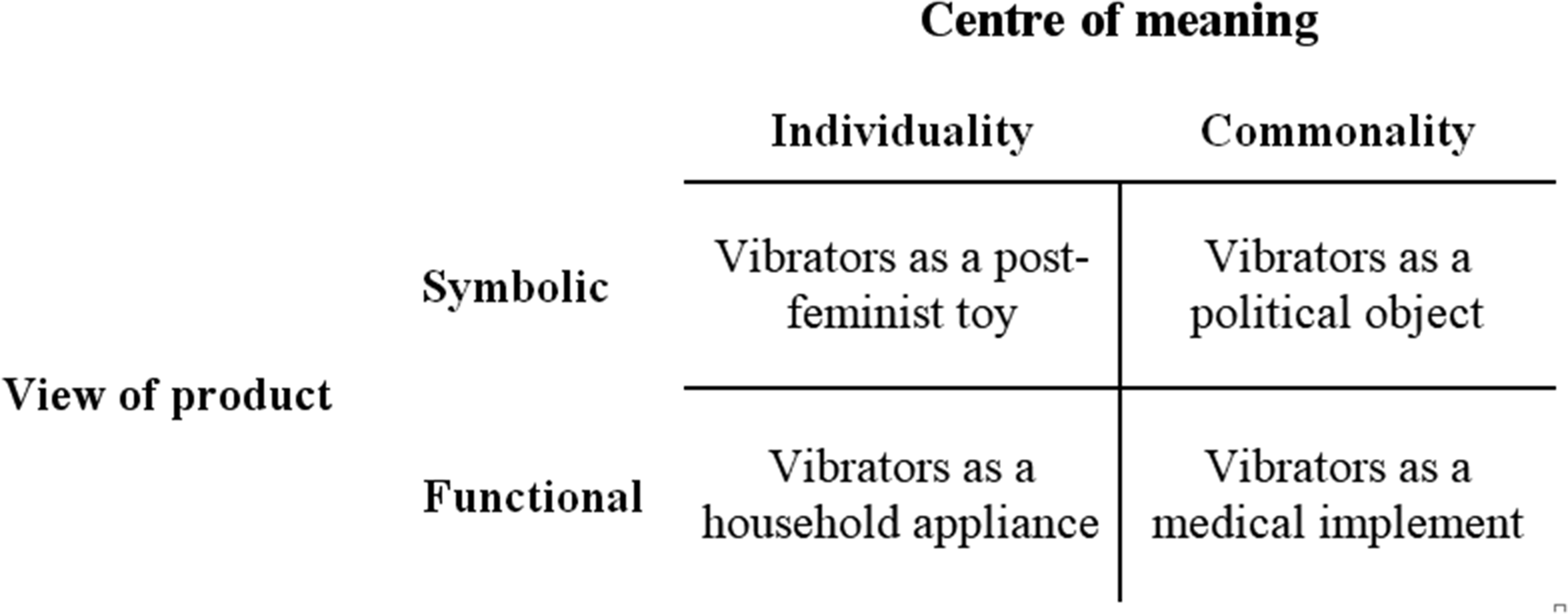
Meaning-based framework of consumer–vibrator relations.
Existing product typologies can be enriched by considering the functional/symbolic perspective (Hirschman, 1980). The purely functional role of vibrators can be intimately tied to characteristic attributes and the inherent utility they provide. Product symbolism is intertwined with identity creation at an individual, community and society level as well as with unambiguous announcements of role and position. Vibrators play a symbolic role by serving as expressions of self-concept as well as transmitters of socio-cultural beliefs and personifications. Thus, a vibrator’s symbolic purpose reveals the image, qualities and perceptions of a consumer who uses it and allows for group cohesion with other consumers.
With respect to the centre of meaning, commonality refers to the degree to which a vibrator possesses a shared versus individualized character. Communal aspects of meaning endow vibrators with a sense of community. The product’s meaning must then be shared by members of the culture or community at some basic level. Because of stronger ties with the self, vibrators with individualized meaning centres reinforce personal pleasure, intimate experiences and private purposes. In this way, the product’s utility expresses much more individuation within society.
Nevertheless, it has to be recognized that sex toys may have both subjective and objective components of meaning. Depending on whether the one or the other component is salient, the classification of vibrators as symbolic or functional, individual or communal, becomes meaningful. Thus, the four categories rather serve heuristic purposes. To be insightful, the framework should be seen as going beyond a simple categorization of roles and meaning centres to focus more on the historical, socio-cultural dynamics that give rise to the embrace of meaningful consumer–vibrator relations.
This framework seems to be useful in its integration and synthesis of various theories that help explain how a product like a vibrator can be imbued with different meanings. By incorporating more than one theory of product meaning, the theoretical analysis of this article went beyond existing schemes, thereby covering a broader range of possible consumer–product relations and socio-cultural phenomena that contribute to an individual and social creation of product meaning. The framework also offers benefits for further research in that it demonstrates similarities and differences between socio-cultural, historical phenomena. Accordingly, the framework’s theoretical support and summary function may provide valuable guidance for future research pertaining to the purchase of vibrators or sexual consumption in general.
For consumer research and marketing, a distinction between the symbolic, functional, individual and communal role served by vibrators captures the connection between consumers and the product that makes for effective advertising. Finally, such a framework could be beneficial for studying the ways in which consumers integrate sexual products into their sexual lives. An underlying assumption in this article’s theoretical approach is that individual consumers constantly interact with their social referents, historical developments and changes, cultural conventions and the market environment so that the product meaning they create will be established, adopted or altered in the context of their social, cultural and economic surroundings. In particular, this framework may move us closer to our general goal as consumer researchers, namely, to understand the versatile meaning of a product in relation to society and culture.
Conclusion
This article has presented a response to the call for broader analyses of the historical and institutional forces that can shape an object’s function and meaning, market operations and consumers in general (Arnould and Thompson, 2005). By exploring socio-cultural history through the commodity, this study showed how meaning ascriptions to vibrators are related to specific cultural tensions and socio-economic anxieties that dominate in particular moments throughout the product’s history. In particular, this article can be understood as a historical panorama that delineates how a socially and politically charged product has emerged from the socio-cultural ferment in the transformative shifts from modernity to postmodernity.
This article showed that vibrators are entities to which a multiplicity of actors have delegated various purposes and meanings in the course of time. As a result, meaning ascriptions to vibrators carry traces of numerous inscription processes that cannot be summarized comprehensively in any simple way. Given the complex and conflicting history of vibrators, it seems that these sex toys will remain a highly versatile entity. The various trials that the vibrator underwent in its meaning-creation process throughout history reveal only some of the essential projections to which it was subjected. Hence, this study points to a need to continue exploring product relations to history, culture and temporality to better capture the essence of an object’s meaning and consumer–item interaction.
The question as to how the meaning of vibrators is individually, socially and materially (re)produced and changed which guided this article presents an important question for the study of consumer behaviour in the realm of sexual consumption. A vibrator today seems to be, perhaps to an unprecedented degree, one element of an extended individual self-making, a material form of aesthetics and a socially constructed source of pleasure, to name only a few meaning ascriptions on which this article focused. This points to the important fact that consumers are actors in relationships with markets, media and other social institutions which together characterize the social embeddedness and significance of culture, power, social structures, social networks and individual cognitive processes in a consumer’s relation to products. These social mechanisms influence the choice set of consumers and provide a constantly evolving menu of material and discursive resources for changing the meaning of commodities. Vibrators may simply present a vehicle through which new opportunities are provided to create a sexual self and to subvert traditional scripts of ‘proper’ sexual behaviour.
What can be concluded from the theoretical analysis in this article is that the meaning of vibrators is not fixed but rather a socio-historically constructed and dynamic evolution. The theoretical analysis demonstrated how an interaction between individual agents and markets can change prevailing social values, norms and concepts, thereby leading to a reconfiguration of the meaning of a specific product. However, shifting the status of a product is a contingent process that incorporates a wide variety of many other influential factors. Beside the meaning–identity link, normative frames, the morality of choices, institutional forces and social referents together play an essential role in the perception and legitimation of a product. This social embeddedness of markets and consumption practices highlights the socially constructed nature of what people regard as ordinary or uncommon forms of consumption in a particular socio-temporal context. In this sense, the meaning of vibrators entails a significant number of discourses and negotiations that are influenced by most historical, economic, normative and socio-cultural factors.
Footnotes
Declaration of conflicting interests
The author(s) declared no potential conflicts of interest with respect to the research, authorship, and/or publication of this article.
Funding
The author(s) received no financial support for the research, authorship and/or publication of this article.
