



Abstract
This article explores cooperation between a commercial supermarket chain and an environmental non-governmental organization linking it to consumer perception of the “The Super Animals” collectable cards promotion initiative. The case study focuses on one particular joint project involving Animal Cards that was initiated by the supermarket Albert Heijn and the World Wide Fund for Nature in The Netherlands. Based on this case, environmental non-governmental organizations’ strategic choices in the context of contesting discourses of sustainability and consumption, as well as implications for environmental education, are addressed. This article combines three strands of the literature – on sustainable consumption, on strategic cooperation between commercial companies and environmental non-governmental organizations and on environmental education. It is argued that the Animal Cards initiative presents an ambiguous case by both attempting to enhance environmental awareness and promoting consumption, opening up questions about the value of such cooperative ventures to the objectives of environmental education. It is concluded that cross-sector partnerships have the potential to lead to improvements in corporate social responsibility and environmental awareness among consumers but simultaneously pose the danger of undermining the critical stance toward consumption.
Keywords
Introduction
Let us start this article with the vignette.
On a rainy October afternoon in 2012, a group of about a hundred parents have gathered in the area in front of the Montessori school in Amsterdam to pick up their children. At 1 minute past 3, a stream of the youngest children pours out into the square and starts to noisily disperse in the crowd of waiting parents. A few minutes later, the older children join their younger schoolmates in the square. A number of children gather in groups, observably more boisterous than the children who have joined their parents. They pull out stacks of cards and start trading. “A seal for these two!” “I already have a seal!” “I’ll trade you this giraffe instead” … Excitement is mounting, children push and shove.
A number of boys climb the monkey bars in the school playground, followed by other children who shout excitedly: “Strooien, strooien!” [“Throw them around!”] One of the boys pulls out his stack of cards, shows them to the group below, and announces that he is going to tear the cards. Children below shout “Don’t tear them” and implore him to throw them down instead. The boy takes his time, pulling out one card after another and showing each to the public, while children’s hands extend up in an effort to grab the cards. One girl almost succeeds in grabbing a card, but the boy pulls it back and tears it into two, telling the girl to pick up the pieces. Following the shouts of discontent from other spectators, the boy throws all the cards in the air and they start to land like confetti in the outstretched hands of the children who stand under the monkey bars.
“They are just like monkeys!” – remarks a mother with a white scarf, standing next to the researcher.
“I cannot wait till this promotion is over … ” – sighs another mother in red coat.
“Well, I think it’s great!” – interjects a third mother in a yellow coat excitedly. “These are beautiful cards!”
“What about this trading?” – ventures her husband.
“Trading is good for children’s social skills … and this way they learn about animals!” – replies his wife. Their daughter runs toward them, excitedly waiving the cards in the air.
“Isn’t it some kind of Greenpeace promotion?” – reflects the father.
“I think it’s just the way to make us buy more stuff in the store” – shrugs the mother in the red coat. “My kid wants to collect all those soft animals they sell too!” – reflects the white scarfed mother. “I don’t mind having them myself!” – the mother in a yellow coat offers.
“Greenpeace probably gets part of the proceeds” – reflects the father and looks at the researcher: “Do you have any idea, does this Greenpeace or whatever it was get part of the proceeds?” “Probably, in a way … ” – the researcher answers. “Well, everybody’s got to make a living!” – the father reflects gaily.
“They are probably made in China” – the mother in red coat sniffs and ventures into the playground to disengage her child from the group of trading children.
This article links the literature and empirical observations on sustainable consumption, strategic choices of environmental non-governmental organizations (ENGOs) and business stakeholders, and environmental education (EE). The critical literature addresses issues associated with “green” consumption and locates consumers and their practices in the cultural, social, and economic contexts (Isenhour, 2010, 2012, in press; Kopnina, 2011a, 2014; Wilk, 2002a, 2002b, 2004, 2009, 2010). We shall discuss how this critical literature interrogates the rhetoric and assumptions of ethical consumption and its relationship to environmental awareness.
Next, we shall examine the literature on strategic collaboration between ENGOs and businesses, particularly in the Dutch context (Bos et al., 2013; Glasbergen, 2011, 2013; Kolk and Van Tulder, 2010; Van Huijstee et al., 2011; Van Huijstee and Glasbergen, 2010a, b; Van Tulder et al., 2001). The purpose of this examination is to gain insight into the reasons why businesses and ENGOs cooperate strategically and how different stakeholders relate to this cooperation. This literature is embedded within the broader research on “green alliances” between businesses and their suppliers, competitors, and other stakeholders (Arts, 2002; Crane, 1998; Hartman and Stafford, 1997; Shah, 2011). Such alliances have become common in recent decades, raising concerns about the motives behind collaborative partnerships between agencies whose relationships were traditionally antagonistic (Arts, 2002).
While this literature explores green marketing strategies within stakeholder theory and the networks model of industrial markets (e.g. Crane, 1998), critical environmental interdependencies between commercial companies, NGOs, and consumers are rarely examined. This article will examine interdependencies between commercial companies, ENGOs, and consumers, and educational benefits of such alliances to the consumer, focusing on the congruity of bonds between various alliances in the context of sustainability.
The interest in the purpose of collaborations between businesses and ENGOs introduces the third strand of literature on EE. EE normally refers to a learning process that increases students’ awareness and knowledge about the environment and associated challenges, develops the necessary skills and expertise to address the challenges, and fosters attitudes, motivations, and commitments to make informed decisions (Tbilisi Declaration, 1978). While research in EE is very broad, dating back a few decades to the first issues of The Journal of Environmental Education in 1969, this article will particularly draw upon the EE literature relevant to consumption and environmental awareness.
We shall focus on the Super Animals collectable cards (hereafter referred to as Animal Cards) promotion as a catalyst for the discussion on sustainability and consumption. The Animal Cards grew out of the partnership between the Dutch branch of the World Wildlife Fund (WWF; in Dutch Wereld Natuur Fonds or WNF) and the Dutch supermarket Albert Heijn (AH).
This article addresses the case of the Animal Cards as an example of a collaborative effort between WWF and AH. As WWF claims that its cooperation with AH serves an educational function, this article focuses on the educational effects of the strategic collaboration between WWF and AH.
Case description
The WWF has offices in 90 countries and per March 2014 counted 910,000 donors. In The Netherlands, these included a growing number of youth members, through their membership of youth clubs such as WNF-Bamboekidz, WNF-Rangers, and WNF-Lifeguards. Founded in 1887, AH is the oldest company owned and operated by Ahold and currently owns more than 850 stores and employs around 74,000 people, making it one of the largest employers in The Netherlands (https://www.ahold.com/Media/Albert-Heijn.htm).
Since 2007, the partnership between these two organizations has developed “to help find solutions to a range of sustainability issues” (Ahold, 2011). In March 2011, AH and WNF launched the Animal Cards promotion for the first time. Supermarket customers could receive Animal Cards by spending 10 euros on groceries. The cards contained pictures and information about animals and were distributed in small paper–plastic packages of four cards. A plastic-coated collector’s album or a wooden box in which to store the full set of 204 Animal Cards could also be purchased at the store. Additionally, a selection of soft toy animals with WNF labels could be purchased (WNF, 2012c). AH announced that it would pay the first 2 months of WNF membership subscription for customers who were “inspired by the promotion” (Ahold, 2011).
The success of this joint initiative in 2011 led to the second Animal Cards promotion which was launched in October 2012 (Ahold, 2012). In 2012, there were 204 different cards in 17 different categories, ranging from “animals with funny names” to “animals with crazy hair styles” (Albert Heijn Koornneef, 2012). As in the previous year, customers were encouraged to collect all the cards and buy newly designed albums and boxes in which to keep them (Albert Heijn, 2012a). Instead of the paper–plastic packages used in 2011, smaller paper attachments were used. In total, 112 million packages containing four Animal Cards each and 800,000 collection albums were produced (WNF, 2012a, 2012b; AH refused to provide information).
Judging by postings by both AH and WWF, the partners considered the action successful (Albert Heijn, 2012a, 2012b; WNF, 2012a, 2012b; WWF, 2012). Both AH and WWF reported that their cooperation is going to stimulate sustainability of the international production of palm oil, timber, paper, and soya, and serves to stimulate the green economy. Both partners reported that their efforts were targeted to stimulate sustainable production and consumption, with WWF additionally emphasizing the role of environmental awareness that such cooperation raises. AH, on the other hand, assumed benefit from the commercial success of increased sales (although official numbers were not reported) or at least through the “greener” image acquired through association with ENGO. The commercial success of Animal Cards was not only evident from AH’s sales but also from the number of postings on Martplaats.nl (the largest on-line market platform in The Netherlands, similar to e-Bay) offering Animal Cards collections since 2011 (Marktplaats, 2014).
Methodology
This research is based on a case study involving participant observation conducted with upper elementary Montessori elementary school children aged between 7 and 10 years and their parents between September and December 2012. The school has a population of 79 children and is located in a predominantly ethnically Dutch well-to-do area in Amsterdam. The researcher approached the children and their parents after school at regular intervals. While the researcher attempted to engage in conversations with children independently of their parents or guardians, these conversations were often conducted in mixed groups of children and parents. Conversations with individual children were conducted with parental consent and sometimes outside the school premises in their homes. Conversations with parents were conducted with and without children present, within school premises and at home. All names were changed.
The participant observation method was chosen because it enabled the researcher to gain a close familiarity with the parents and children over an extended period of time (Spradley, 1980). Children were chosen as “stakeholders” because, first, the Animal Cards are targeted toward the children and, second, because children can be seen as future “potential” customers or donors. The parents and guardians were chosen because they were the “financers” of the Animal Cards and presumably had an influence on their children’s opinions and behavior.
The researcher spent a total of about 15 hours socializing with children and parents outside the school area and about the same amount of time in the homes of five families. Since this was a predominantly ethnographic descriptive study, discourse analysis was applied to organize the data in thematic clusters. Discourse analysis involves recording interactions; transcribing the recorded material; formulating claims about the conversational moves, structures and strategies demonstrated in the interaction and then building an argument using transcript excerpts that have been analyzed (Tracy and Mirivel, 2009: 153). The segments of informal conversations were entered in notes. These were then analyzed to create basic qualitative sections by coding key words or sentences. The researcher has filtered only those segments of observed behaviors and conversations that were related to the children’s and parent’s attitudes toward ethical consumption or to cooperation between commercial and non-profit sector organizations. The three interlinked strands of literature are presented below and then linked to the case study.
Consumption and sustainability
Richard Wilk (2009) has inquired, “What makes human wants and needs grow? How do things that were once distant luxuries – say, hot water – become basic necessities that people expect on demand for civilized life?” One of the possible answers is that various retailers have discovered that triggering consumption is relatively easy, despite religious, ideological, moral, and political barriers (Kaplan, 2000; Kopnina, 2013b; Rees, 2008). Consumption is often used as a social status marker since consumer products are symbolic objects through which we communicate our social status. Marketing psychologists, economists, and retailers have long discovered that goods are facilitators of symbolic communication and exploited the opportunities offered by the knowledge of human psychology in devising marketing strategies to entice the consumers (Blowfield, 2013).
These marketing strategies are increasingly applied on the global scale. While “raising the standard of living” may be aimed at ending severe deprivation, translated into policy the expression is a euphemism for the global dissemination of consumer culture (Crist, 2012: 141–142). The moral call for equal distribution of wealth leads to a greater spread of consumerist culture. Unless the consumption pattern in rich countries is made more sustainable, the crisis of resources is likely to deepen (Rees, 2008).
“Sustainable,” “responsible,” “ethical,” or “green” consumption may seem like the silver bullet. The “moral nature” of objects can spring from the objects’ social, economic, environmental, and political contexts. Ethical consumers can be defined as those whose decisions as to what to consume are shaped by their assessment of the moral nature of that context (Carrier, 2012: 1).
Yet, even the most environmentally minded consumers find it difficult to consume less or consume sustainably. In Confessions of an Eco-Sinner, Fred Pearce (2008) set out to track down the people behind the production and distribution of everything in his daily life. He discovered that awareness of unsustainability is not enough to lead sustainable lifestyle. In the same spirit, Colin Beavan performed the public experiment of “extreme environmental living” in the middle of Manhattan, looking for alternatives to the typical American’s consumption-based way of life. The popular book No Impact Man has brought concerns about the social dimensions of consumption to the fore (Beavan, 2009). One of the most acute observations was how Beavan’s family and friends reacted to what they saw as his extremely odd way of living.
In line with the “rebound effect” theory that states that green marketing drives even more consumption (Greening et al., 2000), scholars have noted contradictions of “green consumption” (e.g. Connolly and Prothero, 2008; Kopnina, 2014; Wilk, 2002a, 2002b, 2010). The contemporary emphasis on “green consumerism” might also be driving more consumption as it aims to absolve consumers of their guilt but fails in stopping over-consumption (Isenhour, 2010).
Wilk (2010) notes that there may even be a “moral rebound effect” where reiterating the message creates guilt, which “drives the continuing bulimic cycle of binge and purge so characteristic of contemporary consumer culture” (p. 42). The concept of “sustainable consumption” has been a “bit of jargon that allows science to say one thing and the public to hear another” (Wilk, 2010: 47). Green consumption or “capitalism with the human face” can be a clever marketing trick to avoid fundamental change (Zizek, 2010). In elaborating on the paradoxes of sustainable consumption, Bryant and Goodman (2004) describe contrasting commodity cultures, namely, the Edenic myth-making culture used to assimilate concerns over tropical deforestation in the South and the consumption-intensive culture lifestyles in the North. Both are weakened as a form of social and political “caring at a distance” owing to the uncritical acceptance of consumption as the primary basis of action.
Sustainable consumption may have only marginal benefits: Many people will try a product that promises green benefits, but they will only make it a routine part of their lives if it saves them money or time, increases their comfort, or confers some kind of valued social status or recognition. On a more fundamental level, people’s everyday moral concerns are much more about other people in their immediate social sphere than they are about the well-being of the planet or people in the distant future. (Wilk, 2004: 14)
Isenhour (2010) notes that contrary to the contemporary dominance of theories which link sustainable action to awareness, the most significant barrier to sustainable lifestyles concerns conformity, equality, and fairness. Purchasing decisions are made in part because of people’s inherited or learned habits (e.g. children following their parents’ consumption patterns), acquired habits (e.g. what consumers have bought before), beliefs and assumptions (e.g. that a product is good for their health), emotions (e.g. “retail therapy”), social influences (e.g. what their peers buy), and conformity to class expectations (e.g. products aimed to enhance one’s relational social standing) (Kopnina and Blewitt, 2014). Wilk (2004) has argued that responsible consumption is not necessarily about “reducing consumption” per se, but about making sure that the “goods and services people buy, use and throw away” consume fewer resources (p. 27). For a very small segment of Western consumers, ethical consumption means not consuming anything socially or environmentally damaging at all, as in the case of vegans. It is open to question how “responsible” the majority of consumers are when they choose between what is cheap and what is “right.”
Significantly, Miller (2001) noted that utopian fantasies about how much happier everyone would be if they gave up their cars and became vegetarians are not a substitute for sound public policy that will move the majority of society – not just a committed fringe – toward a less environmentally destructive society. It is the businesses and the governments that are the largest consumers, and individual consumption decisions are insignificant in proportion. Thus, “many consumption decisions are not made by consumers at all, but by governments, regulatory agencies, and businesses” (Wilk, 2009: 4). Focus on individual responsibility reflects the dominance of neoliberalism whereby governments delegate responsibility to consumers and thus avoid politically unpopular decisions that would limit consumption (Hobson, 2002). While the focus on market-based solutions makes political sense, the current emphasis on lifestyle choices can be seen as a new manifestation of the existing system and ultimately a strategy for the powerful to resist the regulation of resource-intensive, polluting, or socially damaging products (Isenhour, 2010: 457). Considering the growth of human population, the scope for de-coupling growth in production and consumption from environmental degradation is limited. If left to open market mechanisms, sustainable consumption is likely to fail.
One of the most hopeful political mechanisms is consumer choice editing that denies consumers the chance to buy non-sustainable goods (Blowfield, 2013: 282). Whether companies’ decisions to restrict consumer choice are taken as a result of economic calculation or consumer pressure, consumer choice editing avoids the thorny issue of relying on individual good will. However, this option is rarely practiced in neoliberal democratic societies (Kopnina and Blewitt, 2014).
Another opportunity lies in the “sharing economy” and consumption of experiences and services rather than ownership (Tennant and et al., 2015). Consumers can now access an expanding number of sites providing opportunities to share cars, rooms, items, and tasks. Social sharing sites for goods and services and leasing companies could alter the nature of consumption to the less material forms. Yet, keeping a product in use for longer implies that direct sales of new products decrease, impacting profits that could otherwise be made (Tennant and et al., 2015). Also, not everybody wants to share, and many items can simply not be shared.
Another opportunity for sustainable consumption lies in the kind of production system used. The new conception of the system of production design, in which waste becomes impossible, is exemplified by the Circular Economy, Natural Step, and the Cradle to Cradle frameworks (Kopnina, 2011a; Kopnina and Blewitt, 2014; Tennant and et al., 2015).
Despite all these hopeful frameworks, there is still concern about the pricing of sustainably produced goods and the question of whether sustainable choices can be made available and affordable on the global scale. The challenge is to apply these frameworks, despite the current social constraints and political status quo. Since the individual consumer’s sphere of influence can be too small to initiate significant change and many consumers may be simply unwilling to consider sustainable options, efforts to encourage sustainable living depend on structural changes that require political and corporate leadership (Blowfield, 2013).
In essence, the fundamental question remains whether sustainable consumption can be realized within the present market-based society and whether the WNF and AH cooperation does anything to address these challenges. The same debate can be observed in the ENGO community, with some ENGOs opting for strategic collaboration with business in order to reach their sustainability goals while operating from within the system.
Strategic cooperation between companies and ENGOs
Traditionally, adversarial relations between business and ENGOs have given way to increasingly collaborative strategies, including corporate philanthropy, corporate foundations, licensing agreements, sponsorships, transaction-based promotions, joint issue promotions, and joint ventures (Wymer and Samu, 2003). The motives for businesses to collaborate have been largely reputational (Bos et al., 2013; Glasbergen, 2011, 2013; Van Huijstee et al., 2011; Van Tulder et al., 2001). Motives for ENGOs to collaborate also included goal achievement and funding (Kolk and Van Tulder, 2010; Kopnina and Blewitt, 2014; Van Huijstee et al., 2011; Van Huijstee and Glasbergen, 2010a, b). Among others, advantages of collaboration included more sustainable products and funding for environmental goals.
Such mutually beneficial collaboration can be exemplified by the joint effort of the Dutch Rabobank and WNF to produce a climate-neutral credit card on the basis of Clean Development Mechanism (CDM) projects in 2001. This collaboration was the result of the combination of the rising importance of climate change as an issue, the intention of Rabobank’s climate expert to develop a climate-neutral consumer product, and the fact that consumers did not perceive the Rabobank as a credible source of climate-related communication. All these factors strengthened the rationale for promoting a climate-friendly consumer product alongside a credible organization such as WNF. This joint effort to stimulate green investment and issue bank cards with WNF logos was targeted to provide the Rabobank with a symbolic (i.e. reputational) gain. WNF, on the other hand, gained recognition by a wider audience, as well as some modest gains in climate change mitigation (Van Huijstee and Glasbergen, 2010a, b). ENGOs were seen to apply pressure to corporations by using shareholder activism (Gritten and Mola-Yudego, 2010), simultaneously increasing shareholders’ loyalty to a corporation that was seen to cooperate with ENGOs, leading to mutual benefits.
Some observers, however, have blamed ENGOs for “selling out” (Figure 1) and serving the interests of the elites (West, 2006). Risks of such cooperation included marginalization of more critical and ambitious alternatives (Kopnina and Blewitt, 2014; Van Huijstee et al., 2011). The use of the terms “natural capital,” “natural resources,” and “ecosystem services,” prominent in the rhetoric of corporations as well as large ENGOs, is criticized for reducing complex natural and social phenomena into priced and thereby tradable commodities whose priced value is set from afar (Sullivan, 2009). ENGOs were blamed for siding with dominant political and corporate elites and instituting corporate conservation as the only normative institution controlling both the environment and the local people (Igoe et al., 2009). These criticisms have emphasized that far from curbing corporate efforts to increase economic growth and consumption and contrary to the desire to increase environmental awareness, such cooperative ventures risk alienating environmentally committed donors.
Selling out.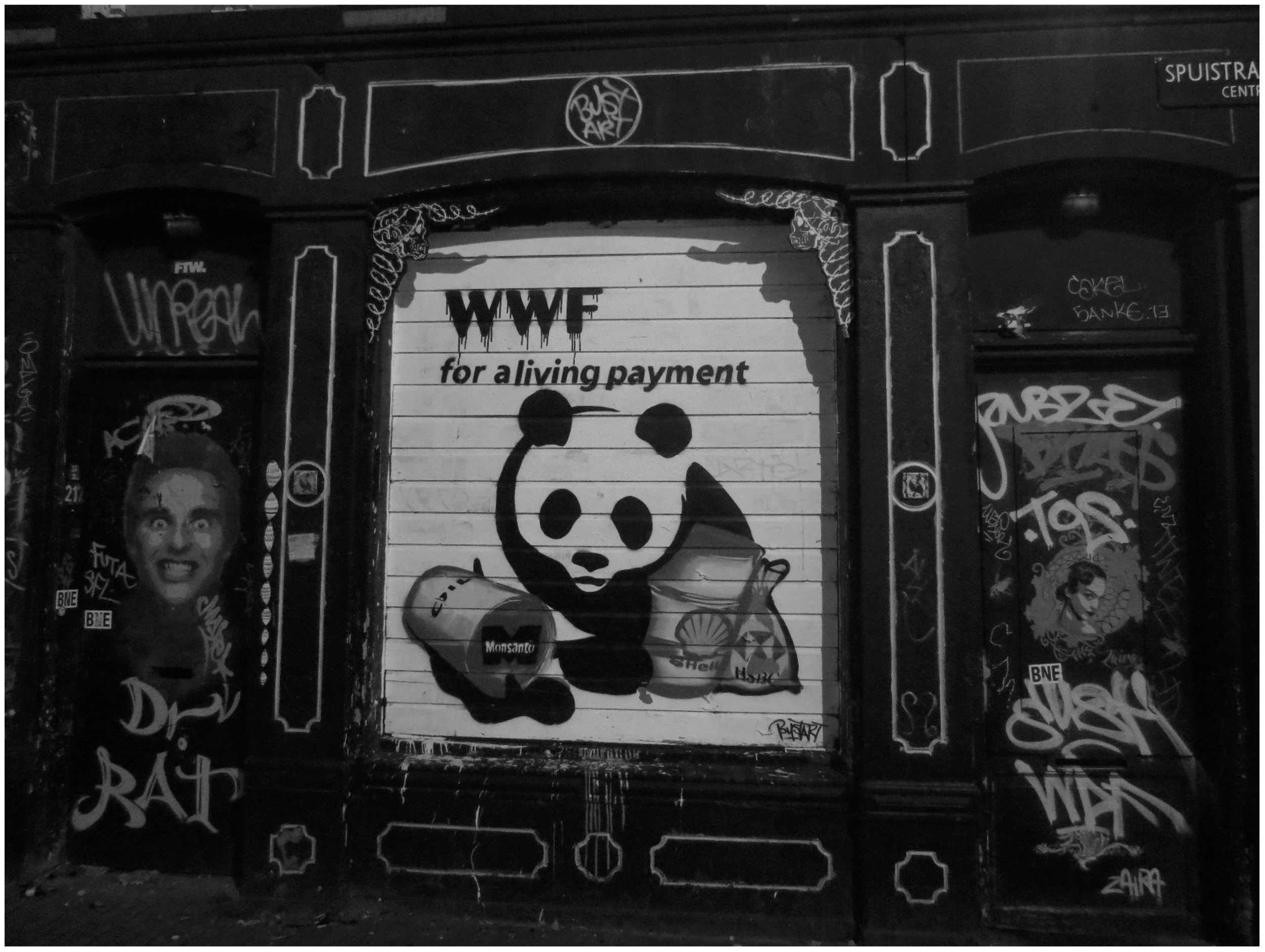
On the other hand, corporate leaders risk being seen as too soft and forgetting the “bottom line” (profit) in the eyes of their shareholders (Van Huijstee et al., 2011; Van Huijstee and Glasbergen, 2010a, b).
Returning to the case of WWF and collaboration, WWF Global states that it establishes partnerships with companies “to help change the way business is done” (http://wwf.panda.org/what_we_do/how_we_work/businesses/). Business Education, through WWF’s One Planet Leaders program, is listed as one of such partnership (http://www.oneplanetleaders.org/). We shall therefore address the issue of how EE fits within the objectives of WWF before returning to the case of Animal Cards.
EE
The focus of EE has been moving in many different directions, starting with conservation education (e.g. Norris and Jacobson, 1998), education for deep ecology (e.g. LaChapelle, 1991), and progressively moving toward the more socially focused education for sustainable development (ESD) (e.g. Bonnett, 2003). While the earlier forms of EE focused on negative human impact on the environment, arguing for the need to recognize limits to growth and the need to curb the growth of human population and consumption, the late 1980s have been characterized by the aim of balancing economic, social, and ecological concerns (Stevenson, 2006). This turn away from concerns about environmental problems toward social inequality signifies a change congruent with the dominant sustainable development rhetoric (Bonnett, 2013; Kopnina, 2012). While education for conservation, including outdoor and experiential education, has remained part of EE repertoire (e.g. Sandell and Öhman, 2010), ESD has become an essential component of EE (Aarnio-Linnanvuori, 2013).
Many NGOs saw their connection to EE and ESD as part of their strategy to achieve environmental awareness (Blum, 2009). Part of WWF’s objective is to educate people about the need to live sustainably and address unsustainable consumption. Where does this leave the Animal Cards?
Case study results
The reactions of both children and parents can be clustered into a number of themes, based on cognitive (knowledge-related) and effective (emotional) reactions, ranging from general appreciation or resentment of the promotion to nuanced views on how they relate Animal Cards to issues associated with consumption, sustainability, and concrete opinions about AH and WNF.
Children
Observation of the children’s behavior is exemplified by the vignette provided at the beginning of this article. Segment 1 illustrates the response of a 7-year-old girl Zoe explaining her reasons for trading (Figure 2):
Segment 1. Zoe: First, mum didn’t want to go to Albert Heijn, but I asked whether we could go for cards because my friends already had cards …
Animal Cards. Researcher: But why did you want Animal Cards? Zoe: They are beautiful! And you learn a lot about animals! Researcher: What kind of things do you learn about animals? Zoe: Oh lots of … that some animals are very quick … some can fly very far, others spend winters at home … Birds and such are also animals. Oh yeah, many animals are in danger … [hesitates, long pause] Researcher: Endangered? Zoe: Yeah, endangered! Mum read about it in the album! Researcher: Does the album explain what animals are endangered? Zoe: Yes! But I forgot … Researcher: Does the album explain why they are endangered? Zoe: Oh because they are eaten and so … other animals eat them … [hesitates, looks hopefully at the researcher for help, when the researcher does not respond, adds brightly] But many animals can be saved, and we can help!
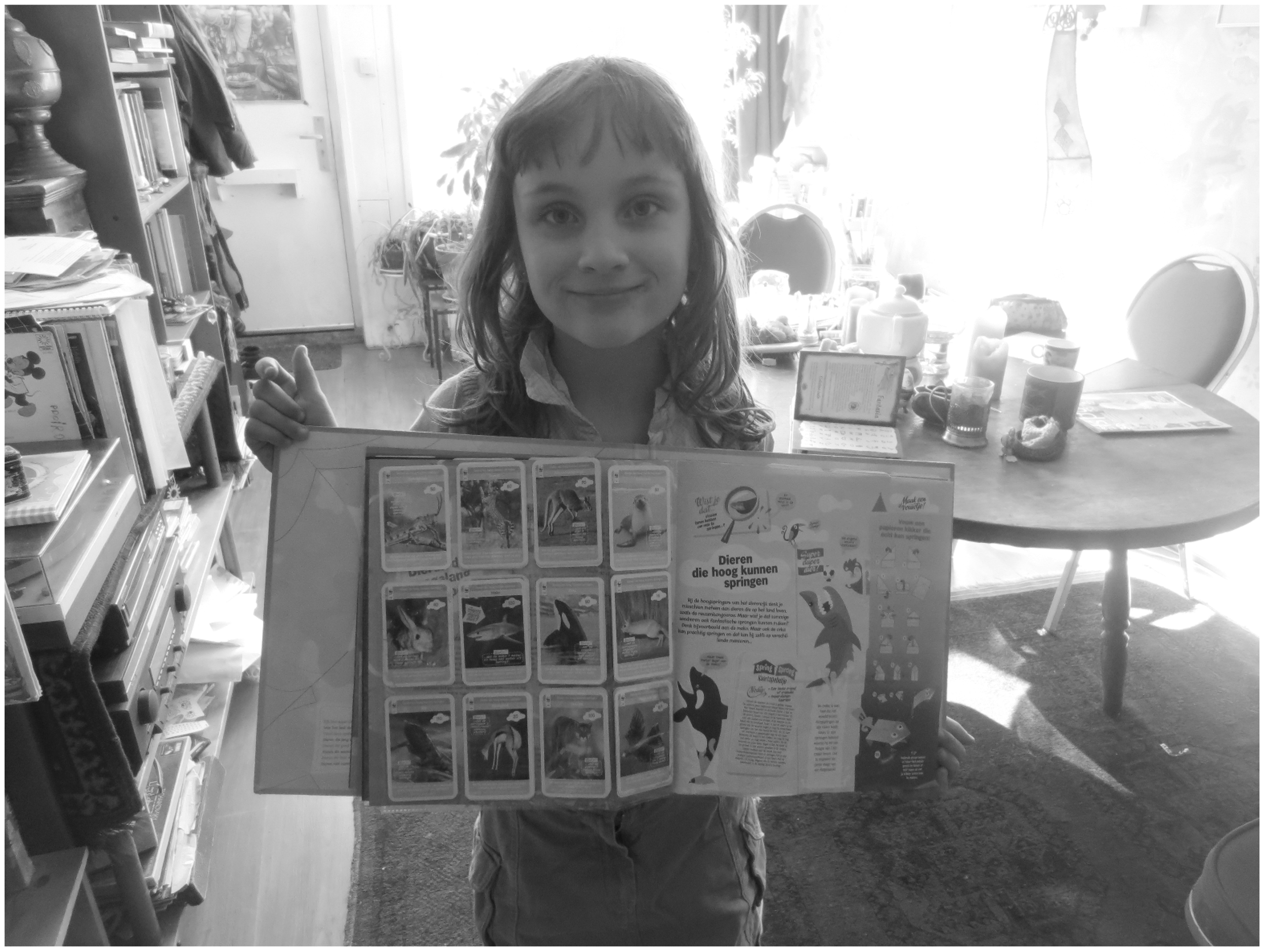
It must be noted that not all children participated in the card sharing or trading activities nor did all the children show interest in the Animal Cards promotion. The researcher has followed those children who were engaged with the cards, although a few significant observations were made by children who were not engaged in such activities. Those children who were not engaged in exchanges were observed to join their parents and guardians and leave the school premises or to occupy areas of the playground where the card trading was not taking place. While the researcher mostly engaged in conversations with card trading children, two extracts from conversation with the non-trading children are significant as they exemplify the reasons why some children liked to trade or not to engage in trading:
Segment 2. Researcher (talking to two non-trading girls Carla and Mila, both aged 8): So, you girls don’t trade Animal Cards? Carla: Naaa … Mila: I got cards from last year! Mum says we have no place to put them … Researcher (to Carla): Do you also have cards from last year? Carla: Not really … Mila: She doesn’t like them! Researcher (to Carla): Why not? Carla: Ahhhh … I don’t know … Mila: Her parents don’t buy them … don’t get them for her … Researcher (to Carla): Really? (to Mila): Can Carla answer herself? (Mila nods reluctantly) Carla: I don’t know … Mum doesn’t like them, I guess. Researcher: What about yourself? Carla: Ahhh … They are nice. But I don’t really need them. Mila: You can share mine! Carla: You don’t have any … new ones. Mila: Well, last year they were more fun. I got a whole book of them! Researcher (to both girls): So, what’s the difference between this year’s cards and last year’s? Mila: There’s a lot of … writing … on new ones … I just like the pictures! I like the funny animals, and this year they write stuff about … I don’t know … I guess they are trying to teach us about animals … Researcher: Who is “they”? Mila: Albert Heijn! If you buy stuff in the store they want you to learn about animals … We are learning about animals at school too!
Segment 3. Researcher (talking to a non-trading boy Hans aged 9): How come you are not trading? Hans: Animal Cards are for babies … Researcher: Why is that? Hans: They like to collect stuff. I don’t need these cards. I collect mini-bikes. My father has a big collection too … Researcher: So, you think only young children are interested in Animal Cards? Hans: Naaa … It’s just that I know all this stuff … About animals … Albert Heijn makes those cards every year. We have books about animals at home … Researcher: Do you like to learn about animals? Hans: Sure! But I’d rather go to the zoo … Researcher: Do you think it’s a good idea that you get Animal Cards when you do shopping? Hans (stares, thinks for a while): I don’t know … It’s kinda weird that you get them [cards] at the supermarket … I guess they want to have more … eh … people in the store. They have more … things that they give away when you shop.
It seems from these two segments that the children do not perceive the link between the cards and WNF, thinking that it is AH that produces them. The children are aware of the fact that this is not the first year that the cards have been produced and that there are more promotional activities that AH engages in. Although they do perceive an educational value in “learning about animals,” they acknowledge that they get their information elsewhere (at school or from books about animals at home).
Parents
As illustrated by the vignette preceding the “Introduction” section, parents’ involvement with Animal Cards was through their children, but as one father acknowledged it in the segment below, the children’s association with Animal Cards was also through the parents:
Segment 4. Father of a 7-year-old son (F7S) (talking to the researcher): The funny thing is, we [me and my wife] started this madness … Max, my son, would not let us do the shopping without hanging on our arm, but we were the ones who started this collection … Maybe if he was the one with the money, he would have gone to another store … Researcher: Why do you refer to the collection [of Animal Cards] as madness? F7S: Ah (laughs) t’s just this whole exchange out there (points to the trading children, then pauses thoughtfully) … But I think it’s actually a good idea, it teaches them [the children] to cooperate, to share … Also it taught Max some responsibility: we told him in the store [Albert Hein] that we are not going to spend 10 euros on shopping any time he wanted more Animal Cards, and that he had to figure out what we really needed to buy – and no ice-creams! – what we really needed in the house … and if it added up to 10 euros or above – sure, he could have the cards … Researcher: So Max learned to be a more responsible shopper? F7S: Yeah, and note what costs what, what deals there are, as well as think about what is already in the fridge and what we still need. Researcher: And what about the cards? What do you think, is this a good promotion? F7S (sounds a bit hesitant): Yeah, well … I don’t know what they are really promoting … Researcher: Albert Hein or WNF? F7S: Was it WNF? I didn’t know that … (looks through the cards his son has stuffed in his pocket) … Aha, the panda! I guess they want to promote their cause … Researcher: Do you think it’s working … with kids? F7S: Promoting cause with kids? I don’t know … I think Max is too young for it … But maybe this is meant as educational …
The intention of the promotion and cooperation between AH and WNF was discussed by two mothers in Segment 5:
Segment 5. Mother 1: I think Albert Hein’s making some extra money on this! Everybody’s shopping for over 10 euros, just to get these cards … I also got them, because everybody has them, but then I thought: what am I doing? Mother 2: I don’t think anybody really buys extra … You know, a year ago there were these footballers cards, then there were the Sesame street toys, or Disney toys, there’s always something … It’s not very transparent how this works, I think … I don’t think anybody always buys more to collect everything … Mother 1: My son loved the football cards! He is still mad about the players … I wonder whether FIFA [football organization] or whoever was also participating? … Mother 2: I guess so! I think they like stunts, partnering with some big organizations … Albert Heijn is probably the biggest with these co-operations! Mother 1: They are like H&M [chain retail store] working with famous designers! Mother 2: I think these Animal Cards are different though, they have this big thing with WNF … Mother 1: Oh? Mother 2: Yeah, you know, they work with stores to have more sustainable products … (Turns to the researcher who until now was passively listening in) You were just asking somebody about it, right? Researcher: Yeah, I am curious about what this Animal Cards promotion is about … So, how do they participate in making these sustainable products, Albert Heijn and WNF? Mother 2: I think when an NGO puts its logo on the product, like with Fair Trade, both the farmers – or the environment – profit because the NGO controls how the product is made … Researcher: And with these Animal Cards? Mother 2 (shrugs, turns to Mother 1): I don’t know … Maybe they use part of the proceeds to reinvest in some jungle-saving actions … Do you have an idea? (Mother 1 appears blank) I guess it’s on their website …
Reflection: Linking literature to the case
The vignette and segments above illustrate some of the impressions of how children and parents perceive Animal Cards as well as some larger issues connected to the promotions, cooperation, environment, and consumption. Linking three strands of the literature, we may reflect on the ideological tensions and management’s co-option of consumer concern, as discussed by Josée Johnston (2008) in the case of the Whole Foods Market. Organic produce is commonly distributed by trans-continental and global commodity chains to disparate market niches, involving unsustainable transportation, which is in direct contrast to the original aspirations of the organics movement (Johnston et al., 2009). Consumers seek social transformation within the constraints of neoliberal regulatory regimes, and corporate-organic marketing constitutes a hybridized identity that interacts with political opportunities (Johnston et al., 2009). This hybrid identity involves both consent to consume and, in the very act of consumption, buying “redemption” from the “sin of consumption” (Zizek, 2010). Remarkably, the educational value of Animal Cards seems to be disconnected from these acts of consumption. Consumption and sustainability are not necessarily consciously linked to each other by either children or their parents. While the parents perceived the continuity between their act of shopping and children’s satisfaction, the children perceived possession of certain cards as a desired good and means of enhancing social contacts (through exchange).
Shopping was directly related to the promotion, causing some resentment as it was linked to financial pressures (having to spend 10 euros on shopping to get the cards) or social pressures (children sometimes insisted on parents doing shopping to get cards, or parents wanted to get cards themselves because others got them, etc.). Sustainability was only mentioned in connection to the sponsor of the Animal Cards, WNF, which was recognized by some parents as sustainability-related.
Strategic cooperation between companies and ENGOs did not occupy the children at their age. This cooperation did elicit some parental responses, particularly rationalizing this cooperation in terms of mutual benefit. The parents were not aware of the nature of this benefit and, as one reflected, felt that the results of this cooperation were not made transparent. However, the cooperation was not further disputed.
The literature about collaborations between NGOs and commercial organizations, including “Green Alliances” (Arts, 2002; Crane, 1998; Hartman and Stafford, 1997; Shah, 2011) as well as that on shareholder activism (Gritten and Mola-Yudego, 2010), indicates that such alliances can help to simultaneously increase shareholders’ loyalty to commercial companies and to increase mainstream acceptance of the work of ENGOs, leading to mutual benefits. While it is clear from this case that the partnership exemplifies a strategy for integrating corporate environmental responsibilities with market goals, environmental values transferred to the consumers in the process remain ambiguous. If we assume that such alliances are an outgrowth of the “Market-based Environmentalism” which advocates making ecology attractive to businesses through market incentives (Hartman and Stafford, 1997), the environmental awareness of the consumers might not reach beyond the commercial interests such as shopping discounts. The motives for AH/WNF and consumer alliances seem to be manipulated by the market-based environmentalism.
The educational effects of Animal Cards, such as knowledge of animals and trading skills, were appreciated by children and parents. However, the educational value of linking animals to the availability of sustainable products in AH or the purported intention of WWF to educate consumers about animals through the very act of consumption remains open to doubt. Bryant and Goodman (2004) have discussed how values like conservation are marketed, arguing that green consumption is a form of narrative that stimulates even more consumption. Educators who increasingly came to treat neoliberal education with suspicion (Jickling, 2005; Stevenson, 2006) could see how these manipulative forms of sustainability intertwine with the work of ENGOs and the narratives of corporate sustainability. Moreover, the literature about consumption as an essential part of education for sustainability is limited (e.g. Kopnina, 2011a, 2011c, 2013a). This case demonstrates the need to highlight consumption as one of the key areas of education for sustainability.
Limitations of the case
Previous studies of the environmental attitudes of Dutch upper elementary school children and their parents to consumption (Kopnina, 2011a, 2011c, 2013a) and transportation (Kopnina, 2011b; Kopnina and Williams, 2012) have demonstrated that the environmental attitudes are not always consistent across generational or socio-economic boundaries. For example, it appeared that children from the well-to-do families with parents who own at least one car exhibited more environmental awareness than children from the lower social status families whose parents did not have cars. While this supports the post-material values hypothesis that postulates that the underprivileged groups cannot “afford” environmental care, the evidence also showed that while the wealthier families were more aware, their consumption patterns were far from sustainable.
This study focused on the rather homogeneous sample of predominantly ethnic Dutch middle-class income families, providing generational comparison only. Follow-up research could focus on a more stratified sample and involve children and parents from different socio-economic backgrounds.
Conclusion
The relationship between NGOs and commercial companies is a developing one, and we have much to learn about it, particularly from consumer culture and sustainability perspectives. This case of Animal Cards and the literature involving sustainability, consumption and strategic cooperation reveals the tension between the effort to foster environmental protection on the one hand and to address consumption on the other hand. Cross-sector partnerships have the potential to lead to improvements in corporate social responsibility and environmental awareness among consumers, for example, by making the children more aware of biodiversity. However, negative trade-offs of the animal card promotion become apparent when consumption of all kinds of products in the supermarket is rewarded by the same cards. As observed by some of the parents from the case study of Animal Cards, this promotion has possibly stimulated increased consumption. Judging from this case, the effort has not led to questioning the connection between one of the largest threats to environmental sustainability – Western-style consumption – that may be indirectly threatening the habitats of the animals portrayed on the Animal Cards. While it might not have been the WWF’s intention to link consumption to sustainability, promoting Animal Cards through the very act of consumption and placing Animal Cards within the larger educational strategy do seem ironic. This case study also raises questions about effectiveness of such partnerships in terms of sustainable development and thus strategic considerations for ENGOs with their collaborative strategy.
Footnotes
Declaration of Conflicting Interests
The author(s) declared no potential conflicts of interest with respect to the research, authorship, and/or publication of this article.
Funding
The author(s) received no financial support for the research, authorship, and/or publication of this article.