



Abstract
Minimalism is an increasingly popular lifestyle movement in western economies (predominantly in the USA, Japan and Europe) that involves voluntarily reducing consumption and limiting one’s possessions to a bare minimum. This is with the intention of making space for the ‘important’ (potentially immaterial) things that are seen to add meaning and value to one’s life. Drawing on interviews with minimalists in the UK, this article reveals that minimalists practice sustainable (non)consumption via limiting their consumption. This is achieved by actively buying less, using up and maintaining what is owned, and, when objects are acquired, only practising highly intentional, considered and (sometimes) ethical consumption. For some, such practices are predominantly based on strong ethical and environmental motivations or are seen as a positive ‘by-product’ of their minimalist lifestyles. Whilst for others, their motivations are primarily aligned to personal well-being. The article subsequently argues that the limited and considered practices of minimalist consumption can be seen as sustainable practices in outcome, if not always in intent.
Keywords
Introduction
Minimalism is an increasingly popular lifestyle movement that involves voluntarily reducing consumption and lessening, limiting and maintaining the number of possessions owned to a bare minimum. Physical objects are lessened, with the intention of making space, whether that be physical, temporal and/or mental space, for the ‘important’ (potentially immaterial) things that are seen to add meaning and value to one’s life.
The etymological origins of the word minimalism stem from the realms of mid-century modernist art and architecture driven by functionalism and efficiency. The modernist architect Ludwig Mies van der Rohe (1886–1969), popularised the saying ‘less is more’ to describe his design preferences or simple structures and open spaces (Schulze and Windhorst, 2012). The phrase ‘less is more’ now constitutes a central premise of lifestyle minimalism.
Lifestyle minimalism has gained increased popularity in western economies, such as the USA, Japan and Europe, over the last decade with an emergence of minimalist ‘figureheads’ (whose popularity may even class them as ‘minimalist celebrities’) creating minimalist related TedTalks, YouTube channels, podcasts, books and blogs (Meissner, 2019; Rodriguez, 2018). Some of the most prevalent include: Joshua Becker of ‘becomingminimalist.com’ and author of ‘The More of Less’ (Becker, 2016), Leo Babauta of ‘Zenhabits.net’ and author of ‘The Simple Guide to a Minimalist life’ (Babauta, 2011) and Joshua Fields Millburn and Ryan Nicodemus of ‘The Minimalists.com’ and authors of ‘Minimalism: Live a Meaningful Life’ (Fields Millburn and Nicodemus, 2011). Millburn and Nicodemus have released two minimalist documentary films on Netflix in 2016 and 2021 and claim to ‘help over 20 million people live meaningful lives with less through their website, books, podcast and documentary’ (Fields Millburn and Nicodemus, 2020). In addition, the Japanese decluttering book by Marie Kondo, titled ‘The Life-Changing Magic of Tidying’ (Kondo, 2014), has sold over 10 million copies worldwide (mariekondobooks.com, 2020), and was developed into a 2019 Netflix series titled ‘Tidying up with Marie Kondo’. The mass popularity of Marie Kondo speaks to minimalist sentiments of a rejection of excessive materialist goods and is further indicative of a current cultural zeitgeist for ‘living with less’ (Martin-Woodhead, 2017; Rodriguez, 2018).
The origins of lifestyle minimalism are considered to stem from the voluntary simplicity movement, that emerged in the USA in the 1970s and has been defined as consisting of ‘people who are resisting high consumption lifestyles and who are seeking, in various ways, a lower consumption but higher quality of life alternative’ (Alexander and Ussher, 2012: 66). Minimalism has been conceptualised as a ‘second wave’ of voluntary simplicity (Dopierała, 2017: 70), that emerged as a reaction to the tightened pecuniary climate after the 2008 global financial crash and also due to escalating concerns regarding the rise in excessive western consumption and post-consumer waste in a time of ‘peak stuff’ (Cohen, 2013; Goodall, 2011; Humphery, 2010; Martin-Woodhead, 2017).
A gradually emerging body of literature has analysed minimalism through the lens of minimalist blogs and popular books (Błoński and Witek, 2019; Dopierała, 2017; Meissner, 2019; Rodriguez, 2018; Zalewska and Cobel-Tokarska, 2016) and has brought to light an important theoretical tension of minimalism being both posited as a form of individualism, based on personal motivations and self-development (Zalewska and Cobel-Tokarska, 2016), but also as being potentially situated within a wider politics of degrowth and environmental concern (Meissner, 2019; Rodriguez, 2018). This study seeks to further explore this theoretical tension by broadening the empirical scope of research on minimalism, via an analysis of in-depth interviews with self-defined minimalists in the UK. The study explores minimalists’ everyday consumption practices and motivations to question if minimalism is purely individualist or an expression of wider environmental and sustainability concerns. The research focuses on UK based minimalists due to the increased popularity of the movement in the UK: as demonstrated by increasing numbers of ‘minimalist.org’ Facebook groups and UK based minimalist blogs. The research also seeks to widen the geographical scope of current literature that is predominately based on blogs and online content in Poland (Błoński and Witek, 2019; Dopierała, 2017; Zalewska and Cobel-Tokarska, 2016) and the USA (Rodriguez, 2018).
The research reveals that minimalists in the UK practice sustainable (non)consumption via limiting their consumption via actively buying less, using up and maintaining what is owned, and, when objects are acquired, only practising highly intentional and considered consumption and, for some, acquiring ethically and sustainably sourced products. The research considers that whilst all participants expressed personal motivations and positive individual consequences of minimalist consumption practice, such as having increased physical, temporal and mental space and greater financial control, some were highly motivated by wider ecological or moral concerns and others saw this is a positive consequence or ‘by-product’ of their minimalist lifestyle. Conversely, some participants were primarily motivated by personal benefits, rather than wider environmental concerns. The article argues that regardless of motivation, the minimalist (non)consumption practices of reduction, repair, reuse and intentional and considered consumption are reflective the ‘“five Rs” current in environmental discourse – recycle, repair, reuse, reduce, and refuse’ (Zamwel et al., 2014: 206) and can subsequently be viewed as sustainable in outcome, if not always in intent. To provide a framework for this discussion, literature on both voluntary simplicity and minimalism are now considered.
Voluntary Simplicity and Minimalism
Minimalism sits within broader lifestyle-orientated consumer movements that seek to challenge mainstream consumer culture via modified forms of consumption – such as, green consumerism (Lorenzen, 2012), veganism (Dickstein et al., 2020) and the slow food (Andrews, 2008) and fashion movements (Fletcher, 2010). Perhaps the most similar lifestyle movement relating to minimalism is the voluntary simplicity movement. The term voluntary simplicity was originally coined by Elgin and Mitchell (1977) who researched ‘individuals who for whatever reasons choose to live with less’ (Craig-Lees and Hill, 2002: 188) and who are defined as ‘individuals who have freely chosen a frugal, anti-consumer lifestyle that features low resource use and environmental impact’ (McDonald et al., 2006: 516). The central premises of voluntary simplicity include: actively choosing to ‘limit expenditure on consumer goods and services’ (Etzioni, 1998: 620), attempts to accumulate less possessions/keeping possession to bare minimum (Elgin, 1981) and the decluttering of what is already owned (material simplicity) (Johnston and Burton, 2003). This is with intention of freeing up resources, predominantly time and money (Huneke, 2005), with the ultimate intention ‘to cultivate non-materialistic sources of satisfaction and meaning’ (Etzioni, 1998: 620). Through the ‘reduced material consumption and the removal of clutter from one’s life’ (Ballantine and Creery, 2010: 45) voluntary simplicity is ultimately based on the premise of having less material objects but having more in non-material terms (Huneke, 2005; McDonald et al., 2006).
The central premise of minimalism of having less material objects in order to focus on the ‘important’ things closely mirrors this sentiment. Due to the similarities of voluntary simplicity and minimalism, Kasperek and Rzeczy (2014: In: Dopierala, 2017) argues that it is difficult to indicate a clear boundary between them. This is reflected in other studies of minimalism, such as Rodriguez (2018: 286) who states: ‘I use the term minimalism to describe a broad array of practices that have been labelled differently at different historical moments. Other labels, including “voluntary simplicity movement,” “simple living,” “decluttering movement,” “downshifting,” “localization movement,” and “New Puritanism,” continue to circulate’. Similarly Błoński and Witek (2019: 7) state that minimalism has also been ‘defined as anti-consumerism, voluntary simplicity and deconsumption’ and that ‘these notions are not identical, although, according to research, the conceptual scope is very approximate’.
The difficulties of conceptually differentiating between voluntary simplicity and minimalism (and the numerous other labels and categorisations) could adhere to Dopierala’s assertion that minimalism is a belief system embedded within voluntary simplicity values and is a ‘second wave’ of voluntary simplicity (2017: 70) that became popularised as a reaction to the 2008 financial crash. Following which there was a shift from conspicuous to more minimal consumption and conscious spending (Wu et al., 2013), escalating concerns regarding the rise in excessive western consumption in a time of ‘peak stuff’ and an increasing popularity of minimalists blogs, podcasts and books. Meissner argues that minimalist lifestyle narratives popularise various aspects of existing voluntary simplicity and anti-consumption attitudes but ‘via the market for mainstream lifestyle media’ (Meissner, 2019: 187). From this perspective, minimalism could be viewed as a new form or ‘brand’ of voluntary simplicity in western culture that is a popular and fashionable lifestyle choice – as opposed to alternative and miserly. For example, Khamais (2019: 513) argues that ‘the concept of consumer restraint has had a popular makeover’ which is reflected by the widening popularity of decluttering culture (such as the global popularity of Marie Kondo), which she argues has led to the ‘aestheticization of restraint’ in which the ‘decluttered subject is autonomous, self-aware and chic’ as opposed to ‘dour, miserly or miserable’ (ibid). This suggests that minimalism is a contemporary outgrowth of the voluntary simplicity movement that has gained individual momentum due to the tightened pecuniary climate, increasing concerns of excessive consumerism and of decluttering and simplicity culture becoming increasingly fashionable.
However, despite the rising popularity of the minimalist movement and a burgeoning pool of literature conceptualising and analysing the voluntary simplicity movement, literature specifically pertaining to minimalism is currently somewhat limited in quantity and empirical focus. Initially, some studies have arisen specifically within Polish literature that draw on literature reviews (Błoński and Witek, 2019) and analyses of Polish minimalist blogs and books (Dopierała, 2017; Zalewska and Cobel-Tokarska, 2016), to consider the rising popularity of minimalism in Poland as a reaction to the shift from economic deprivation to increased consumption following the political transformations of 1989. Dopeierala (2017) considers minimalism as an anti-consumption orientated social practice and Zalewska and Cobel-Tokarska (2016) argue that minimalism is practised in order to try and achieve positive well-being. Tensions of minimalism as a simultaneously collective and individualistic practice parallels Soper’s concept of ‘alternative hedonism’ (Soper and Thomas, 2006; Soper, 2008); in which reduced consumption is viewed as individually beneficially and simultaneously tied to a collectivist concern with sustainability.
Rodriguez (2018) also considers the tensions of individualism and collectivism within minimalism, and expands upon the geographic setting by exploring the increasing popularity of the US minimalist movement, via an analysis of biographies of popular minimalists. Rodriguez argues that the rising popularity of the movement demonstrates a popular critical consideration on ‘the ills of consumerism and an effort to forge new ways of living amidst consumer capitalism’ (286). The consideration posits the rise of minimalism as ‘timely’ by highlighting ‘important problems that typify US capitalism’ (286) such as increasing environmental degradation and ever-increasing consumption and debt. However, Rodriguez also states that minimalism lacks ‘radical character’ as it fails to ‘transform individual forms of resistance into collective action to establish alternative institutions of accumulation and compel policy changes’ (293). Similar individualistic/collectivist tensions are explored in Meissner’s (2019) analysis of five popular minimalist books and one blog: arguing that minimalist lifestyle narratives place the responsibility of resting issues of ‘too much’ upon the individual rather than via ‘collective political engagement’ (187).
The tensions of both individualism and collectivism within minimalism are also identified in studies of voluntary simplicity. For example, Alexander and Ussher (2012) consider how the voluntary simplicity movement is often criticised ‘for being “escapist” or “apolitical”’ (81). They draw on Mary Grigsby’s (a prominent sociologist on voluntary simplicity) assertion that participants in the Simplicity Movement ‘don’t generally talk about policy initiatives, instead focusing on the individual as the primary mechanism for change’ (Grigsby, 2004: 12). They maintain that this is a common view that ‘characterizes the Simplicity Movement as a movement of people who are seeking to “escape” the system at a personal level, rather than “transform” it at a collective level’ (Alexander and Ussher, 2012: 81). Yet conversely, drawing on the analysis of a cross-country survey of over 2000 ‘simplifiers’, Alexander and Ussher put this view into question. They argue that more than two thirds of their respondents saw themselves as being part of a wider social movement and conclude that ‘the Simplicity Movement has acquired the “group consciousness” that it is often thought to lack (or historically did lack)’ (81). This study consequently reframes theorisations as simplifiers as purely individualist and repositions the movement as a group collective with a political sensibility. This conclusion is attested by Zamwel et al.’s (2014) highly comprehensive study that draws on the analysis of in-depth interviews with followers of the voluntary simplicity movement in Israel. They reason that voluntary simplicity is normally viewed as escapist in nature and individually motivated and can only be deemed political if voluntary simplifiers organise for collective action. In opposition to this viewpoint, they put forward ‘that voluntary simplifiers' lifestyle is an individual political choice that should be analyzed using theories of political consumption’ (Zamwel et al., 2014: 199).
Studies of both voluntary simplicity and minimalism identify an important theoretical tension between individualism and personal motivations and of wider collective and ecological concerns. Tensions that have also been explored within wider explorations of lifestyle movements and green consumerism (Haenfler et al., 2012; Huddart Kennedy, 2020; Johnston, 2008; Lorenzen, 2012; Willis and Schor, 2012). This study develops the current theoretical and non-participant led literature on minimalism by adopting a participant led empirical approach that previous voluntary simplicity studies have commonly up taken. By expanding the empirical scope to analyse the values and everyday consumption practices of minimalists, the study ultimately questions if their minimalist motivations and practices are indeed firmly individualistic, or if they demonstrate wider, collective environmental and sustainability concerns.
Methodology
Fieldwork for this study comprised of conducting in-depth, semi-structured interviews (Longhurst, 2010) with 15 self-defined minimalists in the UK, between May and September 2019. The first three interviewees were found by contacting group administrators of UK-based minimalist groups on a widespread social media platform. These individuals acted as gatekeepers by granting permission to invite further participants on the minimalist groups’ social media pages. This snowballing strategy contributed to enlisting a further 8 participants. This approach helped to ensure self-defined minimalist were being targeted as it was assumed that if participants were members of minimalist social media group, they would most likely define themselves as such, or show a keen interest in minimalism (which was proven to be the case). In addition, one participant, who runs a minimalist blog, was enlisted directly by email and three participants were founded via personal contacts’ recommendations.
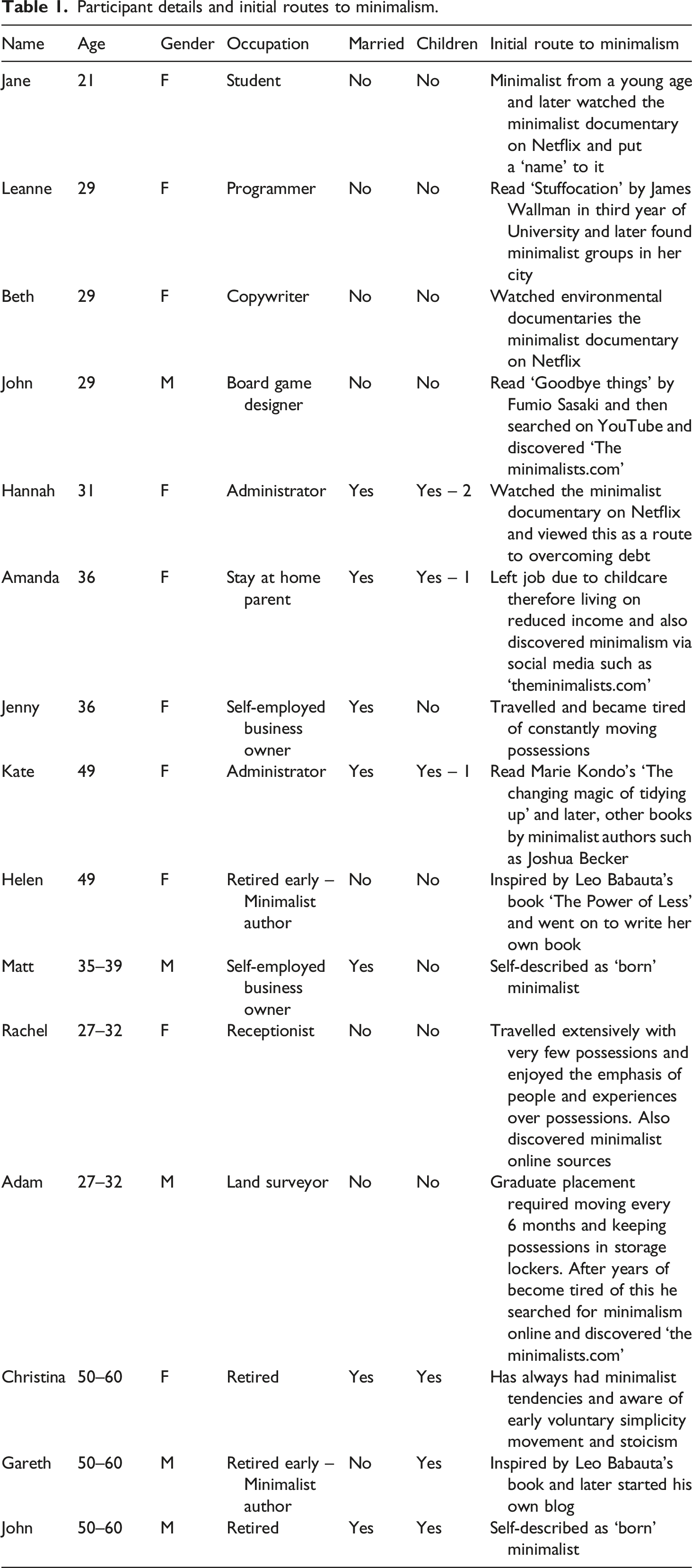
Of the 15 interviewees, 5 were male and 10 were female and they varied in age between 21 years and retirees – with the majority being in their late twenties to early thirties. Interviewees varied in occupation, including, but not limited to, a student; a stay at home parent; an administrator; a receptionist; self-employed business owners; a copywriter; a land surveyor and retirees. Interviewees varied in financial and employment situations, ranging from retirees (2) and financially independent, early retirees (2), young professional graduates within full time employment (6), single income households (3) and one in employment and managing debt (1). Almost half were married and two had children. All were UK residents 1 and one participant was Northern Irish, one was South African and 13 were British.
Participant details and initial routes to minimalism.
Of the 15 participants interviewed, 11 were conducted individually and two married couples were interviewed together. Elwood and Martin (2000: 649) state that ‘the interview site itself embodies and constitutes multiple scales of spatial relations and meaning, which construct the power and positionality of participants in relation to the people, places, and interactions discussed in the interview’. Consequently, participants were given the choice to conduct the interview in the space in which they felt the most comfortable (Cook and Crang, 2007). Six interviews were conducted online due to geographic and temporal convenience for both the participant and I. Nine interviews were conducted face to face: in participants’ homes, coffee shops and private offices (in both my own, and the interviewees’, places of work). The interviews that took place in interviewees’ homes also consisted of ‘home tours’ in which participants’ showed me around their homes and talked about how minimalism played a part in their everyday lives in the space of the home. Some participants allowed me to take photographs inside their homes, whilst others sent me their own photographs.
The interviews were based on a list of questions that related to interviewees’ engagement with minimalism, values and consumption and divestment practices. In the majority of cases, these similar set of questions were asked and discussed but, following the semi-structured approach these were asked in a different order and followed different paths for each interview – with the direction of the conversation intentionally being free-flowing and led by the participants. The interviews lasted between 30 and 90 min and were audio recorded and transcribed verbatim for analysis.
The verbatim transcripts were compiled into the qualitative analysis software NVivo. The research approach adopted a grounded theory methodology (Glaser and Strauss, 1967) with the central purpose ‘to study the experience of participants in order to develop a theory grounded in the data gathered from participants’ (Clandinin, 2005: 218). As Zamwel et al. (2014) state: ‘this approach seeks new understanding of social processes and as such rejects preconceived premises and explanations in favour of general questions formulated in the course of the research’ (205). This was achieved by a process of coding in which ‘coding categories’ were ‘allowed to emerge from the data’ (Herring, 2010: 236). These codes were organised into a ‘coding frame’ (Hannam, 2002: 191) that were made up of a series of master themes that were refined into layers of sub-categories (Kitchin and Tate, 2000) that were used to identify and investigate key themes and patterns that emerged from the data. In the following two sections, the key findings of both participants’ minimalist motivations and (non)consumption practices are explored.
Minimalist motivations: Personal benefits and wider concerns of consumerism
All participants recounted the personal benefits they derived from adopting a minimalist lifestyle of reducing consumption. These included having increased physical, temporal and mental space – alongside greater financial control. First, participants enjoyed the flexibility that having only a few personal possessions allowed them, as there were able to travel, and even move home, more easily. Second, participants spoke about how they spent less time shopping, cleaning and repairing possessions, which allowed them to have more free time and a greater control of their personal finances. Participants also recounted how they felt happier and calmer living in uncluttered spaces and this subsequently provided reduced ‘mental clutter’ in the form of happiness and increased personal well-being. For example, Helen, a 49-year-old retiree and minimalist author states: ‘when you get rid of all the clutter it gives you that space, that peace of mind to think to look inside you and see what gives you joy, what makes you happy’ – suggesting that the removal of material objects and clearing of outer physical space allows for a greater focus on internal well-being. The focus on individual benefits and happiness discussed by the minimalists interviewed is supported by Alexander and Ussher’s (2012: 77) large scale survey of voluntary simplifiers in which 87% of participants said that adopting the lifestyle had made them happier.
Alongside these personal benefits and motivations for adopting a minimalist lifestyle, the majority of participants also expressed wider collective concerns and a strong dislike of consumer culture. For example, Amanda (36) left her job to become a stay-at-home parent. Due to her family living on the sole income of her husband, she began to learn about minimalism via online sources. In the following interview excerpt she describes her dislike of a capitalist consumer culture of accumulation and the premise of continually ‘wanting more’; We’re constantly bombarded with things to buy but that’s because someone somewhere is making a lot of money from it, which I have come to realise I don’t agree with…. because it is constant like thinking oh, I want that thing, I want that thing, I want that thing, it’s pretty exhausting like constantly wanting things and thinking you need new clothes, you need new this, you need this holiday, you need that holiday, you need this bike, you need that car, you need this bigger house. No, you don’t, but it’s just that’s kind of what we’re made to think.
In line with this anti-consumerist sentiment, participants also recollected their dislike of the ‘let down’ of shopping as participants were mindful that shopping could be used as a way to make one feel better, or to try and construct a particular kind of identity, but that this was never achieved and would leave one with a feeling of continually ‘wanting more’. Similarly, participants expressed a strong dislike of aspirational consumption and the demands of consumer capitalism to ‘keep up with Jones’, which was viewed as undesirable and stressful.
For example, Amanda states: ‘A lot of it’s like letting go of what other people think of you or… keeping up with the Joneses, keeping up with everyone else, you’ve kind of got to let that go’. This statement demonstrates how Amanda sees adopting a minimalist lifestyle as a way in which to reject wider consumer culture whilst simultaneously offering her personal benefits of doing so.
However, alongside personal benefits, Amanda also shows a strong motivation to practice minimalism because of her concerns of the environmental impact of consumerism. She states: ‘all this buying, it’s got such a big impact on our environment, so then I started looking at sustainability and how I could make like less of an impact on the planet’. These environmental concerns were also shared by two thirds of the participants. However, several participants expressed that they were not motivated by environmental considerations – and were primarily motivated by personal benefits and self-development. This highlights an initial tension between minimalist motivations between individualism and personal benefits and wider, collective environmental concerns. In the following section, the minimalist acquisition practices of limited, considered and sustainable consumption are explored in order to consider if minimalism can potentially be seen as sustainable in practice, irrespective of intent.
Minimalist acquisition: limited, considered and sustainable consumption
Limited consumption
Limiting consumption via not buying and acquiring objects was a key prerogative of the majority of participants. The interviews revealed that the key ways in which participants manage to reduce their overall consumption are predominantly based on shopping as little as possible. Several participants recounted a strong dislike of shopping as a form of recreation and others recounted how since adopting a minimalist lifestyle they no longer shop for clothing or had not purchased clothing in the last year.
‘Using up’ objects
Participants also recollected how they intentionally try and ‘make do’ with what is already in their possession and using things ‘up’ before considering a replacement. For example, Christina and John are a retired married couple that have been interested in voluntary simplicity and minimalism for many years. John describes himself as ‘born minimalist’, having practised limited consumption since his youth, and Christina is now the leader of her local minimalist group. In the following interview excerpt, Christina and John explain their principle of using something up until it is irreparable before replacing it to their consumption of cars; F: Our policy with the car, isn’t it, you buy something that’s still got a Ford warranty on it… M: Two years old, 30,000 miles and we keep it till… F: Till it dies. M: Till it dies, yeah, rather than buy a new car and get a new one every three years.
Here, we see how Christina and John express a mind-set in which objects are seen as having lives and a desire to not replace these objects until they have reached their full life cycle, that is, ‘died’, with the aim of reducing the overall number of objects acquired and used over time.
Along a similar vein, several participants expressed a nostalgia for a past ‘make do and mend’ culture in which objects lives are extended. Zalewska and Cobel-Tokarska (2016) argue that ‘minimalists diagnose a domination of the culture of excess in the modern world, to go back to the mythologized “long-ago,” when people lived simpler lives’ (505). However, rather than being imagined nostalgia or ‘mythologized “long-ago”’, retirees John and Christina discussed the actual repair culture that they remember from their youth. John recounted ‘I’m old enough to remember, you know, the first colour television my parents had, in today’s- it was £200 in 1974,…you’d have a TV repairman who’d probably mend it if it broke’. He further expressed his dislike of contemporary consumer culture in which ‘things aren’t made to last… You can’t get things mended, if they break you just- you just get another one’. This nostalgia for repair culture, and a dislike of being quick to throw things away and replace them, was not just limited to more mature participants. Amanda expressed a nostalgic desire to ‘go backwards’ to the time of her grandparents in which ‘you mend your clothes rather than if something gets a rip in it go and chuck it out and buy something new’. Collectively, participants showed a strong dislike of what they viewed as contemporary throwaway and re-purchase consumer culture and the need to embrace a culture of object maintenance and repair to ensure their longevity to promote further consumption.
‘Quality over quantity’
Linking to the embrace of ‘using up’ what is already owned and fulfilling an objects potential lifespan, participants communicated a similar attitude towards new purchase and acquisitions - with the majority of participants discussing their desire for fewer, but higher quality objects. This was with the intention of reducing the number of objects acquired, ensuring that objects that were attained were durable and long lasting to prevent having to purchase the same thing again – which could be seen as excessive and wasteful and required more time, effort and further expenditure. This focus on only acquiring higher quality objects inevitably has a higher financial expenditure. However, participants were willing to accept higher financial outlays to adhere to their principles of purchasing quality over quality. For example, Rachel explained how she is willing to purchase more expensive items if she believes they will be good quality and consequently more functional and longer lasting; If something is expensive, I do think okay, yeah it’s expensive, it’s good quality, it’ll last me ages so a lot of it is not buying something cheap because I know it’s not going to last or it’s going to wear out.
Błoński and Witek (2019) argue that the emphasis placed by minimalists on prioritising ‘quality over quantity’ leads to the purchase of more durable items, with longer expiry dates, and consequently avoids ‘the purchase and consumption of many disposable products’ (10). The minimalist focus on product quality, and subsequent product longevity, durability and reduced disposal, could be viewed as strongly sustainably focused (Khamis, 2019; Evans, 2011). Though it is important to consider the financial restrictions of this consumer approach, as although the well-intended premise of quality over quantity to ensure longevity and reduced consumption has clear sustainability benefits, it must be considered that this may only be available to those with the initial financial capital to invest in higher quality purchases. This speaks to debates surrounding the financial exclusion of sustainable and ethical consumption (Littler, 2011) and the considerations of ethical consumers as ‘high cultural capital consumers’ (Carfagna et al., 2014: 158). However, in the case of Rachel, she explains how she navigates the financial barriers of ‘quality over quantity’ by making second-hand purchases to obtain a higher quality item for a reduced cost. She states: ‘I can always buy something of a better quality second hand than I could if I bought it brand new’.
Considered consumption
Alongside limiting consumption, participants also demonstrated highly intentional and considered forms of consumption when it did occur. The majority of participants explained that they do not like ‘window shopping’, browsing or ‘just going into town, going around the shops and aimlessly buying’ (Hannah – a 31-year-old parent and administrator, who became interested in minimalism as a route to overcoming debt), and instead engage in more ‘focused’ shopping where they know specifically what they want to purchase and/or would have a specific shopping list. For example, Beth (a 29-year-old copywriter who became interested in minimalism after watching environmental and minimalist documentaries on Netflix) also reflects this focused shopping approach. She states: ‘I’ve always been the type that I go out and have something in my mind of what I wanted to buy…I don’t just buy on the spot, impulse buy, I really do think about what I’m buying’.
Not buying ‘on the spot’ and taking a long time to reflect on making a purchase was a common theme amongst participants. A third of participants discussed how they would select an item they intend to purchase, and then wait days, or even weeks, to make the final decision to purchase – in order to prevent impulse purchases and assess if an item was truly needed. For example, Adam is graduate land surveyor in his late twenties to early thirties who discovered minimalism via ‘the minimalists.com’. Adam’s possessions now fit into one Ikea storage bookshelf. In the following interview excerpt he recounts: I can’t remember the last time I made an impulse purchase and just went and bought something there and then on the spot. What I’ll do is, I’ll take a photo of the thing, it goes in a folder on my computer at home, I’ll sit on it for at least a couple of weeks. Sometimes I’ll even forget about the photo, and that will be a trigger for me of, ‘Ah, probably I don’t need that anyway’, and I’ll just go ahead and delete it.
Here, Adam expresses how his process of essentially slowing down his consumption considerations is a way for him to prevent impulse purchases and ultimately reduces his consumption as his initial desire for a purchase often fades over time. Others recounted that waiting a few weeks to make a purchasing decision often helped them to assess whether an item was truly needed. The desire to only acquire objects that were deemed to be needed (rather than wanted) was a common principle amongst participants who would often employ strict self-questioning assessments on whether an object was deemed to be truly required. For example, Jenny is a 36-year-old self-employed business owner who was once a keen ‘shopper’ but turned towards a minimalist lifestyle after her fatigue of constantly moving and storing her possessions due to extensive travel and working abroad. In the following interview excerpt, Jenny describes how since her embrace of minimalism, she now only makes a purchase it is functional and necessary – rather than based on wants. She recounts: I haven’t got a pair of winter shoes, I’m going to have to get it, but it’s not like I go into a store and just want more-more-more, it’s a functional purchase, a necessary purchase rather than, ‘Oh, I’ve already got four pairs of boots at home, but I want another pair’.
This adheres to Dopierala’s (2017) assertion that a factor of ‘the minimalist way of life and consumption is the differentiation between needs (real and specific) and whims and impulses’ (79) – arguing that this stems from a reaction to excessive consumption which is seen as the ‘excess of goods in relation to the necessities of life’ (69).
Minimalism’s key premise of reduced emphasis on material objects to make space for what are deemed to be the more important (often non-material) things in life would suggest that minimalists may pay little attention to things and objects and how they are acquired. In contrast, the demonstration of highly focused and intentional consumption, in which time and thought is given to carefully assess if an item is needed, suggests that minimalists have a highly conscious relationship with objects (Zalewska and Cobel-Tokarska, 2016: 505) and adheres to Kramarczyk’s (2015) assertion that ‘the role of minimalism in conscious consumption can be defined as a strategy of implementing conscious consumption in everyday life’ (270. In: Błoński and Witek, 2019: 12). Consequently, minimalism is not necessarily a movement of resolute anti-consumption – and instead a movement of conscious and considered consumption choices (Dopierała, 2017).
Ethical and sustainable consumption
The emphasis on considered and intentional consumption is further reflected in minimalists’ considerations of the sustainable and ethical implications surrounding their potential purchases. The following section reflects upon how some of the minimalists interviewed demonstrated this, via showing a preference for acquiring second-hand items and/or new items that are ethically made (particularly with regard to clothing) and demonstrated concerns over food packaging waste and for some, a move towards veganism.
Over a third of participants discussed how, when they do make a purchase, they prefer to buy something second hand – either from charity shops of second-hand online platforms (such as eBay and Gumtree). The central motivations behind this were first, for general reduced costs and, more specifically, being able to get something good quality for less money – as previously demonstrated by Rachel. And second, for sustainability-based motivations of not wanting to buy something new when a second-hand item was available. For example, Leanne is a 29-year-old graduate programmer who turned towards a minimalist lifestyle in her third year of university upon reading the popular minimalist book ‘Stuffocation’ by James Wallman. She later joined a minimalist meet-up group and is strongly motivated by the sustainable elements of adopting a low consumption lifestyle. In the following interview excerpt, she explains how she tries to buy second-hand items as part of her personal motivation to become more environmentally friendly and ‘zero waste’; I’m also coming from a zero-waste perspective as well, so I know there is sometimes overlap between minimalism and zero waste…what’s the point of me going to H and M and buying new t-shirts, when I can get one for half the price or something… If I can’t find anything in charity shops then high street or I’m looking more online for ethical brands.
Intriguingly, Leanne, has a permanent graduate role, and has the disposal income to consider ethical brands (commonly known to be more expensive), however actively chooses to try and find charity shop items first due to her strong environmental agenda. Other participants expressed similar desires to only purchase from ethical and sustainable brands – particularly with regard to fashion items. Several participants voiced their concerns over fast-fashion and poor working conditions within the garment industry and how this has encouraged them to try and only buy clothing that they feel has been ethically made. As Hannah states: ‘if I am buying things now I am buying stuff that I know is made ethically…I’m going to buy well-made, responsibly sourced things’. Whilst there have been considerations into whether ethical consumption is accessible to only those with the adequate income (Littler, 2011), Hannah brings this into question as she has adopted minimalism in order to tackle large amounts of financial debt – yet still views ethical consumption as a priority.
Interestingly, the majority of participants that demonstrated a concern for ethical and environmentally driven consumption were also vegan, pescatarian or intentionally cutting down on meat consumption for environmental motivations. Several participants expressed a strong awareness of sustainability issues in the food industry and talked about the need to buy food locally and seasonally for environmental reasons. For example, Amanda explains that the motivation behind her decision to turn to a vegan diet was driven by environmental concerns; ‘I went vegan in January as well from me looking at the environmental impact eating meat has…a lot of the vegetables that we eat come from miles away, so that’s not good either’. Others expressed concerns about food packaging and waste. Leanne recounted the guilt she feels for generating plastic waste when she shops; ‘I find when I’m shopping or I get a shopping delivery, you just end up with all this plastic, and I feel awful, but everything just seems to come in plastic, all the fruit and everything’. She explained how she now frequents a zero-waste food shop and only purchases loose fruit and vegetables when she shops in supermarkets to try and reduce the amount of plastic packaging in her weekly shop.
Collectively, these examples demonstrate the ethical and sustainable consumption motivations and practices of some minimalists. With participants showing concerns over the ecological impact of consumption in terms of resources used and waste created and ethical considerations of how products are produced and by whom and under what conditions. Therefore, whilst the narratives of minimalist blogs and books have been critiqued for being individualistic and not considering wider ecological concerns or moral concerns (Meissner, 2019; Zalewska and Cobel-Tokarska, 2016), this analysis of the everyday consumption practices of individual minimalists suggests that, for some minimalists, ecological and moral motivations are a key driving force behind their embrace of a minimalist lifestyle. This aligns with studies of voluntary simplifiers in which motivations have been recognised as environmentally and ethically driven (Huneke, 2005; McDonald et al., 2006; Zamwel et al., 2014).
In addition, several participants expressed that although they were principally motivated by the personal benefits of minimalism, they saw their minimalist lifestyle of consuming less in general as a positive, sustainable outcome of minimalism. For example, whilst Jenny’s predominant motive for adopting a minimalist lifestyle stemmed from her working and travelling abroad, and disliking continually moving and storing her possessions, she recounts her love of ‘feeding into’ sustainability. She recounts: Our reasonings maybe aren’t just for sustainability purposes, although I love that it could feed into that element, because sustainability is something we talk about and are very interested in…and we’re discussing we want to be involved with the movement, but from a cutting down point of view that’s just a lovely… it’s nice that it’s come out of that, a by-product. We didn’t essentially cut down for that reason, but if that can feed into it then that’s a great thing.
Here, Jenny expresses how although her and her husband’s rational for being a minimalist are not primarily sustainably driven, they see themselves as contributing to sustainability by reducing their consumption and view this as a positive outcome or ‘by-product’. This shows similarities to Waight’s (2019) study on the consumption practices of mothers at nearly new sales, in which the primary motivators of purchasing second hand were economic, and environmental considerations were not a primary motivating factor, but instead were a ‘positive consequence’ (539).
However, it must be considered that whilst for some ethical and sustainable intentions were key motivators, or a positive consequence, others did not share these intentions: with four participants explaining that they were not motivated by ethical and/or environmental concerns. Instead, these minimalists were primarily motivated by individual/personal benefits of adopting a minimalist lifestyle and two of these participants found a strong focus on sustainability somewhat off-putting. For example, John, a 29-year-old board game designer stated how he found the sustainable living part of the minimalist movement ‘a little bit impenetrable to really start getting into’. Similarly, Helen, a 49-year-old early retiree and minimalist author, recounts her dislike of ‘obsessing’ over sustainability. She states: ‘I’m not going to be like a lot of my friends who obsess about plastic, or obsess about carbon footprint…not everyone has to be like an eco-warrior, I mean yes you don’t like to waste stuff but neither do [you] obsess about it’. In the case of these few participants, this aligns with the standpoint of minimalists being predominantly individually motivated (Zalewska and Cobel-Tokarska, 2016), as opposed to ecologically concerned. This also speaks to why there is a potential blurring within minimalism of individualism versus sustainably orientated collective action – with some finding the latter highly important, but others finding this aspect potentially ‘obsessive’ and ‘impenetrable’.
Conclusion
This article draws on research collected via 15 semi-structured interviews with self-defined minimalists in the UK. Previous research has highlighted the tensions between individuality and wider collective concerns of minimalism (Meissner, 2019; Zalewska and Cobel-Tokarska, 2016; Dopierała, 2017), whereas this article has broadened the empirical scope of research on minimalism to consider minimalists’ motivations and practices to question this tension.
The findings revealed that all participants adopt a minimalist lifestyle due to the personal benefits of having increased physical, temporal and mental space. The majority of the minimalists interviewed were also either highly motivated by wider ecological and/or moral concerns of consumerism or who saw a contribution to sustainability as a positive ‘by-product’ of their minimalist lifestyle. In addition, there was a smaller group of participants who were primarily motivated by personal benefits, as opposed to a wider sustainability agenda.
Whilst the motivations for adopting a minimalist lifestyle were mixed, the findings revealed that all the participants practised varying forms of highly limited, considered and intentional consumption: with the overarching aim of anti-accumulation and reducing their consumption. The focus on ‘reduction’ is predominant with environmental discourse (Zamwel et al., 2014) and speaks to minimalism’s potential to encourage more sustainable forms of reduced consumption. Adopting a practice theory standpoint, that goes beyond considering individual choices, attitudes, preferences and motivations and encourages a greater understanding of everyday consumption habits and practices (Warde, 2005; Welch and Warde, 2015; Huddart Kennedy, 2020), would suggest that the mixed-motivations of minimalists, varying between individual personal benefits and wider environmental concerns, are relatively unimportant due to their everyday sustainably aligned and pro-environmental practices of reduced consumption that can be seen as sustainable in outcome, if not always in intent.
In addition, the key motivation of the personal benefits offered by minimalism can be viewed a highly beneficial way of promoting, popularising and encouraging a reduced consumption lifestyle. Soper (2008) argues that any anti-consumerist ethic should ‘appeal not only to altruistic compassion and environmental concern but also to the more self-regarding gratifications of consuming differently’ (571). As, ultimately, a non-consumer or anti-consumer lifestyle must still be personal appealing and pleasurable for it become popularised (Black and Cherrier, 2010; Jackson, 2005). The personal benefits derived from minimalism perhaps explain the bourgeoning popularity of the minimalist movement and demonstrate its wider sustainable significance: as minimalism endorses reduced consumption practices and simultaneously offers personal benefits to encourage their uptake. The blurring between personal benefits and sustainability motivations and practices indicates that minimalism also offers the potential to encourage a collective cultural shift that is critical of hyper-consumerism and its environmental impact, at the same time as allowing individuals to achieve personal benefits and contentment from their minimalist lifestyles. Suggesting that minimalism could exemplify Jackson’s (2005) theorisation of the ‘double dividend’ inherent within sustainable consumption: ‘the ability to live better by consuming less, and by the same token, to reduce our impact on the environment’ (25).
Footnotes
Declaration of conflicting interests
The author(s) declared no potential conflicts of interest with respect to the research, authorship, and/or publication of this article.
Funding
The author(s) disclosed receipt of the following financial support for the research, authorship, and/or publication of this article: This research was funded by a Royal Geographical Society with IBG Small Research Grant.
