



Abstract
Many museums have begun to integrate digital technologies as a way of providing opportunities for children to play, explore, and make meaning of artworks. However, little is known about the specific ways children interact with digital artworks in museum spaces. This paper presents findings from a study that explored young children’s interactions with digital artworks at the Beings by Universal Everything exhibition, held at ACMI (formerly known as the Australian Centre for the Moving Image) in Melbourne, Victoria. Data was collected from 22 Years one and two children, aged 6–8 years, from a primary school located in regional Victoria. Qualitative data were generated from video recordings of children’s verbal and non-verbal interactions as they engaged with the digital artworks, researcher observations, and focus groups with the children after the exhibition. Transcripts of children's interactions were deductively coded for pretend play abilities and play elements. Three main themes were identified in relation to the contexts in which the children interacted with the artworks: (1) as individuals, (2) with their peers about the artwork, and (3) as characters within the artwork. Findings showed the different play elements and pretend play abilities evident as the children interacted with the selected artworks. The findings highlight the unique ways to observe, document and analyse children’s interactions and meaning making as they participate in museum spaces, and adds insights into the growing body of research around the affordances of digital museum spaces in fostering children’s learning through play, particularly pretend play.
Introduction
Overview
It is well established in the literature that there has been a significant increase in the number of children’s museums across the world (Hackett et al., 2018; Kervin et al., 2024; Luke et al., 2021), with a shift of emphasis from being ‘places of cultural transmission and reproduction’ (Kumpulainen et al., 2014: 233) to spaces that provide opportunities for children to play, explore, learn, create, and interact with others (Carpenter, 2024; Kervin et al., 2024). This shift has resulted in the incorporation of play and playful experiences for children, both digital and non-digital, into museum exhibitions and activities (Kumpulainen et al., 2014; Olesen and Holdgaard, 2024), leading to a growing interest in understanding children’s experiences in such spaces. A recent review of the scholarly literature on children’s museums (Carpenter, 2024) that analysed 65 articles from the years 2016–2021 found that most of the constructs of research in children’s museums are based around learning, social interaction, physical environment, play, and community engagement. However, as digital technologies are embedded into children’s museums, particularly in the form of human designed artworks, less is known about how play is defined and understood, and the ways in which young children in the early years of schooling interact with these artefacts, how they make sense of the digital artworks through play, and the specific ways in which the children express play elements and pretend play abilities.
Play: The dilemma of a common understanding
For many years, defining play has been an area of great debate amongst researchers, philosophers, educators, therapists, and parents (Paatsch et al., 2023). As Eberle (2014) contends, ‘play is a roomy subject, broad in human experience, rich and various over time and place’ (214). However, despite these ambiguities in understanding play as a concept and as a pedagogical construct, it is well established that play is considered a fundamental human activity that involves rules and norms, and where power relations and social structures are challenged (Greishaber and Barnes, 2021; Holgaard and Olesen, 2023; Olesen and Holdgaard, 2024; Zosh et al., 2018).
Many researchers have often described play in terms of different activities, from rough and tumble play, games with rules, block play, to imaginative or pretend play (Creaghe and Kidd, 2022; Lillard et al., 2013; Stagnitti, 2021). Often, such activities are also aligned to descriptions of play types including construction play (e.g., building a bridge with blocks), functional play (e.g., where objects are used in the play as their intended purpose – a cup as a cup), physical or gross motor play, pretend play (also referred to as imaginary, symbolic play), sensory-motor play, game play, and auditory play. Together, many of these play activities include various art materials and forms, such as painting and drawing, that foster children’s abilities in problem-solving, creativity and reasoning (Petri, 2001). Other researchers have described play according to different characteristics and features including ‘intrinsically motivated’, ‘structured by mental rules’, ‘self-directed and child led’, ‘flexibility’ (e.g., use of objects in different ways), ‘pretense’ (e.g., with actions and objects) and ‘positive affect’ (e.g., laughter, fun) (Gray, 2009; Lillard et al., 2013).
Vygotsky (1967, 2016) posits that play, particularly imaginary situations in play, should not only be seen as one of the groups of play activities but as the leading line of children’s development in the preschool years. Similarity, Eberle (2014) argues that play unfolds spontaneously as a series of events that recognise the volition of the participants and accounts for both rule making and rule breaking, as well as the benefits and risks that are foundational for human learning and development. It is in play that the child creates an imaginative situation whereby their needs, inclinations, and motives to act can be examined through behaviours that are guided by not only their immediate perception of objects or the environment, but also by the meaning of this situation (Vygotsky, 1967). Meaning making in these situations can involve many play abilities including the non-literal use of actions, objects, and attributes, as well the ways in which children build ‘understandings about tools, artifacts, and practices that hold social and cultural relevance in their lives, including digital technology’ (Kervin et al., 2024: 525).
Play is also social as children interact with others, either real or make-believe, to make sense of their worlds. Rakoczy (2008) suggests that pretend play involves not only individual intentionality but also establishes shared or collective intentionality as children engage with adults and peers. It is during play with others that children learn to recognize the intentions of others through understanding behavioural, cognitive and affective interactions (McAloney and Stagnitti, 2009). During social interactions in play, children often learn how to: acknowledge and build on other’s contributions, ask questions, take turns, negotiate roles and defend their position, take the perspective of another, and collaborate as they create shared meaning with others. Vygotsky (1978) argued that it is through these social and interpersonal interactions, often mediated through verbal and non-verbal language, that children develop their socio-cognitive skills. In other words, it is through social interactions in play that children, as co-constructors of meaning, begin to understand themselves and others, as well as the world in which they live (Creaghe and Kidd, 2022).
In more recent years, play research has begun to focus on children’s interactions with digital technologies and the affordances of the technologies in supporting children’s learning, including technologies used in the arts and visual arts. For example, Ko and Chou (2014) found that technologies in visual arts enable children to form mental images and explore their sensory perceptions as they play and manipulate objects in their environment. Typically, play is conceptualised through lenses of socio-cultural, constructivist or developmental theories that were developed prior to a time when digital technologies were integrated into young children’s participation in society (Arnott, 2016; Leung et al., 2020; Marsh et al., 2016). In early childhood education and care, digital play is often interpreted as a pedagogical construct that reflects the role of play as a primary mode of learning (Chu et al., 2024; Edwards, 2023). Chu et al. (2024) conducted a systematic review of the literature, comprising of 118 studies, on children’s digital play since the release of the Apple iPad to investigate the characteristic knowledge base of the digital play literature. Findings showed that there appears to be six distinctive features of digital play positioned in the literature: (1) learning and development (e.g., acquiring specific skills using digital technologies), (2) situated (e.g., adult-perspectives and decision-making as children engage with digital activities), (3) interactive (e.g., children’s behaviours as they interact with digital technologies), (4) enjoyable and entertaining (e.g., children’s enjoyment as they interact with digital technologies) (5) meaningful (e.g., children’s agency, control and intentional acts) and (6) gendered (e.g., female and male characteristics attributed to the digital) (10). However, most of this research was conducted in more formal contexts such as early childhood settings, or in controlled laboratory settings.
While there is a large body of research that explores children’s play in more formal contexts such as early childhood settings and schools, there is growing interest in embracing the incorporation of play into semi-formal settings, such as museums. Unlike formal, school-based contexts, the conditions for learning at museums differ in that visitors are generally free to ‘engage with aspects of the exhibition that they find the most interesting, in an order they decide for themselves, and without the requirement to be assessed afterwards’ (Insulander et al., 2021: 116). However, as Olesen and Holdgaard (2024) note in their review of the research about museums and play, there is a notable paucity of research that investigates the outcomes of these ‘audience-focussed activities’ through play. Similarly, Chu et al. (2024) in their systematic review of the literature on children’s digital play found only three studies that investigated children’s digital play in public spaces, with only one study conducted in a museum.
Play in museums
Current research on play in children’s museums highlights the tremendous variation in the field. For example, some studies have explored the role of parents in children’s play in museums with an emphasis on investigating family conversations and the ways in which the adult supports their child’s learning through talk (Downey et al., 2010; Leinhardt and Knutson, 2004; Wood and Wolf, 2010). Others have investigated the museum environment as a space for children to learn, emphasising the importance of full body engagement (Hackett et al., 2018; Piscitelli and Anderson, 2001) as key components of multimodal communicative practices that move beyond the talk to the physical and non-verbal modes (Hackett, 2014). This emphasis on movement, place, and sensory experience often highlight the ways in which young children entangle with and ‘co-exist alongside spaces and things, with the more-than human’ (Hackett et al., 2020: 31). Together, the findings from these studies highlight the affordances of museums as distinctly different spaces for children to play and explore when compared with other everyday places. However, there appears to be a gap in the research as to the ways in which such spaces support specific play abilities in children as they interact with both the human and non-human to make meaning of museum experiences.
Furthermore, there appears to be wide variation in the literature as to how play is defined, understood, and investigated in these spaces. Luke et al. (2021), while recognising that play has become part of the tacit knowledge of the field of children’s museums, examined professionals’ beliefs about what play is and why it is critical for their institution’s mission. Specifically, they interviewed professionals from 49 children’s museums across the USA and reported that the perceived benefits of play included social, cognitive, emotional and physical development as well as supporting children’s self-direction. However, the researchers also suggested that while the participants acknowledged that play was a significant aspect of the museum’s mission, there were no shared understandings of what play is and how play is assessed, nor the role of play and how it is presented by the audiences within their museum.
Similar reports of the scarcity of research that specifically documents the outcomes of applying play in museums was found in a recent study by Olesen and Holdgaard (2024) who analysed 38 peer reviewed articles about play and museums. Findings from this review showed that most studies were published in the USA and Europe, focussed on children and families, and reported outcomes for participants around three main themes - engagement (i.e., play used to engage in museums – understood as a scalable entity), learning (i.e., with a focus on STEM and social- emotional learning), and enjoyment (i.e., what audiences like, and what is fun and pleasurable as they interact with the museum spaces and objects). However, they also noted that play is highly unpredictable and audience dependent, further confirming the challenges in understanding the ways in which young children make meaning of museum artefacts and activities through play, and the play abilities that are drawn upon and enacted. Similarly, Holdgaard and Olesen (2023) analysed 137 studies on play and museums to explore when, where, and how play had been applied and researched in museums. Findings showed that most studies were published in the field of human-computer interaction with a focus on the design of computer technology and the interactions between humans and computers, with over half the studies reporting on digital technology-enhanced initiatives (e.g., design of a device or app), and only 17% published within the field of education. Furthermore, as Wang et al. (2024) suggest, despite the new opportunities the digital era has created for educators and designers of artefacts in museums, much of this has been centred around ways in which these new technologies support science and STEM learning. However, there appears to be a paucity of research in how children in the early years of schooling make meaning of such digital artefacts in museums and how aspects of play, particularly pretend/imaginative play, are carried out by children as they engage with these artefacts.
Current study
The aim of this study is to address this gap in the research by investigating the ways in which children interact with digital artworks in one museum in Victoria, Australia and how aspects of play are enacted as they experience these artworks. The research question guiding this investigation is: “How do young children in the early years of schooling make meaning of digital artworks through play at the Beings exhibition?”
Theoretical perspective
In this study, the focus on examining children’s interactions with the digital artworks was theorised using socio-cultural and embodiment approaches (Hackett, 2016; Hackett et al., 2018; Vygotsky, 1978), exploring children’s verbal and non-verbal language as well as their movements as they made meaning of the exhibition. Individual and peer interactions were explored to also understand the ways in which the children built on each other’s understandings as they observed and interacted with each other at the digital artworks. In order to examine children’s pretend play abilities, Stagnitti and Paatsch’s (2018) framework involving five pretend play skills was used to understand children’s use of actions, objects, and attributes including: (1) object substitution (e.g., a stick for a person), (2) role play (e.g., pretending to be a customer in a shop), (3) play scripts (e.g., simple stories through to complex stories that include resolutions to problems), (4) sequences of play actions (e.g., detailed logical sequences that can last from a few actions to those that carry over 2-3 days), and (5) character play using dolls and figurines (Stagnitti and Paatsch, 2018).
In addition, Eberle’s (2014) basic elements of play were used as a lens for understanding the ways in which the children made meaning through the play with the digital artworks. Eberle posits that there are six basic elements of play that support children to engage and make meaning of the world around them – anticipation (e.g., curiosity, expectation, interest), surprise (e.g., awakening, excitement, discovery), pleasure (e.g., satisfaction, joy, gratification), understanding (e.g., tolerance, empathy, sensitivity), strength (e.g., creativity, drive, ingenuity), and poise (e.g., spontaneity, fulfilment, composure). These elements work together dynamically to foster children’s physical, intellectual, and emotional development. However, while he recognises these elements as essential for qualifying play, he also argues that ‘it is not possible to extract play from player’s viewpoints or intentions: play cannot be pulled away from where and when and with whom it takes place’ (230).
Materials and method
Methodology
Approach
This study is part of a larger program of research investigating digital play in the early years of schooling conducted through the Australian Research Centre of Excellence for the Digital Child (ARC-CoE-DC). The ARC-CoE-DC is the world’s first research centre dedicated to creating positive digital childhoods for all Australian children. The study employed a qualitative case study to investigate complex phenomena within their real-life contexts using multiple sources of evidence (Nair et al., 2023; Yin, 2018). The unit of analysis comprising the case was one museum that provides digital artworks for visitors of all ages including primary school children, such as in this study, who attended an educational excursion to a museum exhibition of digital artworks.
Research setting
The research presented in this paper reports on the collaborative research between the Deakin node of the ARC-CoE-DC, a museum of screen culture located in Melbourne, Victoria, and a Catholic primary school in regional Victoria, Australia.
The school, which operates under the governance of the Diocese of Ballarat Catholic Education Limited (DOBCEL), implements a play-based learning approach across all year levels, with a strong focus on pretend play, using storyboards and ‘play stations’ around the classroom. Play stations may include representations of familiar spaces in children’s lives such as cafés, supermarkets, or hospitals, or may involve block areas and spaces with abstract and concrete materials such as sticks, cardboard boxes, fabric, and figurines (e.g., people and animals). Storyboards typically take the form of multi-level displays in which narratives are played out across a school term around a particular curriculum theme (e.g., fairytales, sustainability etc.). Children in the early years of school, Foundation to Year 2, are assessed at the commencement and end of the school year in all curriculum areas as well as in pretend play abilities using the Pretend Play Checklist for Teachers (PPC-T, Stagnitti and Paatsch, 2018). In more recent years, the school has been involved in ongoing research to broaden teachers’ understandings of digital play as a pedagogical construct to explain children’s engagement and use with digital technologies both within the classroom and in semi-formal learning spaces, such as museums.
The museum, ACMI (formerly the Australian Centre for the Moving Image) is a museum of screen culture located in Melbourne’s central business district, that welcomes visitors of all ages through their screenings, exhibitions, and festivals. ACMI’s vision is ‘to build a vibrant, diverse connected society of screen literate and technologically skilled watchers and players, and a thriving ecology of creative makers’ (ACMI, https://www.acmi.net.au/). As a museum of screen culture, which is committed to learning from experimentation, ACMI has intentionally utilised play as an organising experience principle in its permanent centrepiece exhibition, The Story of the Moving Image, which offers a range of multi-sensory, interactive and digital play experiences for visitors of all ages. Moreover, for ACMI’s Education Program, which engages with more than 100,000 children annually, play is central to a broad range of programs that develop screen and technology capabilities and deliver creative and critical thinking capabilities, resilience, patience, and improved cooperative play and social skills.
Participants
Twenty-two children, 10 boys and 12 girls, in Years 1 and 2 (referred to at the school as Exploration class), and two teachers consented to participate in this current research. Both teachers hold a Bachelor of Education (Primary) qualification and over 8 years of teaching experience. The children and their teachers travelled approximately an hour and a half by bus from their school in regional Victoria to attend the Beings exhibition at ACMI. Most of the children had not been to ACMI prior to their excursion.
Ethics
Ethical clearance was granted from Deakin University Human Research Ethics (Application ID: 2024/HE000015) and the Diocese of Ballarat Catholic Education Limited (DOBCEL), organisational consent was sought from St James and ACMI. The school then assisted in recruiting Year one and Year two children and their teachers to take part in the research using Plain Language Statements and Consent Forms (PLSCF) prepared by the Deakin research team. Parents/caregivers of the children were provided with the PLSCF so they could consider consenting to their child participating in the research. Children also provided assent to be interviewed.
Beings exhibition
The Beings exhibition, shown at ACMI between May and September 2024, features immersive and interactive installations designed by international digital and media art collective, Universal Everything (see https://www.acmi.net.au/whats-on/beings/ for further details of the artists and their description of these artworks ). These playful interactives and hypnotic visuals invite children to interact with them through movement to bring the 13 artworks to life. Beings was designed primarily for an adult, design-interested audience, but was also intended to be family friendly. ACMI’s head of Education (Author 10) reported that: Despite the design intention focussing on adults, there was strong family engagement across all ages, with almost two thirds of ticket buyers attending Beings as part of a family group, while more than one third of the audience were children (across school and family groups). ACMI’s main aim of the Beings exhibition was for visitors to play with the works as well as with others at the exhibition, through creating an environment that encouraged both active engagement and quiet contemplation, and fostered emotional connects with the exhibition’s interactive elements.
For brevity, this paper focuses on three of the 13 artworks: Kinfolk, Symbiosis, and Transfiguration, as examples of the different types of interactions and play that were evident. Kinfolk is an interactive artwork that uses motion-capture technology and 3D-animation software to create flamboyant figures that come to life as the audience interact with them (see Figure 1) through body movement. The Kinfolk (Universal Everything) interactive artwork featuring flamboyant figures.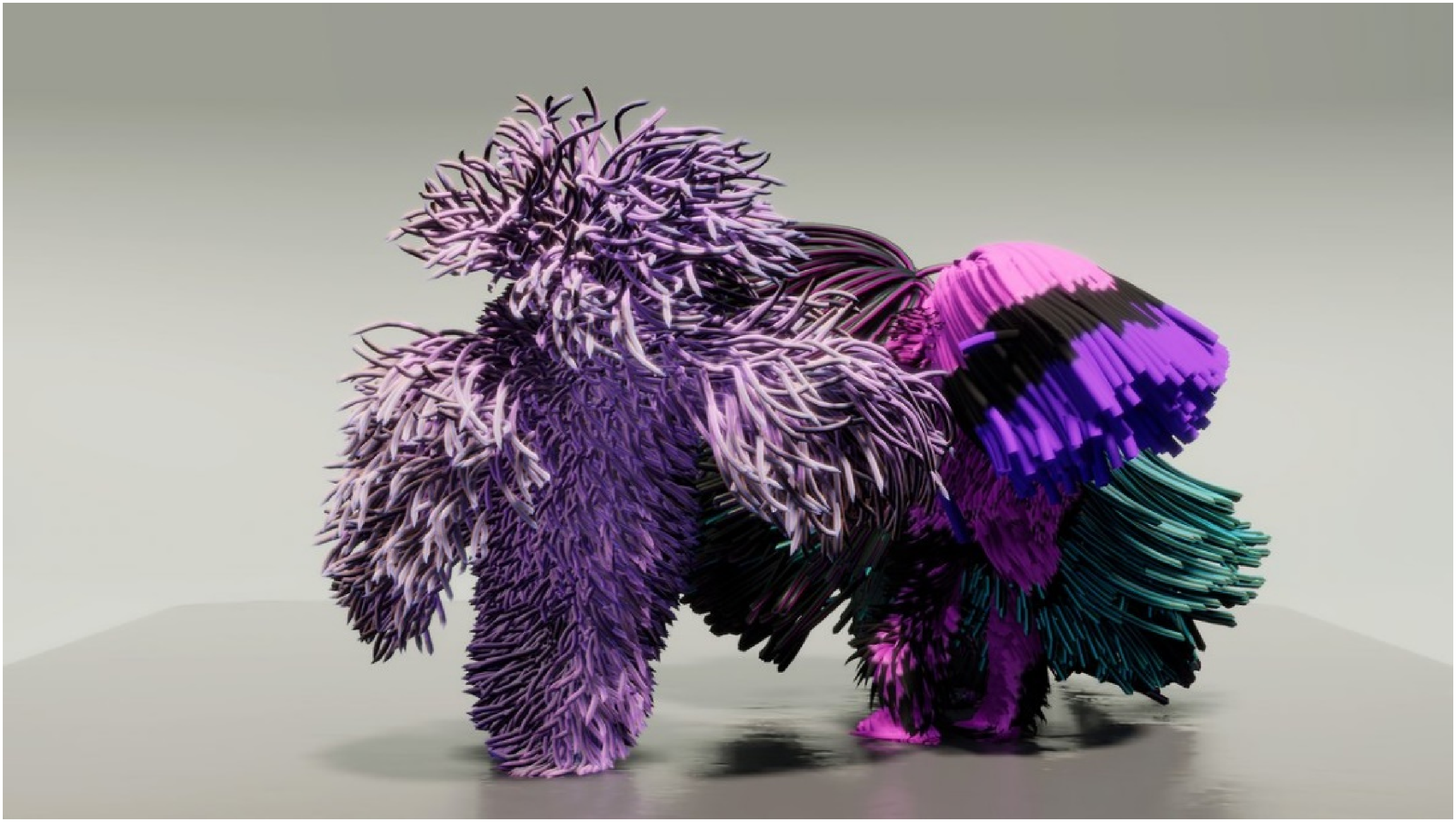
Symbiosis, as the name suggests, involves the interaction between two organisms of different species, created through interactivity and body-tracking technology. Children are encouraged to interact with another person to slide, stick and combine to create a new life (see Figure 2 showing children interacting with Symbiosis). Children interacting with the symbiosis (Universal Everything) artwork.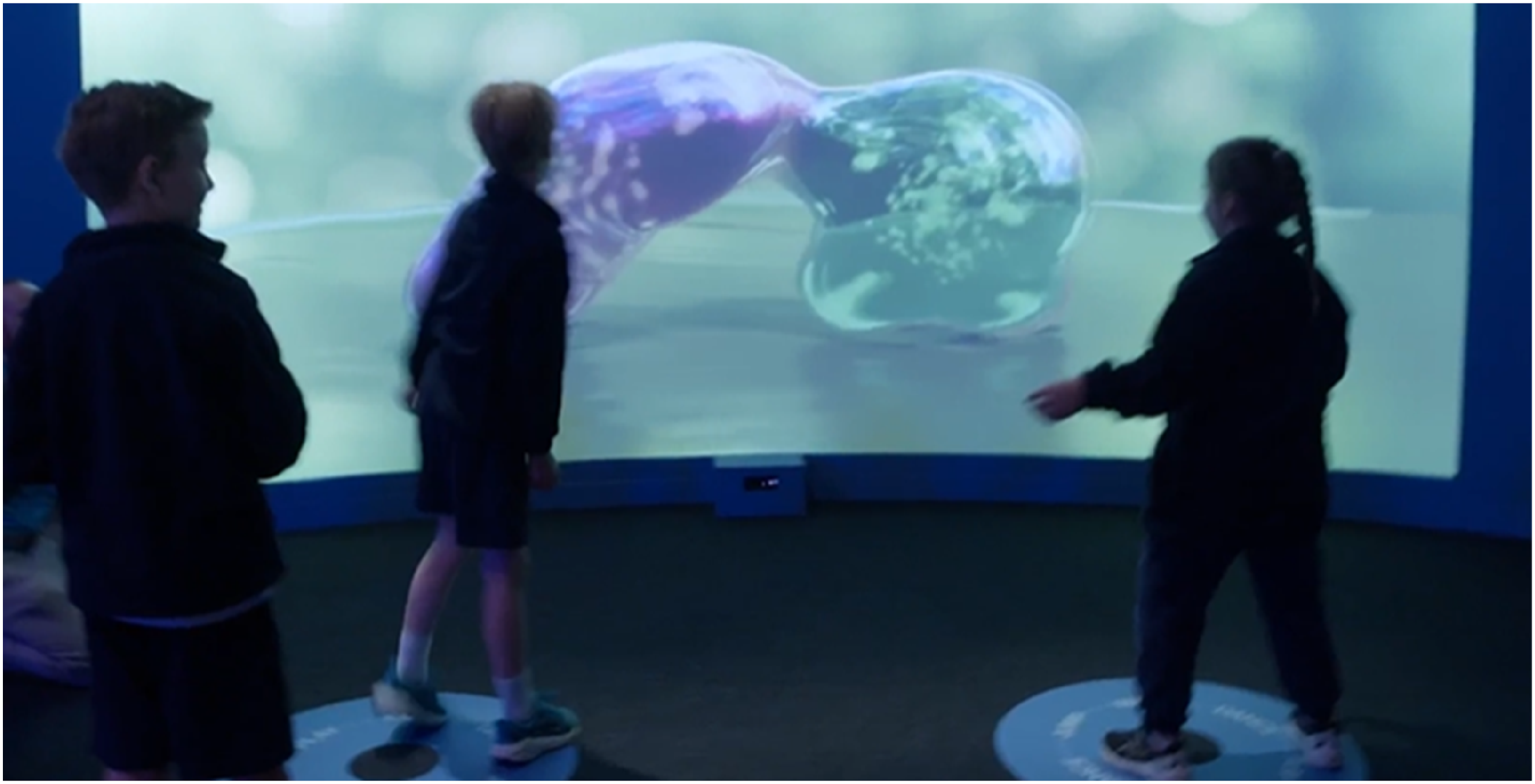
Transfiguration was created using computer-generated imagery of an ever-changing figure that transforms from translucent bubbles to lava, rocks, and flames and includes audio of different footsteps as the figure morphs into each of these forms (see Figure 3). This artwork enables children to listen to and watch the transformation of the figure as it projects onto the screen. The figure morphing into elements in the transfiguration (Universal Everything) artwork.
While the excursion was semi-guided by the teachers in the particular space, children moved around the exhibition freely, moving from one artwork to the next, and at times revisiting the artworks several times as they jumped, danced, and experimented with the different ways the figures in each of the artworks could move, grow, and disappear from the screen.
Data collection
Qualitative data were generated through video recordings of children’s interactions at ACMI, photographs, semi-structured interviews, and researcher observations at the ACMI Beings exhibition.
Video recordings of the children whose parents gave consent and the children themselves who gave assent on the day were captured by ACMI staff. Children whose parents did not give consent attended a different part of the museum while filming in the Beings exhibition took place. Deakin researchers (authors 1, 2 and 5) also observed the group from a distance with consent on each of the visits. These observations were conducted without any interaction with the children or involvement in their activities/experiences at the museum.
Children were interviewed in person in small groups of 4-5 children at the school within 2 days after attending their excursion to ACMI. A list of questions was created for the children to explore what they did and how they felt after attending the Beings exhibition at ACMI. Examples of the interview questions included ‘What did you do at Beings?’, ‘What parts of Beings do you like the most?’, ‘How did this make you feel?’, ‘How did you decide what to do during the excursion?’, ‘Were there specific parts of the exhibition that you found exciting?’, and ‘What did you learn from being part of this exhibition?’. Each interview lasted up to 30 minutes and were recorded then transcribed and read over by the Deakin research team to identify themes.
Data analysis
Children’s interactions at the Beings exhibition and the children’s responses to semi-structured interviews were transcribed and analysed to identify common themes via a combination of deductive and inductive coding (Clarke and Braun, 2013). The analysis used five phases of Clarke and Braun’s (2013) thematic analysis, which were (1) familiarisation, (2) coding, (3) searching for themes, (4) reviewing themes, and (5) defining and naming themes, to identify what the children did and said about their experiences at the Beings exhibition at ACMI. Inductive coding was completed first to identify the ways in which the children interacted with the digital artworks. Deductive coding was then used following the five pretend play abilities framework including object substitution, role play, play scripts, sequences of play actions, and character play using dolls and figurines (Stagnitti and Paatsch, 2018) and Eberle’s (2014) six basic elements of play including anticipation, surprise, pleasure, understanding, strength, and poise. The analysis was conducted by authors 1 and 2, independently. Where there was disagreement between the two researchers, the researchers discussed each difference until agreement was reached regarding the findings.
Findings
Children’s interactions with the beings digital artworks through play
Findings from this study highlight young children’s distinctive ways of making meaning, through play, of the three selected digital artworks featured at the Beings exhibition - Kinfolk, Symbiosis, and Transfiguration artworks. Analysis of the children’s verbal and non-verbal language as well as their body movements showed that there were three distinct contexts in which they interacted with the artworks: (1) individually, (2) with their peers about the artwork, and (3) as characters within the artwork. It is noteworthy that the children often engaged with these three artworks through one or more of these contexts simultaneously. For example, children could interact with the artwork individually while also interacting with their peers about the artwork. For the practical purpose of exploring meanings made through play in a specific context, the dominant context in which the children were interacting is presented. Findings also showed that children expressed different types of pretend play abilities across the five pretend play skills (Stagnitti and Paatsch, 2018), such as role play, sequences of play actions, and simple play scripts, as well as many of the six elements of play (Eberle, 2014) as they made sense of the artworks in the exhibition. The following sections will present selected vignettes from video recordings of the children as they interacted with the three selected digital artworks across the three interaction contexts. These vignettes will also show the specific ways in which the children expressed play elements and pretend play abilities and are accompanied by children’s perspectives as evident in their responses from the interviews.
Children interacting with the artwork individually
Findings showed that many children would interact with the artworks on their own using various hand and body movements such as touching, pointing, dancing, and swaying as they explored the artworks in a playful manner. The children also expressed many elements of play through verbal and non-verbal language, including surprise, pleasure, and anticipation.
Vignette 1 presents an example of three girls individually interacting with the Transfiguration artwork. This artwork comprises a walking figure that is projected on the wall that changes from rock to lava to water and fire. The girls were not able to control the movements of this figure as it changed but could watch and listen to the way that the sounds associated with the walking figure changed to accompany the element in which it was portraying (e.g., swishing noise as the figure walked to represent water).
Vignette 1. Ella, Indy and Mikaela interact with the transfiguration artwork
Ella and Indy walk up to the wall of the artwork (both smile at the figure). They stand a short distance away from each other, only looking at the figure. They reach up to touch the wall, appearing to follow the moving figure with their hands (see Figure 4 Ella and Indy interacting with the transfiguration (Universal Everything) artwork. Mikaela looking between her hands and the artwork.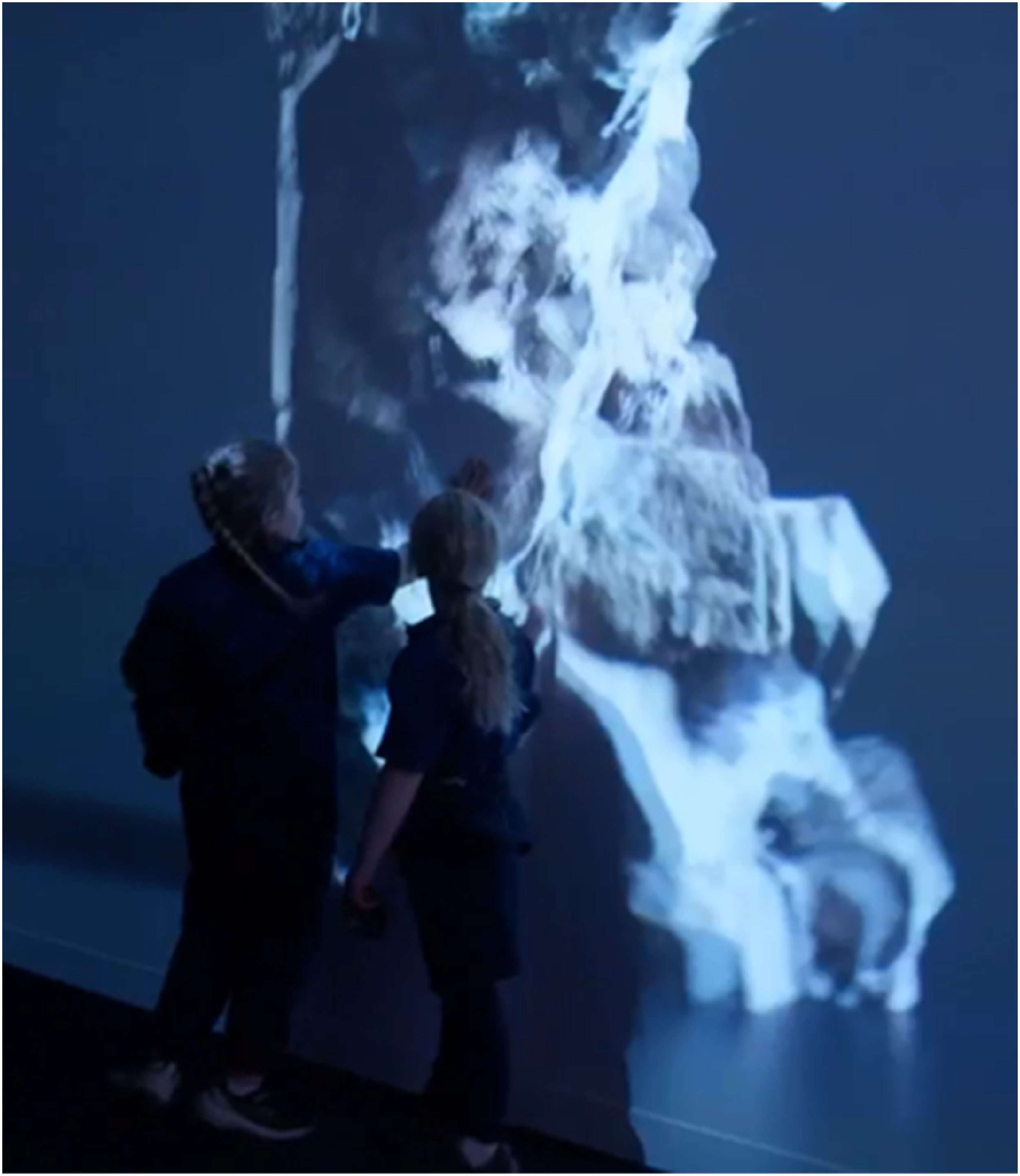
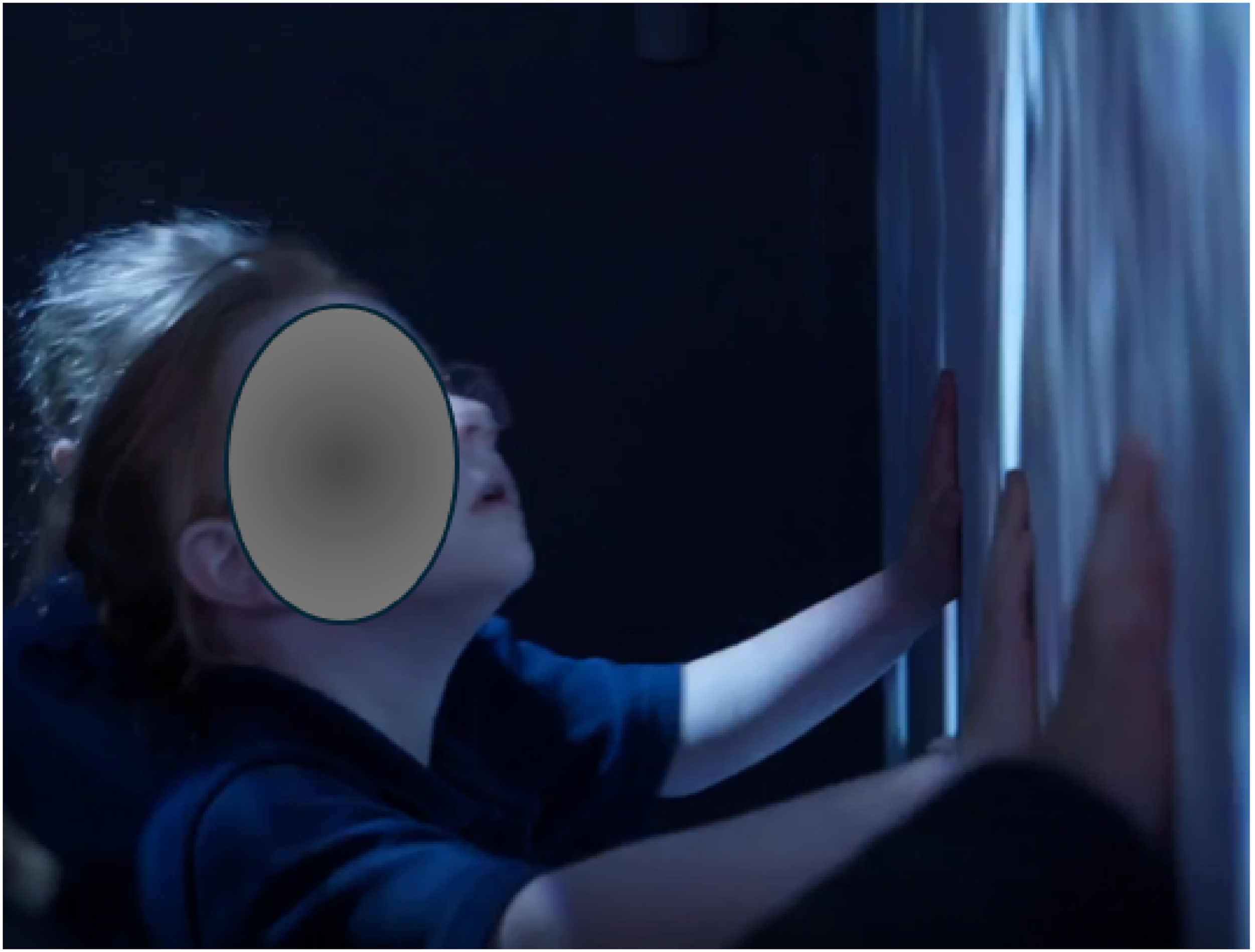
While this artwork was a non-interactive piece in the sense you could not control the movements of the figure, the girls actively searched for interactivity. They used their hands to touch, attempt to feel, and to follow the moving figure as it transformed into different forms (i.e., fire, rocks, water). Researcher observations and video data showed that the girls often appeared like they were looking to feel the projected forms or, at the very least, to see the forms projected onto their hands. The girls’ eagerness to touch and feel the changing elements as they watched the transformation was also reflected in their interview responses. For example, Ella commented that “I couldn’t feel it. I could only feel the wall. Only on the rock part you could feel the rock wall”. Later in the interview, when asked what would have improved their experience of the artworks, both Mickaela and Indy expressed that ‘having different textures to touch and feel while watching the figure’ transform into different textures would have improved their overall experience of the artwork. While there was only limited evidence of any of the girls using pretend play throughout the Transfiguration (i.e., manipulating and exploring objects), they all expressed many of Eberle’s (2014) elements of play including anticipation (e.g., interest and curiosity), surprise (e.g., discovery and awakening), pleasure (e.g., delight and happiness), and poise (e.g., spontaneity and balance).
Vignette 2 illustrates how Holly and Sena interact individually with the Symbiosis artwork. In this artwork, there are two dots on the floor in front of the artwork. Holly and Sena both stood on their respective dots and interacted with the blobs to make them move, not interacting with each other but with their eyes fixed on the object in front of them as they explored what their blobs could do.
Vignette 2. Holly and Sena interact individually with the symbiosis artwork
Holly steps on the right dot and briefly dances. She extends her arm, holds it up briefly and turns around. Then she begins to punch, with each punch becoming faster and more aggressive. She spins around and appears to lose her balance slightly, stepping off the dot. She quickly steps back on the dot and raises one leg to kick. She stands still briefly and watches the screen. Then she spins around quickly and continues to make punching moves. Meanwhile, Sena steps on the left dot and begins to sway both her arms gently while looking at the screen and smiling. At this point she is watching the two blobs coming together. She holds both her hands up, keeps that position briefly, and says to the screen, “I’ll give you a hug”. She puts her hands down and then gently raises both arms again, making a big circle. The girl steps off the dot and moves to another part of the exhibition.
The girls’ individual interactions with the artwork were distinct from each other, as displayed in the ways they played with the characters. While they both interacted with the artwork through body movements and doing so side-by-side, the embodied meanings of these differed as they developed character in their stories. Holly’s body movements started with a brief dance and became progressively aggressive as she incorporated punching and kicking moves as she became her character (see Figure 6). In contrast, Sena’s body movements indicated a gentler character demonstrated through her slow arm-sways and the use of her arms to portray hugs. Both girls demonstrated evidence of pretend play through either becoming a character in the role play or pretending to interact with the blob as a character in the play. For example, Holly became her fighting character through more aggressive body movements, while Sena showed a separation between herself and the character on screen as she engaged in dialogue about what was happening as she moved gently with her character (e.g., ‘I’ll give you a hug’). It also appears from this interaction that both girls used object substitution (i.e., blob as a character) to support their meaning making with the artwork. The girls continued to make meaning in their own ways as they developed their short play scripts. However, in this instance they did not appear to co-construct or co-operate with building story together and after a short while Sena moved away from the artwork. Holly moving her body as she became her character in the symbiosis (Universal Everything) artwork.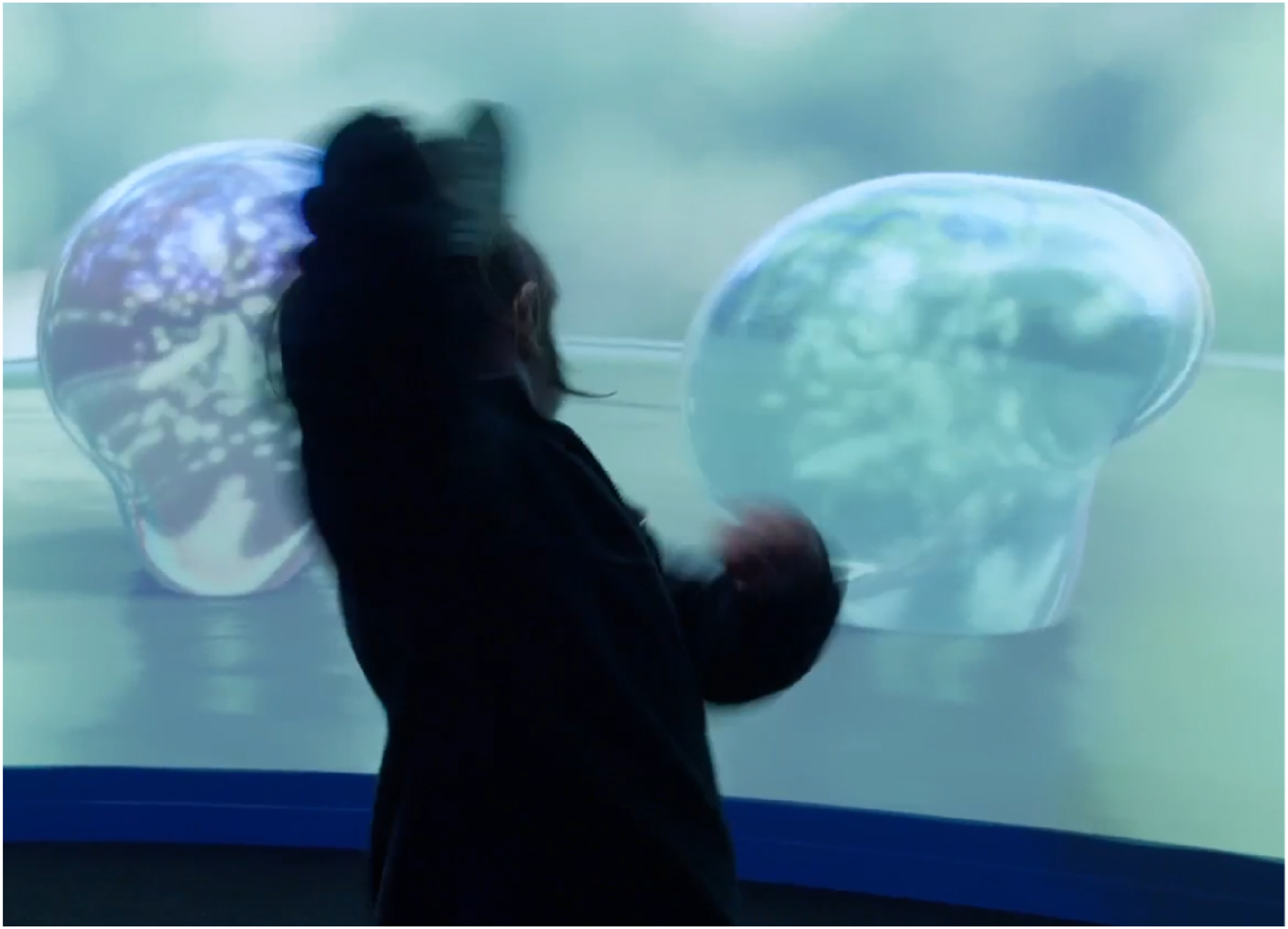
Children interacting with their peers about the artwork
The children often interacted with their peers when experiencing the three digital artworks, and in the process of these interactions, shared meanings about the artworks were often narrated collaboratively. Vignette 3 presents an example of an interaction between Isabelle and Lani who were talking with each other as they watched the figure transforming into different elements in the Transfiguration artwork.
Vignette 3. Peer interactions while watching transfiguration artwork
Isabelle and Lani stand next to each other against the wall across the room to the artwork. They are talking with each other while looking at the artwork. Isabelle: “It’s turning into fire. What’s it turning into now? Lani: “It’s water”. Isabelle: “Crystal. He’s turning into ice. It’s getting frozen. Oh, crystal coming out his arm. Look, it’s gold. He’s growing bubbles on his nose” (laugh). Lani: (pointing to the artwork) “Look, rainbow bubbles”.
In this interaction, the two girls collaboratively constructed their experience of the artwork, displaying many of the elements of play (Eberle, 2014) that ranged from anticipation (e.g., expectation and wonderment) to surprise (e.g., excitement and discovery), and pleasure (e.g., joy and delight). By questioning which form the figure was transforming into, Isabelle created the expectation as the two children waited in anticipation of the figure’s next transformations. The girls then took turns to comment on the different transformed elements, and in this process, together they experienced feelings of surprise as they discovered the elements (e.g., Look, it’s gold; Look, rainbow bubbles) as well as feelings of joy as they laughed at humorous comments about the figure (He’s growing bubbles on his nose).
While the above vignette shows an example of observations and shared meaning making, it was also evident in the data that children worked together to understand and make meaning of the digital concept of the artwork. Vignette 4 presents an example of the ways in which Alfie shares his understandings of the digital artwork, Kinfolk, with his friend Hayden. The interaction also shows evidence of the boys’ curiosity and interest (i.e., play element of anticipation), knowledge and mastery (i.e., play element of understanding), as well as thrill and excitement (i.e., play element of surprise).
Vignette 4. Alfie sharing his understandings of the digital in the Kinfolk artwork
Alfie steps on one of the four large dots to make his character move. He jumps several times and his character copies Alfie’s movements. He then continues to jump on and off the dot, then says excitedly to his friend, “Hayden, Hayden look. Every time I hop off it [the character] disappears. Look I'm going to hop off and come back on”. He jumps on and off the dot several more times, experimenting, looking to his friend and back at the screen.
Such sharing of experiences with peers also provided opportunities for the children to imitate and learn from one another, enabling new knowledge about digital technologies to be constructed. Vignette 5, for example, presents an excerpt from an interaction between Ruby and her friend Harry. Ruby watches Harry intently on one of the four dots in front of the Kinfolk artwork. When it is her turn to stand on a vacated dot, she uses several moves that she had observed to interact with her own character, suggesting that she is demonstrating pretend abilities of role play.
Vignette 5. Ruby observing and implementing moves from her peer while exploring the Kinfolk artwork
Ruby watches Harry standing on the dot next to her. He was jumping with his legs apart, two arms stretching, and says “Ooo”. Ruby exclaims in a high pitch voice, “Now Harry, I’ll do it”. She imitates the same actions as Harry two times. She steps off the dot, and quickly steps on again, repeating the step on and off several times in quick succession and watching the screen as she does. Her being on the screen disappears. She turns and says to the other children “I tricked it. I tricked it. I’m going to trick it”. She raises one arm and dances sideways. “Look I am tricking it. I tricked it”.
Having performed the moves like Harry’s, the child then explored on her own stepping on and off the dots and watched her character moved and changed in response to her steps. She expresses play elements of surprise (e.g., excitement) and pleasure (e.g., satisfaction, joy and happiness) as she excitedly shared with peers, referring at that time to having “tricked it”. Ruby later explained in her interview that she had discovered “a sensor that sensors you. And you don’t even have to stand on the circle while it sensors you. So, you could glitch the technology in one of the things”. Such exclamation of mastering the ability to ‘trick’ the technology and her later comment “you could glitch the technology” reflected her new knowledge that she constructed around how the digital worked in those interactive artworks at the museum – an element of play showing ‘understanding’.
Findings also showed that many children were actively making sense of their experience with digital artworks at the museum even when they appeared only to be observing their peers’ interaction with the artwork, as in the following vignette:
Vignette 6. Maya observing her peers’ interaction with symbiosis artwork
Maya was standing behind her friends Sara and Ana as they were having their turn on the dots in the Symbiosis digital artwork. Sara and Ana were moving their arms in the same way to make their blobs come together. The girls then start a play scene where their blobs appear to become characters in the play. They then try to catch each other by extending their arm movements to try to capture each other. There appears to be conflict in the play as they continue to build their script. Maya: “Hey Ana, you’re connected to her”. Sara: “Oh there I am. I’m pink”. Ana: “No, I’m pink”. Maya: “No, actually Sara is pink”. The girls continued to move their arms, making circles with their arms.
Even though Maya was waiting in line for her turn and not interacting directly, through body movements with the Symbiosis artwork, she appeared to be observing and actively making sense of her peers’ interaction with the artwork. Maya observed how Sara and Ana had made their blobs join together, smiled then feeling pleased and somewhat surprised, she commented to her peers that their characters had “connected”. Even when Sara and Ana appeared confused over which was their character, Maya stepped in to announce that it was Sara’s character that was the colour pink, seeming to have resolved the potential conflict in setting the scene for their story, enabling the two girls to continue with their play.
Children interacting as characters within the artwork
One of the recurring themes identified from interviews with the children was how they were attracted to the moving characters on the screen and their interaction with those characters. Many children expressed their enjoyment at playing with the characters, demonstrating the unique ways that the children were interacting as characters within the digital artwork from “having blob fights” to “making plants grow”, “got to be monsters and make them do cool moves”, and “copy the figure walking”. Interacting as characters within the digital artworks provided the opportunity for the children to engage in pretend play as characters that they could manipulate in imagined scenarios. The following two vignettes in this section show how the children were interacting with their peers as characters within the Symbiosis artwork.
Vignette 7. Elijah and Olivia role playing as characters within the symbiosis artwork
Elijah and Olivia stand on the two sensor dots of the Symbiosis digital artwork. Olivia moves her arms while watching the blobs move on the screen. Elijah stands on the other dot and jumps up and down and realises that the blob moves in the same direction. Elijah keeps experimenting then realises that he can jump on the spot and the blob moves as he exclaims, “I’m jumping”. He then lies on the dot and the blob gets smaller. Elijah laughs as his character appears to be laying down like he is. He looks at Olivia next to him and says “Look, I’m laying down. You’re never going to get me”. Meanwhile, Olivia follows Elijah’s move and lays down saying, “Now you’re never going to get me either”. Both children then stand and swing their arms, seeming to attack each other’s characters. Olivia says, “I killed you”. The characters on the screen connect to become one larger pink blob. “We are the same being”, exclaims Olivia. Both children then leave the dots when the characters disappear from the screen, marking the end of their turn as the next pair of children step up.
In this vignette, it is evident that the children start the play by establishing their character as part of the Symbiosis digital artwork. This development of character includes both children moving their arms and legs, jumping, and watching the screen. They display play elements of anticipation (e.g., interest and curiosity) and pleasure (e.g., joy and happiness) as they laugh with each other as their characters become more developed in their role within the narrative. Together, both Elijah and Olivia co-construct the story by inviting their peer to become involved. For example, Elijah invites Olivia to look at what he was doing (Look, I’m laying down), and follows this exclamation with an invitation to play together (You’re never going to get me). Olivia accepted the play invitation by assuming similar moves and verbal linguistic phrases to her peer (Now you’re never going to get me either). Both children proceeded to interact with the digital artwork (e.g., attacking; We are the same being) and with each other (I killed you) through their characters within the artwork. While the interaction was short, there is evidence of both pretend play abilities and play elements in this interaction. Both children engage in role play, impose meaning on the character, and present a simple play script that is co-constructed to make meaning of the digital artwork. They also show elements of pleasure (e.g., happiness, delight and fun) as they build their narrative around the digital artwork.
Further evidence of children engaging in pretend play is presented in Vignette 8. This vignette presents two children, Mia and Hilda, interacting with each other as their characters engage in an imaginary “blob fight” scenario:
Vignette 8. Mia and Hilda engaged in a “blob fight”
Mia and Hilda stand on the dots to interact with the Symbiosis digital artwork. Both girls sway their arms in a similar pattern to make their blobs move. Hilda immediately holds up her hand as if posing an attack move, smiles and says to Mia. Hilda: Let’s fight me. Mia: Attack (moves arms towards Hilda) The children move their arms, as if they are fighting, until the two characters/blobs connect on the screen. Mia: I got you. (steps left to right and continues to move her arms) Hilda: No, I got you. Oh yes, you did. The characters/blobs disappear from the screen. Hilda: Oh why do you have to go?
In this vignette, much like the previous one, Hilda invited (e.g., positioning her hands in an attack pose; Let’s fight me) Mia to play fighting as their characters/blobs. The invitation to play was accepted, and the children were soon engaged in “pretend” fighting by manipulating their characters/blobs in the digital artwork through body movements (moving arms in the direction of each other) and spoken language (Attack; I got you). Together, they co-constructed the meaning of their short role play through a short sequence of play actions, taking on the role of character in the form of the blob in the digital artwork, which were enacted through verbal and non-verbal language as well as using body movements (directing attack poses towards each other). Even though these interactions tended to last for a short while, due to the programming of the characters to disappear and reappear on the screen after a fixed amount of time, the children were able to sustain their blob fight for the duration of their turn and without any direct body contact with each other, demonstrating understanding of the digital blob as a character in the play.
Discussion
Museums have become a popular place for young children to visit, explore, play, and learn. Given that many of these spaces now integrate digital technologies into their exhibits, greater insight is needed to understand how children interact with, and make sense of, digital artefacts. This study explored how a group of young children in the early years of schooling made sense of digital artworks at the Beings exhibition through play. The research question guiding this research was: “How do young children in the early years of schooling make meaning of digital artworks through play at the Beings exhibition?”
Findings from the analysis of the video data showed three contexts that represented the broad ways in which the children interacted with the selected digital artworks (Transfigurations, Symbiosis & Kinfolk) at the Beings exhibition: (1) children interacting with the artwork individually, (2) children interacting with their peers about the artwork, and (3) children interacting as characters within the artwork. Collectively, this finding demonstrates the distinctive ways in which young children experienced digital artworks at one museum space to make sense of the artworks through play. Children experimented and explored individually, observed others, and worked collaboratively with their peers to co-construct meaning. Across these three interaction contexts, children used verbal and non-verbal language as well as body movements to interact with the digital characters, highlighting the central role of the body in meaning making as well as the use of talk in making sense of their experiences when interacting with human-designed digital artefacts (Kumpulainen et al., 2014). This seamless movement between the digital artworks and their own physicality showed children’s lack of separation between the digital and non-digital as they played and interacted to create meaning.
Children also demonstrated many elements of play as they interacted with the digital artworks. As all the vignettes have shown, as well as our own observations of the children as they entered the museum and moved towards the digital artworks for the first time, there was much anticipation. Eberle (2014) suggests that play begins with anticipation, which includes children being curious, ready and interested – a time where ‘there is an instant or an interval that separates what had not been from what soon will be play… [a time when] we imagine what happens next’ (222-223). In the case of the Beings exhibition, this interval was a time when children watched and moved towards the artworks prior to beginning to play with the artworks either individually or with their peers. Our findings also showed that as the children became curious about the digital artworks, they used body movements to make meaning of what was on the screen, which often led to elements of surprise, including laughter and high pitch talk - as evident in Vignette 5 where Harry was exploring the Kinfolk artwork with his friend Ruby.
Findings also demonstrated that this group of children experienced pleasure as they interacted with the Beings digital artworks at ACMI. Pleasure was often manifested in various expressions of joy, happiness, and fun as evident on children’s faces and through their body movements and verbal exclamations. Eberle (2014) argues that pleasure drives the play and is the keystone of play that leads to children wanting to play more. However, there were also incidences within the play that the experiences were not all fun and pleasurable but rather reflected points of conflict and incidences requiring a resolution in order for the play to continue. For example, in Vignette 6, Sara and Ana both wanted to be the same blob and showed signs of disagreement resulting in a pause in the play. However, such conflict was resolved by their peer, Maya, who observed and offered a solution that was taken up by the two girls.
Our findings also showed that the digital artworks also afforded children’s pretend play abilities including logical sequences of play actions, role play, and the construction of short narratives in the form of play scripts. Children’s interactions with the three selected Beings digital artworks showed how pretend play was constructed through a multilayered process in which children first needed to get acquainted with the affordances of the technology, often through observation and body movements, before incorporating it into their play as either establishing themselves as one of the characters or as a separate character to interact with. Often this would happen multiple times within the same artwork as they interacted, observed, created character and story and became more knowledgeable about what the technology could (or could not) do. Interestingly, the digital artworks that were more interactive, Kinfolk and Symbiosis, provided greater opportunities for children to either take on the role of a character or to interact as a character within the artwork. These experiences that encouraged children, either individually or with peers, to role play and to interact with characters suggest that children were also being provided with opportunities for developing literacy skills including narrative structure, inferencing, and taking the perspectives of characters in a story (Dickinson & Tabors, 2001; Nation et al., 2010; Paatsch and Toe, 2021). For example, as seen in Vignette 8, Hilda and Mia both co-constructed a short play script that involved taking on the role of the blob as a character in the play. They both moved their arms until their characters joined then taking the perspective of each character, they exclaimed that they had caught each other. Within this short sequence, a problem is posed later in their construction of story – a problem not created by themselves but by the design of the artwork itself whereby the blobs have disappeared off screen. Hilda acknowledges the problem but uses this interruption as part of the story by providing a resolution through her character, asking the question “Hilda: Oh why do you have to go?”.
Fewer opportunities for pretend play were evident in the Transfigurations digital artwork. Findings showed that this artwork provided opportunities for children to interact by touching the figure as it changed form. However, while there was no evidence of any children building story or complex sequences of play actions, there were instances where the children enacted simple role play by imitating the walking styles of the figure. Such differences in the play may have been more a result of the limitations of the human-designed digital artworks or the artist’s intended purpose of the artwork rather than as a reflection on the children’s pretend play. It is also difficult to determine whether some children, while not interacting with others or verbalising out loud, were creating story internally as they interacted with the artworks on their own. For example, from our observations of Holly in Vignette 2, we could assume that she is interpreting the blob as a character through her movements as she kicked and punched with her arms and legs. However, it was not clear whether she was building a story with the character or whether she identified herself as a character. These observations also appear to confirm the importance of independent play in supporting children’s curiosity and self-expression (Scott-Barrett et al., 2023).
Findings from this research also show that many children tried to discover the possibilities of the technology. For example, in the Transfigurations artwork, children often spent their time interacting with the artworks trying to find out what the technology could (or could not) do (see Vignette 1). For some children, like Ruby in Vignette 5, this resulted in tricking the technology, which should be seen as a form of play which derives pleasure from breaking the boundaries of the system (Sicart, 2014). This finding may also illustrate the ways that children engage with, and embed digital technologies, in their everyday lives – perhaps evidence of how children consider technology as not being separate from play as they make-meaning of their worlds (Chu et al., 2024). Finally, the findings from this study showed that the children’s interactions with digital artworks, particularly interactive artworks that enabled children’s control over the artworks, provided opportunities for exploration, agency, and creativity. This finding provides implications for designers of digital experiences to explore ways to provide children with greater agency and more choice to support their engagement with digital artworks at museums.
Conclusion
In this paper, we have explored children’s meaning making by examining their verbal and non-verbal language as well as their body movements as they interact with digital artworks through play in one museum in Victoria, Australia. This study has found three contexts in which the children interacted with the digital artworks, and how aspects of play are enacted as they experience these artworks. The three interaction contexts identified were: (1) individually, (2) with their peers about the artwork, and (3) as characters within the artwork. Within these interactions, the children expressed different types of pretend play abilities, such as role play, sequences of play actions, and simple play scripts, as well as many of the six elements of play, such as joy, happiness, fun, and understanding, as they made sense of the artworks and moved seamlessly between the digital and non-digital. Play provides enormous value for children’s cognitive, social, physical, and emotional learning and development including learning 21st century skills such as problem solving, creativity, and group work (Yogman et al., 2018), self-regulation and self-awareness, social capabilities, metacognition, and academic abilities (Creaghe et al., 2021; Paatsch et al., 2023). Given the value of play, particularly pretend/symbolic/imaginative play as is well documented in the literature, the findings presented in this paper confirm the strong benefits of incorporating playful experiences through digital artworks in museum spaces to encourage children’s learning and meaning making.
Footnotes
Acknowledgements
We acknowledge the generous time and valuable support provided from Susan Bye, Senior Producer, School Programs and the Education Team at ACMI. We also thank the children, parents, and teachers at St James Primary School who gave so willingly of their time and thoughts during the conduct of this research project.

Ethical considerations
Ethical clearance was granted from Deakin University Human Research Ethics (Application ID: 2024/HE000015) and the Diocese of Ballarat Catholic Education Limited (DOBCEL) on August 14, 2024.
Consent to participate
Organisational consent was provided by St James and ACMI. Consent was provided by the Year one and Year two children, their parents and teachers to take part in the research using Plain Language Statements and Consent Forms (PLSCF) prepared by the Deakin research team. Children also provided assent to be interviewed. All participants provided written informed consent prior to participating.
Consent for publication
All participants provided written informed consent for any data collected from them to be used for publication.
Author contributions
Authors 1 and 2 made substantial contributions to the conception and the writing of the manuscript. Data analysis was performed by Authors 1 and 2. The first draft of the manuscript was written by Authors 1 and 2 and critically revised by Authors 3, 4, 5 and 6. All authors read and approved the final manuscript.
Funding
The authors disclosed receipt of the following financial support for the research, authorship, and/or publication of this article: This work was supported by the Australian Research Council Centre of Excellence [project number CE200100022].
Declaration of conflicting interests
The authors declared no potential conflicts of interest with respect to the research, authorship, and/or publication of this article.
Data Availability Statement
Data will be made available on request.