



Abstract
As digital transformation reshapes early childhood education, Science Discovery Children’s Museums (SDCMs) emerge as uniquely positioned spaces to foster rich, multimodal learning environments that extend early literacy learning beyond the museum walls through family engagement. This paper presents a case study of an 8-week transmedia program co-designed with an Australian SDCM to foster young children’s multimodal literacy development through STEM-based family interactions across physical and digital contexts. The entry-level transmedia approach layered curated digital content and home-based activities onto an existing STEM exhibition, combining online activities, hands-on problem-solving, and museum visits. A total of 76 families, including 85 children aged five to nine, participated. Data sources included individual semi-structured interviews with 20 children and 16 adults from 15 families, along with 12 SDCM staff involved in program development and implementation, as well as digital platform analytics and social media interactions. Four narrative vignettes illustrate outcomes. Through analysis, themes were constructed to illustrate how children applied literacy practices across modalities such as gesture, image, text, speech, and material exploration, supported by parental scaffolding and collaborative reflection. The program fostered multimodal literacy development, intergenerational learning, and sustained engagement through STEM contexts. Framed within a multimodal view of literacy, computational thinking was conceptualised as a literacy practice involving the purposeful use of symbolic systems to make meaning, solve problems, communicate ideas, and construct knowledge. Children demonstrated computational thinking as a literacy practice through decomposition, pattern recognition, and algorithmic reasoning while developing scientific identities through playful inquiry. Parents became co-learners, creating reciprocal exchanges that strengthened family connections. Findings position SDCMs as transformative early childhood literacy learning environments and offer practical strategies for equitable, accessible digital engagement. This study contributes to understanding literacy as a socially situated, multimodal practice and provides a replicable, resource-efficient approach for cultural institutions seeking to extend multimodal literacy learning beyond physical boundaries.
Keywords
Introduction
This study investigates how transmedia approaches in Science Discovery Children’s Museums (SDCMs) can foster young children’s multimodal literacy through STEM-based family participation. SDCMs provide hands-on environments where children engage through movement, exploration, and sensory experiences (Flewitt 2005; Haywood et al., 2023). Within the context of these informal learning environments, a transmedia approach links home-based activities directly to exhibitions, supports testing and iteration during museum visits, and reinforces learning through subsequent home-based activities. This blending of exhibits, digital media, and online sharing positions SDCMs as ideal contexts for transmedia learning (Fleming 2013; Herr-Stephenson et al., 2013; Sánchez-Caballé and González-Martínez 2023; Yates et al., 2022). Transmedia learning refers to educational experiences unfolding across multiple media platforms, with each medium adding unique elements that extend the learning narrative. In the SDCM context, museum exhibits and digital media are coordinated to support engagement in STEM and multimodal literacy, with computational thinking intentionally embedded as part of the program design. Digital prompts, making activities, and social sharing created a dynamic literacy cycle embedding STEM concepts in everyday problem-solving (Huang et al., 2024; Takeuchi and Stevens 2011). Multimodal literacy in this context extends beyond written text to include gesture, image, speech, and material exploration (Djonov et al., 2021).
Despite this potential, most research on transmedia learning focuses on older learners, with a recent review identifying only two early childhood studies out of 24 (Sánchez-Caballé and González-Martínez 2023). The field remains largely theoretical, with little empirical evidence linking literacy and computational thinking in informal early childhood learning or demonstrating how museum and home activities connect in a cyclical process of engagement. This is despite calls to integrate these rather than teach them separately (Li et al., 2024a; Yadav et al., 2017) and the need for evidence-based models to guide post-digital transformation in informal learning (Giannini and Bowen 2019; Li et al., 2024b). To address these gaps, the research examined a co-designed transmedia program at an Australian SDCM that supported multimodal literacy in children aged five to nine. The 8-week program fostered scaffolded, intergenerational engagement across physical and digital contexts. Families used online Activity Pages, completed hands-on tasks, and participated in STEM-based challenges that created a cohesive learning journey. Findings are presented through four narrative vignettes showing how the program supported multimodal literacy through narrative-based challenges, collaborative meaning-making, and problem-solving across home and museum settings. The conclusion considers implications for SDCMs as transformative literacy spaces and offers practical insights for leveraging STEM contexts to advance transmedia learning in early childhood education.
Theoretical framework
Multimodal literacy and transmedia learning
This study positions children’s multimodal literacy as a form of cultural-historical activity (Engeström and Sannino 2010) in which children, families, and museum resources form an interconnected activity system that generates new multimodal literacy practices. Literacy practices are understood as socially situated ways of making meaning using diverse semiotic resources (Djonov et al., 2021; Jusslin et al., 2020; Serafini and Reid 2023), with multimodal literacy encompassing communication beyond written text to include image, movement, spatial navigation, and digital interaction (Deroo and Galante 2022; Djonov et al., 2021; Hackett 2014; Jewitt 2008; Jewitt and Kress 2003; Kress 2010; Walsh 2010; Woodard et al., 2024). In early childhood, this approach is significant because children naturally draw on diverse resources before conventional literacy skills are established (Kress 2010). It is dynamic and contextual, embedded in everyday activity across home and informal learning environments (Hull and Katz 2006; Meyers et al., 2013; Papadopoulou et al., 2023). STEM learning particularly engages these modes, as verbal, visual, mathematical, and embodied representations each offer distinct affordances for understanding complex ideas (Tang and Tan 2016). These modes are especially relevant in SDCMs, where learning occurs through physical exhibits, digital content, and interactive activities (Crowley et al., 2014; Pierroux et al., 2022; Yates et al., 2022). Children actively construct meaning through embodied, multimodal engagement, strengthened by social interaction with peers and adults (Falk and Dierking 2013; Flewitt et al., 2023; Hackett 2014; Kress 2010; Pierroux et al., 2022; Yates et al., 2022; Young et al., 2022). Multisensory, dialogic exploration further enhances engagement in STEM museum contexts (Flewitt et al., 2023).
Within such contexts, children adapt modes such as gesture, image, and text to reflect their interests (Djonov et al., 2021; Flewitt et al., 2023; Kress 2010). This capacity underlines the relevance of multimodal literacy theory for understanding transmedia learning (Sánchez-Caballé and González-Martínez 2023). Meaning emerges through the interplay of multiple modes, particularly in digital environments where they intersect with physical and social elements (Jewitt 2008; Kress 2010; Pierroux et al., 2022). Transmedia approaches integrate these media and settings, connecting digital, physical, and social experiences in informal environments (Djonov et al., 2021; Sánchez-Caballé and González-Martínez 2023). Unlike single-medium approaches, transmedia designs encourage movement between physical and digital spaces, with children hunting, gathering, and interpreting information across platforms (Jenkins 2010). In practice, this spans multiple platforms, each contributing uniquely to a broader narrative (Jenkins 2006; Sánchez-Caballé and González-Martínez 2023).
Intergenerational learning and collaborative meaning
This form of embodied engagement reflects the social dimension of multimodal literacy. It is grounded in Vygotsky’s (1978) concept of the zone of proximal development. In transmedia environments, parental scaffolding supports children’s engagement with complex ideas across multiple modes (Callanan et al., 2020; Marsh et al., 2015; Price et al., 2022). Family learning becomes a multidirectional exchange. Adults and children co-construct understanding through shared activity (Franse et al., 2020; Taylor and Kervin 2022). Gutiérrez’s (2008) notion of third spaces captures the convergence of diverse knowledge systems. This concept disrupts traditional hierarchies of expertise as children’s digital fluency complements adults’ contextual and experiential knowledge.
Computational thinking as a literacy practice
Building on socially situated, multimodal practices, computational thinking (CT) functions as a literacy practice for meaning-making across contexts. In this study, meaning-making refers to children’s capacity to interpret, express, and construct understanding through the orchestration of varied semiotic resources, including language, image, gesture, sound, and spatial arrangement (Kress 2010). From this perspective, literacy extends beyond print to encompass how children purposefully use these resources to communicate, solve problems, and make sense of their experiences in diverse environments. CT aligns with this understanding as a structured approach to meaning-making in digital, multimodal contexts. Originally described by Wing (2006) as a set of problem-solving strategies in computer science, CT includes practices such as decomposition, abstraction, pattern recognition, and algorithmic reasoning. These strategies support children’s engagement with multimodal texts by helping them parse information, identify key ideas, recognise recurring motifs, and organise their responses across platforms. Brennan and Resnick (2012) describe CT as a means of structuring knowledge, which complements the interpretive and compositional demands of multimodal literacy. In Science Discovery Children’s Museums, children enact CT as they engage with interactive exhibits that require the coordinated use of visual, spatial, linguistic, and material modes. Adult scaffolding supports these engagements in collaborative learning spaces, allowing children to experiment, reflect, and build understanding through both narrative and problem-solving processes (Jenkins 2006; Kesselheim and Brandenberger 2021). Together, these perspectives position children as active meaning-makers who integrate semiotic and computational resources to support scientific reasoning, inquiry, and communication.
Literature review
Experiential foundations and long-term impact in informal contexts
Experiential learning theory provides the foundational framework for understanding transmedia approaches in museum settings. Dewey’s (1963) principle that meaning emerges through cumulative experiences directly supports transmedia designs that link physical and digital engagement. Falk and Dierking’s (2013) Contextual Model advances this understanding by demonstrating how personal, sociocultural, and physical contexts interact to support meaning-making. Active engagement produces a richer understanding than passive observation. Recent empirical work confirms that children’s physical interaction with exhibits improves knowledge transfer across settings (Andre et al., 2017; Callanan et al., 2020). Taylor and Kervin (2022) found that play-based SDCM experiences foster multimodal literacy through verbal, visual, and embodied resources. Their work extends earlier studies by Crowley and Jacobs (2002) and Barron (2006), which demonstrated that deep topic knowledge develops through sustained engagement with personal interests across multiple contexts. However, experiential learning alone is insufficient without considering its social dimensions.
Social interaction is central to meaning-making in museums, which excel as intergenerational learning environments where adults and children co-construct meaning through shared exploration (Falk and Dierking 2013; Pierroux et al., 2022). Compelling museum experiences depend on both individual exhibit interaction and the quality of social meaning-making processes that extend beyond the visit, with recent research highlighting the importance of scaffolded museum interactions. McHugh et al. (2024) found that structured exhibits support parents in initiating explanatory conversations, encouraging deeper engagement and shared meaning-making between adults and children. Their findings align with Callanan et al. (2020), who showed that guided parent-child exploration enhances engagement during museum visits. However, as Drageset et al. (2025) demonstrated, such benefits depend on visitor preparedness, with pre-visit experiences helping families reduce anxiety and prepare expectations. Together, these studies indicate the need for coordinated support across pre-visit preparation and exhibit design to optimise family learning outcomes.
While these scaffolded interactions show promise, their benefits extend unevenly across populations. Marcus et al. (2023) demonstrated that families using museum resources at home sustained scientific interest and conversations post-visit, illustrating learning’s potential continuity across settings, a finding consistent with earlier work by Zimmerman et al. (2015) on how context-sensitive supports can extend situational interest in informal science learning. However, Matthews et al. (2024) caution that extended learning opportunities often privilege families with higher education, digital access, and science familiarity, perpetuating rather than reducing inequities. The tension between learning potential and access barriers underscores the importance of inclusive design strategies. In this program, deliberate accessibility choices, such as leveraging familiar exhibitions and offering multiple engagement pathways, aimed to address traditional barriers to extended museum learning and enabled participation across diverse literacy levels and socioeconomic backgrounds.
Transmedia learning and early childhood education
Transmedia approaches in SDCMs can shift learners from passive recipients to active meaning-makers, navigating interconnected platforms that disrupt linear pedagogical models, opening personalised pathways for sustained engagement (Jenkins et al., 2009; Meyerhofer-Parra and González-Martínez 2023). For example, flexible points of entry and opportunities for multimodal authoring enable even preschoolers to engage deeply with coherent narratives. They can develop critical literacy through remixing cultural resources and socially negotiated meaning-making within SDCMs exhibitions and across their linked digital spaces (Djonov et al., 2021; Potter and Cowan 2020; Yates and Szenasi 2022). Connecting on-site experiences with digital platforms beyond the SDCM visit can extend multimodal literacy development and support identity-building around personal interests, including STEM (Bell et al., 2009; Mateos-Rusillo and Gifreu-Castells 2018), with digital sharing strengthening these identities through community recognition (Hancox 2017). By leveraging these potentials, transmedia engages learners in navigating and integrating multiple modes such as text, image, gesture, and video, fostering multimodal literacy and inquiry (Djonov et al., 2021; Hovious et al., 2021; Jenkins 2006; Kress 2010). Research indicates that such approaches enhance engagement and knowledge transfer in informal contexts (Scolari et al., 2020; Meyerhofer-Parra and González-Martínez 2023). However, inclusive design remains essential as access depends on digital fluency and cultural familiarity (Matthews et al., 2024; Sánchez-Caballé and González-Martínez 2023).
Science discovery children’s museums and computational thinking
SDCMs provide opportunities for young children to engage with foundational CT practices (Andre et al., 2017; Kotsopoulos et al., 2022; Pierroux et al., 2022; Rennie and Williams, 2006; Yun et al., 2020). In these environments, children encounter scientific and computational ideas multimodally, using gesture and movement to explore concepts (Hackett 2014; Kress 2010; Piscitelli 2001). Such embodied approaches align with research on meaning-making through multimodal interaction (Djonov et al., 2021; Hovious et al., 2021). Extending this perspective, Kotsopoulos et al. (2022) and Saxena et al. (2020) found that young children can explore CT concepts through open-ended, hands-on activities, particularly when narrative-driven exhibits encourage family co-engagement. For example, tangible programming exhibits can make abstract CT ideas more accessible (Horn et al., 2008), and parents can support this learning by linking these ideas to everyday experiences (Yun et al., 2020). In this way, CT emerges as a form of meaning-making in which children use literacy practices such as pattern recognition, sequencing, and abstraction across physical and digital environments, strengthening digital literacies and family connections through collaborative inquiry.
Parent-child interactions and digital meaning-making
Parent-child interactions are central to children’s museum engagement and meaning-making. Studies consistently show that children exploring exhibits with parents engage more deeply and receive richer scientific explanations than those exploring alone (Callanan et al., 2020, Haden et al., 2014; McHugh et al., 2024). Through multimodal literacy practices involving visual cues, gestures and verbal elaboration, parents highlight key features, connect experiences to prior knowledge, and co-construct explanations (Crowley et al., 2001; Serafini and Reid 2023). Such scaffolding is not static but adaptively responsive to children’s needs, with parents shifting between direct instruction and guided discovery, tailoring their support to children’s emerging ideas. This adaptive support reflects the socially situated nature of literacy practices in informal learning environments (Callanan et al., 2020; Degotardi et al., 2019; Franse et al., 2020; Marcus et al., 2021; Pierroux et al., 2022). Digital sharing extends these practices beyond museum visits through sophisticated multimodal literacies. Drawing on established patterns of digital storytelling and memory-making (Ocular et al., 2022), families use digital platforms to sustain learning by recording and sharing experiences that support memory, prompt intergenerational discussion, and foster identity formation (Kim and Li 2021; Lazard 2022). They actively recontextualise museum experiences across modes and settings into new communicative forms (Lim 2018). Consistent with Gutiérrez’s (2008) third space concept outlined earlier, these interactions reveal digital literacy as fundamentally relational, unfolding across time, settings, and platforms, and illustrating how diverse knowledge systems converge in joint STEM exploration.
Participatory co-design in museum-based transmedia programs
Participatory co-design fosters transmedia program development by involving stakeholders in shaping educational content. This approach proves particularly valuable for museum settings, where diverse audiences require varied engagement strategies (Schuler and Namioka 1993). Defined as collective creativity applied across the entire design process (Sanders and Stappers 2008) and adaptable to multiple contexts (Simonsen and Robertson 2021), co-design in transmedia aligns storytelling, visitor experience, and educational intent. It does so through a collaborative process in which stakeholders contribute their skills and lived experiences to co-create the program (Aksela 2019; Ko and Chou 2012). Wakkary (2007) demonstrates how participatory processes enable staff to contribute institutional knowledge while also facilitating exploration, discovery, and prototyping with visitors (Stuedahl et al., 2021). This aligns with Science Discovery Centres’ emphasis on active engagement through visitor participation and co-creation, aimed at building stronger connections with audiences, ensuring programming reflects visitor needs, and increasing the likelihood of sustained engagement.
Research context and methods
Research approach
This study investigates how children’s multimodal literacy practices develop through transmedia experiences that intentionally connect SDCM visits with home-based learning through STEM-focused family interactions. Set within an 8-week co-designed program at an Australian SDCM, the research examines how children aged five to nine, alongside their significant adults, engaged with STEM concepts and literacy practices across physical and digital contexts. Grounded in an interpretivist paradigm and constructivist epistemology, this study recognises children as active meaning-makers who construct knowledge using diverse semiotic resources (James and Prout 1997). A single-case study design enabled detailed observation of evolving literacy practices as families engaged with transmedia activities across home and museum settings (Stake 1995). Ethics approval was granted (HRE2024-0040), with informed consent obtained from all adults and age-appropriate assent from children using visual aids (Powell et al., 2016). All data were anonymised.
Program context
Eight-week ‘Super-Human Potential’ transmedia program: Home activities, STEM concepts, and exhibit links.
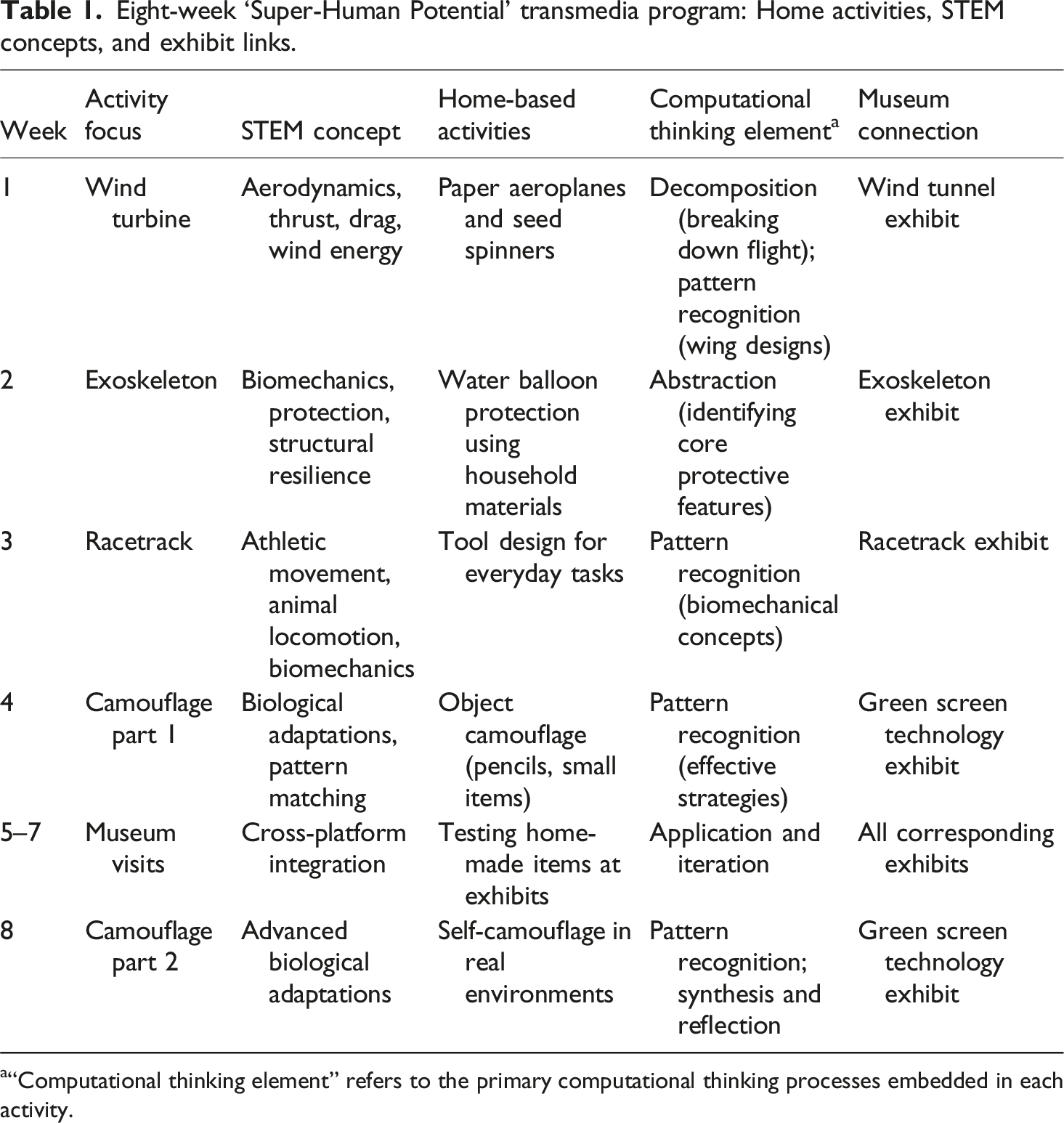
a“Computational thinking element” refers to the primary computational thinking processes embedded in each activity.
Each Activity Page was co-developed with science communicators and included STEM narratives, curated media from YouTube, TikTok, Instagram, podcasts and animated GIFs, activity instruction videos (including adult explainer videos providing scaffolding strategies), and CT challenges. The Activity Pages were intentionally designed to be age-appropriate multimodal texts for children aged five to nine, featuring large fonts, vivid imagery, and inclusive language to support both independent and family-assisted engagement. Each week’s learning sequence began with a narrative contextualising the STEM concept, followed by curated content that required children to synthesise meaning across platforms (Fleming 2013). Content was primarily curated from the SDCM’s archives and social media platforms, with new content developed only when necessary to complete each week’s STEM narrative. Adult Explainer videos supported both child learning and adult learning by providing background science and scaffolding strategies without giving direct instructions, preserving children’s agency while strengthening adults’ confidence in facilitating STEM engagement.
As part of the program structure, museum visits toward the end of the sequence were designed to bridge digital and physical literacy practices by encouraging participants to physically engage with the Human Potential exhibits. These visits enabled further STEM learning on each topic, extending prior digital exploration, and provided opportunities to test activities and challenges from the online program. For example, the Wind Tunnel exhibit allowed participants to test and iterate their paper planes from home-based activities, creating multimodal literacy experiences that connected digital learning, physical making, and embodied experimentation.
The collaborative development process drew on participatory co-design principles (Sanders and Stappers 2008; Wakkary 2007). The researcher provided transmedia learning theory and program structure, while museum staff contributed expertise in exhibit affordances, visitor behaviour, and institutional constraints. Design decisions emerged through collaborative dialogue rather than researcher-led consultation, with the creative team co-developing Activity Page layouts, website elements, and visual design. This participatory approach, aligning storytelling, visitor experience, and educational intent, ensured that the program reflected visitor needs, strengthened connections with audiences, and increased the likelihood of sustained engagement while maintaining theoretical rigour. To support and sustain this engagement in practice, the program employed a timed weekly release strategy supported by SMS and email prompts, creating a predictable framework for families to navigate. Social sharing prompts encouraged participants to document and share experiences in a moderated Facebook group, fostering a broader community of practice and enabling multidirectional engagement between home and museum settings throughout the 8-week sequence.
Participants
A total of 76 families, including 85 children, were recruited from the SDCM’s member base. Following program completion, 15 families were selected for interviews through a multi-stage process based on demonstrated program engagement, evidenced through Activity Page completion and Facebook group participation. Final participation was voluntary, with families self-selecting into the interview process. Of the 20 child participants interviewed, most were aged five to eight, with two aged nine.
Data collection
A multi-method approach captured participants’ experiences through semi-structured interviews conducted after the program as the primary data source. These included individual semi-structured interviews with 20 children and 16 adults from 15 families, along with 12 SDCM staff involved in the program’s development and implementation. Visual prompts from the program enhanced children’s recall and sustained engagement, with parents present but intervening only when needed to keep children’s voices central. Interview data were complemented by digital platform engagement analytics and qualitative Facebook group content, including posts, images, and comments. This triangulated data set (Flick 2018) supported a nuanced understanding of how literacy practices developed through family interaction and informal learning.
Analysis and narrative vignettes
Reflexive Thematic Analysis was employed, recognising that themes are constructed through iterative and interpretive engagement with the data (Braun and Clarke 2006, 2019). The process involved repeated readings of interviews and social media content, followed by initial coding and refinement into themes representing children’s literacy practices. Braun and Clarke’s (2019) guidance on reflexive thematic analysis informed both the decision to conclude data collection, once the research team determined that the interviews provided sufficient depth and richness to address the research questions, and the subsequent coding and theme development process. Shreya’s vignette illustrates how individual cases informed broader themes. Her biochemistry background shaped a hypothesis-driven approach to the exoskeleton activities with her children, which was initially coded under “guided activities” and later refined into the broader theme of “scaffolded scientific inquiry.” The iterative coding process progressed from identifying multimodal moments in which children engaged across visual, gestural, spatial, verbal, and digital modes to developing broader themes that captured how these practices supported STEM learning and family engagement.
Narrative vignettes effectively captured the complexity of participants’ experiences (Richardson and St Pierre 2005), highlighting emotional, embodied, and ethical dimensions often overlooked in conventional analysis (Ellis and Bochner 2000). Four vignettes, drawn from interviews and social media data, each focused on a single family while reflecting broader engagement patterns. Grounded in participant accounts, dialogue and descriptions were synthesised to illustrate recurring dynamics while preserving the integrity of the families’ experiences (Ely et al., 1997). Elements of dialogic narrative methods were incorporated to deepen the analysis of meaning-making (Frank 2010; Riessman 2008), focusing on how children and adults co-constructed meaning and responded to transmedia narratives. The integration of narrative vignettes with reflexive thematic analysis represents a significant methodological contribution to transmedia research, where traditional analysis methods often struggle to capture the dynamic, cross-platform nature of learning experiences (Braun and Clarke 2019, 2021; Jenkins 2006; Johnston et al., 2021; Scolari 2013).
Findings
The findings explore how the transmedia program fostered literacy practices that extended across contexts, platforms, and relationships. These are presented through four narrative vignettes illustrating key themes identified via dialogic narrative analysis of interviews with children and their significant adults, supported by Facebook group data. Dialogue within the vignettes has been edited for clarity while preserving the intended meanings and intentions expressed in the original transcripts.
Vignette 1: Family togetherness: Scaffolded scientific inquiry
Gyles and Shreya, with their children Miraya (8) and Dayaal (7), took part in the exoskeleton water balloon challenge, illustrating how transmedia learning supports collaborative family inquiry while allowing children to pursue their own questions and ideas. “Can I drop it next?” Dayaal bounced on his toes, clutching a water balloon nestled in a protective paper towel. “We need pavement, soil, and water to test how strong our exoskeletons are,” Miraya said, adjusting her balloon covering. Shreya, her biochemistry background evident in her methodical approach, guided their next steps by suggesting they test from different heights. At the same time, Gyles positioned himself to capture the moment on video. “Ready when you are, scientist,” he called with genuine enthusiasm. Dayaal’s balloon, wrapped in cardboard and bubble wrap, survived the pavement drop intact. “It didn't splash!” he exclaimed, while Miraya’s burst on the soil. After several tests, Dayaal examined his balloon with growing curiosity. “I don't understand. Why does mine keep surviving when Miraya's keeps breaking?” Shreya prompted, “What do you think is happening?” Dayaal turned the balloon over thoughtfully. “I think not all balloons break the same way. Even with the same wrapping, it doesn't break. But Miraya’s always does.” He paused, puzzled, as if realising the problem might not just be about luck or chance. “So, you've discovered something about protection and impact,” Gyles said, smiling. “Yeah. I learned that when balloons are inside things, they don’t always break. It depends on what's protecting them.” Gathering materials from the garden for her next attempt, Miraya suggested, “Let's try different materials. Maybe we could use that plastic container with cotton balls inside?” As they played, Shreya asked, “Did you feel we were helping too much or not enough?” Miraya replied, “It was just right. You gave us ideas but let us figure it out too.” Dayaal grinned, “And Dad taking videos was the best part.” Reflecting on the experience, Shreya said. “What I loved was creating an environment where mistakes can be made. They expanded their problem-solving without consequence.” Gyles added, “The wow moment that was shared... that mutual learning together... it defied age for me. We were all scientists today.” The water balloon challenge strengthened family bonds through shared discovery, bridging digital and physical learning.
The water balloon challenge created a space for scaffolded scientific inquiry, where the family co-constructed ideas, tested solutions, and built shared understandings through mutual collaborative inquiry.
Vignette 2: Parallel discoveries: Learning and growing together
Lila and her son Omar (7) engaged in the camouflage activities, demonstrating how transmedia fosters parallel yet interconnected learning journeys. After browsing the program's Facebook group, where other families had shared their camouflage experiments, Omar sat watching videos about camouflage with unusual focus for a typically shy seven-year-old. “Can we try that now?” he asked, pointing to a chameleon that had perfectly matched its leafy background. Lila looked up from her thesis draft, surprised by his enthusiasm. “Look, Mom! I'm going to hide!” Omar arranged his blanket over himself, carefully positioning himself among the grey, blue, and white patterns. “Why do animals camouflage themselves?” Lila asked. Omar sat up straighter, confident. “The animals hide to protect themselves or hide themselves to attack prey,” he replied, his voice steadier than usual when explaining concepts. “Camouflage,” Lila repeated softly, the unfamiliar English word settling on her tongue. “This is the first time I’ve learned this word in English. I only knew the Arabic words before.” Omar tested different objects against various backgrounds. “Some were patterns and some were solid colours,” he explained. Moving to Lila’s bedroom, Omar announced, “I’m on your bed. Putting a blanket over me so no one can see me,” disappearing beneath the patterns as Lila pretended to search for him. Later, they prepared to share their experience on Facebook. She watched as he confidently typed, ignoring her suggested phrases. “You’re better than me in English,” Lila said softly. “I told you what to write, but you used your own words. I’m really surprised.” Their roles had reversed in this moment, with the PhD student learning from her seven-year-old son. She set her pen down, suddenly reflective. “Do you know what I learned from our activities? I learned many things about STEM. Doing the activities and watching the videos together was better than I expected.” Omar’s eyes brightened. “It was fun!” he declared, rating their experience “Five out of five!” Lila immediately responded, “Ten!” Her hands spread wide, doubling the scale in her enthusiasm.
Their camouflage exploration demonstrated how transmedia engagement can support parallel yet interconnected learning journeys, fostering moments of mutual discovery between parent and child.
Vignette 3. Flight path: Creating connections that strengthen family bonds
Joe and his son Tim (6) connected through the paper plane activity, illustrating how a simple transmedia activity can spark unexpected connections through a shared enthusiasm for flight. “Paper aeroplane!” Tim exclaimed as it soared across the living room. Kelly watched him grab another piece of paper, grateful for this shared moment. “That flew really well. Which fold did you use?” Tim held up his plane, pointing to the wing edges. “I angled them up. Rectangles work better than squares. Squares don’t make good planes.” The sound of keys at the door interrupted him. As Joe stepped inside, Tim clutched several planes and raced to meet him. “Daddy, look what I’ve made!” Joe crouched down. “Wow, that’s a serious squadron.” Singling out one plane, Tim said, “Wings like this help it fly straighter. Watch this.” Joe’s eyes widened. “That’s new. Where’d you learn that?” Tim pointed to the tablet without looking up. “From the video. Toby said it’s about thrust and lift.” Joe leaned in, “I used to make these when I was your age.” Tim looked up, beaming. “Let’s race! You make yours how you used to, and I’ll use mine from the iPad.” Joe’s first attempt nosedived. “You need to bend the wings,” Tim said, adjusting it with quiet precision. “The wind needs a way to bounce.” Joe tried again, watching in awe as the plane soared. “Hey! That actually flew!” Tim nodded, his face lighting up. “Much better. Now it has acceleration.” Tim proudly announced the next evening, “I taught everyone at school.” Surprised, Joe asked, “Did you teach them about thrust and lift?” Tim nodded, “Yep! I even showed them how to fold the wings like this.” Joe chuckled. “You’re turning into an engineer.” Tim pointed to Joe’s office. “Can we try your flight simulator too?” Joe’s heart skipped a beat. “You want to fly with me?” Tim’s eyes widened. “Yes.” Joe’s voice softened, touched by the depth of Tim’s focus. “I’d love that.” Kelly observed from the doorway. Their connection was taking flight.
This simple transmedia activity created unexpected connections through Tim and Joe’s shared enthusiasm for flight, strengthening their relationship and sparking new opportunities for shared exploration.
Vignette 4: From exhibit to everywhere: Rory’s sustained STEM engagement
Tian and his son Rory (5) engaged enthusiastically with the program activities, demonstrating how transmedia can extend multimodal literacy development into everyday life beyond the program’s completion. In the weeks after the program ended, Rory’s bedroom floor was barely visible beneath dozens of paper planes. His small fingers worked methodically, creasing another sheet. “Dad! Look what I made!” Rory called out excitedly. “Another plane?” Tian asked, noticing unusual folds. Rory shook his head vigorously. “Nope! It’s a diamond! Like a jewel!” he announced proudly. “Did you learn that from someone?” Tian asked. “No, I just like folding stuff,” Rory explained, demonstrating his deliberate sequential movements. “You must have made a hundred planes by now,” Tian remarked, surveying the collection. “This one curves when it flies because I bent the wings up. And this one goes super fast but drops really fast.” Rory explained, mimicking flight patterns. “I learned that from the wind tunnel testing. Big things and small things fly differently.” When Tian asked what motivated his continued experimentation, Rory shrugged.. “I wanted to see what would happen. Some work better than others.” He pointed to a complex design. “This one took me three tries to get right.” A moth fluttered against the bedroom window. “Dad, look! There’s a moth. See how it’s camouflaged!” Rory gasped. “Remember when I hid with my yellow Minion shirt against the yellow chair? You could only see my head!” He giggled. “You’ve been spotting camouflage a lot lately,” Tian observed. “I notice things camouflaging everywhere now,” Rory exclaimed. Watching his son move so confidently between these explorations. Tian asked softly. “Did I help too much with those activities?” Rory considered carefully. “Just enough. You helped when I got stuck sometimes, but I still got to figure things out myself. That’s how you learn stuff.” Tian marvelled at how structured activities had sparked such enduring curiosity. The program had shifted how Rory saw the world, turning everyday moments into opportunities for exploration.
Rory’s sustained engagement illustrates how transmedia experiences can extend multimodal literacy development into everyday life beyond the program’s completion, transforming how he observed the world and inspiring continued creative exploration. This sustained engagement also strengthened the multimodal literacy and problem-solving skills that shaped his emerging identity as a confident and capable STEM learner.
Discussion
Literacy practices, participant context, and program implications
This study demonstrates how transmedia programs can foster multimodal literacy practices that extend across home and museum contexts. Literacy practices are understood here as socially situated acts of meaning-making that use multimodal resources such as gesture, image, text, and speech (Jewitt and Kress 2003; Kress 2010; Serafini and Reid 2023). These practices involve using digital and material resources flexibly across everyday settings to support literacy development (Djonov et al., 2021; Jusslin et al., 2020). Literacy is viewed as dynamic and embedded in identity and community, shaped through social interaction and material culture, with meaning co-constructed across digital and physical media (Pahl and Rowsell, 2012). This framing provides the foundation for interpreting how the transmedia program fostered literacy practices that extended across contexts, platforms, and relationships. In this study, literacy practices were often shaped by the knowledge, skills, and experiences adults brought to the program.
A significant theme was the background of participating adults, which emerged during post-program interviews. Many held bachelor’s or postgraduate degrees in STEM, education, or the humanities, and this educational expertise influenced engagement through sophisticated scaffolding. Shreya’s biochemistry background, for example, supported systematic experimentation in the exoskeleton challenge, guiding her children’s inquiry while preserving their independence. Cultural diversity also shaped participation, as illustrated by Lila, who, while completing her doctoral thesis, brought a multilingual perspective to the camouflage activities and encountered the English term camouflage for the first time during the program. Such moments enriched shared learning and expanded opportunities for meaning-making across languages. This aligns with Falk and Dierking’s (2013) observation that museum audiences often reflect cultural capital. The educational and demographic profile of families raises questions about equity and inclusion in informal learning environments (Dawson 2014; Matthews et al., 2024), despite the program’s accessible exhibits and materials. Together, these forms of diversity enriched the dialogic nature of transmedia learning, suggesting that programs can be especially potent when both adult knowledge systems and cultural perspectives are leveraged in interest-driven inquiry. Addressing these disparities through accessible formats and flexible entry points can help broaden participation while preserving the benefits of adult-supported scaffolding.
Providing accessible formats and flexible entry points creates the conditions for adult-supported scaffolding, reflecting Vygotskian principles (Vygotsky 1978) in which adult expertise extends children’s learning within their zones of proximal development. Such patterns align with equity priorities highlighted by Matthews et al. 2024 and demonstrate how museum experiences can reframe children’s participation from passive consumption to active literacy co-construction. While museum digital transformation discourse often emphasises technology as a primary driver of learning (Giannini and Bowen 2019), the findings of this study show that sophisticated literacy outcomes are possible without costly technology-first approaches. In the Super-Human Potential program, strategic design, low-cost curation, and human-centred scaffolding enabled complex meaning-making, including computational thinking as a literacy practice, sustained multimodal engagement, and strengthened intergenerational learning. These findings align with equity-focused literature (Matthews et al., 2024; Dawson 2014), which warns that resource-intensive solutions can deepen participation gaps. They also highlight the relevance of intentional, accessible design for cultural institutions that cannot afford costly technological upgrades.
The Super-Human Potential program demonstrates how SDCMs can extend multimodal literacy development beyond physical spaces through STEM-based intergenerational engagement. The four narrative vignettes reveal interconnected ways transmedia supports early childhood STEM learning through meaningful family participation. Children acted as meaning-makers, exploring, interpreting, and extending scientific ideas through multimodal expression. This study advances three theoretical areas: positioning CT as a literacy practice rather than a separate cognitive skill, demonstrating resource-efficient transmedia implementation through strategic curation, and revealing how informal learning environments function as collaborative meaning-making spaces. The program’s success in sustaining engagement aligns with research indicating literacy develops more rapidly when learning connects with children’s lived experiences and interests. By positioning children as active knowledge constructors, the transmedia approach reflects contemporary views of early childhood literacy as socially situated, culturally responsive, and multimodal (Burnett and Merchant 2020). The inclusion of CT within literacy practices suggests problem-solving frameworks complement traditional literacy, supporting more resilient pathways for meaning-making across diverse contexts. The findings illustrate that a resource-efficient transmedia approach, grounded in strategic curation and co-design, can deliver powerful learning outcomes without costly technology-first solutions. Such an approach offers a sustainable pathway for cultural institutions to meet post-pandemic digital expectations while preserving accessibility and educational integrity.
Transmedia as a bridge between contexts: Extending museum learning
The program alternated between home-based digital engagement and in-person museum visits, forming a cyclical process where home activities linked directly to exhibitions, museum visits allowed testing and iteration, and follow-up activities reinforced and extended learning. This cycle demonstrates the capacity of transmedia learning to connect contexts by linking home-based digital prompts to museum experiences, extending engagement beyond institutional boundaries, and reinforcing learning through subsequent home-based activities (Sánchez-Caballé and González-Martínez 2023). In Vignette 4, Rory’s interest in paper planes began with home activities, expanded during his museum visit, and continued afterwards, illustrating how transmedia can extend multimodal literacy development beyond program participation. Activity Pages acted as touchpoints linking home and museum experiences, supporting non-linear, inquiry-driven exploration. Families could follow their interests rather than a fixed sequence, aligning with Jenkins’s (2010) concept of transmedia storytelling and Kress’s (2010) view of literacy as multimodal, where varied representations shape meaning-making. Children navigated digital and physical spaces, integrating experimentation, scientific reasoning, dialogue, gesture, material exploration, and verbal reflection. The approach also increased accessibility as families with limited time engaged at home during quieter moments, while those unable to attend in person still participated meaningfully. Variation in digital literacy, infrastructure, and preferred activity type meant some families engaged deeply with digital content while others focused on physical activities. This diversity underscores the value of multimodal design in accommodating different access levels, schedules, and literacy backgrounds. Effective transmedia programs should maintain such flexibility to support broad participation.
Multimodal literacy development through transmedia engagement
Multimodal problem-solving activities supported literacy development as children interpreted instructions, experimented with materials, and made meaning from their creations, often carrying concepts into everyday contexts. Parents and children documented these moments together and shared them in the program’s Facebook group, adding a collaborative layer where learning was valued and reflected upon. Structured problem-solving fostered CT while reinforcing multimodal literacy, with digital content extending STEM learning from exhibits, inspiring hands-on activities at home, and sustaining meaning-making across settings. Children engaged across visual, spatial, gestural, oral, digital, verbal, and action-based modes, encouraging experimentation, recombination, and expression across platforms, reflecting the semiotic practices of science learning described by Tang and Tan (2016). These multimodal activities supported early literacy as children interpreted, experimented, and expressed ideas through varied modes. Engagement extended into everyday contexts and conversations, with parents’ online sharing affirming learning at home and adding layers to the program’s multimodal ecosystem. The vignettes illustrated these practices: in Vignette 1, Dayaal and Miraya explored water balloons while their mother, Shreya, fostered risk-taking; in Vignette 2, Omar progressed from watching videos to conducting experiments, with his iterative testing reflecting Hackett’s (2014) account of embodied literacies in informal learning.
Alongside literacy, children developed CT through tasks that integrated decomposition and sequencing while fostering exploration and persistence. Digital content extended science themes from exhibits, offering ideas to try at home, which children documented and shared. This movement between digital and physical spaces generated ongoing learning opportunities. Children reshaped science content to align with their interests and experiences, reflecting Jenkins’s (2006) concept of remix and Kress’s (2010) multimodal meaning-making. These layered processes illustrate how varied semiotic resources combine to create meaning, aligning with the multimodal ensemble approach described by Serafini and Reid (2023) and Woodard et al. (2024). This also aligns with Djonov et al.’s (2021) observation that young learners draw on digital and physical resources in hybrid ways. These ensembles supported literacy and problem-solving while shaping children’s identities as learners, scientists, and problem-solvers.
Identity formation, scientific thinking, and computational thinking
A key outcome of the program was children’s growing confidence and emerging identities as scientific thinkers. They combined playful exploration with intentional inquiry, drawing on personal experiences and interests to interpret scientific ideas. In Vignette 3, Tim explained flight principles to peers at after-school care, using knowledge from the program’s activities. This deepened his understanding and strengthened his connection with his father, who had a background in aviation. Such exchanges extended learning into everyday social contexts, supporting the formation of early childhood identity as learners and scientists. CT served as a scaffold for these identities, introduced through open-ended, hands-on tasks that encouraged experimentation and problem-solving. Children demonstrated how CT processes supported multimodal meaning-making. Dayaal used decomposition to explain, “I think not all balloons break the same way… it depends on what’s protecting them.” Omar applied pattern recognition from digital to physical experimentation, noting, “Some were patterns and some were solid colours.” Rory’s algorithmic testing generated precise vocabulary: “This one curves when it flies.” Tim’s abstraction enabled him to generalise principles, such as “Rectangles work better than squares.” He shared these with classmates, demonstrating how CT supports both scientific reasoning and knowledge sharing. Together, these examples show CT functioning as a multimodal literacy practice, where computational processes help children interpret, analyse, and communicate scientific understanding across visual, verbal, and physical modes (Brennan and Resnick 2012; Jewitt 2008; Kesselheim and Brandenberger 2021; Kotsopoulos et al., 2022; Kress 2010; Wing 2006). Children used CT as a literacy practice to strengthen communication, explanation, and knowledge transfer while reinforcing their identities as capable scientific thinkers.
Intergenerational learning
The program fostered reciprocal learning across generations, creating opportunities for shared inquiry rather than positioning adults as instructors. In Vignette 2, Lila deepened her own scientific understanding while supporting Omar, and in Vignette 3, Tim’s exploration sparked conversations with his father, who extended the activity through his aviation knowledge. Such moments reflect Gutiérrez’s (2008) concept of hybrid learning spaces, where everyday experiences intersect with disciplinary knowledge, strengthened by the program’s design features. Adult Explainer videos aligned with Vygotsky’s (1978) zone of proximal development and Rogoff’s (2003) emphasis on participation in cultural practices, offering accessible guidance that strengthened adults’ role as scaffolds. This reflects Crowley et al.’s (2001) and McHugh et al.’s (2024) findings that structured supports enable adults to scaffold inquiry without overtaking children’s agency. As one child described, parents provided ideas but allowed independent problem-solving, preserving agency within joint activity. Through this approach, SDCMs functioned as informal learning environments grounded in embodied participation, fostering multimodal literacy through hands-on engagement, material exploration, and shared meaning-making. Rather than presenting knowledge as fixed or adult-led, the program cultivated dynamic relationships in which families became co-learners, sustaining engagement, positioning children as capable STEM learners, and shaping their literacies across diverse settings while also addressing a gap in early childhood transmedia research in informal contexts.
Limitations
This study offers valuable insights into how transmedia approaches can support multimodal literacy development in SDCMs, but several limitations must be acknowledged. As a single-case study conducted at one SDCM in Australia, it provided in-depth exploration within a specific institutional and cultural setting, offering rich detail but limiting transferability to other contexts. Globally, equity challenges are shaped by disparities in infrastructure, data costs, device access, and cultural relationships with technology. Transmedia programs developed in well-resourced settings may unintentionally exclude families in communities with limited connectivity or differing digital engagement patterns. The entry-level transmedia approach addressed some of these concerns by adapting existing materials rather than relying solely on bespoke digital content. However, further development is required to ensure equitable participation, including low-bandwidth or offline options, multilingual resources, and culturally responsive community engagement strategies. Most participants self-selected from the SDCM’s membership base, representing families already engaged with the institution. Post-program interviews showed a notable skew toward adults with higher educational qualifications, including postgraduate degrees in STEM, education, and the humanities. This demographic profile may reflect the influence of cultural and educational capital on participation (Falk and Dierking 2013), potentially limiting insights into how such programs might engage less-connected or first-time visitors. Finally, the study captured only short-term engagement, highlighting the need for longitudinal research to explore how transmedia experiences influence children’s literacy development and STEM learning over time.
Recommendations
This study affirms that transmedia approaches can extend museum-based STEM learning and support multimodal literacy in early childhood. To maximise their potential, future initiatives and research should prioritise cultural adaptability, equity, and practical design strategies.
Cultural adaptation and future research
Longitudinal research should investigate how transmedia-supported scientific identities develop over multiple years. Cross-cultural studies could evaluate the adaptability of this accessible transmedia approach in varied institutional and community contexts. In contrast, comparative research with more resource-intensive approaches could establish benchmarks for cost-effectiveness. Cultural consultation and localisation should be integrated from the outset to ensure authentic representation, language inclusion, and alignment with community expectations. Future research should investigate how transmedia literacy practices cultivated in museum contexts extend across children’s broader ecological systems, encompassing home, school, and community settings, to develop longitudinal understandings of how such practices are transferred, adapted, and transformed over time.
Equity and accessibility
Equitable programs should offer multilingual resources that prioritise local languages, incorporate low-bandwidth or offline options, and feature activities using only readily available household items, avoiding additional purchases. Flexible entry points, visual-first content, and culturally responsive narratives can accommodate different literacy levels and family structures. Partnerships with schools, libraries, and cultural organisations can help reach audiences beyond traditional museum visitors. As families with higher educational capital may be more likely to engage with extended learning opportunities (Matthews et al., 2024), program design should also address the needs of those without such advantages, ensuring that children from all educational backgrounds benefit equally from transmedia engagement.
Implications
For practice
Structured digital-physical sequences, such as Activity Pages paired with hands-on tasks, can support adult facilitation while preserving children’s agency. Moderated social sharing encourages reflection and builds community connections, while multimodal resources, including videos, short clips, podcasts, and physical activities, help children synthesise meaning across modes. This scalable transmedia approach provides a replicable model for cultural institutions seeking meaningful digital integration without requiring extensive infrastructure.
For theory and policy
By framing computational thinking as a literacy practice, this study shows that an entry-level transmedia approach can sustain engagement without relying on costly technology-first solutions. The co-designed approach offers adaptable strategies for extending learning beyond institutional boundaries while accommodating diverse family contexts. At a policy level, the findings support investment in accessible, community-responsive initiatives as cost-effective pathways to equity in informal STEM learning. Looking ahead, this approach anticipates a future where museums serve as literacy innovation hubs that bridge formal and informal learning through family-centred transmedia design.
Conclusion
This study shows how Science Discovery Children’s Museums (SDCMs) can be transformative early childhood literacy environments by extending multimodal literacy beyond physical boundaries through STEM-focused transmedia approaches. Structuring learning as a cyclical process linking home activities, museum visits, and follow-up engagement sustained participation, deepened multimodal literacy, and connected STEM concepts to children’s everyday experiences. Positioning computational thinking as a literacy practice and embedding transmedia learning within the cultural ecology of SDCMs provides new insights into how young children develop literacy in contemporary settings. These strategies can sustain engagement beyond program participation, embedding learning into everyday family life and expanding the educational potential of informal learning spaces. As museums worldwide navigate post-pandemic digital transformation and prepare for AI-integrated environments, this research demonstrates that sophisticated literacy outcomes can be achieved through strategic, theory-informed design rather than costly, technology-driven solutions. The co-designed, low-resource transmedia approach offers a transferable, resource-efficient approach that other informal learning institutions can adapt to promote equitable multimodal literacy and sustained STEM engagement.
Footnotes

Ethical considerations
This study was approved by the Curtin University Human Research Ethics Committee at Curtin University (Ethics Approval Number: HRE2024-0040). All procedures followed were in accordance with the ethical standards of the responsible committee on human experimentation (institutional and national) and with the Helsinki Declaration of 1975, as revised in 2013.
Consent to participate
Written informed consent was obtained from all adult participants included in the study. Children provided verbal assent using age-appropriate forms with visual cues. All participants were informed of their right to withdraw from the study at any time without consequence.
Consent for publication
Written informed consent for publication was obtained from all participants. All identifying information has been removed from the manuscript to protect participant confidentiality. Pseudonyms are used throughout to protect participant identities.
Funding
The authors disclosed receipt of the following financial support for the research, authorship, and/or publication of this article: This study was supported by Simon Daniele received an industry scholarship from Scitech Science Discovery Centre to support this doctoral research.
Declaration of conflicting interests
The authors declared no potential conflicts of interest with respect to the research, authorship, and/or publication of this article.
Data Availability Statement
The datasets generated and analysed during the current study are not publicly available due to ethical restrictions related to participant confidentiality and the involvement of children in the research. De-identified data may be available from the corresponding author on reasonable request and with appropriate ethical approval.