




Abstract
For many children, their home is where they first encounter digital media technologies. The aim of this study is to investigate how children 0 – 3 years old engage in digital media. We address digital literacies as a sociocultural mindset and a toolbox with attention to skills and comprehensions as well as how children express their agency. The overall research question is: What skills, comprehension, and agency children 0 – 3 years old perform and express when engaged in digital media? We have studied 16 families in Sweden and followed the methodology of “A Day in the Life” developed by Gillen et al. (2007). The study shows that children use technology in their interactions of play in for example video calls, and that dexterity skills are early developed in relation to touch screens. The study also shows that children express agency toward digital media in several ways, for example in taking actions and initiatives. The study concludes that although there is an increased interest in young children’s digital media practices there is still need for more studies with focus on the very young children.
Keywords
Introduction
“And we also thought that Pelle thinks that the smartphone is very interesting…he looks at the phone because he knows it’s there, FaceTime with Granny is there, or other things on it … (Father to Pelle, 5 months).
It is not uncommon to hear parents of young children describing digital media devices as magnets, immediately drawing their attention away from other activities. For most children, the home is where they first come across digital media, and where they develop their first skills and comprehension of them. Children have grown up in media-rich homes (Marsh 2004) long before most media became digital and this has been the case in many countries, including Sweden.
However, it is not just about using the devices. From an early age, children experience the digital culture and develop attitudes towards it (Morgade et al., 2020). This is seen clearly in the introductory quote, indicating an infant’s interest of a smartphone for further exploration. In this paper, the focus is on young children, infants and toddlers, aged 0–3 years and their engagements with digital media technology in their everyday life in their home environments. The aim of this study is to investigate how young children engage in digital media and how digital literacies are demonstrated. Digital literacies, skills, comprehension and agency are conceptualised from a socio-cultural framework, acknowledging that digital practises do not take place without a wider context.
The research question that has guided us in this study is: What skills, comprehension, and agency do children 0–3 years old perform and express when engaged in digital media? Since the children are young, parental reflections on their children’s abilities in the engagement of digital media have been used. Therefore, this has been brought into the operationalisation of the study by asking: How do parents of young children reflect on their children’s skills and comprehension when engaged in digital media? How do parents describe their children’s agency towards digital media?
Literature review
The media landscape has rapidly changed during the last decades with the introduction of digital media technology, followed by numerous studies of implementation and engagement in the home environment. Several scholars have addressed the concern that there is still not enough knowledge of how very young children interact with digital media and what they learn from engaging with them (Barron and Levinson 2018; Burnett and Merchant 2013; Danby 2017; Flewitt and Clark 2020; Kumpulainen et al., 2020; Kumpulainen and Gillen 2020; Lahikainen 2017; Ozturk and Ohi 2022). In their review of research, Kumpulainen and Gillen (2020:105) conclude that studies of young children’s digital literacy practices in the homes have increased over the past years but there are areas that need more attention, for example “our understanding of children’s perspectives, agency, creativity and learning in relation to their digital literacy practices in the home.”
Defining literacies related to digital technology has been under scope for decades and it is not the aim here to present an overview of all the concepts and models that have been developed, either in relation to very young children or to older age groups. Several scholars have addressed the issue (Bélisle 2006; Erstad and Gillen 2020; Esther-Alkalai 2004; Gilster 1997; Knobel and Lankshear 2014; Martin and Grudziecki 2006; Sefton-Green et al., 2016) from a narrow focus on the technical skills to a broader perspective on socio-cultural understandings. It is obvious that literacy in connection to technology became highlighted in the rapid development of digital technologies during the 1990s. Durrant and Green (2000:91-92) made it clear that technologies always have been part of the practice of literacy, usually unnoticed suggesting that “they are very deeply embedded in our daily routines”. Their concerns were directed to the challenges literacy educators would encounter and suggested a ‘3D’ model of literacy-technology learning, including the operational, cultural, and critical dimensions. The important notion from Durrant and Green (2000) was that the dimensions could not be separated. They also emphasized the notion of context. Green (2002) elaborated further on the model when including ‘strata’ that corresponded to the three dimensions; language (operational), meaning (cultural), and power (critical). Still, the emphasis lies in the assumption that the three dimensions are not to be separated – the dimensions need to be taken equally into account (Green 2002:7). The ‘3D’ model encourages studies of literacy practices in given settings or contexts and the dimensions encourage interpretations that are inclusive to the ideas of skills and understanding directly towards the means of communication (e.g. reading printed books or using digital tablets) in a social and cultural context (e.g. a home environment).
During the 25 years that have passed since the notions from Durrant and Green, the development of digital technology has become even more rapid, and the discussion have become more complex. For example, Erstad and Gillen (2020:40) discuss the concepts of literacies and conclude that “the issue of literacies itself is becoming increasingly complex and diverse”. In terms of digital literacies, they welcome a broad view including a variety of theories and conceptualizations, including approaches of multimodality, socio-materiality, and socio-spatiality. The concept of multimodality itself can be further elaborated but a common definition is to consider text in a broad sense, including images, layout, language, sounds etc. Socio-materiality and socio-spatiality embed the notion that the literacy concept also includes a socio-cultural mindset, for example how digital media technology is integrated in everyday practices, and that all literacy activities “take place in spaces and that these spaces are socially experienced and produced (Erstad and Gillen 2020: 39).” Their notion highlighted the importance of the settings for literacy skills development, and that the home environment has a major impact for very young children. This is also emphasized by Morgade et al. (2020) who question the invisibility of the home settings in terms of showing complexity and diversity in studies of children and digital cultures.
Flewitt and Clark (2020:448) provide a rather inclusive definition of digital literacy with main concepts of skills, knowledges and understandings of using the technology as well as showing cultural and social awareness. Their network theory linked to their study showed how young children interacted in digitally networked places with distant family and friends. This practice clearly promoted the development of literacy, not only in terms of skills but the awareness of how social networks are not fixed by physical boundaries.
Play themes are increasingly generated from interactive media and accessed on smart phones and tablets. For many children, digital media is integrated in their play and become tools for learning just like toys and printed books (Marsh et al., 2021; Nkomo et al., 2023; Stephen and Plowman 2014).
One of the early studies by Marsh (2004) showed how play, digital engagements and learning are interwoven among children aged 2 ½ to 4 years old. She found that children’s engagement in television, computer games and mobile phones led to skills development that should be included in the literacy concept, and that ‘techno-literacy’ needs to be more acknowledged in the field of early childhood literacy.
Another study of interest is Bird and Edwards’ (2015) development of The Digital Play Framework with the aim to better understand how children learn to use technology through play. They included concepts like exploration, problem-solving, and skill acquisition in their framework, which are all valid in elaborations of further exploring how digital literacies may be understood when focusing on infants and toddlers. Touch screens have been of particular interest in relation to the very young children. Aarsand and Melander Bowden (2020) point to the attention of previous studies of how children’s use of touch screens which have focused on motoric developments and not as a multi-layered activity related to social practices. However, some studies have highlighted that touch screens expand children’s access to new practices (Barron and Levinson 2018; Merchant 2015) integrating technology, literacies, and everyday social practices.
From a socio-cultural view, Kumpulainen et al. (2020) investigated the digital literacy practices of two-year-old girls in Finland. Their literacy model was based on four dimensions: operational, cultural, critical, and creative, the first three dimensions based on the ‘3D’ model by Durrant and Green (2000). In the Finnish study, children’s agency was included to be closely related to literacy practices for example when making choices in their interactions with digital media. Agency was connected to the creative dimension, and Kumpulainen et al. (2020) highlight their findings of creative agency among the girls and state that it is common to see evidence of creative agency in digital literacy practices, such as singing and dancing while watching video clips or communicating with family members on the smartphone.
As the study in this paper involves 0–3-year-old children, play is an essential starting-point when focusing on their engagement in digital media in their home environment. In a similar way to the ‘3D’ model, the literacy model has been built with the addition of the creative dimension including the aspects of agency. By this, the socio-cultural perspectives are acknowledged while studying the operational (skills), critical (comprehension) and creative (agency) aspects of what it means to be involved in digital media technology at a very young age. Each dimension can be defined by its strata and attributes and built into a complex weave that are entangled with all dimensions. Therefore, the dimensions are not separated but recognized in the model. For example, the stratum of power is part of the critical and creative dimensions when addressing agency among children. Meaning is more complex than just to be ‘boxed’ into a cultural dimension. Rather, it is crucial in all the other dimensions. Therefore, the assumption that when young children engage in digital media, they quickly and simultaneously develop skills, comprehension, and agency has been elaborated on, as they develop understanding of digital media technologies’ role in their everyday life.
Methodology
The present study of Swedish children aged 0-3-year old and their digital media environment in their everyday lives at home is an offspring from a larger project within the COST network DigiLitEY 1 . This methodology was based on ‘A Day in the Life’ as developed by Gillen et al. (2007). In this presented study, the focus is on digital literacies (skills, comprehension, and agency) among the young children.
Participants
The Age Distribution of the Participating Children.

The age of the children referred to the first visit. Although, the aim has been a variety of the families, the small number of families and the nature of an interpretive study did not qualify as a representative sample (Gillen et al., 2007). Another notion was that the sample was based on families interested in participating, and therefore, representative sampling was not an option. However, it can be concluded that the homes of the 16 families in the study were all digital media rich and that their children grew up in digital home environments.
All children’s names have been changed. The ethical guidelines for conducting research involving young children were followed, including our approaches to the children as well as how to manage the data. A letter directed to the children was carefully designed and printed out to encourage engagement and inclusivity and with a short description about the project. Pictures were included that gave the children options to point at and express how they felt about the research.
Data collection
The methodology of ‘A Day in the Life’ as developed by Gillen et al. (2007) has been followed. Three visits with two assigned researchers were conducted in each family. The purpose with the first visit was to interview the parents about demographics, lifestyles in general, and media use in particular. The first visit ended with a pre-filming with the child. The pre-filming was done to ensure that the child would feel comfortable with the camera and the researchers’ presence. During the second visit, carried out within a few weeks from the first one, the two researchers aimed to stay with the child for a day. At least 6 hours of video recording were collected. In most families, only one parent was home during the day. While one researcher was handling the camera, the other took field notes. The camera was turned off in situations such as toilet visits, naps, or if the child was uncomfortable (e.g., crying). If the child went outside, it was followed at a distance and only video recorded in places not involving other people. In some outdoor locations, photos were substituted for the video recording. Between the second and third visit, a compilation of the video material was made, consisting of video clips from the second visit. This compilation video was approximately 20 – 30 minutes of length. Before the third visit, the parents received the compilation video on a USB stick and were encouraged to watch and discuss the video clips. The third visit started by watching the video clips and the researchers had prepared interview questions related to the clips. The second half of the visit consisted of general questions about parents’ media upbringing and media memories, their thoughts for the future in relation to the rapid development of digital media, and what parenthood and childhood mean in the contemporary society. The interviews were recorded, and field notes were taken by one of the researchers. In most cases, the third visit lasted approximately 2 hours.
A questionnaire with three sections about media practice in the homes was developed. It was distributed to parents on the first visit; the first section was about media access in the home environment, the second about children’s use of touch media and apps, and the third about the parents’ estimation of the child’s skills and comprehension of using apps. The second section of the questionnaire was complemented with a similar observational scheme that one of the researchers filled in during the second visit if the child used touch screens. The first families that were visited twice in December 2019 and January – March 2020, were not able to be visited for the third time due to the restrictions of COVID-19 pandemic. To avoid losing the already collected data, digital meetings were set up with the parents and the video compilation was delivered to them in advance so they could look at it together. The interviews took place in Zoom for the families during the spring of 2020. In November 2021, the work with visiting families continued and by August 2022, the data gathering ended. Most of the families had been visited three times as planned, but in a few cases, only one visit was managed. One of the families, was visited for the first time a couple of weeks before the outbreak of the pandemic which made it impossible to continue. By the time restrictions were lifted, the child had become too old for the project. Two other families decided not to participate beyond the first visit. However, the three families were included in the study since the interviews on the first visit contain rich data about their children’s media practices and the parents’ reflections on media use. Also, the fieldnotes, sketches and questionnaires contributed to the overall understanding.
Data analysis
For each family the data material contributed to the understandings of each specific home environment. The different material also contributed to the overall understanding of how digital media technology could be integrated in home environments in Sweden. The fieldnotes complemented the video recordings and the interviews. The data for this study on digital literacies were based on the video compilations, interviews, questionnaires, and observation schemes.
The video data was transcribed after the second visit to contain a complete outline of the different video clips. Then, the video clips were analysed to determine whether they should be part of the compilation or not. With the selected video clips, a shorter video (20 – 30 minutes) was compiled. Although, the focus was on digital media use, activities of non-media or off-line media were also included, for example, video clips of playing with toys, reading printed books, or playing outside. From the video clips, activities involving digital media in an off-line setting, such as children playing or singing from contents, they had taken part of on TV or tablets were also detected. The chosen video clips were then analysed again while structuring the interview guide for the third visit. All families had individual interview guides based on the specific video clips compiled specifically addressed to their child, except for the general questions. For this study, the video clips had mainly served the purpose of detecting reflections among the parents while watching and discussing them during the interviews. Therefore, the ambition was not to analyse the video material separately from the parental perspectives.
Presentation of Codes Detected From the Interviews on Visit one and 3.
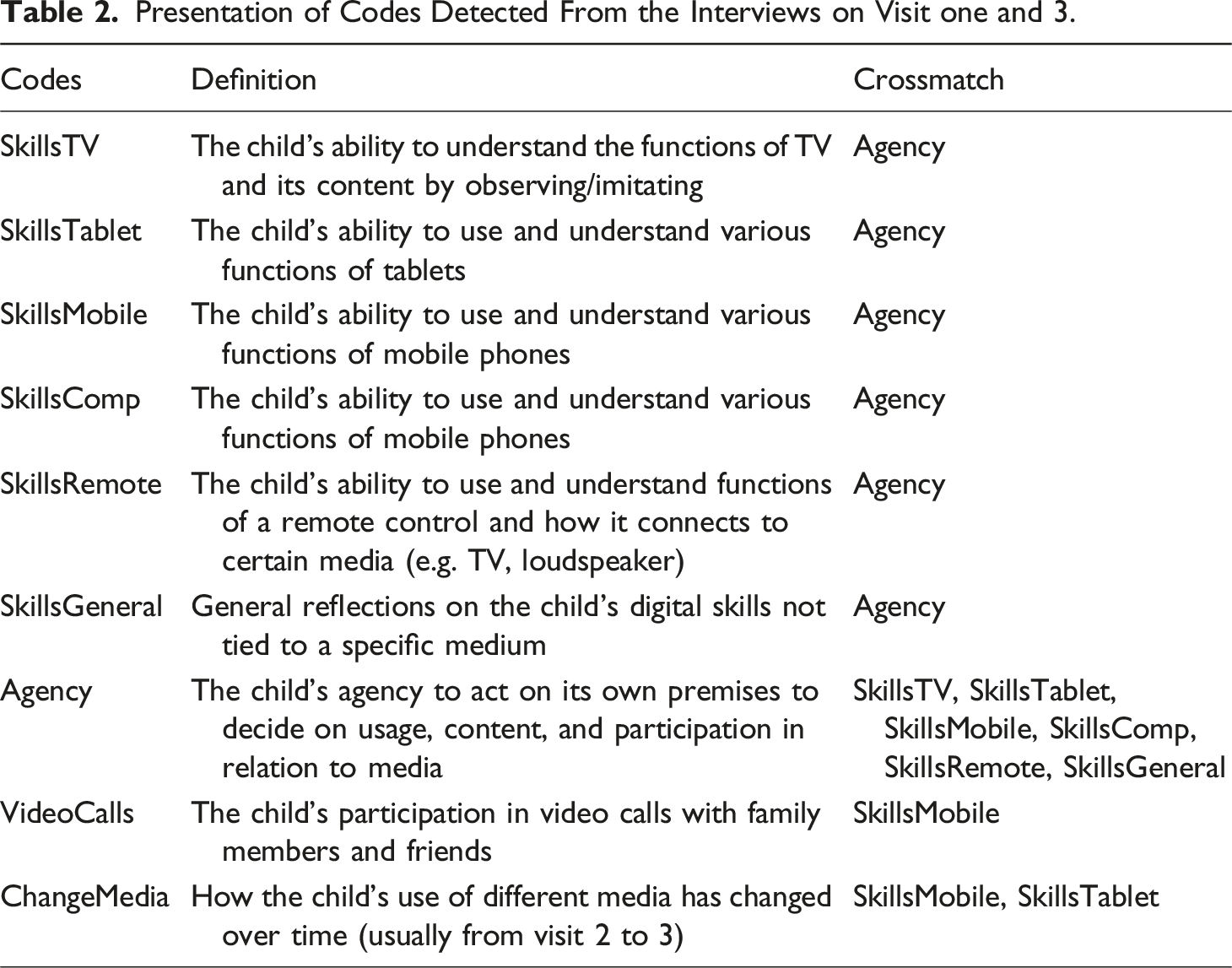
As Table 2 shows, the six codes within the Theme Skills were all crossmatched with Agency to see if any of the different media formats was especially addressed. SkillsMobile was also crossmatched with Video calls to determine if this activity was emphasised in the interviews. Furthermore, the code for finding statements of changing use of media was crossmatched with two of the common screen media in the homes: mobile phones and tablets.
The next step was to carry out a thematic and synthesized analysis of the transcripts based on this systematic and reflexive process. The approach has been inductive with a first reading to detect patterns among the children’s engagements and their parents’ reflections (Patton 2015). All transcripts were read multiple times in the analyses of what different themes the data provided. The following close readings of the transcripts had the purpose of finding categories of what skills, comprehension, and agency could consist of. In the interpretation of the transcripts, statements were found that were linked to categories within our codes and the focus on skills, comprehension, and agency. Two categories were found that could help to describe skills: dexterity and imitation skills. Dexterity in this case is referred to when touch screens were used, which made it different from the definition of dexterity in general that usually is not referred to in connection to literacies. For comprehension, the two categories of association and understanding of function, and for agency, we found five categories: taking actions, initiatives, showing independence, making choices, and showing liking or disliking. In the next reading, the categories served as questions to the material to test if the text could verify and validate them.
The sections of the questionnaire about touch media and the observation scheme complemented the analysis based on the interviews. Extracts from the interviews were edited slightly and translated since interviews were conducted in Swedish (except for one in English).
Findings
In the following section, the findings of how digital literacies are performed among the young children are presented. The outline of the research question structures the section and starts with skills, followed by comprehension and agency. The findings are exemplified with notions from the fieldnotes and reflections from the interviews.
Skills
During the first visit, the parents completed a questionnaire about the children’s use of touch media (smartphones and tablets) and the types of apps they used. In total, 13 families did some type of assessment of their children’s use. Only two types of apps were in dominant use among the children: video apps (e.g., YouTube) and music apps (e.g., sing-a-longs). The same pattern was shown during the second visit when one of the researchers filled in an observational scheme about what kind of apps that was used during the day. Only a few children were engaged in using apps, and they used video and music apps rather than other alternatives such as sports and strategies. It was apparent that most of the parents did not think that their children had sufficient skills to use touch media on their own. The most common skills among the children were the ability to open apps, use video apps, move things on the screen and close and open other apps. The observations by the researcher on the second visit confirmed the same patterns. Six of the children demonstrated more skills and they were between 20 and 40 months of age. As expected, no skills were reported among the very youngest children (6 weeks and 5 months). There was a lack of assessments from a few families as they did not fill in or complete the questionnaire for various reasons.
Statements from the interviews supported the assessments and observations made by parents and researchers. The basic skills were clustered into the following two categories: dexterity and imitation skills. Parents and researchers observed these skills among children of various ages. Using the fingers to change content or move around images on the screen was seen at an early age. For example, the father of 15-month-old boy William made the following comment: The thing is that you can swipe your finger on the screen and so, move around. That's about as far as he knows, and he thinks it's fun. (William, 15 months)
The comment was made while the parents were watching the video clip of the son being involved in a video call with his grandmother. He showed little interest in talking on the phone and the parents explained that he is not allowed to use their phones otherwise. The skills of using the smartphone were limited to the ability to swipe and move around images. Dexterity was also connected to the imitation skills; children observed their parents’ or other siblings’ habits of using screens and then imitated to do the same things. The mother of 21-month-old girl Stella reflected on her daughter’s sleight of hand related to their own use of the smartphone: We have never tried to show her anything, but she has; I think she has observed how we do because I noticed pretty early on that when we touch the smartphone or when we use our phones, we move our fingers in a certain way. And she has already tried like this (showing with her fingers) when she gets hold of the phone. She goes on like this (showing). (Stella, 21 months)
Children were engaged in smartphones in many ways: holding, talking, showing, and taking pictures/videos. The first four were exclusively engagements with the device as a phone. Video calls have become the natural way of communicating with others not present, especially in the way they can engage by showing things: Father: Then she takes the phone and runs off, and she wants to show something with the phone Mother: It could be a new toy or something in her room or so (Elsa, 36 months)
The parents’ quote was related to a video call in one of the video clips. In this situation, Elsa used the phone to show the caller around in her home. Children associated the phone mainly with video calls. However, there were also examples of children that played with the phone in a traditional way: Father: Sometimes, he just walks around with it. Like we do. Mother: Yeah. Now he has started to put it next to his ear. (Hugo, 14 months)
Parents commented on Hugo’s use of the phone while they were watching a video clip of Hugo watching TV and using a phone to point to the screen. The TV screen was connected to an app on the phone and the parents are commented on his understanding when he was saying “YouTube” in the video. The parents were asked about the role the smartphone had for Hugo; if it was mainly to show them that he wanted to watch TV. Then the parents commented on how he had started to walk around with the smartphone and pretended to talk to someone on the phone. There had been a change of engagement with the device between the second and third visits. The parents did not know why because they usually did not use their smartphones in this traditional way.
Imitation skills were otherwise found when the children were using their parents’ devices. One mother described her 21-month-old daughter Stella’s fake calls as a way of practising and that she was imitating the mother by saying “Hello, hello”. From the observations in the fieldnotes, the mother was giving the smartphone to her daughter. Stella joined the researchers and her mother on the sofa with the phone in her hand. The mother helped her to lower the volume since she was not able to do it herself. Previously the mother had watched some of the video clips and the phone was involved in some of the clips. The mother stated that the daughter had a big interest in the smartphone.
Imitating the movements and the purpose of digital media devices was closely linked to the understanding of using them. However, basic skills did not necessarily imply understanding. Parents in 11 of the families expressed their children’s love to push buttons on screens, remote controls, and computer keyboards without understanding the consequences, for example turning off an ongoing video call. For the parents of 35-month-old Elsa, it was essential to let her do things on the screen without help. Elsa was encouraged to try to use a game app on her own, and if failing to, try once more before being given help.
Children’s dexterity was not fully developed to perform actions, but their understanding was already in place.
Comprehension
The parents’ interviews supported the assumption that their children at an early age developed comprehension of digital media technology. Two categories were found in the analysis of parents’ reflections on their children’s comprehension: association and understanding of function. An association could be to connect the device to a specific activity, like: Father: Sometimes she sees a phone and says Grandmother. She knows she can talk to them through this technology […] even if I call my brother and she gets to see me, she says grandmother, so calling on my phone means calling grandmother. (Isabelle, 31 months)
The video clip showed Isabelle talking to her grandmother in the morning. They said ‘good morning’ to the dolls and the conversation was very much an interaction of play. They were singing and Isabelle was holding up her rabbit toy to show her grandmother.
Associations could also be the expectation of the digital device to perform in a certain way: Mother: If she talks in ordinary phone mode, she becomes concerned because she thinks it is weird that you cannot see each other. (Maj, 39 months)
To Maj, video calls were associated with the enjoyment of using Funny Faces, and her father said those were more important than having a conversation. Talking to her relatives was usually for a short time, but her parents said that sometimes she wanted to call friends and then the phone became a device for play and interaction. Jens, 20 months, talked regularly to his aunt on FaceTime. To him the video calls were associated to have fun with filters, and he asked her to become a ‘panda’ or a ‘cat’. It was part of a play to have the animal filters changed during the call. In the interviews, we found statements from 11 families that confirmed their children’s associations between smartphones and interaction with people on the screen.
Children developed understanding of how devices worked, and the statements about understanding functions were usually connected to the smartphone, like understanding to answer if someone was calling or the importance of the smartphone as controlling things. Like the functions of a smartphone, one parent mentioned the child’s understanding of using the child icon for Netflix app: Mother: It is one of these child logins, and she has her own account, and she knows that she should touch her own little figure. (Elsa, 36 months)
Elsa had her own collection of programmes that she could watch, and her parents were changing content when she developed new likings. Previously, she had access to children’s programmes from another app, but her parents were convinced that she had no understanding of the differences between apps. In a video clip, William, 15 months, was listening to music from a Bluetooth speaker. The choice of music was made on an app on the phone. His father made a comment that William understood that the phone was important and used for controlling things. The interviews showed statements from nine families about their children’s understanding of function. However, it was not a clear-cut distinction between association and understanding of function. In the case of Jens’ involvement in video calls with the changing of animal filters, he also proved that he had understood that the filter was a special function that could be used.
In the next part, we provide examples of how children’s agency was expressed and how parents reflected on their children’s wishes to be engaged or not in digital technology at an early age.
Agency
We saw several actions from the children showing their agency towards digital technology. Five categories were connected to agency: taking actions, initiatives, showing independence, choices, and liking/disliking. Here, examples from what was seen in the video clips and the follow-up interviews will be considered. To start with, an example of taking actions is given by the video clip of Stella engaged in a videocall with her grandparents. She showed little interest in talking to them, she finished the call and wanted to use the phone for other purposes like watching clips on YouTube. Mother: …as soon as I call, before she could sit for a few seconds and check around and laugh a bit, but now, directly when I call, she wants the phone herself, and then she clicks it off in a second (Stella, 21 months)
Her mother told that sometimes the call was still going on in the background while she was watching clips from YouTube. She emphasized that the girl loved her grandparents but just did not want to talk to them on the phone. Elsa, 36 months, turned off the music aimed for her little brother and Isabelle, 33 months, stopped singing when her mother tried to record her with the mobile phone. In more than half of the families, there were statements about how the children took different actions to express their agency.
Initiatives can be shown in different ways. They can be instructive like when a child shows a parent what to do to accomplish a wish. For example, the father of 14-month-old Hugo, described how his son picked up the phone and pointed to the TV, when he wanted it to be turned on. The next example was when a child spontaneously took an initiative to suggest engagement in media: Father: Well, really, it could be that we are about to go home and cook dinner, and then she might say, “watch TV” she might say sometimes, and then I say, “yes, we can do that” (Ida, 19 months).
The reflection was made after watching a video clip where the girl had been outside playing in the garden. Two of the families testified about how their children showed independence in their engagement in digital technology. The following example showed a 21-month-old girl’s independence to use digital media and learn more about its functions: Mother: No, she doesn’t ask. … Milena, she is very stubborn. If she shows interest in something, she doesn’t always want to be helped. (Milena, 21 months)
The video clip connected to the mother’s comment about an interaction between Milena and her mother involving a computer and a digital camera. The researcher asked if the parents taught her how to use different devices. Her mother said that she showed her how to handle them to a limited extent. The rest Milena wanted to figure out herself. Stella, 21 months, did not want to let go of the smartphone if she had managed to get hold of it. She wanted to examine it on her own. Stella’s interest for the smartphone was also an example of a change from the earlier visits; her parents said that she used to hand over the phone when she wanted something to be changed on the screen.
Choices also expressed children’s agency. The following example illustrates how parents reflected on their children’s agency in terms of choices: Father: She is very clear if she wants the iPad or the TV. (Maj, 39 months)
The mother experienced that Maj and her older sister were surrounded by screens all the time. Sometimes there was a lot of screen time, but it was balanced by the girls’ choices to play with their dolls house or Lego. The father made a comment that he saw the screen as an asset to them and that they had competence in making their choices when they wanted to.
Finally, liking/disliking was a category within the agency. It was when children showed their preferences or when they turned against engagement for different reasons. For example, some children liked to watch content over and over: Mother: Yes, really, we started with Daniel Tiger quite early, or what you can say, so she has always been stuck on it, like it is something she still likes, even if she has seen an episode like 100 times over and over again (Luna, 36 months)
Liking/disliking may involve interactions between the child and parents. The mother of Isabelle told the following: Mother: She wants to be videoed less and less these days, so I have to be more discrete about filming her. Researcher: Hmm, why is that? Mother: I do not know; she will be just like “No mama” (Isabelle, 31 months)
Isabelle used to be more interested in performing in front of the camera. She still liked to watch herself on the phone, but she did not take the initiative herself to watch videos. The mother said that they had a shared photo album with her distant family members but lately Isabelle did not want to participate.
Since the second and third visits in the families were close in time, we did not see many changes in the children’s use of digital media. Only three families gave statements of changes as also presented above. The findings showed that all the children in this study were engaged in digital media in different ways depending on their ages and family situations (e.g., restrictions, siblings). Digital literacies became more similar among the children who had reached an age of approximately 20 months and older.
Discussion and conclusion
In this article, the focus has been on very young children’s engagement with digital media technology in their home environment with a purpose to broaden the understanding of how infants and toddlers learn and develop skills, competencies, and agency that we include in digital literacy practices. The limitations of the study are acknowledged since it is a small sample of 16 families, and the intention is not to make generalisations of digital literacies among children growing up in Sweden during the years surrounded by a pandemic.
Nonetheless, the findings support the conclusion that children at an early age become aware that the communication in their homes is also expanded to the outside world and the ‘digitally networked spaces’ as addressed by Flewitt and Clark (2020). In the study it was evident how the children were engaged in video calls with family and friends and how they understood the link between digital media devices and the connection outside their home. It was also apparent how children expressed their agency in being involved and on their own premises.
Children’s ways of expressing agency are also aligned with the creative dimension of the literacy model elaborated by Kumpulainen et al. (2020). Choosing filters when involved in a video call is an example of creative agency among children. Another example is the reverse one, when one the children stopped singing as soon as the mother encountered with a smartphone for recording. These findings are significant because they show the children’s ability to understand the activity presently involved in can be facilitated or limited by digital media technology. It also shows clearly how the different dimensions cannot be separated (Durrant and Green 2000); they are all entangled in the complex weave of what can be understood as digital literacies as in our case defined as skills, comprehension and agency.
These findings are also consistent with previous work in the field of play and learning and especially point to skills developed at an early age in terms of the dexterity in relation to touch screens. This study does not show any different findings than that children from an early age learn how to manage the screens by pushing buttons and swiping and therefore use it as a play tool. However, it can also be seen how the play on screens were integrated in social practices also involving exploration and problem-solving as suggested by Bird and Edwards (2015). When children aged 21 months get involved in a smartphone’s screen, it is as much an act of play as it is of exploring and problem-solving.
All the children in the study grew up in digital media-rich homes, and from an early age, have become aware of the existence of digital media devices. In particular, the smartphone had become ubiquitous in everyday life to communicate visually and orally with family members and friends not present in the room. This is also to say that children are aware of the socio-cultural context of their home and where they can perform their engagement with their own sets of agencies.
Young children’s engagement with digital media technology does not necessarily exclude other items such as toys and printed books. Our study shows the opposite. The digital media and screen technologies are entangled in several offline activities in their homes. It points to the need of having a more complex and multilayered understanding of both young children’s engagement with digital media and of their digital literacies.
Theoretically, this study contributes to a more nuanced and widened understanding of how to conceptualise digital literacies in early childhood. Empirically, the study offers detailed and contextualised insights into young children’s early development of digital literacies in their engagement with media technologies. Ongoing debates on preventing screen use in early years make continuous research on the development of digital literacies in early childhood even more pertinent and needed. Digital media and digital literacies will be important parts of children’s lives also in the future, and it calls for further attention.
Footnotes
Declaration of conflicting interest
The authors declared no potential conflicts of interest with respect to the research, authorship and/or publication of this article.
Funding
The author(s) disclosed receipt of the following financial support for the research, authorship, and/or publication of this article: This work was supported by the The Swedish Research Council (Vetenskapsrådet); Grant no 2018-01261.
