




Abstract
Most children growing up in contemporary homes in post-industrial countries use digital media as part of everyday literacy activities, such as to connect with distant family and friends, watch their favourite programmes, play games and find information. However, conceptualizations of the Home Literacy Environment (HLE) have not yet adapted to the implications of these comparatively new practices for young children’s knowledge about literacy or the ways in which they negotiate affectively intense relationships in digital networks. Furthermore, the digital activity of very young children aged 0-3 years and the diversity of print and digital technologies they use remain under-researched. Reporting on detailed case studies of a two-year-old boy and a one-year-old girl in England, which formed part of an EU-wide qualitative study of 0-3-year-olds’ digital literacy practices at home, we problematise the relevance of conventional definitions of the HLE for contemporary homes. Building on nascent research in this field, we argue for the need to reconceptualise the HLE as a digitally networked space, with porous boundaries that enable the very youngest children to negotiate affectively intense relationships and express meaning across diverse modes and media as they connect with distant others in a digitally mediated world.
Keywords
Introduction
Most children growing up in contemporary homes in post-industrial countries observe and take part in digitally mediated literacy practices at home, using devices such as smartphones, tablets, digital TVs and computers to connect with distant family and friends, find information, play games and watch recorded or broadcast programmes. Media usage reports indicate marked year-on-year increases in the digital activity of children aged 3-15 years, including going online (e.g. Ofcom, 2019), and this rising trend has provoked public debates about children’s safety and security in a digitally mediated world (Chaudron, 2015; Livingstone et al., 2017). However, conceptualizations of the Home Literacy Environment (HLE) have not yet adapted to the diversity of print and digital technologies that children use in their everyday literacy practices at home or to the implications for young children’s online and offline literacy networks. Furthermore, the digital activity of very young children aged 0-3 years remains under-researched and largely absent from public policy debates, possibly because this younger age range does not yet feature in ‘society’s digital imaginary’ (Livingstone and Third, 2017: 660).
Delineating what literacy is in the contemporary textual landscape is challenging (Sefton-Green et al., 2016). In this paper, we focus on 0-3-year-olds’ digital literacy, which we define as: developing the skills and knowledge to communicate effectively and find information when using digital technologies; understanding, producing and sharing texts in diverse formats; being creative, collaborative and critical; showing cultural and social understanding of how texts are used, and being aware of e-safety. We recognise that young children’s literacy practices also involve non-digital texts and events, that they often cross material/virtual and offline/online boundaries, and that there is a close relation between literacy and affect ‘as text interweaves in new ways with human activity’ (Burnett and Merchant, 2020: 1).
Reporting on fieldwork from a qualitative study of the under-researched field of 0-3-year-olds’ digital literacy practices at home, we problematise the relevance of conventional definitions of the HLE for contemporary home life. We argue that the fast-paced and widespread growth of digital communication has led to profound changes in everyday literacy practices at home. Rather than being a private, bounded and predictable environment, the contemporary home is a digitally networked space, with multiple external influences. In these networked spaces, very young children can connect with distant family and friends by taking part in literacy practices that are ‘felt’ (Burnett and Merchant, 2020: 3) and not reliant on language fluency. That is, very young children can negotiate affectively intense relationships across social networks using diverse semiotic systems and digital media, often in unexpected ways (Zhao and Flewitt, 2020).
These profound changes to everyday literacy practices prompt us to ask how the HLE might be reconceptualised as a digitally networked space. We ground our argument in fieldwork conducted in the homes of two young families with children aged 0-3 years, one located in an inner-city suburb and the other in a small rural village. The data reported here form part of a wider, pan-European study of thirteen families with children aged 0-3 years in England, Finland, Israel, Portugal, Spain and Sweden, where synergies and divergences were found across the observed patterns of everyday literacy practices at home (Gillen et al., 2018).
Research on the home literacy environment
A long-established body of research across disciplines reports on the influence of the HLE on young children’s language and literacy development, with a high level of agreement that the HLE is a multidimensional and dynamic construct that includes the literacy activities, resources and opportunities children encounter at home, as well as parents’ beliefs about literacy, and their own literacy practices and skills. Here, we offer a brief overview of how the HLE has been conceptualized in past research, and how more recent work in the field of young children’s digital literacy has begun to challenge these conceptualizations.
Developmental and psychological research has tended to assume a parent-centric stance towards children’s literacy experiences at home and has identified correlations between family socioeconomic status, children’s oral language and literacy performance (Dickinson and Smith, 1994; Dickinson and Snow, 1987; Justice and Ezell, 2000; Niklas and Schneider, 2015). This research strand has focused primarily on isolating and measuring specific literacy skills, such as sound-symbol correspondence, phonemic awareness, understanding of decontextualized language, familiarity with print and conceptual development. Although this body of research has found correlations between the HLE and children’s reading outcomes, causal relationships have not been identified. Nonetheless, shared parent-child reading has been consistently associated with children’s improved reading performance, with findings pointing to the importance of the quality of dialogic interaction rather than frequency of shared book reading at home (for a review of studies, see Mol et al., 2008). Moving away from the trend to use single measures of early literacy activity, Burgess et al. (2002) developed a six-dimensional 1 conceptualization of the HLE, with overlapping categories, so each facet could be considered separately, and direct comparisons made with previous studies that had focused on discrete HLE dimensions. This study concluded that although ‘active’ elements of the HLE (such as shared reading, rhymes, songs and literacy games) may be statistically significant, multi-dimensional conceptualizations of the HLE are needed, based on observed home practices, to better inform our understanding. Similarly, in a 5-year study of parental involvement in children’s reading, Sénéchal and LeFevre (2002) found that whilst formal literacy interactions have a positive effect on children’s word decoding, phonological awareness and word recognition, informal interactions help to boost children’s vocabulary and oral language skills, concluding that there are multiple pathways in children’s early home literacy experiences that ultimately lead to fluent reading.
With some notable exceptions (e.g. Foster et al., 2005), developmental and psychological studies aiming to identify specific factors in home environments that support children’s later school-based literacy learning have focused on majority (often White, middle-class) populations. Having identified these factors, their absence in the HLE has been viewed as a deficit in home provision/parenting. Family literacy interventions have therefore been delivered to ‘mediate the effects of living in a low-income household’ (Niklas et al., 2016: 123; see Reese et al., 2010 for a review of intervention studies). In brief, although decades of developmental studies have identified specific factors in the HLE that may nurture early literacy, the impact of this work has arguably been more successful in constructing deficit models of ‘home’ than in moving forward our understanding of the complexity of cultural, social, material and textual factors that have a bearing on young children’s literacy learning at home.
In a parallel strand of ethnographic research, the framework of what counts as literacy has been broadened through the study of everyday literacy practices in diverse social and ethnic communities (Heath, 1983; Sylva et al., 2004; Taylor, 1983; Taylor and Dorsey-Gaines, 1988), when using diverse technologies such as audio-only telephones (Cameron and Gillen, 2013), and children’s perspectives on their home literacy practices (e.g. Mielonen and Paterson, 2009). This seam of work has illustrated how children across ethnic, social and cultural backgrounds are immersed in highly varied literacy environments from birth, with their parents, carers, siblings and grandparents (Gregory, 2001; Gregory et al., 2007; Kenner et al., 2007), in activities such as songs, rhymes etc, but also oral storytelling, drawing, visiting libraries, and using non-digital and digital technologies. Ethnographic studies also point to the importance of parental enjoyment during literacy activities (Preece and Levy, 2018) and emotionally rich, embodied reading experiences (Anderson, 2009) as motivating factors in early literacy learning. For example, the affective relationships and interactions that characterise habitual shared reading routines have consistently been found to nurture young children’s literacy skills and positive attitudes (Mol et al., 2008; Pink and Leder Mackley, 2016), to increase children’s vocabulary (Harvey, 2016), text comprehension and enjoyment of reading (Jung, 2019), and to enhance young children’s initiation into family literacy practices (Marsh et al., 2017). Recent sociomaterial accounts of literacy have begun to explore how ‘something that we call literacy seems to emerge out of a complex and perhaps rather messy array of diverse materials, bodies, and impulses’ (Burnett and Merchant, 2020: 1).
Whereas most HLE research has in the past focused on print-based literacy skills and practices, the growing significance of digital technologies in family life along with emerging insights from sociomaterial sensibilities invite these theories to move forward. The presence of digital technologies in the contemporary home not only extends literacy practices across diverse modes and media (Kress, 2003), but also transforms a previously bounded space into a networked space, where very young children can enjoy connecting remotely with family, friends and a world of information using diverse web-connected digital media. If we are to reconceptualise the home literacy environment, how might we re-conceptualise the contemporary home as a learning environment?
Conceptualising home learning in a digital era
For many decades, scholars across disciplines and theoretical frameworks have offered diverse conceptualizations of home as central to young children’s learning and development. In this field of enquiry, Bronfenbrenner’s Ecological Systems Theory (EST) (1979), and later bioecological systems theory (1999, 2005; Bronfenbrenner and Morris, 2006), is the most widely adopted framework to conceptualise how individual children’s development is nested in a series of interactive and interdependent structural systems. In this framework, the child sits at the heart of five systems represented as a set of concentric circles, like a set of Russian dolls: 1. the microsystem (relationships in the family/school/neighbourhood); 2. mesosystem (interconnections between microsystems, e.g. between parents and teachers); 3. exosystem (systems that do not directly involve the child but which influence the child’s life, e.g. industry, mass media, social services, local politics); 4. macrosystem (larger systems of cultural beliefs, societal values, political trends); and 5. chronosystem (changing socio-historical circumstances over time). Bronfenbrenner’s original socioecological model (1979) highlighted how each child’s development is contingent on context, whereas his subsequent bioecological model (2005, 2006) refocused attention on the agentic role that individuals play in their own development, to the interdependency of person, process and context, and to changes over time.
Bronfenbrenner’s nested model has been widely adopted, yet Tudge et al. (2009) suggest its complexity and continual development have led to its widespread misuse and to scholars being imprecise about which version of the theory they are adopting, ‘resulting in conceptual confusion’ (p.198). Carrington (2013) argues that ecological models falsely assume order and coherence, and Alaimo (2016) reminds us that the wider world does not exist as a background to the human subject but interacts and intra-acts within and through human bodies in the ordinary micro-practices of everyday life, where ‘fundamental boundaries have begun to come undone’ (p3). Similarly, Neal and Neal (2013) suggest that the concentric circles of Bronfenbrenner’s nested systems elide how the different spheres of influence intersect and impact on individuals’ lives. In a reformulation of the bioecological model, they conceptualise the ecological environment as networks of overlapping structures, where ecological systems are connected to individuals directly or indirectly, transiently or constantly (Morgade, Aliagas and Poveda 2020). As can be seen in Figure 1(a) and (b), moving from nested to networked systems theory ‘shifts the focus of attention away from where individuals interact and toward how and with whom they interact’ (Neal and Neal, 2013: 733). Adopting a networked approach therefore foregrounds relationships, and, we suggest, offers potential for a deeper understanding of what Burnett (2011: 216) refers to as ‘the social production of space’ through diverse media and modes of communication across online/distant and offline/co-present activity. This approach resonates with social network theory, which has been used to map the relationships between individuals and the wider social systems in which they participate (e.g. Wellman, 2002).
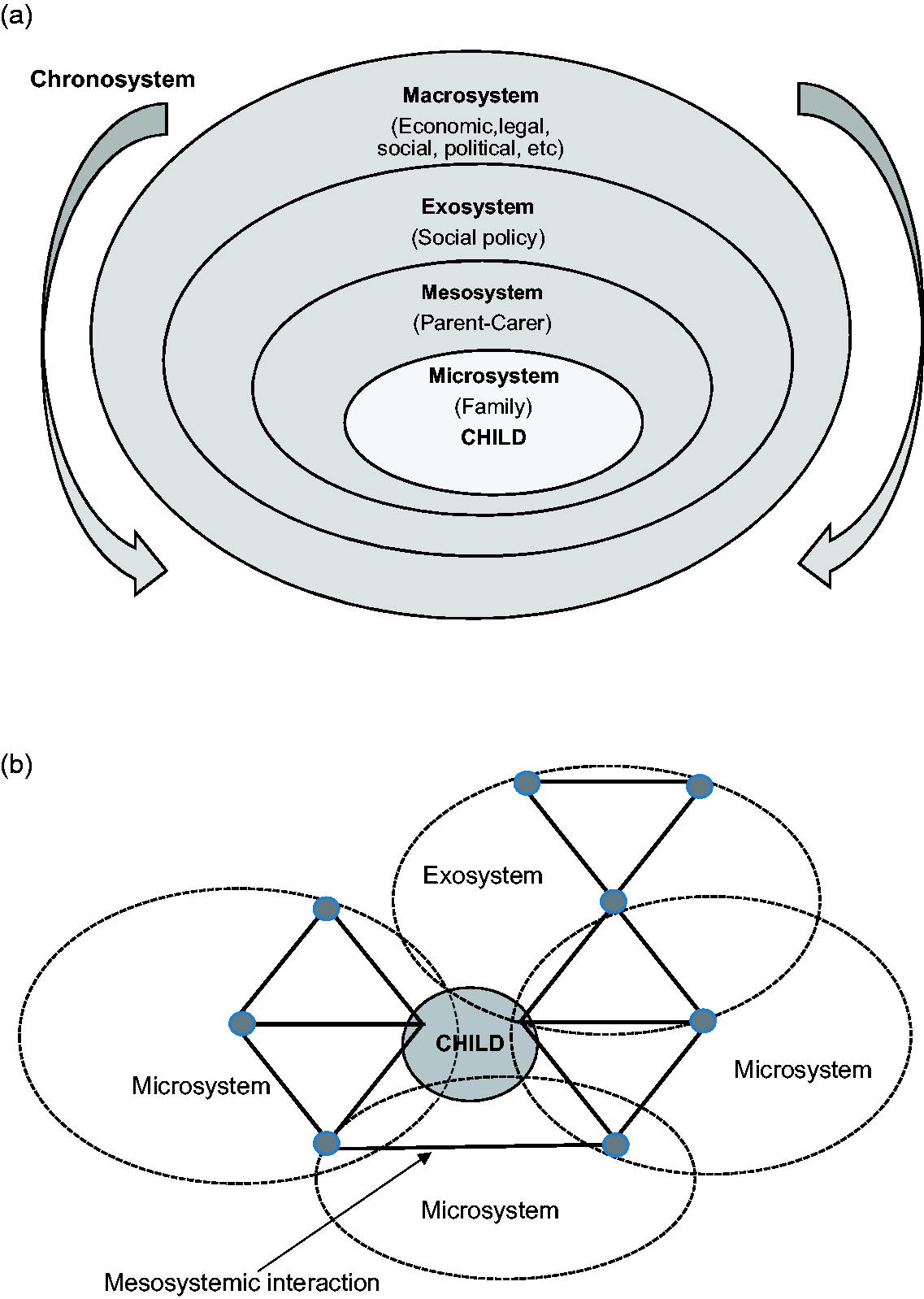
(a) Nested model of systems. (b) Networked model of systems (adapted from Neal and Neal, 2013).
We suggest that the network metaphor offers an apt framework to map the porous boundaries of the contemporary Home Literacy Environment. In this paper, we focus on how very young children use all the resources available to them through diverse communicative modes and social networks to negotiate affectively intense relationships with distant and co-present family and friends.
Method
This paper reports on two case studies of a one-year-old girl and a two-year-old boy and their families in England, which formed part of an EU-wide study of eight girls and five boys aged between nine and 34 months, in 13 families in England, Finland, Israel, Portugal, Spain, and Sweden (Gillen et al., 2018). To gain in-depth insights into individual children’s digital literacy practices and to ensure methodological stability across all research sites, the ‘Day in the Life’ (DITL) methodological approach was used (Gillen and Cameron, 2010). DITL follows ethnographic research principles and methods, using a combination of interviews, field notes and video recordings but in a condensed time frame, with two researchers working together and following a fixed protocol.
We contacted families initially by telephone to discuss the research and the implications of their potential participation, and subsequently visited each home three times:
A 2-hour ‘Familiarisation Visit’ to discuss the project, address any concerns, gain written consent, agree boundaries for the research, conduct a preliminary interview with parents regarding demographic, health and lifestyle information, complete an inventory of digital devices in the home and conduct pilot video recordings. A ‘DITL Visit’, with a minimum of six hours’ video recording on one day in each home, on a day chosen by each family. During this visit, one researcher made video recordings, whilst the second researcher took field notes. Following initial analysis of data from visits 1&2, a final 2-3 hour ‘Iterative Stage’ visit to each family, to co-view and discuss a 30-minute compilation of 6-10 video clips from the DITL Day. The video clips were selected as representative samples of different activities during the DITL filming. Parents were encouraged to say if they would prefer different clips to be included and/or deleted from the data. No parents made this choice.
Across the EU-wide research, DITL offered methodological structure and theoretical flexibility for the study of a heterogeneous sample by a diverse group of researchers, offering multi-faceted insights into how very young children’s digital literacy practices are situated within contemporary everyday family practices and values. In this sense, we generated rich empirical evidence of ‘culture as verb’ (Heath and Street, 2008: 7).
Formal ethical approval was received from University College London, anonymised data were stored safely on password-protected digital systems, and reflective ethics steered the research process. Parents and children had an opportunity to ask about their potential involvement before consenting to participate and were reminded during each visit that we welcomed their requests for privacy regarding where filming might occur and how data might be shared. Parental consent was received for all participating children, and careful attention was paid to child mood during filming, which ceased if any participants seemed disturbed by our presence (Flewitt and Ang, 2020). Pseudonyms were chosen thoughtfully by the participating families. Given the intensity of the day of filming, we attempted to minimise undue intrusion by responding flexibly to unforeseen events and leaving the research site for brief periods, such as children’s nap time. During the ‘Familiarisation Visit’ the children were initially hesitant towards us but were curious about the recording equipment and welcoming during our subsequent visits. Each family was given a full copy of all recorded data and the compilation video. Both families reported retrospectively that the filming day had been enjoyable, less intrusive than they had anticipated, and fairly typical.
Child age (0-36 months) was the key selection criterion for participating families. The two families reported here were chosen purposively - during initial contact one family reported minimal digital media use, whilst the other described digital media as integrated in daily life. Both families were white British and spoke English at home, with all four parents in paid employment. No claims are made regarding diversity in this small sample, although diversity characterised the wider EU sample of 13 families (Gillen et al., 2018).
Petra, aged 14 months, lived with her mother and father in a 2-bedroom apartment in an outer London suburb. Her mother worked part-time as a qualified Special Needs Teacher, and her father as a self-employed professional musician and electrician. Filming took place entirely in the family home, as the weather outside was inclement. Both parents were home during filming, which was usual as they purposefully organised their work schedules to have family days each week. Petra attended a childminder two days per week when both parents worked. Petra had just begun to walk independently, spoke some words clearly and communicated effectively through speech sounds, intonation, skilled use of gaze exchange, facial expression, and hand and body movement.
Charlie, aged 32 months, lived with his mother, father and younger brother, aged 7 months, in a 3-bedroom house in a rural village in South England. Charlie’s paternal grandfather was Dutch, so Charlie was developing some knowledge of Dutch language and culture. Both parents had post-graduate qualifications. Charlie’s mother was on maternity leave from her work in copywriting. His father worked in the tech industry, often from home, where he was on the DITL day, but did not participate in the filming. During filming, the morning was spent in the family home, followed by lunch and the children’s nap, then a walk to the village shop and a visit to maternal grandparents who lived nearby. Charlie attended nursery two days a week, as he had for two years. He was inquisitive, physically dextrous and active, yet equally enjoyed concentrating for extended periods, and spoke with well-developed vocabulary, grammatical accuracy and reasoning.
In keeping with ethnographic research, data analysis was enriched through the ongoing exchange of ideas between researchers and with families during the ‘Iterative Stage’. Analysis began in an impromptu manner, in nearby cafés following each ‘DITL visit’ where we reflected on the affective, lived intensity of the filming, and sketched out diagrammatic models of each HLE. These data-led models began to capture each child’s networks of family and friends, and to clarify how each child was learning certain ways of being, doing and interacting in the socially porous space of the family home. Deeper familiarisation with the video, fieldnotes and interview data led to the generation of inductive analytic themes (Miles et al., 2019), and to the thematic selection of clips for the compilation video. Consultation with families during the third home visit informed our deeper understanding of each child’s home literacy practices.
Findings
To illustrate the networked nature of the children’s HLEs, we present summary accounts of the observed home literacy practices, with details of two instances of each participating child’s digital literacy activities, along with diagrammatic representations of their digital networks, as observed during the DITL filming day and as reported by parents during interview and subsequent consultation.
Petra’s digital literacy networks
One-year-old Petra’s mother described the family as ‘low tech’, with two smartphones (mother and father), an Internet-connected TV, computer (mother’s work), Mac (father’s work), family iPad (mostly for viewing photos and family videos), and a broken digital radio. No technology had been purchased specifically for Petra, other than one xylophone app on the iPad. Petra’s parents had a well-reasoned strategy for using technology at home ‘in small doses’ whilst recognising its relevance for children’s future lives: ‘the more skills you have with technology the more doors it can open for you’ (mother interview). An Internet-connected TV was situated in a corner of the living room and was rarely used – Petra sometimes watched her favourite programmes (Hey Dugee or Baby Jake) with her mother and/or father interacting with her whilst viewing ‘like you would with a book’. With increased mobility, Petra had ‘started handing us the remote control and going ah ah ah … communicating essentially that she wants us to [turn on the TV]’. In line with their ‘small doses’ approach to technology use at home, the parents had agreed to respond by suggesting different activities, such as sharing a book or playing with toys.
Most of the observed early literacy activities were non-digital, including reading books, drawing with felt-tips and crayons, helping mum make a handwritten shopping list, listening to and playing along with the rhythms of music, categorising shapes and colours. Nonetheless, Petra’s parents were surprised when the DITL filming showed digital media were more deeply integrated in home life than they had thought. Petra’s observed digital literacy activity included: navigating (with her mother’s help) access to one episode of Hey Duggee using the TV remote; selecting and playing music with her father on his smartphone; reading iPad symbols (with her father’s help) to find and play with the xylophone app; navigating iPad symbols (with her mother’s help) to view photographs; reading symbols on the washing machine to activate its touch-sensitive controls (on her own, by trial and error, but this was not the first time she had independently switched it on). Petra also interacted regularly with distant family using a smartphone: Researcher: Does Petra ever use a camera? Mum: Yep on my phone she does and on the iPad and we also use WhatsApp for phone calls with my Mum, (father’s) Mum, my sister … so she is actually really used to it … probably daily she will speak to one of them Researcher: video calls? Mum: yeh Researcher: and does she chat and respond? Mum: yes she does now … so when we started using it, a few months ago she was very, very confused … Gaga
2
is 2D on the little screen … but she is really used to it now and she chats away
Petra’s mother dials Gaga’s number while Petra is eating a banana. Unprompted, Petra begins excitedly to sound ‘Hi Gaga’ as she watches the screen intently waiting for her grandma to appear, offering to feed Gaga her banana when she answers the call. Their play includes: Gaga pretending to enjoy being fed the banana; Petra and Gaga playing Peek-a-boo; Gaga voicing ‘Stand up’ ‘Sit down’ as Petra stands up and sits down several times (a recently mastered skill); Petra spontaneously kissing Gaga on the screen; Mum showing Petra how to blow kisses; Petra showing Gaga her plastic zoo animals, simulating each animal’s noise, which her mother and Gaga repeat; Petra pretending to drink from her toy baby’s bottle, then feeding the doll when Gaga encourages her, and subsequently offering the bottle to Gaga, who simulates drinking; Petra showing Gaga an animal picture book, choosing a page with a crocodile on a river, and voicing ‘nap, nap’ (‘snap snap’) as she opens and closes her hands to simulate a crocodile’s bite. Studying the book illustration, Petra begins to hum ‘Row, row, row the boat’, and her mother and grandmother respond by singing the words while Petra smilingly sways her body backwards and forwards as though rowing. The call ends with Petra and her mother blowing kisses to Gaga, then cuddling up quietly together.
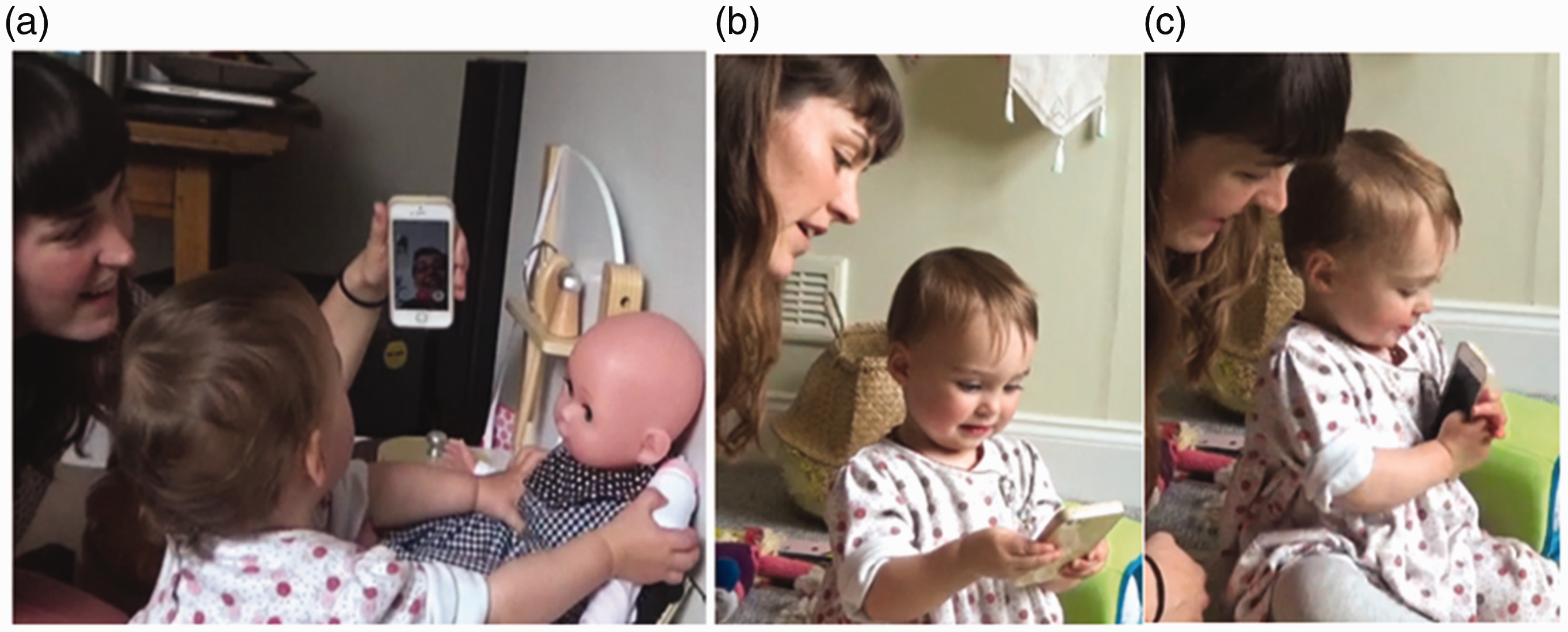
Petra plays remotely with her grandmother (a), waits for her aunt to answer the phone (b) and cuddles the phone/her cousin (c).
Although barely 14 months old, these two calls evidence Petra’s skills, knowledge and social understanding of how to communicate effectively via video calls, and how to share affection over distance. Petra waited patiently and expectantly for both calls to connect. She responded contingently to her interlocutors’ prompts and her actions were performative, inclusive of nearby and distant adults and well-timed to provoke affection and laughter. When she wanted to express meaning, she sometimes fixed that meaning in words (‘Heyo [name]’), or vocalisation (humming a tune), but more frequently in facial expression (smiles/pretend shock), action (blowing a kiss/dancing) or manipulating artefacts (showing toys/making her doll kiss the screen) ‘in the three-dimensional multisemiotic world of objects’ (Kress, 1997: 130) where there are no words, and often no need for words.
These observed episodes, along with the interview data, suggest that Petra had diverse social networks with which she connected through the porous boundaries of her HLE (Figure 3). Adapting Neal and Neal’s (2013) networked model, we can see that Petra connected with her mother and father in the home microsystem, and with at least three other family microsystems whose members (maternal and paternal grandmothers, maternal aunt and cousins) all lived in distant locations. She also connected with the educational policy exosystem at her childminder’s, and with other children there. All these people and systems were influenced by the wider macrosystems of cultural and ideological beliefs with which Petra connected directly through popular culture, and which played a key role in her socialisation in primarily Western, English beliefs and practices. Whilst the networking model presented in Figure 3 is static, it goes some way towards capturing the dynamic intersections between Petra’s networks, and the porous nature of their boundaries.
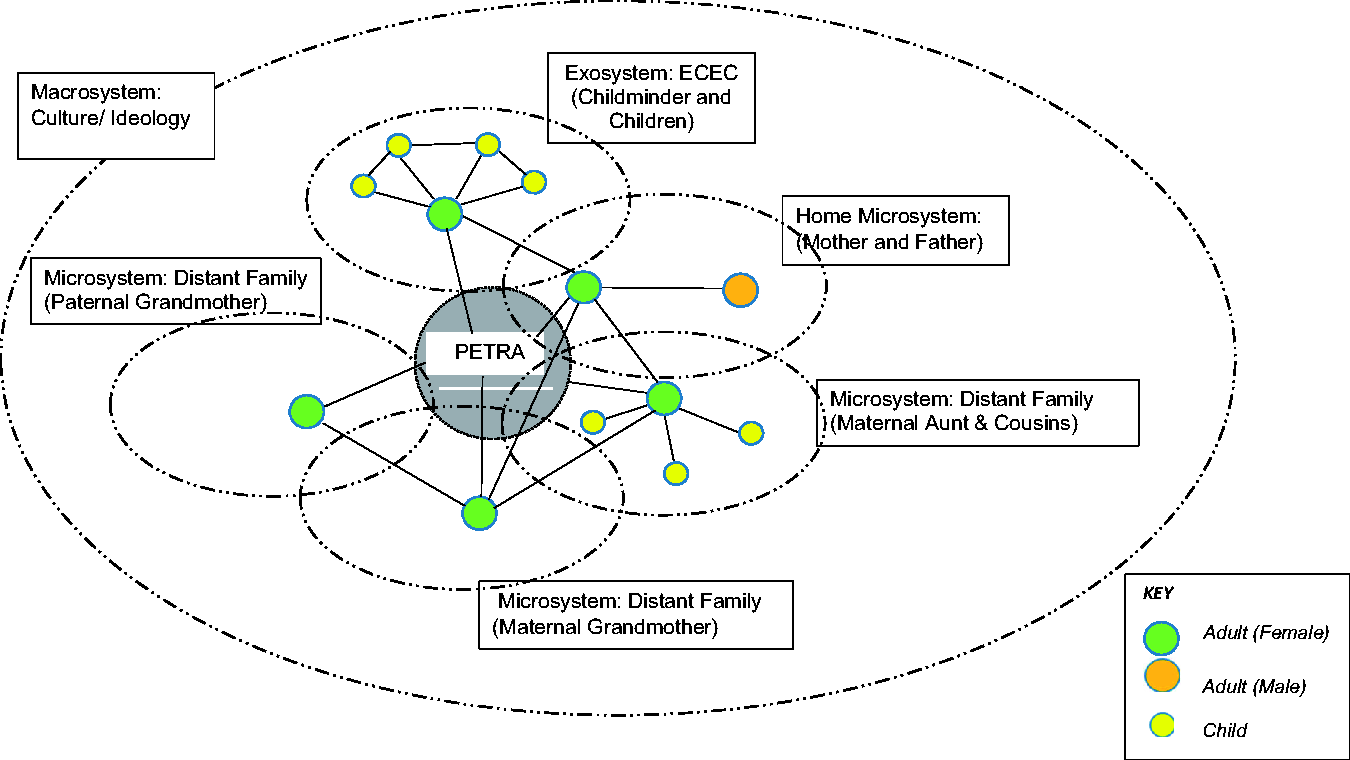
Diagrammatic representation of Petra’s HLE.
Charlie’s digital literacy networks
Two-year-old Charlie’s mother described herself and husband as ‘competent’ and ‘confident’ IT users and considered technology important: ‘the more Charlie can understand about it the better so … he’s allowed to watch us doing anything with technology’. Charlie’s mother had a smartphone and work laptop, and his father often worked on his Mac and smartphone in the open-plan dining area, where Charlie would go ‘to see what Daddy is doing … sometimes finds a video on YouTube and looks at that with Daddy’. No hardware or software had been bought specifically for the children, and the family did not have an iPad. An Internet-connected TV was set back in a recess in the living room, where they occasionally watched catch-up programmes.
Although enthusiastic about technology, Charlie’s mother was mindful of the social expectations of parenting, ‘we all feel a certain amount of anxiety when we are not actually doing stuff with them’. She controlled Charlie’s time with technology and described digital activities as ‘something that we do together rather than something he’s doing by himself’. Charlie had learnt to ‘make things stop and start by himself’ and used his mother’s laptop or the web-connected TV to view single episodes of his favourite programmes (e.g. Paw Patrol and Octonauts) with his mother or occasionally alone if she was busy. He knew how to open apps on his mother’s phone ‘which he enjoys’, and the family contacted the father’s parents via Skype ‘at least weekly or a couple of times a week’. They visited Charlie’s nearby maternal grandparents several times each week.
The family’s activities were highly varied on the ‘typical’ DITL filming day, with most time spent in non-digital, physical, imaginative and creative joint play between Charlie and his mother, with his 7-month-old brother in tow: ‘with Charlie we get up and we start playing and doing and I feel like I play and do with him until bedtime’. Charlie had risen early that day, so when we arrived at the agreed time of 9am, the short morning TV session had inspired a play theme for the day: … he picks up vocabulary from television (and) narratives - storylines that I wouldn’t have necessarily come up with so when you arrived this morning we’d watched an Octonauts episode and it was a really fun one and then we went upstairs and we played pirates for about an hour and a half and then we went and got some pirate books out and that just directed our morning in a way that it wouldn’t have gone (Mother interview extract)
Here, we focus on two short data extracts which illustrate how Charlie and his family communicated remotely and regularly with distant family and friends. The first of these was an eight-minute Skype call with Charlie’s paternal grandparents who lived in the north of England, initiated by Charlie’s mum on her work laptop:
Holding a long construction toy to his eye, Charlie gazes at the computer screen waiting for his grandparents to answer the Skype call, saying to his mother, ‘This is a telescope and I can see a distant island.’ The Skype call connects, and when his grandfather appears on screen, Charlie shouts ‘Grandpa,’ and hugs the screen in a tender embrace (Figure 4(a)). While Charlie’s mother greets them, Charlie begins shooting them with his construction toy, ‘And now he’s shooting you,’ mother explains. Grandpa gnashes his teeth and lurches towards the screen, growling ‘AAARGH!’ whereupon Charlie screams and laughs excitedly. His mother explains they’re preparing for a trip, while Charlie continues his game, ‘I’m shooting you Grandpa.’ Grandma turns to Grandpa, ‘You’re supposed to say “Aargh you got me” and lie down … Shoot him again Charlie and see if he gets it,’ whereupon Charlie pretend-shoots and Grandpa falls backwards so dramatically everyone bursts out laughing. While the grandparents chat with mother, Charlie continues shooting. Eventually, mother suggests they blow kisses to help Grandpa recover from being pretend-shot, which Charlie does enthusiastically. Grandma asks where the family are going. Charlie puts down his toy and explains they are going to see his friend Lizzy and closes the laptop lid, which disconnects the call. Mother reconnects the call, and the grandparents ask Charlie if he might build sandcastles with his friend, but Charlie has gone to his toy basket. As mother talks about the trip, Charlie returns with a toy hammer and pegs, setting them up in front of the screen and hammering. The grandparents compliment his hammering skills, but the noise makes conversation difficult, so everyone blows ‘goodbye kisses’. Mid-kisses, Charlie presses the laptop ‘on/off’ button, disconnecting the call.
Charlie hugs his grandfather on Skype (a); ‘shoots’ him with a plastic toy (b) and sends a WhatsApp video message to his friend (c).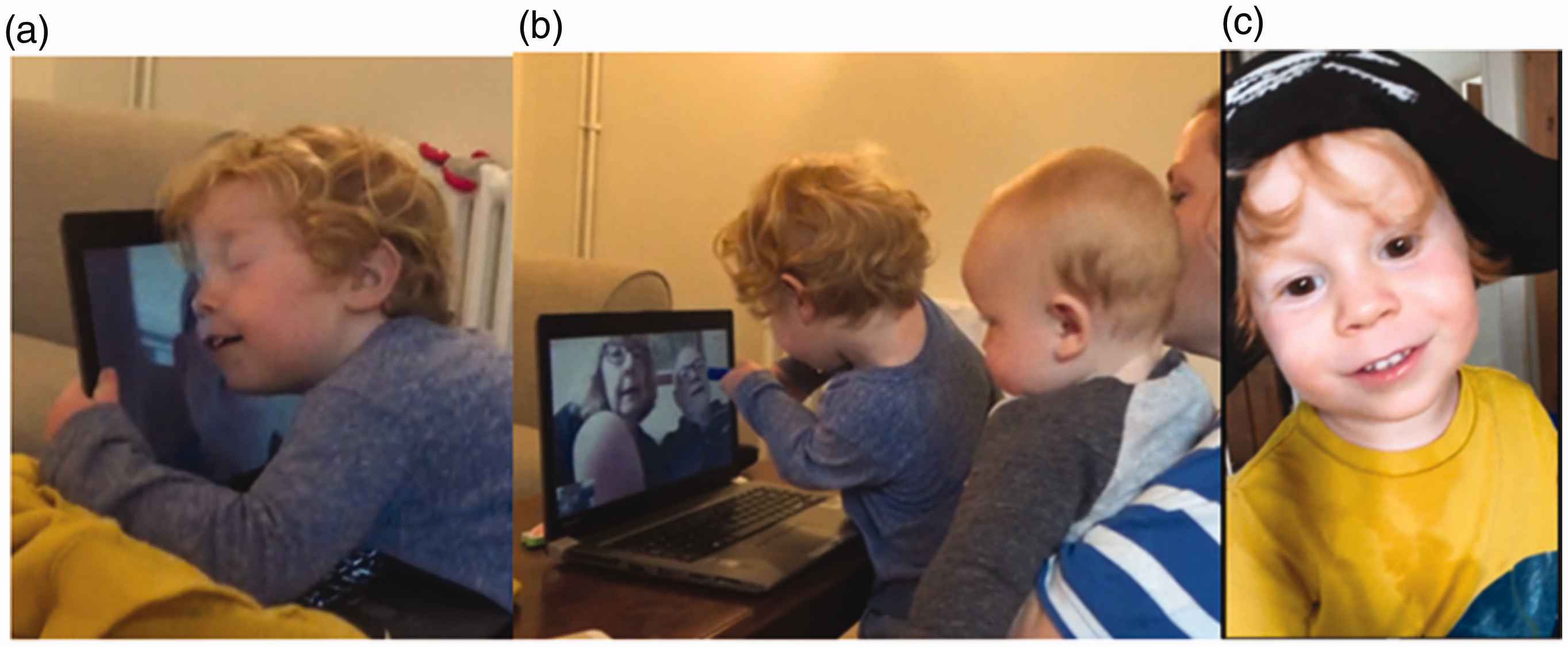
The second extract features a WhatsApp video message that Charlie had sent to his same-aged friend Lizzy, who had temporarily moved away. In on interview, Charlie’s mother had commented, ‘He is really interested in seeing himself … so when he can see himself recorded he is really interested in that.’ Motivated by seeing his mother use WhatsApp with her friends, his desire to connect with Lizzy and his interest in seeing himself, he and his mother had begun to make ‘little videos to send to his friends’. WhatsApp was an available and apt medium for these videos.
The video message presented here was the most recent Charlie had sent to Lizzy, where he had donned a pirate’s hat to create an imaginary joint play scenario. Although only lasting nine seconds, the message is complex, skilful and in keeping with the phenomenon of sharing ‘selfies’ on social media. As the message begins, Charlie’s face is beaming at the intended audience ( Charlie: Mother (off-screen): (whispers prompt to Charlie) blow a kiss Charlie: (glances towards mother, then gaze to screen, leans forwards and blows a kiss towards screen)
These brief accounts of Petra and Charlie’s digital literacy practices during just one day in their home lives evidence how each child was developing the skills and knowledge to communicate effectively and affectively when using digital technologies, and both were learning how to find information digitally (TV programmes using a remote; weather forecasts via an App). Through his WhatsApp video messages, Charlie was understanding, producing and sharing highly creative and complex media texts that were imbued with playfulness and deep affection. Both children were reading meaning from digital symbols, and both showed cultural and social understanding of digital literacy practices. Whilst 14-month-old Petra was moving from vocalisation and action towards expressing meaning through the mode of speech whilst also recognising digital symbols, 34-month-old Charlie was on the cusp of moving from his mastery of oral language to recognising written words and symbols, such as in books, on food packaging and on digital screens. For both children, their digital literacy activities were interwoven with affect, which anchored their material and virtual intra-actions with people, materials and spaces.
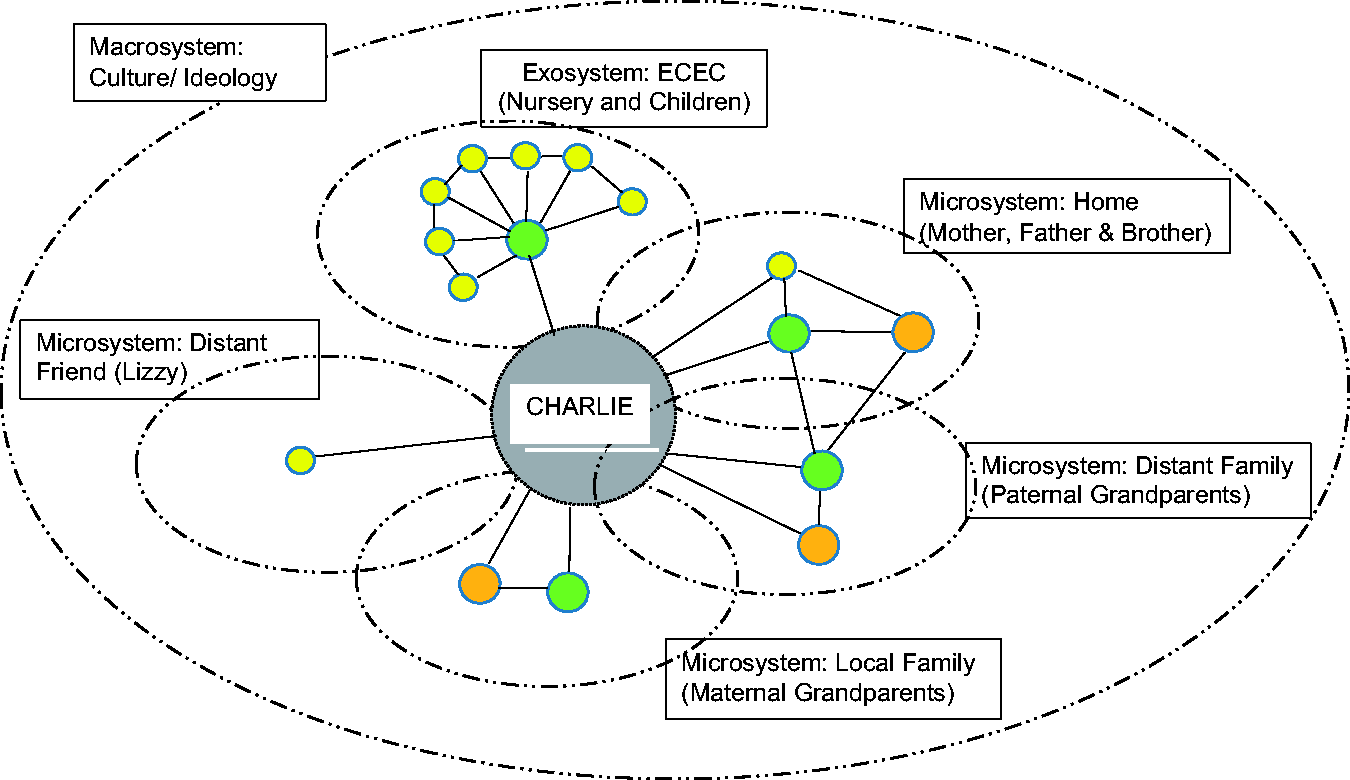
Diagrammatic representation of Charlie’s HLE.
Discussion and concluding thoughts
The findings of this study point to the networked nature of the contemporary HLE, to the permeable nature of its physical boundaries, and to the affective intensity of young children’s relationships with near and distant family and friends that often drives their digital literacy practices. Rather than experiencing the HLE as a bounded space situated neatly within layers of nested social systems, our findings place Petra and Charlie in direct and indirect contact with multiple micro-, exo- and macro-systems which they access physically and/or virtually via digital platforms. Their encounters with these diverse systems are not fixed or static but occur dynamically in overlapping assemblages and entanglements in the fluidity of everyday life.
In studying these networks, our analysis began to unravel how each child exercised agency not through intentionality but through the dynamics of the intra-action that unfolded between their own and others’ bodies and material resources in actual and virtual social spaces. Whilst the sample size of our study is small, we suggest the findings offer sufficient evidence to support Ruppert et al.'s (2013) suggestion that the contemporary home literacy environment requires a conceptual framework to visualise how digital technologies are ‘reworking, mediating, mobilizing, materializing and intensifying social and other relations’ (p.3).
By drawing attention to the micro-practices of 0-3-year-old children’s playful and creative engagement with new media texts and practices, this study makes a unique contribution to ‘a critically under-researched’ field of enquiry about ‘how very young children ‘voice’ their meaning making with new technologies’ (Harrison and McTavish, 2018: 165). However, whereas many past studies, including Harrison and McTavish, draw heavily on Bronfenbrenner’s ecological nested systems to theorise the child in the context of family, school, community, society and culture, we concur with Merchant (2015) that it is time to ‘re-draw our maps of literacy development’ (p.3). In the present age, arguably more than ever before, as research pays more attention to contemporary literacy practices with digital media, so hegemonic, Western notions of the HLE as a bounded refuge are called into question. This is not just the case for adolescents using social media and/or gaming, but also for very young children using digitally connected devices, which include personalised toys, books and baby listening devices as well as smartphones, tablets and computers, and which enable children to connect directly with distant friends, family and – given the risks of a largely unregulated facility – unknown others (Chaudron et al., 2020).
Whilst there will always be risks in children’s ‘exposure’ to digital media, in contrast to public debates that invoke ‘a dystopian discourse that considers digital technologies as fracturing family life and home values’ (Morgade et al., 2020: 111), the present study has identified how the contemporary HLE can help to sustain ‘felt literacies’ (Burnett and Merchant, 2020: 4), which produce and are produced by affective intensity across multiple family and friend networks, and which provoke young children’s creative, collaborative, inquisitive and playful meaning making across multiple modes and media. Far from being nested in neatly constrained structures, the social, cultural and community spheres of influence on young children’s lives often intersect and affect children directly through their multiple networks and affectively intense relationships. These networks are constantly in motion and interwoven with threads of human relationships, offering the very youngest children fleeting opportunities to act, to intervene, to contest and to reconfigure in ways that matter to them. We contend that affect, coupled with the intra-action between people, materials and spaces in these networks, drives very young children’s early literacy practices in the current digitally-mediated era.
In our study, we found that network theory helped us to map the dynamic and multiple relationships between children and others in their social worlds, and to understand how children’s intimate relationships with family and friends are maintained through times of separation and togetherness in affective flows across physical divides. A networking lens also highlights how children’s digital literacy practices cannot be separated from the social, cultural, political, historical and intersectional elements of gender, ethnicity and social standing with which they are inevitably entwined.
The data for our study, which focused on one day in the life of two children from comparatively privileged homes, was not apt to explore how young children’s physical/virtual, close/distant social networks might begin to sow the seeds of inequity in the HLE, through children’s close involvement, or not, with emotionally stable networks and relationships that support their early literacy learning. However, future work in this field might explore how social values and structures come to be embodied in individuals through processes of socialisation, which in the contemporary world is experienced both first-hand and virtually through digital media. How, for example, do young children’s diverse online and offline social networks and relationships shape their affinity or disaffinity with familiar, affective and fun home literacy practices and the literacy practices they will encounter on entering a classroom environment in the highly regulated world of education? Current research does not yet tell us enough about how children’s social networks are sustained across material and virtual spaces, how children’s personal investment in these networks is driven by affect, how digital networks contribute to children’s social and cultural capital (Bourdieu, 1997) or how the intra-actions between people, materials and spaces shape children’s understandings of what literacy is in the contemporary age. This field of enquiry offers a rich vein for future research.
To conclude, we suggest that if we focus only on the HLE as unfolding in the physical, bounded space of home, and if we narrow the focus still further on the presence or absence of particular print-related literacy skills in home practices as indicators of the calibre of the HLE, then we are knowingly ignoring the complex web of affective relationships and networks that drive young children’s learning with, about and through diverse digital and non-digital literacy resources. We also suggest that through detailed studies of young children’s online and offline literacy activity at home, we can begin to understand how even the very youngest children’s developing sense of self and social identity shape and are shaped by the generative potential of intra-actions between people, materials and spaces in their everyday lives.
Footnotes
Funding
The author(s) disclosed receipt of the following financial support for the research, authorship, and/or publication of this article: This research was supported by seed-corn funding from UCL Institute of Education, where Professor Rosie Flewitt was Founding Co-Director of the Helen Hamlyn Centre for Pedagogy.
