



Abstract
Bilingual picture books offer rich sources of dual-language input, but little is known about how different types of books provide opportunities for children’s learning across languages. Building on research describing Spanish-English Codeswitching books (which present languages intermixed), we assessed the quantity, diversity, and complexity of input in Translation picture books (which included the full text in both languages) and compared the two types of books. Translation books included balanced use of English and Spanish and varied in the frequency of switching. Across both book formats, English input was similarly complex, but Translation books presented larger amounts and more complex input in Spanish. Additionally, the two types of books included frequent yet different patterns of language switching, offering dense exposure to an important feature of bilingual experience. Thus, bilingual books could provide children with input distinct from what they encounter in either spoken language or reading activities in a single language.
Keywords
Introduction
To become proficient in two languages, bilingual children need rich and varied experiences with both of their languages (Marchman et al., 2017; Pearson et al., 1997; Place and Hoff, 2011; Thordardottir, 2014). Bilingual language skills have been linked to the frequency, balance, and contexts that surround experience with each language (Hurtado et al., 2014; Paradis, 2011; Welsh and Hoff, 2021). Moreover, children’s experience can rarely be neatly separated by language, and they must learn how and when to use their languages together (Byers-Heinlein and Fennell, 2014; Oller et al., 2007). Therefore, providing bilingual children with diverse and complex input that supports learning across languages increases the likelihood that they will develop robust skills in two languages. One activity shown to support language development is reading storybooks (Bus et al., 1995; Duursma et al., 2007). We compared the language input found in two different types of Spanish-English picture books to understand the learning opportunities that may be available to bilingual children.
In both spoken and written language, bilingual experience is diverse; children rarely receive fully balanced experience (David and Wei, 2008; Hoff et al., 2012; Marchman et al., 2017; Pearson et al., 1997). In particular, there is often greater support for the majority language in the community (Gathercole and Thomas, 2009; Giles and Watson, 2013; Hoff et al., 2021), and this can be especially pronounced in literacy and education (e.g., Luo et al., 2021). In the United States, even in communities where Spanish (the most common non-English language in the U.S., U.S. Census Bureau, 2022) is widely used, children tend to have more exposure to English as they enter school (Eilers et al., 2006; Gutiérrez-Clellen et al., 2009; Hurtado and Vega, 2004; Welsh and Hoff, 2021). As a result, many bilingual parents seek opportunities to build their children’s skills in Spanish in addition to English (Gonzalez-Barrero et al., 2021; Read et al., 2021a).
One accessible source of enriching input is children’s books. Storybooks are often recommended as a tool for supporting children’s language development, including exposing them to new words and concepts (e.g., Breitfeld et al., 2021; Bus et al., 1995; Flack et al., 2018). The text of picture books includes more diverse vocabulary and more complex sentence structure than typical spoken language (Cameron-Faulkner and Noble, 2013; Montag et al., 2015), and participation in shared reading can boost children’s language knowledge (Duursma et al., 2007; Fitton et al., 2018). Children who are read to regularly tend to have larger vocabularies (Farrant and Zubrick, 2012; Sénéchal et al., 2008), providing additional evidence that the input offered during reading interactions may be supportive of learning language.
For bilingual children, reading can offer experience in either or both of their languages, and young bilinguals display learning from both single- and dual-language literacy activities (Brouillard et al., 2022; Méndez et al., 2015; Read et al., 2021b; Restrepo et al., 2013). However, bilingual books have been suggested to be especially beneficial for dual language learners, as they may provide experience well-matched to what a bilingual child ultimately needs to learn, namely the ability to understand and communicate in both of their languages individually, as well as to integrate their knowledge across languages (e.g., Agosto, 1997; Domke, 2018). Thus, there is a growing need to understand how bilingual books present both languages in text, an initial step to determine how to best provide literacy and educational opportunities specifically for dual language learners (e.g., Hammer et al., 2014).
Studies have begun to examine how books might provide input tailored for bilingual learning. To meet growing demand in the U.S. where the number of Spanish-speaking children is growing rapidly (Migration Policy Institute, 2019), books designed for Spanish-English bilingual children have become increasingly common (Chaudhri and Torres, 2022; Gonzalez-Barrero et al., 2021), and research suggests that bilingual children enjoy and benefit from reading bilingual books (Brouillard et al., 2022; Hu et al., 2012; Naqvi et al., 2013; Read et al., 2021b; Tsybina and Eriks-Brophy, 2010; Zaidi, 2020). However, bilingual books differ in how they present two languages together (Domke, 2018; Jeffers, 2009; Semingson et al., 2015), and it is not yet clear whether and how different types of bilingual books offer different experience with each of two languages.
Specifically, for families in the U.S. looking to read in Spanish and English, there are two dominant formats for bilingual books (Chaudhri and Torres, 2022; Gonzalez-Barrero et al., 2021). We term these categories Codeswitching books, where two languages are presented intermixed, and Translation books, where the same narrative is presented in each language (see Figure 1). Recently, we analyzed the text of Codeswitching books, as those books represent a uniquely bilingual experience (Benitez et al., 2022). Results revealed that Codeswitching books contain primarily English words and include frequent switching between languages (Benitez et al., 2022), reflecting differences from child-directed spoken language (Bail et al., 2015). Thus, while they may not include many words in Spanish, Codeswitching books could still offer input that allows children to learn words in both languages and conventions about how languages are used together. Illustrations of pages from Codeswitching and Translation books. Examples of how English and Spanish text tended to appear in (a) Codeswitching and (b) Translation books.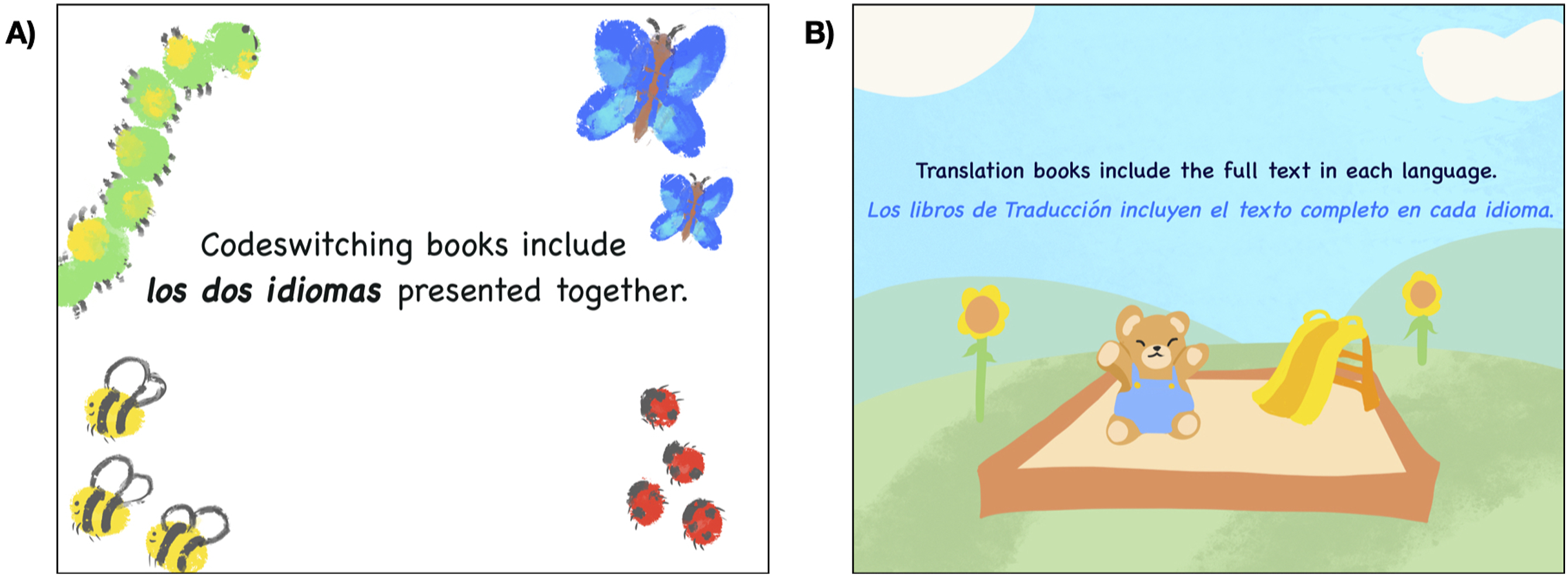
While Codeswitching books are becoming popular (Chaudhri and Torres, 2022), Translation books, which contain the full text in each language (Gonzalez-Barrero et al., 2021), are more common. Thus far, most studies examining children’s learning from bilingual book reading have focused on Translation books across a variety of language pairs (e.g., Brouillard et al., 2022; Naqvi et al., 2013; Quirk et al., 2024). While it may be assumed that Translation books provide equivalent input across languages, translations can be imperfect, and it may be especially challenging to capture cultural references or wordplay, which can be central to children’s literature (Lathey, 2015; Netley, 1992). Therefore, one important goal of the current study was to test whether Spanish-English Translation books actually provide similarly rich text across languages.
In addition to understanding how Translation books present each language, it is important to consider similarities and differences in language use across Codeswitching and Translation books. In bilingual environments, children encounter their two languages used together in multiple ways. At one extreme, children could encounter their two languages from different people in different contexts (e.g., De Houwer, 2007; Ronjat, 1913). Alternatively, children may be immersed in fully bilingual environments where people switch languages freely (e.g., Byers-Heinlein, 2013; Place and Hoff, 2011). While children become bilingual across many contexts, it is debated if there are optimal conditions for bilingual development and whether language switching impedes or benefits learning (Byers-Heinlein et al., 2017; Byers-Heinlein and Lew-Williams, 2013; Place and Hoff, 2016). Here, we describe the input in Translation books (where all content is presented in both languages) and contrast that input to that of Codeswitching books (where the two languages are intermixed) to understand whether and how these books differ in the way that they present English and Spanish text, as well as how they demonstrate switching between the two. Describing how different types of bilingual books present text in two languages can yield insights into the opportunities that children may have to learn from the text in these books. A better understanding of the structure and linguistic content of these books could ultimately inform efforts to provide research-based recommendations to support children’s learning of two languages from bilingual literacy activities.
Current study
We began by constructing a new corpus of children’s Spanish-English Translation picture books, comparable in targeted age and accessibility to the corpus of Spanish-English Codeswitching picture books described by Benitez and colleagues (2022). We first analyzed Translation books separately and asked how Translation books present English versus Spanish. We examined the quantity, diversity, and complexity of English versus Spanish text in Translation books. We then explored how the languages were presented together. We considered how languages appeared on the page, including which language was presented first and if they were presented in alternation. In addition, we investigated the frequency and types of language switching, comparing switching within and between utterances. We predicted that we would find balanced use of English and Spanish across measures of quantity, diversity, and complexity. We also predicted that English would be presented first more often across books, based on earlier findings that bilingual books often emphasize English (Benitez et al., 2022; Domke, 2018). Finally, we predicted that switches would occur almost exclusively between utterances, with few, if any, within-utterance switches.
We then compared Translation and Codeswitching books. We tested for global differences in the quantity, diversity, and complexity of input. Since Translation books present the same content twice, we predicted they would provide more total text. However, because we were comparing books for children of similar ages, we did not expect to find significant differences in overall diversity or complexity of input. We then tested for language-specific differences across book types. Because Codeswitching books have been shown to have imbalances, we predicted that relative to Translation books, Codeswitching books would present richer English input, but fewer words and less complex input in Spanish. We also considered differences in language switching. We expected Codeswitching books would include more frequent switches overall and in particular, more within-utterance switches than Translation books.
Our final question evaluated books’ content. We conducted exploratory analyses to investigate whether the two types of books emphasized different themes. We examined the most frequent nouns in English and Spanish and coded each book for the presence of content culturally relevant to Spanish-speaking communities. Translation books can be books that were originally published as a monolingual book and translated to create a bilingual book. In contrast, because Codeswitching books embed one language in another, this type of book may be more likely to be designed specifically for bilingual and bicultural audiences. Therefore, we predicted Codeswitching books might have a greater focus on content related to Spanish-speaking cultures.
Materials and methods
Sample
We constructed a corpus of 45 bilingual picture books that included the full narrative text in both English and Spanish. Books were selected from a larger list of 286 Spanish-English bilingual children’s books readily available in the U.S. market, compiled via a search conducted in June and July 2021. For more details about how the search was conducted, see Benitez and colleagues (2022). The complete list of books is available on OSF: https://osf.io/cbx3u/. The sample size was chosen to match the full set of Codeswitching books described by Benitez and colleagues (2022).
On the original list, 234 books were classified as Translation books, and 197 included information about target age. We coded target age by calculating the mean of the suggested reading age range and rounding (e.g., a book for 3- to 6-year-olds was coded as target age 5). We selected books to match the age distribution of the larger list (M = 4.89, SD = 2.20; see Appendix A for full list). Our final Translation corpus included a wide age range: target age 1 (N = 1), age 2 (N = 10), age 3 (N = 3), age 4 (N = 5), age 5 (N = 5), age 6 (N = 12), age 7 (N = 6), age 8 (N = 2), and age 10 (N = 1). Twenty-one books were originally published in a bilingual format, 20 were originally published in English with bilingual versions created later, and four books were published simultaneously in English and bilingual formats.
To make appropriate comparisons between the two types of bilingual books (Codeswitching vs Translation), we created age-matched subsets of each corpus. In the full corpora, Codeswitching books (M = 5.7, SD = 1.2) had a higher mean target age than Translation books (M = 4.8, SD = 2.1; t (68.17) = 2.5, p = .02). With this age discrepancy, we would be unable to determine whether any differences could be attributed to the type of book or differences in the intended age (i.e., books for older children would be expected to be longer and more complex). We therefore removed six books from each corpus to better equate target age. In this comparison subset, there was no significant difference in mean target age (Codeswitching: M = 5.56, SD = 1.23, Translation: M = 5.23, SD = 1.91; t (64.89) = 0.92, p = .36). In the results, we note which analyses were performed using the full corpus versus the age-matched subset.
Transcription and coding
Books were transcribed using the Computational Human Articulatory Theory (CHAT) conventions via the Computerized Language Analysis program (CLAN; MacWhinney, 2000) by four trained bilingual coders. All coders were fluent in English and had moderate to native proficiency in Spanish. Coders transcribed text as written, adhering to utterance boundaries and spelling. Narrative text and dialogue were transcribed as input from a single source (see Benitez et al., 2022 for transcription procedures). Background text (e.g., text in illustrations) was included only if it pertained to the storyline. Following CHAT standards, transcripts were organized by utterance. Punctuation that signaled a stop (period, exclamation point, or question mark) or a switch between character speech and narrative text (quotation marks) was used as an utterance boundary.
CHAT conventions require a default language, and for consistency, English was always the primary language. Thus, any use of Spanish was marked. Utterances that contained only Spanish words were tagged, and when utterances included both English and Spanish words, coders tagged each individual Spanish word. Proper nouns included in English sentences (e.g., Abuela) were marked as switches, but names (e.g., José) and words that have been adopted into English (e.g., churro) were not coded as switches. However, names and borrowed words were classified as Spanish when they occurred in Spanish utterances. All words were transcribed as written, even when they were close variants (e.g., abuela/abuelita, dog/doggy).
Measures
Language use measures
We used CLAN to compute measures of quantity, diversity, and complexity, as well as frequency and type of language switching. We calculated all measures separately for each book and aggregated across books.
Measures of quantity included number of word tokens (total words) in English and Spanish, and number of English-only, Spanish-only, and mixed-language utterances. Measures of diversity were number of word types (total unique words) in English and Spanish, and type/token ratio (total number of word types divided by total word tokens) in English and Spanish. Complexity was assessed by the mean length of utterance (average number of tokens per utterance; MLU) for each type of utterance (English-only, Spanish-only, or mixed-language).
Measures of the use of English and Spanish together
Language presentation
We coded (1) whether English or Spanish appeared first, (2) the format in which translations were presented: after each sentence or in blocks (e.g., several sentences of narrative text in one language followed by the translation of those sentences), and (3) whether translations were presented on the same page or across pages.
Switching
We coded switching within and between utterances. Definitions of switches were operationalized using CHAT conventions as well as some theoretical proposals on codeswitching (see Muysken, 2000) that separate the use of the primary (English) versus secondary language (Spanish) following the Matrix Language Frame model (Boumans, 1998; Myers-Scotton, 1997). Utterances that included words in both languages were classified as mixed-language and counted as one within-utterance switch, regardless of how many alternations there were between languages. We also calculated MLU and the number of English versus Spanish words within mixed-language utterances. To code between-utterance switches, we identified Spanish-only utterances and counted a switch whenever the preceding or following utterance was of a different type.
Content measures
Frequent words
To test whether Translation and Codeswitching books focused on different topics, we explored whether the same words appeared equally often across the two types of books. Prior results with Codeswitching books suggested different words tended to appear in English versus Spanish, with family words being especially frequent in Spanish (Benitez et al., 2022), so we measured frequencies separately for each language and calculated frequencies across each corpus. We excluded function words and focused on the five most frequent nouns in English and Spanish. To capture the use of different concepts, we collapsed across close variants (e.g., plurals, diminutives) of individual words (e.g., mom, mommy, and mother were all grouped together). This measure was designed to assess the frequently mentioned concepts in each language in each type of book.
Culturally relevant content
We coded each book for cultural content relevant to Spanish-speaking communities, such as culturally specific food/drinks, attire, or phrases. Two bicultural coders from a Mexican-American community independently coded all books and then compared their coding. Discrepancies were resolved through discussion.
Reliability
Coders were trained and given practice tagging both within- and between-utterance switching by transcribing two Codeswitching books that had previously been transcribed and checked by experienced coders. Once coders achieved high reliability, they transcribed the books in our sample. After transcription, we randomly selected six books to test inter-rater reliability.
We calculated reliability across six measures: number of utterances, number of word tokens, number of word types, MLU, number of Spanish word tokens, and number of Spanish utterances. Krippendorff’s alpha (Krippendorff, 2011) revealed high inter-rater reliability (above 0.8) on all measures, with an average score of 0.977 (MLU = 0.992, total utterances = 0.904, total tokens = 0.996, total types = 0.997, number of Spanish tokens = 0.995, number of Spanish utterances = 0.977).
Results
In the first section, we describe the results from the full Translation corpus (N = 45). In the second section, we compare the input provided by Codeswitching versus Translation books, using the age-matched subsets (N = 39 each).
Comparisons were conducted using chi-square goodness of fit tests and paired and independent samples t-tests. Prior to analysis, all variables were checked for normality. Several variables violated normality assumptions with high skew and/or kurtosis. Wilcoxon signed rank tests were conducted on the variables that violated normality assumptions. All analyses were conducted in R version 4.0.5. Data and analysis scripts are available at https://osf.io/cbx3u/.
Use of English and Spanish in Translation books
Measures of language use
Overall text characteristics
On average, Translation books included 657.7 tokens (SD = 576.4, range: 108-2047) of which 289.5 were unique word types (SD = 217.5, range: 41-768). The mean type/token ratio was 0.49 (SD = 0.13; range: 0.20-0.75). Translation books presented an average of 95.7 utterances (SD = 88.5; range: 20-394) and had an average MLU of 7.4 (SD = 2.9; range: 2.3-14.0).
Quantity measures across languages
First, we compared the total number of word tokens in English and Spanish by conducting paired t-tests (Figure 2). As predicted, the number of tokens did not differ by language [English: M = 331.8, SD = 284.5; Spanish M = 325.9, SD = 293.5; t (44) = −0.90, p = .37]. We next examined the total number of utterances in English versus Spanish (excluding mixed-language utterances). The number of utterances also did not differ by language [English-only: M = 46.7, SD = 41.4; Spanish-only: M = 46.9, SD = 43.5; t (44) = −0.20, p = .84]. Comparisons of English vs. Spanish in Translation books. Means and standard errors for number of (a) word tokens, (b) utterances, (c) word types, and (d) mean length of utterance across English and Spanish text in Translation books. Dots represent individual picture books. Asterisks indicate significant differences (*p < .05).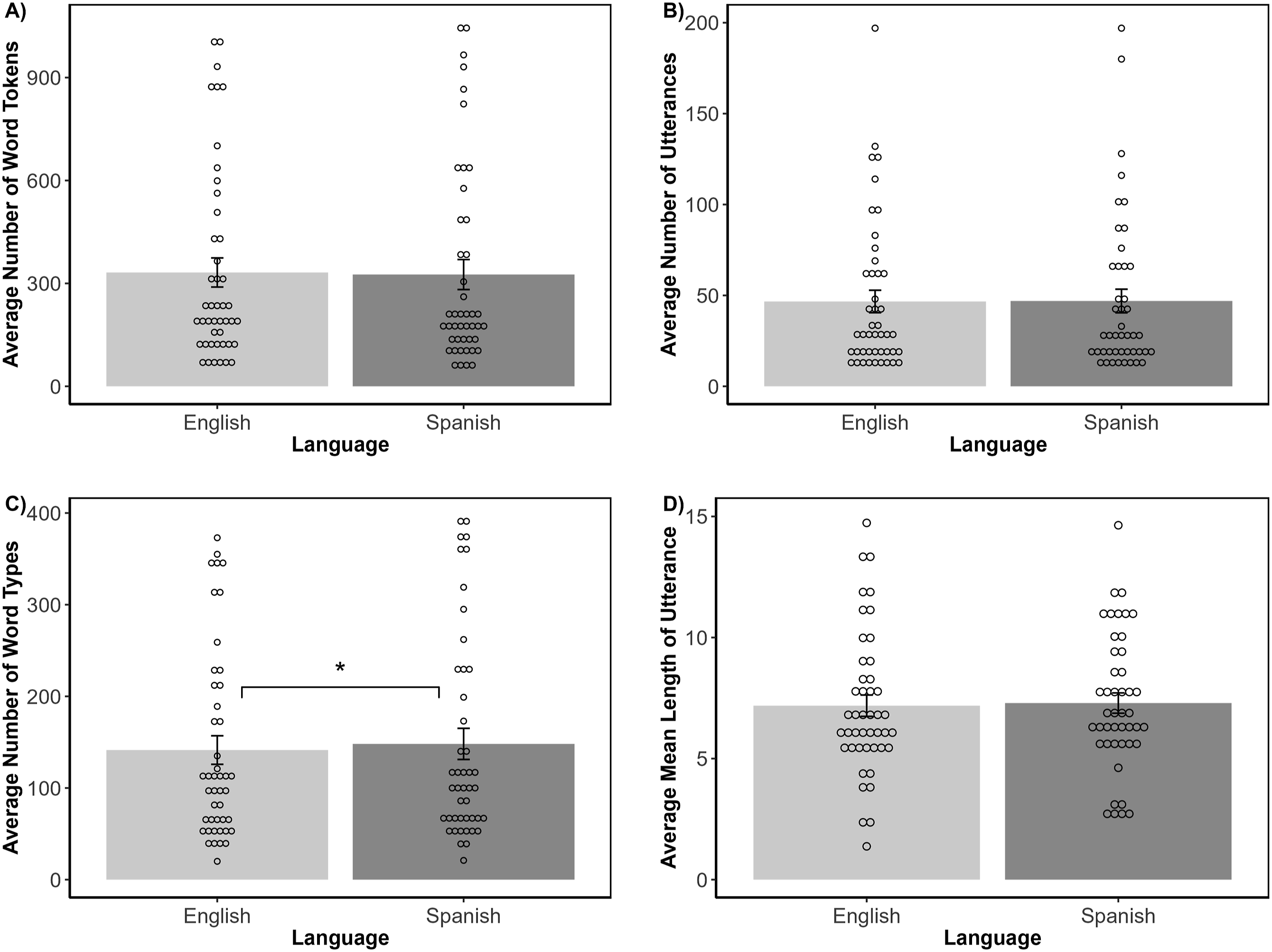
Diversity measures across languages
To evaluate the diversity of words in each language, we compared the number of word types and the type/token ratio for English versus Spanish. Translation books presented significantly fewer word types in English (M = 141.4, SD = 104.5) than in Spanish (M = 148.1, SD = 113.9; t (44) = 2.42, p = .02). In addition, type/token ratio was significantly lower in English (M = 0.48, SD = 0.14) than in Spanish [M = 0.51, SD = 0.14; t (44) = 2.69, p = .01].
Complexity measures across languages
Finally, we assessed utterance complexity by comparing MLU for English-only versus Spanish-only utterances. MLU was similar across languages [English-only: M = 7.2, SD = 3.0; Spanish-only: M = 7.3, SD = 2.8, t (44) = −0.43, p = .67].
In sum, we found that as expected, Translation books in this sample generally offered input of similar quantity and complexity across languages, but unexpectedly included more unique Spanish words.
Use of English and Spanish together
Presentation of text
To understand how English and Spanish were used together, we began by examining the order in which the languages appeared in each book, following prior studies (Daly, 2018; Domke 2018). We conducted a chi-square goodness of fit test to determine if the proportion of books for which English was presented first versus the proportion of books for which Spanish was presented first differed from the expected proportion (50/50, i.e., each language was equally likely to appear first). Results showed that the proportion of books for which English was presented first was higher than expected (30/45 books, χ2 (2) = 8.839, p = .01). To better understand patterns of presentation, we separated books by original language of publication. Among books originally published in English, 15/20 presented English first. Similarly, for books originally published in the Translation format, 15/21 presented English first. In contrast, the four books simultaneously published in English-only and Translation formats all presented Spanish first.
We then considered how languages were presented within each book. English and Spanish could appear in alternating sentences (one sentence in a single language immediately followed by the translation of that sentence in the other language, see Figure 1(b)) or in blocks (several sentences in a single language, then the translation) on the same or across different pages. 15 books presented translations in alternating sentences, 17 books presented languages in blocks, and 13 books used a hybrid format. For most books (28/45), both languages were consistently presented on the same page. Five books always presented translations on different pages, and 11 books presented translations both within and across pages. One book presented the full narrative in Spanish followed by the English narrative. These results illustrate the heterogeneity in how text appears in Translation books, but most books included frequent alternations between languages.
Switching between languages
To further describe how the languages were used together, we evaluated the frequency and types (within- or between-utterance) of language switches. Comparisons were conducted via Wilcoxon signed ranks tests.
Translation books included an average of 23.0 between-utterance switches (SD = 24.1, range: 1 - 162). Approximately 32% of utterances occurred in a different language than the prior utterance, and the vast majority of switches occurred between utterances (Figure 3). Frequency of switching between languages in Translation books. Frequency distribution of the number of books that included (a) within-utterance codeswitches and (b) between-utterance switches. Dashed line represents the mean.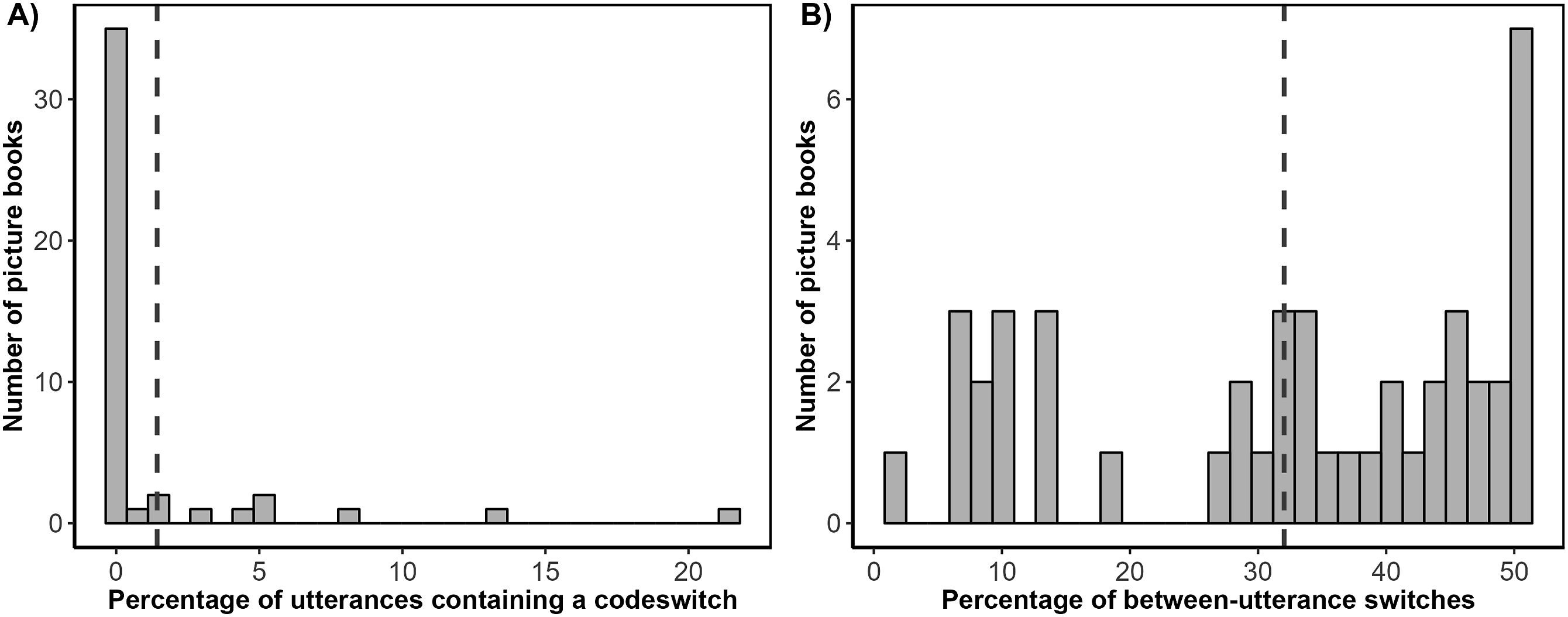
Interestingly, although most books did not include within-utterance switches, 22% of Translation books (N = 10) included at least one mixed-language utterance. None of the books originally published in English or published simultaneously in English and a bilingual format included within-utterance switching. Instead, all books that included a within-utterance switch were originally published in a bilingual format, and nearly half (10/21) of books originally published in a bilingual format included at least one within-utterance switch (M = 9.30, SD = 14.8, range: 1- 48). These mixed-language utterances tended to be long (Mean MLU = 11.0, SD = 5.2, range: 1.5 - 18.2) compared to single-language utterances and contained primarily English words (English: M = 9.9, SD = 5.2; Spanish: M = 1.1, SD = 0.2). Spanish words in mixed-language utterances tended to be nouns, typically referring to people (e.g., mamá, abuela) or culturally relevant places and things (e.g., lotería, barrio, see Supplemental Table).
To summarize, Translation books in our sample provided relatively balanced use of English and Spanish, but there were subtle differences in both diversity and presentation. These books also included frequent switching between languages, but there was variability across books in how switching occurred.
Comparisons of Codeswitching and Translation books
Comparisons of overall quantity, diversity, and complexity across book types
Global quantity
To compare the total amount of text in Codeswitching versus Translation books in our sample (N = 78), we collapsed across English and Spanish (see Figure 4). The number of total tokens did not significantly differ across book types [Codeswitching: M = 540.3, SD = 323.5; Translation: M = 729.2, SD = 588.8; t (76) = −1.76, p = .08]. Likewise, the number of total utterances did not differ significantly [Codeswitching: M = 83.9, SD = 52.9; Translation: M = 102.1, SD = 92.7; t (76) = −1.07, p = .28]. Comparisons across Codeswitching and Translation books. Mean counts of (a) word tokens, (b) utterances, (c) word types, and (d) mean length of utterances across book types, divided by language. Error bars indicate standard errors of the mean when appropriate. Note that only utterances could be classified as Mixed-language; word tokens and types were always coded as English or Spanish.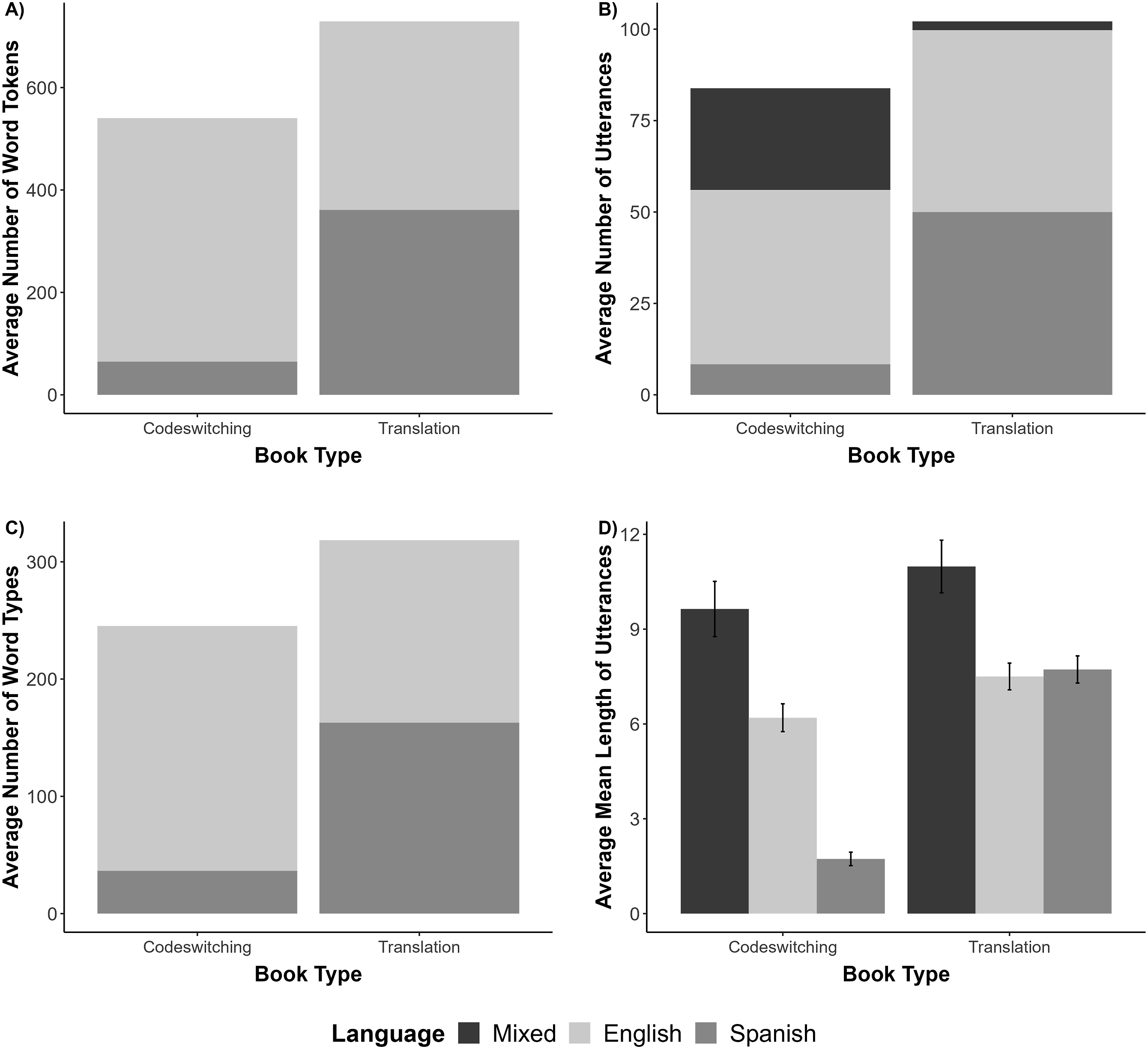
Global diversity and complexity
We examined lexical diversity and syntactic complexity across each book type, again collapsing across languages. On average, the number of unique word types did not significantly differ across book types [Codeswitching: M = 245.3, SD = 103.7; Translation: M = 318.5, SD = 220.4; t (76) = −1.88, p = .06]. In addition, type/token ratio was similar [Codeswitching: M = 0.50, SD = 0.12; Translation: M = 0.49, SD = 0.12; t (76) = 0.40, p = .69], and MLU did not differ [Codeswitching: M = 7.48, SD = 4.6; Translation: M = 7.8, SD = 2.6; t (76) = −0.32, p = .75].
Use of English versus Spanish across book types
Quantity
On average, there was no significant difference in the number of English tokens across book types [Codeswitching: M = 475.6, SD = 323.8, Translation: M = 368.2, SD = 289.6; t (76) = 1.55, p = .13]. However, Codeswitching books included significantly fewer Spanish tokens (M = 64.7, SD = 38.4) than Translation books [M = 361.0, SD = 300.8; t (76) = −6.10, p < .001]. The number of English-only utterances did not differ significantly [Codeswitching: M = 47.7, SD = 44.9; Translation: M = 49.7, SD = 43.4; t (76) = −0.21, p = .84], but Codeswitching books presented significantly fewer Spanish-only utterances (M = 8.4, SD = 9.9) than Translation books [M = 50.0, SD = 45.7; t (76) = −5.56, p < .001]. See Figure 4.
Diversity
Codeswitching books presented significantly more English word types (M = 208.8, SD = 101.9) than Translation books [M = 155.6, SD = 105.3; t (76) = 2.26, p = .03; see Figure 4]. On the other hand, Codeswitching books presented significantly fewer Spanish word types (M = 36.5, SD = 24.0) than Translation books [M = 162.8, SD = 115.8; t (76) = −6.67, p < .001]. In contrast, type/token ratio did not differ for either language [English: Codeswitching M = 0.49, SD = 0.13; Translation M = 0.47, SD = 0.12, t (76) = 0.61, p = .55; Spanish: Codeswitching M = 0.58, SD = 0.23; Translation M = 0.51, SD = 0.13; t (76) = 1.86, p = .07].
Complexity
There were language-specific differences in MLU across book types. For English-only utterances, MLU was significantly shorter in Codeswitching books (M = 6.2, SD = 2.8) than Translation books [M = 7.5, SD = 2.6, t (76) = −2.14, p = .04]. Likewise, Codeswitching books had a significantly shorter MLU for Spanish-only utterances (M = 1.7, SD = 1.3) than Translation books [M = 7.7, SD = 2.7; t (76) = −12.52, p < .001]. In contrast, MLU for mixed utterances was similar [Codeswitching: M = 9.1, SD = 5.7; Translation books that included mixed utterances: M = 11.0, SD = 5.2; W = 136, p = .21].
Language switching across book types
To understand differences in how books presented changes in language, we compared the use of both within- and between-utterance switches. In Codeswitching books, 38.6% of utterances (SD = 22.0%) contained within-utterance switches, and there were between-utterance switches for 8.3% of utterances (SD = 10.8%). In contrast, Translation books included within-utterance switches for 1.6% utterances (SD = 4.2%) and between-utterance switches for 29.2% of utterances (SD = 15.3%). Direct comparisons of the frequency of codeswitching across book types revealed that Codeswitching books included significantly more within-utterance switches [Codeswitching: M = 27.8, SD = 14.9, Translation: M = 2.8, SD = 5.5, W = 96, p < .001], but fewer between-utterance switches [Codeswitching: M = 5.7, SD = 5.7, Translation: M = 22.3, SD = 25.3; W = 1367.5, p < .001]. While both types of books included frequent changes in language, the type of switching that occurred most often differed (Figure 5). Comparisons of language switching across Codeswitching and Translation books. Means and standard errors for the number of (a) between-utterance switches and (b) within-utterance switches found in Codeswitching and Translation books. Dots represent individual picture books. Asterisks indicate significant differences (***p < .001).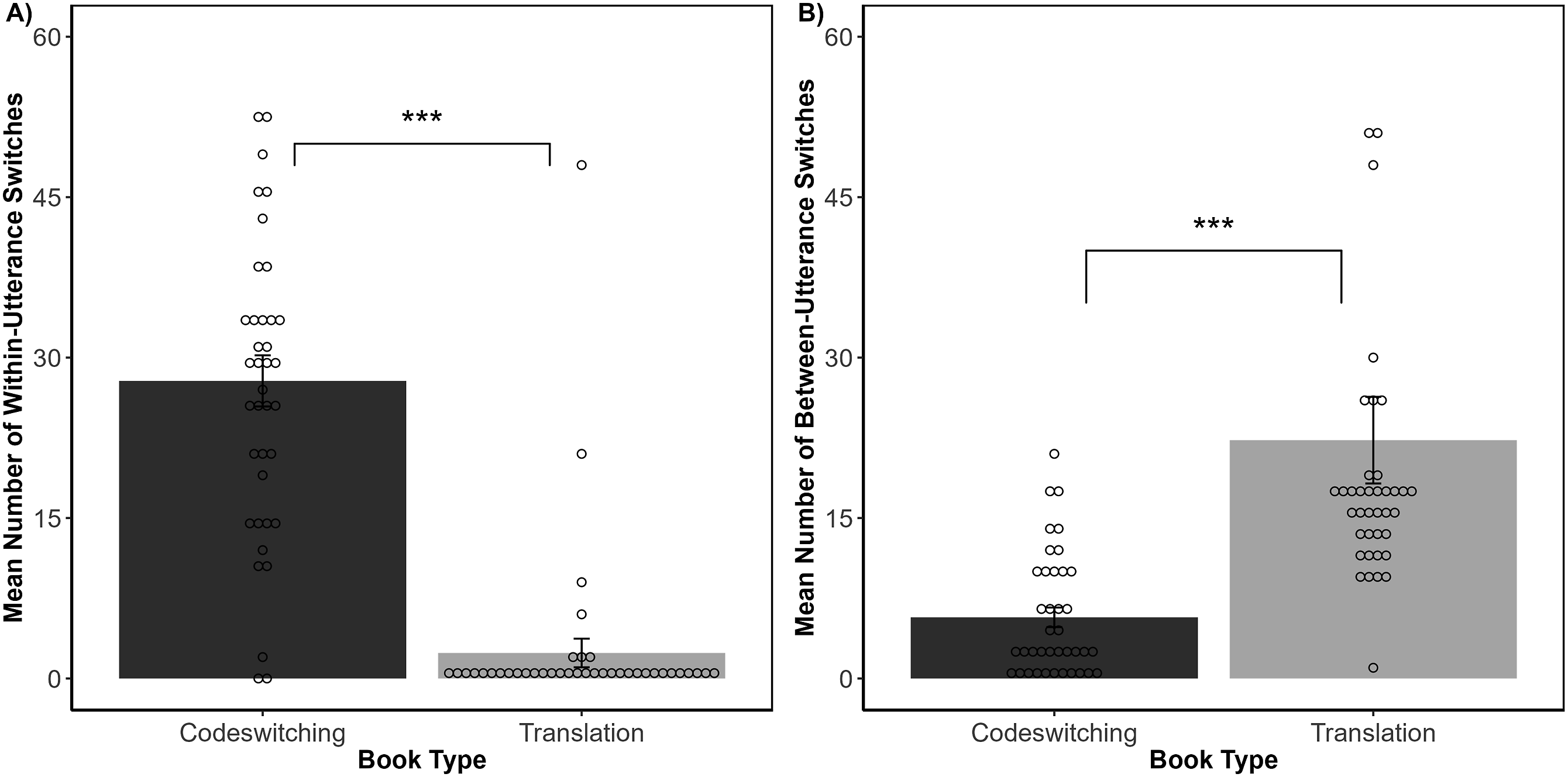
Differences in content across book types
Frequent words
Five Most Frequent English (top) and Spanish Nouns (bottom) Found in Codeswitching Books (left side) and Translation Books (right side).
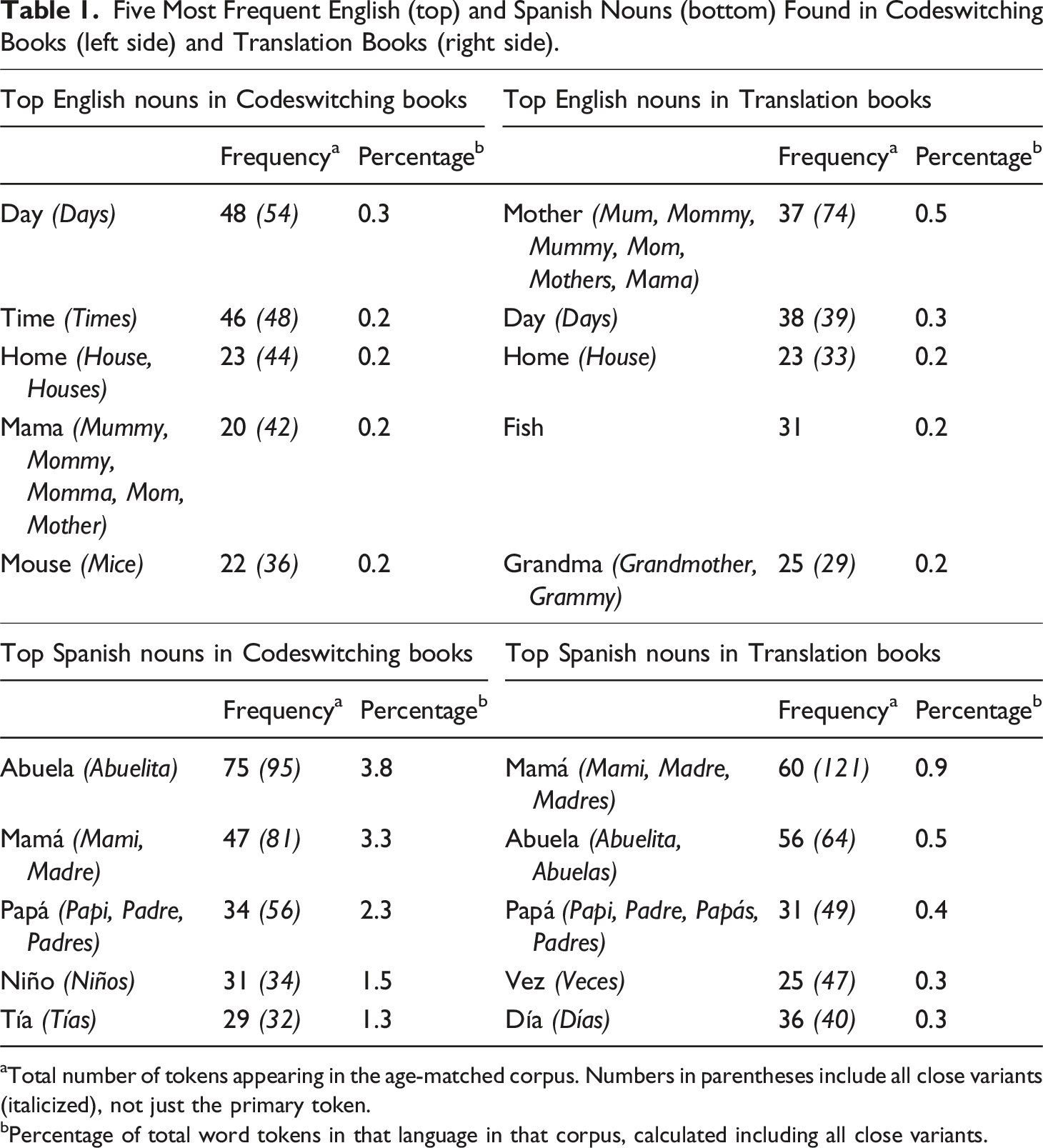
aTotal number of tokens appearing in the age-matched corpus. Numbers in parentheses include all close variants (italicized), not just the primary token.
bPercentage of total word tokens in that language in that corpus, calculated including all close variants.
Translation books did not display this same stark contrast, but there were subtle differences in how often the most frequent words occurred, even for books that were supposedly direct translations. In Translation books, family names were frequent in both languages, especially words referring to mothers and grandmothers. However, the absolute frequency differed, and both mamá and abuela were more frequent than their English counterparts. In addition, some words occurred more often in one language than the other, which may reflect the inexact nature of translation, as well as cross-linguistic differences. For instance, some words are part of compounds in one language (e.g., a veces vs sometimes), which could change counts. Together, these results indicate that Translation books tended to include similar topics across languages but were still more likely to present family words in Spanish.
Culturally relevant content
On average, Codeswitching books (23/39 books) were significantly more likely to include indicators of content relevant to Spanish-speaking communities compared to Translation books (9/39 books), χ2 (1) = 6.12, p = .01. All Translation books that did include Spanish cultural content were originally published in a bilingual format.
These content analyses showed that the two types of books contained overlap in the words that appeared frequently, but there were different patterns in how particular words and concepts were emphasized. Notably, Codeswitching books had an even greater tendency to use Spanish words for specific topics and more consistent focus on Spanish-speaking communities and culture.
Discussion
In this study, we described and compared the text found in two types of Spanish-English bilingual picture books. Our first goal was to characterize the quantitative and qualitative features of the text in Translation books that included the full narrative in both English and Spanish. Our second goal was to compare how Translation books differed in the presentation of English versus Spanish from Codeswitching books. We found that Translation books offered relatively balanced use of English and Spanish, with subtle cross-linguistic differences in the diversity of word use. Furthermore, Translation books included frequent language switching between utterances. Compared to Codeswitching books, Translation books contained greater quantity and diversity of Spanish text, while Codeswitching books included larger amounts and more variety of mixed-language input. Moreover, while both types of books presented frequent changes in language, switches occurred in different forms. Thus, we suggest that different types of books offer different input in each language and that this input is distinct from typical patterns of spoken language.
Input provided by Translation books
Our first aim was to describe the language content of Translation picture books, currently the most common type of Spanish-English bilingual book. In contrast to English-skewed input described in prior studies (Benitez et al., 2022; Domke, 2018; Gomm et al., 2017), Translation books in our sample offered more equivalent input across English and Spanish. Thus, reading these books could allow children to simultaneously build their skills in two languages (Marchman et al., 2017; Pearson et al., 1997; Place and Hoff, 2011). In fact, the only significant difference we found between languages in Translation books was that there were more unique word types in Spanish. This difference is likely due to grammatical properties, such as inflectional morphology (e.g., Spanish nouns, adjectives, and articles include marking for plurality and grammatical gender, and verb forms reflect tense, person, and mood, leading to different forms of the same root word; Lang, 2013; Moreno-Sandoval and Goñi-Menoyo, 2002). Still, the fact that Translation books present more word types in Spanish suggests that there may be more information available to learn in Spanish within these books.
Despite balance in quantity and complexity, it is worth noting that the two languages may not have identical status; none of the books were originally published in Spanish and translated to English, and English tended to appear before Spanish, a finding that is consistent with prior research (Daly, 2018; Domke, 2018). Having English regularly appear first in bilingual text potentially reflects and/or reinforces expectations that English is the culturally-dominant language for literacy activities in the U.S. (Benitez et al., 2022; Cha and Goldenberg, 2015; Hoff et al., 2018; Torres, 2007). Thus, while Translation books in our sample provided a similar quantity of text across languages, they may convey other messages about the relative importance of each language. Future studies could explore what children perceive about the value and function of English and Spanish in the context of reading Translation books.
Our second question concerned patterns of language switching in Translation books. Across the sample, switching between utterances was common, and switching within utterances was less frequent, but still present. The tendency for language switches to occur mostly at utterance boundaries is also characteristic of child-directed speech, but spoken language typically includes less switching than we observed in Translation books (Bail et al., 2015; Kremin et al., 2022). On average, there was a change in language after approximately every third utterance, meaning between-utterance switches were more than twice as common as have been reported in one-on-one interactions with Spanish-English bilingual dyads in the U.S. (Bail et al., 2015). However, just as there are individual differences in spoken language (Bail et al., 2015; Byers-Heinlein, 2013; Carbajal and Peperkamp, 2020; Kremin et al., 2022; Vaughan-Evans et al., 2020), we found variability in the frequency of codeswitching across books: many books included even more frequent switching, while one book included only a single switch.
Comparison of Codeswitching versus Translation books
Our second aim was to compare Codeswitching versus Translation books. After controlling for differences in intended age of audience, the two types of books offered similar total amounts and complexity of linguistic input. Interestingly, because Translation books included the same content across languages, this equivalence actually indicates that Translation books offered roughly half the narrative content of Codeswitching books, suggesting that perhaps the stories are simpler. Nevertheless, the lack of differences in overall quantity, diversity, and complexity suggests Codeswitching and Translation books have the potential to provide children with similarly rich input from which to learn vocabulary and grammar.
Although the overall complexity of text was similar across Codeswitching and Translation books, the composition of that text differed. Research has reliably demonstrated that children’s language knowledge and processing efficiency is linked to the amount of input that they receive in a particular language (Hurtado et al., 2014; Marchman et al., 2017; Legacy et al., 2016; Oller et al., 2007; Place and Hoff, 2011; Potter et al., 2019; Thordardottir, 2014). Thus, the differences that we observed in how these bilingual books present English versus Spanish input could have meaningful implications for children’s experience. Somewhat surprisingly, there were no significant differences across book types in the amount or diversity of English text. However, English-only sentences were longer in Translation books, perhaps because the most complex utterances in Codeswitching books included mixing. Differences in Spanish text were more striking. Compared to Codeswitching books, Translation books included five times as many words and utterances in Spanish. Likewise, Translation books had more complex Spanish-only utterances, but there was no significant difference in Spanish type/token ratio across book types. This lack of difference suggests that type/token ratio may reflect linguistic properties (e.g., use of inflectional morphology) that remain consistent across different types and amounts of child-directed text. More generally, these comparisons emphasize that books in our sample would not offer the same experience across languages, given that Translation books include greater quantity and complexity of Spanish text than Codeswitching books.
Just as they provide different exposure to the languages individually, Codeswitching and Translation books presented different patterns of switching. In Codeswitching books, most switches occurred within utterances, while in Translation books, switches tended to occur between utterances, which could introduce differences in comprehension efficiency. Interestingly, while switches in spoken language are influenced by production demands, such as the tendency to include challenging information later in the utterance (Johns and Steuck, 2021; MacDonald, 2013), these constraints may be less pronounced in text. Bilinguals are sensitive to the placement and predictability of switches (Beatty-Martinez et al., 2018; Salig et al., 2023), and studies of children’s real-time comprehension suggest that some switches introduce greater processing demands than others (Byers-Heinlein et al., 2017; Kremin et al., 2023; Morini and Newman, 2019; Potter et al., 2019). In both word-learning tasks and reading interactions, bilingual children have been shown to be equally successful in learning novel words when they are presented with frequent alternations in language or when they learn first in one language and then the other (Brouillard et al., 2022; Tsui et al., 2023). These findings suggest that the presence of switches does not appear to interfere with learning. In fact, it has been suggested that codeswitches in books can boost bilingual children’s learning of new words (Read et al., 2021b). However, it remains less clear whether exposure to particular types of switching is helpful, harmful, or unrelated to bilingual children’s broader language and cognitive development (e.g., Bail et al., 2015; Byers-Heinlein, 2013; Byers-Heinlein et al., 2017; Carbajal and Peperkamp, 2020). Given that both types of bilingual books included frequent and distinct use of switching, future studies could test whether children benefit more from reading interactions where languages are separated or integrated.
Language input across book types
While Codeswitching and Translation books differed in the locations where switches tended to occur, there were still consistent patterns in how English and Spanish were used together. In both book types, mixed-language utterances almost always consisted of primarily English sentences that included a Spanish word or two; English words were hardly ever incorporated into Spanish sentences. This asymmetry reveals that even in books purported to include the same content across languages, there are differences in how English and Spanish are used, potentially signaling to children that some topics are more relevant for one language (or culture) (Gutiérrez-Clellen et al., 2009). For example, the use of Spanish for certain concepts (e.g., family members) is consistent with the possibility that bilingual picture books may be designed to celebrate cultural heritage and values important to Spanish-speaking communities, such as familism (e.g., Sabogal et al., 1987; Stein et al., 2014).
In addition, the use of Spanish words in English sentences, but not the reverse, could imply that it is more appropriate to use codeswitched words in some contexts than others. Interestingly, the insertion of Spanish words into English sentences is not consistent with patterns in children’s spoken language; young Spanish-English bilinguals in the U.S. are more likely to switch into English when speaking Spanish than to use Spanish words while speaking English (Greene et al., 2013; Gutiérrez-Clellen et al., 2009; Montanari et al., 2019; Ribot and Hoff, 2014; Tulloch and Hoff, 2023), again suggesting English and Spanish are used differently in text versus speech. Switching practices vary both within and between bilingual communities, and it may be more or less accepted to mix languages together (Anderson and Toribio, 2007; Hoff, 2020; Kircher et al., 2022; Montanari et al., 2019; Tulloch and Hoff, 2023). Thus, by including language switches at different levels, bilingual books can expose children to language conventions, in addition to linguistic and cultural content.
Limitations and future directions
While book text can offer a valuable source of input for children, the books themselves are only one part of the reading interaction, as parents may not read text exactly as it appears. In particular, for Translation books, they are many possibilities: parents may read text as it appears in the book, thereby alternating between languages frequently; they may read the book in a single language and skip the other language; or they may introduce their own translations (Gonzalez-Barrero et al., 2021). Thus, the text of books may provide a starting point for children to hear and practice two languages, but transcripts of published text are unlikely to represent the full shared reading experience. Caregivers and children often engage in conversation during reading (see Read et al., in press), and for bilingual families, that extra-textual talk can occur in either or both languages (Bauer, 2000; García and Kleifgen, 2020). Recent studies suggest that parents’ and children’s preferences, goals, and proficiency influence bilingual families’ language choices in reading (Quirk et al., 2024; Read et al., 2021a), but to our knowledge, no study has directly tested how language switching within the text affects switching in extra-textual talk. Future research can determine how different types of books influence children’s exposure to, or production of, language switches. New studies can also explore how families use different types of books to shape the child’s language environment.
The current study focused on books aimed at Spanish-English bilingual children, a large and underserved population that stands to benefit from research that outlines specific factors that promote the development of cultural and linguistic knowledge (Bedore and Peña, 2008). However, the patterns we found in a sample of Spanish-English bilingual books marketed in the U.S. may or may not generalize to other language pairs or settings. For instance, research has compared both families’ attitudes and the frequency of language switching across Spanish-English bilingual communities in the U.S. and French-English bilingual communities in Canada. In a Canadian context where both French and English are used for education and official purposes, parents do not typically report major concerns about their child learning two languages (Quirk et al., 2023), and they have been found to switch between languages less often than Spanish-English bilingual caregivers in the U.S. (Bail et al., 2015; Kremin et al., 2022). It is possible that books written for different communities would reflect these priorities and conventions, and future studies could compare the books available for young children across a wider range of languages, scripts, and cultures. Interestingly, while Translation books could feasibly be created for any combination of languages, Codeswitching books may work best for languages that share a similar writing system and for communities where codeswitching is more widely accepted, and future studies could consider how different types of books may be more or less appropriate for children learning different types of languages.
Finally, it is also important to acknowledge that while we attempted to describe books that would be available to families, there is likely to be wide variability in individual children’s access to these or other similar materials, and we did not analyze every book that they might read. The local libraries that provided many of the books in this study were located in areas with large populations of Spanish speakers, and these types of books may not be found in all communities. Even if the books are available, this study does not tell us how many families are choosing to read these books, and more importantly, we do not have any measures of children’s learning. Going forward, new research could directly assess the experiences that children have with different types of books and test whether reading different books allows children to build their knowledge in one or both of their languages.
Implications
Bilingual language input is not the sum of two monolingual environments, and research on spoken language has made significant progress in describing how bilingual children may have different experiences with each of their languages (e.g., De Houwer, 2007; Hoff, 2020; Marchman et al., 2017). However, much less is known about how children experience their languages through literacy materials and activities, despite the fact that early literacy experiences are considered foundational for school (Barnes and Puccioni, 2017; Castro and Barrera, 2019). The current study offers new insight into the diversity of child-directed text in bilingual picture books and has implications for assessing what children could extract from these books, including lessons about vocabulary, language use, and cultural values. Our study provides a framework through which to evaluate bilingual books across language pairs and communities in future investigations. Finally, our study motivates future research that could examine how bilingual parents, teachers, and children interact with the text in bilingual picture books.
Conclusions
Overall, the current study provides evidence that “bilingual books” are not a uniform category, nor is one type of book likely to be definitively more supportive of dual-language learning. Like monolingual books, the bilingual books that we analyzed offer input that is linguistically distinct from everyday child-directed spoken language (Bang et al., 2022; Cameron-Faulkner and Noble, 2013; Montag et al., 2015; Salo et al., 2016), suggesting these books can provide meaningful and distinct learning opportunities. However, our results also illustrate that global measures may gloss over differences in the input that children receive across their languages, and it is important to consider specific targets for learning when evaluating how books can be used to facilitate bilingual development. In addition, our findings emphasize that bilingual picture books may offer children dense and varied experience with a key feature of bilingual environments: language switching. Thus, a variety of bilingual picture books can offer tools for exposing children to concepts, constructions, and conventions that are not found in monolingual books or speech, thereby presenting new opportunities to promote bilingual learning.
Footnotes
Acknowledgements
We thank members of the ASU Learning and Development Lab and the UTEP Children’s Learning Project, especially Lavender Probasco, Diana Morales Juarez, Diego Estrada, and Mayew Quijas.
Declaration of conflicting interests
The author(s) declared no potential conflicts of interest with respect to the research, authorship, and/or publication of this article.
Funding
The author(s) disclosed receipt of the following financial support for the research, authorship, and/or publication of this article: This research was supported by a grant from the James S. McDonnell Foundation.

Data availability statement
Appendix
Note. Asterisks denote books included in the full Translation corpus, but excluded from the age-matched subset used in comparisons with Codeswitching books.
Book
Author
Publisher
Publication year
Original language
A Disfrazarnos!/We Play Dress-up! (A Jugar!/Ways to Play)
Leonard Atlantic
Gareth Stevens Pub
2017
Bilingual and English
A Movie in My Pillow/Una Película en Mi Almohada
Jorge Argueta
Children’s Book Press
2001
Bilingual
¡A Que No Me Alcanzas!/Catch Me If You Can!
Bernard Most
HarperCollins Publishers
1998
English
About Fish Sobre los Peces A Guide for Children/Una guía para niños
Cathryn Sill
Peachtree Publishers
2002
English
Be Bold! Be Brave!
Naibe Reynoso
With All Press
2019
Bilingual
*Bebé, Vamos a Comer!/Baby, Let's Eat!
Stephan Lomp
Workman Publishing Company
2018
Bilingual and English
Brown Bear, Brown Bear, What Do You See?/Oso Pardo, Oso Pardo, ¿Qué Ves Ahí?
Bill Martin Jr/Eric Carle
Doubleday and Company
1967
English
Book Fiesta! Celebrate Children's Day/Book Day Celebramos el Día de los Niños/El Día de los Libros
Pat Mora
HarperCollins Publishers
2009
Bilingual
Buenos Modales en la Biblioteca/Good Manners at the Library (Buenos Modales/Manners Matter)
Gloria Santos
Powerkids Pr
2017
Bilingual and English
Calm-Down Time/Momento para Calmarse
Elizabeth Verdick
Free Spirit Publishing
2010
English
Carlota Shares her Secret/Carlota Cuenta su Secreto
Maria Rosana Mestre
Lil’ Libros
2021
Bilingual
Cinco Monitos Brincando en la Cama/Five Little Monkeys Jumping on the Bed
Eileen Christelow
HarperCollins Publishers
1989
English
*¿Dónde Está la Oveja Verde?/Where Is the Green Sheep?
Mem Fox
HMH Books for Young Readers
2004
English
Don't Eat Me, Chupacabra!/¡No Me Comas, Chupacabra!
Kyle Sullivan
Hazy Dell Press
2018
Bilingual
*Es Hora de Dormir/Time for Bed
Mem Fox
HMH Books for Young Readers
1993
English
Guacamole: Un Poema para Cocinar/A Cooking Poem (Bilingual Cooking Poems)
Jorge Argueta
Turtleback
2016
Bilingual
Happy within/Feliz por dentro
Marisa J. Taylor
Marisa J. Taylor
2021
English
*Huggy Kissy/Abrazos y Besitos
Leslie Particelli
Candlewick Press
2012
English
*I Love You Sun, I Love You Moon/Te Amo Sol, Te Amo Luna
Tomie dePaola
G.P. Putnam's Sons Books for Young Readers
1994
English
*I Will Love You Forever/Te Amaré por Siempre
Caroline Jayne Church
Cartwheel Books
2016
English
Jack and the Beanstalk/Juan y los Frijoles Mágicos
Carol Ottolenghi
Brighter Child
2001
English
Just because I am: A Child's Book of Affirmation/Solo porque Soy Yo: Un Libro de Afirmaciones para Niños
Lauren Murphy Payne
Free Spirit Publishing
1994
English
Kiki can!/Kiki puede!
Susie Jaramillo
Encantos
2022
Bilingual
La Divina Catrina/Oh, Divine Catrina
Aracely De Alvarado
Arte Publico Press
2020
Bilingual
La Oruga Muy Hambrienta/The Very Hungry Caterpillar
Eric Carle
World Publishing Company
1969
English
Let's Be Friends/Seamos Amigos: In English and Spanish/En Inglés y Español (My Friend, Mi Amigo)
Rene Colato Lainez
Holiday House
2021
Bilingual
The Life of/La Vida de Selena
Patty Rodriguez
Lil' Libros
2018
Bilingual
Little Bunny - I Like… , El Pequeño Hasi - Todo lo Que Me Gusta
Alexandra Dannenmann
Alexandra Dannenmann
2014
English
Lupita's First Dance/El Primer Baile de Lupita
Lupe Ruiz-Flores
Pinata Books
2013
Bilingual
Malty the Blue Tiger/Marita la Tigresita Azul
Kelsey Kloss
Rincon Point LLC
2018
Bilingual
My Colors, My World Mis Colores, Mi Mundo
Maya Christina González
Children's Book Press
2007
Bilingual
Papá, Por Favor, Bájame la Luna (Papa, Please Get the Moon for Me)
Eric Carle
Simon and Schuster
1986
English
Pablo y el Tiburón/Pablo and the Shark
Rachel Cheung/Marina Moreno Earle
BookLocker.com
2020
Bilingual
Playing Loteria/El Juego de la Lotería
Rene Colato Lainez
Cooper Square Publishing LLC
2006
Bilingual
¿Qué Hacen las Ruedas Todo el Día?/What Do Wheels Do All Day?
April Jones Prince
HMH Books for Young Readers
2006
English
Quiero a mi Mama Porque…/I love my Mommy Because…
Laurel Porter-Gaylord
Dutton Books for Young Readers
1991
English
Rainbow Weaver/Tejedora del Arcoiris
Linda Elovitz Marshall
Children's Book Press (CA)
2016
Bilingual
Sally and the Microscope/Sally y el Microscopio
Kevin Marx
Kevin Marx
2021
English
There It Is! ¡Ahí Está!: A Search and Find book in English and Spanish
Marta Almansa Esteva
Marta Almansa Esteva
2020
Bilingual
Thumper Finds an Egg/Tambor Encuentra un Huevito
Laura Driscoll
Disney Press
2009
English
Una Visita Al Zoológico/A Visit to the Zoo (Lugares En Mi Comunidad/Places in My Community)
Celeste Bishop
Powerkids Pr
2016
Bilingual and English
Un Pequeño Libro Sobre Sentimientos: A Little Book About Feelings
Feelings: Spanish English Bilingual EditionSamantha Counter/Abbie Schiller
Ruby’s Studio
2011
English
What Can You Do With a Paleta?/¿Qué Puedes Hacer con una Paleta?
Carmen Tafolla
Tricycle Press
2009
Bilingual
*What Is Your Favorite Color?/¿Cuál Es Tu Color Favorito?
Marcela Klinsrisuk
Lion and Archer Books
2020
Bilingual