



Abstract
While many children grow up in linguistically and symbolically diverse communities, it is still rare that they encounter an early educational experience adapted to the complexities of their everyday communicational reality. This paper takes an ecological and multimodal approach to a preschool’s book project in a multilingual community. The study examines the web of resources that emerges from activities, actors and their interrelations during the book project. It is shown how multimodal resources emerge when supported by active pedagogical community engagement, and how resources underpinning early childhood literacy cross linguistic and modal boundaries. The paper uses a multimodal interaction analysis to show how the socioecological resources emerging during the project come together in multimodal interaction. Pedagogical potentials building on multimodal resources involving the wider ecology of actors in linguistically complex settings are discussed.
Keywords
Introduction
With increasing globalization and the migration of people, children grow up in linguistically diverse environments where contemporary communication and learning occur in a multitude of languages, semiotic systems and a range of cultural practices are represented, as people communicate often using several languages and means of communication (Blommaert, 2013). Perspectives, such as translanguaging, multilingual ecological studies (Kramsch and Whiteside, 2008), and multimodality (Block, 2013; Hua et al., 2017) have been making headway as a view to understanding diverse linguistic settings, taking its starting point in a more ‘mobile’ view of linguistic exchange (Canagarajah, 2018) attuned to this communicational diversity. However, while such perspectives hold educational potential, multilingual educational practices have also posed educational challenges, and more widespread adoption of these views has been slow in many sectors (Kirsch, 2020). A ‘monolingual bias’ (Block, 2003) is still common in education settings.
A shift towards monolingualism has also been noted in the Swedish context of this study, where the School Inspectorate (2017) recently noted a lack of understanding of bi- and multilingualism and a bias toward monolingual practice. While translanguaging perspectives hold great potential for practices in multilingual communities, Kirsch (2018) has noted the relatively scarce implementation of translanguaging into early childhood education. Furthermore, educational practices face contradictory discourses and values surrounding education and multilingualism, where monolingual practices are still commonplace, and children in Swedish preschools are sometimes even hindered from using their native tongues, as observed in the School Inspectorate’s (2017) investigation. To counteract this, there is a need to study successful examples of educational early literacy practices in multilingual communities. However, in this conceptual picture, there seems to be a dissonance between theory, educational potential and multilingual educational practices.
Contrary to practices exemplifying monolingual bias, critical educational alternatives can show empirical and conceptual examples of diverse education settings using life’s linguistic and symbolic complexities in multilingual communities. The current study examines a preschool with high levels of linguistic diversity in an ethnically diverse preschool on the outskirts of Stockholm, Sweden, where none of the enrolled children spoke the majority Swedish language in their homes. Here, the multilingual setting in the community is adopted into the literacy practices, following decades of experience in the area. This study takes its starting point in the multilingual learning ecology and aim to two lines of inquiry: 1. How an ecology of resources for children’s early literacy emerge during the book project, and 2. how multimodal resources from the ecology are used in multimodal literacy interactions.
Early childhood literacy in multilingual ecologies
Currently, a global interest in bi- and multilingual education is reflected in an increased interest in children’s bilingual education (King and Mackey, 2007). This trend has not least been spurred by the many reported benefits of bi- and multilingualism (Bialystok, 2018). However, while this interest has gained momentum, many educational systems still arrange educational settings based on a monolingual bias (Wei, 2018). Taking this monolingual starting point for education has led to what (Zhao and Flewitt, 2020: 267) call a ‘disjuncture’ between children’s educational and home literacy environments. This disjuncture is also reflected in the Swedish context, where the Swedish curriculums embrace multilingualism. However, this was not reflected in the practices the School Inspectorate (2017) observed.
To break the monolingual bias, translanguaging has offered a move away from a rigid monolingual education toward what Canagarajah (2018: 32) calls ‘a shift […] to consider more mobile, expansive, situated, and holistic practices’. This includes moving away from ‘dual programs' in childhood education toward a dynamic view of language use influencing educational settings (García and Li, 2014). Studies of complex linguistic environments have also absorbed an ecological view of language and semiotics (van Lier, 2004), as it offers a view coherent with the multilingual realities children grow up in. This perspective shift is characterised by Gort and Sembiante’s (2015: 8) observation that ‘The language practices of bilinguals are multiple and dynamic, complex and interrelated, and constantly adapting and adjusting in response to the affordances that emerge in everyday communicative situations’. In multilingual communities, many affordances for early childhood literacy may come in ‘hybrid’ practices (Gutiérrez et al., 2011) involving several languages and diverse activities and technologies supporting these. Multilingual communities can thus provide unique learning experiences for children that cross ecological systems. In their everyday lives, children may participate in several interconnected literacy systems that underpin early literacy support for children (Gutiérrez et al., 2011).
Today, there is a complex weave of languages and semiotic resources that could potentially influence multimodal literacy practices (Flewitt, 2008), taking advantage of the pedagogical potentials afforded by the multilingual ecology. This is noted by Steffensen and Kramsch (2017: 11), who points out that “a way forward for an ecological educational practice is to embrace practices that take their starting point in concrete learners’ microecological orbits, rather than in institutional curricula in isolation”. A similar view is taken by Flewitt and Clark (2020), showing how individual children’s literacy actions draw from a network of ecological resources. More generally in multilingual communities, Kramsch and Whiteside’s (2008) study of communication in a multilingual community shows how people use a range of linguistic and semiotic means in everyday encounters, leading to an emphasis on 'symbolic competence’, the ability to communicate across languages and symbolic means to achieve understanding during multilingual and multicultural interaction. For example, Bengochea et al. (2018) example of how children use multimodal resources in playful early childhood literacy actions. In their study, the focal child drew from literacy experiences crossing the home, school and community setting using ‘transmodal’ resources in their play. In Ibrahim’s (2020) study, the picturebook showed a particular use for early literacy interaction, creating a ‘multilingual nexus’ crossing linguistic borders.
Hornberger et al. (2018) show the potential of ethnography to bridge the gap between policies and practices of language learning in multilingual early childhood literacy. This study of early childhood literacy practices of a multilingual community can offer a step away from language-centric educational practices and examines the web of resources that are part of these young children’s educational process. In line with this suggestion, our study examines children’s everyday preschool literacy interactions as afforded by multilingual and multimodal resources. This takes critical meaning for the community of this study, where none of the children at the studied preschool uses the majority language as a primary communicational mode in their homes and are part of a community featuring heterogenous literacy practices. To enable this, the current paper combines multimodality and socioecological study to understand interlinked resources underpinning children’s early literacy activities.
A multimodal ecology framework
A central feature of ecological theories is a shift from things or individuals as isolated units toward an interest in what goes on in-between people and things. Meaning-making is communication between people based on the resources available in an ecological system (van Lier, 2004). This focuses on how communication and learning happen in the interaction between people, distributed among multimodal resources actively used by people. A multimodal ecology view involves multiple languages and various culturally coded symbolic means for interaction (Kramsch and Whiteside, 2008). Multimodality is embedded with a translanguaging view (Wei, 2018), seeing how modes of communication, including languages, are interchangeably used in the multilingual community under study in this paper.
Multimodal ecologies are complex open systems (cf. Cameron and Larsen-Freeman, 2007; van Lier, 2004) where several languages and modes influence how children make meaning. The study traces the various meaning-making potentials ecologically available for children and their use in the multimodal literacy practice. Meaning-making should be seen ‘as an emergent phenomenon, triggered by the availability of symbolic and nonsymbolic affordances in the environment.’ (Steffensen and Kramsch, 2017: 5). The thesis is that meaning-making for children emerges from opportunity structures (Bronfrenbrenner and Ceci 1994) in the multimodal ecology. This view considers communication as ‘assembling’ communicational resources in interaction and for the preschool to assemble activities that support children’s meaning-making taking from the various linguistic and multimodal resources ecologically available. A key point in the framework used here is that educational interactions ‘orchestrate’ a range of multimodal means – verbal, gestural and material resources – and these shape children’s meaning-making potentials (Kress et al., 2001). Moreover, the multimodal resources shaping children’s literacy opportunities are drawn from a wider web of socioecological resources than is often considered.
As multimodal ecologies hold resources for communication, they are also key for understanding opportunities for children’s learning and development. Bronfenbrenner (1979) has provided a widely used framework for understanding children’s developmental opportunities as nested within interactions and activities that children partake in during everyday interaction. This can be translated into multimodal ecology, as communication and language learning opportunities emerge from the interactions in the multilingual ecology. The socioecological model is classically conceptualized as interconnected levels of interacting systems: the micro-, meso-, exo- and macro- and the chronosystem (i.e., time) (Bronfenbrenner and Morris, 2006). Crucially, many of the activities and resources children participate in are comprised of agglomerates of networked interrelations between systems (Neal and Neal, 2013). Moreover, children’s literacy experiences are built up of a network interrelating different ecological systems supporting their literacy development (Flewitt and Clark, 2020). Children in multilingual communities often encounter a set of, more or less, interrelated literacy experiences. This paper analytically uses the frame from Neal and Neal’s (2013) interpretation of Bronfenbrenner’s ecological model and traces the meaning-making potentials that arise in literacy practices of the ecology. A longer description and operationalisation of the ecological model, as used in this study, is available in the Appendix.
Study design
Setting and participants
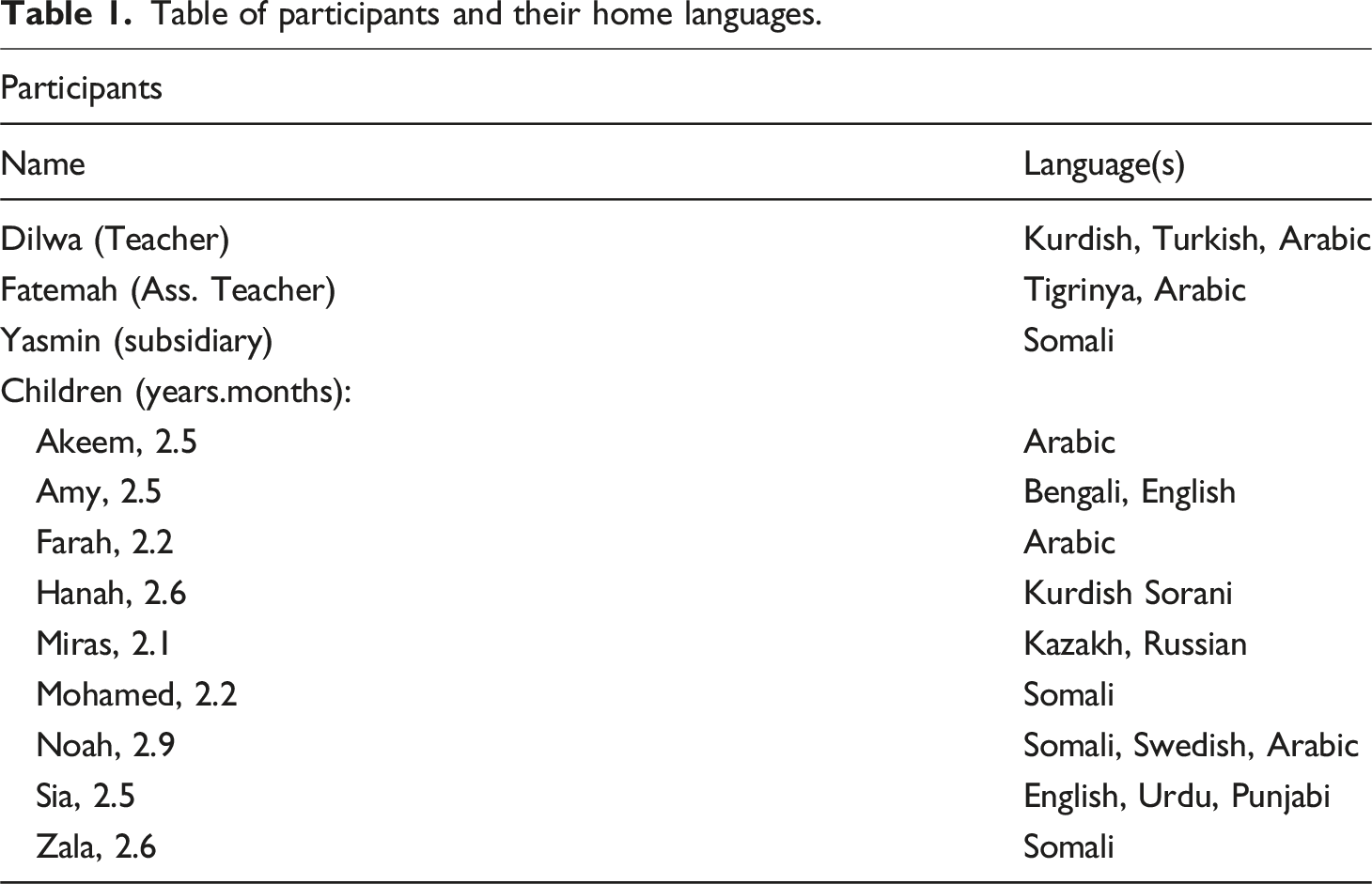
The setting for this study is a preschool located in a multilingual community in a suburb of Stockholm, Sweden. Among the 48 children enrolled, 32 main languages are used in the children’s homes. Notably, these are the languages parents report to be listed in the preschool’s written record. However, during the project, it became clear that additional unreported languages were spoken in some children’s homes. For example, as some parents have fled their countries of origin, they may feel less inclined to present their ethnicity in the documented record.
Table of participants and their home languages.
Data collection
The ethnography builds on multimodal methods of ethnographic data collection (Jewitt and Leder Mackley, 2019), using video as a primary tool for data collection. Secondary materials were also collected through field notes, photographs, teacher interviews and documentation records. This study focuses on the children's book project. Data was collected for the project, which featured a popular Swedish children’s book called Knacka på! (English title: Knock Knock Knock!). Visits to the preschool were conducted for 9 weeks with pre-visits and follow-ups. The project’s main phase utilised techniques from focused ethnography (Knoblauch, 2005), where time in the field is shorter than traditional anthropological and ethnographical studies but aims to collect rich material in this briefer time frame. The core data generated at this time was 11 h of video related to the project with field notes, 125 photos of activities, environments, artefacts, documents and emails related to the book project.
The children’s book
The children’s book featured in the project is named Knacka på! (English title: Knock Knock Knock!), and is regarded as a classic of Swedish children’s books. A popular book widely used in some parts of Sweden, given to parents of newborn children through libraries through funding from the national pediatric childcare system.
Extracts from the book are presented in Figure 1, designed to foster shared reading and interaction between adults, children and the book. At the opening, the reader(s) are presented with a house and then proceeds to knock on coloured doors, and by flipping the page, enters a room featuring a surprising set of characters, items and a rhyme. This structure encourages an adult to read and children to knock on the doors, making it also engaging for pre-verbal children. The book featured in the project. (a) show the cover in the original Swedish, the English and Arabic translations. (b) display the first of the doors the blue door and to the right is an excerpt of two children knocking on this door during shared reading. (c) show the first of the rooms, the blue room, and (d) the second room – the ‘red room’.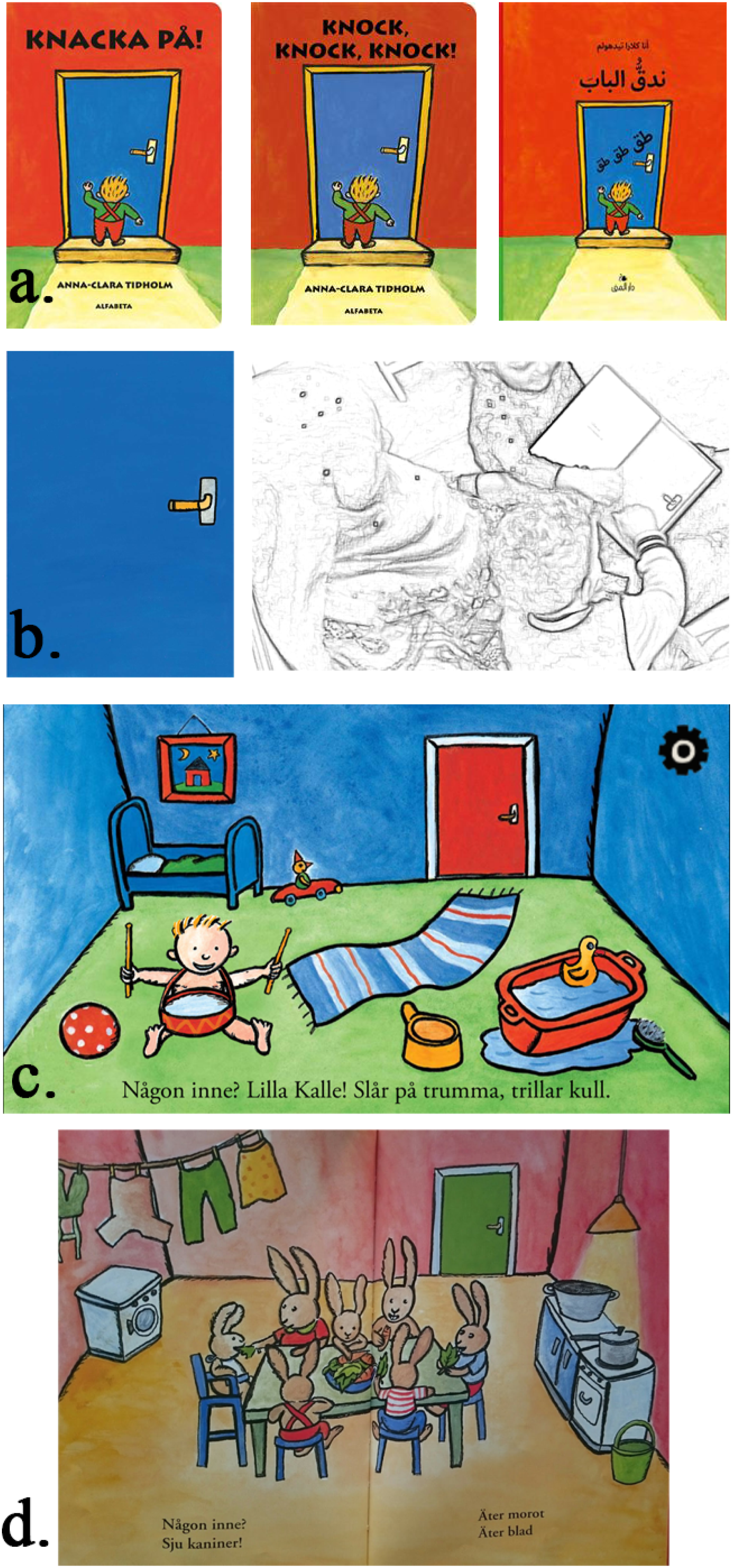
The book’s popularity has made it part of different initiatives for early childhood literacy, and has been translated into several languages. It is also part of a widely used e-book collection for preschools with a translation feature, allowing the book to be accessed in many languages. The book has been released as a stand-alone application for touchscreen tablets, where knocking actions can be performed as an interactive feature with the touchscreen surface.
Analytical methods
All types of activities related to the book project have been tracked and examined for the multimodal resources used and how it engages with children’s early literacy. The study examines various activities and materials related to the book, not just reading it. A multimodal approach was important because some activities did not require the book to be present, such as playing with items from the book in the playroom or shaping monkeys from the book during art activities in the crafts room. The study still included these activities, and they are key to establishing the multimodal ecological relationships formed during the project.
This included activities where children participated with the book, but also activities related to the project where the book was not present. For example, children playing in a playroom designed from the book may not explicitly mention the book but play a theme, character and/or item from the book. In this way, several activities that did not contain the book were also analysed. Initially, a map of key activities during the project was created to explore the resources and activities related to the project multimodally. Later, the ecological analysis described below traced the affordances of activities and actors in the projects’ ecology.
At the start, the project involved reading the book and creating a playroom at the preschool based on the “blue room” from the book. As the project progressed, however, the playroom was turned into the “red room,” the second room in the book (see Figure 1), and the parents of the children were more closely involved.
The project’s scope expanded over time, and various activities were added, including increased participation from children, parents, and community actors. These activities were noted with video, field notes, or documentation. The project spun a complex web of resources, and this network of activities and resources has been examined using an ecological analysis.
Ecological system analysis
An ecological analysis based on the theoretical framework was performed, analysing the role of the mapped activities from a multimodal ecology perspective. Here, Bronfenbrenner’s ecological system levels were used as analytical categories to examine how the literacy activities unfolded at different proximities from the children’s daily interactions related to the book project, building on the ethnography data of recorded interactions, field notes and documentation. Furthermore, Flewitt and Clark’s (2020) concept of analysing a network of relations at different parts of the bioecological system has been applied to capture how an interrelated set of resources underpin children’s early literacy experience. In the results, this is analytically visualised and described to show the complex interrelations involved in resources for children. The project’s actors and activities have been analyzed from their involvement with the book project. The interrelations between activities and actors have been traced using the ecological system described above.
While the multimodal ecology at times is split for analytical purposes, the analysis also considers the critique of disassembling ‘levels’ and dichotomies of global versus local, macro versus micro etc. (see Kramsch and Vork Steffensen 2008; Neal and Neal, 2013 for discussion; Wei 2018). The systems approach reveals how different systems and activities distal to the children can create early literacy support by providing multimodal resources surrounding the socioecological systems of children. Importantly, these levels come together as they are orchestrated in multimodal interaction (Kress et al., 2001), where resources are drawn into early literacy interactions.
Multimodal interaction analysis
Following how interaction for the two-year-olds of this study takes place in this multilingual ecology, where affordances of “complex agent-environment systems” (Steffensen and Kramsch, 2017: 8) create opportunities for children’s early literacy. A multimodal approach to interaction analysis (cf. Goodwin, 2000) has been taken to examine interactions where meaning-making emerges. Here, interaction hinges on linguistic interaction and how gestures such as pointing, iconic gestures, bodily movement, posturing, and symbolic and non-symbolic affordances shape early literacy interactions (Jewitt and Kress, 2003). The multimodal interaction analysis examines modes used in interaction that can be traced to resources in the multilingual and multimodal ecology. The paper showcases examples of how resources of the ecological system are used in early literacy practice, and that can be traced to the ecological systems interrelations in the literacy project, thus linking affordances of the book project ecology to the early literacy interactions.
Findings
Ecological analysis
The project is examined based on the theoretical framework using Neal and Neal’s (2013) concepts of interrelated networks, allowing a more dynamic interpretation of the traditional conceptualisations of Bronfenbrenner’s ecological systems. The ecology of the book project is displayed in Figure 2, with the networked interrelations between ecological systems marked. Illustrated results from analysis of the activities actors during the project shown by socioecological system and networked interconnections.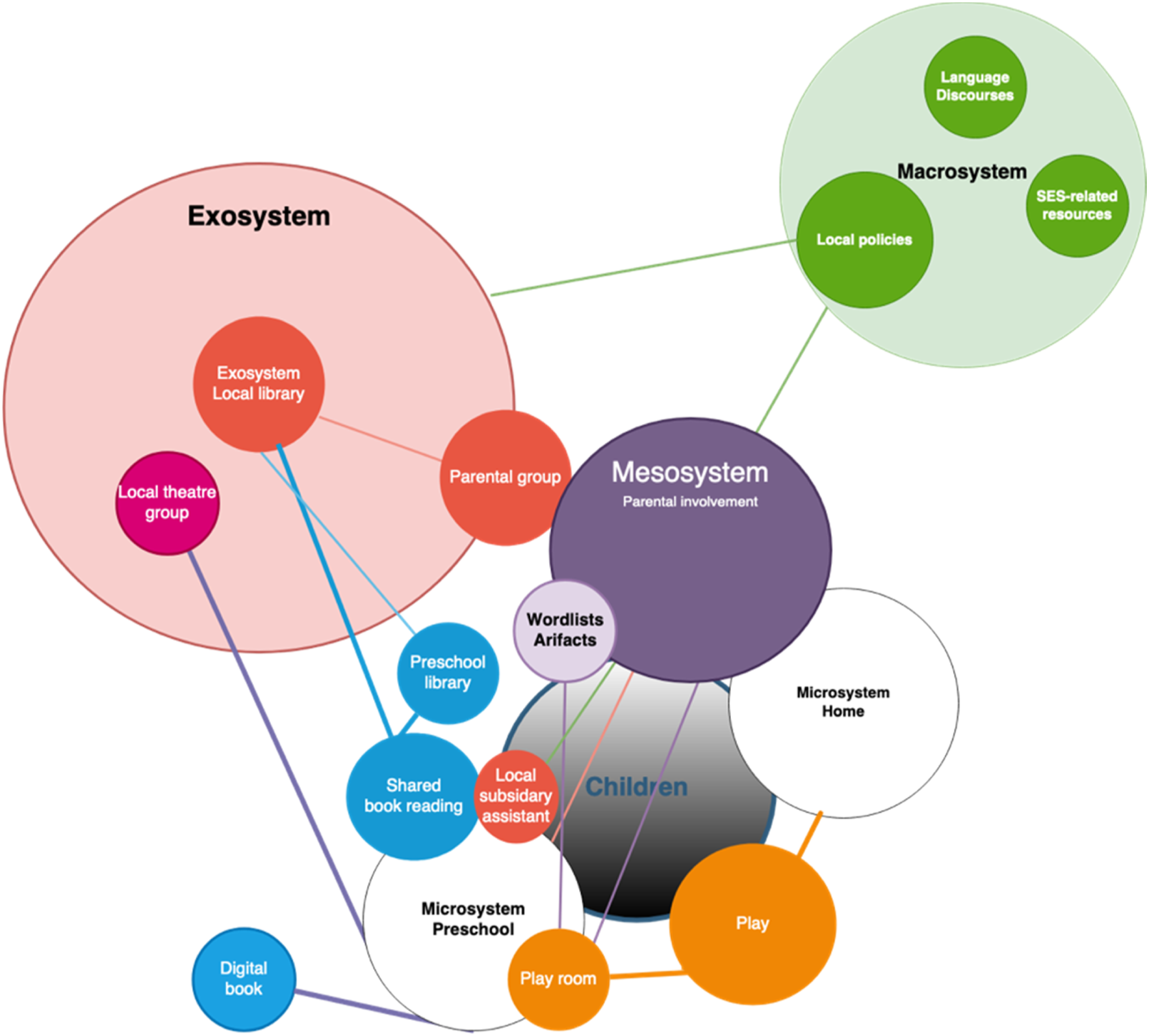
Following the classic rendition from Bronfenbrenner’s model with the child in the middle. The model has been expanded with the networked approach (Flewitt and Clark, 2020; Neal and Neal, 2013). Here the children are joined by the two major microsystems: the home and the preschool. Microsystem activities related to the book are displayed in blue and orange circles. The major mesosystem identified in the study is the parental involvement, which is shown in purple, connecting to exosystem activities. Notably, all systems are connected somehow, showing the complex interrelations emerging during the project.
The network of relations in the ecology is marked with lines showing how they relate in the ecology during the book project. Next, each system is described in separate sections, and then the interrelations are discussed, showing how they forge multimodal resources for children’s early literacy interactions. Key activities and actors are marked in bold to point out ecological relations in the text.
Macro-system
The Macro-level system is the overarching cultural and social system. It indirectly influences the sociocultural setting, and in that way provide context that has bearing on the child growing up. Locally, this has influenced how the area where the preschool is located is associated with a discourse about linguistic impoverishment, i.e., a ‘lack of Swedish’ and how children in these areas ‘fall behind’ because of limited exposure to Swedish language and culture, has been part of the political debate and nationalist discourses surrounding the area (also see Bunar, 2001).
Contrary to these views, however, the preschool has a long-collected experience of pedagogical and outreach work in the area. This local practice and policy diverge from the School Inspectorate’s (2017) report of monolingual biases in preschools. The pedagogy here has been built closely with the families and community actors. It engages in the multilingual and multicultural backgrounds represented, where children's languages and cultural heritage are actively brought into the preschool’s practice. For example, a country or ethnic origin is featured every month, and children learn the language, music, customs, and eat foods related to the country/origin (see Samuelsson, 2022, for a detailed example). In short, the preschool has found ways to engage with the multilingual and multicultural community and in the day-to-day communication with parents leading to relations between the Exo and Meso-systems of local actors and parental engagement.
Exo-system
The exosystem is a link between ecological systems, of which at least one does not include the child but influences the child’s setting indirectly. This can be, for example, a parent’s or sibling’s activity in a community setting, as this does not directly include the child but may influence conditions that also carry over to children’s literacy experience.
The most present exo-level actor during the project is the library. The library became involved during the project when a reading group for parents without Swedish literacy skills was formed. This initiative allowed parents to gain an understanding of their children’s book project, thus forming a connection between the local actors and the microsystems of the children related to the book. This exo-level activity may be peripheral to the children, but it enables parents to read the book with, interact and play with their children based on the book, thus providing a link between the community, the home setting and the children in ways that support the literacy project.
Another critical component in the exo-system was the local youth subsidiary from the community working at the preschool. This assisted the preschool group and additional linguistic resources, as the community worker spoke three languages represented at the preschool, thus providing another connection between the community Exo-System and the preschool Micro-system by being a bridge between the community, languages spoken and direct interactions with children during the book project.
Meso-system engagement
The mesosystem connects two or more microsystems and links settings that include the child. Here, the main mesosystem is the interaction between the children’s home and the preschool, as the two major settings children take part in. In the mesosystem, multimodal support arises from communication between the preschool and the families, bridging the two major socioecological systems in which the children partake.
A core Meso-level aspect of the project was the parental involvement. At first, the book and the project were introduced at the parental meeting and through letters and emails. As many parents do not have a high proficiency in the Swedish language, word lists from the book were sent out to be translated, and words from the book were taped on the wall of the project playroom. Thus the children could encounter the words in various languages throughout their day afforded by this interconnection between ecological systems while also reminding teachers and parents to use words from the book regularly, simultaneously instigating a translingual learning process for parents. The meso-level thus becomes a key for engaging interactions between systems. As parents engage in the community exo-system, the preschool support translingual engagement with the book (through the wordlist), and children engage with all of these systems. A complex interlinking of resources can enable literacy support that influences many areas of children’s daily lives.
Another key connecting children’s microsystems is play. The playroom, based on the book, actively engaging in words and artifacts from the book, provided a space where children can engage with the book in spontaneous or pedagogical play. Moreover, play provides a possible connection between the preschool and home, as children can play based on the book outside the preschool. This play can also be infused by the parent’s increasing involvement or with siblings. For example, during a later phase of the project, when the second room (with rabbits) was introduced, children were given a stuffed rabbit to take home to play and/or sleep with, creating a possible continuity between preschool and home.
Micro-system activities at the preschool and interactions between systems
The microsystem is the level where children partake in direct interaction with people and environments. This includes the “physical, social symbolic that invite, permit or inhibit engagement in activities” (Bronfenbrenner, 1993: 15). Notably, the microsystem is also where linguistic and semiotic exchange occurs for the children and where multimodal resources are pulled-together in the direct interactions children engage in. In this analysis, this mostly concerns activities observed during the project at the preschool, but also how activities interrelate children’s micro-systems in ways that are supportive of their literacy development.
Book readings were reoccurring and developing across the project, taking the forms of planned group reading sessions and shared readings. As the book was available during the everyday activity, readings would happen spontaneously and children would also ‘pre-read’ the book themselves (e.g., swapping and knocking on pages). Moreover, the small preschool library, where the translated book was available to children and their parents allowing the book to be present throughout the days at the preschool, but also extending over to the home microsystem, forging possible connections between the preschool and home settings.
The playroom was designed as one of the rooms from the book. The teachers made a cardboard door and arranged the room to resemble the book’s room by adding toys and artefacts to the room that are featured in the story. The playroom allowed teachers to support children in reenacting the book as part of the play with the children (or ‘guided play’, see Samuelsson, 2020). Teachers would name scenes and rhymes from the book and scaffold children toward a playful reenactment of the book. During the project, the room became where children spontaneously engaged in solitary free play and peer play with objects and scenes from the book as it would always be available for them. Moreover, as parents (and the children having siblings at the preschool) increased involvement, it also created opportunities that children’s playful engagement supported in the after-school settings as children could play with their parents, siblings and/or with the artefacts related to the book that the preschool provided.
The playroom features words from the book on printed labels on the walls. These key words match the word list sent out to the parents. Prompting the reoccurring use of vocabulary from the book by teachers and parents in the home languages. This creates a web of multimodal support that stretches between the home and preschool setting for children to encounter the book multilingually.
The local library participated in the project in several ways. At first, the library was advised to take in the book in additional languages represented in the community before the preschool visited the library, and parents were advised to take their children to visit. As a result, the preschool frequently visited, and a partnership around the book was initiated. Later, the library took its own initiative by creating the reading-group for parents. Interactions across the ecological systems are here creating a web of literacy support for children. While the reading group was not obligatory, it potentiates meaning-making support with children or in the proximity to the child’s developmental system. Another example of engagement with the community actors was at the end of the project, when a local theater group was hired to enact the book for the children showing another multimodal side of the range of literacy activities used during the project and the strong community connections underpinning the literacy work of the preschool.
During the project digital resources were utilized in several ways. The book is available as a stand-alone application. The department has two iPads available, where children can use interactive buttons and ‘walk’ into the rooms through knocking on the touchscreen surface, and, moreover, can change language. The teachers used the digital variant of the book to present it using a projector, projecting it onto a whole wall in front of children, creating an embodied and immersive reading experience. Moreover, as the app is available for smartphones and tablets and also features several languages, it is another potential interaction between the preschool and home microsystems that involves both translingual opportunities and multimodal modes of relating to the book across settings.
While the digital activities would not occur as often as the traditional readings and play sessions, they nonetheless provided additional multimodal components to the web of resources and activities children encountered during the project. The pedagogical environment is a complex interaction of multimodal resources – children across the project amassed a great net of experiences related to the book across ecological system levels (see Figure 2). During the project, literacy support emerged for children in sometimes unpredictable, non-linear ways, undergirded by the range of ecological activities and multiple modes of engaging with the book available during the project. This can also be traced to the multimodal interactions that took place in the everyday interactions during the book project. Next, two of these are analysed and traced for how children employ their translingual and multimodal resources in multimodal early literacy interactions.
An ecological web of resources for children’s early literacy
The notion of the chronosystem should be taken into account when understanding multilingual community work. Activities and interactions amass during the project, creating multimodal support in the early literacy practice forged from the interrelations between systems. During the project, an ever-growing web of activities developed, consequently interconnecting levels in the ecological system (e.g., Figure 2). This web consisted of growing iterated interactions among institutions (the preschool, library, theatre), across modes of communication (the children’s languages, the book, items in the playroom etc.). Moreover, the web of interrelations during the project involved a set of actors (children, teachers, parents, and the parental literacy group) interacting during activities related to the book project. This ecology’s multimodal web of affordances presented opportunities for children’s multimodal meaning-making related to the book. Some of these span over threads of networked relations detailed in the previous sections and illustrated in Figure 2. For example, the preschool’s local policies and long-term active community work are present in the daily literacy interactions. Here, this Macrosystem factor can be traced to the daily multimodal interaction. We look at an example of this next.
Example 1 – shared reading in the multilingual literacy practice
It should be noted that most of the interaction, both educational talk between children and the teachers and between peers, was in Swedish. In this highly heterogenous community, the majority language of Swedish is the lingua franca. Due to this diversity, using another language with peers is often not a viable strategy for children to maintain successful communication and sustain play-bouts with each other 1 . However, most days, children use their mother tongue at some point inclined with the preschool’s literacy policy and practice actively encouraged using minority languages and/or other cultural symbols. To showcase this, we look at an example of translanguaging during multimodal interaction.
The assistant teacher played with the children in the book-inspired playroom in the following example. The session then moved into a spontaneous shared reading session with the child Amy (Bengali L1), jointly reading the book with the assistant teacher Fatemah. In this excerpt, they have come to a room in the story where a bear family is putting their cubs to bed and brushing their teeth.
In Figure 3, the child draws the teacher’s attention to the book, by saying ‘look look’ using a pointing gesture (line 1). ‘What is that?’, asks the teacher (line 2). The girl then uses a non-standard word ‘bosha’ to describe brushing, a form that mixes the Swedish ‘borsta’ with the Bengali ‘Brāśa’ (line 3). When the teacher’s response is not immediate, the girl uses a sound and gesture to depict brushing of teeth (line 3), making it abundantly clear for the teacher who confirms saying ‘toothbrush’ (line 4). This is, in turn, acknowledged by the girl, who answers with an added ‘t’ to the word – ‘bosta’ (line 5). From this, a dialogue about toothbrushing and the number of times per day ensues. Multimodal interaction about the toothbrushing bears from the book.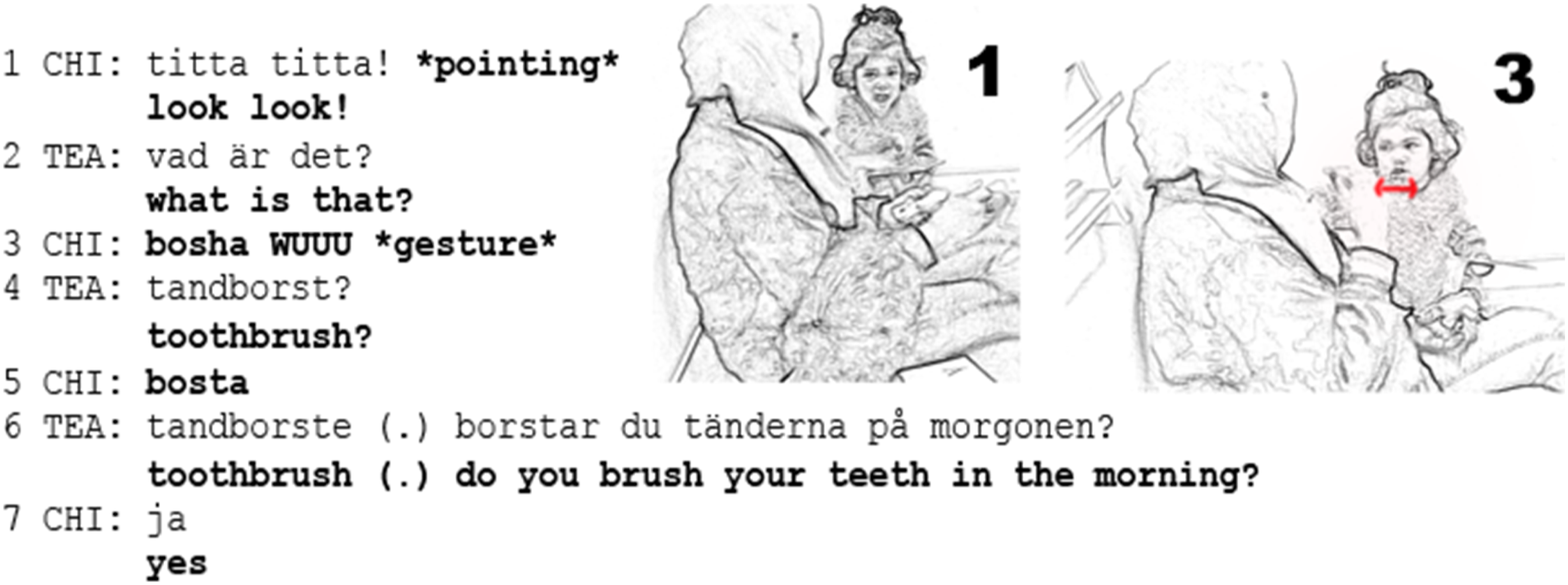
The example illustrates how multimodal communication is used in the multilingual literacy practice. Deictic gesturing (pointing to the book), onomatopoetic sounds, and creative use of language here work together to create mutual understanding. The child mixes the Swedish and Bengali forms to express herself in a way normal for this multilingual community, showing how early literacy communication crosses linguistic and modal borders in a relatively effortless way where children can use their available linguistic resources in their meaning-making related to the book.
There are also more elaborate ways later in the project where children utilise the multimodal and material means during the literacy sessions. Children draw from the multimodal potential generated during the project, and we will next look at what this can amount to at a session later on in the project (after the second room has been built).
Example 2 – using the web of resources in early literacy interaction
As we saw in Example 1, children communicate with semiotic resources that often transcend linguistic borders and modes of communication. This example shows how a shared book reading session widely utilizes the web of multimodal resources later in the project. The example in Figure 4 is read from left to right, and the various multimodal resources used are highlighted. After describing the interaction, the next subsection shows how resources are linked to the socioecological system. Using ecological resources from the project in multimodal early literacy interaction.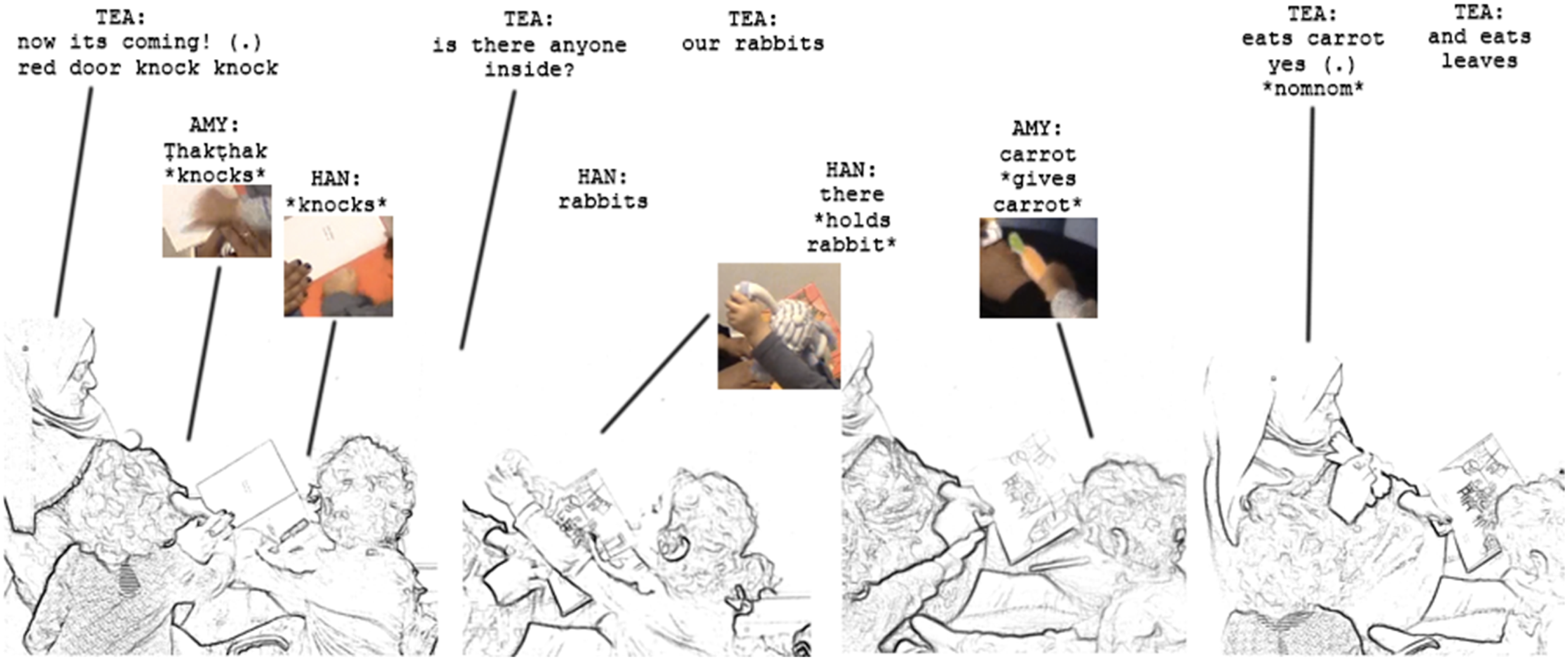
The excerpt in Figure 4 covers a reading of the pages from the book with the ‘red room’ (see Figure 1). The children Amy and Hanah (Sorani L1) and the teacher sit in the project playroom and thus have items featured in the book within reach while they read.
There are various linguistic, modal and physical resources at play here. The teacher first opens with the page featuring the red door, and the children go on to knock as usual. While Hanah only knocks physically, Amy also adds the Bengali phrase ‘Ṭhakṭhakṭhak’, when knocking. When the teacher asks if there ‘is anyone inside?’, Hanah answers, ‘rabbits’. As the children have recently been given stuffed rabbits (the ones the children brought home), Hanah holds up her animal. This spurs Amy to enact the next line in the book (which would be ‘eats carrot’), by giving a paper carrot to the teacher, who proceeds to read ‘eats carrot’ from the book and pretendedly chews the carrot before continuing reading.
Utilising the web of resources in early literacy interaction
In the micro-system interaction at the preschool, influences from interworking ecological relations we have traced in this project can be seen at play, such as in the interaction above.
Children in Example 2 draw from multimodal features available for them in this place and are a part of the web of resources supported by the project. We can trace this interaction’s features to several ecological systems previously analyzed as ecological entities, here being used in early literacy interaction. For example, the macro-level preschool norms of language use supporting children’s bilingual language use is a background for undergirding both of the above interactions, where translanguaging is part of the everyday literacy interaction at the preschool. Also, multilingual work with the book involving parents and the library supports the reading by using words reiterated in emails and wordlist throughout the project and also contributes to the range support available for children spanning both the preschool interaction as seen here and onto their home literacy settings.
Adding to the set of literacy-related resources available during the project, the children use the multimodal artefacts available. The carrot, and stuffed rabbits can be linked to parental involvement initiatives in the preschool and contribute to how playthings interconnect the preschool and home literacy spaces. This is an important space beyond formal education initiatives, as the book is part of unplanned, free-play activities and may also be part of play involving siblings or parents. Play thus provide an important extension of the educational activities that can undergird the educational literacy process. The playfulness is also apparent in Example 2, with the book being read in the actual playroom of the project, the children playfully use things available to enact the story and thus playfully draw from the multimodal means that have emerged during the project.
This exemplifies the range of potentials giving rise to multimodal opportunities, where modes are assembled in interaction, drawing on resources from the multimodal ecology. The expressive use of resources could be supported by forms of expression ranging from digital projections of the book to watching the theatre enactment. The multimodal ecology support children to use experiences both in- and out of the preschool for meaning-making related to the book, using multilingual and multimodal resources to fuel interactions such as the one showcased in Example 2. The wide-ranging resources children use in these literacy interactions and the multi-level support system the project provided show the potential of considering a wider ecological web of resources that directly or indirectly can influence children’s literacy experiences.
Discussion
This paper presented a multimodal ecological view and examined how early literacy support emerged during a multilingual book project. The paper reveals the web of resources amassed from ecological interrelations during the project and how they are part of children’s meaning-making resources in multimodal translingual interaction. The study thus provides further examples of how current early literacy practices shift towards complex combinations of multimodality (Flewitt, 2008; Zhao and Flewitt, 2020) and multilingual interaction (Bengochea et al., 2018). This paper shows how this web of resources supports early literacy interactions that cross modal and linguistic borders. In the project, Macro-level conditions, such as the multicultural and multilingual acceptance of the preschool, promote children’s multimodal expression, illustrated in Example 1. Like in Bengochea et al. (2018) example, children here select from and use a range of multimodal means of literacy expression drawn from the diverse everyday settings the children are part of, whether at home, preschool or community settings. Furthermore, this study has pointed to the important synergies arising from interaction among these spheres of children’s early literacy experiences and how these are assembled in multimodal interaction.
The socioecological and networked analysis points to a complex view of learning, where parts of the socioecological system that are not directly interacting with the children also create affordances for meaning-making. Crucially, several of the activities traced in the project would not have been possible with preschools with a monolingual bias, which is reportedly still prevalent (cf. School Inspectorate, 2017) in the Swedish context. Instead, the pedagogical work traced in this ethnography is underpinned by open linguistic and semiotic exchange values, characteristic of a multimodal translanguaging view. The ecological view, promoted in this study also vouches for an ‘open systems’ view (Larsen-Freeman, 2020), where interactions in a system offer possibilities. This is exemplified by the active community work and how the interactions among systems are identified to support the book project studied. For example, the preschool and library separate and interrelated work relate to children’s early literacy experience directly through children’s visits to the library and the translated book and indirectly through meso-system connections through the parental group. Learning opportunities emerge from active engagement across systems in the multimodal ecology supporting multilingual exchange related to the book, sometimes in unplanned and unexpected ways. Multimodal literacy support arises non-linearly, and from this perspective, preschools assemble ecology resources as part of a pedagogical approach embracing the local multilingual setting of its emplacement (Pennycook, 2017) that give rise to multilingual early literacy support. The parental involvement with the preschool and library, can, in turn, give rise to literacy-related interaction. For example, new linguistic and multimodal resources related to the book can be used when reading or playing with their children drawing from resources such as the parental group, the word list, digital tools or other artefacts.
In interaction, multimodal resources were employed by children for communication related to the book (Bengochea et al., 2018). Children use means that cumulate throughout the project when they make meaning about the book. For these young children growing up in a multilingual setting, there are various communicational affordances in the ecological setting of their everyday lives. This project uses various multimodal and translingual resources in early literacy practice. It is seen how teachers and children employ a set of multimodal resources in interaction (cf. Kramsch and Whiteside, 2008), including both symbolic and non-symbolic modes (Steffensen and Kramsch, 2017), as illustrated in Example 2. Here a range of resources is employed in children’s engagement with the book that is underpinned by resources cumulated in the project’s ecology during the project. For example, children draw from the toys used in play and the linguistic and literacy resources to orchestrate meaning-making scenarios related to the book multimodally.
Educational implications and future directions
The educational effort in this multimodal learning ecology is about creating opportunities for meaning-making from diverse languages and modes. Consistent with the ecological systems view, this can be promoted through engagement with various actors in the different systems surrounding the children. This active approach creates networks of engagement across socioecological systems (Flewitt and Clark, 2020; Neal and Neal, 2013) that powerfully underpin early literacy support for children. The opportunities created by this open pedagogical approach should be highlighted, as many of the project activities would not have been possible in monolingual preschool pedagogies or limited openness to using minority languages. The ecology of resources creates learning opportunities influenced by the diverse, global and technologically infused network of interconnected actors and activities. A pedagogical sensitivity to children’s multimodal and translingual realities provides children with opportunities. In an open system, activities can cross semiotic and linguistic borders, creating a web of resources for children, exemplified by activities and interrelations traced during the project and how these are recruited in literacy-related activities.
The ecological and multimodal viewpoints to how learning potentials for bi- and multilingual children are bridged between children's educational, play, community, and home environments. Pedagogical potentials arise when preschools work in concert with the linguistic and cultural ecology featured in a community. The ‘hybridity’ (Gutiérrez et al., 2011) developed through interactions between systems of this study shows a particular pedagogic potential for multilingual communities when the preschool actively engage with the community and home settings. The preschool studied here actively integrated itself with the local multilingual community, affording a pedagogy that extends beyond languages and into the multimodal web of the multilingual community. Here, important pedagogical examples can be drawn for practices that go beyond the monolingual agenda and explicitly work with the translingual (Wei, 2018) and multimodal (Kress et al., 2001) resources available. In this diverse setting, creating pedagogical solutions that are attuned to the linguistic and cultural complexities of the local setting it draws from (cf. Gutiérrez et al., 2011; Pennycook, 2017), showing potential from joint collaborative community work that extends well beyond the traditional bounds of the preschool.
Conclusion
This paper has promoted an ecological view for understanding early literacy practices in a heterogenous linguistic setting. This view changes the pedagogical frame to how preschools actively use resources from multilingual communities to promote communication and learning opportunities that engage a wide range of resources emerging from various interconnected actors and processes. The educational perspective that rises from the preschool in this study promotes a view consistent with the linguistic richness of multicultural environments and shows how these can be powerfully recruited in early literacy practices.
While requiring time and effort, early childhood educational settings can spin webs of resources within their neighbourhoods that enrich children's multilingual literacy experiences, effectively drawing from locally available resources and using these for multilingual children’s meaning-making processes. This pedagogical work is sometimes at odds with many current monolingual practices. However, the example of this study points to some of the powerful educational potentials that might be gained from a more open educational systems approach.
Statements
The use of images from the book Knacka På! (Knock, Knock, Knock) and its translations have been obtained from the publisher.
Footnotes
Declaration of conflicting interests
The author(s) declared no potential conflicts of interest with respect to the research, authorship, and/or publication of this article.
Funding
The author(s) received no financial support for the research, authorship, and/or publication of this article.
