




Abstract
Although research on the home literacy environment and its impact on early literacy has long focused on mothers, the past decade has seen a shift in scholarly attention to the role of fathers. Building on this shift, we examined whether the nature of parent–child interactions during shared storybook reading varies with parent gender, child gender and the interaction between the two, and we analysed whether possible differences in the nature of mother– and father–child interactions are related to story comprehension. We made video observations of mothers and fathers within 36 relatively highly educated families reading a storybook with their kindergartener (age 4 – 5) and registered the use of cognitively challenging (i.e. decontextualized) talk during these activities. After each shared reading session, we additionally administered a test assessing children’s understanding of the story being read. Two-way mixed ANOVA’s revealed no effects of parent gender or child gender on either the use of cognitively challenging talk or children’s story comprehension, nor did we find interaction effects of parent and child gender. The extent of cognitively challenging talk was significantly correlated to children’s comprehension scores for fathers, but not for mothers. This correlation seems to have masked another association, however: when correlations were computed separately for girls and boys, we found that the proportion of cognitively challenging utterances of both parents was correlated to comprehension scores for boys, but not for girls. The absence of parent gender effects provides further insights into the way mothers and fathers shape interactions during shared reading, but also stresses the need for studies with larger, more diverse samples. The observation that more frequent use of cognitively challenging talk was paralleled by better story comprehension for boys invites further research on the specific effects of shared reading for boys.
Introduction
The extent to which children are engaged in literacy activities in their homes, often referred to as the home literacy environment (HLE), plays a crucial role in their early literacy development (Burgess et al., 2002; Leseman and de Jong, 1998; Niklas and Schneider, 2013; Van Steensel, 2006). Although research on the HLE and its impact on early literacy has long focused on mothers, the past decade has seen a shift in scholarly attention (Cutler and Palkovitz, 2020; Duursma, 2016). In line with changes in the caregiving roles of parents in western societies (Lamb, 2000), the number of studies on the contribution of fathers to the HLE has increased (Cutler and Palkovitz, 2020; Varghese and Wachen, 2015). In the current study, we build on this relatively new line of research by examining whether the nature of parent–child interactions during shared storybook reading varies with parent gender, child gender and the interaction between the two, and we analyse whether possible differences in the nature of mother– and father–child interactions are related to story comprehension.
Literature review
Research so far suggests that father–child literacy activities – particularly shared reading – have an important added value to children’s early literacy development. Duursma et al. (2008), for instance, found that Early Head Start fathers’ reported shared reading frequency at age three was significantly related to children’s receptive vocabulary at the same age, although the association was only found if fathers had at least a high school education. Fagan et al. (2016) also examined Head Start families and established that fathers’ shared reading frequency at age four was related to children’s concurrent language competence. While Duursma et al. (2008) and Fagan et al. (2016) focused on fathers’ contributions only, others compared the effects of mothers’ and fathers’ behaviours. Baker (2013), Baker (2014), for instance, found that both mothers’ and fathers’ home literacy involvement at age two (including shared reading frequency) uniquely predicted children’s literacy skills at age four, and that this was true in both Caucasian and African American families. Interestingly, research by Duursma (2014) suggests that fathers’ contributions might even be stronger than those by mothers: in a sample of Early Head Start families, she found that paternal shared reading frequency at age two predicted both concurrent and future vocabulary scores, whereas maternal shared reading frequency did not.
One possible explanation for the unique effects of father–child shared reading is that fathers engage in other types of interactions during shared reading than mothers do. More specifically, fathers have been suggested to use more ‘cognitively challenging’ talk: they are thought to employ more diverse vocabulary and ask more questions that require children to think beyond the literal text (Cutler and Palkovitz, 2020; Duursma, 2016). Two reasons have been proposed for this ‘differential experience’ (Bernstein-Ratner, 1988; Gleason, 1975; Korat et al., 2008; Rowe et al., 2004). On the one hand, it might be that because fathers generally engage in fewer shared activities with their children than mothers do, they might be less attuned to their children’s language level: while mothers adjust their interactions to their children’s emerging competence, fathers’ relative inexperience is hypothesized to make them use (too) complex talk. On the other hand, it might be that fathers approach shared reading differently from mothers: they might view shared reading as a teaching activity and consequently ‘impose larger demands on children and stretch their performance’ (Duursma, 2016: 479). In either case, fathers may be more inclined to talk to children in a grown-up fashion, forming a ‘bridge to the outside world’ (Gleason, 1975: 293).
A few studies have compared mother and father talk during shared reading, but results are mixed. Some researchers have indeed found that fathers use more complex language than mothers do. Korat et al. (2008) compared maternal and paternal mediation in storybook interactions with five- to six-year-olds in a diverse sample of low and middle socio-economic status (SES) families. They found that fathers used other, more challenging ways of expanding their children’s knowledge than mothers did: while most of the mothers’ extra-textual talk consisted of paraphrasing story fragments, fathers more often engaged in what Korat et al. refer to as ‘distancing’ (e.g. predicting what is going to happen next or drawing comparisons). Duursma (2016) compared mothers’ and fathers’ storybook readings with their preschoolers, focusing on the amount of ‘non-immediate talk’, which she defines as talk that goes beyond the information in the text or illustrations and, for instance, involves making predictions or connections to children’s experiences, drawing inferences or explaining events (Sigel, 1982). Both at age two and three, Duursma found that fathers used significantly more of such non-immediate talk than mothers. Finally, Vandermaas-Peeler et al. (2011) found an interesting interaction effect of parent and child gender on the complexity of interactions during shared reading. They compared the amount of ‘literacy-related guidance’ in mother and father talk, defined as a composite of the frequency of simple and elaborate descriptions, predictions, inferences and recalling text. Fathers were shown to provide twice as much of such guidance to girls than to boys, while for mothers there was no such difference.
Other researchers found no differences in cognitively challenging talk between mothers and fathers or they observed that mothers use more complex language than fathers do. Blake et al. (2006) compared mother and father talk during shared book reading in two age cohorts: one-year-olds and two-year-olds. They found that children’s age but not parent gender determined complexity level. For instance, both mothers and fathers asked more informative questions and questions about children’s feelings to older children than to younger children and both parent genders did this to a similar extent. Schwartz (2004) examined behaviours of mothers and fathers during shared reading with their two-year-olds. She found that fathers used significantly more literal and, thus, less challenging questions than mothers (e.g. questions asking children to label or localize an object on a picture), while mothers used more ‘expansions’, that is, instances where they elaborated on children’s utterances, for example, by making connections with children’s previous experiences or world knowledge.
Although conclusions on the similarities and differences between mother– and father–child interactions during shared reading remain tentative, the quality of father talk does appear to make a unique contribution to children’s language outcomes. Blake et al. (2006), for instance, found positive and significant correlations between fathers’ use of complex questions with their one- and two-year-olds and children’s scores on the McArthur Communicative Development Inventory. Pancsofar et al. (2010) found that fathers’ use of diverse vocabulary during shared reading to their infants predicted children’s communicative skills at 15 months and their expressive language scores 2 years later. Malin et al. (2014) found that the amount of ‘metalingual talk’ fathers produced during shared reading interactions with their two-year-olds predicted children’s pre-kindergarten receptive vocabulary scores. Finally, Baker et al. (2015) registered fathers’ mean length of utterance (MLU) during shared reading as a measure of linguistic complexity and found that MLU assessed before kindergarten entry positively predicted children’s receptive vocabulary scores during kindergarten. Interestingly, in both the studies by Pancsofar et al. (2010) and Baker et al. (2015), the quality of mothers’ talk did not predict language outcomes when entered in a model with fathers’ quality of talk. The latter might imply that fathers better succeed in making shared reading a learning experience than mothers do: their possibly more frequent use of cognitively challenging talk could have positive consequences for what children take in from a story (i.e. it may help them learn more words or better process the storyline). To test whether this is a viable hypothesis, additional research linking mother– and father–child shared reading interactions to comprehension of the story being read is required.
As we have argued, examining the role of fathers in children’s literacy development is a relatively new line of inquiry. Still, it is based on a rather traditional perspective on both gender and family composition: it assumes that families include a mother and a father, whose identities are clearly distinguishable. However, gender identities are not necessarily clear cut (Bem, 1974; Spence, 1993) and there are various non-traditional family configurations (e.g. single-parent families, same-sex parent families and extended families). From our review of the literature, we must conclude that such issues are hardly touched upon in home literacy research (Cutler and Palkovitz, 2020). While gender identity has been found to be a predictor of reading motivation in some recent studies (Espinoza and Strasser, 2020; McGeown et al., 2015; McGeown, 2012), how gender identity steers the role different caretakers play in children’s literacy development is as yet unclear. Similarly, little systematic research has been done on home literacy patterns in non-traditional families (Prins et al., 2021). Our aim in this study is to add to the small, but growing research base comparing mothers’ and fathers’ contributions to early literacy. Similar to the above-described studies comparing mothers and fathers, we designed our study from a more traditional perspective on gender and family. Nevertheless, we acknowledge that family contexts have become increasingly diverse.
The current study
The frequency and quality of father–child shared reading activities appear to make a unique contribution to children’s early language outcomes. The question whether this is caused by special features of father–child interactions during shared reading remains unanswered: while some studies comparing mothers’ and fathers’ storybook reading show differences in the complexity of parent–child talk, others do not. In their recent review, Cutler and Palkovitz (2020) therefore call on researchers to extend the research base that examines parental distinctions in shared reading styles. In the current study, we follow this call and compare mothers’ and fathers’ use of cognitively challenging talk during shared reading. Following Vandermaas-Peeler et al. (2011) observations, we additionally examine whether there is an interaction effect of parent and child gender, that is, whether parents engage in different types of interactions with girls than with boys and whether possible differences are dependent on parent gender. We also assess whether differences in the use of cognitively challenging talk between mothers and fathers have implications for what children learn from stories. Assuming there are such differences, there are two possible outcomes. On the one hand, it may be that fathers’ more frequent use of cognitively challenging talk supports children’s story comprehension because it elicits deeper processing. On the other hand, it may be that fathers’ talk is too challenging and thus interferes with children’s understanding of the story being read. Consequently, we test whether children’s story comprehension differs when being read to by mothers and fathers. We also assess whether the use of cognitively challenging talk is related to story comprehension, and whether these relations differ dependent on parent and child gender.
These aims result in four research questions: (1) Do mothers and fathers differ in the use of cognitively challenging talk during shared reading interactions with their children? (2) Do differences between mothers’ and fathers’ use of cognitively challenging talk depend on the gender of the child? (3) Do children comprehend stories better after being read to by fathers than by mothers? And is there a difference between boys and girls? (4) Are there differences between mothers and fathers in how the use of decontextualized language plays a role in story comprehension? And what role does child gender play?
Method
Design
We made video observations of mothers and fathers within families reading a storybook with their kindergartener (age 4 – 5) and registered the use of cognitively challenging talk during these activities. After each shared reading session, we additionally administered a test assessing children’s understanding of the story being read.
Participants
Participant characteristics.
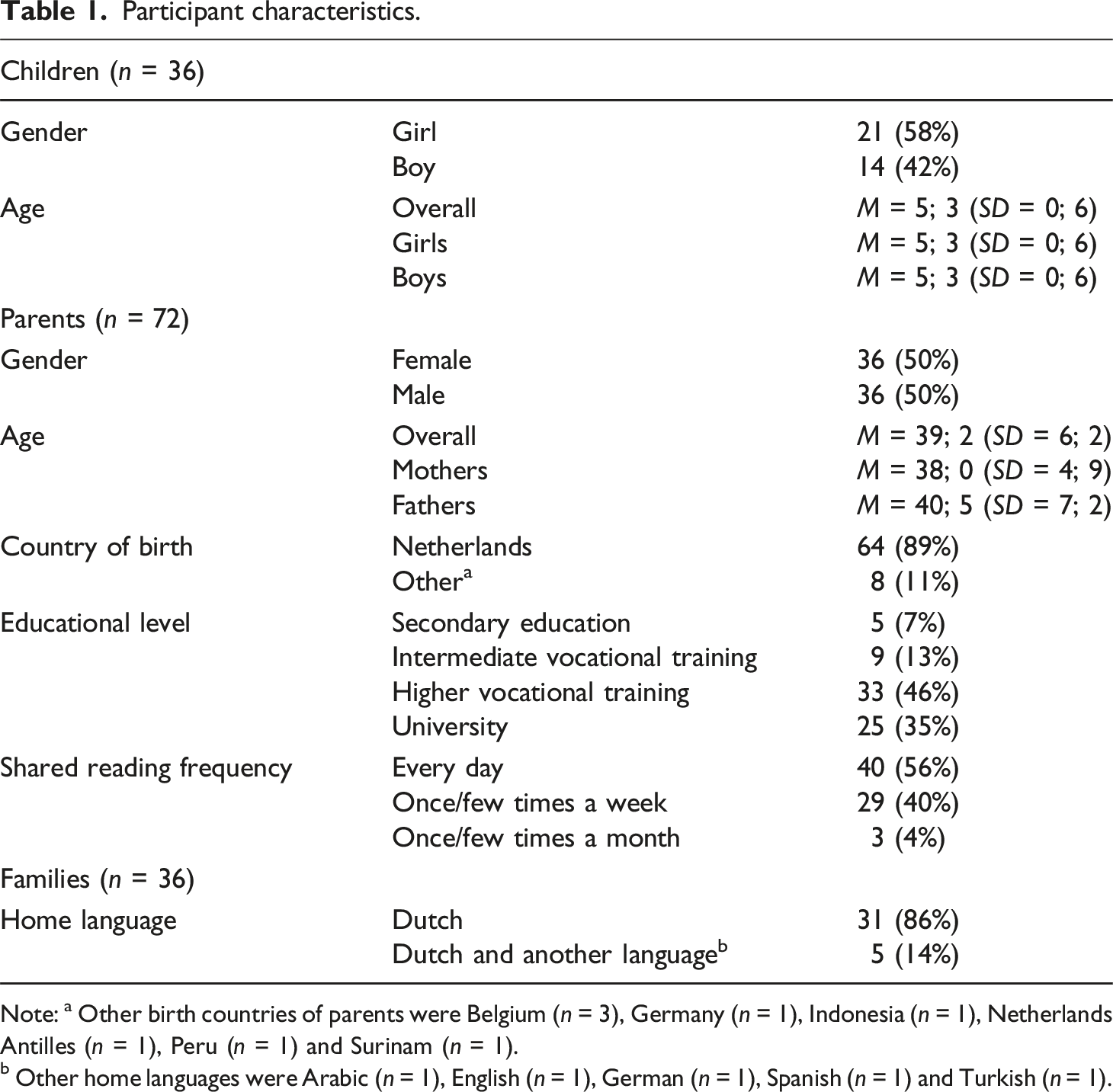
Note: a Other birth countries of parents were Belgium (n = 3), Germany (n = 1), Indonesia (n = 1), Netherlands Antilles (n = 1), Peru (n = 1) and Surinam (n = 1).
b Other home languages were Arabic (n = 1), English (n = 1), German (n = 1), Spanish (n = 1) and Turkish (n = 1).
Measures
Observations
During the observations, parents were asked to read one of two picture books with their child. Each picture book contained twelve pages, with about four to five lines of text and one corresponding drawing per page. The first book, Eekhoorn en Ekster gaan op zoek naar eikels (‘Squirrel and Magpie go looking for acorns’) was 388 words long and described how Squirrel invites his friend Magpie to search for acorns. Because Magpie is more interested in shiny things, he overlooks all kinds of special situations (e.g. a hedgehog with socks on his spines). At the end of the story, Magpie realizes that due to his inattention he missed a lot of beautiful things. The second book, Het geluid van Eend (‘The sound of Duck’) was 450 words long and described the story of Duck, who wants to make friends with the animals on a farm by mimicking their sounds. However, the animals laugh at her because her imitations fail. Then she meets Frog, who encourages Duck to make her own sound (i.e. quacking). When the other animals hear Duck and Frog ‘singing’ together (in Dutch, representations of sounds that ducks and frogs make are similar, i.e. kwaak), they come over to listen and Duck no longer feels sad and lonely. Both books had been developed for a previous study (De Koning et al., 2020), which ensured that families had not seen the books before.
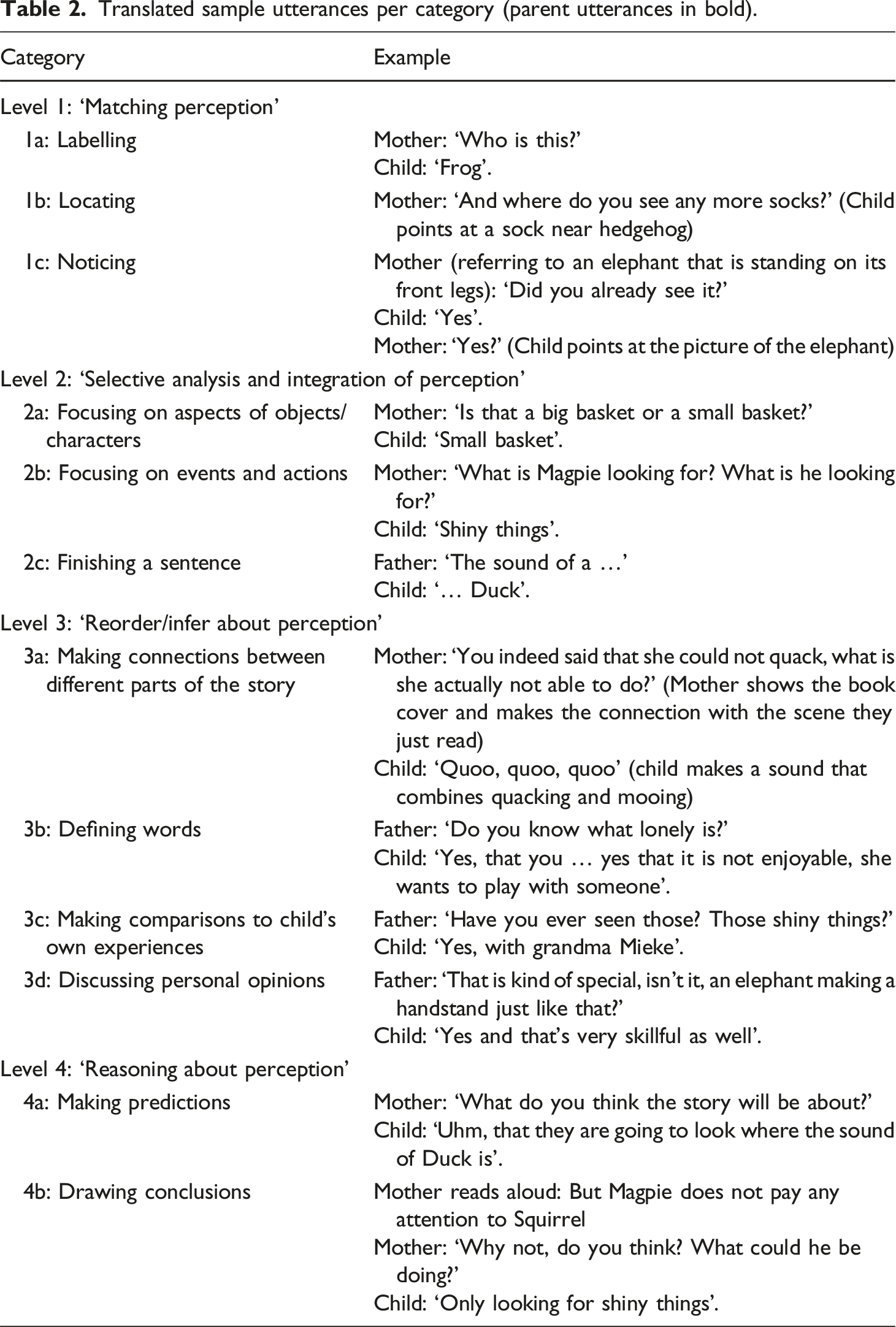
Observations were video-taped, and all extra-textual utterances were transcribed and coded. We used an existing coding scheme (De Koning et al., 2020; De la Rie et al., 2018; De la Rie et al., 2020), that allows to determine how cognitively challenging parent–child interactions are by coding the level of ‘decontextualization’ for every utterance (Curenton et al., 2008; Snow, 1983). The scheme was adapted from schemes used by Van Kleeck et al. (1997) and Sorsby and Martlew (1991), which were, in turn, based on the distinction in decontextualization levels proposed by Blank et al. (1978).
Translated sample utterances per category (parent utterances in bold).
Story comprehension
For each of the two picture books, we constructed a comprehension test to assess children’s understanding of the story content. We based the tests on Paris and Paris’ (2003) Narrative Comprehension of Picture Books task. We asked children ten open-ended comprehension questions about each book. Five were about explicit information in the text and addressed the story characters, setting, initiating event, problem and outcome resolution. The other five required children to make inferences based on the characters’ feelings, dialogues, causal relations, predictions and themes. To exemplify what questions were asked, the Appendix includes one of the tests. Questions were read aloud by a researcher. In case a question referred to a picture in the picture book, the researcher showed the corresponding picture. Children’s answers to the questions were audio-recorded and transcribed. From the transcriptions, answers were scored according to rubrics that contained all correct answers and their corresponding scores. Per question, children were awarded 0, 1 or 2 points. A score of 0 points indicated a wrong answer or no answer; one point represented a correct answer; two points were awarded if the correct answer was accompanied by a coherent explanation. For each picture book separately, an overall comprehension score was computed by summing the scores on all 10 questions (ranging from 0 to 20 points) about the picture book.
Procedure
Counterbalancing parent–child pairs across different situations.
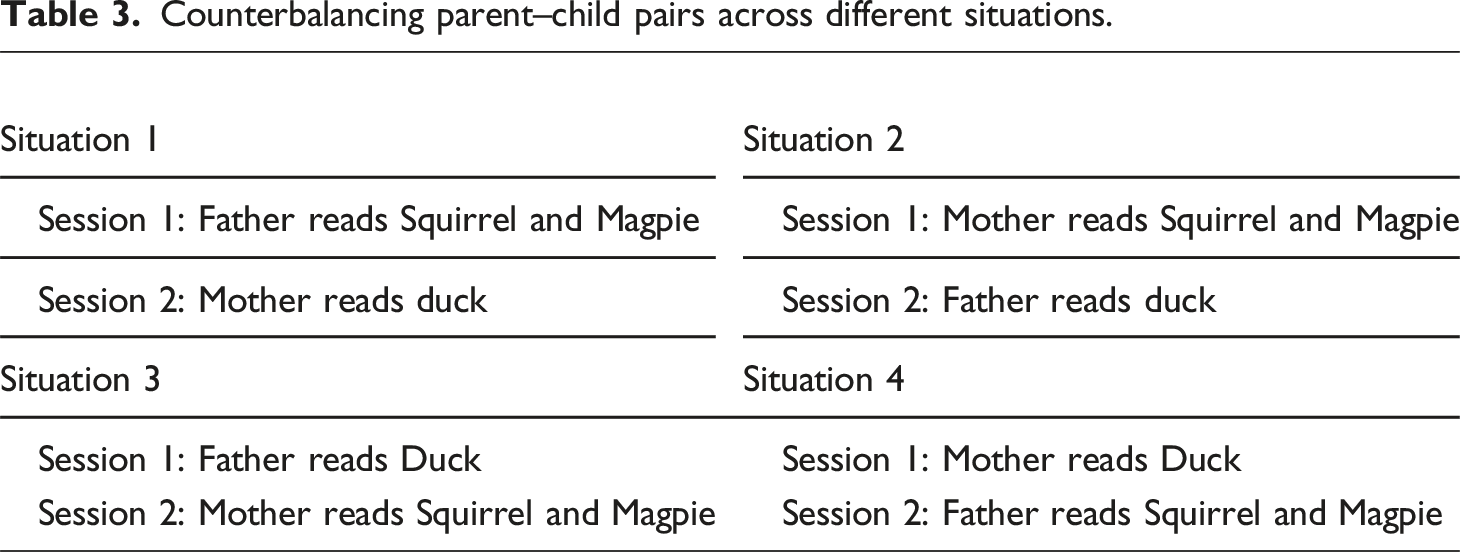
The researcher followed a standardized protocol. First, to make the child feel at ease, the researcher introduced herself and started a brief conversation, for instance, about what the child was wearing or what the child did at school that day. Subsequently, she briefly explained the research and the procedure, after which the parents were asked to sign a consent form. Then, the researcher prepared the observation session: she put the picture books in place and set up the video camera and/or voice-recorder. Since observations are not a natural setting for children, children were actively involved at this stage: children were invited to make a test recording. When the preparations were finished, the researcher asked the first parent to start the first reading session, instructing her or him to read the book as she or he would normally do, and started the recording. During the session, the researcher stayed in the room but sat apart from the parent and child, maintaining a neutral stance as much as possible (i.e. by not responding to child and parent during the activity, neither verbally nor non-verbally). The other parent was urged to distance her- or himself, to prevent (s)he would observe the other parent and (unconsciously) take over her or his behaviour. After parent and child indicated the session was finished, the researcher administered the story comprehension task. The parent was asked to leave to ensure that she or he could not (un)consciously influence the child’s answers. However, if this made the child feel uncomfortable, the parent was allowed to stay and was asked not to interfere with the test administration. The researcher was instructed to give positive feedback to the child without helping the child to answer the questions (e.g. ‘I can see you are doing your best!’). After the first observation and test administration, the procedure was repeated with the second parent. At the conclusion of the visit, the child was given a small present (a sticker book or colouring book) and the parents were handed a gift certificate of 12.5 euros. Video and audio recordings were stored on SURFdrive, a safe and university-approved cloud system.
The transcripts of the observations were coded by three trained coders (Authors 2, 3 and 4). Coders were trained during two sessions. In Session 1, the first author explained the coding scheme using a sample transcript. Between Sessions 1 and 2, the coders independently coded a practice transcript. The first author then computed the agreement between each coder and the model coding, using Krippendorff’s α (Hayes and Krippendorff, 2007). Both for content-related versus other utterances (α = 0.69) and for level of decontextualization (α = 0.72), interrater reliabilities were above the norm of α = 0.67. All 72 transcripts were then double coded. We applied ‘blind’ coding to limit bias: for instance, when Author 2 had conducted the observation in a family, Authors 3 and 4 coded the transcripts of this family. The average interrater reliabilities were above the norm (content-related versus other utterances: α = 0.75; level of decontextualization: α = 0.76). Finally, each pair of coders (Authors 2–3, Authors 3–4 and Authors 2–4) discussed and resolved discrepancies to determine the final codings.
The story comprehension tests were scored by Authors 2, 3 and 4 as well. Each test was assessed by a pair of raters (Authors 2–3, Authors 3–4 and Authors 2–4), once again using an unbiased, blind procedure so that none of the researchers assessed a test she had administered. The average interrater reliability between coders was high (Krippendorff’s α = 0.82). Discrepancies between each pair’s scores were discussed and resolved to determine the final scores.
Analysis
To answer Research Questions 1 and 2, we used a two-way mixed ANOVA with parent gender as the within-subjects factor and child gender as the between-subjects factor. Similar to previous studies (De Koning et al., 2020; De la Rie et al., 2018; De la Rie et al., 2020), we defined the dependent variable – cognitively challenging talk – as the proportion of the total number of utterances that were at Level 3 or 4. This analysis allowed us to determine whether there were differences between mothers and fathers in their use of cognitively challenging talk, whether parents varied in their use of cognitively challenging talk in interactions with girls and boys, and whether possible differences in the use of cognitively challenging talk in interactions with girls and boys were dependent on parent gender. Inspection of the boxplot indicated two outliers but because there were no substantive reasons for excluding these cases and because the studentized residuals had no values greater than ± 3, we decided to keep the sample intact. Neither the Shapiro–Wilk test (ps > 0.05) nor the Normal Q-Q plot showed deviations from nonnormality. There was homogeneity of variances, as assessed by Levene’s test (ps > 0.05). Finally, Box’s test indicated there was homogeneity of covariances (p = .964).
To answer Research Question 3, we also conducted a two-way mixed ANOVA with parent gender as the within-subjects factor and child gender as the between-subjects factor, but with the story comprehension task as dependent variable. Neither the boxplot nor the studentized residuals indicated the presence of outliers. Neither the Shapiro–Wilk test (ps > 0.05) nor the Normal Q-Q plot showed deviations from nonnormality. There was both homogeneity of variances (Levene’s test: all ps > 0.05) and homogeneity of covariances (Box’s test: p = .672).
To answer Research Question 4, we first computed overall correlations between the proportion of Level 3 and 4 utterances of mothers and fathers and children’s scores on the comprehension test. Subsequently, we computed these correlations separately for girls and boys.
Results
Descriptive statistics
Descriptive statistics.
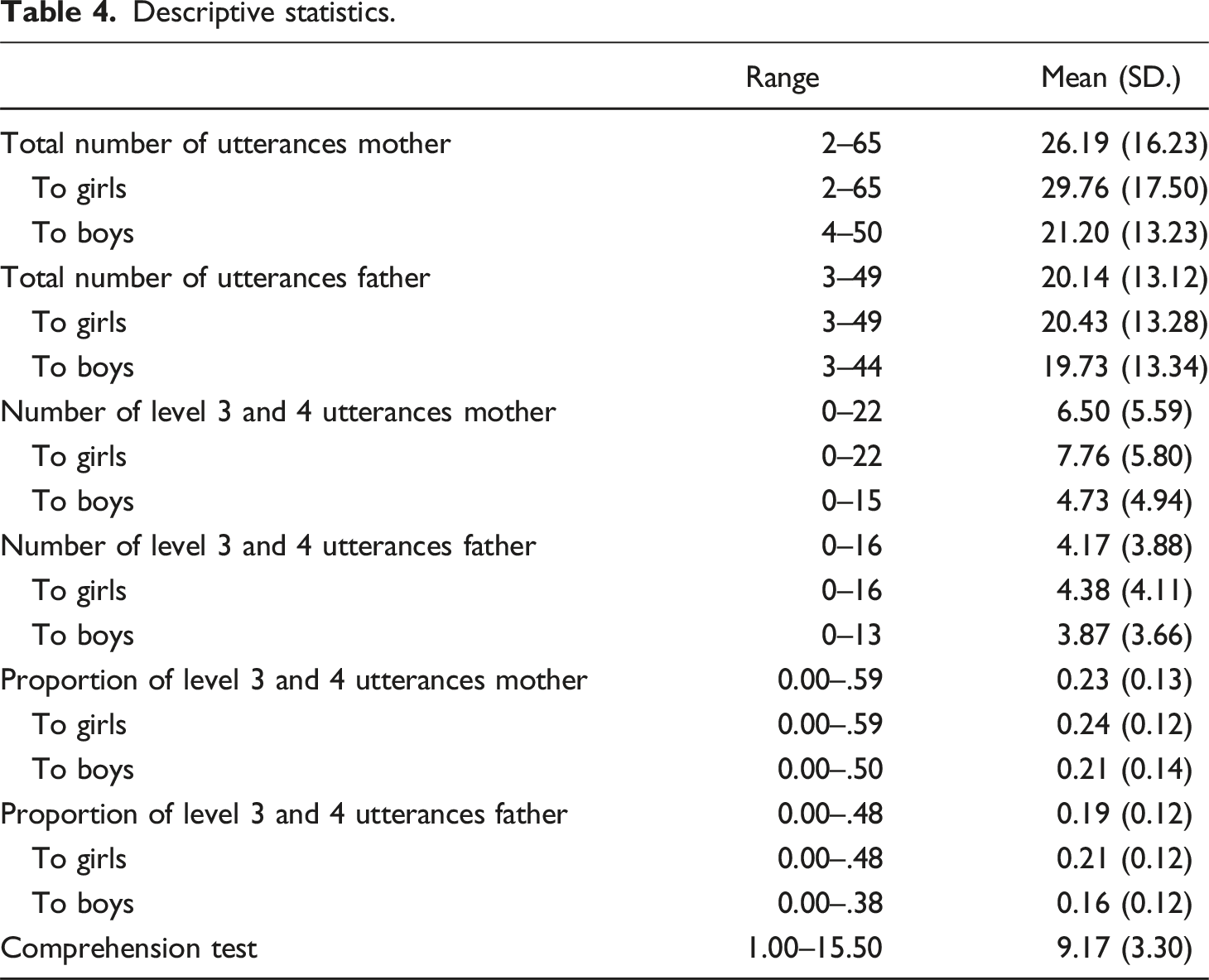
Mothers used more utterances than fathers did and, as a likely consequence, also more Level 3 and 4 utterances. Conclusions on whether mothers and fathers differ in their use of cognitively challenging talk might thus be distorted by the fact that mothers overall talked more during shared reading than fathers did. Consequently, we decided to base further analyses on proportions of Level 3 and 4 utterances (for a similar procedure, see De la Rie et al., 2018; De la Rie et al., 2020). The mean score on the comprehension test indicates that, on average, children had about half of the questions correct.
Research Questions 1 and 2
The two-way mixed ANOVA showed that there were no main effects of either parent gender (F [1, 34] = 2.92, p = .097) or child gender (F [1, 34] = 1.06, p = .310) on the proportion of Level 3 and 4 utterances produced by parents. There was also no significant interaction effect of parent and child gender (F [1, 34] = 0.00, p = .964). In other words, mothers and fathers did not differ in the extent to which they used cognitively challenging talk in shared reading interactions with their child; whether the child was a girl or boy also did not make a difference.
Research Question 3
The two-way mixed ANOVA showed that there were no main effects of either parent gender (F [1, 34] = 0.57, p = .457) or child gender (F [1, 34] = 2.21, p = .147) on the scores on the comprehension test. There was also no significant interaction effect of parent and child gender (F [1, 34] = 0.15, p = .698). In other words, variability in children’s comprehension scores was not dependent on whether they had been read to by their mother or father; whether a child was a girl or boy did not matter either.
Research question 4
The overall correlation between the proportion of Level 3 and 4 utterances by parents and children’s comprehension scores was r = 0.30, p = .001: the larger the share of cognitively challenging utterances, the better children’s understanding of the stories. For mothers, the correlation between the proportion of Level 3 and 4 utterances and children’s comprehension scores was not significant (r = 0.28, p = .099), but for fathers, it was (r = 0.38, p = .023). Subsequently, these correlations were computed separately for girls and boys. For girls, neither correlation with comprehension scores was statistically significant (mothers’ proportion of Level 3 and 4 utterances: r = 0.07, p = .774; fathers’ proportion of Level 3 and 4 utterances: r = 0.18, p = .435). For boys, however, both correlations were significant (mothers’ proportion of Level 3 and 4 utterances: r = 0.56, p = .029; fathers’ proportion of Level 3 and 4 utterances: r = 0.56, p = .030).
Discussion
Although mothers tended to talk more during shared reading activities than fathers, mothers and fathers did not differ in the extent to which they used cognitively challenging talk: the proportions of Level 3 and 4 utterances in parent–child interactions were similar for both genders (Research Question 1). Child gender did not play a role either: parents did not use more cognitively challenging talk in interactions with girls than with boys and there were no interaction effects of parent and child gender (Research Question 2). Additionally, there were no parent gender, child gender or interaction effects on story comprehension (Research Question 3). The share of cognitively challenging talk was associated with story comprehension: more Level 3 and 4 utterances by parents were paralleled by a better understanding by children of the stories being read. This association appeared to be related to parent gender: for fathers the correlation between proportion of Level 3 and 4 utterances and children’s comprehension scores was significant, for mothers it was not. This correlation seems to have masked another association, however: when correlations were computed separately for girls and boys, we found that the proportion of cognitively challenging utterances of both parents was correlated with comprehension scores for boys, but not for girls (Research Question 4).
The absence of effects of parent gender on the share of cognitively challenging utterances may be explained by the characteristics of our sample: most parents were higher educated and read to their children at least once a week and this was true for both mothers and fathers. Whereas the notion of differential experiences in shared reading is partly based on fathers’ assumed lack of experience (Korat et al., 2008; Rowe et al., 2004), this probably not holds for the fathers in our sample: most of them were likely practiced readers of children’s books. There are other possible explanations as well. We examined mother–father pairs: each pair thus read to the same child. Since characteristics of the child (e.g. her/his language ability) influence the nature of parent–child interactions (Saracho and Spodek, 2010), similarities in interaction patterns between mothers and fathers may reflect a child factor: specific characteristics of the child determine how both parents respond. Parents within a family may also learn from one another. The Family Systems Theory, for instance, suggests that mothers and fathers tend to adjust their parenting styles (Cox and Paley, 1997). This may also hold for shared reading: mothers and fathers may observe each other while reading and take over one another’s behaviours.
The observation that mothers’ and fathers’ use of Level 3 and 4 utterances was related to children’s comprehension scores may be explained in two ways. On the one hand, it may imply that parents better succeed in discussing picture books more elaborately when children have a better understanding of the story being read: better story comprehension might allow more cognitively challenging interactions. On the other hand, it could mean that, when parents engage their child in more challenging interactions, they help her or him understand the story better. Following the latter interpretation, it was interesting to see that correlations between the proportion of Level 3 and 4 utterances and story comprehension were significant for boys, but not for girls. Possibly, boys needed more support in understanding the stories than girls or, rather, they needed to be challenged more. This interpretation aligns with the outcomes of previous research on young children’s literacy interests. In a study among five-year-old children, Meagher et al. (2008), for instance, found that boys showed significantly less engagement during shared reading than girls did. Baroody and Diamond (2013) found that both parents and teachers of four- and five-year-olds reported significantly less interest in literacy activities such as shared reading for boys than for girls.
Limitations and future directions
One limitation of our study is that there was relatively little diversity in our sample: most parents were high educated and were born in the Netherlands. Interestingly, previous studies that included low SES families did find differences between mothers and fathers in interaction patterns (Duursma, 2016; Korat et al., 2008). Therefore, a question that deserves further scrutiny is to which extent SES and/or other variables, such as ethnic background, are responsible for the presence or absence of gender effects. From the afore-mentioned studies, only the study by Korat et al. allowed a comparison of SES groups – their sample included 19 low SES and 20 middle SES families – but they only tested main effects of parent gender and SES, not their interaction, possibly due to the relatively small sample size. To be able to analyse interaction effects of parent gender and characteristics such as SES and ethnic background, we therefore call for research based on larger, more diverse samples.
The sample is homogeneous in another way as well: apart from one family in which the child was raised by grandparents, the sample did not include any non-traditional families (e.g. single-parent families and families with same-sex parents). Although our design did not necessarily rule out the participation of these families (see Participants), we did not come across these families during recruitment. Inclusion of non-traditional families would enrich our knowledge of how home literacy environments take shape. Extending research designs to include information on gender identities might prove insightful as well, as previous studies on reading motivation have shown (Espinoza and Strasser, 2020; McGeown et al., 2015; McGeown, 2012).
Another limitation is that we cannot draw definitive conclusions about the causal mechanism underlying the association between the use of cognitively challenging talk and story comprehension for boys. It could be that the use of more challenging, decontextualized talk helps in engaging boys during shared reading and that this has positive consequences for their processing of text. To test the validity of this assumption, intervention studies would be necessary. Interestingly, however, we could not find any studies that analysed effects of interventions such as Dialogic Reading – in which cognitively challenging parent–child interactions are promoted – separately for girls and boys (e.g. Mol et al., 2008). We therefore recommend conducting experimental studies that assess whether introducing cognitively challenging talk during shared reading activities with boys results in higher attention, stronger engagement and more favourable language outcomes.
A final limitation is that we focused on parental utterances only. The positive correlation between the proportion of Level 3 and 4 utterances and comprehension scores suggests parental utterances help children in processing stories more actively (see previous Limitation). However, sequential analysis of utterances by parents and children and the connections between those utterances might have shed even more light on the cognitively challenging nature of the interactions.
Conclusion
Our study provides further insight into the effects of parent and child gender on the nature of parent–child interactions during shared reading. The fact that we found no effects of parent gender on either the use of cognitively challenging talk or children’s story comprehension suggests that, at least in higher SES families where both parents are engaged readers, mothers and fathers are more alike than is assumed (Cutler and Palkovitz, 2020; Duursma, 2016). The contrast with the outcomes of previous studies using other types of samples (Duursma, 2016; Korat et al., 2008) stresses the need for studies with larger, more diverse samples, so that interaction effects of parent and child gender and background characteristics can be tested. The observation that more frequent use of cognitively challenging talk was paralleled by better story comprehension for boys invites further research on the specific effects of shared reading for boys.
Footnotes
Acknowledgements
We would like to thank the families taking part in this study.
Declaration of Conflicting Interests
The author(s) declared no potential conflicts of interest with respect to the research, authorship, and/or publication of this article.
Funding
The author(s) received no financial support for the research, authorship, and/or publication of this article.
Author Notes
Brenda Gouw is alumnus of Erasmus University Rotterdam, Saskia Liefers and Tessa van Aspert are alumni of Free University Amsterdam.
