



Abstract
COVID-19 has changed the daily lives of families, impacted on work, social interactions, and mental health. Since spring 2020, parents have been working from home and children have been home from daycare and school. Parents are experiencing stress in an attempt to satisfy the demands of work, family, and COVID-19 concerns. Due to the fact that children have been home from daycare and school, parents have the sole responsibility of caring for and teaching their children until schools are able to fully and effectively meet the needs of educating students in an adapted format. Research provides a wealth of information documenting the advantages of parents reading to their children. Children benefit from read-alouds with parental interaction, and these benefits include an increase in oral language skills, reading comprehension, vocabulary, and an increase in motivation to read. The purpose of this study is to answer two questions: (1) Since parents were home more often with their children, were parents spending more quality time reading to their two-to four-year-old children? This can be defined as reading developmentally appropriate books to their children with their undivided attention; and (2) Since parents were home more often with their two-to four-year-old children, were parents reading more to their young children? Parents of pre-kindergarten students were surveyed to determine the answers to these questions.
The COVID-19 pandemic had a wide sweeping impact on the 2019-2020 school year across the state of Minnesota. According to a map created by Education Week (2020), a statewide shutdown beginning 19 March 2020 closed 8,909 schools for the year, affecting 5,360,849 Minnesota students. According to Centers for Disease Control and Prevention (2020) data, Minnesota has had a total of 105,740 confirmed cases of Coronavirus to date. With schools back in session for the 2020-2021 school year, utilizing various methods of delivery of instruction such as online, face-to-face, and hybrid, the academic impact of school closures and alternative delivery models remains to be fully seen.
Early childhood education programming, defined as educational opportunities for children from birth to age eight, has also been impacted by the Coronavirus pandemic. Many preschools across the nation have continued to offer socially distant instruction through use of web conferencing technologies such as Zoom (Szente, 2020). Preschool, however, is not a fundamental right in the United States as it is in some European countries such as Sweden and Norway (Samuelsson, Wagner, and Odegaard, 2020). Therefore, many preschool services including school lunch programmes were interrupted during the pandemic, only providing childcare for essential workers (Chor, 2020). Currently in Minnesota, both voluntary pre-kindergarten (VPK) and school readiness plus (SRP) programmes ‘serve a total of 7,160 children throughout the state in 128 school districts and charter schools at 215 locations. Not all districts have VPK or SRP programs’ (Minnesota Department of Education (MDE), 2020, para. 2).
Parents of students at any age experienced challenges of having to care for their children while schools remained closed (Alon, et al., 2020). This was particularly challenging for parents of preschoolers, especially those children with disabilities. One study by Neece et al. (2020) surveyed parents of preschool children with disabilities, aged three to five, to better understand their home experiences during the pandemic. The authors (2020) found that ‘49.2%’ of those surveyed ‘reported some benefits, most commonly having more time together as a family’ (p. 743). While time together as a family is often beneficial, the study also found parents of preschoolers with disabilities reported several challenges including: finding a work-life balance, navigating changes in daily rhythms, isolation, childcare, emotional support, preventing boredom, and financial woes (Neece et al., 2020). In addition to healthcare and behaviour problems, the authors (2020) cited parental concerns over interruption of their child’s educational services. In fact, ‘the vast majority of parents said that their child’s services had decreased 77.9%’ (p. 742).
The school year is already interrupted each year with three months of summer vacation resulting in an educational gap which is mentioned frequently in literature as ‘the summer slide’ (Chor, 2020). This academic achievement gap was widened during the 2019-2020 school year due to the interruption of school because of the Coronavirus pandemic. This can be seen in a regression of literacy rates among our youngest students. When looking at scaled reading scores from the Preschool Language Assessment Scale (PreLAS2003), researchers Bao et al. (2020) predict that during a normal school year, children in kindergarten ‘would improve by 13.8 points from 1 January to 1 September 2020 (the approximate start of 1st grade fall semester)’ (p. 6). However, with instruction being disrupted and schools remaining closed through to the end of the 2019-2020 school year, it is predicted that kindergarten class of 2019-2020 will only increase 9.5 points from 1 January 2020 to 1 September 2020, ‘31% less than that without COVID-19 school closures’ (p. 6). One mitigation strategy to help close this gap is visits to the public library during the summer (Bao et al., 2020). In contrast, a March 2020 survey by the Public Library Association, a division of the American Library Association (ALA) depicted through a graph that ‘98% of branches around the country were closed during the pandemic’ (p. 4). When branches were surveyed again by the ALA in May of 2020, a graph illustrated that ‘62%’ of libraries nationwide were still ‘fully closed’ with only ‘1%’ reporting to be ‘fully open with no restrictions’ (p. 4). Left without public resources, Bao et al. (2020) stress the importance of parents reading to their children at home.
The benefits of reading aloud
Since March 2020 when COVID-19 impacted on schools, work, and daily life, parents have been primarily working from home and children aged birth to eight have been spending more time at home instead of in childcare and school. There are resources available to parents describing a variety of activities parents can do with their children to keep children entertained, occupied, and progressing academically during the pandemic (Brownlee, 2020; Center for Disease Control and Prevention, 2021; MN Department of Health; Osmanski, 2021; Pearlstein, 2020). However, research confirms that home literacy practices such as reading aloud impact on the whole child and offer numerous life-long advantages including cognitive development, language development, social-emotional development, and opportunities to bond (Demir-Lira OE, Applebaum LR, Goldin-Meadow S, Levine SC, 2019; Gottfried et al., 2015; Mendelssohn et al., 2018).
The benefits of reading to young children are immense, and since parents are children’s initial teachers as well as children’s primary teachers, reading at home is essential. Explicitly, benefits of reading to zero-to eight-year-olds include an increase in cognitive development and language development as well as advancing vocabulary development, pre-reading skills, and emergent literacy skills (Gillespie, 2019). Read-alouds elicit questioning between parents and children and strengthen sound discrimination and language which enables young children to acquire phonemic awareness related to a child’s native language - phonemic awareness is essential to a child’s ability to read (Posner and Rothbart, 2007: 166).
Reading aloud has also been associated with brain development in preschoolers. Hutton et al. (2015) concluded that when preschoolers experienced read-alouds, portions of their brain were stimulated in the areas ‘supporting mental imagery and narrative comprehension’. Literacy at home should start in the early years to support language development and academic achievement (Niklas et al., 2016). According to the Center on the Developing Child at Harvard University (2016), early experiences impact on ‘brain architecture’ and if these early experiences are positive experiences, then these positive experiences will help to promote healthy brain development (p.7). For a child’s developing brain, the serve and return of language exchange involved in reading aloud stimulates executive attention which is required for school; executive attention involves reading, maths, and conceptualizing abstract ideas (Posner and Rothbart, 2007: 81). Furthermore, when parents read to children and expose children to a print-rich environment, children learn about alphabetic principles and concepts of print, and acquire linguistic awareness and phonemic awareness, as well as vocabulary development (NAEYC, 1998). Additionally, language-rich environments that facilitate language exchange not only support cognitive development, but also have a positive effect on maths achievement (Baker, 2013). In turn, reading aloud when children are young prepares children with essential cognitive skills, language skills, literacy skills, and maths skills, thus enhancing reading success, and motivation in school, which ‘has long-term educational benefits that extend throughout the academic lifespan’ (Gottfried et al., 2015: 31).
Research evidence indicates that the benefits of reading aloud to children also support social-emotional growth. In a study conducted by Mendelsohn et al. (2018), the findings concluded the following, ‘We found that promotion of positive parenting activities such as reading aloud, play, and talking resulted in enhanced social-emotional development for children in low-income families’ (p. 5). Listening to a story read by a parent or another adult helps children relate to the character's experiences and the character’s emotions. While reading, a parent uses inflection, emotional expressions, gestures, and eye contact which are internalized and interpreted by children. Consequently, relationship-building activities such as reading create a bond between child and parent.
When reading to children, parents engage in a bonding experience that simultaneously influences language acquisition due to the natural discourse that occurs. As Lev Vygotsky proposed in his sociocultural theory, parents influence children’s social and cultural perspectives by interacting with children and engaging children in meaningful experiences (McDevitt and Ormrod, 2020: 211). This parent-child cooperation and meaningful interaction establishes an integral and vital connection that many theorists such as Ainsworth et al. (2015) and John Bowlby (1988) evidenced as valuable secure attachment. While parents and children partake in reading a significant message is conveyed about reading which includes enjoyment, attention, and positive feelings (Curry et al., 2016; Gottfried et al., 2015). Indeed, the positive outcomes of reading aloud extend beyond promoting language, literacy, vocabulary, social-emotional and cognitive skills; the benefits yield enduring results on academic performance (Gottfried et al., 2015).
Description of the study
Purpose
The purpose of this study is to answer two questions: (1) Since parents were home more often with their children, were parents spending more quality time reading to their two-to four-year-old children? This can be defined as reading developmentally appropriate books to their children with their undivided attention; and (2) Since parents were home more often with their two-to four-year-old children, were parents reading more to their young children? Parents of pre-kindergarten students were surveyed to determine the answers to these questions (see supplemental Appendix).
The preliminary questions gathered background information and addressed whether parents were home more often with their children due to COVID-19 and the age of the child(ren) attending preschool. The survey was designed to answer questions about the potential increase in parental quality time spent with two-to four-year-old children and the quality time encompassed reading with children. Spending quality time reading entails a parent or caregiver reading to their child(ren) ‘at least 30 minutes each day’ and together discussing the book, asking questions, and pointing to pictures and words while sitting next to each other (U.S. Department of Education, 2012). A question pertaining to the typical reading environment prior to COVID-19 and during COVID-19 was asked to determine the type of home environment parents and children were experiencing. This question stated, ‘When you read to your child prior to COVID-19, what best describes your typical reading environment?’ Parents could choose a range of descriptions which were: I read a book to my child while sitting next to my child; I read a book to my child while I was occupied with another task; I did not have time to sit with my child to read a book; When I read to my child, I was usually distracted and unable to finish the book; When I read to my child, I spent extra time asking questions about the book; or When I read to my child, I did not ask questions about the book. Subsequently, the same question was asked of parents regarding the reading environment during COVID-19.
The second research question regarding quality time enquired about reading developmentally appropriate books to pre-kindergarten children prior to COVID-19 and during COVID-19. The question determined if the quality of books read to pre-kindergarten children altered due to familial circumstances during COVID-19. The survey question encompassed the following types of books: age-appropriate children’s books; advanced chapter books; children’s magazines; and adult literature. Age-appropriate books are defined as books that have been determined to be relevant to a child’s age or level by the publisher; thus, the books would be considered developmentally appropriate. Advanced chapter books are usually read subsequent to picture books, are 30 pages or more, and are typically read to or by elementary students usually 7 years of age or older (National Library of New Zealand, n.d.; Scholastic, 2019); advanced chapter books are upper-level reading material with more difficult vocabulary (Reading Rockets, n.d.).
To research the question about whether parents were reading more to their young children, the research questions focused on how often parents read to their pre-kindergarten children prior to COVID-19 compared to how often parents read to their children during the pandemic. The survey question regarding how often parents read to their children prior to COVID-19 and during COVID-19 allowed parents to choose from the following options: daily; several times per week (two to three times per week); several times per month; monthly (one time per month); or never. In addition, questions encompassed the number of hours per week parents spent reading to their pre-kindergarten children prior to the pandemic compared to during the pandemic. The survey question provided options for parents which included: an hour; less than an hour; or more than an hour.
Methodology
Participants
A single survey with ten questions was distributed to 500 families with parents who had children two to four years of age attending a state or independent preschool. The independent preschool had 10 children enrolled in the toddler classroom and the preschool classroom had 13 students enrolled. Siblings attended the school; therefore, a total of 20 families received the survey. The public preschool sent the survey to 480 families with children enrolled in the two to four-year-old preschool programme. Although 500 surveys were distributed, a total of 45 respondents replied, which is a 9.0% response rate. Not all 45 respondents responded to all ten questions. The independent school consisted of a diverse population of children and parents whose primary language was English. The independent school did not disclose specific enrolment by race/ethnicity; however, the independent school revealed that the diverse racial demographics of children and parents reflected the larger community: White, Black and African American, Hispanic/Latino, two or more races, and Asian. The state school’s demographics also had a diverse population of children and parents which consisted of the following: 171 White students, 53 Black students and African American students, 14 Hispanic/Latino students, 18 students identified as having two or more races, 1 Asian student, and 2 American Indian or Alaskan Native students (National Center for Education Statistics, 2019-2021). Unlike the independent school, the state school’s demographics primarily consisted of a high population of Somali families whose primary language was not English.
Most questions required a single selection; however, there were two questions that allowed parents to choose more than one option. Single responses were required for the following questions with regard to pre-COVID-19 and during COVID-19: Are you home more often with your child due to COVID-19?; How often did you read to your child?; How many hours per week did you read to your child; What best describes your typical reading environment?; How often do you read to your child?; How many hours per week do you read to your child? Multiple responses could be applied to the question about the age of the child attending preschool and the type of books read to their child prior to COVID-19 and during COVID-19.
Forty-five parents who completed the survey identified the age of their child as two, three or four. Some parents have more than one child attending the preschools that were surveyed. The data revealed that of the parents surveyed identifying the age of their preschooler, 57.45% were four-year-olds, 29.79% were three-year-olds, and 12.77% were two-year-olds.
Out of the 45 respondents surveyed, 43 parents responded to the question asking if they were home with their child(ren) more often due to COVID-19, 83.72% answered yes. The number of parents who responded that they were not home with their child(ren) more often due to COVID-19 was 16.28%. The results of the survey revealed that more parents were home with their child(ren) more often due to COVID-19.
Instrument
A Qualtrics survey was utilized as a tool to collect data. The survey was conducted during the pandemic from November 2020 to 30 January 2021. The survey included ten questions pertaining to reading practices prior to COVID-19 and reading practices during COVID-19. Each of the school’s directors sent the survey via email to parents of preschool students. After one to two weeks, the survey was re-sent to encourage participation. Answers to the survey were completely anonymous and all IP addresses were removed to ensure confidentiality. Qualitative and quantitative data were analysed using bar graphs to record the parental responses to reading practices. An analysis of the quantitative data was calculated to measure the standard deviation to determine the distribution of the data.
Data analysis
Analysis of research for question 1
Quality of time reading
Since parents were home more often with their children, were parents spending more quality time reading to their two-to four-year-old child(ren)? This can be defined as reading developmentally appropriate books to their children with their undivided attention. NAEYC recommends read-aloud activities parents can do with their children to promote literacy skills such as ‘read aloud at least once every day; talk about the story before, during, and after reading; share a variety of literature (stories, poems, and informational books) over time’ (n.d.). To determine the quality of time parents spent reading with their child(ren) the data related to this question were collated, categorized, and analysed. The survey question asked what types of books parents read to their child(ren) prior to COVID-19 and during COVID-19. Parents had the option to choose more than one type of book that they read to their child(ren). The choices included the following: age-appropriate children’s books; advanced chapter books; children’s magazines; adult literature; and I did not read to my child.
Pre-COVID-19
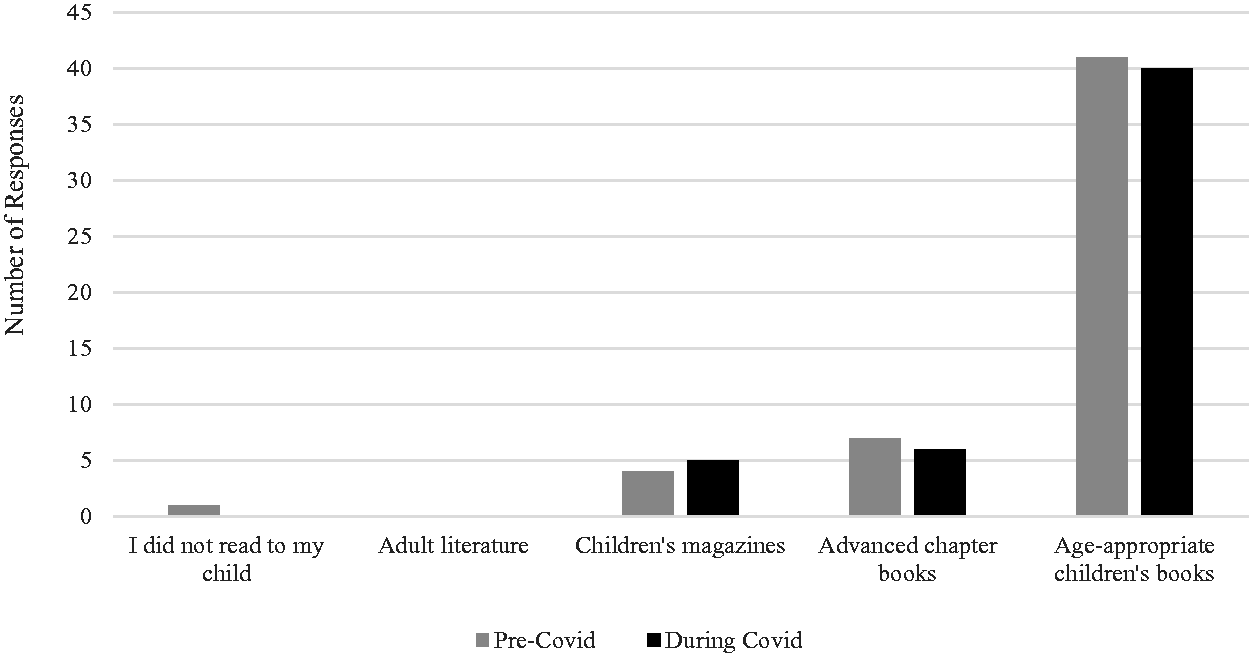
When asked what type of books parents read, there was a total of 53 responses. The higher response rate was due to parents being able to choose more than one response. Prior to COVID-19, 77.36% of parents indicated that they read age-appropriate children’s books. A response of 13.21% indicated that parents read advanced chapter books prior to COVID-19. Of the parents surveyed, 7.55% reported that they read children’s magazines prior to COVID-19. Zero per cent of parents responded that they read adult literature and 1.89% responded that they did not read to their child(ren). Figure 1 illustrates parental responses to the type of books parents read pre-COVID-19 and during COVID-19.
What types of books did you read to your child?
During COVID-19
Parents could choose all that applied to the question pertaining to the type of books they read to their child during COVID-19. Therefore, of the 45 respondents there were a total of 51 responses. During COVID-19, 78.43% of the parents who responded reported that they read age-appropriate children’s books which revealed a 1.07% increase in the number of parents reading age-appropriate children’s books compared to prior to COVID-19. The percentage of parents reading advanced chapter books during COVID-19 was 11.76% which was a decrease from the parental responses prior to COVID-19. Reading children’s magazines increased by 2.25% during COVID-19 as compared to prior to COVID-19. Adult literature remained consistent at zero per cent (see Figure 1).
Pre-COVID-19
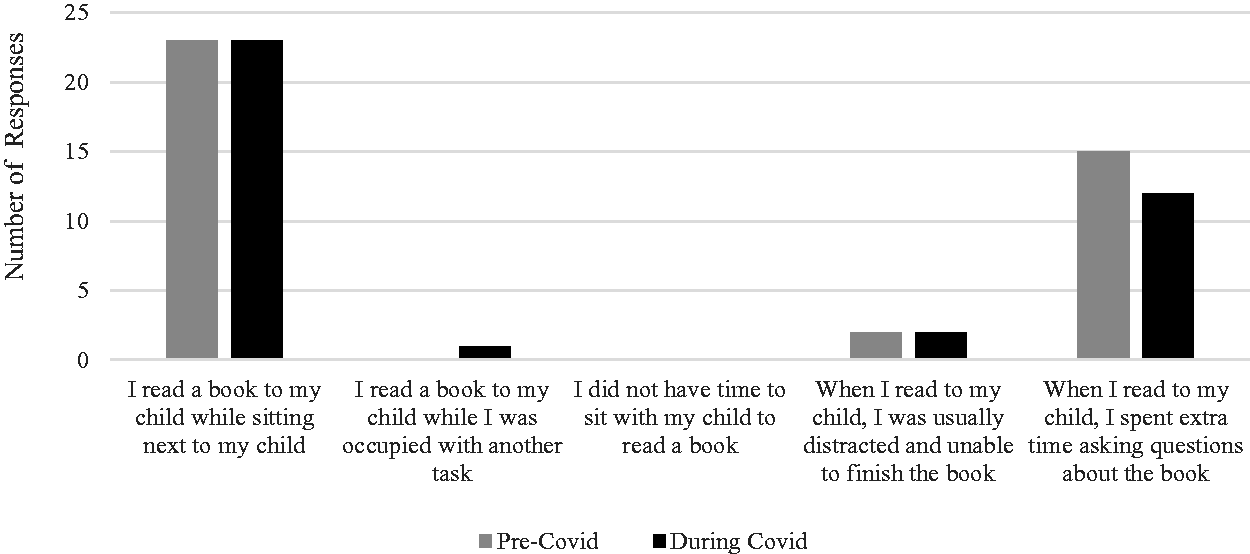
The second question that addressed the quality time parents spent reading to their preschool child(ren) asked the following: When reading to your child prior to COVID-19, what best describes your typical reading environment? Parents were asked to choose one reading environment that best described how they read to their child(ren) most often. The question also identified how parents read to their child(ren) during COVID-19. Parents had the option to choose just one reading environment that described how they read to their child(ren) during COVID-19. These questions identified if the quality of reading practices changed during COVID-19. Quantitative data pertaining to the question regarding quality time were collated, categorized, and analysed. Figure 2 provides a comparison of the typical reading environment pre-COVID-19 and during COVID-19.
When you read to your child, what best describes your typical reading environment?
Of the 45 respondents, a total of 42 parents responded to the questions pertaining to their reading environment. When asked how parents read to their child(ren) prior to COVID-19, 54.76% of parents described their typical reading environment as reading a book to their child while sitting next to their child. The percentage of parents who responded that they spent extra time asking questions about the book was 35.71%. Of the 42 respondents, 4.76% of parents replied that they were usually distracted and unable to finish the book and 4.76% of parents responded that they did not ask questions about the book. Zero responses were recorded for parents reading a book to their child(ren) while occupied with another task and, similarly, zero responses were reported for not having time to sit with their child to read a book.
During COVID-19
The responses to the same questions about their typical reading environment with their preschooler within the time frame of during COVID-19 indicated that out of a total of 41 parents, 56.10% of parents reported that they read to their child while sitting next to their child which is an increase of 1.34% from the responses prior to COVID-19. Of the parents surveyed, 29.27% responded that they spent extra time asking questions about the book. This reveals a 6.44% decrease from the number of parents who spent extra time asking questions prior to COVID-19. When asked if parents were distracted and unable to finish the book when reading to their child(ren), 4.88% of parents indicated that this was the case. This was a small increase compared to reading practices prior to COVID-19. The percentage of parents who read to their child(ren), but did not ask questions during COVID-19 was 7.32% which was an increase of 2.56%. Additionally, 2.44% of parents responded that they read to their child while they were occupied with another task during COVID-19. Reading while occupied with another task increased during COVID-19 in contrast to prior to COVID-19 being 0%. All parents who responded specified that they had time to read to their child(ren). (see Figure 2)
Analysis of research for question 2
Quantity of time reading
The second question in the research was: Since parents were home more often with their two-to four-year-old child(ren), were parents reading more to their young children? This was measured both in terms of amount of time and frequency. One question encompassed how often parents read to their child prior to COVID-19 and during COVID-19. An additional question focused on the frequency by asking how many hours per week parents read to their child. To determine the quantity of time parents spent reading with their child(ren) the data related to this question were collated, categorized, and analysed.
Pre-COVID-19
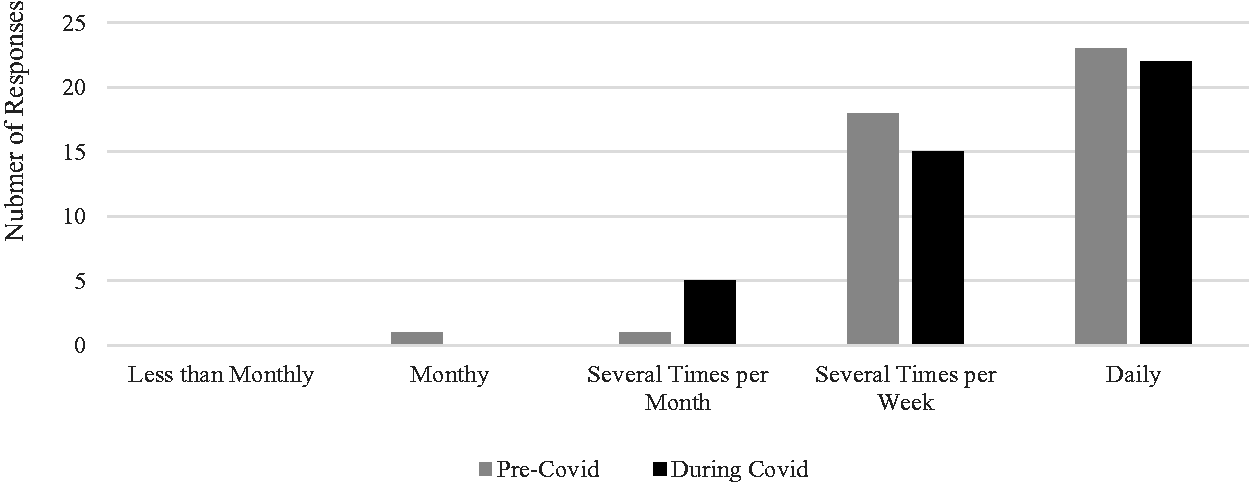
Although a total of 45 parents responded to the survey, there were 43 responses to the question about reading time and frequency. The question addressed how often parents read to their child(ren) prior to COVID-19. Of the 43 responses, 53.49% of parents indicated that they read daily to their child(ren). The responses pertaining to reading several times per week (two to three times per week) were 41.86%. The responses for reading several times per month were 2.33% which was equivalent to the responses for reading monthly (one time per month). Of the 43 there were no parents who stated that they did not read to their child; thus, 43 respondents read to their child(ren). The data distribution had a low standard deviation of .66. Figure 3 depicts how often parents read to their child pre-COVID-19 and during COVID-19.
How often did you read to your child?
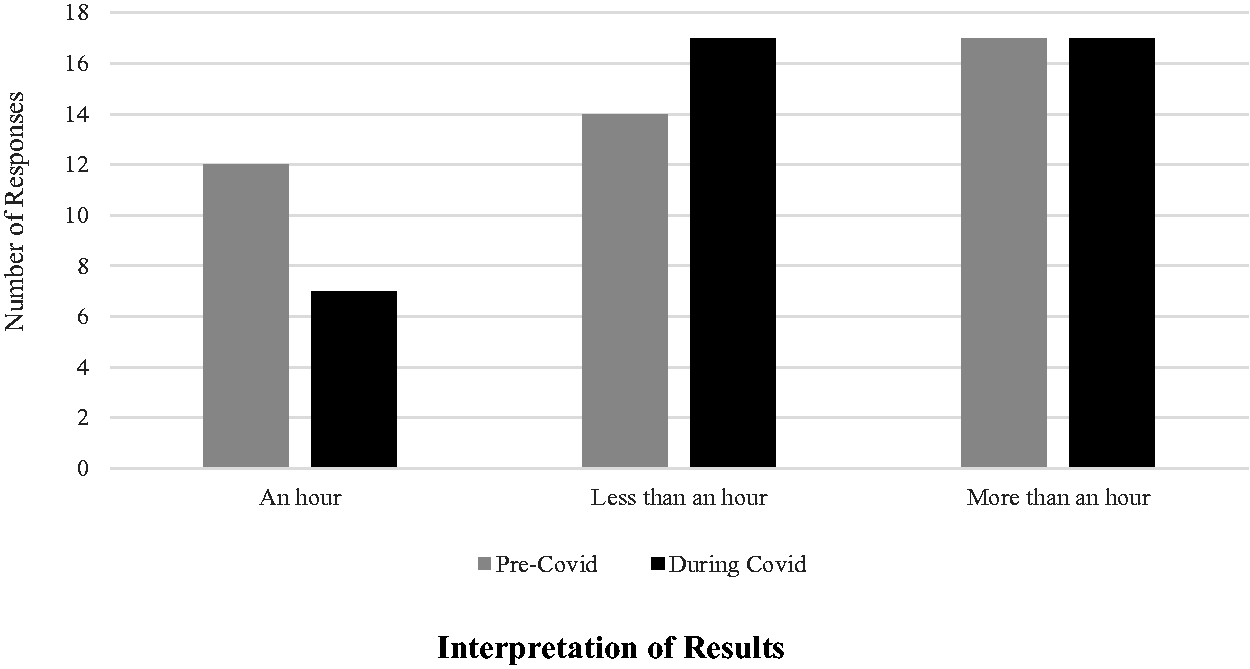
The second question conveyed the number of hours per week parents read to their pre-kindergarten child(ren) prior to COVID-19. Figure 4 shows the amount of time parents read to their child(ren) prior to COVID-19 and during COVID-19, and as the figure details, there were 43 responses. Of the 43 responses, 39.53% of parents responded that they read more than an hour to their child(ren). The response for reading less than an hour was 32.56%. The percentage of parents who responded to reading for an hour was 27.91%. The standard deviation was .81 which is a low distribution.
How many hours per week did you read to your child?
During COVID-19
Forty-two parents responded when asked how often they spent reading to their child(ren) during COVID-19. Of the 42 parents who responded to the question, 52.38% responded that they read to their child(ren) daily which is a minimal 1.11% decrease from the amount of time parents spent reading to their child prior to COVID-19. The response to reading several times per week (two to three times per week) was 35.71% which is a 6.15% decrease from the amount of time per week parents read to their child(ren) prior to COVID-19. The percentage of parents who responded that they read several times per month was 11.90% which is an increase of 9.57%. Zero parents responded to reading to their child monthly (one time per month) which was a 2.33% decrease to what was reported prior to COVID-19. Additionally, zero parents responded to never/less than one time per month to their child revealing that parents were spending time reading to their child(ren). The standard deviation was recorded as .69 which is a narrow distribution. There was a significant difference in parental responses pertaining to reading several times per month; parents responded that they read significantly more during COVID-19 than prior to COVID-19. Figure 3 details the contrast between the amount of time parents read prior to COVID-19 compared to during COVID-19.
When asked the number of hours per week parents read to their child(ren) during COVID-19, 41 parents responded. As illustrated in Figure 4, of the 41 parents, 41.46% responded that they read less than an hour and 41.46% stated that they read more than an hour. The percentage reported by parents for more than an hour of reading time increased during COVID-19 by 1.93% and reading less than an hour during COVID-19 increased by 8.9%. Reading for an hour during COVID-19 compared to prior to COVID-19, decreased by 10.84%. A minimal .73 standard deviation was calculated. The data illustrate that the number of hours parents spent reading to their preschooler(s) remained relatively the same pre-COVID-19 as during COVID-19.
Interpretation of results
During COVID-19 more parents chose age-appropriate books to read to their child and children’s magazines. Although the time (hours) spent reading to their child(ren) remained similar prior to COVID-19 and during COVID-19, parents maintained the quality of books or magazines that they chose to read to their child(ren). While reading to their child(ren), parents responded that they sat next to their child; however, parents reported that they had less time to ask questions about what they read. Parents disclosed that they were distracted more often during COVID-19 which interrupted quality reading time. The results of the data reveal reading practices were altered due to COVID-19, and data also indicate that parents still knew the benefits of reading to their preschool child(ren). COVID-19 had an impact, but parents still spent time with their child(ren), and parents still took the time to read to their child(ren).
The original hypothesis was that parents would read to their two to four-year-old child(ren) more often during COVID-19 because they were home more often with their child(ren). The results of the data support that parents were reading more to their child(ren) during COVID-19. The frequency of parents reading to their children several times per month increased during the pandemic. The increase in the frequency spent reading to children may have been due to multiple reasons such as more parents were working from home, parents were more involved with their children, and trying to balance caring for their children along with work responsibilities (Lee et. al., 2021; Garbe et al., 2020).
To evaluate the statistical significance, a Chi-Square Test was utilized. The null hypothesis was that parents read to their preschool child(ren) equally as often prior to COVID-19 compared to during COVID-19. The alternative hypothesis was that parents read to their preschool child(ren) more often or more frequently during COVID-19. More often and more frequently would be determined by reading daily, several times per week, or several times per month. Table 1 refers to the parental reading practices with preschool children prior to COVID-19 and during COVID-19. Using a 5% significance level, an analysis of the data rejects the null hypothesis; thus, the data pertaining to a change in parental reading practices prior to COVID-19 and during COVID-19 are statistically significant.
Statistical significance: Prior to COVID-19 and during COVID-19, how often did you read to your child?.
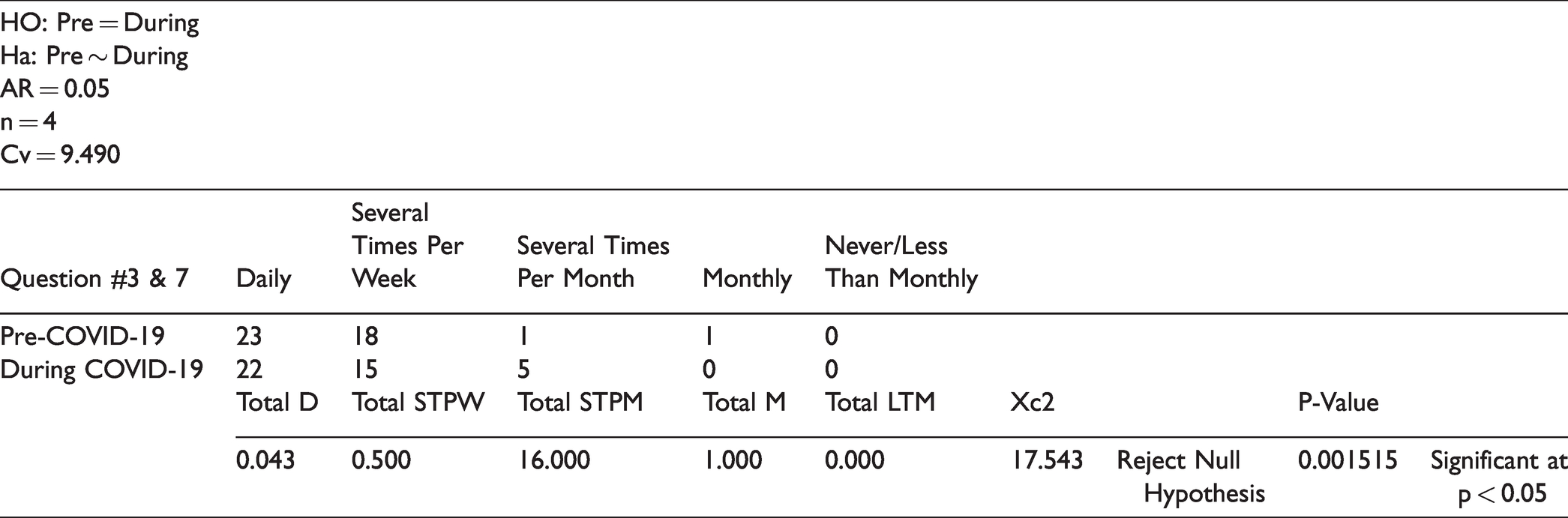
Table 2 details the amount of time parents read to their child(ren) prior to COVID-19 and during COVID-19. Reading more often or more frequently would be defined as reading for an hour or more than an hour. The null hypothesis was that parents would read to their preschool child(ren) for an equal amount of time (minutes to hours) prior to COVID-19 compared to during COVID-19. The alternative hypothesis was that parents spent more time reading to their preschooler(s) during COVID-19. Using a 5% significance level, the null hypothesis was accepted.
Statistical Significance: Prior to COVID-19 and during COVID-19, how many hours per week did you read to your child?.
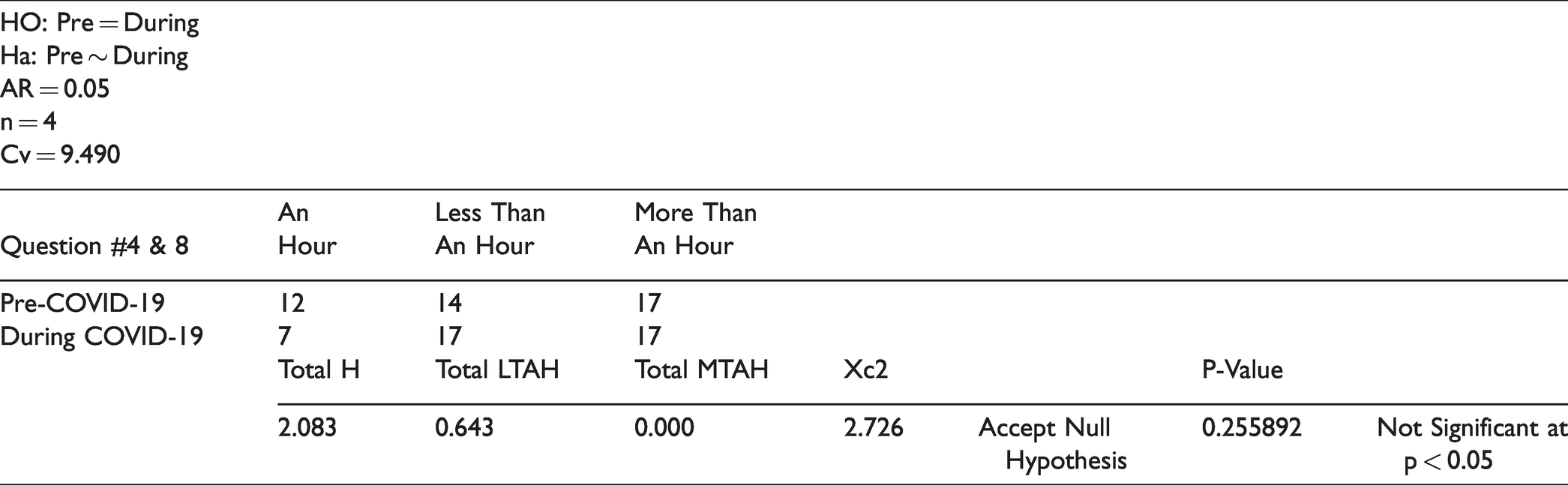
In sum, based on an analysis of statistical significance, the frequency of parental reading practices with preschoolers increased during COVID-19; however, a statistical difference was not evident with regard to the hours parents spent reading to preschoolers prior to COVID-19 compared to during COVID-19.
Conclusion
Although the response rate was low, the data collected contribute to our knowledge and understanding of reading practices of families with preschool children during COVID-19 by illustrating the changes in quality time and reading practices. Reading is invaluable during the early childhood years and if children do not have exposure to quality reading time, then the consequences will impact on the child’s academic future and the developing child. Early experience influences the developing child ranging from neural development to social-emotional development (Institute of Medicine and National Research Council, 2000: 3). Based on the data in this study, parental reading practices with two-to four-year-old children(ren) did change during COVID-19. The data results support that parents read more often during COVID-19 compared to prior to COVID-19. It is evident in the data that parents know the value of reading to their child(ren) because all parents surveyed responded that they do read to their preschool child(ren). As schools slowly return to in-person instruction and public libraries remain open around the country both for in-person and curbside pick-up, parents may find additional opportunities to read to their child(ren) and delineate their time between work and reading with their child.
Weaknesses in the study
A limitation of the study is the low response rate of 9% which indicates that the respondents may not be representative of non-respondents; therefore, the results of the survey may not be indicative of the target population. Thus, rate bias could alter the data towards the preschool parents who replied. The ideal survey response rate for a population size of 500 with a margin of error of 5% would have been 218. According to Karen et al. (2008), response rates between 60% and 70% are satisfactory, and depending on the topic, less than 60% may be justifiable. Since the survey was self-completion, a response of 65% would have been acceptable (Kelley et al., 2003). In addition, electronic mail or Internet could have posed an issue for some of the respondents (Karen et al., 2008).
Despite the limitations, this research was a small-scale study to bridge a knowledge gap in statistics about family reading practices with preschool children prior to COVID-19 and during COVID-19. COVID-19 has changed familial and societal practices and the impact is still being evaluated. Currently, there is a lack of research on family research practices with preschoolers during COVID-19. This paper serves to bring awareness of current trends and highlight the need for further research in this area.
Recommendations for further research
The response rate was lower than anticipated; however, one reason for the low response rate may have been attributed to the fact that the survey was distributed only in English while many parents in the community were speakers of other languages or not literate in English. In addition, parents may have been trying to multitask work and parenting during the pandemic with limited time to perform any extra-curricular activities or requests beyond daily activities.
There is a wealth of information yet to be gathered on COVID-19’s impact on home reading practices. To obtain a higher response rate, this study could be expanded to include birth to third grade and could also be expanded to include more schools. It could also be expanded to study the impact of parents reading to their children during the pandemic who are non-English speakers. Further insights could be gained by comparing the amount of screen time, as defined by gaming and television, in a home before and during the pandemic and comparing it to the amount of time spent reading to children. A longitudinal study would further elucidate the pandemic’s long-term impact on reading compared to students who learned to read during a different era.
