




Abstract
This paper contributes to the contemporary focus on literacy and digital stories in early childhood education and care (ECEC) institutions. When a group of young children create an animated story together, they might collaborate, both with their peers and with their teacher. By drawing on social semiotic multimodal perspectives as the theoretical framework, the purpose of this paper is to describe and explore how different modalities and narrative devices contribute to the development of an animated story created by six children (aged 4-5 years) and a teacher in collaboration. The study is a qualitative case study, focusing on contemporary events in a Norwegian kindergarten. The empirical material consists of video-recorded field observations of the process as well as the final product. Through an inductive exploration of the development of verbal narrative, three analytical strands are identified: i) verbal narrative in the final product, ii) multimodal narrative in the final product, and iii) narrative devices applied by the children during the process. The findings demonstrate the importance of including and considering the process, the product, narrative devices and all the modalities—in particular the kineikonic mode—when creating an animated story with young children. An implication of these findings is for ECE teachers and researchers to acknowledge and integrate all the various aspects that contribute to the final product when young children create animated stories.
Keywords
Introduction
This paper contributes to the contemporary focus on literacy and digital stories in early childhood education and care (ECEC) institutions. The use of digital technology in ECEC is a fast-growing field, with a calls for more research regarding the youngest children’s creations with digital technology (e.g. Burnett, 2010; Burnett and Daniels, 2016; Hsin et al., 2014; Marsh, 2010), digital stories (Garvis, 2016) and classroom-based early literacy learning with digital technology (Flewitt et al., 2015). An animated story is an example of a digital story expressed through several modalities (e.g. moving images, voice, music, pictures and written text) (Kress, 2010). When a group of young children create an animated story together, they might collaborate, both with their peers and with their teacher (see Undheim and Jernes, 2020). Still, we know little about how an animated story evolves through such a collaborative creation process and how different modalities and narrative devices contribute to the story. We understand narrative devices as strategies used to narrate a story (Nikolajeva, 2004). By drawing on social semiotic multimodal perspectives as the theoretical framework, the purpose of this paper is to describe and explore how different modalities and narrative devices contribute to the development of a stop-motion animated story collaboratively created by six children (age 4-5 years) and a teacher in a Norwegian kindergarten.
The animated story created in this study is about a princess named Rapunzel, who is trapped in a house by her stepmother. The children use elements from the fairy tale genre, and in the first scene, the stepmother walks from the house, into the wood, and then returns home (Excerpt 1). Further, the story is free from conflict and tensions in the overall plot line. The narrator voice describes what happens in the story without elaborating. A specific characterisation of an animated story is the sequences of still images that create an illusion of movement, e.g. to make a clay figure appear to be walking (Marsh, 2006), illustrated by the moving images in Excerpt 1.
Excerpt 1: The narrator voice and moving image in scene 1 in the animated story about Rapunzel. Moving image: A female character opens the door and walks into the wood. Narrator voice: “Once upon a time a stepmother was going for a walk.” Moving image: The female character moves through the wood. Narrator voice: “She walked and walked and walked.” Moving image: The female character stumbles and falls onto a small rock. Narrator voice: “And then she fell onto a rock and didn’t see anything.” Moving image: The female character walks back towards the house, jumps up, and falls down. Narrator voice: “And then she went home again, she took a shortcut up and then she fell down and ….” Moving image: The female character opens the door and walks into the house.
Today, young children are increasingly engaged with a range of digital texts and narratives. These digital texts and narratives can be used to enrich children’s literacy experiences (Kucirkova, 2017) and inspire them to create their own stories (Flewitt et al., 2015; Kucirkova, 2019), including digital stories, as highlighted by the Norwegian Framework Plan for Kindergartens (Norwegian Directorate for Education and Training, 2017). When creating an animated story, children develop several skills, such as understanding narrative, multimodality and the genre of animation (Marsh, 2006: 506). Moreover, by giving children a chance to participate as creators of an animated story, they are given an opportunity to experience digital technology used as a tool to create their own products, in contrast to being consumers of content created by others (Kucirkova, 2017; Rowsell and Harwood, 2015).
Theoretical perspectives
Narrative theory
A central element of animated stories is the narrative, which can be defined as “extended discourse forms in which at least two different events are described such that the relationship between them (temporal, causal, contrastive or other) becomes clear” (Ninio and Snow, 1996: 175). Narratives often consist of one or more characters who act, sequences of events leading to consequences or new events, and a plot (Bruner, 2003). In western culture, a narrative is often structured with a beginning, followed by a middle section and then a final section. At the beginning, contact between the narrator and the audience is established, the characters are introduced and the action is initiated. In the middle section, the action gradually builds up through sequences that build on each other and create a holistic plot; often something unexpected happens, or there is a breach. In the final section, there is usually a resolution, often with a direct link to the beginning, thus creating a whole and coherent narrative (Bruner, 2003). Narratives in Norwegian children’s literature and fairy tales often follow this western narrative structure, sometimes based on a home-out-home structure (Birkeland et al., 2018).
Social semiotic multimodal perspectives
Barton introduces the ecological metaphor for literacy; he highlights “how literacy is embedded in other human activity”, emphasising the need to see literacy in relation to social contexts and social practices (Barton, 2007: 32). Telling an oral story is a linguistic activity with culturally distinctive features; hence, creating an animated story using multiple modalities is also a literacy activity (Rowsell, 2013). Literacy used to be a term related only to reading and writing; however, digital technology has reshaped how we read, write and create texts (Barton, 2007; Sefton-Green et al., 2016). Today, a one-sided focus on verbal language may be referred to as “mere literacy” (New London Group, 1996), in contrast to seeing meaning-making as a combination of several modes, as in social semiotic multimodal perspectives (Kress, 2010; Kress and Jewitt, 2003; Kress and van Leeuwen, 2001).
Modes, such as pictures, sound and moving images, are semiotic resources socially made and used in a social context to create meaning (Kress, 2010). In a creation process, there are many choices to make, and the focus moves from using to creating, foregrounding the choices the creators make during the meaning-making process (Kress, 2010; Kress and Jewitt, 2003). The transduction process from one mode to another is essential in this process, e.g. from an oral story to an animated one (Kress, 2010). Each mode has specific affordances and potentials; pictures, for example, can give an overview, words can highlight action, while sound can create a mood. Sometimes the modes may complement and highlight each other, e.g. the text and pictures in a picture book, a narrator voice and pictures in a picture book app, and sound and pictures in a digital story; at other times, the modalities may overlap and communicate the same message (Kress, 2010). When creating an animated story, children can experience how to create meaning through various modalities (Tønnessen, 2012), and the personal interest of the maker is emphasised (Kress, 2010).
A central element in an animated story is animation sequences made of still pictures. However, from a social semiotic multimodal perspectives=, it is not the still pictures that are of interest but the motion created by these still pictures and the combination of these moving images with other modes, e.g. moving images in combination with sound and/or text (Kress, 2010); this is explained as the kineikonic mode (Burn and Parker, 2003; Mills, 2011). The kineikonic mode “uses a range of semiotic resources to make the moving image, integrating them into the spatiotemporal flow by (re)designing and producing them within the spatial frame and the temporal sequence of the film” (Burn and Parker, 2003: 59). The kineikonic mode is an assemblage of various integrated modes used to communicate a message, composed in a coherent way through various modalities (Burn and Parker, 2003). However, creating connections between spoken words and visual images when creating moving images is often challenging, according to a professional animator interviewed by Rowsell (2013: 17).
In this paper, the children’s animated story is seen in light of social semiotic multimodal perspectives (Kress, 2010; Kress and Jewitt, 2003; Kress and van Leeuwen, 2001) which consider meaning-making to be a combination of several modes.
Previous research on young children (from birth to six years) creating animated stories
In several studies in which groups of young children created stop-motion animated stories together with teachers or researchers, the interaction between the participants during the process is emphasised (Fleer, 2017, 2018; Letnes, 2014, 2019). In Letnes’ studies (2014, 2019), the narrative was created through dialogue and interaction among the creators (groups of children aged 5-6 years and their teacher); they discussed which characters to include and the actions of those characters and agreed on the story’s main plot. Some adjustments were made to the narrative when they animated the scenes. The animated story developed—and meaning was created—through an interplay of different modalities (i.e., sound, photos, text and moving images) during the creation process (Letnes, 2014: 172). In Fleer’s studies (2017, 2018), groups of children (aged 2-5 years) and their teacher created animated stories based on well-known fairy tales; in these studies, the children’s role-play played an important part in the development of the narrative during the creation process.
A central element when creating an animated story, as emphasised by several researchers, is the transduction process (Fleer, 2018; Letnes, 2014; Marsh, 2006; Palaiologou and Tsampra, 2018). Transduction “names the process of moving meaning-material from one mode to another” (Kress, 2010: 125), e.g. from an oral story to an animated one. Marsh (2006) explored young children (aged 3-4 years) creating stories individually; first the children planned their stories on paper, then they animated them. According to Marsh (2006), key aspects of the children’s paper-based narratives were maintained during the transduction from paper-based narratives to digital media. However, some of the children found it difficult to understand how to create animated movement; they tended to photograph key aspects of the story, treating each picture as one scene, instead of making animation sequences by photographing a series of still pictures to create an illusion of movement (Fleer, 2017; Marsh, 2006).
While some studies mostly focus on the digital part of creating animation, such as taking still pictures (Fleer, 2017; Marsh, 2006; Petersen, 2015), other studies describe the process of creating an animated story from a wider perspective by focusing on both non-digital (e.g. creating a narrative and props) and digital activities (e.g. taking still pictures for animated scenes, recording sound and editing) during the process (Fleer, 2018; Leinonen and Sintonen, 2014; Letnes, 2014; Palaiologou and Tsampra, 2018; Undheim, 2020). However, all these studies focus on the process, not the final product; it is therefore unknown, for example, how the original fairy tales in Fleer’s studies (2017, 2018) influenced the final products created by the children.
This paper contributes to other studies on young children creating animated stories by emphasising both the creation process and the final product. The research question driving this study is as follows: In what ways do the different modalities and narrative devices contribute to the development of an animated story created by a group of children and a teacher in collaboration?
Methodology
Research design and participants
The study is a qualitative case study focusing on contemporary events in a Norwegian kindergarten (Yin, 2014). A group of six children (aged 4-5 years) in a municipality-owned kindergarten collaborated to create a stop-motion animated story with their teacher. The participating teacher and the children were recruited from another research project in Norway (Mangen et al., 2019). 1 The teacher was asked to organise a group of six children who would enjoy participating in the creation process. The group included four boys and two girls aged between 4.3 and 5.6 years (M = 5.1 years). The teacher has 20 years of experience as a kindergarten teacher, but the animated story presented in this paper is the first stop-motion animated story she has made together with children. Prior to the research project, the teacher attended a workshop on how to use freely available applications to create stop-motion animated stories.
Empirical data
The empirical material consists of video-recorded field observations of the process (6 hours of video from 9 days) and the final product. The creation process started with a shared dialogue-based reading activity in which the children were invited by the teacher into a dialogue around a digital picture book (see Tønnessen and Hoel, 2019), followed by a dialogue about the animated story they were going to make themselves. The digital technologies that were used during the creation process were an iPad, the Stop Motion Studio app (Cateater LLC, 2017) and the iMovie app (Apple, 2018). The teacher encouraged the children to think about what they wanted to include in the narrative, supported the children by showing interest in their opinions, and, at the same time, inspired them by offering suggestions (see Undheim and Jernes, 2020). Children’s active participation and a child-centred pedagogy are highly valued in Norwegian kindergartens (Norwegian Directorate for Education and Training, 2017). The children’s participation and collaboration in this study are in line with the UN’s (1989) Convention on the Rights of the Child and the Norwegian Framework plan (Norwegian Directorate for Education and Training, 2017).
All activities planned by the teacher during the creation process took place in a separate room, with the six children, the teacher and the first author present. 2 The teacher planned and facilitated the activities, while the first author observed, took notes and video-recorded the activities with a handheld video-camera. The video recordings were used to capture the multimodal complexity including verbal and non-verbal communication, the different layers of information emerging at the same time, and the temporal and sequential records of the process, as undertaken in previous studies (e.g. Flewitt, 2006; Heikkilä and Sahlström, 2003).
Ethics
Ethical guidelines, as stated by NESH (2016), were taken into account and followed during the entire research process. All the children, the parents and the teacher gave their informed consent orally and in written form. Prior to the research process, the first author visited the kindergarten and spent some time with the children. The children’s assent to participate in the study was sought, acknowledging their role as active participants; this meant ensuring that they understood why they were invited to participate and what their role in the research would be (Danby and Farrell, 2005).
Analysis
The video-recorded field observations from the creation process were transcribed by the first author, focusing on the content within the verbal and non-verbal communication during the activities, in Hyper Transcribe (Researchware, 2013). Then, an inductive analysis of the creation process was carried out, based on written transcripts and videos, in NVivo Pro (QSR International Pty Ltd., 2018). Inspired by Bamberg (2007: 173), the concept of “narratives-in-interaction” and what was happening “here-and-now” when the animated story was created were of special interest to us. First, through an in-depth inductive exploration and analysis of the creation process, grounded in empirical material, the children’s ideas related to the narrative and the animated story were analysed: who the story is about, what the characters are doing and where. During this inductive analysis of the process, the narrative devices scary and funny emerged as important elements for the children. Then, an analysis of the verbal narrative in the final product was carried out, followed by a social semiotic multimodal analysis of the stop-motion animated story (Burn, 2016; Burn and Parker, 2003; Kress, 2010; Mills, 2011). The children’s ideas during the process were integrated into the analysis of the product. In the next section, the results will be presented and discussed in three analytical strands: i) the verbal narrative in the final product, ii) the multimodal narrative in the final product, and iii) the narrative devices applied during the process.
Results and discussion
The verbal narrative in the final product
The final product is a two-minute stop-motion animated story with five scenes (Table 1). The children called it Two Running Away [To på rømmen], though they only talked about it as The Rapunzel Movie.
The verbal narrative (narrator voice).
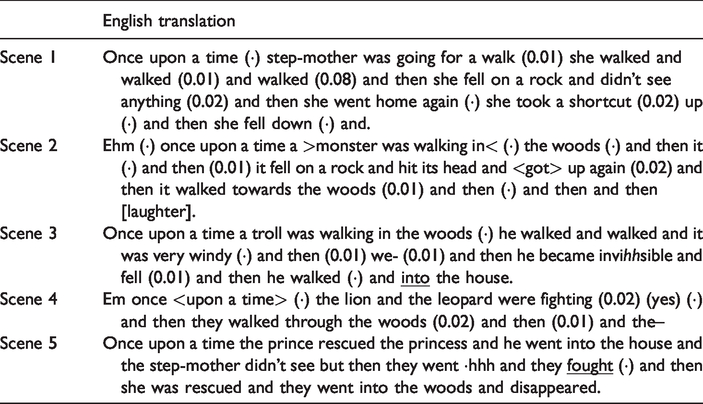
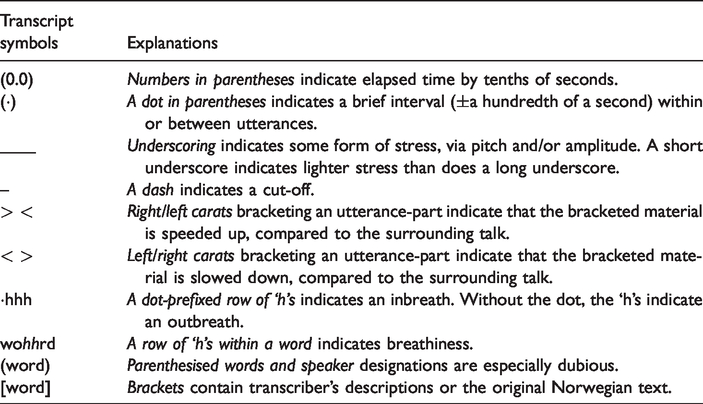
The verbal narrative presented in Table 1 is a transcript and translation of the narrator voice in the final product. The transcription was first done in Norwegian, in the children’s dialect, and then translated into English; it is based on Jefferson’s transcription symbols (2004: 24-31) (Appendix 1).
The narrator voice was performed by two children and was recorded as the children were watching the moving images at the end of the creation process. None of them had recorded their own voice for a voiceover in an animated story before. The verbal narrative presented may be described as a rendition of what the children saw happening in the animated story; the children took the role of impersonal observers who recounted events and commented from a third-person perspective. The verbal narrative consists of several genre-specific wordings or phrases, e.g. “Once upon a time” [Det var en gang] and “Happily ever after” [De levde lykkelig alle sine dager] (Hoel, 2013). One girl started the first scene by saying, “Once upon a time.” In the next scene, a boy expressed that he did not know how to start, and the girl suggested, “You can start by saying ‘Once upon a time’,” and then he did so (Table 1). One could ask if the verbal narrative is five separate narratives, since every scene starts with the opening phrase “Once upon a time”. However, the children were very clear that it was one story. In this specific case, the opening phrase seems to have much in common with “cue phrases”, which, in writing research, are described as genre-signalling words or phrases, a way to highlight the transition from one scene to another (Hoel, 2013). However, we interpret the use of “Once upon a time” as a way for the children to scaffold themselves to enter into narrator mode by drawing on shared knowledge in their local culture (Theobald, 2016).
The children used elements from the fairy tale genre (introduction and repetition), and the verbal narrative in the five scenes has a home-out-home structure (Birkeland et al., 2018): several of the characters presented in the verbal narrative move from the house to the wood and then back into the house. Other than that, there are few similarities with other western narratives (Bruner, 2003; Ninio and Snow, 1996). The story is free from conflict and tensions in the overall plot line; thus, some of the scenes are quite dramatic and humorous.
Based on the transcript of the verbal narrative in the final product (Table 1), one could say that the narrative is fragmented (Nicolopoulou, 2011). The use of the conjunction “and” to combine the different sections of the narrative is a common characteristic of a paratactic narrative style in which time is commonly used to structure the narrative, “and then …” and then…” (Hoel, 2014: 8). It is worth noting that the children did not verbally elaborate the narrative; they just said what was needed to describe what was happening in the moving images. The verbal narrative does not reflect the children’s everyday language competence as it occurs in the video recordings from the process. The children had never made a stop-motion animated story before, and they had never recorded their voices for a voiceover before. They clearly expressed that they were unsure how to do it, which probably influenced the final product.
In summary, the verbal narrative is only one of several modes in this multimodal story.
The multimodal narrative in the final product
Two Running Away starts with a written text presenting the title. “News-inspired” music can be heard in the background; it is quite dramatic, indicating some action. The animated story takes place in the wood next to the house; in the middle of the wood, there is a very small rock. The children made props and characters out of Duplo-blocks and clay. The framing of all of the scenes is composed of long shots, displaying the house, wood, an characters and most of the activity, which mainly takes place outside the house (Fig. 1).
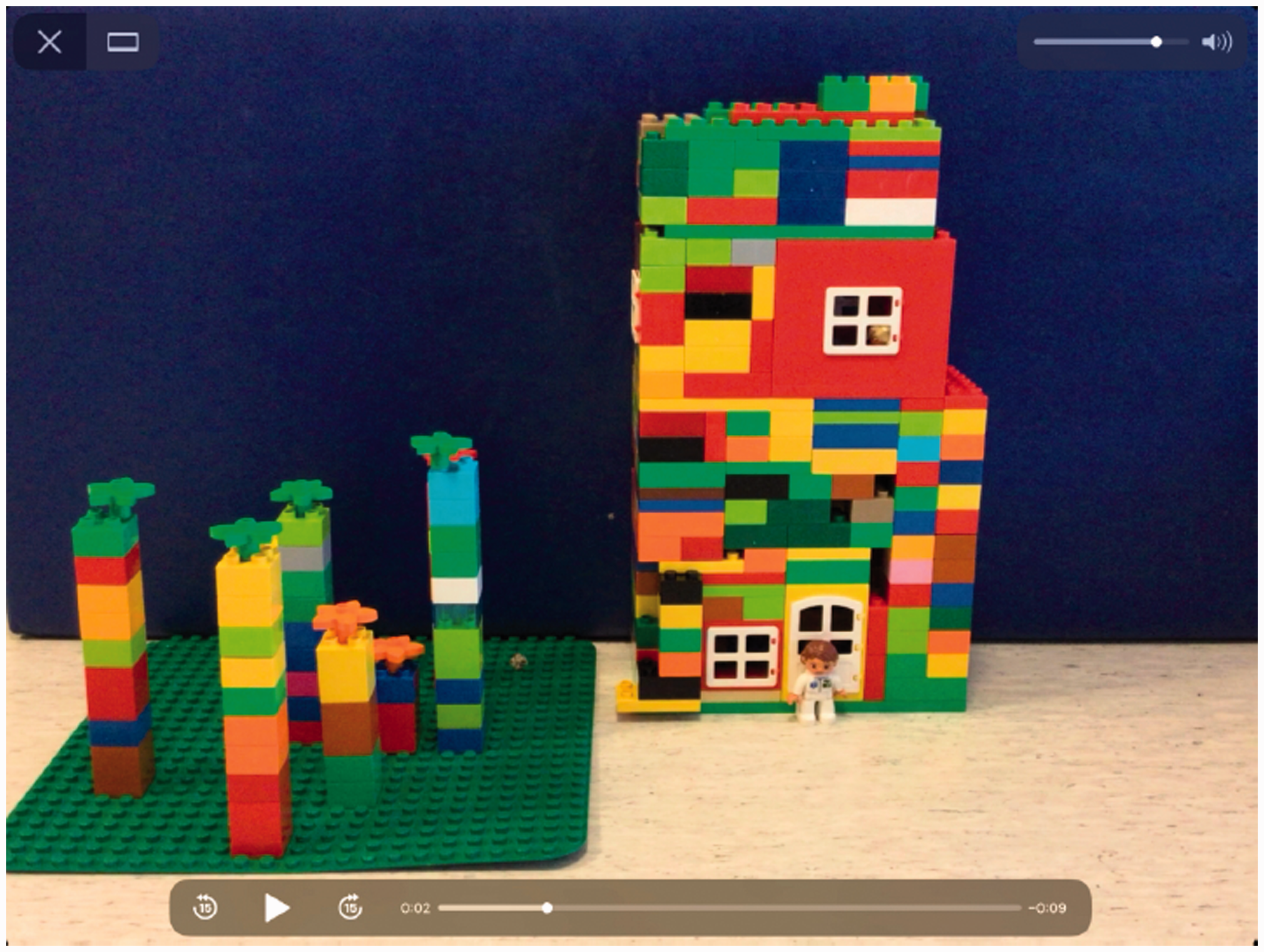
Still picture from the animated story displaying the house, the wood and the very small rock.
The spatial relations between the characters and props can be seen as non-linear and random, and the narrator voice saying “She walked and walked (0.01) and walked” indicates time. The story unfolds through four interrelated modes (Kress, 2010): verbal narrative (narrator voice), moving images, music, = and written text. The combination of these modes in an animated story is described as the kineikonic mode by Burn and Parker (2003).
In all the scenes, attention is drawn towards the active character’s movements (Table 2), which are displayed by the moving images and described by the narrator. There is a salient new character in each scene. In scene 1, the stepmother comes out of the house; in scene 3, the troll walks towards the wood. The narrator describes what we can see in the moving images, but also adds some new information, e.g. “she didn’t see anything” when the step-mother falls onto the rock (Table 2, scene 1). During the animation, the children re-organised the trees several times. When they watched the scenes afterwards, the teacher said, “How cool, we can see the trees moving!” “That’s because it is very windy,” one of the children replied. The child, who had narrated this part of the animated story, included the wind as a prominent element in the story by saying, “It was very windy” (Table 2, scene 3).
Multimodal analysis of the final product, adapted from Burn (2016: 321).
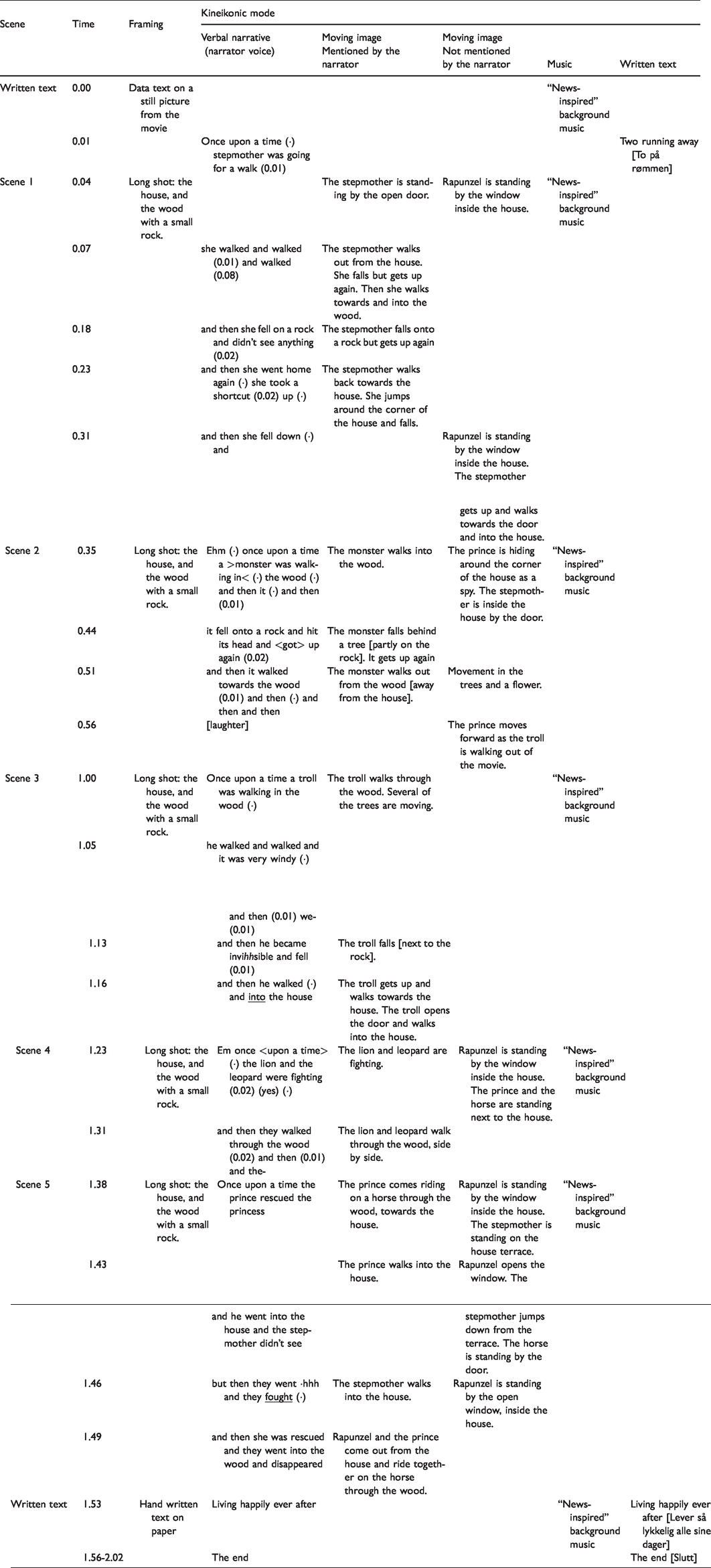
In three of the scenes, there are characters visible in the moving images that are not mentioned by the narrators: Rapunzel in scene 1, the stepmother and the prince/spy in scene 2, and Rapunzel, the prince and a horse in scene 4 (Table 2). Early in the process, when the children and teacher were composing the narrative, the children agreed that the story should be about Rapunzel who was trapped in the house by her stepmother. Since she was trapped, she had to stand by the window all the time, the children explained (Fig. 2). When preparing props for the animation, the children placed Rapunzel behind the window in the house. However, the narrator voice does not mention Rapunzel by name at all in the verbal narrative; thus, the character is mentioned in the last scene only as “the princess”: “Once upon a time the prince rescued the princess.”
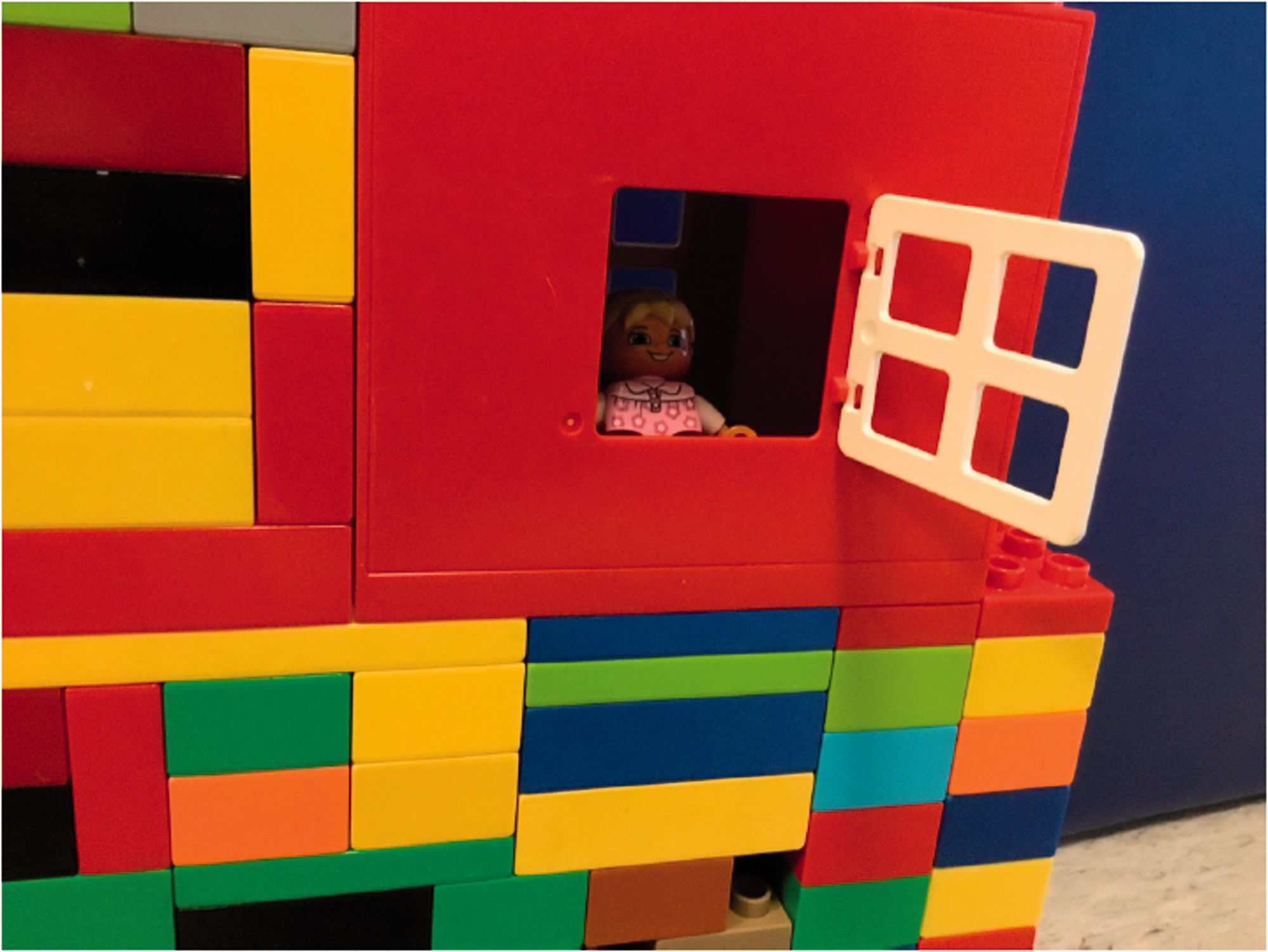
Still picture from the animated story, Rapunzel is standing by the window inside the house.
Another character who is not mentioned in the verbal narrative but is visible in the moving images is the spy; he was added to the story during the process, when the teacher and two children were preparing the setting for scene 2. The children had placed Rapunzel inside the house, and one boy had placed the prince outside, next to the house (Fig. 3). They were discussing whether the prince should be included in the scene or not (Excerpt 2). Still pictures from the animated story; the prince/spy is hiding around the corner in the picture on the left and standing by the corner in the picture on the right.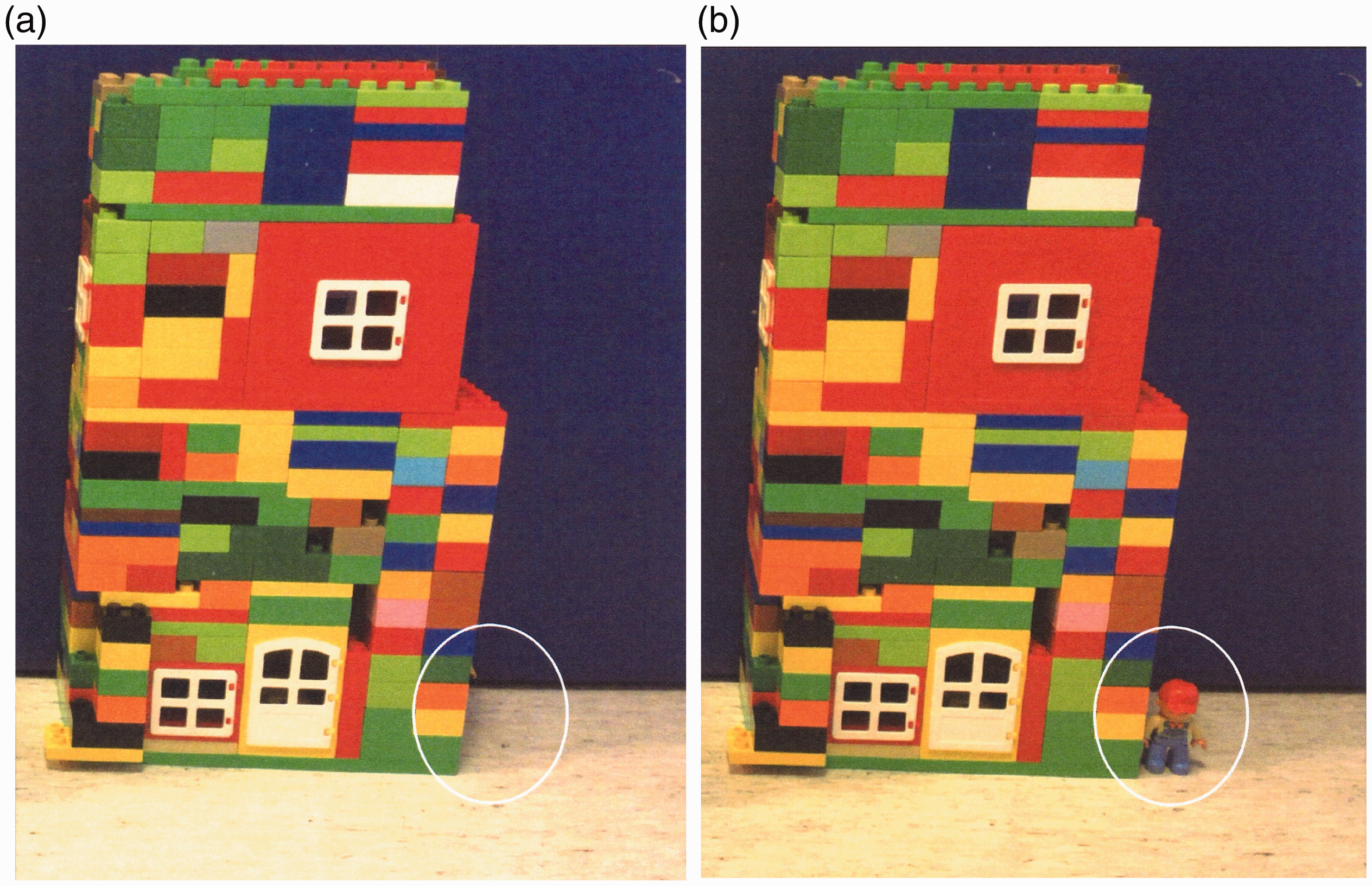
Excerpt 2: The children and teacher are discussing a character in scene 2.
Girl: He is not supposed to stand there! [Moves the character away]
Boy: But he has to be there!
Teacher: Then we must decide. Do you want the prince to be present in the first scene, or not?
Girl: Not!
Boy: No! [To the girl]
Teacher: Why do you not want him to be present? [To the boy]
Girl: That is not how Rapunzel is [referring to the Disney movie]. The prince must come in at the end, after he has been running, like this [she shows with her body how the prince must run].
Teacher: But if you want him to be present [to the boy], then maybe he can hide around the corner, like a spy?
Boy: Ok, just here then [places the prince at the corner of the house, as illustrated in Fig. 3].
Girl: No, that is not how Rapunzel [she stops in the middle of the sentence]. Yes! It is supposed to be funny also! Then Rapunzel doesn’t know.
Teacher: Then nobody knows that he is standing there. That makes it both funny and a little scary, like you wanted, since he is standing there spying.
Girl and Boy: Yes! [Laughing]
The two children agreed to include the prince as a spy in scene 2 (Excerpt 2). As shown in Table 2, the prince/spy is standing by the corner of the house or hiding around the corner as a spy in several of the scenes.
The analysis of the animated story shows that all modalities—verbal narrative (narrator voice), moving images, music and written text—contribute to the story and play important roles in the final product (Table 2). The interplay between different modalities is also highlighted by Letnes (2014). Our analysis shows that the children’ interests and the choices made by them during the creation process strongly influenced the final product, e.g. sound, which was mentioned by the children several times during the creation process: “They don’t talk! We need sound too!” (see Undheim, 2020). This can be seen as being in line with, for example, Kress (2010) and Tønnessen (2012).
The analysis reveals that verbal language has a central function during the creation process, in the shaping of the story (in negotiations, discussions and retellings of what is planned), but is less important in the final product. The analysis of the multimodal narrative in the final product may indicate that moving images are the most important modality for the children, with the verbal narrative complementing those. When recording the voiceover, the children did not verbally elaborate the narrative; they just said what they saw as necessary to complement the moving images, taking the other modalities’ affordances into account (Kress, 2010; Tønnessen, 2012). However, the children watched the moving images as they were recording the narrator voice, and some of the characters moved quite fast, especially in the last scene; this might have given the children fewer opportunities to elaborate the narrative (Table 2, scene 5). Even professional animators find it difficult to create connections between spoken words and visual images when creating moving images (Rowsell, 2013).
Some might say that verbal narrative is weakened in an animated story. However, we see this in relation to one’s own understanding of literacy and narrative. In an animated story, verbal narrative is an important part of the whole—in which all modalities are equally important. This can be understood as being in line with an elaborated understanding of literacy and narrative as “multiliteracy” (Barton, 2007; New London Group, 1996; Sefton-Green et al., 2016). Elements not mentioned verbally in the final story, e.g. the spy and the name of Rapunzel, are visualised through other modalities, which can be seen as an example of “show, don’t tell”. The children clearly see the verbal narrative as part of the whole product, which is an essential aspect of the kineikonic mode (Burn and Parker, 2003; Mills, 2011).
“Show, don’t tell” may be seen as a narrative device used by the children to highlight elements not mentioned verbally; the analysis shows that the children also used other narrative devices.
The narrative devices applied during the process
Scary and funny are two narrative devices that emerged as central elements for the children on the first day, and these narrative devices continued to be important for the children throughout the whole process. On the first day, when the teacher encouraged the children to think about what they wanted to include in the narrative, several of the children mentioned “scary” and “funny”. “A scary story,” one of the girls suggested. “I want to make a funny story,” one of the boys said, while another boy continued, “I will make a monster, a scary.” The following day, the teacher repeated what they had talked about the previous day: “Someone said they wanted the story to be funny. And someone said they wanted the story to be scary.” The teacher explained once more that they were only making one story and asked the children if the story could be “both scary and funny”. After some discussion back and forth between the children, they agreed and confirmed that they wanted to make a story that was both scary and funny. One comment by one of the children managed to combine the different ideas from the children: “Rapunzel is actually quite scary.” Several researchers highlight how children remix and build on previous stories when they create their own stories, often inspired by popular culture (Hoel, 2013, 2016; Rowsell and Harwood, 2015; Sakr et al., 2018). Our analysis emphasises the importance of foregrounding the children’s choices during the creation process, in line with the Norwegian Framework plan (Norwegian Directorate for Education and Training, 2017) and social semiotic multimodal perspectives (Kress, 2010; Kress and Jewitt, 2003).
Later, when the teacher re-focused the children’s attention on whom the story was going to be about, they introduced several new characters, among them the “Booga Booga Monster” and “Scary Troll”. Both the monster and the troll are mentioned in the verbal narrative and are visible in the moving images in the final product, representing the personal interest of the children (Kress, 2010) (Table 2, scenes 2 and 3). However, when watching the animated story, it is not easy to understand that they are scary. Both the monster and troll move quite statically; they were made of mouldable clay by the children, but when the clay dried, the figures were no longer movable (Fig. 4). To underline the scary part, the children chose a “news-inspired” soundtrack as background music for the entire animated story; it was chosen from among several available soundtracks in the application because it indicated action and a scary mood. The music can be seen as having a complementary role to the moving images and verbal narrative (Kress, 2010), emphasising the scary part.
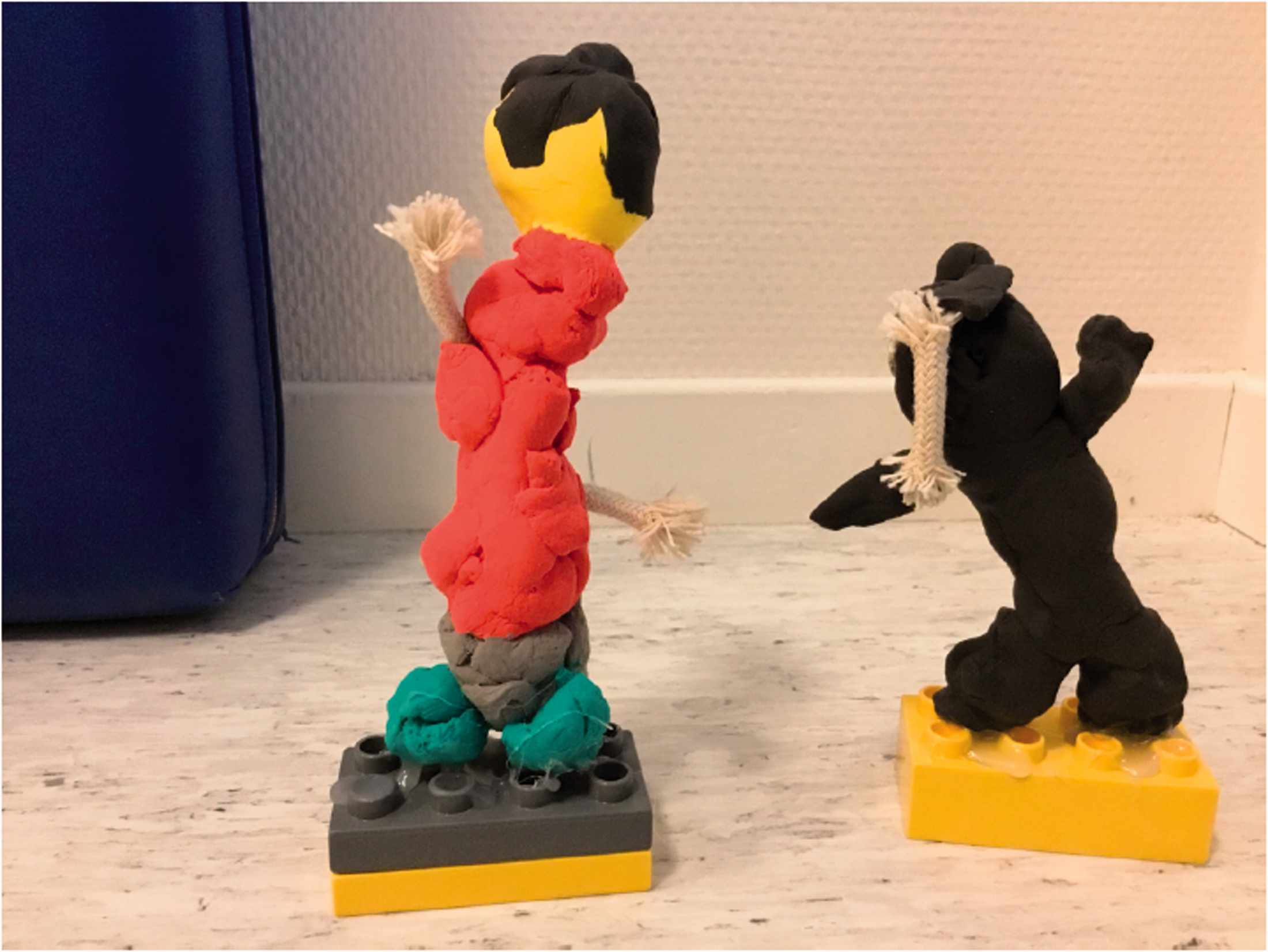
The monster and the troll made by the children.
The children participated with enthusiasm during the creation process: “I want to take the photos”, “I know how to do it”, “I want to be the monster”, “Me too!” and “This is fun!” are examples of comments made by the children during the process.
In scene 4 (Table 2), a lion and leopard are fighting. When the children talked about these characters while composing the narrative, they started to role-play how the lion and leopard would fight. Later, when the children were taking still pictures for the animated scenes, they also started to role-play the fight with the figures and there are no still pictures of this fight. It appears that the children and teacher “forgot” to take pictures of the fight; the few still pictures they took of this scene were mostly located outside the view of the tablet. This is in line with similar findings recorded by Fleer (2017) and Marsh (2006). According to Fleer (2017), it was difficult for children to conceptualise the story line, place objects within the view of the camera and take a series of photographs to make animation sequences. In our study, the time-consuming and elaborated fight between the lion and leopard that was role-played by the children during the creation process does not appear to be an important issue in the final product; however, during the creation process, this was an important issue for the children.
At the end, when the product was finished, the children clearly expressed that they were very proud of the animated story they had created together, as observed by the first author and mentioned by the teacher.
Conclusion
In this paper, we describe and explore the development of an animated story created by six children (aged 4-5 years) and their teacher. The analysis shows how the animated story evolves through this collaborative creation process and how different modalities and narrative devices contribute to the story. Through an in-depth inductive exploration of the creation process and the final product, three analytical strands were identified: (i) verbal narrative in the final product, (ii) multimodal narrative in the final product, and (iii) narrative devices applied by the children during the process.
The animated story consists of five scenes that all start with a narrator voice saying, “Once upon a time” (Table 1). This may indicate that the animated story consists of five separate stories, but the children were very clear that it was one story. Hence, “Once upon a time” may be interpreted as a way for the children to scaffold themselves to go into narrator mode. Based on the transcript of the verbal narrative in the final product, one could say that it is fragmented (Nicolopoulou, 2011). However, when we explore the multimodal narrative in the final product, we see that the children do not verbally elaborate the narrative, they just say what is needed to complement the moving images, by drawing on each modality’s affordances (Kress, 2010; Tønnessen, 2012). The analysis of the animated story shows that all of the modalities contribute to the story (Kress, 2010) and play an important role in the final product: verbal narrative (narrator voice), moving images, music and written text. The combination of these modes is described as the kineikonic mode, in which interrelations between the modes are emphasised (Burn and Parker, 2003) (Table 2).
Some might describe the verbal narrative in this animated story as weak and fragmented, drawing on an understanding of literacy and narrative as “mere literacy” (New London Group, 1996). However, elements not mentioned verbally—for example, the spy and the name of Rapunzel—were in the animated story visualised through other modalities in line with the narrative device of “show, don’t tell”. By drawing on an elaborated understanding of literacy and narrative as “multiliteracy” (Barton, 2007; New London Group, 1996; Sefton-Green et al., 2016) and including the process in the analysis, we see the verbal narrative in the animated story as one important part of the whole, which is in line with the kineikonic mode (Burn and Parker, 2003; Mills, 2011). An animated story is a way to create meaning; the narrator voice can be seen as a way to include the audience in the narrative by highlighting some important elements, e.g. the stepmother hitting her head and the wind moving the trees (Table 2, scenes 1 and 3).
The use of digital technology in ECEC is rapidly growing, with several researchers calling for more research on the youngest children’s creations with digital technologies (e.g. Burnett, 2010; Burnett and Daniels, 2016; Hsin et al., 2014; Marsh, 2010), digital stories (Garvis, 2016) and classroom-based early literacy learning with digital technologies (Flewitt et al., 2015). In this study, we performed an in-depth inductive analysis of the creation process by drawing on observational data from the process, and a multimodal analysis of the final product. Another possible way to explore the development of the animated story could be to analyse it based on time and space (e.g. Burn and Parker, 2003; Mills, 2011).
The children participated with enthusiasm during the creation process. The narrative devices of tension and humour played an important role for the children during the entire process; in this way, the children’s personal interests strongly influenced the final product (Kress, 2010). The findings from this study demonstrate the importance of including and considering the process, the product, the narrative devices and all of the modalities—in particular the kineikonic mode—when creating an animated story with young children, in contrast to most previous research that focuses only on the process. From our perspective, the final product can be understood as a snapshot of the children’s concerns at the end of the process. To provide a full picture, it is important to include both process and product in the analysis, to understand how important elements during the process influenced the final product. Further, the importance of keeping eyes and ears open for magic in young children’s creation processes is emphasised. An implication of these findings is for ECE teachers and researchers to acknowledge and integrate all the various aspects that contribute to the final product when young children create animated stories—the process, the product, narrative devices and all the modalities.
Footnotes
Acknowledgements
A great thank you to the children and the teacher who so willingly welcomed the first author into their kindergarten.
Funding
The authors received no financial support for the research, authorship and/or publication of this article.

Notes
Appendix 1: Glossary of transcript symbols (Jefferson, 2004: 24–31).
| Transcript symbols | Explanations |
|---|---|
| (0.0) | Numbers in parentheses indicate elapsed time by tenths of seconds. |
| (·) | A dot in parentheses indicates a brief interval (±a hundredth of a second) within or between utterances. |
| ____ | Underscoring indicates some form of stress, via pitch and/or amplitude. A short underscore indicates lighter stress than does a long underscore. |
| – | A dash indicates a cut-off. |
| > < | Right/left carats bracketing an utterance-part indicate that the bracketed material is speeded up, compared to the surrounding talk. |
| < > | Left/right carats bracketing an utterance-part indicate that the bracketed material is slowed down, compared to the surrounding talk. |
| ·hhh | A dot-prefixed row of ‘h’s indicates an inbreath. Without the dot, the ‘h’s indicate an outbreath. |
| wohhrd | A row of ‘h’s within a word indicates breathiness. |
| (word) | Parenthesised words and speaker designations are especially dubious. |
| [word] | Brackets contain transcriber’s descriptions or the original Norwegian text. |