




Abstract
The importance of supporting children’s reading engagement and reading comprehension from the early years is widely acknowledged, particular for children growing up in areas characterized by socioeconomic challenges. This mission is collectively shared by teachers and librarians, although with differing starting points and responsibilities. This paper draws on a Swedish study of librarians’ book talks with eight-year-old students in Grade 2 and their teachers, and the views these participants express on reading and children’s literature. The methods used were observation and interview. In the analysis, different views appear regarding what reading is and might mean, such as the role that children’s literature plays in this. The results indicate two prominent narratives regarding reading, where one has a clear emphasis on being able to read and where the other stresses the pleasure of reading. Both these discourses display a narrowness regarding genres other than fiction literature, languages other than Swedish, and formats other than printed books. Further, an image of the reading child as an individual reader appears in both discourses. The results highlight the need for a broader approach that integrates functional reading with processes of reflection and active language use, drawing on the content in children’s literature, with an awareness of multilingual considerations. It is argued that children’s literature plays an important role in children developing a view of themselves as readers, and discovering that there are many ways to be a reader.
Introduction
Many Swedish children enjoy listening to books being read to them by their parents or other family members; they read printed books and/or listen to audio books as well as borrowing books from the local library in their spare time. In this way, they become socialized in using and making meaning from children’s literature, 1 in terms of developing positive experiences, attitudes and habits regarding reading. However, many children do not. Evaluations of Swedish children’s reading and media habits reveal that an increasing number of children read printed books and/or listen to books to a lesser degree than in the past, or not at all (Nordicom, 2016; SOU, 2012; Swedish Media Council, 2017a, 2017b, 2019; Swedish National Agency for Education, 2017, 2019). Evaluations carried out by the Swedish Media Council show that for the last two decades, a majority of children in Sweden are active on the Internet and that this occupation takes up a large amount of their free time (Swedish Media Council, 2017a, 2017b, 2019). Children’s books are therefore increasingly coming into competition with other media. This raises the question of how to integrate and make use of children’s literature within classrooms that are part of societies characterized by intense media density. In the latest PISA evaluation, 38–39% of 15-year-old students from Sweden, Finland and Norway state that reading is a waste of time (Swedish National Agency for Education, 2019). Since it takes time to create positive habits regarding fictional and non-fictional literature, children and young people are dependent on contexts where they are motivated to experience literature together with others in various ways and, over time, on their own.
It is evidently of great importance to support children’s reading comprehension and reading habits from the early years, not least among children growing up within socioeconomically disadvantaged areas (SOU, 2012; Swedish National Agency for Education, 2017). Further, unfavourable socioeconomic conditions in certain areas, such as higher unemployment and lower educational levels (Aldén and Hammarstedt, 2016), can lead to children facing narrower access to literature and/or media technology (Fransson et al., 2018; Swedish Media Council, 2017b). Children growing up in so-called underprivileged areas do not have a lower cognitive ability than other children, but they might have different experiences of the multiple possibilities of literacy in general and reading of children’s literature more specifically (Heath, 1983; Nutbrown et al., 2017). There are, of course, exceptions and variations in all areas regarding parents’ educational backgrounds, including literacy experiences in general and reading habits more specifically within families. However, all these conditions exist within a society that at the same time places high expectations on children’s reading, articulated through national curricula and an increasingly standardized education (e.g. Wahlström and Sundberg, 2018).
Traditionally, public libraries in Sweden have been charged with the task of promoting reading among children, which was reinforced by an action programme by the Swedish Arts Council in 2014. Public libraries direct efforts towards children, their families and other adults in their surroundings, in the form of storytelling, book circles, book talks and so on. In this work, preschools and primary schools, as well as child welfare centres, are important partners for cooperation (Schmidt, 2015). In addition, and according to Swedish School Law (2010), students from primary to upper secondary school should have access to a school library, although this is not always the case. Together with schools and their school libraries, public libraries have what could be described as a shared mission regarding the promotion of reading. Even if this task regarding reading differs between public libraries and compulsory school, points of contact do emerge regarding how children in a certain municipality, district or town can be supported to develop positive experiences and attitudes towards children’s literature and shared and/or individual reading of this literature. The focus of this paper is book talks, which are one of the most common activities for promoting reading that public libraries direct towards children (KB, 2016). The paper draws on a study in which six book talks in three libraries aimed at children in Grade 2 were observed and where interviews with the participating teachers, librarians and children were carried out. The aim is to study the contexts that book talks are part of, the views of children’s literature and reading that emerge among participating librarians, children and teachers, and the discourses that these views create.
Reading/literacy practices
Children’s experiences of reading can involve the most diverse experiences of literature, culture and popular culture, based on various media and drawing on different languages for various purposes, and within a wide range of contexts (Barton, 1994; Fast, 2007; Heath, 1983). Literacy practices are hence not only social and cultural but also part of existing power structures (Street, 1993). Luke (1991) accentuates that reading is discursively constituted cultural knowledge that is produced, carried out and talked about in specific ways. Barton (1994) stresses that the use of texts in various contexts can mean possibilities as well as limitations for different individuals, explained by Street (1993) as being the case because literacy practices are not only social and cultural but also part of existing power structures. Research on children’s reading suggests that using several approaches to literacy is crucial, and further that these approaches need to interact with each other and be incorporated into various practices, as outlined in the following.
Conditions/prerequisites for reading
When learning to read in sound-based languages, a necessary starting point is to automatize the connection between phoneme and grapheme (e.g. Cain and Oakhill, 2007; Elbro, 2004). Since children have different language backgrounds, this might mean that they are capable of exploring sounds and letters at different levels, in different ways and drawing on different languages. Automatized reading does not per se result in a reader being able to comprehend what is being read. In order to understand the content and draw conclusions from it, a reader needs to reflect on this content. For this, any reader, naturally, benefits from having a rich vocabulary. A crucial and well-known condition for successful literacy learning concerns what language a child is offered the opportunity to learn to read in (Cummins, 2001; Laursen, 2011). If it is in their first language, where the sounds and the meaning of words are familiar, the likelihood of success is greater than if it is not (Cummins, 2001).
Children are to a great extent dependent on interactive dialogues with peers and adults around the content of texts in order to achieve comprehension. Accordingly, many researchers stress the importance of shared and dialogic reading (Damber, 2015; Guo et al., 2012; Yopp and Yopp, 2006). Drawing on Langer (2011), such reading can mean that children with the guidance of, for example, a librarian, a teacher or a parent, can move within a story. Inferences can be made regarding what is not made explicit but emerges through the plot or in some other way. Children can envision and compare each other’s thoughts or reflect on characters’ possible choices (ibid.). For this to happen, children’s encounters with others’ interpretations are essential. Drawing on Gadamer (1975), Simon and Campano (2015) suggest that interpretative reading of literature opens the way for various interpretations, as well as negotiations around these. Here the notion of ‘fusing horizons’ is crucial. The concept of horizon involves, according to Gadamer (1975), “the range of vision that includes everything that can be seen from a particular vantage point” (p. 301). To have a horizon also means “not being limited to what is nearby but to be able to see beyond it” (Gadamer, 1975: 301). In order to reach new horizons of comprehension, Gadamer emphasizes play [Spiel], which becomes a metaphor for the process in which a reader’s interpretations so far are at play. When children listen, watch, browse through books or swipe with their fingers on screens, they often become engaged in personal ways regarding what they, with all their senses, experience as important in that very moment of space. Kress (1997) shows that younger children explore signs and texts in similar ways to when they play. When children experience texts, their immediate perceptual experience creates, in my interpretation of Gadamer, a space ‘in-between’, which makes it possible to approach and step into a text and encounter its content more deeply.
Strategies for reading comprehension can, in line with Palinscar Sullivan and Brown (1984), be integrated and introduced in terms of questioning, clarifying, summarizing and predicting. Such strategies can be presented and practised from deductive or inductive approaches. Deductive approaches refer here to when one or several strategies for reading comprehension are introduced and modelled by the teacher and then practised. Inductive approaches refer here to explorative processes, such as, for example, when children discover the content of a picture book and spontaneously ask questions and reflect on the content. In such explorative processes, children might use one or several strategies for reading comprehension, but without being aware of the strategies themselves.
Another aspect of reading practice aimed at children is critical approaches. Children are dependent on support in order to critically review texts, and to raise their own questions about the content (Dyson, 1997; Vasquez, 2004). When conclusions are drawn from factual content in books, films and websites, these conclusions need to be compared and scrutinized in order to reach adequate and reasonable understandings of the information. With the aim of critical awareness, Vasquez (2004) stresses the importance of encouraging children to compare, question and think about the content of texts. Vasquez emphasizes the importance of making various claims visible in texts, and for children to have the opportunity to compare and reason about these. When children are urged to think about what they would want to change, or what they would want for a certain character, their critical awareness can at the same time be strengthened (Janks, 2010; Leland et al., 2005). Critical approaches also include examining in what ways a character is being represented, as well as finding out who or what is behind a text and for what reason the text was produced (Janks, 2010).
In this section, various aspects of reading have been highlighted, which are essential, separately and together. I suggest that these approaches be categorized as follows: functional reading, which involves automatized decoding, with the possibility of reaching an understanding of what is literally being said in the text; reading as immediate and perceptual experiencing, which involves the personal engagement that reading can create; and, finally, reflective and critical reading, which means that the content is understood and reflected on as well as critically reviewed. These aspects draw on two main opposing theoretical starting points regarding conditions for children’s literacy learning: individualistic and psychological perspectives on the one hand and social orientations on the other (Cummins, 2015: 231–232). I believe that these two perspectives are dependent on each other and that it is possible to combine them and incorporate both of them into various reading practices.
Discourses of children’s reading
Discourses are created within social contexts and form, according to Foucault (1993), prevailing notions, i.e. certain fixed ways of talking about and understanding the world. These discourses influence and decide on for what is socially and culturally accepted and thereby what is seen as worth striving for. Discourses might have enabling as well as restrictive consequences for different individuals (Foucault, 1993). Further, discourses are dependent on economic and political interests, as well as national and international policy regarding children’s reading. The latter creates conditions relating to and depending on existing power structures within society, linking local reading practices with institutional, national and global discourses of ‘desirable’ practices around children’s reading and ‘successful’ literacy education (Luke, 2004). Existing power structures within various reading practices can, drawing on Foucault’s (1993) discourse theory, result in possibilities for certain children while creating obstacles for others (Heller, 2008; Janks, 2010; Laursen, 2011).
Childhood is a pluralistic concept intertwined with gender, socioeconomic conditions, ethnicity and age (e.g. Corsaro, 2018). When children, through social interaction, become involved in discursive practices around reading, this also creates conditions for their identity making, which is shaped by their various positions in relation to their different prerequisites and childhood circumstances, together with their personal habits and experiences of reading (Laursen and Fabrin, 2013; Schmidt, 2018).
Depending on what kind of reading practices are defined as proper and desirable within various settings of society, norms are constructed that create discourses around reading (Foucault, 1993). Discourses on children’s reading involve views on what kinds of reading activities are seen as essential for children to be part of when reading and when learning to read, and also what kind of texts, drawing on various media and genres, they are given access to. The concept of discourses will here be understood as specific ways of talking about and understanding the world (Foucault, 1993) that have significance for social interaction around various phenomena in society, such as, in this case, the phenomenon of reading. Accordingly, discourses determine the boundaries for what is socially and culturally accepted as ‘true’, ‘trustworthy’, ‘sensible’, ‘good’ and so on. Luke (1991) refers to reading as “an historic and culture-specific competence which has been regulated institutionally in accordance with particular economic and political interests” (p. 6), and points out that reading is done and produced via the economic and cultural domain of schooling in selected ways. When discourses around reading are created, they are therefore created because of certain economic and political interests of private actors as well as policy actors like the OECD (e.g. Wahlström and Sundberg, 2018). In this way, children’s experiences within various reading practices are linked with institutional, national and global discourses of successful literacy practices during childhood (Luke, 2004).
Context of study
The study was conducted in 2015-16 in three public libraries and three primary schools in the south of Sweden. Two of the libraries were integrated with the school libraries at two of the schools involved. All the participating librarians and teachers were female. For each library, two book talks with eight-year-old children in Grade 2 were studied. After each book talk, it was possible for the children to borrow books to take home or into their classroom. Group interviews with the librarians and the teachers as well as with the children were conducted in each school. Approximately one third of the participating children in each of the book talks spoke a language other than Swedish at home. One library was situated near a midsized town, one within a smaller town and the third within a smaller community. None of the libraries or schools were situated within what could be described as socioeconomically unfavourable areas.
Aim
The aim of the study is first to investigate the context in which the three book talks are situated, and what opinions and views around reading and the book talks, as well as around children’s literature, appear among the participating librarians, teachers and children. Second, the aim is to analyse the discourses around reading that are created through the participants’ talk. The research questions are: What is the purpose and nature of book talks? What appears as desirable regarding children’s reading and children’s literature and what is not made visible? What theoretical perspectives on children’s reading emerge through the participants’ talk? What kind of a reader is produced through the participants’ talk and what role does children’s literature play in this reading profile?
Finally, my aim is also to discuss the results with regard to the possible power relations that are made visible and which, drawing on Foucault’s (1993) discourse theory, might result in opportunities for some children and constitute obstacles for others (Heller, 2008; Janks, 2010; Laursen, 2011).
Methodology
The study draws on ethnographic reflexive approaches in which I as a researcher observe and describe actions in relation to the study’s aim and theoretical standpoints (Hammersley and Atkinson, 1989). I view every group interview as a relational conversation where, as a researcher, I am trying to understand the people I talk with. These group interviews are, however, not equivalent to everyday conversations, as they have a specific structure, as well as entailing scientific and ethical demands (Kvale and Brinkmann, 2009). A semi-structured interview guide was followed in the interviews. At the same time, my ambition was to listen carefully and follow the conversation, and to ask follow-up questions or, if necessary, to bring the conversation back to the aim of the study (ibid.). Carrying out group interviews often results in a broader scale of thoughts and ideas compared with individual interviews, which motivated my choice regarding this (Xerri, 2018). With regard to ethical considerations, the recommendations of the Swedish Research Council (2011) have been followed in this study. All participating children and their parents, as well as the participating teachers and librarians, were informed of the conditions of the study and gave their written consent for participation and research publications.
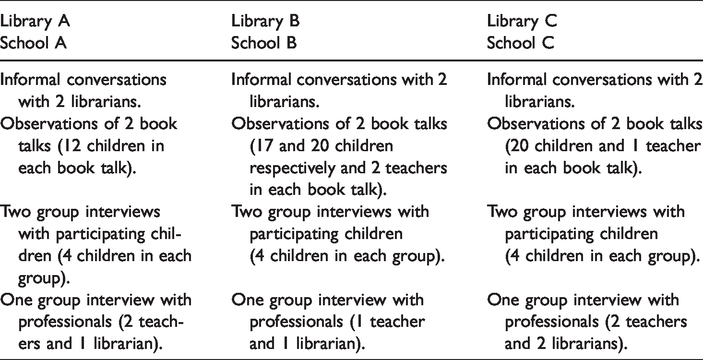
Through a letter sent out by the regional authority (Region Skåne) in which the aim and the methods of the project were described, contact was established with three libraries that carried out book talks on a regular basis with children in Grade 2 and their teachers. Initially, informal conversations with the librarians were carried out during which field notes were taken. After this, as illustrated in Table 1 below, two book talks in each library were observed. During these observations, I was positioned at the back or at the side of the group of children and here field notes were also taken. In conjunction with the observations, two group interviews, in which four children per group participated, were conducted. In these interviews, questions were asked about the children’s experiences of and thoughts about the book talk, their ideas about what characterizes a good book, their reasons for reading as well as their experiences of conversations and/or other activities drawing on children’s literature. In the next step, one group interview was carried out with the participating librarians and teachers. Here the teachers were asked questions about their experiences of book talks as well as their ideas on supporting children’s reading and the role which children’s literature plays in this. In total, 32 children and 9 adults were interviewed.
The study.
Analysis
The empirical material consists of field notes from informal conversations with the three participating librarians, field notes from observations of six book talks, together with transcripts from six group interviews with the participating children and three group interviews with the participating teachers and librarians. The field notes and transcripts make up a text which has been analysed with the aim of studying the contexts that each book talk is part of, the talk about this activity, as well about reading and children’s literature, that emerges in the interviews, and the discourses this talk creates. In the first step, the analysis will focus on what appears desirable and what may not be talked about. After this, I will investigate what kinds of theoretical underpinnings emerge through the participants’ talk, drawing on the perspectives presented earlier on functional reading, reading as immediate and perceptual experiencing, and reflective and critical reading. Last, I will look into what kind of a reader is produced through the participants’ talk and what role children’s literature plays in this.
Results
To begin with, the results shed light on what the participating librarians see as being the purpose of book talks for children in general, as well as on what is happening during each observed book talk. Next, the teachers’ and the librarians’ views on and experiences of promoting and supporting children’s reading, as well as their talk about children’s literature are presented, followed by the children’s views and experiences of reading and children’s literature. Lastly, discourses that are created and made visible through the participants’ talk are presented.
The purpose and nature of book talks
A book talk, according to the librarians, is about trying to paint a picture of the book, which can be done by telling the children about the content, retelling some parts of the plot, emphasizing the basic problem of the story or by describing a character. The librarians stress collectively that they want to foster “reading pleasure” with the purpose of supporting children’s reading. One of them says that “the children should think it is fun” and adds: “There are so many stories waiting to be read”. When it comes to the selection of books, all of them stress the importance of breadth regarding both content and level of difficulty. Also, all of them emphasize the importance of supporting individual children in choosing a book to borrow and read. Through the librarians’ talk, reading for pleasure appears as being both the aim and the solution for children to become readers in their own individual way. The expressed view about ‘reading for fun’ relates partly to the theoretical perspective presented earlier on literacy and reading as immediate and perceptual experiencing. The desirable reader that appears is the individual child who reads children’s literature for fun, drawing on a wide range of books.
The book talks
Each book talks last about half an hour. In the first two observations, 12 children participate in each book talk, in which a total of five fiction books are presented. No teachers participate in these two book talks. The librarian begins by presenting the book Samuel’s remarkable calendar [Samuels sällsamma kalender] (Karlsson, 2013). Initially, the children are captivated by the story about a magical advent calendar, where the main character, Samuel, walks into one of the “windows” and disappears, but when the children are encouraged to share what they think will happen, some of them start playing with some cushions instead. The remaining part of the book talk is characterized by the same pattern. When the librarian starts to talk about Rolf, who lives in Paris and wants to be with Ofelia in the book A thousand hints for a coward [Tusen tips för en fegis], she first has to prevent a conflict between two of the children (Susson, 2013). When the book talk is repeated with the second group of children, this half hour is again characterized by the same kind of restlessness among some of the children. When the librarian reads aloud from the last-mentioned book, a section where Rolf’s dad claims that “courage cannot be ordered or bought”, several of the children listen for a while. In conjunction with this, one of the children asks: “But is he really a coward then?” This question is drowned out by the buzz of the other children’s voices and soon after the book talk ends.
In the two following observations, 17 children participate in one book talk and 20 in the other, along with their teachers. Five factual books are presented to the first group. The first one is the book Faqirs [Fakirer] (Engholm, 2013). “This is the only book that has been written in Swedish about faqirs, and it is for children,” says the librarian, holding up the book at the same time as she continues to tell the children about the content in this and other books by the same author. “He only writes books about things that are uncomfortable and a bit scary,” the librarian concludes, and turns to the next book Important maps for adventurers and dreamers [Viktiga kartor för äventyrare och dagdrömmare] (Sheppard, 2013). The librarian talks about magma and continental plates and asks, “Have you done much travelling?” Several children relate their experiences of travelling, the participants in the room listen to each other and one child is encouraged to talk by her teacher. When everybody has finished, the librarian presents a riddle book and the children are encouraged to guess the answers to two riddles. In the next book talk, five fiction books are presented, described as story books, that is, “stories which have not really happened, but could have really happened”. The first book is The dragon ship [Drakskeppet] (Bylock, 2016). “This is a scary book,” the librarian says and starts to talk about the main character, Petit, and other people in her village. “Do you know what a castle looks like?” the librarian asks and starts to draw with her hand on the carpet in front of her, explaining. Afterwards, the librarian reads a section aloud in which Petit gets taken away by the Vikings. One of the children cries out, “This is a scary book,” and the librarian confirms “It is a scary book,” at which point another child says, “I want to borrow this book.” Three more books are presented and then the librarian talks about the book Run! Fanny, run! [Spring! Fanny, spring!] (Reynolds, 2012). The characters and basic plot of the book are presented, after which the book talk ends.
Twenty children and their teachers participate in each of the last two observations. In total, 20 books on topics like pets, friendship and sport, as well as “exciting” [spännande] books, are presented by the librarian as her favourite books. The librarian reminds the children that it is possible to borrow the books from their school library. “Do you like riddles?” she asks next, then reads out some riddles which the children can guess the answers to. Then The rabbit catastrophe [Kaninkatastrofen] is presented and the children are asked the question, “What do you think will happen?” (Angerborn, 2010). Several of the children raise their hands and share their thoughts. “Do you like pets?” the librarian asks next and books on this topic are presented, followed by exciting books. The librarian reads aloud from The boy in the graveyard [Pojken på kyrkogården], in which a girl meets a boy who is a zombie (Lindholm, 2015). Eventually, sports books are presented, and then it is time for the children to come forward and choose one book to borrow. “Wait a little, you cannot just rush forward and start fighting about the books,” says the teacher, and reminds the children that they have to return the books after the winter sports holiday. When the next class arrives, their teacher says: “Oh, this is so cosy,” and takes a photo, after which the librarian continues: “Now I will give you tips about my favourite books,” which is done in the same way as before.
In the first two book talks, no teachers accompany the children. In the subsequent book talks, librarians and teachers are in the same room and its situated practice, which might send out signals to the children that this event is part of their school practice, and therefore significant. When the teachers accompany the children, the participating teachers contribute in various ways to a positive atmosphere in three of the book talks, i.e. they are supporting the children to take part and/or comment in positive ways that this event is a good thing.
In all the book talks, various authors of children’s literature are mentioned and front pages of various books are displayed to the children. Also, the contents of these books are talked about, either briefly or in a more in-depth way, focusing, for example, on a certain character or dilemma. The genre of fiction dominates. Factual books are presented to a lesser degree. Children’s literature in languages other than Swedish is not shown or mentioned, or versions of these books as e-books or audiobooks. When the various books are presented, it is done with the goal of each participant child finding a book to borrow and read individually. The various books are therefore not presented in ways that signal that the reading of one of these could be done together in dialogic ways, for example later on in the children’s classrooms. Again, the view of ‘reading for pleasure’ seems to be the underlying epistemological view, relating partly to reading as immediate and perceptual. The desirable reader that appears is again the individual child who reads children’s literature for fun, drawing on a wide range of books in the genre of fiction through the medium of printed books and in Swedish.
Children’s literature in relation to children’s reading development: Professionals’ perspectives
All the participating teachers are positive towards book talks as a way of promoting/supporting children’s reading. One of the teachers says that it makes her happy when she sees how the children “get hooked by the book talk”. Another teacher says that book talks result in children borrowing more books from the school library. The teachers would like more of their students to go to the library in their spare time. At the same time, the teachers collectively stress the need for supporting the students in their decoding. “During Grade 1, the aim is to teach the children to read,” one of the teachers says, and continues: “Half of the children could read when they began and the rest, well they could not read at all.” Another teacher says: “Well, here we plod on all the time,” and goes on: “For some children, it never becomes fun.” This teacher reflects that presenting children’s books at different levels might mean that every child can have access to a book to read that they like and that is at an appropriate level.
The librarians stress collectively what they refer to as “reading for pleasure” [läslust]. One of the librarians expresses that “in my profession we do not focus so much on the pure technical reading” and states: “We work with the pleasure.” Through this statement, a clear distinction appears in relation to the teachers, who all emphasize the crucial need for automatized decoding and their task of supporting their students in this. Another distinction that appears between the participating teachers and librarians concerns approaches to the question of what kind of books are appropriate for children to read. All teachers highlight the need for children to practise reading a “book of the right level of difficulty” and stress the importance of having access to easy-to-read books in Grade 1. One teacher says that “certain children are more attracted to factual books”, but says at the same time that she finds it “demanding to find the right level for practising when it comes to factual texts”. Another teacher states: “I really want to encourage children to read more demanding books, but in the reading-practice situation, it becomes important that you can handle it, that is, what you are supposed to be practising right then.” All the teachers agree that they steer the children’s choices of books to a greater degree compared with the librarians. “We know what they can handle,” says one of them. The same teacher states that children “could easily borrow a more difficult book that an adult or a sibling can read for them”. However, books that children borrow to read individually in school “must be a book at their level”.
One of the librarians says that a book talk, and the time afterwards when each child chooses a book to borrow, might become what she describes as “an effort”. The same librarian mentions that she would like to prevent someone from starting to look at themselves as someone who doesn’t read, which, according to her, “might easily become an identity that follows a person”. The librarian continues her line of thought and says: Maybe you will read different books than your friend. Maybe you must walk another path than your friend to achieve reading, and might be that you perhaps listen to books instead, or perhaps only read factual books.
None of the teachers reflected on the possibility of using the books that were presented and talked about in the book talks in their own teaching. After a while, one of the teachers says: “I believe almost every knowledge requirement can be connected to a book if you want to start a big theme, but it is, unfortunately, the time.” Another teacher adds: “It would be possible to develop this further.” Yet another of the teachers reflects that the content of various books could inspire the students in their writing, but does not specify how.
All the librarians say that they do not know what happens after a book talk. One of them says that, “When someone comes in on the next Saturday, then that really makes you happy!” Another one of them expresses the same issue in the following way: Well, like now, I will meet these children twice a semester, perhaps. If I am lucky. If you succeed in booking some classes, and then they might come back to the library, then you do not know what happened at all, what the effect was.
Drawing on the teacher’s talk, they stress that children’s practising of decoding and the ability to read with fluency are desirable. Decoding is, drawing on the teachers’ talk, equivalent to ‘reading’, but is not necessarily ‘fun’. It is worth noticing that not much talk appears regarding how to establish classroom practices in which children can take part in interactive dialogues with peers and adults, and with the goal of supporting both reading engagement and reflective/critical reading. The participant librarians state, on the other hand, that they do not know what will happen with the books, in what ways they will be read, discussed or perhaps drawn upon in classroom practice.
Hence a divide emerges between the participating librarians, who collectively stress the pleasure of reading, and the participating teachers, who collectively stress the ability to decode and read with fluency. When analysing the professional teachers’ and librarians’ talk, a view of the child as an individual reader emerges once again. To support and encourage children to visit libraries appears as a solution for children to develop positive habits and attitudes regarding their own reading.
The meaning of reading: Children’s perspectives
A majority of the children appreciate taking part in the book talks and borrowing books afterwards. One child says that “otherwise you maybe would not have known that these books existed” and another child says: “I think I will start to read a lot now”. Several of the children say that they would like to visit the library again. A majority of the children have a book in their hand when returning to the classroom. “I borrowed that book about a boy, a faqir,” says one boy. When questions are asked about why it might be good to read, one girl answers that “you need to read in order to do everything, kind of”. One boy exclaims: “Imagine you get a letter telling you that you are going to win 2000 Swedish Crowns, and you cannot read!” Another child says that one has to be able to read in order to “understand more words and to be able to choose a job”. The children express that they are aware that one can read at different levels. Some of them observe that they read books marked with various numbers of stars in school, and that those with fewer stars are “really easy”. One girl mentions the national tests, 2 explaining that “then you must be able to read a text in a certain amount of time, write about it and then you must understand it, otherwise you get lower grades”. Another girl relates that she finds it difficult to read and that she gets support on this in her school. Other children explain that when they do not understand what they read, then it is not fun to read. “Then you do not know what it is about,” one boy explains, and a girl says: “Then it is like reading in another language.” Only two of the children, both girls, give examples of reading children’s books that have been significant for them, a question that is asked in all interviews. A majority of the children explain that they like exciting books and many mention specific areas of interest. One boy says that he “always heads directly for the shelf with sports books”. Few of the children describe, despite direct questions on the topic, experiences from their classrooms in which the content of books is worked with, drawing on shared or individual reading experiences. Some children say that they have written reviews on books, but that they do not do that anymore. The same children mention question cards which they sometimes use for peer conversations about their individual reading, and the same children talk about having experiences from a classroom project on Swedish authors of children’s books. Regarding individual reading in school, one child says: “We kind of just read them and that can take some time.” All the children state that they have reading for homework on a regular basis, and a majority use some kind of reader for this.
Drawing on the participating children’s talk, they appear to appreciate the book talks and the library visits. In line with their teacher, they stress the ability to read with fluency. Also, the children seem to be fully aware that one can read at different levels as well as of their own ability in comparison with peers. Interactive and dialogic classroom practices around books emerge to a lesser degree in the children’s talk, despite direct questions regarding this. The reading child that emerges is the individual reader who is able to read in a functional way. However, the children’s direct and positive reactions regarding the presented books are strong.
Created discourses
The results of this study make two dominant discourses of reading visible, where one has a strong focus on being able to read in terms of automatized decoding and the other highlights reading for pleasure. In both these discourses, a narrowness emerges regarding genres other than children’s fiction literature, as well as languages other than Swedish and also media other than printed books. Further, an image of the reading child as an individual reader appears in both discourses.
The librarians express that they want to motivate children to read and they often use the concept of reading for pleasure. In the discourse created by the librarians’ talk, it is seen as essential that children get support to borrow books that they want to read and also that they find reading enjoyable. In relation to the previously presented aspects of reading, this discourse is close to reading as an immediate and perceptual experience. This discourse that appears through the librarians’ talk concerns mainly “fun” or “scary” reading experiences. However, there are no statements concerning children’s and teacher’s shared and dialogic classroom reading, nor regarding reflective and critical reading or functional reading. Based on the librarians’ talk, a discourse is hence created that values children’s individual reading experiences with a focus on fictional books in Swedish and with pleasure/enjoyment as a goal. The librarians who participate in the study do not seem to have very high expectations regarding what will happen back in the classroom; instead, they seem to focus on the children’s individual reading experiences.
The teachers stress that they want to support their students in developing automatized decoding with the purpose of reading with better and better fluency. The standpoints that create this discourse are close to what characterizes functional reading. In the teachers’ talk about children’s reading, there are no statements regarding reading as an immediate and perceptual experience, nor regarding reflective and critical reading. In the discourse that is established through the teachers’ talk, a desire emerges that the children will read the presented books on their own in the classroom or, alternatively, at home. Some possibilities appear for a more conscious and creative use of children’s literature in classroom teaching and learning when one of the teacher’s states: “It would be possible to develop this further,” and when another teacher comments that the content of books could inspire students’ writing. The participating teachers do not exclude the possibility of including and using children’s literature as content and context for classroom teaching and learning, but it is made clear that this is something that they usually do not prioritize. The project about Swedish authors, which some of the participating children talk about in the interviews, seems to make for an exception here.
The talk of the participating children establishes a similar discourse to what appears through their teachers’ talk. One of the children says, regarding the books that are being read individually in the classroom: “We kind of just read them and that can take some time.” Among the children, a seriousness appears regarding the significance of being able to really read, which relates to the teachers’ statements on practising reading with the goal of reading with fluency. Very few statements from the children relate to engagement, feelings or reflections aroused by the reading of children’s literature.
Discussion
It is not possible to generalize the results of the study in ways that apply to all book talks carried out by librarians, and that is also the case for the practices around reading that are offered through classroom teaching and learning in the early school years. Nevertheless, the results raise questions about the ways in which the book talks in this study, and other book talks, might be followed up in the classroom. The results also raise questions about the ways in which children’s literature is included and drawn upon in the early years of literacy education.
Drawing on the professionals’ talk regarding children’s reading and children’s literature, it appears that the librarians hold a ‘reading for pleasure’ perspective and the teachers hold a functional perspective. The teachers stress that children’s practising of decoding and the ability to read with fluency are desirable, and the librarians stress that they want to support positive reading experiences for children. In this way, the teachers epistemologically, consciously or unconsciously, draw on individual and physiological perspectives on reading ability and the librarians on social orientations regarding reading (Cummins, 2015: 231–232). This creates a dichotomy which I find problematic since both perspectives are dependent on each other and it is crucial to combine and incorporate them in reading practices directed towards children with different language backgrounds and various experiences of literature and habits of reading. The two prominent discourses that appear, either on being able to read technically or on reading with pleasure, create, as I see it, a problematic dichotomy. In addition, the results display a narrowness regarding genres other than fiction literature, languages other than Swedish, and formats other than printed books.
In the three book talks, the genre of fiction dominated, which indicates that other genres, for example factual books, could be included. This also holds for the various ways of reading, like listening to books, and so on. In addition, no books in languages other than Swedish are presented. Since multilingual children attended all three book talks, this indicates the need for an awareness of multilingual considerations. If the books that are presented at book talks, and that could be used in meaningful literacy education, were to be accessible in all the first languages that are to be found in a group or class of children, this would be a crucial success factor for reading comprehension, as well as providing possibilities for maximum identity investment and cognitive engagement (Cummins, 2001). For many multilingual children, it is likely that one of their family members can read the story to them. For this to be achieved, the contact that is established between a local school and the library before a book talk becomes crucial. It is through this professional contact that librarians can obtain information about the participating children’s language background. Such information might also concern children with needs for “easy-to-read” [lättlästa] books and/or e-books or audiobooks on the grounds of dyslexia or any other functional variation.
Regarding the role of children’s literature in early literacy education, it is through compulsory education in classrooms for the early school years that the real emphasis regarding the work with children’s literature, in terms of active language use, dialogic reading aloud and work with shared and individual reading, has to be carried out. It is of crucial significance to support children in their development of functional reading, where strategies for decoding and basic reading comprehension have to be balanced and explored from both inductive and deductive standpoints. It is of equal importance to support children’s experiences of reading in such a way that they get opportunities to invest in their own identities and that their reflective and critical reading is also supported (Cummins, 2001; Dyson, 1997; Janks, 2010; Langer, 2011; Vasquez, 2004). In this pedagogical work, children’s literature plays an important role in children developing a view of themselves as readers, and discovering that there are many ways to be a reader. In this regard, an activity like a book talk carried out in the local library is much too valuable not to be followed up on and taken advantage of back in the classroom.
In addition, I view it as essential that children’s literature is given a place in classroom practices for young children, and for literature to be drawn upon for communicative reflection, where thoughts are shared and interpretations negotiated with the goal of reading comprehension. This could be carried out through dialogic reading aloud in which reading logs are used creatively, so that students are supported to move through the story and envision what will happen (Langer, 2011). Such reflective reading could also be realized through reading groups or reading “buddies”, and eventually through individual reading where children read different books depending on their interests and what they are capable of. Once again, such reading can be followed up and worked with in ways that lead to active language use and with opportunities for maximum identity investment and cognitive engagement (Cummins, 2001).
Implications
The results illustrate limitations regarding a lack of reading as an immediate and perceptual experience as well as reflective and critical reading. This suggests a need for broader approaches that integrate functional reading with processes in which reflection and active language use are brought together with multilingual considerations. In activities around literature in which children are involved, sensitivity is of great importance. The latter is expressed by one of the librarians in the following way: “Maybe you will read different books than your friend.” Pedagogical classroom work around children’s literature means, over time, supporting children with various backgrounds and needs in the socializing process of becoming one who reads. In this work, schools and their teachers need all the support they can get from, for example, public libraries.
From my point of view, we need to make the most of children’s literature. In a time with a massive flows of information via the Internet, there are many options that demand children’s time and attention. Literature raises questions, now and in the past, about human life and existence that are as important for children as they are for adults. I see it as essential for children to have access to a wide range of authentic literature when they are learning to read, as well having continuing access throughout their socialization as readers. For this to be achieved, bridges between libraries and classroom practices are needed. Children’s literature, fictional and non-fictional, and in the forms of magazines, poems, e-books, and printed books and so on, must be allowed to play a central role in early literacy education.
