



Abstract
COVID-19 impacted all aspects of children's lives. Research showed that teachers were most concerned about Communication and Language, and Personal, Social and Emotional Development, two of the three Prime Areas of the Early Years Foundation Stage which underpin all learning. The pandemic had a significant impact on early years settings. Practitioners reacted quickly, adapting the way they worked with children and families to ensure all children were supported, whether at home or in the education setting. This paper examines these short-term responses and reflects on what the disruption tells us about what is important to early years practitioners and parents. The Language Intervention in the Early Years (LIVELY) project, focusing on language and communication skills in the Early Years Foundation Stage, started just before the first lockdown and was therefore ideally placed to investigate changes that resulted from the pandemic. We interviewed 11 practitioners, from 10 schools and 1 nursery in the North East of England. Within the group, the experiences of children, families and practitioners varied; our aim was to identify common themes. Parental engagement, the relationships between schools and parents/caregivers which enable children's learning, became even more central and much of the support provided by settings focused on how parents and carers interacted with their children to support language and communication. This paper identifies some of the benefits of the imposed changes and how these could continue in early years settings post-pandemic.
Introduction
The early years set the stage for a child's later development, forming either sturdy or fragile foundations upon which all other learning and development is built (Shonkoff and Phillips, 2000). A key area of development is language. Poor language development has cascading consequences across a child's development and into adult years, affecting literacy, education, wages and both physical and mental health (Law et al., 2009; Marmot, 2020). Communication and language have been a priority in the Early Years Foundation Stage (EYFS) since the introduction of the Desirable Outcomes for Children's Learning on Entering Compulsory Education (SCAA and DfEE, 1996): the first national statutory framework for early years in England. As one of three prime areas of the EYFS, it underpins all seven areas of learning and development (DfE, 2021b); the most recent update to the EYFS statutory framework increased this focus (DfE, 2021a).
Early years practitioners (EYPs) are supporting a growing number of children with additional needs in this area; children from socially disadvantaged groups are at greater risk (Law et al., 2000; Law et al., 2017). Children's experience of sensitive, enriching interactions with the key adults in their lives is crucial: parents (this term is used throughout to refer to adults with parental responsibility or who fulfil a parent/caregiver role for the child) and educators (Ramey and Ramey, 2004; Taggart et al., 2015). Implementing interactions within play-based, developmentally appropriate learning experiences can be challenging for EYPs (Eadie et al., 2022); parents vary in the degree to which they can provide such interactions in the home (Levickis et al., 2022). This can be more difficult for families where there are pressures of time, high levels of stress, and limited resources, and the need for settings to provide enriching language learning experiences becomes more important (Frizelle et al., 2021). Close collaborative working with parents can improve a child's access to supportive interactions across home and educational settings (Nutbrown, 2018).
Quality early years provision requires a focus on system (e.g. staffing), structure (e.g. the learning environment), and process (e.g. curriculum, interventions and parental engagement) (Eadie et al., 2022). Support for language and communication can require the involvement of speech and language therapists (SLTs) (McKean and Reilly, 2023). All these aspects were affected by the pandemic which had a significant impact on interactions between children and adults. The vital compensatory and enabling roles played by early years settings in the lives of many children, especially those most socially disadvantaged, were seriously compromised.
This paper presents qualitative data from EYPs involved in LIVELY, a randomised controlled trial (RCT) evaluating the efficacy of early language interventions, which ran from January 2020 to May 2022 (McKean et al., 2020) the months immediately before COVID-19 restrictions and the months where the most major changes to school practices were in place in England. Qualitative interviews explored the effects of COVID-19 restrictions on support for children's language development. This paper describes the impact of COVID-19 restrictions on classroom practices and the nature of partnerships with parents.
Impact of the COVID-19 restriction on children's early language and communication development
The trend of increasing Speech, Language and Communication Needs (SLCN) was exacerbated by COVID-19 (McKean and Reilly, 2023). The number of children with language and communication needs increased, with younger children generally showing a bigger decline in attainment than older children (Blainey et al., 2020). Social and emotional development was the greatest concern for parents and EYPs, though language development, physical development and educational outcomes were also areas of concern (Fox et al., 2021). There was a significant increase in demand for services at a time when many SLTs were redeployed with a significant reduction of SLTs going into settings (RCSLT, 2022). Many therapy sessions moved online (Law et al., 2021) but many children missed out on specialist support (RCSLT, 2022). Throughout the pandemic, children's access to education varied (Figure 1). In the earliest phase, only children of key workers and/or vulnerable children had access. In the UK key workers had roles which were critical to the COVID-19 response, for example health and social care (DfE, 2022). Later, all children returned to settings but with considerable disruption to attendance due to requirements to isolate when teachers, family members and/or classmates contracted COVID-19. Some parents continued to keep children at home after the initial lockdown (Bowyer-Crane et al., 2020). Reduced time in educational settings coincided with other disruptions, including social distancing measures and restrictions on gatherings (Charney et al., 2020).
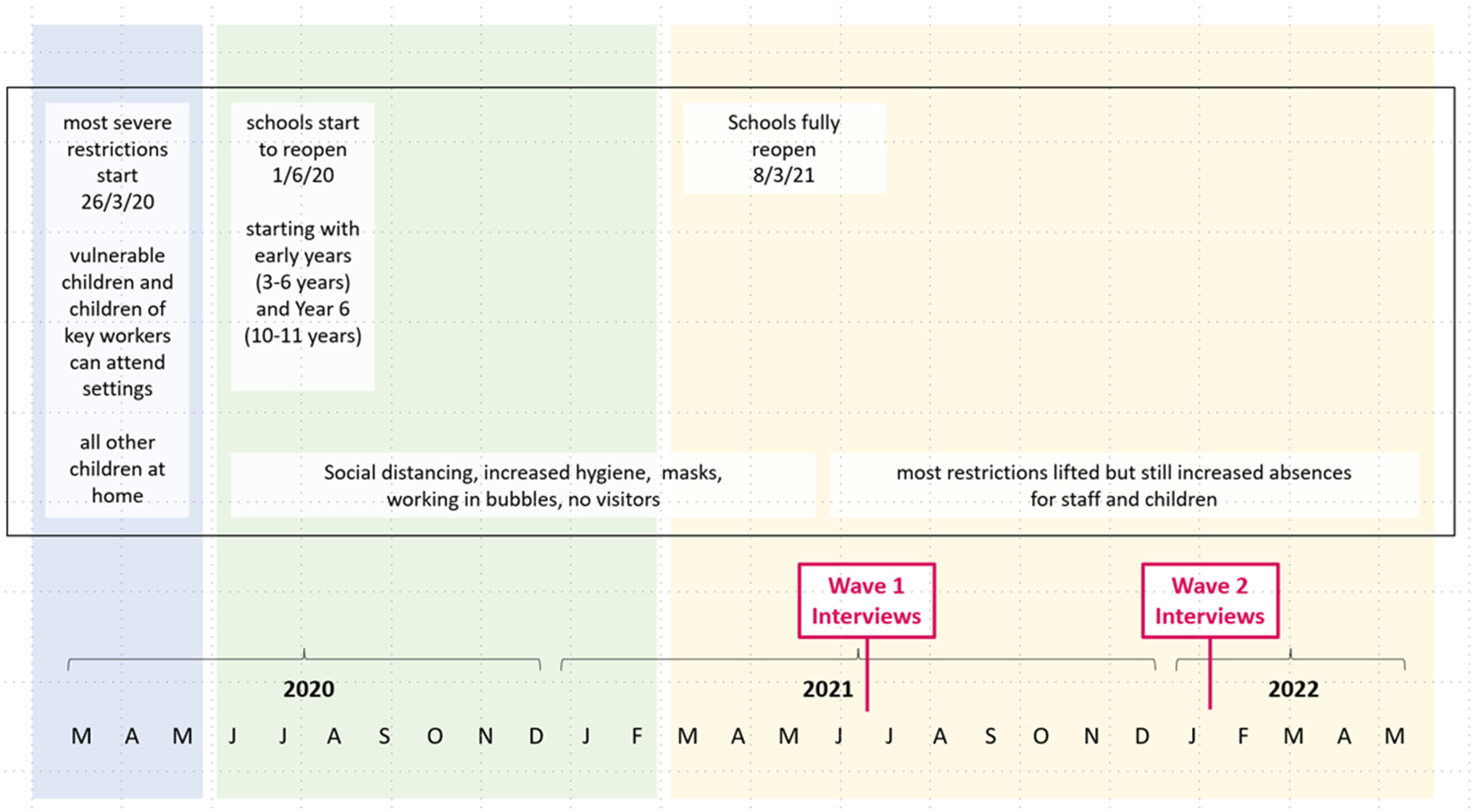
COVID-19 restrictions during LIVELY project.
Children who had more exposure to Early Childhood Education and Care showed greater increases in receptive language than peers who had less exposure (Davies et al., 2021), with some children of key workers/vulnerable children experiencing an educational boost. Studies suggest there may have been benefits from children spending more time at home; the precise nature of the benefits is not always clear (Fox et al., 2021; Nicholls et al., 2020), but included children having opportunities and time to play with siblings, alone and outdoors, although parents may have had limited time to spend with their children (Egan et al., 2021). Parents of children with developmental delays reported that children's skills learned before lockdown, including social skills, had dissipated (Paulauskaite et al., 2021).
Effective support for language and communication is linked to the environment, interactions and activities (Dockrell et al., 2015). Throughout the pandemic senior leaders ensured their settings provided adequate teaching and staffing support for pupils on site while also providing quality distance learning for pupils at home (Nelson and Sharp, 2020). Some restrictions required changes which would potentially affect support for language and communication, for example, increased hygiene and social distancing (La Valle et al., 2022; Tracey et al., 2022). Much of the literature focuses on a shift to online learning and highlights challenges faced by early years settings, for example the lack of technology at home or the need for training in the use of technology (Dayal and Tiko, 2020). Often they refer to synchronous activities with children engaging remotely with their teacher (Dayal and Tiko, 2020; Szente, 2020). How parents supported their children varied (Fung et al., 2023; Wheeler and Hill, 2021). Davies et al. (2023) found that children who were well supported at home made good progress but did not specify what ‘well supported’ means. There are few descriptions of how teaching was affected and those that do exist lack detail (Goddard, 2023).
Some changes meant factors which have previously been regarded as ideals were enforced, for example smaller class sizes or different staff deployment. Earlier evidence suggested reducing class size would involve too large a cost to be practical (EEF, 2021). However, benefits may be large for younger children as they allow EYPs to provide more enriching interactions. The same report suggests an alternative may be to change the deployment of staff (teachers and teaching assistants) so that EYPs can work more intensively with smaller groups. Pandemic provision saw smaller classes and different deployment of EYPs. While these changes did not remain in place, they provide an opportunity to see what difference they made. Of course, they were not tried in ideal circumstances. Class sizes may have been smaller but EYPs had the extra challenge of supporting children who remained at home. They also had to navigate additional challenges in the setting (e.g. extra cleaning/PPE, members of staff being ill/isolating, etc.) (Bowyer-Crane et al., 2020). Practices to support transition into school also changed (Bakopoulou et al., 2021). Families were no longer able to enter settings at drop-off or pick-up time (Bowyer-Crane et al., 2020). Home visits could not happen, and communication was conducted remotely, sometimes even when restrictions eased.
Parental engagement and partnership with early years settings
Parental engagement was vital as limited access to settings meant many key touchpoints between parents and settings were lost. Support had to be achieved at a distance (Kim and Asbury, 2020). EYFS children accessing learning through a ‘Zoom classroom’ required support from a parent which was not always viable. The importance of relationships between schools and parents, which enable children's learning, has been recognised for many years (Education Scotland, 2021). Nutbrown (2006) identified the first programmes aimed at involving parents, in the 1960s, ‘largely as a way of addressing poor home experience’ with initiatives developed to support parents to learn about their children's way of learning (p. 95). The promotion of such partnerships is also present in progressive iterations of the EYFS curriculum (DfE, 2017, 2021b). Little is known about what schools do to support parental engagement (Axford et al., 2019) but a few explicit frameworks to guide practice exist (Education Scotland, 2017; Goodall and Vorhaus, 2011; Hannon, 1995; Van Poortlviet et al., 2018).
The ORIM framework (Hannon, 1995) emphasises that parent knowledge of how children learn is vital (Hannon et al., 2020). When supporting their children, parents need to know what to do and why. Collaboration with educational practitioners supports this knowledge exchange. ORIM aims to help EYPs and parents identify practical ways of supporting children's development, highlighting four key roles for parents:
Opportunities: providing resources, highlighting appropriate activities Recognition: noticing, encouraging, and valuing children's achievements Interactions: working together, adults supporting the child, for example through direct teaching or play Modelling: leading by example, for example demonstrating a skill
Engagement is especially important when children are young (Gorard and See, 2013). Good-quality home learning environments can serve as partial protection against the effects of disadvantage up to the age of 14 (Cole et al., 2022). It is important to recognise that parental engagement strategies need to be adapted to different home contexts (Campbell, 2011). One of the most tangible ways schools and parents work together is through ‘homework’. Its value in primary schools is contested but is often used by parents to judge the quality of a school (Hattie, 2012). Parents’ and practitioners’ perceptions of appropriate homework can differ (Bates et al., 2022). Practitioners have a greater focus on the provision of a rich learning environment, for example parents reading with or listening to their child, helping children learn letters, numbers, songs or nursery rhymes, modelling literacy and providing good quality parent–child interaction (Axford et al., 2019). However, parents may find more concrete didactic tasks easier to understand. Teachers feel these can be inappropriate and lead to children being put under too much pressure (Hannon and James, 1990). Simply sending tasks home is unlikely to result in positive learning. Parents need support to understand what practitioners want them to do and why it may be beneficial. A coaching approach through modelling and supported reflection could be most appropriate (McKean, 2022) and building genuine connections with families is important (Levickis et al., 2022).
Parents may lack the confidence and knowledge needed to support their children (Education Scotland, 2021). Parents’ experience of education, their attitudes and self-efficacy can affect parental engagement (Spear et al., 2021). Some parents need extra support, or access to interpreters, to understand the guidance provided due to having English as an additional language or literacy and/or learning difficulties. Others may find engagement difficult due to ongoing work commitments. As settings, homes and parent–child/practitioner–child relationships vary, similar activities across homes and settings should not be expected (Levickis et al., 2022) but parents and EYPs value and can potentially benefit from detailed guidance for effective partnership working.
Attitudes can be a barrier, teachers may have stereotypical views, for example assuming poverty and lack of interest in education are linked or believing parents in poverty need more help from teachers (Hannon and O’Donnell, 2022). However, barriers are often not related to interest, but to time and resources (Laxton et al., 2021). Recent changes in terminology, describing such groups as ‘underserved’ rather than ‘hard to reach’, reflect attempts to shift the balance of power so that the onus falls on practitioners rather than parents to enable successful engagement.
While technology has been used to support parental engagement for many years, it became vital during the pandemic (Laxton et al., 2021). This brought the digital inequalities in society to the fore. Children from more deprived schools had less access to electronic devices (Cullinane and Montacute, 2021) and some schools provided loan equipment. The most advantaged state schools provided more devices to pupils in need than the most deprived schools, widening rather than narrowing the gap (Cullinane and Montacute, 2021). Access to devices and internet connections was not enough. Parental support is vital for children in the EYFS to benefit from technologically mediated home learning (Andrew et al., 2020). Families vary considerably in the degree to which they can do this with constraints of knowledge, confidence, time and competing pressures all playing a role.
Challenges and innovations in settings’ practices and parental engagement relevant to early language development
Restricted and altered social and learning experiences during the pandemic brought positive and negative consequences for children's language development. There is a clear imperative to reduce the harm for children who have been negatively affected and to harness learning regarding modifications and innovations in EYFS practice which may be of future benefit (Sharp and Skipp, 2022).
To that end, and with a focus on practices relevant to children's language development, we seek to characterise how changes in classroom practices and parental engagement were enacted over this period. We aim to:
explore the impact of COVID-19 on practice and provision in settings, with a focus on communication and language development explore how settings encouraged parental engagement to support children's learning at home identify insights to inform current and future practice, provision and partnership to foster children's early language development.
COVID-19 was a catalyst, requiring educational settings and practitioners to innovate and try new approaches to teaching and learning. We aim to harness this learning to inform better parental partnerships in the future.
Methodology
Context
The study was conducted in the North East of England with 20 schools participating in the LIVELY RCT. The schools involved had an interest in, and identified a need to support, language and communication (McKean et al., 2020). Schools were split into two waves to receive interventions and data collection took place in June/July 2021 and January/March 2022.
At these times, the most restrictive practice (homeschooling for all but a small minority) had passed. Schools operated ‘bubbles’, small groups or classes taught separately from one another, until the end of July 2021, limiting the number of peers and staff the children interacted with. Whole classes were sent home if one member of a bubble tested positive. In January/March 2022 when schools were no longer using bubbles, COVID-19 outbreaks were on the rise causing significant disruption but with individual absences rather than whole classes.
Participants and schools
EYPs from the 20 EYFS settings involved in the LIVELY study were invited to talk about their support for language and communication development and the impact COVID-19 had on this. Eleven volunteered. Pupil demographics for schools in the North East vary from the national average, as evidenced by higher proportions of children receiving free school meals.
Five semi-structured interviews were conducted in June/July 2021 (Time 1), and six in January 2022 (Time 2). All participants were women who taught or worked with Early Years children. Ten worked in Local Authority (LA) schools, one worked in a LA nursery school (Table 1.)
Interviewees and their settings.
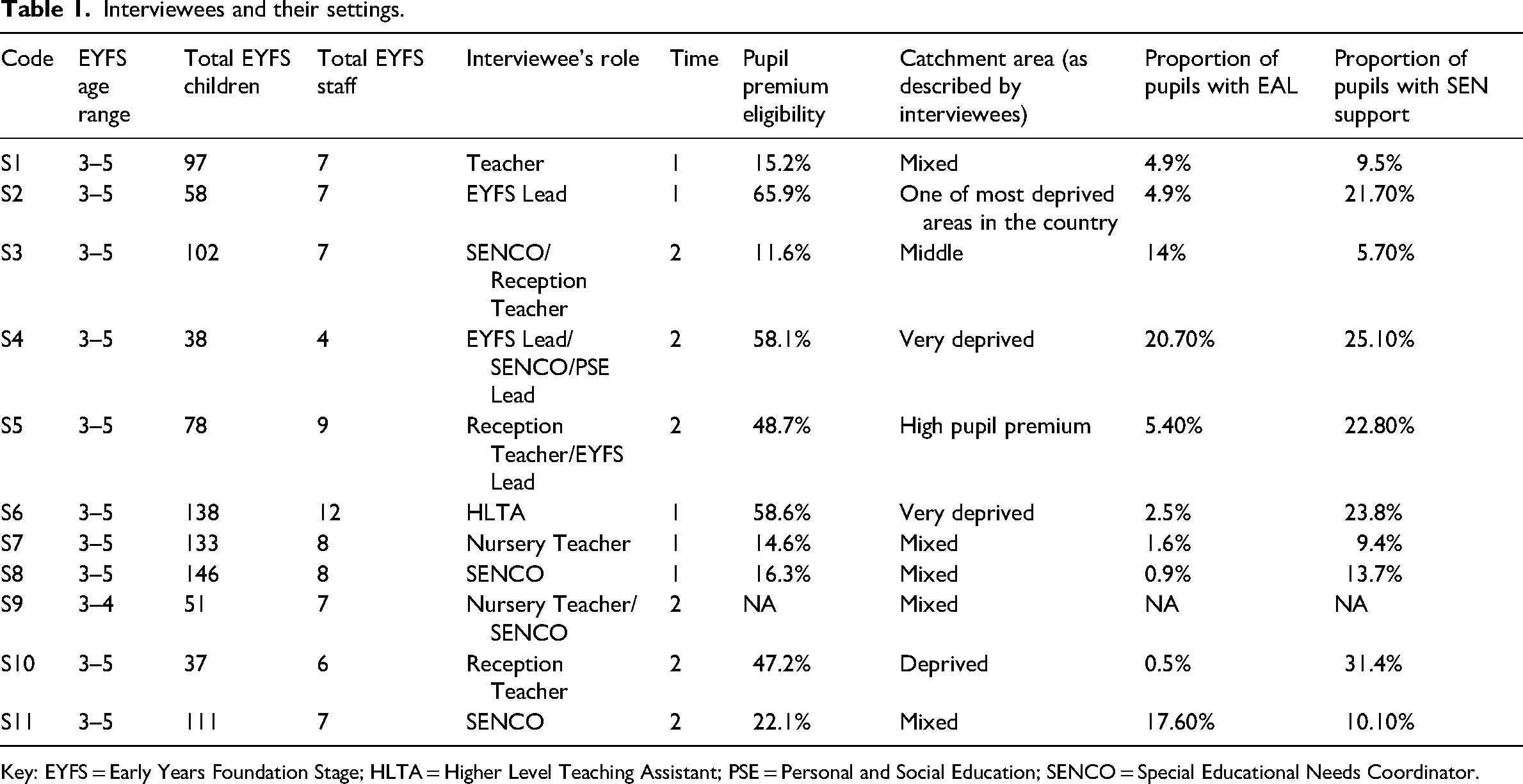
Interviewees and their settings.
Key: EYFS = Early Years Foundation Stage; HLTA = Higher Level Teaching Assistant; PSE = Personal and Social Education; SENCO = Special Educational Needs Coordinator.
This project was granted ethical approval by Newcastle University and followed the BERA ethical guidelines (BERA, 2018). An information sheet was provided explaining the participants’ right to withdraw, anonymity and confidentiality. Fully informed consent was obtained. Recordings were stored securely and destroyed after transcription. No personal details were retained in the transcripts.
Researchers and epistemic stance
The first author, previously an EYFS practitioner, conducted the interviews and led data analysis. The wider team, involved in the development of data collection procedures and analysis, has SLT backgrounds. The study falls somewhere along the inductive-deductive theoretical continuum, being partly data-driven and partly theory-driven (Guest et al., 2011). Data were collected and analysed with reference to an initial set of themes, however, we remained open to the emergence of new themes and/or subthemes during data collection and analysis. The interview schedule included questions based on literature about providing effective support for language development (Justice, 2004; McKean et al., 2017), this supported deductive analysis. Themes also emerged from the data through inductive analysis, which led us to identify the value of using the ORIM framework (Hannon, 1995).
Data collection
Interviews were conducted using video-conferencing software (N = 10) or telephone (N = 1). Mean interview length was 57 minutes (range = 44–79; SD = 9). Interviews were transcribed automatically before being checked by team members.
Data analysis
A systematic and iterative analysis was undertaken following the principles of thematic analysis (Braun and Clarke, 2022). Initial codes were developed collaboratively, definitions were developed and agreed. They were then applied to the whole data set. Using NVIVO software, pre-populated codes were created which aligned with the interview schedule; detailed sub-codes were developed as the transcripts were reviewed. This allowed themes to be examined in detail and ensured final codes were closely related to the data. Three members of the research team worked on the coding individually, with regular discussions to ensure consistency.
As themes emerged (see Figure 2), they were discussed with other members of the project team who had not been involved in data collection. This ‘peer debriefing’ (Long and Johnson, 2000) provided an opportunity to reflect on alternative interpretations of the data.
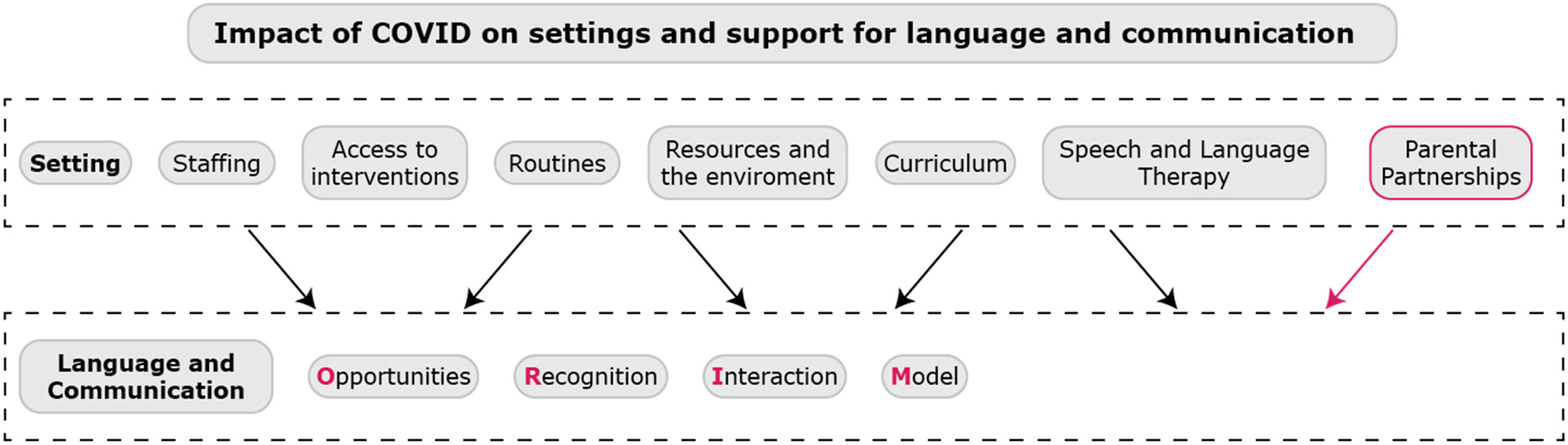
Themes identified during analysis.
Figure 1 shows how the impact of COVID-19 varied over the time of the project and this was recognised by the interviewees. The same themes emerged from all the interviews though experiences within themes could differ. The interviews were semi-structured; not all interviewees talked about all the same issues and so our data are not a comprehensive review of practice. Settings responded differently to the pandemic and issues raised by a single interviewee could be as important as those mentioned by everyone. For this reason, we have followed the advice of Braun and Clarke and have not quantified the findings (2022). We have selected quotes which best illustrate each theme aiming to show where different settings had contrasting experiences of the same issues. One set of themes related to changes that had affected the setting and, during the first analysis phase, parental engagement emerged as an important theme. To support interpretation of these data the team explored relevant theory regarding parental engagement in the EYFS to deepen our understanding and theoretical grounding. The ORIM framework (Hannon, 1995), was identified as a particularly relevant and specified model to understand parental engagement for learning and so was applied to aspects of the analyses.
This section describes practices relevant to children's language development and parental engagement (Education Scotland, 2021), between March 2020, the start of COVID-19 restrictions and March 2022. ‘There's been two years of disruption, but actually it's not two consistent years, it will have affected different children in different ways’. (S11)
Language and communication relevant changes in settings’ practice
Staffing
Most children missed at least some time in settings and when they attended it was very different to the pre-pandemic experience. In the early days of the pandemic only vulnerable children or children of key workers were attending, and staff were not able to move between groups or classes. Throughout the pandemic, all settings experienced high levels of staff absences, some had vulnerable staff working from home. This often resulted in fewer staff being available, affecting the quality of teaching. However, these changes sometimes resulted in the creation of small groups in settings and there were opportunities for online support. Given the number of child absences, the child-adult ratio could be smaller, resulting in greater progress. ‘Some of those children made huge leaps in progress… one in particular… he was so quiet, so quiet, didn't talk to anyone, was just one of the children you’d miss. …all of a sudden all of this language came out … ‘cause the group was smaller and he was braver and had the attention of the teachers more often’. (S1) ‘We’ve continued to have visitors right through… but it's probably not the case in every school’. (S8) ‘The class teacher was with them all of the time because of that bubble. That meant that there were more discussions at lunchtime, more chances to teach playground games and to teach social interaction and the language that goes along with that’. (S11) ‘[Children who] have a language need that makes them a bit more reluctant because they are starting to be a bit more aware that it's hard for them, they flourished… because they had a smaller group’. (S11) ‘It's not a surprise as I’d always thought if I could have a smaller class, I would be able to give them more attention and more time. That's not a surprise, but it … happened and I felt it, and I saw it’. (S1)
Access to intervention/speech and language therapy
Unlike some studies, which reported a decline in the quality of interactions between adults and children (Bassok et al., 2020), all the EYPs reported an increase in interactions and positively linked this to children's language development. However, the provision of targeted interventions decreased.
In some cases, children requiring extra interventions to support language and communication were able to continue to attend their setting throughout the pandemic, but this was not the case for all. Even when it was, some staff were not able to work across bubbles meaning that interventions were often adapted or discontinued. Some practitioners moved interventions online; others continued in the setting, but the duration was reduced. ‘[Name of TA] is doing speech and language intervention via Tapestry
1
for the parents whilst [children are] isolating so that doesn't stop… all they need to do is just watch and then she's doing like my turn, your turn’. (S2) ‘Also because of COVID hitting, I think because it's [the intervention is] supposed to run over a certain amount of time. Yeah, they couldn't fit it in anymore. ‘cause … the children weren't in … ‘cause the bubbles closed’. (S1) ‘He's had some virtual sessions, I think that's worked really well. I think staff could fit more in … they're not travelling from setting to setting. So perhaps they will get through the waiting lists’. (S5) ‘…a Zoom session. I don’t think they’ve had the same feel as they would if they were in clinic or in school’. (S8) ‘It's [assessing language] meant to be done before Christmas, but we had such low staff levels due to COVID that we’re still suffering at the moment’. (S5) ‘Health visiting teams weren't going out and doing checks and … [there] were quite a few children who then arrived in the following September… we were the first people to maybe be seeing them’. (S11)
Routines
Bubbles and increased hygiene meant free flow, where children were able to move around an early years setting doing different activities and mixing with peers, was no longer possible. ‘During COVID there was about 18 months, where we did not mix at all between nursery and reception because if one child tested positive, you’d lose 100 children. So we kept them quite separate, which was really sad because I think one of our strengths is that free flow’. (S3) ‘We always just [used to] have snack available and people could help themselves, but with COVID we had to sit and clean our hands, and we couldn't allow the fruit bowl just to be out, and actually it's been lovely because we sit in groups of 10 or 15 and just have snack, some milk and a nice chat’. (S3)
Resources and the environment
Resources were removed from settings due to COVID-19 risk assessments and restrictions. ‘We have only recently got sensory play back, so the water and the sand… that's been a massive miss’. (S6) ‘Parent workshops have been the thing that stopped, trips, those real-life experiences’. (S5) ‘We agreed that we would always have the home corner … throughout the year because children have spent so much time at home during COVID that this is where you can get in with their experiences’. (S4) ‘We had to strip the whole environment down… we love that it's back in all its glory now, but actually it did make us think you know in some instances, is there too much’. (S9)
Curriculum
Disrupted staffing levels and child absences meant most settings were not able to cover the full curriculum. The freedom to adapt the curriculum could result in settings focusing more on areas they thought should be prioritised, for example, settings adapted the curriculum in response to increasing emotional demands. ‘[We] reduced the curriculum demands over COVID because when you're increasing the emotional demands you kind of need to balance that up’. (S11)
Parent contact
One of the most common changes was parents not being able to bring their children into the building or, in some cases, the playground. This could make children separating from parents at drop-off challenging, especially for parents. It was more often seen as an opportunity for children to become more independent. ‘It didn't make much difference to the children, it did to the parents’. (S7) ‘They've managed it so well and we've found it's actually better, they’re just in and that's it. They can find their own name a lot more independently for the pegs and things’. (S6) ‘Something we really strive and thrive ourselves upon, is our relationships with our families and so when we weren't able to, it's almost like taking a huge step back and almost, well disengaging … trying to engage with parents but from afar has been really tricky’. (S10) ‘I don't mean to sound patronising, or you know, unkind towards parents, but sometimes they need a little bit [of] support on what a meaningful interaction can be’. (S10) ‘[Some parents] have had … a poor experience of education themselves … it's kind of become this vicious cycle’. (S10) ‘We still have regular parent's evenings, not face to face, but via telephone’. (S5) ‘With COVID we have been in touch with phone calls to all of our families, we have invited certain families in if they have needed some support at certain times, obviously safely’. (S7) ‘They haven’t been able … [to] form those friendships with other parents because they’ve been encouraged to stay apart… they haven’t really had children going to each other's houses for tea after school and have … play dates and all that’. (S8)
Language and communication relevant changes in parental engagement
Variability in progress and home learning
‘I feel like when they came back, we’re starting again’. S2 ‘I just think it's had a detrimental impact on them in every way, shape and form, … their emotional needs…mental health, … and not interacting and losing how to interact with children I think is the most frightening thing’. (S10) ‘Some children excelled because they were at home … they were in their most comfortable environment, and they took things in their own direction’. (S11) ‘There have been children who have got parents at home who I’ve just been applauding silently from behind the screen, ‘cause they’ve just been amazing, and they’ve taken on what I’ve done … and you’ve got other parents who don’t quite do the right thing, but they’re doing something so some children have done well, others have not done as well’. (S1) ‘When they came back into school, they couldn’t wait for anything, their demands had to be met instantly, because they’ve been with adults meeting their needs, almost before they had asked for what they wanted’. (S3)
Barriers and enablers to, and characteristics of, parental engagement
Settings did not appear to follow a formal framework when facilitating parental engagement. Rather they intuitively provided support which aligned with the components of the ORIM framework. EYPs described a range of strategies and approaches they employed to develop parental engagement and support parents to support their child's learning. They identified a range of barriers and enablers to engagement. We applied the ORIM framework to our analyses of barriers, enablers, strategies and approaches and have used it to structure these findings.
Opportunities
Settings wanted to ensure children had opportunities to learn but some parents lacked knowledge about what their child should be doing. Some interviewees described significant variation in parents’ skills (including literacy and digital literacy) meaning some children made more progress than others. To address this, parents were provided with opportunities to learn how to support their children. All interviewees talked about sharing activities which were appropriate for the children's age and for promoting language development. They provided accessible information and advice, for example videos as well as written materials. ‘… just popping little videos on ClassDojo, modelling … when you first send the children's picture books home thinking it's got no words in, how [are] we reading, you know just putting little clips on and explaining how to do that’. (S10) ‘…signposting families to stories or resources, we were doing that via online links, … YouTube … storytelling videos and things like that which wasn't really something we'd promoted as a nursery before’. (S9) ‘I’ve also given paper copies … a few of my parents [said] I struggle [with technology]’. (S4) ‘We did have a bank of iPads that were loaned out to parents’. (S5) ‘I’ve even had parents dancing to the ‘banana, banana meatball’ because the kids have loved it. Getting that parental engagement is really important’. S2 ‘Promoting families to try and get out for a little bit of fresh air in a little walk around … we had to be sensitive about that … there was an element of you know, just look around, discuss what you see and discuss the seasons, discuss how things are changing. Stop, stop and talk…’ (S9)
Recognition
Settings ensured parents’ and children's achievements were recognised and supported. Most schools provided regular support by phone or email, and some involved children in these conversations. ‘Outside of COVID, we would have ‘stay and play’ sessions where they would come in and they would join with some of the nursery routines and the songs. That unfortunately hasn’t happened, but we have had lots of phone calls. The phone calls have been with parents and children at the same time, which is quite nice’. (S7)
Parents were encouraged to recognise and value their children's achievements, but some had inaccurate expectations of what their children should be able to achieve. COVID-19 meant there were limited opportunities for children to meet their peers and it could be hard for families to make comparisons with other children unless a child had older siblings. Several interviewees mentioned potential developmental problems not being picked up as professionals were not seeing children regularly. When technology helped EYPs to see children's achievements, data protection meant it was rare for these to be shared outside the family. Consequently, parents still had little information to benchmark their children's achievements.
Interaction
Settings wanted to maintain and support interaction between families and EYPs and between parents and their children. They were no longer able to visit families before children joined their setting and parents were no longer able to visit settings. Face-to-face meetings were rare, though some settings provided these for parents identified as needing extra support. These happened outside, at a safe distance. It was difficult to build relationships and establish trust so EYPs tried to be as visible as possible in the playground and used technology to communicate with parents. The change was rapid and even schools that were already used to this approach could struggle to adapt. ‘As much as we’ve been doing homework from September online, it was only homework, it was one session per week. Suddenly everything was online… It's been a combination of trial and error really to see what works best for the families’. (S8)
Many of the activities focused on reading but EYPs encouraged parents to focus not just on ‘academic’ tasks but to value all interactions. Many children benefited from extra time with their parents or siblings but there was often a lack of time and opportunity for parents to interact with other adults and children. This affected children, and parents who would previously have been able to support each other.
Modelling
Settings wanted to ensure parents understood how to support their children's learning. Pre-pandemic, many settings provided opportunities to observe EYPs working, for example ‘stay and play’ events.
During COVID-19, videos were created to model skills, for example how to blend sounds or read wordless picture books. Some interviewees especially valued examples of two-way communication. A small number of parents recorded themselves working with their children, allowing EYPs to see how they were modelling language and communication. ‘I’ve demonstrated how to teach them certain things and you can see them making their own versions and filming themselves and doing it and trying to use the same language’. (S1)
Discussion
Impact of the COVID-19 restriction on children's early language and communication development
COVID-19 caused significant disruption over two academic years, a large proportion of the lives of 3- and 4-year-olds. Restrictions had a major impact. Most children experienced times when they could not attend the setting. When they could, bubbles meant they were not able to interact with adults and children in the same way as before. Routines were disrupted and there were changes to the environment and resources children could access. Not all these changes were negative. While language and communication often suffered; this was not always the case. Where there were more opportunities for interaction children's language could improve dramatically.
Impact of the COVID-19 restrictions on early years language and communication provision
In contrast to much of the literature, our settings’ support for children's learning rarely involved the children directly interacting with technology, meaning many concerns linked to screen time, raised by the literature (Liu, 2024), were not discussed. Given the challenges and concerns raised by remote synchronous teaching via technology, a return to traditional teaching where this happened seems likely (Kruszewska et al., 2022). The types of changes our settings introduced may be more likely to be sustained. Many of our settings’ adaptations increased the amount of interaction adults had with children or supported children's independence. Examples included changes to snack time and children entering the setting alone. This finding was in contrast to Nicholls et al. (2020) who suggested independence reduced. Some changes will be unsustainable, for example changes to staff-child ratios and staff deployment. Others, such as reflecting on what resources to have available for children and changes to routines like snack time to encourage interaction with adults and peers are likely to continue in some settings.
Parental engagement and partnership with early years settings
One of the most significant changes was the development of systems to support parental engagement. These changes were intended to compensate for reduced opportunities for parents and EYPs to meet and they provided support for children learning at home. Positive progress made by children at home was attributed to time spent with parents or siblings, but this was not possible for all. Many parents had limited time to spend with their children (Egan et al., 2021). Laxton et al. (2021) identified time and resources as barriers to effective parental engagement. Knowledge is also important; parents need to understand what types of interactions are most beneficial. Some EYPs talked about children who had lost self-regulation skills because all their needs were being met, reducing the need for children to be independent. The support interviewees provided was intended to ensure parents’ time was used most effectively.
Technology was a key route to providing support and settings were aware of the varying needs of different families. As well as a digital divide, there were other inequalities: in knowledge, time and resources. Settings were encouraged to address these inequalities during the pandemic. Support came in different, accessible formats. EYPs talked about clarifying why their suggestions were important, which helped to increase parents’ confidence. Interviewees were able to tailor support according to specific parental needs, reflecting the view that context is an essential factor when considering parental engagement strategies (Campbell, 2011).
Parents and practitioners are concerned about the negative impact the pandemic had on children's language and communication development in the long term (Blainey et al., 2020). The adaptations put in place by our settings could help support children who need to catch up. The impact could go beyond this though, with such adaptations potentially improving universal support for all children entering the setting in future (Nutbrown, 2018).
The ORIM framework was not explicitly used by EYPs to plan their adaptations, but they instinctively addressed all ORIM components, this was helpful but the adoption of an explicit theoretically- and evidence-informed framework could have supported all EYPs/settings to adapt more effectively and consistently. Making the framework explicit could also support helpful innovations to be sustained.
Delivery of all parts of the ORIM framework can be supported by technology. Technology was used mainly as a communication tool between parents and EYPs. This reflects the age of the children, who need support to use technology. Technology allowed information about opportunities to be shared and allowed parent activities to be recognised and supported by EYPs. While children rarely used the technology to interact with others, it was used to support interaction between parents and practitioners and encouraged parents to interact with their children. It supported modelling, which helped parents to understand what types of activities their children should be experiencing. These factors contribute to building positive relationships and help develop trust and respect.
Informing current and future practice
During the pandemic, adaptations were implemented quickly, with little time to reflect and consider alternatives. The most positive changes included smaller class sizes, higher staff to child ratios, and increased use of technology, for example learning journals, video conferencing and other communication tools. Changes to routines resulted in increased interaction between children, their peers and adults and led to more independence. An increased focus on parental engagement resulted in a more tailored approach to individual children's and parents’ needs.
It will be interesting to observe how many of the changes remain in place. Practitioners need to consider implications for workload and resources if successful adaptations are continued. For example, during the pandemic many technology suppliers provided free support and resources to help schools deliver remote learning (TES, 2021); these now have to be purchased.
While many parents have always supported their child's learning at home the pandemic saw a significant change. Parents were no longer simply expected to complete homework from the setting but to be involved to a greater degree. Some needed help to know that support for learning does not need to focus on ‘formal’ activities (Spear et al., 2021), or require special resources.
Even with support, the way parents worked with children was inconsistent. Addressing this inconsistency could benefit all children. The immediate challenges of the pandemic are over, but children will continue to need extra support. A more explicit framework to support parental engagement with early years settings would be valuable. This study has demonstrated that the ORIM framework has potential for more systematic application within settings and aligns with intuitive frameworks of partnership for EYPS.
Strengths and limitations
Our research provides a snapshot of practice in a small number of settings. Interviewees already had enough interest in SLCN to prompt them to volunteer for the LIVELY project; their views may not be representative of schools more widely. We focused on practice, adaptations settings implemented and why these changes were made; we did not measure the impact of these changes. In line with other studies, (Hannon et al., 2006; Nutbrown, 2018) we talked to EYPs, not to children and parents. Future studies should consider their views.
Conclusion
Early years education and the development of language and communication skills play an essential role in building a strong foundation for a child's future life. Positive interactions with adults are essential. The pandemic provided a useful lens through which to evaluate practice. The adaptations provided an opportunity to reflect on how interactions could be supported beyond the strategies EYPs were already using. An explicit framework to promote parental engagement, such as ORIM, could allow all practitioners and settings to consistently support families and children. A framework could enable practitioners to identify the types of activities which are most effective and focus their time on these; support parents to use their time effectively by providing advice about opportunities/activities to support their children; recognise how parents work with their children; provide positive feedback to parents who can support effective learning and enriching interactions and provide encouragement and modelling to families that need additional support.
Supplemental Material
sj-docx-1-clt-10.1177_02656590241276694 - Supplemental material for Adapting early years language and communication support in response to COVID-19 – A catalyst for reflection and more successful parental engagement?
Supplemental material, sj-docx-1-clt-10.1177_02656590241276694 for Adapting early years language and communication support in response to COVID-19 – A catalyst for reflection and more successful parental engagement? by Christine Jack, Elaine Ashton, Kate Conn, Carolyn Letts, Sean Pert, Emily Preston, Naomi Rose, Helen Stringer and Cristina McKean in Child Language Teaching and Therapy
Footnotes
Acknowledgements
The authors would like to thank all the schools who participated in the LIVELY project, especially the 11 interviewees.
Declaration of conflicting interests
The authors declared no potential conflicts of interest with respect to the research, authorship and/or publication of this article.
Funding
The authors disclosed receipt of the following financial support for the research, authorship and/or publication of this article: The LIVELY project was funded by the Heather van der Lely Foundation.

Supplemental material
Supplemental material for this article is available online.
Notes
References
Supplementary Material
Please find the following supplemental material available below.
For Open Access articles published under a Creative Commons License, all supplemental material carries the same license as the article it is associated with.
For non-Open Access articles published, all supplemental material carries a non-exclusive license, and permission requests for re-use of supplemental material or any part of supplemental material shall be sent directly to the copyright owner as specified in the copyright notice associated with the article.
