




Abstract
This article examines how various stakeholders’ practices on the ground mobilise and immobilise the Chamagudao’s heritage as a historic trade and caravan route. The research is based on ethnographic fieldwork in Yunnan, China, following movements of tourists, guides, residents and information on the remaining trails of the Chamagudao. It outlines how nodes, constructed by state actors and touristic media, rather than the lines of mobile heritage primarily constitute the Chamagudao, and the implications for tourists’ awareness and understanding of the Chamagudao as mobile heritage. Explicitly mobile practices occurring along its trajectories are challenging the nodal interpretations of this historic route. The article offers a mobile perspective on assessing the opportunities and challenges faced by tourism routes in China in the governments bid to develop these as mobile heritage destinations.
Keywords
Introduction
Mobilities in the form of people’s, objects’ and technologies’ movements are an integral component of heritage landscapes, to which the new mobilities paradigm provides a lens to investigate more fluid, mobile types, aspects and productions of heritage (Sheller and Urry, 2006). Tourism routes and trails represent compelling cases as physical representatives of mobile heritage made by and for forms of physical and cultural mobilities along pathways between individual bounded sites (Svensson et al., 2021). Understanding trails as mobile heritage acknowledges that mobile practices and experiences and how these are enabled and disabled, need to be considered within studies of heritage routes, as they allow tourists to make ‘experiences of discovery’ related to tangible and intangible ideas about mobilities and their role within culture, nature, history and art (du Cros and Jolliffe, 2011: 183). How such ideas are mobilised depends on the articulation work done by various stakeholders on local, regional and national level, indicating a context-dependent and multi-layered process (Svensson, 2021).
This ethnography explores China’s Chamagudao, a former caravan route, contemporary tourist destination, and part of the serial nomination of Heritage Routes in Asia for World Heritage Status (UNESCO, 2016). Located in China’s Southwest, the Chamagudao links modern-day Sichuan and Yunnan Province and the Autonomous Region of Tibet. Its historical length is estimated at 3000km (Chen, 2004). Based on the trade of tea, horses and other goods by caravans, it lasted from the 7th century AD to the 20th century (Freeman and Ahmed, 2015). The name ‘Chamagudao’ was first coined in the book ‘An Exploration of the Great Cultural Triangle of Yunnan, Sichuan, and Tibet’ published in 1992 by six scholar referred to as the ‘Six Gentlemen’ (六个君子) exploring the role of tea for culture and trade in the region (Sigley, 2013). Around the same time local governments started searching for cultural artefacts for cultural branding and use within tourism. Traversing subtropical forests, steep river gorges, densely forested mountain ranges, and the Himalayas through an equally ethnically and culturally diverse landscape, its historical and cultural significance for the region and China consequentially led to the Chamagudao’s integration in the plans of local governments and tourism developers and its resurgence within tourism (Sigley, 2013).
Based on Cresswell’s (2006) view of mobile heritage as an intertwining of spatial, social, historical and embodied features manifested through mobilities, I aim to foreground the significance and potential of mobilities in the form of walking in the Chamagudao’s development and illustrate how various stakeholders’ practices alternatively mobilise and immobilise the Chamagudao’s route heritage. As such, this article builds on previous efforts published in Tourist Studies incorporating a mobilities perspective in the examination of the development, performances and experiences of tourist destinations (e.g. Grimwood and Caton, 2017; Iaquinto, 2020; Larsen et al., 2021; Rabbiosi, 2021; Wagner and Minca, 2017) and the particular characteristics and emerging complexities of tourism development in China (e.g. Huang et al., 2019; Ong et al., 2023; Yuan, 2022). Informed by observations of tourists,’ guides,’ entrepreneurs’ and state actors’ practice, I will discuss three specific points in the examination of the (im)mobilisation of the Chamagudao as a tourism route: what remains of the Chamagudao as a route, the omission of trails in the narrative presented to tourists, and the micro-level mobilisations of the Chamagudao as mobile heritage.
Trails and routes in tourism
Associated with several benefits, tourism routes’ and trails’ designation and revitalisation has garnered attention from tourism developers worldwide (MacLeod, 2017; Timothy and Boyd, 2015). Benefits associated include economic development through cooperative cross-regional networks creating synergies for tourism development through sharing resource, expertise, and marketing (Briedenhann and Wickens, 2004; Meyer-Cech, 2005), promoting multi-vocality and community participation (Council of Europe, 2011; MacLeod, 2017), and educational opportunities related to environmental and heritage conservation (Timothy and Boyd, 2015). Additionally, Rabbiosi (2021) observes that increasing interest at local and national government levels in promoting walking holidays to support local development has led to more attention being paid to providing the needed infrastructure, including routes and trails.
Heritage trails commonly embody landscapes of mobility heritage based on physical and intellectual movements of people, objects, and knowledge over time (Svensson et al., 2021) and encompass a variety of experiential products, focused on nature, cultural heritage, religious pilgrimage, or other historical mobilities.
Research has identified the need to investigate tourist destinations including tourism routes and trails from a mobilities perspective, exploring how and why tourists move, how destinations’ infrastructural, social, cultural and spatial contingencies enable some forms and some people’s and things’ mobilities over others, and how destinations are shaped by mobilities (Hamilton and Alexander, 2017; Sheller and Urry, 2006; Wagner and Minca, 2017). Recent research highlights how a mobilities-informed perspective can provide rich insights into routes’ and trails’ constitution, different groups’ experiences and their contributions to understandings of heritage (MacLeod, 2017; Øian, 2019). For example, Mason’s (2020) study illustrated how movements of different groups created new surfaces and inscribed new meanings to the Jordan Trail.
Essentially designed to offer mobile pathways linking nodal destinations, tourism routes and trails are destinations where physical and cultural mobilities are the experiential focus (MacLeod, 2017). Walking is connected to many contemporary tourism routes and trails, producing distinct socialities and meanings through interactions with place (Middleton, 2018). The distinct spatialities and temporalities generated by the slowness of walking and its explorative and ruminative potential can generate heightened awareness of historical and cultural contexts (Kato and Progano, 2017), supporting interaction with and internalisation of heritage values (Kärrholm et al., 2017). However, cultural heritage routes carry complex meanings and interpretations of heritage, as do the mobile practices along its trajectories (Wang and Kao, 2017). Additionally, complex landscapes of supply and demand, where stakeholders may disagree on policies, design, meaning, interpretation and management of the trails and other tangible and intangible heritage aspects, pose a key challenge (Timothy and Boyd, 2006).
In China, heritage routes have been used as devices for cultural policy and diplomacy, building a narrative of mobilities of the people of Chinese nations over time and space (Sigley, 2023). Investigations have focused on their history (e.g. Zhang and Liu, 2019), political and diplomatic function (e.g. Winter, 2020), and their role in tourism (e.g. Szadziewski et al., 2022). Here, focus is on the practices and experiences of corporeal mobilities, how these are supported or hindered through the routes’ material, political, social, and managerial affects, and how such mobilities contribute to the Chamagudao’s material and social construction.
This research utilises insights from various previous studies to achieve this goal. Ingold’s (2007) concept of lines as a way of knowing and inhabiting the world and Mason’s (2020) conceptualisation of trails and routes as historical representations of past and present movements offer an understanding of the Chamagudao as mobile heritage where movement and embodiment are central to constructions of its tangible and intangible heritage. Such an understanding reflects the productive connections forged between the trails and routes and physical movements upon them and underlies the investigation presented here. From this viewpoint, the ‘destination-in-motion’ (Hamilton and Alexander, 2017) is used to position mobilities through which trails’ natural and cultural heritage are explored and experienced at the investigation’s centre. Drawing on Øian’s (2019) work foregrounding corporeal mobilities’ intersection with politics of trail designation and management, I focus specifically on the ways in which mobilities at the micro-level can contest the more nodal narrative produced by tourism administrations and some businesses. Informed by Wagner and Minca’s (2017) explorations of the delineation of the ‘Route des Kasbas’ through guiding material, the role that touristic information plays in discursively facilitating and/or restricting a mobile interpretation of the Chamagudao are incorporated.
Thus, the mobilities and material productions of different knowledges of the Chamagudao and its constructions for tourism are critically explored in their productions of the Chamagudao as a heritage route.
Methodology
Ethnography was chosen for the study of the Chamagudao as mobile heritage, as ethnographic approaches are well-established in their ability to provide insights into the complexities of both tourism mobilities and heritage tourism (Connell et al., 2021; Iaquinto, 2020; Rabbiosi, 2021; Varnajot, 2019; Wagner and Minca, 2017; Yuan, 2022). I followed a relational ontology exploring human mobilities alongside mobilities of information, imaginaries and ideas along the Chamagudao (Sheller and Urry, 2006) through a mobile approach to ethnography as a spatial practice (Clifford, 1997). My research included two fieldtrips to Yunnan of 6 months (April–September 2016) and 2 weeks (April 2017) respectively. During these, I sought out trails associated with the Chamagudao leading me along parts of the former caravan route. It was not only trails informing the investigation of the Chamagudao as a mobile heritage destination, but also its many moorings: its ancient villages, market towns and tea mountains. Although I cannot claim to have covered the whole Chamagudao, or even all remaining trails, this mobile ethnography reflects the mobile, varied and flick-carpet-style destination the Chamagudao emerged as.
Mobility was also made explicit in the data collection. I observed trails in their materialities and socialities by walking them myself. To interview tourists, I conducted walking interviews (Mackay et al., 2018) alongside participant observation, following participants on their journeys on the Chamagudao’s trails. Local trekking guides were interviewed using semi-structured interviews, building a basis of local expertise with follow-up email conversations with two guides post-fieldtrip between 2017 and 2021. Local expertise was also derived from informal encounters with members of local communities, and informal meetings and conversations with local tourism officials during the second fieldtrip (see Table 1 for participant breakdown). Similar to Wagner and Minca’s (2017) approach, documents such as maps, tourist information leaflets, and excerpts from guidebooks as representational materials of the Chamagudao were consulted, providing insights into information flowing about and along the Chamagudao. Additionally, official websites of both the central government and Yunnan’s provincial government were consulted for news related to developing tourism on the Chamagudao post-fieldtrips.
Research participant breakdown.
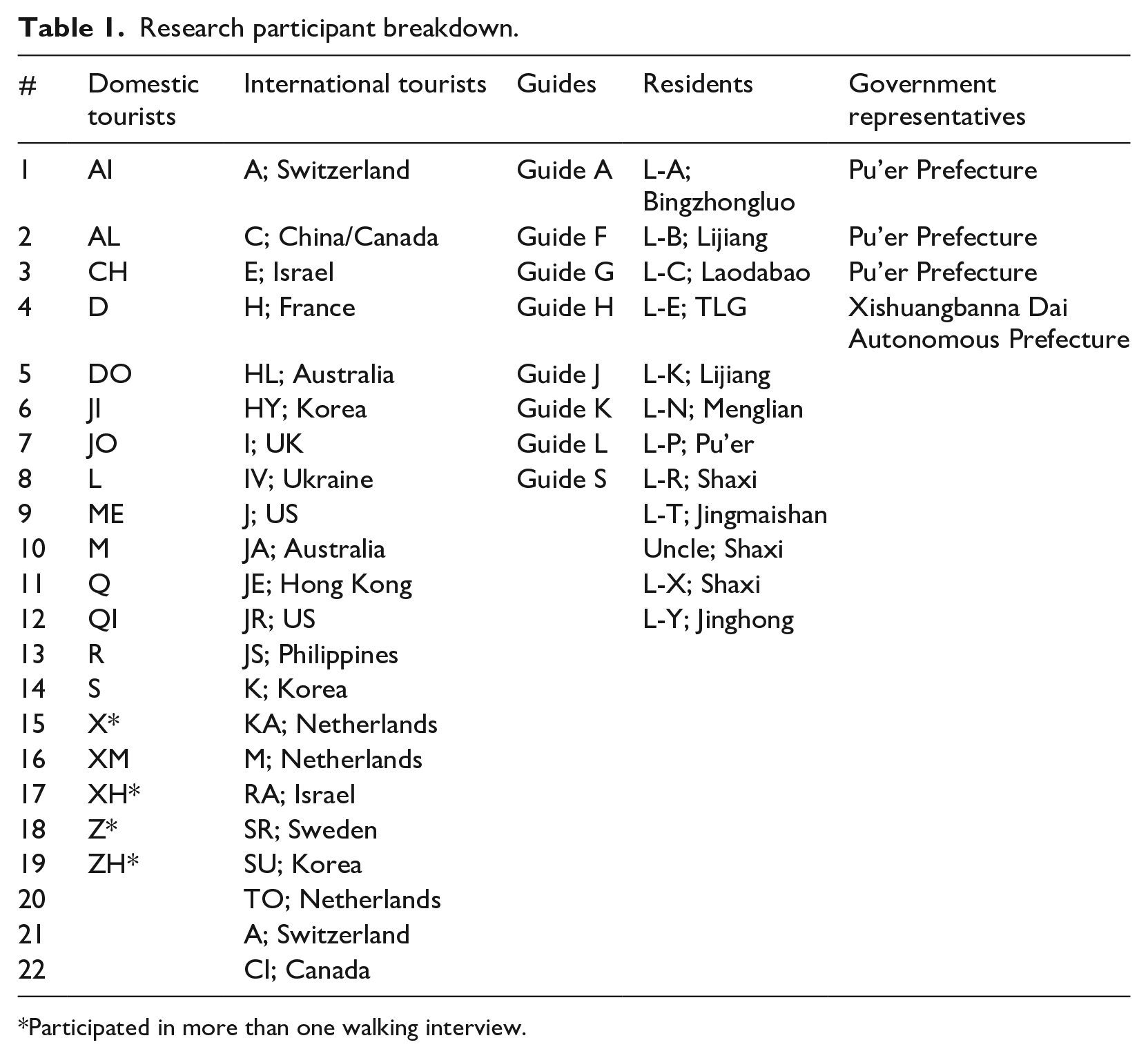
Participated in more than one walking interview.
Although an in-depth discussion is beyond this article’s scope, my positionality as a foreign researcher in the field had implications for the participants I was able to access (Witte et al., 2023). The variability in my negotiated positionality also implied varying levels of trust, depth and detail of encounters with participants.
Data was analysed in reiterative steps, both during and post-fieldwork. Using open coding (Cook and Crang, 1995), interviews and observational data were analysed individually and then together, searching for potential connections, similarities, and differences between various data sets to identify patterns, while theoretically-oriented analysis sought explanations of these patterns.
Findings
What remains?
A fundamental challenge to creating a cohesive Chamagudao heritage route is the question what remains.
Stylised maps as in Figure 1 show a simplified version, concentrating on its two main arteries from Xishuangbanna to Tibet and Sichuan. These main arteries do no longer exist as routes travelled on foot or horse, although modern highways effectively still trace similar trajectories. Many sections and tributaries have been subject to urbanisation and infrastructural developments, while others have fallen into disuse as the Chamagudao laid dormant for decades before its re-discovery for tourism (Cui et al., 2011).
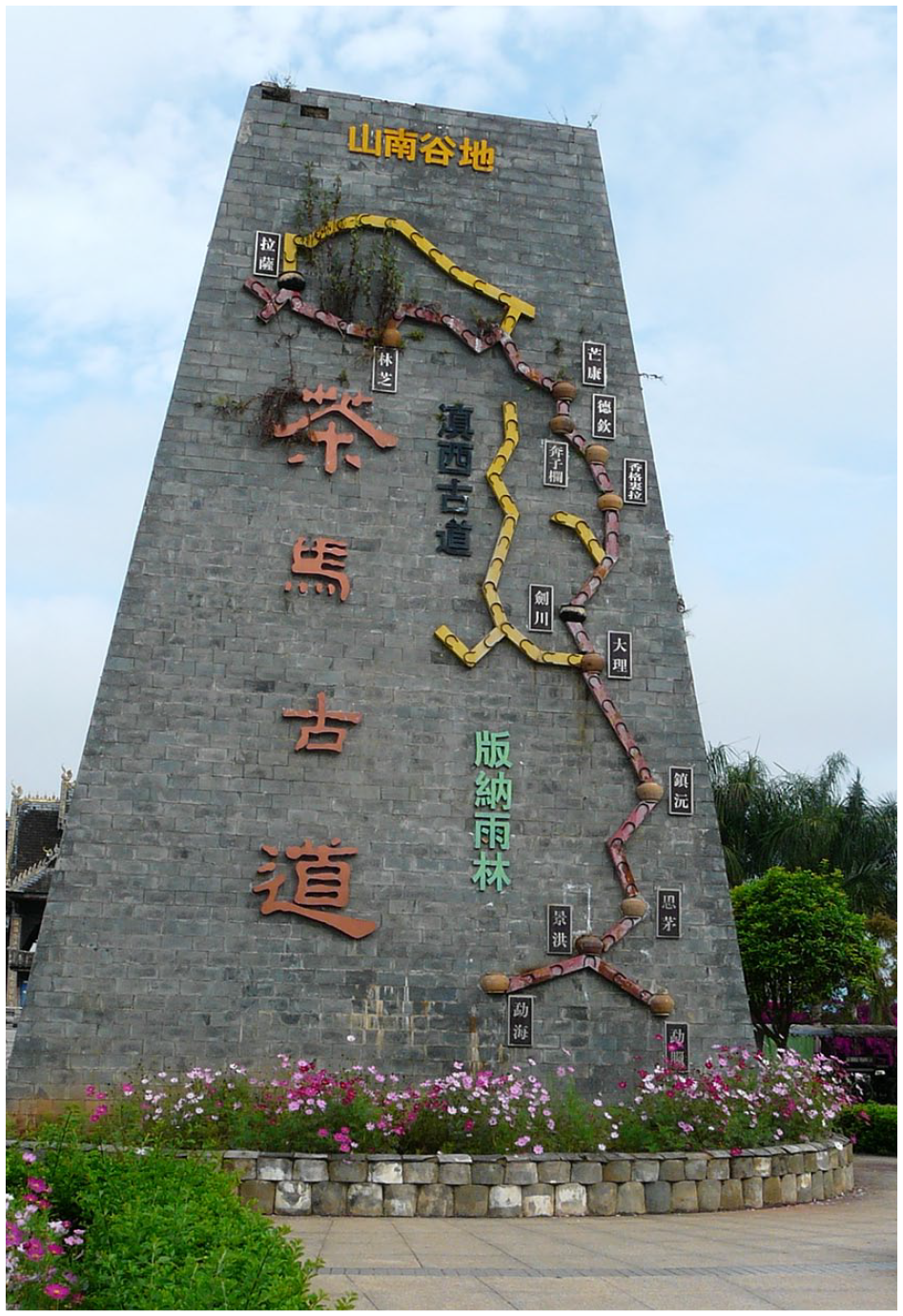
Stylised map of the Chamagudao in Menghai.
The Chamagudao’s nodes provide versatile tourist experiences, including numerous villages, towns and cities linked to the Chamagudao, including Nakeli, Pu’er or Menghai in the South, or Shuhe, Liijiang or Weishan in the North. Attractions often include historic inns, temples, museums and markets linked to the caravans like Shaxi’s Tea-Horse-Road Museum (Figure 2), and horse rides are frequently offered to tourists along cobbled streets as seen in Shuhe’s old town (Figure 3). Additionally, tea, a main Chamagudao trade good, its production sites, plantations and tea mountains have become a draw for domestic special interest tourism (du Cros, 2007). Several Chamagudao-themed parks and scenic areas have opened over the years, for example in Pu’er (Figure 4), providing tourists the opportunity to learn about this route and view a variety of its tangible remains and replications.
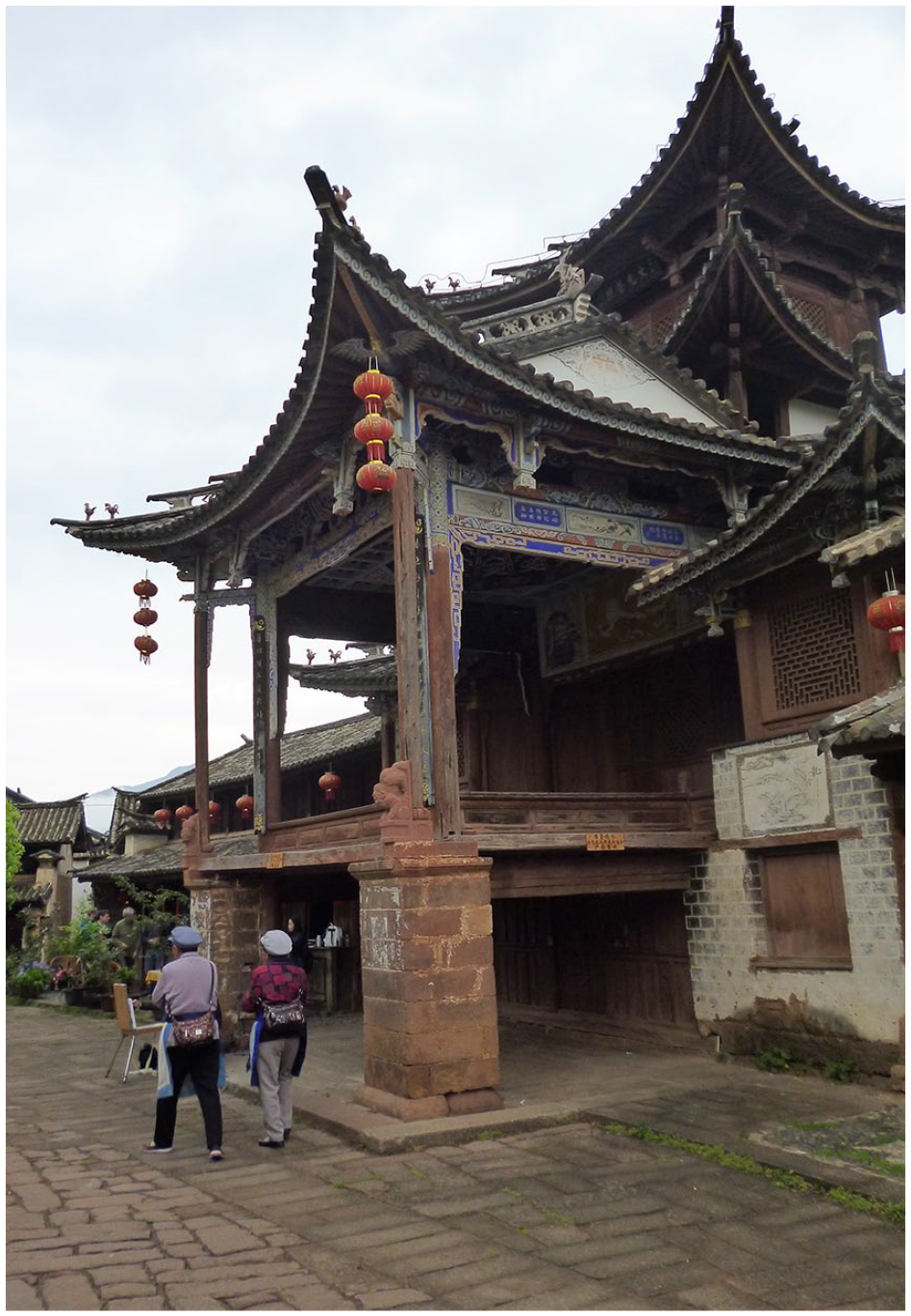
Tea-Horse Road Museum Shaxi.
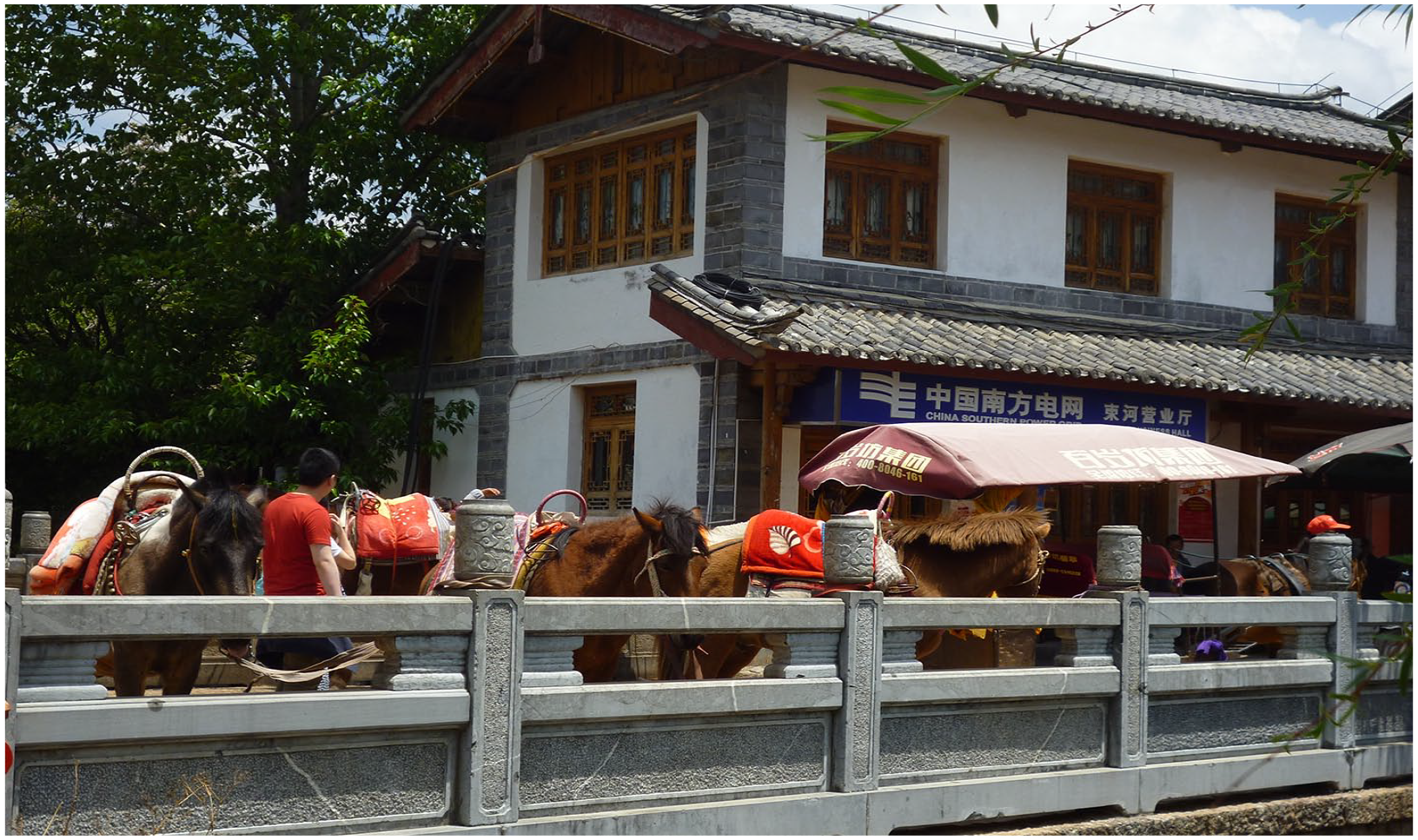
Horserides offered in Shuhe.
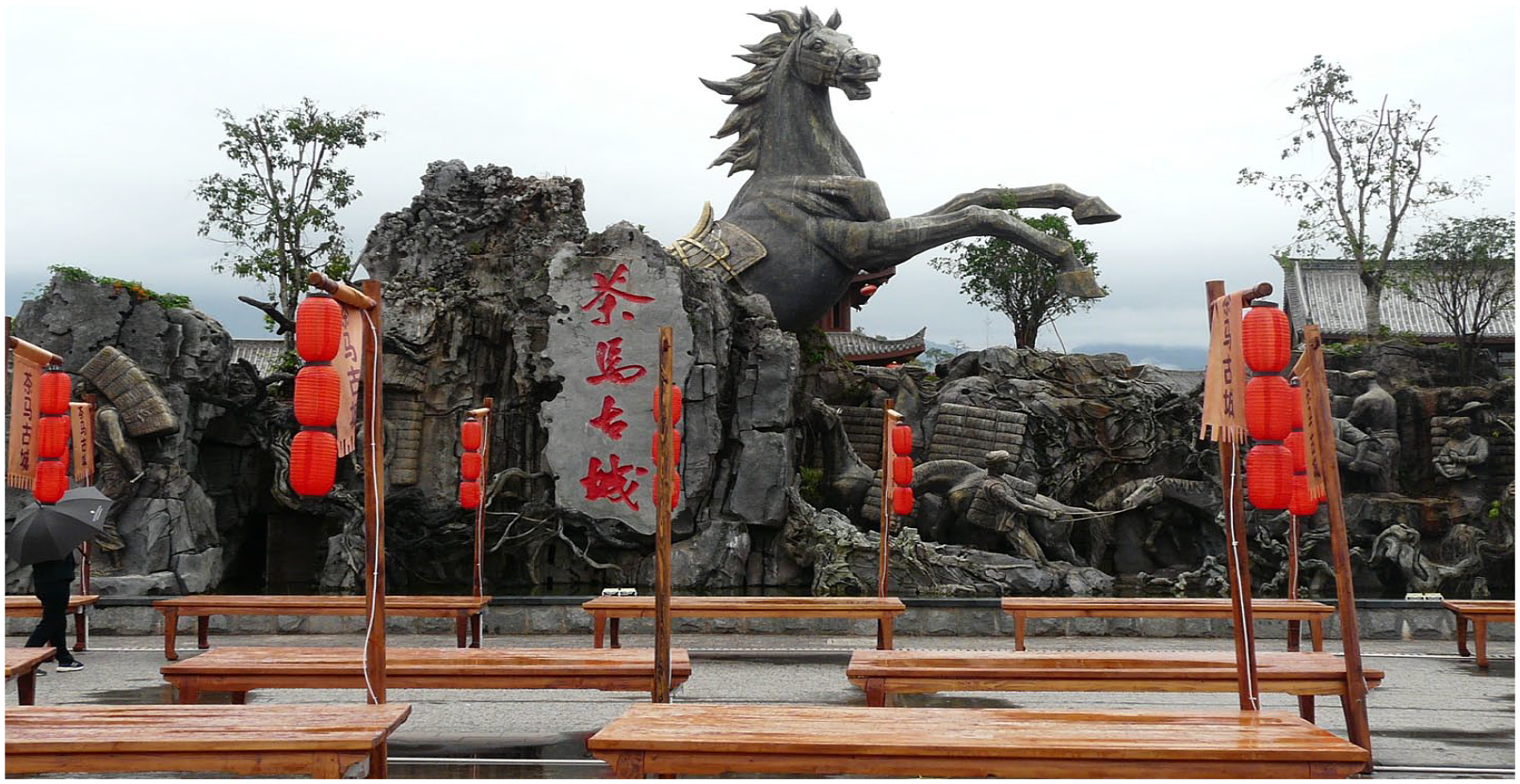
Chamagudao-themed area in Pu’er.
Furthermore, some former Chamagudao trails have survived, including a section along the Gaoligong Mountain Range, local tributaries in the Nujiang Valley, trails in the Yubeng Scenic Area, the upper Tiger Leaping Gorge Trek, trails around Shaxi and in Xishuangbanna’s sub-tropical forests and tea mountains. Varying in length, difficulty, conditions and status as tourist attractions, tourists could theoretically experience trails ranging from the highly organised, over those maintained to remain natural, to the unofficial and unmaintained. This is illustrated in the Figures below showing the Cloudpass’s officially designated paved trail (Figure 5) in juxtaposition to the Tiger Leaping Gorge’s Upper Trek (Figure 6), a trail maintained by locals and offering a rugged, more challenging trail experience.
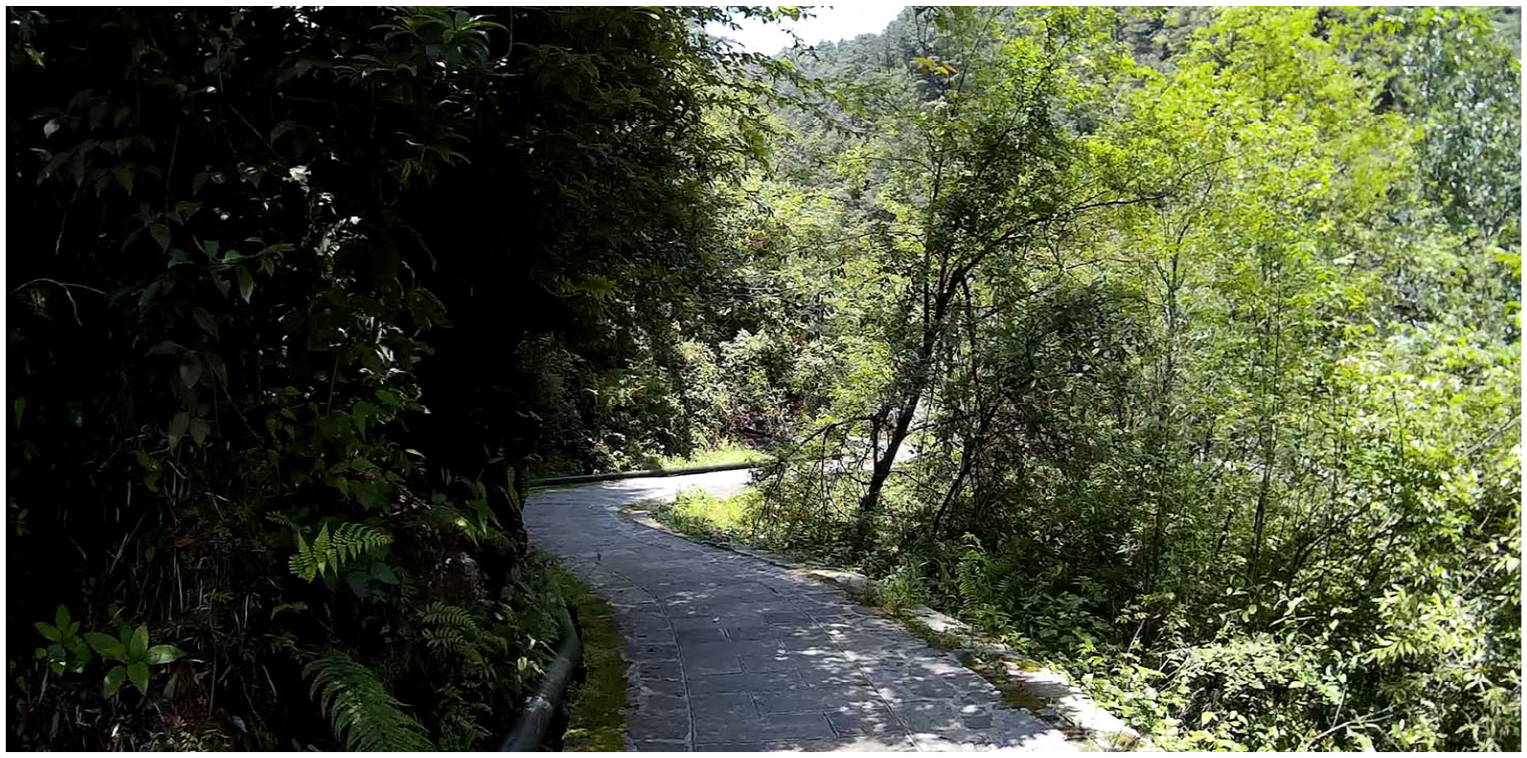
Cloudpass official walking trail.
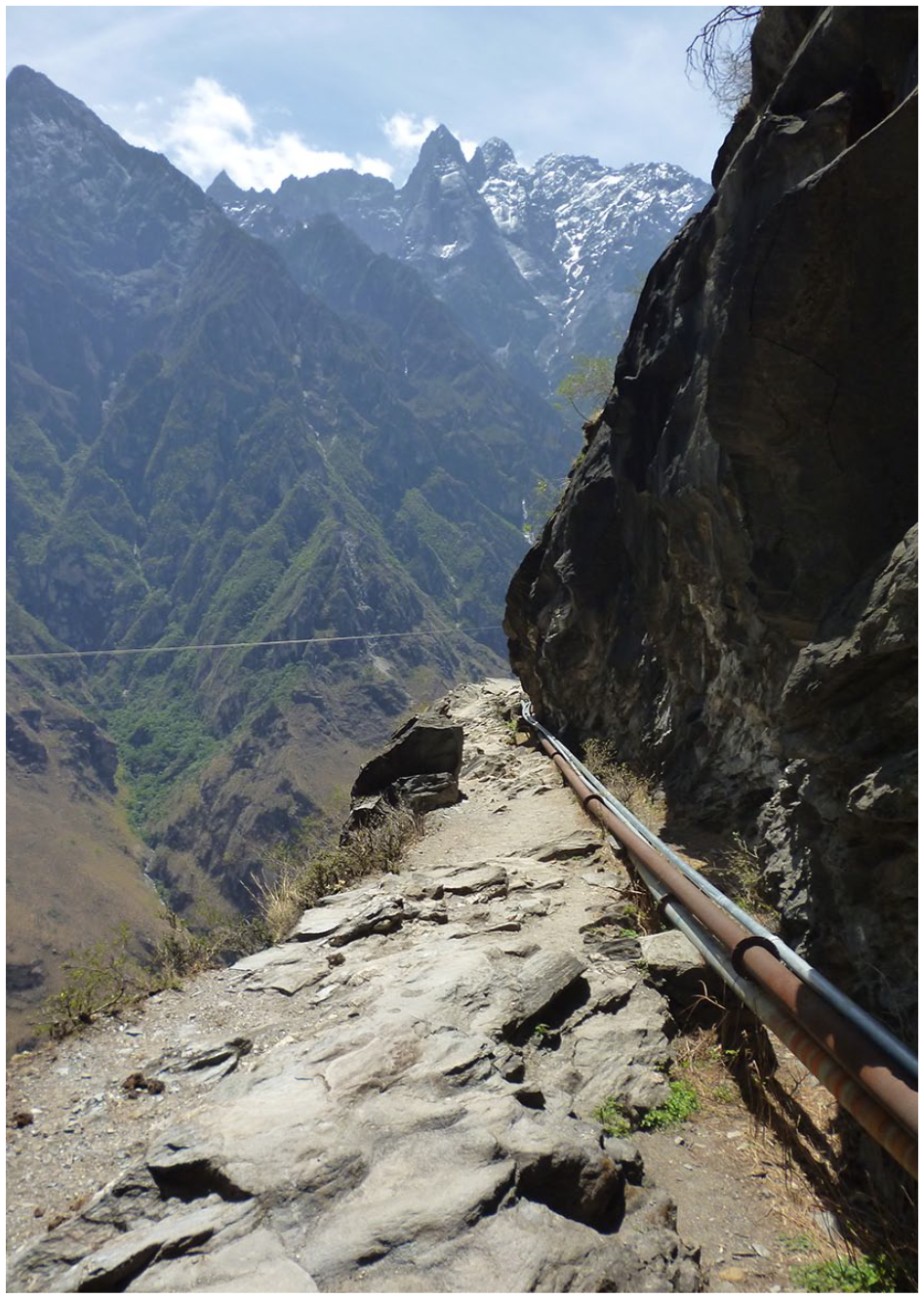
Upper Tiger Leaping Gorge Trek.
However, the surviving route and trail network is unsurprisingly patchy, as caravans ceased to travel these roads, meaning their original purpose was abandoned leading to their decay and obscurity, while nodes such as town continued to be lived in, with records of their histories kept more consistently. Guides told me more trails remain nevertheless, but many are well hidden, often known only to locals, or accessible only to highly experienced hikers. The remaining trails are not linked to each other physically, which is unsurprising given the Chamagudao’s vast scale and infrastructural and urban developments across Yunnan. However, neither are its trails or its nodes linked administratively nor are they overseen by a common management and marketing organisation.
Thus, although nobody knows exactly how much of its trail network has survived in total, Chamagudao trails exists providing theoretically an opportunity to develop the Chamagudao as mobile heritage route. However, its route-aspect remains implicit and opaque to tourists as illustrated going forward.
A Chamagudao of nodes, not lines?
Throughout today’s hike, J has been asking about the Tea-Horse Road and where he might be able to find places that retain this heritage in a visible way. [. . .] He tells me he came across it through the Lonely Planet and a travel blog: “I first read about here [Shaxi] and the bit about the Tea-Horse Road in the Lonely Planet. Then I looked it up online and came across this blog, Travelcathay. I saw pictures on there and read the blog about different posts on the Tea-Horse Road”. (fieldnotes)
The blog entry mentioned (no longer available) listed several ancient towns and villages situated on the Chamagudao, but not the trails. Although several Chamagudao-themed destinations visited during fieldwork included no walking trails at all or only short walks leading through town rather than following historic caravan trajectories beyond town boundaries (e.g. Shuhe, Menghai, Nakeli), many others did have nearby walking trails with claim to Chamagudao heritage. Nevertheless, an impression of a Chamagudao of nodes not lines was one projected through much of the touristic media consulted by tourists.
The Lonely Planet, a widely used guidebook among international travellers in China, makes three brief remarks of the Chamagudao: As part of its proposed 4-week Yangzi itinerary, focusing on towns and villages, inviting readers to ‘discovering the scattered villages and old towns around Lijiang, including Shaxi and Shuhe on the old Tea-Horse Road’.; in the description of Shaxi promoted as ‘one of only three surviving caravan oases from the old Tea-Horse Roads stretching from Yunnan to India’; and as a special entry within the Shaxi section (Harper et al., 2017). The latter is the only one focusing on the Chamagudao’s route-aspect, introducing a brief history and its importance to regional trade. However, at no point is the reader invited to travel any of its remaining trails.
Online information equally tended to focus on towns and similar bounded sites as various participants noted.
When I found your post, I looked at some websites to find out more about hiking the Tea-Horse Road. We love hiking but I did not know about the Tea-Horse Road as a hiking route. But there was little info. For example, Yunnan Explorations. . .I’d say the name suggests it would include hiking tours but no. (I)
Similarly, on-site tour operators in the towns visited advertised Chamagudao-experiences focusing on sightseeing tours in villages, towns, and specific scenic sites, such as Lashi Lake advertised by many tour operators in Lijiang (see Figure 7), without incorporating remaining trails that may be travelled on foot.

One-day sightseeing trips to Chamagudao destinations offered by Lijiang tour operator.
The dominant narrative in the touristic information landscape therefore largely omitted its trails and opportunities for tourists to engage in embodied walking journeys of the Chamagudao.
The resulting disconnect between Chamagudao heritage experiences and its trails was noted by both Chinese and international participants: There is a lot of information on the Tea Horse Road. [. . .] if you go to Xishuangbanna, there are a lot of places that say, ‘Come her and drink real Chamagudao tea’. Because the tea mountains are where Pu’er tea is from. And here in the North, there are all these old towns that are part of it. But, they don’t always talk about it much. [. . .] It’s really hard to find out if you can actually walk any Chamagudao trails. (XH) Most [trails] are not there anymore. But we heard from a friend some are. We started searching online but it was really hard. Nothing much at all. The old towns, they are easy. Everyone knows Pu’er. But we could not find many trails. (Z)
XH’s observation illustrates participants’ difficulties in finding Chamagudao trails because the information landscape focused primarily on villages, towns, and tea production areas. The issue is exacerbated by tourists’ limited time available for identifying potential options. For international, especially non-Asian tourists, among whom awareness of the Chamagudao was much more limited in the first place, this was even more pronounced: I have read about the Tea Horse Road. I went to Shuhe and there were some signs. I also read a bit online. In Shuhe, they had horse rides but just through the town. I don’t think they took you to the actual road. Is there one? Anyway, I had no idea there were actual trails of the Tea Horse Road here. It’s cool. It. . .makes walking here somehow more. . .it’s like walking history. (J)
While not all participants had come to Yunnan to seek out Chamagudao trails, most participants agreed walking trails linked to this heritage held great appeal, providing an alternative way of experiencing the Chamagudao through emplaced and embodied encounters with history (Svensson, 2021). However, participants, who sought walking options, reported they had been met with surprise: I went to a few of the tour operators when I was in Dali. I tried to find out where I could go to hike. Not just Tea Horse Road, just anywhere. They just didn’t know? Only the Cloudpass but I wanted to know where else, not just Dali. (M)
M’s experience was not unusual, indicating that not only Chamagudao trails, but walking trails in general are largely omitted from touristic information. Although there are numerous walking trails in Yunnan, information on how to access these and their conditions were often difficult to unearth, as illustrated in K’s experience: It was not really easy to follow [. . .] It seems not well maintained. The map is not useful at all. It just shows the trail, how it goes but not in detail. The tourist information should give you a detailed map. [. . .] I hear the reason is that the area is not developed by the government but by local people. So that’s why there is no arranged system. (K)
K’s reflection echoes Rabbiosi’s (2021) observation that level and quality of signage and waymarking have significant effects on tourists’ experiences ad performances on trails. The upper Tiger Leaping Gorge Trek had been developed and maintained by locals, spearheaded by Sean who runs a guesthouse, tours and website. 1 Even for official trails, information such as detailed maps or on-trail difficulty levels and conditions were sparse or non-existent, an effective barrier for tourists wishing to hike as part of their Yunnan journey.
Guides concentrating or including hiking tours shed light on possible reasons and issues surrounding walking opportunities. Some pointed towards a common perception held by authorities that Chinese tourists, the main market, are not interested in walking the Chamagudao: I think for most Chinese tourists, hiking is just not very interesting. And for the government Chinese are the important market. So, they don’t even try to explain that these treks are part of the Chamagudao. So, basically, tourists can only find out through us and maybe sometimes through some staff at the hotel. (Guide A) Yes, well, most places, most towns like here, they want the money from tourism. But they don’t necessarily know how to. . .what tourists may be looking for. The people who decide, they are not experts or not always, so they just do what towns like Lijiang have done. But the problem is tourists want more now. Not just foreigners like you. I have more Chinese clients that want to go trekking and they are often really interested in the Tea Horse Road. (Guide J)
The traditional approach in China has long been marked by mass tourism and a streamlining of tourism products often condensing destinations into highly commoditized and standardised tourism products targeting the mass market (Xu et al., 2013). However, it is increasingly acknowledged the Chinese domestic market is in a continuous process of diversification (Li et al., 2017). Yet, as tourism planning and development is down to state actors (Marafa et al., 2019), if they are not convinced of the potential market for a trail-based Chamagudao experience such developments are difficult: Having seen tourism development in Yunnan since 1996, I would say projects only come off with lots of cross-government support, [and with] some private companies with government connections making money on any infrastructure. (Guide K)
The few encounters with local tourism officials during my fieldwork supported the guides’ perceived lack of interest in developing the Chamagudao as a route. During a meeting with one town’s tourism administration representatives in Pu’er Prefecture, it was asked whether there were any remaining Chamagudao trails nearby. The town did have one trail leading to a sacred site important to the region’s ethnic population, but the superior present at the meeting denied the existence of any Chamagudao trails. The assistant revealed later there were two Chamagudao trails not managed by the tourism administration, but still used by locals. He had advocated for them to be included in the town’s tourism offerings, which had been refused with the notion tourists would not be interested. Such divergences in what parts of the Chamagudao’s heritage are seen as valuable supports elsewhere observed difficulties to bring together various stakeholders’ opinions on policies, design, meaning, interpretation, and management of heritage for tourism (Timothy and Boyd, 2006).
A destination providing an example how the Chamagudao’s mobile heritage could be incorporated explicitly in a destination’s tourism portfolio is the market town of Shaxi. The Shaxi Rehabilitation Project provides a more holistic experience of the Chamagudao’s mobile heritage. Tourists visiting the town’s Xingjiao temple are provided with an informative exhibition detailing the project’s objectives, including the development of Chamagudao trails in the area. The Pear Orchard Temple outside of town includes a small exhibition room detailing Chamagudao trail options around town. However, Shaxi was unique in this regard. Local tourism planning, guidebooks, websites, tour operators, and locally available tourist information presented the Chamagudao’s heritage as a collection of nodes, obscuring mobile experiences of this historic route.
More recent developments indicate a continued prevalence of a nodal narrative of Yunnan’s Chamagudao at the local level, including a Chamagudao-based holiday park focusing on tea experiences in Dadugang (Yunnan Daily, 2023a) and the Pu’er Ancient Tea Horse Road Scenic Spot (visited in 2017 when still in development) that opened in 2018, offering cable car rides and exhibition halls focused on tea culture and the history of the Chamagudao, which was listed among the ‘Yunnan Province’s 30 Key Cultural Projects 2017’ (‘2017年度云南省30个重点文产项目’) by the provincial government (Yunnan Daily, 2018). Dali’s government further invested 20.98 million yuan (ca. USD 2.96 million) into tourism facilities in Fengyangyi, a Chamagudao-themed village and part of the Dali government’s ‘Dali Haixi National Rural Revitalization Demonstration Park’ (Yunnan Daily, 2023b). Here, too, museums, tea experiences and restored traditional courtyard buildings form the core of the Chamagudao experience, with only a 10-minute walk along a cobbled street identified as part of the Chamagudao road offering a brief route-based experience. Thus, the Chamagudao becomes visible primarily through sedentary attractions and the production and consumption of tea, while mobile route-based heritage experiences are rare and themselves often bounded within town limits.
The Chamagudao’s invisibility on-trail
Where Chamagudao destinations included walking trails, these were not explicitly linked to the Chamagudao, even in Shaxi where trails did form an official aspect of its revitalisation as a Chamagudao destination. Once on the main walking trail on Shibao Mountain, Chamagudao heritage remained largely invisible.
We come across a carving that looks like the one of the Syrian traders a guide had told me about. M asks why there would have been any Syrian traders in the region, and I mention it’s likely that the Tea-Horse Road connected to other transregional routes and so people from quite far places could have ended up here. We had previously chatted about the Chamagudao. M and J remark they would have never known this trail was connected as there were no signs making this visible. (fieldnotes)
The signs on Shibao Mountain are primarily waymarkers, while informative maps and plaques in temples and nearby stone carvings concentrate on the history of Buddhism in the region leaving the Chamagudao unnamed despite Buddhism having found proliferation not least because it functioned as a corridor not just for goods and people but also ideas and beliefs. The non-acknowledgement was noticed by participants: I am surprised they don’t show that this is the Tea-Horse Road. It’s cool to know I am walking on it now. But without you, I’m not sure I would have picked up on it. (S)
Their impression is illustrated by the absence of any mentioning of the Chamagudao on official trail maps pictured in Figure 8.
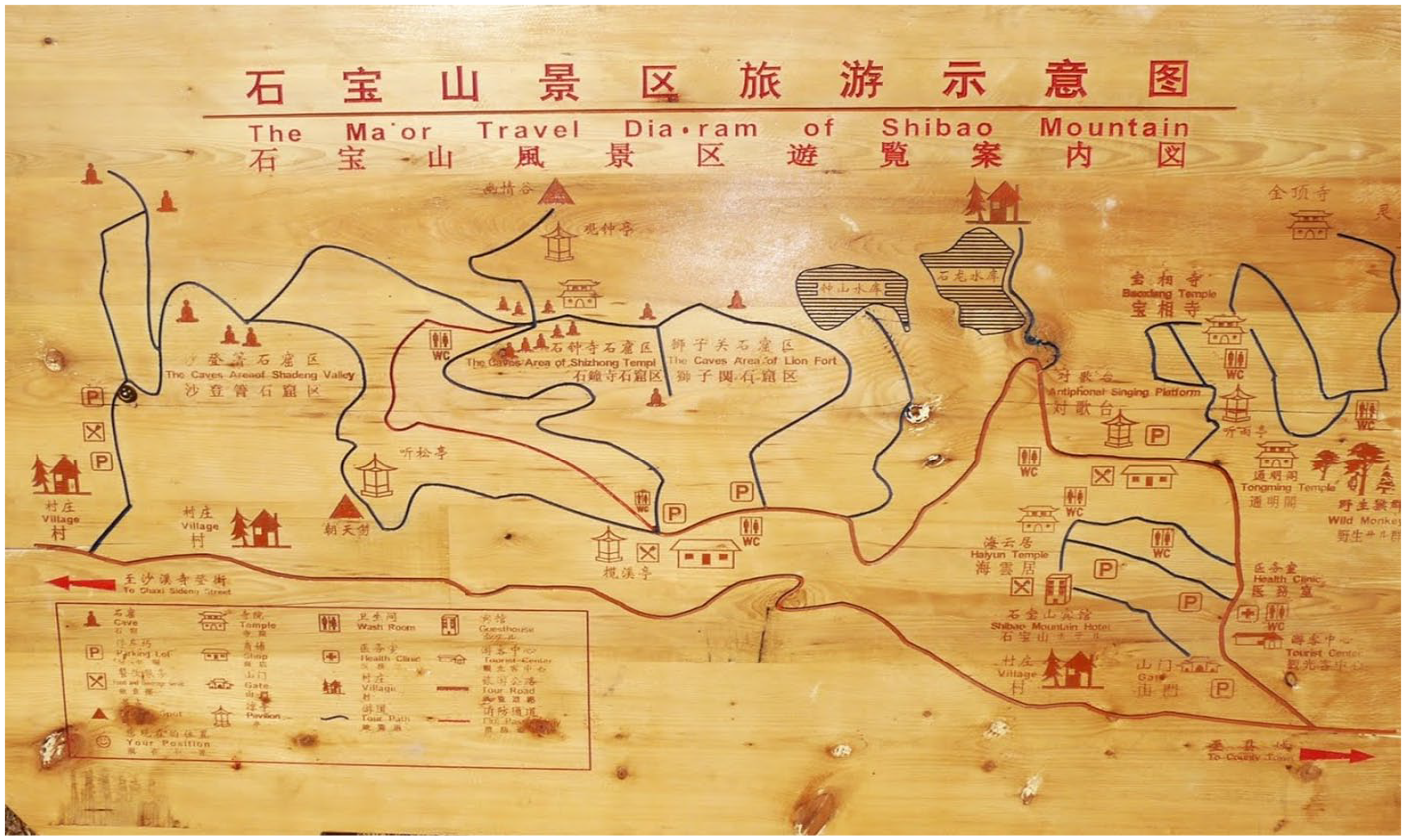
Map of Shibao Mountain walking trails near Shaxi.
The absence of explicit connections made to the trails’ Chamagudao heritage on-trail was a consistent theme. Official tourist trails, like the Cloudpass or Yubeng’s trails, did include waymarkers and provided heritage-oriented information on-trail and via related material such as websites. However, it was local histories mobilised as heritage framings. For example, the Cloudpass drew on stories of Kublai Khan resting his horses near a mountain lake before conquering Dali, while Yubeng drew on its Tibetan heritage, natural beauty and the myth surrounding its long status as a hidden paradise. 2 Other trails created and maintained by local communities, like the Tiger Leaping Gorge or the trails surrounding Bingzhongluo in Nujiang Valley, were focused on information on and off-trails of a primarily utilitarian nature, such as accommodation markers or safety warnings in the Tiger Leaping Gorge pictured in Figures 9 and 10.
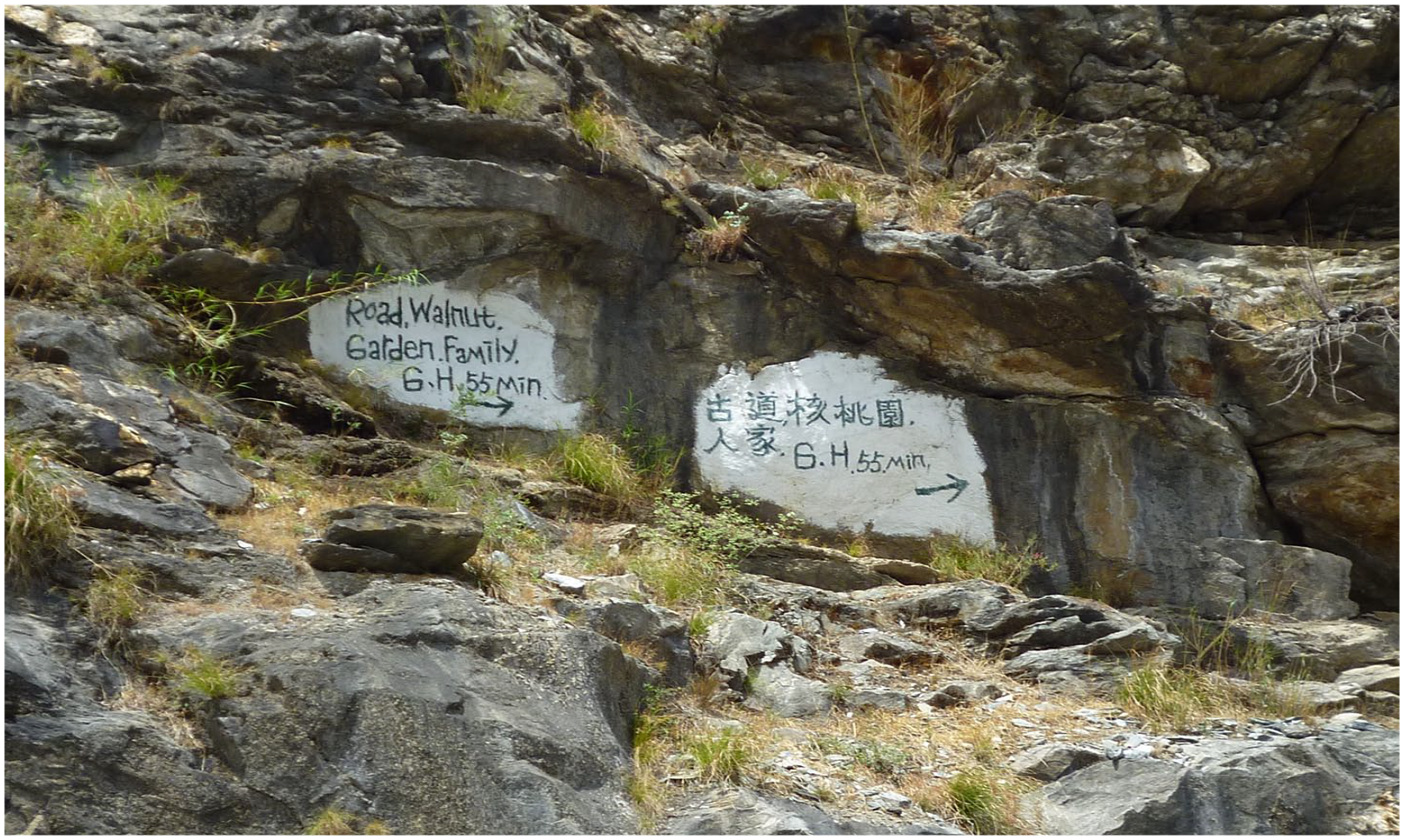
Tiger Leaping Gorge accommodation waymarkers.
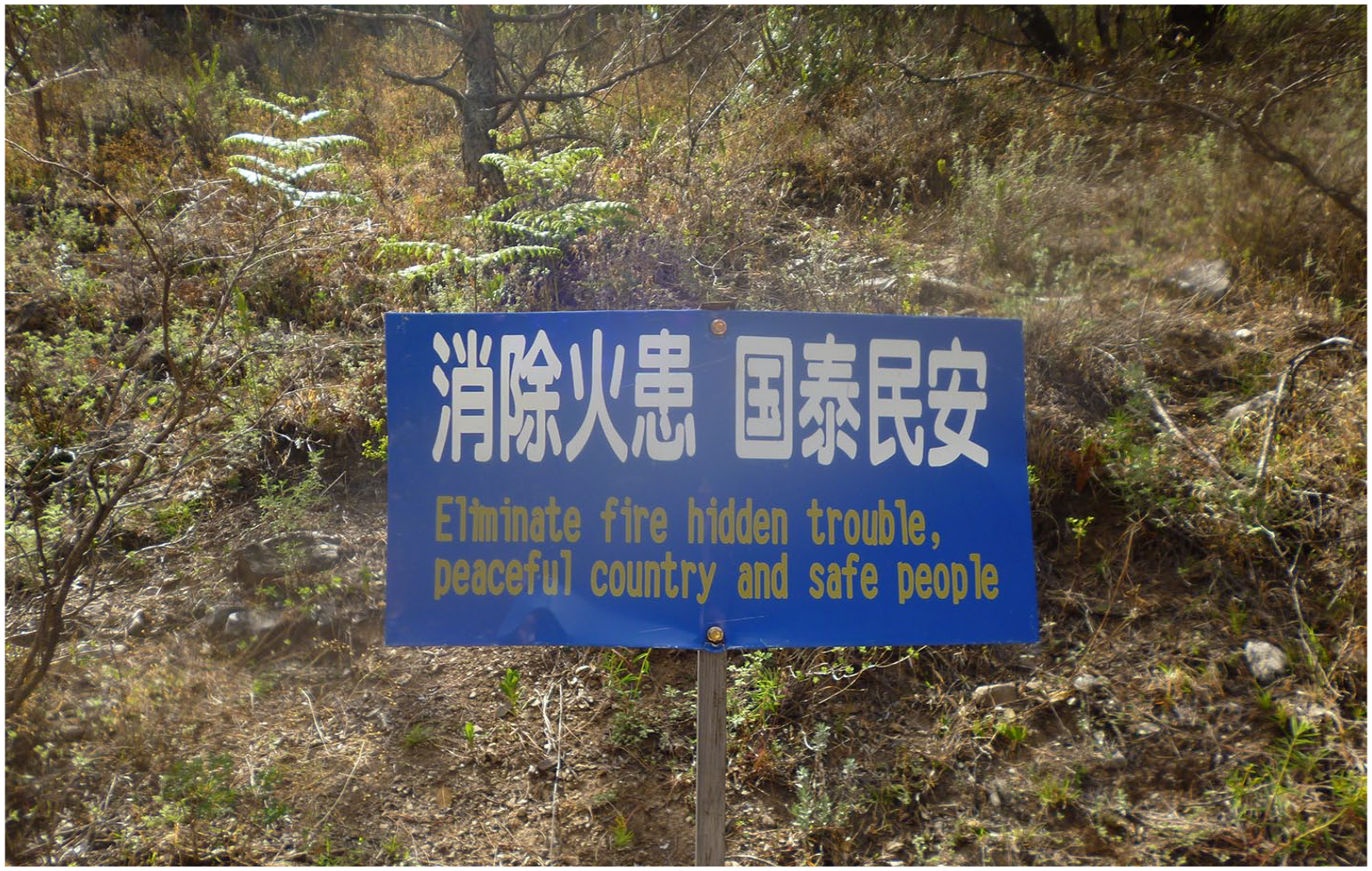
Tiger Leaping Gorge safety warnings.
Thus, connections between trails and their Chamagudao heritage were largely left to chance not only pre-visit but also on-trail. As signage related to trails’ heritage helps visitors connect better to histories and vanished landscapes (Guichard-Anguis, 2011), the absence of signposting of trails’ Chamagudao heritage increases the difficulties for tourists to make such connections even when specifically sought.
While Chinese participants aware of the Chamagudao’s existence were able to draw on local knowledge brokers to make potential connections between trails and the Chamagudao explicit, or, as a guides termed it, ‘knew to ask’, international tourist were less likely to even suspect a link. The trails’ heritage tended to remain opaque to them: We had read about the Tea-Horse Road in the Lonely Planet, but it seemed to be in a different place, not here, not the Tiger Leaping Gorge. So, is the Tiger Leaping Gorge part of the Tea-Horse Road? We’re also planning to go to Yubeng. Is that Tea-Horse Road, too? You said it’s basically all Yunnan? (K)
Even for Chinese participants explicit connections between the trails and the Chamagudao were difficult to ascertain: You asked if we know about the Chamagudao. I think all Chinese know it’s in Yunnan. But not necessarily that Yubeng is also [part of it]. Even now we’re here, I know but I can’t see it anywhere. No signs, no nothing. (C)
This opaqueness of trails’ heritage was noted also among guides. A guide in Jinghong noted many hiking trails she guided her clients along were former caravan trails, which remained invisible to tourists: There are many trails I take clients to that are old Chamagudao. But if you don’t know to ask then you would never know. Some of my Chinese clients, because they know this area is Tea-Horse Road, they will ask and then I tell them or the villagers we visit tell them. But you have to ask people. When I take tourists to the trails, they don’t know, only if I tell them. These trails are not official. There are no signs. So, you have to already know, or someone has to tell you. (Guide S)
Thus, only the already initiated or those told by the initiated were able to connect the Chamagudao’s heritage and their walking experiences. In creating mobile heritage experiences, it is thus not only important to facilitate corporeal mobilities but to include material markers of supporting stories and information on these trails. On the Chamagudao trails, encounters with these stories were largely left to chance, dependent on tourists being able to access local knowledge.
Mobilisations on the micro-level?
There are signs the Chamagudao’s trails are being mobilised as ‘destinations-in-motion’ through walking mobilities tracing the Chamagudao’s historic lines as the result of non-state actors’ practices, including tourists, local communities, and hiking guides. The Chamagudao as historic route that can be travelled on foot was perceived to hold clear appeal to a diverse market: I could see a Tea-Horse route having wider appeal than just China, like India and other neighbouring countries. [. . .] Also, I expect China’s young people could be into the route, as another ‘find yourself’ experience some had by going to Tibet in years past. (Guide K)
Guides emerged as key actors in the rediscovery, protection and linkage of remaining trails with their Chamagudao heritage. Several guides interviewed engaged in identifying trekking routes for clients, including those specific to the Chamagudao. Scouting trails, guides would establish trajectories, length, and difficulty levels of routes, and secure basic resources for their clients. This included, for example, establishing relationships with villages along the identified routes to provide basic accommodation and provisions, while themselves providing the expertise needed to navigate trails. Where relevant, it would also include drawing on local knowledge about these trails’ connections to the Chamagudao to make heritage links knowable to clients: Normally it’s a three-day-trip trekking. The people homestay with the local minorities and in the night we’re cooking together. [. . .] Because in the mountain area most people are Bulan or Aka and they grow tea, they know a lot about the Tea-Horse Road. So [tourists] can visit the tea field and afterwards I also take them to the Tea-Horse trail. (Guide J)
Equally, more direct exchanges between locals and tourists mobilised trails’ Chamagudao heritage. ‘Uncle’, a mushroom trader in Shaxi, had been asked by two participants to show them the way to the Shaxi-Mapingguan trail. Both wanted to walk ‘the real Chamagudao’, which had brought them to Shaxi. I asked ‘Uncle’ whether he thought the trail would eventually vanish like others since the new road between Shaxi and Mapingguan was almost finished: I hope not. It is a part of our special local character. Maybe tourists like you will keep it. You are not the first tourists I have helped to find the trail. And also, the one to Huaceng. And I have seen some other locals guide tourists here. Some travel by horse, some walk like you. They all seem to enjoy it a lot. Maybe the trail can become a real tourist attraction. Maybe the government can do something. (Uncle, translated by XH)
Tourists’ reported interest in the Chamagudao’s trails is echoed by other locals. A hostel in Shaxi organised treks to Mapingguan and other Chamagudao trails in this area, which were well-received by guests as a staff member said. In Bingzhongluo, trails acting as local connectors between the valley and settlements in the higher mountain regions had been mapped by an entrepreneurial local as tourists had increasingly been asking where to hike in the region. A conversation with an accommodation provider revealed these trails were not officially designated tourist attractions, although some were situated in the broader Nujiang First Bend Scenic Area. He observed a slow but steady increase of tourists seeking to hike on these trails: These trails, we [locals] know them and many of us travel them a lot. They are sometimes the only way to a village. Many are tough. But they are a part of this place. You even see small mule caravans bringing things up and down the mountains. Some people, like you, are interested in this because it’s like the Chamagudao has not stopped here. (L-A)
Thus, trekking guides and local communities play essential roles in mobilising and sustaining the Chamagudao as a route still travelled on foot.
Equally, tourists seeking out surviving Chamagudao trajectories are important actors in mobilising a mobile, trail-based experience and understanding of the Chamagudao. One sub-group among participants focused on Chamagudao trails rather than nodal attractions, seeking mobile re-enactments of history, reflecting forms of secular pilgrimage in their choices (Witte, 2021): Because we really wanted to see the Chamagudao. And really experience it. So, we decided to come to Shaxi. [. . .] There are several trails of the Chamagudao here we can walk. That’s really cool. Because in other places, you can maybe see a museum or something, but the trails aren’t there anymore. (XH) So, I think you have to walk. There is really no other way to understand. You get to feel kind of the same things, I guess? (XM)
Although walking tourists’ awareness of the Chamagudao varied, upon discovery of this heritage the consensus was walking experiences were enhanced by the notion of following historic mobilities along its trails: I think that makes hiking here more special as well. [. . .] because it’s a bit like walking in someone’s footsteps. I think that is really cool. [. . .] I mean, then probably even people who don’t normally hike would want to come and do part of it. Because that is quite different than going hiking just in random places. It’s kind of, yes, like this is real history. (HL) I enjoy hiking no matter Chamagudao or not, right? But when I saw the pictures of the local caravan the [accommodation] owner showed me and he told me ‘You know, this is real Chamagudao’, I felt like ‘Wow, so this is like, a really important trail, not just any trail’. Maybe I can do more. (Q)
Participants not only appreciated the added layer of perceived meaning in their walking experiences, but in some cases, it sparked a desire to find other Chamagudao trails, further supporting a slow bottom-up mobilisation of the Chamagudao’s trails as mobile heritage. Thus, tourists’ practices emerge to play a crucial role in the formation of the Chamagudao as a mobile heritage route, supporting the view that tourists’ agency and performances need to be considered in explorations of how destinations’ characters develop alongside the structures and discourses within which they are embedded (Iaquinto, 2020; Yuan, 2022).
Discussion
A mobile lens for investigating how the Chamagudao’s heritage is practiced and perceived illustrates the importance of corporeal mobilities to experiencing historic mobilities along the Chamagudao’s lines. It illustrates the role of non-state actors ‘on the ground’ in mobilising the Chamagudao’s route heritage at times in contrast to more sedentary interpretations visible in the touristic media and local official narratives tourists encounter visiting Chamagudao towns and villages. Engaging in vernacular heritage-making practices, tourists, guides and residents enact and proliferate a mobile version of the Chamagudao. This reflects a view of walking as ‘a trail-based cultural performance of heritage’ (Barber, 2019: 305), and of heritage performances and enactment being no longer limited to monumental buildings and artefacts (Robinson and Silverman, 2015). Their practices produce meanings both on officially designated tourism trails and unofficial trails, rendering the former Chamagudao trails rather than ‘just’ walking trails, and the latter to be discovered and maintained as Chamagudao walking trails in the first place, illustrating walking and other mobile practices’ potential for securing otherwise marginalised interpretations of heritage (Wang and Kao, 2017). Corporeal mobile practices bring the Chamagudao’s mobile heritage to life, articulating trails as ‘landscapes genuinely suitable for movement on foot’ (Svensson et al., 2021: 243). Trails are thus mobilised as ‘destinations-in-motion’, in turn framing the Chamagudao as a mobile heritage destination of nodes and lines. Mobile practices traced here emerge as integral to the construction of the Chamagudao as mobile heritage, and importantly, indicate the marketability of the Chamagudao as a heritage route where tourists can trace part of its historic lines on foot. The research therefore echoes Dobson (2011); tourism planners should consider the importance of landscape and the heritage it represents beyond spatially bounded sites.
Within China’s tourism context specifically, Yuan (2022) attests to a ‘new wave of place-making of the Chinese countryside’ initiated by a top-down model of tourism development in China. China’s central government’s commitment to developing its mobile heritage is articulated in the Wuxi Declaration on Cultural Route Heritage Preservation noting ‘objects of preservation have expanded from the heritage object itself to include the surrounding environment and visual corridor’ and ‘types of heritage have expanded from the static to the mobile’ (Wuxi Changyi, 2009 in Sigley, 2023: 5). With specific view to the Chamagudao, the central government included it in the List of Major Officially Protected Sites at the National Level (State Council, 2013) indicating its perceived cultural value in the national heritage discourse. Under the China Principles the Chamagudao further falls specifically under the sub-category of heritage routes defined as: “created by activities related to transportation, the migrations of people, trade and commerce, or military movements within a specific geographic area and consist of road or water transportation networks together with associated sites”. (ICOMOS, 2015: 59)
Notably, this definition explicitly refers to the transportation networks themselves (as well as associated sites) as heritage. Article 38 further clarifies that for cultural landscapes, heritage routes and waterways conservation should apply to ‘the entirety of the site, while also conserving important, individual elements’ and include the setting and natural landscapes in the area (ICOMOS, 2015: 97), which implies the inclusion of trails alongside more bounded sites such as towns.
However, even in a top-down model of tourism development like China’s, said developments are nevertheless open to different kinds of tensions and multiple interpretations (Yuan, 2022). The findings presented here indicate that the mobile narrative of the Chamagudao as envisioned by the central government lacks realisation in government and business practice on the local level in Yunnan, where Chamagudao-themed experiences tend to focus on museums, ancient buildings, and tea experiences, with linear aspects of the Chamagudao heritage restricted to small sections of cobble stone paths leading through towns.
Instead, it is the walking mobilities of tourists, residents and guides producing an understanding of the Chamagudao as a heritage route of past and present mobilities that converge with the narrative of the Chamagudao as a cultural route the central government has put forward. However, for now at least, the knowledges produced at the local level by tourism administrations, private tourism enterprises, and touristic media favours a much more sedentary, nodal construction of the Chamagudao, where opportunities to re-enact and perform its mobile heritage through corporeal mobilities using its lines remain largely marginalised. These observations further previous arguments that tourism ontologies are multiple, interwoven and complex, marked by multiple relations and agencies between and of different actors (Ong et al., 2023; Yuan, 2022).
The divergence of meaning-makings and material productions of knowledge illustrated here reflects the socially constructed nature of heritage (Dobson, 2011) as well as tourism spaces (Yuan, 2022). Developing, interpreting, and managing cohesive cultural heritage routes is a complex undertaking, defined by stratified cultural values, meanings and interpretations and the presence of numerous and diverse human activities along their trajectories producing a multi-facetted landscape of social, cultural, economic, and environmental effects. The Chamagudao, like other heritage destinations, involves multiple stakeholders ascribing different meanings and holding different interests in relation to the development of heritage for tourism (Paquette, 2021). Complex relationships between public and private institutions, communities and tourists underlie heritage construction in general (Paquette, 2021). The Chamagudao’s scale and its administratively, entrepreneurially, topographically, and culturally diverse landscape heighten this complexity.
The challenge of identifying remaining trails and routes is apparent, as is a perceived and self-reported view of local administrations that most walking trails provide little attraction to tourists coming to experience the Chamagudao. Additionally, administrative complexity inherent to the Chamagudao that transverses political boundaries at the subnational level, spanning several prefectures, counties, and townships with varying levels of tourism development poses a further challenge. On the provincial level alone, the Chamagudao is considered to be a key heritage route crossing Yunnan, Sichuan and Guizhou and numerous local administrations within each of these (State Council, 2013). While China’s central government sets out an overarching heritage policy in terms of planning and decision-making in tourism, it is the provincial governments communicating and often interpreting these while local governments implement policies and are responsible for the coordination of resources, promoting their tourism brands and creating sustainable development plans (Liu et al., 2020). The resulting multi-departmental and hierarchical structure, conflicts resulting from overlapping remits of multiple authorities, and regional discrepancies and competition can impose barriers to holistic and cohesive tourism planning across levels and administrative zones (Marafa et al., 2019; Zhang and Xiao, 2014). This is confirmed in a report by the CPPCC National Committee, which outlined that current work relating to the preservation and planning of the Chamagudao as a heritage route is insufficient, citing an inconsistent approach across individual regions and lack of overall planning to be key issues (CPPCC, 2017).
Additionally, the different businesses involved in the production of the Chamagudao as tourist destination focus on distinct aspects of its heritage. Where entrepreneurs in the tea business may be more focused on the promotion of nodal destinations along the Chamagudao, such as its tea mountains, trekking guides are unsurprisingly keen to protect and develop the Chamagudao’s route aspect.
What has been outlined here is that applying a mobile lens to the Chamagudao’s and its individual locales’ development offers opportunities to create links nevertheless, while also satisfying the central vision outlined in the Wuxi Declaration of heritage expanding from a specific site to include cultural routes. The current Chamagudao is an amalgamation of individual towns and tea mountains, each varying drastically in how and to what degree the Chamagudao’s heritage is presented, often leaving tourists unsure whether destinations visited were part of the Chamagudao. Incorporating trails and using these to link nodal attractions and destinations under a Chamagudao umbrella theme could help develop it into a cohesive mobile heritage route, especially since the potential of walking trails to boost the attraction of cultural heritage sites is widely recognised (Dobson, 2011). This is also supported by Yuan (2022), whose work on rural villages in China that have become tourism destinations points similarly to the importance of ‘legibility and themefication’ (p. 140) in affording the tourist access to landscapes as tourism spaces. Notably, she specifically notes that tourist trails can play an important role in linking wider areas into a thematically recognisable narrative. Previous research indicating a rise of active outdoor-based tourism activities in China, such as walking (Li et al., 2017, 2020; Witte, 2021; Witte et al., 2023) provide additional rationale.
This research cannot identify whether the development of one fully linked-up trek that can be walked continuously is feasible. Numerous challenges like vanishing of many original Chamagudao lines, issues of identification, questions related to safety, other land uses and land ownership, combine to make such an undertaking seem extremely ambitious at least. However, creating a cohesive and mobile experience of heritage on the Chamagudao can be achieved otherwise. For example, The Routes of the Olive Tree is not a physically linked route but links its individual parts through a central narrative of mobility allowing the olive tree to become a cultural and natural marker across the Mediterranean, which can be enacted through mobile practices along specified routes and trails in different olive-tree destinations that are only partially physically linked (Council of Europe, 2023). (Re)linking the Chamagudao’s linear mobile heritage by incorporating remaining trails to and between nodes within local tourism planning and information disseminated to tourists would allow tourists seeking mobile heritage experiences to partially enact historic caravans’ movements, and for nodes along these lines to draw on synergetic effects experienced on other heritage routes (Hamilton and Alexander, 2017; MacLeod, 2017; Timothy and Boyd, 2015). Current bottom-up-practices by tourists, guides and residents are promising signs for the desirability of trail-based mobile interpretations of the Chamagudao as a mobile heritage destination and its trails’ development as ‘destinations-in-motion’, linking corporeal mobilities and heritage experiences. As they alone are however unlikely to be sustainable without the explicit support of local government, this research provides a rationale for practicing the vision outlined in The Wuxi Declaration at the local level of tourism planning and development.
Conclusion
This article has contributed to the understanding of mobile heritage constructions, illustrating the fundamental importance of facilitating corporeal mobile practices and experiences. Thus, the suitability of a mobile lens to the development and assessment of linear heritage, specifically tourism routes and trails is demonstrated. The research supports the need to consider trails as heritage themselves rather than just transport corridors (see MacLeod, 2017), emphasising tourists’, residents’, and trail guides’ perspectives of trails as heritage. The shortcomings of the Chamagudao’s development as a heritage route are demonstrated, identifying three key issues: lack of integration of trails in official and media narratives of the Chamagudao at the local level, limited integration and visibility of Chamagudao heritage narratives on its trails, and an ongoing reduction of remaining Chamagudao trails, which threatens future opportunities to address the first two issues and is itself exacerbated by the same.
Yet, the research also provides evidence that even in a top-down-system like China’s tourism industry, ground-level practices of non-state actors still matter and can contribute to the protection and even revival of heritage, while offering interpretations and experiences thereof otherwise marginalised. However, considering the Chamagudao’s spatial, cultural, and historic dispersion, these are unlikely to create a cohesive route narrative.
The research thus provides a rationale for developing the Chamagudao through an explicitly mobile lens and for realising the vision outlined in The Wuxi Declaration for the Chamagudao across administrative levels of tourism planning and development. Chamagudao trails still exist, often close-by nodal destinations, some already designated as tourist trails but not linked explicitly to their Chamagudao heritage, others unofficial but already visited by tourists. Explicitly linking official trails with their heritage both on- and offsite and incorporating unofficial trails into the marketed tourism canon provides opportunities to mobilise the Chamagudao’s linear heritage alongside its lines, enhancing destinations’ tourism portfolio, and contributing to the long-term survival of remaining trails. Drawing on local knowledge brokers’ expertise is needed to ensure a participatory approach inclusive of these stakeholders’ mobilities. Here, further research is required to understand local stakeholders’ needs, heritage interpretations and capacities. Moreover, tourists already walking the trails should be consulted to identify how mobile experiences of the Chamagudao can be best facilitated.
Footnotes
Funding
The author(s) disclosed receipt of the following financial support for the research, authorship, and/or publication of this article: This research was supported by the Doctoral Research Fellowship 2014-2018 of the Centre for Events, Tourism and Hospitality Management at Leeds Beckett University.
