




Abstract
This paper applies indigenous research methods to understand the motives of visitors attending Penitensya (a Lenten Filipino ritual involving violent ritualistic performances) which we introduce as a novel form of religious-dark tourism. The paper also examines the tourism product potential of Penitensya as a controversial, yet potentially valuable feature of Filipino public culture. The motives of visitors to the Penitensya ritual in the Philippines during the 2019 schedule of events are examined to understand the touristic appeal of this unique form of religious-dark pilgrimage which involves overt and abject rituals of mortification and self-harm. Analysis suggests that the motives for attending Penitensya resonate with the motives of visitors to dark tourism attractions, and these include the allure of a novel cultural experience, knowledge-seeking and rubbernecking. The findings suggest that Penitensya might have unrealised potential as a legitimate form of intangible Filipino cultural heritage, but in order to authenticate the event as part of the nation’s cultural tourism product mix it must be carefully curated and marketed, and embraced by local authorities and the wider community.
Introduction
Penitensya – translated as ‘repentance’ – is a Lenten ritual which is practiced on Maundy Thursday and Holy Friday in the Philippines. Although specific visitor numbers are unknown since no measurement has occurred, anecdotal accounts suggest the event attracts thousands of local and international tourists every year. Locals typically perform the ritual as a spiritual gesture to repent for sins, to commemorate and appreciate the sacrifice of Christ, and to fulfil a vow or a promise. Controversially, and contrary to the wishes of the Catholic Church, which views the ritual as heretical, participation involves penitents; hooded, half-naked men, scourging themselves by cutting and whipping their flesh with leather straps or strips of bamboo as an extreme act of mortification (Moratilla, 2018). Some participants carry crosses through local churches and lie on scorching concrete pavements, whilst others consent to being ‘crucified’ (but not killed) as the ultimate act of sacrifice. Cross bearing and flagellation are common in Central Luzon in the provinces of Bulacan, Pampanga and Laguna. The motivations to take part in Penitensya include atonement for sins and the opportunity to show gratitude for answered prayers (Prudente, 2017). However, younger penitents ostensibly take part purely for fun and the allure of a novel experience. Despite protestations from the Catholic Church, particularly the Archdiocese of San Fernando, the ritual has grown in popularity, and it is now listed amongst the official calendar of annual events hosted by the city’s authorities and the Department of Tourism in Central Luzon, which is the setting for this research (Prudente, 2017). This paper examines touristic interest in Penitensya as a form of religious-dark tourism. The specific aims are: (1) to establish the extent to which the motives of visitors to the Penitensya ritual resonate with the wider motivations associated with dark tourism site visits and (2) to explore the extent to which dark tourism plays a role in diversifying the touristic appeal of Penitensya beyond that of religious pilgrimage. The possibility that the event might be considered at once a site of religious tourism pilgrimage and as a dark tourism attraction is therefore put to the test. The rationale for the study has its roots in observations made in Light’s (2017) recent review of 20 years of cumulative dark tourism literature. Light suggests that the links between dark tourism and death are not ontologically stable, and that previous research has conceptualised dark tourism in terms of deviance and participation in ‘dark leisure’ activities that are shameful, embarrassing or socially condemned. The paper argues that Penitensya is a clear example of dark leisure, and therefore qualifies as a hybridised form of religious-dark tourism.
To fulfil this investigation, indigenous methods of cross-cultural research taking orientation from Sikolohiyang Pilipino (Filipino psychology) were employed to gather data (Pe-Pua, 1989; Pe-Pua and Protacio-Marcelino, 2000). Data primarily consists of photographs and field notes based on observations and serendipitous interviews with 12 local, and three international visitors who travelled to witness the proceedings in April 2019. A literature review explores the nexus between religion, pilgrimage and dark tourism, before the methodology sets out the research approach used to gather and interpret data. The findings suggest that the event is a unique hybrid of religious-dark tourism, which has the potential to be marketed as a legitimate form of cultural tourism. We propose that Penitensya could be embraced and promoted as part of the cultural tourism product offer of the Philippines given that it is clearly hardwired to the nation’s public culture as an important annual celebration. Furthermore, we mobilise and develop upon Podoshen et al.’s (2017) concept of abjection theory by harnessing an example of deviant leisure that showcases real violence and bloodshed to an emerging touristic audience that are, to an extent, driven by jouissance (a certain allure towards the abject). Penitensya presents a hitherto unexplored category of dark tourism festivity that takes place away from a ‘comfortable, controlled and prestigious venue’ (p. 18) and in this sense it offers a fertile unit of analysis to explore visitor motives and concepts such as abjection.
Theoretical background
Religion, pilgrimage and festivity
There appear to be two types of religious tourists: first, those whose faith and spiritual beliefs are congruent to the destination and second, those whose faith and religious beliefs (or non-faith) are not congruent with the destination. In the latter case, visitors may be motivated by novelty, and the opportunity to appreciate heritage and religious buildings as cultural, rather than religious relics. For visitors in this category, religious practices are viewed as novel and curiosity becomes the principal motive for taking part (Asi et al., 2015). Religious tourism can take many forms including visits to religious sites, missionary travels, fellowship vacations, crusades, conventions and rallies, monastery visits and guest-stays, faith-based camps and pilgrimages (Asi et al., 2015). Short term or ‘day trip’ pilgrimages, as referred to by Rinschede (1992) are the specific focus of this paper. Nolan and Nolan (1992) note that festive pilgrimages and religious events are attended by both local residents and inbound visitors, ranging from those that are principally driven by religious interests, to those with secular motives. They suggest that the mix within this complex matrix tends to vary depending on the contrasting types of religions and attractions, and that procedures and policies tend to emerge (e.g. wearing appropriate clothing and behaving respectfully) where conflict between residents/non-residents and religiously/secularly motivated visitors arise. The attraction base, the authors suggest spans three, often overlapping categories as follows:
(1) pilgrimage shrines, which are defined as places that serve as the ultimate goal of religiously motivated journeys from beyond the immediate locality
(2) religious tourist attractions which can take the form of structures or sites of religious significance, often with historic or artistic importance; and
(3) festivals of a religious nature
All three of Nolan and Nolan’s categories bear relation to the Holy Week Celebrations in the Philippines, although the third category is the focus within this paper. Greenwood (1989) notes that religious festivals are often viewed as functioning, or potential tourist attractions that are temporally bounded and which share many of the characteristics, including the challenges, commonly associated with other, ‘mainstream’ event attractions. The extent to which religious festivals are engrained features of public culture determines their potential to succeed as tourism attractions. For example, the popularity of Christmas markets in various European destinations are a testament to the power of targetted advertising as well as to local support (Jansen-Verbeke et al., 2005). The extent of Catholic religious events such as Carnival, Easter, Pentecost and Corpus Christi, incorporating a number of feast dates in the calendar year mean that there is likely to be a religious festival taking place somewhere in Europe on any given day of the year (Nolan and Nolan, 1992). The impact of tourism on destinations that host religious festivals are varied. In addition to the positive economic impacts that are a result of visitation (bed nights, retail, sightseeing and so on), problems often occur when the size of the crowd outstrips the capacity of the physical space to cope with the numbers.
In other cases, Moratilla (2018) claims that the celebrants often feel that they are increasingly staging a spectacle for tourists, rather than authentically pursuing the object of their devotions. The most vulnerable events are perhaps those that occur in the holiday season, such as the pilgrimage to Mecca, which attracts increasing numbers of visitors year on year. Rinschede (1992) separates out religious festivals and events into three contrasting types: short-term, long-term and organisational types of religious tourism. Short-term tourism, the focus of this research, is defined by spatially limited travel over relatively modest distances. The goal is often to reach a pilgrimage site, or to take part in a festival, conference or gathering. Clearly, such events are bound by seasonality and it can be challenging to take a reliable measure of their impact. The phenomenon of dark-religious festivals as a novel example of such a short-term event is considered in the section below.
Religious festivals as dark tourism
The activities that take place on Maundy Thursday and Good Friday in the Philippines include self-flagellation, staged crucifixions and various acts of allegorical mortification which lend themselves to the possibility that the event can be considered a manifestation of dark tourism because of its association with death, violence and suffering (Robb, 2009). Penitensya bears some similarity to the historical ritual of flagellation that has historic significance in Mediaeval Europe (Tiatco and Bonifacio-Ramolete, 2008) when rituals were based on the principles of asceticism. There are also parallels to Turner’s (1969) concept of liminality and communitas which suggest that religious ritual is a complex mosaic of egalitarianism, brotherhood and conflict. As a factionalised community, the penitents that are the subject of this analysis maintain their separateness yet carry out flagellation together. They participate in their devotions, not as individuals, but as a discrete group based ostensibly on community membership that is more or less formally constituted. They gather to pay homage simultaneously, but separately to a common cause (Sallnow, 1981). The type of spectacle that is the subject of analysis here resonates with Grime’s (1992) critique of pilgrimage as an ‘invented rite’ or self-created ceremony which, depending on opinion, can be considered as either an example of ritual creativity, or (perhaps from the perspective of the Catholic church) a widespread cultural neurosis.
The intention of flagellation is to affect a vicarious participation in the pain and suffering of Christ following his condemnation to crucifixion. In the Philippines, flagellation, as a culturally significant ritual was introduced by the Spaniards in the 16th and 17th centuries (Peterson, 2014). The practice was originally carried out to observe the penitential activities of the Christian Church, but it came to be scrutinised by the church and ultimately rejected as heretical. Three ‘spectacular’ performances are carried out as part of proceedings (Tiatco and Bonifacio-Ramolete, 2007: 61): (1) amusan krus (the carrying of the cross), (2) pamamalaspas or pamagparaya (self-whipping or self-flagellation) and (3) pamagsalibatbat (crawling in the street). These behaviours are allegorical re-enactments of the various sufferings of Christ. Participants tend to opt into one or more of these rituals, depending on the extent to which they would like to profess their devotion. Despite the protestations and disapproval of the church, and government officials, these rituals have persisted with obduracy through to the present day (Moratilla, 2018). The profiling of the festivities across mass and social media have meant that it has increasingly caught the attention of global audiences, leading to an increase in tourism (Bräunlein, 2009, 2012). Crucially, Moratilla (2018: 151) notes that ‘. . .flagellating oneself in public constitutes a blurring of the barrier between the personal and the public—that is, while the pain inflicted is ostensibly individual and solitary, it is also communal’.
Flagellation is also therefore a potentially curious aspect of Philippine culture that attracts the attention of both religious and secular visitors. It is this very possibility that is a central motivator of the primary research reported in this paper, which seeks to examine the motivations of spectators of these activities in order to contrast these with the motivational characteristics more commonly ascribed to other examples of dark tourism-as-pilgrimage, such as personal growth, empathy, spiritual travel and a search for unity (Collins-Kreiner, 2015). Other motivations include sensation seeking, voyeurism, rubbernecking, the desire for a novel experience or adventure (Podoshen, 2013), cultural, educational, recreational enlightenment and a desire for cheap thrills (Robb, 2009).
The phenomena of tourism visits to sites associated with death, suffering, tragedy and the seemingly macabre is a well-established feature within tourism academia (Cohen, 2011; Foley and Lennon, 1996; Seaton, 1996; Stone and Sharpley, 2008). The nexus between death and tourism is a historical one, with roots that reach back to at least the early 19th century (Seaton, 1996), whilst the phenomenon of dark tourism, which places more of a focus on the chronological distance of the events that are interpreted at such sites has come to dominate the literature on this topic (Stone, 2013). Travel to places that are associated with death and the seemingly macabre is increasingly common, and includes a range of experiences from battlefield tourism to visiting the sites of massacres such as ground zero in New York, as well as visits to recent sites of tragedy such as L’Aquila in Italy (Isaac and Ashworth, 2011; Wright and Sharpley, 2016). Isaac and Ashworth (2011) note that there has been a pronounced growth in the number of visits to dark tourism sites in recent times, typified by the record number of visitors (1,400,000) to the iconic Auschwitz-Birkenau museum in 2011.
Prentice (2004) suggests that when discussing rarefied forms of tourism, such as ecotourism, medical tourism and dark tourism, apprehending and describing motivations can be far from straightforward as tourists, themselves are often unable to explain what has motivated them to travel. Behind our own aim to understand the motives of visitors to the Penitensya event is an awareness that some of the motives that have been identified in the literature in relation to dark tourism sites have some theoretical transferability to the context of a unique religious event themed around gore and death. These motives include an interest in violence (Seaton, 2012), learning about history and culture, morbid curiosity and a desire to ‘see it to believe it’ (Biran et al., 2011).
A competing claim to the idea that interests are driven by sensation seeking and voyeurism (see Cole, 1999) is that interest in death is more general, and not person-specific. Others have contributed typologies to the literature around dark tourism motivations. For example Sharpley (1999) introduced the binary proposition that visits can be either purposeful or accidental, and visitors can be categorised across four related quadrants ranging from ‘pale’ to ‘dark’. This idea was developed upon by Stone and Sharpley (2013) who proposed that a putative category of ‘dark tourists’ are motivated by a quest for a new experience, or some kind of adventure as a unique form of cultural capital. The idea of gaining access to something culturally unique which is overtly ‘dark’ in nature resonates clearly with the spectacle of Penitensya as an attractive prospect for visitors. Further motivational linkages between dark and religious tourism become evidence when considering Kang et al.’s (2012) visitor motivational research at Jeju Peace Park in South Korea. The authors note the centrality of obligation, curiosity and education as the key motivations of visitors in their sample and these are also evident in studies of religious tourism. Education and gaining knowledge are particularly salient motives according to a number of previous studies into the motives of religious tourists (see e.g. Nicolaides, 2016; Timothy and Olsen, 2006). Educational motivation was also found to be a key driver of religious tourism in a large scale, quantitative study by Robina Ramírez and Fernández Portillo (2018).
Crucially, given the second aim of this paper, the scope of what counts as dark tourism has evolved away from fixed heritage sites, museums, monuments and spaces in which tragedy has taken place to now include festivals (Podoshen, 2013), periodic rituals and community traditions (Rashid, 2018). The nexus between dark tourism and secular and religious pilgrimage was first discussed by Seaton (1996), who noted that religion has long been a motivational driver of visits to sites associated with death and dying including battlefields and re-enactments of the death of Christ. Other examples of ‘dark’ sites that attract pilgrims include the Book Depository, in Dallas, graveyards such as Père Lachaise Cemetery in Paris, Jewish Holocaust sites, sites of atrocities and prisons (Isaac and Ashworth, 2011). This association was drawn out in more detail by Collins-Kreiner (2015) who noted that religious pilgrimage can be considered as an example of dark tourism, particularly where there is an attraction to a ‘dramatic event’ that is ‘dark in character’. As well as noting that neither pilgrimage nor dark tourism are necessarily hardwired to death, she also illuminated the theoretical commonalities between religious pilgrimage and dark tourism from the perspective of push and pull motives. She suggests that both types of tourism are motivated variously by personal growth, empathy, spiritual travel and the quest for a strong sense of unity. A further claim is that both ‘types’ of tourist seek out mystical, magical experiences or ‘transformations’. Religious and dark tourism can involve an enlightening, life-changing experience based on a visit to a meaningful site that lies beyond the regular tourist experience (Collins-Kreiner, 2015). Light (2017) provides further legitimacy to the idea that dark tourism need not involve death as a central theme by noting that dark tourism has been conceptualised in terms of deviance where tourists participate in ‘dark leisure’ activities that are shameful or socially condemned. Penitensya is a clear example of this kind of tourism.
Indeed, the idea of dark tourism as a socially problematic and deviant practice has been debated by a number of scholars in recent years. Deviant leisure was first described by Williams (2009) as a catch-all term for taboo leisure pursuits and pastimes such as sexual sadomasochism and radical body modification. In the context of tourism as leisure – and specifically dark tourism, Biran et al. (2011) and Stone and Sharpley (2013) were amongst the first authors to observe a putative deviance associated with those that visit the sites descried by this term, in terms of both their motivations to visit them, and their subsequent ‘enjoyment’ of the experiences. In so doing, these authors frame dark tourism as a socio-cultural taboo, since so many of the attractions and events associated with dark tourism foreground discussions and representations of death (a typically sequestered discourse) within the public culture. Stone (2013) suggests that the term ‘deviant leisure’ entered academic parlance specifically to describe leisure behaviour that goes against the prevailing moral grain of society. Deviant leisure, he suggests – using the example of tourism visits to Chernobyl – describes sensation-seeking behaviour that can be immoral, unhealthy or even dangerous. However, a compelling counterargument to the idea of dark tourism as deviance is presented by Edmondson (2018) who mobilises Madame Tussaud’s defence against the idea that visits to its wax museum exhibitions must be considered deviant. If the desire is common, Tussaud countered, then it is not deviant.
To develop upon the idea of dark tourism as leisure-deviance, the psychoanalytic sociological analysis of tourist behaviour introduced by Uriely et al. (2011) associated unconscious psychological drives such as sex and aggression with various acts of tourism, and in the case of dark tourism they suggested that visits to dark tourism sites are a sublimation of aggression, and a way for our ‘death instinct’ to find expression. Young and Light (2016) suggest that there is something inherently appealing about so-called deviant forms of tourism, since they are increasingly embraced – particularly by younger visitors – as ‘alternative’ and fashionable. Cemeteries are cited as examples, and particularly those where famous icons and celebrities are interred. Interestingly, the authors also note how the living body as ‘the geography closest in’ is increasingly conceptualised as a site of identity and social experience that is constituted through embodied practice and performance of the type witnessed at Penitensya. Podoshen et al. (2015) introduced and examined the idea of dystopian dark tourism involving dark aesthetics, simulation, emotional contagion and the pursuit of both utopia and dystopia. Interestingly their paper discusses the consumption of violence and violent media, noting that consuming violent entertainment can empower some people to overcome fears through desensitisation and by directly facing death. The ‘passive desensitisation’ they describe has interesting implications for the current study which involves an analysis of the consumption of violent spectacle. Of further relevance is Podoshen’s (2013) discussion of emotional contagion, and the idea that emotion is ‘infectious’ in tourism settings where direct sensory engagement with a spectacle such as Penitensya can provoke a mirrored feedback process. The same author later collaborated with others to produce an analysis of abjection in relation to the black metal music scene (Podoshen et al., 2017). The concept of abjection – a ‘terrifying, visceral reaction to stimuli. . .often involving bodily fluids and traces of physical death’ (Podoshen et al., 2017: 3) – has clear relevance to the focus of the current study, particularly the authors’ observation that religions offer an example of abjection by establishing rituals of personal sacrifice and purification which can be performed and consumed as in the case of Penitensya. Indeed, events such as Penitensya constitute what Podoshen et al. (2018a: 347) describe as ‘extraordinary spaces’ which provide visitors with ‘experiences of difference, darkness, and danger sustained by shocking forms of . . . performance. . . within the liminality of the festival space’.
Whether the focal point of debate is motivation or deviance, the scope of dark tourism clearly remains very much contested, leaving open a number of options in terms of the focus of conceptual and empirical research. Religious and secular pilgrimages of the type that are discussed above clearly share some overlap with dark tourism when it comes to visitor motivations and the desire for deviant novelty. Isaac and Ashworth (2011) argue that dark tourism is evolving, perhaps as a consequence of a more knowledgeable, critical and selective tourism consumer base to become increasingly experiential and visual in terms of its appeal. Indeed, market segmentation in tourism generally feeds the demand for increasingly novel, differentiated experiences of the type that can be provided by encounters with sites associated with stories of death, tragedy and suffering. In addition, amongst the more salient contemporary motives of those that engage in dark tourism are spontaneity and sensation (Stone and Sharpley, 2008), in stark opposition to the idea of purposefully curated tourism experiences such as graveyard tours and memorials. These trends, which mirror tourism consumption habits more generally, are reflected particularly in the idea of Penitensya as an example of a transient, yet thrilling, experientially-focussed form of religious-dark tourism.
Penitensya ritual in the study area: Darkness and religion in Lumban
Lumban is about 104 km from Manila, the capital of the country. It is one of the oldest towns in the province of Laguna and has more than 30,000 inhabitants (Department of Interior and Local Government-DILG: Region 4-A Calabarzon, 2019). One of its main tourist attractions is a manmade lake called Caliraya. Another source of tourist revenue comes from its cottage industry, embroidery, which has won the region its recognised status of embroidery capital of the Philippines (Department of Interior and Local Government-DILG: Region 4-A Calabarzon, 2019). During the Holy Week period, Lumban also attracts other types of tourist who are driven by religion, yet potentially, in some instances also motivated by the macabre nature of the practices that are undertaken at the event. The proximity of Lumban makes it a convenient short-term destination for those on their way to nearby tourist sites who may be interested in experiencing Penitensya.
The period from Holy Monday to Black Saturday is devoted to performing rituals intended to commemorate the death, passion and suffering of Christ. Pilgrims and visitors flock to the 16th century Lumban church for Visita Iglesia, a modern-day version of a short-term pilgrimage (Rinschede, 1992). Visita Iglesia involves visiting between seven and fourteen churches, and reciting the Stations of the Cross. In most Catholic churches, the centre of attention is a life-size wooden image of the dead Christ. Another Holy Week practice is the reading/chanting aloud (pabasa) of the Pasyon (Passion), an indigenous epic narrative of the death, suffering and resurrection of Christ told in poetry format which can take several days to read. Many Pasyon chanters/readers consider reading the Pasyon as their form of Penitensya. They might read through the nights and refuse to sleep until they finish the epic narrative. While the Visita Iglesia and the Pasyon highlight the spiritual aspects of the passion of the Christ, the physical element of his death and suffering is epitomised in the self-flagellation ritual, where religion and darkness are in complex interplay.
The methodology described in the next section sets out the approach undertaken in April 2019 to investigate one occurrence of Penitensya as a novel form of religious-dark tourism that attracts visitors with various motives and levels of interest.
Methodology
Indigenous research design
From the indigenous perspective, research is a ‘dirty word’ inevitably bringing up ‘the worst excesses’ of European imperialism and colonialism (Tuhiwai Smith, 2021: 1). Indeed, the practice of Penitensya is a product of religious heritage from the Spanish colonial rule. The type of abjection discussed in this paper ‘carries traces of colonial constructions of othering/otherness in which the native Filipino as barbaric, superstitious, irrational, ignorant, fanatical, etc. was subjected to the outsider’s objectifying gaze’ (Moratilla, 2018: 156). In the case of the indigenous fieldworker who conducted the observations and interviews, ‘research is homecoming, and to “research back” is also a way to return to our communities’ (Moratilla, 2018: XXV).
Research into dark tourism has primarily been pursued using an interpretivist, qualitative paradigm with a tendency towards pluralist/postmodern philosophical stances (Wight, 2006). This study is qualitative in nature and takes its inspiration from ‘Sikolohiyang Pilipino’ or Filipino psychology (Pe-Pua and Protacio-Marcelino, 2000). Sikolohiyang Pilipino (SP hereafter), an intellectual and social movement (San Juan, 2006) amongst Filipino scholars, is a response to a perceived level of cultural insensitivity, inadequacy and the unsuitability of Western-oriented approaches with regards to understanding Filipino culture and mentality (Pe-Pua and Protacio-Marcelino, 2000). This is not to say that Western approaches are rejected. As Pe-Pua (1989) emphasises, while ‘particularness’ is emphasised, ‘universality’ is not neglected. Additionally, he adds that strict borders between disciplines is in itself a western concept which suggests the interdisciplinary nature of the indigenous method posited in SP. In other words, we flag up the complexity of how we are using the word ‘indigenous’.
SP is still in its infancy and has not been fully elaborated or refined for empirical research (San Juan, 2006). What sets SP apart from western qualitative methods is that its concepts and terminology are derived from indigenous customs and common practices of the Filipinos (San Juan, 2006). However, it must be recognised that ‘Filipino-ness’ is in itself a contested concept owing to the colonial experience of the Philippines (Aguila, 2015). To posit that there is a Filipino culture, is to deny the diversity and heterogeneity of the Filipinos.
Despite criticisms of SP, its principles can still be used as a heuristic device. We would like to point out that our aim is not to offer a detailed problematisation of the dichotomy between indigenous and western research nor present an in-depth discussion of SP concepts. Our suggestion is to explore the principles of SP, of which there are five, in order to unsettle traditionally western methods of knowledge production.
The first principle of SP focuses on the level of interaction or relationship between the researcher and the participants which should be built out of pakikipagpalagayang-loob 1 (roughly translated as the level of mutual trust, understanding, rapport). Second, the power relations between the researcher and the participants should be symmetrical. Third, the welfare of research participants takes precedence over the data obtained from them, and nothing that could jeopardise the interviewees should be published. Additionally, if in the course of conducting the investigation, the researcher uncovers any community needs, then they try to intervene, where possible. Fourth, the method used in the research should be adaptable to the existing cultural norms and appropriate to the population. In order to know what is appropriate, the researcher must use pakiramdam (sensitivity, shared inner perception) which is a highly prized virtue amongst Filipinos. Pakiramdam refers to an intuitive type of sensitivity based on being socialised into a culture that valorises high-context communication (Hall, 1983). In high context cultures like the Philippines, there tends to be less emphasis on verbal content; and more on inferring indirect meaning based on the specific situation or circumstance. According to San Juan (2006: 58), pakiramdam is the ‘sensorium apparatus’ or emotional a priori that enables the researcher to calibrate the level of interaction in complex field situations. Indeed, pakiramdam helps the researcher to determine when to ask personal questions, when to conclude the interview and how to interpret non-verbal gestures (Pe-Pua and Protacio-Marcelino, 2000). The fifth principle of research based on SP is that the mother tongue of the participants should be used when collecting data.
The indigenous methods deployed in the collection of primary data for this study were: pagtanong-tanong (asking questions), pakikipagkwentuhan (story telling or informal conversations), pakiramdam and nakikiugaling pagmamasid (participant observation). These methods approximate ethnographic approaches, but they are indigenised in that they are based on the five guiding principles of SP research discussed above (Pe-Pua, 1989). The researcher who conducted the fieldwork was born and raised in the town where the study was conducted, and thus was very familiar with the local norms and practices in addition to the ability to speak the local dialect. However, she received her research training and education in western institutions, which makes the ‘indigenous’ application of research procedures also up for interrogation.
The methods of data collection can be said to approximate western ethnographic methods. As stated above, SP does not reject western methodologies but pays special attention to the skills of the researcher to navigate locally and culturally sanctioned practices. During field work, the researcher engaged with participants through informal conversations (pagtatanong-tanong), storytelling (pakikipagkwentuhan) and active participation (nakikiugaling pagmamasid), all along employing pakiramdam to ‘read’ the situation. This involved visiting the main church and local chapels, going to different homes for the reading of the Pasyon, and attending religious processions.
Data and data collection procedure
With the help of local informants and cultural insiders, the researcher ‘cased the joint’ (Hammersley and Atkinson, 2007: 29) and identified areas where visitors/tourists congregate. First, the community breakfast for flagellants was attended followed by attending the paghihiwa (cutting) session where razor incisions were made on the flagellants’ backs. Second, many tourists, most of them part of the Visita Iglesia tours, went to the town plaza to take in the sights after their church visit to watch the flagellants. Third, the religious processions on Holy Wednesday and Good Friday attracted local and international tourists who were given the option to participate or spectate.
The researcher was ‘invited’ to a pre-flagellation breakfast on the morning of Good Friday. Securing this ‘invitation’ involved standing in the middle of the alley near where the breakfast was going to be held. The fieldworker used this technique knowing that anybody going to the site who recognises her would invite her to the place. But it takes local knowledge to employ this strategy. The greeting for the locals is not ‘hello, how are you’ but it’s either ‘where are you going’ or ‘have you eaten’. True enough, within minutes of being seen standing ‘aimlessly’ (pakapa-kapa) in the alley, the researcher was invited to watch the flagellants’ community gathering. Chairs and tables were set up in the middle of a dead-end street while friends and family of the flagellants brought home cooked meals to share. The flagellants in this study form a tightly knit group. Participation in the rituals, in this sense is not largely spontaneous. Rather the event depends on the commitment of a loosely organised ‘cast’ that has rehearsed its performance on a number of previous occasions, and the motives for taking part might not be any more complicated than adherence to a routine, cultural ritual. Another view is one expressed by Zialcita (1986) who argues that, although the men do not explicitly express it, the Penitensya ritual gives them an opportunity to reinforce their bonds with each other and prove their manliness.
After the breakfast, punctuated by bursts of teasing and banter amongst the flagellants, they got ready for the manghihiwa (cutter) to make tiny razor incisions on their backs. Some of the interviews were conducted while tourists were watching the ritual. Most of the spectators winced and groaned at the sight of blood trickling out of the flagellants’ backs after each incision. However, they seemed to take a strangely deviant interest in the ritual, approaching it as a ‘thrilling circus performance’ (Bräunlein, 2009: 908). The overly eager spectators frantically took close-up shots of the cutting ritual, with a heightened level of arousal as they witnessed the ritual. Podoshen et al. (2017) note that the key to the abject is ‘a repulsion but a realisation and understanding’ (p. 114) that violence is a ubiquitous presence in the world.
After the cutter finished making the incisions on the backs of the 11 flagellants, the penitents assumed a single file formation and started to flog their backs forcefully. They embarked on their pilgrimage around the town, stopping briefly in front of the church and chapels for prayers. They lay on the ground with their arms outstretched to form a cross. They also stopped in front of the houses where the Pasyon was being chanted.
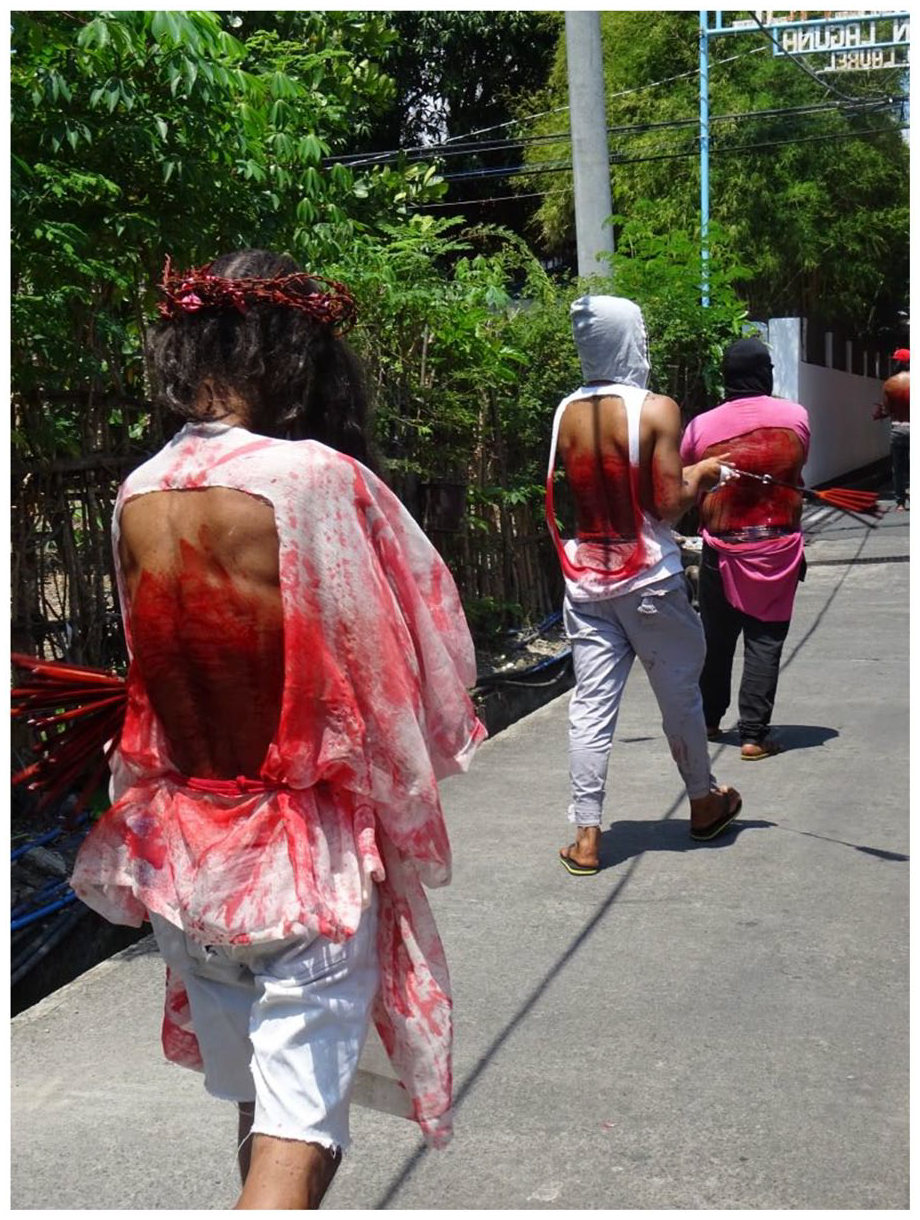
The flagellants, in single file formation, on their way to the church.
Interviews and participant observation
Serendipitous 2 interviews were conducted in situ while the tourists were partaking in the Easter ritual. Before proceeding, we should note that serendipity is not a new concept in research, and indeed ‘chance and serendipity’ have been viewed as keys to ethnographic investigations (Tilche and Simpson, 2017). While field workers are surrounded by opportunities for potentially serendipitous moments, it takes ‘relevant and contextualizing prerequisite knowledge’ to recognise these moments as serendipitous (Tilche and Simpson, 2017: 92). In the context of this research, moments of serendipitously running into tourists were facilitated by cultural informants, insider knowledge and childhood experience of where they might congregate so the fieldworker came equipped with ‘temporal serendipity’ of being ‘in the right place and at the right time’ and indeed ‘where the action is’ (Fine and Deegan, 1996: 7). This approach works well with pakapa-kapa, another SP method which literally means ‘groping in the dark’ (Pe-Pua and Protacio-Marcelino, 2000).
Many tourists who participated in the church tours waited for the flagellants in front of the church where the penitents knelt or lay prostrate in silent prayer. Some visitors attended the processions and participated in the chanting of the Pasyon. The researcher took on the role of a participant observer by attending church activities related to Visita Iglesia, joining the passion singing in two different locations, attending the processions on Holy Wednesday and Good Friday and watching the flagellants have their community breakfast followed by the cutting ritual. As such, the researcher was able to unobtrusively and casually converse with visitors. To collect data, the indigenous approaches of interviewing – pagtatanong-tanong and pakikipagkwentuhan were deployed and the tourists were asked:
(1) what brought you to Lumban?
(2) what is your opinion of self-flagellation as a Lenten practice?
The questions were intended to elicit the visitors’ motivations for visiting the town and to explore the extent to which they share some of the motivational characteristics associated with dark tourism. Some 15 visitors participated in the interviews; 12 from the greater Manila area and 3 from abroad (the UK, USA and Switzerland). The interviews lasted between 15 and 35 minutes, with the three international interviews lasting longer than those with the locals. The fieldworker, using her pakiramdam (innate sensitivity) in high-context settings, approached the interviewees with small talk, introduced herself and the research she was undertaking.
Ethical considerations
Ethical research involving human participants requires voluntary and informed consent, confidentiality and anonymity and protection of the participants from harm. Consent is usually sought in writing. However, this can be problematic for some cultural and ethnic groups where signing a document might be intimidating and might imply a prejudged lack of trust (Liamputtong, 2010). In this study, consent was solicited verbally from the interviewees. To assure them of anonymity and confidentiality, the researcher only asked for their nicknames and their usual place of residence. No harm was foreseen from the publication of their responses, and pseudonyms were used in place of nicknames.
Data analysis
As stated, the aims of this paper were: (1) to establish the extent to which the motives of visitors to the Penitensya ritual resonate with the wider motivations associated with dark tourism site visits and (2) to explore the extent to which dark tourism plays a role in diversifying the touristic appeal of Penitensya beyond that of religious pilgrimage. The two questions asked of the interviewees were designed to achieve these aims. Field notes of interviews and a research journal of observed practices were analysed to identify common themes. The findings are reported below.
Findings and discussion
We have suggested that Penitensya, alongside other Easter events such as Visita Iglesia and Pasyon, can be said to have a dark element since they evoke the macabre, and the death and suffering of Christ (Hartmann, 2014; Robb, 2009; Seaton, 1996). This ‘darkness’ is enmeshed with the religious nature of the event which we argue is an unexplored form of hybridised dark-religious tourism. The discussion of the results below reflects the blurriness of interpreting the tourists’ motivation to spectate the ‘religious-scandalous nature’ of the violent ritual. Interpretations of Pentitensya therefore resonate with Podoshen et al.’s (2018a, 2017) works on abjection in the sense that witnesses to this spectacle are viewing something that is vile and repulsive, yet ‘accepted’ and acceptable as a window into an aspect of national culture. Added to this complexity is the sociocultural background of the local tourists. As stated earlier, the Philippines is high-context culture (Hall, 1983) so the interpretation of verbal content must be interpreted not only based on what is said but also what is not said, taking into consideration the sociocultural context.
Voyeuristic and morbid fascination about a ‘forbidden’ ritual?: ‘They don’t even go to church and on Good Friday, they profess to atone for their sins!’
The accounts in this section were from five tourists who were present at the flagellants’ community breakfast and the cutting ritual. They watched the flagellants leave for the pilgrimage around town.
Angel, a 67-year-old American retiree, professes to be a devout Catholic. She had travelled to well-known religious sites such as Lourdes, Fatima, the Vatican in Rome and Medjugorge. When asked about her motivations for coming to the town, she said that Lumban church was part of her yearly Visita Iglesia, alongside other Catholic churches in the region. And since she has made many friends over the years, she also times her visit to coincide with Good Friday. Although she did not specifically mention that watching the flagellation ritual as one of her motivations, the researcher noted that she was present at the site. When asked what she thought of the Penitensya, she said: ‘I was staying near where the flagellants had their breakfast. I saw them drinking alcohol early in the morning. Look, these flagellants, they appear so holy and all but after the hampas-dugo (flagellation), I bet you they go back to their bad habits. They don’t even go to church and on Good Friday, they profess to atone for their sins!’
Angel added that being a good Catholic is not a 1-day Biyernes Santo (Good/Holy Friday) event; it must be a part of everyday life. She pointed out that one of the organisers of the penitents’ breakfast approached her for a financial donation to buy another bottle of alcohol. She refused and told him that it was inappropriate. Angel seemed troubled by the flagellants and insisted that their practice subverted Catholic beliefs.
Sandro, a tourist from a nearby province came to Lumban to watch the flagellation ritual, which is not an Easter tradition in his town. Without being prompted by the researcher, he commented on the impropriety of alcohol consumption by the flagellants at the breakfast: ‘They’re trying to numb the pain with alcohol, what kind of a Penitensya is that! That is not the way to share the suffering of the Lord; if they are sincere about it, they should really feel the pain’. In other words, Sandro views the flagellation itself as unproblematic but felt that alcohol-mediated pain was unacceptable.
Two of Sandro’s male friends from the neighbouring town, Sta. Cruz, came with him out of curiosity. They wanted to ‘see it to believe it’ (Biran et al., 2011). While watching the flagellants whip their backs to prepare for the bloody ritual, they emphasised that Jesus Christ was crucified to save mankind from sins, so it was unnecessary to engage in self-mortification. One exclaimed, ‘I always wonder why these men do it. Why go through all that pain when they can just go to the priest and confess their sins? Jesus already died for our sins. If they are solid about their faith, they should obey the church and stop flagellation’.
Teyam, from Cavite city, came to Lumban with her family to watch the flagellants and to visit the Lumban church as part of her Visita Iglesia. Lumban was her eighth church, and she was on her way to the National Shrine of Saint Padre Pio in another province. When asked why she wanted to watch the flagellation ritual, she did not answer the question directly; instead, she said, ‘they have this one day a year that they atone for their sins and they think all will be forgiven. Jesus has already died on the cross to save us so what the flagellants are doing is pointless really’.
The motivations reported by the interviewees vary: visiting churches as part of Visita Iglesia, visiting friends and curiosity. While the Visita Iglesia is of undoubtedly religious nature sanctioned by the church; flagellation is deemed as heretical. It should be noted though that while taking in the ‘sights’, the interviewees were expressly vocal about their condemnation of the flagellation. It might not exactly be ‘shadenfreude’, but there seems to be a claim to moral superiority and self-righteousness. In the predominantly Catholic community, self-mortification is viewed as a public declaration of grave sins committed against the faith. Thus, by virtue of spectating a socially condemned ritual that they themselves consider abhorrent, deviant and shameful, the tourists can be seen as voyeurs deriving ‘dark leisure’ from it (Light, 2017). This experience of Penitensya is clearly an example of dark leisure as defined here, and it therefore qualifies as a hybridised form of religious-dark tourism.
Interpreting the verbal accounts of the interviewees without taking the sociocultural background and Sikolohiyang Pilipino into account might result in ‘low context’ analysis (Hall, 1983). The Philippines is predominantly a ‘high context’ culture, thus indigenous researchers need to pay attention to non-verbal language using ‘pakiramdam’ or innate sensitivity (San Juan, 2006). It was noted that while the interviewers gave brief, straightforward answers regarding why they were at the flagellation site, their denunciation of the practice was impassioned. Our interpretation is that they were trying to ‘save face’ (Brown and Levinson, 1987); in order to rescue themselves from the shame of participating in the non-Church sanctioned ritual, they had to express pro-Church sentiments.
The five tourists were at the site from breakfast until the penitents left for their pilgrimage around town. They were all present to witness the grisliest part of the ritual when the manghihiwa (cutter) made the razor incisions in the flagellant’s backs. It is our contention that in addition to their verbal accounts, the tourists must also be partly motivated by elements of rubbernecking and morbid curiosity framed with an air of moral superiority. The limitation of the interview method needs to be taken into account in the analysis. Consistent with Prentice (2004), articulating motivation in dark tourism, is not straightforward because tourists themselves might not be able (or prefer not) to verbalise their own motivation. Indeed, what is the likelihood that they will admit to deriving at least some form of dark, deviant leisure, cheap thrills or voyeuristic fascination in watching other people suffer?
Filipino culture and fulfillment of Panata (vow): ‘I can’t imagine a Good Friday here without the hampas-dugo’
Self-flagellation has been part of the Filipino Easter celebration since the 15th century and has evolved into an enduring cultural tradition as an integral part of Holy Week in central Philippines (Moratilla, 2018).
Ben, a Canadian, reports that his motivations to travel all the way to Lumban every Easter are religious and cultural. He feels that Lent in the Philippines has a much more spiritual focus than in Canada. When he was approached by the researcher, he was sitting in a portable chair in front of his bungalow, which gives him a clear view of the penitents as they walk past his house. When probed how the Penitensya fits into his reasons for the visit, he states ‘It’s part of the Filipino culture. It’s part of Lumban. Although I don’t agree with their flagellation, I can’t imagine a Good Friday here without hampas dugo’. He added that Penitensya is part of the whole Lenten experience alongside Visita Iglesia, the Pasyon and the processions – practices that are unheard of in Canada.
Bobot and Lita, a couple from Manila, took the 4-hour journey to Lumban with their three grandchildren. They said their motivations were to watch the Penitensya and visit relatives. They happened to know some of the penitents and wanted to show their support to them. They sounded sympathetic towards the flagellants: ‘people have their own way of commemorating the suffering of Christ, and Penitensya is one of them. When we go to Lumban on Good Friday, we’ve come to expect the hampas dugo, as well as the pabasa (Passion reading) and the padasal (prayers hosted in homes of community members’. They added that Bobot’s older brother and uncle, both deceased, had participated in the flagellation ritual for many years as part of their panata (vow). It can therefore be inferred that Lita and Bobot were also motivated by a sense of community spirit and solidarity with the penitents. Indeed, it was observed that they exchanged quick smiles and greetings with some of the flagellants, whom they knew by name. Whilst flagellation is a solitary affair, it is very much communal since many locals participate in the ritual, supporting the flagellants as they go about their ritual.
Terio’s case is a little different from the others as he is a flagellant. A visitor from Manila, he has been going to Lumban for self-flagellation since 2011. He had made a promise (panata) to God to self-flagellate on Good Fridays. He even showed the researcher the numerous keloid scars on his back from layers of razor incisions. When asked to elaborate on his motivation, he seemed embarrassed. Another flagellant sitting beside him interjected: “It all started when Terio had a life-threatening experience. He was almost killed by a gang and the only thing that saved him was to jump into the river”.
Terio believes self-mortification is a way to demonstrate gratitude to God and atonement for his wrongdoings. His case, according to other flagellants, is not unusual as local and foreign tourists often join them to experience ‘something very different’.
The notion of panata is a core aspect of Filipino religiosity (Prudente, 2017) and is most evident during Lent. Most flagellants engage in the practice in fulfilment of a promise to God in exchange for favours such as healing or finding a job. Similarly, many local tourists who do the Visita Iglesia and chant the passion are similarly driven by this vow which is usually handed over to and inherited by family members assuring its continuity as a cultural tradition (Prudente, 2017). Even if family members do not live in the town anymore, they make the journey to Lumban to honour the vow.
In her conceptualisation of religious pilgrimage as dark-tourism, Collins-Kreiner (2015) argues that tourists are also motivated by personal growth, empathy and spiritual travel. It is difficult to say to what extent each motive played a part in bringing tourists to Lumban. As stated earlier, there are other events happening during Holy Week. Tourists flock to Lumban for different reasons: to visit the 16th century church as part of Visita Iglesia; join the Passion reading; and take part in the processions. However, while these practices are sanctified by the Catholic Church, self-flagellation ritual is ‘forbidden’ (Bräunlein, 2009). Thus, motivations for partaking the Visita Iglesia, Passion reading and processions can be attributed to religiosity, personal growth and spirituality, interpreting tourists’ motivation for taking in the Penitensya is less straightforward. Nonetheless, all the aforementioned Lenten customs embody the Filipinos’ ‘fascination with the suffering, battered and dead Christ’ (Bräunlein, 2009: 892), with Penitensya being considered as one of ‘extremist’, ‘literalist’ embodiment of Filipino Catholicism (Bautista, 2010: 151).
Curiosity and novelty: ‘It was quite interesting and novel experience for me’
According to Bautista and Bräunlein (2014), the re-enactment of the suffering of Jesus Christ evokes the ‘spectacular’ because of the ‘visceral impact of bloodied flagellants’ directly assaulting our sense of sight and emotional fortitude (p. 502). An international tourist from Switzerland, Hans, came to watch the flagellants because he was curious about what he had heard from other tourists and the media. He said: ‘I’m not a religious person so it was quite interesting and novel for me to experience Holy Week in Lumban. This is my second time here. Before, I was bewildered and somewhat astonished when I watched the flagellants. I did not know what to think. It’s not like I go out of my way to watch them but they walk the streets whipping their bloody backs, so you see them out the window doing their pilgrimage around town. I had never seen anything like it before. It is so bizarre. I respect their faith and practice though’.
The above account resonates with Kristeva’s (1982) association of abjection with jouissance: ‘one does not know it, one does not desire it, one joys it in’. Indeed, Kristeva motes that we are continually and repeatedly drawn towards the abject in the same way we are drawn to trauma according to Freud’s understanding of repetition compulsion. Ultimately, there is a certain pleasure that is felt in experiencing trauma, but one that is quite different to the dynamic of desire. Put another way, what is disgusting may repel but it also captivates imposing itself upon us so that ‘we find our eyes doing “double-takes” at the very thing that disgusts us’ (Miller, cited in Haynes, 2013: 34).
Another international tourist, Margaret from Birmingham UK, was in Lumban only for the afternoon of Good Friday. She was on her way to other tourist destinations in the area – Pagsanjan Falls and Caliraya Mountain Resort. She had heard about the hampas dugo from other travellers and was excited to see it for herself. ‘I’ve heard about self-flagellation here and I wanted to see it for myself out of curiosity’.
Several local tourists echoed similar views. One said, ‘I never thought much of it. I come here, watch grown men crawl on the streets and beat their backs to a bloody pulp. I suppose it’s not something you see every day, it’s different’. Another visitor from the city said, ‘It’s interesting to watch the flagellants. They look very sincere. It’s hard to look at all the blood and the beatings, though. It’s weird’.
The findings reflect a sense of a sense of disbelief, of wanting ‘to see it to believe it’, amongst the tourists in watching ‘torture porn’ (Bräunlein, 2012: 388) or what can be considered as ‘violent entertainment’ (Podoshen et al., 2015). Once again the concept of abjection is notable. Just as Podoshen et al. (2017) note that the presence of blood and animal parts in death metal rituals do not simply encompass a ‘revolting subject’, but also signify a pre-Christian culture and a connection to land and survival, the flagellation and blood on display during Penitensya symbolise the values and traditions of a cohesive community that is steeped in Catholic tradition. The aim is not to shock outsiders, but to maintain and honour an intrinsic cultural tradition. Arguably, their curiosity is likely perpetrated by the local and international media with ‘sensational front-page headlines, news reports and photographs’ of the bloody ritual (Bräunlein, 2009: 897). The field researcher noted that the tourists flinched and squirmed upon seeing ‘violence in progress’ (Robb, 2009: 57). Why do they subject themselves to such an experience? Although verbal replies to the interview support the analysis that they are motivated by morbid curiosity and novelty, their behavioural reactions to the ritual lead the researchers to interpret it as something more. It has been posited that sensory delight, sadistic pleasure and emotional contagion might explain the appeal (Podoshen et al., 2015). The tourists flinching and squirming in choric unison at the sight of the flagellants enable them to partake in an activity and ‘experience emotion based on the place they are in, and/or the accompanying stimuli, and then pass this emotion to others in close proximity’ leading to an ‘emotional state in a chain-like reaction’ (Podoshen et al., 2015: 318).
Is there a difference of perspective between believers and non-believers, between Catholic and non-Catholic tourists? The interview data suggests that some believers/Catholics were very critical of the Penitensya as they expressed disgust and indignation about the misinterpretation of this religious practice. Other believers, especially those who come to Lumban to partake of other rituals such as Visita Iglesia, procession and Passion chanting, seemed more sympathetic to the penitents and accept self-flagellation as an integral part of the Lenten tradition. Those who have little or no knowledge of the Penitensya culture and tradition in Lumban, but have read or heard about it through the media (or heard about it from other travellers) seemed to be motivated by deviant leisure and a voyeuristic and morbid curiosity with the abject. To them, Penitensya provides an experience of ‘difference, darkness and danger’ (Podoshen et al., 2018a) embodied in the ritual.
Theoretical implications
In this section we reiterate the two main aims of this study and discuss how they have been addressed in this paper. The first aim was to determine the extent to which the motives of visitors to the Penitensya ritual resonate with motivations associated with visits to dark tourism sites. Based on interviews with local and international tourists, there are motives that hark back to dark tourism motivations found in previous studies. These are: voyeuristic and morbid curiosity (see Best, 2007; Foley and Lennon, 1996; Podoshen, 2013), an interest in violence (Seaton, 2012) and quest for an overtly ‘dark’ and novel experience (see Stone and Sharpley, 2013). Our findings also build on earlier work by Podoshen et al. (2017, 2018a) by developing upon the idea of death and consumption from ritualistic perspectives. Specifically, this is the first study to look the ‘consumption of disgust’ based on self-flagellation, where the abject is therefore not simulated or artificial, and where authentic horror is foregrounded, rather than only an allusion to violence. We have also, in looking at Penitensya, identified what Seaton (1999) calls ‘socialisation’ – the sequential process through which tourism attractions are gradually marked as meaningful, quasi-religious shrines (Collins-Kreiner, 2015). This event is an example of a dark tourism product-in-development, and future research is required to examine the event in more detail as it matures, in order to update our understanding of visitor motives. We also address Podoshen et al.’s (2017) call for research that looks at death consumption from a perspective that is not purely based on building community, and strengthening religious purview. Penitensya is certainly an example of each of each of these. However, it also tears the community apart and incites doubt in one’s religious beliefs. Penitensya is complex site of tension between the Catholic Church and those who participate in it. It is very divisive, provoking disgust, moral superiority and indignity among those who believe that it is a horrifying and heretical way to practice a Lenten ritual. At the same time, it brings locals and tourists together to reflect on their own, and the penitents’ religious beliefs. The sight of penitents lying prostrate while praying in front of the Catholic church is blatant heresy on display right in the face of the institution that prohibits and inspires it at the same time. Penitensya is arguably also a form of sequestered dark spectacle that offers an increasingly curious audience a chance to interact with Filipino national public culture. In terms of abjection, the findings lend themselves to Kristeva’s (1982) concept of jouissance. For Kristeva, ‘victims’ of the abject are fascinated, rather than submissive and willing, and they are provoked, and forced to contemplate that which is uncomfortable to face.
A key limitation of the interview method needs to be mentioned here. Five of the fifteen tourists were vocal about their condemnation of the flagellation, yet they were present during the community breakfast, the cutting ritual and the penitents’ pilgrimage. Taking inspiration from the indigenous approach of Sikolohiyang Pilipino, it is argued that the interviewees are at least in part also motivated by ‘rubbernecking’ and deviant leisure derived from watching the ‘torture porn’, although they might not be able to articulate it.
Holy Week in Lumban can be considered as dark by virtue of its focus on the death and suffering of Christ. There are, however, undeniable overlapping religious elements especially for those who also attend the processions and partake in the Visita Iglesia. There are also those who are partially motivated by visits to friends and relatives. Still there are tourists who are en route to other tourist sites in the area, and their desire to ‘see it to believe it’ (see Biran et al., 2011) is piqued by hearsays from interactions with other tourists and previous encounters in media and literature.
Our second aim was to explore the extent to which dark tourism plays a role in diversifying the touristic appeal of Penitensya beyond that of religious pilgrimage. Given that the event is also the object of state and church scrutiny, Penitensya is a divisive spectacle that subverts a number of religious beliefs and the principles of local authorities. Having said that, the event is clearly an established part of Filipino Lenten tradition, especially the concept of Panata as mentioned by some of the interviewees. Rather than approaching Penitensya as a problem that must be overcome, we argue that the local authorities could achieve better results by embracing the event as part of the legitimate cultural fabric of the Philippines with real revenue potential as a form of intangible cultural heritage. There is already a precedent in Cutud, in Central Philippines. Cutud is known for its Good Friday crucifixions which attract hordes of international tourists. The yearly crucifixions were commercialised and publicised by the local government, and the Department of Tourism with the assistance of barangay (community) (Tiatco and Bonifacio-Ramolete, 2008). If the more grisly and violent crucifixion can be promoted as a tourist attraction in Cutud, why not self-flagellation in Lumban and other parts of the country where Penitensya is being practiced?
Managerial implications
Ahead of any action to commercialise this event, there is a need to consult widely with the local community, the church and participants in order to ensure that the idea is supported, and also to ensure that appropriate tourism infrastructure is in place to meet the demand. The involvement of the local community in this way is a crucial step towards the development of dark tourism (Kim and Butler, 2014). Dark tourism as a unique tourism product-type is generally underserved by marketers, ostensibly because the thematic content of ‘dark’ visitor experiences is difficult to sell. Nevertheless, lessons from other destinations that have come to embrace forms of ‘dark’ heritage could be instrumental in shaping the future of Penitensya as a legitimate form of dark tourism. The first step towards achieving this is to recognise that there is demand for the event, and that visitors that are drawn to it are directed by specific motives that must be understood and served. Korotchuk (2013) notes how the local authorities in Chernobyl have gradually come to accept the touristic potential of Pripyat, which has emerged from its liminal status as a nuclear alienation zone to become a popular site for thrill seeking tourists interested in a novel encounter. Crucial here has been a process of engagement whereby local authorities and tour agencies have worked with residents to provide carefully curated tours and targetted marketing campaigns. Closer to the context of Penitensya, Mexico’s Day of the Dead parade; a celebration of the lives of friends and family who have died has evolved to become one of the nation’s most iconic intangible heritage products, and crucial to its success has been the support of local authorities and destination marketing stakeholders (Cano and Mysyk, 2004). By adding their support to Penitensya, we argue that the local authorities and the church could not only soften their approach to the event, but could embrace it as an engaging and prominent part of the nation’s cultural tourism product mix. Allocating resources to marketing and event management could unlock the unrealised potential of this iconic event. Moreover, marketing the event using local communities as resources presents an opportunity for the Filipinos to control the narrative regarding self-flagellation and crucifixions (including ‘fake’ ones), which have been constructed by the media as ‘barbaric’, ‘pagan’ and a ‘mockery of Philippine culture and religious beliefs’ (Bräunlein, 2012: 393). Additionally, Bräunlein (2012) notes that Philippine passion rituals are part of a global ‘mediascape’ whereby images of self-mortification are circulated around the world. This inevitably shapes people’s assumptions about Philippine religious practices which have ‘always been governed by European discourses’ (Bräunlein, 2012: 384). Indeed, Philippine Lenten practices such as self-flagellation and crucifixion, have been framed as ‘bizarre phenomena of a pre-modern folk-religiosity or archaic survivals of “our” past, or as a post-colonial mimicry of European religious history’ (Bräunlein, 2012). We acknowledge that the notion of ‘commercialising’ the event might not sit comfortably with indigenous scholarship. However, the value of ‘getting the story right and telling the story well’ (Tuhiwai Smith, 2021: 277) is worthy of further investigation.
Conclusion
Our intention with this paper has not been to put forward a framework for determining the ‘darkness’ or ‘religious-ness’ of a festival like the Penitensya. Seaton (1996) has already made the inextricable connection between darkness and its unique function in the life of Christian societies since the mediaeval ages. However, there has been a lack of academic attention to the inextricable link between the relatively young field of dark tourism and the much older phenomenon of religious tourism in the form of pilgrimage (Collins-Kreiner, 2015). Drawing from the data we would argue that, despite opposition to the event from the Catholic Church and local authorities, it could be marketed as a unique and legitimate form of cultural tourism. The type of stakeholder consultation identified above in relation to Chernobyl would be a key antecedent to legitimating Penitensya. Local authorities could engage in a conversation with local residents about how to market and support the event in a responsible way. A systematised way of curating the event for visitors, would go beyond the consumption of abjection and disgust but might provoke reflection amongst Western outsiders, in particular about how the Filipinos have culturally appropriated a ‘disgusting’ practice that they inherited from the colonisers. With contextualisation drawn from local perspectives, there is potential to transform darkness and abjection to a cultural space that would force tourists to examine their own spiritual beliefs as well as the colonial legacy of an imported religious practice.
Footnotes
Funding
The author(s) received no financial support for the research, authorship, and/or publication of this article.
