



Abstract
The refugee construct is multidimensional, encompassing legal, administrative, political, and social layers. On one hand, being granted refugee status can be a matter of life or death; on the other, classifying people as refugees can be a violent act of naming as it may become a tool of categorization. Grounded in Refugee Critical Race Theory (RefugeeCrit) and informed by humanizing and arts-based methods, this qualitative study examines how four Chechen refugee-background students (RBSs) in Poland construct understandings of the term refugee. Data for this paper derive from a larger study conducted in Poland, and include semi-structured interviews, field notes, multilingual self-portraits, and I Am From poems, as well as related multimodal and multilingual artifacts. The study’s findings demonstrate that RBSs construct several understandings of the term refugee: a) refugee versus foreigner versus stranger distinction, (b) being unaware of the refugee term, (c) unquestioned internalization of the refugee term, and (d) neutral or/and positive positionality toward the refugee term. These four responses are captured in the Refugee-background Students’ Response to Refugee Term (RRR) model, which foregrounds the dynamic tensions between circulating majoritarian narratives in school and community contexts, and students’ counter-stories. The RRR model reveals the complex, fluid, and context-sensitive nature of the refugee label while centering RBSs’ perspectives as a means to amplify their agency in research. The paper advocates for refugee-centered, arts-based, humanizing, and participatory research, as well as for contextualized uses of the refugee label that enable self-positioning and foregrounding RBSs’ agency.
Introduction
The refugee term has a broad variety of legal, social and political meanings and connotations (Kayaalp, 2020; Nguyen, 2018). On one hand, it is legally defined by the Refugee Convention and Protocol (UNHCR, 1951, 1967); therefore, refugees are protected by international law. On the other hand, refugees are often deprived of their human rights by, for example, being illegally placed in detention camps, including children being separated from their parents/caregivers as a result of the zero-tolerance immigration policy at the U.S.-Mexico border (Lovato et al., 2025; Planas, 2026; Van Ramshorst, 2025) or being pushed back at the Polish-Belarus border (Straczuk, 2024). In addition, refugee status is politically determined because it only entitles some to exercise their human rights as the UNHCR definition of a refugee determines the features of an idealized refugee personhood (Woolley, 2017). Therefore, refugees need to convince the asylum officers with a substantiated story of persecution to be identified as fully-fledged citizens (e.g., Hong, 2020). Scholars draw attention to the fact that popularly used expressions such as genuine refugees or real refugees in the media may indicate that refugee status is often undermined and carefully scrutinized (Loring, 2015).
In this context, the power of narrative plays a tremendous role in convincing the ‘fact finders’ or those in power who grant refugee status that refugees’ stories are reliable (Woolley 2017). Millbank (2009) describes it as the most serious verdict dependent on an authentic story. Only stories providing well-founded evidence can permit refugees to be identified as fully-fledged citizens (Woolley, 2017) whereas refugees’ home narratives, defined by Blommaert (2001) as stories full of ahistorical and incoherent details about the refugees’ journeys, are often unconvincing to immigration officials. Thus, asylum seekers may be refused refugee status (Ryu and Tuvilla, 2018).
In the same vein, the label refugee functions not only as a legal category but also as a political and discursive “currency” that refugees must use to obtain necessary aid, and this story based currency can reproduce “hierarchies of deservingness” (Hong, 2017, 2020). As Hong (2020) notes, refugees “often possess little more than their stories with which to fight for survival” (p. 34). With these stories, refugees can narrate persecution, vulnerability, and gratitude, which must fit legible and affective scripts to be accepted (Hong 2017, 2020). That juxtaposition produces a paradox. On one hand, refugees who perform the expected victimhood and gratitude may be considered “deserving” and thus eligible for protection and aid, while the same story can present them as needy, which confirms misconceptions about refugees being a burden to the hosting society, government, and migration institutions. In brief, refugees whose narratives conform to institutional scripts are hierarchized higher in terms of deserving help than the others, whose experiences fall outside those sanctioned narratives (Hong, 2020). This again confirms that “all refugee politics – are story driven, and all refugee storytelling is political” (Hong, 2020: p. 35).
While legal and political terms matter as being granted refugee status “can often mean the difference between life and death for asylum claimants” (Woolley, 2017: 379), classifying people as refugees can also be a performance of symbolic violence (Bourdieu and Passeron, 1990) as “state-sanctioned naming of people … [is] part of the fabric of the dominant social order [which] research often participates in and perpetuates such namings of deficiency and erasure” (Paris, 2019: 220). Drawing upon Refugee Critical Race Theory (RefugeeCrit) and counter-storytelling (Delgado, 1989; Solórzano and Yosso, 2002; Strekalova-Hughes et al., 2018), this qualitative study addresses the following research question, “how do Chechen RBSs in Poland understand and construct the meaning of refugee?”, and brings the focus to the legal category of refugee as is understood by Chechen refugee-background students (RBSs) 1 in Poland. In particular, this study provides a model called Refugee-background students’ Response to Refugee term (RRR), which encapsulates the study’s findings and can potentially be applied in conceptualizing the contested tensions between majoritarian narratives and counter-stories surrounding the term refugee. In addition, it can serve as a reference for promoting refugees’ agency and for carrying out refugee-centered research addressing the use of the label refugee.
Refugee Critical Race Theory (RefugeeCrit)
Refugee Critical Race Theory (RefugeeCrit) (Strekalova-Hughes et al., 2018) draws upon Critical Race Theory (Delgado and Stefancic, 2001), and its main theoretical tenets focus on: (a) the oppressive dimension of legal refugee status, (b) the call for counter-stories and agency as responses to colonial, imperial, and racist majoritarian narratives, and (c) the intersectionality of race, legal refugee status, and context (Strekalova-Hughes et al., 2018). RefugeeCrit emphasizes counter-storytelling, empowerment, and refugee-centered research to contest essentialism and reframe dominant majoritarian stories about refugees. It offers ways to analyze the structural forces that essentialize refugees and advocates for more participatory, arts-based, and multimodal practices that enable refugees to tell their own stories.
Accordingly, RefugeeCrit aligns with this study as it laied the groundwork to unpack meanings associated with majoritarian stories perpetuated about refugees and the refugee term; helped challenging the status quo of the refugee term; and provided insights into RBSs’ responses to the refugee term. As the omnipresent discourse about RBSs tends to be politicized and dominated by deficit perspectives (Ryu and Tuvilla, 2018), RefugeeCrit provides a way to capture this terrain of struggle between majoritarian and counter-stories, and to oppose the dominant, essentializing and dehumanizing labels imposed on RBSs.
Majoritarian stories and refugees
Majoritarian stories are “stories of those in power and whose story is a natural part of the dominant discourse” (Solórzano and Yosso, 2001: 475). Such stories simplify multilayered experiences, normalize institutional oppression, maintain existing power structures, and silence marginalized groups (Fránquiz et al., 2011; Giroux et al., 2013). When present in educational settings, majoritarian narratives can negatively affect socio-emotional, physical wellbeing, and academic growth (Daniel, 2019; Keddie, 2012).
The process and concept of othering, that is creating a binary between self and the other, is pivotal in understanding the mechanism of majoritarian stories that exclude or/and stigmatize those who differ from the hegemonic group (Powell and Menendian, 2016). Othering is fueled by the fear of the unknown and is reinforced by hostile and dehumanizing rhetoric, contributing to xenophobia, racism, and support for nationalist politics (Bauman, 2016). Following Spivak (1988), refugees are representative of the groups called oriental others and subaltern subjects, and they are often othered at the intersection of language, legal status, race, ethnicity, gender, nationality, and religion.
The language employed to discuss refugee issues plays a significant role in the perpetuation of the majoritarian narrative about refugees. Language matters, because it may lead to real, often life-threatening consequences in refugees’ lives. Refugees are often dehumanized by being defined through negation, specifically by such terms as illegal, non-citizen, non-person or stateless (Pulitano, 2013). Such language may limit their true identity and indicate that refugees are neither fully human nor deserving of a human response to their challenging circumstances.
Furthermore, research indicates a polarization around the refugee term, especially in connection to the terminological distinction between the expression refugee and economic immigrant (Ryu and Tuvilla, 2018), regarding who genuinely deserves help or not (Cuttitta, 2018). Therefore, the refugee label contributes to a hierarchization of deservingness among migrants (Hong, 2017, 2020). On the one hand, humanitarian portrayals emphasize the suffering of refugees, frame them as blameless victims, and essentialize them as needy recipients rather than as social actors (Malkki, 1996). On the other hand, they are simultaneously depicted as particularly costly to the state because they are positioned as having less to “offer” in return, as intending to take advantage of the social welfare system and take jobs away from the citizens of the hosting country (Fassin, 2011). In sum, bureaucratic labeling processes and political framings produce and reinforce differential social positions, where the refugee category secures certain rights but also becomes the basis for claims that refugees are burdens on welfare and labour markets (Brekke and Brochmann, 2015; Zetter, 1991).
These portrayals are reinforced by humanitarian images of suffering and language like “plight” and “despair” (Malkki, 1996), and some scholars note that refugees may embrace certain identities to meet the requirements of the official definition of a refugee, that is an apolitical, suffering, agentless victim (Woolley, 2017). The more suffering in a refugee’s story, the greater the chance of proving eligibility for refugee status and asylum (Malkki, 1996), and Armstrong (2008) shows that stories of suffering have been used as advocacy tools. Jeffers (2011) similarly argues that refugees are expected to “play the role of ‘Convention Refugees’” (p. 17) to secure official recognition. These portrayals are often adopted by NGOs and international organizations to mobilize aid, yet doing so can reproduce deficit narratives. Such majoritarian stories also shape expectations about how refugees should present themselves to qualify for protection. For instance, narratives of extreme suffering and victimhood can become de facto requirements for being granted status (Jeffers, 2011; Malkki, 1996; Woolley, 2017). At the same time, refugees are frequently overlooked in educational policies, making invisibility an integral part of the majoritarian story (Olszewska et al., 2024; Tandon, 2015). Left unaddressed, these majoritarian narratives may function as tools of oppression, which is why contesting them is central to RefugeeCrit.
Counter-stories and refugees
Definition
Counter-stories are “stories of self-definition” (Nelson, 2001: 15) and, following Solórzano and Yosso (2002), are both a method of telling the story of those experiences that are not often told (i.e., those on the margins of society) and a tool for analyzing and challenging … the majoritarian story (p. 26).
As refugees are more complicated and heterogenous than a single narrative, scholars advocate for the use of counter-stories to contest single stories about refugees (Bal and Arzubiaga, 2014; Nelson, 2001). Counter-stories may serve researchers, educators, refugees, and RBSs as tools of resistance and empowerment to contest single and dominant narratives, which attempt to maintain power asymmetry and ensure that certain groups stay at “the bottom of society’s well” (Bell, 1992: v). Counter-stories can also centralize marginalized voices; humanize statistics; position refugees as individuals with self-autonomy, resilience, and legitimate knowledge; and challenge stereotypes (Bell, 1992; Solórzano and Yosso, 2002; Tandon, 2015; Williams, 2004).
Solórzano and Yosso (2002) also note how refugees’ lived experiences are unique and constitute a resource, which should be leveraged and understood in a context of structural oppression. Counter-storytelling may also serve as an example of a new interdisciplinary research approach to advocate for human rights with the guiding words of Elie Wiesel, who asserted that no human being is illegal (Pulitano, 2013). Along these lines, Jackson (2002) explains that: without stories, without listening to one another’s stories, there can be no recovery of the social, no overcoming of our separateness, no discovery of common ground or common cause (pp. 104-105).
Therefore, counter-stories may play a powerful role in reminding us of our common humanity and pursuing a more socially just world (Golombek et al., 2022).
Agency and empowerment of refugee-background students
Aligned with RefugeeCrit, researchers urge a shift away from focusing only on traumatic narratives required for being granted refugee status toward foregrounding agency, resilience, resistance, self-identification, and future through counter-storytelling (Daniel, 2019; Ryu and Tuvilla, 2018). For instance, Tandon (2015) argues that RBSs’ counter-stories can position refugees as individuals with self-autonomy, resilience, and legitimate knowledge to decide about themselves. In another study focused on RBSs’ identities in an afterschool workshop focused on creating identity texts, Daniel (2019) shows how counter-stories can serve as expressions of RBSs’ agency, illuminating their perspectives and identities (Anderson et al., 2003; Chatty, 2010; Marlowe, 2010). Therefore, there is a need for a co-creation of empowering spaces for voices that are unheard and silenced (Fine, 2017) as well as for more participatory research in solidarity with refugee-background communities, focusing on refugee youth’s own views and needs in the Polish and international contexts.
Foregrounding, unpacking, and co-constructing narratives with RBSs can assist them reclaim their voice and agency, create platforms for family and community participation, and foster more inclusive, equitable, and culturally and linguistically sustainable environments (Bal and Arzubiaga, 2014; Roy and Roxas, 2011). While counter-storytelling is not a panacea, it is a powerful practice within RefugeeCrit for contesting harmful majoritarian narratives, amplifying refugee agency, informing socially just educational policies and practices; problematizing what constitutes knowledge and truth as well as hosting empowering dialogues in school settings (Atwood and López, 2014; Williams, 2004).
Refugee-centered research
Scholars call for more refugee-centered narrative research that uses counter-storytelling to amplify and document refugees’ experiences, views, and envisioned futures, especially in the post-truth era, when refugees are often mistrusted, misrepresented, silenced or unheard (Bal and Arzubiaga 2014; Doná, 2007). In the context of RBSs, Shapiro (2016) advocates for the centrality of their voices and perspectives by co-creating spaces in which RBSs can ask questions such as: What is the lived experience at school and in the community, What language / literacy resources and practices are meaningful to them (and to their families)?, What can we learn from work they produce, both inside and outside the classroom?, How might awareness of the above inform school policies curricula, and instruction? (p. 13).
Moreover, as RBSs’ experiences are usually represented by adults, researchers must listen directly to youth to gain equitable insights into their identities and educational needs (Nieto, 1994; Sonn et al., 2013). Furthemore, centering refugee perspectives and reframing deficit views can potentially transform educational research that has historically promoted damaged perspectives (Bal and Arzubiaga, 2014). Storytelling, including writing, interviews, and artistic forms, offers multiple ways to center RBSs’ voices and resist essentializing representations (Bell, 1989; Doná, 2007; Solórzano and Yosso, 2002; Williams, 2004). Such methods are effective in disrupting stereotypes and leveraging refugees’ cultural and linguistic resources to navigate dominant systems (Delgado, 1989; Paris, 2012).
Methodology
This paper drew from a larger qualitative study (Olszewska, 2020), which was conducted in a public elementary school in Grades 6, 7, and 8, in Warsaw, Poland in 2019-2020. In addition to RefugeeCrit and counter-storytelling, this study drew upon humanizing and arts-based research methods, which I describe in more detail in a chapter specifically focused on these research approaches (Olszewska, 2023b; Paris, 2012). In brief, humanizing and arts-based research methods center participants as co-creators of knowledge. Through multimodal identity texts (e.g., language self-portraits and I Am From poems with handprints), RBSs’ agency and lived realities were illuminated rather than treated only as data points. In my work, these approaches also extend into data analysis, i.e, through techniques like Humanizing Multimodal and Multilingual Analytic Portraits (Olszewska, 2023b), so that visual, poetic, and multimodal data sources remain foregrounded throughout the research, keeping the research process dialogic, respectful, empowering, and counter-hegemonic.
Context
The school was situated in a low socioeconomic post-industrial district of the city, close by a foreigner reception center, which mainly hosted refugee-background single mothers with their children. Half of the school population consisted of immigrant- and refugee-background students originating from Chechnya, Moldova, Ukraine, Afghanistan, Iraq, and Vietnam. The school was commonly called, the Good Angel’s School as the school principal explained that angels are present in all religions and embody good and care and clarified that this name captured the school’s values, including, prioritization of students’ safety, well-being and happiness over their grades and standardized tests. The school was described by the media, educational institutions, and NGOs as a unique place warmly welcoming and successfully integrating immigrants and refugees into the community. This school also offered a unique special newcomer’s program for Polish language learners.
Participants
Overview of participants in the study.

Refugee and humanitarian status of participants and their families
Below I outline the legal status of the participants and their families, as well as the practical consequences of those statuses for mobility, protection, and everyday life. Prior to conducting the study, the mothers of the study’s participants declared that they and their children were refugees. Karina and Lisa’s mother along with her children were granted refugee status, whereas Suzy and Zuzia’s mother along with her children were granted humanitarian status [in Polish: zgoda na pobyt ze względów humanitarnych] as their refugee application has been rejected. The humanitarian status recognized that individuals with such status cannot go back to their homelands due to fear of persecution, torture or other forms of violence, and they are allowed to travel across Europe. However, they did not receive the UN Convention Refugee Travel Document, also known as Blue Passport, which provides the ability to travel without limits out of state and return back to their hosting state with the granted refugee status. One of the other differences between the humanitarian and refugee status was that they needed to renew their status biannually.
Data collection
The data in this study included primary and secondary data sources. The primary data sources encompassed fieldnotes from classroom observations, multilingual self-portraits created by RBSs accompanied by informal conversations; semi-structured individual interviews (referred to as I1-I2), and I Am From poems (Merriam and Tisdell, 2016; Prasad, 2013). The secondary data sources included a selection of students’ school written work and informal conversations with school faculty and staff, the school principal and vice-principal, students, and parents. The data collection was accompanied by ongoing research processes including maintaining a researcher’s reflective journal and writing research memos (Lincoln and Guba, 1985).
Data analysis
The data analysis of the larger study from which this paper derives consisted of one preliminary phase, and two major phases encompassing: (1) composing participant’s portraits and co-construction of participants’ stories and (2) an identification of master stories and counter-stories across data and participants. As this paper originates from a larger study, I only describe phase 2 of the data analysis, which is the focus of this paper addressing the following research question: “how do Chechen refugee-background students understand, construct, and disrupt the legal category of refugee in Poland?”
In the second phase of my data analysis, through deductive and inductive techniques, I categorized previously identified domains (Spradley, 1979) into bigger groups and overarching themes. As RefugeeCrit and counter-storytelling served as a conceptual and analytical tool in this study, I identified two main domains across participants, that is majoritarian stories and counter-stories. In this study, I focus uniquely on the majoritarian story called “refugee term at school” and the counter-story called “RBSs’ Response to Refugee term (RRR)”. I also tested the preliminary domains and themes across the full multimodal dataset, including language self-portraits, I Am From poems with handprints, photos of artifacts, and the Humanizing Multimodal and Multilingual Analytic Portraits. This phase involved iteratively comparing codes across participants, refining domains where discrepancies arose, and foregrounding participants’ voices so that the findings remained traceable to participants’ stories and the study’s humanizing aims.
Ethics and researcher’s positionality
The study was approved by the Institutional Review Board (IRB) at a research-intensive university in the southeastern U.S and by the Research Ethics Committee at the University of Warsaw, Poland. Informed consent from the participants’ guardians and the students’ assent facilitated procedures that ensure ethical treatment in this work.
As a white researcher working with vulnerable populations, I had an obligation to disclose my own multiple positionalities (Fine, 2017). I followed a critical scholarship of hope in my work (Olszewska, 2023a). As a young, undocumented migrant, daughter and descendant of a multigenerational migrant family, emergent bilingual from communist Poland in the US, I grew familiar with struggles of linguicism and other injustices faced by migrants. Later, as an educator and researcher, I have worked with and learned from migrant students. However, I was also an outsider to experiences of my participants of Chechen origin and refugee background. My own background also played a role in making sense of their stories.
Findings
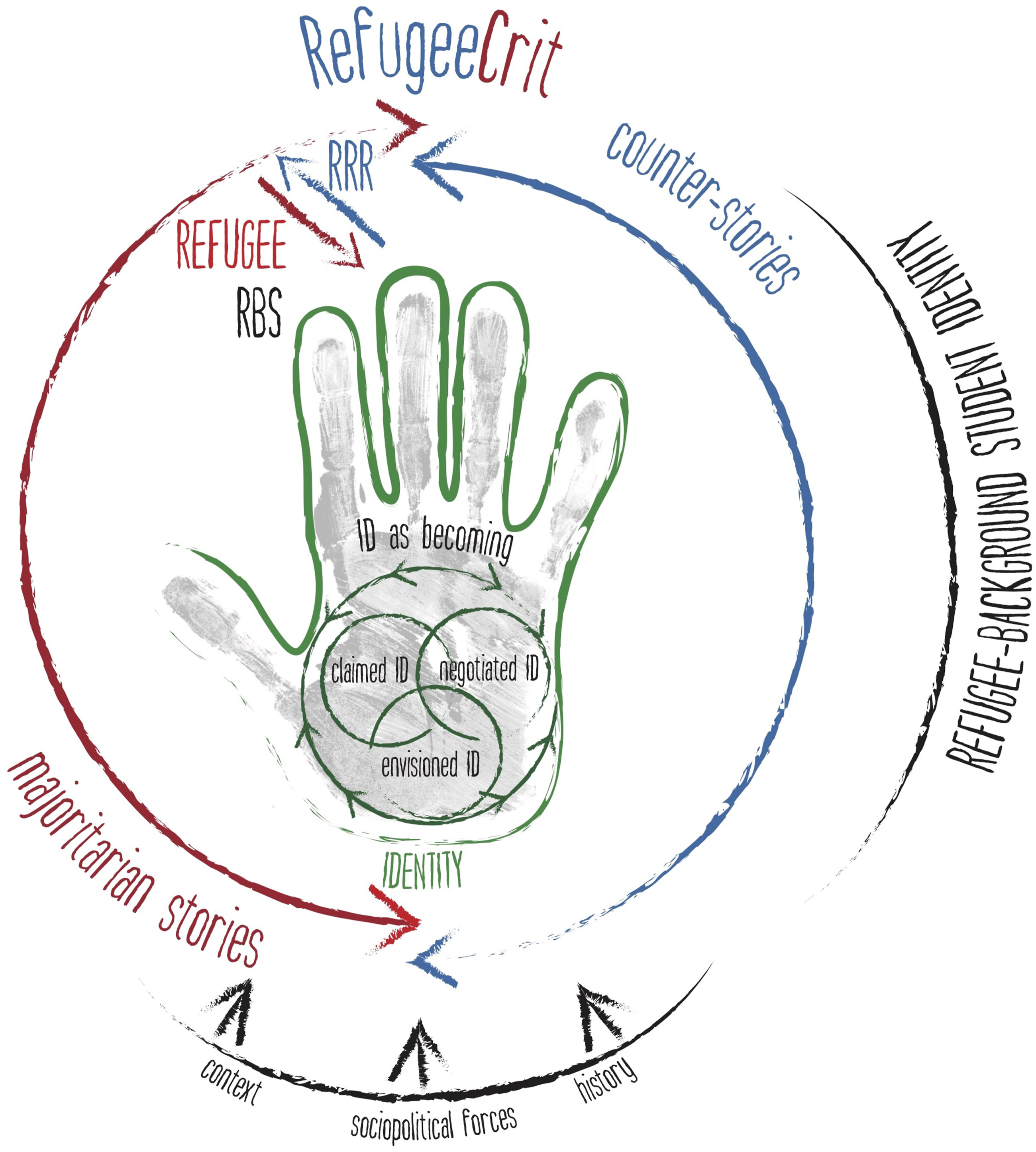
Framed by RefugeeCrit and counter-storytelling, the findings have demonstrated that RBSs enacted an array of responses to the refugee term (RRR), framed as counter-stories, in reaction to majoritarian stories told about the “refugee term at school.” This dynamic is captured by Figure 1 (Olszewska, 2020), which is a part of a larger framework (Figure 2) (Olszewska, 2020). I first discuss the refugee term as it was used by the adults and some of the students at the school, and I depict these majoritarian stories by the small red arrow called refugee (Figure 1). Second, I unpack the RRR model, shown by the smaller blue arrow (Figure 1) and frame it as counter-stories. The dynamic interaction of the small red and blue arrows is part of a circle composed of larger blue and red arrows reflecting the construct of RefugeeCrit which shows the constant and fluid struggle of the majoritarian and counter-stories. These majoritarian stories perpetuate presuppositions about the marginalized groups and are promoted by the dominant group. The marginalized groups’ own stories constitute a response to the majoritarian stories and are framed as counter-stories. RBSs’ response to refugee term (RRR) model (Olszewska, 2020). Alignment of the larger study’s findings with the RefugeeCrit theoretical framework (Olszewska, 2020).
Majoritarian stories: Refugee term at school
The term refugee and refugee-background students were not widely used or popularized by the school leadership, faculty, staff, or students at my field site. The term used formally and informally to refer to students of immigrant and refugee backgrounds was “stranger students” (Polish: uczniowie cudzoziemcy) or “stranger” (Polish: cudzoziemiec). These labels were applied in Polish research, official policy, and by school leadership and faculty to encompass all students of immigrant and refugee backgrounds. Those terms were also used in formal policies implemented at the school. However, during a conversation with the school principal, she shared that, in her view, the Polish term uczniowie cudzoziemscy carries a pejorative and deficit connotation implying that those students are somebody else’s responsibility. The morpheme cudzo-in the Polish word cudzoziemscy literally means “somebody else’s.”
Some of the teachers at the school, despite their welcoming and supportive demeanour, engaged in “symbolic violent acts of naming” (Paris, 2019); for example, calling refugee- and immigrant-background students “stranger students” in front of other pupils, faculty, and staff. The youth experienced symbolic violence by being publicly categorized with labels imposed on them. Kubin and Świerszcz (2011) observe that Polish school leadership, teachers, parents, and students hold stereotypes about Chechen culture that originate in a lack of knowledge and understanding of that culture. Studies have shown that categorizing and othering are common violent practices experienced by refugees (Zetter, 1991, 2007). As a result, identity negotiation in educational environments is a challenging process for RBS and may impact their academic success, socio-emotional wellbeing, social interactions, and integration (Bal and Arzubiaga, 2014).
The term refugee was also often employed as an insult among students. The principal reported several incidents in which students used the word as a pejorative and offensive label; for example, saying “you are such a refugee” (Polish: “Ty uchodźco”) with the intention of offending a schoolmate. Another instance of targeting the refugee population involved a sticker placed above the entrance door to the apartment building of two study participants (Karina and Lisa) that read, “Stop Islamizing Poland” (Figure 3). Klaus and Wencel (2008) observed similar incidents in their report on discrimination against immigrants and refugees in Poland. “Stop Islamizing Poland” sticker (Olszewska, 2020).
As social labels shape everyday belonging and exposure to discrimination in school and other public places, the principal had encouraged teachers, staff, and students to replace the terms foreigner, stranger, and refugee with the term friend, because she did not want RBSs to feel stigmatized or unsafe at school. Therefore, instead of celebrating World Refugee Day on June 20, the principal decided to celebrate Friendship Day to make all students feel welcome and avoid perpetuating a negative association with the word refugee. By deciding not to use the term refugee, the principal intended to ensure that the school remained a supportive, loving, and safe space, protected from potential xenophobia and Islamophobia. This example shows how the principal actively countered the majoritarian story about RBSs by replacing the term refugee with friend because refugees had been targeted with insults at the school. This way the principal advocated for reframing the dehumanizing narrative surrounding RBSs through a lens of friendship across languages, races, cultures, religions, and countries of origin. In addition, after some of our weekly informal chats about research literature on RBSs, she adopted the idea of shifting the focus to students’ resources (Ruíz, 1984) and began calling them multicultural and multilingual students. She also promoted this perspective among her faculty and at meetings with district politicians, other school principals, and educational decision-makers.
An additional example of violent acts at the school was physical marginalization expressed in classroom seating. Although Polish and RBSs interacted daily, classroom seating showed a clear ethnic and linguistic divide between Polish students and RBSs. This finding echoes a study conducted with South Asian students in the northeast of England. In that study, Crozier and Davies (2008) argue that: ethnocentrism together with racist harassment serves to relegate the young people to the [physical] margins, where they have little choice but to remain, not least for fear of their safety (p. 285).
Counter-stories: RBSs’ response to refugee term (RRR)
The RRR model (reflected by the small blue arrow, Figure 1), illustrates the findings of the study presenting RBSs’ understandings and reactions to the refugee notion, and includes the following positionalities: (a) refugee versus foreigner vs. stranger distinction, (b) being unaware of the refugee term, (c) unquestioned internalization of the refugee term, and (d) neutral or/and positive positionality toward the refugee term. Below, I describe each understanding of and reaction to the refugee notion.
Refugee versus foreigner versus stranger distinction
RBSs’ differentiated understandings of the term refugee and their self-identification with it, including how they distinguished refugee from related labels foreigner and stranger and how they responded affectively and socially to each term’s meanings and connotations. The participants’ knowledge and understanding of the term refugee varied, and therefore their self-identification with the term varied as well. Among the group, Suzy was the most confident about the meaning of the word refugee and differentiated it from the words foreigner and stranger by clarifying: I guess refugees is a term used by people who help us [at The Office for Foreigners] whereas strangers [in Polish: cudzoziemcy] is the way teachers refer to us in order to avoid the word foreigners [in Polish: obcokrajowcy] (P2, I2).
The “refugee versus foreigner versus stranger” distinction highlights that legal status often has material consequences, including access to housing, food, healthcare, and education. Suzy links the refugee label to the aid her family received.
According to the participants, the refugee term also had a meaning of being from a different country. In particular, Zuzia defined the term refugee as someone “from a different country” (P3, I2). Zuzia also believed that the word foreigner (in Polish: obcokrajowiec) had a pejorative meaning and connotated a sort of discontent. She expressed that the term foreigner (in Polish: obcokrajowiec) made her feel belittled. Specifically, she said that when someone used that term, she felt “like they [Poles] were dissatisfied” (P3, I2). Stranger [in Polish: cudzoziemiec] is a term used by teachers and state organizations as well as in Polish policy, literally meaning someone from another land whereas foreigner [in Polish: obcokrajowiec] is a term popularly used to refer to people from a different country, literally someone from a foreign, alien or other country.
Although Suzy and Zuzia described refugee as a neutral or positive term, they appeared aware of its possible pejorative connotations. The problematic, risky, agonizing and contradictory nature of the refugee term for refugees in their self-positioning is captured in his collection of refugee stories, The Displaced: Refugee Writers on Refugee Lives, by Viet Thanh Nguyen (2018), a Pulitzer Prize winner from Vietnam residing in the US, a refugee himself. He shares, I was once a refugee, although no one would mistake me for being a refugee now. Because of this, I insist on being called a refugee, since the temptation to pretend that I am not a refugee is strong. It would be so much easier to call myself an immigrant, to pass myself off as belonging to a category of migratory humanity that is less controversial, less demanding, and less threatening than the refugee (p. 11).
Nguyen’s insistence on remembering and claiming his status and label as a refugee functions as an act of resistance to the forgetting of his lived experiences and the denying of his refugee identity, even though life without the label might involve less risk and greater comfort. By naming his status, he preserves the geopolitical and historical realities that shaped his life and resists assimilation and erasure. By contrast, the school principal’s deliberate substitution of the term refugee with friend aims to protect students from essentialization, stigma, and xenophobia, while fostering a more inclusive, safe, and caring school environment.
Based on the above, both approaches are theoretically and empirically sound and potentially complementary, yet they derive from distinct paradigms. While Nguyen (2018) advocates for affirming one’s legal, socio-historical and political identity despite potential negative consequences and obstacles, the school principal’s approach is primarily pedagogical and protective, particularly in the context of elementary school children, where she aims to ensure that no student is discriminated against or ostracized on the basis of immigration status.
Being unaware of the refugee term
This category describes RBSs, who lack familiarity with or recognition of the label , cannot define, are uncertain whether it applies to them, and often experience the status as externally imposed rather than incorporated into their identity. When asked about the word refugee, the youngest participants, Karina and Lisa, had not heard the term refugee before, were unaware of its meaning, were unable to pronounce it in Polish, and did not know if they were refugees. Prior to conducting the research, I gained permission from the mothers and principal to ask the participants about the refugee term. I knew from the recruitment procedures, from the school principal, and from Karina and Lisa’s mother, that all four participants held refugee status or were eligible to be called refugees. When I asked Karina and Lisa about the term stranger, Karina confirmed that she was a stranger (in Polish: cudzoziemiec) and she explained that the term meant “student from other countries” (P1, I2b). Lisa just nodded her head to confirm that she was a stranger but seemed to feel uncomfortable being asked about it.
Either due to the principal’s goal of protection or their young age, the two younger participants, Karina and Lisa were not familiar with the word refugee. This absence could indicate that this particular part of their identity was imposed on them by international and Polish administration and law and was not an identity that they felt personally affiliated with. Pittaway and Pittaway (2004) share a Sudanese women refugee’s testimony: “Being a refugee is not by choice, if it’s a choice I wouldn’t be a refugee anywhere.” Her comments indicate that while others may apply the refugee label, those to whom it is applied may not incorporate it into their identify.
The category “being unaware of the term refugee” may protect younger RBSs from immediate stigmatization but can also obscure their specific needs and limit access to resources and support. It may also hinder opportunities to connect with others who share similar displacement experiences, which can be important for healing and addressing trauma.
Unquestioned internalization of the refugee term
This category describes participants who accept the label refugee uncritically, adopt it as part of their self-identity because institutions providing aid to the participants apply it to them, and thereby link the term directly to access to humanitarian assistance and generosity. One of the participants’ reactions to the refugee term was unquestioned internalization. For example, Suzy admitted that she and her family were refugees, “yes, we are [refugees]” (P2, I2). She also pointed out that the term refugee was “our name, people from another country” (P2, I2), and explained that she knew about it because she and her family obtained help with their apartment and clothes from the Office for Foreigners, where they were called refugees. She noted that “they say it, when we come there, they say that we are refugees in the project, so we are them” (P2, I2). This aligns with Vigil and Baillie Abidi’s (2018) autoethnographic study on identity formation at the intersection of refugee self-identification and labeling.
In addition, Suzy expressed that she self-identified with the refugee identity marker by thanking Poland for helping refugees and allowing them to stay, in a handprint made for Poland’s Independence Day. In sum, Suzy and Zuzia believed they were called refugees because that is what the NGOs called them, and they connected the refugee term with humanitarian assistance. Their statement about how larger structures determine who we are and how we are labeled appears to align with Kumsa’s (2006) confession: I am a refugee. Others look at me and see a refugee. I look at my Self through Others’ eyes and become a refugee. The notorious cycle of Self is complete. The fact that I have been a Canadian citizen for over ten years matters little (p. 230).
Also, Suzy and Zuzia’s belief highlights the vitality of the refugee legal label and how it translates to real-life consequences despite its socially constructed nature. The legal and political dimensions of refugee status recognize refugee-background families’ ordeals and guarantee their human rights and fundamental protections from the government and NGOs (Zetter, 1991). Indeed, legal labels matter because they determine whether individuals and their families receive economic and social support (Woolley, 2017).
The “unquestioned internalization” often reflects pragmatic survival. Accepting the refugee label can secure aid but risks internalizing deficit narratives about refugees, if left unchallenged. Internalization can also make RBSs more visible to institutional scrutiny and more vulnerable to marginalization, exclusion, racism, xenophobia, or linguicism, which can potentially affect RBSs’ academic growth,socio-emotional and mental wellbeing.
Neutral or/and positive positionality toward the refugee term
This category describes participants who accept the label refugee without stigma, treat it as normal or even positive, and report no negative experiences or emotional harm from being called a refugee, often preferring it to more pejorative labels like foreigner. Some of the participants showed neutral or/and positive positionality toward the refugee term. For instance, Suzy stated that the word refugee “is good … is normal” (P2, I2) and “it’s not offensive at all” (P2, I2). Suzy also shared that she had never experienced any negative reaction to her being a refugee: It’s like, it’s not offensive to me and I don’t feel bad about it, simply it’s normal… for example, when they call me refugee, they don’t mean, I don’t know, how to say it, hey you, stranger [in Polish: cudzoziemiec], but simply refugee is the name we have, that’s what they call us, like, people from another country (P2, I2).
Suzy explained, “It’s nothing important to me” (P2, I2). She perceived herself more as a stranger. Suzy also asserted that, along with other RBSs, they were usually called strangers (Polish: cudzoziemcy) or refugees (Polish: uchodźcy), not foreigners (Polish: obcokrajowcy), because, according to her, obcokrajowcy had a pejorative connotation. Similarly, Zuzia said she had not experienced any negative consequences from being called a refugee and considered the word to have a positive meaning, stating, “It’s normal and good, refugee” (P3, I2). When responding to my interview question about the term refugee, both Suzy and Zuzia appeared eager to ensure I understood that the notion did not carry negative connotations for them, as if they were aware of the stigmatization and the loaded language surrounding the refugee term in Poland. The neutral or positive positioning may indicate identity affirmation and resilience, yet it can coexist with unacknowledged discrimination and symbolic violence in schools; for example, the hostile “Stop Islamizing Poland” sticker (Figure 3). Thus, neutral or positive self-identification does not necessarily signal the absence of harm.
Discussion and implications
The examination of RBSs’ responses to the refugee term in Poland provides insights into how four Chechen refugee-background youth in Poland understand and construct refugee term while navigating complex relationships with their refugee status. The RRR model (Figure 1) captures RBSs’ understandings and reactions to the refugee notion including the following positionalities: (a) refugee versus foreigner versus stranger distinction, (b) being unaware of the refugee term, (c) unquestioned internalization of the refugee term, and (d) neutral or/and positive positionality toward the refugee term. The RRR model’s four ways of understanding the term refugee are not merely descriptive categories; they carry practical implications for RBSs. Building on these findings, the RRR model can assist in conceptualizing the dynamic and fluid tensions between majoritarian and counter-stories related to the term refugee. It can also be applied as a point of reference in fostering refugees’ agency and conducting refugee-centered research in relation to the refugee term.
Life-saving or violent naming: The struggle of the majoritarian and counter-stories
RefugeeCrit articulates the dynamic and fluid tensions between majoritarian and counter-stories. This juxtaposition underscores the conceptual complexity of the term refugee and the need to nuance and contextualize its use. In particular, the distinction between violence and the life-saving act of naming may not be categorical but contextual, and thus requires careful attention to intention, interpretation, priorities, and the power structures that shape a given context. The removal or avoidance of the term refugee from the public discourse may help disrupt processes of labeling and categorization as well as it can reduce tensions surrounding how this population is labeled and demonized. Nevertheless, such erasure also risks losing the legal, social, and political specifities associated with forced displacement. In particular, it may be more difficult to identify RBSs needs, claim their rights or situate student experiences within broader patterns of RBSs that RefugeeCrit seeks to unearth. Moreover, RBSs may lose opportunities for advocacy and access to resources informed by an understanding of refugee-specific trajectories.
Therefore, on the one hand, applying for and being granted refugee status may result in life-changing circumstances and can literally be a matter of life or death for the individual and/or the entire family (Hamlin, 2021; Van der Boor et al., 2022). It is especially urgent in today’s challenging times, when vulnerable populations face xenophobic, racist, isolationist, and authoritarian governments, closed borders, global political instability, economic collapse, and an omnipresent sense of anxiety and uncertainty. Some degree of legal, economic, and social stability is essential in such unpredictable and insecure times. For refugee-background populations, as shown in some of the study participants’ stories, being granted legal status, including an official identity card, a place to stay, access to education, clothing, and healthcare, a valid work permit, and a stable job, is typically what refugee status guarantees.
On the other hand, it has been argued that classifying people can be a violent act of naming and oppression, since it becomes a tool for categorization, essentialization, and marginalization (Dhillon and Ulmer, 2024; Janmyr and Mourad, 2018; Paris, 2019). In educational contexts, limiting a student’s identity to a single marker they may not even accept can hinder efforts to learn about their full and rich identities. It can also negatively affect how their needs, assets, and lived experiences are addressed, and can undermine opportunities for them to self-position (Fruja Amthor, 2017).
RBSs’ agency and refugee-centered research
RBSs can achieve agency around the term refugee through participatory, inclusive, dialogical, and democratic practices in safe contexts. In this study and the referenced literature, agency emerged when students’ voices were centered and invited into the discussion. Counter-storytelling in the form of arts-based, multimodal, and multilingual projects, such as multimodal identity texts, e.g. I Am From poems and multilingual self-portraits, foregrounded RBSs’ views on self-identification. Participants’ agency and lived realities were illuminated rather than treated merely as data points. Identifying and contesting dehumanizing majoritarian narratives through counter-storytelling and humanizing methods, enabled participants to share their own perspectives on the term refugee. Therefore, there is a need for a co-creation of empowering spaces for voices that are unheard and silenced (Daniel, 2019; Fine, 2017). The opportunity for RBSs to speak about their realities may encourage others to share their own stories and find support and inspiration in others’ biographies.
The findings of the study have demonstrated that even though a legally fixed term, refugee appeared to be a notion with different meanings as some of the participants navigated two or even three positionalities toward the term refugee. The legal identity was just one of many identity markers as the participants did not feel that the refugee term predetermined who they were and wanted to become. This view aligns with research that shows that refugee is not a fixed and static entity (Kayaalp, 2020; Zetter, 1991), but can be multilayered, fluid, and contradictory (Hamlin, 2021; Voutira and Doná, 2007), and that refugees themselves have agency in terms of navigating and responding to the refugee term.
Conclusion
This study highlights the importance of redefining and reimagining the term refugee in research and educational settings, as well as in policy, the media, and public discourse. It also contributes to a growing body of research on refugees’ responses to the term refugee (e.g., Hampton and Türkyilmaz, 2023; Lefort-Rieu, 2025; Vigil and Baillie Abidi, 2018; Worrell, 2024). Despite their individual differences, four participants in this study, Karina, Lisa, Suzy, and Zuzia, showed that being a refugee or a RBS is not their primary identity marker as there is much more beyond their past, their present complex lived experiences, and their futures. Every RBS has a different story, which is why each should be understood individually. RBSs vary in country of origin, religion, race, ethnicity, and migration history. At the same time, the label refugee is not without consequences. Granting legal protection and access to services such as education can literally save lives by, while the act of naming can also reproduce marginalization, increase the risk of detention (Interwencja Prawna, 2008) or of surveillance (cf., the requirement for all adult US non-citizens to carry proof of their immigration status at all times in the US; USCIS, 2025). The study thus suggest that a middle path may be needed, in which naming is reclaimed on students’ own terms rather than being imposed or wholly suppressed.
Drawing on Chimamanda Ngozi Adichie’s TED talk (2009) on the danger of a single story, “stories matter” and can save lives. Adichie states that “stories have been used to dispossess and to malign. But stories can also be used to empower, and to humanize” (17:24). Along the same lines, Bell (1989) asserts that master narratives have been employed as a means of oppression because they can essentialize, oversimplify, categorize, and stereotype people, whereas counter-stories may reveal injustices and liberate people. Therefore, we need to keep challenging master narratives and deconstructing the monolithic representation of the refugee term. This approach is particularly crucial for educators as a better understanding of what it means to be a refugee can lead to more equitable and inclusive policies and practices, better understanding of students’ needs, affirmation of their identities, and the co-creation of spaces for their agency and empowerment.
Footnotes
Acknowledgments
I am grateful to Elizabeth Bondy, Toril Opsahl, and Tomasz Tymiński for their feedback and practical help. Thanks also go to the Reviewers for their valuable comments. Most importantly, this work would not have been possible without the study’s participants. Thank you for sharing your stories.

Ethical considerations
The study was approved by the Institutional Review Board (IRB) at University of Florida (#201901353) and by the Research Ethics Committee at the University of Warsaw, Poland. Informed consent from the participants’ guardians and the students’ assent facilitated procedures that ensure ethical treatment in this work.
Funding
The author disclosed receipt of the following financial support for the research, authorship, and/or publication of this article. This work was partly supported by Polish-U.S. Fulbright Commission and the Research Council of Norway through its Centers of Excellence funding scheme (223265, 302219).
Declaration of conflicting interests
The author declared no potential conflicts of interest with respect to the research, authorship, and/or publication of this article.
Data Availability Statement
The data supporting the findings of this study are publicly unavailable due to confidentiality restrictions. However, data can be made available upon request to the corresponding author.