



Abstract
Te Tiriti o Waitangi is a foundational constitution document for Aotearoa New Zealand negotiated between hapū nations and the British Crown. This covenant has been marginalised, dismissed and consistently breached by New Zealand governments. After sustained activism by Māori in the 1970s onwards there has been a renewed passion for honouring and upholding Te Tiriti from Tangata Tiriti organisations. This has led to a flurry of Tiriti-led organisational change, unfortunately little has been published about these efforts. This paper draws on interviews with six senior Māori and Pākehā Tiriti workers conducted in April 2025. The interviewees are both participants and contributors to this article. Collectively this collection of reflections provides a synopsis of over 150 years of Tiriti work across Aotearoa New Zealand organisations (non-profit, for-profit, public institutions). The findings are framed through an iterative interview approach, and the discussion is a fusion of story-telling and collective reflection. We found that Tiriti-led organisational change is a journey not a destination, and it requires ongoing (re)commitment. Tangata Tiriti organisations need to enter into relationships with Māori, who determine the success of the endeavour and whether the benefits are realised. The most effective approaches are holistic in nature and include some education components. Alongside this, there needs to be power-sharing and collective responsibility by all staff within the organisation. Critical to Tiriti work is also disrupting monocultural practice and institutional racism. Tangata Tiriti organisations require reflective leadership, political will and an understanding that engaging with Te Tiriti benefits all New Zealanders. To move beyond performative practice requires engagement with one’s head, heart and hands. For Te Tiriti to be genuinely upheld requires the dismantling of colonial structures.
Introduction
Te Tiriti o Waitangi (the authoritative Māori text) is a unique document to Aotearoa which was negotiated between the British Crown and hapū (sovereign nations) in 1840. It formalised the relationship between the parties and established the terms and conditions of non-Māori settlement. It granted the British limited governance of non-Māori, reaffirmed Māori tino rangatiratanga (absolute authority), previously recognised through He Whakaputanga o Te Rangatiratanga o Nū Tīreni (the Declaration of Independence), and guaranteed equity for Māori. It also recognised cultural and religious freedom for all parties (Healy et al., 2012).
Since 1840, through Crown policies and actions of colonisation and assimilation, Te Tiriti has been consistently breached (Orange, 2011; Walker, 1990). This colonial violence has had intergenerational social, economic, cultural and political impacts on Māori as lands were taken, and social systems supplanted by colonial social institutions (Moewaka Barnes and McCreanor, 2019). Māori have always resisted colonisation (Harris, 2004; Ngata, 2017), and the Waitangi Tribunal (2014) – a permanent independent commission of inquiry – have found Ngāpuhi, and, therefore, Māori, have never ceded their sovereignty. These efforts have not stopped the juggernaut of colonisation and Tiriti breaches that continue to contribute to systemic inequities (Cram et al., 2019).
Tāngata Tiriti was a term coined by Eddie Durie (1989) to refer to Tauiwi (settlers) who gained entry to Aotearoa via Te Tiriti o Waitangi. It has evolved over time to refer to individuals and organisations committed to upholding Te Tiriti and tino rangatiratanga and living in tika (right) relationship with tangata whenua (Bell, 2024; Dam, 2022). As detailed in Jen Margaret’s text (2016) on Tiriti-led organisational change, becoming a Tiriti-honouring organisation is not a destination, it is an ongoing journey of vigilance and (re)commitment. Each organisational (and personal) journey is unique as organisations navigate their own histories and confront their ethical responsibility to share power and engage in decolonisation.
Scholarship in Aotearoa has increasingly examined the implications of Te Tiriti o Waitangi for institutions and public life. Work on cultural safety (Papps and Ramsden, 1996; Ramsden, 2002), constitutional transformation (Matike Mail Aotearoa, 2016), and critiques of performative institutional commitments (Hamley et al., 2024) highlights the gap between rhetorical alignment and structural change.
According to Came, Barnes, Heta-Morris (in press), becoming a Tiriti-dynamic organisation requires both collective and individual responsibility focused on power sharing and structural change. For non-Māori practitioners and leaders, this transformation involves building cultural safety, engaging in antiracist practice, and developing authentic allyship that moves beyond performative identity into consistent action. Cultural safety is foundational, requiring professionals to reflect on power differentials and shift authority to Māori whānau to define safe practice. For Māori, transformation involves affirming kaupapa Māori approaches that centre Indigenous values and self-determination within health and social services.
Effective organisational journeys depend on sustained investment in Tiriti education to build capacity, the implementation of co-designed plans with Māori, and clear accountability mechanisms such as specific key performance indicators for leadership. Meaningful organisational transformation must embed Māori worldviews into strategy, governance, and service delivery. Sustaining these shifts requires a broader societal commitment to decolonisation, re-indigenisation, and constitutional change that honours tino rangatiratanga.
While this scholarship outlines the normative aspirations of Tiriti-honouring organisations, there has been relatively limited engagement with organisational change theory as a lens for understanding how such transformations unfold in practice. Tāngata Tiriti organisations have historically rarely prioritised publishing their Tiriti journeys. Institutional knowledge of how organisations reached this point is also often lost as key staff move on from the organisations. It is unclear to what extent claims to being Tiriti-based are aspirational, evidence-based, or in the blurry space in between. Oral histories of organisational change can also shapeshift depending on who is left to tell the story. In this context Tiriti workers who support organisational change often hold a unique viewpoint on what works, what doesn’t work and what is needed when navigating these organisational journeys. This summarises relevant organisational change literature while also focusing on Tiriti workers’ perspectives on Tiriti-led organisational change.
Methodology
This paper draws on key stakeholder interviews with senior Māori and Pākehā Tiriti workers recruited from the professional networks of the authors. Tiriti workers can be tangata whenua trainers and activists committed to advancing tino rangatiratanga, decolonisation and re-indigenisation or Tauiwi committed to pursuing Tiriti and racial justice. This paper draws on the authors and Tiriti workers’ 150-plus years of experience working with organisations on Tiriti application. We also introduce relevant organisational change theory, which does not prescribe a Tiriti pathway, but provides language for understanding why aspiration alone does not produce structural transformation (Argyris and Schön, 1978; Knoster et al., 2000). Routine, unnoticed, desensitised behaviours, dominant institutions retain their power and ruling relations over others (Berger and Thomas, 1967). Despite individual practitioner moral and ethical beliefs regarding fairness and equity of outcome, the ways institutions are organised and sustained - their logic and practice - result in perverse outcomes for non-majority groups.
We used thematic analysis (Braun and Clarke, 2006) as a flexible, interpretive method for identifying patterned meaning across the interviews, rather than as a rigid coding framework. Our analysis involved familiarising ourselves with the interview material, generating initial codes, grouping these into broader candidate themes, and refining those themes against the dataset as a whole. We then worked to define and name the final themes, drawing on both participant quotations and our collective interpretive analysis to tell the story of the data in relation to Tiriti-led organisational change.
Based on a synthesis of these insights and experiences in organisations, we highlight three organisational change and Te Tiriti themes: (1) Organisational change must be structural, collective and relational. (2) Organisational change must go beyond symbolic engagement. (3) Progress of organisational change must be tracked through relational, cultural and material impacts.
The Tiriti workers, in a gesture of accountability and transparency, have generously agreed to be identified and named as co-authors on this paper. Although participants are named as co-authors in acknowledgment of their contribution and transparency, initials are used in the findings to aid readability. As the Tiriti workers are recognised experts in their field and talking about their area of professional expertise institutional ethics was not sought. We acknowledge their years of service, unique expertise and lived experience, their commitment and passion for Tiriti justice. By way of introduction, we interviewed:
Jen Margaret
(Pākehā) is Kaihautū | director of Groundwork: Facilitating change. Jen has worked with thousands of people across all sectors of New Zealand society to build understanding and action to uphold Te Tiriti. She is the author of two books which are widely used to guide practice: Working as allies: Supporters of indigenous justice reflect (Margaret, 2013); and Ngā Rerenga o Te Tiriti: Community organisations engaging with the Treaty of Waitangi (Margaret, 2016).
Christine Herzog
(Pākehā) started as Tiriti educator in the 1980s, when she migrated here from the United States. She had a particular interest in what it means in practice since the 1990s. Her experience of Tiriti responsiveness in organisations and sectors was mainly been in local government, education, community groups and research. Sadly, Christine died suddenly while we were writing this article. We dedicate this article to her. Moe mai rā e te rangatira.
Dean Adam
(Pākehā) has over 25 years of experience in research, evaluation, policy, community psychology and public health. Working in central and local government for much of this time, he has had many opportunities to reflect on the challenges and opportunities in decolonising bureaucracies. Dean contributed to the final review and write up of this article.
Takawai and Chris Murphy
(Ngāti Manawa and Pākehā) are amongst the nation’s most popular and accomplished cross-cultural facilitators. Their teaching careers include experience in the primary, secondary & tertiary sectors – including management & principal level. They have presented to a wide range of audiences nationally and internationally for over 25 years.
Dr Rangimārie Mahuika
(Ngāti Rangiwewehi) is the Senior Advisor Te Tiriti strategic initiatives at Te Kunenga ki Pūrehuroa - Massey University. She provides advice, support and training on Te Tiriti o Waitangi and ensuring organisational actions align Te Tiriti articles and aspirations.
Virtual interviews were conducted in April 2025 for about an hour. We took an iterative approach to the interviews, using prompting questions flexibly and recursively across conversations as themes emerged. This iterative approach informed the structure of the findings. We chose to quote extensively from the Tiriti workers but also paraphrase and edit for clarity and brevity. In the discussion, we also draw on our own lived experience as researchers who are themselves Tiriti workers with decades of experience in Tiriti and decolonisation work.
The researchers were HC, a Pākehā activist scholar with extensive experience in public health, Tiriti application, critical policy analysis and antiracism; AB, a Pākehā researcher and evaluator and Tiriti educator in education and public health; and WW(Tūhoe & Ngāti Kahungunu) who is an Indigenous therapist, father of four, activist and environmentalist; and THM(Te Arawa whānui, Ngāti Awa, and Ngāti Kahu) who has over 10 years’ experience in the addiction sector, with a strong focus on peer support and the development and facilitation of motivational living programmes. The paper concludes with He Whakaaro Māori – a Māori final word - to amplify Māori analysis and final reflection in affirmation of Māori exercising rangatiratanga/authority.
Findings
Key informants were asked prompting questions addressing what organisations are doing well in terms of engaging with Te Tiriti, what some of the challenges, the advantages and opportunities of engagement, learnings from Tiriti-led organisational change and how accountability to tangata whenua was navigated.
What do you see organisations doing well in relation to engagement with their tiriti responsibilities?
CH’s approach to working with organisations is to start from where they are at. A key measure of success was regular forward momentum rather than perfection. She noted that, over her career, it had been rare to see sustained organisational momentum. She warned that conflating Tiriti strategies with strategies focused on addressing the consequences of colonisation can create implementation problems, especially in relation to accountability. She noted organisations are increasingly engaging with Te Tiriti from a governance perspective early in their Tiriti journeys. The language has shifted over time from euphemisms like equity and discrimination, to more direct language about racism. Some organisations have made structural changes and appointed Māori roles and Māori teams, and written policy statements and Tiriti responsiveness plans. Tiriti education has also become normalised in some sectors such as health.
DA discerned that organisations are recognising they should be doing something, but are unsure of what to do, how to be Tiriti responsive. He has observed greater organisational investment in Tiriti work. Assigning sole responsibility to Māori staff to uphold Te Tiriti within an organisation enables Tauiwi to avoid the challenges and discomfort of taking responsibility. This approach can stall the change process as one person cannot easily transform an organisation.
JM perceived those organisations that engage strongly with Te Tiriti take a holistic approach. That is, they ensure senior leadership are on board and can articulate what that means in practice to all staff. Māori leadership, either external or internal, was also important, as was a commitment to upskilling all employees. Staff need to know why they are doing the mahi, how to do it and what to do. This can be reinforced through having strategies and policies in place so anyone within an organisation knows their Tiriti responsibilities and are accountable for doing them well.
Equally fundamental to JM is the need for Tangata Tiriti organisations to address systemic racism within their respective organisations. We often talk to organisations about pepeha and policy, saying, you might have a beautiful pepeha, but if your policy that impacts on potentially thousands of people is still racist – you need to work on that. There can be a tendency to go towards performative rather than transformative action.
JM maintains organisations that are doing well are doing that deeper work to understand how their organisational ways of working impact on Māori and what needs to shift and change. Organisations that focus on asking questions like “How are Māori impacted by our work? How can we ensure our work is beneficial to Māori? What are the aspirations of mana whenua and how might we support those aspirations” are asking good questions.
RM noted there are some organisations that are thinking about Te Tiriti and they conclude that, in comparison to other organisations, they are doing well. But when you’re inside the organisation and you understand what that means in practice, it’s not always what it sometimes seems from the outside.
When organisations do well there is a clear commitment, not just what they say, but also in terms of funding and resource. It is backed up at a senior leadership level. But there also then needs to be a high proportion of staff who understand it and they can follow through.
TM said every organisation he works with is different. We’ve worked with quite a few rōpū who are just starting their Tiriti journey. They get us in, and we run our course, and we get participants to pick a personal goal, it might be to learn my pepeha; and, in
work-
related
groups, we get them to design a
work-
related
action plan. And then we encourage them to come back for half a day, three or four months later, but for a whole lot of reasons, [for] a lot of groups this doesn’t always happen.
The ones who come back, firstly they are grateful to receive the education, and they try really hard. This guy came on yesterday, he said “I’ve never been on a protest before in my life, but I joined the hikoi Tiriti last year” so they do all this personal stuff, but there’s not really any support from the management.
We had a guy his goal was to get pronunciation right. Now he was probably what you would call a redneck. None of his mates pronounced Māori right, but he did it anyway and now it’s become the norm. They’ve all accepted it and some of them are starting to
try.
So, I find that Pākehā are now starting to talk about becoming a good Tangata Tiriti, now that never happened five years ago. So, it’s really
heart-
warming
.
What are common challenges organisations encounter on their Te Tiriti journey and how are these overcome?
DA sensed a common challenge for organisations was a lack of executive leadership understanding of or support for Te Tiriti. Organisations need unified organisational alignment to navigate both internal and external resistance. Responding to negativity and defending a position drains energy from forging a new path forward. He noted there is considerable literature on organisational change that is not often utilised in pursuing Tiriti justice.
How do organisations plan for successful organisational change? How do we bring people on board? Who are our champions? Do we have a communication plan? How do we measure progress? How do we handle staff turnover and induction? I don’t think many organisations plan for the organisational change required to embed Te Tiriti.
Over time, CH has observed fits and starts of Tiriti-led organisational change, even within the same organisation. This occurs as they often focused on education rather than building Te Tiriti into the culture and structure of their organisation. If you rely on a charismatic leader and they leave the organisation, the work can stall and institutional knowledge is lost, and then the cycle must start again. Sometimes, board membership can change, and momentum is thereby lost.
CH said it is not necessarily sustainable for Tangata Tiriti leaders to consistently remain on the front line of Tiriti justice. She likens it to bushwhacking. If you are clearing a path for 20 other people on a bush walk it is exhausting being at the front. The bushwhackers don’t always notice what it is taking out of them, and the followers don’t recognise the need to support.
CH is concerned about the current resurgence of Pākehā interest in mātauranga Māori. She is troubled about the potential risks and the ignorance of Tauiwi pursuing this path in terms of capacity to engage meaningfully. She has encountered Tangata Tiriti organisations that seem to think learning a waiata is indigenising their workplace or renormalising mātauranga Māori.
JM has witnessed organisations creating beautiful Te Tiriti responsiveness plans and strategies, yet racism remains deeply embedded in the organisation’s systems and people. This is not surprising, she states, as we live in an everyday environment that normalises racism. Pākehā particularly need to learn how to see racism and injustice and envisage and build new, Te Tiriti honouring, ways of being. People often look for grand (romantic) gestures and undervalue small important critical steps.
At Groundwork, JM shared they have been prioritising haumi/ally (Margaret, 2013) work. This requires Pākehā to engage in deeper work and see themselves. What is needed is upskilling cultural capability so that there is a shift in Pākehā monocultural norms and exercise of power. This developmental groundwork involves Pākehā taking responsibility for seeing and changing from controlling to power-sharing ways of being.
As Pākehā we want to think that we’re good people and being racist is bad, so we don’t want to really associate with that. Yet as Pākehā we benefit daily from colonial power systems, whether we want to or not. We can shift if we understand this, and respond collectively by sharing power and resources, and supporting tino rangatiratanga.
JM has observed idealised notions of what a Tiriti-dynamic organisation might look like, and those ideals can get in the way of progress. Pragmatism is really important in this work, because we can get so stuck on doing the right thing that we don’t do anything (Anonymised. 2015). There are some examples of totally Tauiwi organisations who want to move to a 50:50 Māori-Tauiwi board. Their work may or may not impact significantly on Māori.
Pursuing this aspirational objective may not be a great use of scarce energy and resources. Māori will determine what boards are a priority for them to join. Tauiwi need to consider: What are our relationships with mana whenua? How can we be a better organisation as we are? and then build relationships and support the appropriate hapū, iwi Māori entities that relate to our work without being a drain. There is way too much pressure on a small number of Māori to carry or to shift Pākehā organisations.
JM has noticed recruitment and human resources are areas of Tiriti work that are critical to organisational change that have received insufficient attention.
We can be working with organisations, and they’re still onboarding people who are not appropriate. By that I mean they are not on board with this mahi. There needs to be good critical questions being asked to detect this during recruitment processes. We are always saying to organisations, be mindful bringing more Māori onboard if this is a hard place to be as Māori. If Pākehā aren’t up for doing this work and assume Māori will “fix it”, that’s a problem.
As mentioned by DA earlier, JM agrees there needs to be shared accountability and responsibility for Tiriti work.
We have encountered some of the stronger resistance from Pākehā women who have fought hard for positional power. Pākehā, who might have done some of this mahi in the 80s, and feel like they’ve done it, feel like they know it. On a
day-
to-
day
basis they may actually feel deeply out of their depth with what’s required of them. And because of their responses to working in patriarchal systems, rather than being able to be vulnerable and open about their feeling of being incapable or
ill-
equipped
, there can be a lot of defensiveness. There can also be projecting or blaming others for the issues rather than taking responsibility.
As are others within the Tiriti movement, JM is interested in the challenge to Tauiwi to get their house in order offered by the landmark Matike Mai report on constitutional transformation (Matike Mai Aotearoa, 2016). She noted because of colonisation, Pākehā can struggle to imagine how to work within the kāwanatanga and relational spheres within Matike Mai. Pākehā can navigate the familiar colonial system but can’t always step into the unknown.
There is often that question of, who else has done this well or where does this
power-
sharing
approach successfully happen? There are examples here and overseas that we can be drawn on. Pākehā need reassurance. There is a fear of the unknown and people feeling uncomfortable, because that’s how racism works. [Pākehā] are more comfortable to sit within deeply problematic, racist structures rather than change.
For Pākehā it can be hard not to be in control. Being part of a dominant and dominating culture often leaves Pākehā ill-equipped for working across cultural worlds, being able to listen, to interact, being able to hear when things are spoken and expressed in ways that are unfamiliar. These are skills we need to develop to contribute effectively to Te Tiriti honouring.
RM observed that organisations with good intentions to commit to Te Tiriti often risk compounding existing tensions and cultural dynamics, if those commitments are not carefully executed.
… once you’ve made some of those big commitments, you are at more of a risk if you don’t follow through because … you’re going to have people watching and paying attention.
RM stated that if these good intentions and actions are only held by a charismatic few then the change process, or any change inspired by Te Tiriti, is prone to collapse once those individuals leave the organisation. Institutional knowledge must be embedded at multiple sites beyond the level of individuals
I’ve seen where once that person leaves, the organisation doesn’t have the capacity to carry it through themselves, because actually it was the individual who had that vision, or where it was their baby, and there wasn’t enough wide enough support to carry it through.
Numerous Māori and Tiriti scholars identify the brutal effects of colonisation and resulting intergenerational trauma for Indigenous peoples (Aho, 2014; Koea, 2008; Smith and Reynolds, 2013). RM also pointed to the traumatised state of Tauiwi and Pākehā migrating to Aotearoa. Reflecting on the defensive and reactive dynamic enacted through acknowledged and displaced trauma, RM stated that intergenerational trauma for Māori and Pākehā is one of the biggest barriers to healing and needs to be addressed before we can move forward together.
TM identified barriers created by a lack of financial resourcing and a commitment to the Tiriti kaupapa that social change requires. And, in order to effect change, that commitment needs to filter down from senior leadership not just kaimahi.
We’re struggling for time, and our workload is bloody huge and the bosses’ management don’t come to your course, so we get kaimahi, but a lot of organisations we don’t get the rangatira and for most organisations the necessary follow
up.
Burnout and overload are a reality for Māori kaimahi in organisations, particularly Māori in leadership roles. TM identified that Tiriti educators are often exhausted and struggle with workload and he wondered about the differences between Māori and other organisations – particularly levels of capacity and motivation. Other organisations seemed to be better resourced and motivated to embrace Tiriti-based organisational change.
What advantages and opportunities do organisations discover through their tiriti journey?
There has been over 180 years of colonisation in this country. JM shared how Pākehā working to address racism towards Māori and improving their relationships makes for a more positive socio-political-cultural environment. Many Tāngata Tiriti organisations have adopted whanaungatanga processes at the start of meetings for example: it’s always good to know who you are talking to, but this has not been the standard Pākehā way. So, it helps more generally with relationships. If you only care about the money, fiscally it also makes sense to improve service to Māori communities and reduce inequities.
CH said some organisations she has worked with attribute improved outcomes for their client, patients or students to organisational Tiriti work. Others measure it by changes to their governance structures. She noted Te Kawehau Hoskins’ (2010) PhD research produced remarkable outcomes for Māori kids, which meant Tauiwi wanted to be part of it. They were told by the Māori whānau that Māori leadership is the only way that that’s going to work.
DA, inspired by the likes of Nelson Mandela (1994) and Paulo Freire (2000), shared that for him Tiriti work isn’t about freeing and liberating the oppressed other, it’s about us (Pākehā) liberating ourselves. That is one of the benefits of the mahi. He has observed organisations improving their relationships with Māori (not necessarily hapū) over time but struggling to sustain those relationships. Tauiwi organisations often know they aren’t doing well for Māori. They can see that hapū are producing positive outcomes for rangatahi and can see the benefit of their engagement. Once involved, they end up stepping outside their routine and doing things they would not normally attempt.
RM reflected on the capacity for organisations (and individuals) to be responsive and trust in emergent praxis rather than linear theoretical approaches. Tiriti-based approaches require a trust in emergent complex systems, challenging simplistic, reductionist models of governance/being. These linear models tend to foster an illusion of control or demand perfectionism.
Especially in my current workplace, I’ve really developed the mantra of the importance of imperfect action because there is quite literally so much that needs to be done that just pick somewhere, pick something and start there.
RM’s mantra mirrors other radical scholars’ understanding of systems change and the interplay of complex power dynamicswhich require human and imperfect forms of resistance.
I’ve been told off when I was doing the right thing, I’ve also been told off when doing the wrong thing and the reality is that you just have to smile sweetly and learn to be humble and accept that sometimes it’s not about
you
RM offered that this is an essential part of the learning process for everyone, not only Pākehā. How can we expand our practice? Rather than one-time applications and unrealistic expectations setting us up to fail, can we learn from mistakes and weave them into a larger vision?
Sometimes things just do not go the way that you think they’re going to go and that doesn’t mean that all is lost, it simply means that you take this opportunity to regather. Let’s reflect on what went well and where did things go badly and what shall we do about that next time, so we try and avoid that happening again and you just get better as you go along
As Tā Wharehuia Milroy reminds us: ‘Ko te whakaiti te whakaaro nui o te wharenui’. Humility is the keystone of profound thinking (our interpretation). RM emphasised the importance of humility in Tiriti praxis – Te Tiriti teaches that navigating complex relational dynamics and structures requires deep reflexivity, compassion and a degree of selflessness that centres others.
I also remind a lot of my Tauiwi colleagues that they do need Māori support and connections, there’s no way for our Tauiwi colleagues to be able to navigate this without some support from mana whenua, but I also point out that … that’s the same for me. … And that if they’re not aware of that, then I need to make sure that they are not just to keep the organisation safe, but to keep myself safe also and to ensure that the interests of those mana whenua groups are being represented, even if they’re not actively in the
room.
TM observed that, when these conditions are met, kaimahi inevitably begin to deepen connections and develop a greater sense of trust and confidence.
The biggest benefit in staff becoming closer together and staff bonding being much better. ... The greater respect and understanding of Māori staff, especially round things like Te Tiriti and te ao Māori, and people’s responsibilities. In the past that’s never been recognised by organisations, so that’s a big benefit.
What are organisations learning, and how do they track their success?
CH noted that considerable material has been written about aspects of Tiriti history, Tiriti breaches and some about application. For instance, there is considerable writing, often in the form of blogs and social media content, about the fight to secure and retain Māori wards in local government and around co-governance. CH wants to see more aspects of Tiriti work published so people can formally share learnings, so everyone isn’t always bushwhacking their own path.
Different organisations CH has worked with have attempted to monitor aspects of their Tiriti journeys. One organisation integrated it into their annual staff climate survey.
They asked questions such as Do I know what the organisation’s Tiriti policy is? Do I understand it? Do I understand what my role in it is? And do I have the resources to do what my role in it
is?
A local government organisation had reasonably sophisticated staff education programmes, and they measured success by the projects from each individual staff member that came out at the other end. They focussed on the completion of projects, reflection of the project’s impact on what it was trying to achieve. Unfortunately, those programmes don’t exist anymore, and the work isn’t published, nor documented at all.
DA thinks we need a blog to capture the work and the critical reflections on Tiriti work. The organisations he has worked with have found the work harder than they anticipated, and bigger than they were prepared to commit to.
Organisations focus on taking baby steps, and then that’s as far as they get. We’ll take that on board, but we can’t do that till we have done this and we’re not ready for that. And that’s as far as we get
–
it is a rinse and repeat of Tiriti
101
JM is committed to evaluating Tiriti work. She maintained organisations can and should have measurables, even if they are hard to attribute. A measure might be greater wellbeing or work satisfaction across an organisation. A culturally safe environment lets you be your whole self. For instance, sometimes we need to step out of work to care for whānau and need flexibility – a culturally safe workplace might say “Of course you have to go, you’re in our thoughts, we’re sending you with aroha”. There are concrete things that can be measured like putting all staff through an education programme. But these things can be tick-boxes if the racism within the organisation remains ticking over and Māori staff are having a horrible time. She noted:
I think we have to be realistic in big organisations, sometimes it’s hard to change the whole organisation but there can be pockets of change that are significant. Sometimes people need to work quite creatively and do
under-
the-
radar
change, this might be the bit that makes a difference.
Leadership is important to Tiriti work. It matters what is encouraged, and whether people are open to working with uncertainty, with change, with contradiction, with not knowing. JM maintained we need humble Pākehā leaders. With some leaders it is hard for us to do transformative change. We try to foster agency and encourage everyday Tiriti action. She explained:
It’s a weird contradiction, that Pākehā can hold power and control, but at the same time, when it comes to Te Tiriti we have a sense of sort of powerlessness. Agency is about knowing you might not be able to change your whole organisation, but you might see things that you can do within your team, or your own daily
work.
When factors outside their control mean the work environment is hard to change, JM encourages people to also consider their contributions elsewhere in their community, within their family. These are skills we need to develop to contribute effectively to Te Tiriti honouring.
RM reflected that implementing a cultural competency framework or strategic plan consists of short-, medium- and long-term goals and strategies. Short-term goals are relatively easy to achieve and are cost-effective. Medium- and long-term goals require more vision and commitment from the organisation but, combined with immediate short-term gains, they contribute to a sense of progress and enable a constant process of review essential for ongoing development. However, RM warned, this development is only reliable if it is achieved in collaboration with/across Māori organisations and mana whenua.
While I think it’s important that our Tauiwi whānau are recognising that this is an important area and that they want to make a contribution, if they’re serious about that contribution being useful, then they should do so more collaboratively with Māori.
RM pointed out that, in this complex cross-cultural space, Pākehā and Tauiwi Tiriti workers are vital in order to gain the attention of and speak confidently to Pākehā about Pākehā responsibilities to and relationship with Te Tiriti (particularly in a review process).
TM suggested that the major benefits that derive from Tiriti-informed practice include an increase in empathy and, correspondingly, in trust. When organisations develop a capacity to respond appropriately and empathetically to Māori experience, this eventually results in a sense of trust in the organisation by Māori inside and out.
I think the biggest one is staff. Are management getting a bit more understanding of the circumstances that shape Māori staff? And then, in the long term, is [management] being trusted as they continue on the journey? Being trusted by Māori inside and
out.
How are these organisations navigating accountability back to tangata whenua?
A Tiriti journey is likely to be long, complex and evoke a range of emotional responses as learning and unlearning occurs. At its heart, Te Tiriti consists of dynamic relationships with Māori and/or hapū. Tiriti-dynamic organisations often have accountability mechanisms internally to Māori leadership within the organisation and/or to mana whenua or other collective Māori structures externally.
CH is clear there are risks in using internal accountability arrangements if the person is not extremely senior. Recommendations and advice from Māori in an accountability role are not always taken seriously. CH defined accountability as being transparent about what we do
I know places where there’s a clear delegation or
co-
governance
arrangements, but I don’t see “mainstream” accountability. Tauiwi might think we’re doing all right or OK or good or helpful. I say if it is a Tiriti strategy, it has to benefit mana whenua not just tangata whenua and if it’s not a Tiriti strategy, if it’s equity or renormalising, it has to be external. Because anyone internal is likely to have a conflict of interest in telling you whether you’re on the right track or
not.
DA has seen positive accountability mechanisms within local government in the form of rūnanga. “The question is always whether they’re advisory or actually have decision-making rights over councils.”
JM has seen organisations navigate accountability in different ways. There may be internal accountability, which sometimes is an important starting point before external relationships can be pursued. Other organisations focus on external relationships. JM takes a pragmatic approach, she thinks
it’s best this stuff is worked out in the
day-
to-
day
practicality rather than lengthy memorandum of understanding drafting. That said, paperwork is important but isn’t it about both sides showing
up?
It is also important for Tangata Tiriti to see their own people as a collective that we’re responsible for, for the behaviours of Tauiwi in this relationship. She noted:
I think Pākehā often want to be told that they’re doing a good job by Māori. We’re always clear that that’s not another job for Māori to tell us we’re doing a good job. But if you get invited back, that is saying something, if you get a growling, that’s generally saying that someone’s investing in the relationship with you rather than not talking to you anymore. I think there can be the formal accountabilities, but I think there’s a lot of that relational accountability that is equally important, but maybe more subtle or harder for organisations to get a sense
of.
RM considered two different ways in which organisations are accountable back to tangata whenua: i) an ‘ad hoc’ scenario where staff are also iwi members and uphold ongoing relationship with mana whenua, and ii) where organisations have structurally embedded relationships with mana whenua.
It’s really about organisations creating those spaces where mana whenua can have some leverage to be able to say hey, we need you to be doing these things and I think that in organisations that are doing this stuff well, it will be clearly signposted in their internal strategic documents, in their policies.
RM stated that this structural integrity is not enough of its own account but, more importantly, it creates space where organisations can be held accountable.
TM reflected on the efficacy of Tiriti-based organisations such as Network Waitangi who led from the floor, getting in and doing the business of creating and maintaining relationships from the ground up – in the kitchen and holding the pen.
practically, you know, like going and working in the kitchen now, helping them with research are things like that, but are using their privilege to overcome obstacles. They are an awesome organisation.
According to TM true accountability comes from relationship and the work of relationship is the doing.
Discussion
A Tiriti journey does not have an ending, rather it is an ongoing, relational process of working to uphold the articles of Te Tiriti. The interviewed Tiriti workers were clear: Te Tiriti journeys are bespoke and what is working well or what success looks like for one organisation is not a blueprint for another. Based on the critical narratives we have collected, we discuss three salient learning themes and practices of promise that can support Te Tiriti organisational change.
Organisational change must be structural, collective and relational
Organisational culture refers to the shared assumptions, values, and norms that shape how institutions interpret their purpose and enact their work (Schein, 1985). Change literature distinguishes between symbolic or transactional adjustments and deeper structural or transformational shifts (Burns, 1978; Bridges, 1991). Symbolic change typically involves visible gestures or policy revisions that operate within existing power arrangements, whereas structural change alters governance authority, resource allocation, accountability pathways, and the underlying logic of decision-making. This distinction is particularly significant in Tiriti contexts, where visible cultural inclusion does not necessarily equate to redistribution of power. Pence (2021) argues that “attributing institutional failures to the attitudes, personal beliefs, biases, or ignorance of individual workers leaves unchallenged and unaltered all the ways institutions do not adequately connect the intervention to what is actually going on for people” (p. 331). This is primarily because individual behaviours in one environment are enmeshed in networks of power and control at a societal level. These dynamics break or complicate the potential of just political relations between settler colonial groups and Indigenous peoples. Importantly, institutional analyses are not about blaming and/or correcting individual “deficits” or “shortcomings” (Pence, 2021). Rather the focus is on identifying and examining “problematic organizational assumptions, policies and protocols that organize or drive practitioner action, empowering institutions with the information to engage in constructive reform” (Weber and Morrison, 2015).
O’Sullivan (2007) critiques biculturalism as inadequate and calls for power-sharing arrangements that support Māori self-determination. Similarly, we found that meaningful organisational success is not just about symbolic gestures or individual efforts: it requires collective responsibility, senior leadership buy-in, and adequate resourcing. An over-reliance on charismatic leaders or passionate individuals to drive Tiriti-based change can mean that when these people leave, momentum often stalls, and institutional knowledge is lost. Sustainable change requires embedding Te Tiriti into the organisation’s culture, structure, and systems. It must move beyond individual champions.
Sustained change is more likely when all staff are upskilled, understand their responsibilities, and can align their day-to-day work with coherent strategies, policies, plans and processes. Spelman (2013) developed a Tiriti/Treaty Relationships Framework that supports structural and relational change in public and community sector organisations, emphasising the need for worldview integration and long-term commitment to systemic transformation. This includes building collective capacity, ensuring leadership alignment, and distributing responsibility across teams. Without this, organisations risk repeating cycles of progress, stasis, and regression. Freire (2000) introduced the concept of conscientisation, a process of developing critical awareness and collective action, which underpins many Tiriti-led education and organisational change strategies. Klimek and AtKisson’s (2016) Amoeba Model of social change illustrates some of the complex roles that individuals can take within social change movements (see Figure 1). Adapted: Amoeba model of social change.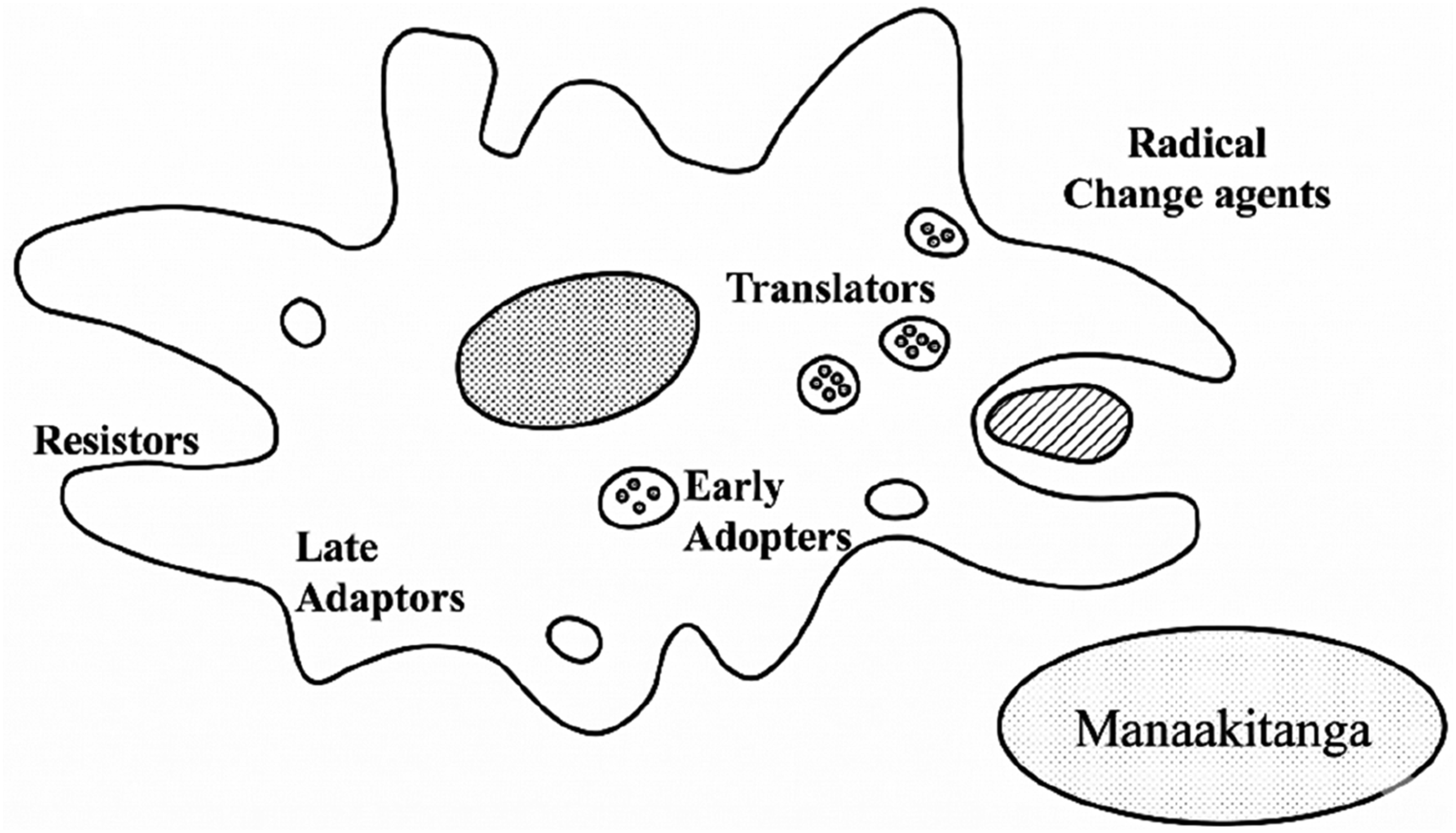
In the Amoeba Model, the various elements of the organism represent different roles in the work of social change. Radical change agents are often at the vanguard of a movement, creating new paths, while translators explain and engage others in the movements. Early adopters take direction from progressive leaders and lean into the work with the late adopters joining when there is no credible alternative. Resistors are ideologically opposed to progressive change. Manaakitanga is about those that provide practical and emotional support for others in the movement. Engaging with Te Tiriti invites organisations to embrace imperfection, trust in emergent praxis, and move beyond rigid, linear models of change. This opens space for innovation, responsiveness, and sustained relationships with mana whenua. Meaningful Te Tiriti work is not about grand gestures, but about sustained, reflective, and relational practice that encompasses ups and downs.
Promising Te Tiriti organisational change can be structural, collective and relational. It may involve: •. Change that involves education, conscientisation, and tangible structural shifts (e.g., policies, governance, leadership). •. Māori leadership and roles are invested in (e.g., they have decision-making authority and associated budgets). •. Staff and leadership groups share the commitment. There is not an over-reliance on charismatic leaders, and there is consistent political will. •. Ensure the organisation, not just individuals, hold enduring relationships with diverse tangata whenua groups. •. The Amoeba Model: Recognise different roles in change movements and the need to support all of them. This can prevent staff burnout.
Beyond symbolic engagement
Classic organisational change models also help interpret the patterns described by Tiriti workers in this study. Beckhard and Harris (2004) propose that change occurs when dissatisfaction with the current state, a compelling vision of the future, and clear first steps collectively outweigh resistance. Interviewees in this study frequently described organisations that articulated commitment to Te Tiriti but lacked shared vision, clarity about initial steps, or sustained dissatisfaction with colonial inequities. From a change perspective, such conditions predict stalled transformation and symbolic drift.
Similarly, Knoster’s framework suggests that sustainable change requires alignment between vision, skills, incentives, resources, and action planning (Knoster et al., 2000). When any of these elements are absent, predictable dysfunctions arise: confusion when vision is unclear, anxiety when capability is underdeveloped, frustration when resourcing is insufficient, and false starts when action is not embedded structurally. Organisational change theory does not prescribe a Tiriti pathway, but it provides language for understanding why aspiration alone does not produce structural transformation.
There is a tension between “performative” and “transformative” engagement regarding Te Tiriti-led organisational change
Building genuine cultural capability involves all staff recognising systemic injustice and being involved in (re)imagining practical Tiriti-honouring alternatives. This orientation involves prioritising “haumi ally work” such as upskilling Tauiwi, and ensuring that commitments are backed by resources, accountability, and a willingness to work through discomfort and complexity towards mutually beneficial relationships. The adoption of Māori-led approaches can lead to improved outcomes for clients, patients, and students, demonstrating that Te Tiriti honouring is not only ethically important, but also practically effective for all.
This learning theme advocates movement beyond surface-level actions toward meaningful, mutually beneficial power-sharing relationships, such as: •. Go beyond one-off cosmetic changes to buildings, branding or tikanga Māori. •. Let go of idealism and perfection by encouraging humility, reflective practice, and ongoing organisational learning. •. Recognise the different emotional toll of Tiriti work for diverse tangata whenua and non-Māori. This includes being up-front about the risks and racism Māori face.
Track progress through relational, cultural and material impacts
Sustainable success involves embedding reflection and evaluation into organisational culture i.e. providing regular feedback loops, and leadership that is honest about the challenges and potential of everyday Tiriti action. Organisations are recognising that while some aspects of Tiriti work can be measured—such as staff participation in education programmes or changes in governance structures—true progress also lies in harder to measure causal relationships. These include increased cultural safety, improved relationships, greater empathy, and trust from Māori staff and communities. Success is not just about what is done, but how it is done. Developing and embedding values and practices such as humility, collaboration with diverse tangata whenua, and a willingness to work through discomfort and uncertainty are themselves a part of transformative change. Organisations are learning to value imperfect action and relational accountability as essential components of transformative change. Organisations can meaningfully measure and understand their progress through recognising: •. Like most organisational change or growth initiatives, process evolves over time. •. Success is context-specific. What might work for one organisation may not work for another. The specific Tiriti partners within the setting determine what is working or not for them. •. Key performance indicators, surveys, social outcomes, and Māori and non-Māori qualitative feedback can all be used to assess progress. •. Use action research cycles that combine qualitative and quantitative with Te Tiriti partners to refine actionable steps forward (Greenwood and Levin, 2007). •. Formal relationships with iwi/hapū, rūnanga, or co-governance structures that value and recognise Māori authority demonstrate the value and resource of a Te Tiriti relationship. •. There is a need for visibility about the contours of Tiriti-led organisational change work. Examples of theories and practice need to be published and shared in order to build collective learning and sustain efforts.
Reid et al. (2022) established that countering systemic inequities between Māori and non-Māori adults could save Aotearoa over NZ$860 million annually. This underscores that the impacts of Tiriti-honouring change are not only relational and cultural, but can also have significant material and economic implications. Te Tiriti engagement cannot be reduced to tick-box exercises, short-term projects, staff climate surveys or individual project evaluations to track progress. While these elements can provide a sense of completion, they often lack continuity and visibility internally and externally. The absence of documentation and shared learning means many organisations end up “reinventing the wheel.”
Summary
This article set out to examine what Tiriti workers observe when organisations claim to pursue Tiriti-led transformation. Drawing on thematic analysis of collective reflection, we identified recurring patterns: symbolic engagement without structural redistribution of power, under-resourcing of relational labour, and the over-reliance on individual champions rather than systemic accountability. Situated alongside organisational change scholarship, these findings suggest that the barriers to Tiriti-honouring transformation are not merely cultural but structural and institutional. While commitment is often expressed, the conditions required for sustained transformation — shared vision, capability, investment, and governance reform — remain uneven.
By considering Tiriti workers’ insight alongside organisational change theory, this article contributes a practitioner-grounded account of why transformation stalls and what it demands. Rather than offering a prescriptive model, we illuminate the lived realities of those navigating this work across diverse organisational settings. We maintain by affirming that Tiriti-honouring change is relational, structural, and ongoing. It requires courage, investment, and a willingness to redistribute authority. In keeping with the principles discussed throughout this article, we return the final word to Māori co-authors as an expression of rangatiratanga within the structure of this text.
He whakaaro Māori
When organisations do well there is a clear commitment, not just what they say, but also in terms of funding and resource. It is backed up at a senior leadership level. But there also then needs to be a high proportion of staff who understand it and they can follow through.
‘Ko ngā amorangi ki mua ko ngā hāpai ō ki muri’ is often literally translated as ‘the leaders out the front and the workers at the back’. Implicit in this whakataukī is that leadership can only be sustained via a nourishing relationship with all elements of a community or organisation. While this is true, it is also not the whole story. Standing alone, this interpretation is simplistic and also tends to be distorted by a colonial lens on power, i.e., that leadership (therefore power) is synonymous with being at the apex of a hierarchy or being at the front of an organisation. In our kōrero, both Māori and Pākehā voices emphasised the importance of leadership: prioritising Māori leadership and seconding Pākehā/Tauiwi leadership. That critical change occurs only when a critical leadership is enacted at all levels of the organisation. And further, that Te Tiriti itself requires and creates leadership.
The voices/reo whakatangi in this paper also emphasise deeper, more nuanced reading of this whakataukī – that we work in complex, emergent, nonlinear systems. At a deeper reading the whakataukī captures multiple nuances of networked (relational and structural) leadership and obligations beyond a binary construction of power and leadership. That leadership is not only supported by the work ‘out the back’, but ‘out the back’ are also sites of power, and ‘workers’ are performing many forms, expressions, manifestations and modes of leadership. Each role has interconnected reciprocal mana sourced in a relational dynamic between individual and collective. In this, model every worker is a leader and every leader is a worker, with different roles, responsibilities and obligations.
This non-linear, emergent and networked understanding of power relationships and responsibilities is reflected in the experience of both Pākehā and Māori Tiriti workers who articulated that, in their experience, Te Tiriti challenges us to discard monocultural linear systems and rigid organisational models. These models are often difficult and painful to dislodge because they are embedded in Western, hetero-, patriarchal/capitalist norms at the level of culture. This means that these dominant norms form not only larger social macro and organisational structures but are also mirrored in the structures of the mind/thinking, feeling, emotion, identity and belonging at the level of individuals. Tiriti-led change is therefore, by necessity, working at all these levels of change mostly simultaneously. Mostly simultaneously because there are also elements of sequential change that occur, i.e., that the work of change cannot happen unless there is a heart change. So, I find that Pākehā and Māori are now starting to talk about becoming a good Tangata Tiriti, now that never happened five years ago. So, it’s really heart-warming.
In his kōrero exploring constitutional change Moana Jackson often quoted the work of Frederick Douglass, who stated that in order to transform racism that we need to win the hearts of people. Te Tiriti creates a space where this battle for the heart can occur – te poho, the heart space. To reiterate, this was an important point made by both Māori and Pākehā voices in this analysis, that Te Tiriti is not only a cognitive exercise but also a necessary space for healing colonial trauma created by deeply nihilistic, capitalistic and racist structures. Correspondingly, Māori voices in this analysis identified unacknowledged European baggage as one of the greatest impediments to powerful sustained change within organisations which, if unaddressed, continued to operate to defend and reinforce existing colonial structures and often created ongoing resistance to Tiriti-led change.
Te Tiriti challenges and invites us to imagine a future that is multi-layered/multi-dimensional and non-binary. A future where Māori realities and knowledge systems are deeply embedded and operational at all levels. Organisations (and/or staff/leaders) in our kōrero often perceived these levels of change as a threat, challenging existing power structures and asking people to change core assumptions. In their work with organisations, Te Tiriti trainers identified what antiracism and diversity equity and inclusion educator Verna Myers identifies as the ‘work’ that white people need to do: i) seeing barriers as they exist in the world, ii) putting themselves into the shoes of marginalised communities to learn more about their experiences and perceptions, iii) understanding how being white has shaped their world view and perceptions, and iv) gaining the skills of navigating complex cross-cultural dynamics.
In Aotearoa, before we can begin to move forward together into an unknown future, Te Tiriti challenges us to see ourselves, to know who we are, and what/who we bring with us to the tēpu. And like Myers’ wero, in the context of persisting dominant colonial structures, this is particularly the work of Pākehā (rather than overloading already overwhelmed scarce Māori resources). How to redress intergenerationally entrenched (capitalist – racist and patriarchal) power structures in organisations. How to enact powerful structural organisational and social change. What was immediately apparent and stated repeatedly in our kōrero, is that in order for radical change to occur, change needed to be supported structurally. And that this structural frame needed to occur in te poho, the heart space, allowing this radical analysis to be supported by a radical form of love or mahi aroha. Mā tōu rou, mā taku rourou ka ora te iwi.
Dedication
Christine Herzog, one of the key-informants and our comrade died suddenly while we were writing this article. Christine was a much-loved friend and mentor to many. For over 40 years she was a tireless advocate for social justice and Te Tiriti o Waitangi. We dedicate this article to her. Moe mai rā e te rangatira.
Footnotes
Acknowledgements
Thanks to the past present and future Tiriti workers who support organisations on their Te Tiriti journeys everyday in both warm and hostile environments.

Ethical considerations
Ethical approval was not secured as experts in their field were interviewed about their area of expertise.
Funding
The authors disclosed receipt of the following financial support for the research, authorship, and/or publication of this article: This project was funded by Te Tāpui Atawhai – Auckland City Mission and a Royal Society Te Apārangi Marsden research fund.
Declaration of conflicting interests
The authors declared no potential conflicts of interest with respect to the research, authorship, and/or publication of this article.
Data Availability Statement
Data is available from the corresponding author.