



Abstract
Restrictions on Indigenous peoples’ contributions to policymaking pervade post-settler societies like Australia, Canada and Aotearoa. Such effects are observed in spite of agreements like Te Tiriti o Waitangi in Aotearoa and the United Nations’ Declaration on the Rights of Indigenous Peoples. Te Tiriti, negotiated between the British Crown and Māori (Indigenous peoples of Aotearoa), may have been entered into honourably by both parties, but the Crown has consistently resisted its implementation. Contemporary colonialism is characterised by the entrenched and on-going displacement of Indigenous people’s authority by settler states, rationalised by race as a determinant of human worth. Impacts include land alienation, unsustainable resource exploitation and marginalising Indigenous voices from opportunities to make policy consistent with Indigenous values and preferred ways of living. Colonialism normalises institutional racism so that public policy outcomes are persistently unjust. This article describes Critical Tiriti Analysis (CTA), an original contribution to transforming colonial policy, which retrospectively evaluates whether any specific policy document is consistent with Te Tiriti. Substantial interest in CTA from policymakers, practitioners, and scholars led to the development of the tool as a prospective guide to making policy that is consistent with authoritative interpretations of Te Tiriti, and therefore, more likely effective in producing public policies which eliminate inequities. CTA was initially focused on health policy and built on a series of questions that arise from our interpretations of the text of Te Tiriti, contemporary Tiriti scholarship and jurisprudence, and our observations of the ways in which the method is being used by ourselves and others. Although deeply grounded in Aotearoa, we argue that CTA may be transferable to other colonial contexts, such as the Australian where treaties between First Nations and the state are being contemplated, and Canada which has passed legislation to implement the Declaration on the Rights of Indigenous Peoples.
Keywords
Introduction
In 2019, the Waitangi Tribunal, a permanent independent commission of inquiry in Aotearoa, found that consistent inequities in the Māori burden of disease were partly attributable to breaches of Te Tiriti o Waitangi (described below). The Tribunal found significant breaches in relation to: i) the legal and policy structure of the health sector; ii) underfunding of Māori health; iii) inaction in the face of health needs; iv) Māori whānau (extended families) receiving poorer quality and quantity of care; and v) the marginalisation of Māori in health decision-making at all levels (Tribunal, 2019).
In 2020, a Parliamentary Select Committee examined and endorsed the conclusions of the Tribunal (New Zealand Parliament, 2020). Both reports found that Te Tiriti provides a framework for responding to these instances of institutional racism.
In this paper we consider implications of these and related developments for health policy in Aotearoa. This is a policy domain to which we have contributed an original but retrospective policy evaluation tool that we have called Critical Tiriti Analysis (CTA). CTA has attracted considerable interest among policy communities (Came, et al. 2020a). In this article, we describe CTA, note its existing applications, explore its use for policy development and consider its potential adaptability beyond Aotearoa. From these considerations we develop a prospective policy making tool through a series of questions relating to each element of Te Tiriti. For the convenience of people who may wish use CTA, we repeat these questions at a single point in our conclusion.
Te Tiriti o Waitangi is a treaty that the British Crown put to Māori rangatira (chiefs) at Waitangi in 1840. It was presented in the Māori language, and proffered a means of bringing law and order to the increasing (mostly British) settler population while protecting Māori absolute authority over their own affairs (Orange, 2011). Its substantive content is set out in a preamble, three written articles and a verbal agreement.
There have been several translations of the Māori text the most prominent being those by Kawharu (1989) and Mutu (2010); we draw on both to strengthen our understanding of Te Tiriti. The preamble explained the Queen’s wish to establish a government “to protect the chiefs and the subtribes of New Zealand … to preserve their chieftainship and their lands to them and to maintain peace and good order … so that no evil will come to Māori and European living in a state of lawlessness” (Kawharu, 1989: 1). The first article gave Britain the right to establish government over its (non-Māori) settlers (kāwanatanga), while the second committed the Queen to protecting unqualified Māori chieftainship (tino rangatiratanga) over their lands, villages and treasures. The third article promised Māori the rights and privileges of British subjects (Mutu, 2010) which, in 2022, has evolved into New Zealand citizenship. It was also mutually agreed to protect religious freedom including established Māori beliefs and customs.
The English translation was signed by about 40 rangatira and the Māori text by over 500 (Healy and Murphy, 2012). As te Reo was the primary language spoken at the time, O’Malley et al. (2013) and others concluded that it is likely that the Māori text was the one read by and discussed with rangatira prior to signing. The substantive difference between texts is that the English version was widely considered a cession of Māori sovereignty to the British Crown, while the Māori text conferred a right to establish government over non-Māori upon the British Crown, while retaining Māori authority (Mutu, 2010). However, the qualifications and limits to the scope of authority conferred are important in both texts. Furthermore, the international legal doctrine contra proferentem holds that in the event of dispute, interpretation turns on the understanding of those who accepted rather than those who proposed any treaty (Mutu, 2010).
While in ordinary usage the differences between sovereignty and governance are significant, Fletcher (2022) argued that interpreting the texts in conjunction with the British instructions to its treaty negotiator, William Hobson, shows that he and the Anglican missionaries who translated the English into Māori, did not use the word sovereignty to describe an absolute and exclusive power. Whether it is sovereignty or governance, the power conferred on the British Crown was not an absolute and unqualified right to displace Māori authority and the powers of public administration were to include Māori – independently as rangatira and together with others.
The agreement was presented in the Biblical language of covenant (kawenata) and the initial (and continuing) Māori interpretation was that this was a solemn and enduring commitment not a surrender of Māori authority (Healy and Murphy, 2012). In this sense Te Tiriti is consistent with He Wakaputanga o te Rangatiratanga Nū Tīreni, (the Māori Declaration of Independence), where sovereignty is affirmed in te Reo Māori (Māori language) by the terms, mana (influence or standing) and tino rangatiratanga (absolute chiefly authority).
While debates about the meaning of Te Tiriti continue among some (O’Sullivan, et al., 2021), a consistent and unresolved theme is the nature and scope of Māori authority vis-à-vis that of the Crown. In short, what is the authority that belongs to Māori independently of the state and what distinctive presence should Māori enjoy within the state to protect rangatiratanga, and to exercise their share in the political authority of the state that is held by virtue of citizenship? In which ways might these questions be addressed to satisfy the Tiriti expectation of ‘peace and good order’? Thus, Te Tiriti has contemporary implications for how, why, by whom and for whom policy is made.
In 1975 the Waitangi Tribunal was established to investigate breaches of the Treaty of Waitangi (English version) and Te Tiriti (Māori text) through the Treaty of Waitangi Act 1975). The Tribunal make recommendations but, critically, these are not binding. However, subsequent negotiations with the Crown have led to apologies, co-management arrangements of natural resources and financial compensation for historic (and contemporary) Te Tiriti breaches (Mutu, 2018). They have also contributed to changes in the way policy is made. Treaty principles have subsequently been explicitly elaborated, revised and refined. One of the distinguishing features of CTA is that it refers only to the substance of Te Tiriti and does not attempt to define associated principles because this practice diminishes the standing and influence of the original text.
By the 1980s the ripples from the establishment of the Waitangi Tribunal extended to public policy more generally. Puao te Ata Tu was a landmark report that exposed institutional racism within the public sector and policy’s monocultural character (Ministerial Advisory Committee on a Māori Perspective for the Department of Social Welfare, 1988). Despite subsequent institutional reforms, systemic injustices and inequities in health, social and economic outcomes were not disrupted (Marriott and Sim, 2014). Māori continue to experience a disproportionate burden of disease, poorer education outcomes, higher debt and shorter life expectancy (Moewaka Barnes and McCreanor, 2019), as do many other Indigenous communities in colonial contexts (Gall et al., 2021).
Māori have always resisted colonisation and the normalisation of institutional racism (Walker, 1990) and sought to uphold Māori understandings of Te Tiriti as an expression of sovereignty and mana motuhake (self-determination, autonomy). A current example of this which find visionary and important is the Matike Mai (Matike Mai Aotearoa, 2016) movement which has developed concrete proposals for bi-national constitutional arrangements as a pathway to nationhood informed by racial justice. 1
Beyond Aotearoa, Indigenous-led initiatives to protect Indigenous rights include the United Nations Declaration on the Rights of Indigenous Peoples (United Nations, 2007). However, in 2010 the New Zealand government accepted it as an aspirational instrument (Key, 2010).
Evidence about contemporary and historical breaches of Te Tiriti continue to be presented to the Waitangi Tribunal and inform our understanding of alternative institutional, policy and policy-making arrangements that are consistent with the original agreement. For example in 2021 the Waitangi Tribunal (2021) found that the Government’s Covid-19 vaccination strategy breached Te Tiriti by failing to adjust age based eligibility for Māori to reflect their median age being significantly lower than other population groups. Further breaches related to covid management showed Māori exclusion from policy decisions. CTA is a mechanism to enhance policy consistency with Te Tiriti and it is presently discussed in detail.
Te Tiriti o Waitangi, as distinct from its principles, provides a potentially powerful policy platform to address racism and the burden of Māori health injustices and inequities. To this end, CTA shows that ‘Te Tiriti is always speaking’ (Tawhai and Gray-Sharp, 2011) by offering clear pathways towards the commitments it made about the distribution of political authority. CTA allows the contextualised interpretation of those aspirations in policy development and evaluation.
Te Tiriti and health policy
In contemporary Māori policy discourses, there are two key Waitangi Tribunal findings that CTA considers. Firstly, in the report Te Paparahi o te Raki, WAI 1040 (Waitangi Tribunal, 2014) the Tribunal found that Ngāpuhi (a Northern tribe) did not cede its sovereignty to the British Crown. The Minister for Treaty Negotiations moved rapidly in an effort to contain this crucial point: ‘There is no question that the Crown has sovereignty in New Zealand. This report doesn’t change that fact’ (Kenny, 2014). Both the finding and the minister’s response raise questions about the meaning of sovereignty and whether it is an absolute indivisible authority as Hobbes (1958) claimed or whether it is a body of powers reflecting the people’s collective authority with Māori exercising shares in its expression. As rangatira exercising independent authority over their own affairs and as citizens sharing the powers and responsibilities of kāwanatanga (governorship) (O’Sullivan et al., 2021).
It is indefensible with respect to Te Tiriti, and many theories of liberal democracy, to argue that state sovereignty exists separately from Māori for others to use as a fair and reasonable subjugating power. The Tribunal’s finding brings a sense of urgency to questions of how, why and by whom power and authority are distributed and exercised. CTA is one of our original responses to these questions and is distinguished by its essential requirement that Māori people must always lead or substantively contribute to policy development.
Secondly, WAI 2575 Hauora: Report on Stage One of the Health Services and Outcomes Kaupapa Inquiry, which was the Tribunal’s first nationally significant health claims report (Waitangi Tribunal, 2019). The Hauora report recommended that the primary health care system reflect the Tiriti guarantee of tino rangatiratanga in the design, delivery, and monitoring of health services. It recommended that the New Zealand Health and Disability Act 2000 be amended to include the explicit aim of achieving ‘equitable health outcomes for Māori and other population groups’ (p. 164). It further recommended that this aim be stated explicitly in all systemic strategies and plans, and that an independent Māori Health Authority be considered. This consideration should include the Authority providing and procuring primary health services and policy advice. The Tribunal also recommended stronger accountability mechanisms with respect to Māori outcomes, supported by more robust and effective data collection (Waitangi Tribunal, 2019).
Development of critical Tiriti analysis
Critical Tiriti Analysis initially emerged from discussions among activist scholars within the health activist group STIR: Stop Institutional Racism (Came, et al., 2016). It was also informed by the experience of two of the authors (HC and TM) giving evidence before the Waitangi Tribunal (2019) in which we argued that health policy was poorly aligned with Te Tiriti. The analysis developed further with Māori political theorist (DO) and critical Indigenous scholar (JK). We embraced a critical approach because Te Tiriti and/or Treaty discourses promulgated by the Crown and others were deeply compromised in the ways the Tribunal found (Cabinet Office, 2019; O’Sullivan et al., 2021).
An important decision in the early development of CTA was to focus exclusively on the Māori text of Te Tiriti and the elements contained in the preamble, the three written articles, and the verbal commitment. Government policy documents frequently make no reference to Te Tiriti (Came, et al., 2019). They are more likely to refer to the Treaty (the English version), Treaty principles, or concurrently to Te Tiriti and the Treaty, and in ways that suggest they are the same in all their substantive content. We argue that such variation takes attention from Te Tiriti as the authoritative text.
Our interpretation of Te Tiriti, supported by extensive bodies of historical, jurisprudential, and political scholarship, is that it contains at least five elements that should inform policy development. Importantly, this interpretation rejects the use of principles in the place of the text of Te Tiriti. The principles have been developed through ongoing judicial interpretation, Tribunal reports, legislation and policy instruments. Yet neither text referred to the ‘partnership between races’ that the Court of Appeal elaborated as a principle in some detail in 1987, and which has been used to distance Māori from the Crown as adversaries in a binary junior/senior relationship (O’Sullivan, 2007).
CTA assists policy makers to evaluate public policy with reference to Te Tiriti (Came et al., 2020a). By focusing on the five elements of the Māori text, CTA maintains that Māori do not participate in public life as partners to the decision-maker but as rangatira with authority to make decisions over their own affairs and exercise substantive leadership and presence wherever policy is made inside the state. Its purposes are to ensure the exercise of rangatiratanga, including in new policy contexts, and to improve the working of democracy so that citizenship is a status of distinctive and meaningful influence. This means that one may conceptualise “relations between Indigenous peoples and the state not simply as Indigenous policy making but as democracy making” (Davis, 2021: 376). This is important because the power to establish government that Te Tiriti conferred on the British Crown was not a power to do harm to Māori. The avoidance of harm is preliminary to the broader presumptions of good government including the ideal that the powers and resources of the state should support all people and not just some (white) people’s opportunities to sustain lives that they have reason to value (Sen, 1998).
CTA’s simple but far-reaching expectation is that with Te Tiriti as a guiding framework, more effective and just public policy will develop. This conceptual paper reviews current retrospective uses of the CTA then proposes ways of using CTA prospectively to inform new policy development.
Retrospective critical tiriti analysis
CTA is a policy evaluation tool developed to support researchers, policy makers, practitioners, and indeed, any citizen, to assess the extent to which a policy is consistent with Te Tiriti. It is an analytical review involving a five-stage process requiring meaningful Māori leadership. A CTA does not seek to commentate on the character of the author nor the organisation publishing the document.
The first stage of a CTA involves a high-level consideration of the policy to establish its attention to te ao Māori (the Māori world) and Te Tiriti. Does the policy appear Māori-led or have significant Māori content? Or does it appear that Māori people and aspirations were excluded or otherwise marginalised?
The second stage involves a closer examination of the document to investigate to what extent it responds to the five elements of Te Tiriti– i) the preamble, ii) kāwanatanga, iii) tino rangatiratanga, iv) ōritetanga (equitable citizenship) and v) wairuatanga (spiritual freedom).
Critical Tiriti Analysis indicators.
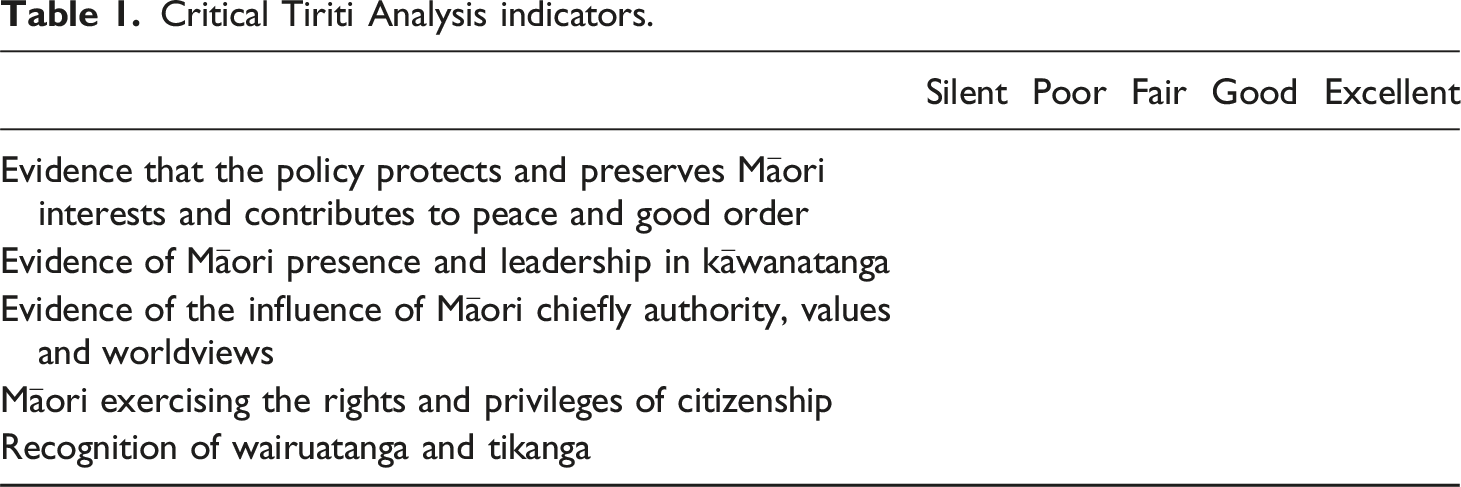
There is no one-way to conduct a determination. Sometimes people do it together as a group; other times they make individual determinations and then negotiate a collective position. Written commentaries may contextualise the table and explain the determination. The indicators can and have been adapted to review particular documents; they are evolving iteratively as people work with CTA. They may continue to evolve.
Stage four provides suggestions about how the document could have been strengthened. It involves making practical suggestions about how the policy might be improved, which may include different framing, approaches or new content. It is also an opportunity to identify instances of innovation or points for replication. It has always been intended that a CTA process be mana-enhancing, that is recognising and maintaining the intrinsic value of those who were involved in developing the policy (Came et al., 2020b). This intention acknowledges that in policy documents, some (Māori) contributors may have been marginalised or had their contributions removed from the final published version. The CTA does not capture good will/intentions on behalf of the policy-makers.
Stage five is the Māori final word. Its rationale is that for a CTA to serve Māori interests there must be considerable Māori leadership and presence throughout. CTA proposes no single model for satisfying this element but suggests that an authoritative Māori view is more likely with multiple Māori perspectives contributing to the determination. It is not intended as a task for a single individual, but as a comprehensive assessment of the whole CTA through a critical Māori lens.
Since 2020 a number of retrospective CTAs have been published. These include CTAs on primary health care (Came et al., 2020a; Kidd, et al., 2021), strategic cancer control policy (Came et al., 2020; Came and Kidd, 2020), health reform legislation (Rae et al., 2023, Rae, et al., 2022), human resource practices (Goza, et al., 2021) and youth health (Clark et al., 2022). Anecdotally, we understand that CTA has been used by policymakers in the Ministries for the Environment, Health and Justice, by Pharmac, Accident Compensation Corporation and Te Whatu Ora - Health New Zealand. Hundreds of people are now alumni of training workshops we (and others) have conducted and are variously applying CTA to their policy evaluation/development and project work.
CTA was originally intended as a tool for systematic evaluation of existing Crown policy in relation to Te Tiriti. Unsurprisingly its limitations have been largely associated with its specific focus on already published policy documents. While the retrospective focus of the CTA has been useful for illustrating where Crown policy has failed to recognise and honour Te Tiriti, and step four involves suggesting improvements, there remains scope for adapting it with an explicit focus on the development of new policy.
Moreover, there is growing curiosity among Māori policy makers on how the CTA might function within their context, for example when they are contributing to a Māori health policy or strategy within a Crown entity. Further Māori-led development needs to occur in this respect.
Our response is to revise CTA as a policy development method proposing questions that policymakers could ask from prospective standpoints. Its potential is to prevent harm and realise positive Māori aspirations by ensuring that Māori are rangatira in policy making.
Prospective critical tiriti analysis
The development of CTA for prospective use in policy-development emerged from the experience of providing training to practitioners in diverse fields, such as education and health, scholars and policymakers, on how to work with CTA as an evaluative method. Rather than critique what already exists, participants instead expressed a desire to influence policy by applying CTA to the development of future measures and supporting documents such as strategies, project design, curriculum, research data analysis and professional registration competencies.
The Pharmacy Council (2022) has used CTA to revise professional competence standards for public consultation. The Council, which is chaired by a Māori pharmacist, adapted CTA by raising tailored questions to guide its development process. Those involved in drafting the standards included a Tiriti reference group and the Māori Pharmacists’ Association. The draft’s underlying presumption is one that we intend our prospective CTA model to support, with its emphasis on Māori perspectives of health and wellbeing:
Māori have a range of world views and practices which have relevance to their current health status. When developing treatment plans for Māori, pharmacists should use and expand on their knowledge of Māori models of health and core Māori practices including tikanga (correct rules) and kawa (protocols) to improve relationships and health outcomes (p 24).
We are also aware of other groups using CTA for planning purposes, where the intention is for Māori and other citizens to work together with Te Tiriti guiding their common purpose. For example, one such group has been contracted to prepare New Zealand clinical practice guidelines for the diagnosis of a major neurodevelopmental disorder. It is working with CTA to assess whether the process and recommendations being developing to meet the rigours of Te Tiriti consistency. The group has completed an initial prospective CTA assessment, shared it with their governance group and have indicated mid-term and final assays to achieve their aspiration of the guideline being grounded in Te Tiriti.
Moreover, the group has adapted the CTA assessment scale to fit its purposes and, in the process, provided a conceptual and applied development that strengthens the original CTA. In particular, the group adapted our likert scale for CTA assessment, to a mauri scale which recasts our 5-step analysis process (Haami Harmer, Personal communication 28 Oct 2022). Given that mauri renders from te reo as life force, vital essence, naming steps 1–5 as mauri titaha, mauri noho, mauri piki, mauri oho and mauri ora, would align CTA practice with an ontological principle of profound significance to Māori philosophy, values and culture (Te Whatu Ora - Te Toka Tumai, 2022). The nuance introduced through the specification of mauri forms designed to describe the state of a project or development, shifts each stage of assessment beyond the casual violence of ordinal convenience, to a relational demarcation of progress around each element of Te Tiriti.
The group’s approach is culturally significant in ways that the introduction of te reo Māori into CTA would not, by itself, reflect. In fact, utilising te reo in documents or processes that are not already embedded within a Māori world view would constitute cultural appropriation and has been critiqued through retrospective CTAs (Came et al., 2020; Came and Kidd, 2020). We have purposefully not provided a full explanation here of the mauri forms suffice to say that they suggest a cumulative trajectory from nascence to full realisation of mauri because they are culturally specific and do not lend themselves to rapid translation (see Marsden, 2003; Durie, 2001). This example illustrates the importance of Māori led adaptations of the CTA to bring effect to a Te Tiriti based prospective process.
Another example of a developing prospective CTA is that of a multi-disciplinary bicultural research team working across multiple university and community sites to develop a proposal for a major study on the health impacts of climate change. Here CTA is drawn upon, especially to guide the development of safe, effective, respectful, collaborative processes for Māori and Tauiwi (an inclusive term for settler) researchers working on the grant application. Again, CTA is already in play in this context and is conceptualised as a part of robust Tiriti-based processes, with multiple applications along the way, to check and orient Tauiwi praxis to ensure alignment with Māori in the research application.
Recognising these levels of interest in CTA (O’Sullivan and Came, 2022) and that the purpose of policy evaluation is to inform Tiriti-consistent policy development, this article adapts CTA to explicitly guide policy development as a complement to our earlier evaluation work.
Our intention is to contribute to this evolving practice and provide policymakers, scholars and practitioners with a simple though ideally far-reaching framework to support their work and form a sustainable community of practice 2 . This framework could also support public submissions to parliamentary or other policy-making entities (Came et al., Under review; Rae et al., 2022).
To this end, our focus is on processes and practices to promote public policy that is consistent with Te Tiriti. Our second purpose is to identify adaptations of CTA that may contribute to policy making outside the state, within the state in other jurisdictions such as Australia and Canada, and to other contexts where the intent is to ensure that the perspectives of people otherwise marginalised or excluded from policymaking may be assured of equitable inclusion.
We use our analysis of a Cabinet Office Circular (2019) on the Treaty and Te Tiriti to further our development of CTA (O’Sullivan et al., 2021). The Circular was issued as an instruction to policy advisors on the Treaty and/or Tiriti questions they should consider when preparing advice to ministers.
Our evaluation of the Circular, led to a series of alternative questions that we argued better reflect the substantive content of Te Tiriti (O’Sullivan et al., 2021). Our prospective CTA method uses an adaptation of these questions which we proposed were more likely to contribute to just and enduring policy outcomes because they help policy advisors to assess, prior to developing a policy, whether the responsibility best belongs to independent Māori political communities or to the state.
In keeping with CTAs original structure and format, our indicative questions respond to each of the five elements of Te Tiriti. We recommend focussing on the main overarching and essential question with respect to each element. Supplementary questions will ordinarily be developed in-situ, to suit individual contexts and add to the overarching initial questions that we propose. Devising supplementary questions is, in itself, a powerful act that will deepen our collective understandings of Te Tiriti and clarify the intent of the policy under development for the policymakers.
Preamble
The preamble to Te Tiriti is often ignored or over-looked in terms of the contribution that it makes to interpretation of the document, particularly in contemporary contexts. The preamble is important because it explains the Crown’s intent, its reasons for proposing the agreement and the purposes of the government it wished to establish. The preamble reflects the drafters’ interpretation of the British Foreign Office’s instructions (Normanby, 15 August 1839) as well as the instructions in the letters patent issued to Hobson on the purposes of the treaty he was to propose (Fletcher, 2022).
Our point here is that the provisions that follow in the articles of Te Tiriti are imbued with imperial gravitas, making the compact entered into, a matter of honour for the British Crown, which in that era was imbued with power, might and reach. These responsibilities have been inherited by the New Zealand Government (see Department of Prime Minister and Cabinet, 2017). It is important to raise the following fundamental question in relation to the preamble. • How will this policy respect existing Māori authority, strengthen relationships, and contribute to peace and good order?
Supplementary questions: • Who is at the table, who else should be at the table, who is in control of this process? • Who is this policy intended to benefit?
Article 1- kāwanatanga
Kāwanatanga is the Crown’s right to govern and responsibility to govern in favour of Māori citizens as much as it governs in other citizens’ favour. This includes protecting Māori interests and requires meaningful Māori involvement in all decision making. The presumption of Māori substantive engagement in establishing policy priorities and approaches is fundamental to this element. Our foundational question, which is also an expression of the article 3 right of citizenship, is: • How are Māori leading and contributing to this policy’s development, and to establishing the priorities it is intended to serve; do Māori say that these arrangements are satisfactory?
Supplementary questions: • What does honourable kāwanatanga look like in this process? • How will decision-making processes ensure that Māori have the final word on how this policy benefits Māori people?
Article 2 – tino rangatiratanga
Matike Mai Aotearoa (2016) argued that tino rangatiratanga is “the right for Māori to make decisions for Māori” (p. 8). This right is potentially exercised by hapū (subtribe), iwi, marae, urban authorities, Māori non-governental organisations and other groupings. This article encompasses autonomy over land, water, natural resources, and all that was, and is, of value to Māori including culture and good health. Māori control and autonomy over their own lives are determinants of a flourishing Māori population. So: • Is this a policy that more appropriately belongs in whole, or in part, to a Māori political community as an expression of rangatiratanga? • If not do Māori people say that matters of tikanga or specific Māori interest need to be considered and how are Māori experts drafting or otherwise contributing to this policy? • How will resources and power be restored to Māori/hapū?
Supplementary questions: • How will this policy advance Māori/hapū tino rangatiratanga? • How does this policy reflect Māori/hapū values/authority? • How does it strengthen Māori/hapū collective wellbeing?
Article 3 - ōritetanga
The original Māori text of Te Tiriti refers to Māori and the people of England, and their tikanga, being treated ‘rite tahi’ (the same) by the Crown in terms of the rights and duties that they enjoy (Kawharu, 1989). These rights and duties have evolved considerably from the ‘subjecthood’ of 1840 with citizenship, in 2023, describing a substantive body of political responsibilities, rights and capacities. Most importantly, kāwanatanga is no longer an authority exercised by the King over and above his subjects, but an authority that the people confer on parliament which in turn determines the formation of government.
In practice, however, Māori are often excluded or diminished as part of the ‘people’ in whom this authority is vested. They may also be diminished as people who contribute to exercising the powers of government through their participation at all levels of the policy process. CTAs purposes include providing ways of ensuring that Māori are meaningfully among the ‘people’. In contemporary times, particularly in relation to health, this article’s implications for equitable policy outcomes is emphasised. The Waitangi Tribunal has found that this right is compromised by colonisation and institutional racism (Waitangi Tribunal, 2019). So: • How will this policy consider the responsibilities, rights and capacities of Māori citizens and ensure equity of outcomes as Māori people define them?
Supplementary questions: • How do Māori expect policy to work differently from previous policy that has generated or maintained inequities?
Article 4 – wairuatanga and custom
This article, often omitted from descriptions of Te Tiriti, is a verbal agreement that the range of faiths including “Māori custom” will be protected by the Crown (Berghan, et al., 2017). Wairua is a manifestation of custom, an expression of spirituality and a descriptor of psychological well-being. • How will this policy support people to live as Māori and according to Māori values and customs?
Supplementary question: • How does wairuatanga influence this policy?
Contextualised supplementary questions
A pragmatic but unifying question in responding to Te Tiriti as an agreement concerned with fairly distributing power and authority, is ‘Who does what, how and why?’ From this perspective O’Sullivan (2022, pp. 25–26), developed the following questions in a discussion paper commissioned to support the Ministerial Review into the Future for Local Government: • Which local government functions could be better conducted by iwi, hapū or other Māori political communities? • Which functions could be managed to reflect rangatiratanga and support more effective governance? • What would a system of local government look like if everybody contributed in culturally meaningful ways? • How could principles and practices of Māori decision-making processes be transferred to the council chamber? • How can local government be arranged to ensure that group membership is not a democratic disability for any citizen or groups of citizens? • How would standing orders ensure that decisions are not made ‘until we understand each other’? • What exactly would make councils morally legitimate from the perspective of Māori communities? • Which structures and participatory arrangements would give Māori reason to say that the system of local government belongs to them as much as anybody else?
O’Sullivan used these contextualised questions to develop two foundational arguments which are adaptable to other policy domains. Firstly, that councils do not necessarily have to carry out all the functions of local government. Some of these functions could belong to the domain of rangatiratanga and therefore be more justly and efficiently carried out by Māori political communities - iwi, hapū or marae, for example. Secondly, Māori people should reasonably expect to engage in council affairs with participatory parity. That is to participate in culturally preferred ways and with the expectation that culture is not an obstacle to meaningful influence. Public decision-making processes should not be culturally foreign to any citizen.
International applications of CTA
Although CTA was developed in response to Te Tiriti and its relationship with local health policy, its arguments are strengthened by their wider location in international human rights discourse. For example, the principle of different but complementary First Nations’ authority inside and outside the state is central to the UN Declaration on the Rights of Indigenous Peoples. Article 5: Indigenous peoples have the right to maintain and strengthen their distinct political, legal, economic, social and cultural institutions, while retaining their right to participate fully, if they so choose, in the political, economic, social and cultural life of the State (United Nations, 2007, art 5).
In the specific context of health, the Declaration maintains that: Article 23: Indigenous peoples have the right to determine and develop priorities and strategies for exercising their right to development. Indigenous peoples have the right to be actively involved in developing and determining health, housing and other economic and social programmes affecting them and, as far as possible, to administer such programmes through their own institutions (United Nations, 2007, art 23).
CTAs consistency with the Declaration means that it may be adaptable to other Indigenous contexts such as the Australian state of Victoria where the First Peoples’ Assembly is contemplating a treaty or treaties with the state and Canada where legislation to give effect to the Declaration was enacted in 2021. However, CTA extends the scope and significance of article five by showing how Indigenous people may and should be part of the state and hold positions of policy leadership inside the state as it works out the steps it will take to realise the rights of Indigenous persons to “the highest attainable standards of physical and mental health” (United Nations, 2007, art. 24 (2)).
CTA also recognises that such health aspirations are contextualised by both culture and colonial experience. Rangatiratanga and meaningful citizenship are expressions of the internationally sanctioned right to self-determination, and they are not realised only by the state doing justice to all citizens as (Waldron, 2002) conceptualised it, but by the substantive political capacities that are available to Indigenous peoples to do justice to themselves (O’Sullivan et al., 2021). This presumption, which CTA reflects, provides a framework for responding to the questions of who does what, how and why?
The Declaration was the outcome of Indigenous co-operation among nations and although it would be unrealistic to suggest that it reflects a unanimous view, its level of support reflects that in their cultural and political diversity, there is strong agreement on what constitutes the universal right to self-determination and how it might be expressed with respect to cultural and colonial contexts. Its international character and authority contribute to Indigenous public policy as a site of international co-operation and potential policy transfer. CTA is well-placed to add to the possibilities that arise as: The world of public policy is becoming increasingly small due to dramatic changes in global communications, political and economic institutional structures, and to nation states themselves (Evans, 2009: 243).
As the Victorian (Australia) First Peoples’ Assembly prepares for treaty negotiations with the state, its expectations of what it wants to achieve and why, are developing clearly and in response to its own accounts of what self-determination means and what it should achieve. The Assembly’s deliberations include working out the nature of Indigenous policy leadership and how this might address “the corrosive legacy of invasion, improve the lives of the people, and allow everyone in Victoria to create a future together as equals” (First Peoples’ Assembly of Victoria, 2021). Thinking about whether this future should include guaranteed seats in parliament or whether there should be an Indigenous body with the power to make policy decisions reflect CTAs view that there may be many sites of decision-making authority and that citizenship may evolve in ways that contest its potential to make ‘Whiteness’ its ‘definitive marker’ (Moreton-Robinson, 2004: 79).
The inclusive and meaningful citizenship that CTA imagines could be useful in the Victorian context because adapting its questions and indicators to suit different jurisdictions reflects its response to Rousseau’s (1968) counter-colonial argument that the general will is an institution in which each necessarily submits himself (sic) to the same conditions which he (sic) imposes on others; this admirable harmony of interest in justice gives to social deliberations a quality of equity (p. 58).
Adapting the five main CTA elements for international use could ask: • How will this policy advance First Nations’ self-determination and reflect inclusive and effective government? • How are First Nations and their members leading and contributing to this policy’s development, and to establishing the priorities it is intended to serve; do they say that these arrangements are satisfactory? • To what extent is this a policy that more appropriately belongs in whole, or in part, to a First Nations political community as an expression of self-determination; which matters of culture or specific interest need to be considered and how are First Nations’ people, with appropriate expertise, drafting or otherwise contributing to this policy? • How will this policy serve First Nations people as well as it serves anybody else? • How will this policy support people to live as a First Nation’s person and according to the values and customs by which they want to live?
British Columbia passed legislation to implement the Declaration in 2019 (Legislative Assembly of British Columbia, 2019). Canada followed in 2021. Its legislation requires Canada to take all measures necessary to ensure the laws of Canada are consistent with the Declaration; prepare and implement an action plan to achieve the Declaration’s objectives; and table an annual report on progress to align the laws of Canada and the action plan (Parliament of Canada, 2020).
Our modified CTA questions may be relevant to these objectives and to the alignment of Canada’s implementation action plan. The action plan intends to address injustices, combat prejudices and eliminate all forms of violence and discrimination against Indigenous peoples, including elders, youth, children, persons with disabilities, women, men and gender-diverse and two-spirit persons. It also aims to promote mutual respect and understanding, as well as good relations, including through human rights education related to the monitoring, oversight, follow up, remedy or other accountability with respect to the implementation of the Declaration (Parliament of Canada, 2020).
These objectives require explicit alignment with culture and colonial contexts. They are general human rights aspirations, and their potential impact may depend on how Canada gives effect to its accompanying commitment to ensuring that all future legislation is consistent with the Declaration. Contextually adapted CTA questions and indicators may support this intent. CTA’s presumption of substantive inclusion is also a presumption of accountability. Inclusion also presumes that self-determination encompasses an Indigenous political community’s right to do justice to itself.
Conclusion
Colonialism is not an historical event. It is an ongoing political relationship which may only be brought to conclusion through considered inclusion. Despite the significant body of literature that describes the ongoing impact of colonisation on the health and wellbeing of Indigenous peoples, considered inclusion has not occurred.
In Aotearoa, Te Tiriti o Waitangi was a concise agreement that Māori saw as binding and enduring. Critical Tiriti Analysis has considered Te Tiriti in a contemporary way to enable policy, strategy and other documents to be effectively measured against this agreement. The extent of policy actors’ use of this tool and increasing calls for CTA to be used prospectively to prevent harmful policies from being developed, has resulted in the adapted version that we have presented in this article.
International applications of CTA may be useful for Indigenous peoples who are negotiating treaties or developing policies that enact the United Nations Declaration on the Rights of Indigenous Peoples or are otherwise intended to advance the right to self-determination. For these purposes, a further set of potential questions were proposed that may provide the foundation for testing policy against Indigenous needs and aspirations, and internationally normative human rights principles. For Aotearoa these questions are repeated in the one place for ease of reference: • How will this policy preserve tino rangatiratanga, strengthen relationships, and contribute to peace and good order? (Preamble) • How are Māori leading and contributing to this policy’s development, and to establishing the priorities it is intended to serve; do Māori say that these arrangements are satisfactory? (Article 1 and Article 3) • To what extent is this a policy that more appropriately belongs in whole, or in part, to a Māori political community or hapū as an expression of rangatiratanga; which matters of tikanga, or specific Māori interest need to be considered and how are Māori experts drafting or otherwise contributing to this policy? (Article 2) • How will this policy ensure equity of outcomes for Māori? (Article 3) • How will this policy support people to live as Māori and according to Māori values and customs? (Verbal commitment)
CTA may contribute to non-colonial policy arrangements by asking its five simple but transformative questions.
Footnotes
Acknowledgements
Thanks from the CTA authors to the practitioners, scholars, decision-makers who have embraced CTA. We appreciate your feedback and treasure your stories of the diverse ways you are applying the tool.
Declaration of conflicting interests
The author(s) declared no potential conflicts of interest with respect to the research, authorship, and/or publication of this article.
Funding
The author(s) received no financial support for the research, authorship, and/or publication of this article.
