



Abstract
This article examines the interplays between outward and inward migration and the emergence of resentment in two cities in the Italian region of Lombardy. Drawing on the concept of ‘resentful affectivities,’ we conducted 43 ethnographically-informed interviews with shopkeepers in Pavia and Mantova. Through the emotional lenses of discontent, distrust, and nostalgia, we trace how resentful affectivities shape, interconnect, and potentially mobilize discourses around emigration and immigration. In particular, these three emotions link migration issues to normative expectations of democracy, often translating complex social-political dynamics into resentful affectivities through emigration and immigration narratives that give coherence to empty-crowded paradoxes. Emigration and immigration are articulated into resentful affectivities as the two sides of the same coin – the ‘best Italians’ are leaving while less-deserving/-desirable foreigners are arriving – with shopkeepers attributing varying degrees of agency to this dual movement, which integrates or illustrates broader criticisms to political elites. We argue that these notions connect emigration and immigration, not as counterbalancing each other, but rather through an overarching idea that broader phenomena with specific culprits are weakening and may potentially destroy a community that is nostalgically fantasized in opposition to every present facet inspiring discontent and distrust. Our contribution unveils the impact of unfulfilled expectations of political representation on resentful narratives of emigration and immigration.
It was the best of times, it was the worst of times…
The renowned opening line of Charles Dickens’ A Tale of Two Cities intertwines perception and emotion through paradoxical descriptions. It is through paradoxes that shopkeepers in Pavia and Mantova seem to make sense of and ascribe meaning to their world. And this paradoxical nature of everyday life evokes emotions, which are reflected in discourses that create social and political meanings, and make overlapping, sometimes contrasting, narratives intelligible.
One such emotion is resentment, which, we argue, elicits a subset of emotions, shaping worldviews and having political implications that can be either active or passive. We shall use the term ‘resentful affectivities’ to cover active and passive manifestations of resentment seen through the lens of three emotions: discontent, distrust, and nostalgia. A crucial implication of resentful affectivities pertains to the view purported by those who are governed about those who govern: citizens may feel that the government does not act in the common interest, in conformity to a specific national culture, or that those who govern act in ways that may potentially destabilize the political, social, territorial, and/or economic balance of the country. This perceived gap between the expectations of those who are governed and what they argue that the government does or does not do has the potential to constitute a veritable crisis of representation: the public may feel less, or not at all, represented by its elected representatives. We examine the resentful affectivities harbored by commercianti [shopkeepers], a specific group that is historically known to be susceptible to the politics of resentment.
Looking at the petite bourgeoisie in urban contexts of the wealthy region of Lombardy may seem counterintuitive, given a long-lasting political emphasis on less affluent, less infrastructurally developed and more isolated regions. However, recent research on ‘left-behind places’ (Pike et al., 2023) has broadened their spatial imaginary to interregional inequalities and political shocks amidst conflicting political and economic narratives, such as those leading to Brexit (McCann and Ortega-Argilés, 2021). Furthermore, ‘place resentment’ (Munis, 2022) has been reclaimed beyond rural settings and strictly socio-economic terms to encompass small- and medium-sized cities with a history, or at least a resemblance, of demographic stability, industrial development and economic prosperity (Borwein and Lucas, 2023; Cabello, 2021; de Lange et al., 2023; Huijsmans, 2023a). The research developed to date on place resentment seems to be predominantly concerned with its voting outcomes (Jacobs and Munis, 2023; Trujillo and Crowley, 2022), with only a few studies exploring the link between place resentment and emotions, such as trust in politicians (McKay et al., 2021) or anti-immigrant attitudes (Huijsmans, 2023b). In this paper, we add to this literature by examining emotions underlying different resentful affectivities that cannot be separated from the spatial context in (and against) which they are articulated: the cities of Pavia and Mantova.
We focus on the issue of mobility – encompassing both immigration and emigration – to investigate the articulation of resentful affectivities by shopkeepers. As recent Eurobarometer data suggest, 1 immigration is a highly salient issue all over Europe, being thus key in grievance-utterance and prone to high levels of politicization (Brug, 2015). While Italy has a long-standing history of emigration, the post-2008 financial crisis period has seen a marked increase in the outmigration of highly educated and skilled youth (Tintori and Romei, 2017), part of a widespread, increasingly salient phenomenon of depopulation threatening the EU (Newsham and Rowe, 2023). For this reason, we posit that both presence (immigration) and absence (emigration) have the potential to be articulated into resentful affectivities, even if absence tends to be far more neglected in the literature.
Therefore, we focus on emotions manifested in two urban contexts according to the guiding research question: How is human mobility articulated into resentful affectivities among shopkeepers in Pavia and Mantova? We shall argue that the issue of mobility informs normative expectations of democracy, namely by shopkeepers who may see in this bidirectional issue (outward and inward migration) specific threats to their city and way of life, thus adding to burgeoning resentful affectivities that can, furthermore, be extrapolated to national and transnational levels. Through a subset of emotions, here understood as three lenses of resentment, we operationalize the concept of resentful affectivities, unveiling a social, rather than strictly political, notion of democracy that gives significance to mobility at local, regional, and national levels.
Theoretical framework
Emotions are an important consideration in the political sphere (Marcus, 2000; Hall, 2009; van Leeuwen and Petersen, 2024), particularly in shaping or contesting “taken-for-granted assumptions that underpin the decision of agents” (Fierke, 2013, p. 209, as cited in Koschut et al., 2017). In the context of mobility politics, “emotions play a bigger role than facts in attitudes to migration” (Sharif, 2019: 5) by reinforcing or challenging the arbitrary and self-evidently accepted boundaries of common sense (Hutchison and Bleiker, 2017; Ranciere, 2006). Although considerable attention has been given to the migrant viewpoint (De Leersnyder et al., 2011; Boccagni and Baldassar, 2015; Mahmud, 2021), emotions have become increasingly central to studies shifting the perspective to host societies’ public attitudes (Brader et al., 2008; Dennison and Dražanová, 2018; Verkuyten, 2021; Lee, 2023; Xuereb, 2023). This shift in focus can be partly attributed to perceptions of mass immigration and the widespread concern it potentially raises for political, cultural, and social communities and (ethno)national identities (Sniderman et al., 2004; Johnson and Hing, 2005; Lindstam et al., 2021), often overlapping with social status anxiety, EU criticism and a general hostility toward political elites (Abts and Baute, 2022). The emphasis on a common culture and identity in notions of the nation-state has made it potentially difficult and conflictual to reconcile the functioning of national political systems with the incorporation of newcomers at the national (McLaren, 2012) and local levels (Caponio and Pettrachin, 2025; Dimitriadis and Ambrosini, 2024). It is thus unsurprising that resentment predominates in the literature on the migration-emotions nexus, highlighting the emergence of democratic dilemmas or ‘crises of representative democracy’ (Salomon, 2020; Celis et al., 2021), and often translating into negative attitudes toward immigrants and immigration (Denti, 2022; Dražanová and Gonnot, 2023).
Resentment is typically defined as a negative emotion created by a perceived unjust, disruptive situation where one feels unfairly treated compared to others in society – as being ‘relatively deprived’ (Spruyt et al., 2016). This anger brews over time, conferring to resentment a distinctive sort of moral anger (Celis et al., 2021; Fleury, 2022). For this reason, populism has been directly linked to resentment, alongside hope and anger (Rico et al., 2017; Salmela and Von Scheve, 2018; Wagner, 2014). Other authors insist on a semantic distinction between resentment and ressentiment (Capelos and Demertzis, 2022; Fassin, 2013). While the former is associated with moral anger and a sense of self-efficacy that can drive political engagement, the latter is a largely unconscious experience presenting feelings of injustice, humiliation, deprivation, and inferiority. To address the interplay between these dimensions, Capelos and Demertzis (2018) coined the concept of ‘resentful affectivity’ to denote the complexity and fluidity of emotions surrounding resentment that ressentiment seems to hyperfocus on.
Resentment presents tangible and polarizing challenges to the experience of democratic representation, which manifest in spatial terms (Cohen, 2019). Studies on resentment have taken a spatial turn, according to which populist views are predominantly held by modernization losers. In other words, inhabitants of rural places or medium- and small-sized “broken provincial cities” (Collier, 2018), who feel ‘left behind’ in a metropolization process accentuating territorial inequalities and marginalizing peripheries, are expected to be more susceptible to feelings of resentment. Such hostility toward place-based outgroups perceived as unfairly advantaged (Munis, 2022) is often designated in the literature as ‘place resentment.’ This concept, blending political, socioeconomic and cultural elements, has two core claims: (i) populism is driven by resentment, and (ii) this emotion is fueled by periphery-metropole cleavages and dichotomies (Cramer, 2016; Huijsmans, 2023b).
Resentment has also been historically linked to specific social groups, notably shopkeepers, and their political mobilization. In the seminal work on Paris shopkeepers amidst late-nineteenth-century economic changes, Nord (1986: 486) argued that the experience of real decline alongside polarization bred lower middle-class – or petite bourgeoisie – resentment. In twentieth-century Italy, shopkeepers frequently found themselves on the same side of nationalist and fascist movements, drawn together by a common rhetoric intertwining cultural reaction and commercial defense. However, these encounters were often opportunistic and rather fortuitous (Morris, 1996: 304). Studies on Italian fascism have reflected on the ambiguity and even suspicion that, more often than not, characterized the relationship between shopkeepers and political movements (Morris, 2002: 5-6). Shopkeepers’ interests tend to be, furthermore, dominated by local preoccupations (Morris, 1996), with an emphasis on “order, security, expenditure capacity, relative conformity, space attractiveness” that make authoritarian projects particularly attractive to them (Saitta, 2022: 371-373). Shopkeepers tend to view themselves in a state of relative deprivation or even ‘under siege’ in relation to something or someone: in their study on shopkeepers in a London neighborhood, Wells and Watson (2005) argued that, due to feelings of loss regarding both economic prosperity and a sense of community, shopkeepers engage with exclusionary narratives on national identity reflecting resentment toward resource distribution. For this reason, in regions where manufacturing has declined, emigration rates have increased, and advanced services have been displaced or remained underdeveloped, the resentful petite bourgeoisie has become the ideal target of populist discourses (Margalit, 2019; Norris and Inglehart, 2019).
Resentment never operates on its own – not only does it typically mingle culture, history, and domestic politics (Koncewicz, 2019), but it also incorporates reactive emotions while depoliticizing others (Tuinen, 2020). In other words, resentment relies on different combinations of resentful affectivities as reactive emotions. One such emotion is nostalgia, the longing for a more prosperous, predictable, socially homogeneous (reimagining of the) past – a ‘glorious era’ that a construed ‘everyone’ can rally around (Elçi, 2022). There is a sense that “something is fundamentally rotten” at the heart of a given society, accompanied by “an omnipresent, menacing feeling of decline,” of irreversible loss of the very best of a community, of a ‘golden age’ long gone (Gaston and Hilhorst, 2018: 11-12). The majority of the European public can be classified as nostalgic (De Vries and Hoffmann, 2018), a trend reflected in political discourse underscoring the restorative – rather than reflective – framework of nostalgia (Boym, 2008; Duyvendak, 2011), especially in societies dealing with ageing populations, mass immigration and economic setbacks (Campanella and Dassù, 2019). Nostalgia as a sort of longing and moral superiority of the past (Elgenius and Rydgren, 2022) is thus a mechanism of identity continuity, of “thinking of oneself in terms of a particular social identity” (Lammers, 2023) in times of perceived collective threats. For this reason, some authors have also suggested associations between this emotion, nativist narratives (Bertossi et al., 2022; Kešić et al., 2022), and populism (Insero, 2022; van Prooijen et al., 2022; Couperus et al., 2023; Frischlich, 2023).
Discontent, another key emotion encompassed by and leading to resentment (Rhodes-Purdy et al., 2023), has been on the rise across Europe (Aassve et al., 2024). It can be characterized by a self- or society-centered lack of satisfaction with the state of things (Giebler et al., 2021), also referring to the belief that politics and politicians struggle to offer meaningful, coherent visions of, or any hope for, the future (Elchardus, 2015). Notions of ‘economic decline’ even in historically prosperous regions (Fetzer, 2019; Lenzi and Perucca, 2021; McKay et al., 2021; Rodríguez-Pose and Vidal-Bover, 2024), as well as the existence of ‘identity crises’ and ‘cultural conflicts’ (Norris and Inglehart, 2019), have been highlighted as the main factors contributing to discontent. The belief that the polity has “failed to be responsive to the spectrum of citizens’ needs” fosters discontent (Edwards and Foley, 1997), heightens populism (Rooduijn et al., 2016) and regime antipathy mediated through resentment, potentially increasing negative intergroup attitudes (Rhodes-Purdy et al., 2023).
Trust in politics is connected to a wide range of social and political outcomes perceived as beneficial to society, from political participation to democracy and stability (Nye et al., 1997; Levi and Stoker, 2000; Uslaner, 2002). Analyses on trust in relation to distrust have provided ambiguous results. Still, the latter has been commonly understood as a general feeling of unease and suspicion toward politics (Korvela and Vento, 2023), or the people’s perception that the political system will act maliciously rather than beneficially (Newton, 2007). While some authors argue varying levels of mis/distrust as an essential component of democracy (Verhoest et al., 2025) with inherent democratic value (Krishnamurthy, 2015), or as an “inevitable inconvenience of democracy” (Orwin, 1984), others point to distrust, an insidious emotion, as the primary rationale behind resentment (Koncewicz, 2019). Distrust is portrayed at best as vigilance in judging components of the political system (often expressed as mistrust), but it often points to the lack of trust toward the political system (Bunting et al., 2021), with serious implications for democracy: “when mistrust turns into widespread distrust and cynicism, then the quality of democratic representation itself may change” (Zmerli and Meer, 2017: 1). The main targets of distrust are often political elites, portrayed as self-interested actors with a personal agenda (Bøggild, 2020). In this context, technical incompetence is not the only explanation advanced for mistakes; there is also a generalized “belief that political actors behave in a way that violates the shared moral norms of fairness and justice” (Bertsou, 2019), thus entailing an ethical dimension.
Racial and ethnic distinctions are engrained in emotional and discursive dynamics of inclusion and exclusion (Cancian et al., 2024; Nowicka and Wojnicka, 2023; Silva Rebelo et al., 2022), thus influencing sources, feelings, ascriptions/constructions, and fluidities of belonging (Hedetoft, 2002). Distinctions between ‘Us’ and an ‘Other’ under different terminologies are, therefore, present in attitudes, perceptions, and emotions of host communities regarding migrant populations (De Coninck et al., 2019; Verkuyten et al., 2018). The concept of ethnicity proves particularly helpful in the context of this analysis, since we look at emotions expressed by a social group whose members assert and construct belonging locally (the Pavesi, or people from Pavia; and the Mantovani, or people from Mantova), regionally (Lombardian), and nationally (the Italians). Although ethnicity has been defined in various ways, the main features of an ethnic group identified by Hutchinson and Smith (1996: 6-7) are helpful in pinpointing intersections between ethnic identities and emotional responses to e− and im-migration: (i) a ‘proper name’ that identifies and expresses the “essence” of the community; (ii) a sense of fictive kinship provided by a myth of common origin or ancestry; (iii) shared memories of a common past; (iv) elements of a common culture that usually include religion, customs, and language; (v) a symbolic attachment to the ancestral land, as with diaspora peoples; and (vi) a sense of solidarity by at least some sections of the community. Addressing socially constructed aspects of ethnic identity in relation to resentful affectivities offers a new perspective on the “ways in which boundaries, identities, and cultures, are negotiated, defined and produced through social interaction inside and outside ethnic communities” (Nagel, 1994: 152).
Drawing on the existing literature, we depart from assumptions that (1) shopkeepers in small- and medium-sized cities harbor active and/or passive forms of resentment, which may express in different resentful affectivities regarding government and administration, global cultural and economic phenomena, their city, their fellow citizens, and their personal situation; and that (2) inward and outward migration is incorporated into resentful affectivities, namely through combinations of discontent, distrust, and nostalgia, building a resentment that informs, and is coherent with, particular worldviews.
The why: Relevance of the two cities
The focus on emotions and their role in shaping discourses in changing times appears particularly relevant in the case of Italy and its northern region of Lombardy. The country has undergone challenges related to globalization, technological change and labor market restructuring, and historically stable or thriving regions have not escaped unscathed. Lombardy, considered one of the most economically stable regions of Italy and characterized by high economic growth in some of its provinces (Velthuis, 2023), is also a predominantly right-leaning region and the one with the highest immigrant population in absolute terms (ISTAT, 2022).
Lombardy’s grounds for emotions underlying resentment manifest in voting preferences and are intensified by immigrant presence (Salomon, 2020) and high emigration levels (Zerka, 2019). Within the regional context, two urban realities stand out as socially and politically representative, while also being cities with wealthy – more remote or recent – pasts: the medium-sized cities of Mantova and Pavia. Mantova, with a population of around 48.000 people, despite presenting an increasing immigration rate (13%) at the provincial level in 2023, well above the national average of 8.5% (Provincia Di Mantova, 2023), reports one of the highest rates of emigration in the country at the provincial level (3.6%, according to ISTAT 2022). Furthermore, the city has a history of electoral preference for the center-left (centrosinistra) – although the far-right populist party Fratelli d’Italia had a considerable growth, with polarized results in the 2022 general election coming from Mantova. Pavia is a more populated (70.000 inhabitants) city, and, compared to Mantova, has had a more consistent increase, since 2018, of the immigration rate, which is today around 14,5%, also well above the national average. Another noteworthy feature is that Pavia has reinforced a clear-cut center-right (centrodestra) preference (Andrino et al., 2022; ISTAT, 2022).
We argue that these two cities offer a meaningful basis for comparison due to their migration profiles and political contexts: Mantova as an emigrant-sender city and Pavia as an immigrant-receiver city; Mantova more polarized in its political preferences and Pavia with a right-wing majority. Moreover, the selection of these cases aligns with the specific aim of our study: to challenge the assumption that urban contexts and their populations – often perceived as ‘better off’ than other areas – are less susceptible to social challenges/tensions and place resentment. By focusing on shopkeepers’ narratives in the urban cores of two northern Italian cities, we investigate how resentful affectivities surface in the ways migration is interpreted, discussed, and emotionally negotiated at the local level.
The how: Methodology
Method of data collection
Data was collected through interviews in the two cities. Fieldwork carried through with “ethnographic sensibility” (Herzog and Zacka, 2019) 2 allowed us to gather data through (thematically) semi-structured interviews with the selected urban social group and a series of observations of the urban contexts. The businesses whose shopkeepers we interviewed were all located in the historical centers – centro storico – of the two cities, where we also find the oldest activities. 3 The nature of the small, family-owned businesses was varied: food retail (such as small grocery or delicatessen stores); fabric, shoes and clothing stores; furniture and home décor/antique shops; bookshops and stationery shops; hardware stores; and two jewelry boutiques.
Our aim was to capture the resentful affectivities of people who witnessed and experienced the city’s developments. The demographics of the shopkeepers varied, the youngest interviewee being 24 years old, but the majority of them in their late 40s to early 60s; people falling under the conceptualized categories of, respectively, the baby busters and baby boomers (Pritchard and Whiting, 2014). It is key to underline that these generations generally did not grow up in a diverse Italy, which became a country of immigration only in the 1970s and dealt with more significant immigration flows in the early 1990s (Bonifazi et al., 2009). As a result, compared to other European countries, such as France and Germany, these generations of Italians did not witness as many people migrating to and choosing to stay in Italy (Bulli and Soare, 2018) in their formative years, being thus only more recently confronted with the prospect of a diverse, multicultural society.
We developed prompts as interview guidelines to keep the advantages of ethnographic flexibility while being aware that the chosen contexts might spontaneously shape our line of questioning. Keeping weekly reports allowed us – while in two different cities – to jointly reflect on and recalibrate our approach when needed. From November to December 2023, we conducted 43 interviews with shopkeepers, 20 in Pavia and 23 (in 21 local shops) in Mantova. The interviews were conducted in Italian and lasted from 40 minutes to 3 hours (shortest and longest). Speaking to interviewees in their native language while not being locals allowed us to reach out to more people and start the interaction by conveying a sense of curiosity and interest regarding the cities, the area around them, and their ways of life. Reflecting on our positionality allowed us to remain objective while being mindful of our subjectivities (Bourke, 2014): being young researchers who are not local but can interact in Italian allowed us to advance a curious approach, which generally helped make the conversation more pleasant and some potentially sensitive topics less tense, giving the locals space to introduce their contexts and views.
Our prompts 4 aimed at delimiting the answers to the topics that were more obviously of interest to our research, but we allowed digressions and some more dialogic dynamics that were also telling of the shopkeepers’ preoccupations, grievances, and worldviews. Through the opening general prompts, we gathered information regarding the history of the business and its development, which allowed us to delve deeper into the current challenges. The prompt approach was successful due to its flexibility, enabling us to adjust it to our interlocutor and thus creating an environment where the interviewee could be comfortable sharing insights on potentially sensitive topics. The strategy was helpful in our first contacts, to counter some initial reluctance. Additionally, we noticed that the timing of the interviews was also relevant: the closer to Christmas, a particularly busy time, the more stressed and easily triggered our interlocutors tended to be. However, the upcoming festivities also highlighted particular anxieties and expectations harbored by shopkeepers that were helpful insofar as they rendered it easier or seemingly more opportune to identify certain grievances, tensions, and culprits, thus providing essential insights into their current situation in these two cities.
Methods of data analysis
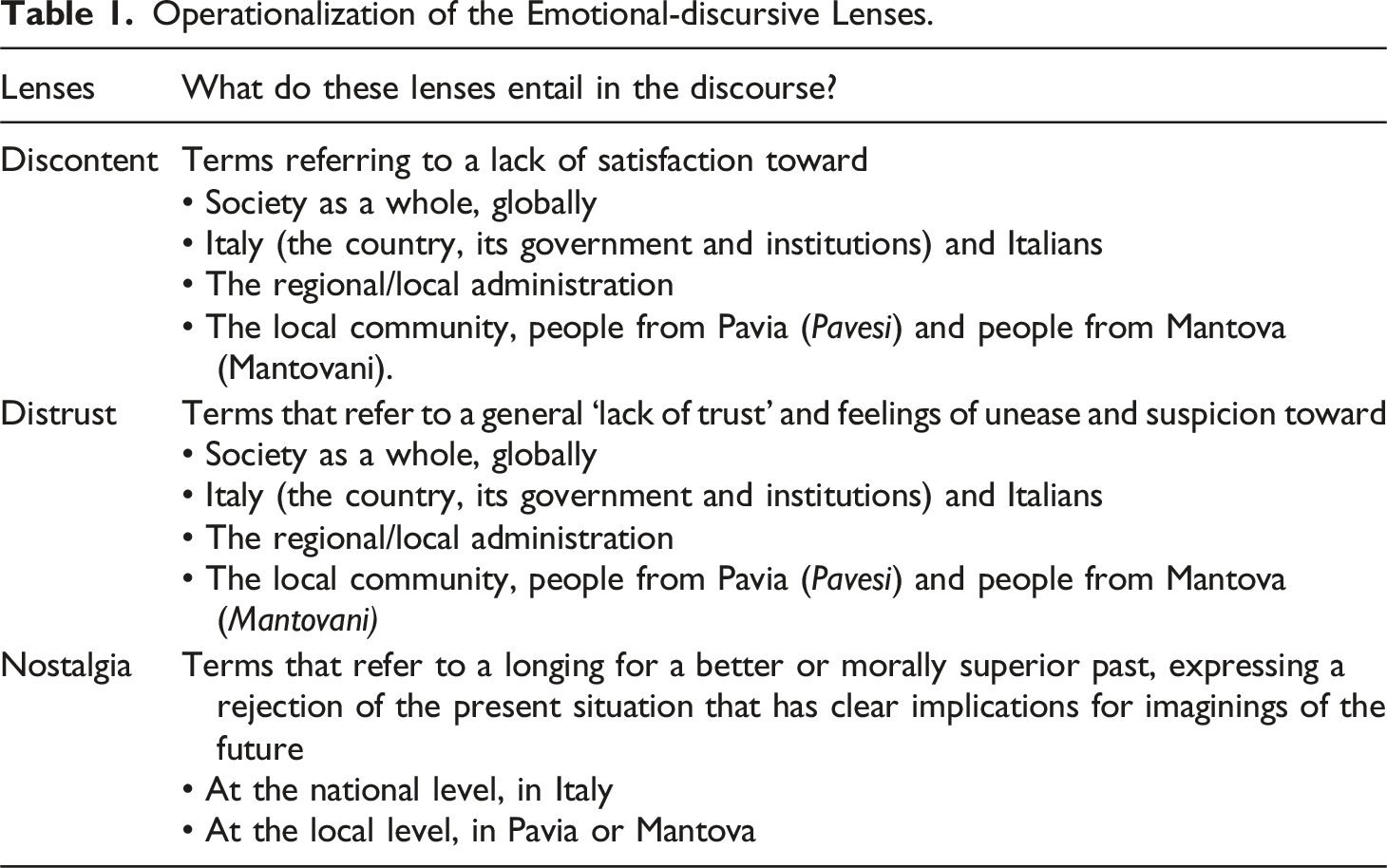
We apply specific lenses according to three emotional dimensions shopkeepers use when expressing resentful affectivities: discontent, distrust and nostalgia. They express, interconnect, and overlap with the resentful affectivities expressed by shopkeepers when conveying experiences of injustice, a sense of deprivation, and moral anger, particularly when linking specific problems, institutions, and culprits to immigration and emigration. Expressions and attitudes conveying a sense of dissatisfaction with the current situation were placed under the lens of discontent. In the same way, expressions and attitudes expressing doubt, uncertainty, skepticism and suspicion were under the lens of distrust, while those conveying a yearning for a return to an irrecoverable past were referred to through the lens of nostalgia.
Operationalization of the Emotional-discursive Lenses.
Shopkeepers and resentful affectivities in Pavia
Although diverse, the shopkeepers’ community in Pavia presents similar patterns in how it conveys these resentful affectivities embodied in the specific frames of discontent, distrust and nostalgia. Discontent is mainly linked to the city’s administration with the recurrent statement that “the municipality does not do anything/does not care.” The administration does not appear to fulfil its duties, and the city is lasciata andare, left to its decline, becoming less and less cared for, sleepy and inactive. More specifically, when referring to a perceived lack of activity and vibrancy, a few interviewees refer to the city as a ‘dormitory,’ a place where people go to sleep in more affordable housing, despite working in neighboring bigger cities.
In addition, the administration does not seem to care to support the commercianti and their small, family-owned businesses in the historical center as there is some frustration regarding immigrants setting up and taking over thriving businesses while Italian ones appear to be sinking. An interviewee mentions that “with all of these big chains, Chinese, Pakistanis, and Moroccans taking over, we [small family businesses] have been struggling.” These immigrant-owned businesses are equated to big chains, and the competitiveness of their services is emphasized to explain why they attract more clients. Despite a racially-charged wording when mentioning “tutti questi cinesi, pachistani e marocchini,” shopkeepers direct their resentful affectivities to a perceived injustice regarding the disadvantages posed to small (Italian) family businesses rather than expressing an outright dislike of newcomers due to their origins: their foreign-ness emphasizes a perceived unfair disadvantage imposed to those who belong to the local and national ethnie. The agent of this perceived unfairness, however, is not the immigrant, but rather the local administration, accused of not acting in support of small, ‘historical’ businesses. More often than not, immigrants and immigration are painted with a broad brush. This population tends to be mentioned as a monolithic entity, without much attention being paid to different backgrounds or personal challenges. These generalizations also impact the way shopkeepers link their discontent toward immigration to how the Italian state receives and manages newcomers. “It is easy to let people in the country and let them work on the streets and abandon them without giving them any reassurance or support,” explains the female owner of a historical shop in Corso Garibaldi, “look at how they are treated […] if they knew this is the miserable life that awaits them here in Italy, I am not sure they would leave their countries.”
Interviewees also emphasize the lack of social and cultural activities in the city. The administration, in particular, is accused of having been increasingly preoccupied with transforming Pavia into a city of services instead of fostering a sense of community. In addition to a perceived negligence from the local administration, interviewees report discontent regarding the overall relationships within the city, portraying the Pavesi as provincial and close-minded people who like tranquility and look at change with suspicion; a mentality that purportedly helped creating a ‘stagnant society.’ Some interviewees also convey discontent regarding the italiani as a people: “if Italy has problems, it owes them to itself.” Judgments are passed on the ‘spendthrift’ character of the Italians, to whom “all is a show,” while there is also a paradoxical acknowledgement of their hardworking qualities as a people, even in face of adversity. One interviewee, in particular, reveals discontent regarding concrete social problems revolving around dire situations affecting immigrants and nationals alike; a discontent that has, furthermore, potential to spread social unrest: “[…] As groups of people arrive, there will be good and not-so-good people [among them]. [...] And through my volunteer work, I notice social unrest in all social groups, not specifically or solely linked to immigrants. I am hurting because when I see these things [immigrants begging in the streets and homeless nationals in the humid winter cold], I believe that we – the part of society that is doing better – have failed.” (Male shopkeeper, artisan)
Many interviewees do not trust the administration to implement what is best for Pavia as there is a strong assumption that the administration “does not care and has only contributed to the city’s destruction.” In addition, some interviewees reflect on how this is a more general problem of Italian institutions that “sometimes even create and build things but are not able to follow through and maintain what they created or promised.” Given a sense of relative deprivation, many interviewees express a generalized suspicion toward those doing seemingly well. Immigrants are, at times, the target of such sentiments, as some immigrant-owned businesses appear to succeed while our interlocutors complain about “immigrants walking around the city and doing nothing.” This suspicion regarding the nature of immigration in Italy is described in the hesitant words of an interviewee stating that “I better not speak of immigration because […] these things are bigger than us, it is not really clear what lies underneath [migration policies].” This perception of the world and society is deeply embedded in distrust, one of this group’s manifested resentful affectivities, with an assumption that some obscure interest underlies a social issue or a specific phenomenon, something authorities, powerful actors, or immigrants themselves might be hiding from the public.
Regarding nostalgia, while, for some interviewees, apathy, social detachment, and quietness have always been constitutive parts of Pavia, others reflect on how much the city has changed throughout the last decades. In the past, people were purportedly more committed to social relations and community-building. Pavia had more activities and opportunities to offer, and overall, it was a better place to live in. This frequent reflection on the good old times – e.g., quando io ero giovane [when I was young] gives us insights into a feeling of constant nostalgia. “Nothing can ever be like it was,” summarizes one interviewee: this nostalgia often refers to the city, but it is also found in regards to the shopkeeping activities, as many report to be struggling to make ends meet vis-à-vis the city’s perceived decline alongside a loss of moral values that used to guide social interactions. Indeed, Pavia’s rich history and tradition also take a central place in the interviewees’ discourse: a city with a promising past and charming traditions whose continuity is now threatened. Our interviewees consider Pavia to be calm, although not as safe as it once was. Interestingly, criminality is almost solely linked to immigrants and youngsters, once again generalizing an ‘other’ through their villanization. An interviewee mentions that Pavia is still doing well if one looks at the integration of immigrants and overall safety, mostly because “there are not many [immigrants] yet because the people who manage them understand that Pavia is a city that cannot take a lot of them and the few that come get integrated.” Nonetheless, immigrants of color are still at times referred to as extracomunitari – a somewhat derogatory term coined in the early 1990s to designate those coming from outside the European Union – with some being directly associated with laziness and criminality: They are mantenuti, parasites. They live a good life of criminality without being stopped in this country while Italians are sinking, paying all of these taxes without seeing any return in the society we live in. We are here working like crazy and they [questi, literally “these ones”] have time to go strolling around the city. (Male shopkeeper, historical bar)
Whilst highlighting the presence of undesirable or undeserving newcomers, shopkeepers also notice how the city center has changed due to outward migration. Shopkeepers of Corso Garibaldi, in particular, portray a historical street, before vibrant, as being now empty and faded. Gentrification does not bring prosperity to small businesses either, as “cities are becoming less and less distinctive […] and big chains and franchised businesses in their centers make them look more and more like each other.” At the same time, the city might appear emptier because, despite being a city of services with its university and hospital, people are leaving. “There are no reasons to stay here,” mentions one interviewee for whom emigration is intrinsic to Italy as a country, “I am thinking of leaving the country myself as my father once did.”
Shopkeepers and resentful affectivities in Mantova
In Mantova, the first impression is that the city is emptying from the core of the commercial activity. “So many shops are empty,” says the shopkeeper of a candy specialty shop, “people come here for a day trip, from bigger and more popular cities such as Verona or Milan, to see the art and architecture, and the city also promotes exhibitions and concerts, but people do not come here to spend money or do lots of shopping, [which is why] only restaurants and bars thrive in the city.” Shopkeepers in Mantova convey a general discontent regarding the current conditions of the city, especially those perceived as impacting their living: lack of parking spots and a strict policy of traffic red zones in some streets that renders shopping there “less comfortable”; increasing rental prices that make it impossible to live and make business in the city center if not “upon inheritance” or sustained by chain businesses with national or international prominence; and the nefarious effects of e-commerce to small businesses, some of them trying to adapt with the creation of websites, even if feeling that they cannot “keep up.”
Although they see Mantova mostly as a provincial paesone, literally “extended village,” shopkeepers tend to recognize the unfulfilled potential of the city center, often encapsulated in the recurring expression la bella addormentata [the sleeping beauty]. In addition to references to measures and changes that have affected their living, shopkeepers often observe the “lack of youngsters” in the city center, for which the practical reasons commonly advanced transpire discontent regarding the present circumstances: Mantova is presented as lacking opportunities and services, as its youth is confronted with the aforementioned rising rental prices; the transfer of key services, in which the highly skilled youth is trained to work, to the suburbs; and with the realization that only bigger cities nearby can provide opportunities to the improvement of personal circumstances. The lack of solutions has clear implications for the future of the city: “it is something we will have to live with, only a few stay,” “there are some young people, but the best of them go away,” “nobody wants to live as their grandfather did and take over the small family business, which gives more headache than money, or work the land after earning a university degree,” “now you see mostly older people […] the city will unavoidably wither if nothing changes […] but I do not see what could be done.”
Discontent, accompanied by a particular sense of demographic helplessness, makes the issue of emigration especially salient to shopkeepers in Mantova’s city center. Still, the common impression is that, although Milan “offers an attractive job market” to the youth, the preferred destination is abroad as “Italy gives them no incentive to stay”: “half or more [of those who emigrate] go abroad … Switzerland, Germany, Luxemburg, France but less, and others to the USA,” a move facilitated in present times by a “better command of foreign languages” among younger generations. In the conversation, when confronted with Mantova’s emigration rates, some interviewees would, however, see the need to introduce another layer to these “blind numbers,” which many believe may be inflated by “the Italian imbecile administration,” according to which “anyone with a drop of Italian blood can be considered Italian.” “Those statistics should be taken with prudence,” argued an elderly shopkeeper whose wife’s family had established the shop in the 1930s, “because they mix different demographic movements.”
A general feeling of distrust is overwhelmingly expressed at a national level. At the municipal level, on the contrary, shopkeepers seem openly satisfied: “we have a bravo sindaco,” meaning “a mayor who is a good guy,” was a recurrent impression, praising “how much the mayor has done for the city” and naming the renovation of buildings that “make the city more beautiful” and the rehabilitation of a public park seen as reviving community spirit. Distrust does manifest when referring to the state, national-level administration and political elites through statements such as “I do not trust a word they [politicians] say, nor the media, they only show you what they want you to see”; “there is no one with a political project, there are only slogans”; “we have a long line of corrupt politicians who have ruined this country”; “they only care about their position and how they can profit from it, not about what they can do for the country and the people”; “there is no statesmanship or long-term vision, they think in terms of electoral cycles”; “Italy had all the conditions to be in a much better position, but we have terrible politicians who only look for personal gain” and “a ridiculously inefficient administration.” According to shopkeepers in Mantova, the system does not only have some faults; it is primarily rotten, as politicians are seen under the light of criminality and corruption or, at the very least, incompetence.
From the local and regional levels to the national, some interviewees brought up a clear sense of nostalgia. Nostalgia is evoked alongside claims of a decreasing sense of community, including among shopkeepers, with an association that, although existent, they see as offering little support. This sense is characterized by the longing for a ‘lost past’ when life was better or easier and the city more vibrant. Such longing often encompasses expressions of discontent with undertones of ethnic differentiation within the nation. Their city is in a region that shopkeepers feel was historically wronged in the development of a unified Italy, of which it was purportedly a loser: “Italy is too long of a peninsula that was turned into a country”; “North and South could not be more different”; “here we contribute more to the country than the South”; “how many times did we have to pay for the mistakes of the South? Too many!”; “historically everything worked so well in Lombardy.” The placing of the city within a region in relative decline (in opposition to a glorious past) that transpires from their discontent seems to mirror a broader Italian decline within a European context: “Italy had a leading position, we were at the forefront of industrial development,” said the co-owner of a fishery at Via Cavour, “now we are reduced to nothing in Europe; we do not even dictate our own destiny.” Some, like a shopkeeper in Piazza Erbe, blame the European Union for this: “the Euro, and the Union model as a whole, was created to favor Germany.”
However, this apparent decline is not directly connected to immigration, at least not as far as the city is concerned. All the interviewees considered Mantova a safe city, even if merely in comparison to bigger ones. Thus, there is still a clear link between immigration and criminality through an association between ‘safety’ and a ‘more homogeneous’ city, ethnically speaking. Immigration was regarded as either a big-city issue or as a problem at the national level, with immigrants allegedly increasing the pressure on public services, infrastructure, and welfare. Although the tendency overall was to blame an ‘inefficient’ administration or ‘incompetent’ politicians for the potential dangers posed by immigration – “in Italy, the problem is always the lack of planning, the Italian stupidity,” “immigrants do not have a big impact on the country, but politicians use them to gain votes” – some interviewees held more extreme views: I am not racist, you know, and I do not want to go too much into politics, but while we need immigrants, I cannot understand this – how should I put it? – sostituzione [replacement], let’s say […] Why the government seems to do nothing to retain Italians and Europe wants so badly that we make space for everyone who comes knocking on our door […] Of course, we should help those fleeing war […] but if in your house you can only fit five people, are you really going to receive fifteen in good conscience, knowing that you cannot feed, clothe, and properly accommodate them? [her sister intervenes, in disagreement] I am not blaming those poor people, I am blaming the government! In the past ten or fifteen years it was open door, not caring if people had a place to sleep or an empty stomach – do you think that’s humanitarian or rather irresponsible? (Female shopkeeper, family-owned fabric store)
Although more extreme at their core, these notions illustrate a common perception connecting immigration and emigration: one (newcomers) cannot compensate the other (people leaving). On the contrary, they both are seen as part of a broader phenomenon with specific culprits, weakening or potentially destroying a community that is nostalgically fantasized in opposition to the present distrust and discontent.
Discussion and conclusion
Although portraying a somewhat shared experience of struggle, our interviewees in Pavia and Mantova “could not be said to be actively seeking to change their place in the world” (Wells and Watson, 2005: 262). Despite their claim to ‘avoid politics,’ shopkeepers’ emotions of discontent, distrust, and nostalgia in the constellation of resentful affectivities against local- and national-level government informs their worldview and has the potential of being politicized and mobilized at different levels or extrapolated to broader phenomena and transnational entities and institutions.
While in Pavia government-related grievances were directed toward both local and national levels, in Mantova, grievances are mostly circumscribed to the state, contrasting with an overall satisfaction with their local administration. Pavia, more of an immigrant-receiver city, and Mantova, more of an emigrant-sender city, both display place resentment, as the entirety of interviews reported feelings that their cities were disregarded and mistreated by political elites; that they did not receive a fair share or were contributing disproportionately to the state’s resources (often in terms of regional resentment); and that their best-interest and values were somewhat disregarded. Place resentment becomes visible in commonly employed expressions by shopkeepers when asked to describe their city. The city of Pavia, with a wealthy past of industry and thriving businesses, is described as a ‘dormitory’ and a ‘city of services.’ The city of Mantova, with a culturally and artistically rich past where tourism and businesses thrived, is described as a ‘sleeping beauty,’ more of a paesone than a city.
Discontent was the predominant lens we identified in the discourse of shopkeepers in Pavia. This discontent was both self- and society-centered: shopkeepers in Pavia had a negative assessment of their situation, often emphasizing the personal resilience required to keep the doors of their business open amidst unfavorable circumstances, also pointing the finger at the local community. This discontent was predominantly formulated as a resentful affectivity against the local administration, which, according to the interviewees, contributed to the economic decline. However, discontent sometimes encompassed Italian society as a whole. In Mantova, discontent was less localized and often discursively intertwined with nostalgia, accompanying statements describing a perceived broader decline. Perceptions of territorial inequalities were much more central to discontent among shopkeepers in Mantova, who pointed to North-South national divisions and the place of Italy within the European Union. Both in Pavia and Mantova, discontent also strongly manifested in criticism toward the fiscal system allegedly depleting hard-working citizens with excessive and unfair taxation. Shopkeepers in the two cities believed that ‘they had it worse’ than their parents, which seems to bring an overwhelming uncertainty regarding the future. From their discourse transpires a lack of confidence in their fellow citizens; the decreasing importance of all-encompassing ideologies leading to comprehensive narratives (Abts, 2015); a belief of loss of political power; and a decreasing sense of community concomitant to an increasing sense of socio-economic vulnerability. These markers of discontent (Steur et al., 2017), providing the basis for an evaluative compass on the way democracy works (Norris, 2005; Akkerman et al., 2017), are significant for the normative expectations regarding the democratic process, i.e. what people may expect, as citizens, taxpayers and members of local and national communities, from their elected representatives.
Distrust was the lens manifesting in the most similar way in both cities. In Pavia, it is still directed toward the local administration, although it often reflects a broader lack of trust in Italian institutions and a generalized suspicion toward political elites. As in Mantova, there is the impression that political elites not only act in their own interest but also take part in a broader agenda, including but not restricted to migration, that is ‘hidden’ from the general public. Distrust, the predominant lens in Mantova, primarily concerns the central government and national elites, which integrate a political system that tends to be perceived as corrupt or, at the very least, ‘faulty.’ In both cities, there is the general feeling among shopkeepers that politicians at the national level want to take advantage of positions of power for their own gain. Where there was support for right-wing populist politicians, the idea was that “they cannot do worse” than their predecessors, for they at least seemed to have in consideration “what was best” for Italy and Italians. In the absence of what shopkeepers could deem as competent, trustworthy politicians, the value of democratic representativity is lacking, thus opening a crack in the legitimizing foundations of democratic processes and institutions. Distrust and discontent often appear intertwined, as discontent may be translated into distrust in manifestations of system dissatisfaction, and distrust often depends on discontent – a negative assessment of the present situation – to motivate the identification of problems, such as e− and im-migration, and culprits.
Nostalgia is more prevalent in Mantova, a city with a higher emigration rate: there is a sense of demographic helplessness – young people leaving – for which shopkeepers do not see a solution, political or otherwise. This aspect is in stark contrast with the discourse in Pavia, which attracts newcomers thanks to the university and the hospital, as well as study programs and jobs offered in these contexts. However, in Pavia, even when young people may be attracted by the university, the perception is that they are not encouraged to stay. Shopkeepers tend to place the absence of young Italians within broader globalized trends, ranging from free movement to e-commerce, that threaten not only the city, its culture, and local community, but also their trade. Human mobility is, thus, an ever-present element in their nostalgia: ‘before,’ according to an unprecise chronology, ‘Italians’ stayed, hence the city was more vibrant; ‘before’ there were not as many immigrants, hence citizens felt safer. There is, therefore, a desirability scale among shopkeepers regarding immigrants, contrasting incoming foreigners to the idea that ‘the best Italians’ (i.e. highly educated young adults) leave the city and the country. The idea of an ethnically diverse Italian society has strong implications for the nostalgia voiced by shopkeepers. They feel that not only their city is being engulfed by bigger ones, thus losing its distinctiveness, but also that they are losing their own Italian-ness due to cities being deserted by their young nationals or flooded by newcomers (or both). Feelings of an alienating loss were often illustrated by recollections of a lived past of ‘what the city used to be.’ However, the use of the past to make claims about the present has no delimited temporality: our interviewees often evoked different pasts, depending on what they wanted to criticize or whom they wanted to exclude. Thus, one can say that nostalgia is much more about the present than it is about the past: it is tied to change, to globalization and its effects on national democracy and the nation-state (Rodrik, 2011), leading to a growing concern regarding what politics is capable of (Contreras et al., 2018; Bickerton et al., 2022) and the coherence of national, collective identities. Nostalgia can fuel discontent, as the perception of decline is often accompanied by a presumption that older generations lived more comfortably and/or an idealization of the past, as well as distrust, since nostalgia provides a critical frame to new phenomena and trends of globalization that are often perceived to be promoted by certain elites.
Racial and ethnic distinctions clearly matter in the formation of resentful affectivities: although most shopkeepers seemed concerned about how their views would be morally assessed – sometimes having the need to preamble their opinions to assure the interviewer that they were not racist and did not discriminate – they frequently referred to migrant populations according to their origins and ethnicity. In Pavia, in particular, the way they worded the origins of some immigrants – such as the use of ‘extracomunitari,’ a word with a negative connotation, meaning those coming from outside the EU; or specific mentions to their country of origin, such as China, Pakistan, and Morocco – suggests an emphasis on perceived differences, often framed as threats to the shopkeepers’ trade, the ethnic homogeneity they view positively, or security. In both cities, there was a tendency to portray immigrants as a monolithic entity and migration as a uniform experience/phenomenon, especially regarding the populations perceived as less desirable, less deserving, or even less similar to the Italian ethnie. In Mantova, immigrants from Eastern European countries appear to be those with whom shopkeepers have the most direct interaction and whom they view most favorably – especially Eastern European women, praised for their contributions to society as caretakers of Italian elders. Eastern European immigrants are portrayed as closer to Italian culture and values compared to immigrants from the African continent. There is, thus, a clear hierarchy based on perceived cultural and ethnic proximity, shaped by shopkeepers’ understanding of Italian culture and ethnicity; in other words, shopkeepers adopt a racialized frame in their immigration narratives. In Pavia, this racialization is more explicit, with shopkeepers often identifying specific nationalities or religions as undesirable, undeserving, or even threatening. We hypothesize that the more overt racialization observed in Pavia (with specific nationalities and religion being often mentioned) may be linked to the higher number of immigrants in this urban context. In contrast, in Mantova, racialization is subtler. Immigrants – especially women – from European backgrounds (Eastern Europeans) are perceived as more ‘integrated’ and non-threatening, while those from non-European backgrounds are often left unnamed but still positioned as ‘other.’ This produces a desirability-deservingness scale that privileges perceived similarity to Eastern Europeans. In both cases, non-European immigrants are viewed as threats – economically and culturally.
Although during the so-called ‘refugee crisis’, negative attitudes were displayed from below, local authorities and right-wing movements in Italy toward asylum seekers (Dimitriadis et al., 2021), our interviews did not hint at any concrete impact of this crisis on present migration narratives. Nevertheless, the absent link between those events and the resentful affectivities that inform present migration narratives is not strong enough evidence to support findings sustaining that the crisis did not increase anti-immigration sentiments (Stockemer et al., 2020). However – and even if, in the rare instances where refugees were mentioned, it was considered that they should be granted protection and support – it can be said that the image of the refugee appears as an example of a deserving newcomer who should be prioritized over others. Thus, the less-deserving, less-desirable ‘other’ is implicitly identified as an economically motivated, non-European migrant, perceived as coming in too high numbers, draining the public resources, and as a potential threat to ethnic homogeneity and security.
Migration narratives influence normative expectations of democracy harbored by shopkeepers in the cities of Pavia and Mantova. Such expectations arise from personal notions of justice, prosperity, and representativity in local and national communities, with political elites being held responsible for the practical implementation of such values. Since both inward and outward migration present a challenge to the national state, the way this challenge is articulated into resentful affectivities by shopkeepers gives coherence to narratives that, although placing the blame on politicians and/or the local/national administration, emphasize who should be included and who should not. By distinguishing between desirable/deserving and undesirable/undeserving inhabitants, shopkeepers in the two cities give coherence to empty-crowded paradoxes. Emigration and immigration are, thus, articulated into resentful affectivities very much as the two sides of the same coin – the ‘best Italians’ are leaving while less desirable/deserving foreigners are arriving – with shopkeepers attributing varying degrees of agency to this dual movement, which integrates or illustrates broader criticisms to the government and political elites, whether local or national. Ultimately, these notions of mobility connect immigration and emigration, not as counterbalancing each other, but rather through an overarching narrative according to which broader phenomena with specific culprits are weakening and may potentially destroy a community that is nostalgically fantasized in opposition to every present facet inspiring discontent and distrust.
Migration is known to be “a highly emotional topic, often used for political mobilization” (Schneider 2020: 215). A subset of emotions, here proposed as lenses through which resentful affectivities can be understood, is prolific in ascribing political meaning to both presence and absence, interweaving mobility with broader themes of burden-sharing; the preservation of local, regional and national identities; a perceived political, social, economic, and ethno-demographic decline; and the attribution of blame to political elites who are deemed to have failed as representatives of those they govern. Although the shopkeepers’ discourse tends to comprise several emotions, even if unevenly, the lenses we applied to it – discontent, distrust, and nostalgia – were meant to discern the main themes of active, potential or latent resentment that we, grounded on historiography and theory, expected to find. Yet we did not want to take its active manifestations for granted nor be blinded to more passive expressions. While the concept of resentful affectivities has proven to be more inclusive than resentment in this task, the application of lenses pinpointed the emotions according to which inward and outward mobilities are articulated vis-à-vis urban contexts and normative expectations stemming from social notions of democracy.
Our contribution highlights the importance of unfulfilled expectations and their role in shaping resentful affectivities within narratives of immigration and emigration. Shopkeepers’ normative imaginaries are deeply rooted in the past, and as such, they face considerable difficulties in reconciling these visions with present-day realities. Emotions such as discontent, distrust, and nostalgia stand in tension with the potential for imagining normative futures in the present. Discontent undermines the capacity to build community and fosters a sense of hopelessness; many shopkeepers express a lack of initiative in protecting long-standing local businesses, which they feel are neglected by politicians. The erosion of trust further hinders political engagement and collective organization. Shopkeepers lament the absence of community support, yet simultaneously fail to mobilize efforts to create or participate in such a community. Nostalgia adds to a sense of inertia and hopelessness, leaving shopkeepers emotionally anchored to a perceived better past while feeling powerless in the present. Their discontent and lack of trust in politics extend to visions of economic redistribution: they do not trust politicians to enact meaningful change and view tax contributions as futile, believing that the state no longer represents their interests and acts with growing incompetence.
A recurrent theme when speaking of the country, the city, and outward and inward migration was the feeling that shopkeepers’ interests (as urban inhabitants, as citizens and tax-payers, as a class, as Italians) were not being upheld by political elites: shopkeepers did not feel represented by those who were democratically elected to govern them. This expectation of representation, seemingly left unfulfilled, informs their adherence to particular (e−/im-)migration narratives, their moral judgment on the present status quo, and what they perceive to be the desired social outcomes of democracy. Discontent, distrust, and nostalgia weave a colorful tapestry of resentful affectivities, which may turn into ‘politics of resentment’ if shopkeepers mobilize, as they have in the past. We encourage a future agenda to further explore the link between the migration-emotions nexus and the (potential) politics of resentment, namely by looking at particular social groups with vested interests in exclusionary notions of space, identity, and fiscal citizenship, as these notions dialogue with and are negotiated within broader narratives known to impact voting behavior and political mobilization. Although the shopkeepers we interviewed seem uninterested in politics, their present withdrawal amidst a perceived crisis of representativity may make them more receptive to populist empowerment movements that tend to thrive amongst those self-proclaimed uninterested in politics in search of a vision reconciling globalizing phenomena and the nation-state.
Footnotes
Acknowledgements
We would like to express our gratitude to Jean-Thomas Arrighi and to Matteo Gianni, for their invaluable comments, suggestions, and encouragement.
Declaration of conflicting interests
The author(s) declared no potential conflicts of interest with respect to the research, authorship, and/or publication of this article.
Funding
The author(s) disclosed receipt of the following financial support for the research, authorship, and/or publication of this article: This research was supported by the nccr - on the move, funded by the Swiss National Science Foundation grant numbers 51NF40_205605 and 51NF40_182897.
Ethical statement

Data Availability Statement
Data sharing not applicable to this article as no datasets were generated or analyzed during the current study.