




Abstract
This study examines the issue of child refugees who fled the former Yugoslavia and spent a brief period of time in Czechoslovakia during the beginning of the 1990s. The adults who were formerly child refugees talk about their experiences in exile and how it affected their subsequent life trajectories. In 2023 and 2024, we conducted qualitative semi-structured interviews with 19 Czech minority former child refugees to gain their viewpoint on the situation. All of them spent several months in the former Czechoslovakia during the war in the former Yugoslavia. They ranged in age from seven to 17 at the time of war. We focus mainly on how they reconciled with being child refugees, coping mechanisms they employed at the time, and the effects of living in exile on them. The children’s ability to cope with exile was influenced by their age, wartime experience, and level of personal resilience. Their ability to communicate with peers about their experiences and feelings, spend time together, and establish routines for recreational and academic activities all became essential in assisting them in adjusting to life away from their families. This paper expands the limited body of literature on former child refugees by introducing a novel case study that has received minimal attention in existing research.
Introduction
The war in former Yugoslavia and its impact has been mapped by numerous scholars. There is, however, a less explored narrative, which relates to child refugees who went to former Czechoslovakia, but only stayed there temporarily. However, in their words, this experience of being refugees tremendously affected further lives and trajectories. Therefore, this article will map the reception of child refugees and their companions from Croatia in the fall of 1991, their stay in the Czech and Slovak Federal Republics, as well as the circumstances of their return to their country of origin in February 1992, including the impact of exile on their further lives.
This article analyses qualitative interviews taken between 2023 and 2024 with 19 Czech minority former child refugees. Further interviews were taken with the people who accompanied them (mothers, teachers) or children who had stayed in Croatia but these will not form part of our present analysis. In the fall of 1991, the Czech Republic accepted more than 1,300 children from the Daruvar area, which was then on the front line of the war in Croatia. Mothers or grandmothers were accompanying the youngest children, while older ones were accompanied only by teachers and educators. Instead of the expected 14 days of their stay abroad, the child refugees spent almost 5 months in Czech exile, from September 1991 to the end of January 1992. It was a controlled evacuation organised by Czech exile organisations in Croatia in cooperation with the government of the Czech and Slovak Federative Republic. Although the offer of help came with regard to the presence of the Czech minority in Yugoslavia, the children were included in the evacuation regardless of their nationality (in addition to the Czech nationality, they were mainly Croatian, Serbian and Hungarian children).
Assmann (2001) included living memories of contemporaneous witnesses, that is relating to the recent past, which are shared with contemporaries, under the label of communicative memory, which is the subject of oral history studies. These memories create the so-called historical consciousness of the given population group that shares it. We are talking about a collectively shared knowledge of the past, through which group belonging is created and maintained. We can therefore also speak of collective memory, which is ‘a living bond with the past. It is what remains from the past in the consciousness of groups, or better said, what these groups make of the past’ (Šubrt and Pfeiferová, 2017: p. 20). So, although it is a remembrance of past events, its meaning is essential for the present.
From the thematic analysis of in-depth semi-structured interviews with people who lived the refugee experience as children, it is evident that this stage of life permanently changed them. Their lives were divided into the period before and after the war. The children became war refugees and remain associated with this identity to this day. It became part of the historical consciousness shared by adults, often parents, and shaped the generational memory of this group, which remains part not only of family tradition, but in the case of a minority group, also of the minority identity of Czechs in Croatia. This case study case study has received minimal attention in existing research. We pose the following research questions: How did life in exile influence child refugees and how do they reflect on it as adults? Which strategies did they use to deal with this experience?
The article proceeds to discuss the situation of 1991 and the circumstances of the transfer of children from Croatia to Czechoslovakia. Next, we introduce the literature on refugee children and research on memory of former refugees in adulthood. We then discuss the methodology of our research and the characteristics of our sample. We present the findings based on the narratives of former child refugees and answer our research questions. Finally, we discuss our findings in the context of wider literature on memory research and child refugees.
Background
Many of the child refugees from Yugoslavia had a connection with Czechoslovakia. They came from the Daruvar region, which hosts a considerable Czech minority population. However, the number of the Czech population there decreases with every census. In the first post-war census in 2001, the population composition of Daruvar region was as follows: Croatians 60%, Czechs 19%, Serbs 13.6%, others 7% (Šabićova, 2002). There were 10,510 Czechs living there at that time (Horina, 2007). Currently, there are only 7,862 persons claiming Czech nationality in Croatia, of which the largest number of Czechs live in Bjelovar-Bilogora County, namely 5,002 persons (Croatian Bureau of Statistics, 2024). In this county, the share of Czechs in the population is 4.91%. The largest representation of Czechs by municipality is currently Končanica with 46% of the population, Dežanovac (22.8%), Daruvar (20.92%), Grubišno Polje 16%, Sirač 10.5%. Since Daruvar and Grubišno Polje are towns, 2/3 of the Czech population in the Daruvar region lives in them.
In 1991, when Slovenia and Croatia declared their independence, the war began, which also had an unfortunate impact on the lives of Czechs living in Croatia. Already in the first days of the war, when bombs hit Daruvar, Czechs and their children were among the victims. The Union of Czechs and Slovaks in the Republic of Croatia defended the interests of the compatriots at the international level. During August 1991, a number of appeals to stop the war and appeals for help were sent from the Union to responsible people and institutions around the world, including to the then President of the Czech and Slovak Federative Republic (ČSFR), Václav Havel (Janotová, 1992).
On 3 September 1991, members of a government delegation from the Czech and Slovak Federative Republic, led by Viktoria Hradská, met in Daruvar with representatives of the Union of Czechs and Slovaks in the Republic of Croatia to offer immediate assistance, namely, to enable and secure the return of all Czechs from Croatia to their old homeland, if they wished so (Tomek, 1991). However, the then chairwoman of the Union, Lenka Janotová, flatly refused: “Our people cannot and do not want to stand outside the current events, because they have opted for democracy and cannot approve of terrorism and its methods in any form. […] Our homeland is Croatia, which in no way disowns our old homeland, and that is why we are turning to the CSFR for help. […]” (Jednota, 1991: p. 4).
The leadership of the Union of Czechs and Slovaks had changed its plea of aid to the form of evacuating children. On 8 September 1991, the Czechoslovak government approved the admission of children from the threatened areas of Daruvar of all nationalities (Croatian, Hungarian, Czech, Slovak and Serbian), as the aid was intended for children from Croatia, regardless of nationality, until the war situation calmed down (Kočí, 2019; Preissová Krejčí and Kočí, 2020). In addition to the request to allow children and youth to stay in Czechoslovakia, including their education, supply of school supplies, didactic material, textbooks and literature, as well as food, the Union of Czechs and Slovaks also asked the Czechoslovak state for medical supplies, and technical equipment including radios and video cameras. The evacuation date was set for 13 September 1991. Due to the great interest, not only the number of buses increased, but other dates for the transports were also agreed.
During September and October 1991, more than 1,300 children were transported from western Slavonia to the former Czechoslovakia to escape the horrors of the war, and many others joined the mass evacuation groups in Bohemia and Moravia because their parents had already taken them to relatives or friends. In this way, some 1,500 children and mothers with young children were rescued and made safe before the war withdrew from the vicinity of their homes. Most of the children were in Seč — 356 and with them were 15 teachers. There were 321 children and 15 teachers in Jánské Koupele near Opava, 185 children were in Stráž pod Ralskem, 156 children and seven teachers were in Mariánské Lázně, 112 children and two teachers were in Vranov nad Dyjí, 111 children and seven teachers in Zderaz, and 80 children and five teachers in Chlum u Třeboně (Pejić and Hnojčík, 2011). The refugees were accommodated in various recreational facilities; the largest groups were accommodated in facilities where school classes could be held, with a capacity of several hundred beds. Smaller groups were housed in hostels for seasonal workers or in smaller recreational facilities.
The children were evacuated along with their teachers and educators from Croatia. Among them were individuals of Czech, Croatian, or Serbian nationality. Their teachers, who also considered themselves refugees during this period, often joined the groups after enduring traumatic experiences of the war. The children were educated following the Croatian curriculum, and for those coming from Czech schools in Croatia, bilingual instruction was provided. Textbooks were imported from Croatia to ensure continuity in their education. In Yugoslavia, Czech and Slovak schools traditionally catered to children of various nationalities, with bilingual teaching conducted in Czech and Serbo-Croatian or Slovak and Serbo-Croatian. As a result, the evacuated refugee children were not enrolled in Czech schools. Instead, special educational and leisure activities were organized for them in refugee facilities. These activities often included visits to Czech theatres, cinemas, and cultural events and artists, psychologists, and leisure teachers frequently visited the children in the refugee facilities. Czech-speaking children had the advantage of being in a language-friendly environment, which helped them engage more easily with these activities. However, as most of these children either lived in areas of Croatia with a significant Czech population or attended Czech schools, the majority had a good understanding of the Czech language (Preissová Krejčí and Kočí, 2024).
Child refugees and adulthood
In spite of the ethical issues that working with children entails (Alderson and Morrow, 2020), there is a body of literature relating to child refugees, who represent an especially vulnerable population. There are two strands of literature on children and migration that inquire about refugee children’s mental health (Eisenbruch, 1988; Fazel and Stein, 2002; Goldin et al., 2003; Lustig et al., 2004; Schwartz et al., 2022) and education (Dryden-Peterson, 2016; Graham et al., 2016; Hones and Cha, 1999). The findings show that refugee children are at an increased risk of mental health issues such as PTSD, depression and anxiety (Pfeiffer and Derluyn, 2023). Traumatic experiences can also refer to being separated from the family and living conditions both before migrating, during migration and in new countries of settlement. These experiences can have long-term effects on the mental health of child refugees, with some studies showing that unaccompanied refugee minors are overrepresented in psychiatric care (Jensen et al., 2019).
The studies focusing on child refugee education mainly look at their integration in the countries of settlement and how refugee children do in comparison with their native peers (Hassan et al., 2023). However, there are also various barriers to education that have to do with the resources available to refugee children, the most obvious one being limited language knowledge. There are also studies focusing on improving access to education for refugee children or improving the quality of learning (Palik and Østby, 2023). Both the impact of mental health issues on child refugees and the educational outcomes have long-lasting effects that might continue into adulthood. There is also research about refugee children that examines other issues, for example how child refugees view ‘home’ (Arvanitis and Yelland, 2021) and use methods that analyse children’s play (MacMillan et al., 2015), children’s drawings (Oztabak, 2020), children’s writing (Macková and Preissová Krejčí, 2023) or collective narratives (Denborough, 2014; Jacobs, 2018).
While there seems to be limited research involving the perspectives of child refugees (Anagnostaki and Zaharia, 2023), the studies inquiring about former child refugee experience in adulthood are even rarer. Anagnostaki and Zaharia (2023) carried out similar research to ours with former child refugees from Greece. They examine the role of other people as a resource for unaccompanied child refugees. During the period of the Greek civil war (1944–1949) thousands of children were taken from their villages in Greece and settled as unaccompanied refugee children in countries of the former Eastern Bloc. According to Anagnostaki and Zaharia (2023), separation significantly impacted attachment ties to parents, leading to questions about the existence of attachment representations. Second, the importance of relationships appeared diminished overall and third, the role of peers was emphasised.
Another study focusing on child refugees from the Greek civil war was carried out by Danforth (2003), and Danforth and Van Boeschoten (2012). They found how collective histories were constructed from individual children’s narratives. Similarly, they looked at individual refugee experiences and showed that both parties of the conflict appropriated child refugees’ stories and depicted them as passive victims of the transfer. Therefore, the stories served ideological aims. However, child refugees also show remarkable resilience and recent research emphasises their agency rather than vulnerability. Jafari et al. (2022) define resilience of child refugees as a positive adaptation. They show several levels from the individual and family to school, community, society and transnational space that help child refugees’ resilience. Goodman (2004) identifies four strategies that help child refugee’s resilience, namely a) collectivity and the communal self, (b) suppression and distraction, (c) making meaning, and (d) emerging from hopelessness to hope.
There are limited studies with adults who used to be child refugees. Some studies focus on unaccompanied refugee children in Europe who were later contacted for a follow-up study (see, e.g., Wallin and Ahlström, 2005), others use narratives of refugees of an oral history project (Nets-Zehngut, 2011). Studies in Europe also focus on narratives of adults who survived World War II as children (Hollo, 2020; Wylegała, 2015). However, due to the complexity of the issue and difficulty in accessing the participants, the literature on former child refugees remains rare.
Methodology
When working with refugee children, we need to be aware of the risk of retraumatizing them (Jacobs, 2018). Therefore, discussing the situation with adults who used to be child refugees can seem like a suitable strategy. At the same time, we need to be aware of the fluidity of memory and possibility of omitting some information that might have been too traumatic. Kevers et al. (2018) note that narrative methods are often used in research on refugees’ traumas. At the same time, these are shaped by a larger environment and interactions with the audience. This takes into account the positionality of the researcher and wider social context. Similarly, remembering is shaped by a wider collective environment. Following Kevers et al. (2018, p. 660), who carried out their study ‘through reflecting on the mobilisation of relational, moral, collective, and political aspects of remembering within the research relationship’, we are also mindful of these aspects, which can influence the outcome of our research.
The qualitative semi-structured interviews were conducted in the context of a long-term ethnographic fieldwork of the first author in the Daruvar region. The interviewees were selected through snowball sampling and purposive sampling techniques. The first author had known about one half of the respondents prior to the interview. The condition for taking part in our research was that the former child refugees had lived in exile in Czechoslovakia during the war in Croatia. Furthermore, at that time, they had to be pupils of primary or secondary schools between the ages of seven and 18, so that they could remember the events of that time. All of them were pupils or graduates of Czech primary schools in Croatia and they came from the Czech minority population in Croatia. Hence, the interviews were conducted in Czech language and only later were they translated into English by the second author.
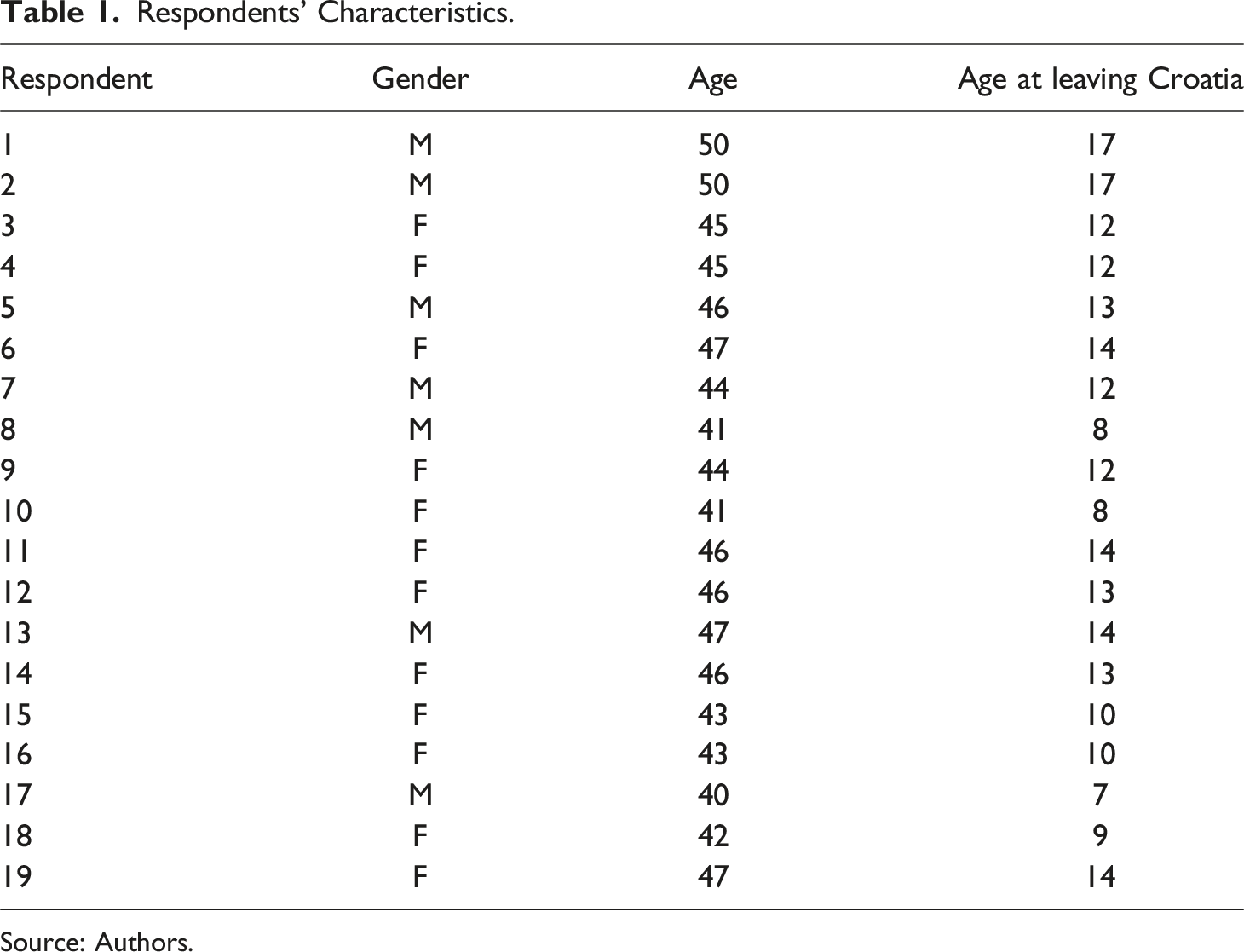
Respondents’ Characteristics.
Source: Authors.
Overall, we had seven male respondents and 12 female respondents. While the respondents were between the ages 7 and 17 while leaving Croatia, most common them were between 12 and 14 years old at that time (11 respondents). All of the respondents stayed away from their parents for 4.5 months with the exception of respondents 9 and 11 who stayed away for 4 months and respondent two who stayed away for 5 months because he had been evacuated earlier by his parents.
The interviews were recorded by the first author and we manually transcribed the interviews ad verbatim and used Atlas.ti software for data analysis. We carried out a thematic analysis (Maguire and Delahunt, 2017), which enabled us to understand, describe and interpret people’s experiences. We also aimed to uncover the meaning of the child refugee experiences given by the respondents. We started with an open coding to discover the initial themes, which we later refined and then used axial coding to work on emerging categories and sub-categories.
Circumstances of exile
To understand the context in which children became refugees we will list the categories that are present in most of their stories. We will start with discussing the circumstances of them leaving and during their stay in Czechoslovakia. The extent to which children voluntarily accepted exile depended on their personal experience of the war at that time. If they had direct wartime experience — they had cared for or encountered wounded persons, feared for their own lives, or felt threatened — then they identified better with going abroad. Another important factor facilitating the children’s acceptance of exile was their age or maturity, with older children being aware of the gravity of the situation and the loss of a sense of security. Children faced problems when trying to navigate the new wartime environment. ‘When they threw the bombs for the first time, my mom and dad were not at home, and my sister and I didn’t know where to hide’ (respondent 4, F). As stated by respondent 17 (M): ‘I remember even nights when the enemy army almost went into Daruvar. When first the shells fell and then the shooting started. […] Through the window, as we were going to sleep, I saw that the school was on fire.’ Respondent 12 (F) shared this memory: ‘Dad gave us one hand grenade if someone went into the cellar… So that we would defend ourselves…’
All of the respondents thought that they were going on a trip with their classmates for 10 days or 2 weeks. ‘We were going on a trip for 14 days, so we had a bag and everything ready’ (respondent 7, M). Whether their parents, who sent them on the trip, also thought it was for a short time is not clear from the evidence. ‘My mother told me I was going on a trip for 2 weeks’ (respondent 16, F). But soon they began to have doubts about going back: ‘the trip takes too long and […] you don’t know what’s going on at home… (respondent 9, F). They were always tense in anticipation of a return that was delayed. After all, the circumstances of departure were already difficult on some days. ‘At one point it was quite quiet on the bus. Because we weren’t going the usual way — that was closed, there was fighting going on’ (respondent 7, M). The respondents also remembered that the buses were escorted by the police and the army to the border. For many of them it was the longest journey in their lives and for all of them, even the oldest ones, it was the longest separation from their families.
Visits from their parents and other loved ones during the time in exile were a very crucial part of that period. These were also linked to a possible traumatic experience, and of two kinds. Firstly, with the parents came information that had eluded the children up to that point. ‘That time they came from Pemia [village], like after they shot everyone there… Well, we just had lunch and they all came in black to the canteen. I’ll never forget that crying. It was horrible’ 1 (respondent 15, F). And secondly, the fact that the children had to say goodbye to their parents again every time. And it was hard even for the oldest ones: ‘Mom and Dad came after a month for 24 hours and brought us things. And they had to come right back because Dad was with the police’ (respondent 1, M).
However, it was not only the children who took away traumatic experiences from their meetings together, but also their parents. ‘After 2 months, say December 1991, my mother came to visit, say for 3 days… and me: “Hi mom — and goodbye!” She would certainly say how she felt, I believe she would have preferred to turn around and leave, but she couldn’t because the bus didn’t go back until 2 days later. I left with my friends. And she stayed alone in our room. […] But just because you’re without your parents for three or 4 months, you start to function differently’ (respondent 2, M). Another story took place in Jánské Koupele as recalled by one of the respondents: ‘When a mother came to Jánské [Koupele], she had a little girl there, about a year and a half old, and the child didn’t recognize the mother at all and started running away from her’ (respondent 13, M). This shows a possible weakening of the familial ties.
But parents’ visits were generally the cause of great joy: ‘...when my parents came there - to Bohemia, they brought the roast — the cooks didn’t know what to do with it, like they brought it whole. So my parents had to show how to split it. That was so rare for us kids!’ (respondent 18, F). And the visits did not even have to be coupled with in-kind gifts, because when the kids were having a hard time, especially before Christmas, and their parents came to visit, they ‘felt a little lighter’ (respondent 13, M). The joy, however, was soon replaced by the pain of parting: ‘So it was the worst for us when they left and we stayed…’ (respondent 12, F). The period of separation seemed long to children. ‘It seemed as if it had been 40 years. It seemed as if we were never to return again’ (respondent 4, F). Similarly, respondent 9 (F) recalls, ‘It wasn’t like 4 months that passed, like it was too long, like it was one such important part of my life…’ The children also remembered anticipating phone calls from families. Parents and relatives, including many families who didn’t have a phone at home, tried to keep in touch with their children at least once a week.
Some of the children had their siblings with them, so it helped them deal with the situation. ‘We are twins, we have been together since we were little, it was a bit easier for us’ (respondent 13, M). They also tried to move siblings to stay together during their stay abroad. ‘There were several women from our village in Vranov [in Czechia], and also the brother who didn’t go with us, he was six, he was in Vranov, so they moved us to Vranov’ (respondent 14, F). However, not everyone was this lucky. Respondent 1 (M) recalls, ‘my younger sister followed me, but she was in Jánské [Koupele], we didn’t see each other at all.’ A few of the children had the privilege of having their mothers with them as teachers or carers. ‘I was lucky to have my mother there, which most of the children didn’t have’ (respondent 17, M). The children who were involved in teaching at the large centres where regular teaching was taking place continued at their home schools upon their return and carried on without losing a school year, others who were not so lucky had to repeat the following school year.
Strategies for dealing with the situation
How could children without parents endure such traumatic events for many months? What helped them get through the difficult times? Apart from a series of organised activities, a routine that came every day, a school that they were involved in, they also built relationships with their peers. ‘We had each other. We were better that way’ (respondent 13, M). The shared activities took their minds off their thoughts and comforted their sadness. ‘You’re sad for a while, but then you forget and you have fun with the others, you play a bit here, you have fun there, it wasn’t as stressful for us as it was for the adults’ (respondent 4, F). Children also shared accommodation and during the time, they shared their sorrows. ‘There were five of us in the room. It was maybe even better that we were together like that. One cried, the other cried, so we all cried together. It was like we became friends’ (respondent 18, F).
Respondents also built close relationships with adults who were there. ‘From today’s point of view, I admire those teachers, how they handled us, because I remember that we, on the floor, we were grade 3 and 4 in elementary school, there were about 30 to 40 kids, and there were two teachers who had us from morning to night, and they taught us’ (respondent 10, F). Respondent 16 (F) also mentions that thanks to their carers, ‘we were never alone’. The narrators were aware of the teachers’ great dedication and often expressed gratitude for the way they looked after them in the facilities: ‘The teachers gave everything for us, we were like their little children, they looked after us beautifully there’ (respondent 15, F). Respondent 10 (F) also adds that they wanted ‘to make sure that we lived as normally as possible and that we were spared all the things that were going on here [in Croatia].’
Respondents, for the most part, had little or no contact with the local Czech children. For example, respondent 4 (F) states: ‘We had no such contact with Czech children, with Czech schools.’ But sometimes the isolation of the refugees was broken, so it happened that one of the respondents made a friend for life in the hostel, who she refers to as a ‘new sister’. ‘She worked there, was 17 years old at the time and lived only with her mother in Budišov’ (respondent 15, F). She and her younger brother even went to see her and her mother on weekends, introducing them to their parents when they came to visit. ‘To this day we still visit each other, even twice a year. So we’re like sisters to each other’ (respondent 15, F).
The narrators’ acceptance of their status as child refugees was made easier when they accepted the life changes that had befallen them, and there were not a few. The life change was about their personal development and the home and society they were returning to. Respondent 10 (F) claims, ‘I’m clarifying for myself what childhood is, because I realise that my life has been cut in half by the war…’ Some talk about their youth being ‘stolen’ because ‘everything was completely different at that point… Like we had a hundred problems before… Then I didn’t need anything more. Just to survive…’ (respondent 2, M).
Much of the testimony concerns the forced maturing of our narrators. Dramatically described by respondent 9 (F): ‘And actually, that’s the day your childhood stops. Like that was the last day I felt like a kid, playing carefree in the street. And then like by then you’re not a kid anymore — your life changes overnight’. Similarly, respondent 12 (F) adds: ‘We left as kids, we had to learn independence, we saw something new, we experienced something new… And we didn’t feel like kids anymore’. But even the younger children felt that they had become independent by being in exile. ‘I think we had to look after ourselves a bit more’ (respondent 13, M).
Often the sense of transformation was not only in the immediate inner world of the children, but also in their perception of their surroundings. ‘There was nothing we could do, we went on living. But the war left an indelible mark on our lives and on our [village]’ (respondent 11, F). Respondent 17 (M) agrees with the changes: ‘It was as if the war brought with it a complete paradigm shift, like a complete change of life.’ Former child refugees experienced anxiety because of the war. ‘My whole generation, and not only mine, felt the war very much. That fear, to live with fear for 5 years, it’s not easy when you don’t know what will happen and how it will be’ (respondent 16, F). Former child refugees generally reflected on the ethnic situation in the communities and how it changed after their return. In spite of being in exile together with other national groups, they were aware of the ethnic dimension of the conflict and the mark it left in their communities. They remember the situation before the beginning of the conflict: ‘Before the war the whole village lived as one, there was no difference who is a Croat and who is a Serb. There were no differences at all, we were all friends and we didn’t know what it meant [to be] a national minority. We didn’t know that at all. Until the war started’ (respondent 12, F). Respondent 10 (F) recalls: ‘Until the war, nobody cared who had which nationality. We were all talking to each other, we were all friends… What I, as a human being, cannot quite understand is that suddenly they were so deluded by this ideology that they believed somebody from above, more than the people they lived with and knew directly, for many years.’
Other former child refugees agree with changes brought about by war and the way they had to deal with them. ‘Such events leave deep traces and that something in a person’s life is permanently changed — changed because such traces remain, even on several generations and not only on people who have personally experienced something like war’ (respondent 17, M). The defence against the negative effects of anxiety and the fear experienced was the strong need for children and adolescents to live a normal life. As respondent 17 (M) claims, ‘[when home, we responded by our] orientation to normal things.’ To summarize, there were different coping strategies that child refugees used to deal with this experience — relationships with peers, support from the teachers, becoming self-reliant and accepting the change.
Reflecting on exile
The children felt they had become more independent and more mature after returning from exile, and this experience stayed with them for the rest of their lives. Many of them also retained the friendships they had made during their exile in Czechoslovakia. All of these consequences of these events continue to accompany them to this day in varying degrees of intensity. They also reflect on the decision to send the children away. ‘I, as a parent, would do everything the same today, I would do everything to protect my children and send them to the Czech Republic’ (respondent 2, M).
By accepting their decision to save their children, they continue the narrative that prevails in the Daruvar region. When being asked about their children, many of them say they would send them away to save them. For example, respondent 6 (F) claims, ‘We would send them without a second thought. Without a second thought. Right now.’ Similarly, respondent 4 (F) agrees: ‘I’d send my kids there in all sorts of ways… Just make sure the kids are saved and safe.’ Yet, she also claims that she ‘would go with the children. Because we don’t need things like that in our lives. And I’d talk my husband into it. Like nothing material is important, only family is important’ (respondent 4, F).
Former child refugees express gratitude that they could be in safety. ‘I’m glad now that we were there and I don’t regret at all that we were there. We had a good time there and if I had known what I know now as an adult, when I was a kid, I wouldn’t have regretted it and I would have been grateful to my parents for sending us there’ (respondent 13, M). Similarly, respondent 18 (F) claims, ‘It’s only now that I understand. And I appreciate my parents more. Before I had my own children, I didn’t know what it meant to love someone so much… Of course, they also understand how hard it was for their parents.’ Our respondents also reflect on how the situation could feel to their parents and other relatives. ‘I suppose most of them [parents] thought they were saying goodbye forever. Because that’s the way it is in war… nobody knew what was in store for them, so I think the parents didn’t know if they were saying goodbye forever…’ (respondent 9, F).
Therefore, many former child refugees feel, in spite of the difficulty of the situation, that their parents’ decision to send them away was inevitable and justified and they would probably send their children away had they been in a similar hypothetical situation. While they commented on the difficulty of their lives in exile, they felt that safety represented an important value and they were grateful for being able to stay safe during the worst months of the war. It seems that most of them reconciled with the idea of being child refugees and felt it was the best option for them given the circumstances.
Our narrators have many memories associated with their adolescence and childhood, with the ones relating to the war and their departure into exile being the most intense: ‘I actually remember what happened there very clearly, like I haven’t forgotten it. Like if I had to write it down now, I would write it all down. No problem’ (respondent 9, F). As we were told: ‘The memories are so bittersweet’ (respondent 14. F). The narrators also remember things that they would like to have rather forgotten. Some of them say: ‘We didn’t want to be there, we were forced to be there’ (respondent 12, F).
Perhaps this is why a large number of the narrators admitted that they do not talk much about the period they lived through with their children and do not pass on their experience to the new generation. The shared narrative is that this experience cannot be transmitted. ‘We never told our children much about it… because they can’t understand it anyway. Just like people who haven’t experienced it can’t understand it at all’ (respondent 12, F). This narrative of parents, who often now have children of a similar age to their age when they were in exile, is repeated: ‘They [children] don’t understand it at all. I tell them about it but they can’t imagine it… I think they can’t understand it, they can’t relate to it emotionally. But I think it’s good this way’ (respondent 9, F). Therefore, this experience shared collectively by the refugees and its narrative is something that is so unique that no one else can understand it. Maybe that is also why some former child refugees do not often discuss this formative experience. It would be interesting to explore how the children of former child refugees, now teenagers, understand and reflect on their parents’ experiences and the impact those experiences have had on their own lives. This could serve as a compelling direction for future research.
Discussion
Previous research on refugee children discusses their mental health and education. However, research on refugee children in adulthood is rarer with some exceptions (Anagnostaki and Zaharia, 2023; Danforth, 2003; Danforth and Van Boeschoten, 2012). The situation we describe did not lead to a protracted displacement but only several months in exile. We did not focus on the evaluation of this situation on former child refugees’ mental health. However, previous research indicated that children who are refugees have a higher chance of developing mental health conditions such as PTSD, depression, and anxiety (Pfeiffer and Derluyn, 2023). However, being cut apart from one’s family and living circumstances before, during, and after migration can also be considered traumatic events and literature shows that these experiences may have long-term implications on the mental health of child refugees (Jensen et al., 2019).
Anagnostaki and Zaharia (2023) conducted a study with Greek child refugees that was comparable to our present research. They looked at how other people can serve as unaccompanied child refugees’ resources. We concur with the findings and emphasize the significance of peer relationships, the development of bonds with other caring adults, and the potential weakening of familial relationships. Anagnostaki and Zaharia (2023) also claim that the impact of separation on attachment links to parents was substantial. While the children in our case study stayed away from their families for several months and they kept telephone contact (and there were even short visits), it nevertheless impacted them. The way it did depended on the age of children. The youngest ones might not have even recognised the parents, as was told by one of the respondents. Older respondents also put emphasis on peer ties. A story when a child preferred to leave the mother and be with peers after a short greeting illustrates this phenomenon. This is similar to a situation reported by Danforth (2003).
Yet, the narratives of the former child refugees in our case study seem to see the decision to send children away because of security as inevitable and justified. They would not hesitate to save their children in the same way. They also expressed gratitude to the parents, teachers and those who took care of them. Many of them experienced sadness when looking back at the time but also some positive aspects. As respondent 14 (F) put it, ‘the memories are so bittersweet.’ This is similar to Danforth’s (2003, p. 183) claim that ‘the refugees’ accounts of their experiences are replete with contradiction, ambivalence, and paradox.’ Danforth, however, reports that those Greek child refugees who were returned to their villages, reported problems with reintegration. However, this might be connected with the longer time they spent in exile. Even today, the former child refugees from Greece continue to see themselves as victims of the tragedies they endured as children (Danforth, 2003). However, they do not perceive themselves solely as helpless victims. In their first-person narratives, they present themselves as victims who have transformed into heroes, reclaiming agency and resilience from their suffering. The former child refugees from Croatia emphasise the positive aspects of their stay abroad rather than victimhood and emphasise their adaptability and resilience.
According to Jafari et al. (2022), a young refugee’s resilience can be defined as positive adaptation. In order to support the resilience of child refugees, Goodman (2004) offers four strategies that help child refugee’s resilience, namely a) collectivity and the communal self, (b) suppression and distraction, (c) making meaning, and (d) emerging from hopelessness to hope. In our stories, all of them were present. The collectivity manifested itself by being surrounded by others, whether peers or carers. As one respondent stated, ‘one cried, the other cried, so we all cried together’ (respondent 18, F). Next, children also became distracted thanks to different activities, learning and even trips. ‘You’re sad for a while, but then you forget and you have fun with the others, you play a bit here, you have fun there, it wasn’t as stressful for us as it was for the adults’ (respondent 4, F). The strategies of making meaning and emerging from hopelessness to hope fully appeared in retrospective narration. It is not clear now how the former child refugees evaluated their experience at that time but now, they give meaning to it thanks to having the information about the war now. They feel they understand how difficult the situation was for their parents but at the same time, they appreciate the protection they were given. Finally, participants expressed some sentiments that could be classified as emerging from hopelessness to hope. They made the best from the experience and appreciated the friendships, some of which last to this day. ‘During the time there I met a lot of kids there who I’m still good friends with today and who I might never have met’ (respondent 19, F). They are also grateful that they do not have to be making the same choice their parents did.
Conclusion
This paper contributes to the existing body of literature on former child refugees, focusing on a case study that has been rarely explored in previous research. Life in exile affected the future of most of the children. As some of them described their experience, ‘and actually, that’s the day your childhood stops’ (respondent 9, F) or ‘such events leave deep traces and that something in a person’s life is permanently changed’ (respondent 17, M). The refugees went through a difficult period after going into exile and after returning home. They never found their old home again. This experience changed their lives, similarly to other experiences of former refugee children. Part of this experience is the early maturity and isolation of children who often see their childhoods cut short by war and exile, or even ‘ended’ or ‘lost’ at that time. However, unlike in other contexts, they do not view their refugee experience, which has become part of their identity forever, in a negative way; on the contrary, most of them would have made the same decision in their parents’ shoes. All of them adhered to the collectively shared narrative that saving children by taking them into exile was the best that was possible at the time.
Our respondents did not focus on the national aspect while they were away, only emphasizing it upon their return. Being part of the Czech national minority, they were less influenced by the political narratives prevalent among the Croatian or Serbian population. Therefore, the political aspects of remembering were not central among our respondents. However, the collective and relational aspects of remembering (Kevers et al., 2018) were important for our study. The former child refugees shared this experience with their peers, who they continued to encounter in their hometowns or villages. However, they noted a reluctance to pass these experiences on to the next generation. While communicative memory (Assmann, 2001) and historical consciousness are shared within the former refugee community, there remains a hesitancy to engage in broader collective discussions about these experiences. Further research is needed to explore whether and how their children have been impacted by their parents’ past.
Coping with life in exile was influenced by the child’s personal resilience, their prior experiences during the war, and their age at the time. Relationships with peers and peer support emerged as an important strategy to deal with the experience. Strategies for sharing experiences and emotions with peers, spending time collectively, and turning school and extracurricular activities into routines all became crucial in helping them overcome the separation from parents and loved ones. Former child refugees were resilient and integrated this experience into their current lives and identities. The care and concern of their teachers and other people who decided to help the child refugees was also important to them. Among other strategies that former child refugees used was self-reliance (often extended to help to younger ones) and accepting the change.
The most difficult thing for the children was that they did not have frequent contact with home, information about the events in Croatia and the loss of loved ones, and they did not know when they would return home. After the initial days, this created tensions as they did not know when they would leave, if ever. The children made friends with each other and some of them even made new friends from the Czech Republic, whether they were carers and educators in recreational facilities or Czech children. They went through a difficult time not only when they left home but also when they returned there. Their home and homeland had changed, the people and the environment had been marked by the war, just as they had been by their stay abroad. Nevertheless, they all agree on a commonly shared narrative that they were spared the worst of the war in Croatia. They feel gratitude to their parents who had the strength to let them go to safety, to the teachers who often represented their parents in exile, and to all those who cared for them abroad.
Footnotes
Declaration of conflicting interests
The author(s) declared no potential conflicts of interest with respect to the research, authorship, and/or publication of this article.
Funding
The author(s) received no financial support for the research, authorship, and/or publication of this article.

Data availability statement
The data used in the research cannot be publicly shared but are available upon request.