



Abstract
The Anthropocene epoch is known as the time when the actions of humans began to impact the planet in unprecedented ways. There is consensus that the “golden spike” coincided with the advent of colonialism and especially settler colonialism. Indigenous Peoples have been impacted by what has been called contemporary colonialism or new colonialism. This has had implications, not only for their local environment, but also for their cultures, languages, health, economies, and political self-determination. Our study is framed by theories of contemporary and new colonialism as well as cultural colonialism and how this is manifested in the discourses of mining companies as they trivialise or ignore community and fuse Indigenous futures with extractive industries, also failing to recognise the non-human rights of the land and post-humanist/new materialist perspectives. The auto-ethnographic yarn (knowledge sharing) told in this article is the voice of an Indigenous Aboriginal Yawuru man living in Western Australia. Through thematic analysis of his, and other Aboriginal people’s yarns, we reveal Indigenous values and beliefs of permanence, community care, and the ensoulment of nature. Thematic analysis of the scripted narratives of the value statements of two mining companies operating in Western Australia uncovers a notion of community care discordant with that of Aboriginal people as well as a focus on courage and curiosity. The occlusion of any traditional, bottom-up understandings of human/non-human relationships in the values statements of the mining companies contrast with the way that Indigenous People’s narratives point towards ecological, social and economic sustainability in an Anthropocene dystopian future.
Introduction
We acknowledge and convey our respect to the custodians of all Australian First Nations and honour their knowledges, the people and more-than human kin everywhere who keep the law of the land, and the Ancestors and old persons from every nation now living in Australia (Yunkaporta,·2019).
In July 2022, an Australian mining company (Mineral Resources (MinRes)) aired a promotional video featuring a well-known ex-liberal party federal minister and various other film celebrities (Mineral Resources, 2022). The tone was light-hearted and comedic. The video is called “The Future of Workplace Wellness”. The valuing of “wellness” is ironic in the context of the sickness inflicted on the environment and Aboriginal and Torres Strait Islander peoples in the regions where MinRes operate. “Wellness” in the MinRes context is institutional language. “Wellness” from an indigenous perspective refers to the preservation of deeply ingrained values and belief systems and a land that is healthy (Curley and Lister, 2020; Davis and Todd, 2017).
In the same year, a more established mining company (RioTinto) used promotional material featuring diversity, inclusion and recycling, under the banner of “Finding Better Ways” (Tinto, 2023a). This was the same mining company that blew up the Juukan Cave paintings in Western Australia’s Pilbara a short time before. The caves had paintings of “the highest archaeological significance in Australia” (Borschmann, 2020). They provided evidence of continuous human habitation going back 46,000 years (Borschmann, 2020). The paintings also had “sediment containing a pollen record charting thousands of years of environmental changes,” (Slack et al., 2017) and were, therefore, important for scientific research into environmental change and sustainability. A report entitled “Never Again” concluded that Rio Tinto “knew the value of what they were destroying but blew it up anyway” (BBC News, 2020) lending credence to dystopian thought in Anthropocene discourses which predict the extinguishing of stories, memories and biodiversity (Cafaro and Primack, 2014).
Our article investigates this dystopian view of the Anthropocene, attributing the march towards doomsday to the conceptual divergence of values between those who dig up and change the land and those who conserve the land as part of community; those concerned with human-centred “progress” and those who “recognize that justice is also material, ecological, geographical, geological, geopolitical, and geophilosophical” (Ulmer, 2017: 833). We attempt to offer analytical perspectives which explore these meanings and divergences, as well as the consequences of this for the land and the Indigenous Peoples who live with it, by asking the questions: 1. How do Aboriginal peoples in the north of Western Australia experience the impact of mining companies? 2. How do the values and discourses of mining companies reflect the innate values and belief systems of Aboriginal peoples?
Background
[Country] means home and land, but it means more than that too. It means the seas, and the waters, the rocks and the soils, the animals and winds and all the beings, including people that come into existence there. It means the connections between these things, and their dreams, their emotions, their languages and their Rom (Law). It means the ways we emerge together have always emerged together and will always emerge together (Country et al., 2016, 2019).
Native Title was recognised by the Australian High Court in 1993 through the Mabo decision in 1992. Prior to this, Aboriginal and Torres Strait Islander claims for land rights were ignored on the premise that Australia belonged to no one when settlers arrived (AIATSIS, 2022). Native title overturned this premise. This means that mining companies must negotiate with Indigenous Peoples if they want access to their land.
One such “negotiation” is important to note because it features in the yarn of our co-author and narrator, Author 2. In 2009, Woodside Energy, Shell and BP put in a proposal to build a large liquefied natural gas (LNG) plant at James Price Point, a place 40 km north of Broome with rich Aboriginal history, unique land-forms, wilderness and culture. Despite strong public outcry, the government supported Woodside Energy in its proposal, citing Woodside’s world class reputation for environmental standards and the promise of improved livelihoods for Aboriginal people in the region. Woodside offered a $1.5 billion package of payments to the Jabirr Jabirr people, the Traditional Owners of the affected land which they accepted despite protests from other neighbouring Aboriginal groups situated along the song lines. The mining company, and the government, positioned this as bringing good to community or ‘building community’ (Manuel and Posluns, 1974). Poelina et al. have asked for whose “greater good” and for what community (2021: 1)? This is an especially important question as land is a community member in Aboriginal ways of seeing the world.
Four years on, Woodside pulled out due to economic considerations (Wesley and MacCallum, 2014) leaving Broome divided between those for and against the project. Such aborted attempts at mining are common in the region, leaving the local population psychologically displaced after years of tussles and “negotiations”. A proposed Bauxite mine and deepwater jetty by Amax Bauxite at the Mitchell Plateau, in 1971, (Wahlquist, 2015) also saw the company withdraw for economic reasons. They left behind their bulldozers and graders to rust and disfigure the landscape, demonstrating a lack of understanding or regard for Indigenous values and no appreciation of what constitutes community, namely humans and non-humans. Another site at Nookanbah also failed after Aboriginal and non-Aboriginal supporters from Broome blocked progress for 2 years in 1980 (Bamford, 2018).
Governments of the state of Western Australia have always relied on mining for revenue. In the period 2008–2017 the state’s conservative coalition government, headed by Colin Barnett, openly stated its commitment to making Western Australia “the world’s biggest resource industry […] economy” and ensuring that the industry’s growth is not “hampered by structural impediments or red tape” (Barnett, 2009). The government have argued that high incomes and employment in the mining sector (Australian Bureau of Statistics, 2012a, 2012b) are for the greater good (Manuel and Posluns, 1974; Poelina et al., 2021). More recently, the Labour party invested $40 million dollars to accelerate the discovery of critical minerals (Media Statements, 2023). To counter criticisms, companies were obliged to create a “community investment fund” with some monies earmarked for an Aboriginal cultural centre in Perth. (Thompson, 2022). Again, the question of what, and who, constitutes community is vague, and seen through the values of the Global North. The land is excluded from community and therefore reparation can be made easily through an exhibition of human artifacts. The emphasis on monetary gain, at the expense of conservation of land and sharing spaces, runs contrary to Indigenous values and inflicts anthropogenic environmental change on Indigenous Peoples (Whyte, 2017).
Related literature
Article 19 of the United Nations Declaration on the Rights of Indigenous Peoples (UNDRIP, 2007) states that policies and legislation need to enshrine Indigenous rights and responsibilities towards guardianship and custodianship for their lands and their right to continue to use the lands they occupy in traditional sustainable ways. The need to consider cultural, social, economic and environmental dimensions of development is widely acknowledged as a way to stymie damage to the land, waters and peoples living alongside non-human community members. In line with this, researchers of the effects of mining natural resource development now talk about social, actuarial/legal, and political licences to operate. All licences are meant to represent public interest (Robinson et al., 2020) and are core to environmental sustainability, but the social pillar is often not prioritised (Poelina and Nordensvard, 2018). The situation becomes two-sided rather than three-sided (Agyeman and Evans, 2004) in negotiations between mining companies, governments, and Aboriginal and Torres Strait Islander peoples. The uneven balance of power between Indigenous Peoples and the other parties leaves lands and waters, Indigenous communities, their traditions and practices, vulnerable.
Localised literature has drawn attention to the plight of the West Australian environment and its eco-systems as well as the planet as a whole. The work of Anne Poelina, an academic, Aboriginal woman, and Nyikina Warrwa Traditional Custodian, focuses on saving Martuwarra, the Fitzroy River, in the face of threatened government projects to conduct mining, water extraction and fracking (Street, 2020). In her co-authored work entitled, “Hearing, voicing and healing: Rivers as culturally located and connected” (Martuwarra et al., 2020: 2), the river writes its own story and is listed as lead author, crossing the boundary between human and non-human as it says, “When the settlers came, they gave me the name Fitzroy River, but I hold to my name which was given to me in the beginning of time, now written as both Mardoowarra/Martuwarra.” The posthuman turn which asks who and what has the “capacity to know,” is encapsulated in the qualities assigned to the river in this current epoch of the Anthropocene, with justice involving more than what can be found in human relations (Ulmer, 2017) and incorporating the thinking behind new materialism. Colonial practices of the past are implicated in the rise of this epoch and Poelina et al. (2021) argue that these practices continue to thrive in current day Australia, with Eurocentrist development focusing only on economic profits and job creation with no regard for the health of the land and the waters. In contrast, the Aboriginal Martuwarra Fitzroy River Council advocates responsible development and adaptation to local circumstances and contexts through a negotiated social licence (Martuwarra et al., 2020) focused on ensuring the wellbeing of not only the Aboriginal people, but the non-human community.
Theoretical underpinnings
Colonialism usually involves exploitation of resources and people. While colonialism can be equated with exploitation, settler colonialism can be regarded as replacement (Wolfe, 2006). More recently the term contemporary colonialism describes, “a form of post-modern imperialism in which domination is still the settler imperative but where colonizers have designed and practise more subtle means of accomplishing their objectives” (Alfred and Corntassel, 2005: 597; Poelina et al., 2021). Contemporary colonialism is focused on destroying traditional knowledges and manners of relating (De Sousa Santos, 2014). It overrides epistemological and ontological alternatives to the dominant ways of seeing the world (Ward et al., 2021). New colonialism is connected with contemporary colonialism. It focuses on “the scramble for …energy and mineral resources” (Curtis, 2016: 0–1). Our study is framed by theories of contemporary and new colonialism but also cultural perspectives of colonialism and how these are manifested in the discourses of mining companies. Cultural colonialism refers to the extension of colonial power through cultural activities and institutions and/or the asymmetrical influence of one culture, and their beliefs and values, over another in the context of global capitalism (Amsler and Ritzer, 2007). Cultural colonialism is evident in the discourses of mining companies as they trivialise or ignore community and fail to recognise non-human rights. Aboriginal yarns position Aboriginal people in direct contrast to this with community being foremost and the non-human being part of that community.
The shapeshifting of colonialism into other forms also means that we need to be mindful of perspectives coming out of Fourth World theory (Manuel and Posluns, 1974) which suggest that erasure of talk about ceremony, homelands and colonial legacies can occur due to globalisation. A “we are you” agenda can be promoted, legitimising Settler occupation and focusing on economic development (Nietschmann, 1994: 236–237), all of which “devalu[e] … pre-colonial history” (Fanon, 1963: 10). We also need to consider the theory of Peoplehood which has its roots in 1960s anthropology (Spicer, 1962), and the work of Cherokee anthropologist, Thomas (1990). This theory allows us to see the interconnection of community, respect for language and heritage (Tankosić et al., 2022), cultural practices and sacred sites with the absolute “ensoulment of nature” in Indigenous communities (Cajete, 2000: 178) being paramount for environmental justice and survival. The “ensoulment” of nature forms the basis of more recent theories of posthumanism and new materialism which question what it means to be human in the Anthropocene, an epoch defined by disruption to humanness and unpredictable precarity; with humans being in the same constant state of “ontological becoming” as the material world as it changes physically (Cole and Malone, 2019: 157).
Research design
The past has seen poor research practices by non-Indigenous researchers (Gower, 2012) so we thought carefully about how we approached the research. The design that best suited our study is autoethnography. It fits with Aboriginal beliefs around what constitutes reality, ways of knowing and thinking. Autoethnography has been called a postmodern ethnography which studies the single self by capturing the researcher’s own experiences (Reed-Danahay, 1997). It allows for reflection on links between social practices and personal experiences through life stories, narratives (Ellis, 2004) and yarns. Within this design, as far as we could, we endeavoured to use an Indigenous Research Paradigm methodology (Wilson 2008). This allowed the privileging of Aboriginal voices within our study (Datta, 2018). Our approach was also informed by an “ethical space of engagement” framework (Ermine, 2007) which allows researchers with differing perspectives, lived experiences and views of the world, to come together to co-develop a study.
Participants were firstly Author 2, a man of Yawuru descent from the North-Western Australian Broome region and Indigenous academic in the School of Education at the university in which we teach. Author 2 lived and taught in Broome in the 1980s. He currently teaches the On Country Aboriginal Teacher Education program in Western Australia. Secondly, Author 1, a migrant from the UK and non-Indigenous scholar with experience of working in multilingual and multicultural community settings. Thirdly, Author 3, a non-Indigenous scholar with experience of working in discourse analysis and a background living alongside mining in Chile. While systems of authorship have been framed by a Global North hierarchical system, we support a decolonised approach which sees the re-framing of authorship to reflect shared knowledge and co-design between all authors as illustrated in the RiverOfLife publication (2020) referred to in this article, where the river is named as the lead author. Power imbalances were minimised by all participants being academics even though they were employed at different levels. There is no doubt that our cultural backgrounds would have impacted our ways of working together (Ward et al., 2021) but we are reflexive and mindful of that.
Autoethnographic data collection methods align with Aboriginal epistemological values such as “yarning”; an Aboriginal cultural practice for knowledge sharing (Besserab and Ng’andu, 2010) which allows participants to respond to a topic as they see fit (Walker et al., 2014), building a trusting relationship between researchers and knowledge holders (Dean, 2010). Yarns give the speaker the opportunity to tell their own story because it is their story to tell (Tankosić et al., 2022). Yarning took place over 90 min initially then intermittently after that as Author 2 returned to his community to speak with Elders, family and Aboriginal activists to fill gaps in knowledge or consult published materials and media reports. Social Yarning took place before and after the Research Yarning (Besserab and Ng’andu, 2010). Yarns were not linear due to the flexible nature of Aboriginal discourse processing which tends to exhibit a non-reliance on chronological temporal schemas, giving preference to events, places and the people in them (Sharifian, 2005). As Poelina et al. (2020: 8) suggest, “Thinking of time not as linear but as ‘always here’ facilitates a recognition that stories, patterns and meanings exist in the landscape, as they have always done.” Yarns were recorded and transcribed by a co-author then checked for trustworthiness by the narrator. Yarns reflecting Aboriginal values were also collected from literature and YouTube narratives. Values statements of two mining companies were collected from their websites.
We were not aware of any established Australian Aboriginal analytical methods for yarning research, but thematic analysis is often used successfully to analyse qualitative data collected from yarns (Gibson et al., 2020). This type of analysis allows for flexibility (Braun and Clarke, 2006) and interpretation using an Aboriginal epistemology and can represent the intersection of worldviews, perspectives, and ways of working (Gone, 2019). Thematic analysis was also used to analyse the values statements of the two mining companies.
Aboriginal peoples and their land experiencing mining
Author 2’s extended yarns can be understood through the lenses of contemporary or new colonialism, cultural colonialism, Fourth World and Peoplehood theories, post-humanism and new materialism with themes alluding to the values of permanence, community care, the ensoulment of nature and the non-human. His yarns provide a response to research question 1: How do Aboriginal peoples in the north of Western Australia experience the impact of mining companies?
Permanence
Author 2’s story was one of continual trepidation of the traditional lands and waters where he has grown up, not only being destroyed and disfigured by mining ventures, but also being closed off to him through exclusion zones. Such actions had the potential to diminish his cultural identity and sense of self through the erasure of his history, memories and links to the land creating psychological displacement (Alfred and Corntassel, 2005). His sense of his, and the land’s, permanence over thousands of years in this country was threatened. His yarn focused on the contested site at James Price Point described in the Background section of this article. My brother told me this … that had the refinery been set up on the coast it would have quarantined an area of 30 square kilometres from the site and that would have included various beaches just north of Broome and the James Price Point site…. Umm…There are popular fishing and camping spots. There’s a place called Willie Creek…Erm …Barred Creek …Quondong, all those places would have been quarantined, a no-go zone, so, that would have impacted the locals, you know, like local Broome people who’ve been going there for years. Like I remember my father and mum taking all of us camping to Willie Creek, Barred Creek, Quondong Point…Yeah, fishing going out to Prices Point fishing. Uh, it would have been an exclusion zone for everyone.
The importance Author 2 attached to community knowledge sharing and the credibility of his sources is apparent when he starts his yarn “My brother told me this.” He goes on to describe the 30-kilometre exclusion zone that would have been set up if mining had gone ahead, and the effect of this on his family memories and those of locals (“Uh, the locals, you know, like local Broome people who’ve been going there for years. Like I remember my father and mum taking all of us camping to Willie Creek, Barred Creek, Quandong…”) as well as his long-term connection with country.
Community care
Author 2’s yarns also revealed values committed to care of the community, with community comprising both human and non-human community members. He points out that the impact statement for the James Price Point project, commissioned by the mining companies themselves, and provided to the state government, pointed to mass devastation of the land and surrounding waters, all of which have implications for the escalation of the Anthropocene. This devastation was trivialised by government. Reading the impact, they were saying that they were going to be pumping almost 30 billion litres of wastewater into the ocean each year, you know, and that would have obviously impacted on the marine life, and BP Shell and Woodside actually declared that it would be a marine dead zone…Actually admitted that. Umm…As I said that if there was an oil spill, it would hit Broome within 10 days and it would destroy Cable Beach. But you know the point that [WA State Premier] makes is bloody incredible, he says (laughs). Like cos he doesn’t live in Broome. He says... OK…The impact…What did he say? The Impact would have been as small as a thumb prick, or a pinprick, … Here we go. [State Premier] says the damage to the environment would be a pinprick equivalent to one seat at the MCG [Melbourne Cricket Ground], equivalent to one seat at the MCG, happening on an unremarkable beach. You know that James Prices Point is a significant beach to the Broome people, people go out there camping, fishing, it’s a nursery for the humpback whale…, it would have destroyed that… And local Aboriginal people go out for dugong and turtle hunting there. It would have destroyed that too. ...Ummm…back on the land. You’ve got very sensitive flora and fauna…. existing there. UM, and some of it is only located in that area and nowhere else. And there’s studies to prove that.
The new colonialism described by Curtis (2016: 0–1) is evident in Author 2’s yarn. The impact of the mine was clear to all parties, Aboriginal people, mining companies and government, but “the scramble for …energy and mineral resources” continued. Author 2 suggests the government minister involved in making decisions on mining has no lived experience outside of the cities (But you know the point that [WA State Premier] makes is bloody incredible, he says (laughs). Like cos he doesn’t live in Broome) and therefore has no empathy. His narrow, culturally colonial world view is reflected in his likening of the devastation that would have been inflicted on James Price’s Point to a pinprick and the removal of one seat at the Melbourne Cricket Ground (Kimberley, 2018; The Sydney Morning Herald, 2010). A life giving, natural site that has existed for years, the “birthplace of the humpback whale” and traditional hunting ground for bush foods such as “dugong and turtle”, is reduced to being compared to a transient game of cricket and described as “unremarkable” by the minister even though there is unique, and as Author 2 says, “very sensitive flora and fauna existing there. UM, and some of it is only located in that area and nowhere else. And there’s studies to prove that….” The displacement of traditional bush food sources, bush medicines, flora and fauna is dismissed out of hand by the minister with no regard to any discontinuation of species who have lived there for thousands of years. Overall, the value of permanence is devalued while the value of change is endorsed.
Aboriginal values and beliefs are tied to the social licence to operate (Robinson et al., 2020). This licence is often neglected or over-ruled during “negotiations” (Agyeman and Evans, 2004; Poelina and Nordensvard, 2018) because it is not a binding contract (Bice et al., 2017). In his yarn, Author 2 describes how it is two against one-the community (social licence) versus the actuarial/legal and political licences of the mining companies and the government who band together. When you look at the play and the interplay between those 3 licences, you know one by the community, one by the er …proposed by a mining company, or companies, and then one that's proposed by the government or is held by the government … So, you’ve got the social licence to operate you’ve got the…actuarial licence to operate and the political licence to operate, but, as Poelina says, it’s the political licence that often dominates proceedings, with governments granting rights and lending political support whenever they can for industry to carry out various activities. So, it’s two against one, basically.
In contemporary colonial and new colonial settings one set of values can become dominant over the other. From a Fourth World perspective (Manuel and Posluns, 1974) this can mean using the argument of the “common good” to achieve the interests of dominant parties and overrule consideration of Indigenous People’s value systems or pre-colonial histories (Fanon, 1963). Author 2 corroborates this in his story: Through the imposition of dominant settler society and values, you know, so, it’s governments not recognising, or not wanting to recognise. ...the obligations that Aboriginal groups have to their land ...Uh, it’s not respecting those values. It’s governments saying, it’s for the greater good of all society, including Aboriginal people.
The value sets of Aboriginal people include a deep obligation to the land. This is not a choice but a duty. Author 2 tells us how this is not respected by the dominant settler colonial group who merely impose their value sets on the traditional owners of the land (“the obligations that Aboriginal groups have to their land… Uh, it’s not respecting those values”). This is all done in the guise of the “greater good” which often falls short of accommodating Aboriginal and Torres Strait Islander peoples (Poelina et al., 2021). Author 2 tells us about an elder in a remote community north of Broome and the Elder’s decision to consider the greater good of his community: And Mandy [pseudonym] was saying that her dad’s an elder and a custodian of the land there. And he said that this tidal company wanted to build a power station there because [his community] has so many nearby islands and the volume of seawater that comes through that area is totally amazing… so this company said, look, we’d like to build a tidal …Umm... power station here. And… er… it’ll bring wealth to your community. It’ll bring employment to your community. Erm …But it would destroy parts of your community. …you know, for this facility to be built and all this sort of stuff to happen…But it would bring wealth. And his answer was no. So, because he has an obligation to protect the land, to allow that to happen would be to kill the land… the spirits within the land. And this is what … a lot of mining companies and governments don’t understand that when Aboriginal people die, their spirits return back into the land and, as a consequence, they’ve got an obligation to protect it.
The responsibility that Aboriginal people carry to be carers of the land, and the community of spirits and souls reliant upon it, is a deeply ingrained value (“they’ve got an obligation to protect it”). This obligation overrides the monetary gain which could be accumulated (“it would bring wealth. And his answer was no”). The health and wellbeing of Indigenous Peoples around the world is more “holistically conceptualised” than the Global North model of health and includes connection to land or “Country,” culture, spirituality, ancestry, family, and community” (Gee et al., 2014: 55). Author 2 talks about his close friend who recently passed away and who tried for years to stop the government backed fracking (seismic lines) by Buru Energy north of Broome saying, “He actually was in tears that he was unable to protect the land… making him feel like he had failed.” When unable to be carried out, failure to protect the land can cause psychological displacement in terms of mental health break downs.
Ensoulment of nature
The first day that Author 2 yarned with us there was a solar eclipse. Before the eclipse, he told us he would stop yarning to witness it. Such a connection with the natural elements forms the backdrop to Author 2’s lived experience on his ancestral lands. From a peoplehood perspective (Spicer, 1962; Thomas, 1990), Global North values show no commitment to keeping the land, which is a community member, healthy and, therefore, ignorance of the “ensoulment of nature” (Cajete, 2000: 178). Many Aboriginal voices have been heard which tell of the living nature of land and waters (Martuwarra et al., 2020). Mervyn Street describes and draws the Martuwarra (Fitzroy River) in his YouTube video made in response to the proposal for the Fitzroy River catchment area to be used for mining, water extraction and fracking (Street, 2018). See Extract 1: A yarn and protest about Martuwarra Fitzroy river by Street (2018).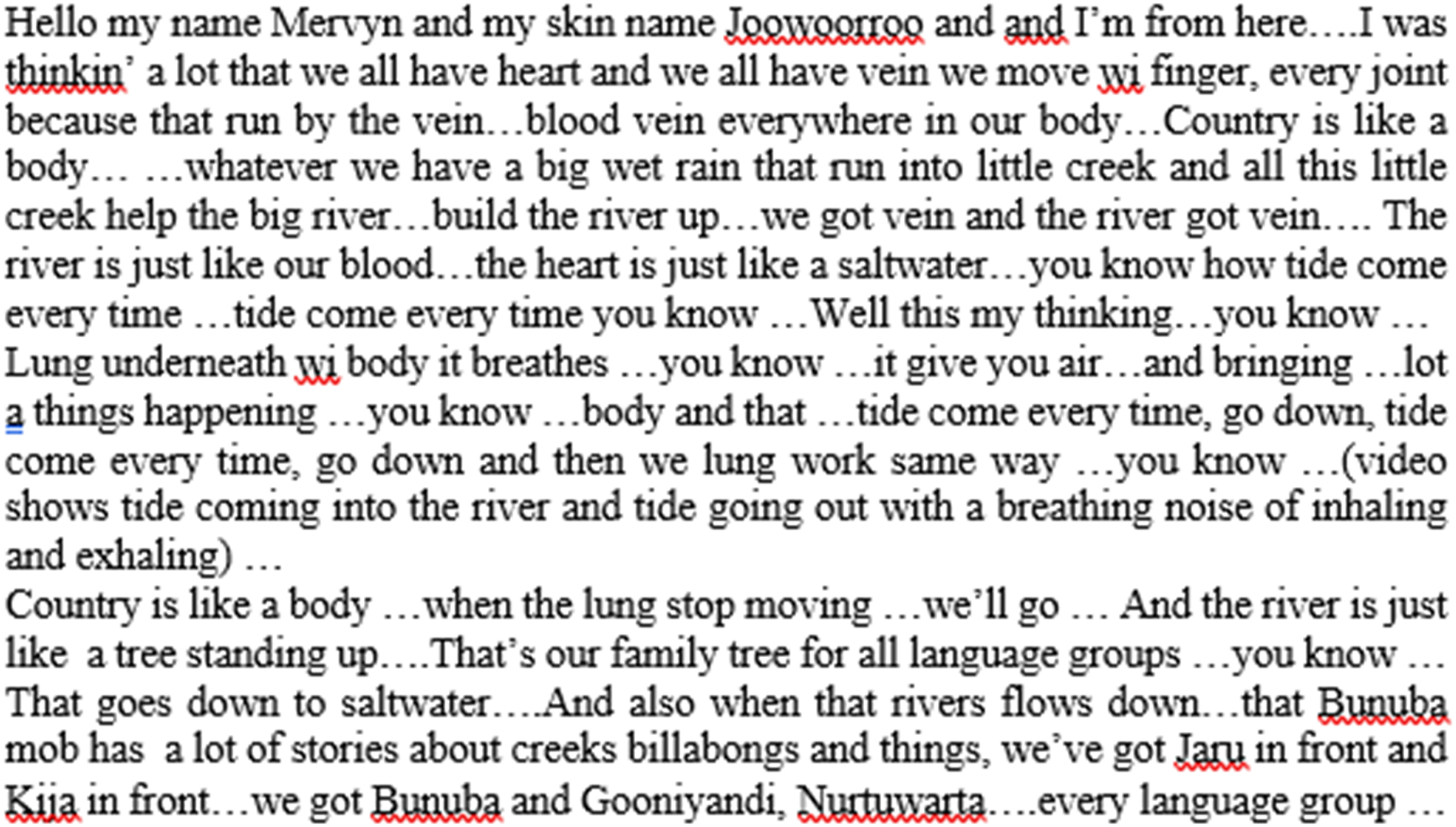
The river is part of community with a vascular system and lungs that breathe and bring the tides in and out. It is “active, self-creative, productive and unpredictable.” There is no distinction between us and the river; we are both an “assemblage of objects cellular and historical” (Cole and Malone, 2019: 158). To build a Tidal Power station would be to kill this river and hence be as serious as intentionally killing a community member. See Figure 1. Mervyn Street’s sand drawing of the Martuwarra river.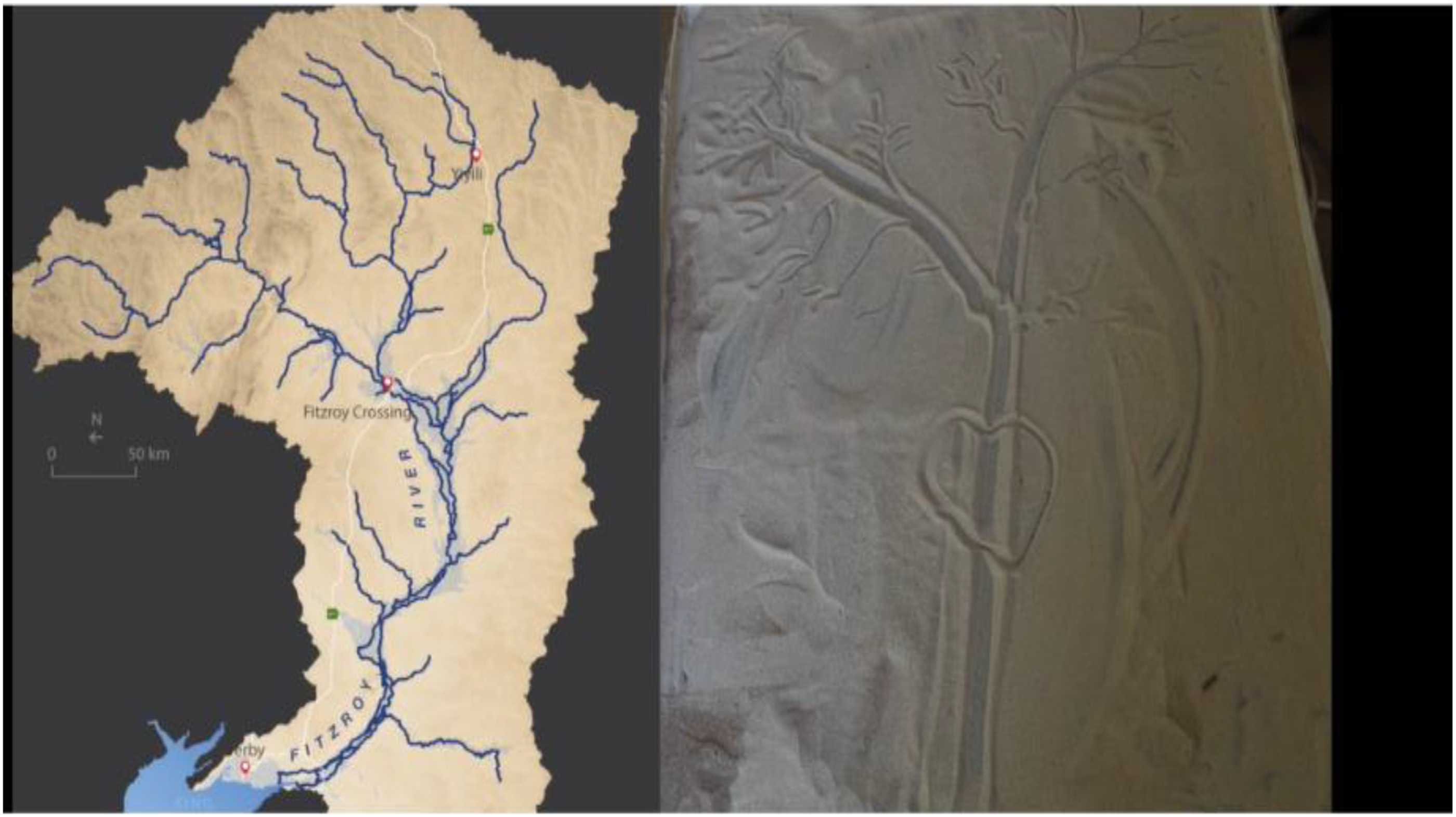
Mining companies experiencing mining
The second part of the study involved looking at the Values Statements of two mining companies to address research question: 2. How do the values and discourses of mining companies reflect the innate values and belief systems of Aboriginal peoples? It was important to know this in order to see if dystopian views of the Anthropocene were being mediated by mining companies listening to Indigenous Peoples and adopting values and practices based on traditional ways of sustaining the land. Themes that were apparent are discussed below:
Community care
Extract 2 is taken from the website of MinRes (Mineral Resources, 2023) during a search for the values statements of the company. It has been cut down to only focus on Values not Purpose and Vision. Values of MinRes.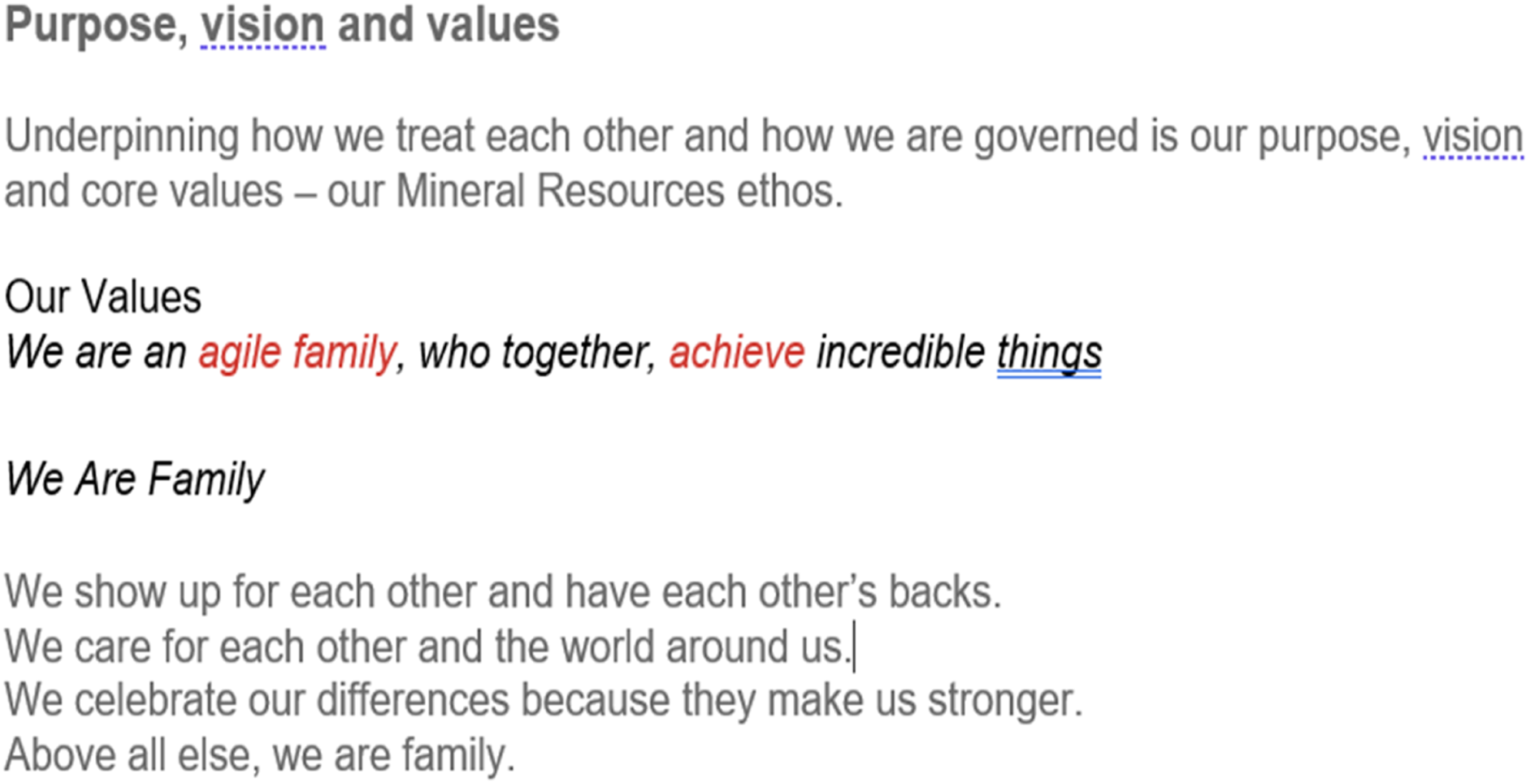
While the mining company pays lip service to core values which include a Duty of Care, the emphasis is on institutional community, how co-workers “treat each other” and how they “are governed.” The emphasis is inward looking, with the company and the people who “belong” to the company, being the priority-the “Family.” This notion of family does not extend beyond the company. There are key differences in these statements with the values expressed by Aboriginal peoples in their yarns as seen in Extract 3. Mervyn Street talks about community (2018).
Mervyn’s vision of “family” extends beyond the four walls in which he lives and even beyond his own language community. It includes everyone who drinks from the Martuwarra (Fitzroy) River and the river itself. All must be looked after and treated well, not just the immediate family. MinRes’ first value “We show up for each other” hints at community bonding but is only linked with attendance at work. There is an underlying suggestion that non-attendance somehow breaks up the family which can only exist inside the four walls of the building. The next value: “have each other’s backs,” has a dubious undertone of people doing anything to protect “the family,” even lying, which seems to go hand in hand with mining companies’ practices of blowing up sacred sites then claiming they did not know they were sacred. There is talk of caring for the environment (“We care for each other and the world around us”) but it is an after-thought to another statement about caring for each other within the confines of the company. The statement is humanist rather than post-humanist or new materialist, seeing humans as the main agent rather than the environment as embodying “vital materiality” and “agential realism” (Cole and Malone, 2019: 157). There is also reference to “inclusion” in this value which states, “We celebrate our differences because they make us stronger,” but the implication is that the only reason to celebrate is because having “differences” and diversity will show the company, and the people in it, in a more positive light, and lead to a stronger fiscal position as a result. The values finish with the repetition of “Above all else, we are family,” leaving us with the Mafia Esque feeling that this “family” will stop at nothing to get what it wants. Of course, value statements are for institutions and companies, while values and belief systems reflect a lived experience on a more profound level. However, they are still a window to the soul of the companies who write them. Equally, the values of institutions are often transient, dependent upon goals and targets. Colin Barnett’s, likening of the impact of mining on the land to the loss of one seat at the MCG, highlights the acceptance of transience as an acceptable value in his world while the belief systems and values of Indigenous communities are permanent, having existed for thousands of years. They continue to form part of how they see and engage with the world around them.
Rio Tinto has had more time to refine its value statements and advertising techniques. In a pdf called “The Way we Work” (Tinto, 2023b) the company outlines its values of Care, Courage and Curiosity as shown in Extract 4 below: Values of Rio Tinto.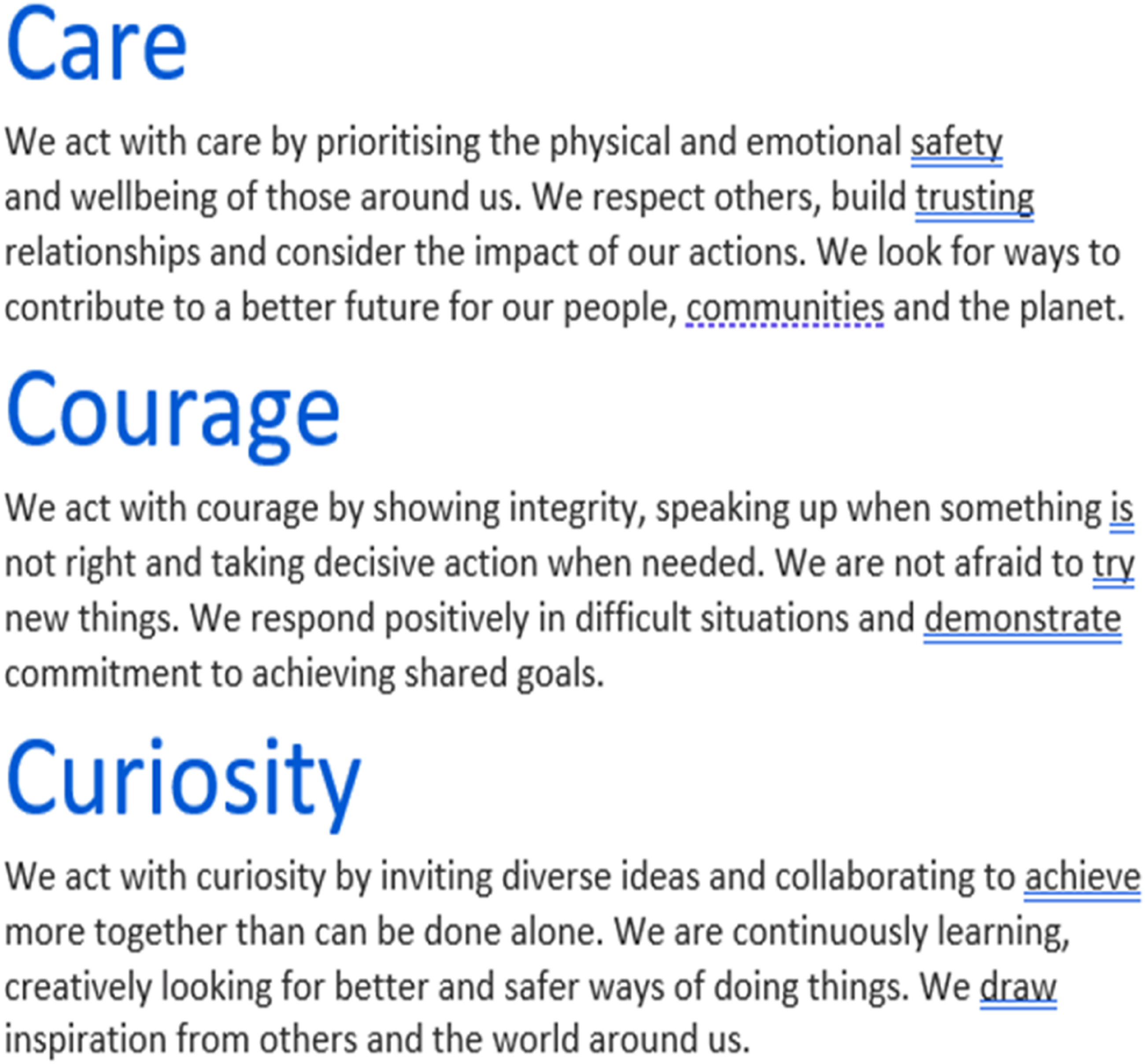
Rio Tinto’s sense of “care” talks about “physical and emotional safety and wellbeing of those around [them].” Like MinRes, this seems to suggest a very narrow definition of community, or, at best, is unspecific about for whom the company are caring. It is also unclear what is meant by “we,” the company, or the people in it. There is talk of respect and building “trusting relationships” but again it is left vague as to with who these relations will be. It does not indicate any post-humanist leanings towards building respectful relationships with the material world except to say that they will “consider” the impacts of their actions; again, reflecting a view of the environment as lacking any agency (Cole and Malone, 2019) and remaining unclear whether they will “consider” their actions before or after the event (e.g. the blowing up of the Juukan caves). The final line of the caring value says, “We look for ways to contribute to a better future for our people, communities and the planet.” The use of the words “our people” is ambiguous but seems to indicate a closed family group which comprises the mining company as the word “communities” is added separately. The final reference to “the planet” sees the word “the’ being used instead of “our.” The European and colonial Newtonian-Cartesian world view is apparent, with humans remaining exterior to their environment but having an “understanding” of it as outlined in Peoplehood Theory (Spicer, 1962; Thomas, 1990). This statement is very far from the voices of the River Of Life project (Martuwarra et al., 2020) participants who said, “Our River is like our Mother… We got a rule that we do the right thing… there is only one river-and all the people worry about that river not to be destroyed.” They are connected to the land as a child to “a mother” and experience anxiety and “worry” when there is danger for their mother. They are “shared bodies” in a “space-time” continuum, being and becoming alongside material matter (Cole and Malone, 2019: 158).
Courage
Rio Tinto also talks about valuing courage (“We act with courage by showing integrity, speaking up when something is not right and taking decisive action when needed…We are not afraid to try new things”). This seems to contradict their track record of destroying the Juukan Caves with no one in the company speaking up or showing integrity. The only thing they could claim is that they took decisive action to destroy a magnificent ancient site (the Juukan Caves) and that they tried out a “new” or transient thing with no regard for “old” or permanent things. Aboriginal people, on the other hand, as narrated by Author 2, have shown extreme courage in standing up to the government and mining companies over the years against all the odds: And you know Malcolm [pseudonym] … he was a strong advocate against Buru Energy fracking and you know, the seismic lines east of Broome….where there’s over 14,000 km of straight lines that now feature in the landscape and he protested….Each year, he would often lead the parade of the local annual festival, protesting against fracking. He also protested to Woodside in Perth and I attended some of these protests…. he also brought with him… local townspeople as well. But he says that…as traditional owners and as traditional elders, we are born to look after this country…of course governments and mining companies said no, we’re not gonna listen to you. Cause it’s just bush anyway…
Curiosity
Rio Tinto is keen on “curiosity,” however, to date there is little evidence of Rio Tinto “acting with curiosity or inviting diverse ideas or collaboration,” “continuously learning, creatively looking for better and safer ways of doing things” or drawing “inspiration from others and the world” around them in terms of listening to Aboriginal people’s ideas on how to move forward and allowing them governance in co-designing these ways forward. Like all other mining companies, they have not shown any curiosity in the birthplace, and nursery of the humpback whale or the biodiversity of the “very sensitive fauna… And flora existing in areas targeted for mining” that Author 2 describes. Aboriginal people, on the other hand, have researched the value of bush foods and medicines, as well as traditional ways of making the land sustainable (Gillies, 2017) and keeping the land alive.
Conclusion
Indigenous Peoples all over the world have been impacted by mining activities and changing energy landscapes. The colonisation of Indigenous lands shows the Anthropocene “as an uneven process” (Curly and Lister, 2020: 258). This “unevenness” has been described by some as “the capitalocene” putting the blame for human destruction of the planet on the modern world system (Moore, 2017). Indigenous scholars have attributed the Anthropocene to the intensification of colonial power relations and practices (Curly and Lister, 2020). Indigenous Peoples are only considered human once they disown their relationship with the non-human (Simmons, 2019). In Western Australia colonial powers are apparent in the disregard for the social licence to operate on Aboriginal lands. This is a form of contemporary colonialism, new colonialism and cultural colonialism.
Our article collates the yarns, and lived experiences of one group of Indigenous Peoples and that is the Aboriginal People of the north of Western Australia who are under constant threat of destruction of their land and resulting changes in their environment and planet from mining agendas. The yarns that we collected reflect values and beliefs about the permanence of land, Aboriginal people’s obligation to take care of community (the land is a community member) and the ensoulment of the land. Author 2’s yarns indicate Aboriginal people’s courage in standing up for the land, collaboration across peoples and curiosity in connecting with the land to ensure its, and the planet’s, survival. He also stresses the feelings of failure and trauma that can set in when Aboriginal people are unable to be true to these values because they have been over-ruled by governments and/or industry in the form of mining companies.
We only looked at two mining companies and the data we collected from these company websites was far from exhaustive. While sites included reference to community care, courage and curiosity, their interpretation of these values was discordant with Aboriginal ways of experiencing these same values. Moreover, despite saying the company stood for courage and curiosity (“We are not afraid to try new things…We draw inspiration from others and the world around us”), Author 2’s story about James Price Point and related literature, would prove otherwise. Values statements fell short of encouraging partnerships and, most importantly, governance by Aboriginal people.
Aboriginal people are future-looking. In the age of the Anthropocene, and the post-humanist, material turn, they envisage mining activities conducted in ways which include not only their values, and beliefs but acknowledgement of Indigenous materialism which decries colonial agendas and brings relational worlds together which have been cast aside by “thingification” (Clary-Lemon, 2019). They imagine having “a central role in the development, implementation, and evaluation of policy and legislative or administrative measures that impact on their lives” (Poelina and Nordensvard, 2018: 154). Indigenous governance and rights to the land can facilitate an “ethical care” of the land, foster protection of the land, and the cultures and languages of its Indigenous Peoples (Poelina and Nordensvard, 2018: 149). Aboriginal governance can increase understandings around the complex relationships of sites, land, or country, which cannot be separated from the people, or custodians, who live there and care for them. Collaborative governance, policy and research can realise a vision of sustainable, restorative and regenerative development (Martuwarra et al., 2020), recognising that all peoples are connected wherever they live and that song lines ensure this connection. As Poelina and her colleagues say, “We can envisage a new way of governing land, Living Waters and people. A world different to the one we have just come from…an alternative course of development” which includes the “ethics of co-management and co-existence” (Martuwarra et al., 2020: 10 & 17). By listening to the wisdom of Indigenous Peoples and Indigenous materialism, and including these ideas in governance, the extractive industries and complicit governments could decolonise the Anthropocene and learn ways to mitigate the dystopian future of our planet before it is too late. By acknowledging what Indigenous people have always known, that matter is alive, “active, self-creative, productive and unpredictable” and that we are entangled with this “vital materiality” which has “agential realism” (Cole and Malone, 2019: 158), we could begin to reconsider our existence, actions and how we live.
Footnotes
Declaration of conflicting interests
The author(s) declared no potential conflicts of interest with respect to the research, authorship, and/or publication of this article.
Funding
The author(s) received no financial support for the research, authorship, and/or publication of this article.
