




Abstract
Existing works on the sources of secessionist agitations in postcolonial Africa tend to be methodologically nationalist but also circumvent the diasporic dimension. Particularly, the resurgent ethnic separatism amongst Igbos in southeastern Nigeria has been predominantly analysed from the theoretical standpoints of relative marginalisation and material deprivation that focus on domestic politics in post-war Nigeria. We broaden this literature by underscoring the diasporic dimension of this secessionist conflict. Drawing on the literature on diaspora nationalism with a focus on the case of the Indigenous People of Biafra (IPOB)—a transnational separatist movement—we reveal evidence showing how the Igbo diaspora instigate and exacerbate separatist tensions in the homeland by reviving collective memories of the macabre Nigeria-Biafra war (1967–1970) and reimagining alternative political futures for ethnic Igbos devoid of the state’s grand narratives of nationhood. We contend that the diasporic dimension is profoundly critical to comprehending separatist agitations in southeastern Nigeria with implications for wider postcolonial African contexts.
Introduction
On 27 June 2021, Nnamdi Kanu—a British-Nigerian activist of Igbo ancestry and leader of the Indigenous People of Biafra (IPOB), proscribed by the Nigerian state as a terrorist organisation—was ‘‘arrested’ 1 in Kenya and brought to Nigeria for allegedly jumping bail in 2017. Among other offences, Kanu had been charged with terrorism, treasonable felony and managing an unlawful society (Busari and Princewill, 2021). Days later, in a press conference on Nnamdi Kanu’s situation, Nigeria’s attorney-general described Kanu as an existential threat to the corporate existence of the state despite the latter’s inexplicable physical disappearance from Nigeria (Elusoji, 2021). Not much is known about Kanu’s life before he came to limelight for his Biafran activism but he was born and raised in southeastern Nigeria before leaving to attend university in the United Kingdom (BBC News, 2017). As a British citizen with robust ties to Igboland in south-eastern Nigeria, Kanu is an archetype of the Igbo diaspora, and—like some Igbos in the diaspora discontented with the myriad woes of the postcolonial state—backs the restoration of the defunct Biafran state (1967–1970). However, despite the influence of the Igbo diaspora on secessionist agitations in southeastern Nigeria, extant scholarly literature has sidestepped the role of the diaspora in Biafran separatist mobilisation in Nigeria. Indeed, existing literature tends to engage in ‘methodological nationalism’ (Wimmer and Schiller, 2003) by confining the study of renewed ethnic separatism in Nigeria to geopolitical boundaries of the Nigerian state, with scant attention given to transnational forces that shape ethnic mobilisation in the homeland. When the Igbo diaspora is considered, if ever, it is not so much on secessionism in Nigeria but on their transnational business ties and development projects (see Fonta et al., 2015; Amagoh and Rahman, 2016; Reynolds, 2004) and especially in Igboland (see Lu, 2022a; Reynolds, 2002). Hence, the Igbo diaspora is often depoliticised and not fully explored in the copious literature on secessionism in southeastern Nigeria.
The methodological nationalism of extant studies is axiomatic from the two theoretical standpoints predominantly utilised to assess the secessionist drive in postcolonial Africa, especially in southeastern Nigeria—namely, the relative marginalisation and political economy frameworks. On the one hand, relative marginalisation theorists posit that the resurgent Biafran separatism in Nigeria is the by-product of perceptions of deprivation amongst Igbos in Nigeria. Such perceptions of relative marginalisation engender narratives of ‘collective victimisation’ (Ibeanu et al., 2016) and collective memories of a people under siege (Onuoha, 2016; Thomas and Falola, 2020) as Igbos in southeastern Nigeria perceive themselves as a ‘community of suffering’ (Harneit-Sievers, 2006: 123). In contradistinction to the relative marginalisation perspective, other researchers explore the ‘generational dimensions’ (Onuoha, 2014) of secessionism in southeastern Nigeria from the standpoint of political economy. For the political economists analysing Biafran separatism, it is not so much the perception of relative marginalisation but the literally precarious social conditions―the scarce economic opportunities coupled with massive unemployment―of young Igbos that engender separatist agitations in contemporary Nigeria. For example, Nwangwu et al. (2020: 527–528) divides Igbo nationalists into two groups: the first generation that emerged in 1970 and is orchestrated by elite organisations such as the Ohanaeze Ndigbo that seek the participation of Igbos in mainstream Nigerian politics; and the second generation that surged since 1999 and is made up of separatist groups such as the Movement for the Actualisation of the Sovereign State of Biafra (MASSOB) and the Indigenous People of Biafra (IPOB) that wish to create a sovereign state for Igbos. For Nwangwu et al. (2020: 535), the second generation of Igbo nationalists―those who long for the restoration of Biafra―is a collaboration between the Igbo petty bourgeoisie and the underclass―the poor and unemployed young Igbos―with the latter constituting a disproportionate fraction of the people driving the ethnopolitical movements in southeastern Nigeria.
In this article, we depart from the methodological nationalism of extant literature that confines the issue of Biafran separatism to the geopolitical boundaries of the Nigerian state. Instead, we adopt the ‘methodological de-nationalism’ (Anderson, 2019) approach that centres transnational forces―the Igbo diaspora―in the separatist agitations. Although domestic issues cannot be completely discarded in the assessment of ethnic separatism in postcolonial Africa, they do not constitute the sole factors that impact the secessionist agitations in the region. In analysing the role of the diaspora in the resurgent separatist tensions, our focus is on the IPOB which is currently the largest, most renowned, and most active Biafran secessionist movement that boasts of numerous sympathisers amongst the Igbo diaspora from virtually every part of the globe. Our choice of focusing on IPOB as a diaspora separatist movement rather than the entire Igbo diaspora is to evade what Brubaker (2002) rightly calls ‘groupism’ whereby social scientists tend to conceive concepts such as nation, identity, race, class, ethnicity as internally homogeneous and externally bounded substantial entities rather than in terms of political projects, organisational routines, and institutional forms. Indeed, the Igbo diaspora is extremely diverse so that not all its members or organisations support a separatist ideology and agitations. Whilst it is incontrovertible that IPOB is predominantly championed by Igbos in the diaspora, as we will show, the separatist organisation is neither synonymous with Igbos nor with the entire Igbo diaspora (see SBM Intelligence, 2017). Moreover, Biafran activism―that is, the emergence of separatist movements in postwar Nigeria―has polarised identity as many ethnic Igbos continually contest any attempts to conflate Igbo identity with Biafran secessionist movements such as IPOB. For some Igbos, the conflation of contemporary Biafran secessionism with Igbo identity amounts to ‘warmongering’ that militates against the well-being and business of Igbo people across Nigeria (Nwachukwu, 2017). Consider, by way of example, the ethnographic observations of the anthropologist Vivian Chenxue Lu derived from interactions and interviews with several Igbo merchants in Lagos―the commercial capital of Nigeria―most of whom rejected any inclination toward conflating Igbos with Biafran activism: Many of the market leaders adamantly insisted that their markets had not in fact been closed for the sit-at-home protests, and some market association leaders have publicly denounced Biafran secessionist organisations’ use of wholesale markets in Lagos as political stages. (Lu, 2022a: 503).
It is important to note here that the resurgent Biafran separatism in contemporary Nigeria has rekindled longstanding controversies over identity and belonging in Biafra in the context of resentment and resistance of a Biafran state by minority groups in the oil-rich Niger Delta (alternatively called South-South). Indeed, whereas Biafran activists such as Nnamdi Kanu consider the Niger Delta as part and parcel of the imagined Biafran state as originally declared in 1967 (Nwafor, 2020), minority groups in the Niger Delta such as the Ikwerre have firmly distanced themselves from the Biafran identity as they regard themselves as an independent ethnic group and committed to Nigeria’s unity (Usman, 2021). This disagreement between some Igbo nationalists who are sympathetic to the restoration of the Biafran state and non-Igbo minorities in the Niger Delta who are averse to a Biafran state harks back to the Nigerian Civil War where ethnic minorities rejected Biafra that portended―as they perceived it at the time―Igbo domination and instead chose to belong to Nigeria (Usuanlele, 2017; Osaghae, 1991). It is little wonder that this controversy has continued to manifest in postwar Nigeria with contemporary Biafran activism increasingly associated with the Igbo and, as a consequence, largely confined to southeast region (the homeland of ethnic Igbos). Contemporary Biafran activism, driven mostly by the Igbo diaspora, has not resolved this controversy that militates against struggles for the restoration of a Biafran state.
Accordingly, whilst acknowledging the polarisation of Igbo identity amidst the resurgence of Biafran secessionism and evading any proclivity to conflate Igbo identity with contemporary Biafran activism our research charts a novel terrain by positing that local and global forces are inextricably intertwined in the (re)production of ethnopolitical tensions in southeastern Nigeria and beyond. Our research draws on primary and secondary sources including direct quotes from speeches and news reports, online media sources (mostly Radio Biafra, Twitter & YouTube), books, journal articles, and various reports of organisations to shed light on the diaspora component of resurgent Biafran separatism in Nigeria that has so far escaped scholarly attention. Our article contributes not only to the burgeoning literature on Biafran separatism that is methodologically nationalist and leaves little or no room for transnational and global processes that are linked to national territories (Wimmer and Schiller, 2003: 579), but also to the scholarly literature on diaspora mobilisations for political change in postcolonial African homelands.
This article is organised around three sections. In the first section, we clarify and operationalise the key concepts that orient our research―long-distance nationalism and diaspora―and how they are germane to the case of Biafran separatism. In the second section, we delve into the formation of the Igbo diaspora in the aftermath of the Nigeria-Biafra war. In the third section, we explore evidence showing how IPOB fuel separatist tensions in southeastern Nigeria from abroad. We conclude by reiterating our contention, through the Biafran case, that scholarship on ethnic separatism in postcolonial Africa ought to take the diaspora into account for a wholistic comprehension of political agitations.
Conceptual framework: Long-distance nationalism and diaspora
Long-distance nationalism refers to ‘a set of identity claims and practices that connect people living in various geographical locations to a specific territory that they see as their ancestral home’ (Schiller, 2005: 570). Benedict Anderson invented the term to capture the role of diasporas in the political life of their homelands. Anderson (1998) posits that capitalism is the progenitor of long-distance nationalism and identity politics because it made mass migration and mass communication possible. Capitalism facilitated mobilities with rapid advancements in transportation and communications, which ‘have had extraordinary effects on international labour markets, on transnational migration, and on conceptions of identity, precisely because they are so tightly linked to the changing global distribution of wealth and resources’ (Anderson, 1992: 7). With improvements in transportation and communication, people can easily disperse to distant places for various reasons and still keep in touch with relatives in their homelands. Indeed, long-distance nationalism creates a ‘transborder citizenry’ for immigrants and their descendants, where citizens in the ‘territorial homeland view emigrants and their descendants as part of the nation, whatever legal citizenship the émigrés may have’ (Schiller and Fouron, 2001: 20). These transnational linkages between hostlands and homelands enable the long-distance nationalist to advocate political change such as separatism in the homeland.
Intimately intertwined with long-distance nationalism is another crucial concept: diaspora. There is some consensus amongst scholars that the term was originally used to describe the forced dispersal of Jews from their homeland―the Land of Israel―due to persecution and their subsequent settlement in different parts of the world before it was later applied to Greek and Armenian diasporas that were equally forcibly displaced from their ancestral homelands (Tölölyan, 1996; Baumann, 2000; Cohen, 2008; Ben-Rafael, 2013). Hence, the Jewish, Greek, and Armenian diasporas are considered as the ‘classical diasporas’ (Brubaker, 2005: 2). This has meant that many conceptualisations of diaspora tend to extrapolate the Jewish, Armenian and Greek diasporic experiences to various ethnoracial and ethnoreligious groups. For example, drawing on the ‘ideal type’ diaspora, William Safran posits that diaspora should be applied to expatriate minority communities whose members share several characteristics, including ancestry, collective memory, ‘otherness’ and affinity for the homeland (Safran, 1991: 83–84). Safran’s conceptualisation has been criticised on two grounds. First, it simplifies Jewish migratory history by suggesting that Jewish migrations were always the consequence of catastrophic episodes such as oppression and coercion. Critics underscore that Jewish migrations were both voluntary and coerced so that attributing only traumatic experiences to the Jewish diaspora is myopic and distorts the complexity of Jewish history (Gruen, 2002: 6; Cohen, 2008: 35). Similarly, James Clifford cautions against making a definitive model from ‘the strong entailment of Jewish history on the language of diaspora’ but rather, the ‘Jewish (and Greek and Armenian) diasporas can be taken as nonnormative starting points for a discourse that is hybridising in new global conditions’ (Clifford, 1994: 306). Second, by relying on a negative interpretation of Jewish diaspora, critics argue that Safran’s definition gives the concept of diaspora a negative connotation. They contend that diasporas could emerge as much from ‘traumatic and massive uprootings’ (Skrbis, 1999: 5) as from trade, commerce, labour, and voluntary migrations in search of greener pastures (Cohen, 2008). These critiques not only entail that the restrictive usage of diaspora inflected by a partial interpretation of Jewish historical experiences is utterly misguided but also leave the concept open to various (mis)usages.
In this article, we employ diaspora in a broader sense to mean a group or segment of people residing outside a ‘homeland’, regardless of whether such decision is the consequence of traumatic uprooting or voluntary mobility. Our definition aligns with Cohen (2008) and applies to several categories of people and their descendants, including ‘expatriates, expellees, political refugees, alien residents, immigrants, and ethnic and racial minorities tout court’ (Safran, 1991: 83). Furthermore, given that our research is on Biafran separatism, we agree with Schiller’s (2005: 575) contention that separatism is a form of long-distance nationalism, as separatist movements founded by diasporas that have a collective memory of, and perennial longing for, the independence of their homelands tend to mobilise to ensure autonomy within an existing state or to secede from an established state. Diaspora mobilisation for political change in homeland politics has been extensively documented in various contexts (Adamson, 2016; Demmers, 2002; Hockenos, 2003; Koinova, 2011; Moss, 2016; Schøtt, 2021; Wayland, 2004). Our research on the long-distance nationalism of the Igbo diaspora regarding Biafran secessionism in postwar Nigeria resonates with similar scholarship in various parts of the world. For example, in the case of secessionism in Sri Lanka, Thiranagama (2014) and Chalk (2008) empirically demonstrate how the Sri Lankan Tamil diaspora support the secessionist agitations of the Liberation Tigers of Tamil Eelam (LTTE) in Sri Lanka through publicity, propaganda, and fundraising to ensure the creation of a Tamil state. Similarly, Dieckhoff (2017) has explored how the Jewish diaspora are deeply tied to Israeli nationalism, enabling the State of Israel to persist in contemporary times; and Tigno (2008) has observed the same phenomenon amongst the Filipino diasporas. And, finally, although long-distance nationalism has been observed in the African context in the case of Zimbabweans (McGregor, 2009) and Eritreans (Koser, 2003), it is not usually specifically centred on secessionism as we do in this article. Hence, our research centres long-distance nationalism in secessionist agitations in Africa with particular reference to the Nigerian context.
The reasons why diasporas are concerned about, and get involved in, homeland politics are various and complex. On the one hand, Benedict Anderson contends that diasporas mobilise in the domestic politics of their homelands because they are neither accountable to anyone nor affected by the consequences. This is precisely why Anderson (1998: 74) avers that long-distance nationalism may create ‘radically unaccountable’ politics. On the other hand―and contrary to Anderson’s presuppositions―Moss argues that diasporas maintain strong ties with their homelands, which is the principal motivation for their participation in homeland politics. As Moss (2016: 279) puts it: ‘Emigrants and exiles often maintain some degree of social, economic, and political ties to the home-country…and these transnational relations shape diasporas’ calls to action in significant ways.’ Our position is that there is merit in both standpoints so that diasporas’ involvement in separatism are shaped as much by unaccountability and sinister interests as by myriad ties to the homeland.
Long-distance Igbo nationalists who back separatist movements such as IPOB fall into a diasporic category that Cohen (2008) calls ‘victim diaspora’―that is, diasporas that emanate from catastrophic (or traumatic) events such as civil wars, massacre, genocide, slavery, political instability, expulsions, economic failure, and famine. That the Igbo diaspora could be considered a ‘victim diaspora’ does not necessarily mean that Igbos do not voluntarily migrate to geographic spaces for purposes of trade, commerce, or work. Being a ‘victim diaspora’, as Cohen (2008: 4, emphasis in original) explains, might also mean that ‘their victim origin is either self-affirmed or accepted by outside observers as determining their predominant character.’ Indeed, as Lu (2022b) has demonstrated in her ethnography conducted amongst Igbo diasporic merchants, there are Igbo trade and labour migrants in various parts of Asia and the Middle East. To say the Igbo diaspora is a ‘victim diaspora’ is not so much to undermine Igbos’ voluntary migration but to posit that Igbos’ dispersal since the late 1960s is largely the legacy of a traumatic experience during the Nigeria-Biafra war (1967-1970) whose memories remain alive and breed collective resentment against the post-war Nigerian state. In the next section, we trace the foundation of the Igbo diaspora in the context of the catastrophic Nigeria-Biafra War and its legacies.
The Nigerian civil war and the formation of the Igbo diaspora
Over a million Igbos and other ethnic minorities from the now-defunct Eastern region of Nigeria were massacred and starved to death (Heerten, 2017) by the Nigerian armed forces, a traumatic episode in Nigeria’s turbulent history that some scholars have either considered a genocide or as a civil conflict with some trappings of a genocide (see Bird and Ottanelli, 2017; Daly, 2020; Heerten, 2017; Heerten and Moses, 2014; Korieh, 2013). The plight of Igbos during the fratricidal conflict led some international observers to call Igbos the ‘Jews of Africa’ (Heerten, 2017; Ejiofor, 2022). With the anti-Igbo pogrom of 1966, many Igbos and other ethnic minorities from the now-defunct Eastern region of Nigeria fled the northern region fearing that the state was incapable of protecting them. Although some Igbos had lived outside Nigeria in the precolonial and colonial eras due to the Atlantic slave trade and the quest to acquire Western education, the Biafra war was a defining moment in the formation of not just what we call a ‘diasporic consciousness’ but also of ‘diasporic victimhood’ amongst Igbos. In other words, the Nigeria-Biafra war was the genesis of Igbos’ forced dispersal to several places across the globe and the birthing of the ‘greater supra-Igbo identity’ (Uduku, 2002: 305). The war ossified the identity of the Igbo diaspora as a ‘victim diaspora’ (Cohen, 2008), especially as the weaponization of hunger engendered a humanitarian crisis where many Igbos and other ethnic minorities in former Eastern Nigeria―mostly children― were ‘evacuated and flown to the neighbouring countries of Gabon and Côte d’Ivoire by relief agencies to protect them from the conflict’ (Ibhawoh, 2020: 569).
Immediately after the war, some Igbos returned to other parts of Nigeria and established businesses there, but the devastations wrought by the secessionist conflict and its legacies directly or indirectly compelled many Igbos to migrate outside Igboland and Nigeria in search of better economic opportunities whilst maintaining strong ties with the homeland (Uduku, 2002). Hence, the increasing emigration of Igbos out of their homeland since the 1970s and the concomitant diffusion of post-war Igbo diaspora across Europe, North America, Asia, and the Middle East have durable connections to the devastations of the tragic war that paralysed the economy of southeastern Nigeria. Of course, this is not to suggest that all Igbo―and, by extension, Nigerian―emigrations from Nigeria are invariably determined by the Nigerian Civil War. In an Afrobarometer survey (Figure 1) of why Nigerians from the six geopolitical zones―including Igbos in the southeast region―have decided to emigrate, economic reasons are predominant: ‘The most common reasons cited for considering moving abroad are to find work (35%), to escape economic hardship/poverty (31%), and to pursue better business prospects (10%). Only a few cite pursuing an education (6%) or tourism (5%) as their main reason to consider emigration’ (Isbell and Ojewale, 2018: 4). In this sense, poverty, lack of opportunity, and the search for greener pastures and better living conditions also determine the emigration of Igbos―including IPOB’s supporters in the diaspora―to various parts of the world. Reasons Nigerians consider emigration (Source: Isbell and Ojewale (2018: 4).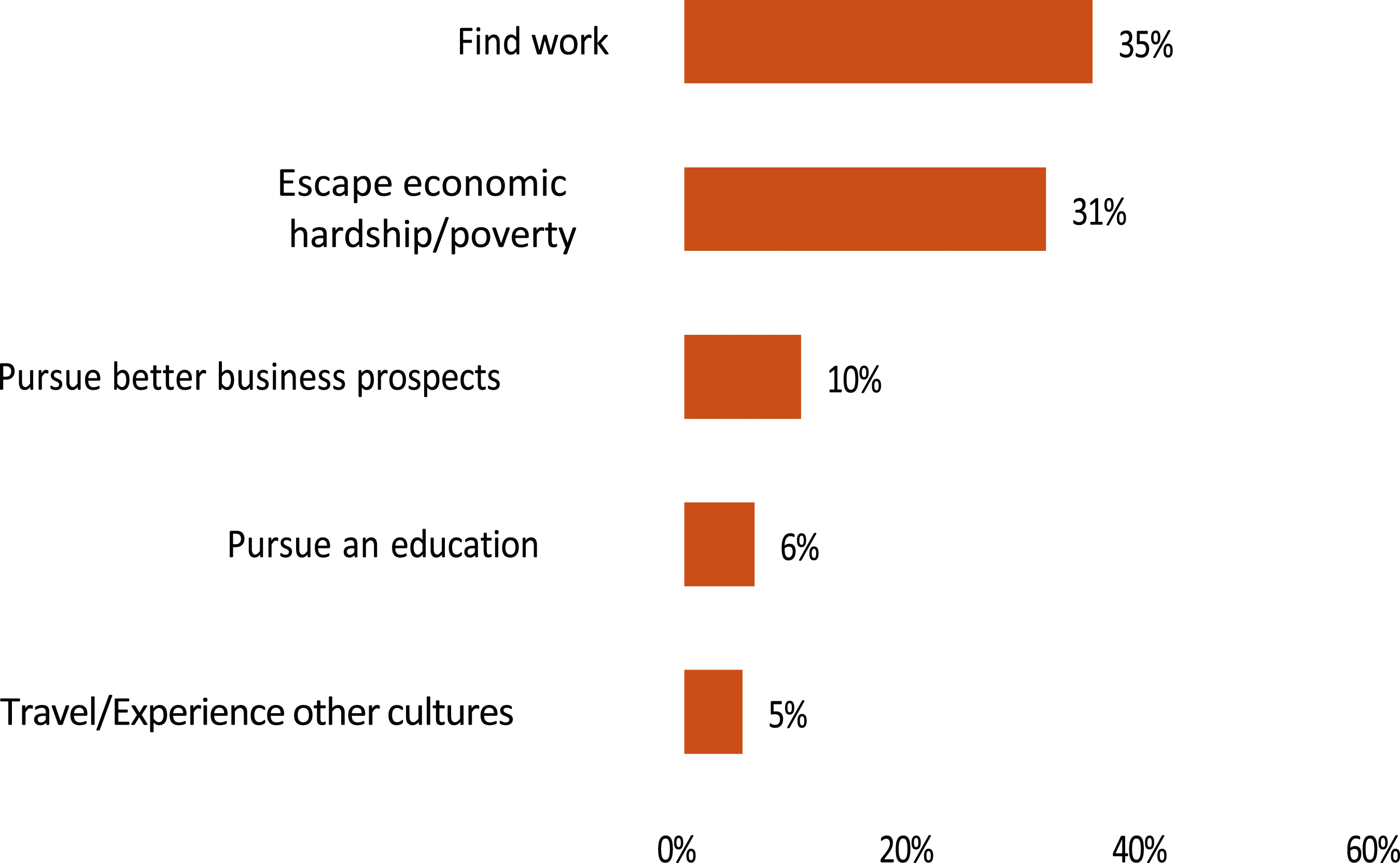
Whilst some Igbo diaspora organisations like the World Igbo Congress are committed to Nigerian unity and see the restructuring of Nigeria as the solution to the ‘Igbo question,’ others like IPOB have gravitated instead toward secessionist causes that, in their imagination, can facilitate a scission within the Nigerian state. We shall discuss how IPOB is able to do this via its mostly diasporan supporters.
IPOB diaspora mobilisation for self-determination in Nigeria
Scholars have noted that because the war forced many Igbos to pursue economic opportunities outside their boundaries, the region continues to survive—more than any other region in Nigeria—through diasporic remittances (Dike, 1966; Harnischfeger, 2011). It is not clear if Harnischfeger and Dike were referring to the Igbo local diaspora (ILD)—residing in other parts of Nigeria— or the Igbo international diaspora (IID)—residing outside of Nigeria. Although, one can suggest that Dike may have been referring to the ILD because at the time of his publication the IID did not yet exist in any significant way. However, it is worthy to note that the diaspora being discussed in this article refer mostly to the Igbo international diaspora. This is because there is more neo-Biafran support among the IID than the ILD; while the former dreams of a return to a Biafran homeland that once was, the latter are increasingly worried of the potential loss to their investments and livelihoods in other regions of Nigeria if a Republic Biafra were to re-emerge. Indeed, looking back at the infamous ‘abandoned properties’ saga in the post-war years in southern Nigeria, this worry is not far-fetched (see Maiangwa, 2016; Smith, 2014).
Mobilisation efforts by the IID to the Biafran cause blossomed during the war itself, with records of massive protests by Biafran students in various countries around the world (see Katsakioris, 2019). Today, there is an ever-growing, unrelenting, population of Biafran support groups all over the world – notable among them is the Indigenous Peoples of Biafra (IPOB) founded in 2012 in London by Nnamdi Kanu. IPOB is the largest and most daring Igbo separatist movement that emerged after MASSOB (Nwangwu et al., 2020). It is a registered organisation in the United Kingdom, the United States, and several other countries across the world.
Below, we explore evidence of the various mobilisation channels employed by IPOB and their sympathisers in the diaspora.
Internet/social media
The internet is by far the biggest channel through which IPOB supporters in the diaspora mobilise themselves and especially their counterparts in Nigeria (see Figure 2). Through the internet—and especially social media platforms such as Facebook, Twitter, and YouTube—IPOB spreads information and propaganda faster to a larger group of people and at a relatively low cost than other traditional media. They also enjoy a considerable and, often, a maximum amount of anonymity. So, it is a no-brainer that this is a tool of choice for neo-Biafrans in the diaspora looking to mobilise support for their cause in the homeland of southeastern Nigeria. From dubious internet webpages to dodgy accounts on Facebook and Twitter, there is no shortage of daily propaganda and anti-Nigeria derision from IPOB supporters, many of whom operate from outside Nigeria. They use social media platforms memorialise the trauma through the reproduction of pictures from the Biafra war era. IPOB also enjoys a growing presence on WhatsApp, where their messages are widely shared via group broadcasts. In the aftermath of Nigeria’s 2015 elections, constant dissemination of neo-Biafran messages via online broadcasts, publications, and other internet-based channels helped IPOB gain massive support for its cause (Ajiboye and Abioye, 2019). Indeed, there have been other internet-based channels via which previous neo-Biafran groups mobilised themselves—but IPOB is different. IPOB has been able to gain enviable visibility due to its young, social media-savvy followership and their belligerent rhetoric against Nigeria and its government (Daly, 2021; Maiangwa, 2021). There is also the remarkable surge in the usage of photoshopped images and memes by IPOB as a way of diffusing their ideology into the minds and hearts of their audience (Lu, 2017). Discussing IPOB’s diasporic channels on WhatsApp and Facebook, where ‘messages in Spanish or German outnumber those in English or Igbo,’ Daly (2021: 22) opines that IPOB ‘flourishes in exile’ because its members ‘can operate more openly in Europe and North America, where they fly under the radar, than they can in Nigeria.’ Lilja (2018) notes that the use of the internet is a two-way street: the diaspora can use it to send support back home and, through it, to see what is happening back home and may become radicalised to support. Locations of IPOB page administrators on Facebook (Source: Adebajo, 2023).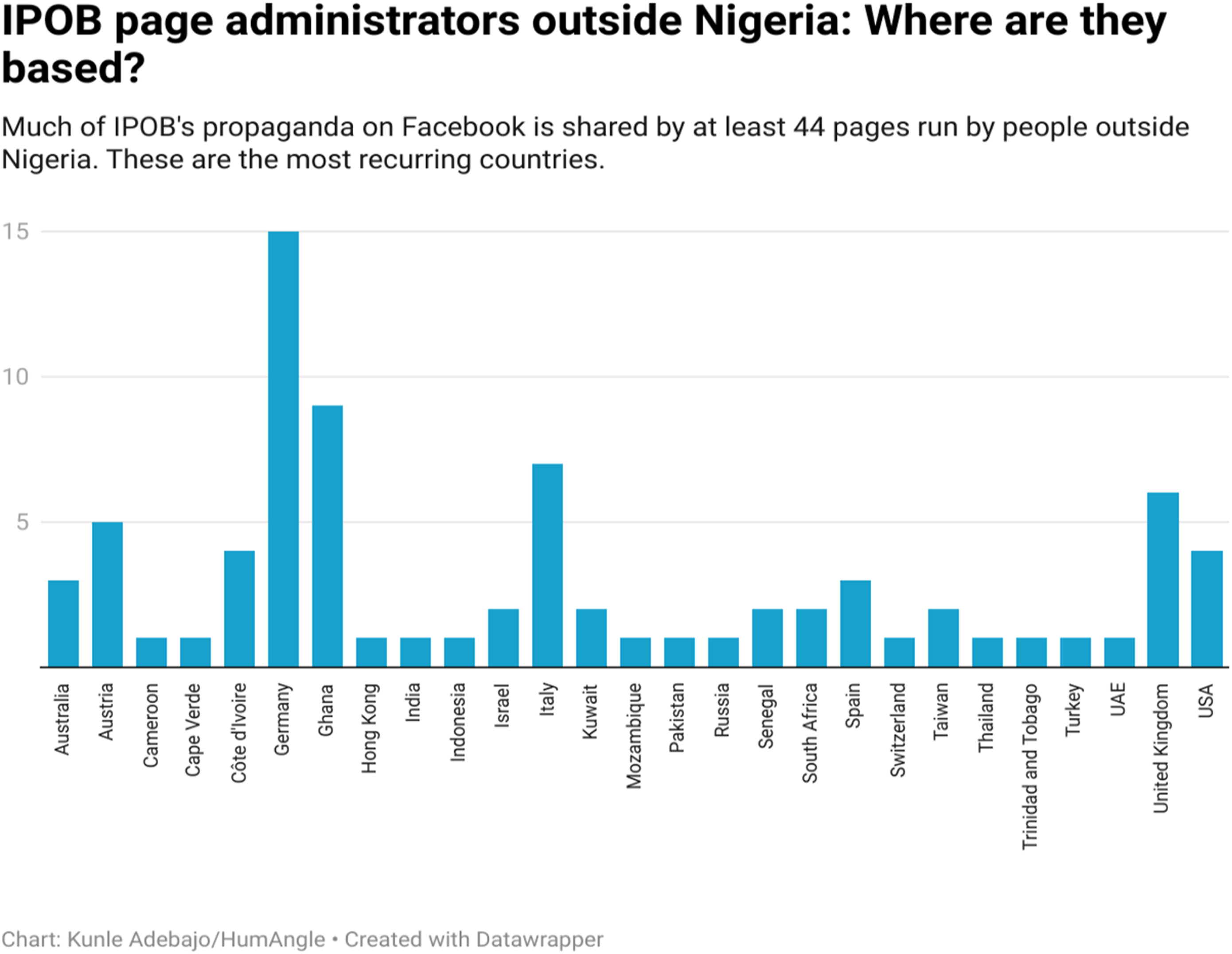
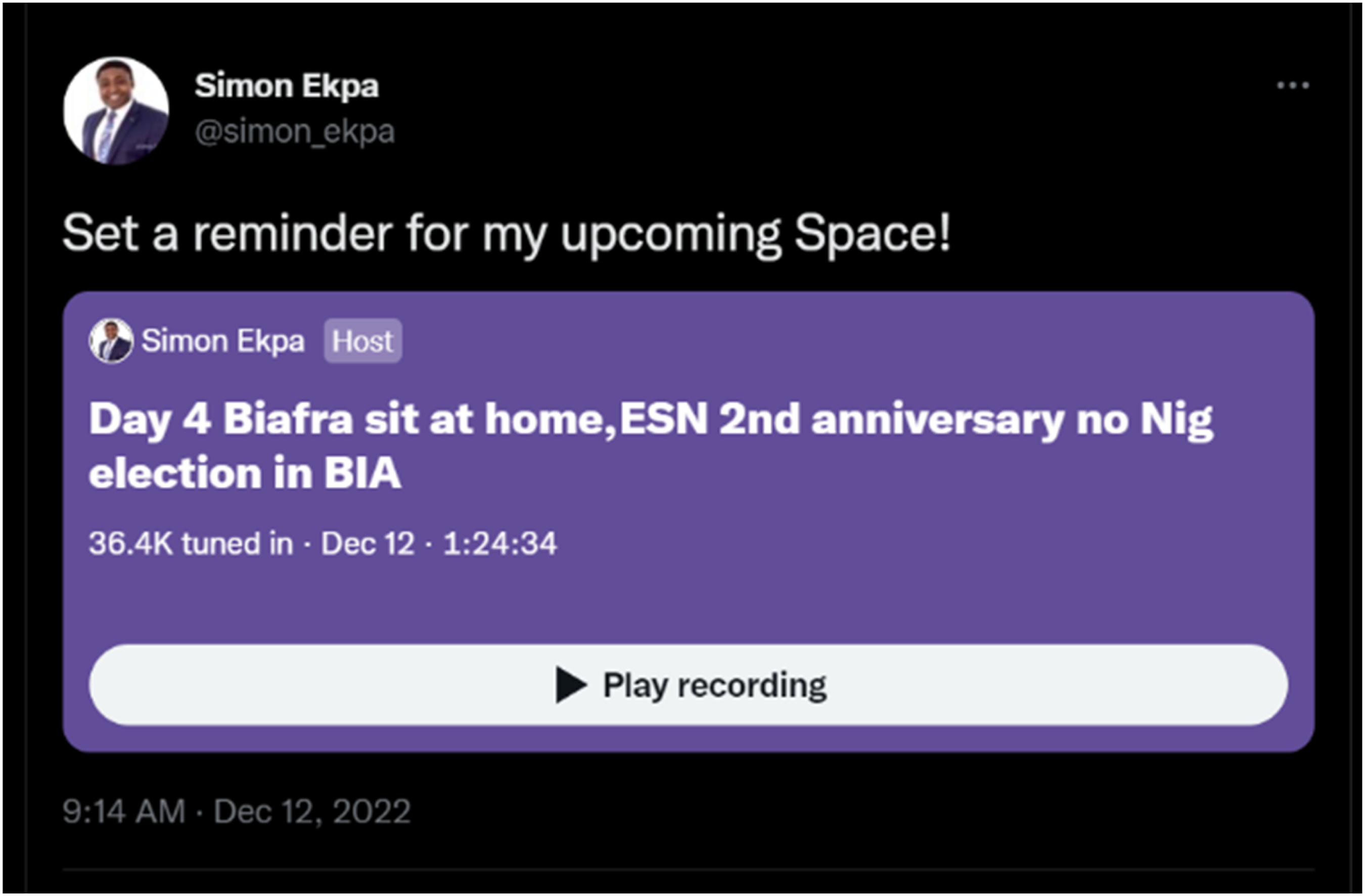
A couple of studies have shown that online and internet-based channels help mobilise people to IPOB protests and activities in Nigeria (Bennett and Segerberg, 2013; Bennett et al., 2014). Using evidence from IPOB’s internet channels, it has been demonstrated that a movement’s ideology can be effectively propagated for the mobilisation of support to its cause. Specifically, participants in the study showed a congruence between their usage of the internet and their likeliness to mobilise information, provide frontline support, and participate in IPOB activities (Bennett and Segerberg, 2013; Bennett et al., 2014). Similarly, Chiluwa (2018) observes that these groups may not always agree—as there are varied ideological differences capable of brewing division amongst them. In all, what is obvious and axiomatic is the efficient instrumentalization of the internet and other online-based channels by IPOB as a means of mobilising support between the diaspora and home-based Biafran activists. From periodic fundraising campaigns (see Figure 3) to disseminating its separatist ideology and activities around the world (see Figure 4), the internet has been profoundly indispensable to IPOB’s mission of connecting the Igbo diaspora to the homeland with the ultimate aim of restoring Biafra in Nigeria. A viral misleading tweet was traced back to Mr. Ekpa’s Twitter account (Source: Adebajo, 2023). Screenshot of Mr. Ekpa’s Twitter Spaces showing a global listening audience of around 36,400 people. Source: Twitter - @simon_ekpa: https://www.twitter.com/simon_ekpa/status/1602230508951408641.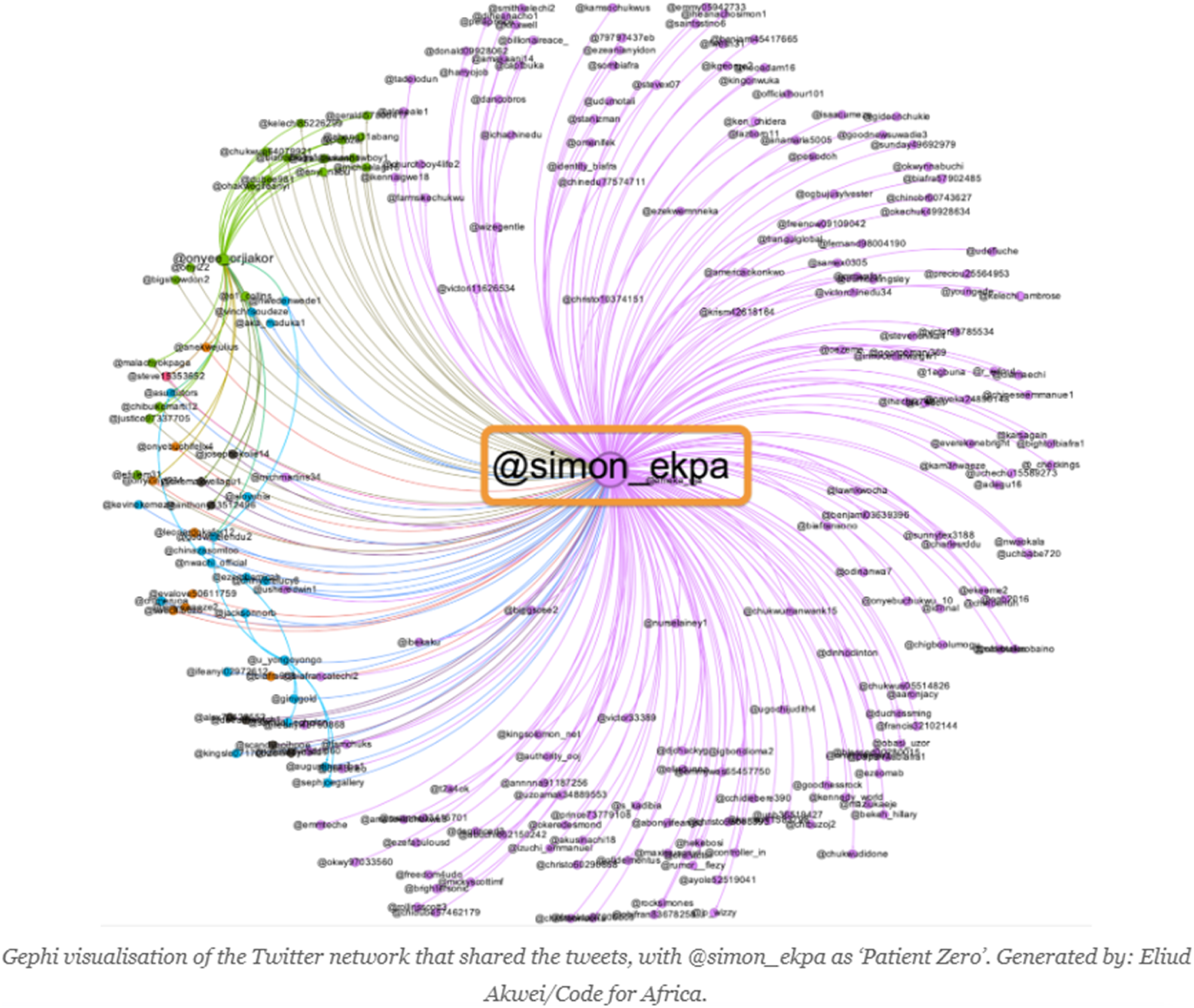
In June 2021, in response to IPOB and its diaspora activism on social media, Nigeria banned Twitter after the social media company removed a tweet from the president, which threatened violent government crackdowns on resurgent Biafran separatists (Princewill and Busari, 2021). The tweet was the first time Nigeria’s President Muhammadu Buhari would openly write about his plans for the group. The consequent Twitter ban—which lasted for 7 months before it was lifted—unwittingly elevated and centred IPOB in the separatist conversations about Nigeria. A few days after the ban, President Buhari granted a televised interview where he repeated his threats to crush resurgent pro-Biafran agitators mostly from Nigeria’s southeast region. The president repeated his threats against the group and seemed to conflate the businesses and properties of Igbo people lawfully living across Nigeria with those of the IPOB members, thus IPOB is just like a dot in a circle. Even if they want to exist, they will have no access to anywhere. And the way they are spread everywhere, having businesses, having property, I think IPOB doesn’t know what they are talking about. In any case, we say we will talk to them in the language they understand. We will organise the police and the military to pursue them. That’s what we can do and we will do it (Arise News, 2021).
The president’s claim sparked all kinds of reactions from human rights activists and leaders of various sociocultural Igbo groups (Adedayo, 2021; Shibayan, 2021). President Buhari’s ‘lexical choices’ in that interview and his negative disposition towards an entire ethnic population clearly ‘point to his anti-ethnic sentiments and polarised leadership’ (Ashindorbe and Chinaguh, 2021: 60). There was very little that differentiated his comments from the violent rhetoric often employed by Mr Nnamdi Kanu and his followers. A comparative analysis of the speeches of Kanu and Buhari found that they often employed combative language in advancing their opinions on ‘sensitive national discourse’ while neglecting the effects of such statements on national cohesion and security (Onyenweaku, 2021: 95).
In 2022, an investigation by the Disinformation Unit of the British Broadcasting Corporation (BBC) revealed a network of diasporic Nigerians sympathetic to IPOB’s secessionist cause engaging in the deliberate circulation of violent rhetoric and misinformation across social media platforms ‘in an apparently coordinated effort to stoke ethnic tension, and encourage the breakup of the country’ (BBC, 2022). These ‘media warriors’ (BBC, 2022) are part of a large ‘troll farm’ operating from outside Nigeria. They use the internet and social media to perpetually call out government officials, traditional rulers and religious leaders in the Igbo-dominated southeastern Nigeria, accusing them of colluding with the Nigerian government to sabotage their pro-Biafran efforts. These ‘media warriors’ even go ahead to call for attacks on these people and their facilities. One of the persons in the report—an Italy-based Nigerian with over 40,000 followers on Facebook—was quoted thus: Go after these mighty, mighty saboteurs; leave all these [small] saboteurs […] Those are the people that need to be beheaded. Those are the people that need to be burned to ashes. Those are the people their houses need to be invaded…. (BBC, 2022).
Another example was from a Facebook video, where a user was aggressively stoking existing ethnic tension in Nigeria. This Facebook user from London levied unfounded claims of a plot by Northern residents (especially the Fulani among them) to annihilate ethnic Igbos: --all of them, they are into mission in our land, Biafra land, Eastern part of Nigeria. They have come […] to do all sort of odd jobs, but now they are into kidnapping. They are on a mission to exterminate, kill, maim, wipe out all of us (BBC, 2022).
Although there have been violent clashes between herders—predominantly Fulani—and farming communities in the southeast region (see Okibe, 2022), there is no evidence to support the conspiracy being alleged by these “media warriors”. Nigeria presents an easy and ready audience for online merchants of misinformation and ethnic chauvinism, as internet coverage is relatively high and access is relatively cheap. These warriors are popular among their audience as they have hundreds of thousands of followers across various social media platforms, which can be interpreted as a clear indication of inclination for their type of rhetoric. It was a broadcast by Mr Nnamdi Kanu, detained leader of IPOB, in May 2020 that brought many of these ‘media warriors’ to limelight. In a transcript of his broadcast, Kanu recommended that his followers listen to certain people fighting for the Biafran cause on social media Listen to these people here on social media broadcast. They are our people and are doing a good job […] I also encourage you to follow them on Facebook and let us sink the zoo (Nigeria) together (Egwuatu, 2020).
Many of the people mentioned by Kanu—including a Finland-based follower Simon Ekpa—continue to reference this open endorsement by Kanu during their broadcasts as proof of their credibility and status within IPOB's online media network. The BBC investigation revealed that these online media trolls would often switch from English to local languages, like Igbo, which allows them to spew disinformation and hate speech without quick detection by various social media content moderation teams (BBC, 2022). A later investigation by HumAngle corroborated the claims made by the BBC and traced a barrage of violent and misleading social media posts to accounts owned by members of the IPOB ‘media warriors.’ Particularly, the investigation traced a false claim about Nigeria inviting mercenaries from Burundi to fight against Biafrans, which had been copy-posted 138 times by other Twitter accounts, to have originated from ‘@Simon_Ekpa’ (Figure 3) – a verified account belonging to Simon Ekpa, the self-styled disciple of Nnamdi Kanu (Adebajo, 2023). The diasporic nature of this social media mobilisation is further buttressed in the fact that over 44 Facebook pages affiliated with IPOB were identified to have administrators from across 27 countries, top amongst which were Germany, Ghana, Italy, UK, USA, Côte d’Ivoire and Austria (Adebajo, 2023). A reason for this large diasporic interest in the neo-Biafran struggle is unsurprising, as many of these societies in Europe and North America have stronger democratic tolerance for free speech and anti-government criticisms.
Sit-at-home protests/2023 election boycott
IPOB decided in 2017 to adopt a form of civil disobedience popularly known as the ‘sit-at-home’ to stop further loss of lives arising from violent government clampdowns on its members. Other groups like MASSOB and the Biafra Zionist Movement (BZM), who emerged before IPOB and had used these tactics in the past, also joined in this declaration (Nwangwu et al., 2020). These sit-at-home days were declared to memorialise certain historical events related to the Biafran struggle, and to protest certain government actions that challenged IPOB’s interests. For example, besides the usual sit-at-home to commemorate Biafra’s independence declaration on 30th May, IPOB declared a sit-at-home in Igboland for every Mondays to protest the ‘unlawful imprisonment’ of its leader Mr Nnamdi Kanu by the Nigerian government. The group also extended its declaration to include certain days that Mr Kanu was scheduled to appear in court, as a show of solidarity (Obianeri, 2022). An overwhelming majority of Igbos were initially happy to comply with this change albeit for various reasons. First, some genuinely believed that Nnamdi Kanu was unjustly imprisoned and that perhaps there was a chance that the non-violent action would influence the federal government to release him. Second, the reports of people being flogged (and even killed) because they disobeyed the sit-at-home declaration made many people scared of what could happen to them if they were seen on the streets. A final reason was that some people—mostly office workers—were happy with the consequent 4-day work weeks. As time went on however, and as the sit-at-home declarations started to become wanton and often inexplicable, the economic import of the days lost started to dawn on many (Ugwu, 2022). Parents who have schoolchildren and an increasing number of Igbo business owners began to air their frustration at the loss of a vital Monday’s work. Ironically, wary of being called ‘sabo’ or being assaulted or killed for disobeying the sit-at-home order, many in Igboland have had to endure another form of enforced silencing and authorised remembering from their diasporic kins who think they know better.
Simon Ekpa is another archetypical long-distance nationalist. Like Nnamdi Kanu, not much is known about Simon Ekpa or about how and why he came to live outside Nigeria. He was born and raised in southeastern Nigeria and had represented the country as an athlete in many international competitions, including as a silver medallist at the 2003 African Under-20 Athletics Championships 2 in Cameroon (The Cable, 2021). Ekpa has since emerged as one of the biggest forces of disintegration for a nation he once represented and had promised to return all medals he won for Nigeria (Oyeleke, 2021). Ekpa made repeated declarations of sit-at-home protests across the Igbo-dominated south-eastern Nigeria (see Figure 4). He also insisted that Nigeria’s 2023 elections would not hold in the region. Ekpa is a diasporic Igbo who has lived in Finland since 2007, from where he sends out daily broadcasts, tweets and other messages in line with his self-styled ‘auto-pilot’ neo-Biafran agenda. He came to limelight in 2021 after he announced on his Facebook page that he was a disciple of detained IPOB leader, Nnamdi Kanu, and that Kanu had ordered him to stand in for him as leader of the group and broadcaster on the group's radio station, Radio Biafra. A 2022 BBC investigation had identified Ekpa as part of the IPOB ‘media warriors’ allegedly responsible for mobilising violence in southeastern Nigeria via social media from his home in Finland (BBC, 2022).
These sit-at-home orders came to a head during Nigeria’s presidential election in February 2023, when Ekpa proclaimed sit-at-home orders for the election day in line with his anti-election mandate and ‘countdown’ to the actualisation of Biafra. Fearing that Ekpa’s growing influence might cause low voter turnout in the region, the apex Igbo socio-cultural organisation—Ohanaeze Ndigbo—made a press statement encouraging the Igbo to disregard any sit-at-home orders and to come out en masse to vote. Their statement—which shows the impact of Ekpa’s social media rhetoric on the homeland—was accompanied by an increase on a previous bounty they placed on Ekpa from $50,000 to $100,000. An excerpt of this statement read thus: Ndigbo have assembled documents proving that Ekpa is sponsoring killing of Igbo and Nigerians, especially security agents, burning of public properties, disruption of economic and social activities in the region [...] Ndigbo will collaborate with other Nigerians to apprehend those who are seen to be enforcing Ekpa’s sit-at-home from February 23 to 28 in an attempt to disrupt the coming presidential elections on February 25 and hand them over to security agencies (Akpa, 2023).
Since Ekpa represents only the ‘Autopilot’ faction of the IPOB leadership structure, it was hardly any surprise when the other Directorate of State (DOS) faction distanced itself from Ekpa’s declarations: If Simon Ekpa is on our own side, if he is really fighting for freedom and show he is not part of the killings in the Southeast, he must withdraw orders against election in the South. Enough of bloodshed in the Southeast […] IPOB has nothing to do with Nigeria fraudulent election. We are focused on the release of our leader, Mazi Nnamdi Kanu, and a Biafra Referendum date.” (Ogbonnaya and Nkwo-Akpolu, 2023).
Ekpa’s disruptive declarations also led to meetings between Nigeria’s Foreign Affairs Minister, Geoffrey Onyeama and the Finnish Ambassador to Nigeria, Leena Pylvanainen to intervene in the matter (Ugwu, 2023). Additionally, several letters were written by interest groups and citizens to the Finnish Parliament and Police calling for Ekpa’s arrest and deportation. One online petition calling for this arrest and deportation gathered over 3000 signatures. An excerpt from the petition read thus: One Simon Ekpa […] a Nigerian living in Finland, and holding Finnish citizenship, has by proxies, successfully established and coordinated an armed rebel group in Eastern Nigeria whom he now wields to destroy lives, property, and businesses in Eastern Nigeria. He’s been seen countless times, using his media platforms in Finland to issue orders to his armed goons in Eastern Nigeria to launch deadly attacks on millions of people in the region for flouting his sit-at-home orders. (Osaji, 2022).
Mr Ekpa was later arrested a few days after by the Finnish Authorities and was released after questionings (Nwonwu, 2023).
Radio Biafra
Radio Biafra was relatively unpopular until 2012 when it was relaunched by Nnamdi Kanu. Its predecessor was the Voice of Biafra International, a radio station also managed and financed by the Igbo diaspora. Radio Biafra took its name from the war propaganda ‘Radio Biafra’ station setup by the erstwhile Biafran government during the Nigerian-Biafran War to mobilise and sensitise its people. The regular transmission of news helped to ‘unite the heterogeneous ethnic groups that made up Biafra and to build a community spirit which Biafrans displayed through their commitment to the war efforts’ (Omaka, 2018: 575). In its reemergent form, however, this Radio Biafra broadcasts out of London (not Nigeria) and has reignited the call for Igbo secession from the Nigerian state. IPOB and Radio Biafra are currently registered as non-profit in London with sponsorship from donations from the Igbo diaspora. Kanu functioned as Radio Biafra’s director and presenter until 2015 when he was arrested by the Department of State Security (DSS), Nigeria’s secret police. The discussions on most of Kanu’s radio programmes bordered on the marginalisation of the Igbo in Nigeria, the failures of the Nigerian state, and why Biafra was the only solution for Igbos everywhere (Iyorah, 2017).
Radio Biafra was Kanu’s platform of choice to disseminate provocative messages bordering on hate speech, violence, and anti-Nigeria derision. For instance, whilst responding to a caller who asked about his ‘mechanism towards actualising the dream of Biafra,’ Kanu said: The mission of Radio Biafra is very simple: To get Biafra by every means necessary and possible. By every means, including war, including violence…Big violence that no one has ever seen before. We said we’ll burn the zoo down and we’ll do it: Nigeria will be burnt to the ground, completely burnt to the ground (Voopin Magazine, 2016).
Radio Biafra is a powerful mobilisation tool for Kanu and IPOB, through which they shape public discourse on Biafra—especially amongst diasporic Igbo youths who did not experience the civil war—across the globe. Kanu’s radio strategy is not far from the strategies employed by the original Radio Biafra set up during the war, employing propaganda and outright provocation for the radicalisation and motivation of its supporters within and beyond Nigeria (Doron, 2014; Omaka, 2018). Through this strategy, Kanu and IPOB have been able to recruit many members in the diaspora. In a 2014 interview on SaharaTV, Kanu boasted about the reach of his Radio Biafra broadcast, saying: ‘if we can place the name “Biafra” on the satellite, if we can broadcast so that the whole world can hear us every blessed day, if we are in over 70 countries around the world with over 5 million listeners, there is nothing we cannot do’ (SaharaTV, 2014).
In the same interview, Kanu again repeated his violent tropes: ‘Our promise is very simple; if they fail to give us Biafra, Somalia will look like a paradise compared to what will happen to that zoo. It’s a promise, it is a pledge, and it is also a threat to them… I do not believe in peaceful actualisation or whatever rubbish it is called’ (SaharaTV, 2014).
Since Kanu’s rearrest and detention in 2021, IPOB has continued to employ Radio Biafra to rally the Igbo diaspora to its struggle for self-determination and to call for Kanu’s release. The state holds powers to interdict a radio and its transmission for breach of ethical codes or threats to law and order, but a trans-border radio is quite complicated. For example, a radio can be legal in the country where it is primarily located and from where it transmits signals but can be illegal in the country where the signals are received. Radio Biafra is one such example because it transmits legally from London to all countries in the world—including Nigeria. It is no surprise then that Nigeria’s federal government who considers Radio Biafra as illegal has tried and failed to jam its signals (Premium Times, 2015; Tijani, 2015).
In 2021, the Nigerian government released a press statement containing excerpts from Kanu’s radio and online broadcasts where—in addition to calling for elections boycott—he called for the killing of Biafra’s enemies, including ‘Fulani herdsmen’, law-enforcement officers and ‘Governor Willie Obiano of Anambra State’ (News Agency of Nigeria, 2021). In a 2022 report by the Interagency Ministerial Committee (IMC) of the National (Money Laundering & Terrorist Financing) Risk Assessment (NRA) Forum, IPOB’s Radio Biafra was noted to have highly provocative narratives fused with misinformation, hate speech and disdain for the Nigerian Authorities (NRA Forum, 2022: 16). The report also accused the group of using propaganda to mobilise financial support from its members in the diaspora (NRA Forum, 2022). As was the case with Chukwuemeka Odumegwu Ojukwu—the leader of the defunct Republic of Biafra—Kanu’s reasons for backing secession resonates with many Igbos today. Biafra—whether geographically or ideologically—has now become a proxy for many Igbo youths in the homeland and in the diaspora to voice their opinions about their perceived political and economic marginalisation as well as the incessant killings of their people in various parts of the country (Daly, 2021). Hence, Radio Biafra is an invaluable medium for Igbo long-distance nationalists to organise for, and advocate, political change in their southeast Nigerian homeland.
Eastern security network
Nnamdi Kanu—after he was granted bail in 2017—somewhat began to tone down his violent rhetoric. Although, whilst in Nigeria, he insisted on using peaceful means—via the instrumentality of a referendum—to restore the Republic of Biafra, he would go on to allegedly jump bail, flee Nigeria and establish an armed militant wing (Eastern Security Network or ESN) of IPOB in December of 2020. IPOB claimed that ESN was similar to other sub-regional security structures—for example, the Western Nigeria Security Network (‘Amotekun’)—and a necessary response to what it described as ‘criminal activity and terrorist attack on Biafraland’ (Shibayan, 2020): This outfit […] will ensure the safety of our forests and farmlands which terrorists have converted into slaughter grounds and raping fields. We can’t watch helplessly while those we are agitating to liberate from bondage are gradually being eliminated by terrorists,” […] We, therefore, advise every robber, kidnapper and other criminals to steer clear of Biafraland or brace for the worst. We must defend Biafra no matter the price.
It is important to note that while Amotekun is backed by state legislatures in Nigeria’s western region, the ESN is not backed by any state legislation in eastern Nigeria. Rather, the state legislatures in Nigeria’s eastern region opted to establish their own joint security vigilante otherwise known as ‘Ebube Agu’ (Soonest, 2021). The establishment of ESN was met with heavy condemnation from government officials. Other socio-cultural groups in Nigeria’s eastern region, especially the Ohanaeze Ndigbo, also condemned IPOB’s establishment of ESN, citing that they were not consulted beforehand and feared that such militarization of the Biafran struggle might invite more military action from President Buhari’s government in the region (Ishaku, 2020).
Noteworthy is the fact that Nnamdi Kanu set up the ESN while he was outside Nigeria after allegedly violating his bail conditions (Kabir, 2018). Another major indication for IPOB’s massive impact on the homeland came when Nigeria’s government officially designated the group as a terrorist organisation. This designation in 2018, coming after IPOB had brandished its newly-formed vigilante outfit— Biafra Security Service (BSS) and precursor to the ESN—enabled the group to rally support both locally and especially internationally against the declaration. The effective lobbying tactics of IPOB’s diasporic networks may lie in the fact that hardly any international organisation or foreign country, including the US and the UK, have heeded the Nigerian Government’s call to label IPOB as a terrorist group (Elusoji, 2022; Wodu, 2022). In 2021, the Nigerian government accused IPOB of allegedly inciting violence and orchestrating the killing of 60 persons in 4 months—via the ESN—including police officers (News Agency of Nigeria, 2021).
Networks of diasporic associations (and demonstrations)
Another channel of diasporic mobilisation for IPOB in Nigeria is through networks of association, most of which are registered in foreign countries around the world, and their regular protests. Indeed, there was diasporic support for IPOB before 2015, but it was Kanu’s arrest that jolted them into limelight. There was a rallying cry against his arrest, with supporters trooping out to protest across many countries. In Nigeria, these protests turned deadly quickly as there were violent clashes between IPOB supporters and the often-repressive government forces. These harsh measures by Nigeria’s government only strengthened the group’s resolve as it enabled them to make martyrs of their dead colleagues and engineered another form of propaganda campaign for the diasporic supporters. After Kanu’s release in April 2017, he returned abroad to his Radio Biafra telecasts and strengthened the online campaigns. He also centred the Igbo diaspora in his renewed effort by appointing them to prominent positions within IPOB’s network. IPOB has a clear structure for its mobilisation from the diaspora—and nowhere is this suggestion more evident than in a 2021 press statement from a ‘Head of Membership and Mobilisation of IPOB in Australia’ commending members in Nigeria and indeed all Igbo people for obeying the sit-at-home declaration to mark the May 30 ‘Fallen Heroes Day’ (Nwankwo, 2021).
Since the extraordinary rendition of Nnamdi Kanu from Kenya by Nigeria’s government, IPOB has been factionalised into two prominent diasporic leadership groups—Autopilot and the Directorate of State (DOS). The former, led by Finland-based Simon Ekpa and observed to be much more militant in its operations than the latter, led by Switzerland-based Chika Edoziem. Despite their disagreements on methods, they fervently pledge allegiance to Nnamdi Kanu and the overarching aim of restoring the Republic of Biafra. IPOB operates a decentralised structure, where considerable autonomy is enjoyed by the regional and national coordinators (Immigration and Refugee Board of Canada, 2022). In this sense, there is for example IPOB USA, IPOB Austria, IPOB Germany, IPOB Canada, IPOB Australia, IPOB Spain, IPOB Malaysia, and so on. These networks of IPOB associations coordinate their members and sympathisers in myriad diasporic spaces. They collaborate on fundraising and the dissemination of the group’s separatist ideology across the globe, especially amongst the Igbo diaspora. This has allowed for the group’s activities—particularly, its sit-at-home protests and the armed activities of the ESN—to be successful despite the arrest or extrajudicial killings of its leaders and members.
These diasporic IPOB groups also conduct conferences and facilitate demonstrations around the world (see Figure 5) to compel the Nigerian government to release Kanu and to allow a referendum for an independent Biafran Republic (Ezeamalu, 2016; Oke, 2022). IPOB protesters typically don Biafran garbs—oftentimes with Kanu’s picture embossed on their shirts and dresses—march with Biafran flags, and wave placards festooned with Biafran imaginaries and popular phrases such as #FreeNnamdiKanu, #BiafraReferendumNow and #BiafraExit. During one such demonstrations in Madrid, an IPOB protester made the following remarks: The world must hear us … We have come out en masse to protest. We are IPOB. The Nigerian government must free our leader... Biafra must be free, Mazi Nnamdi Kanu must be freed unconditionally because he has not committed any crime… We are not calling for war, we are calling for self-determination, a referendum is our right, they must give us. We are Biafrans, not Nigerians. Nigeria is a contraption, it is a zoo, it is a British company, Nigeria is a crime against humanity, we denounce Nigeria with our blood. Biafra is my identity (Sahara Reporters, 2021). IPOB demonstrations in Belgium lauded by a tweep on Twitter. Source: Twitter - @EmekaGift100: https://www.twitter.com/EmekaGift100/status/1537194590759002112.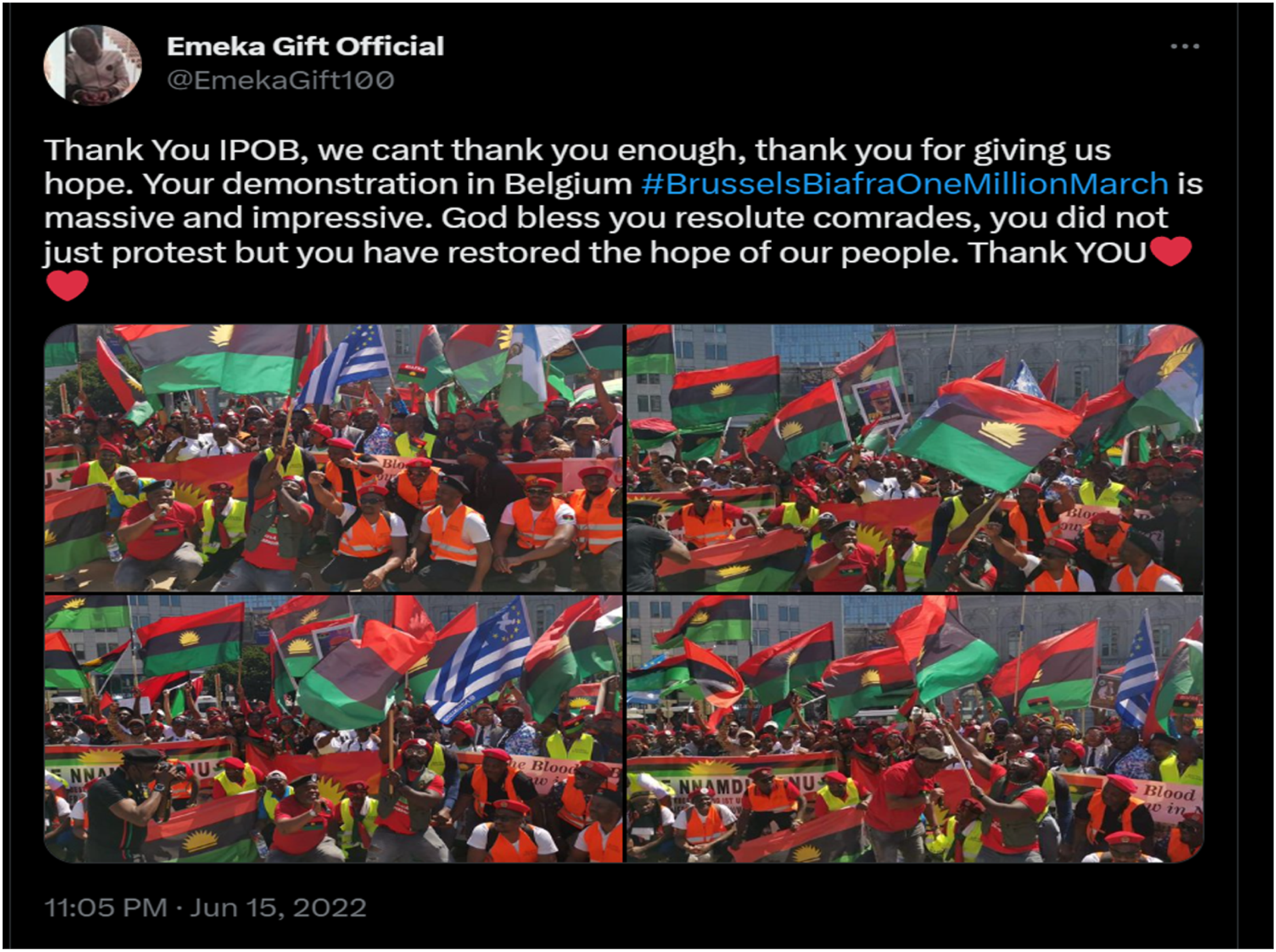
IPOB members have also organised protests in the diaspora during foreign visits of Nigerian political elites. For instance, the group disrupted an event attended by Nigeria’s Senator Ike Ekweremadu in Nuremberg, Germany in 2019. This action was defended by the group’s spokesperson thus: Yesterday… the Nuremberg IPOB family in Germany in keeping with the long-standing directive from our leader to hound all instigators of Operation Python Dance, IPOB is glad to report that Ike Ekweremadu was confronted and duly hounded out of a so-called New Yam Festival event in Germany…Despite repeated warnings to the organisers of these jamborees… they went ahead to invite a known traitor, co-conspirator and one of those that worked with Igbo governors to proscribe and tag IPOB a terror organisation while they never raised any voice against murderous Fulani herdsmen. This should serve as a warning to [other Igbo politicians] that any day we find them in a public event abroad, they will be humiliated. IPOB is strategically located in over 100 countries around the world. Anywhere we find them, they will be dealt with. (Olafusi, 2019).
The statement not only corroborates our observation of IPOB’s combative rhetoric, but it also shows the reliance of IPOB on the length and breadth of its networks in over “100 countries around the world” to mobilise action towards its goals.
Diasporic funding
In a comparative study between the strategies of IPOB and Boko Haram—both of which are recognised as terrorist organisations by the Nigerian government—Okoli notes that ‘funding and strategic advice’ are some of the ways IPOB gets diasporic support (2017: 134). A BBC’s report gave a rare explanation of the financial nature of this diasporic mobilisation, revealing that many of IPOB’s ‘media warriors’ spread across the world are paid stipends with additional funds to purchase laptops, phones, internet data and other paraphernalia (BBC, 2022). The report like Okoli’s study, however, could not tell how and through which channels these monies or items were sent. Nigeria’s Presidency noted that ‘[IPOB] mouthpieces and their wallets are their most effective tools’ (Channels TV, 2022). The Presidency was referring to IPOB’s sophisticated propaganda machinery as ‘their mouthpieces’ and their robust financial structure as ‘their wallets’. It had earlier claimed that IPOB spends about $85,000 monthly to discredit the Nigerian government ‘with no records of the source of this largesse’ (Shehu, 2020). In 2021, it was reported that IPOB paid over N300million ($750,000) to hire the services of an American lobbying firm to win the support of U.S. government officials and political influencers (Adesomoju, 2021).
Our observations suggest that IPOB fund these activities through diasporic donations and remittances. In countries like the US and the UK, the Igbo diaspora have been particularly noted for their remittances for investments, ceremonies, and community infrastructure development in the homeland (Reynolds, 2004). IPOB has mastered the art of exploiting these diasporic channels alongside the nostalgia of the Biafra that once was to mobilise financial support. It had been noted that members of the Igbo diaspora—many of whom dream of an independent Biafran territory—contribute massive financial and technical assistance to IPOB through various online-based platforms (Ibeanu et al., 2016). We found an application form on an IPOB ‘customary government’ webpage
3
for members to register and make payments into bank accounts in Nigeria and the UK. We also found various fundraising campaigns conducted on social media platforms (see Figure 6) for IPOB diasporic members to make donations. IPOB’s Fundraising Campaign Posted on Twitter [redaction by the authors]. Source: Twitter - @IkpokiBiafra: https://twitter.com/IkpokiBiafra/status/1605479393718980609/photo/1.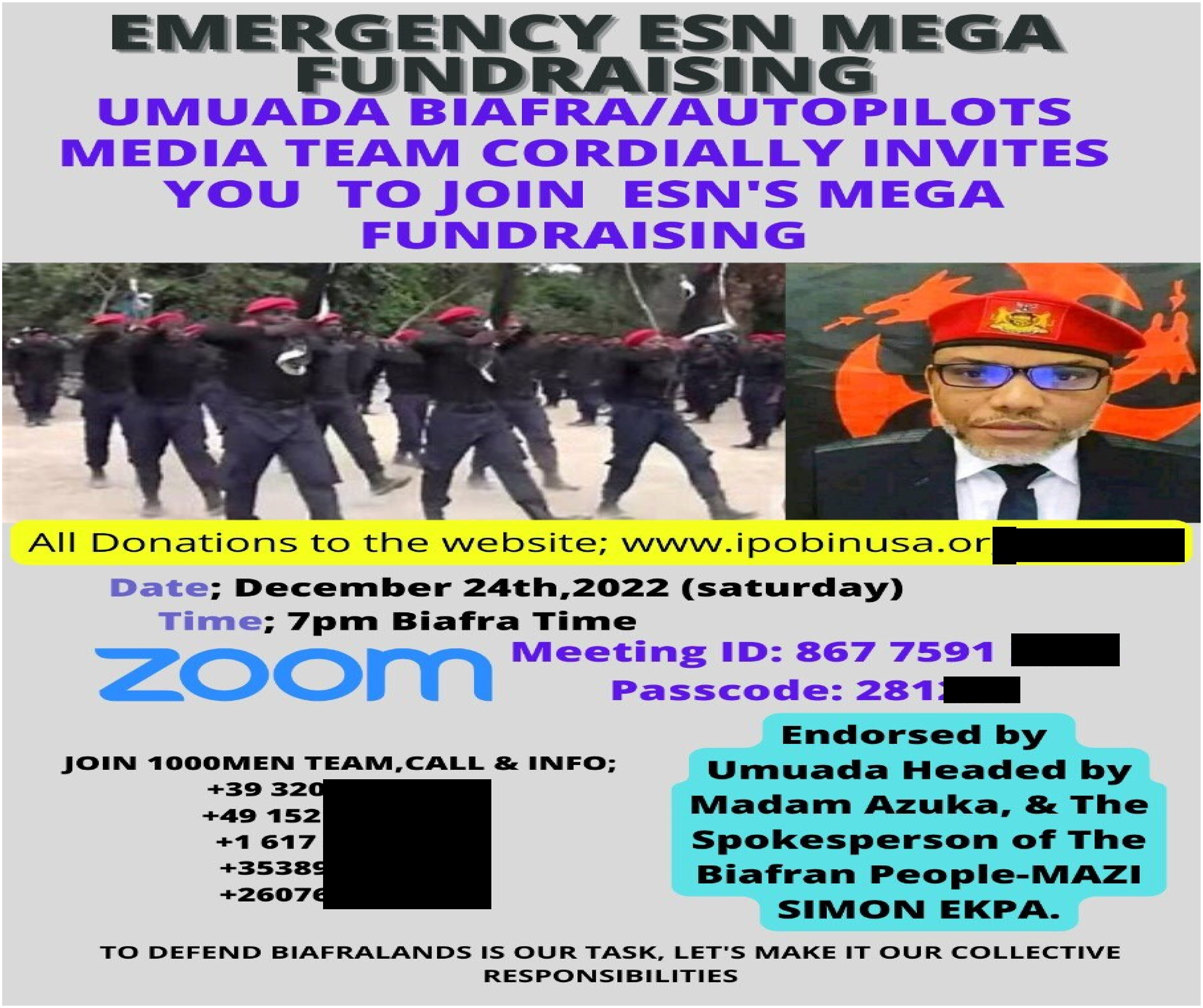
A 2022 report by the NRA Forum noted that IPOB also ‘coerce or influence’ target audiences to make donations via its social media channels and Radio Biafra (NRA Forum, 2022: 16). The report—commissioned by Nigeria’s Financial Intelligence Unit (NFIU)—further notes that IPOB’s links with diaspora neo-Biafran sympathisers form ‘a significant part of their financial base.’ These funding contributions are made through ‘overseas-based bank accounts,’ as well as via voluntary donations, levies, souvenir sales, and via several enrolment forms (NRA Forum, 2022: 16). This report, however, admits that it had ‘no reliable reports of amounts that could be traced directly to the IPOB terrorist group’ (NRA Forum, 2022: 16). IPOB’s financial sources and support structure have remained quite elusive. Nevertheless, we know that IPOB’s separatist activities are funded in large measure by members of the Igbo diaspora who—with their expansive financial resources—are sympathetic to the Biafran cause.
Conclusion
The extant literature on separatist conflicts in postcolonial Africa is, as we have shown with the Biafra case in southeastern Nigeria, methodologically nationalist and privileges domestic actors alone. The diasporic dimension has received little attention. Our article counteracts the methodological nationalist stance by presenting the impact of the diaspora/long-distance nationalists. We have shown that the Igbo diaspora play a significant but underexamined role in the renewed separatist conflicts in Nigeria’s southeastern region – even though they are yet to come to terms with the minority question as to what ethnic territories constitute Biafra. The long-distance Igbo nationalists who back IPOB’s secessionist cause do so not only because they are insulated from Nigeria’s political repression but also because of their socioeconomic and political connections to the homeland, which make them care about transcending the multifarious malaises of the postcolonial state. We also highlighted the various channels of diaspora mobilisation, including internet and social media, radio broadcasts, demonstration and funding. Although what we have provided is hardly an exhaustive list of the channels of diaspora mobilisation, they illuminate our contention that the renewed Biafran secessionism orchestrated by IPOB in Nigeria is fuelled in large part by transnational forces beyond the postcolonial state, so that discussions of the conundrum that sidestep the diasporic component automatically fail to capture the bigger picture. As can be gleaned from this case study, the examination of the influence of a ‘nationalistic diaspora’ creates a clearer, more powerful explanation. We recommend future research to compare the diasporic element of Biafran separatism in Nigeria with other separatist conflicts in postcolonial Africa to explore how those relations underpin the quest to reimagine and restore the homeland.
Footnotes
Declaration of conflicting interests
The author(s) declared no potential conflicts of interest with respect to the research, authorship, and/or publication of this article.
Funding
The author(s) disclosed receipt of the following financial support for the research, authorship, and/or publication of this article: This work was supported by the Bill and Melinda Gates Foundation (OPP1144).

Data Availability Statement
The authors confirm that all data generated or analysed during this study are included in this published article. In addition, primary and secondary data sources supporting the findings of this study were all publicly available at the time of submission.