




Abstract
Marine Le Pen managed to mobilise a substantial share of the votes in the French 2022 presidential elections, ending up second after the winner Emmanuel Macron. This study aims to increase our understanding of the political appeal and mobilisation of women in far-right movements by exploring the identity management strategies Marine Le Pen deployed in her presidential Twitter campaign to construct her position as a female, right-wing populist political leader and rightful president of the nation. A corpus of 701 tweets (published between 4 July 2021 and 10 April 2022) from Le Pen’s official Twitter account were analysed through a critical discursive psychological approach. Through our analyses, we identified five subject positions that Le Pen constructed for herself in her discourse: the Protector, the Punisher, the Women’s Candidate, the Mother, and the Voice of Justice. Our findings show that through careful discursive negotiation between femininity and masculinity, Le Pen managed to engage in a dynamic positioning between a harsh candidate who punishes ‘the Other’ and a compassionate and loving mother candidate who takes care of the nation’s children. This flexible way in which Marine Le Pen claimed different positions for herself may have been a central factor that enabled her to appeal to millions of voters in the 2022 French presidential elections. The study contributes to the literature on identity politics and the discursive mobilisation of gender by female far right political leaders.
Keywords
Introduction
The French presidential elections of 2022 displayed an unprecedented political landscape in France. For the second time in a row, Emmanuel Macron, President between 2017 and 2022 and candidate of République en Marche, and Marine Le Pen, candidate and president of the far-right party Reassemblement National, ended up competing against each other in the second and final round of the elections. The elections resulted in victory for Macron, giving him 58.55% of the votes and thus a second presidential term. The first round of the elections, however, had given the far-right and far-left candidates Marine Le Pen (23.15%), Eric Zemmour (7.07%) and Jean-Luc Mélenchon (21.95%) more than half of the voting share (France 24, 2022). This result, together with Marine Le Pen’s considerable popularity, revealed a deep polarisation of the French electorate. Indeed, despite Macron having secured his second and final term as president, Le Pen (Leroux, 2022) and––to a large extent––the national and international media (e.g., Kirby, 2022) interpreted the results of the elections as a victory of sorts for Le Pen and for the entire far-right movement in France.
Although not alone––as examples from Germany, Denmark, Norway and Finland have shown––Marine Le Pen is one of the most famous women to become president of a far right or right-wing populist party. She inherited the presidency of the party, from her father Jean-Marie Le Pen in 2011, and was re-elected most recently in 2021. Founded by Jean-Marie Le Pen in 1972, the party, formerly called Front National, has profiled itself as a nationalist, anti-immigration and anti-EU party that promotes economic protectionism and the rights of the ‘native’ French people (Stockemer and Barisione, 2017). Whilst Jean-Marie had become (in)famous for his overt Islamophobic rhetoric and Holocaust denials and was eventually expelled from the party in 2015, his daughter has managed to soften its image and substantially increase its electoral support. In 2014, for instance, the party made international headlines when gaining almost 25% of the votes in the elections to the European Parliament (John and Abboud, 2014). Indeed, ever since Le Pen took over the party, it has increased both its membership and electoral support, and has become considered ever less radical and ‘dangerous’ in public opinion (Alberdi, 2020; Stockemer and Barisione, 2017).
The present article explores the political communication and mobilisation of Marine Le Pen by examining her 2022 presidential election campaign on Twitter. Through a critical discursive psychological perspective, we analyse the ways in which she presented herself as a political leader and constructed particular versions of the French nation in order to position herself against her political competitors and appeal to the electorate. More precisely, our aim is to shed light on the ways in which Le Pen, as a female far-right political leader, flexibly mobilises different aspects of her identity to appeal to voters. Such an examination increases our understanding of the stability and reproduction, but also of the change that is accomplished by female leaders within these typically male-dominated, patriarchally value-oriented parties that oppose structural measures for promoting gender equality (Norocel et al., 2020). This paper thus seeks to contribute to the still relatively scarce literature on the identity politics and discursive mobilisation of gender by female far right political leaders.
Women in far right and right-wing populist movements
Social and political scientific literature has described the challenges associated with the identity management of women active in politics as a ‘double bind’ (e.g., Campus, 2013; Kitzinger, 2007; Pettersson and Sakki, 2022; Snipes and Mudde, 2020; Sorrentino and Augoustinos, 2016). Feminist scholars have drawn attention to persisting conceptualisations that associate political leadership with typically masculine characteristics, such as ambition, strength, and toughness, in contrast to traits regarded as ‘feminine’, such as softness, compassion, and emotionality (Sakki and Martikainen, 2022). This places female political leaders in a disadvantaged and dissonant position: being ‘too feminine’ and playing the ‘gender card’ is frowned upon by the public, but attempting to appear masculine and ‘tough’, for instance through rhetoric or attire, may be equally detrimental (Donaghue, 2015; Harp et al., 2016).
It may be argued that the pressures associated with this double bind are particularly sharp for women in far-right populist movements. This is because despite the growing number of women in far right and right-wing populist movements, including women reaching leadership positions (Meret S Slim and Pingaud, 2016), these movements and parties remain dominated by men (e.g., Spierings and Zaslove, 2017). Moreover, across national borders, these parties are united by what Norocel et al. (2020: 23) refer to as the promotion of white masculinity. Here, the concept of hegemonic masculinity, associating men and masculinities with power (Connell and Messerschmidt, 2005), intersects with hegemonic whiteness, ideas of white racial superiority (Hughey, 2010). Far-right populist parties articulate these ideas in the form of patriarchal or anti-feminist agendas (Agius et al., 2021; Lodders and Weldon, 2019), entailing a strong promotion of the traditional family model, gender roles, and heterosexual normativity, and a resistance to enhancing women’s reproductive rights and reducing the wage gap between men and women through structural measures (Akkerman, 2015; Kitschelt and McGann, 1997; Norocel et al., 2020; Pettersson, 2017).
The idealisation of white masculinity is also reflected in the ways in which matters related to gender equality often intersect with those of race and ethnicity in far-right populist discourse. For instance, far-right populist politicians tend to depict gender equality as an inherent characteristic of Western (‘our’) culture, an achieved accomplishment needing no further action. By contrast, immigrant and minority communities – typically Muslims – become accused of being authoritarian, ‘backward’ and oppressive of women (Pettersson, 2017; Norocel and Pettersson, 2021). Farris (2017) has coined the term ‘femonationalism’ to account for this phenomenon, wherein right-wing nationalist politicians and activists mobilise issues of gender equality in their campaigns against Islam and Muslims, claiming that these are oppressive of women and thus unfit to co-exist with ‘gender-equal’ Western cultures and peoples. In a similar vein, recent feminist scholarship has discussed the ways in which, for far right and anti-gender movements, gender has become a ‘symbolic glue’ that ‘integrates anti-EU, anti-liberal, anti-communist and homophobic attitudes, which can produce voters for the rightists’ (Kováts and Põim, 2015: 77).
How do women in far-right populist movements articulate these ideologies of the parties they represent? Research indicates that for these politicians, it is indeed a delicate matter of balancing between their position as women, on one side, and that of a populist right-wing politician, on the other. For instance, Pettersson’s (2017) study of female politicians in right-wing populist parties in Finland and Sweden showed that these politicians negotiated various ideological dilemmas (Billig et al., 1988) in their talk. In other words, they negotiated contradictory values and aspects of ‘common-sense’ in their talk about issues related to gender, women’s rights, and feminism, striving to circumvent the double bind by finding a mid-way between pro- and anti-women’s rights stances. However, as Kajta (2022) has argued, also within nationalist and right-wing populist parties women are not a uniform group in terms of their political involvement. Kajta’s study among Polish female activists showed that whilst the strong trend among these activists was a perception of women as protectors and reproducers of the national culture, and a rejection of liberal feminism, there were also voices that took a more ambivalent position vis-à-vis conservatism and feminism and sought to actively promote the involvement of (right-wing) women in politics.
Another line of research has focused specifically on female far right and right-wing populist political leadership, and whether and how this differs from the powerful, hard and ‘charismatic’ leadership style – often associated with masculinity – of their male counterparts and predecessors (Meret, 2015). For instance, Meret (2015) and Meret S Slim and Pingaud (2016), have examined how gender is constructed in the style, rhetoric, discursive strategies, and agenda positions of the three female right-wing populist leaders Pia Kjærsgaard in Denmark, Siv Jensen in Norway and Marine Le Pen in France, and related this to how these political leaders are represented in the media. In the case of Kjaersgaard, her political style and rhetoric was no less ‘hard and masculine’ than that of her male colleagues, yet media representations and party literature tended to exaggerate their female and gendered elements. As Meret (2015: 101) concludes, Kjaersgaard’s ‘charismatic profile is defined at the intersection between a professional, hard core and despotic leadership (masculine) style in the public political sphere, and a motherly, ordinary, over-emotional and straightforward nature mainly ascribed to the ‘private Pia’, a woman and a mother’. In the case of Marine Le Pen, media representations around her have been ambivalent and complex (Matonti, 2013). She is often portrayed as her father’s daughter, compared to him and portrayed as a ‘manly leader, associated with masculine traits such as virility and determination. At the same time, however, an image has circulated of Marine Le Pen as ‘ultra-sexualised’, focusing on her blond, feminine appearance and reputation as a ‘party girl’ in the past, and characterising her political approach as guided by passion rather than reason (Boudillon, 2005; Meret, 2015). Whereas these conflicting representations are both highly gendered, Snipes and Mudde (2020) have pointed towards an opposite portrait of Le Pen in the French press, where physical aspects have been disregarded. This, the authors conclude, goes against the usual gendered treatment of women politicians in the media.
In terms of Marine Le Pen’s own political style and rhetoric, research has shown that she has attempted to renew and make more ‘politically correct’ the agenda and profile of the party she inherited from her father, taking a more liberal approach to issues such as gay and women’s rights, and removing blatantly racist and anti-Semitic talk from the party’s anti-immigration agendas (e.g., Amengay et al., 2017; Baider, 2015; Stockemer and Barisione, 2017; Meret S Slim and Pingaud, 2016). However, as Farris (2017) has concluded, this approach has also been characterized by a ‘tactical silence’ on behalf of Le Pen on issues such as abortion and gay rights, in order to cater also to the more conservative factions of the party’s supporters. Geva (2020) suggests that in her style and rhetoric, Marine Le Pen has combined hegemonic masculinity with ‘hegemonic femininity’ (Schippers, 2007), an ‘intersectional performance of femininity and of heterosexuality, where women who perform hegemonic femininity reproduce hierarchies of race, sexuality, gender, and class; and, at the same time, reproduce masculine domination over women’ (Geva, 2020: 6). In this way, Geva suggests, Le Pen has strived to navigate the double bind for female politicians in the political realm.
This article aims to contribute to the literature discussed above with a qualitative, critical discursive study of Marine Le Pens political mobilisation on Twitter. More specifically, we investigate the identity management strategies she deploys in her presidential Twitter campaign to navigate the double bind of masculinity and femininity, and construct her position as a female, right-wing populist political leader and rightful president of the nation. In the unprecedented political situation of the 2022 French presidential elections, marked by deep political polarisation, Le Pen was competing not only against Macron to her political ‘left’, but also against another far-right candidate, Eric Zemmour, as well as a female political antagonist from the right, Valérie Pécresse. During the first round of the elections, Le Pen’s main challenge consisted in differentiating herself from the far-right candidate Zemmour, which she did by criticising his agenda and rhetoric of being misogynist and sexist (Le Gal, 2022). In the second round, the presence of Islam in French society in general and the use of the Muslim headscarp in public places in particular were central topics of discussion that both Le Pen and Macron were pressured to take a position on (e.g., BBC, 2022). In this context, it is particularly interesting, therefore, to examine how Le Pen in her tweets constructed and negotiated her identity vis-à-vis the aforementioned topics and political opponents in order to appeal to the electorate.
To the best of our knowledge, no previous studies have explored Marine Le Pen’s rhetoric in social media from a critical discourse analytic perspective. Such a perspective is particularly useful for studying discursive positioning and mobilisation (online) in a context of political turmoil, as it considers both the fine-grained rhetorical patterns, and the broader societal and political dimensions of discourse. In light of that research has demonstrated the paramount importance of Twitter in the electoral campaigns and political mobilization of right-wing populist political leaders in Europe (Daniel and Obholzer, 2020; Pérez Curiel, 2020) as well as in the U.S. (Stolee and Caton, 2018), the present study seeks to add to our understanding of the appeal and success of women such movements.
Methods
Data
Our data consist of tweets (excluding retweets) posted on the official Twitter account of Marine Le Pen. We chose to focus on Le Pen’s presidential campaign and rhetorical mobilization in this specific channel, since, 2.8 million followers, Twitter has been one of Marine Le Pen’s main channels of communication with the public and mobilization for her political cause (Pérez Curiel, 2020). Social media platforms, such as Facebook, YouTube and Twitter, as well as political blogs and memes, offer unique opportunities due to their immediacy, their global reach, and their specific affordances in terms of multimodal (verbal, visual and sonic) features. Thus, such platforms have become increasingly important for right-wing populist political communication and mobilisation (e.g., Laaksonen et al., 2020; Moffitt, 2016; Pajnik and Sauer, 2017; Pettersson et al., 2022). For these parties, a particularly useful aspect of the social media has been that they allow for articulating a personal brand and agenda, without the involvement of journalists and the mainstream media (Laaksonen et al., 2020; Sakki and Pettersson, 2016). Research has shown that Twitter constitutes an ideal arena for the dissemination of propaganda and fake news (Pérez Curiel, 2020), and that it is characterized by forceful, emotional language, rendering it an environment that nurtures political polarisation (Törnberg P Andersson et al., 2021). A comparative study of the official Twitter accounts of Marine Le Pen in France, Matteo Salvini in Italy and Santiago Abascal in Spain demonstrated that for these populist politicians, Twitter was a key strategic arena for political mobilisation and for personal political branding (Pérez Curiel, 2020).
In general, social media have become an increasingly important sphere of political campaigning (Jensen, 2017; Chadwick and Stromer-Galley, 2016), offering politicians a plethora of digital tools and affordances (incl. The use of hashtags, images, videos) to reach out to diverse audiences. Although platforms such as Twitter would theoretically offer the opportunity for political leaders to engage in dialogue with their supporters, research indicates that this is a marginal phenomenon, as politicians rarely react to retweets and comments by their followers (Jensen, 2017; Pérez Curiel, 2020). However, Twitter has become a central platform for politicians’ personal branding and identity-management, including the construction of gender identities (Spina and Cancila, 2013). Twitter constitutes a channel through which politicians’ political messages may ‘go viral’ through their reproduction (through retweets) by their followers, on one side, and dissemination by journalists and the media, on the other (Jungherr, 2016). Thus, political tweets have become a significant tool for political mobilisation and communication, and an influential part of what Chadwick and Stromer-Galley (2016) calls a ‘hybrid media system’, referring to the integration of digital and more traditional types of media. In her electoral campaigns, Marine Le Pen has used Twitter to communicate her (party’s) stances on ideological issues such as Euroscepticism, migration politics, and terrorism (Pérez Curiel, 2020). During her 2022 presidential campaign, she showed remarkable activity on Twitter, tweeting on average twice per day, with up to 35 tweets per day during March, the month leading up to the election.
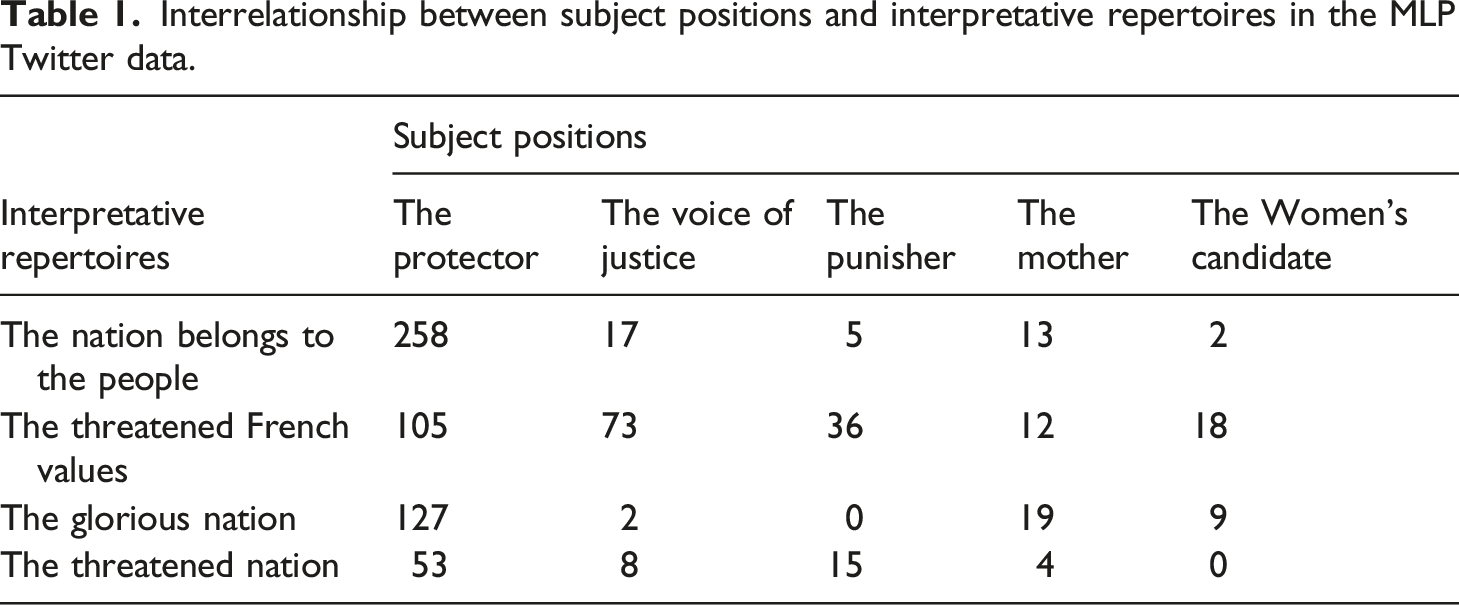
Interrelationship between subject positions and interpretative repertoires in the MLP Twitter data.
Methods of analysis
Our analyses of the Twitter data were informed by work within critical discursive psychology (CDP). CDP is a methodological perspective that has its roots in both post-structuralist and conversation analytic traditions (Wetherell, 1998). A central tenet of CDP is its ambition to capture the complex relation between discourse and the speaking subject, by considering people as both products and producers of discourse (Edley, 2001). From an analytic perspective, this entails analysing both the ‘micro’ and ‘macro’ dimensions of discourse, or put differently, to study it both in terms of its fine-grained rhetorical construction and to examine it as part and parcel of its broader social, political and historical context. For analysing political tweets, CDP is particularly useful, as it allows for studying them in terms of their rhetorical content and form, including the use of verbs, pronouns, and rhetorical strategies, and tensions in the discourse; as well as for situating the tweets in their particular context and thus elaborating upon their social and political functions (e.g., Burke and Rowe, 2015; Jowett, 2015; Pettersson and Sakki, 2022).
As within discursive psychology (which, in contrast to CDP, traditionally focuses more on the immediate interactional context), within CDP, discourse is perceived to be ‘more than words’: it is regarded as social action per se (Potter and Wetherell, 1987). That is, when people construct versions of social reality, they do so in order to achieve certain argumentative and social functions. In the present study, we were particularly interested in how Marine Le Pen in her presidential Twitter campaign constructed her identity as a political leader to mobilise popular support. Using the vocabulary of CDP, we were interested in, first, how Le Pen constructed interpretative repertoires about the French republic, and second, how she claimed certain subject positions for herself as a political leader. Interpretative repertoires (Gilbert and Mulkay, 1984) are sets of discursive resources that are intertwined with any community’s common sense (Edley, 2001) and that are deployed in people’s talk to construct and reconstruct different versions of reality in order to serve particular social (and political) functions (Wetherell, 1998). As for subject positions, these refer to the flexible and malleable ways in which people in their talk may construct – for themselves and others – identities or locations. As with interpretative repertoires, these identities or locations can be constructed for the sake of achieving specific interactional, social or political purposes, such as, for instance persuading an audience or defending an argument.
Our analysis of interpretative repertoires and subject positions relied on the three-step inductive procedure for the analysis of the discursive content (1), form (2) and function (3) of political talk proposed by Sakki and Pettersson (2016). Our analyses of content (1) consisted of data-driven thematic coding of the entire tweet corpus, which was done using the software Atlas. ti. This analytic stage resulted in the identification of 48 themes, the majority of which focused on issues identified by previous research on far-right populist political tweets (Pérez Curiel, 2020), including restoring purchasing power and the French economy, celebrating and honouring the French people, giving priority to ‘national interests’, and claims about the French people suffering from the country’s alleged national insecurity. The initial thematic content analysis allowed us, first, to structure the large data-corpus, and second, to inform the subsequent identification of interpretative repertoires and subject positions. This identification was based both upon the contents of the themes, and their rhetorical forms (2) (how these contents were rhetorically constructed). In so doing, we focused on the rhetorical strategies and discursive resources (Potter 1996; Wetherell and Potter 1988, 1992) as well as the linguistic properties (e.g., use of pronouns and verbs) that Marine Le Pen deployed when constructing particular versions, or interpretative repertoires, of the French nation, and identities, or subject positions, for herself as a leader of that nation. In the third analytic stage, we analysed the discursive functions (3) of the discourse in the broader political discussion in which it was embedded. To this end, we considered the interrelation between particular subject positions and interpretative repertoires, as well as aspects such as the date of publication and the use of hashtags. This allowed us to elaborate on the social and political functions that the tweets may serve, for instance, how they serve to position other social and political actors in specific ways, and how they can act as vehicles for political persuasion and mobilisation. Finally, we discussed the labelling of the interpretative repertoires and subject positions, and how formulate these labels so that they illustrate the main rhetorical contents, forms and functions as well as possible. We conducted the analysis on the original French tweets. The English translations below were conducted by the second author, who is a native French speaker.
Analysis
In this section, we present our analysis and findings of the discursive construction of subject positions and interpretative repertoires in Marine Le Pen’s presidential election campaign on Twitter. The detailed analyses below are illustrated by examples from the Twitter data (screenshots of the French originals along with the English translations) and divided into sub-sections according to the five subject positions. We present the subject positions according to their prevalence in the data, starting from the least and finishing with the most prevalent. Each position is presented within the interpretative repertoire that it occurred most frequently in. As we will see, among these positions and repertoires, the less prevalent ones dealt with issues concerning women’s rights, whereas the most prevalent ones centred on topics that support and promote far-right populist ideology. This is in line with previous research (e.g., Pérez Curiel, 2020) that has identified the topic of economic grievances allegedly brought upon the people by those in (economic and political) power, as well as due to immigration and asylum policies, as core themes in political tweets of far-right populist leaders. The interrelationship between the interpretative repertoires and subject positions, to which we return to reflect upon in the discussion below, is summarized in Table 1. As the subject positions could occur in more than one interpretative repertoire, the table presents a slightly higher figure (N = 776) than the actual number of tweets in the data corpus (N = 701).
The women’s candidate
Although not the predominant position we identified in the analysed data, in some (29) of her Tweets, Marine Le Pen positioned herself explicitly as a champion of women’s rights and as speaking on the behalf of women. Le Pen constructed this position most frequently (18) within the interpretative repertoire of ‘the threatened French values’. In this repertoire, French equality, fraternity and freedom were depicted as threatened from within by the government, on one side, and by the presence of Islam in French society, on the other. This discursive pattern has been documented in previous research on nationalist and right-wing populist political discourse for instance in the Dutch (Verkuyten, 2013), Nordic (Sakki and Pettersson, 2016) and British (Wood and Finlay, 2008) contexts. Through what we call the ‘Women’s candidate’ position, Le Pen presents herself as the one who knows ‘women’s problems’, especially regarding the lack of gynaecologists in rural areas, and, even more so, regarding women as victims of street harassment, as in Figure 1 below: MLP tweet, 6 April 2022.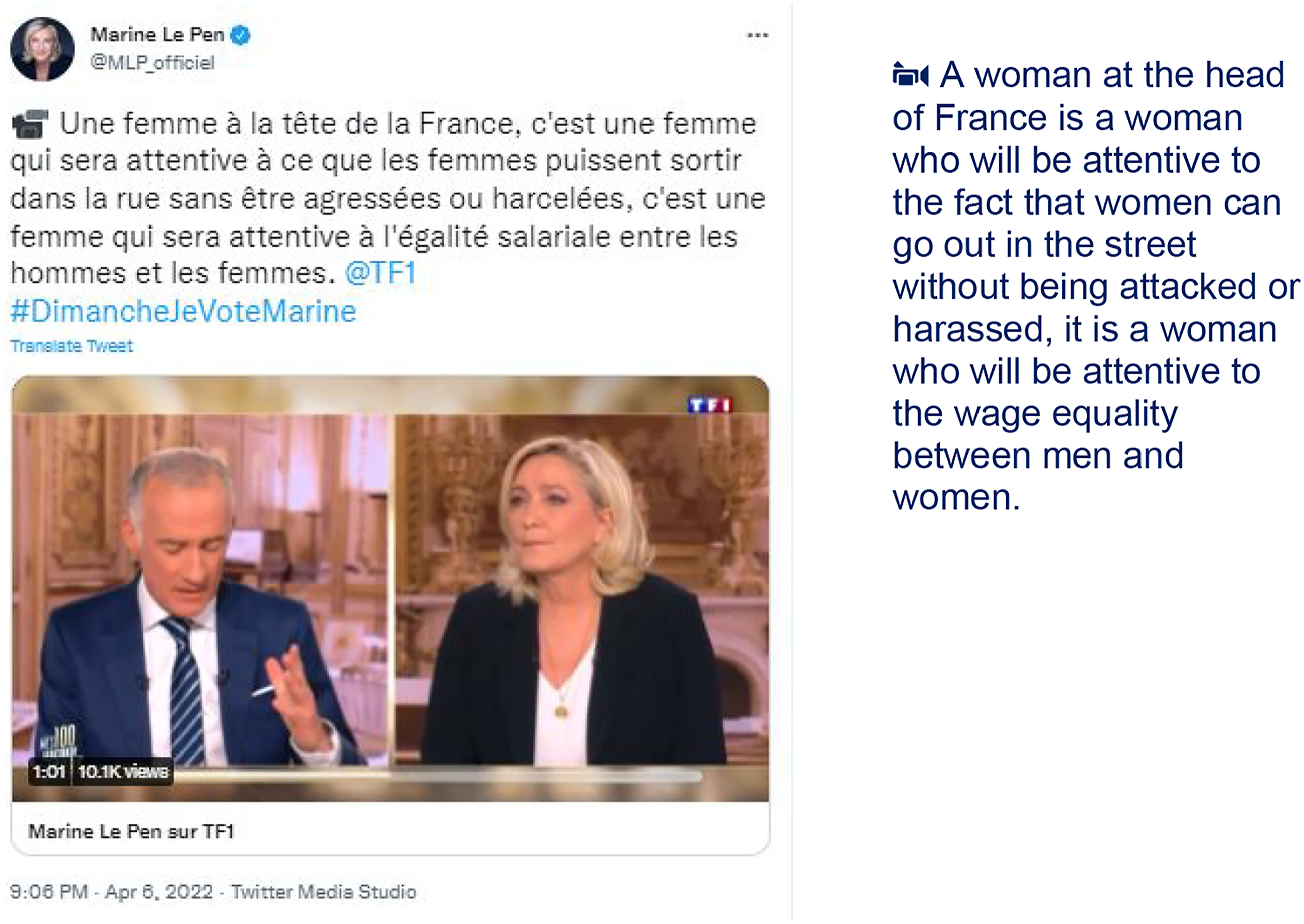
In Figure 1 above, Marine Le Pen refers to herself in the third person, talking about herself as ‘a woman’, repeating this word thrice. In this tweet, she talks explicitly about issues related to women’s rights: street harassment and equality between men and women on the labour market. The rhetorical power of her message – that she as president would be the one who acknowledges women’s rights – is built through a list construction (‘it is a woman who…’; Jefferson, 1990). Further noteworthy aspects in this tweet are the use of passive voice and vague formulations (‘will be attentive to’), and the lack of any explicit promises in terms of how to solve these issues. Such rhetorical manoeuvres allow Le Pen to carefully navigate women’s issues, positioning herself simultaneously as one who cares about them ‘as a woman’, yet also to do so from a distant and less tangible position. This tweet must also be examined in light of the timing of its publication – with only 4 days to go until the first round of the elections. This allows us to interpret the function of this tweet as positioning Marine Le Pen as a counterforce to Emmanuel Macron – as one who as a woman by implication understands and defends them. Further, it is interesting that even though Le Pen has refused to call herself a feminist and taken a sceptical stance towards structural measures of promoting women’s equal position in the labour market, here she nevertheless manages to address this issue by promising to address it. Indeed, such ‘tactical silence’ seems to be an important rhetorical tool for female right-wing populist politicians in their delicate balancing and positioning of themselves vis-à-vis gender equality policies on one side, and the patriarchal ideology of the party they represent, on the other (Pettersson, 2017).
In the following example of her positioning as the ‘women’s candidate’, Le Pen addresses young women explicitly:
In Figure 2 above, Le Pen constructs a common ingroup for herself and the (young) women of France, whom she depicts as the future of the ‘beautiful’ country of France. Indeed, a juxtaposition is constructed between women, national pride, and the future, on one hand, and what she refers to as the present situation of France as being in an ‘infernal spiral of decline’. This metaphorical, hyperbolic formulation serves to further enforce this juxtaposition, and to add rhetorical force to her message (e.g., Pettersson, 2017) about a France that is under threat ‘from within’. What exactly is implied by through the metaphor of decline is left unclear; however, in the context of the final days of the presidential campaign, we may again interpret this tweet as an implicit attack on the policy of Emmanuel Macron and his government, who have made France a victim of disastrous policies. MLP tweet, 1 April 2022.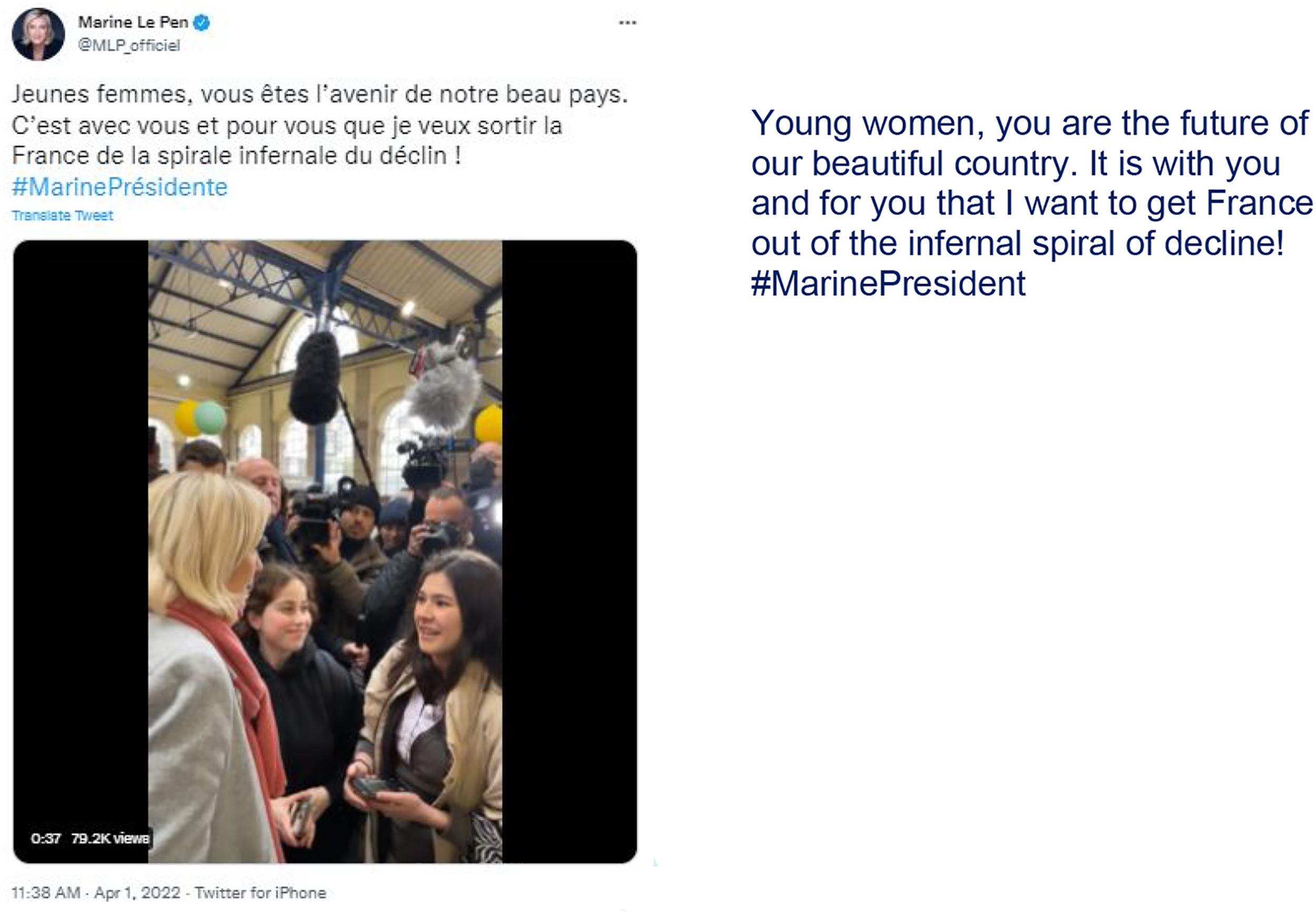
The mother
A further distinct way in which Marine Le Pen mobilised issues of gender and womanhood in her presidential campaign on Twitter was through the concept of motherhood. In her tweets, Marine Le Pen mobilised motherhood in two distinct ways: first, in talk about the ‘children of the nation’ and their to-be-protected future, and second, through drawing explicitly upon herself as a mother. An example of the latter construction is presented below within the interpretative repertoire of the threatened French Values, where Le Pen constructs her position as a mother to emphasize the vulnerability of children in a country where, allegedly, insecurity prevails:
The tweet in Figure 3 above bears many rhetorical similarities to the previous one analysed here. First, we see a similar use of temporality as a discursive resource (Mols and Jetten, 2014; Pettersson, 2017; Reicher and Hopkins, 2001) to highlight the contrast between the fatal presence, implicitly caused by Macron and his allies, the ‘traitors to the nation’ (Sakki and Pettersson, 2016), and a brighter future promised by Le Pen. Second, she uses a three-part-list (‘insecurity, precariousness and fatality’; Jefferson, 1990) to as a discursive tool to construct the interpretative repertoire of the threatened French Values. In this tweet, however, it is children, not women, who are constructed as the ones embodying the ‘future’ of the nation. Children symbolize innocence and sanctity; they are in undisputable need of protection, thus the concept becomes a powerful rhetorical tool in political mobilisation (Pettersson, 2017). Finally, constructing her position as ‘a mother’ and referring to her own children as the motivation for her own presidential candidacy, Le Pen simultaneously positions herself as speaking for all French children, as their and the nation’s ‘mother’. MLP tweet, 4 April 2022.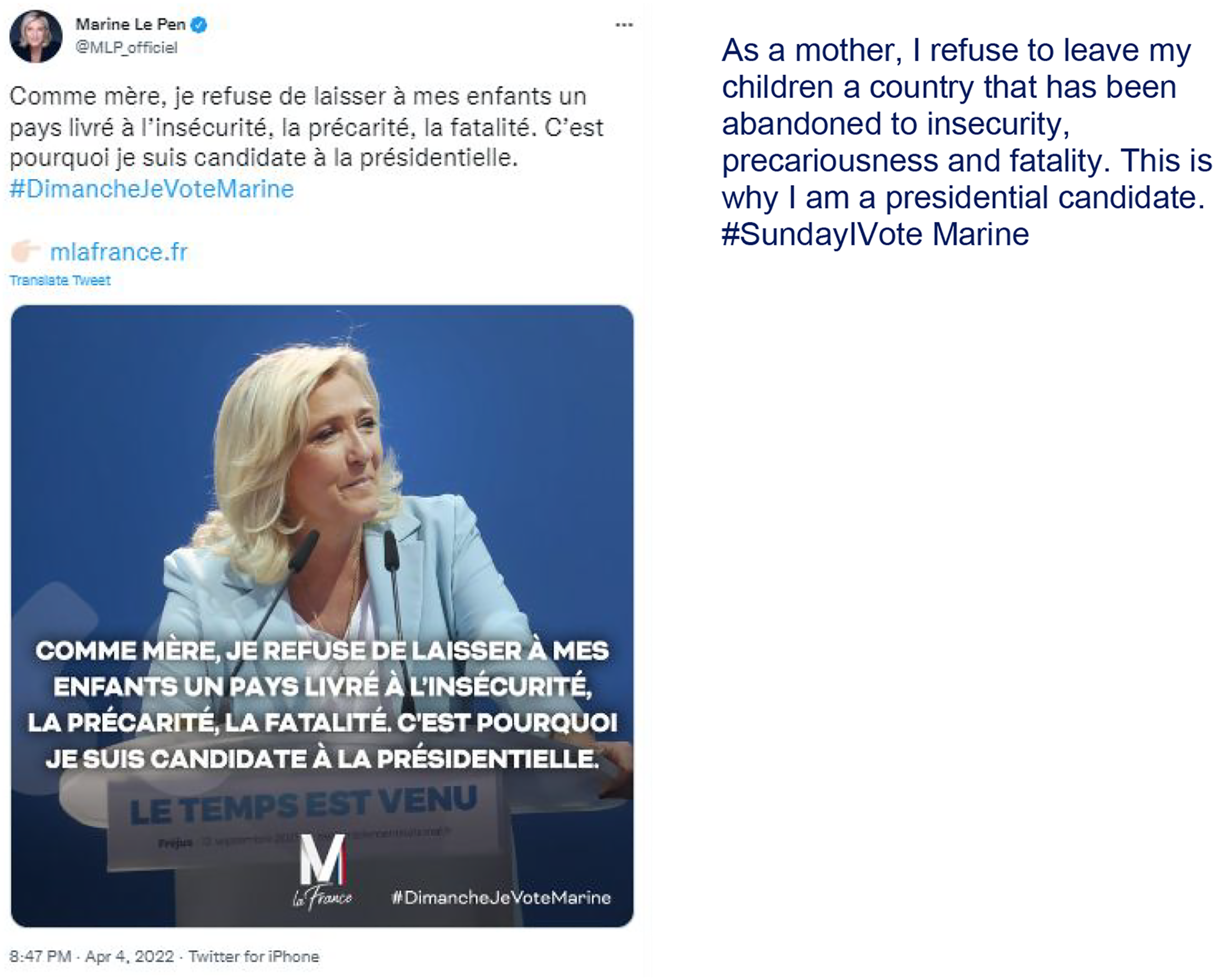
Most frequently, however, Marine Le Pen constructed the mother’s position within the interpretative repertoire of the ‘glorious nation’ (19). Within this repertoire, Marine Le Pen drew upon discursive resources that celebrated the French people, and the culture, history, and traditions of France. In this discursive context, Le Pen constructs herself as (one of) the mother(s) of the nation, expressing compassion, hope and love towards its children, as illustrated below in the glorious nation repertoire:
The tweet above was posted on July 4th, when Marine Le Pen had just been re-elected as the President of the Reassemblement National, expressed here in the reference to ‘the victory’. In this tweet, Le Pen uses listing (Jefferson, 1990) as a rhetorical tool in each sentence, which serves to add rhetorically weight to the message. The interpretative repertoire of the Glorious Nation is constructed through both visual and verbal means: the blue-white-red colours, the French flag and the heart together evoke immediate associations to the French nation, and pride and love for it (cf. Hakoköngäs and Sakki, 2016). It is also worth noting the repeated use of the personal pronoun ‘we’, which here remains undefined – it could refer to the party, to its leadership, or to Marine Le Pen herself. In this context, however, together with talk of ‘our nation’ and the ‘French people’ the use of ‘we’ as an undefined ingroup category serves to position both Marine Le Pen and her party as the true representatives of the nation and its people (cf. Augoustinos et al., 2002; Pettersson, 2019).
To summarize Figures 1–4, Le Pen constructs the French nation simultaneously as victimised – due to Macron’s detrimental policies (Figures 2 and 3) – and glorious – thanks to the honourable French people to whom Marine Le Pen and her party will restore their country (Figures 1–4). In particular, as we have seen, the strong reliance on the notion of victimhood allows Le Pen to position herself flexibly and strategically as a representative of the people. MLP tweet, 4 July 2021.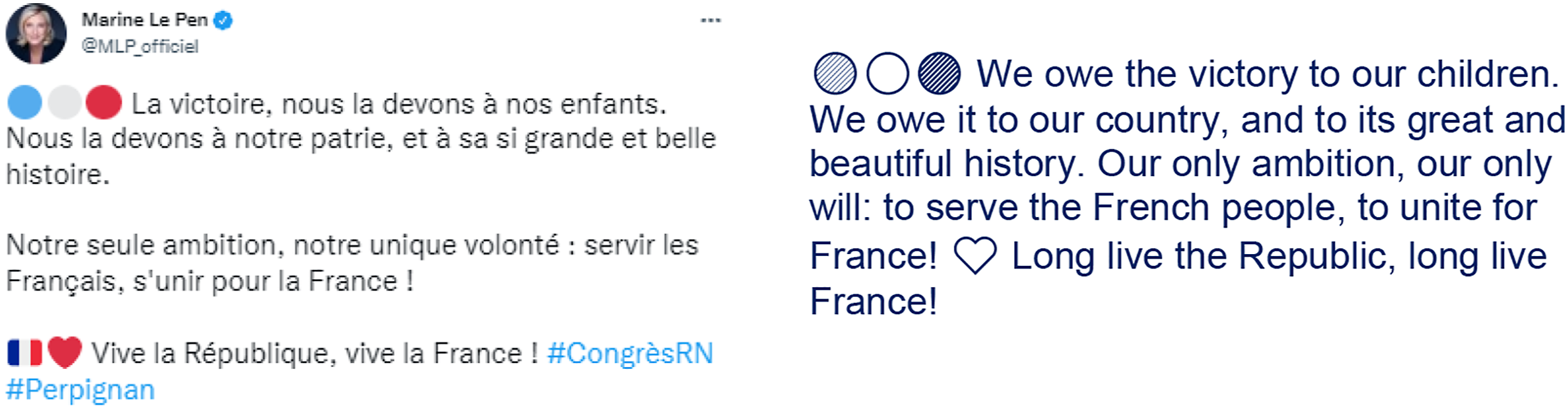
The punisher
The third most common position that Marine Le Pen constructed for herself in the analysed Twitter data was the one of the ‘punisher’. This position was constructed mostly within the interrelated repertoires of the threatened French values (36) and the threatened nation (15). The position of the punisher was characterized by the use of the personal pronoun ‘I’ by words related with anger. From this position Le Pen discursively attacks the Other, typically embodied either in her political antagonists, especially Macron’s government, or Islam and Muslims, who allegedly ‘spoil the life of the French’, as in the example below within the interpretative repertoire of the threatened French values:
In the tweet above, Marine Le Pen talks explicitly about the Islamic veil, which had become a polemic issue in the presidential election debates. In Le Pen’s presidential Twitter campaign, a recurring discursive pattern was to embody the alleged dangers associated with Islam and its ‘totalitarian ideology’ in the veil. In the extract above, she asserts that she wants to ban – not Muslims or Muslim women as people, nor Islam as a religion – but the ‘uniform’ that symbolises the ‘totalitarian’ and threatening ideology of Islam (cf. Sakki and Pettersson, 2016). In this way, she manages to express the agenda of her party that opposes the presence of Islamic culture in France without explicitly blaming or insulting women who voluntarily choose to wear the headscarp.
The position of the punisher was also prevalent within the interpretative repertoire of the threatened nation. This repertoire resembled that of the threatened French values as it too relied on the discursive construction of threat against France, its values and people. However, in contrast to the threatened values repertoire, within this one the threat was constructed as deriving from outside the national borders, in ‘illegal immigrants’ and the threat of terrorism that were depicted as putting the lives of the French people at risk. This interpretative repertoire is demonstrated below in connection with the position of the punisher:
The tweet above was posted on international women’s day, March 8th. It is followed by a link to an opinion piece in the newspaper Le Figaro, which comprised a ‘letter to women’ from Marine Le Pen. In both her tweet and the letter, Le Pen promises to punish, that is, to expel from the country all ‘foreign criminals and delinquents’ who commit acts of violence against women. Indeed, in this particular case we can see that the position of the punisher is strongly intertwined with that of the women’s candidate: a punisher yes, but especially a punisher of those allegedly causing great harm to women. A strong juxtaposition is her constructed between the ‘innocent’ French people on one side, and the ‘criminal and violent’ foreigners on the other – a common way of constructing threat and mobilising support for anti-immigration agendas in radical-right political discourse (Sakki and Pettersson, 2016). Through the position of the punisher, however, Marine Le Pen seems to take one further step: not only does she condemn the current state of affairs (implicitly) implied to be caused by the policies of the current president and government, but she actually promises to punish the guilty ones – be it a ‘uniform’ of totalitarianism as in Figure 5, or in ‘criminals and delinquents’ as in our present example. MLP tweet, 16 February 2022.
The voice of justice
The fourth position examined here, that of the ‘voice of justice’, was most common within the interpretative repertoire of the threatened French values (73). Also often revolving around the issues of street harassment and sexual abuse, but in contrast to the interrelated positions of the women’s candidate and the protector (discussed below), from this position Le Pen did not construct herself as a hero or even as an active actor at all (there was, for instance, hardly any use of the pronoun ‘I’). Rather, her discourse was characterized by a lexicon around laws and decrees, and on the injustice experienced by the French in the face of various problems (purchasing power, security, etc.). In response, Le Pen constructs her position as someone vigilante to defend French people, women, and children. The position of the voice of justice was often intertwined with that of the Women’s candidate, as illustrated in Figure 7 below in the context of the interpretative repertoire of the threatened French values: MLP tweet, 8 March 2022.
As in Figure 1 above, the present one also centres around the topic of street harassment – a common theme in the analysed data corpus. In the extract above, it remains between the lines who Le Pen refers to by ‘the perpetrators’, yet in light of the repeated attribution in her tweets of blame to ‘foreigners’ for street harassment or sexual abuse, this category seems to be implied guilty in this Figure 7 example as well. The tweet contains an implicit critique of the prevailing legislation that, according to Le Pen, is too lenient. When interpreting the construction of the position of the voice of justice, it is important to bear in mind Le Pen’s education as a lawyer, as this background adds credibility to the claims and proposals she is making. In sum, the extract above may be read as the lawyer and potential president Le Pen formulating the ‘voice of justice’ that will restore – through legislation – the French values and ways of living that are currently under threat Figure 7. MLP tweet, 17 February 2022. MLP tweet, 2 November 2021.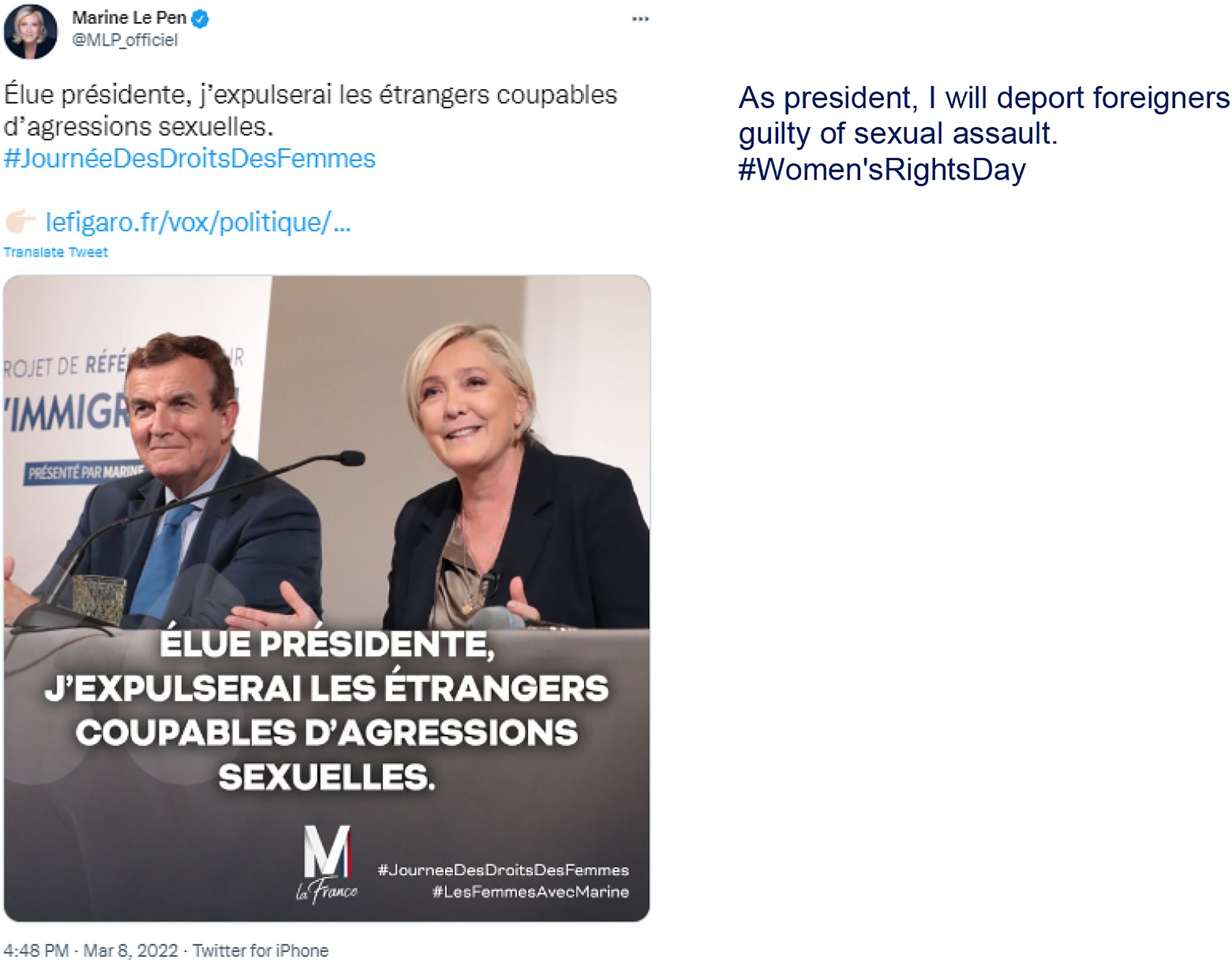
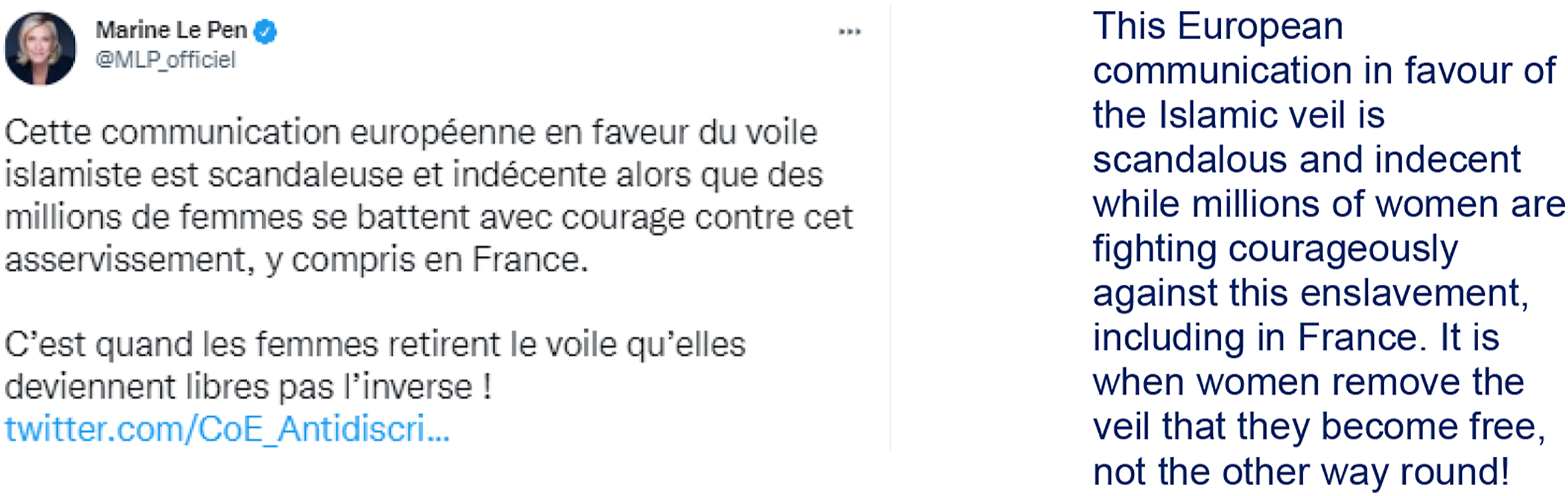
In the following extract, we see an example of a different construction of the voice of justice, where another common theme in the Twitter campaign – the Islamic veil – is the central issue:
In the extract Figure 8 above, Marine Le Pen constructs a discursive division between the ‘European communication’ – by implication, the European Union, and the Islamic veil on one side, and the ‘millions of women’ of the world and in France who are fighting against it. In this extract, (Muslim) women are constructed both as victims of the oppression of Islamic culture, and heroes who bravely fight it. This rhetoric is in line with Farris’ (2017) concept of femonationalism, referring to the ways in which gender (equality) and women’s rights are mobilised in political discourse against Islam. As in Figure 5, the ‘scandalous and indecent’ Muslim veil is constructed as an object of evil; as an embodiment of oppression of (Muslim) women around the world. Le Pen does not refer directly to herself or speak in active voice; nevertheless, she manages to implicitly construct for herself a position of champion of justice and freedom for women against the alleged threat to these posed by the veil, and by implication, by the presence of Islam and those or that who support it.
The protector
The final position examined here, which we call the ‘protector’, was the overwhelmingly most prevalent one in the corpus of Marine Le Pen’s presidential campaign on Twitter (occurrences). The position of the protector was dominated by the use of the personal pronoun I (and to a lesser extent through ‘we’, referring the party Reassemblement National), and accompanied by ‘action verbs’ related to protection, defence, decision making, and firmness. Through this positioning, Le Pen characterized herself with strength and determination to guarantee the protection of the nation and its people.
Illustrating the construction of this subject position within the interpretative repertoires that afforded it allows us to examine in further detail the discursive resources that it relied on. The position of the protector was most frequently mobilised in the interpretative repertoire called ‘the nation belongs to the people’ (258 occ.). This repertoire typically constructed a cleavage between the ‘ordinary, hardworking’ Frenchmen, the rural French population, farmers, and the poor, on one side, and Macron’s ‘elitist’ government and its economic policy, on the other, and often deployed expressions of anger and injustice:
In Figure 9, Marine Le Pen again uses repetition (‘crushed, suffocated’, and ‘on fraud, on immigration’) as well as vivid metaphorical language to depict an image of the victimised people of France suffering under an economic system that favours deception and costs related to immigration at the loss of the French people. In this example, we can see elements of classic right-wing populist ideology, where the self – the right-wing populist politician positions themselves as the protector of the ‘rightful’ people against two distinct yet interrelated others: immigrants and the economic threat they entail (resembling Sakki and Pettersson’s 2016 concept of immigrants as ‘welfare abusers’ in right-wing populist discourse), on one side, and an ill- or undefined ‘elite’ on the other, who favour immigrants at the expense of the people (Mols and Jetten, 2016; Sakki and Pettersson, 2016; Staerklé and Green, 2018). In this example, Marine Le Pen’s construction of herself as Protector allows her to position herself as the one who will restore the nation to its people, in this case, through giving ‘the French their money back’ (from the elite and the immigrants that they favour). MLP tweet, 30 November 2021.
The position of the protector was also often constructed within the interpretative repertoire of the threatened nation, where Le Pen even positioned herself as the protector of the French people and nation at the face of the external threats posed by ‘illegal’ immigration and terrorism, threats that have been sanctioned by Macron and his government. Figures 10 and 11 below illustrate this positioning: MLP tweet, 9 January 2022. MLP tweet, 9 January 2022.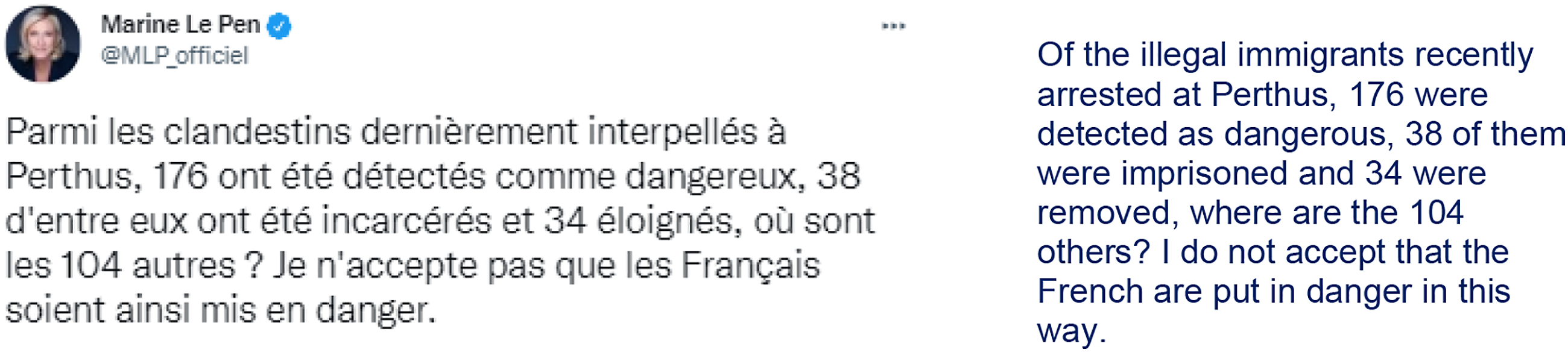
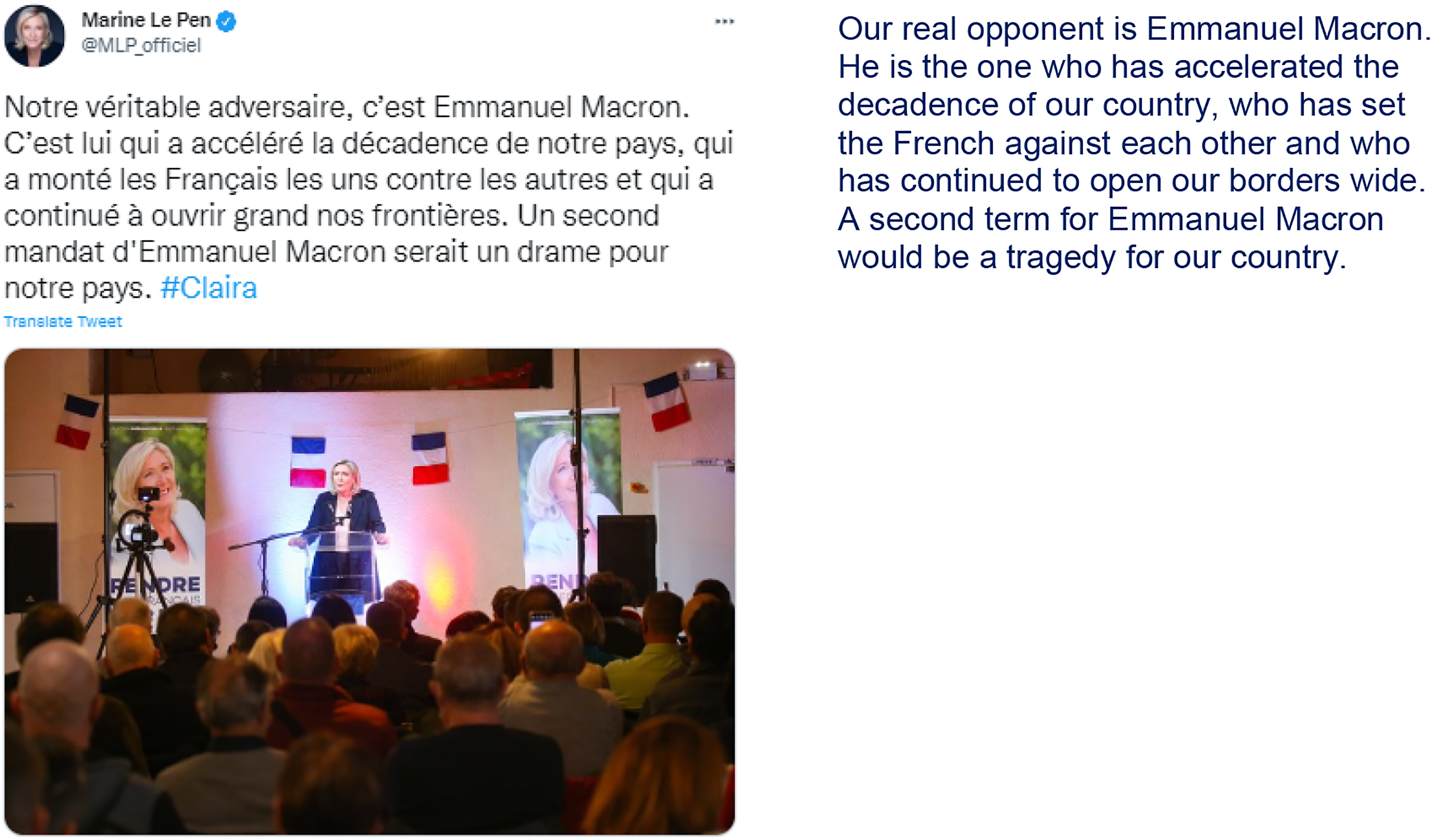
The tweets in Figures 10 and 11 above were published on the same day, 9 January 2022, thus it is possible to interpret them as interrelated. In Figure 10, Le Pen makes explicit reference to ‘illegal immigrants’, using the language of quantification (Potter, 1996) to make the threat these persons pose seem concrete. In addition, she poses a question to an unspecified recipient about the missing, non-imprisoned ‘illegal immigrants’, followed by a sentence expressing her lack of acceptance of the danger this puts ‘the French’ at. In this extract, then, we again see a juxtaposition being constructed between the (good, threatened) French people on one side, and (bad, dangerous) immigrants and their protectors on the other. However, unlike in Figure 9 where the threat was constructed as an economic one, here it concerns criminality and concrete danger, in Sakki and Pettersson’s (2016) terms, constructing immigrants as ‘norm breakers’ (2016).
The theme of the alleged danger to the nation posed by a policy of ‘wide open borders’ is followed up in the following Tweet (Figure 11), where Emmanuel Macron becomes the explicit target of Le Pen’s critique. Again, in the second sentence we can detect a three-part list (Jefferson, 1990) that serves to highlight the message of Macron as pursuing an agenda that threatens the French both from outside, through the ‘open borders’, and inside, through setting ‘the French against each other’. The last sentence depicts a second term for Macron in hyperbolic terms as a ‘tragedy’ and using the undefined ‘our’ when talking about the country of France. This further serves to position Le Pen as one of the victimised yet noble people, as their protector against Macron, whose politics would be disastrous for the French nation and people.
Concluding discussion
The aim of this article was to explore how Marine Le Pen mobilises electoral support in her 2022 presidential campaign on Twitter. In practice, we have examined the ways in which Le Pen positioned herself as a female, right-wing populist political leader and prospective president of the nation. We were particularly interested in how Le Pen negotiated the double bind or gender dilemma facing women in politics: that of navigating between masculinity and femininity in her identity management. Our methodological approach that drew on work in critical discursive psychology (Edley, 2001; Wetherell, 1998) allowed us to examine these discursive negotiations both at the micro-level of rhetorical tools and strategies, and as part and parcel of the macro-level in which this discourse was produced, that is, within the social and political context of the French 24, 2022 presidential elections. In other words, the approach enabled us to analyse how Le Pen flexibly positioned herself as a political leader within different interpretative repertoires of the French nation in order to appeal to the electorate.
Our findings show that Marine Le Pen positioned herself in five distinct yet interrelated ways in her tweets during the presidential campaign. On one hand, through claiming the positions of ‘the mother’ and ‘the women’s candidate’, she reached out specifically to women, promising to secure their rights and safety (especially regarding sexual assault and street harassment), and to protect the future of their children. On the other hand, through the positions of the ‘voice of justice’, the ‘punisher’ and the ‘protector’ Marine Le Pen spoke to ‘the French people’ as a whole, promising to restore to them their country, their money and their values and to punish those – President Macron and his government – who had allegedly robbed the people of these things through their ‘disastrous’ economic and immigration policy. These positions are to a large extent familiar from previous research on right-wing populist discourse, where the speakers tend to position themselves as the protectors and allies of the ‘rightful native people’ against the ‘corrupt elite’, immigrants and Islam (e.g., Mols and Jetten, 2014; Sakki and Pettersson, 2016; Verkuyten, 2013; Wood and Finlay, 2008). However, our analysis has shown that through the position of the ‘punisher’, Marine Le Pen brings this discourse one step further: not only does she promise to protect ‘the people’, but to ‘punish’ those who have betrayed them.
We have examined these five subject positions in light of the socially and culturally rooted versions, or interpretative repertoires, of the nation that Marine Le Pen constructed in her discourse. These four interpretative repertoires about the nation - the nation belongs to the people, the threatened French values, the glorious nation, the threatened nation – relied heavily on the use of temporality as a discursive resource (Mols and Jetten, 2014; Reicher and Hopkins, 2001; Pettersson, 2017). In so doing, the interpretative repertoires served to construct and contrast a nostalgic image of the ‘glorious France’ of the past, a France that is being destroyed in the present (by Le Pen’s political antagonists, the presence of Islamic culture, and the threats of ‘illegal’ immigration and terrorism), and a brighter future France under the prospective rule of Marine Le Pen. Indeed, a serious and ‘matter-of-fact’ rhetorical tone, the use of temporality (Mols and Jetten, 2014; Reicher and Hopkins, 2001; Pettersson, 2017) along with listing and repetition (Jefferson, 1990) seem to characterize Marin Le Pen’s mobilisation discourse on Twitter. Our results indicate that Le Pen’s political tweets balanced between traditional far-right populist ideology through the promotion of themes such as national protectionism and hostility towards immigration and the government or elite, on one side, and presenting herself as a champion of women’s rights, on the other. Through the rhetorical work accomplished by tactical silence (e.g., regarding her party’s ideology) and vague formulations (e.g., regarding women’s issues), she was able to frame her agenda in terms of (re)producing her party’s patriarchal ideology, yet at the same time to cater to female voters (cf. Pettersson, 2017). In other words, these discursive tensions may, paradoxically, be regarded as both a central challenge and opportunity for Marine Le Pen as a female leader of a traditionally male-dominated political party.
Taken together, our findings support previous studies on the rhetoric and style (and media representations) of Marine Le Pen that have pointed towards their ambivalent character (Boudillon, 2005; Geva, 2020; Matonti, 2013; Meret, 2015). Indeed, our findings indicate that – in seeking to position herself in the competition against Macron to her political left, on one hand, and Zemmour to her right, on the other – Le Pen managed to flexibly mobilise notions of womanhood and softness, but also of forcefulness and power associated with masculinity. In other words, in her tweets Le Pen strived to manage the double bind of identity management by engaging in a careful negotiation between hegemonic femininity (Schippers, 2007) and masculinity (Connell and Messerschmidt, 2005) through the subject positions that she constructed for herself (Geva, 2020). Our findings allow us to interpret the positions of the ‘punisher’ and the ‘mother’ as two extreme, opposing forms of the ‘protector’ position. These constructions allowed Le Pen to engage in a dynamic positioning between a harsh candidate who punishes ‘the Other’ and a compassionate and loving mother candidate who takes care of the nation’s children. In other words, these positions together enabled Le Pen to negotiate her gender identity and role as a mother with the ‘manly strength’ of a severe punisher. These two extreme forms of the protector were deployed according to the discursive context, that is, the interpretative repertoire within which they were constructed, and had different discursive registers (more expressions of anger in the former, and more compassion in the latter).
This conclusion leads us to a second one concerning the contradictory and paradoxical position that Marine Le Pen constructs for her audience. On one hand, her discourse paints a picture of an audience – the French people – that is endangered, victimised and in need of protection, yet at the same time, one that is glorious and worthy of respect. Similar discourse has been documented previously in research on right-wing populist political discourse, for instance in the Nordic context (s e.g., Sakki and Pettersson, 2016). In sum, and using the terminology of Billig and colleagues (1988), we may conclude that in her discourse, Marine Le Pen is balancing two ideological dilemmas: one between masculinity and femininity (for herself) and the other between victimhood and glory (for the nation and its people).
Our study is limited methodologically in the sense that it concentrated on tweets only, and not, for instance, on the videos, links or follower comments associated with them. Further, in order to fully explore the rhetorical construction of the subject positions and interpretative repertoires, we focused primarily on the verbal content of the tweets, and did not engage in multimodal discourse analysis. These limitations propose interesting avenues for future research on the appeal and reception of the online communication and mobilisation of women in far right and right-wing populist movements. In terms of the political climate in France, it remains highly polarised and in transformation, with the far-right and far-left mobilising increasing factions of the electorate. Future studies should attend to these developments, for instance, by exploring the political mobilisation of the far-left and the far-right in France.
Marine Le Pen did not become president of France through her campaign. However, she managed to mobilise a substantial part of the electorate – more than 13 million votes in the second round – for her political cause (French Ministry of the Interior, 2022). Through a critical discursive analysis of her communication in her political campaign on Twitter, our study has sought to shed light on how and why this happened. According to our findings, the flexible manner in which Marine Le Pen negotiated the double bind, claiming complex and multifaceted (gender) positions and roles for herself on Twitter, may have been a central factor that enabled her to (re)construct her personal brand (Pérez Curiel, 2020) and appeal to millions of voters in the 2022 French presidential elections. In terms of the practical implications of our study, then, we hope that increasing our understanding of the rhetorical construction of the politics of a female right-wing populist leader will help those who seek to provide alternatives to it.
Footnotes
Declaration of conflicting interests
The author(s) declared no potential conflicts of interest with respect to the research, authorship, and/or publication of this article.
Funding
The author(s) disclosed receipt of the following financial support for the research, authorship, and/or publication of this article: This work was supported by the Academy of Finland; 332192.
