




Abstract
This paper examines the impact of Indian intervention on the Madheshi parties’ claim to self-determination in Nepal. In 2007, the Madheshi parties launched mass protests, demanding the recognition of their self-determination through an autonomous Madheshi province. Mainstream political parties became hesitant to incorporate this demand. The Nepalese government signed agreements with the agitating Madheshis but did not intend to implement its commitments. The Indian government was monitoring these developments; it stood on the Madheshi side and urged the Nepalese government to recognize self-determination and autonomy in the new Constitution. It increased pressure through press releases, parliamentary statements, bilateral visits, and an undeclared economic sanction. Against this background, this paper examines the following question: What is the impact of the Indian intervention on the Madheshi claims for self-determination in Nepal? It identifies that the Indian intervention obstructed the recognition of Madheshi self-determination as a constitutional right and the agenda of the nationalist movement. The mainstream political parties perceived the Indian intervention as unwanted interference in a sovereign state’s internal affairs and responded to this pressure by adopting the Constitution without including self-determination. The Indian government continued to pressure through economic sanctions, but the latter just increased anti-Indian sentiments in Nepal. As a result, the Nepalese government re-strengthened its ties with the Chinese government and concluded trade and transit agreements. The Indian government perceived that Nepal-China ties would affect its national interests in Nepal and stayed silent about the Madheshi parties. This silence constructed a permissive environment for the Nepalese government to ignore the nationalist demands and forced the Madheshi parties to concede their self-determination as the ethnonational agenda.
Keywords
Introduction
The Madheshi 1 demand for self-determination came to the surface through their protest against the Interim Constitution in 2007. The Madheshi peoples urged the government to adopt the federal state restructuring and recognize their self-determination by forming an autonomous province in the Tarai region. The Nepalese government has adopted federal restructuring, but it has remained hesitant to recognize the Madheshi self-determination.
By definition, self-determination refers to the right of the people to identify their political, social, cultural, and economic futures on their own. During the anti-colonial period, it stood as the right of the people to political independence, and many colonized states became independent using this right. The understanding of the right to self-determination has, however, changed (Xanthaki, 2004). People can also exercise self-determination through the formation of autonomous provinces (Erk & Anderson, 2009; Ghai, 2000). In the Nepalese context, the Madheshi peoples are asking for the internal recognition of self-determination through the concession of autonomy.
The demand for self-determination raised debates in the Nepali state in which high hill caste people are dominant. By demographic composition, hill Brahmin and Chettri constitute 28.8 percent of the total population 2 (Central Bureau of Statistics, 2012) but occupy 77 percent of the top positions in the judiciary, tertiary education, and public administration and over 50 percent in most other fields (Adhikari & Gellner, 2016). The ethnic communities consistently fought against this domination and demanded inclusion.
With the liberalization of the panchayat system, the demand for ethnic recognition surfaced. But the panchayat regime discouraged ethnic, cultural, and linguistic differences in the public sphere (Adhikari & Gellner, 2016). After 1990, the return to parliamentary democracy provided a conducive environment for the rise of ethnic consciousness. The public sphere was not controlled as before; the ethnic activism reached the social grassroots, and the ethnic formation gathered pace (Adhikari & Gellner, 2016). The marginalized communities sought recognition and inclusion in the state mechanism, which the Maoist insurgency (from 1996 to 2006) capitalized on.
The Maoists obtained the popular support of marginalized communities through their commitment to ethnic justice. During the insurgency, they established nine autonomous regions, among which six were named after the ethnic groups: Magarat (Magars), Tharuwan (Tharus), Tamuwan (Gurungs), Tamsaling (Tamangs), Newa (Newars), and Kirant (Rais, Limbus, and others) (Adhikari & Gellner, 2016). Following the peace accord, the Maoists dissolved these autonomous regions, but the marginalized communities including the Madheshis continued to demand ethnic autonomy.
The mainstream political parties 3 were, however, hostile to the idea of identity-based federalism, which they considered the imported agenda that works against the state’s territorial norms (Hutt, 2020). Its impact was evident in the Constitution-writing process. Nepal had elected the Constituent Assembly (CA) in 2008 for writing the Constitution, but the disagreement over the federal design, autonomy, and self-determination led to this CA’s dissolution, and the second CA was elected for the same purpose in 2013. The mainstream parties proposed to form the provinces based on geography, historical continuity, and economic viability and demarcate the provincial borders along North-South lines, including both hill and the Madhesi districts (Hutt, 2020). The Maoists could not stick to their ethnic agenda due to their alliance with the mainstream parties. The CA consequently released the Constitution in 2015 without recognizing the Madheshi self-determination. The Madheshi protest has since persisted.
In response, the Indian government appeared concerned about the Madheshi demands. The Madheshis share ethnic, cultural, linguistic, economic, and geographic ties with the Indian people. Based on this interconnection, the Madheshi parties urged the Indian government to support their cause. Upendra Yadav mentioned that the Madheshis are people of Indian origin and want a positive approach from India (Thakur, 2007). When Nepal promulgated the Constitution without addressing their concerns, the Madheshi leaders sought Indian assistance in their movement (The Economic Times, 2015).
The Indian government, too, expressed solidarity and occasionally rankled the Nepalese politicians in support of the Madheshi parties (Miklain, 2008). In 2015, the Indian authorities gave pressure to delay the adoption of the Constitution and address Madheshi demands (CPN-UML, 2021); it also obstructed the transportation of petroleum goods to increase pressure on Nepal. Whether this pressure has affected the recognition of Madheshi self-determination – becomes a relevant concern.
Studies suggest that mainstream parties were afraid of addressing the Madheshi demands for two reasons. First, these parties did not want to lose their dominance in the polity. Therefore, they hesitated to recognize the self-determination of traditionally disadvantaged communities (Brand, 2014) and denounced autonomy as dangerous to territorial integrity (Lecours & Arban, 2015). Second, the Nepalese politicians feared that self-determination and autonomy would build a space for national disintegration and rejected the recognition of these rights (Edrisinha, 2015; Tamang, 2009). Combining self-rule with a shared- rule, the federal system enables minorities to self-determine their futures and maintain ties with the central government. In Nepal’s case, the debates centered on self-determination and autonomy; the shared-rule element could not receive the required attention. This gave the impression to the stakeholders that the federal system is a mechanism for independence (Acharya, 2014). In sum, these studies examine the internal factors that were working against self-determination; they are yet to discuss whether foreign intervention has any bearing on the recognition of this right in Nepal.
Drawing on this gap, this paper examines the following research question: What is the impact of the Indian intervention on the Madheshi peoples’ demand for self-determination in Nepal? It identifies that the Indian intervention has obstructed the recognition of self-determination both as the right in the Constitution and as the nationalist agenda. The Nepalese government perceived the Indian intervention as unwanted interference in a sovereign state’s internal affairs and adopted the Constitution that did not include self-determination as a right. India continued to give pressure through economic sanctions that encouraged the Nepalese government to re-strengthen its ties with the Chinese government. The Indian government perceived that increasing Nepal-China ties would affect its national interests in Nepal and stayed silent about the Madheshi issues. This provided a permissive environment for the Nepalese government to ignore nationalist demands and force the Madheshi parties to increasingly concede their nationalist agenda.
This paper has used document analysis as a research method and analyzed 32 documents of two different categories. The first category includes 24 documents from the Indian government– statements, press releases, and responses to the parliament, which were selected using ‘the Indian support to Madheshi parties’ as a criterion. The second category includes 8 documents from the Nepalese government– the CA transcripts, the Constitution, the amendment bills, statements, and political reports, which were chosen using ‘the Nepalese government’s response to Indian intervention and the Madheshi demands’ as a selection criterion. In terms of timeframe, these documents cover the period between 2007 to 2021. This period is critical to understanding the emergence and the present status of self-determination in Nepal.
Structurally, this paper unfolds into five sections. After this introductory section, the second section presents a theoretical framework, the third section gives a brief synopsis of the Madheshi demands, and the fourth section examines the impact of the Indian intervention on the Madheshi self-determination. Major findings come at the end.
Foreign intervention, legitimacy, and success: theoretical framework
This paper draws on the argument that the legitimacy of foreign intervention determines the outcome of ethnic conflict (Cooper & Berdel, 1993; Brown 1996; Caplan, 2013). When the conflicting parties understand the foreign influence as legitimate, they support intervention, and the chance of success increases. Conversely, if foreign intervention is understood as illegal aggression in the host state, the chance of success diminishes.
The question of legitimacy becomes more intense if the foreign actor is the next-door neighbor. The geographical proximity brings political, social, economic, and strategic interests to the surface. The resolution or sustenance of conflict can have direct effects on the intervener’s national interests. The neighbor’s engagement thus “makes settlements more difficult to reach” (Brown, 1996: 29). The nearby powers can become concerned about their own interests and seek to manipulate conflict in a particular direction (Brown, 1996). When interests dominate, the foreign actors do not get legitimate space in the host state.
The organizational structure of the foreign actors also determines the extent of legitimacy. The multilateral intervention is generally considered more legitimate than a unilateral one. Multiple actors need to come to a consensus before undertaking such intervention, which forces the interveners to adopt a neutral position. Multilateral interventions are thus more likely to succeed than unilateral actions (Nalbandov, 2009). The single interveners calculate the costs and benefits and potentially possess bias in the intervention. When foreign interests surface, the warring groups accuse the interveners of prioritizing self-interests and label them as the illegal aggressors by the side they stand against (Nalbandov, 2009).
Thus, the “intervention needs to have a credible and sustainable source of legitimacy” (Cooper and Berdel, 1993:140). Being a multilateral organization, the United Nations (UN) has legitimacy and neutrality; its interventions are more likely to succeed than others. Foreign intervention gives positive outcomes when the warring parties become willing to reconstruct their countries (Brown, 1996). If the response is need-based, the conflicting parties do not stand against the external actor, and legitimacy increases. In Nepal, the mainstream parties and the Maoist insurgents became willing to stop the conflict and requested the UN to monitor the peace process in 2006 (Asian Study Center for Peace, 2011). The conflicting parties considered the UN’s presence necessary, legitimate, and neutral; this organization thus achieved success in conflict resolution.
The Indian intervention in Sri Lanka’s ethnic conflict can also become a relevant illustration regarding legitimacy. In 1990, the Indian government was involved in Sri Lanka’s ethnic conflict due to its geographical proximity and connection with Tamil people (Alam, 1991). But its intervention did not receive broad-based support and legitimacy. India wanted its action to be seen as legitimate and coerced the Ceylonese government into sending an invitation for intervention; it sought to demonstrate that its intervention was based on the host government’s requests (Gunewardene, 1991). But the conflicting parties did not entertain the Indian intervention due to which the intervention did not succeed. This failure has taught that foreign intervention just leads to failure without the massive support of the concerned parties (Khobragade, 2008). The interveners thus become concerned about the status of their intervention. The legitimacy is likely to provide grounds for the success of the foreign intervention. Interveners can also obtain legitimacy by minimizing their participation. The less they involve in domestic affairs, the more they are likely to push their agenda (Nalbandov, 2009). If the foreigners seek to micro-manage domestic politics, legitimacy weakens.
In sum, the foreign intervention potentially succeeds if the interveners demonstrate a neutral and legitimate position in the host state. Being considered legitimate, multilateral interventions and the involvement of distant powers are more likely to succeed than the neighbor’s unilateral intervention. In the absence of legitimacy, foreign intervention breeds discontent and affects conflict resolution. In the case of the Madheshi peoples’ self-determination struggles, the Indian intervention was considered an intrusion, and it could not thus succeed.
Madheshi demands: brief overview
The Madheshi demand for self-determination, which came to the surface in 2007, has its roots in the 1950s. The regional consciousness became evident after Vedananda Jha formed Tarai Congress in 2008 BS (1950–51). The Tarai Congress demanded the formation of an autonomous region, the recognition of the Hindi language as the official language, and the proportional inclusion of Tarai dwellers in civil services (Basnet, 2019; Gaige, 1975). In addition, Raghu Nath Thakur launched ‘Madheshi Mukti Aandolan’ in 1956. In his argument, Madhesh should become an autonomous region under the United Nations Charter’s provision regarding non-self-governing territories and develop foreign policy on its own (Jha, 2017). But the ruling elites of Kathmandu considered these demands against the hill culture and made concerted efforts to mute these claims.
The regional issues further stagnated after the imposition of the panchayat system (1960) that imposed Nepali as the official language (Gaige, 1975) and ethnic homogenization based on one language, one dress, and one nation (Jha, 2017). The “distinctiveness of Madhesis in terms of their culture, language, and tradition made it difficult for them to identify with” the homogenizing policies (Jha, 2017: 26). The ruling elites made the ‘distinctness’ an excuse to consider the Madheshis as ‘non-Nepalis’ or the ‘Indians’ (Jha, 2017). The Madheshis suffered from the angst of proving loyalties to their own country (Jha, 2014). The projection of the Madheshis as the Indians was meant to increase the hill people’s access to the abundant natural resources that existed in the Tarai region (Jha, 2017).
In this political environment, the Madheshi peoples could not continue the demand for autonomy, but their regional consciousness did not lessen. Gajendra Narayan Singh formed a Madheshi front known as Sadbhawana Parishad and struggled against the homogenizing policies (Jha, 2017). After the restoration of democracy in 1990, some Madheshi parties emerged on the scene, but caste politics complicated the ethnic politics in the region. The upper-caste Madheshi leaders coordinated with the upper-caste hill leaders and became members of the mainstream parties (Basnet, 2019). Notwithstanding its failure to address historical, political, and ethnic grievances, the democratic political environment provided a conducive environment for ethnic activism in the region.
The regional consciousness increased at the height of the Maoist insurgency; the Madheshis supported the Maoists, hoping to see the realization of their nationalist aspirations. The Maoists, due to their alliance with the mainstream parties, could not push for the Madheshi agenda. The Interim Constitution (Nepal Law Commission, 2007) committed to undertaking state restructuring but did not specifically refer to the federal system and autonomy (Nepal Law Commission, 2015). In retaliation, the Madheshi peoples, under the guidance of the Madheshi People’s Right Forum (MPRF), launched a mass movement, expressed resentment against the Nepali state’s ignorance of their grievances (Hatchhethu, 2007; Sijapati, 2012), and articulated their concern for dignity, fundamental freedoms, and identity (Lal, 2007). The Madheshi parties reinvigorated the regional agenda through the Madhesh movement in 2007.
In response, the Nepalese government signed an agreement 4 with the MPRF in 2007, expressing commitment to ensure proportional representation and partnership of Madheshi communities in all government structures, to provide national recognition to Madheshi cultures, and to establish a federal system of governance (Asian Study Center for Peace, 2011). However, it remained hesitant to honor this agreement. Sensing this hesitation, three Madheshi political parties– Sadbhavana Party, MPRF, and Terai Madhesh Loktantrik Party– formed the United Democratic Madheshi Front and launched a demonstration in 2008. The government then agreed 5 to form an autonomous Madheshi province within a federal state (Asian Study Center for Peace, 2011).
However, the Tharu community did not support the Madheshi autonomy and demanded the recognition of the Tharuhat autonomy in the western Tarai (Miklain, 2008). The Madheshi leaders underplayed the internal differences to emphasize a broader unity among the Madheshis (Kantha, 2010) and expressed confidence that the Tharu agitation would resolve within one Madhesh (Jha, 2008). They also accused the mainstream political parties of raising the Tharu issue to undermine the Madheshi movement (Kantha, 2010) and pushed for an autonomous province.
Participating in the CA debates, Mahindra Raya Yadav (Tamalopa Nepal 6 ) argued that the Madheshi peoples have suffered internal colonization and are entitled to the right to self-determination under international norms and treaties (CA Secretariat, 2014:1411). Laxmi Kumari Chaudhari (MPRF) added that the Madheshi peoples have suffered marginalization on all fronts; the unitary state marginalized Madheshi, Tharu, and other Indigenous communities in the name of promoting the state’s multiethnic identity. But the multiethnic framework did not overcome subjugation; the formation of an autonomous province is thus important (CA Secretariat, 2014: 1391). Shivaji Yadav (MPRF) urged the mainstream political parties to recognize the mandate of the Madhesh movement and make people sovereign (CA Secretariat, 2014:1459). Jitendra Narayan Dev (MPRF) mentioned that the Madheshi peoples want to transform the basic character of the state; therefore, they want recognition of their distinct identities through the provision of autonomy (CA Secretariat, 2014: 1325). These speakers presented the formation of the Madheshi province as a measure to address historical grievances.
In presenting demands, the Madheshi leaders urged the government not to suspect their patriotic sentiments. The Madheshi peoples, as Dev mentioned, were not demanding independence; they were just demanding autonomy (CA Secretariat, 2014: 1325). Dev reiterated that patriotism is in the blood and gene of the Madheshi peoples. In the Madhesh movement, the Madheshi peoples just demanded dignified co-existence within Nepal (CA Secretariat, 2014: 1325). Mahindra Raya Yadav also mentioned that the Madheshi peoples do not want separation; there is no reason to suspect the Madheshis’ commitment (CA Secretariat, 2014: 1411). These statements indicate that the Madheshi were asking for internal self-determination.
This does not mean that the Madheshi leaders refrained from uttering session threats in their entirety. Dev has, for instance, mentioned, that if Madheshi demand is ignored, Madhesh will find out recognition and autonomy on its own (CA Secretariat, 2014: 1325). Autonomy and recognition meant secession in this case. Mahindra Raya Yadav also mentioned if the majority does not listen to the Madheshi parties, that will lead to accidents or bloodshed (CA Secretariat, 2014: 1411). These statements illustrate the utterances of secession threats coming from the regional leaders, but these threats were used as a bargaining chip. They started with an extreme position to force the Nepalese state to provide them with autonomy (Miklain, 2008).
The Madheshi leaders, however, suggested that autonomous province should be homogenous in composition. Ramjanam Chaduhary (MPRF) argued that the Madheshi territories should not be lumped with the hills area in state restructuring (CA Secretariat, 2014: 1330). Indra Jha (Tarai Madhes Loktantrik Party) argued that Madheshi peoples will accept only when a single province is formed in their region (CA Secretariat, 2014: 1635). Bijaya Kumar Singh (Tarai Madhes Loktantrik Party) argued that political parties must understand that state restructuring became essential to give power to marginalized nationalities. Therefore, the provinces must be made autonomous, and the Madheshi peoples should get the right to make policy decisions in local matters (CA Secretariat, 2014: 1671). These CA members asked for ethnic autonomy to pursue their growth and development within Nepal.
In sum, the Madheshi parties raised the demand for self-determination through autonomy. They wanted the state to accommodate this demand through the federal system. Other demands were meant to strengthen autonomy in practice. The state has embraced federal state-restructuring and becomes willing to address other demands, but it has rejected the demand for an autonomous province.
The Indian intervention: impact on Madheshi demand
This section demonstrates that the Indian intervention has become a barrier to the recognition of Madheshi claims to self-determination in Nepal. The intervention does not always have to be a military invasion; the political pressures, press releases, economic sanctions, and moral support to the agitating group in the foreign state also count as intervention (Paquin & Saideman, 2010). India intervened in the ethnic conflict through its support of the Madheshi demand for an autonomous province in the Tarai region. But the mainstream political parties suspected that India could have been seeking to incorporate the plain region into its jurisdiction through the fulfillment of this demand and adopted the Constitution without incorporating the Madheshi demand. In reaction, India imposed an undeclared economic sanction, which encouraged the Nepalese government to re-strengthen its ties with the Chinese state. Due to fear of losing dominance in Nepalese politics, the Indian government remained silent about the Madheshi parties and focused on mending ties with the mainstream parties. Consequently, self-determination suffered both as the constitutional right and the nationalist agenda, which the following sub-sections investigate.
a) Rejection of self-determination in the Constitution
The Indian support for the Madheshi demand led to the rejection of self-determination as a right in the Constitution. The mainstream parties did not understand the Indian pressure as a genuine concern for inclusion and accommodation but as an illegitimate intervention in a state’s sovereign rights. The Indian pressure increased anti-Indian sentiments in Nepal, and the Nepalese government released the Constitution, rejecting self-determination. The following diagram illustrates different stages leading to this rejection (Figure 1). Diagram illustrating the impact of the Indian intervention on self-determination as the right in the Constitution. 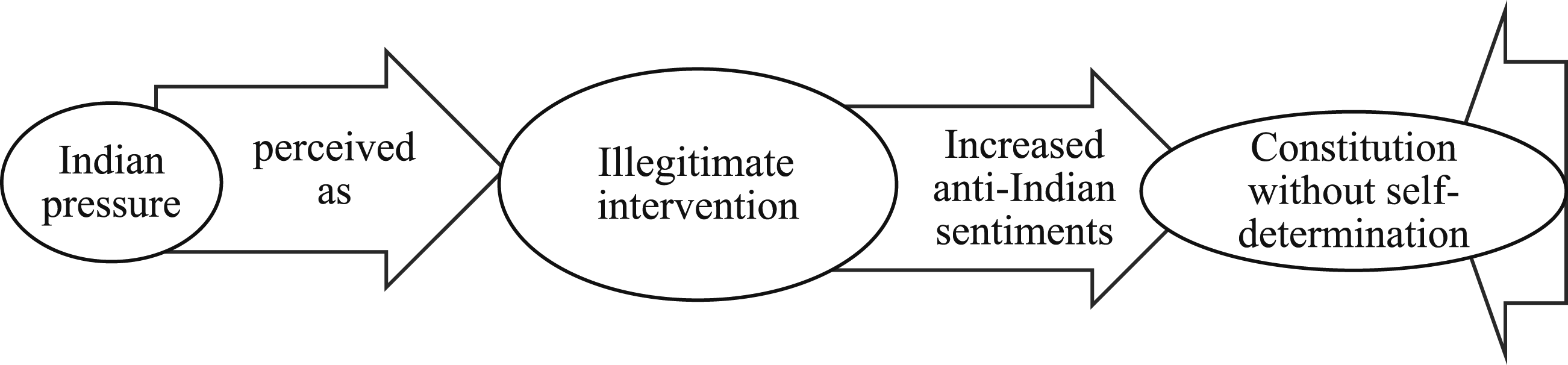
First, the Indian government, as shown above, stood on the side of the Madheshi peoples after the Madhesh movement of 2007. The Madhesh agitation increased social unrest, disturbances, and casualties. Being concerned about these tensions, the Indian parliament asked its government to give detailed information about the “ethnic violence against people of Indian origin” in Nepal 7 (Ministry of External Affairs, n.d.). India treats the Madheshis as people of Indian origin. The Indian parliament asked for this information out of its special concern for the Madheshi peoples. In response, the Indian government expressed a hope that all genuine grievances would be addressed (Ministry of External Affairs, n.d.). But the Madheshi agitation did not decrease. In May 2007, the Indian parliament again asked whether the Nepalese state has, in recent times, given inhuman treatment to the Madheshis 8 (Ministry of External Affairs, n.d.). In response, the government replied that the Madheshi peoples are “demanding greater political, social and civil rights”; the Nepalese government has announced its decision to “delineate electoral constituencies on the basis of equal population, and geographical factors and specificity, and to increase the number of such constituencies in proportion to the population of Madheshis” (Ministry of External Affairs, n.d.). These statements demonstrate that the Indian parliament and the government demonstrate a special concern toward the Madheshi peoples.
Despite this concern, the Madheshi demands did not get addressed, nor did the tensions decrease. Amid these disturbances, the Indian government pressured the Nepalese government to sign an agreement with the Madheshi political parties in 2008. In this accord, the Nepalese government agreed to form an autonomous Madhesh state (Asian Study Center for Peace, 2011). The Nepalese government concluded this agreement under Indian pressure, which Shiv Shankar Mukherjee, the then ambassador to Nepal, admitted, saying that “agitations in 2007 and 2008 led to a written agreement signed on February 28, 2008, which guaranteed an autonomous Madhesh” and “there was no ambiguity in the commitment. I was witness to the discussions and the final draft” (Mukherjee, 2015). The presence of the Indian ambassador as a witness is evidence that this document was signed in the Indian interest.
The pressure increased after Indian Prime Minister, Narendra Modi’s visit to Nepal in August 2014. Modi addressed the CA and advised the Nepalese politicians to adopt a consensus-based Constitution. 9 The Indian Prime Minister did not explicitly refer to the Madheshi demands. But he urged the Nepalese politicians to take sufficient time to address existing discontents and ensure that “har Nepali ko lage ki yeh ek aisa guldasta hai jismein mere ek phool ki bhi mahak hai (each Nepali citizen should feel that the Constitution is a bouquet in which one flower represents their aspirations)” (Ministry of External Affairs, n.d.). Sympathies for the Madheshi demands encouraged him to advise the Nepalese government to adopt an inclusive Constitution.
Even after the Prime Minister’s visit, India was not confident that Nepal would implement its advice. Therefore, the Indian parliament kept the government on alert about Nepal. In 2015, it asked the government to update the house about the recent developments in Nepal. The government expressed an expectation that the Nepalese leaders would continue to work together and build the Constitution that honors past understandings 10 (Ministry of External Affairs, n.d.). In this context, the term ‘past understandings’ referred to the agreements between the government and the Madheshis.
These pressures were not, however, building a positive environment for the fulfillment of the Madheshi demands in Nepal. The mainstream political parties focused on issuing the Constitution without addressing the Madheshi demands. The Madheshi parties boycotted the Constitution-writing process, realizing that their demand would not be addressed. The Indian diplomats, who were watching these developments, increased pressure on Nepal from their position. Writing an article in September 2015, the former ambassador Jayanta Prasad suggested Nepal adopt its Charter in a consensus of all stakeholders. He argued that Bhutan and India released their Constitution with consensus, and Nepal should follow this tradition (Prasad, 2015). Just two days before the Constitution, India sent its foreign secretary S. Jaishankar as the Prime Minister’s special envoy to advise the Nepalese political leaders to incorporate Madheshi demands in the Constitution. After the visit, the foreign secretary issued the following statements:
11
We would like its completion to be an occasion for joy and satisfaction, not agitation and violence. We hope that Nepal’s political leaders will display the necessary flexibility and maturity at this crucial time to ensure a durable and resilient Constitution that has broad-based acceptance. (Ministry of External Affairs, n. d.)
Jaishankar pressured the Nepalese government to delay the adoption of the Constitution and include the concerns of the Madheshi parties (Majumder, 2015). In his political report, 12 K. P. Oli 13 recalled that “the special envoy pressured the then Prime Minister and political parties’ leaders not to release the Constitution, with a warning that Nepal will face consequences if they go against Indian advice” (CPN-UML, 2021). In sum, India wanted to incorporate the Madheshi demands in the new Constitution and accordingly gave pressure on the Nepalese government.
Second, the Indian intervention increased anti-Indian sentiments in Nepal. The Nepalese politicians interpreted the Indian pressure as an interference in internal affairs (Khobragade, 2016), which increased animosity and frustration towards India (Shah, 2017). The Indian government could not establish that it was seeking the marginalized communities’ inclusion and accommodation. In many instances, the nearby powers meddle in the conflict and worsen the situations (Brown, 1996). The Nepalese politicians questioned the legitimacy of Indian actions, suspected the Indian government of inciting the Madheshi peoples to protest, and stood against the Indian position.
The anti-Indian sentiments are an important aspect of Nepali nationalism. At different times, the Nepalese politicians have utilized the Indian support to secure their power position, uttered anti-Indian statements when their interests did not fulfil, and used anti-Indian sentiments to increase their political capital (Upreti, 2016).
In 2015, the anti-Indian sentiment was, however, more against the Indian intervention in the Constitution-writing process than toward power politics. The Constitution’s drafters felt that the Indian government was supporting the Madheshi demand to bring the territorial disintegration of the Nepalese state. In an ethnic conflict, when the foreign actors take the side of one particular group, the other considers that illegal or illegitimate (Nalbandov, 2009). The Nepalese politicians considered India as the actor with ulterior motives and took a stand against the ethnic demand. Girija Prasad Koirala 14 thus said, “I cannot fulfill the demand creating whole Madhesh as a one state no matter what power on this world forces me to do so” (Miklain, 2008: 6–7). Through these statements, Koirala indicated his intention to stand against the Indian intervention.
The anti-Indian sentiments appeared in the CA members’ statements too. Haribol Gajurel (CPN-Maoist) stated that the neighbors’ interest has played a significant role in Nepal’s political transformation; the political parties did not work as per the foreigners’ interests, and the first CA could not give the Constitution (CA Secretariat, 2014:1458). Gajurel did not specify the name, but neighbors other than India did not have reservations about the federal system. The Chinese government had expressed commitment “to support Nepal’s independent choice of social system and development path suited to its national conditions” (Ministry of Foreign Affairs, 2018). India was the only actor giving pressure on the Nepalese government to incorporate the Madheshi demands; Gajurel was thus hinting toward the Indian government.
The outside intervention in ethnic conflict does not just concern the settlement of the conflict. It inspires debates about the nature of state sovereignty (Cooper & Berdal, 1993). The political actors of the host state become concerned that the foreign powers can be seeking to change the state’s territorial norms, and this understanding increases the repulsion toward the foreign actors. In Nepal, the CA members doubted that India was seeking to hurt the Nepalese state’s national independence and territorial integrity and presented India as an illegitimate actor. In this reference, Mohan Singh Rathor (CPN-UML) stated: There is a grand design to carve Nepal into pieces and integrate/incorporate Tarai into India, and there is a danger that the foreigners are playing a role to disintegrate Nepal in the name of ethnic preferential treatment or the right to self-determination. Therefore, we do not need that kind of federalism. (CA Secretariat, 2014: 1466–67)
In an echo of this, Gauri Kumari Oli (CPN-UML) said, “the right to self-determination in a single homogenous province is a design to merge Tarai into India, therefore, this should be rejected” (CA Secretariat, 2014: 1472). Oli suspected that India was encouraging the Madheshi political parties to raise the demand for self-determination just to bring division.
Similarly, Chandra Prakash Mainali (Nepal Communist Party, Marxist Leninist) argued that the right to self-determination would construct an environment for foreign states to conspire against Nepal’s territorial integrity. In a federal design, the provinces are autonomous to exercise the constitutionally provided rights, and additional autonomy is not necessary; to provide self-determination to a particular ethnic community is to invite self-destruction. Mainali urged the CA members to consider the situation of Crimea 15 before incorporating the demand for self-determination (CA Secretariat, 2014: 1242). The implication is that the provision of the right to self-determination prepares a favorable environment for India to secede Nepal’s plain.
These statements demonstrate that India had not succeeded to establish the legitimacy of its position despite claiming to stand for democratic inclusion of the marginalized communities. The external actors aim to obtain legitimacy through their appeal to a variety of constituencies (Berman, 2006). India reiterated its wish to see progress, growth, and prosperity in Nepal and tried to appeal to both mainstream elites and the Madheshi peoples. But the mainstream parties saw the Indian government plotting against the state’s sovereignty norms. The Madheshi parties, for whom India rankled the ruling elites, were not satisfied with the Indian position either. Statements of Upendra Yadav are the evidence: We are people of Indian origin, but remember we are Madheshis and Nepalis. This is our struggle. India can give us moral support, which is not forthcoming at the moment. The people of Bihar and UP are with us, but the Government of India is not taking any notice. (Thakur, 2007)
The Indian government could not receive appreciation for what it was doing in Nepal. The political parties perceived that India would want to utilize the right to self-determination to fulfill its own territorial interests (Nayak, 2011). This understanding gave rise to anti-Indian nationalism.
The Indian government was aware of the rise of anti-Indian sentiments. 16 In a response to the parliament, it stated that “Nepal has people of various persuasions whose views on India are sometimes hostile” and “the concerned authorities in Nepal have been sensitized to our concerns in this regard” (Ministry of External Affairs, n.d.). The government realized that the Indian position was breeding discontent in Nepal.
Third, the rise of the anti-Indian sentiments led to the rejection of the right to self-determination in the Constitution. Nepal adopted a centralized model of the federal system in which all provinces got equal competencies, but the Madheshis did not receive additional autonomy (Jnawali, 2021). The Indian intervention was contributing to this situation. Oli, for instance, mentioned that “the foreign intervention in an independent state’s sovereign right to make the Constitution was unacceptable. Nepal adopted the Constitution, rejecting such pressures” (CPN-UML, 2021: 38). Including a single autonomous province was not a desirable option; the Madheshi political parties would get disproportionate power in the politics due to their regional unity (McDonald &Vaughn, 2013). Mainstream political parties did not want that situation and issued the Constitution without recognizing the Madheshi claim.
This does not mean that the Madheshi demand has been rejected in its entirety. The Constitution has made a provision for the Madheshi province that is composed of eight Madheshi districts: Saptari, Siraha, Dhanusa, Mahotari, Sarlahi, Rautahat, Bara, and Parsa (Nepal Law Commission, 2015). This does not, however, address the full demand. The Madheshi parties wanted the formation of a single autonomous province in the entire Tarai region from Mechi to Mahakali, but the Constitution has placed eight districts in one province and lumped other Madheshi districts with the hill districts (Jnawali, 2018). This demarcation dispersed the Madheshi communities. The fear of territorial disintegration led the mainstream to choose this structure; the Indian intervention heightened that fear.
In sum, the Indian pressures increased anti-Indian sentiments in Nepal. The Nepalese politicians responded to the Indian intervention by promulgating the Constitution that did not include self-determination as a right.
b. Rejection of self-determination as an agenda
The Indian intervention has affected the continuation of self-determination even as the agenda of Madheshi politics. Being upset with the rejection of its advice, the Indian government imposed an undeclared economic sanction after the adoption of the Constitution. This sanction did not construct a positive environment. The Nepalese political parties considered that the Madheshis are fighting in the Indian incitement. The Nepalese government adopted a strategy to isolate autonomy from the Madheshi demands, which is making it difficult for the Madheshi parties to defend self-determination as their agenda. The different elements of this challenge become evident in the Figure 2. Diagram illustrating the impact of Indian intervention on the agenda of self-determination.
First, the Indian government, as shown above, demonstrated its frustration by imposing an undeclared economic sanction on Nepal. When the neighboring countries including the European Union, China, and Japan congratulated Nepal for making the Constitution, India refused to recognize the Constitution and imposed economic sanctions. It rather issued a note of concern 17 (Ministry of External Affairs, n.d.) and stood on the Madheshi side.
In the aftermath of the Constitution, the Madheshi parties launched demonstrations on the Nepal-India border. In the excuse of the Madheshi protest, the Indian government blocked the transport of petroleum products and imposed economic sanction. It claimed that the Nepalese leaders were advised to take urgent steps to defuse the tension; the demonstration was a natural outcome of not listening to its suggestion 18 (Ministry of External Affairs, n.d.). The Indian government was also rumored to present a list to the Nepalese government to make some amendments to the Constitution (Roy, 2015). It has, however, denied presenting any such list and claimed to have just urged Nepal to issue the Constitution in consensus (Ministry of External Affairs, n.d.). Whether it handed in the list or not, India exerted pressure through the economic blockade.
Nonetheless, the Indian government could not demonstrate that the economic sanction was important to promote democratic inclusion in Nepal. The foreign actors need credible sources to justify their intervention (Cooper & Berdel, 1993). But the Indian government did not have anything to justify its action; therefore, it denied imposing any sanction. 19 It argued that the obstructions occurred due to the demonstrations on the Nepalese side; Nepal should thus amend its Constitution and address marginalization before seeking to ease transportation (Ministry of External Affairs, n.d.). India could not explain what made the blockade necessary and reiterated that “there is no hindrance from the Indian side” (Ministry of External Affairs, n.d.). The parliament asked whether the Indian pressure helped the Madheshis to secure their rights. 20 In response, the government stated that “India has been supportive of a broad-based and inclusive Constitution in Nepal” (Ministry of External Affairs, n.d.) and admitted supporting the Madheshi demand for autonomy.
Second, the economic sanction provided the Nepalese government an opportunity to revive anti-Indian nationalism. The Nepalese political parties did not interpret the blockade as the disruption resulting from the Madheshi protests but as a foreign intervention designed in the name of social unrest. The blocked-time Prime Minister Oli stated that “the protest of the Madheshi parties was just an excuse. The transportation was blocked even in the entry points in which protests did not exist” (CPN-UML, 2021: 38). In Oli’s argument, India violated international human rights treaties and acted against humanity; the sanctions did not have any other purpose than to meddle with the Nepalese state’s domestic politics (CPN-UML, 2021). Oli succeeded to create this understanding and encouraged the Nepalese people not to surrender before the foreign intervention (CPN-UML, 2021), which eventually constructed anti-Indian sentiments in Nepal.
The Indian engagement with the Madheshi issues was becoming counterproductive to its national interests. The foreign intervention needs to obtain support from the conflicting parties to become successful; the external support does not give a logical conclusion in the absence of such support (Khobragade, 2008). The Nepalese people interpreted the Indian sanction as an invasion of internal affairs, and the anti-Indian sentiments increased. Realizing this fact, the Indian parliament drew the government’s attention to improving the Nepal-India relationship. In December 2015, it asked 21 whether the bilateral relationship had come under strain after the adoption of the Nepalese Constitution, and what measures have been taken to restrengthen the India-Nepal relationship 22 (Ministry of External Affairs, n.d.). The parliament asked why the harmonious relationship between Nepal and India has faltered and the undue malice has increased against India 23 (Ministry of External Affairs, n.d.). It also presented a ‘calling attention’ motion 24 and instructed the government to mend bilateral relationships by adopting the appropriate remedial measures 25 (Ministry of External Affairs, n.d.). These parliamentary initiatives illustrate that the Indian side had realized the negative consequences of its intervention.
A related concern of the parliament was the increase of the Chinese influence on Nepalese politics. The Nepalese side considered that India supplied the agenda and imposed a blockade in support of its agenda. Due to this perception, the Prime Minister Oli mentioned that he would resolve the present crisis, maintain national independence, dignity, and national integrity, and find an alternative (The Indian Express, 2015). Using the term ‘alternative’, he was hinting toward seeking Chinese support and stand against the Indian intervention.
Certainly, the pro-China position is also a part of Nepali nationalism as much as anti-Indian sentiments. The Nepalese politicians have often used the pro-China position, known as the China card, to increase their leverage on India. But this time, the Nepalese people demonstrated national unity and solidarity against the Indian intervention (CPN-UML, 2021), and the government utilized strong public support to seek Chinese assistance in support of its initiatives.
The Chinese government also pledged to support the Nepalese government “to safeguard national independence, sovereignty, and territorial integrity” (Ministry of Foreign Affairs, 2018). Accordingly, Nepal concluded the Protocol of Transit and Transport Agreement with China and received permission to use four seaports (Xingang, Shenzhen, Lianyungang, and Zhanjiang) and three land ports (Lanzhou, Lhasa, and Xigatse) for trade with third countries in 2018 (Nayak, 2018). The Chinese support is, however, partly facilitated by the presence of strong and numerous communist parties in Nepal. The Chinese authorities want to see the unification of the communist parties and the presence of a strong communist government (Bhattarai, 2022). This wish also supported the Nepalese government, under the leadership of the chairperson of the Communist Party of Nepal, to conclude various treaties with the Chinese government. Whatever the reasons, the Chinese authorities positively responded to the Nepalese government’s effort for trade and transit agreements.
Following these treaties, the Indian side became concerned about the Chinese influence in Nepal, and its concern with the Madheshi agenda began to decline. In 2016, the Indian parliament asked whether Nepal had signed a transit and transportation treaty with China to minimize its dependence on India 26 (Ministry of External Affairs, n.d.). Nepal’s relationship with China should not generally become a concern for the Indian parliament. Sovereign states conduct bi-lateral treaties to secure mutual interests. But the Indian parliament asked how the Nepal-China relation would affect the India-Nepal relations (Ministry of External Affairs, n.d.). In 2017, it inquired whether the Nepalese government had proposed a joint military exercise with China, and how this proposal would impact India’s national interests 27 (Ministry of External Affairs, n.d.). These concerns indicate that the Chinese influence deterred the Indian government from supporting the Madheshi issues.
The Indian parliament reminded the government to maintain its strong presence in Nepal’s politics. Expressing concerns about the Chinese government becoming the top aid donor to Kathmandu, it asked “what diplomatic, political, and economic measures the Ministry is proposing to be a major player in Nepal?” 28 (Ministry of External Affairs, n.d.). The parliament became concerned about Nepal’s increasing inclination toward China 29 (Ministry of External Affairs, n.d.) and urged the government not to let this inclination affect the Indian interests.
Due to the fear of the Chinese influence, the Indian government, parliament, and diplomats began to reflect on the mistakes of their approach. The former ambassador S. D. Muni admitted that the Indian government stood on one side of the polarized politics instead of seeking to “nudge both sides of the polarised debate through quiet and sustained diplomacy” (Muni, 2015). The other former ambassador Rakesh Sood also mentioned that India wanted to get the Madheshi concerns addressed through the new Constitution, but it tried to micro-manage the Nepalese politics in the name of Madheshis, which strengthened anti-Indian nationalism (Sood, 2015). These two former diplomats’ statements suggest that India had focused on micro-management instead of conflict resolution. When the foreign actors engage in various interests and seek to micro-manage the internal politics, that hurts their legitimacy and credibility (Nalbandov, 2009). The Indian government lost its credibility due to the unnecessary intervention, which the parliament acknowledged through its statements.
In 2017, the parliament asked whether India backed the Madheshi demands, and what new diplomatic measure is underway to improve the relations with Nepal 30 (Ministry of External Affairs, n.d.). This question assumes that India has made mistakes by supporting the Madheshi parties and needs to identify remedial measures. In response to this question the government stated that India wants the Nepalese government to address the discontents of “the protesting groups” (Ministry of External Affairs, n.d.). This response represents a significant departure in the Indian policy toward the Madheshis. India was used to identifying the Madheshis as the people of Indian origin. At this time, the Indian government just used the term ‘the protesting groups’, indicating its intention to stay silent about the Madheshi demands and neutralize the anti-Indian sentiments.
Third, the silence of the Indian government has constructed a rigid environment for the Madheshi political parties to continue self-determination as the nationalist agenda. The Madheshi parties are raising the issue of self-determination just to show the rhetorical commitment to their agenda. The Nepalese government has utilized this situation to isolate ‘autonomy’ from the Madheshi demands.
The recent amendments to the Constitution are evidence. In December 2015, the Nepalese government made a decision to amend the Constitution for ensuring proportionate inclusion and population-based delineation of electoral constituencies, reiterating its commitment to making appropriate arrangements for the demarcation of provinces (Ministry of Foreign Affairs, 2015). It did not, however, specify the timeline regarding the formation of a political mechanism for that purpose.
The Nepalese parliament accordingly amended article 42 to ensure the Madheshis’ proportional inclusion in the state and article 84 to ensure the delimitation of the electoral constituencies based on population and geography (Nepal Law Commission, 2015). The Madheshi parties’ major demand was the re-demarcation of the provincial boundaries. But the Nepalese government addressed demands other than re-demarcation, indicating its intention to ignore the formation of an ethnic state.
The Indian government, which had refused to recognize the Constitution, presented the amendment decision as a positive development 31 (Ministry of External Affairs, n.d.), whereas the Madheshi leaders considered the amendment incomplete. By welcoming this amendment decision, the Indian government indicated its intention to remain silent about Madheshi demand. The Nepalese government used this situation to ignore the Madheshi agenda of self-determination, which is evident in the subsequent amendment.
In 2020, the Nepalese government undertook the second amendment of the Constitution to present its claim in Nepal-India land disputes. Speaking in the federal parliament, Prime Minister Oli claimed Kalapaani, Lipulek, and Limpiadhura as Nepalese territories (Himalayan News Service, 2020). Nepal has had a strong case over Lipulekh and Kalapaani and a weak one for Limpuadhura under the terms of Sugauali Treaty that was concluded at the end of the Anglo-Nepal war (1814–1816). Despite these historical facts, the Nepalese rulers’ silence for over 150 years has amounted to acquiescence and weakened the claims (Cowan, 2020). Presenting its renewed claims over these territories, the Nepalese government amended the Constitution and updated Nepal’s map on the national emblem in June 2020 (Nepal Law Commission, 2015). The analysis of the land disputes does not fall within the scope of this research, but the developments, surrounding the amendment process, provide an important illustration of the Madheshi parties’ concern with self-determination.
The Madheshis urged the government to make the amendment decision in a package and address their concerns, but the Nepalese government became unwilling to go beyond revising the state’s map in the coat of arms. The Madheshi parties threatened not to support the government’s proposal if the ruling party does not support their bill (Pradhan, 2020); their proposal was rejected, but the Madheshi parties voted in favor of the government’s bill. In 275-member House of Representatives, the Madheshis just had 34 members (Bhattacharjee, 2020), and the government’s amendment would have been approved even without their support. This amendment was of national importance, and the Madheshi parties were not in a position to oppose it. The mainstream elites treat the Madheshis as the Indians (Jha, 2017); standing against this amendment would give further chances to these elites to question the Madheshis’ loyalty and patriotic sentiments. Therefore, the Madheshis could not stand for their agenda and supported the government’s bill.
However, the Madheshi parties– Rastriya Janata Party Nepal and the Samajwadi Party registered 32 a private amendment bill in June 2020, including a provision that the Nepal government would form a federal commission to determine the number and the re-demarcation of boundaries of the provinces (House of Representatives, Nepal, 2020). This amendment proposal was rejected, and the Madheshi parties were aware of this outcome prior to the registration. This proposal was registered just to demonstrate that the Madheshi parties have not left their agenda.
The merger and split of the Madheshi parties also illustrate the increasing distance from the issue of self-determination. In June 2020, the Madheshi parties merged to form Janata Samajwadi Party Nepal, claiming to seek broader consensus on the issue of autonomy and self-determination. This party has gone through different alignments within five years to come to its present status. These alignments demonstrate the the Madhesi parties’ co-optation into the power politics.
In June 2015, three parties– the MPRF (representing ethnic Madheshis), the Federal Socialist Party (representing hill ethnic groups), and Khas Samajwadi Party (representing hill high caste Chettri)– merged to form Sanghiya Samajwadi Forum Nepal. The newly formed party claimed to support ethnic autonomy and self-determination for the Madheshi and other marginalized nationalities (FSFN, 2017). In practice, the power politics seems to inspire this merger. In the Tarai region, the middle caste Madheshis– Yadav and others– are struggling to challenge the upper caste dominance in politics. The desire to appeal to the middle caste constituencies and become a dominant force in Madheshi politics seems to motivate the MPRF to seek a merger with the hill ethnic parties (Basnet, 2019). In addition, the total vote share of the MPRF had come down to 2.3 percent in 2013 from over 6 percent in 2008. The legislative parliament was mulling over a proposal that asked the political parties to secure three percent votes to qualify as a national party. The MPRF became concerned about the prospect of jeopardizing its national status (Basnet, 2019). In these conditions, Sanghiya Samajwadi Forum Nepal was formed, jettisoning the term ‘Madheshi’ from its name (Basnet, 2019). The desire for political dominance rather than ethnic concern thus determined this merger.
In 2019, the Sanghiya Samajwadi Forum Nepal and Naya Shakti Nepal merged to form the Samajwadi Party Nepal, which presented ethnic federalism and democratic socialism as its ideologies. The Samajwadi Party Nepal further merged with Rastriya Janata Party Nepal; this merger led to the formation of the Janata Samajwadi Party Nepal in 2020. After the formation of this party, Rajendra Mahato 33 stated that the party would “highlight the national agenda and will not be limited to Madheshi region” (Bhattacharjee, 2020). This illustrates that the Madheshi parties are leaving their regional base, which also means leaving their agenda for self-determination. The newly formed party, as CK Lal mentioned, lacked ideological clarity (Giri, 2020), and the power politics determined its activities.
In August 2021, Rajendra Mahato and Mahanta Thakur have formed a separate Loktantrik Samajwadi Party. At the time of this writing, Baburam Bhattarai has formed a separate Samajwadi Party. These splits were not based on ideological or ethnic issues. The appointment of leaders in the government, the internal decision-making processes, and the portfolio management issues inspired this split (Khatiwada, 2022). Whatever the reasons, these mergers and splits indicate the gradual distancing of the Madheshi leaders from ethnic self-determination. In the absence of strong international and national support, the Madheshi parties co-opted to power politics.
In sum, the Indian intervention increased anti-Indian nationalism in Nepalese politics, which led to the rejection of the Madheshi self-determination both as a constitutional right and the nationalist agenda.
Conclusion
This paper concludes that the Indian intervention has not supported the Madheshi demand for self-determination. It has rather affected the Madheshi peoples’ demands both as the right and the agenda.
Indian support has affected the recognition of self-determination as a right in the Constitution. The Indian government supported the Madheshi demands for autonomy and increased pressure on the Nepalese government to incorporate this issue. But the Nepalese politicians perceived the Indian pressure as an illegitimate concern in a sovereign state’s right to choose a political system and adopted the Constitution that did not recognize the Madheshi self-determination.
The Indian pressure also hurt self-determination as an agenda of ethnonational politics. The Indian government imposed economic sanctions to force the Nepalese government to recognize the Madheshi claims. But the Nepalese government restrengthened ties and concluded trade and transit agreements with the Chinese government, which India thought would affect its national interests. In its attempt to secure its position in Nepalese politics, India remained silent about the Madheshi demand. This silence constructed a permissive environment for the Nepalese government to ignore the Madheshi demand for self-determination. This forced the Madheshi parties to use their demand just as a negotiating measure in power politics than as the nationalist agenda.
The Nepalese case has left some lessons to the stakeholders: the Indian government, the Madheshis, and the Nepalese government. It has taught the Indian government not to seek micromanagement of Nepalese politics in the name of conflict resolution. The Indian government should thus refrain from interfering in Nepal’s internal politics while urging the Nepalese counterpart to adopt ethnically inclusive measures. The Madheshi parties should continue ethnic mobilization and negotiate with the mainstream political actors to resolve their grievances instead of seeking to succeed with Indian support. In addition, the Nepalese government has not achieved anything from the weakening ethnic agenda. The proper response to Madheshi aspirations would make the state more democratic, inclusive, and just; the government has missed an opportunity to address historical cleavages by refusing to recognize Madheshi autonomy. It is thus necessary to form an ethnically sensitive autonomous structure, resolve the Madheshi grievances, and consolidate the state’s territorial norms.
Footnotes
Declaration of conflicting interests
The author(s) declared no potential conflicts of interest with respect to the research, authorship, and/or publication of this article.
Funding
The author(s) received no financial support for the research, authorship, and/or publication of this article.
