



Abstract
Drawing on three cases of long-term Indigenous–settler alliances in Canada, this research investigates the roles and contributions of settlers towards decolonization. As a multidisciplinary team of Indigenous and non-Indigenous scholars, our research goal has been to understand how such alliances endure and change over time, and how they negotiate power dynamics, tensions and changes, within a settler colonial context. Taking a comparative case study approach, and analysing interviews, sharing circles and archival documents, we focus here on the lessons that alliance participants have learned from their activist experiences about settler roles and responsibilities. The three cases include (1) The Right to Belong: Indigenous women’s organizing and the struggle to eliminate sex discrimination in the Indian Act; (2) Shoal Lake 40 First Nation’s Freedom Road campaign to end a century of state-imposed geographic isolation and to secure access to safe drinking water; and (3) the alliance-building and solidarity activism of Canadian ecumenical social justice coalitions now under the umbrella of KAIROS Canada. While none of these campaigns alone equates to decolonization in the sense of land return and Indigenous sovereignty, each has helped create the conditions, relationships and transformations in settler consciousness that may provide the ground for decolonization. Taken together, the three case studies illustrate the contingent environments in which alliances are forged and the ways in which settlers take up particular responsibilities based on Indigenous-defined goals.
Keywords
Introduction
In Canada and other settler colonial states, Indigenous–settler alliances have emerged as a significant area of study since the early 2000s. Various case studies and analyses have documented the achievements of these alliances, pointing as well to persistent and at times intractable tensions that arise. Beyond the academic realm, strong voices have emerged regarding these relationships from Indigenous activists, artists and communities on the front lines of Indigenous struggles. Within this charged environment, settler allies are challenged to respond at individual and collective levels to demands for relational as well as structural change.
The challenge of building Indigenous–settler alliance relationships takes a particular shape in Canada, given histories of treaty-making and a pervasive ‘peacemaking myth’ that renders invisible histories of anti-Indigenous violence (Regan, 2010). Alliance-building in this context is shaped as well by interconnected histories of struggle that have played out on and with these lands. Indigenous people have fostered, for example, alliances in support of their efforts to assert land, treaty and resource rights (Davis, 2009; McCarthy, 2016; Wallace, 2013); to protect lands and waters (Bédard, 2017; Indigenous Environmental Network, 2013); and to resist extractive industries and other forms of destructive development on their lands without their consent (Da Silva, 2010; Howe, 2015; Sherman, 2010). Other alliances have been forged to address sex-based discrimination (McIvor et al., 2017), genocidal violence against Indigenous women, girls and gender-diverse people (D’Arcangelis and Huntley, 2012; Lavell-Harvard and Brant, 2016), and the intersecting impacts of racism, colonialism and capitalism upon both Indigenous and racialized communities (Simpson, 2014, 2017). Coalitions have also formed in support of federal Indigenous policy change and the adoption and implementation of the United Nations Declaration on the Rights of Indigenous Peoples (Hartley et al., 2010; Manuel and Derrickson, 2015).
In the last decade, Indigenous and non-Indigenous scholars in Canada have begun to critically evaluate Indigenous-settler alliances and partnerships. Following longstanding Indigenous critiques of ‘environmental crusaders, racism, re-colonization and do-gooders’ (Bobiwash, 2003: 273), this scholarship interrogates ‘coalition as a microcosm of colonial relationships’ (Davis and Shpuniarsky, 2010: 336), tracing how colonial power relations and assumptions are often reinscribed within alliance relationships (Davis, 2009; Denis and Bailey, 2016). Conversely, Indigenous and settler activists and scholars have contemplated ‘settler ally’ roles and responsibilities in light of intersecting identities and power relations, highlighting an emerging and evolving set of principles and practices (Amadahy, 2008; Denis and Bailey, 2016; Mathur et al., 2011; Walia, 2012). This work also explores ‘coalition as a site of learning and transformation’ (Davis and Shpuniarsky, 2010: 340), considering the emotional work that accompanies and undergirds processes of relationship-building towards decolonization (Battell Lowman and Barker, 2015; Carlson-Manathara with Rowe, 2021; Christian and Freeman, 2010; Hiller, 2017; Regan, 2010). Scholars have observed that it is often in the context of alliance relationships that settlers begin to engage in critically reflexive action to challenge settler colonial power structures (Amadahy, 2008; Gehl, 2012; Irlbacher-Fox, 2014).
Our research extends this line of inquiry by looking specifically at long-term Indigenous-settler alliances unfolding in the Canadian context, in a project called For the Long Haul: What We Can Learn from Long-term Indigenous-Settler Alliances. Drawing upon critical Indigenous theory, settler colonial theory and critical race theory, we analyse three case studies in light of concepts such as relationality (Wilson, 2010), settler moves to innocence (Tuck and Yang, 2012; Battell Lowman and Barker 2015), transforming settler consciousness (Battell Lowman and Barker 2015; Mackey, 2016) and processes for ‘unsettling the settler within’ (Regan, 2010; Hiller, 2016). The cases include: (1) the decades-long struggle to end sex discrimination in the Indian Act (Right to Belong); (2) Shoal Lake 40 First Nation’s Freedom Road campaign for clean water and a road; and (3) the long history of Indigenous solidarity work undertaken by Canadian ecumenical social justice coalitions now under the umbrella of KAIROS Canada. While we gathered the stories of both Indigenous and settler allies in our research, this paper focuses on how settlers reflect on their roles and learning in the context of long-term alliance relationships.
The purpose of this article is to consider what long-term Indigenous–settler alliances can reveal about settler roles, responsibilities and processes of learning and unlearning in the struggle to advance Indigenous sovereignty and self-determination. The stories told here are not intended to be comprehensive; they only scratch the surface, highlighting selected allies’ stories about what they learned from and contributed to engagements with Indigenous-led movements. As discussed by Bell et al. in their introduction to this edited collection, the principle of relationality is at the core of Indigenous-settler alliances and relationships (Freeman and Van Katyk, 2020; Land, 2015; Wilson, 2008). Community activists and scholars warn against self-proclaiming the designation of ‘ally’ (Montreal Urban Aboriginal Community Strategy Network, n.d.). In our research, our selection of participants depended upon the recommendations of key Indigenous leaders who were aware of the community of supporters in each case study. In these long-term alliances, supporters came and went over the decades, sometimes being recognized as allies by Indigenous leaders at particular points in time. Rather than attaining the fixed status of an ally, this recognition is a constant relational negotiation.
The Case Studies
As authors, we are connected personally to the case studies through family or activism. Dawn Lavell-Harvard and Lynne Davis collaborated on the Right to Belong case study. Dawn Lavell-Harvard is an Indigenous leader and scholar who grew up in the Indigenous women’s rights movement where her mother was a prominent leader. Lynne Davis is a white settler scholar and activist whose life and work have been profoundly influenced by Indigenous community relationships, and her research and teaching focus on Indigenous-settler alliances and transforming settler consciousness. Jeff Denis led the Shoal Lake 40 case study. He is a settler sociologist who supported the Freedom Road campaign as a result of his long-standing ties to the Treaty #3 region based on earlier research on anti-Indigenous racism and reconciliation. Chris Hiller led the KAIROS Canada case study research. For her, working as a settler coalition member and church representative with KAIROS Canada and its predecessor, the Aboriginal Rights Coalition, served as a crucible of life-altering learning and relationships that continue to inform her teaching and research in the area of pedagogies towards decolonization. Each case study is told in a slightly different way: the Right to Belong case outlines key contributions of settler allies while attending to shifts in their critical consciousness along the way; the Shoal Lake 40 case explores how allies learned principles and applied practical skills in support of the Freedom Road campaign; and the KAIROS Canada case reflects on the evolution of ecumenical efforts to build Indigenous solidarity through the narratives of three women whose decades-long engagements intersect with different segments of that journey.
Case 1: The right to belong
The Right to Belong case study focuses on the struggle to change the Indian Act to provide sex equality. It was led by Indigenous women with a multitude of supporters and allies at different stages of the effort. The Indian Act was passed into law in 1876 soon after the founding of Canada, 1 and serves to define who is an ‘Indian’, naming such individuals ‘status Indians’. Prior to 1985, if a status Indian woman married someone who was not a status Indian, she lost her status. Despite changes to the legislation over time, discrimination against Indigenous women remained in the Indian Act until October 2019. 2
In their decades-long efforts to end sex discrimination in the Indian Act, Indigenous women lobbied the federal government, but were opposed both by the government and by male leaders of national Indigenous organizations and Band Councils in their home communities. Indigenous women brought their cases to the Supreme Court of Canada, but it was only when they turned to the United Nations (UN) Committee on the Elimination of Racial Discrimination (CERD) and the Inter-American Commission on Human Rights that the federal government was shamed into making changes (Feminist Alliance for International Action [FAFIA], 2019).
During these decades of struggle, Indigenous women found Indigenous and settler allies who helped support the work. Our research project brought together key Indigenous leaders and their supporters in an historic gathering to share stories of their involvement and learning in the process of working to end gender discrimination (now called sex discrimination) in the Indian Act. 3
Friendships through time
The 1960s and 1970s were a time marked by mounting demands for social change globally and in the Canadian context. New Indigenous organizations were forming, and young leaders were emerging as Indigenous peoples demanded to be heard. In the early 1970s, young Indigenous leaders living or working in Toronto were part of an interconnected activist network. One of these leaders was Anishinaabe Kwe Jeannette Corbiere, a woman who had lost her status when she married settler musician and photojournalist, David Lavell. She protested the loss of her status in the courts, reaching the Supreme Court of Canada in the landmark Lavell-Bedard case in 1974. At the historic gathering convened for this research, Jeannette Corbiere Lavell and friends shared memories from those days. Settler allies who had been part of these activist social networks as youth described how their understanding of Canada shifted as they learned about ‘the system’ and how oppression was enforced.
José Garcia remembered arriving in Canada from Colombia in 1965. He met and built relationships with the Lavells and other Indigenous organizers. As a leader in the Afro-American Progressive Association and the Black Liberation Front, José Garcia talked about how important it was to form alliances:
I always knew that you had to build alliances in order to be effective . . . You become a force to be dealt with because . . . being black you look outside of the immediate community and into the world and you [people of colour] were a majority.
Jeannette Corbiere Lavell faced strong opposition from Indigenous organizations who felt her Supreme Court challenge to the Indian Act endangered Indigenous rights (Lavell, 1991). José Garcia recalled:
There were a lot of threats . . . people were angry at her, especially the old boys club . . . so immediately, I said ‘Sure! I would gladly go to Ottawa with you’. And I wasn't necessarily saying, ‘well, I'm going to be her bodyguard’. . . But we were photographed by the [Toronto] Star and it looked like we were right behind her, standing as bodyguards, which at that time we were . . .
In the early 1970s, Scots-Irish settler musician and activist Bob Robb became part of the movement in Toronto. He described himself as a mouse: ‘That's sort of how I got into it, basically by being a mouse, being nobody. And in the process of learning and discovering, . . . my guitar is my vehicle and my open mind is my value’. He talked about the diversity of the people engaged in change and finding ways to cross cultural boundaries:
I said it's a good thing we all speak fiddle. You know that finding the common ground. . . the songs that we were writing were important. . . The organizing things we were doing from Native issues and struggles that were being addressed by a handful of people that were sort of family and never was homogenous in opinion of what should be done.
The settler allies above are individuals who formed close personal and working relationships with Indigenous leaders of the time. More than five decades later, they have maintained relationships of mutual respect, loyalty and friendship that sprang from their shared activities, personal histories and commitments as young people. These personal relationships contrast with more formalized alliances with organizations and networks where relationships are role-defined.
Shifting consciousness through court challenges and United Nations action
Lavell and co-defendant Yvonne Bedard (Haudenosaunee) lost their Supreme Court challenge, and the struggle against the Indian Act was picked up by Sandra Lovelace (Maliseet) who brought her case to the UN Committee on the Elimination for Racial Discrimination (CERD). In 1981, CERD found Canada in violation of the UN Covenant on Economic, Social and Political Rights for sex discrimination in the Indian Act. In the following decades, there would be more litigation and international judgements condemning Canada for sex discrimination in the Indian Act. Yet Canada failed to act to change the legislation.
Three forces in particular helped to sustain the momentum through this decades-long struggle. 4 The first force was the constitutional litigation brought by Sharon McIvor, a member of the Lower Nicola Indian Band in British Columbia, and her son Jacob Grismer, in the wake of the Lavell-Bedard decision. As a First Nations woman, McIvor was accorded a second-class form of status that restricted her ability to transmit status to her children and grandchildren. In McIvor’s case, two levels of court ruled that the sex discrimination in the status registration provisions of the Indian Act violated the equality rights guarantees of the Canadian Charter of Rights and Freedoms. As a result of the McIvor constitutional litigation, thousands of First Nations women and their descendants gained recognition of their status. Nevertheless, the federal government left much of the Indian Act sex discrimination intact, necessitating continued activist pressure.
A second force towards change was the actions of Indigenous women and their organizations who partnered with the Canadian Feminist Alliance for International Action (FAFIA) to bring Indian Act sex discrimination to the attention of various international human rights bodies, as illustrated in Figure 1 On 11 January 2019, in an individual complaint brought by Sharon McIvor, the UN Human Rights Committee ruled that the ongoing Indian Act sex discrimination violated the rights of Indigenous women under international human rights law (FAFIA, 2019). Claudette Dumont-Smith, Native Women’s Association of Canada (far left); Jeannette Corbiere Lavell, Native Women’s Association of Canada (centre), Sharon McIvor, Feminist Alliance for International Action (far right), and Shelagh Day, Feminist Alliance for International Action (second row, centre) at a meeting of the Inter-American Commission on Human Rights in Washington, DC, 28 March 2012. Photo credit: Juan Manual Herrera/OAS/Flickr CC.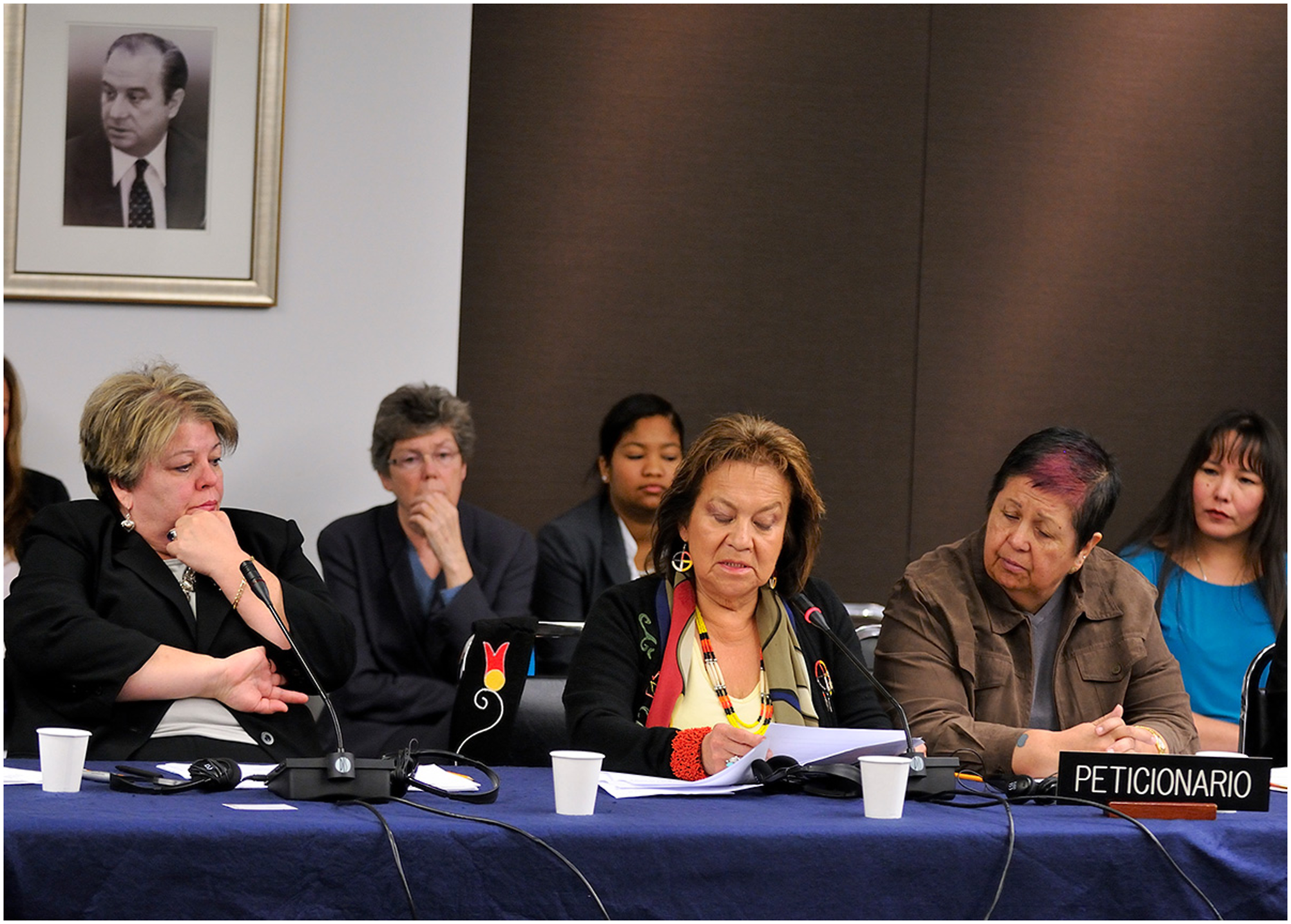
A third force for change was the 12 April 2019 call of Canada's National Inquiry into Missing and Murdered Indigenous Women and Girls for the elimination of sex discrimination from the Indian Act. The National Inquiry echoed the finding of international human rights bodies that Indian Act sex discrimination is one of the root causes of violence against Indigenous women and girls. Indigenous organizations, churches, civil society organizations and most political parties had been united in calling for a national inquiry (National Inquiry into Missing and Murdered Indigenous Women and Girls Commission, 2019). A significant milestone in the struggle to end sex discrimination in the Indian Act was the bringing into force of all provisions of Bill S-3 in August 2019, on the eve of a federal election, following a huge lobbying effort by Indigenous women and their supporters, including members of the Canadian Senate (FAFIA, 2019).
Settler participants in our research articulated a common analysis to explain why Canada had continued to resist eliminating sex discrimination from the Indian Act despite decades of litigation and concerted lobbying. As lawyer Gwen Brodsky shared:
Canada is actually deeply dug in, deeply addicted to the drug of sex discrimination, and it took me a while to realize or decide for myself, to learn what the explanation for that is. I don't know exactly when the shoe dropped with me, but it did. . . that Canada is deeply conflicted about recognizing the full extent of the group that Indigenous people are. . . It means more Indigenous women at the table. And being present at the table gives them the ability to say ‘no’.
Settler allies describe a process of learning as they came to understand Canada’s agenda to take Indigenous land. Each participant refers to a shift in their own consciousness, as Gwen Brodsky expressed above. FAFIA leader Shelagh Day explained:
And it's taken me a while to get to this point, but having worked on the issue for decades, and observed first-hand the federal government's extreme intransigence and protracted delays, I now do understand, profoundly, that the real problem here is that the sex discrimination in the Indian Act has been a very effective tool of assimilation.
Constitutional lawyer Mary Eberts talked about her learning in the following terms: ‘as a settler, [I am] always trying to deepen my understanding of what's really going on and what my government is really trying to do in my name’.
The settler allies involved in this research were prominent leaders in the Canadian women’s movement through the 1990s and 2000s to the present day. They established relationships with Indigenous women leaders over decades while working together on specific objectives. Individual allies described learning as a process that did not happen overnight but unfolded as they came to grips with Canada’s true agenda. This shift in consciousness can be found in our other case studies as well.
Case 2: Shoal Lake 40 First Nation and the Freedom Road Campaign 5
The Freedom Road case study examines the Shoal Lake 40 (SL40) First Nation’s campaign to build a bridge and a road and thereby end a century of state-imposed geographic isolation. SL40 is an Anishinaabe community on the Manitoba–Ontario border and a signatory to Treaty #3. 6 In 1913, the Canadian government approved the construction of a 150 km aqueduct from Shoal Lake to Winnipeg to supply the predominantly non-Indigenous city with clean drinking water. The government expropriated 3500 acres of SL40 reserve lands, excavated its burial grounds, and forced the community to relocate. In the process, SL40 was cut off from the mainland, becoming an artificial island. All this was done without consent and despite the written objections of community leaders (Perry, 2016).
For decades, SL40 members had to rely on ice roads in winter and a barge in summer, and it was often dangerous to cross the lake; at least nine people died trying to do so. In 1997, a boil-water advisory was instituted at SL40 – and the government refused to build a water treatment plant because it was deemed too costly. The community’s most pressing goal was to build ‘a road to freedom’, as SL40 member Bobby Blackhawk put it. In addition to facilitating the construction of water and sewage systems, Freedom Road would enable members to move freely on their land and to access jobs, schools, health care and other resources that most Canadians take for granted.
While non-Indigenous allies played a limited role in the early stages of the Freedom Road campaign, in the 2010s SL40 strategically cultivated alliances with a range of settlers and urban Indigenous people. Some of these actors played key roles in convincing the federal, provincial (Manitoba) and municipal (Winnipeg) governments to support Freedom Road.
In 2014, the SL40 Chief and Council, frustrated that they had exhausted virtually every channel, passed a council resolution authorizing ‘direct action . . . to do whatever it took’ to build Freedom Road. The Canadian Museum for Human Rights (CMHR) was scheduled to open in Winnipeg that September; since water was a feature of the museum (e.g. the Healing Waters exhibit that used Shoal Lake 40 water without acknowledging its impact on the community), the first action was to invite Museum staff to Shoal Lake to learn about ‘The Price of Water’. The staff agreed to visit and the First Nation invited the national press to bear witness. When the CMHR opened that fall, community members mounted a peaceful, educational occupation of the museum grounds for 4 days. In the context of the Truth and Reconciliation Commission (TRC) 7 and Idle No More, 8 they reasoned that it was an opportunity to educate the public, shine international media attention on Canadian hypocrisy and stimulate action. Indeed, hundreds of Winnipeggers visited and supported the occupation; some made practical contributions such as bringing food, water, firewood, banners and other supplies. Thousands more became aware of the situation through media coverage. Meanwhile, SL40 members Daryl Redsky and Stewart Redsky and long-time non-Indigenous advisor Cuyler Cotton used the occasion to begin an ongoing display of the story by opening the Museum of Canadian Human Rights Violations at SL40, in essence a ‘counter-museum’. Journalists, politicians, residents of Winnipeg and activists were invited to come ‘see life at the other end of the pipe’. Many described the experience as eye-opening and transformative. When visitors tearfully asked, ‘What can we do?‘, Stewart Redsky, the Museum’s curator, would remind people that the injustice was their responsibility to change.
Under organized and spontaneous pressure and increased media scrutiny, the Winnipeg and Manitoba governments publicly committed to contributing their share of construction costs for Freedom Road (estimated at $10 million each). The only holdout was the Conservative federal government. Over the next year, solidarity groups formed, including Friends of SL40, Churches for Freedom Road and Students for Freedom Road. With SL40’s approval, or together with SL40 members, individuals and NGOs organized rallies (as shown in Figure 2), petitions, letter-writing campaigns and educational initiatives, contributed funds for SL40 members to speak at the United Nations, and mobilized social connections with political leaders and decision-makers. Behind the scenes, the SL40 Chief and Council, their Métis lawyer Bruce McIvor, Cuyler Cotton and Ogichidaa
9
Daryl Redsky continued to meet, strategize, lobby and negotiate with government representatives. Honour Our Agreements: Supporters of Shoal Lake (SL) 40 stand outside the Manitoba legislature in Winnipeg calling on governments to honour their agreements with the First Nation to help fund the construction of Freedom Road, 19 December 2017. Photo credit: Boris Minkevich/Winnipeg Free Press).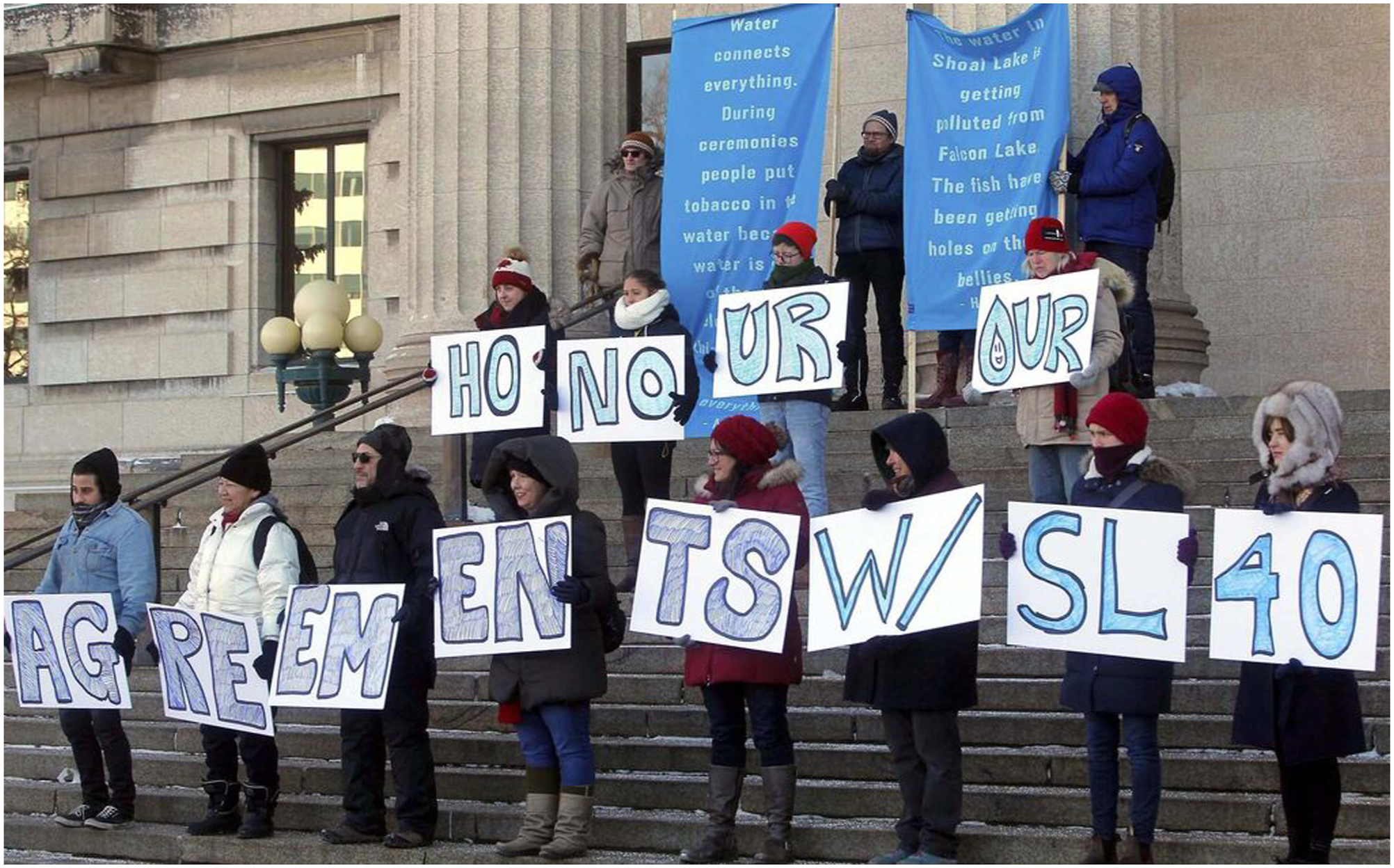
Ultimately, federal funding was secured with the election of the Liberal government in November 2015, and Freedom Road opened in 2019. This means that a water treatment plant, a new school and other infrastructure can now be built on reserve; while colonialism has not ended, these are significant achievements for the community as defined by the community. Below, we highlight selected allies’ stories about what they learned from the Freedom Road campaign regarding their roles and responsibilities and ways they could contribute to Indigenous-led movements.
Humility, accountability and respecting Indigenous leadership
Appalled by the federal government’s refusal to fund Freedom Road, in June 2015, a small group of settler Christian activists in Winnipeg gathered to discuss how to support SL40. They called themselves Churches for Freedom Road and created a professionally designed website. The group devised a plan to get 100 churches in Winnipeg to erect signs supporting Freedom Road and then send pictures of the signs to all Members of Parliament. Long-time Indigenous rights activist Steve Heinrichs of Mennonite Church Canada advised the churches not to ‘do anything without the approval of Shoal Lake 40’ and connected them with Cuyler Cotton who was the appointed liaison to Chief Erwin Redsky. The activists wisely heeded this advice. Christian singer/songwriter Steve Bell recalled:
We made sure we didn't do or say anything that wasn't Cuyler-approved which was then, of course, Erwin-approved . . . It got to the point where I phoned Cuyler almost every day for months . . . You know, I got the ear of the mayor's office, so I’d get counsel from [Cuyler] on ‘what could we be saying to the mayor?’
This anecdote illustrates several points. One is the role of seasoned allies like Steve Heinrichs in mentoring more novice allies and bridging social networks. Another is the importance of respecting Indigenous leadership and ensuring that one’s actions/messages are approved by and consistent with the goals of the Indigenous community/nation in question. It is also clear that very experienced and trusted settlers like Cuyler Cotton, who has worked with SL40 since the 1970s and developed deep relationships with many community members, may occasionally serve as liaison people, relieving some of the burden from Indigenous leaders, and strategizing with them at the highest levels.
Some settler allies also learned from their mistakes and had the humility to reflect and adjust their behaviour. Christian activist Jeff Friesen emphasized the importance of ‘doing your homework before you come to the table’ and ‘not just relying on Indigenous folks to . . . teach us how to be respectful.’ He also acknowledged learning this lesson the hard way:
I definitely have made missteps . . . and what’s been important for me at least is to not let that stop me from keeping on trying . . . I can think of one instance where I was being interviewed on CBC
11
and I was talking about a member of Shoal Lake 40 using the pronoun ‘he’ but the person I was talking about was a woman. And so that . . . forced me to step back and say ‘I don’t know this community as well as I thought I did; I have work to do’. . .
Using personal resources to advance Indigenous causes
Several allies reflected on how they used their personal skills, resources and social networks to advance Indigenous peoples’ causes where helpful or requested. Settler historian Adele Perry explained, ‘you have your skills, connections, and capacities . . . and they aren’t ever everything, but sometimes they’re something.’ In her case, writing a book (Perry, 2016) about the aqueduct and its impact on SL40 ‘seemed like something I could contribute that would be useful and possible.’ Urban Indigenous filmmaker Michelle St John included some of the Freedom Road story in her 2016 documentary Colonization Road. 11 And settler artist/activist Leah Decter, in collaboration with SL40 and others, organized a public art display in Winnipeg where statements from SL40 members were stenciled onto an active transportation path using unpotable water from Shoal Lake. 12 With SL40’s permission, these allies applied their specialized skills to raise public awareness and support for Freedom Road. In turn, as Michelle St John said, they felt ‘enriched’ by their relationships with community members and ‘blessed to have been trusted with their stories.’
Perhaps most exceptional is Cuyler Cotton’s diverse work with SL40 for more than four decades. In the 1970s, while working with SL40 members on a reserve housing construction project, he was ‘outraged’ to learn about the aqueduct and its impact on the community. Since then, Cuyler has dedicated much of his working life to using his research, advocacy and technical skills to support SL40. With SL40 leaders’ approval, this work has taken the form of land claims research, funding applications, project management, media outreach, negotiation and lobbying. During the Freedom Road campaign, Cuyler served as ‘policy analyst’ to Chief Erwin Redsky and his Council, helped organize the CMHR occupation and SL40’s counter-museum, coordinated SL40’s media strategy and co-chaired the Freedom Road Working Group with representatives of SL40 and all three levels of government. In addition to having a profound desire for social justice, Cuyler said his work with SL40 is motivated by the fact that the community’s survival is at stake and ‘I know people who died; they were my friends.’
Some settlers also played pivotal roles by mobilizing their political connections. Steve Bell recalled how his long-time friend and fellow Christian Joy Smith – a Conservative Member of Parliament (MP) in Winnipeg who had led the passage of legislation to fight human trafficking – phoned Steve to ‘encourage [him] in [his] work.’ She said she saw Freedom Road as ‘critical’ for preventing human trafficking. Steve asked if she would speak out, and she agreed. Together, they visited SL40 with a camera crew, toured the reserve-based museum and then held a press conference in Winnipeg where MP Smith publicly broke ranks with her government. Fellow Conservative MPs were livid. The Harper government never committed to funding Freedom Road. But every federal opposition party announced or reiterated their support.
Overall, the Freedom Road case highlights the strategic brilliance of a First Nation community using human rights and reconciliation discourses in a particular context to appeal to a wide range of allies and supporters. These allies and supporters – some of whom had longstanding ties to the community, many of whom did not – were most effective when they took time to listen and learn, acted in accordance with SL40 leadership and used their skills, resources and networks in ways that directly supported the First Nation’s goals.
Case 3: KAIROS Canada and ecumenical efforts to build Indigenous solidarity 13
The forty-year arc of ecumenical work in support of Indigenous rights began in 1975, when the Dene Nation and other Indigenous nations strategically sought the churches’ assistance in communicating to Canadians their opposition to proposed mega-development projects in northern Canada. These requests coincided with calls from Indigenous people within the churches for settler Christians to turn from colonial ways of being, to stand with them in advocating for Indigenous rights. 14 The churches responded by creating Project North (PN), a two-year initiative of research, education and communication whereby churches used their influence and resources to create spaces for Indigenous peoples to speak about the proposed Mackenzie Valley Pipeline and other issues drastically affecting their lives (Hamel, 1994) 15 . This process fed into a federal inquiry that led to a successful call for a moratorium on northern development prior to the resolution of Indigenous land claims (Berger, 1977).
Learning to listen
This win occurred during a rising tide of Indigenous activism in Canada, with Indigenous nations asserting rights to lands and resources in ‘hot spot’ conflicts across the country. 16 Local churchgoers joined regional solidarity groups and called on national churches to be more engaged, leading to Project North becoming a formalized ecumenical coalition in 1977. Coalition staff then served as conduits of information between regional groups and Indigenous nations embroiled in disputes over resource rights or federal Aboriginal policy.
Jean Koning, a settler of British heritage, served as a PN volunteer in the 1970s and 1980s. Jean recalls a pivotal moment during a national North-South Consultation, when Indigenous leaders withdrew to caucus for 2 days, leaving church leaders and PN staff to contemplate their first lesson in listening and relinquishing control: You could tell the leaders, they were just rolling their eyes and saying, ‘Well, what can we do?’ But that was the beginning of understanding how to listen to First Peoples.
And that's something that I don't think a lot of white people really understand: that if you're going to listen to First Peoples, you've really got to insist that the space, and the time, and the energy of listening be given to them. We don't work like that; we take it for granted.
Discerning what true partnership means
In the late 1980s, Indigenous partners and regional groups challenged Project North to abandon its bureaucratic, church-oriented management style for more collaborative forms of decision-making. Elaine Bishop, another settler of British heritage, joined Project North at this time. Having worked for several years with the Lubicon Cree in supporting their land rights struggle in northern Alberta, Elaine brought a conviction that Indigenous people ‘knew how to do what they needed to do. It’s my people that were in the way, so my focus needed to be on my people and on building that understanding, the humility.’ A Quaker with deep experience of consensus decision-making and circle processes, Elaine played a key role in transitioning PN into the Aboriginal Rights Coalition (ARC), helping to develop ARC’s new three-way partnership structure giving Indigenous communities, network groups and church partners equal power in decision-making.
Under this new structure, ARC adopted a more radical activist stance. Annual National Assemblies brought together Indigenous grassroots activists and leaders from across the country to share information, analyse policy, strategize and envision a national movement for Indigenous rights. Indigenous partners set action priorities, and regional groups concretely supported on-the-ground struggles. ARC’s national office in Ottawa equipped regional groups to engage policymakers and supported church institutions in policy advocacy and educating people ‘in the pews’.
As Elaine observes, some churches were ambivalent about ARC’s activist stance, with church bureaucrats seeking to use their influence as funders to redirect the work away from ‘cutting-edge stuff’ like direct action:
What I was hearing from some of the churches is, ‘Yeah, we'll put money in, but we want to control how it's spent.’ That doesn't work. If you are really going to be an ally, you need to be willing to put the money in and let the [Indigenous] allies make the decision about how the money is spent, what the key struggles were, where you needed to be on the front lines.
Other church staff worked with Elaine behind the scenes to ‘keep the church off our backs’.
Elaine served as chair during the period of ARC’s involvement with the Royal Commission on Aboriginal Peoples (RCAP). 17 In their 1996 report, RCAP Commissioners recognized ARC’s work and identified the churches as being well-placed to play a key educational role in building Indigenous–non-Indigenous relationships. Over the next 5 years, ARC took RCAP’s call as marching orders, creating educational kits and organizing workshops across the country. As a centrepiece of this work, ARC members collaborated with Indigenous Elders and educators in developing ‘The Blanket Exercise’, a popular education tool for teaching about land dispossession and engaging Canadians in the history between Indigenous and non-Indigenous peoples. 18
Practicing self-reflexivity
Reflecting on ARC’s solidarity work during the late 1980s to mid-1990s, Elaine wonders about its efficacy given their inability to press the federal government to implement RCAP recommendations. More significantly, she worries that their work left unaddressed the critical question of reparations, a concept she now sees as core to ‘keeping up their end of the bargain’ as treaty partners:
Our questions should have been, ‘Oh my God. We've been a key part of your colonialism. What do we need to do to say we're sorry? How can we support you in transforming this?‘. . . I didn’t even have a sense that we knew that we needed to have that conversation. . . I’m sure many of the Indigenous people knew it.
In 2000, the churches merged ARC with 10 other ecumenical coalitions to become KAIROS Canada, ending the shared formal decision-making processes with Indigenous communities and civil society groups. While considered controversial by some Indigenous partners and resulting in more radical regional groups leaving the coalition, this merger also brought together the strengths of the coalitions in a creative synergy that moved forward work on Indigenous rights.
One early manifestation of synergy was the Canadian Ecumenical Jubilee Initiative (CEJI), a three-year campaign of education and action centred on the biblical tradition of Jubilee. In the initiative’s final year, ARC led coalition partners in organizing a national petition in support of Indigenous land, treaty and inherent rights (CEJI and Ten Days for Global Justice, 2000). The campaign culminated in The Blanket Train, where hundreds of Indigenous and settler activists travelled by train to Ottawa to unfurl blankets on the grounds of Canada’s Supreme Court, signifying a ‘reversal’ of the processes of land dispossession outlined in the Blanket Exercise. Sara Stratton, a CEJI staff member at the time, describes the event as offering ‘non-activist’ churchgoers a concrete, accessible and inspiring way to express in the language of their faith their desire for a renewed relationship between Indigenous and non-Indigenous peoples:
And I think, when you give people the opportunity to not just sign a postcard but to personally invest in something, and you help them understand that there is something in their tradition that calls them to respond. And it was exciting too! It was like a crazy idea.
19
This campaign also marked a significant shift in KAIROS Canada’s approach to Indigenous solidarity. After politicians refused to enter the 50,000 signed land rights petitions into Canadian Parliament, KAIROS staff shifted their efforts away from advocacy and towards broad-based education. Since then, KAIROS Canada has developed numerous education and action campaigns (as illustrated in figure 3), organized church delegations to Indigenous communities immersed in rights-based struggles and coordinated international exchanges of solidarity. But much of its public education work has centred on refining and expanding the use of the Blanket Exercise. Looking back over her 16 years as a KAIROS staff member, Sara describes a significant evolution in the exercise itself, which early on was ‘still a pretty white thing’, with non-Indigenous people explaining the history of Indigenous and non-Indigenous peoples. It now engages Indigenous Elders, reflects Indigenous knowledges and protocols, and centres Indigenous leadership in a much more fundamental way:
It's a different experience because it is rooted and led now by those most affected. So, to me, that's a really, really good example of re-examining your good intentions and saying, ‘we can make that better’.
KAIROS Canada's Let Justice Roll resource in support of the United Nations Declaration on the Rights of Indigenous Peoples (KAIROS Canada, 2017). People arrive on Parliament Hill with banners during the KAIROS Roll with the Declaration event in 2011. Photo credit: Katherine Masterton.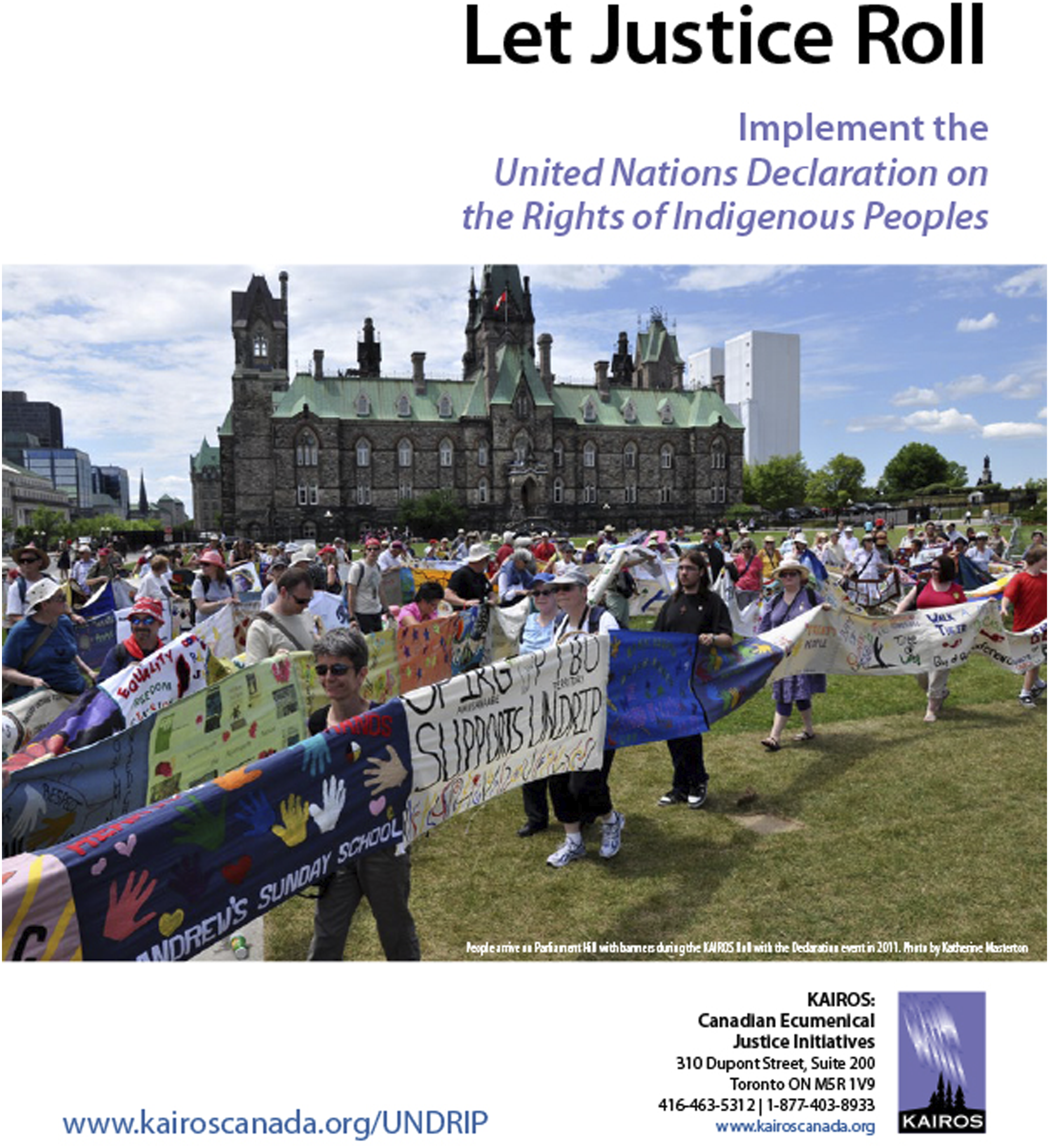
Sara describes KAIROS Canada's long-term educational efforts as coming to a crescendo in their participation at national gatherings of Canada’s Truth and Reconciliation Commission, where network members and staff,
for the first time really, really heard in a personal way the experience of colonization, the intergenerational experience of colonization. You were actually confronted with the impact of your own history. And I think that changed people, and I think it changed the organization. That was the moment, I think, when KAIROS really learned, in a visceral way, that it had to listen.
For Sara and others at KAIROS Canada's, that listening entails interrogating how white supremacy and colonial ways of being continue to shape their efforts despite best intentions:
It was always [our] position that [Indigenous partners] lead, but you can hold that position, and you can still walk alongside it with your white privilege and decide how you're going to respond. And the TRC all of a sudden said to all of us, ‘You can't do that anymore. This is different than what you think it is.’
20
The narratives these three women share reflect learning processes that weave throughout the work of KAIROS Canada and its predecessor organizations. They speak of learning to step back: to listen iteratively, with humility, and on Indigenous terms. They speak as well of learning to step up: to name and confront settler entitlement and assertions of power – their own and those of others – and to use whatever resources, influence, or creativity they have to amplify Indigenous perspectives and to create spaces where Indigenous peoples can speak for themselves. These women also describe learning to centre and celebrate Indigenous leadership while relinquishing control – over agenda, decision-making, roles, even organizational structures. They speak as well of becoming nimble, open to correction and attentive to relationship; in Sara’s words: ‘to genuinely respond to what is being asked, to be quiet, to understand that sometimes the answer is, “no, we don’t want you here with us right now”. And to be able to accept that that is the point of allyship, taking direction from someone else.’ Finally, they speak of learning to live into Indigenous understandings and protocols of relationship centred in the treaties and bringing others along in the process of learning.
Conclusion
Despite their differences, our three case studies reveal many common themes regarding settler ally roles and responsibilities and the kinds of (un)learnings and relationships required to contribute to decolonial and Indigenous-led movements. These insights include: the importance of deep listening; taking time to build trust; respecting differences and boundaries; recognizing and amplifying Indigenous voices; centring treaty principles; being humble, accountable and flexible; using one’s skills, talents, or resources to advance Indigenous causes; strategizing together; and following direction from Indigenous peoples. Many settlers involved in the Right to Belong, Freedom Road and KAIROS Canada cases also emphasized the need for diverse settlers to address the ‘Canadian problem’ (TRC, 2015) by challenging settler colonial mindsets, myths, narratives and racisms within their own communities. To a large degree, these findings are consistent with past literature on best practices and principles in Indigenous-settler alliances (e.g. Amadahy, 2008; Davis, 2010; Davis et al., 2017; Denis and Bailey, 2016; Mathur et al., 2011; Regan, 2010; Walia, 2012; Wallace, 2013).
These three cases also highlight distinctive features of long-term alliances that may be more difficult to observe in shorter-term coalitions or flashpoint events. They provide insight into how ally roles shift over time, depending on the goals and needs of the movement and the resources and capacities of the allies. They demonstrate how settlers who are in it for the long haul learn from mistakes and adapt their behaviour to dynamic situations; indeed, the effectiveness of an alliance depends in part on the ability of individual players to learn and adapt to one another. These cases also show how, as settlers learn by doing, and as they expand and strengthen their relationships with Indigenous peoples, they often become mentors to less experienced settlers seeking to work in solidarity.
As settlers enter into genuine long-term relationships with Indigenous peoples, their understanding expands over time as their eyes open to the fact that Canada is based on the dehumanization of Indigenous peoples. They develop a clearer and deeper critique of the violence of the settler colonial state and settler logics. They may have started out working in solidarity on one specific issue but come to realize that single issues are part of an intentional inter-connected system of oppression and violence. In addition, they engage in processes of learning and unlearning (Carlson-Manathara and Rowe, 2021; Hiller, 2017; Margaret, 2013), of ‘unsettling the settler within’ (Regan, 2010), as they recognize the internalized settler logics implanted within themselves (Battell Lowman and Barker, 2015; Hiller, 2017; Mackey, 2016).
Above all, the three case studies illustrate the depth of relationships and commitments that are nurtured by working in alliance over many years, such that many of the settlers and Indigenous people involved come to view one another in ‘family’ or kin-like terms and these relationships may extend beyond a particular activist struggle (cf Hancock & Newton, this volume). Long-term alliances provide the time and space to reflect on successes and failures, to identify blind spots, to interrogate colonial ways of thinking and being and to make sense of the overall trajectory not just of a movement, but of the broader collective journey towards decolonized relations.
Footnotes
Declaration of conflicting interests
The author(s) declared no potential conflicts of interest with respect to the research, authorship, and/or publication of this article.
Funding
The author(s) disclosed receipt of the following financial support for the research, authorship, and/or publication of this article: This work was generously supported by an Insight Development Grant (#430‐2018‐00,505) from Canada’s Social Sciences and Humanities Research Council.