



Abstract
In Aotearoa New Zealand, social and ethical responsibilities to work towards decolonization are shaped by the principles set out in legislation aimed at honouring Te Tiriti o Waitangi (The Treaty of Waitangi). Our study with young settler activists in Aotearoa working on a range of social issues aimed to find out how these activists thought about and worked toward enacting these responsibilities. We found that most settler activists were hesitant to speak on behalf of Māori or in ways that centre Indigenous needs and experiences because they felt unsure of how to do so in a respectful way. Many settler activists suggested they met their decolonizing responsibilities if they included Māori members in their group or collaborated with Māori groups, but others put forth additional strategies. Overall, though, activists’ sense of ‘taking responsibility’ seemed to depend on Māori guidance and, if none was available, settler activists were often paralyzed. Yet Māori are not always able or willing to guide the process; still settlers must act. This imperative is our stepping off point to explore settler activists’ articulations of their responsibilities. Based on our participants’ fluid and complex thinking about and doing decolonizing work, we propose a ‘continuum of engagement’ to explore what creates possibilities for settler activists to take responsibility and action in ways that work toward decolonization but are not dependent on Māori to guide every step.
Introduction
Regardless of the political work they engage in, settler activists must consider their relationship with Indigenous peoples – specifically how and whether their activism advances decolonization. As one part of a larger research project with young activists in Aotearoa New Zealand, we explored how these activists understood their responsibilities to work toward decolonization, responsibilities grounded in and shaped by Te Tiriti o Waitangi (The Treaty of Waitangi). 1 The responsibility to work toward a decolonizing agenda in areas of social justice and community relations applies to all settlers, but our focus in this article is on young settler activists from four of the six groups in our study: (1) Generation Zero (Auckland) 2 is working towards a zero carbon future to address the threat of climate change; (2) Thursdays in Black (UoA) 3 is working towards a future without sexual violence; (3) InsideOUT Kōaro is promoting rainbow youth visibility and safety in schools and communities; and (4) JustSpeak, whose goal is to reduce and ultimately eliminate incarceration. 4 We focus on these four groups from the wider study because they are single-issue focused, Pākehā – (or tauiwi-) 5 led, and not explicitly targeting colonial land dispossession, which makes them more comparable on questions of settler-colonial responsibilities.
Individual settler activists in the four groups we discuss here articulated an awareness of their responsibilities as they flow from the Treaty, which was not always collectively mobilized by their groups. We argue that the groups that have made progress have done so because individual members have been more successful in bringing their understandings of responsibility for decolonization to the collective in ways that are coupled with clear strategies. They had the ability (both personally and structurally) to turn their individual understandings into group actions. In groups that struggled to move beyond tokenistic responses, settler activists found it hard to translate their individual awareness into sustained group practices of responsibility for the Treaty and decolonization, often due to the group’s structure, mission and guiding theory of change.
In many cases, settler activists’ sense of responsibility, or their ability to act on that responsibility, seemed to depend on Māori guidance and, if none was available, activists were often paralyzed. Yet, as one Māori participant expressed it: ‘People fear to tread when there's not a Māori there beside them and I say there's not always gonna be a Māori so people wake up, what are we gonna do?’ We use this challenge as our stepping off point to explore settler activists’ articulations of their responsibilities under Te Tiriti, including our own responsibilities as settler researchers doing this work.
The degree to which groups are able to mobilize and take action in line with collective responsibility for the Treaty and decolonization is dynamic and varies between as well as within groups over time. Taking responsibility for contributing to decolonization is a difficult and imperfect process. We can learn what facilitates or impedes acting on collective responsibilities by understanding those groups that have struggled to implement good ideas as well as those who have succeeded. Settler subjects must act, yet as Joanna Kidman (2018) warns, they must also ‘tread softly’. What it means to ‘tread softly’ is uncertain; no fixed model exists (Stein et al., 2020: 56) This is the tension with which our participants, and we as settler researchers, struggle.
Te Tiriti and decolonisation
The discourse of Treaty obligations in Aotearoa is complicated by the existence of two versions – one in English (the Treaty) and one in te reo Māori (Te Tiriti) – which convey different understandings of sovereignty, governance and the terms for co-habitation on these islands. Most Māori chiefs signed Te Tiriti, but it was the Treaty under which the Crown proceeded to dispossess Māori, and throughout the contentious Treaty of Waitangi claims ‘settlement process', the Crown continues to privilege English rather than Māori language text. This is despite the fact that the Waitangi Tribunal, established in 1975 to adjudicate Treaty breaches, recognizes both Te Tiriti and the Treaty (Ruru, 2018). 6
Te Tiriti o Waitangi is an agreement between Māori and the Crown. Yet since the Fourth Labour government introduced the concept of Treaty principles into legislation in 1989, there has been increased focus on settler obligations in maintaining the relationships between Māori and the Crown, including the question of how settlers engage with the overarching project of decolonization. 7 Te Tiriti o Waitangi and decolonization are entwined because civic responsibilities and broad social norms about justice, fairness and social relations flow from founding political documents (Grimm, 2005; Petrie, 2002). 8 As Helen Yensen (1989: 141–142) writes, the personal and political are inseparable in relation to the Treaty: ‘Honouring the Treaty has to become a functional part of our daily lives.’
Throughout the 19th and 20th centuries the government (‘the Crown’) breached Te Tiriti by ‘taking away the things that make life possible and good’ (Elkington and Smeaton, 2020: 18) such as land and other resources, which they have an ethical responsibility to return (Tuck and Yang, 2012). Settlers colonized Aotearoa by ‘imposing their ideas about the world on Māori’ and ‘decolonization is the process of removing those impositions’ (Elkington and Smeaton, 2020: 18). Thus, engaging one’s responsibilities that flow from Te Tiriti in Aotearoa would include revaluing Māori language, practices, and ways of being, and supporting rangatiratanga (Māori sovereignty) by challenging Crown structures that undermine Māori sovereignty and returning confiscated whenua (land).
Treaty principles and debates in Aotearoa shape and serve as a critical context for how activists understand their place in Aotearoa and their responsibilities for decolonization work in this space. But while this is the context for these conversations, our article is not about the relationship between versions of the Treaty or the Crown’s privileging of the English language translation. Rather, the contribution we make is in showing the complexities as activists try to understand and do decolonizing work in civil society in the context of their activism.
While the Treaty and debates about its meaning shape civic, social and political obligations in specific terms in Aotearoa, the general themes of settler responsibilities for upholding the authority and dignity of Indigenous peoples, their knowledge and self-sovereignty are similar in other settler contexts such as Canada and Australia (Nikolakis et al., 2019). These responsibilities are ethical imperatives to act for social, political and economic justice grounded in the agreements and principles set out in founding documents and their application over time. To this end, Susan da Silva (2002) discusses the importance of having Pākehā study the Treaty of Waitangi in order to understand their commitments to take action to help bring about a truly bi-cultural society. Roseanne Black (2010) explores how Pākehā coming to recognize both Māori as tangata whenua (the original people of the land) and the social relationships set out through Te Tiriti leads to a decolonizing agenda that settlers have a responsibility to enact. Taking these arguments together, we can follow Jen Margaret (2019) and Stephanie Irlbacher–Fox (2012) to say that acting for decolonization out of moral responsibility is important, but ultimately action needs to be premised upon relationship: ‘everyone is needed…Co-existence through co-resistance is the responsibility of settlers’ (Irlbacher–Fox, 2012: n.p.). While these responsibilities may be clear enough as aspirations, putting them into practice is complicated, as we unpack below.
Locating ourselves and our participants
In all work, but particularly in decolonizing work, it is important to locate oneself as author and knower. Place and identity matter for what can be said and how knowledge can be produced (Alcoff, 2009; Stein et al., 2020). Karen is from the South Island; Carisa is an Auckland-based immigrant from the United States; Kyle is from Auckland, now living in Dunedin. All of us are Pākehā researchers grappling with our roles as settlers, and we have each at various points been involved in activist campaigns across a range of issues.
Carisa and Karen worked with Generation Zero (GZ) and Thursdays in Black UoA (TiB) while other team members, Pākehā and Māori, conducted the interviews with InsideOUT Kōaro and JustSpeak. Kyle acted as a research assistant on the project across all groups and interviewees. 9 With all of our groups we invested in ‘being present’ and ‘ongoing personal engagement’ (Hoskins and Bell, 2021: 504). Our efforts to be responsible settler researchers are evolving and imperfect, but we are committed to avoiding ‘Pākehā paralysis’ (Tolich, 2002), and to learning from our mistakes. In framing the analysis that follows, we aim to learn from rather than judge the range of participant responses, especially as our own engagements as scholars and activists continue to develop, and often fall short. Through understanding our groups’ thinking and actions, we seek to learn what might help settler activists and researchers contribute more effectively to the overall project of decolonization in settler societies across the globe. Writing this article is part of that process, acknowledging that much decolonizing remains to be done in academia in general (Kidman, 2020) and in social science research practices in particular (Kluttz et al., 2020).
Just as we need to give a sense of our own standpoint, it is important to understand who our participants were. We interviewed 15 GZ-Auckland members aged 18–28, 12 TiB (UoA) members – all tertiary students – aged 19–23, 14 InsideOUT Kōaro members aged 18–27, and 13 JustSpeak members aged 22–38. Of these 54 participants, 10 identify as Māori and another seven as both Māori and New Zealand European. The remainder are Pākehā. Some participants’ real names are used (with their permission) while others have code names or are not named if there is a risk of identification; we do not distinguish between these approaches to ensure anonymity of those who chose that option.
Our research unfolded over two-and-a-half years (2018–2020), and included participant observation of group meetings and actions plus two interviews of 60–90 minutes in length with participants, usually one-on-one and roughly one year apart. In both interviews, we asked participants for their perspectives on how their group ‘engaged’ with the Treaty of Waitangi. ‘Engaged’ is more euphemistic than asking how groups ‘took responsibility’ for decolonization. So in the analysis that follows, our phrasing of the question shaped articulations of responsibility and may have contributed to articulations that seem inadequate. One participant said the question ‘threw her’ because ‘it’s just a hard question about everyday life’ with much wider implications than what happens in Thursdays in Black: ‘how do I go about honouring the Treaty? It’s a hard question to grapple with; super important but what [does] that practically look like?’ (Astrid).
Settler allies and the work of decolonization
Questions about the role of settlers in decolonization have been asked across a number of contexts: Australia (Land, 2015; Reynolds, 2014); Canada and the United States (Wallace et al., 2010; Kluttz et al., 2020; Regan, 2010); Palestine (Svirsky, 2014) and the Pacific (Garrison, 2019). Several authors argue that settlers should take responsibility for decolonizing themselves and colonial social structures, and that this work should not fall on Indigenous people (Regan, 2010; Land, 2015; Kluttz et al., 2020). In the New Zealand context Ani Mikaere (1998) argues that Māori are not responsible for, and should not be burdened with, Pākehā guilt over colonization, nor the work of decolonizing Pākehā.
One model of settler responsibility-taking comes in the form of Pākehā Treaty education projects. Groups undertaking this work focus on Pākehā as the target of Treaty education, understanding that there is a role for self-critical colonizers to act proactively to divest colonial power (Herzog, 2002; Huygens, 2011). This work opened up spaces to engage in ideological, historical, constitutional, cultural and emotional labour, as Pākehā were challenged to re-learn much of their historical and cultural understandings (see Beausoleil, this volume). This approach supports McKegg’s (2019) argument that privileged white settlers have an opportunity, and an obligation, to unpack their privilege, and this requires more than acknowledging it. The journey of becoming an ally for indigenous social justice requires inhabiting new ideas and changing oneself. As Kluttz et al. (2020: 54) explain, ‘a decolonizing solidarity’ cannot spring from a ‘helping’ motivation; it ‘requires potential allies to recognize that they do not want to live in a world where oppression continues.’
Not everyone agrees that settler decolonization work can or should be done apart from Indigenous people (Bignall, 2014; Svirsky, 2014). Australian Aboriginal scholar Aileen Moreton–Robinson (2017) contends that an Indigenous-led relationship paradigm allows partners to push boundaries and challenge each other while maintaining ongoing ethics of respect, generosity, hospitality and humility. Rachael Fabish (2014), a Pākehā New Zealand scholar, engaged in a deliberative cross-cultural activist group to explore issues of decolonization within activism. She concluded that having Pākehā and Māori thinking together about decolonization facilitated learning about colonialism and its inherent privileges, and enabled opportunities to sit with discomfort, guilt and shame across cultural difference. It also provided opportunities for the re-making of Pākehā identity (Fabish, 2014). When this argument is put forward by a settler scholar, it might signal a heightened awareness of the need to be respectful of Indigenous aspirations and the goals of tino rangatiratanga (self-determination), but it could also reflect an unwillingness to risk getting it wrong or to work without the ‘cover’ of having Indigenous people to vouch for one’s good intentions. And, as the title of our article claims, there are not always going to be Indigenous activists available to help settlers do their work: they have other priorities, and are often spread too thin.
Sometimes settler subjects need to get on with doing the work of decolonizing, at least their own spaces and practices if nothing else. This raises the question of how best to serve as an ally. Engagement in the work of being a settler ally presents the challenge of how to speak about colonizing processes and their impacts on Indigenous peoples from the perspective of a beneficiary of those processes. This has to be done only in spaces where it is appropriate and in a way that does not recentre white stories or take the focus off of those who are oppressed (Miller, 2018). Stewart (2020: 11) argues that allies are those who have done the thinking required to understand the history and nature of the Māori-Pākehā relationship. Allies understand that they should not speak for Māori; rather, they should speak to the problems of colonization and shifts they can make in their own practices.
Pākehā are approaching this work with the goal of supporting Indigenous struggles, yet the location that someone speaks from, and the privilege that exists in that location, cannot simply be erased through good intentions (Kidman, 2018). Speaking for, rather than with, others in these contexts can reimpose oppressive power structures (Alcoff, 2009; Kluttz et al., 2020). This can happen especially when decolonization is taken up metaphorically, as a change in how one thinks about oneself or others, rather than materially (Tuck and Yang, 2012). If decolonization remains metaphorical, there are three key risks. First, settler allies will use ‘ally’ relationships with Indigenous people to perform what Bell (2014) has termed a ‘double settler move’ – seeking redemption through performative statements while continuing to colonize Indigenous people in activist spaces through acts of exclusion or marginalization within settler-led movements. Second, metaphorical allyship risks Pākehā abjecting themselves to an idealized Other while diverting the debate from the material conditions of oppression to their own psychic malaise or bicultural-neediness (Lawn, 1994; Newton, 2009). Third, the challenges of allyship can provoke ‘Pākehā paralysis’, an inability to engage constructively through fear of making mistakes (Tolich, 2002).
Retreating from speaking about oppression is another way of abandoning political responsibilities. It is common for settlers, as they begin to enter spaces of allyship, to find themselves carrying a burden of guilt over the ways they have come to occupy their positions of power and privilege, particularly insecurities about the legitimacy of their place on stolen land (Mikaere, 2011). Fabish describes how, in her research on anarchists, she often encountered Pākehā paralysis where activists resisted engaging with feelings of guilt around colonization (Gibson and Fabish, 2017). Paralysis and resistance to discomfort are tied up with privilege (Land and Margaret, 2013). This is the opposite of taking responsibility. Hence, the tension between the need to act, but also to tread softly (Kidman, 2018).
Activists need to learn to navigate conflicts and contradictions in allyship (Kivel, 1996; Kluttz et al., 2020), and to be reflexive about whiteness, power, privilege and one’s motives in speaking with and for others (Alcoff, 2009; Mott, 2016; Morris, 2017). Arguing against paralysis, settler activist Tim Howard argues ‘there is a challenge to us not to go into the relationship as passive, unthinking servants but to go in with some strength, with some spine. We’re more use to Māori if we’re coming in with all our skills, all our strength, and particularly all our integrity’(Howard and Margaret (2013: 39). Since we can’t turn back the clock on settler colonialism, how can settlers use their power, privilege and skills to avoid perpetuating past harms and to reimagine relations of social and political power?
Decolonizing as settler – allies: A continuum of engagement
We have organized our discussion into a continuum of understandings and practices derived from our analysis of the interviews conducted for our study (see Figure 1). The continuum indicates the range of ways our participants articulated their understandings of ‘Treaty engagement’. Continuum of engagement.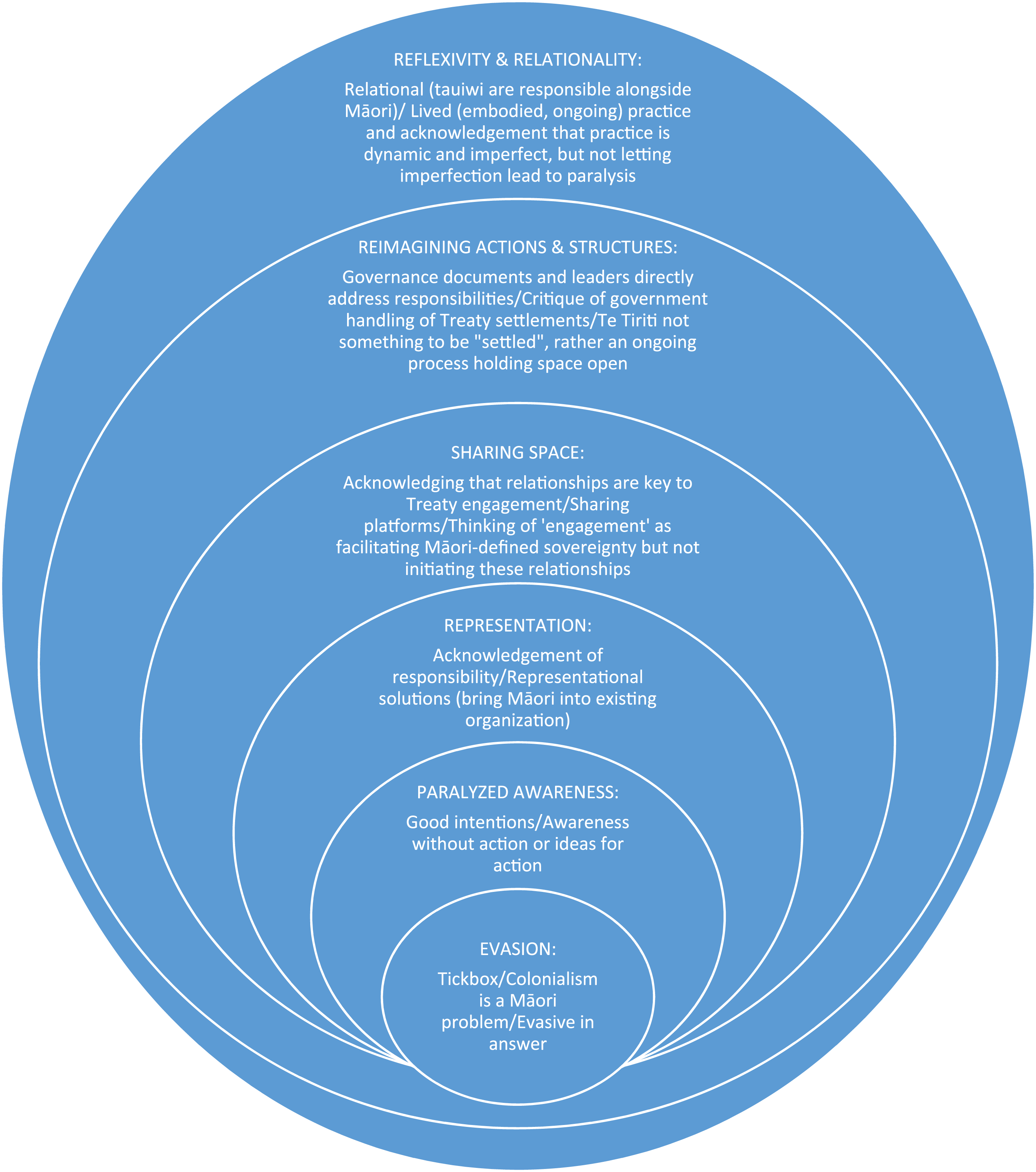
There were subtleties within as well as between different positions along the continuum. As we discuss, grappling with settler decolonial responsibilities is a process, not an end point, and practices were not discrete. In using a continuum as a heuristic, our intention is not to ‘fix’ a participant’s response to a particular position but rather to indicate how their reflections shared some common ground with others during the course of the study, with the possibility they might move in either direction or articulate multiple positions during the same interview. Formulating Treaty responsibilities as processes along a continuum represents how the stages in this process overlap for our participants, resisting an implicit ‘progress narrative’, and allyship or Treaty engagement as an ‘achieved status’. Rather, this work requires ‘continued questioning and constant un-settling’ (Kluttz et al., 2020: 53).
We include reflections from Māori as well as Pākehā participants. Māori and settlers were diverse in their ideas about, and commitments to, decolonizing their activist groups. Some Māori participants said they felt alienated because they were expected to have ‘Indigenous knowledge’ that they did not possess, or to embody the decolonial work of the group. Although we ultimately had space for only a small number of quotes from a rich data-set, our selections exemplify key positions on the continuum, often reiterated by many participants we did not have space to include.
From evasion to representation
In this section, we present examples from the first three locations of the continuum, moving from answers that were ‘evasive’ to those demonstrating ‘awareness without action’ to ones offering ‘representational solutions’ such as bringing Māori into the existing organization. Evidence of these three positions occurred across all four groups, and participants’ responses often skated across the three locations on the continuum. The problematic nature of Pākehā domination of each group was identified by many participants, but they were stumped as to what they could do. For example: I think that another issue with Thursdays in Black is it’s a very Pākehā-dominated club, and I definitely think that has issues. How to solve them, not sure. (Jenna, TiB)
This sense of ‘evading’ responsibility overlapping with a ‘paralyzed awareness’ of a need to do something without then doing it was echoed by other participants. Often these overlapping responses were couched in explanations that suggested nothing would be done without Māori activists present. Participants then speculated about why Māori might not be able easily to join their group or why the Treaty might not be top of mind when the group was planning an action or campaign: I'd like to say yes [we’re engaging with the Treaty] but I don't know. I doubt that. I think that's kind of also a symptom, like we're… a lot of students, and so a lot of like Auckland Central which means pretty far away from South Auckland which is where the majority of Māori and Pasifika people live so that kind of also counts against us, just geography-wise… But I would say people in Gen Zero recognize, everyone recognizes, it's a problem and understands the Treaty is important and we need to do more but we just haven't done it. (Logan, GZ) When we ran parking day…it wasn’t like we kind of sat down and were like ‘Oh how is this parking day going to be in line with the Treaty?‘… I mean, High Street is where we held it so it probably was Māori land, it definitely was Māori land at some point. I don’t know actually, yeah now you mention it. I personally didn’t really consider that, so maybe we could incorporate it more. (Zoe, GZ)
These two participants were both aware of expectations their group should engage with the Treaty but could not yet imagine how. Their comments (and others) point to how preconceptions about who Māori are can limit one’s vision – for example, Logan’s comment misses that many Māori live and work in central Auckland. Zoe identified how the Treaty did not immediately come to mind when they were planning campaigns, yet the question prompted her realization that Parking Day – an informal occupation of car parking spaces with games and entertainment to show alternative uses for central city spaces – was taking place on colonized land. Thinking of only some issues or spaces as ‘Māori spaces’ limits understanding and action.
Others acknowledged that their group was not yet ‘engaging’ with the Treaty but they were willing to think through what it would mean to do so and had ideas about how to move forward even if they didn’t know how to push their ideas into action. Often these members articulated ‘representational’ answers for how to meet Treaty responsibilities, that is the sense that to meet these responsibilities a group needs to have one or more Māori member(s) to ‘represent’ Indigenous experiences and interests. I think the fullest way that [TiB] could engage…is to actually create a space that is accessible for Indigenous people, you know whether it be Māori or from other countries, to come in and discuss those issues with us and help us build them. (Brooke, TiB) We’re a very, very, very Pākehā group. So, that’s always an issue…. In terms of what we’re doing to solve that, I don’t actually know. [But] I think the biggest one would just be more Māori/Pasifika participation in our groups. It would be really cool to see that. (Luke, GZ)
These responses place the onus on Māori and other Indigenous peoples to ‘come in’ to help build a space that is accessible and/or assume that what Pākehā have built can be readily used by ‘non-white’ others. They also essentialize Māori into a homogenous group. Still, representational responses begin to suggest the importance of working in relationship with others. In response to a follow-up question asking how Generation Zero could facilitate Māori and Pasifika participation in the group, Luke replied
It would be really good to go to those areas and try and engage more. So, for example, one of the things we always do for our campaigns is submission parties. So … we’d host evening submission parties where people come in and submit on something, and we provide them with a guide. And we did a lot of those in South Auckland. I think we could’ve done better at that because we could’ve, actually, talked to schools down there, and got them to come. But we did pop-up submission parties in Papakura and Manurewa. So, that is cool because it’s really kind of going right into communities that are more Māori/ Pasifika. And showing what we do, and hopefully encouraging participation. Other than that, though, I don’t know much more than participation, in terms of what we could do in terms of the Treaty of Waitangi, admittedly.
One problem with relying on representational solutions within existing groups – bringing in ‘people from diverse backgrounds’ as another participant put it – is that the work of moving the needle on Treaty engagement often then falls to those non-Pākehā members.
Below, Yasmin from TiB acknowledges the need to see Māori perspectives and hear Māori voices in the work that they do. But her understanding of what engagement means in practice is still framed in a representational model: using te reo Māori alongside English on the ‘merchandise’ without engaging in the broader significance of how te ao Māori (Māori worldview) infuses the language.
A lot of our merchandise [badges and t-shirts] is in te reo and English, I think that’s really nice to have that representation of culture and yeah I guess, it’s kind of hard to say how we might explicitly incorporate the [Treaty] principles etc.… I think it would be cool if… the Exec [had] more of a Māori/Pasifika perspective, especially if we had some people on our Exec who kind of identified with that, which we don’t have currently, to my knowledge. (Yasmin, TiB)
The representational solutions proposed here were somewhat vague; there was a sense they might not be put into action. There were, however, representational solutions suggested where more reflexive work was evident. In the following example, Jenna was critical of TiB’s lack of engagement and identified how they did not have good models to follow:
I don’t really think other organizations engage with the Treaty particularly well if you’re looking to how like the Government works, engages with it and it’s ‘oh tick off the principles,’ they’re like, ‘I think we just have to consider [them] and we’ve considered them.’ I think if maybe there was some higher up organizations that demonstrated and modelled how to incorporate the Treaty into organizations, [but] then I also probably shouldn’t pass on responsibility for that. (Jenna, TiB)
When asked in a follow-up question what meaningful engagement would look like, Jenna replied ‘I think that’s also something that would need to be had in conversation with someone who’s Māori. I’m Pākehā’. (Jenna, TiB)
Jenna was aware that Māori need to shape what counts as meaningful engagement, and she was frustrated at the lack of models or guidance for doing that engagement. She both displaces her responsibility for doing the work – the conversation needs to include Māori but ‘I’m Pākehā’ seems to preclude the conversation – at the same time that she acknowledges she’s avoiding a responsibility she could take on. She says later in her interview that her group’s engagement using te reo on their badges is ‘not enough’ and they need more Māori students in the club – again, a representational idea of bringing Māori in to lead the way in a Pākehā space – while saying ‘I don’t know how you kind of take that first step without it being a token gesture and moving into like real meaningful [engagement]… I don’t know’.
In short, for settler activists to take up relational responsibility, there was an expectation of engagement with Māori and at the same time awareness that this placed a further burden of responsibility on Māori:
But then you don’t want to, you know, reach out to Māori communities and expect them to put in that labour. I dunno, it’s complicated. (Jenna, TiB)
Jenna is grappling with tensions and demonstrating a willingness to sit with them. She, like many other participants quoted in this section, indicated the beginnings of an analysis of why their groups did not know what to do and/or why Māori and Pasifika young people might not join. Jenna and Luke hint at how representational responses can be part of thinking about relationship building, opening up toward the rest of the continuum. This shows, again, how the circles in the continuum are nested and actions are potentially overlapping. In the next section, we move further along the continuum to analyze participants’ responses about Treaty engagement and settler responsibilities that were more nuanced but did not translate into consistent actions.
Sharing space: Tread softly, but take action
Some participants had more developed analyses of what responsibilities to the Treaty and decolonizing work should entail and some ideas about tactics, even if they haven’t yet been able to bring that understanding to fruition in their groups’ documents or actions. There were a range of responses that we have grouped in ‘sharing space’ on the continuum, which sometimes included aspects of other circles on the continuum as well.
It’s important to try and listen and understand first before you act, otherwise you can end up not helping. (Rhys, GZ)
There needs to be a pathway which centres Mātauranga Māori [Māori knowledge] values because…how I might respond to sexual assault and the help I might want or need, that could look completely different to someone…who is Māori…I think the Uni needs to maintain awareness of the biculturalism of New Zealand and the different cultural practices and how…someone who’s Māori might want much more community-centred kind of support than I. (Astrid, TiB)
It’d be good if they [TiB] could also play a supporting role to Māori organizations that are wanting to talk about this or like make change on this so maybe that would be the better way, you know like do it in conjunction with other groups. (Mackenzie, TiB)
Listening and understanding before acting is one way to negotiate the importance of treading softly where action is still envisaged. These participants articulated the importance of Pākehā reaching out to, and supporting, Māori groups rather than seeing Treaty engagement as dependent on representational solutions such as Māori joining, leading or providing guidance to Pākehā-dominated groups. In advocating for a bicultural model for survivors of sexual abuse and thinking about playing a supporting role to Māori organizations rather than expecting Māori to do the supporting, these participants straddle a fine line between an awareness of responsibilities (illustrated in the previous section) and taking action on that awareness.
Similarly, Steven, from Generation Zero, offers one of many examples of participants moving across positions (circles) on the continuum of engagement (Figure 1). He acknowledged that GZ needs to and is working to ‘decolonize ourselves and decolonize the campaign’ and on how they put that into action.
We’ve actively now tried to share our platform and our privilege with…Indigenous climate change groups as well so… we were able to get a meeting with Shane Jones [Māori Member of Parliament] and… we were like… we’re going to allow others to come with us on this. So we’re just going to use our privilege and our platform to book the meeting and get it seen but it’s really about bringing others with us so bringing Te Ara Whatu [an Indigenous climate action group]… who are very suspicious of us, which is fine, really important, and put us in our place... .(Steven, GZ)
In JustSpeak, a similar approach to using privilege was articulated by many in the group as ‘leveraging privilege’ and knowing when to ‘pass the mic over’.
It’s really important to walk the line between leveraging your privilege and using it to get onto those platforms to then challenge other privileged people. But then, when the time’s right, pass the mic over to the people who are actually more affected by the issues that you’re talking about. (Charlotte, JustSpeak)
What we’re trying to do is to use the privilege and the enthusiasm of a lot of white privileged volunteers…and saying actually the racism in our system is not a Māori issue, it is an issue for all of us to take forward and… that means being really, really specific and intentional about where JustSpeak plays and where it doesn’t to make sure that we’re not taking the voice or using a platform that shuts other people out. (Cath, JustSpeak)
These three quotes indicate subtle differences in, and reflexivity about, decolonizing work both across and within organizations. And they straddle a few circles in the continuum. In inviting Te Ara Whatu to their meeting with a Member of Parliament, GZ moved beyond an ‘awareness’ of responsibility by actively sharing their access to power, while also acknowledging the suspicion Māori express and the good reasons for that, demonstrating a more reflexive stance further developed in larger circles on the continuum. Where GZ shared one platform with Te Ara Whatu, Charlotte and Cath reflect on sharing space as well as moving aside (‘passing the mic’) so those most directly affected can have it. Treading softly means being willing both to call out racism and, in some contexts, to step back from speaking (Miller, 2018).
Reimagining actions and structures: The importance of leadership
The differences between settler and Māori activists within organizations is important to our unfolding analysis. And given the differences within organizations, the degree to which individuals have the ability (both personally and structurally) to influence the group can make a difference to the kind of decolonizing work the organization as a whole engages in. Decolonizing work does not just happen; it needs advocates. For example, Jess (TiB) argues that during periods when the national TiB group is more active and cohesive, the work of local chapters reflects ‘more of an awareness of the Treaty and partnership’. The shift from awareness to doing requires leadership and an explicit structural commitment to the work, represented by the larger circles in the ‘Continuum of Engagement’ (Figure 1).
For both InsideOUT Kōaro and JustSpeak, group leadership and work with Māori consultants were key to collectively addressing settler responsibilities for decolonization, though this consultation came at different points in each group’s timeline. In what follows, we first analyze InsideOUT Kōaro’s more recent initiative, then in the next section consider JustSpeak’s longer-term work to ensure their governance documents and processes reflect the Treaty and decolonization. We are attentive to the diversity amongst settlers and Māori within these groups, and that governance documents and efforts to mobilize collective responsibility are important but do not always ‘trickle down’ to how members understand the key aims of the group.
Over the last two years that we spent with them, InsideOUT Kōaro worked to incorporate greater understanding of the Treaty, te ao Māori, and of Māori conceptions of gender and sexuality into their work. Their strong relationship with takatāpui (queer) activist and scholar Elizabeth Kerekere provided authority and direction for revamping the organization’s governance documents and modes of action. Taking collective responsibility for decolonizing queer spaces and queer activism involved changes to how they conducted meetings, conceptualized their work and engaged with Māori concepts. Some of the leadership fell to Māori members of the organization and outside Māori consultants, but Pākehā members with personal knowledge and commitment shared the burden.
InsideOUT Kōaro members shared long, detailed examples of these new initiatives; we have space to share just excerpts of key quotes here. Max, who is Pākehā, explains that ‘Just in the last month or so, I think we had…a series of three different workshops around te ao Māori.’ Annie, also Pākehā, elaborates on this point, but qualifies her comments with ‘I’m gonna tread carefully here purely because I think that I need to work on it a bit more’: We recently did a massive changeover… on a board level, like, policies, to reflect Māori principles and the Treaty. We’ve also had a number of workshops on te reo Māori … And, also… InsideOUT has implemented karakia [prayers or ritual chants] to their sessions, and are actively working with rainbow Māori organisations. So, it’s something that they're actively doing, rather than kind of one-off or somewhat sporadically. (Annie, InsideOUT Kōaro)
Annie is cautious about this work being enough but gives a sense of the range of actions that have been taken. Some actions from across the continuum are in evidence. While karakia or occasional use of te reo Māori could be read as tokenistic, when layered with building relationships and changing leadership practices, they can become more robust forms of decolonizing practices.
Annie offers one reading of InsideOut Kōaro’s efforts. The next quote, from Kate, illustrates our points that there are differences within groups, and documents and practices do not always filter down the same way to all members:
I personally haven’t been involved in much of this work, but I think I know that, as individuals and as an organization, it’s something we’re really, really committed to. And we know we don’t have it right yet. (Kate, InsideOUT Kōaro)
All InsideOUT Kōaro interviewees spoke to how their Managing Director Tabby modelled Treaty commitment and responsibility to take action. This included her role in leading the group’s annual multi-day meeting at a marae (Māori gathering place) and ongoing learning about te ao Māori. Lottie summed it up: I feel like InsideOUT just wants to be better and wants to make people’s lives better… Tabby really pushes that…but everyone else wants to learn it as well… Being in InsideOUT, there’s definitely that sense of responsibility and sense of commitment to that… But I’m also Pākehā, so, I can’t say that that is what is happening, and the Māori members feel that that is what is going on. (Lottie, InsideOUT Kōaro)
Here Lottie introduces an important test: how Māori members perceive and experience settler responsibility and action. In interviews and later follow-up communications, some Māori members suggested that InsideOUT Kōaro’s response is a mix of reflexivity and what we describe in the second circle of the continuum as ‘paralysed awareness’, good intentions without (significant) follow-through. On the one hand, they noted that ‘there’s been a lot of really good progress':
one of the things that’s come out of the workshops with Elizabeth [Kerekere] is that we have … reframed our strategic plan which is…the document that we update annually…with the framework that Elizabeth generously donated to us. [And] it’s really great having the input and shared knowledge of other Māori and also Pākehā who are proficient in that understanding with te ao Māori and also te reo which is like refreshing because it feels like all the onus doesn’t have to be on us as Māori.
Yet they’ve also told us ‘there is still significant work yet to be done’.
It is also important not to essentialize Māori, or to assume that just having a Māori group member means your group is doing decolonizing work. Māori have differing degrees of knowledge about te ao Māori, and it’s a heavy burden to expect Māori to ‘represent’ an entire people and history, as this quote from Avante illustrates:
Māori and
Pasifika
activism, it felt almost, it sounds really bad, but it felt not as important to me. But then I realized that as I’m Māori, it actually does make an impact. And, also, that I should’ve been paying more attention as, you know, we live in this country, and we have a duty to our Indigenous folks. (Avante, InsideOUT Kōaro)
Through the work InsideOUT Kōaro has done to bring te ao Māori into the group’s practices, members have grown in their personal understanding of how thoroughgoing colonialism is. Shay, who is also Māori, initially thought that InsideOUT Kōaro’s main goal is to ‘help with LGBT specific identities’ but being part of the organization meant I got confronted with the effects of colonization and the erosion of my culture… partially through the work, the te reo workshops at InsideOUT. That was interesting and overwhelming but important… Now I’m seeing exactly how much it affected my family line and why I always felt so awkward or disconnected from my culture…. (Shay, InsideOUT Kōaro)
In this section we canvassed a greater number of interviews from InsideOUT Kōaro to illustrate the range of ways activist groups led by settlers can usefully take on the labour of initiating decolonizing work, which might benefit settler as well as Māori members of organizations. The perspectives outlined here again straddle different areas on the continuum of engagement, from ‘reimagining’ governance documents to ‘reflexive’ embodied practices of allyship.
Reflexivity and relationality: Doing the mahi (work) of settler colonial responsibilities
When you’re trying to create a different looking world, you can’t do it by just looking like the old world. (Carla, JustSpeak)
Where InsideOUT Kōaro has historically been led by Pākehā members, JustSpeak currently has Pākehā leadership but its initial establishment in 2011 was led by Māori. Their governance documents and processes were set up to mirror a Treaty partnership. As such, they provide additional ways of conceptualizing work in the wider circles of the continuum.
JustSpeak was conscious that the predominance of settler staff and volunteers conveyed a powerful message to those who encountered JustSpeak face-to-face, despite having a Board that is currently 50/50 Māori/non-Māori. JustSpeak understand that they are not, and cannot be, a Kaupapa Māori organization, that is, one run by and for Māori. Instead, one Māori Board member thinks it is important to consider how do we make JustSpeak be the good leader as a Tangata Tiriti [People of the Treaty, referring to the role of non-Māori New Zealanders] organization and so that means building awareness, capability inside of ourselves…so therefore anybody who comes to our space…understands those relationships…[A]nd that just means more education, more talking about what are really uncomfortable conversations and checking our own selves... . (Grace, JustSpeak)
Grace, who has ‘whakapapa to both Tangata Tiriti and Tangata Whenua’ (has Māori and Pākehā ancestry) here speaks to the reflexivity that’s required in decolonizing work, and she makes clear that this process is ongoing. Even when you get it wrong, you have to keep trying.
JustSpeak’s Treaty engagement as a reflexive process over time was also articulated by the current Board Chair Jordan (who is Pākehā). Grace and Jordan situated JustSpeak’s work across the two biggest circles of the continuum in Figure 1 above, involving governance structures such as a bicultural Board and relational sharing of responsibilities between Māori and settlers (‘tauiwi’) to decolonize the criminal justice system. I don’t think there’s any question over the foundational importance of the Treaty, particularly around, like, partnership as a primary thing where it’s not about us as primarily Pākehā, educated women to solve the issue… So it’s kind of like identifying our positionality in this environment and reflecting on that and reflecting on the community’s needs over our own personal needs and trying to fulfil those first. (Jordan, JustSpeak)
Partnership is a key feature of the wider circles in the continuum. The bicultural Board means recruiting Māori into JustSpeak to work in relationship with tauiwi as part of a power sharing process intended to facilitate Māori self-determination: …we recruited specifically for Māori board members recently, and we recruited for one and we ended up bringing on two because they were such high-quality candidates … And so I think that in a little while [one will be] in the position of knowing the organization well enough to [co-chair and]… having a Māori caucus and giving them the power to do, you know, whatever they need to do and have, you know, equal say in the Board and to take leadership of the… stuff around Te Tiriti and what that should look like… Even though we’re not doing it right now… it’s in our documents, we’re working toward it in a meaningful way, here’s our steps that we’re taking…There’s been a lot of difficult conversations over the last two years but I’m really happy with where we’re getting to now and I think that our Māori Board members are as well which is the most important thing because it’s not for me to say what that should look like. (Jordan, JustSpeak)
Jordan’s words demonstrate how the smaller circles in the continuum above were integral to JustSpeak’s evolution towards working in the bigger circles. Recruiting Māori on to the Board can look like a number of different things. It can be tokenistic and burden Māori with decolonizing labour (it is, in essence, inviting Māori into a Pākehā space). But it can also be a way of sharing resources, handing over power and working with Māori to ensure JustSpeak’s actions and campaigns serve the community they are working for: Māori affected by the criminal justice system.
But it is not enough to have Indigenous members on governing boards. It is also important for settler activists in the organization to engage in ongoing reflexivity about their own position and what they can, and cannot, do. JustSpeak needs to be a collective endeavour that invites Māori to a table that has not been pre-set. Julia, who is Māori, articulates why Māori representation and leadership matters, and some of the work she sees still needing to be done: [JustSpeak] doesn’t operate in a Māori way. It operates in a very Pākehā way … it’s important to have Māori eyes on things, and the Māori world view, and to have power in terms of decision making of how resources are spent when they’re so scarce in this area. (Julia, JustSpeak)
Still, tauiwi benefit from colonialism so the burden is on them to do the heavy lifting of undoing it, as Pākehā member Tania articulates: [JustSpeak is] a group of mostly, not entirely but definitely mostly, Pākehā or tauiwi volunteers and staff members and just trying to negotiate that complicated space of saying you can’t not talk about it because then you’re essentially reneging your responsibility and you’re also putting all the emotional labour and actual labour on Māori and that’s not fair either… I think a lot of it is more about how we focus our time and our energy in a way that shares the burden but doesn’t take up space that we shouldn’t take up. (Tania, JustSpeak)
As we discussed earlier in relationship to the potential perils of allyship, tauiwi can not speak for or as Māori, but can speak to the central problems of colonization. JustSpeak still has work to do as many in the organisation would acknowledge, and Tania’s and Julia’s perspectives highlight the ongoing tensions in taking responsibility. Practices are dynamic and imperfect, yet imperfection must lead to critical reflection that informs future practices, not to paralysis.
Conclusion: Decolonizing is a process with cross-cutting responsibilities
The ability for some youth activist groups to engage their settler responsibilities more robustly than others stems from a variety of factors. Where turnover is high (such as a university-based group like Thursdays in Black) and membership remains young and resource poor (in terms of time, money and bodies), even members who have good ideas for engaging deeply with settler responsibilities have little support or opportunity to put actions in place or bring a small, fluctuating membership on board with serious decolonial action. Groups that are more successful have embedded Treaty responsibilities into their governance documents and Pākehā members have taken it upon themselves to teach each other about te ao Māori, or to bring in consultants to start work that they then take forward.
Conceptualizing our participants’ work in a continuum of engagement captures the importance of leadership, reflexive listening and ongoing structural commitment. In this way our findings reflect and bring specificity to the local and international literature we explored at the start of this article: good intentions are insufficient. Settlers need to do decolonizing work in partnership with Indigenous people, whether that partnership comes in the form of a bicultural board, bringing in Indigenous consultants, or an in-depth reading of Indigenous work and Te Tiriti history. Settlers need to ‘tread softly’: step up and, when necessary, step back (Kluttz et al., 2020: 63). Moving from smaller to larger circles in a sustained way requires turning a decolonizing lens on settlers rather than continuing to make Indigenous people the ‘other’ to be studied. As Tricia McGuire–Adams (2021) writes, ‘settler allies are made, not self-proclaimed’. This ‘making’ is an active, reflexive process, and it means negotiating when and where to act in ways that are most useful (Miller, 2018) and also ‘with some strength, with some spine’ (Howard and Margaret, 2013: 39). So even as decolonizing work must be done in some form of partnership with and accountability to Indigenous people, settlers cannot always wait to act or expect Māori to take them by the hand. As our title quoting one of our Māori participants implores: ‘there’s not always going to be a Māori [beside you] so people wake up, what are we gonna do?’
This dynamism and complexity of being an ally and taking responsibility is reflected in how individuals and groups moved through the continuum of engagement. In the smaller circles of the continuum, we can see that many people know the work is important, or should at least be acknowledged, but are unable or unwilling to imagine how to do it. Yet groups and individuals change over time and bring members along with them. Leaders make Treaty engagement a priority; structural commitments sustain this engagement through leadership changes. Guidance from other groups and individuals can provide resources to build capacity and knowledge, and members who are willing to listen can take on board feedback and grow.
While many groups could certainly do more work to translate their awareness into actions, it is also not up to youth activists to figure out this process alone. Leadership comes from outside, as well as inside, activist organizations. On the one hand, when activists like Jenna say there are no good models for how to proceed, they evince a blindness to decades of activism and writing that has been done, thought and disseminated. Part of settler responsibilities is to do the reading, the digging into the histories, to learn from the work that Indigenous activists and settler allies have made available. On the other hand, there are multiple axes of responsibilities, and multi-generational activist engagement is necessary. For example, more and better media coverage of history and activist teachings is needed. And Pākehā researchers need to be more willing to talk publicly about our failures and our successes in meeting our settler responsibilities to help others overcome ‘Pākehā paralysis’.
Footnotes
Acknowledgements
The authors thank Avril Bell, Joanna Kidman, Rose Yukich, and two anonymous reviewers for their generous feedback on earlier drafts.
Declaration of conflicting interests
The author(s) declared no potential conflicts of interest with respect to the research, authorship and/or publication of this article.
Funding
The author(s) disclosed receipt of the following financial support for the research, authorship and/or publication of this article: This work was supported by the Marsden Fund Council from Government funding, managed by Royal Society Te Apārangi under Grant UOO1730.
