



Abstract
This study investigates, using an experimental study, the consequences of negative and positive media messages on young Muslims by gaining insight into who, and under which circumstances, engages in certain collective or individual identity-management strategies. Based on Social Identity Theory (SIT) and previous literature, we expect that negative and more positive media messages moderate the relationship between the degree of identification with the religious group and the application of identity-management strategies. Factor analyses illustrate the presence of at least three types of strategies: collective-fight strategies (meaning one is willing to fight for the group), collective flight-strategies (that entail no change of the status quo) and individual strategies (strategies that solely benefit the individual). Contributions are made empirically and theoretically. Empirically, we measure and group all proposed identity-management strategies based on our findings among the same research population. Theoretically, we hypothesise about how both negative and positive media messages condition the role of religious saliency for Muslims’ identity-management strategies. Results from a survey-embedded experiment among Dutch Moroccan and Turkish Muslims show that high identifiers are more likely to apply fight strategies, and less likely to apply individual strategies (in line with SIT). Regardless of tone, exposure to messages mentioning Muslims make the application of fight strategies more likely among high identifiers. Meanwhile lower identifiers feel a reduced need for change when exposed to more positive messages. These insights in the (mutual) role of religious identification and media messages shed new light on how media messages can bring about group distances, intergroup conflicts and intragroup cohesion and provide a stepping-stone for future research to further insight in the systemic and long-term implications thereof.
Introduction
Growing cultural, religious and social diversity have triggered a large debate on migration issues across Western Europe. The position of immigrants is constantly shifting, and currently Muslims, in particular, are considered ‘problematic’. Politicians of populist radical right parties stress the threat of Islam (De Lange and Mügge, 2015; Shield, 2017; Spierings and Zaslove, 2015), while mass media have become increasingly negative about this specific religious group (D’Haenens and Bink, 2007; Lepianka, 2017).
Such increased hostility can contribute to alienation, experience of discrimination, stigmatisation, talking back, collective action and can potentially even trigger radicalisation (Neumann et al., 2018; Rafiqi and Thomsen, 2020; Saleem et al., 2019; Van Den Brandt, 2019; Van Es, 2019). These negative depictions in media challenge positive group distinctiveness among (young) Muslims (Abrams and Giles, 2007; Brown, 2000; Branscombe et al., 1999; Tajfel and Turner, 1979). According to Social Identity Theory (SIT) (Tajfel and Turner, 1979), there are five strategies for minority members to apply in order to deal with negative group distinctiveness. These identity-management strategies are versatile, and we still know fairly little about if and under what circumstances Muslims choose to engage in (which of) these strategies.
We contribute to previous research by explicitly measuring all of these strategies distinguished by Tajfel and Turner (1979) among the same research population and theorising about the conditioning effect of media messages for the well-established association between religious saliency and identification-management strategies (Şafak-Ayvazoglu et al., 2020). Building on SIT, and in line with factor analyses presented in this study, we divide the several strategies into three sub-types. These are, collective-fight strategies, collective flight-strategies and individual strategies. To a certain extent, this distinction resonates with Tajfel’s (1975) analysis of how Hirschman’s (1970) voice and exit analysis can be extended to the intergroup context, in which applying so-called collective-fight strategies can be an expression of ‘voice’ and individual strategies of ‘exit’ and thereby choosing individual social mobility. One expectation that is stressed in the literature and in the theory alike, is that the likelihood to come into action depends upon one’s attachment to the group (Liu, 2006; Saleem et al., 2019; Wojcieszak et al., 2017). We aim to take this expectation one step further and develop arguments on the moderating impact media messages may have on the application of these strategies.
Hence, we expect that a person’s degree of identification is affected differently by exposure to certain media messages. We therefore hypothesise that media messages bring about different effects of religious identification in applying a particular strategy. By means of an in-survey experiment, we will find out the role media messages play in the negotiation of Muslim identities and partaking in identity-management strategies.
Furthermore, we investigate not only the role of negative but also the impact of positive media messages. We are thereby able to answer the question concerning whether a more positive connotation reduces the already extant tendency to select and apply certain strategies, or whether, regardless of tone, the simple exposure to a message in which one’s group is discussed is enough to trigger a certain response. The aims of our study are combined in the following research question: ‘What is the role of religious identity salience in choosing certain types of identity-management strategies among young Muslims, and how does this role depend on positive and negative media messages?’
We identify two key contributions to previous research. First, this study has ample theoretical and empirical value, as it provides us with additional insights in the mechanisms behind SIT’s identity-management strategies by introducing the context of media exposure and how this affects the well-established association between religious identification and identity-management strategies. Rather than investigating one, we theorise about, as well as test, the wide range of strategies which were included in our survey (see Mummendey et al., 1999 for one of the few studies which have done so). We hereby build on a range of previous studies exploring some of these strategies or other responses of Muslim citizens (Şafak-Ayvazoglu et al., 2020; Van Es, 2019; Van Den Brandt, 2019; Verkuyten and Reijerse, 2008). Second, where previous studies have predominantly explored the role of negative media content, we acknowledge both negative and positive media message to inform debates on how the tone of media messages triggers certain responses. Thus, this article has a very concrete societal relevance: it allows us to see how a large minority group engages with, and responds to, news content. We study this using a single manipulation study among young (age 18 to 45) Muslims with an immigrant background (generation 1.5 and beyond) in the Netherlands, a group that makes up the largest portion of the migrant population in the Netherlands. These Muslims lived the largest part of their conscious lives in a post-9/11 society, a period during which Muslim depiction in media became increasingly negative (Abdullah, 2015). We aim to study the consequences of this by shedding light on who, under which circumstances, engages in what type of identity-management strategy. In doing so, we provide new information regarding larger debates on societal conflict as well as potential radicalisation processes of Muslim minority groups.
Muslims’ portrayal in Dutch media
Though we have ample knowledge of media influences on prejudice towards various immigrant groups, including Muslims (e.g. Czymara and Dochow, 2018; Jacobs et al., 2016; Jacobs et al., 2017; Van Klingeren et al., 2015; Van Klingeren et al., 2017), there is not much literature yet on the effects of media on Muslims’ identification-management strategies. Studies covering this theme are mostly from the US context (e.g. Appiah et al., 2013; Saleem et al., 2019; Saleem and Ramasubramanian, 2019). The European media context is different in many respects, with Muslims being the most salient ethno-/religious minority group (Semyonov et al., 2006). Van Klingeren and Spierings (2020: 1–2) describe the integration narrative in the Netherlands as follows: ‘Especially since the turn of the millennium, the debate in Western Europe no longer simply focusses on the integration of migrants as such, but often particularly emphasizes Muslim migrants and cultural integration, thereby referring mostly to migrants of Turkish and Moroccan descent.’ In media, however, Muslims are often underrepresented (Devroe and Saeys, 2002; Entman and Rojecki, 2000), and when the group is discussed, it is often given blame for arising problems (Lepianka, 2017; Shadid, 1995).
Unsurprisingly, the Dutch population carries a mostly negative image of this group (D’Haenens and Bink, 2007; Lepianka, 2017). These negative images, spread both via media messages and present in the population, lead to a noticeable inferior position of Muslims in society, a threatening of their religious identity and a challenge to the positive group distinctiveness (Saleem and Ramasubramanian, 2019; Schmuck et al., 2017; Tajfel and Turner, 1979; Wojcieszak et al., 2017). 1
Identity-management strategies
Tajfel and Turner’s (Tajfel and Turner, 1979; Turner, 1978) SIT states that people use social identities to define themselves. The evaluation of a person’s self-concept thus depends upon the status of their social group. According to the theory, people judge their own social position in comparison to other groups. If they judge their social group to be inferior to others, they are more likely to seek the change, as Tajfel and Turner call it. This is best described by a need to see your group in a more positive light, a goal that can be reached through the application of particular identity-management strategies.
According to SIT, the degree of legitimacy and stability of the majority group being more privileged and the degree of permeability of the majority group is imperative for opportunities of change to be seen. Previous literature has shown both elements are important regarding the level of perceived in-group-bias (Bettencourt et al., 2001) and in response patterns. Turkish immigrants showed a leaning towards more individual mobility if the majority group situation was perceived as legitimate and stable (Verkuyten and Reijerse, 2008). Verkuyten and Reijerse also found a positive relationship between seeing opportunity for the change and degree of Turkish identification. Although we are unable to integrate legitimacy and permeability into our models, this correlation could account for part of the differences we might find between high and lower Muslim identifiers, as high identifiers might seek more change.
SIT is frequently used to study how minorities identify with, position themselves and interact within, a majority environment (Berry, 1990; Ellemers and Van Rijswijk, 1997; Van Zomeren et al., 2012). We base our expectations on the original SIT, which distinguishes five identity-management strategies (e.g. Ellemers, 1993; Ellemers et al., 1993; Tajfel and Turner, 1979; Taylor and Moghaddam, 1987). The first three strategies take place at the group level, and are: 1) group absorption (i.e. assimilation): minority group members completely adapt to the norms, values and habits of the majority group; 2) social creativity: this consists of two tactics, either people start to compare their group to other (lower) social groups, or start to re-categorise their group based on different dimensions/re-evaluate the dimensions on which comparison to the majority group takes place (e.g. black lives matter); and 3) direct conflict by which the social order is challenged. The latter two are individual strategies; 4) social mobility of an individual minority member to the majority (e.g. by means of educating themselves and/or adjusting to their norms and habits); and 5) social comparison within the same minority groups, thereby creating sub-groups from which one can distinguish itself.
Although some of these strategies are distinct, others are easier to apply together. Based on this notion, the theoretical distinction already made by Tajfel and Turner and in line with factor analyses presented in this study, we analyse and hypothesise these strategies into three categories in the theory section: 1) collective fight consists of the first social creativity strategy of re-categorisation and seeking direct conflict (politically or otherwise) through collective action. These fight strategies can easily be combined, but are unlikely to be combined with flight of individual strategies, as these serve a different goal; 2) collective flight consists of ‘group absorption’, and seeking inferior groups for group-differentiation (the other social creativity form); 3) the individual strategies remain the same as described above (strategy 4 and 5).
Tajfel and Turner (1979) and Tajfel (1978) argued that stronger identification to the in-group leads to a stronger felt need for intergroup-differentiation and change. Yet, they do not specify to what extent this association is susceptible to (individual) conditions such as exposure to media messages. This is where the theoretical advancement needs to be made. We hereby build on previous research theorising and testing on this association (Mummendey et al., 1999; Verkuyten and Reijerse, 2008; Verkuyten and Yildiz, 2007), where we make contributions by measuring and acknowledging all identity-managements strategies within one study and explore the impact of exposure to (negative and positive) media content on the association between religious identification and these identification-management strategies using an experimental approach.
We argue that only those who feel very strongly about their identity (i.e. high identifiers) are willing to engage in a fight – when one is willing to risk a battle/conflict, and spend much time and energy in order for their entire group to benefit. Someone who feels less connected to the group will be less inclined to do so. In addition, as Verkuyten and Reijerse (2008) argued, they are less likely to see opportunities for group change. Hence, they will be more likely to select a strategy that takes less of an effort and causes less resistance such as flight or individual strategies – in line with the study by Şafak-Yvazoglu and colleagues (2020) where lower identifiers prefer to engage in a strategy that sought distance from religious and in-group affiliations. The group, the norms and the customs that are attached to the social group would be diluted or left behind. This is something high identifiers are unlikely to want.
To test these theoretical propositions, we formulated the following hypotheses: As opposed to lower identifiers, people who identify strongly with their Muslim identity are more likely to apply a collective fight strategy (h1a); …are less likely to apply a collective flight strategy (h1b) and, …are less likely to apply an individual strategy (h1c).
Identity and the effects of a negative media message
Identification also plays an important role in the extent to which people perceive a context as hostile and thus seek change (Lei Sparre, 2020). Mackie et al. (2000) argued that, when people identify highly with their group, emotions are related to their group being targeted, rather than them feeling personally offended. Negative news depiction has been found to trigger anger in high identifiers which, in turn, activates action-orientated behaviours (Saleem and Ramasubramanian, 2019; Wright, 2009). For these reasons, we expect those who identify strongly with their Muslim identity to be triggered into fight strategies more than lower identifiers when exposed to negative media content.
Also, flight strategies are of different kinds. One of the reasons minority members are driven into action through negative news media is because of their concerns about increasingly negative majority attitudes (Fujioka, 2005; Mutz and Goldman, 2010). Allegedly, these negative attitudes are unlikely to change when the minority group adjusts their customs completely, and the minority group is absorbed. Majority attitudes will also not change when the minority group selects an inferior group for group-differentiation. It makes little sense that negative media would drive high identifiers towards these strategies. Rather, we expect them to switch to strategies that would restore or enhance their positive group identity (Major and O’Brien, 2005), that is, fight strategies. Meanwhile, those with lower levels of identification might be more willing to reduce cognitive dissonance levels within themselves after being confronted with a negative media message through the use of flight strategies.
Negative media messages can trigger the application of fight strategies in high-identifying Muslims especially (h2a); and flight strategies in lower-identifying Muslims (h2b).
Finally, the individual strategies come at the price of leaving behind or renouncing your social group. For these reasons, Muslims who identify strongly with their social group are highly unlikely to select an individual strategy. Hayward et al. (2018) argued that negative contexts (such as exposure to negative media content) highlight the disadvantaged position of minorities, and minority members will engage in measures that help alleviate the strain that comes with this notion. Supposedly, especially those with weaker ties to their social group feel the urge (and possibility) to apply individual strategies when, through media, they are reminded of their inferior societal position. These lower identifiers have less to lose and much to gain, and by applying individual strategies they are able to alleviate the strain in a sustainable manner.
As opposed to high identifiers, negative media messages can particularly trigger the application of individual strategies in lower-identifying Muslims (h2c).
Identity and the effects of a positive media message
Moreover, although the lion’s share of minority media research investigates the impact of hostile media environments, thereby providing us with vital information on their effects, understanding the effects of positive messages is, perhaps, of equal importance. Insight into the effects of positive media content can inform and answer questions with regard to effect reductions (see e.g. Van Klingeren et al., 2015). In our case, we explore whether positive media results in the tendency to reduce the application of certain strategies, or triggers a similar response to negative media messages depending on a person’s level of identification.
Van Zomeren et al. (2012) argued, in their Social Identity Model of Collective Action (SIMCA), that one of the key drivers, or even a precondition for collective action (Bandura, 1995, 1997, 2000) is group efficacy. Whether efficacy is high or low depends on the available resources. It is a rational cost-benefit calculation as to whether action would result in actual change. Drury and Reicher (2005) stated that high group efficacy is reflected in collective power and strength. Positive news could lower the effects of group efficacy as it can lead people into thinking that changing the social hierarchy is not necessary, or at least not very urgent, which reduces the necessity to apply a fight strategy. Given that high identifiers are generally more likely to apply a fight strategy to begin with, this reducing effect of positive media applies to this group in particular. Hence, we formulate the opposing hypothesis that:
Posi tive media messages can decrease the application of the fight strategies in high-identifying Muslims especially (h3a).
With regard to collective flight and individual strategies, we argue that context mostly affects the lower identifiers as they are theoretically more likely to apply these strategies than high identifiers. Through positive media cues they might be affected in the opposite way, as it then seems even less necessary to apply any strategy. Since they are not confronted with their social group’s inferiority, but with a more positive in-group image the direct need to apply either of these identity-management strategies supposedly decreases within this group.
Positive media messages can decrease the applic ation of collective flight (h3b) and individual strategies (h3c) in lower-identifying Muslims, whereas there is no expected difference for high identifiers.
Materials and methods
To test our formulated hypotheses, we applied a survey-imbedded experiment, which was part of the larger Young Muslim Identity survey (MI-ID). The survey was supervised by researchers at the Radboud University (Spierings and Van Klingeren, 2019) in the autumn of 2019 and executed by research company Labyrinth in the Netherlands. It was set out amongst Muslims aged 18 to 45 from generation 1.5 (younger than 13 years of age upon arrival) through generation 3 (at least one grandparent with a migration background). As we required our participants to be socialised in the Netherlands, the survey was only available in Dutch. All respondents needed to self-identify as either Moroccan or Turkish 2 , and as Muslim. Incentives were given in the form of 10-euro gift certificates.
Because this group is slightly more difficult to reach, several sampling strategies (i.e. online, by recruiters and through telephone) and survey methods were applied (i.e. face-to-face, telephone and online via e-mail and social media). Due to an overrepresentation of Moroccan Muslims halfway through data collection, Turkish Muslims were targeted more specifically and, eventually, exclusively in order for this group to be more represented. Through such purposive sampling, this survey allows for answering research questions on young Muslim minority groups specifically. In the survey, the experimental manipulation was executed right before the items on identity-management strategies. In this way, the general characteristics and relevant variables such as religious identification in our case were assessed before the manipulation and therefore not affected by it, whilst the scores on the identity-management strategies were.
Eventually, a total of 581 participants between the age of 18 and 45 completed the survey (of which 37.3% had a Turkish background, 62.7% a Moroccan background). Of all respondents, 59% were female, 41% male. Despite our efforts, our data show an underrepresentation of Turkish Muslims which, in real life, make up 48% of the second generation and 53% of the first generation against 52% and 47% of Moroccans, respectively, in the Netherlands in 2019 (CBS Statline, 2020a). It also shows an underrepresentation of men, which make up 51% of the Turkish and Moroccan migrant population (CBS Statline, 2020b). Among the Turkish migrant sample, the higher educated are slightly overrepresented (30.2% versus 24% in the actual population) whereas there is an underrepresentation of the higher educated in the Muslim migrant sample (19.3% versus 27% in the population). All these characteristics are randomly distributed across the (experimental) manipulation and will thus not affect the results, as controlling for these characteristics yielded the same results.
Dependent variables
This study captures the five identity-management strategies (and six tactics) of the theoretical SIT framework (Tajfel and Turner, 1979) and analyses them into three - flight, fight and individual - constructs. This distinction builds on previous research and came to the fore in factor analyses of the data used in this study (presented in the Online appendix, Supplementary Table A1). Because these strategies are inherently different for each group under investigation, no standardised survey questions are available. So far, few studies have dared to engage in investigating all these strategies among one research population in a quantitative manner (for one exception see Mummendey et al., 1999). We based our survey questions partly on Blanz et al. (1998), who investigated these strategies among East- and West-German identifying people, as well as on discussions with three experts in migration research in the Netherlands. To capture the different theoretical strategies, we formulated various statements in the survey. Supplementary Table A2 in the Appendix presents an overview of all items and associated SIT strategies.
The results of factor analyses illustrate that there are two clearly distinguishable underlying constructs that could be identified as collective-fight-, and individual strategies. The former dimension (Cronbach’s alpha = 0.83) grasps the collective-fight strategy and consists of what we measured to be our collective action and re-categorisation items: 1) ‘I would like to create more chances with other Muslims for Muslims in society’, 2) ‘I would like to actively contribute to giving Muslims a more positive image’, 3) ‘I feel the need to explain people that veils are no sign of oppression’ and 4) ‘I feel the need to explain people that Muslims are in general peaceful’. The latter dimension (Cronbach’s alpha = 0.75) consists of the intragroup comparison and individual mobility items: 1) ‘I am more Dutch than the average Muslim in the Netherlands’, 2) ‘I see myself as being different from some of the other Muslims’ and 3) ‘There are certain Muslim groups to whom do not feel associated’.
Answer categories to all these statements ranged from 0) ‘Does not apply to me at all’, to 9) ‘Applies to me completely’. For both of these dimensions, averages were calculated to create the collective-fight strategies (M = 7.59, SD = 1.69), and the individual strategies (M = 4.06, SD = 1.83) variable.
The last two measured items, which we dubbed collective flight-strategies, did not show a high factor loading on either of the first two dimensions, neither did it form a clear third dimension. The two items (‘I prefer comparing myself to other migrant groups than to Dutch people’ and ‘Muslims have to let go of their religious habits’) were correlated somewhat (r = 0.542; p = <.001). Given that they did not belong to the first or second dimension either, we decided to analyse both items separately (‘Absorption’ item: M = 3.37, SD = 1.97, ‘Comparison to other groups’ item: M = 0.56, SD = 1.46). Although the theoretical expectations remain the same for both items, they do not appear to tap into the same underlying construct. We therefore argue that both items can be seen and are analysed as separate ‘flight’ strategies. We still use the description ‘flight strategy’ for both, as they refer to either a mental or physical way of coping with the inferior group position by simply finding a way around it, instead of collectively fighting it or individually moving from it. Supplementary Tables A3 and A4 in the Appendix present correlations and descriptive information of the distinguished categories of strategies.
Independent variable: Muslim identification
Participants’ identification with their religious group was measured using the item: ‘Could you answer which statement applies most to you?’ Answer categories ranged from 0) ‘I do not feel connected to my Muslim identity at all’, to 3) ‘I feel very strongly connected to my Muslim identity’. 3 As we are interested in the high identifiers versus lower identifiers and for analytical purposes, we recoded this variable into 0 ‘lower identifiers’ (those who scored 0 to 2 on the original item), which made up 28% of the people in the database, and 1 ‘high identifiers’ (those who indicated a score of 3 on the original variable) who made up 72% of the people in the database. 4 In doing so, we were limited in the use of a single item measurement where a multi-item scale would have been preferred (Verkuyten and Martinovic, 2012).
Moderating variable: media messages
Experimental set-up
The experiment had a between-subject design with two experimental groups, and one control group. People were randomly distributed among the different stimuli. They were exposed to a fictitious online news article with either a positive (N = 199) or negative (N = 202) connotation and related to experienced contact between natives and Muslims. Individuals in the control group (N = 180) were exposed to news content that was completely unrelated to Islam. Immediately after exposure, the dependent variables (the identity-management strategies) were measured.
The stimulus was given in the form of a fictitious newspaper article on contact between Dutch natives and Muslims. The article was based on a real newspaper article from a well-read online-only news platform in the Netherlands (nu.nl). All stimuli had a similar structure and sentences were identical except when containing explicit information on positive or negative sentiments with respect to Muslims. That is, in the negative manipulation, the headliner read: ‘Most Dutch do not engage, and are unwilling to engage with Muslims’. In this article, results of research based on a survey among Dutch natives were discussed in terms of natives feeling ‘threatened’ by the Muslim population. In the positive stimulus, the headliner read: ‘Dutch people increasingly engage with Muslims’. In the article, the same research was discussed, but the results were framed in a more positive manner. For instance, it stated that ‘more people are open to contact with Muslims’. The articles clearly stated to be based on research conducted among a representative sample, to increase reliability of the provided information. The control group was exposed to an article about news on a missing cow (the English translation of the manipulation material are presented in Supplementary Appendix A5). 5
Supplementary Appendix A6 presents the effects of exposure to these three experimental stimuli on one’s score on the three distinguished strategies. We found no significant main effects (see Supplementary Figure A6 in the Appendix for mean scores for each manipulation group). Although this lack of significance may be considered surprising, this study has theorised that such exposure to media messages can affect the association between religious saliency and types of identification-management strategies. The latter will be analysed using multivariate regression analyses presented in the next paragraph.
Manipulation check
To check whether respondents indeed experienced more negative or positive sentiments in the news message they were exposed to, they were asked to answer the question after reading the news article: ‘You just read an article, would you say that the Muslim community was described in a positive, negative or neutral way?’ Answer categories ranged from 0) Very negative, to 10) Very positive, with 5) being labelled as the explicit ‘neutral’ mid-point. Respondents could also choose the category ‘Not applicable’. As intended, the group exposed to the negative sentiments indicated more negativity (M = 2.09, SD = 1.64) than the group that was exposed to positive sentiments (M = 5.11, SD = 3.23) 6 . Exposure to the latter message will be described as ‘more positive’ than exposure to the negative manipulation. Results show significant differences between the two groups [F(1, 383) = 162,673, p < .001], which indicated successful manipulation. Among the control group, 72.2% chose ‘Not applicable’ and 16.7% the neutral mid-point. This suggests that almost 90% of the control group agreed that there was not an explicitly negative or positive description of the Muslim community.
Results
Analytical strategy
Results on the fight, flight and individual strategies, Models 1a, 1b, 1c, 1d.
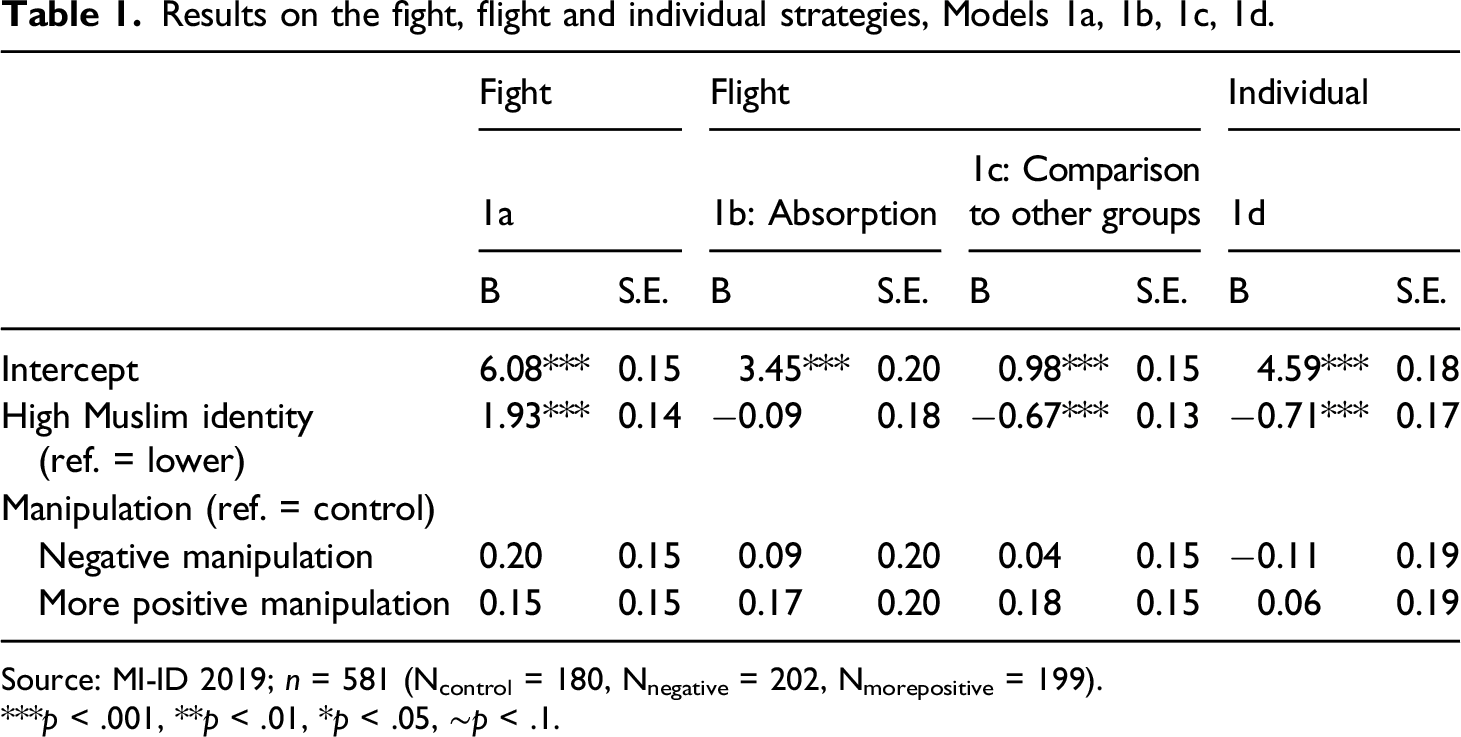
Source: MI-ID 2019; n = 581 (Ncontrol = 180, Nnegative = 202, Nmorepositive = 199).
***p < .001, **p < .01, *p < .05, ∼p < .1.
Results on the fight, flight and individual strategies, Models 2a, 2b, 2c, 2d.
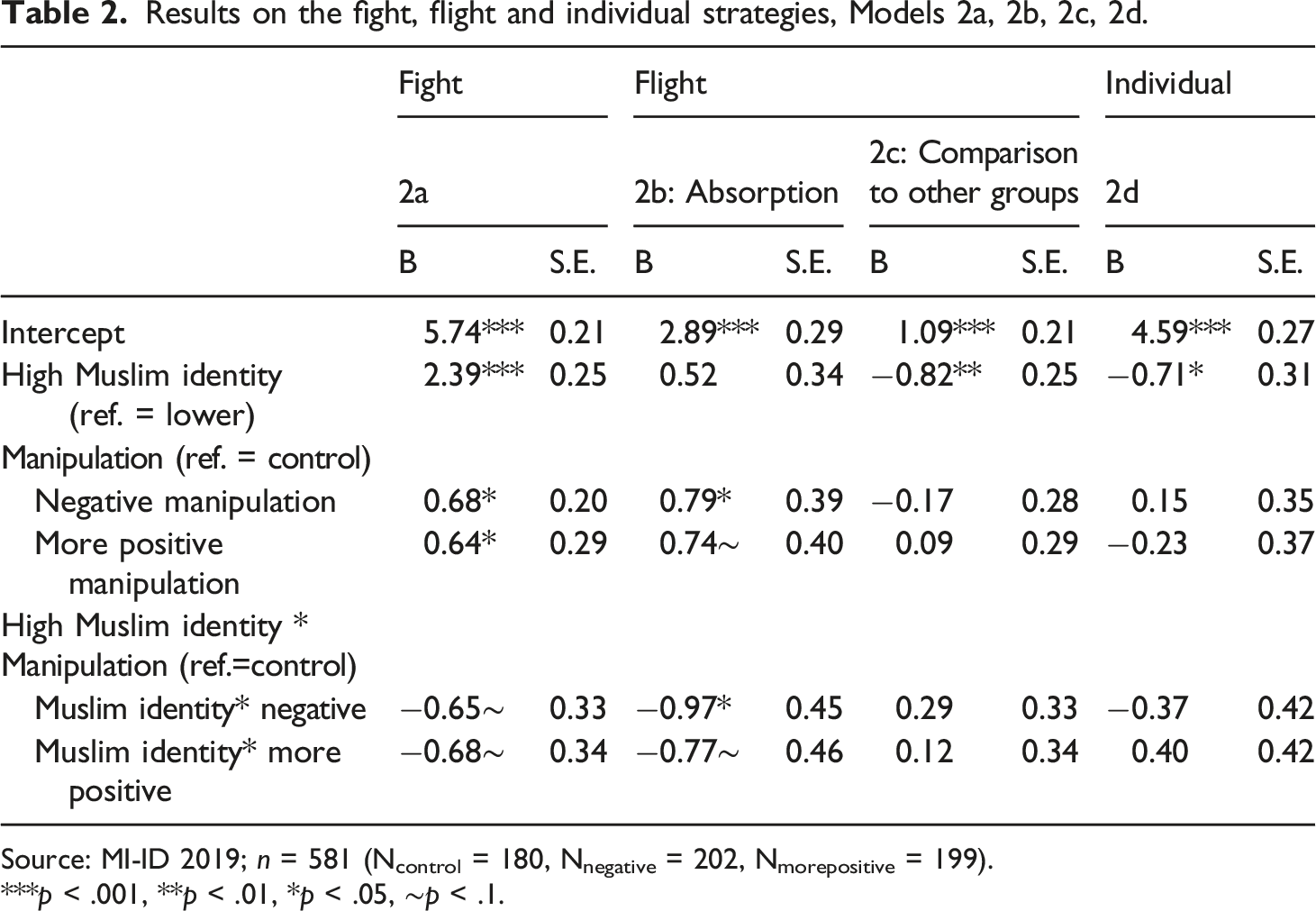
Source: MI-ID 2019; n = 581 (Ncontrol = 180, Nnegative = 202, Nmorepositive = 199).
***p < .001, **p < .01, *p < .05, ∼p < .1.
Direct associations
In Table 1, we present the results on the three types of identity-management strategies. With the exception of the ‘absorption’ strategy, the results are all significant and in the expected direction. High-identifying Muslims are more likely to apply the collective-fight strategies, while they are less likely to apply the ‘comparison to inferior groups’ strategy, as part of the flight strategies, or individual strategies. These results confirm hypotheses 1a and 1c, and partly confirm hypothesis 1b as there is no significant effect of identification on the ‘absorption’ strategy (as part of the flight strategies). This is a noteworthy finding, as it suggests that willingness to be absorbed into Dutch majority society does not depend on one’s strength of connection to the minority group. This willingness is quite low amongst all Muslims.
Moderating effects of negative and more positive media messages on fight strategies
For reasons of clarity, we discuss our results following each of the three types of strategies – thereby abandoning the logical order of the hypotheses, but allowing a direct comparison between more positive and negative media effects.
Moving along to Table 2, which presents the moderating effects of media messages on fight strategies in Model 2a. The interaction effects show a marginally significant moderating role of media messages, suggesting that both negative (H2a) and more positive (H3a) media content weaken the positive association between identification and collective-fight strategy application. This opposes H2a as we assumed negative media messages to trigger the application of fight strategies among high identifiers especially. Continuing to hypothesis 3a, which stated that more positive media can decrease the application of the fight strategies in high-identifying Muslims especially. The negative interaction effect is marginally significant (p = .055) and its direction in line with the hypothesis. However, when we take a closer look, the difference in strategy application can mostly be observed among lower-identifying Muslims, and they are triggered into the application of fight strategies by negative and more positive media alike. We will discuss the implications of this finding in more detail in the conclusion.
Moderating effects of negative and more positive media messages on flight strategies
With respect to the flight strategies (Table 2 Model 2b & 2c), in case of the absorption strategy, we see a similar pattern but in the opposite direction as the fight strategies. The moderation is small, but significant, and indicates that the positive association between Muslim identity and applying the absorption strategy is hampered by exposure to both negative and more positive media. Among lower identifiers, both more positive and negative media trigger the likelihood of selecting the absorption strategy, whereas there is a negative effect of negative and more positive news among high identifiers. This is in line with hypothesis 2b (Negative media can trigger the application of flight strategies in lower-identifying Muslims). This, however, rejects hypothesis 3b, which predicted that more positive media would decrease the application of such collective flight-strategies among lower identifiers. Again, it is interesting to see that, regardless of tone, both stimuli strongly show the same effect.
The second flight strategy (comparison to inferior groups) showed rather small and insignificant moderation effects. Hence, there is no indication that media messages impact the main effect of identification with the group, and so hypotheses 2b and 3b are not confirmed.
Moderating effects of negative and more positive media messages on individual strategies
Finally, regarding the individual strategies (Table 2 Model 2d), we also find no significant differences in the impact of being exposed to either negative or more positive media when compared to the control group. In this case, however, the difference in impact of more positive versus negative news was marginally significant (p = .057). However, looking at Figure 1, we see that, among high identifiers, the likelihood to apply individual strategies remains rather stable when exposed to more positive news, whilst it decreases when exposed to negative news (as mentioned above, this difference is marginally significant). This is in line with our hypotheses. Moderation between Muslim identity and manipulation group on individual strategies (scale ranges from 0 to 9). 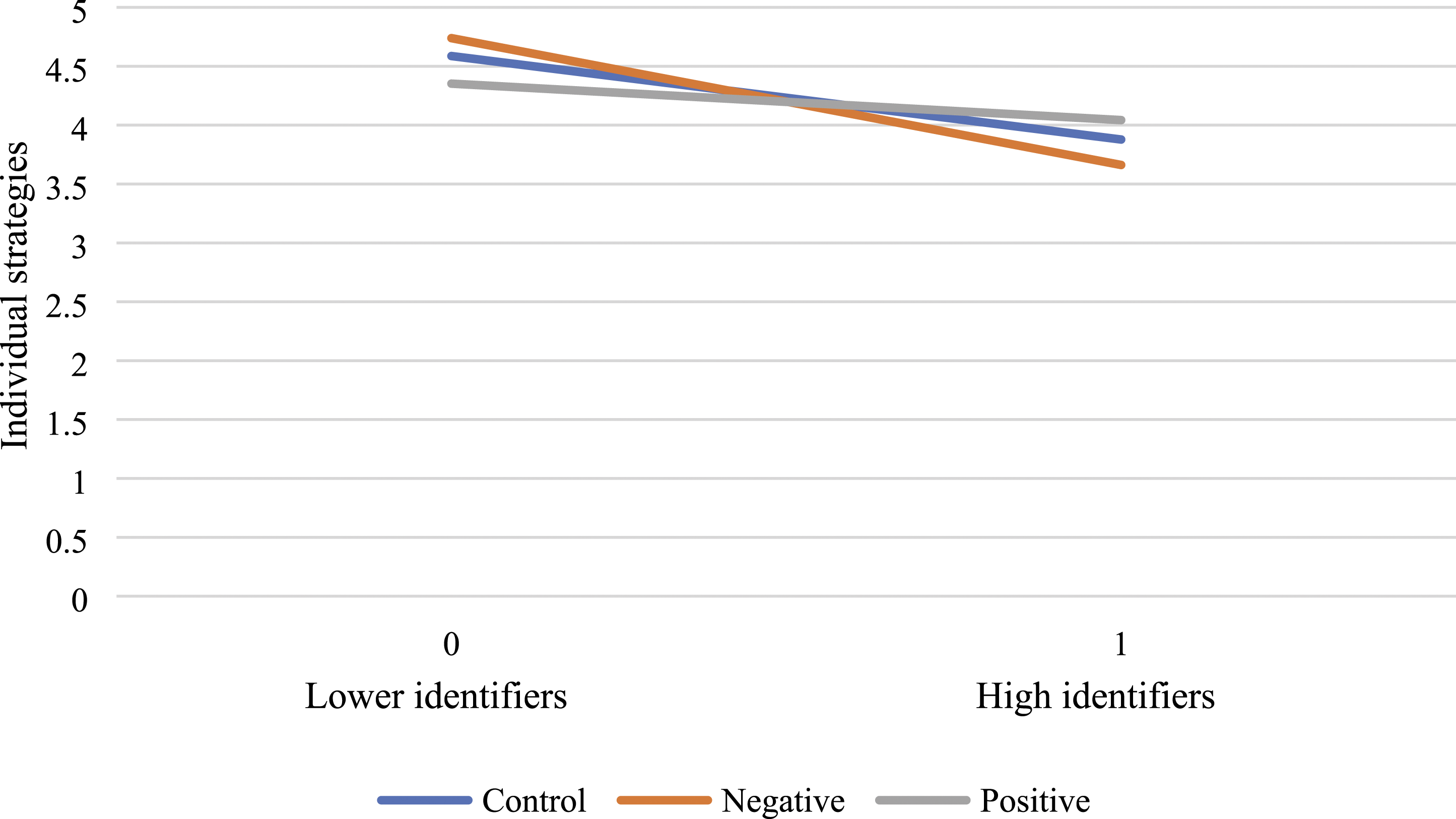
Discussion
In Western European news media, Muslims are increasingly depicted as a problematic minority group (D’Haenens and Bink, 2007; Lepianka, 2017). In this paper, we test the hypothesis that these negative depictions may very well challenge positive group distinctiveness among young people identifying as Muslims living in these societies (Abrams and Giles, 2007; Brown, 2000; Branscombe et al., 1999; Neumann et al., 2018; Tajfel and Turner, 1979; Verkuyten and Reijerse, 2008). With this study, we contribute to the discussion on the role of social identity and media messages by investigating how Muslims, with different levels of religious identification, responded to news items in which their religious group was discussed in either a negative or more positive way. We explored how these media messages influence the role of identity salience among young Muslims in applying certain identity-management strategies.
Starting with the former two collective fight and flight strategies, our results indicate that the level of identification plays a major role in how young Muslims strategize. High identifiers are more likely to choose strategies that may drive their group to a higher social status, whereas lower identifiers tend to choose strategies that either do not help the group or that only help themselves rise above their initial group. These results are largely in line with what one would expect, based on SIT. Indeed, if one identifies more with a group, one is more willing to fight for something so that the entire group benefits. Absorption (as part of our flight strategy), however, showed to be independent of identification. Our findings showed that high and lower identifiers alike are similarly unwilling to adapt to Dutch society by letting go of their own religious habits. Reflecting on measuring the absorption strategy, we recommend future studies to include multiple items that assess this strategy as our current item of to what extent ‘Muslims should let go of their religious habits’ could also tap into other concepts such one’s acculturation attitudes.
Interestingly, media messages affected this (lack of) connection to a certain extent and showed that reading about one’s group in a news message (regardless of tone) can increase the likelihood for lower identifiers to apply the absorption strategy. This pattern of more positive and negative tone yielding a similar response also emerged with regard to fight strategies. Although the effects are small, these patterns lay bare the contours of a different mechanism than expected based on previous literature, in which solely the effects of hostile media were investigated (Saleem and Ramasubramanian, 2019; Schmuck et al., 2017). This finding contradicts the idea that especially, or only, negative media encourages group responses, such as collective activism (see also our expectations based on the SIMCA model by Van Zomeren et al., 2012). In doing so, our study contributes to previous research by illustrating that the well-established association between religious identification and identification-management strategies can, to a certain extent, be dependent on specific conditions, such as exposure to certain media messages. Future research is, however, necessary to further assess the systemic role media messages plays in these processes as this study was a single manipulation study.
Regarding the individual strategies, a completely different pattern emerged. The application of these strategies depended strongly on people’s connection to the group, which was strengthened by exposure to the news items. More positive news reduced the likelihood of applying this strategy in lower identifiers, indicating that young Muslims felt no need for change when exposed to more positive messages. Negative news triggered the likelihood within lower identifiers while reducing it among high identifiers. These findings were in line with our expectations and follow the logic as described by Tajfel and Turner (1979), assuming that level of identification matters in the application of strategies. The innovation being, however, that we now know that the tone of a media message matters with regard to the application of these individual strategies.
These findings strengthen us in the idea that the distinction between fight, flight and individual strategies is an important and relevant one to make. The patterns illustrate that, indeed, the three types of strategies diverge, which indicates that they are theoretically and empirically distinct. The division between the fight and individual strategy is especially clear. The flight strategy was multi-dimensional in the empirical analyses, making us question whether the two distinguished dimensions should be considered as two different theoretical entities as well – one that relates to abandoning cultural habits to fit in with the majority group and the other to the need to feel superior to other societal groups. Our study shows and underlines that SIT’s identity-management strategies encapsulate various dimensions and that differentiating between them can be fruitful in understanding underlying mechanisms.
Despite our contributions, our study is not free from limitations. First, we were limited in the use of a single item to measure Muslims’ religious identification which is not most suitable to capture such identification in its various forms. Future studies would benefit from the use of a multi-item scale to measure identification, which is a more validated scale in social psychological research (see e.g. Verkuyten and Martinovic, 2012). In addition, our study only investigates media messages with positive and negative tones and pays no attention to specific frames, for example. Although we improve upon previous work by including a control group which allowed us to distinguish effects from a baseline group (Wojcieszak and Kim, 2016), more and different versions of news messages would be a valuable addition. Whereas there is no consensus yet on which evidence type is more persuasive (Wojcieszak and Kim, 2016), narratives are found to affect behavioural intentions more strongly, such as applying identity-management strategies (Zebregs et al., 2015). The impact of narrative message on such strategies may be larger compared to a more statistical message, as we used in this study.
Finally, we have no insight in the longevity of the found effects, like most experiments on message effectiveness. Results may be short-lived, which is likely to depend on several contextual circumstances (Lecheler and De Vreese, 2016; Wojcieszak and Kim, 2016), such as one’s exposure to media, being embedded in a religious household or neighbourhood and, in general, the daily conversation of Muslims’ identity or ‘the Muslim question’ (Van Den Brandt, 2019). Future studies are therefore recommended using a longitudinal design with a delayed post-test and to study the role of circumstances other than media messages.
In sum, our study contributes to understanding how religious identification and media messages join forces for young Muslims in applying a certain identity-management strategy. Adding to previous studies, we were able to explore all original identity-management strategies among the same research population to increase understanding of how processes behind these strategies vary. This appears worthwhile, as patterns differ between distinguished strategies. Regardless of tone, media messages mentioning Muslims appear to make a fight strategy more likely among high identifiers. A second contribution was made by exploring the effect of negative and positive media messages. Studies including the latter are scarce. Interestingly, our study suggests that the tone of media message does not always bring about different strategies. Mentioning Muslims in a media message – regardless of tone – appears to be sufficient for (not) preferring a certain strategy, especially regarding collective strategies. These insights in the (mutual) role of religious identification and media messages inform us that media messages, to a certain extent, can play a role in increasing and decreasing group distances, intergroup conflicts and intragroup cohesion.
Supplemental Material
sj-pdf-1-etn-10.1177_14687968211060538 – Supplemental Material for Do religious identity and media messages join forces? Young Dutch Muslims’ identification management strategies in the Netherlands
Supplemental Material, sj-pdf-1-etn-10.1177_14687968211060538 for Do religious identity and media messages join forces? Young Dutch Muslims’ identification management strategies in the Netherlands by Nella Geurts and Marijn van Klingeren in Ethnicities
Footnotes
Declaration of conflicting interests
The author(s) declared no potential conflicts of interest with respect to the research, authorship, and/or publication of this article.
Funding
The author(s) received no financial support for the research, authorship, and/or publication of this article.

Supplementary Material
Supplementary material for this article is available online.
Notes
References
Supplementary Material
Please find the following supplemental material available below.
For Open Access articles published under a Creative Commons License, all supplemental material carries the same license as the article it is associated with.
For non-Open Access articles published, all supplemental material carries a non-exclusive license, and permission requests for re-use of supplemental material or any part of supplemental material shall be sent directly to the copyright owner as specified in the copyright notice associated with the article.
