




Abstract
In societies where solidarity and cohesion are experienced primarily via shared national identity, immigration raises questions regarding how non-nationals can gain social membership, so that they are not perceived as undermining solidarity and cohesion. A key aspect of immigrants’ experiences is thus whether they embrace the national identity of the destination country. Governments in many destination countries increasingly seek to ensure that they do, via policy initiatives that impose specific requirements for gaining legal citizenship: applicants for naturalization are commonly required to pass a test (ensuring sufficient knowledge of e.g. ‘life in the UK’) and attend a ceremony that includes a pledge of loyalty. This paper considers whether the British version of these requirements is effective in leading immigrants to embrace British national identity. It uses data drawn from the UK household panel survey (‘Understanding Society’) to facilitate a comparison between those immigrants who become citizens and those who do not. The main finding is that those who become citizens significantly increase their attachment to British identity. Whether they do so specifically because of the policy requirements (the test and ceremony) is debatable, but it seems clear that these requirements do not inhibit development of a sense of Britishness among the immigrants who meet them.
Keywords
Introduction
In some societies, notions of ‘diversity’ have taken root, such that immigrants can gain acceptance and a sense of belonging to some extent. But gaining acceptance and belonging is never entirely without difficulty; migration to another country often marks one as a ‘foreigner’, someone whose social belonging must be achieved rather than taken for granted (Alba and Foner, 2015). In many European countries, gaining full membership – including formal citizenship – has generally become more difficult in recent years: governments have increasingly required immigrants to demonstrate that they deserve membership e.g. via their embrace of the country’s national identity (Kofman, 2005; Pratsinakis, 2018).
These requirements commonly arise in response to concerns expressed in terms of social cohesion and solidarity. For some natives, cohesion and solidarity is grounded in a sense of similarity – a notion that the individuals who constitute one’s own society have enough in common to merit mutual regard and trust. This sense of similarity is usually expressed via shared national identity; in many respects the population of a country is highly diverse (e.g. in terms of demographic characteristics, or economic status, or values and opinions), but a sense of commonality is nonetheless achieved via the notion that ‘despite everything we’re all British’ (Anderson’s ‘imagined community’, 1983). Given that immigrants by definition initially lack the shared nationality that underpins this way of experiencing solidarity and cohesion, a key challenge (as understood by policy makers) is therefore how to ensure that immigrants embrace the ‘local’ national identity. Whether immigrants come to think of themselves as (for example) British is however not sufficient on its own: what really matters (in connection with the anxieties of natives) is whether natives can perceive that they have done so.
A common mechanism for addressing this policy challenge is to require that immigrants pass a test, as a condition for gaining formal citizenship. Another common requirement is attendance at a citizenship ceremony, where themes of citizenship and national identity are expressed in emotionally resonant ways. Ceremonies also usually involve an oath or pledge of allegiance and loyalty. In theory, a test can function as a signal not only of knowledge but of the embrace of values that embody what many understand as the ‘substance’ of their national identity. One might reasonably doubt that a test can be effective in this regard, but again what matters is whether it can function at the level of perception, offering reassurance to natives who feel threatened by an inflow of people they understand to be ‘different’. When immigrants pass a test (e.g. regarding ‘life in the UK’) and attend a ceremony in the process of becoming naturalized citizens, they can then perhaps assert a reasonable claim that they merit acceptance as part of ‘us’ – especially if gaining citizenship in this way indeed goes with embrace of the corresponding national identity.
This paper considers the effectiveness of those requirements for UK naturalization, asking whether new citizens feel a deeper sense of British national belonging. Policy-makers justify adoption of these requirements by asserting that they will bring positive outcomes (including a deeper sense of belonging among immigrants). 1 Many observers (including academic researchers), however, believe that the consequences are mostly negative, leading many immigrants to feel marginalized and alienated (e.g. Kalra and Kapoor, 2009; Kostakopoulou, 2010; Kundnani, 2007). For the most part, these diverging views have been grounded in ‘textual’ readings of the policy itself; in essence, they are predictions. Only rarely do we see empirical investigations of immigrants’ experiences of the policy (e.g. Bassel et al., 2018; Byrne, 2017; Cooke, 2009; Fortier, 2017). Those contributions emerge from qualitative interviews; there is also a need for a quantitative approach to data and analysis, in part to underpin conclusions that represent the immigrant population as broadly as possible.
Here, then, I use data from the UK Household Longitudinal Study (‘Understanding Society’ – University of Essex et al., 2016) to investigate the consequences of the UK policy for immigrants’ sense of belonging and attachment to British national identity. The analysis starts with sample members who were noncitizens in Wave 1 and then compares those who (by Wave 6) had become citizens to those who had not. The panel structure of the data mitigates concerns about endogeneity – in particular, ensuring that any greater attachment to British identity among new citizens (relative to noncitizens) is not simply rooted in a difference already evident prior to naturalization. The core finding is that becoming a UK citizen is indeed associated with increased attachment to British identity: a sense of Britishness increases over time among both groups (those who become citizens and those who do not), but the increase is significantly greater among new citizens. In the final section I consider whether this increase is attributable to the requirements of the UK citizenship process.
Previous research on national identity and the UK citizenship process
Similarly to many European countries in the post-war period, immigration in the UK led to long-term settlement in ways that were not intended or anticipated (Hansen, 2000). Many of the immigrants, originating from the so-called ‘New Commonwealth’, were non-white and endured prolonged periods of unchecked racism. Under the Labour government elected in 1997, elements of a plausible anti-racist policy framework were adopted (e.g. via the Macpherson Report; Macpherson, 1999), and a report by the Runnymede Trust (2000) gained quasi-official status in its affirmation of a (somewhat peculiar) multicultural vision for British society. But a reversal of these trends was precipitated by an outbreak of ‘race riots’ in northern English cities in the summer of 2001. Yet another report (Cantle, 2001) explained the riots with reference to (alleged) failures of integration and the notion that people of different ethnicities were living ‘parallel lives’. A new ‘Nationality, Immigration and Asylum Act’, passed into law the following year, marked a clear break from earlier trends, to such an extent that Britain became a core instance of the ‘retreat of multiculturalism’ (Joppke, 2004).
The new policy sought to restore ‘social cohesion’ (Hickman et al., 2012) – a quality of British society apparently undermined by immigration and failure of integration. 2 Key provisions included new requirements for gaining citizenship: applicants would have to pass a ‘Life in the UK’ test and then attend a citizenship ceremony and affirm one’s loyalty to the nation. Cohesion would (in theory) result from ‘British values’ being ‘shared’ to a greater extent – i.e., immigrants would come to adopt those values in ways they had, it seemed, so far failed to do in sufficient measure. Insofar as immigrants expressed increased commitment to British identity, policy-makers perhaps also hoped that this feeling would be reciprocated by natives via greater acceptance.
The new citizenship policy met with an outcry among academics and other observers (not least for the way it appeared to rest on a faulty diagnosis of the riots – Ratcliffe, 2012). Far from fostering greater integration, the policy seemed likely to exacerbate immigrants’ marginalization and exclusion. By imposing requirements for learning and demonstration of knowledge, it signaled their alleged deficiencies and inferiority (Kalra and Kapoor, 2009; Kostakopoulou, 2010), in particular their ignorance (Byrne, 2017; Skey, 2011) and their failure to act in approved ways (Osler, 2009). The new requirements gave expression to concerns that many natives already harbored about Muslims in particular, and in response at least one observer asserted that the policy amounted to ‘anti-Muslim racism’ (Kundnani, 2007). The requirements of course had directly exclusionary consequences when applicants failed the test, and people from some origin countries (e.g. Bangladesh, Iraq, Afghanistan) have had a harder time than others in passing the test (Ryan, 2008; van Oers, 2010) – a difference that fed perceptions of unfairness regarding population segments that already felt vulnerable. These criticisms unsurprisingly failed to deter the government, and in successive years the test has been revised to focus less on practical information and more on British history (including dates).
For the most part, critiques have emerged from consideration of the policy itself, via a reading of documents and public statements. (A core example consists of the questions/answers; Brooks (2016) finds numerous examples where the ‘correct’ answer required by the test is factually false.) There are a few exceptions: Cooke (2009) and Fortier (2017) conducted interviews and found that many people targeted by the policy experienced significant anxiety about their situation. Some respondents interviewed by Byrne (2017) expressed appreciation regarding what they learned via preparation for the test, though others saw the content as peripheral to their lives as new citizens; some also perceived that having to achieve citizenship via demonstration of knowledge meant that their status was tenuous and ‘less than equal’. Monforte et al. (2019) observe immigrants in the UK absorbing discourses of ‘deservingness’ in connection with citizenship and the test process: some people try to establish their sense of belonging by pointing to the failings of others (including failure to pass the test).
But insofar as claims about exclusion and marginalization are rooted in a reading of the policy itself (as with much of the literature), they are essentially predictions or expectations derived by the observer. To assess the implications for inclusion and belonging, there is a clear need for further investigation of consequences of the policy via empirical research that explores directly the experiences of the immigrants themselves.
To construct an investigation of this sort, we can draw insight from previous research on the process by which immigrants generally embrace a new national identity in the destination country. That question has received attention in no small measure because of concerns noted above, i.e., the possibility that immigration, by fostering diversity, undermines social solidarity and nationality identity (e.g. Goodhart, 2004; Putnam, 2007). A number of studies have shown in contrast that ethnic identity is not in conflict with national identity: immigrants and their descendants often retain a strong sense of ethnic identity but nonetheless adopt strong national identities in the destination as well (Georgiadis and Manning, 2013; Gong, 2007; Nandi and Platt, 2015). Minority groups with immigrant background in the UK generally embrace a British identity to an extent very similar to that of the white native-born population (Manning and Roy, 2010; Maxwell, 2006); this pattern also holds for Europe more broadly (Reeskens and Wright, 2014). An important implication is that multiculturalism is not in conflict with integration (Heath and Demireva, 2014; Wright and Bloemraad, 2012; cf. Reitz et al., 2009 for Canada).
Of course, not all individual immigrants embrace a national identity (a statement that also holds for the majority-group population). The likelihood of doing so is stronger among those who enjoy socio-economic advantages (Kesler and Schwartzman, 2015). Context matters as well: a supportive environment that enables participation in core institutions (education, the labor market, housing, etc.) enhances prospects for a feeling of belonging (Crul and Schneider, 2010). Encountering exclusionary attitudes and practices contributes to the opposite outcome; immigrants who were attacked or perceived discrimination were less likely to embrace a British identity (Heath and Demireva, 2014; Karlsen and Nazroo, 2013; Maxwell, 2006).
Another key factor associated with embrace of a national identity is naturalization itself (Karlsen and Nazroo, 2013; Reeskens and Wright, 2014; Simonsen, 2017). In each case, however, the finding emerges from research that uses cross-sectional data; the authors properly observe that the direction of causality is unknown (perhaps becoming a citizen fosters a deeper sense of Britishness [N → B], or perhaps naturalization is more likely among those who have already developed a deeper sense of being British [B → N]). Previous research supports the reasonable notion that attachment to national identity makes naturalization more likely (Abascal, 2017; DeSipio, 2001). What is less clear is whether the reverse is also true. For Germany, Fick (2016) finds that naturalization leads to an increase in attachment to German identity. The critiques of the UK citizenship process discussed above, however, might suggest (as a hypothesis) that those who become citizens will subsequently be more likely to reject a British identity, in reaction to the exclusionary implications of the policy (the test requirement, in particular). At a minimum, that hypothesis works against the N → B interpretation of the cross-sectional association evident in previous research. Using longitudinal data, I propose to distinguish between these possibilities by exploring the evolution of national identity among immigrants in the UK.
Data and analytical strategy
To investigate the evolution of attachment to British identity among immigrants who become citizens, I draw on data from Wave 1 and Wave 6 of ‘Understanding Society’, the UK Household Longitudinal Study (University of Essex et al., 2016; for technical details see Buck and McFall, 2012). This dataset, initiated with Wave 1 in 2009/10, is well suited to research on immigrants in the UK; in addition to the main sample, the project includes a ‘boost’ sample of ethnic minorities, focusing on five of the main minority groups (Indian, Bangladeshi, Pakistani, black African, and black Caribbean). The sample analyzed here begins with immigrants in the UK who said at Wave 1 that they did not hold UK citizenship; these individuals are then revisited in Wave 6, at which point some have become UK citizens. (Wave 6 is the first wave in which the citizenship question is repeated.) The variable for analysis is drawn from a question included on the ‘extra 5 minutes’ questionnaire pertaining to ethnicity, administered to a subsample comprising the ethnic minority ‘boost’ sample, a sample of ethnic minority individuals living in areas of low ethnic minority density (LDA), and a small number of ‘general population’ sample members (in part for comparison to the majority population). The total sample size available for this purpose is 553; of these, 251 had become citizens while 302 remained non-citizens. 3
The dependent variable is given by answers to the question ‘how important is being British to you?’. 4 Respondents were asked to select a number on a scale from 0 to 10 (higher numbers = more important). If a respondent spontaneously said that he or she was ‘not British’, in our analysis they are assigned a value of ‘minus 1’ (a recoding applied to forty individuals at Wave 1 and two at Wave 6). A survey question about national identity could of course be posed in other ways. In the European Social Survey, for example, respondents are asked: “how emotionally attached do you feel to [the UK]?” It is not evident that use of a different question along these lines would lead to different findings (still less, findings that are to be preferred over what is reported here). The research question considered in this article pertains to the extent to which immigrants embrace British identity (in the context of the citizenship test process) – and the wording of the Understanding Society question is suitable for that purpose.
The main independent variable is citizenship status, i.e., whether an individual became a UK citizen. The analysis below compares immigrants who became UK citizens to those who did not, during a period when gaining citizenship was conditional on meeting the requirements enacted in 2005 (passing the ‘Life in the UK’ test and participating in a citizenship ceremony). The variable is imprecise in this respect insofar as people applying after 2007 for indefinite leave to remain were also required to pass the ‘Life in the UK’ test; some people in our sample who remained non-citizens would nonetheless have taken the test. However, they would not have participated in a citizenship ceremony; the citizenship variable thus distinguishes those who ‘participated fully’ in the UK citizenship process.
For other covariates, in many respects the analysis follows the lead of Nandi and Platt (2015), who analyzed the same variable. I thus include sex, age (in six ranges), and partner status (never married, cohabiting, married/civil partnership, and separated/divorced/widowed). UK regions are included, as is a variable identifying respondents who live in areas of low ethnic minority density. Employment status is used as well as occupational status, drawing on the 8-value scheme in the National Statistics Socio-Economic Classification (Rose et al., 2005).
A variable for educational attainment is constructed from a number of questions asking about highest qualification, where qualification was earned, and age at leaving school. The categories used below are primary/no education, secondary school abroad, secondary school in the UK, university abroad, and university in the UK. It was necessary to draw on several existing variables for this purpose because of the complexity in some immigrants’ educational history and because there was significant non-response for individual questions.
Given that the sample analyzed here (focusing on immigrants initially lacking UK citizenship) is different from the one analyzed by Nandi and Platt (2015), the analysis departs from theirs in certain respects as well. Instead of including a variable for ethno-religious group, I construct a variable for region of origin; de Vroome et al. (2014) show that attachment to national identity varies significantly depending on immigrants’ origins. The variable draws on a survey question asking about country of birth; given the small sample size, I collapse these answers into the following regions: Europe, South Asia, Africa, North America + Australia + New Zealand, and ‘other’. For some purposes it is undesirable to use aggregations of this sort: ‘South Asia’ (comprising India, Pakistan, Bangladesh, and Sri Lanka) and ‘Africa’ are geographic locations with very high levels of social diversity – an observation that pertains as well to the immigrants in the UK that originate from those regions (e.g. Lam and Smith, 2009). But with the small sample available, a finer grain is not possible, and a crude aggregation is preferable to not making any distinctions at all within the sample.
A variable for time since arrival in the UK is included (Reeskens and Wright, 2014), as is a variable indicating whether the respondent has experienced verbal harassment or physical attack. A variable for ‘interest in politics’ offers four responses (none, not very, fairly, and very); this as well is a departure from Nandi and Platt (2015), who used a variable focused on political party affiliation (arguably less relevant to non-citizens, most of whom cannot vote).
Descriptive characteristics of the sample appear in Table 1, which gives values separately for those who became citizens and those who did not. The core of the analysis then focuses on results from random-effects regression models (e.g. Rabe-Hesketh and Skrondal, 2008). This technique exploits the panel data structure, ensuring that any association between naturalization and attachment to British identity is not a function of differential tendency towards naturalization among those with already higher (or indeed lower) attachment to British identity. A more stringent test for investigating causal relationships would involve a fixed-effects approach, focusing on within-subject change – but the sample size here is too small (that analysis can use only those individuals who changed their citizenship status, thus 251 respondents). In addition, a random-effects approach is arguably more appropriate in situations when the dependent variable is likely to be associated with time-invariant characteristics (something a fixed-effects analysis cannot address); in this context, region of origin is likely to have a significant association with attachment to British identity. The models presented below include standard errors computed in accordance with the complex survey design (e.g. clustering within primary sample units).
Sample characteristics (percentages).

The use of panel data offers some leverage in connection with the question of causality. Even so, a random-effects analysis is not robust to the possibility of model misspecification (omitted variables). I therefore then turn to an alternate analytical framework that considers the question from a different angle. The overall goal is to gain an empirically-grounded sense regarding the impact of the UK citizenship process on immigrants’ engagement with British national identity. The longitudinal data enable us to see changes across time for those who became citizens (as well as those who did not). But the question about ‘impact’ underpins interest in an additional observation: what would have happened to the national identity among those who became citizens if they had not become citizens? That question cannot be answered directly via empirical observation; it points to an unobservable counterfactual.
Again, panel regression models offer some leverage: they tell us the association between naturalization and Britishness when other variables are controlled (i.e., when all else is equal). But an alternate approach, rooted more explicitly in a counterfactuals perspective, suggests a different way of determining what ‘all else is equal’ should mean (Morgan and Winship, 2007). Regression models focus attention on determinants of the dependent variable (here, Britishness). A counterfactuals perspective focuses instead on determinants of the key independent variable – here, naturalization. Additional variables required for this purpose (beyond those identified above) include logged income (adjusted for household size via an OECD scale), home ownership (vs. other modes of tenure), presence of children in the home (yes/no), and difficulty speaking English (yes/no). Matching algorithms (e.g. Guo and Fraser, 2010) are used to create a proxy for ‘what if they had not become citizens’, by finding non-citizens who are similar to citizens on the characteristics associated with naturalization. Average levels of ‘Britishness’ are then compared between the two groups; insofar as one is confident that Britishness among the matched non-citizens represents what the citizens would have experienced if they had not in fact become citizens, the difference (if any) represents change. The counterfactual is still unobserved (by definition), but it is useful to consider a proxy value derived via this approach as a complement to the value offered in a regression framework.
Results
Table 1 shows that importance of British identity increased over time both for new citizens and for those who remained non-citizens – but the increase was greater for those who became citizens. The substantially greater attachment to British identity at Wave 1 is plausibly a factor in the decision to naturalize among those who do so – but again the increase among those who do become citizens was greater than the increase among those who remained non-citizens. The positive association between naturalization and importance of British identity is also apparent in the bivariate regression model in Table 2, which takes account of the ‘starting’ values (reinforcing the conclusion that naturalization was followed by a greater increase in attachment to Britishness).
Random-effects regression estimates of importance of British identity.

The regression model with control variables in Table 2 shows that this conclusion persists when variables are introduced to control for other determinants of national identification. The naturalizers and non-naturalizers are different in noteworthy ways. In particular, immigrants from Asia were much more likely to become citizens during this period, while immigrants from Europe, North America, Australia and New Zealand were much less likely to do so. The region of origin variables are also strongly associated with importance of British identity: immigrants from Asian, African, and ‘other’ countries report significantly greater attachment to Britishness relative to immigrants from Europe, controlling for other factors. But these differences do not account for the greater increase in attachment among those who become citizens: even when controlling for region of origin, that differential persists (with statistical significance meeting a stringent threshold). 5 The coefficient itself is far from trivial: people who become citizens are almost a full point higher on the 12-point scale of importance of British identity, relative to those who remain non-citizens.
It is evident from Table 1 that people who become UK citizens already showed more attachment to British identity before naturalization (relative to those who did not become citizens) – but the random-effects model shows that naturalization is associated with a subsequent increase in importance of being British. The answer given by the analysis here is: both statements are supported (N → B and B → N). That conclusion leads to rejection of a notion rooted in the various critiques of the citizenship process: the policy might lead to certain types of negative experiences and consequences for immigrants in the UK, but it does not appear to alienate them from British identity. On the contrary: becoming a UK citizen leads to greater attachment to British identity, in excess of what appears over time among immigrants in the UK generally.
This core finding is remarkable by way of contrast to what appears for other variables in the model. For many variables, statistical significance at the conventional threshold (p < 0.05) is not achieved; for example, support is lacking for the idea that educational attainment, employment status, and occupational status matter for importance of Britishness. Nor does age appear to matter; likewise for interest in politics. There are some regional differences: greater importance for those living in the Midlands (relative to London) and lower importance for those living in areas of low ethnic minority density (controlling for other variables). Where statistical significance is lacking, one might point to the small sample size, in part to account for the way results here differ from those in the analysis by Nandi and Platt (2015) (of course, the sample is different in other respects as well, not just size – a different population is being represented). But the small sample size does not impair the significance of the finding in respect of naturalization.
The small sample size is, however, an obstacle to additional exploration regarding whether the impact of naturalization is different for people from different origin regions. The size and significance of the coefficients for origin region might offer a basis for anticipating that the impact of naturalization could vary across the groups denoted by region. Table 2 shows that immigrants from Asian, African, and ‘other’ countries show a much greater attachment to British identity (controlling for other factors), relative to immigrants from Europe and North America/Australia/New Zealand. One might then wonder whether becoming a citizen has diverging consequences among the groups originating in these different regions. A model using interaction terms (not shown) does not however offer any support for this notion.
Recalling the fact that respondents who spontaneously said ‘I’m not British’ were recoded to –1 on the ‘importance of Britishness’ scale: robustness checks were conducted to ensure that results were not unduly affected by this decision. The main substantive result reported above is unchanged if (1) these respondents are instead recoded to 0, and if (2) they are dropped from the analysis entirely.
Given the limitations of random-effects models (and the limited prospects for a fixed-effects analysis with such a small sample), I now turn to a matching analysis rooted in a counterfactuals perspective. As a first step (to determine which variables are relevant for the matching algorithm), I construct a logistic regression model of naturalization for this population segment (Table 3). Research on naturalization suggests a range of possible determinants at the individual level, including sex, age, income, partnership status, education, time since migration, presence of children, language ability, place of origin, and home ownership (Aptekar, 2015; Bloemraad, 2006; Chiswick and Miller, 2009; Diehl and Blohm, 2006). In this context, I also consider whether previous attachment to Britishness (at Wave 1) is a predictor of naturalization. In Table 3, variables with a statistically significant (p < 0.05) association include Britishness, age, time since migration, and place of origin (all drawn from Wave 1, i.e., values prior to naturalization).
Logistic regression of naturalization.
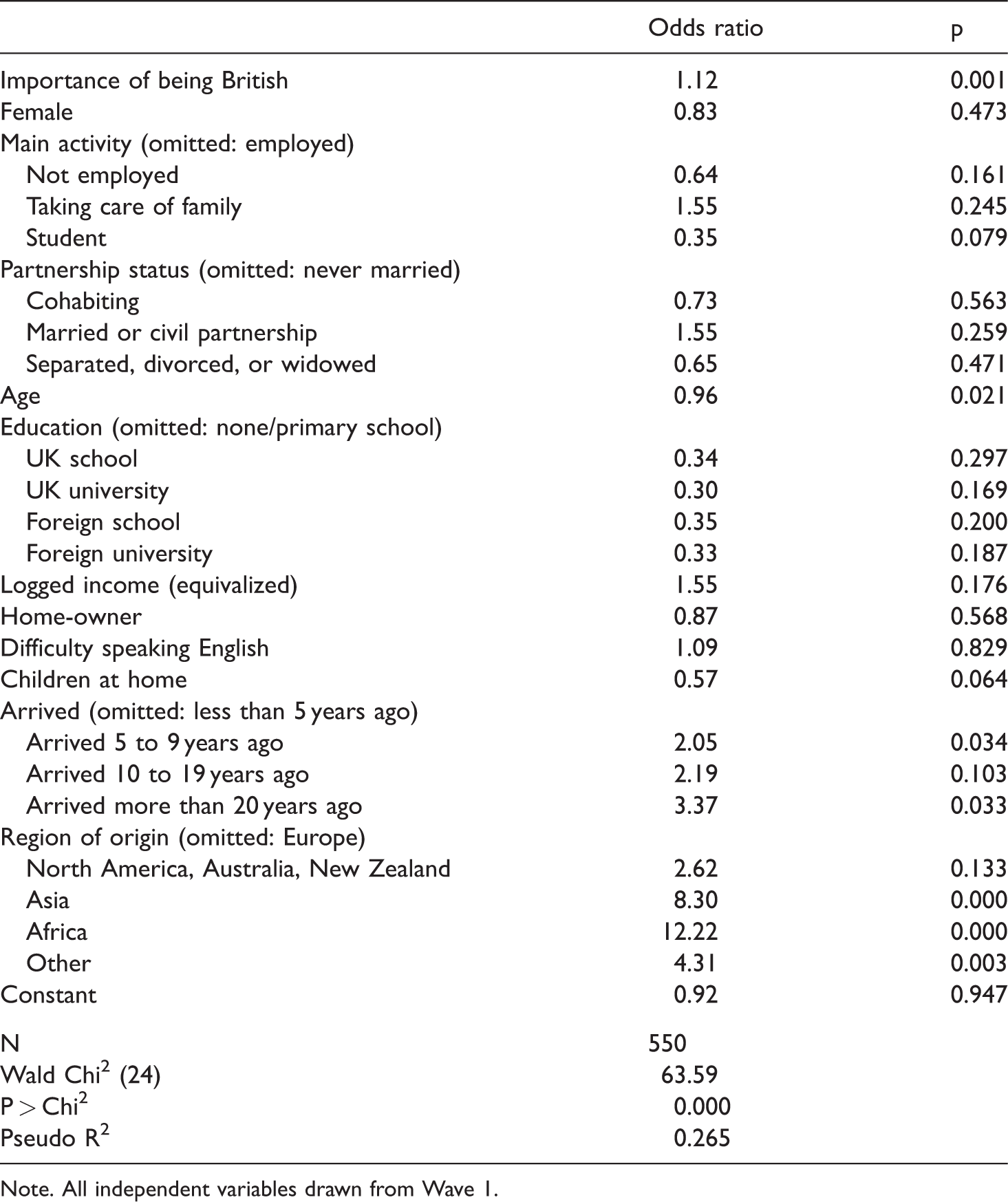
Note. All independent variables drawn from Wave 1.
A matching model 6 with these variables reinforces the conclusion that naturalization in the UK leads to an increase in attachment to British identity. To identify the effect of naturalization on those who in fact became citizens, I use the ‘average treatment effect for the treated’ (ATT) specification. The model indicates that people who became citizens are one point higher on the 12-point scale relative to matched non-citizens, with p = 0.029. 7 Under the assumptions of this analytical framework, that figure represents an increase associated with naturalization – a result consistent with the finding from the random-effects model presented above.
Discussion and conclusion
The UK citizenship process does not appear to inhibit an embrace of British identity among those who become citizens. People who take up UK citizenship increase their attachment to British identity, to an extent greater than those who remain non-citizens; the tests and ceremonies do not form an obstacle in this respect. Whether the citizenship process itself contributes to an embrace of British identity is perhaps another matter. As Joppke (2010: p. 129) notes, the chair (Bernard Crick) of the commission that recommended the ‘Life in the UK’ test rejected the notion that the test was intended to foster attachment to national identity. It is then possible that people who become citizens embrace British identity despite the requirements of that process, not because of it. That idea is plausible when one considers that the citizenship process has a negative impact on other aspects of immigrant integration (e.g. in the political sphere) in the UK: immigrants who become citizens report being less interested in politics, relative to those who remain non-citizens (Bartram, 2019).
Knowing about the specific contribution (if any) of the tests and ceremonies in connection with national identity would require getting to grips with another unobservable quantity: what would have happened to new citizens’ attachment to British identity if they had become citizens in a context that did not include these requirements (but was nonetheless equivalent in other ways)? The analysis here, drawing on data from a period when the requirements were in place, cannot offer leverage on that question; it can only distinguish between the experiences of those who participated fully in the citizenship process vs. the experiences of those who did not. We could also ponder the implications of naturalization requirements that involve more stringent tests (and other components). The ‘Life in the UK’ test initially had a stronger focus on practical information (Brooks, 2016; Byrne, 2017); in more recent years it has been revised to emphasise ‘factoids’ (sometimes involving obscure historical dates) in ways that seem intended purely to increase its difficulty (and perhaps even the failure rate). The UK test is also generally seen as less restrictive than some of the continental European versions (Michalowski, 2011; Mouritsen, 2013). A more exclusionary/selective set of conditions for naturalization might well have different consequences for immigrants’ attachment to the relevant national identity.
The notion that a citizenship ceremony might enhance attachment to national identity is by no means implausible. Aptekar’s research (2015) on American citizenship ceremonies shows that they can stimulate a significant emotional outpouring (applause, cheers, etc.); that quality depends to a great extent on the ‘stagecraft’ employed by the organizers as well as the speeches delivered by officials. Interviews with new citizens in Norway revealed positive views about their experiences with ceremonies there, a finding that Hagelund and Reegård (2011) attribute in part to the voluntary nature of the ceremonies. Similar research in the UK by Byrne (2014) suggests a more negative view: officials leading ceremonies in the UK often speak about Britain’s long history of ‘welcoming’ immigrants, and many of Byrne’s respondents felt by contrast that Britain had not constituted a welcoming atmosphere for them. Again, however, knowing whether the ceremonies cause any lasting impact in one’s sense of British identity would require going beyond the data available for the analysis conducted here.
As noted above, the requirements for tests and ceremonies emerged in response to concerns about ‘social cohesion’ – in particular, the notion that immigrants were leading ‘parallel lives’ in part because of failed integration. Has this policy agenda succeeded in restoring social cohesion? It certainly appears that immigrants are doing their part, at least via embrace of British identity. But even if we believe that the policy was successful in eliciting a greater sense of Britishness among immigrants, we would also need to know whether their embrace of British identity has been reciprocated via acceptance among natives. Immigrants in the UK identify with Britishness to a great extent (especially when they become citizens); are they then accepted as British by British natives? Although the available data do not enable us to address that question directly, we can gain some insight from the fact that immigration has persistently been among the top three issues of concern to the British public (Duffy, 2014). There is no evidence that the UK citizenship process has succeeded in reducing the anxieties of British natives about immigration; it continues to be a divisive issue, in part because political entrepreneurs perceive that fanning the flames of voters’ anxieties is a successful vote-getting strategy.
Some limitations of this research are worth noting. Because the data are drawn from the ‘extra 5 minutes’ sample, the results might not reflect well the experiences of immigrants who do not belong to ethnic minority groups; individuals in that category are included via the ‘general comparison’ sample, but coverage in that respect is limited and the numbers analyzed here are small. One might also bear in mind the limitations of random-effects models: there is a possibility of bias from omitted variables, though the coefficient for the naturalization variable is quite large and redressing any bias might not eliminate the effect entirely.
Footnotes
Declaration of conflicting interests
The author(s) declared no potential conflicts of interest with respect to the research, authorship, and/or publication of this article.
Funding
The author(s) disclosed receipt of the following financial support for the research, authorship, and/or publication of this article: This research was conducted as part of a project funded by the Economic and Social Research Council [ES/K010174/1]: ‘The UK Citizenship Process: Exploring Experiences’. The paper uses data from Understanding Society, an initiative funded by the Economic and Social Research Council and various Government Departments, with scientific leadership by the Institute for Social and Economic Research, University of Essex, and survey delivery by NatCen Social Research and Kantar Public. The research data are distributed by the UK Data Service.
