




Abstract
Research shows that news media around the world tend to represent ethnic minorities in ways which nurture distorted views and invite negative attitudes. Scholars have also emphasised that, in contemporary societies, a political climate has emerged which has made overt racism unacceptable and social taboos leading to racist statements are increasingly being managed and disguised in order to avoid direct accusations. In this paper we use Multimodal Critical Discourse Analysis (MCDA) to carry out an in-depth analysis of a Romanian television news report—selected from a larger corpus—which addressed the situation of the Roma migrants in Norway. We show how this medium, with editing techniques, voice-overs, sound effects and captions, has its own subtleties for communicating racism in ways that are less obvious at a casual viewing. The case we analyse reports on a Norwegian/EU project to build a factory in Romania, so that Roma migrants can return home to work rather than live and beg on the streets of Oslo.
Keywords
Introduction
It has been shown that the news media in many countries around the world tend to represent ethnic minorities in ways that carry certain kinds of stereotypes, ideas and values, which invite and foster negative understandings about them (Husband and Downing, 2006; Van Dijk, 2005). It is evident that, in many societies a political climate has emerged which has made overt racism unacceptable and social taboos leading to racist statements are now being managed in order to avoid direct accusations (Nelson, 2013). Racism, therefore, has become ‘disguised’, taking subtler forms (Simmons and Lecouteur, 2008) which are much less obvious and ‘hard to notice unless given careful attention’ (Kim, 2012: 657). More blatant forms of racism and prejudice have, therefore, become replaced by what is known as a ‘new or modern racism’ (Ansell, 2016; Barker, 1981). Here, racism may be concealed in matters of cultural evaluations, in statements that minorities threaten national values or violate norms, and in economic concerns about strains on the welfare system and denying ethnic nationals job opportunities. Not only do such views deny racism, but they are also presented in ways which appear as justified and rational (Augoustinos and Every, 2007). This is what allows for minorities to be presented in a negative light, while speakers can maintain a stance of being reasonable and decent (Capdevila and Callaghan, 2008; Van Dijk, 1992).
It has been a central task of Critical Discourse Analysis (CDA), a field of critical linguistics from which the present paper draws, to carry out close analysis of texts and talk to reveal these buried strategies in order to show how racism is both communicated and, at the same time, denied (Van Dijk, 2005). In this paper, we look in close detail at one Romanian television news report on Roma migrants living in Norway. We use this case study to add to an understanding of how the Roma are defined and represented in Romania at this present socio-political moment, but most importantly to show how racism is communicated in ways which are disguised and somehow less easy to pin down specifically through the affordances of television news. We are interested in how television news accomplishes this in a unique way with its use of voice-overs, footage, sound, editing, interviews and captions.
The report we analyse in this paper is about a factory which is being built (by a Norwegian business) in Romania for Roma migrants living in Oslo, so that they are able to return home to work, rather than live on the streets begging. We show how these events are reported in a way that invites hatred toward the Roma, yet which avoids overt racist statements, other than stereotypes and clichés. The report we have chosen comes from a corpus of 81 news clips collected from Romanian Antena 1 news from 2014 to 2018. Except for two of the clips, which dealt with traditional ‘Roma’ heritage/culture, all represented the Roma in entirely negative terms. Yet, all of these reports avoided any overt racist or discriminatory statements. The aim in this paper, therefore, is to look in great detail at one news report to reveal how this is accomplished.
In order to reveal the discursive universe created in this news report, we must first provide some background. This is important for understanding how actual events and circumstances are ideologically formulated in the news report. This background relates to existing racism toward the Roma in Romania and the EU, to the news media coverage of Roma migrants, as well as to the initiatives of various NGOs which operated in Romania.
Roma migrants in the EU
Romania’s accession to the EU in 2007, which corresponded with the economic crisis throughout the EU, allowed for large numbers of people from Romania, including the Roma, to migrate to Central and Western Europe in search of jobs and opportunities. For many Roma there was little to keep them in Romania (Pusca, 2010). The extreme levels of poverty, social exclusion, discrimination and violence suffered by the Roma across the continent in general, and in Romania in particular, have been well documented (Bachousi, 2018; FRA, 2014; Pantea, 2009; Ram, 2012b).
The Roma migrants were by no means necessarily welcomed in the EU countries where they often experienced the same social exclusion to the job markets, housing and health care, being forced to settle in improvised camps or beg in order to make a living (Djuve et al., 2015; McGarry, 2012; O’Nions, 2011). These migrants, along with those arriving from other parts of the world, were often regarded as both social and economic threats by their host countries (Fox et al., 2012; Friberg, 2018; Loveland and Popescu, 2016). They were linked to organised crime (Van Baar, 2014) or became the scapegoats in the right-wing rhetoric which was used to muster nationalist sentiments or distract attention from other, pressing domestic issues (Fekete, 2014; Vidra and Fox, 2014; Wodak, 2015). In this context, the Roma suffered through controversial actions undertaken by various EU governments: forced evictions, repatriations from Germany, Belgium, France and Italy, visa entry restrictions in Finland, Norway and Denmark, practices which contradicted the European protocols 1 in reference to the treatment of European citizens (Amnesty, 2012a, 2012b; Breazu and Machin, 2018; ERRC, 2016; Korando, 2012; Pantea, 2013; Richardson and O’Neill, 2012). Within Romanian political and media discourse, these reactions were largely reported as understandable; there was even a sense of celebration, that other governments and EU citizens became more aware of the severe social problem and burden the Roma constituted (Breazu and Machin, 2018).
The Roma in Romania and EU initiatives
It is estimated that, in Romania, the Roma population is about two million people, although Roma must be understood as a broad category which can include many ethnic, linguistic and cultural groups (Puskás and Ålund, 2015). Throughout much of Romanian history, the Roma have been viewed as a ‘social problem’ that needs to be solved often suffering extreme social marginalisation, discrimination, poverty and hardship (Achim, 2004; Bunescu, 2014; Ladányi and Szelényi, 2006).
NGO groups have shown that Romanian Roma often live in the poorest areas of the country, away from the cities, in places with few available amenities such as paved roads, drinking water, gas or electricity (Magyari et al., 2008). Drop-out rates among Roma students are rather high because of poverty and other challenging living conditions. The situation of the Roma is more precarious in places where communities are evicted from public areas, without any alternatives or support, by government authorities. Lacking identity cards, employment and finance, most Roma families are then forced to settle elsewhere until the next eviction, further fragmenting contact with schooling (Magyari et al., 2008).
From the early 1990s, the EU gave emphasis to improving the situation of the Roma and urged member states to implement programs to combat discrimination (Sigona and Vermeersch, 2012). Member states were to provide reports on their proposed strategies to promote Roma’s equal access to education, job markets, health care and accommodation (Sigona and Trehan, 2009). For newer EU members like Romania, it has been particularly important to demonstrate, at least theoretically, that this issue was taken seriously (Ram, 2012a). In this context, the Romanian government and National Agency for the Roma have been working with a range of NGOs, drawing on EU funds. Such initiatives have been challenged by some observers who argue that they tend to carry an ideology of ‘fixing’ the Roma, to make them fit into the wider society (McGarry and Agarin, 2014).
At the time of carrying out the research for this paper, there were a number of NGOs operating in Romania aiming to provide such local and integrated support—some instances which we see represented in the news report which we analyse. These projects aimed at improving the living conditions of vulnerable Roma by supporting the children to continue their education, providing training in basic vocational skills or in setting up small-scale businesses, and by educating the people on how to better access health care services in Romania (Tdh, 2019). It has been argued that initiatives to improve the Roma’s lives have made little impact on their situation; although, on the positive side, they may have at least been successful in raising the profile of the marginalisation and discrimination which they suffer (Van Baar, 2018).
Other EU initiatives have involved fostering partnerships between member countries which can have both a humanitarian and mutually beneficial business outcome.
The news report we analyse involves one such project, which drew on Norwegian and EU funding; this project would work alongside the Romanian Social Development Agency and the Council of Europe.
The media coverage of the Roma
Research on the representation of the Roma in European media presents consistent findings that the Roma are depicted as a homogenous group which shares common attributes related to criminality, cultural backwardness and insularity, refusal to live by the norms and values of European societies (Catalano and Fielder, 2018; Creţu, 2014; Richardson, 2014; Tremlett et al., 2017; Vidra and Fox, 2014). There is little media coverage about successful Roma citizens or about Roma experiences with social exclusion, marginalisation and the continuous discrimination they still face in many parts of the world (Fekete, 2014; Korando, 2012). In this sense, it has been argued that the media have not helped with the task of integrating the Roma but rather contributed to spreading Romaphobia (McGarry, 2017; Messing, 2014; Tremlett et al., 2017; Waringo, 2006).
In our corpus, and in the detailed analysis we present, such findings are confirmed. But we also find something else which relates to the broader socio-political context across Europe where racist discourses take newer forms which are not clearly related to biology but allude to culture, traditions, behaviors and values (Ansell, 2016; Simmons and Lecouteur, 2008; Van Dijk and Wodak, 2000). In this paper we present a case of media analysis where racism is not obvious at a casual viewing, and we show how television news has its own affordances to present racist discourses in subtle and deniable ways.
Theory and methods
In this paper we use Multimodal Critical Discourse Analysis (MCDA) (Machin and Mayr, 2012), a form of multimodal discourse analysis closely aligned to the principles and aims of Critical Discourse Studies (Flowerdew and Richardson, 2017). This involves a close critical examination of how discourses and ideologies are carried by both language and other forms of communication such as images, films, war monuments, etc., and how these function to serve specific political interests and maintain certain kinds of social relations (Ledin and Machin, 2018).
A key concept here is that of discourse which is used to describe broader ideas communicated by a text (Fairclough, 2013; Van Dijk, 1993). Discourses can be thought of as models of the world (Foucault, 1972) and include components such as kinds of participants, actions, ideas, values, goals, and settings (Van Leeuwen and Wodak, 1999). These combine to comprise discursive ‘scripts’ (Van Leeuwen and Wodak, 1999) which are sequences of activity or the ‘doing of discourses’. Such discursive scripts form the accounts of what is happening in the world, who is doing what, for what reasons, and with what kinds of priorities. MCDA allows us to examine how actual events become recontextualised to form new discursive scripts which suit various ideologies. This is examined by asking what kinds of components have been, deleted, added, substituted, re-arranged, etc. This form of analysis is particularly suited to the analysis of the discursive script which used in our case study to represent the actions of various social actors featured in the reporting.
One highly productive way to draw out discursive scripts is through social actor and social action analysis (Van Leeuwen, 2008), as applied multimodality by Machin and Mayr (2012). In practice, this simply means drawing out who is represented in the discursive script, how they are represented and what they are represented as doing. In the analysis we begin by looking at how participants are represented and then move on to what they are doing.
The case study we choose for this analysis is taken from a corpus of 81 news clips collected from Romanian Antena 1 news from 2014 to 2018. The year 2014 is significant because it marks the time when the work restrictions for Romanian citizens were lifted across the EU, and, therefore many Romanians, including Romanian Roma, migrated across Europe in search of better job opportunities. The digital news archive was searched using terms, such as ‘Roma’ and its derivatives, ‘Gypsy’ 2 and its derivatives. The news clips were imported into NVivo 12, a qualitative data software, and the news clips were thematically categorized. This step of analysis is similar to Van Dijk’s (2009, 2013) semantic macro-structure analysis, and is instrumental for mapping out the themes and discourses used to represent the Roma. The selected news clip is typical of the kind of language and audio-visual content we found across the sample.
For the last three decades, Antena 1 has been one of the top three television stations in Romania both for entertainment and news. Antena 1 is part of the Intact Media Group, which includes a range of audio-visual and radio stations; along with leading national newspapers and magazines, Antena 1 shares similar characteristics with other leading audio-visual stations in Romanian, which are privately owned by powerful business people who are the members of, or affiliated with, political parties, or who occupy senior positions in government (Coman, 2009; Ghinea and Mungiu-Pippidi, 2010). The clientalistic nature of Romanian media, mirrored in the close partnership between media, businesspeople and politicians, is a defining trait of Romanian media system (Mogavero, 2014; Parvu, 2018c). It has been argued that Romanian media lack ethical journalistic practices, especially when reporting on ethnic minorities who are often scapegoated for the failures of Romanian politicians, or societal problems (Breazu and Machin, 2018; Nacu, 2012). It is into this Romanian news media context and this political climate that we must place the news report which we now analyse.
Social actors analysis
The Roma
As the two anchors introduce the story the tone for both the linguistic and visual representation of the Roma is set.
Anchor 1: The Norwegians found a solution to bring back from Romania (mistake of the anchor, he meant Anchor 2: Especially for them, the Nordic people will build a textile factory at Târgu Cărbunești. Anchor 1: The people will receive jobs in their own country, so that they will no longer need to beg in the Netherlands (mistake of the anchor, he meant Norway).
What is immediately obvious in Extract 1 is that this news coverage is not about Roma integration nor their social exclusion, but about their being a ‘problem’ for Norway, which seeks ways to lure them back to Romania. Noteworthy, also, is the presenter’s error of mistaking Norway for the Netherlands. It appears that such details are less important—as we will see, beyond poor professional and ethical standards, this news report is quite carefully crafted to invite negative attitudes toward the Roma, by presenting them as a problem.
After the introduction section, a voice-over takes the role of providing the narrative. The voice-over states:
The people sing and dance on the street of Oslo. 200 of them are from Târgu Cărbunești. They left for Norway, because at home there is no place to work. So, they use their musical talents, but sometimes they earn better from begging.
Scholars have pointed to the dangers of this tendency to homogenise and essentialise the Roma that they become ‘that group’ which is problematic, or associated with problems (Tremlett and McGarry, 2013). The Roma become a sort of minoritised object (Sigona and Vermeersch, 2012), so that it is hard for them to be imagined as something like Romanian or in relation to other issues such as social class, job status, place of dwelling, or other kind of social belonging (Durst, 2011). The situation of the Roma becomes one and the same with who they fundamentally are (Fekete, 2014). All this is part of what has been called the ‘fetishization’ of the Roma (Pusca, 2010: 1).
Throughout the report, captions are used and here we see another form of collectivisation in language:
ABOUT 200 ROMA FROM TARGU CARBUNESTI LIVE IN OSLO FROM BEGGING OR SINGING
Visual representation of the roma
As the anchors introduce the story with the comments above, we cut to a street scene (Karl Johan Street, a typical tourist site in Oslo). We see a group of Roma, wearing traditional clothing of the kind usually worn at celebrations, cheerfully dancing, singing and playing the accordion (see Figure 1). They shout out in a fashion associated with traditional Roma weddings. The music is Rock around the clock by Bill Haley and His Comets, played in a manele style, a Romani music genre, which is associated with low culture in Romania (Haliliuc, 2015). While the source for the clip appears on the screen, ‘Amateur Footage’, it is not clear how this relates to the story itself since we see neither begging, the factory, nor signs of repatriation, nor do we know if these are the actual Roma who will be helped by the scheme. Rather this appears to be archive footage of a Roma wedding celebration, unrelated to the actual story, apart from the fact that the people are located in a street in Norway’s capital city.
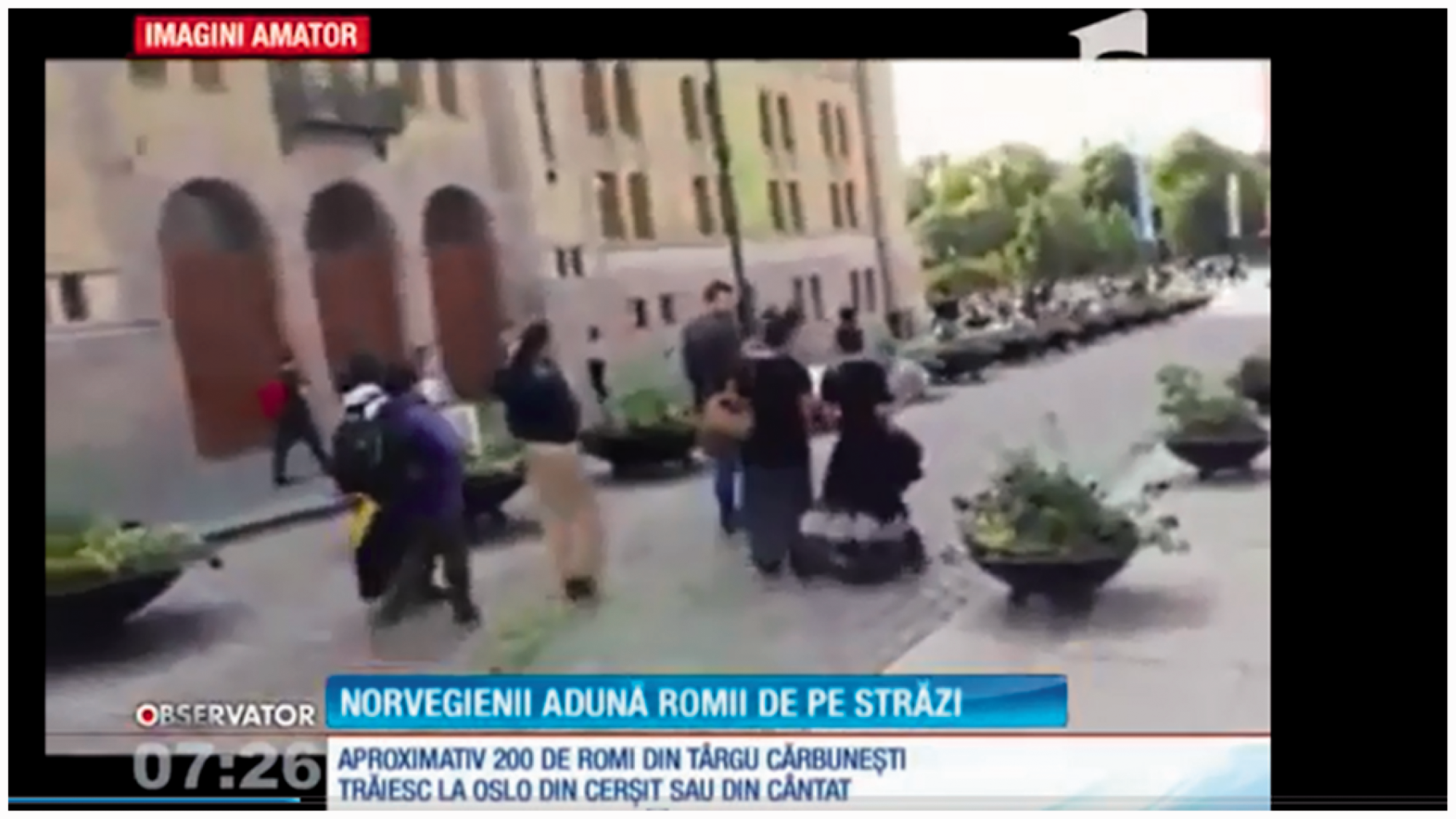
Roma parading on Karl Johan Street in Oslo.
While it can simply be cheap and convenient for news outlets to use such stock footage to provide visual content for the story (Machin and Polzer, 2015), one might think it could be possible to find a clip which reflected the actual circumstances of the Roma living in Oslo, particularly since Scandinavian media had covered the Roma in regard to begging in the street and sleeping outdoors (Aftenposten, 2014; Røstvik, 2015). The choice to use a clip of the Roma in traditional costume again invites the viewer to essentialize the Roma. It also leads to a recontextualisation of the actual events where actual harsh circumstances are left out and a traditional, backward representation of the Roma foregrounded.
We then cut to another scene as the anchors are still introducing the story, presumably still in Oslo, also archive footage. We see five older people—two women and three men—who play the Russian folk song, Kalinka on accordions and tambourines, also in the style of manele. The members of the group appear poor, unkempt, but also wearing colorful traditional clothing. We then see a closer shot of one man (seen in Figure 2) who dances, but rather awkwardly and clumsily.
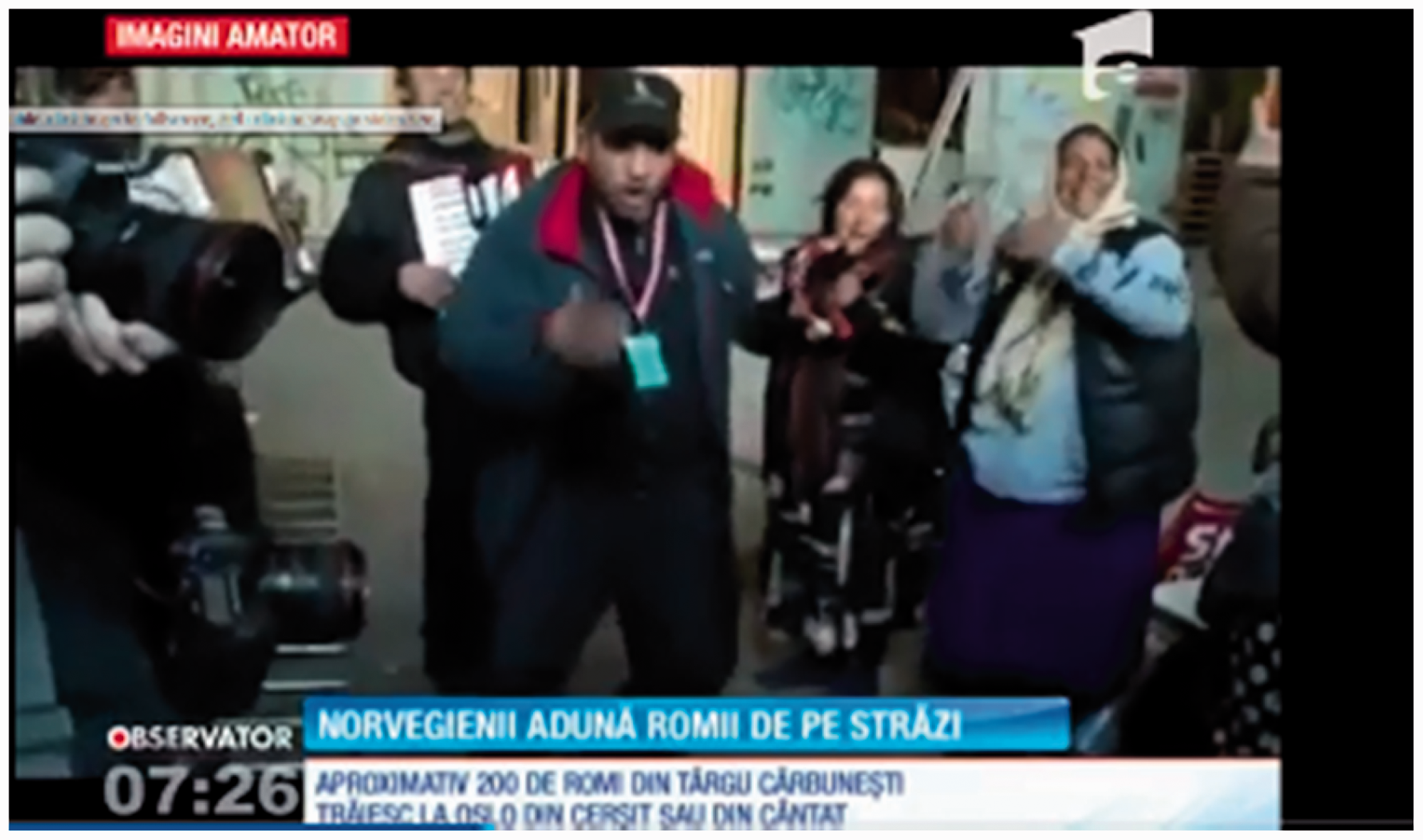
Roma playing music and dancing awkwardly.
The decision to include such footage which appears to represent the Roma in an unflattering way, certainly does not add to viewers’ understanding of the context, but can be understood as part of what have been described as strategies of ridicule (Eriksson, 2015). Scenes are selected and edited to make participants look unflattering, awkward, stupid or incompetent. What is fostered here is a sense of superiority for the viewer who is invited to laugh at those depicted. Other authors have observed similar strategies in television programs such as ‘Big Fat Gypsy Weddings’ which use the Roma to get cheap laughs in a manner which would not be seen as acceptable for the representation of other ethnic groups (Cowley, 2012).
Beyond laughter, this visual footage carries deep moral evaluations (Eriksson, 2015; Eriksson and Machin, 2017; Jensen and Ringrose, 2014) as viewers are invited to look down at the Roma. For Jensen and Ringrose (2014) such representations of the Roma are about suppressing socio-political understanding and fostering moral outrage. We might reasonably suggest that the scruffiness and overall bleak appearance of the Roma seen in the visual footage could be a direct consequence of the harsh conditions experienced living on the streets in the freezing weather as is well documented by news outlets at the time. But this aspect of the Roma experience is excluded from the discursive script being provided in this account. The effect of this representation of the Roma as ridiculous and socially backward has the effect of making their marginalised position appear as related to their culture rather than their socio-political position (Jensen and Ringrose, 2014). And, importantly, such mocking is not simply innocent humor or fun but can carry a disciplining function, as it legitimises discourses which are essentially racist (Billig, 2005; Willett, 2016).
We then move to a sequence of short interviews where a voice-over poses questions to local Roma people. We meet a man and two women (seen in Figure 3). We see these people in relative close-up, head and shoulder shots, but none is named. All colors in these images are fully saturated which creates an unaesthetic view and gives a feeling of gaudiness and tastelessness (Kress and Van Leeuwen, 2002). And the people interviewed appear to have exaggeratedly dark complexion. We are given no information about identity, age, if they are parents, nor how they live. As with the Roma in Norway, they remain anonymous.
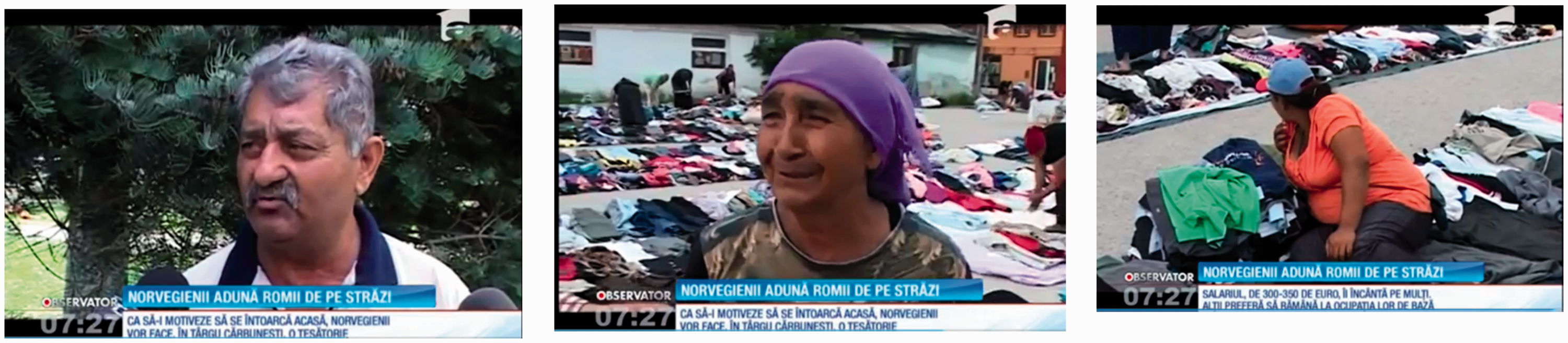
Roma people being interviewed.
Important in this sequence of interviews is how the film is edited. This plays an important part in regard to how the Roma are represented. As the interview sequence starts, a caption appears providing the meaning and coherence for what follows:
THE SALARY OF 300-350 EUROS IS TEMPTING FOR MANY. OTHERS PREFER TO STICK WITH THEIR MAIN OCCUPATION.
Roma woman Reporter Roma woman
This creative use of editing allows it to appear that the Roma themselves see begging as their main occupation. It also appears that the woman is saying that begging is well-paid. It has been observed that this kind of resequencing is common in news media and reality television (Bell and Van Leeuwen, 1994). This can be used to represent people as socially incompetent (Eriksson, 2015) but, in this case, it also clearly distorts what is said to perpetuate the idea that the Roma would rather beg than work—that they beg not as they are victims of the social structure, but through their own choosing.
Visually, edited into the interview sequence, we see another important scene which contributes to the fetishisation of the Roma in the report. We see footage of large houses (Figure 4). No comment is made on this scene, and again it is uncertain that it is connected to this story or to the actual village itself. Yet, these large and extravagant houses have become part of the wider discourse of Roma’s extreme otherness (Pusca, 2010) and here they function as metonymic representations of the community. They are thought to represent wealth, and therefore they do not need help.
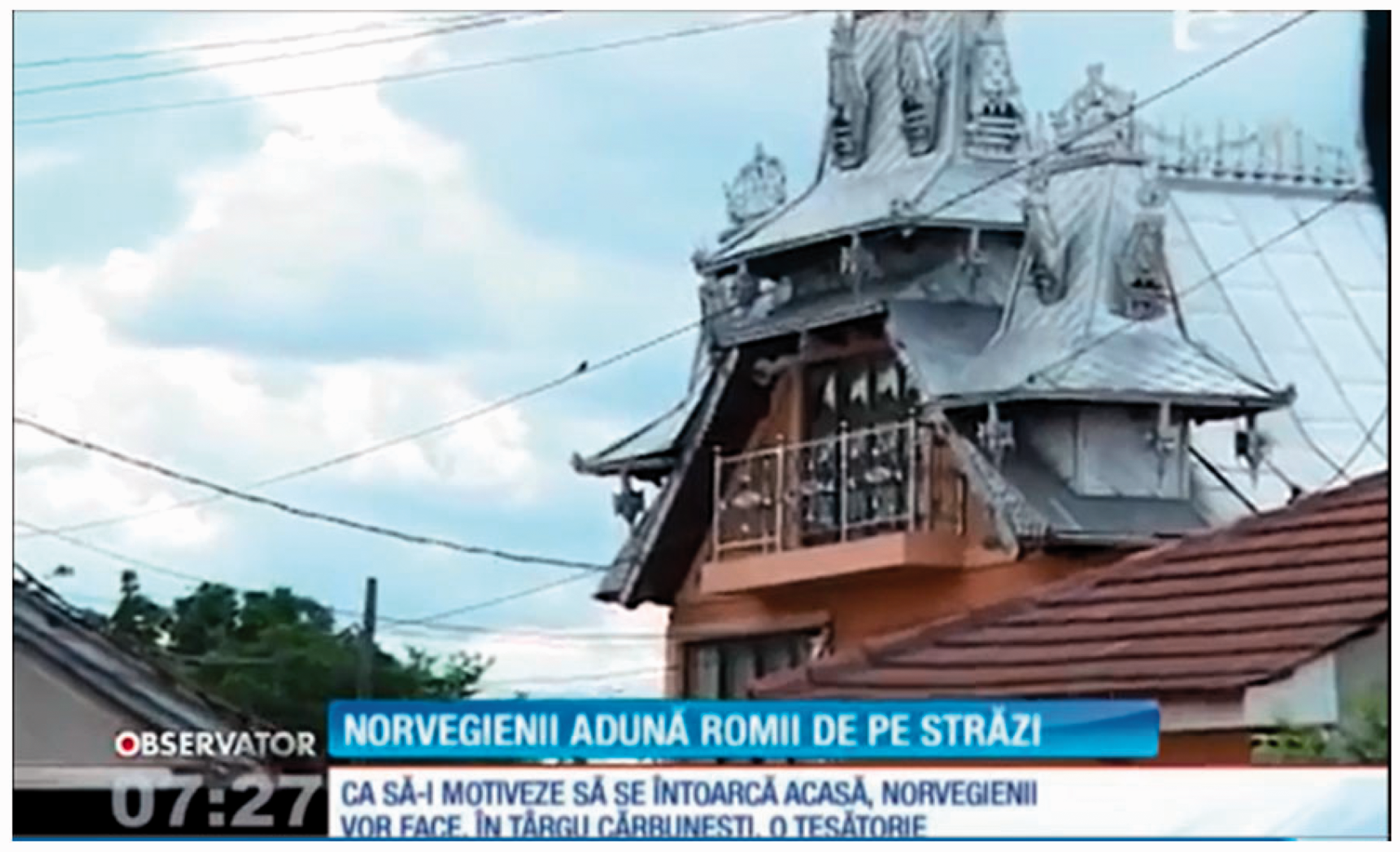
Roma Palace.
So far we find no overtly racist statements about the Roma, but nothing encourages the viewer to align alongside their situation, nor to see them as individual people who have fears, hopes, or humanity. They are a generic other who are backward, slightly ridiculous, incompatible with the wider modern culture. This representation substitutes their actual situation of hardship and survival on the streets in a cold climate.
Social action
Here we turn our attention specifically to what the Roma are represented as doing in the news report.
The mention of the term ‘begging’ is salient throughout the report. At the start we are told the Roma ‘live in Oslo from begging’. The construction of the factory means that they ‘will no longer need to beg’; the conclusion to the news report suggests that ‘many prefer to stick with their basic occupation (begging)’ as they ‘earn better from begging’. And, as we saw in the analysis of the interviews with the Roma in Extract 5, editing has been used to create a sense that the Roma themselves attest that begging is their preferred occupation.
The foregrounding of ‘begging’ as part of Roma culture has been highly criticised by many (Djuve et al., 2015; Friberg, 2018). It is rather argued that begging is a symptom of extreme poverty, especially in the context of the social and economic changes that have swept Europe, where Romani traditional ways of earning have vanished (Cherkezova and Tomova, 2013; Ruggiu, 2016). Begging is also a result of the ongoing discrimination, social exclusion and forced relocations of the Roma in Europe (Van Baar, 2014).
Apart from begging, other unproductive activities are foregrounded. At the start the anchors state that the Roma ‘sing and dance on the streets of Oslo’ and ‘use their musical talents’. These statements are accompanied by visual footage of Roma in Oslo playing instruments and dancing in what appears to be a spontaneous fashion. This also signals how the Roma may simply be incompatible with the idea of gainful employment and the role of responsible productive citizens. Of note in Figure 3, we are shown Roma people lying on the ground at the market, here signifying laziness, or being unproductive.
The voice-over also emphasises that the Roma are the privileged recipients of work and support:
Especially for them, the Nordic people will build a textile factory at Târgu Cărbunești.
And:
The people will receive jobs in their own country, so that they will no longer need to beg.
Also, given the representations of the Roma we have seen above, the Norwegian initiative sounds likely to fail or to be a vain attempt. They 'prefer' to beg and the ‘Roma palaces’, associated with wealth, assumed to have been accumulated from tax evasion and other criminal activities (Creţan and Powell, 2018; Creţu, 2014) suggest that the Roma do not need such help and incentives. Here we find a discourse where it is the hard-working Romanian taxpayer who is overlooked, as the undeserving Roma are given hand-outs (Breazu and Machin, 2018). Again, we find no overt racist nor discriminatory statements, but it is reasonable to suggest here that hatred for the Roma is being fostered, as part of the injustice experienced by the non-Roma Romanians.
The representation of the Norwegians
We now move on to examine the representational strategies and actions for the other participants. We begin with the Norwegians.
‘The Norwegians’ clearly have an important role in the events presented in the news report. Yet, the viewer is never told exactly who these Norwegians are. Linguistically they are represented as ‘the Norwegians’, ‘the Nordic people’, ‘they’. But clearly these events do not involve the whole of the Norwegian population nor the even greater category of ‘Nordic people’. We are dealing with a specific organisation which is working with European money and in relation to the Romanian authorities. Yet, the use of the collective ‘Nordic people’; and ‘Norwegians’ suggests that it is a whole country, ‘a people’ or region, who are involved in the process of repatriating, or wanting to be rid of the Roma.
Visually, in one scene (Figure 5), we see what appears to be a representative of the Norwegian government, where we see three men in the town hall. This person is neither named, nor ‘functionalised’ (we are not told specifically what his official role is, nor what he seeks to achieve in the town). Clearly who he is exactly is something to be backgrounded, as its inclusion in the script would raise the issue of the actual nature and intentions of the organisation relating to the integrated initiatives to help the Roma. The discursive script being presented here is of a different order, where the chief purpose appears to be negatively represent the Roma and show how they are favored by the establishment.
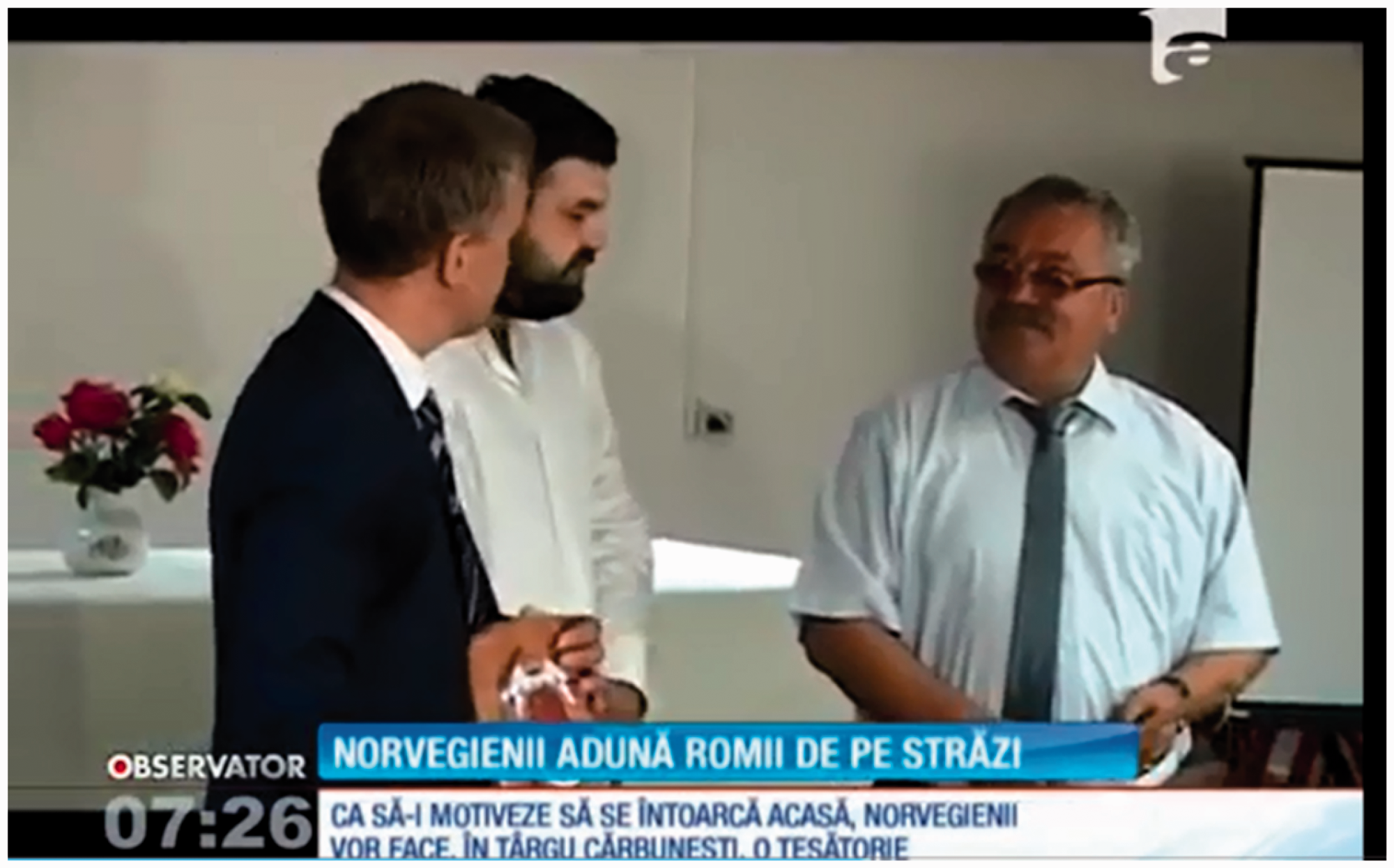
Romanian and Norwegian delegation.
The use of the collective, the ‘Norwegians’, ‘the Nordic people’, is important when we come to the social actions associated with Norway. We are told that ‘the Norwegians’ ‘found the solution’ to the Roma begging on the streets. Here the use of the term ‘solution’ suggests that the Roma present a situation that needs solving. And this is spoken as a nominalisation, where a verb, here ‘solving’, is presented in a noun form: ‘solution’. In CDA it has been observed that nominalisations can be used as they remove the need to specify causalities. So here we are not told what specifically is being solved. We are only told that there is a solution in place to ‘bring the Roma back to Romania’. There is, therefore, the connotation that the Roma themselves present a problem, although this is not stated overtly. In this context, the noun ‘solution’ resonates with Hitler’s final solution to the ‘Jewish problem’, as it euphemistically refers to the deportation of the Roma from Norway to Romania.
We are also told the Norwegians ‘built a textile factory to motivate the Roma to return to Romania. Foregrounded here is not that the factory is to help the Roma, nor that this is part of wider European incentives to address Roma poverty and marginalisation. The factory is rather a way to ‘motivate the Roma to return to Romania’. Important here is that viewers will be aware of other less benign policies across Europe at the time to repatriate the Roma.
The use of the word ‘motivate’ also suggests that the choice to leave lies in the hands of the Roma, that they have agency here. Will they choose the factory and work, or singing, dancing and begging? Signified here is the discourse that, in the end, the Roma situation of social exclusion is one of choice.
As we see the street scene at the start of the report as we hear the anchors speak in Extract 1 a caption appears (shown in Extract 7):
It is only in the conclusion to the report that the Norwegian relationship with the European Union is mentioned, as we see below.
The project will be carried out by Norwegians, at Târgu Cărbunești with money from the European Union.
The Romanian authorities and the NGO
Linguistically, the Romanian authorities are absent from the report. We only see them in a single short scene which takes place in the town hall as they meet the Norwegian representative (Figure 5). However, there is no information about who these people are, their roles or what they have to say about the factory project. This is a huge omission as here we are dealing with agents acting on behalf of the Roma in Romania.
The only official person who is individualised through naming is an NGO representative whose full name and role is displayed on screen. In the news clip he is introduced as a volunteer for ‘an NGO’. Yet, his exact role and organisation is not specified. From other media sources (Militaru, 2019; TV, 2016) we established that the man is a Romanian citizen living in Norway, who has worked with Norwegian organisations. He is also founder of an NGO whose role is to help Roma migrants in Norway to return home and be integrated into the Romanian job market and a member of Fra Tiggerkopp, a Norwegian NGO whose mission is ‘to find creative and constructive contributions to the begging problems in Norwegian cities’. Again, this omission points to the fact that the actual process and mechanics of supporting the Roma are not relevant here per se, as much as signalling the unworthy nature of the Roma, the Norwegian desire to be rid of them and the injustice of this use of funding.
The NGO representative speaks in the report saying:
They will create a
Conclusion
It has been observed that racist discourses in the media are increasingly more managed, disguised and concealed. The challenge is then to dig deeper into communication to reveal how this ideology is nevertheless communicated. The analysis in this paper shows how television news, with its specific affordances and editing techniques manage to communicate such ideologies.
In this news clip, the racism and incitement to hatred are never communicated at the surface, in open terms, but through what is implied by a combination of what is said in voice-overs, captions and editing. As the presenter tells us, all Norwegian people want a ‘solution’ to the Roma, and a factory is being built ‘especially for them’, we see Roma in traditional clothing parading ridiculously in a main street in Oslo and playing music associated with low culture. The caption informs us that about ‘200 Roma’ live off begging, yet we see a scruffy man dancing awkwardly, and he appears to represent all the 200 Roma in Oslo. Editing and juxtaposition are used to give the sense that the Roma choose begging and profit highly from it, having little appreciation of the gift of the factory, or for the possibility of real work.
Importantly, through language and images, the viewer is denied the chance to see the Roma humanised as ordinary individuals, worried for their children, their family and their livelihood—important strategies to prevent any alignment with them as people. And these racist sentiments make it difficult for the viewers to understand the Roma in the context of their long-standing history of discrimination and marginalisation in Romania (Creţan and Powell, 2018).
In this paper we show the value of carrying out a close analysis of one news clip—findings which are characteristic of our wider corpus of news clips. Running through them is this sense that the Roma are a known ‘them’ who flagrantly act in their own interests, not following laws, profiting from unlawful acts or avoiding civic responsibilities such as paying taxes. Yet, also consistent, as we saw in the present analysis, is the sense that the authorities do nothing to control them, but rather look the other way, even help them, something which is always evaluated negatively. In this paper, none of these things is necessarily overtly stated, but rather communicated by the combinations of language, visual footage images, music and captions.
Footnotes
Authors' note
David Machin is now affiliated with School of International Studies, Zhejiang University, China.
Declaration of conflicting interests
The author(s) declared no potential conflicts of interest with respect to the research, authorship, and/or publication of this article.
Funding
The author(s) received no financial support for the research, authorship, and/or publication of this article.
