



Abstract
Roma people in Europe experience racism and various forms of discrimination: exclusion from the formal labour market, limited access to education and healthcare, and housing deprivation and segregation. At the same time, they respond to this situation by displaying a variety of creative micro-practices and daily forms of resistance, skilfully navigating constraints and opportunities. In this article we focus on how Romanian Roma migrants experience and challenge housing deprivation and segregation in Italy, where thousands of destitute Roma live in either informal settlements, constantly targeted by forced evictions, or within state-funded camps. More specifically, we ask how these adverse housing conditions are navigated differently by Roma women and men. Drawing on the concepts of ‘intersectionality’ and ‘social navigation’, we analyse 24 life stories collected in Italy, as part of a research project investigating the effects of public policies on destitute Roma migrants in France, Italy, and Spain. We argue that, despite both Roma women and men experience housing deprivation and segregation, they navigate these unfavourable circumstances through strategies shaped by their gendered social location and its intersection with age and parental responsibilities. Our analysis shows that Roma migrant women predominantly reconcile informal economic activities with a performance of feminine domesticity and obedience. Especially young women resort to marriage and separation as tools to navigate different housing arrangements. Finally, mothers navigate state institutions and informal settlements in the attempt to preserve both their children’s safety and family unity. In contrast, Roma migrant men leverage their relatively privileged status in the public space, by more easily negotiating access to the formal labour market, including at a younger age. Men with parental responsibilities also prioritise their children’s safety, but the targeting of male-specific socialising practices in state institutions can make them reassert the relative behavioural freedom that they enjoy in informal settlements.
Introduction
The Roma are the most discriminated ethnic minority in Europe. They experience racism (McGarry, 2017; Van Baar, 2011), and have limited access to formal employment (Marinaro, 2019), education (O’nions, 2015), healthcare (Alunni, 2020), and adequate housing (Berescu et al., 2013; Maestri, 2019; Picker, 2017). Italy records among the highest rates of Roma housing deprivation and segregation within Western Europe. Here thousands of destitute Roma live in either informal settlements, constantly targeted by forced evictions, or within state-sponsored camps and accommodation that foster ethnic segregation and present highly critical hygiene and safety conditions (Associazione 21 Luglio, 2024).
In this article we ask how housing exclusion in Italy is experienced and challenged by Roma migrants, depending on their gender. Whilst critical Romani scholarship has recently focused on formerly silenced Roma groups through an intersectional lens, such as Roma women (see Vincze, 2014), including mothers (Humphris, 2019), and LGBTQIA+ (Fremlova, 2022), our article addresses a lack of comparative research into Roma’s gendered social positionings in relation to housing deprivation and segregation. More specifically, we explore the social navigation strategies of 24 Romanian Roma migrants in Italy, examining the differences and similarities between Roma women and men with different ages and parental statuses. Our analysis evidences how Roma women and men skilfully navigate unfavourable housing conditions and policies by mobilising the support of charities and families, and through strategies that are shaped by their gendered social location and its intersection with age and parenting responsibilities. For example, while Roma migrant men leverage their relatively privileged status within the public sphere, by more easily negotiating access to the formal labour market, women resort to marriage or the performance of feminine vulnerability and obedience to navigate housing access opportunities.
The first section of the article discusses the literature on Roma housing deprivation and segregation, while the second illustrates our theoretical approach, informed by the concepts of ‘intersectionality’ and ‘social navigation’. After discussing our methodology in the third section, we introduce the housing policies targeting the Roma in Italy, and the consequent housing deprivation and segregation that these have created in the last three decades. The following sections present our empirical analysis of how Romanian Roma migrants navigate housing policies and deprivation, by focusing on their experiences in Roma official camps, in emergency accommodation, and in informal settlements subject to forced evictions. The conclusion reflects on the intersection of gender, age, and parental status in influencing Romanian Roma migrant’s strategies of access to adequate housing.
Roma housing segregation and deprivation in Europe and its overlooked gendered dimension
It is estimated that 52% of Roma in Europe experience housing deprivation (European Union Agency for Fundamental Rights Agency, 2023). Despite improvements in the last decade, still 33% report having been forced to leave their accommodation in the last 5 years, and around 6% live in slums or caravans (Ibid.). Although academic and advocacy knowledge production can inadvertently contribute to a fallacious culturalization of Roma marginality (Cittadini, 2018; Grill, 2018), it is important to acknowledge how Roma groups do experience restricted access to decent and adequate housing compared to the national averages of their countries of residence (European Union Agency for Fundamental Rights Agency, 2022). The situation is especially worrying in countries such as Italy, where 25% of Roma live in slums or mobile homes, and Greece and Romania, where 68% and 70% of Roma respectively report experiencing deprived housing conditions (European Union Agency for Fundamental Rights Agency, 2022).
Despite national differences, the residential confinement and substandard living conditions experienced by Roma people are unfortunately widespread across both Western and Eastern Europe (see Picker, 2017). For example, Italy became infamously known as ‘Campland’ (European Roma Rights Center, 2000) because of its state-sponsored Roma camp system that developed since the late 1980s (Daniele, 2011; Mantovan, 2021; Sigona, 2011). Although France is characterised by a colour-blind approach and does not recognise ethnic minorities (Hermanin, 2011), camps have been used to house French Travellers, while Roma migrants were relocated in so-called ‘integration villages’ (see Legros and Vitale, 2011; Maestri, 2019). In the UK there are official camps for Gypsy-Travellers, which have been justified as a form of protection of their alleged nomadic lifestyle, while at the same time enhancing control and segregation (Picker, 2017; Powell, 2013). Although Roma camps do not officially exist in Spain, an assimilationist approach pushed Gitanos and Roma into segregated neighbourhoods (Aguilera, 2017; Magazzini and Piemontese, 2016). Ghettoized urban areas, often threatened by evictions (Várnagy, 2023), can be identified in Central and Eastern Europe too, like in Czechia (Bancroft, 2001), Romania (Lancione, 2019; Zamfirescu, 2015), Slovakia (Van Baar, 2012), and Hungary and Serbia (Berescu et al., 2013). Only a minority of destitute Roma experience segregation and deprivation, but the visibility of their housing situation reinforces group stigmatisation towards Roma in general, including wealthier classes (Creţan and Powell, 2018).
Scholarly research critically discuss the role of state institutions in perpetuating Roma segregation (Picker, 2017), including through seemingly humanitarian policies (Agarin, 2014; Van Baar, 2012). Civil society organisations, including pro-Roma charities, also play an important role in the reproduction of Roma housing segregation (see Armillei, 2018; Maestri, 2017; Manca and Vergnano, 2019). At the same time, the Roma are not passive subjects but they skilfully navigate opportunities within unfavourable circumstances. Scholarly work has thus focused on mundane micro-practices (Creţan et al., 2022; Ivasiuc, 2018; Legros and Lièvre, 2019), including the mobilisation of different forms of capital and resources that can facilitate processes of housing inclusion (Clavé-Mercier and Olivera, 2018). In fact, even segregation in camps and informal settlements can be instrumentally used by Roma to strategically access charity support (Sigona, 2015), speak out and act politically (Pontrandolfo, 2018), and accumulate savings for projects of upward social mobility (Manzoni, 2017).
Yet, despite this wealth of research, the gendered dimension of housing segregation and deprivation has been overlooked. This neglect is remarkable when we consider the proliferation, in the last decade, of analyses devoted to Roma women’s experiences, beyond housing. For example, the active role of Roma migrant women has been explored in relation to street begging (Baldino, 2020; Marcu, 2017), street work (Dumitru, 2020), family planning (Gamella, 2018), health (Kozubik et al., 2020), and migration and social mobility projects (Ivasiuc, 2018). Research has also focused on Roma women within the criminal justice system (Mantovan, 2024) and in encounters with state actors, who often stereotypically portray them as ‘despicable mothers’ (Humphris, 2019; Mantovan and Maestri, 2021; Vrabiuescu and Kalir, 2017). Finally, research has discussed the role of Roma women in the wider Romani movement (Brooks, 2012; D’Agostino, 2018; Izsàk, 2009; Kóczé et al., 2018; Oprea, 2009), and how Roma women build alliances beyond national differences (Sordé Martí et al., 2012). Recent scholarship has also focused on other formerly silenced groups, such as Roma LGBTQIA+ (Corradi, 2018; Fremlova, 2022), and scholars in Critical Romani Studies have highlighted how identities beyond the ethnic one importantly shape Roma’s lived experiences (Bogdan et al., 2018). Apart from a few exceptions (Andrei et al., 2014; Mózes et al., 2024), however, this attention towards gender is yet to be developed in studies on Roma housing deprivation and segregation (Maestri et al., 2024).
In this article we therefore aim to contribute to the field of Roma housing research through a gender and intersectional approach, by asking: how is housing segregation and deprivation in Italy experienced and navigated by Roma migrant women and men? More specifically, as we will discuss in the next section, through an intersectional approach we aim to understand how specific individual characteristics intersect with gender in shaping Roma women’s and men’s social navigation strategies of housing access.
Intersectionality and the social navigation of Roma housing deprivation and segregation
The term intersectionality refers to an intellectual project, which attends to the relational nature of power and social inequalities (Collins and Bilge, 2016; Davis, 2008). It is based on the understanding of identity categories (such as race, gender, class, sexuality, age etc.) and systems of oppression (e.g., racism, heterosexism, classism, ageism etc.) as reciprocally interrelated rather than mutually exclusive (Ibid., Collins, 2015). It enriches approaches uniquely focused on gender, foregrounding the interplay of various social locations in determining the experiences of discrimination and resistance of individuals at multiple crossroads of oppression (Yuval Davis, 2014). Intersectionality was indeed first introduced as a metaphor (Collins, 2019; Crenshaw, 1989) that could help analyse the intertwinement of racism and sexism experienced by African American women within legal frameworks and collective action in the USA (Chauvin and Jaunait, 2015; Crenshaw, 1991). We will use the concept of intersectionality to explore Roma women’s and men’s experiences of housing segregation and deprivation. In so doing, we will pay attention to how gender and other variables shape their housing careers, opening up and foreclosing different opportunities in different moments and spaces.
More specifically, we will employ an ‘intercategorical’ approach (McCall, 2005), which foregrounds relationality by provisionally adopting existing categories as anchor points and explicating the relationship between them. As argued by McCall (Ibid., 1785), unlike an intersectional ‘anticategorical’ approach, which aims at deconstructing analytical categories, an intercategorical perspective is concerned “with the nature of the relationships among social groups and, importantly, how they are changing, rather than with the definition or representation of such groups.” This effectively means that, in this article, we will adopt the analytical distinction between Roma ‘women’ and ‘men’ (as all our participants self-identified in either of these two categories) to investigate how they navigate seemingly similar processes of exclusion. This does not mean, however, that we endorse an essentialist and binary understanding of gender; in fact our analysis will support a constructionist approach to gender (Butler, 1990) as performed and negotiated through social practices, including the social navigation of housing processes.
In our analysis we also foreground how Roma migrants actively navigate challenges and opportunities. Indeed, the Roma respond to housing deprivation and segregation through forms of “ordinary agency” (Ivasiuc, 2018, 129), i.e., what they “actively do [italics in original] to deviate, alter, resist, or challenge the policy and development interventions targeting them.” Differently from collective action and political mobilisations, here we focus on practices that are not aimed at overthrowing the status quo, but that are developed by migrants who are silently trying to ‘survive’ (Barnao and Saitta, 2020) and come as close as possible to their idea of a desirable life. We define agency as the intentional ability to make a difference within a context of perceived opportunities and constraints (see De Haas, 2021; Triandafyllidou, 2017). More specifically, to capture Roma women’s and men’s agency, we employ the notion of ‘social navigation’. Borrowed from social anthropology (Vigh, 2009), it has been increasingly used in migration research to explore migrants’ agency vis-à-vis uncertain environments (see Schapendonk, 2018; Triandafyllidou, 2019; Tuckett, 2015; Wall, 2019). The Roma are indeed confronted with a highly hostile environment rooted in historical racist policies and stereotypes. In Italy this is compounded by a recurrent use of emergency measures and discourses, as we will illustrate below. Therefore, destitute Roma migrants have developed a capacity to navigate a thorny field, characterised by heterogeneous housing policies and forced evictions, and populated by different state and civil society actors. More specifically, as we will discuss in the empirical section of the article, in our study we observed that social navigation strategies are shaped by our participants’ specific gendered and intersectional social locations.
Methods: Life trajectories, positionality, and intersectional analysis
This paper is based on the analysis of 24 life stories of Roma migrants originally from Romania, who settled in Italy (12 men and 12 women) 1 (see Annex I). The stories included in this article were collected as part of the international research project ‘MARG-IN – MARGinalization/Inclusion: the medium- and long-term effects of foreign poverty regulation policies on target populations: the case of so-called “Roma” migrants in Western European cities (France, Italy, Spain)’, led between 2015 and 2019 by the University of Tours (France), which also granted ethical approval. The decision to focus on Roma migrants followed the criminalisation of these groups in the early 2010s (Daniele et al., 2018). For example, Italian and French governments of the time had adopted exceptional policy measures targeting Roma migrants from Eastern Europe (from Romania, especially), including forced evictions and repatriations (Hepworth, 2012; Parker, 2012). Through an analysis of public policies targeting marginalised and destitute Roma migrants, the project aimed to assess their effects on the Roma’s spatial mobility, housing, economic practices, and social relations.
The project methods were informed by biographical and life course research (Legros et al., 2024). While the former foregrounds the participants’ and their families’ main life events (Rosenthal, 2004), the latter emphasises turning points and critical moments (Gray and Dagg, 2019; Laub and Sampson, 1993), linking experiences at the micro-level with meso- and macro-social events. The research team collected 75 ‘life trajectories’ (trajectoires de vie) of Roma migrants in France, Italy and Spain, focusing on significant episodes, ruptures, and transitions experienced by participants in different domains of their lives (Paugam, 1991). Unlike for in-depth interviews, the aim of these life trajectories was to trace the unfolding events that characterised the participants’ lives, rather than foregrounding their feelings and subjective accounts. As a result, the project did not rely on thematic analysis of interview transcripts. In fact, data were gathered through multiple qualitative methods (after gaining the participants’ verbal consent): not only in-depth interviews, but also participant observation and document analysis (e.g. policy documents and media accounts) in different languages (i.e., French, Italian, Romanian and Spanish). The analysis illustrated in this paper therefore does not discuss direct quotes from participants but examines particular events and turning points of their housing trajectories. The data were pseudonymised and inserted in a structured outline covering the following topics: the participant’s main biographical events, a brief history of their household (with a family tree), their spatial mobility (specifying the resources mobilised and future housing projects), their economic practices (including sources of income, main economic activities, and satisfaction with current financial situation), social relations (e.g., with family, friends, co-workers, and institutions), and the main effects of public policies on all these different aspects. Collating all the data in a standardised manner enhanced the comparability of life trajectories, also foregrounding the broader political and economic context and the social networks in which participants were embedded in.
The project adopted convenient and snowball sampling strategies, which are especially useful when conducting research with hard-to-reach populations (Raifman et al., 2022). All participants self-identified as ‘Roma’ and were born in Romania. The majority of them defined themselves as either “modern” Roma, “Romanianised” Roma (romanizat) or using the term “Laeshhh”, i.e., no longer speaking Romani language. Only 5 out of 24 specified their family ethnic group: three self-identified as ‘Ciurari’ (originally from Transylvania region), 1 as ‘Ursari’ (mostly living in the Wallachia region) and 1 as ‘Căldărari’ (a group traditionally associated with coppersmiths) 2 . Given that the project exclusively focused on destitute Romanian Roma migrants experiencing poverty in the destination country, there was no sample variance in relation to class. In contrast, the age profile of the sample offered great variety, enabling us to focus on its importance in experiences of housing deprivation and navigation strategies. Finally, in terms of gender, we maintained a balance between women and men participants, while none of them self-identified as LGBTQIA+.
During the fieldwork, we engaged in reflexive practice concerning how our own positionality as middle-class non-Romani women researchers affected our analysis. As observed by Fremlova (2018), non-Romani researchers can fruitfully participate in knowledge production on the Roma as long as they critically reflect on ethical issues and power relations. Self-identifying with the same gender position and having a shared experience of motherhood helped us to some extent to relate to the experiences of many Romani women. We also identify as allies and employ critical approaches, such as intersectionality, in our work. Nevertheless, we are very conscious that we have never faced the same forms of oppression that our research participants experienced, because of our privileged race and class position. Critical Romani Studies encourage participatory action research in which Romani local informants (or scholars) are involved in all phases of the research (Bogdan et al., 2018: 5). However, when this is not possible, researchers can still report on Roma’s experiences and challenge discrimination (Ibid.). Roma participants’ involvement in the MARG-IN project was limited to the stage of data collection. We therefore take full responsibility for the analysis and presentation of findings, and we acknowledge our epistemic power in representing the experiences of Roma migrants, whose agency we have tried to foreground in our interpretation. At the same time, it is important to highlight that data were gathered by a pool of researchers who had long-standing connections and collaborations with Roma groups, as academics and activists, as well as volunteers in pro-Roma civil society organisations. This considerably helped avoid the risk of “extractivism” (Tuck and Yang, 2014).
In this article, we advance an intersectional analysis of Roma migrants’ experiences of housing segregation and deprivation in Italy, which had remained underdeveloped in the MARG-IN project (Maestri et al., 2024) 3 . We analyse Roma women’s and men’s life trajectories, paying attention to how various aspects of the participants’ identities (e.g., racialization, gender, age, relationship status, parenting responsibilities) shape their experiences of housing deprivation and social navigation. We then compare the experiences of participants who occupy different social locations (e.g., women vs men, married vs unmarried/divorced/widowed, youth vs elderly). Because of the relatively small size of the research sample, we do not seek generalization through our analysis.
Roma housing deprivation and segregation in Italy
As mentioned above, Italy received the notorious title of ‘Campland’ (European Roma Rights Center, 2000) due to the presence of state-funded Roma camps since the late 1980s. As confirmed by recent figures (European Union Agency for Fundamental Rights Agency, 2022), Italy records among the highest rates of Roma living in slums and caravans. Though the situation has considerably improved in the last decade, today still 15,800 Roma experience housing segregation and deprivation in Italy, i.e., roughly 10.5% of Roma population in Italy (Associazione 21 Luglio, 2024). The majority of these Roma live in official camps (13,300, as opposed to 2,500 living in informal settlements) (Ibid.), which are publicly funded mono-ethnic housing projects, where municipalities supply mobile housing units (either container houses or caravans) and basic facilities (such as drinking water, toilets and electricity). Whilst the majority of Roma living in informal settlements are Romanian migrants, in official camps 62% of residents are naturalised Italian citizens, with a migration background from former Yugoslavia (Ibid.). At the same time, as we will show in the next sections, increasing numbers of Romanian Roma migrants have also accessed state-funded camps and emergency accommodation, and therefore an analysis of their life trajectories can fruitfully contribute to an understanding of the effects of various housing policy tools.
Official Roma camps started being promoted by Italian regional governments in the 1980s as a form of protection of Roma’s alleged cultural nomadism (Sigona, 2003, 2011), and were initially strongly supported by pro-Roma charities too. This culturalization of Roma’s dwelling practices, however, ignored the fact that their housing informality and geographical mobility was in fact historically related to seasonal economic activities (see Lucassen et al., 1998; Okely, 1983) and push factors, such as wars and racial discrimination (Legros and Vitale, 2011; Sigona, 2003). The implementation of this housing policy was accelerated during the Yugoslav Wars in the 1990s, following the arrival of Roma asylum seekers who started living in informal settlements in major Italian urban centres. Local governments thus started using the sites created in the 1980s for so-called nomads to temporarily re-house newly arrived Roma asylum seekers. However, despite being presented as temporary accommodation facilities (Marinaro, 2009), these camps have persisted until today and have importantly affected the lives of thousands of Roma families in Italy, trapping them in a temporal and legal limbo (Bravi, 2009; Maestri, 2019).
Roma living in official camps experience residential segregation, isolation, and territorial stigma, in addition to poor hygiene and safety conditions, as well as overcrowding (e.g. some camps in Rome host more than one thousand people). It is estimated that in official camps life expectancy is 10 years lower than the average national population (Associazione 21 Luglio, 2024). In official Roma camps, the municipalities also supply a series of services through subcontracted NGOs, including internal security and school support for the children. Many third-sector organisations work as camp managers, thus playing an ambiguous role between humanitarian support and control (Armillei, 2018; Armillei and Maestri, 2018). Research has also evidenced how Romani activists have been co-opted in the control of Roma camp populations (Marinaro and Daniele, 2014). Due of their state of infrastructural neglect and progressive abandonment, however, some official camps have now been listed as ‘tolerated’ and awaiting clearance, without further state support provisions.
Because of all these problems, the Italian government adopted a National Strategy for the Inclusion of Roma, Sinti and Caminanti Communities in 2012 (as requested by the EU Framework for National Roma Integration Strategies), which included a plan for the dismantlement of the official camps and support for housing access of Roma camp dwellers (Daniele et al., 2018). As a result, in cases of forced eviction, municipalities started housing the Roma in emergency centres rather than relocating them into new official camps. Centres are often located in buildings in peripheral urban areas and, like in camps, overcrowding can easily lead to tensions between residents. However, in the centres residents may be subject to tighter controls than in camps: mobility is strictly monitored (e.g., with curfew hours) and there are specific codes of behaviour (e.g., pets and alcohol consumption are not allowed). To date, there are still three emergency centres in the cities of Brescia, Naples and Latina (Associazione 21 Luglio, 2024).
Overall, despite the number of Roma living in camps have almost halved in the last 10 years (Associazione 21 Luglio, 2024), the implementation of the national plan for the dismantlement of camps has been fragmented and did not result in the end of Roma housing deprivation and segregation (Alietti and Riniolo, 2019; Daniele et al., 2018; Pontrandolfo and Solimene, 2023). Today many Roma still live in camps or settlements that have been abandoned by the state, and are still often targeted by forced evictions violating international human rights laws (European Commission against Racism and Intolerance, 2024).
The gendered navigation of work and family opportunities in official camps
Official camps often undeniably constitute a longed-for improvement for Roma who have lived in informal settlements, thanks to their access to basic facilities and infrastructures, e.g., water and electricity. Life in official camps also enables residents to be included in forms of charity support, which can help them enhance their access to education and healthcare, as well as work and housing opportunities (Sigona, 2015). Nevertheless, Roma living in official camps are confined to a state of legal uncertainty and protracted temporariness. Moreover, in these spaces, Roma mobility is monitored by camp managers and their everyday life is often subject to the control of a multiplicity of state actors (e.g., social workers or the police). Roma women and men therefore learn to skilfully navigate this intricate entwinement of obstacles and opportunities, in order to improve their living conditions.
For example, getting a place in an official camp can constitute an important step in one family’s plan towards accessing adequate housing conditions, despite the negative aspects that we just mentioned. This is epitomised by the story of Adelina (Daniele, 2016), whose family moved from an informal settlement to an official camp in Rome in the late 1990s. Adelina, born in 1996, arrived in Italy when she was only 2 years old and settled in one of the largest informal settlements in the Roman periphery. Having lived there only for a couple of years, she did not have any direct memory of it but she vividly remembered her parents telling her about the cold and the mud during the winters, and the lack of drinking water. After the clearance of this settlement in 1999-2000, Adelina and her family moved in a housing unit in an official camp. Although they lived in a small container and faced increased surveillance through the daily presence of the police, Adelina’s family welcomed this move as a considerable improvement from their previous housing situation, also thanks to the opportunity to access healthcare for her disabled younger sister. George (Daniele, 2017c) had a similarly positive experience. After arriving in Italy in 2002 with his mother and brother, when he was 9 years old, he settled in an informal settlement in the outskirts of Rome, where his aunt was living. However, from the very beginning, his family actively looked for ways to leave the informal settlement and move to an official one. Thanks to the support of a charity in charge of the schooling of Roma children, George’s family was finally allocated a housing unit in an official camp. This not only implied a considerable change in housing infrastructural resources; it also facilitated his father’s journey towards formal employment and financial independence, later enabling his family to afford the renting of a council housing flat.
But while living in an official camp can indeed facilitate housing and job access, Roma women and men craft strategies of economic independence and housing mobility differently. The Roma women in our sample tend to reconcile their economic activities with their feminine domestic role as mothers and wives, whereas men often leverage their free mobility within the public space. For example, Jana (Santilli, 2017) (born in 1975) settled in Italy in 2005, after many years of circular migration in different European countries. Once in Italy, her family was allocated a housing unit in an official camp in the Eastern periphery of Rome. After separating from her husband, she needed to provide for her four children and therefore she opened an informal café in her housing unit in the official camp. Several women in our sample also panhandled while living in official camps, e.g., Iolanda (Daniele, 2017b), Florentin’s wife (Persico, 2017b), Gabriela (Persico, 2017c), and George’s mother. Panhandling, as a solitary activity, is quite common among women because it does not entail working with men. This was the case of Iolanda who, after getting married, was prevented from pursuing her career aspiration to become a hairdresser and was forced to panhandle by her mother-in-law. Moreover, panhandling is a form of highly femininized emotional work, eliciting feelings of compassion, vulnerability and pity (Baldino, 2020; Marcu, 2017). In contrast, men are granted a higher degree of freedom within the public space, and engage in activities that are perceived as predominantly masculine, e.g., driving. For example, Dorin (Daniele, 2017a) informally worked as a taxi driver for camp residents, and so did Jana’s son, who was able to buy a car thanks to his mother’s work and savings. Our analysis also highlights how formal job opportunities are more frequent among men. This is the case of George and his father: George’s father was employed as a minibus driver by a charity working in their official camp and was then replaced by George. Also Dorin enrolled on a formal paid internship with a charity working in an official camp. Finally, Iolanda’s father used to work for the camp managing charity as a keeper, and then started working with a charity who provided school support services to the children of the camp. In contrast, Iolanda’s mother frequently worked, but only informally, mostly as a cleaner or in the vegetable and fruit picking sector.
While the formalisation of men’s work situation can support families in accessing adequate housing, e.g., by gaining the financial means to afford a rent within the social housing market, this is often not an option for women living in official camps. As a result, within our sample we observed that women tend to develop social navigation strategies based on marriage (or divorce) that can help them move between different housing solutions. For example, Adelina decided to get married and move abroad to escape her life in the official camp. As we illustrated above, her story exemplifies the different opportunities that can emerge in official camps; at the same time, it also shows how opportunities might not evenly distribute across all family members, in fact penalising younger women. While access to employment definitely benefitted Adelina’s mother, her economic independence hindered Adelina’s aspirations. From a very young age, Adelina found herself responsible for most house chores and care work, as her mother was working outside the house. This led Adelina to stop attending school, which significantly undermined her education and subsequent job prospects. Subject to increasing family control during her teenage years, Adelina started seeing marriage as a possible way out. After getting married when she was 18 years old, she moved in her family-in-law’s flat in Brussels, which entailed a considerable progress in her housing condition. Unfortunately, however, a difficult relationship with her mother-in-law did not lead to an improvement in Adelina’s housework load. Because her mother-in-law forced her to panhandle and to take care of her nephews and the house, Adelina went back to live with her parents for a period, before returning to Brussels and moving to an independent flat with her husband. Though not successful, the decision to get married is how Adelina decided to navigate the unfavourable circumstances that she had endured when living in the official camp with her family of origin. Separation can also be used as a strategy to regain control over someone’s aspirations and plans. This was the case of Iolanda, whose mother-in-law also wanted to control her day-to-day activities. Disapproving of her plan to enrol on a hairdressing course, Iolanda’s mother-in-law forced her to drop out, to panhandle, and to hand over her earnings. Unhappy with the situation and thanks to the support of her family of origin, Iolanda decided to divorce. She later got married again and moved to Germany. Overall, Adelina’s and Iolanda’s stories demonstrate how Roma women tend to have a more difficult access to formal economic activities compared to their male counterparts, and therefore strategically navigate family relationships to create opportunities for economic and housing access.
Roma women and men in emergency accommodation between exit and adaptation
There are two main types of emergency accommodation that have been used by municipalities to relocate Roma migrants after forced evictions: emergency centres and mother and child shelters. As mentioned above, emergency centres are often over-crowded and this can create tensions between families (Daniele et al., 2018). They also present strict rules, e.g., curfew hours or alcohol consumption prohibition. As a result, some men in our sample refused to fully comply with these rules and eventually decided to leave the centres, considering the informal settlement as a space of relative freedom compared to state institutions – as we will discuss further below.
Florentin, for example, lived for a short period in an emergency centre in the area of Milan. With his wife, Magdalina, he migrated to Italy in 2003, aged 49, to join his younger brother. After the umpteenth forced eviction, the municipality offered them relocation to an emergency centre. The couple accepted but Florentin struggled to adjust to the rules of the centre: he was repeatedly caught drinking alcohol, which one day generated an argument with one of the workers of the charity managing the centre. According to Florentin, the worker did not approve of him inviting his friends for drinks and, after throwing away his half-full beer bottle, he reacted with a verbal aggression towards her. The centre manager reported the episode to the public officers of the municipality, who decided to expel him. His wife, in contrast, could stay, due to her poor health condition but, after 10 days of separation, she decided to leave the centre too, to reunite with Florentin.
Men’s conflicted social navigation of emergency centres is in certain cases counterbalanced by their wives’ strategy of adaptation. For example, Anastasia (Pasta, 2017d) and her family – whose story we will discuss more in detail in the next section – lived in two emergency centres after a long series of forced evictions, which also took a heavy toll on her son’s mental health. In 2010, during their first experience in an emergency centre, Anastasia and her family were expelled because the workers claimed that her husband Dumitru did not sufficiently cooperate with the charity supporting their housing access. In 2011 the family was again offered emergency accommodation and, this time, Anastasia successfully convinced Dumitru to comply with the rules of the centre, i.e., an indoor smoking ban and employment continuity. Thanks to Anastasia’s strategy of adaptation, and Dumitru’s subsequent compliance, the family was supported by the religious charity running the centre in filing in an application for council housing, and were eventually allocated to a flat in 2013.
In the last decade, in cases of forced evictions of informal settlements, mother and child shelters have been frequently proposed as temporary relocation solutions. The exclusive targeting of mothers and children has been instrumentally used by public authorities to avoid offering a housing solution to all evicted residents, while at the same time seeking political legitimacy. Indeed, as confirmed in our research, families are often concerned about separation and therefore not all accept this housing solution. This enables authorities to show that they formally respect human rights law (by offering alternative relocation) while in fact putting the onus on the Roma, who are left to figure out alternative housing arrangements on their own. Moreover, the identification of mothers and children as policy beneficiaries is based on patriarchal and orientalist gender stereotypes that depict (a) mothers, rather than fathers, as the parent who is solely responsible for childcare and, (b) Roma mothers as dysfunctional and needing re-education (see Corradi, 2018; Humphris, 2019; Mantovan, 2024; Mantovan and Maestri, 2021). Mother and child shelters present a similar degree of control of residents’ behaviours to emergency centres and, in addition, they also police and discipline Roma women’s mothering practices. Despite exclusively targeting women with children, this emergency relocation solution indirectly impacts men too, as they are a priori excluded from it, as experienced by Laurentiu (Pasta, 2017a) and Catalin, Daciana’s husband.
The story of Daciana (Persico, 2017a) demonstrates the difficulties that both Roma women and men have to navigate when accepting relocation to a mother and child shelter. Daciana was born in 1986 and migrated to Italy in 2002 to join her cousin, who was living in Milan. After an abusive marriage, which ended in divorce, she married Catalin, with whom she had two children. In 2010, during an umpteenth forced eviction, Daciana was loading a car with her belongings, when a social worker noticed that her 2-month old daughter had been left alone in Daciana’s shack. The social worker threatened Daciana to report her to the police for child abandonment unless she moved in a mother and child shelter. Daciana reluctantly accepted to be separated from Catalin, who in the meantime had found a place in a homeless centre, opened during the winter season. However, once in the shelter, Daciana experienced conflicts with the social workers, who accused her of child neglect. Realising that arguing would have not helped her situation, she then decided to self-discipline, intentionally performing the role of the repenting mother. Daciana navigated the challenges of mother and child shelters through a strategy of adaptation (similarly to Anastasia, mentioned above), which led her to modify her conduct according to the social workers’ expectations as the only way to keep custody of her children. Finally her strategy proved successful: she convinced the social workers and the judge that she could serve the best interest of her children and, after 8 months, they were all finally discharged and reunited with Catalin.
However, not all women are willing to adapt as Daciana did. A series of women in our sample struggled to adjust to the disciplinary rules and atmosphere of the shelters and adopted an exit strategy, though for different reasons than for the men mentioned above. We observed that women tend to refuse this solution (either from the start or after only a short stay) because they want to maintain family unity, and also because they find these centres too controlling, which makes them constantly fear that they will lose custody of their children. This is the case of Delia (Pasta, 2017b) and Crina (Pasta, 2017e), who both only spent a few nights in mother and child shelters, quickly deciding to leave and reunite with their husbands. Indeed, as we will illustrate in the next section, though living in an informal settlement comes with significant difficulties, housing informality can enable Roma families to preserve unity and can grant them with strategic invisibility from the threatening gaze of social workers.
Forced evictions and informal settlements: The trade-off between children’s safety and family unity
Forced evictions and life in informal settlements have extremely negative material and psychological impacts on Roma migrants. They uproot communities; they generate anxiety, especially among young children; they frequently violate international human rights laws; they hinder access to adequate housing as the majority of evicted residents are left to find new accommodation solutions on their own, often ceaselessly moving from one informal settlement to another. The story of Anastasia sadly epitomises all these difficulties. Born in 1974, Anastasia migrated to Italy in 2001 to join her husband, who was living in an informal settlement in the northern periphery of Milan. Between 2001 and 2008, Anastasia and her family experienced at least seven forced evictions. Her fourth child, Mihai, born in 1999, particularly suffered the violence of these forced evictions and started manifesting signs of Post-Traumatic Stress Disorder (PTSD). Anastasia reported that, because of the forced evictions, Mihai refused to go to school, fearing that his parents would not be able to pick him up. Thanks to the support of a charity, Anastasia finally found a job in a care home and in 2014 her family moved to a council housing flat. However, the multiple forced evictions that her family experienced (including more than 15 in less than 6 months between 2010 and 2011), left indelible effects on her children, who continuously struggled with school attendance.
But Roma migrants proactively navigate these adverse circumstances, crafting strategies that can help them improve their life and housing quality. As in Anastasia’s case, Roma migrants skilfully mobilise the support of charities as well as of family members and co-nationals. This was the case of Laurentiu, who arrived in Italy alone in 2003, aged 40. In 2009, after his daughters joined him, he started establishing contacts with a charity that often visited his settlement to get help with their education. Also Alin’s family (Pasta, 2017c) experienced many forced evictions. After arriving in Italy in September 2010, aged 15, within his first 6 months in Italy Alin went through 11 forced evictions. Following this difficult period, Alin’s family temporarily moved out of Milan and were hosted by his aunt, who lived in a squatted building near the railways. Manifestations of solidarity from civil society can increase during highly mediatised forced evictions, such as the clearance of the informal settlement in Rubattino street in Milan in 2009. The attention of the media increased the visibility of the Roma’s dire living conditions, attracting unprecedented support, e.g., from the schools where Roma children were enrolled. Both Hester (Pasta, 2017f) and Alexandru (Pasta, 2017g) and their respective families were living there at the time of the forced eviction and found temporary accommodation through the private hospitality of people supporting their cause.
While both Roma women and men mobilise charities, family, and community networks, in our research we also observed some important gender differences. For instance, mothers living in informal settlements develop strategies of social navigation that are driven by, on the one hand, the protection of their children and, on the other, the preserving of the family unity. As mentioned above, during forced evictions, only women and children are likely to be offered relocation to a shelter. Families with young children are therefore sometimes faced with the question of being housed without the fathers, and other family members, such as grandparents. Certain families reluctantly accept the splitting of the household to guarantee their children’s safety, as discussed earlier. However, whilst this option is considered positive for the children, it is sometimes turned down because it breaks families apart, and informal settlements are thus regarded as a preferable solution. This was the reason why Daciana initially rejected relocation to a mother and child centre: she did not want to be separated from her husband Catalin as she worried that, left alone, he would have not been safe. While accepting to move to another informal settlement preserved family unity, this choice also entailed enduring difficult living conditions and experiencing other forced evictions. With the hindsight, Daciana regretted not moving to a mother and child shelter earlier, and she accepted when the opportunity represented itself again. At the same time, the location of the mother and child shelter is a crucial aspect in a family’s decision. For example, Crina wanted to accept relocation, but the municipality told her that the shelter was in a different city, at around 140 km from Milan. She therefore refused, while later the same year she accepted a place in a shelter located within the municipality of Milan, as this solution allowed her not to be far from her husband.
The fear of losing custody of children is another reason why some mothers opt for a strategy of invisibilisation in informal settlements, reluctantly accepting extreme housing deprivation in exchange for family unity. While events such as highly-mediatised forced evictions can increase visibility (consequently attracting solidarity, as discussed above), informal settlements can also help Roma become “imperceptible” (Tyler and Marciniak, 2013, 148). Within disciplinary institutions, such as emergency centres and shelters, women feel constantly exposed to the threatening gaze of the state, and might therefore prefer the invisibility of informal housing. Daciana’s story clearly attests to this feeling of being watched and judged by state actors. Similarly Delia’s housing strategies were predominantly driven by a desire to protect her children, which eventually made her decide to leave the mother and child shelter. Delia migrated with her parents to Italy in 2003, aged 16. After getting married to Andrei, and staying for a short period in her father-in-law’s council housing flat, the newly-wed couple started living in informal settlements in the periphery of Milan. In 2012, after one of the many forced evictions that her family experienced, Delia was offered a place in a mother and child shelter and she accepted. However, she decided to leave after only 3 days, fearing that the social workers would take her children away.
Though undeniably difficult, life in informal settlements can be also strategically used by men to escape the controlling gaze of the state and to enjoy some degree of freedom with regard to international mobility. As just discussed, some Roma women are willing to trade the relative comforts of mother and child shelters for the freedom to be with their husbands in informal settlements. Similarly, some Roma men are ready to accept the unfavourable conditions of informal settlements not to feel subjected to the disciplinary rules of emergency centres. This was the case of Florentin and Dumitru mentioned above. In other cases, living in informal settlements is preferred because it does not entail a control over mobility, unlike Roma migrants might experience in official camps or emergency centres. This was the case of Iacob (Ciniero, 2017), who migrated with his wife to Lecce in 2000, aged 35. Their main motivation to migrate was to improve their economic situation at home in Romania and, therefore, the couple developed a seasonal migration pattern, spending 3 months in Italy and 3 months in Romania (also to bypass visa requirements, which were lifted in 2007). In Lecce their economic activity predominantly consisted in panhandling, and less frequently in seasonal jobs in the agricultural sector. After experiencing migration in other European countries, including the Netherlands and Greece, Iacob and his wife Larisa decided to go back to Italy, where they felt that panhandling and informality was more tolerated. Informal housing thus endowed Iacob and Larisa with a degree of flexibility, enabling them to alternate periods in Italy and in Romania, where their children attended school and where they had their own house, with homegrown vegetables and a small activity of livestock farming.
Conclusion
In this article we have developed an intersectional comparative analysis of Romanian Roma migrants occupying different social locations, and we have examined how these afford them with specific capacities to access housing within a structural context of deprivation and segregation in Italy. In particular, through the notion of ‘social navigation’, we have focused on how forms of ordinary agency are deployed within adverse and often uncertain circumstances, shaped by hostile policies of forced eviction and confinement, and by interactions with multiple disciplinary agencies and actors.
Whilst all Roma migrants who participated in our project have been negatively affected by repeated removals from informal settlements and segregation in official camps or emergency centres, they have also proactively navigated these situations in different ways. More precisely, what we referred to as their ‘navigation capacities’ are influenced by group dynamics linked to a gendered division of labour and gender expectations intersecting with age and parental status. First, the stories that we illustrated in the article evidence how men are more likely to work outside the house (both within the formal and informal economy), which can help them generate income to climb the housing mobility ladder. In contrast, women develop strategies that enable them to reconcile their domestic feminine roles with their personal aspirations through, for example, informal economic activities that take place in domestic settings or that do not entail interacting with male co-workers (e.g., panhandling).
At the same time, age is also a significant variable shaping Roma migrant’s strategies of housing access. Younger couples often mobilise family networks to ensure access to adequate housing, living with their parents or older family members. The prioritisation of family unity and safety in these cases implies often putting up with family tensions, e.g., conflicted relationships between young wives and their mothers-in-law. Indeed, especially for women, gender importantly intersects with generational hierarchies. For example, families might impose limitations on young women’s freedom through the control of their sexuality (Guy y Blasco, 1999; Powell, 2016). Therefore, for young women in particular, marriage and divorce can become useful navigation tools for moving between different housing arrangements and for pursuing life quality and personal aspirations.
Finally, the intersection of gender and parental status importantly structures Roma migrants’ navigation of state policies. Concerns around children’s safety and family unity can lead families to accept relocation in temporary accommodation, under the constant threatening and disciplining gaze of state actors. In these cases, we observed that women and men can both develop strategies of adaptation or exit, though for different reasons. Women either comply with or escape the rules of temporary centres and shelters mostly because of their desire to protect their children. In contrast, men might feel more threatened by rules targeting predominantly masculine socializing practices, including alcohol consumption and smoking. This can sometimes make them willing to trade family unity and the material comforts of the centres for the relative behavioural freedom that they can enjoy in informal settlements.
In conclusion, through an intersectional lens, we have argued that Roma migrants’ experiences of housing exclusion are shaped by interlocking systems of power, i.e., not only racism, but also heterosexism and ageism. At the same time, constraints can turn into resources, and in the article we have shown how the same categories used to perpetuate inequality and exclusion can in fact be strategically harnessed by individuals to craft gender-specific micro-practices aimed at overcoming deprivation and segregation.
Footnotes
Acknowledgements
We would like to thank Tommaso Vitale, Olivier Legros, and Céline Bergeon for involving us in their MARG-IN project. Special thanks go to the researchers Antonio Ciniero, Ulderico Daniele, Anna Maria Pascali, Stefano Pasta, Greta Persico, and Cristina Santilli who kindly gave us their consent to conduct analysis on the data that they collected in Italy. This research would have not been possible without the Roma migrant participants. We are grateful to them for sharing with the research team the difficulties that they encounter daily, as well as their hopes and plans for the future.
Declaration of Conflicting Interests
The author(s) declared no potential conflicts of interest with respect to the research, authorship, and/or publication of this article.
Funding
The author(s) disclosed receipt of the following financial support for the research, authorship, and/or publication of this article: This work was supported by the Agence Nationale de la Recherche (ANR-15-CE28-0006).

Data Availability Statement
Notes
Appendix
Sample description (participants in alphabetical order).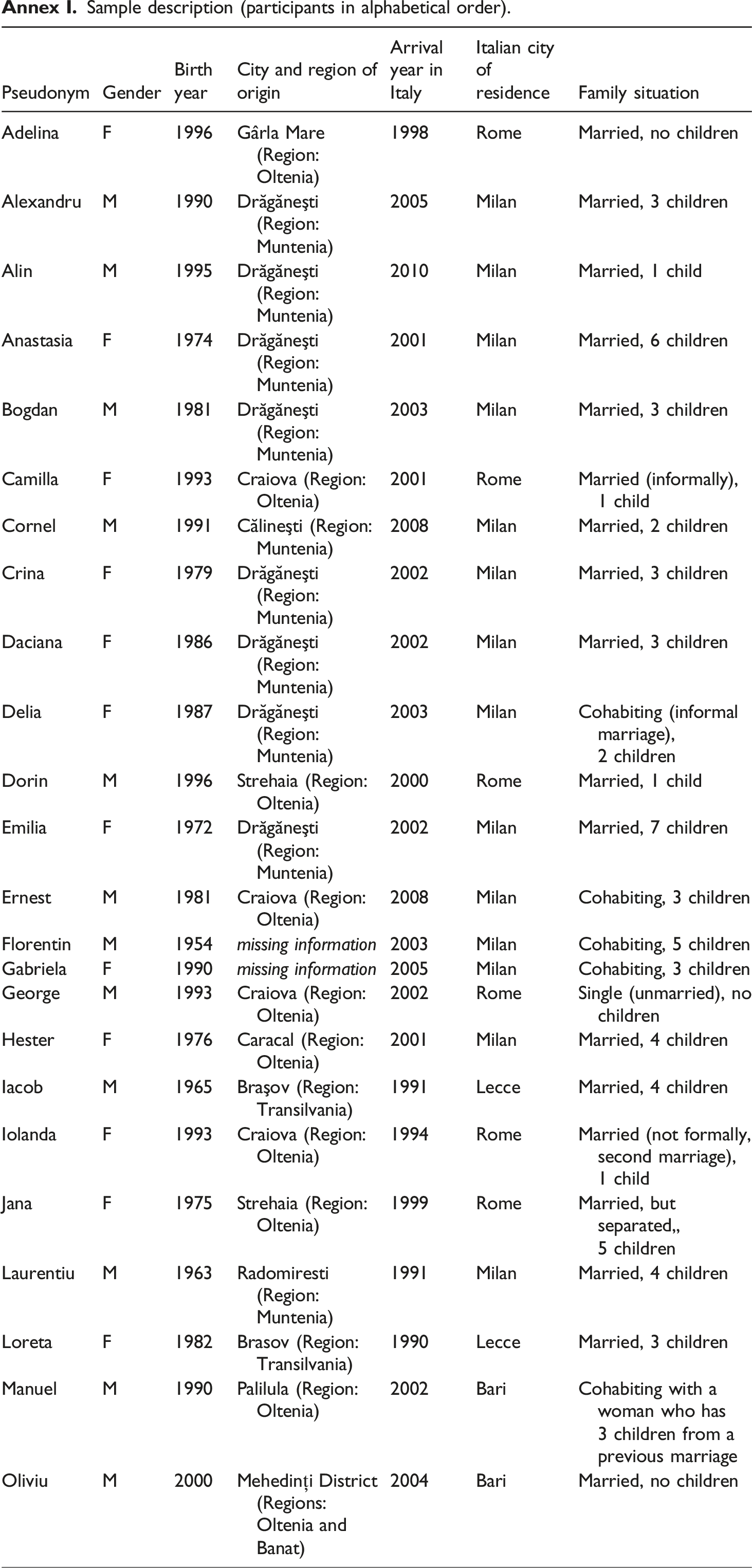
Pseudonym
Gender
Birth year
City and region of origin
Arrival year in Italy
Italian city of residence
Family situation
Adelina
F
1996
Gârla Mare (Region: Oltenia)
1998
Rome
Married, no children
Alexandru
M
1990
Drăgăneşti (Region: Muntenia)
2005
Milan
Married, 3 children
Alin
M
1995
Drăgăneşti (Region: Muntenia)
2010
Milan
Married, 1 child
Anastasia
F
1974
Drăgăneşti (Region: Muntenia)
2001
Milan
Married, 6 children
Bogdan
M
1981
Drăgăneşti (Region: Muntenia)
2003
Milan
Married, 3 children
Camilla
F
1993
Craiova (Region: Oltenia)
2001
Rome
Married (informally), 1 child
Cornel
M
1991
Călineşti (Region: Muntenia)
2008
Milan
Married, 2 children
Crina
F
1979
Drăgăneşti (Region: Muntenia)
2002
Milan
Married, 3 children
Daciana
F
1986
Drăgăneşti (Region: Muntenia)
2002
Milan
Married, 3 children
Delia
F
1987
Drăgăneşti (Region: Muntenia)
2003
Milan
Cohabiting (informal marriage), 2 children
Dorin
M
1996
Strehaia (Region: Oltenia)
2000
Rome
Married, 1 child
Emilia
F
1972
Drăgăneşti (Region: Muntenia)
2002
Milan
Married, 7 children
Ernest
M
1981
Craiova (Region: Oltenia)
2008
Milan
Cohabiting, 3 children
Florentin
M
1954
missing information
2003
Milan
Cohabiting, 5 children
Gabriela
F
1990
missing information
2005
Milan
Cohabiting, 3 children
George
M
1993
Craiova (Region: Oltenia)
2002
Rome
Single (unmarried), no children
Hester
F
1976
Caracal (Region: Oltenia)
2001
Milan
Married, 4 children
Iacob
M
1965
Braşov (Region: Transilvania)
1991
Lecce
Married, 4 children
Iolanda
F
1993
Craiova (Region: Oltenia)
1994
Rome
Married (not formally, second marriage), 1 child
Jana
F
1975
Strehaia (Region: Oltenia)
1999
Rome
Married, but separated,, 5 children
Laurentiu
M
1963
Radomiresti (Region: Muntenia)
1991
Milan
Married, 4 children
Loreta
F
1982
Brasov (Region: Transilvania)
1990
Lecce
Married, 3 children
Manuel
M
1990
Palilula (Region: Oltenia)
2002
Bari
Cohabiting with a woman who has 3 children from a previous marriage
Oliviu
M
2000
Mehedinți District (Regions: Oltenia and Banat)
2004
Bari
Married, no children