




Abstract
Policies on preventing radicalization and recruitment to violent Islamist organizations have been widely criticized for reinforcing negative stereotypes of Muslims as a group. Sweden has stood out by international comparison by announcing an approach built on inclusion and participation, especially with regard to Muslim civil society. But what does it mean to make a policy process inclusive and participatory? How can values of inclusion and participation be combined with efficient implementation and realization of policy goals, especially in a policy area where discourse and practice have tended to reinforce patterns of exclusion and discrimination? This article develops a framework that puts the roles of participants at the center: what expectations, boundaries and capacities come with an invitation to participate? Based on interviews with actors involved in the Swedish policy process, including Muslim civil society leaders, the study suggests that participation, in this case, meant primarily being present, thereby confirming commitment and stakeholder status and contributing legitimacy, and providing instrumental knowledge and communication networks. While Muslim representatives were often not expected to be more involved, some indicated that they themselves hesitated to go beyond these roles for several reasons. They expressed a concern that merely having opinions or critique could be interpreted as ‘radical’ and as not accepting the idea that Muslims as a group should have special responsibilities for preventing radicalism. One way of overcoming such obstacles is through subtle, indirect exercises of influence that allow policy-makers and administrators to anticipate the concerns and interests of affected groups without requiring their direct participation.
Introduction
The question of how state institutions should handle tensions between democratic values and efficient management has become increasingly central to scholarly discussions on strategies of preventing radicalization (see Esposito and Iner, 2018; Jacoby, 2016; Jenkins, 2016). A one-sided focus on efficient counter-radicalization and counter-terrorism risks leading to states setting aside human rights and the democratic values of inclusion and responsiveness to citizens’ views. In many Western countries, governments have been criticized for doing precisely this (Baker-Beall et al., 2014; Heath-Kelly et al., 2017). On the other hand, efficiently preventing recruitment to violent extremist organizations is part of a democratic state’s responsibility toward its citizens, a responsibility that requires methods that often cannot themselves be subject to democratic deliberation (Jacoby, 2016; Schwarzenbach, 2020). However, is there always a trade-off between efficiency and democratic legitimacy? The apparent tension between these two values has been the subject of debates in a growing literature in public administration research (e.g. Ansell and Gash, 2018; Fung, 2015; Holdo, 2016a, 2016b; Nabatchi, 2010a, 2010b; Nabatchi et al., 2017; Öberg, 2016; Schafer, 2019; Torfing, 2019). Increasingly, scholars are rediscovering ‘the public in public administration’ (Nabatchi, 2010a: 309), arguing that classic management objectives could, and should, be combined with citizen participation through new modes of interaction and collaboration. An important part of their argument is that participation may generate legitimacy and cooperation that, in turn, help improve administrative efficiency (Fung, 2009, 2015; Holdo, 2019; Torfing, 2019).
This paper aims to explore what inclusion and participation come to mean, and what they could mean, in recent policies of counter-radicalization. The stakes are high in the context of such policies precisely because they bring to the fore the tension between two important values involved in all public administration: on the one hand, efficiency, since preventing radicalization is necessary to avoid losses of life and personal tragedy and, on the other hand, democratic inclusion and participation, because counter-radicalization risks reproducing and reinforcing patterns of social and political exclusion and discrimination, specifically the exclusion and discrimination of Muslim minority groups. While democratic theorists and public administration scholars claim that inclusion and participation can, in fact, contribute positively also to efficiency—by proving important knowledge and legitimacy—this seems more difficult in policy-making where histories of racism and exclusion may, on the hand, make people reluctant to participate, and, on the other hand, make such participation undesirable in the eyes of both state authorities and parts of public opinion. This paper brings these arguments to bear on a critical context of public management by examining practices of collaboration in one case of counter-radicalization: Sweden. Building on previous research on Sweden’s particular policy orientation with regard to multiculturalism and state-civil society cooperation, this paper suggests that Sweden is a critical case due to its comparably far-going rhetoric of inclusion and appreciation of the participation of minority groups in civil society. Compared to other countries that lack this rhetoric, Sweden appears as a most likely case for being inclusive and participatory in work on counter-radicalization. In other words, if values of democratic legitimacy and inclusion are anywhere brought to bear on the management of terrorist threats and recruitment to radicalized groups, Sweden would be the place to look. The purpose of this paper is to use this case to ask: what does it even mean, and what could it mean to be inclusive and participatory in the context of counter-radicalization?
The study develops an analytical framework for assessing the roles that civil society may play in work of preventing radicalization. Civil society actors, this framework suggests, may be included and participate as ‘objects’ that perform their roles (e.g. generating legitimacy, showing interest and commitment) by merely showing up, listening, and going home; they may participate as ‘instruments’, by carrying out tasks such as informing the public and bringing local knowledge to the awareness of state authorities; they may act as ‘actors’ whose participation add value by representing interests of citizens, including an interest in prevention; and finally, they may become ‘agents’, who voice their own views about their roles, question pre-existing assumptions, and seek to influence, or co-produce, processes of decision-making according to their views, interests, and experiences. Applying this framework is applied to the context of Sweden’s policy of counter-radicalization, this study examines what spaces exist for citizens to play active roles in work to prevent radicalization? Interviews with administrators and civil society actors show that citizens were involved as objects, instruments, and sometimes actors, but not as agents. On the one hand, these results suggest that counter-radicalization, like many other policy areas, can be more inclusive and participatory than has been acknowledged in academic and political discussions. On the other hand, the results suggest that policies of counter-radicalization face particular obstacles to becoming inclusive and participatory, obstacles that are due to features of ‘radicalization’ discourses and wider and more longstanding patterns of social and political exclusion. For example, Muslim leaders might have taken more active roles, thereby sharing more of their experiences and influencing policy-making and concrete implementation, had not their actions been constrained by a reasonable fear that their engagement might actrually be seen as ‘radical’. Moreover, Muslim leaders have also expressed the view that taking more a active role might signal that they accept the false assumption that they have a responsibility for people being recruited to violent Islamist groups. In the concluding discussion, I suggest that one way of overcoming these obstacles is by allowing Muslim civil society subtle, indirect exercises of influence through which they can help policy-makers and administrators to anticipate their concerns and interests without directly participating.
Previous research
Counter-radicalization policies have come to take up more and more of the discourse previously referred to as ‘counter-terrorism’. While some researchers trace the term back to the 1990s, policy-makers, ‘terror experts’, and other practitioners, came to adopt this term increasingly after the UK’s adoption of ‘Prevent’ as one of its counter-terrorism strategies (along with Pursue, Protect and Prepare). Shifting to ‘radicalization’ meant focusing on an imagined process of gradual attitudinal change rather than the actual act of committing a crime (Heath-Kelly et al., 2014). The term ‘counter-radicalization’ is thus used to refer to measures taken to prevent people from gradually becoming willing to commit, or support acts of terrorism.
As noted by several researchers, discussions, and policies of counter-radicalization, like counter-terrorism, have involved assumptions (often with shaky or non-existing empirical support) about how people come to decide to join a violent violent group (Baker-Beall et al., 2014; Heath-Kelly et al., 2017). More important for present purposes, they have also focused almost exclusively on the question of what ‘works’ in the sense of what the most efficient way is to stop the apparent wave of recruitment to terrorist groups. However, states’ efforts to efficiently prevent radicalization and recruitment to such groups also raise questions concerning an apparent trade-off between efficiency and democratic legitimacy. Indeed, ‘the war on terror’ has been a divisive discourse that has led, directly or indirectly, to the portrayal of Muslim citizens as a domestic threat to a liberal democratic society (Baker-Beall et al., 2014; Heath-Kelly et al., 2017). Counter-radicalization discussions thus risk generating the sense that the issue is how to protect some groups of citizens (‘natives’) from the perceived risks coming from the presence of a deprived Muslim minority. Research from Europe (e.g. O’Brien, 2016), in particular the UK (Klausen, 2009; Thomas, 2017), Germany and France (Mucha, 2017; Schwarzenbach, 2020) and Denmark (Lindekilde, 2014), indicates a widespread tendency that democratic states, in significant ways, have set democratic values aside in order to make counter-terrorism and recruitment prevention more efficient. For example, in the UK, as part of the Terrorism Act 2000, police officers were given the authority to stop and search people without the requirement of reasonable suspicion. As Alpa Parmar comments, the threat of terror thereby ‘provided an increased legitimacy to the justification for state intervention despite the fact that the police practices contravened democratic values’ (2011: 378).
Counter-radicalization and counter-terrorism policies that fail to consider the consequences for groups of citizens that become objects of fear and suspicion reflect the view that democratic values cannot be allowed to stand in the way for efficient management (see Jenkins, 2016; Tsoukala, 2006). Critical analyses of radicalization policies have generally focused on this tendency to give priority to efficient management at the expense of democratic legitimacy. They have also questioned the empirical basis for framing recruitment to extremist groups in terms of a ‘radicalization process’ (Baker-Beall et al., 2014). Several scholars have suggested, moreover, that the one-sided focus on efficiency may be problematic not only from a democratic perspective, but also strategically mistaken. The aim has been to ‘upset the easy rhetoric of simplistic, reductionist and often counter-productive counter-terrorism policies’ (Heath-Kelly et al., 2014: 2; see also Parmar, 2011: 377). The view that existing, flawed counter-terrorism policies have often been counter-productive implies, much in line with participatory arguments in public policy and administration, that a less excluding and discriminatory approach, which would give equal recognition and respect to all citizens, would, apart from being ethically preferable, also be more productive (see also Arshad-Ayaz and Naseem, 2017).
This study does not test whether inclusive and participatory approaches to counter-radicalization actually are more efficient. Instead, it examines what citizens’ participation can come to mean in practice in the context of counter-radicalization. The study focuses, moreover, on a case that may perhaps be best described as ‘mediocre’ with regard to efficiency, that is, neither particularly successful nor particularly unsuccessful, but that stands out, instead, with regard to its rhetoric of inclusion and participation. This case allows us to examine in what ways can citizens actually participate in counter-radicalization. Previous research on counter-radicalization in other countries suggests that citizens may often be merely used instrumentally by the state, on the assumption that they have a ‘moral duty to assist the government in providing services to the public—including security from terrorist threats—in the most efficient way’ (Ragazzi, 2014: 167; see also Lindekilde, 2014). In other words, citizens may be expected to contribute to efficient policing by providing information and other forms of cooperation, while having no influence on practices of counter-radicalization to which they and other members of their communities are subject (see also Grossman, 2019; Thomas et al., 2017). However, the public administration literature suggests a number of ways that citizens can be involved, some of which go far beyond this instrumental perspective (Nabatchi et al., 2017; Torfing, 2019).
A framework for analyzing citizen participation in counter-radicalization
This study uses a framework that builds in particular on the work of Fung (2003) and Cornwall (2002, 2003, 2004). Both Fung and Cornwall offer conceptual tools for understanding citizen participation in general. Fung, focusing on the democratic roles of civil society actors, lists six ways that associations contribute to a democratic society. Four of these are of particular relevance to counter-radicalization policies: (1) teaching democratic values and practices, (2) contributing to public deliberation (3) representing citizens’ interests, and (4) expanding ways for citizens to participate in decision-making. 1 For analyzing participation in counter-radicalization, Fung’s framework has some significant limitations, however, because it takes the perspective of the government as opposed to the perspective of participants. In other words, it treats associations as instrumental for a democratic government as opposed to seeing social activism as a service to a group, community or civil society as a whole. By contrast, Cornwall (2003, 2004) suggests a typology that focuses on the roles that spaces of participation allow citizens to take. 2
People, Cornwall suggests, may play the roles of mere ‘objects’, in cases where government representatives value their presence but not their active participation. In counter-radicalization work, leaders of Muslim associations, in particular, may often be invited to events where strategies and principles are announced. If they are only there to provide passive support and show commitment, their participation may be little more than an appearance without actual participation: they are invited to show their support for a common effort and get some minimal recognition of their status as community leaders in return. A slightly more active role is that of the ‘instrument’, which can perform a pre-defined function, such as providing information about tendencies and sentiments among community members and helping to spread government messages. For leaders of associations, this type of exchange may be appealing, even if it seems insignificant, because it means a form of mutual recognition. Neither ‘objects’ nor ‘instruments’ are given opportunities to influence decision-making, however, since their contact with authorities is limited to specific government needs.
In contrast to ‘objects’ and ‘instruments’, citizens take the role of ‘actors’ when they are allowed to contribute to a process of management and decision-making by representing their groups’ interests. Actors may demand to get something in return for their participation. Muslim associations may, for example, get additional funding and resources in return for their contribution to counter-radicalization programs. Or they may subtly influence policy-making by making their views known. Beyond these indirect ways of affecting public administrators and decision-makers, citizens may also be ‘agents’ in the sense of using spaces of participation for their own purposes. For example, by participating in counter-radicalization efforts, Muslim associations may, in theory, build relations and create leverage that ca be used to gain wider recognition and expanded possibilities for active citizenship. As Cornwall stresses, this classification of modes of participating helps to ask specific questions that are critical to understanding whether citizens are empowered or disempowered by participation, whether they are included or dominated within a certain space of interaction. And they may help to examine questions of citizens’ actions, such as: which forms of cooperation help ‘turn spaces for consultation into opportunities for deliberation, inclusion and accountability?’ (Cornwall, 2002: 24).
This study’s framework, summarized in Figure 1, combines Cornwall’s classification of types of participatory roles with specific participatory ‘functions’ outlined by Fung (2003) as well as other functions (‘being present’, ‘informing’) that are more specific to the context of counter-radicalization (see Lindekilde, 2014; Ragazzi, 2014; Thomas et al., 2017). As this image suggests, spaces are not necessarily static with regard to the roles given to citizens. Instead, they may move between different modes of participation. Moreover, these four modes can be seen as degrees of participation in the sense that moving from objects to instruments to actors to agents gradually increases the scope and intensity of participation. Agency, the most expansive form of participation, includes the possibility of acting upon, that is, in ways that affect, the assumptions and boundaries involved in participation (see also Hayward, 2000). In other words, it means being able to affect the role one is assigned to play, which should be seen as a more participative and inclusive than other modes and, from a democratic perspective, a more desirable mode (although practical, social, political and other, considerations may mean that it is not always the most appropriate form.
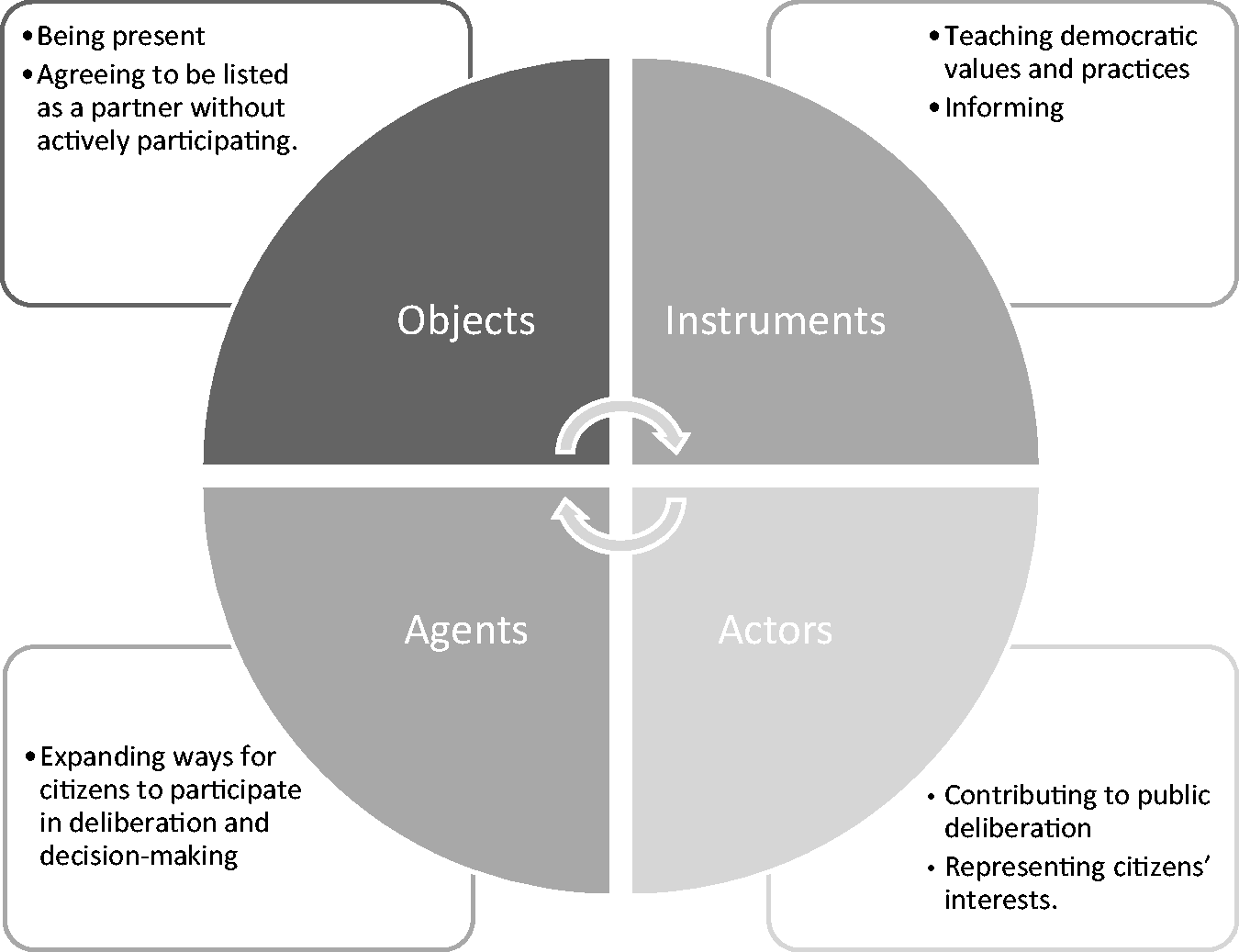
Four ways of participating in counter-radicalization work: as objects, instruments, actors or agents.
Case selection and methods
As in other Western countries, the debates about Sweden’s way of approaching radicalization focused, during and after the observable wave of recruitment of Swedish citizens in 2012–2014, on its efficiency. Some actors involved in these debates claimed that Sweden lagged years behind the neighboring country Denmark, for example. 3 However, assessments of efficiency are difficult to support empirically (partly because, in terms of comparative analysis, the number of independent variables far exceeds the number of cases). Compared to Denmark, however, it can at least be said that Sweden has had a similar trend. Both countries were taken by surprise as large groups of youths joined the Islamic State (IS) between 2012 and 2014. According to official reports, the numbers of people recruited to the IS have remained stable from 2016: Sweden has had among 30,9 people per million inhabitants joining the IS, and Denmark 22,3, according to a report from terrorist experts that ranks Sweden as the 19th and Denmark 22nd among the countries with most recruits (Benmelech and Klor, 2018). 4 This suggests, at least, that it is hard to support the claim that Sweden performs far worse than a comparable, neighboring country, but it also does not perform better.
Where these countries differ, however, is in the values emphasized in policy-making. Traditionally, Sweden and Denmark have developed different approaches to integration, which is also reflected in the rhetoric on counter-radicalization. Denmark, representing an ‘assimilationist’ policy, is often regarded as ‘tougher’ than Sweden on radicalization (see Lindekilde, 2014 for an assessment of Denmark). Sweden, by contrast, represents a multiculturalist approach in which ethnic minorities are encouraged and financially supported by the state to develop their distinct cultures within Swedish society and thereby help integrate minorities into Swedish civil society (Larsson and Lindekilde, 2009). Sweden’s counter-radicalization policy is similar to Denmark’s but differs in its emphasis on the participation of civil society groups. In different local contexts, specific Islamic organizations have become significant partners in strategic and practical work with Muslim youths (Holdo, 2020a) Denmark, where religious associations are often less independent of the state, has not to the same degrees used Muslim civil society groups as partners (for more on the Danish case, see Lindekilde, 2014; Nielsen and Kühle, 2011).
While Muslim associations have played crucial parts in many countries’ counter-radicalization efforts, Sweden stands out because of how it articulated this collaborative approach from the start as the government created a new position, and agency, with the task of leading the work of preventing radicalization. The National Coordinator to safeguard democracy against violent extremism (or ‘National Coordinator’ for short), was to: engage and involve concerned actors on local levels, such as social services, schools, police, leisure activity providers, and associations within civil society, including religious communities, and facilitate the development of local forms of collaboration between actors with the purpose of supporting democracy against violent extremism. (Swedish Government, 2014: 5)
The strategy involved inviting civil society groups to events where Islamist, as well as Right-wing and Left-wing, violent extremism would be discussed and supporting municipalities in the work of developing strategic plans. An important part of the focus in this work was, as the final report of the agency states, to involve many different sectors in society. ‘It means that a variety of agencies, organizations, religious associations, and all municipalities are needed in this work and that all the different actors contribute with their distinct competence and within the framework of their specific tasks’ (Swedish Government, 2017: 110). It is this emphasis on collaboration and participation that makes Sweden a critical case to examine what citizens’ involvement in counter-radicalization can mean in practice. 5
Fourteen interviews were conducted for this study. 6 They include interviews with the previous Secretary (2014–2016) and temporary head (2016) of the national coordination agency against violent extremism, as well as local coordinators of preventive efforts and police in Malmö and Stockholm. They also include eight interviews with local Muslim associations in Malmö and Stockholm, and other associations involved in this work in these cities, as well as Gothenburg and Borlänge. 7 By interviewing both representatives of government agencies and municipalities and people representing Muslim civil society, this study provides perspectives from ‘both sides’ on the roles given and performed by civil society in the Swedish work on counter-radicalization.
Complementing these interviews, I also participated in two public meetings initiated by the National Coordinator and in two local meetings initiated by Muslim associations on the theme of democracy and violent extremism. In addition, the larger project of which this study is part involved the examination of newspaper articles published on radicalization as well as work to prevent it from 2012 to 2018. Finally, the study also uses official documents, such as the directive to create the position of a National Coordinator and the final report from that agency.
The interviews provide accounts that necessarily subjective, but they give a quite coherent image of the modes of participation available to citizens. They show that a few associations were able to participate more actively and that the projects of counter-radicalization generated competition among local organizations that hoped to benefit and contribute to this work. Together they paint the image of a state policy of counter-radicalization that welcomes participation but firmly maintains the authority of state representatives to control processes of decision-making and interpretation of the problems that ‘radicalization’ refers to.
Analysis
The analysis is structured in four parts. It examines the different roles that associations’ representatives can, in theory, play in the government’s work on radicalization (objects, instruments, actors, and agents). As this analysis shows, it is important to acknowledge that Muslim associations do not see themselves merely as potential targets of preventive work. Nor do they see themselves only as potential targets of stereotyping and Islamophobic views connected to discourses of radical Islam. Rather, the actors interviewed see themselves as stakeholders in a broader sense: they are directly affected both by the recruitment efforts of extremist groups that target members of their community and by consequences of how the government chooses to manage the problems that they approach as part of radicalization, such as, potentially, increased Islamophobia. This broad sense of being stakeholders is reflected in how associations see themselves participating in collaborative efforts. To participate is partly a way to contribute to solving a problem that affects Muslim communities and partly a way to represent Muslims as a group that is part of Swedish society and not a threat to that society. As one interviewee put it: ‘We, as Muslims in Sweden, suffer more from radicalization that you Swedes, so to speak, or other non-Muslims. Let us be honest. It hurts when I am walking on the street and people generalize and say that “he is Muslim, he is probably radical”. […] This happens because there is misinterpretation, too little knowledge, too much ignorance.’ 8
The interviews also demonstrate that the actors involved see the work against violent extremism as a top-down effort, where the state and the municipalities need to define the objectives and local associations can contribute. However, there are also context-dependent reasons for why Muslim associations hesitate to take a more active role in this work as agents that can shape forms of collaboration to suit their own interests, such as a sense that, as Muslims, they need to be extra cautious to not be seen as subversive or critical due to the risk of being associated with ‘radicalism’.
Citizens as objects of participation
To be an ‘object’ of participation means to invited to take part and that once presence is appreciated. However, active participation in the sense of sharing views and experiences is neither expected nor encouraged. While this mode of participation does not involve being able to influence decisions or discussions, it can still be a meaningful act for civil society actors. To be present rather than absent can at least give a sense of gaining a minimum of recognition. Being there, and having been asked to be there, shows that one is not invisible and not unimportant. Representatives of Muslim associations and municipalities from all over the country took part in the meetings of the National Coordinator. However, often a few invited experts did most of the talking. Other participants were asked to disuss the topics raised by the experts with persons sitting next to them. The idea was that these representatives would gain knowledge and insights that they could bring back to their local context. Participating at these meetings thus meant being involved in important strategic government work, even if one did not actively participate in the formulation of that strategy.
The general perception is that these meetings were appreciated by participants both as a forum to mutually recognize each other as partners in work on radicalization and as a way of networking. Thus, the purpose in some ways went beyond treating participants as ‘objects’, since they also exchanged knowledge, problems, doubts, and experiences. However, these meetings are nevertheless the form of participation that best approximates the ‘object’ mode of participation. None of the interviewees for this study explicitly embraced this limited mode of participation. Instead, confirming that these big meetings to which a large number of associations and institutions are invited have a tendency to result in a passive mode of participation. One of the interviewed association leaders expressed a sense of not being interested in this form of collaboration: ‘We fight against everything that threatens to destroy this society. So it is good that they work on this. We do not work with the Coordinator, but we think it is good that [others] do.’ 9 Another association suggested that it would have liked to be included in more meetings, but that the actors already involved did not recognize it as important enough to include it in the networks. 10
Instruments of participation
To be ‘instruments’ of participation is to play a more active role than objects. ‘Instruments’ serve a function; they help get a task done. In this context, being an instrument means helping the government achieve its objectives. The National Coordinator’s work was primarily to support local efforts to prevent radicalization by creating networks and bringing people together nationally and supporting municipalities’ work to develop their own strategic plans. In the media, the government’s success or failure was repeatedly measured in terms of how many municipalities were still lacking a local strategic plan. The National Coordinator, too, criticized the municipalities that, in the coordinator’s view, seemed to lack ambition in this regard. 11 Thus, an important instrumental role for civil society, as well as other actors participating, was to contribute to the creation of a local strategic plan and to serve as local partners to the municipality in work to strengthen democracy and preventing radicalization. Islamic associations were also instrumentally valuable for their capacity to spread information and awareness of the problem of radicalization. Associations that, for example, initiated their own meetings and lectures for their members on this topic, were praised. Conversely, associations that did not accept the view of the government, or did not show as much will to cooperate on the terms set by the government, were criticized by the National Coordinator.
One important way that Muslim associations contribute to work against extremism is by organizing meetings for their members where they spread information about the problem and the work of the government. These meetings, says a representative of one Muslim organization, serve to inform people of how they can handle a situation where a family member or friend is showing signs of radicalization. Another Muslim leader says that they have special ‘cultural evenings’ where they combine, for example, music and discussions about problems of extremism. Especially during the time immediately after the first reports of youths from Sweden traveling to Syria and Iraq, Muslim civil society leaders felt that their communities’ concerns over radicalization were being ignored by decision-makers. Ibrahim Bouraleh, the president of a prominent, Stockholm-based association, points out during the interview that he was among the first to publicly address the problem of radicalization and call for more organized efforts to stop the recruitment of youths. 12 Muslim leaders acknowledge in different ways that one way that they become instrumentally important in work against radicalization is by increasing the awareness of the issue. A local police officer based in a Stockholm suburb adds to these aspects that Muslim associations often perform crucial social work that they rarely get credit for. When families are concerned about their youths, they may feel more confident in Muslim leaders than for state institutions such as social services or police. 13 Similarly, a Malmö-based association stresses that ‘social work is key to stop radicalization. Some people have problems at home, but they do not want to tell anyone. They are ashamed, they are scared.’
Another instrumental function that several associations emphasize is to educate their members about democracy and ways to participate in a democratic society. Part of the reason this becomes an important function is that many members of Muslim associations are immigrants from non-democratic countries. Several associations say that they talk about democratic values. They also encourage members to participate in elections. A representative of one association says: ‘We want to teach our members, and those who are not members, that Islam is peace. […] and that we can become more included and integrated in the society.’ 14
There are some associations that are not as included as instruments of participation, however. Some of these feel that their capacity to contribute is not acknowledged. One association asked if it could join an existing local project against radicalization but did not receive an answer. Other associations felt that the idea of participating without being able to affect the terms was too limiting. The interviewee compares to associations in the UK that, according to him, ‘have the courage to stand up for their members, be part of the societal debates, criticize when needed. But we are very anxious and scared [of doing this]’. 15
Actors in participation
To be an ‘actor’ in participation is to be recognized as being able to add value to discussions, planning, and processes of decision-making beyond being present (as objects) or helping the government achieve its predefined tasks (as instruments). An ‘actor’ brings their own experiences and views to bear on the issues being managed. Moreover, actors are watchful of how views may differ and how the interests of their communities may differ from the interests of the government or other actors involved. Thus, being actors in participation may often mean advocating for the views, experiences and interests of their communities. In the context of work against violent extremism, civil society actors have often played an active role in local agenda-setting. In Malmö, for example, the leader of the Islamic Academy (Islamakademin), Salahuddin Barakat, has been an important actor in several projects of collaboration with the municipality as well as other religious associations. The coordinator of safety and security says in an interview that the work against extremism has been shaped by the particular individuals that take leadership on the issue, including Barakat, who ‘has become a crucial partner that does a lot of important work’. 16 This work is both directed toward members, whom Barakat’s organization involves in discussions about various societal problems and questions about how to live true to one’s beliefs in Swedish society, as well as directed toward the broader society that often lacks the knowledge needed to understand the perspectives of Muslim communities.
A similar role is taken by Ibrahim Bouraleh’s organization in Stockholm. As a Muslim leader, Bouraleh frequently participates in public meetings and in the media, and he also engages members of his organization in discussions about societal issues. A local police officer says that his own understanding of the debates about radicalization was shaped by exchanges with leaders like Bouraleh, who made him understand that: one can look at [the issue of how Muslim leaders handle radicalization] in different ways. One can either think that it is important that they distance themselves [from violent extremism], but on the other hand, a person who is not a terrorist, or an al-Qaeda sympathizer, why should that person have to distance themselves, should one distance oneself because one is Muslim? But nevertheless, many Muslims feel this pressure to distance themselves.
17
The interviews indicate, however, that the Muslim associations included in this study do not generally feel that they can contribute in these more active ways to work against extremism and radicalization. On the one hand, there are existing networks of cooperation that can be difficult to be included in. On the other hand, projects of counter-radicalization themselves create a sense of competition between Muslim leaders and associations, since municipalities and government agencies provide limited space, and may have limited patience and interest, for Muslim associations to participate. That some were repeatedly not invited or not listened to, while others were, seems to have been a cause of resentment among those not included, or those included only to a limited extent. One interviewee criticized a local project of collaboration between youth associations and Muslim associations and Malmö Municipality. According to the interviewee, the project was widely discredited. ‘Those who were included in this project lack knowledge and experience and this is a sensitive issue since it’s about preventing extremism. They did not listen to us.’ At one meeting, the interviewee said they had been told that there were ‘no extremists in Malmö’, but only a few weeks later, a young man from Malmö was arrested in Brussels. ‘If they had listened to us, this would not have happened. Because we have knowledge and experience and have worked locally, we know these youths.’ 18
Agents of participation
In contrast to ‘actors’, ‘agents’ of participation act to influence not only the outcomes of collaboration but also its form, its terms, and its objectives. For the associations involved in counter-radicalization work, expressing agency in this sense would mean to have a say about the understanding of ‘radicalization’, the goals set for collective efforts, and how the collaboration needs to succeed in order for it to serve the interests of all actors involved. Government policies aimed at preventing the growth of extremism are typically based on a top-down model of decision-making and implementation. The Swedish government does, however, claim that the best way to deal with problems of radicalization is to work with civil society and bring together all experts and practitioners affected and form networks of knowledge and information exchange.
None of the Muslim leaders interviewed for this study indicated that they felt that they had played a part in shaping the policy process as such. One reason for this may be that preventing extremism is perceived as naturally a top-down process that needs to be shaped by the government to serve the national interests. The integrity of this work may, in other words, require full government control. As several associations interviewed in this study suggested, they also do not want to be seen as confrontational by challenging the approach chosen by the state. Acting as agents that aim to affect the boundaries of their participation may, in this context, come with the risk of being seen as ‘radical’ or as trouble-makers. 19 One interviewer suggested that it is a general phenomenon that Muslims keep quiet. Apart from a couple of outspoken and well-connected individuals, Muslim leaders are generally quiet in public debates. ‘Unfortunately, many keep quiet out of fear’, he said. There is a tendency that people feel that they need to constrain themselves to not be perceived as ‘radical Muslims’.
Another important reason is perhaps that Muslim associations may be reluctant to take the roles as agents in the policy process because they do not want to signal accepting the notion that they, based on religious identity, have a special responsibility for preventing radicalization. Several representatives of Muslim associations criticized the view expressed by the National Coordinator, Mona Sahlin, who argued that Muslim organizations should have been more outspoken in distancing themselves from violent extremism. Noting that Muslim associations were already doing important work for integration and democracy, they argued that being Muslim did not oblige them to distance themselves any more than any other association or citizen. 20 Likewise, they could similarly argue that they are no more obliged to contribute to work against radicalization than any other part of civil society.
These aspects make it complicated to imagine Muslim associations playing the role of agents that not only participate but also shape policy processes, even if this could facilitate a more inclusive approach that considers diverse interests. However, the Swedish approach suggests a more subtle, indirect way that citizens can be involved without actively taking part. By anticipating concerns and interests of affected groups earlier in the policy process, when the work is planned and organized, they can be influential without directly participating. The Swedish approach seems in many ways, in fact, already adjusted to the interests of civil society groups, even if they rarely exert influence over the procedures. The government’s interest in adjusting to the interests of Muslim (and other) associations may help in motivating them to participate in other roles—as objects that confirm their commitment and status as stakeholders and help give a sense of democratic legitimacy to the process, as instruments that provide crucial knowledge and communication networks, and, possibly, as actors that alert decision-makers about concerns that they may have overlooked. The Secretary of the National Coordinator suggested that what makes the Swedish approach different from countries such as Denmark and the UK is this focus on inclusion and participation. Another difference is the sensitivity to issues concerning Islamophobia, which is much more underlined in the Swedish approach. For example, in contrast to the work conducted by other countries, the Swedish government opted for an approach that targets three types of violent extremism at once and within the same program and agency (apart from Islamist extremism, also violent right-wing and left-wing extremism). Part of the rationale was to avoid the impression that the government only acknowledges extremism in which Muslim citizens are involved. This consideration for the interests of Muslim associations does not mean that they have a say about the forms of collaboration, however, although it does suggest that the forms have been adjusted to motivate them to participate.
Concluding discussion
Arguments for making public administration and policy-making more inclusive and participatory have not generally been applied to contexts that bring the tensions between efficiency and democracy most to the fore. Counter-radicalization is, more than most policy-issues, such a context. This study of Sweden’s approach suggests, on the one hand, that far more significant roles can be played, and have been played, played by Muslim civil society actors in preventive work than has generally been acknowledged in the literature. On the other hand, there are obstacles particular to this context of policymaking. Muslim representatives were often not expected to be involved beyond the roles of ‘objects’ and ‘instruments’. Moreover, some of the Muslim leaders interviewed indicated that they themselves hesitated to go beyond these roles for various reasons. They expressed a concern that merely having opinions or critique could be interpreted as ‘radical’. There is also a perceived risk that more active participation could be interpreted as accepting the idea that Muslims as a group should have special responsibilities for preventing radicalism.
From a democratic perspective, there is often much to gain from giving more significant roles in policymaking and implementation to those most affected by their consequences. It is important to acknowledge that Muslim communities are doubly affected by policies of counter-radicalization. First, while empirical research suggests that there is no connection between levels of religious devotion and the likelihood of participation in terrorist acts (conversation seems in this context to be an effect of recruitment, rather than the opposite, see Roy, 2017), the fear of youths being recruited is often more widespread in Muslim communities, as Muslim youths are more exposed to recruitment attempts. Second, discourses of radicalization have often played a part in reproducing and reinforcing prejudices toward Muslims, and people with immigrant backgrounds in Muslim-majority countries. For these reasons, inclusion and participation can serve important democratic purposes beyond being present and providing knowledge. It can be regarded as a democratic right to also be able to defend one’s interests in areas where one is significantly affected. Overcoming obstacles to inclusion and participation is thus an important challenge. Confronting it may require that people are given the opportunity to act upon (in ways that affect) assumptions and boundaries in policy processes (see Holdo, 2020b).
However, representatives of minority groups should also not be treated as if they had a special responsibility to contribute to preventive work. For this reason, it is equally important to examine how policy processes can become more sensitive to diverse interests without those interests being directly represented by stake-holders. This may require, for example, that civil society groups are able to subtle and indirectly influence policy processes in ways that allow decision-makers to anticipate their concerns and interests. Such ‘action at a distance’ is often associated with more influential groups (see Hayward, 2000), but can be extended to adjust to the needs of groups that would otherwise be marginalized in decisions that affect them. This article has sought to contribute to thinking about not only what inclusion and participation come to mean in a policy process but also what it could mean.
Footnotes
Acknowledgements
I thank Niklas Emond for assistance with interviews in the research this article is based on. I also thank all the persons who agreed to be interviewed and allowed me to sit in at meetings and discuss various aspects of the policy process. For very helpful feedback on the paper, I thank Zahra Hamidi and two anonomymous reviewers.
Declaration of conflicting interests
The author(s) declared no potential conflicts of interest with respect to the research, authorship, and/or publication of this article.
Funding
The author(s) disclosed receipt of the following financial support for the research, authorship, and/or publication of this article: This research was supported by the Swedish Research Council for Health, Working Life and Welfare (FORTE), grant number 2015–00943.
