



Abstract
In highly digitised societies, children and adults have qualitatively different perspectives of contemporary online play activities, such as children's synchronous use of multiplayer virtual worlds (e.g. Minecraft) with video-chat software platforms (e.g. FaceTime) in the family home. This article explains how insight into these different intergenerational perspectives was gained via a novel research co-design. Philosophically underpinned by the qualitative research tradition of hermeneutic phenomenology, the research co-design involved the systematic implementation of creative, collaborative participatory methods with four Australian families in comfortably appointed research settings. The study identified points of commonality and tension occurring between children's perspectives of online play and those of their caregivers to inform the development of new cultural resources that bridge divergent intergenerational perspectives of online play. Methodologically, it demonstrates how co-design in qualitative research is a valuable approach for exploring the different lived experiences of children and their caregivers in relation to online play.
Keywords
Introduction
In family homes globally, a popular recreational activity for children in the middle childhood years (8–12) is online play (eSafety Commissioner, 2024a; Ofcom, 2025). During online play, children in different home settings can interact as avatars (i.e. customisable animated figures) in the same multiplayer virtual world environment (e.g. Minecraft, Roblox, and Fortnite) whilst using voice- or video-chat software platforms synchronously to discuss their shared in-world activities (Mills et al., 2023). Online play occurs in a blended digital/real-world ecology that places children in direct relationship with their friends – who act as play partners in an online context – and their caregivers (e.g. parents and grandparents) – who guide children's participation in such play in the ‘real-world’ context of the family home (Albarello et al., 2021). Within this blended ecology, children's lived experiences and perspectives of online play are qualitatively different to the historical play experiences and contemporary expectations of their caregivers. This is because many children are highly motivated to engage in online play with friends (eSafety Commissioner, 2024a), whereas their caregivers are less likely to have participated in such play themselves during their middle childhood years. Caregivers are also morally obligated to establish rules for online play (e.g. screen time rules and online safety rules) that promote children's development while keeping them safe (Lafton et al., 2024).
Currently, little is known about the blended ecology of online play in the family home. This knowledge is important because Hedegaard (2009) argues that children's developmental trajectories may be negatively impacted if their motives for engaging in certain social activities (e.g. online play) conflict with adult demands regarding these activities (e.g. rules) in everyday cultural settings (e.g. family homes). Understanding this blended ecology is necessary so that the developmental trajectories of children who are motivated to engage in online play in the family home are optimised. The need is heightened given that many children relied heavily on online play during recent COVID-19 lockdowns (Rideout and Robb, 2021) and are likely to continue to engage in online play despite most lockdowns now being lifted. However, while insight into the blended ecology of online play is necessary, understanding how to investigate such play from the perspectives of both children and their caregivers is not yet well-established.
This article details an innovative approach to co-design with children and caregivers based on Hedegaard's (2009) theoretical model of child development, encapsulating children's motives for engaging in online play and caregivers’ socialised practices regarding rules for online play. Contemporary approaches towards co-design involve researchers working closely with participants (e.g. children and their caregivers) to formulate viable solutions to real-world problems via a creative, collaborative design process (Sanders and Stappers, 2008). The article begins by describing how co-design research approaches have evolved over time and informed the development of participatory methods. Then, the theoretical framework conceptualising the study, in terms of Hedegaard's (2009) model of child development, is explained and the use of participatory methods with the participating families is presented. Following this, the research findings are reported and considered in relation to how they can be used to inform new cultural resources that may help minimise tensions occurring in the family home that are potentially being fuelled by divergent intergenerational perspectives about online play. The article concludes by arguing for the utility of co-design research approaches for providing insight into the blended ecology of children's online play in family homes. A brief summary of the study was detailed in a paper identifying common elements of co-designs directed towards addressing the problem of adult hesitancy in relation to children's agentic use of digital technologies for play and learning (Stavholm et al., 2024).
Evolution of co-design research approaches
In the 1960s, human rights-based movements, such as civil rights and women's liberation, gave rise to industrial initiatives that provided opportunities for people whose voices were previously silenced to have a say in decisions affecting them (Robertson and Simonsen, 2012). This emancipatory thinking was particularly embraced in Scandinavia where workplace democracy laws established in the 1970s saw professionally trained designers drawing on the knowledge, skills and creative ideations of end-user workers to inform the development – or co-design – of new technological systems that helped streamline their everyday work practices. These co-design techniques were intentionally utilised to bridge life-worlds between designers and end-users and represented a clear shift from positioning participants as passive ‘subjects’ to collaborative approaches where participants were instead positioned as ‘co-designers’ or ‘design partners’ in the research process (Cumbo and Selwyn, 2022; Sanders and Stappers, 2008).
Initially conceptualised as participatory design, co-design research inspired institutional change by supporting ‘mutual learning through equitable partnerships of communities and experts through the design of an intervention’ (Cumbo and Selwyn, 2022: 60–61). For this reason, researchers conducting co-designs intentionally recruit, and collaborate alongside, people who have informed understandings about real-world problems so they can co-construct practicable outputs (e.g. resources and conceptual models) that aim to improve future practice. Core to this process is that co-designers are provided with the tools, techniques, and/or processes they require within a ‘safe’ space that fosters their ability to freely express their opinions and creative ideas (Sanders and Stappers, 2008). Establishing safe spaces for co-designers is imperative because some people may feel uncomfortable expressing their innermost thoughts to strangers, or those with institutional power, particularly if their views misalign with (or contradict) what ‘experts’ think (Bergold and Thomas, 2012). To mitigate this, researchers conducting co-designs make it clear that dissenting opinions are highly valued because they help reveal diverse ways of thinking and facilitate the co-construction of new knowledge.
While early co-designs focused primarily on identifying the negative effects of inefficient industrial systems, they were later utilised to explore how human experiences and interactions might be enhanced. Sanders and Stappers (2008: 8) argue that both negative effects and enhancements need to be addressed in a holistic, integrated way to ‘face the immense challenges of living in the 21st century’. While emerging from industrial research almost two decades ago, this thinking nonetheless aligns with recent studies drawing on co-design principles to explore how digital products and services can suppress or empower children's right to be, and feel, safe in online spaces (eSafety Commissioner, 2019) and inhibit or enhance free play opportunities in digital environments (Livingstone and Pothong, 2021).
Fundamentally, researchers conducting co-designs reject hierarchical notions that only qualified designers can engage in collective creativity and believe all people – including children – can express creative initiative. By recognising research participants in this way, co-designs have inspired development of new methods that foster mutual learning between designers/researchers and co-designers (Robertson and Simonsen, 2012), including participatory methods.
Participatory methods
In alignment with research co-designs, participatory methods provide inclusive and equitable opportunities for people of all ages to be actively involved in the co-construction of knowledge alongside researchers (Clark, 2017; Mills et al., 2016). Such methods are usually visually based (e.g. drawings, photographs, digital stories, maps, and collages) and flexibly designed to accommodate the various capabilities and creativity levels of research participants (Groundwater-Smith et al., 2015). According to Bergold and Thomas (2012: 192), participatory methods are particularly useful for exploring how ‘two spheres of action – science and practice – meet, interact, and develop an understanding for each other’. This interaction sees social science researchers and practitioners (e.g. caregivers, educators, and children) collaborating with each other to produce new knowledge about everyday social practices (e.g. parenting, pedagogical, or play practices). Researchers adhering to participatory methodologies are invited to set aside familiar routines, forms of interaction, and traditional hierarchical relationships so they can rethink how existing situations within a particular cultural setting might be interpreted.
Rooted in empiricism – a philosophical worldview arguing that human beliefs and knowledge are acquired via direct sensory experiences – participatory methods aim to generate qualitative data within naturalistic settings (e.g. comfortably appointed real-world spaces) rather than controlled environments (Rossman and Rallis, 2017). Within these naturalistic settings, research participants are recognised as competent, articulate ‘co-researchers’ who bring unique skills and experiential knowledge to an investigation and are supported as agentive partners in their interactions with researchers (Bergold and Thomas, 2012). Like co-designs, researchers employing participatory methods aim to establish collaborative conditions that foster collective creativity and knowledge-sharing among participants and embrace dissenting views to address power imbalances within a research setting (Cumbo and Selwyn, 2022). Democracy is an assumed sociopolitical condition for research informed by participatory methods and shapes multiple aspects of the research process including its aims, question(s), design, data generation, and interpretation of results.
The democratic condition reflects the principles of mutual knowledge building historically underpinning co-design research (Bergold and Thomas, 2012) and was later instrumental in guiding development of what came to be recognised as child-centred participatory methods (Lundy and McEvoy, 2011). For example, in the late 20th century, children's right to freely express their opinions about matters affecting them was codified via the United Nations (1989) Convention on the Rights of the Child, while the field of childhood studies promoted the view of children as knowledgeable ‘beings’ capable of acting with agency and inspiring social change (see James et al., 1998).
Child-centred participatory methods arguably invite children's democratic right to express their perspectives, knowledge, and creative ideas about social needs relevant to their everyday lives (Groundwater-Smith et al., 2015). Such methods have been used widely by researchers seeking primary (elementary) school age children's perspectives into a range of issues and experiences, including the quality of their local communities (Hacking and Barratt, 2009), the impact of cyberbullying (Baas et al., 2013), opportunities and challenges shaping their use of digital media (Third et al., 2014), and their ability to maintain friendship connections during COVID-19 lockdowns (Barley et al., 2025).
In recent years, child-centred participatory methods are increasingly being used to capture 8- to 12-year-old children's experiences, understandings, and perspectives of online play. For example, 8- to 10-year-old children attending a before-school ‘Virtual world games club’ created paper-based spider diagrams to illustrate their lived experiences and understandings of revenue-creation activities and friending practices in multiplayer virtual worlds (Willett, 2017). In other studies, children in the middle childhood years have been invited to draw pictures, design maps, create short films, take photographs, and/or capture screenshots about their digital and online play experiences during COVID-19 lockdowns (Cowan et al., 2021; Díaz et al., 2023).
In further recent examples, 10- to 11-year-old children designed paper-based comic strips using photographs and screenshots of online games important to them (Loudoun et al., 2024) and 8- to 11-year-old children created audio recordings and paper-based texts (e.g. diaries, lists, and collages) to describe their online gaming experiences (eSafety Commissioner, 2024b). In these studies, child-centred participatory methods facilitated children's participation in the research and supported their ability to engage in traditional research activities (e.g. interviews and focus group sessions) with adult researchers. These examples suggest child-centred participatory methods are viable for exploring contemporary blended ecologies involving children's online play.
Theoretical framework
The theoretical framework informing the co-design study described in this article was Hedegaard's (2009) Model of child learning and development through participation in institutionalised practice. Conceptualised in Denmark in 1976 (the same period of time when co-designs were gaining traction in Scandinavia), Hedegaard's (2009) model provides a framework for exploring how children's motives for engaging in developmentally beneficial activities (e.g. play) are intertwined with adult practices guiding such activities in institutional settings (e.g. homes and schools). Grounded in cultural-historical theory, Hedegaard's (2009) model comprises three analytical planes. The first analytical plane – the state perspective – represents an historical context in which culturally based traditions (e.g. societal norms, values, and discourses about what constitutes ‘good’ child development) exert powerful influences on the way adults frame children's participation in social activities within a particular society.
The second analytical plane – the institutional perspective – represents a social context that knots together children's motives for engaging in particular activities (e.g. online play) with adult demands for these activities (e.g. household rules) in institutional settings. Within this analytical plane, adult demands are reflected in their everyday practices (i.e. how they act and interact with children) which have been profoundly shaped by culturally based traditions (i.e. those identified within the state perspective). The third analytical plane – the individual perspective – represents a developmental context in which children's motives for engaging in certain social activities change as they reach certain ages. At the individual level, children are viewed as social agents capable of transforming adult practices and wider sociocultural conditions to meet their own needs.
Within the individual perspective of Hedegaard's (2009) model, cultural-historical understandings about child development provide the fundamental dynamics for children's personality development at certain ages. These understandings are predominantly drawn from Vygotsky's (1998a) periodisation of child development, which suggests that children enter critical developmental periods at certain ages prompting new motive orientations to appear in their consciousness. For example, Vygotsky (1998a) theorised that children entering the middle childhood years (around age 7) become increasingly motivated to engage in object-centred learning activities with more knowledgeable others (e.g. educators and advanced peers) and children entering adolescence (around age 13) become increasingly motivated to form private codes of friendship with peers who share similar interests. Within this analytical plane, adults are encouraged to respond sensitively to children who may exhibit disruptive behaviours reflective of critical developmental periods so their developmental trajectories can be optimised.
In the co-design study described in this article, Hedegaard's (2009) theoretical model was used to conceptualise a specific form of play – known as online sociodramatic play – as an ‘institution’. Conceptualising online sociodramatic play as an institution meant that it was considered a social context constituted by children's motives for engaging in online sociodramatic play intertwined with adult practices for such play in the blended ecology of the family home. This paper examines the co-design process used with caregivers from the state perspective and 8- to 12-year-old children from the individual perspective to jointly describe the institutional perspective – or the ‘institution’ – of online sociodramatic play within the blended ecology of the family home. The research question guiding the study was ‘How is online sociodramatic play constituted as an institution in the blended ecology of the family home for 8- to 12-year-old children and their caregivers?’ The remaining focus of the article involves the framing of the co-design approach, a summary of the research findings, and a discussion considering how the co-design may be interpreted as a productive methodology for understanding the institution of online sociodramatic play according to Hedegaard's (2009) Model of child learning and development through participation in institutionalised practice.
Methods
In the co-design study, purposive sampling was used to recruit eight children (aged 8–12) who regularly engage in online sociodramatic play at home and their caregivers (five parents and one grandparent) from the Australian state of Victoria. Two families known to the first author were invited to participate via convenience sampling (Saumore and Given, 2008). Snowball sampling (Crouse and Lowe, 2018) was then invoked to recruit two further families because children who engage in online sociodramatic play must use specific software platforms (e.g. Minecraft played in Creative mode) to give rise to such play (Caughey et al., 2024) and thus represent a niche community within highly digitised societies. Families known to the first author were invited to share a digitised advertisement describing the research with other families via multimedia messaging services. The advertisement guided interested caregivers to contact the first author via e-mail so that families known to the first author did not need to disclose if they had agreed to participate.
Participating children and caregivers were positioned as co-researchers actively involved in the co-production of knowledge about the institution of online sociodramatic play according to the state and individual planes of development within Hedegaard's (2009) theoretical model (Bergold and Thomas, 2012). For child co-researchers, this involved their participation in five group sessions – referred to as the MineTime Club – which were conducted in a comfortably appointed university meeting room or a shared living area within the home of a participating family. The term ‘MineTime’ is a composite of the two software platforms – Minecraft and FaceTime – used to define online sociodramatic play involving separately located children engaging in Minecraft-based activities whilst simultaneously using FaceTime to discuss these activities (see Caughey et al., 2024).
The first three MineTime Club sessions were attended by children to facilitate their perspectives on online sociodramatic play. The final two MineTime Club sessions were attended by children and their caregivers so they could engage in joint discussions about children's motives for engaging in online sociodramatic play and caregiver practices manifesting as household rules for such play. Each MineTime Club session ran for 1 h and fieldnotes were recorded by the first author to capture children's ideas and opinions using a small, leatherbound notebook and white feather pen. The notebook and pen were purposely selected to resemble the ‘book and quill’ icon typically used in Minecraft to record in-game notes. Reflective notes were also recorded by the first author in the notebook after each session to reflect on the extent to which the co-researchers’ participatory research needs were met during the session. Fieldnotes and reflective notes were digitally transcribed by the first author within 48 h of each MineTime Club session.
During the sessions, children were provided with a MineTime researcher pack to facilitate their participation in the research. The pack included a personalised MineTime lanyard, a Minecraft-inspired graphite pencil, and activity sheets inviting children to draw symbolic objects, skins (virtual clothing for an avatar), and/or in-world environments they enjoy using during in-world play with friends (see examples in Figure 1).
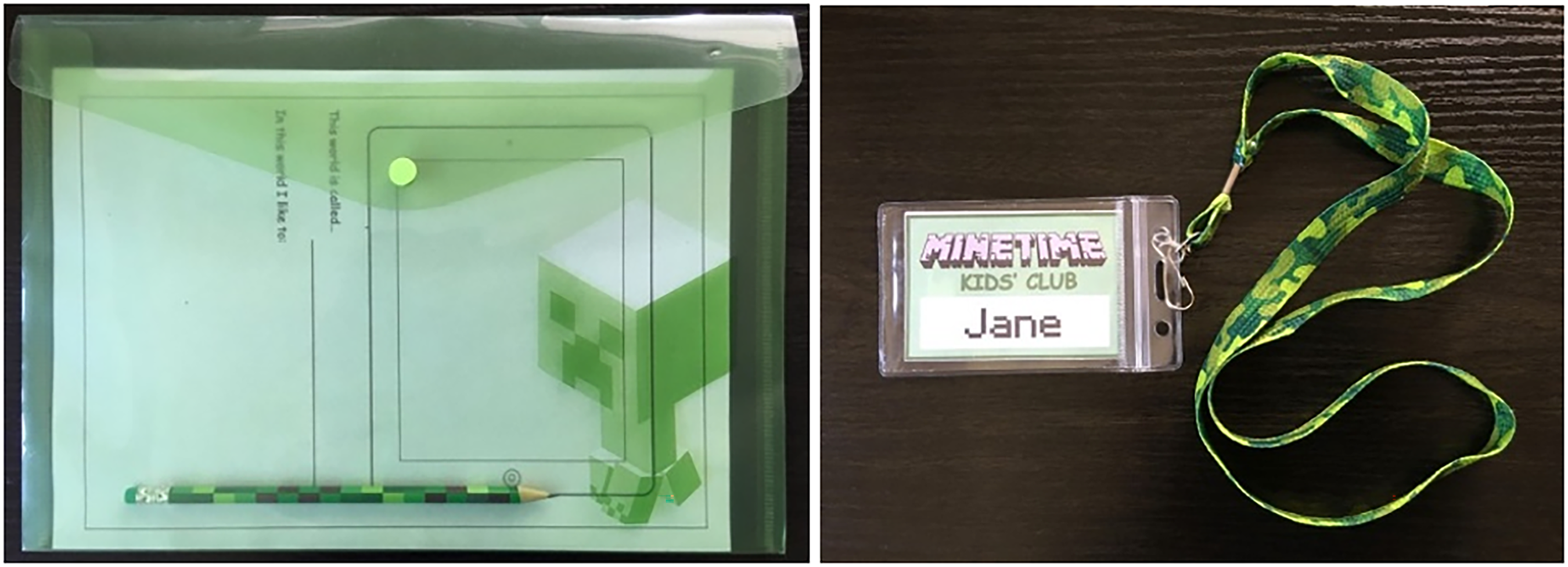
Examples of a researcher pack and lanyard.
At the university setting, synthetic grass squares were used to create a pathway to the room in which MineTime Club sessions were conducted (Figure 2), while for those children participating at home, MineTime Club was held in a shared living area. The synthetic grass squares were purposely selected to resemble the top of ‘grass block’ icons which are highly symbolic of the Minecraft gaming platform.
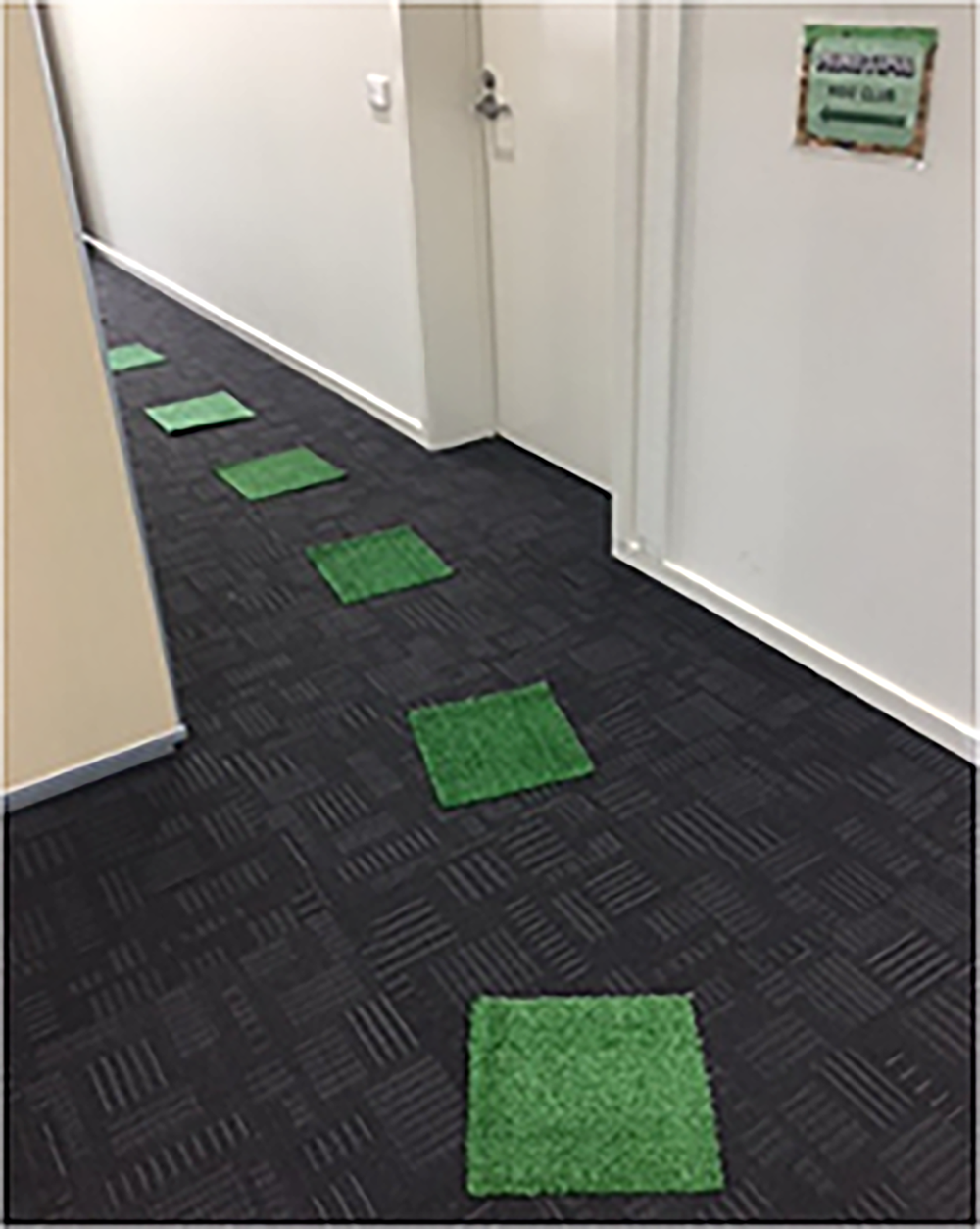
Synthetic grass squares creating a pathway to the university meeting room.
For caregivers, three individual interviews were conducted with the first author, either in a comfortably appointed university space or via telephone from home (according to caregiver preference and availability). Interviews were audio-recorded and ran for 10 to 45min each. An interview schedule guided the first two interviews using two focus questions (i.e. What are the rules for online play in your home? and What influences your beliefs, expectations, and rules for online play in your home?) and a range of sub-questions (e.g. When are children allowed to play online with friends? Where in your home are children allowed to play online?), including examples of potential cultural influences on their practices (e.g. parenting ideals, family background, information disseminated by governmental agencies and social media). The third interview involved a classification activity using data gathered with children during the third MineTime Club session. As previously mentioned, caregivers also attended the final two MineTime Club sessions with their children/grandchildren.
Ethical considerations
Prior to the commencement of MineTime Club sessions and individual interviews, written consent forms were completed by caregivers and age-appropriate written assent forms were completed by children. These forms invited co-researchers to select pseudonyms for themselves. Children's ongoing written assent to participate in MineTime Club sessions was also obtained via a sign-in sheet detailing the activities to be conducted (e.g. Today I can talk about why I like MineTime). Here, inclusion of ‘I can’ indicated to children that their involvement in the research activities was optional. All children completed sign-in sheets at the beginning of each session with no children declining to participate in the research activities.
The co-design study received ethics approval from a university Human Research Ethics Committee (HREC) and was guided by core socio-ethical principles valued by researchers employing co-design research approaches, such as democracy, agency, equitable participation, empowerment, and inclusivity (Cumbo and Selwyn, 2022). The first author employed ethical symmetry (Groundwater-Smith et al., 2015) with child co-researchers at all times during MineTime Club sessions. This meant honouring each child's democratic right to freely express their views and act with agency during the sessions. Children were also consulted prior to documenting their verbal responses in the fieldnotes book and made aware that they could peruse, audit, and make changes to written text recorded in this book at any time.
In further alignment with co-design research approaches, the first author strived to establish and maintain friendly, respectful, non-intrusive relationships with all co-researchers and requested their permission before taking photographs of physical or digitised documents they had created. Photographic data were captured using the camera application (app) of a password-protected tablet device and deleted after the study was completed. Research activities were also conducted at mutually convenient times with families and navigational strategies (e.g. signage placed around university buildings, map showing the location of the university meeting room sent to caregivers) were implemented to assist co-researchers locate the university meeting room.
Co-design research approach
The co-design study described in this article was underpinned by hermeneutic phenomenology (Heidegger, 1962). In hermeneutic phenomenology, the ‘phenomenon’ represents something that appears in human consciousness and is brought into being in the world via lived experiences (Vagle, 2018). For example, the institution of online socio-dramatic play is a phenomenon that appears and is brought into being for children and caregivers within the blended ecology of contemporary family homes.
Researchers working with hermeneutic phenomenology gather and interpret lifeworld-sensitive texts (e.g. vignettes, images, and anecdotes) documenting how participants describe their lived experiences of the phenomenon under investigation (van Manen, 1997). However, bias-free reporting on the lifeworld-sensitive texts of co-researchers is difficult to achieve because interpreting the subjective lived experiences of participants requires researchers to simultaneously reflect on their own experiences of the phenomenon. For this reason, researchers using hermeneutic phenomenology may also draw on pre-existing literature and/or theories to help shape the research (Neubauer et al., 2019), such as Hedegaard's (2009) model of child development. Interpretation is therefore an iterative, dynamic process – known as the hermeneutic circle – involving both data generation and analysis. Via the hermeneutic circle, researchers are able to craft a detailed description encapsulating how the phenomenon appears and is brought into being for those who directly experience it (Vagle, 2018; van Manen, 1997).
Given the commitment of the hermeneutic circle to understanding the participants’ experiences of an in situ phenomenon, the research described in this paper drew upon design-based research principles (McKenney and Reeves, 2018) to co-create children's and caregivers’ responses to their lived experiences within the institution of online sociodramatic play. This occurred via three main phases: (1) exploring the problem as it is experienced by participants within its real-world context; (2) co-constructing prototypes providing potential solutions to the problem; and (3) evaluating and reflecting on prototypes in terms of their effectiveness relative to the problem. In the co-design study described in this article, interim data analysis was conducted on phase 2 participant data to inform the joint research activities necessary between children and their caregivers in phase 3. These activities were specifically designed to achieve an institutional perspective comprising children's motives for engaging in online sociodramatic play and caregiver practices guiding children's participation in such play in the blended ecology of the family home.
Phase 1: Exploring the problem
During phase 1, children and caregivers explored the real-world problem of online sociodramatic play (i.e. MineTime) with the first author, notably that children and their caregivers have qualitatively different lived experiences and perspectives of such play. In the first MineTime Club session, children addressed the question: What is MineTime and why do you, and your friends, like it? To assist this process, children took turns rolling foam question dice (displaying ‘why’, ‘who’, ‘what’, ‘when’, ‘where’ and ‘how’ on the faces) to verbally generate and answer open-ended questions (e.g. When do you like playing MineTime? Why do you like playing MineTime?). Children were then invited to interview each other about why they enjoy MineTime using mini-clipboards and paper-based interview schedules. Following this, children planned how they might create a digital response to capture answers to the open-ended questions generated via the dice-rolling activity. Digital responses are creative, multimodal expressions documenting people's understandings and perspectives of real-world concepts or phenomena within their own lives (Edwards, 2012). The concept of a digital response was presented to children as a ‘creative response’ to heighten their understanding that it could be created using paper-based materials (e.g. posters), digital tools (e.g. slideshow presentations and e-books), or a combination of both. In the first audio-recorded individual interview, caregivers engaged with the focus questions and sub-questions detailed on the aforementioned interview schedule then planned how they might create a digital response to capture their answers to these questions.
Phase 2: Co-constructing prototypes
In phase 2, children and caregivers co-constructed prototypes with the first author regarding their lived experiences and perspectives of online sociodramatic play in the form of digital (or paper-based) responses. During the second MineTime Club session, children constructed individual responses using 10 focus questions elicited during the dice-rolling activity in the previous session. The questions were printed on small pieces of paper using Minecraft-inspired font and placed inside red envelopes referred to as Redstone Envelopes (Figure 3). In Minecraft, ‘redstone’ is a symbolic object that activates other objects (e.g. it can open doors and turn on lights). Drawing on this activating potential of redstone, children were invited to use the questions within their Redstone Envelope to generate their digital (or paper-based) responses.
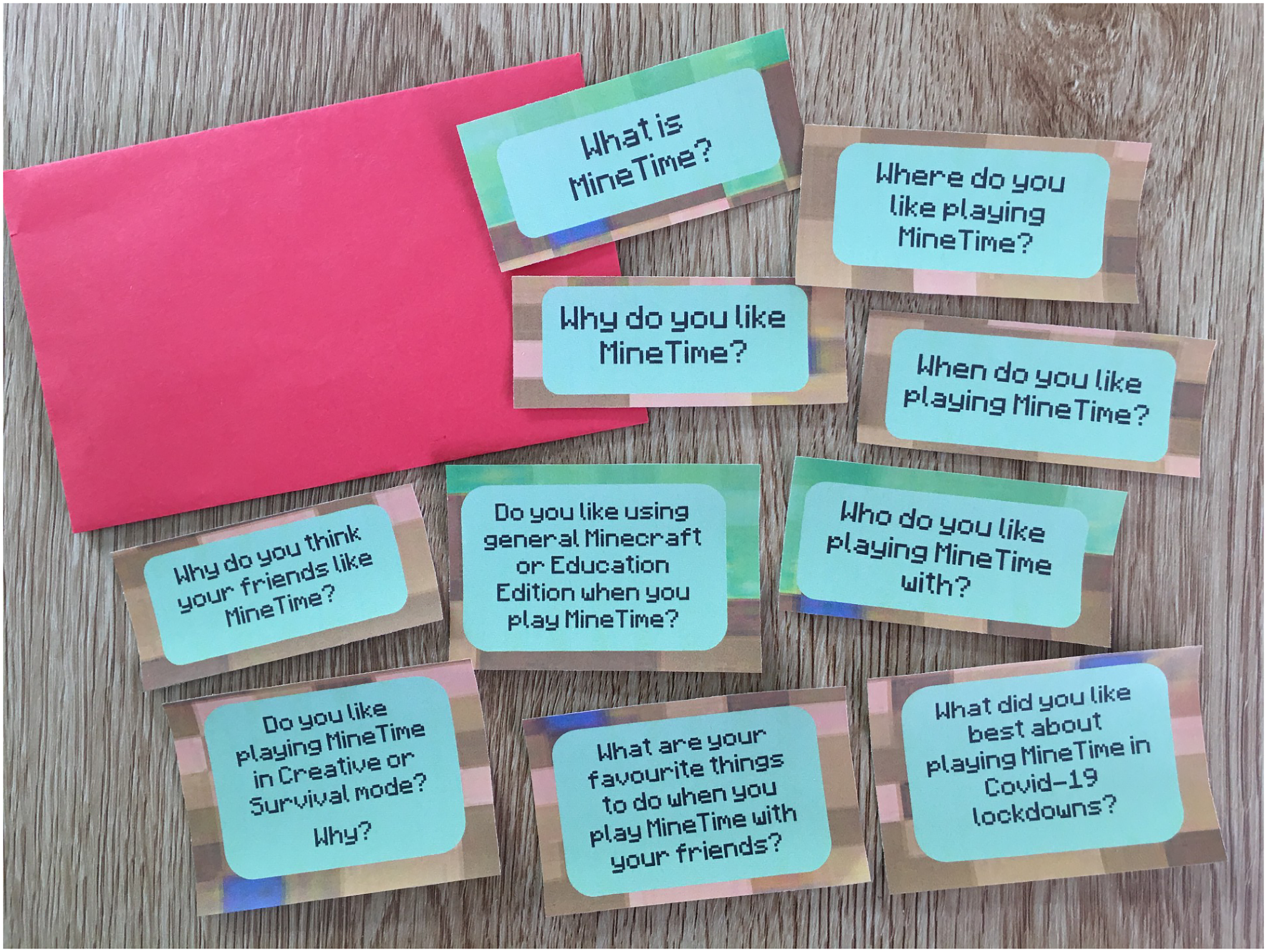
Example of a Redstone Envelope and focus questions.
Children who chose to construct paper-based responses were provided with physical materials (e.g. poster paper and coloured markers) and children who chose to construct digitised responses were encouraged to bring their own devices (e.g. iPads and laptops) to the session. Responses created by children included paper-based posters, slideshow presentations and e-books (Figure 4).
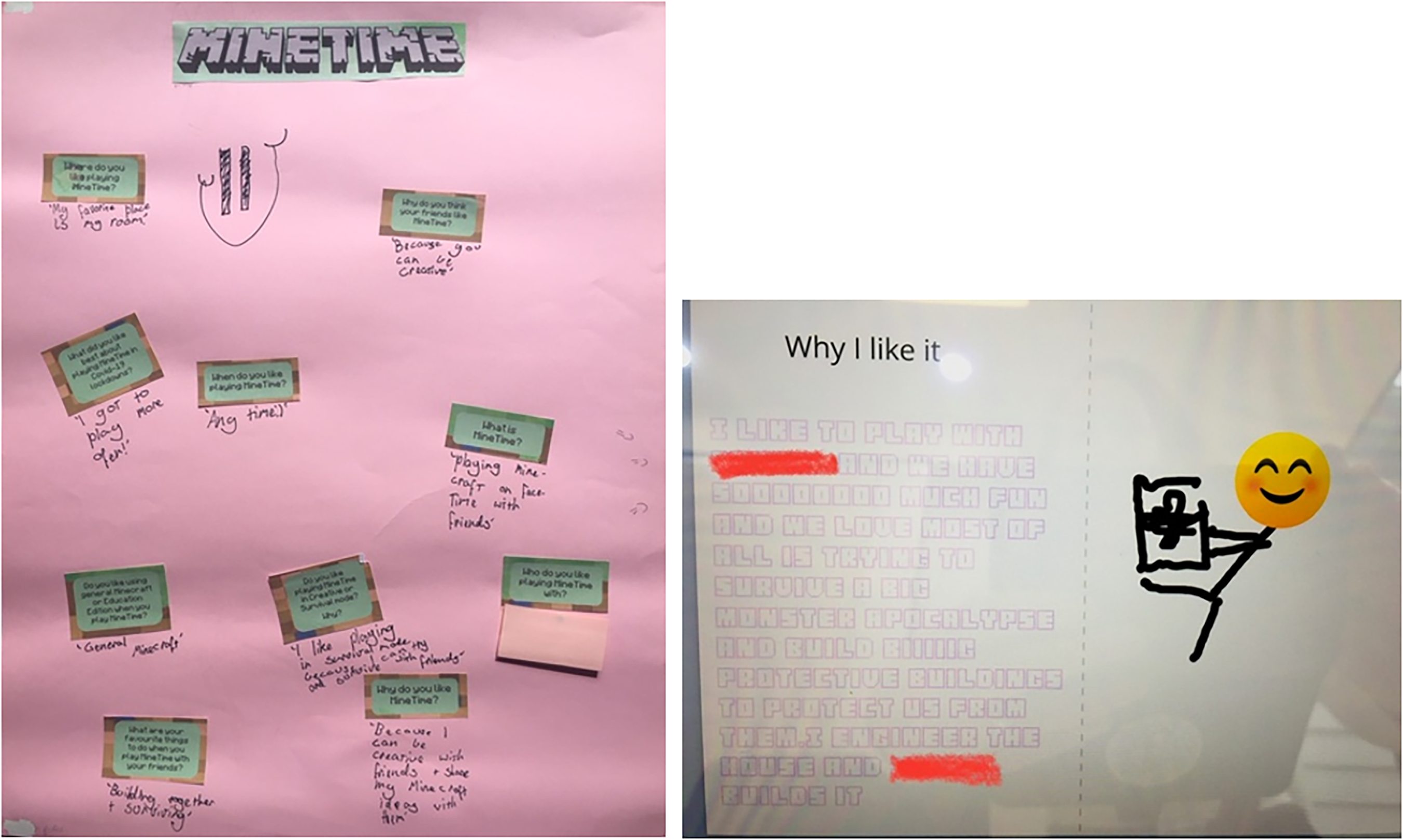
Examples of children's paper-based and digitised responses.
During the second audio-recorded individual interview, caregivers likewise constructed digital responses. All caregivers elected to use Microsoft Word for their responses. These responses were informed by an invitation from the first author to describe their rules for children's online play and what they perceived as influencing these rules. During this process of description, the first author entered the responses (and screenshots/photographs of societal influences described by caregivers) into a Word file, with this file comprising each caregiver's digital response (Figure 5).

Example of a caregiver's digital response.
Interim data analysis
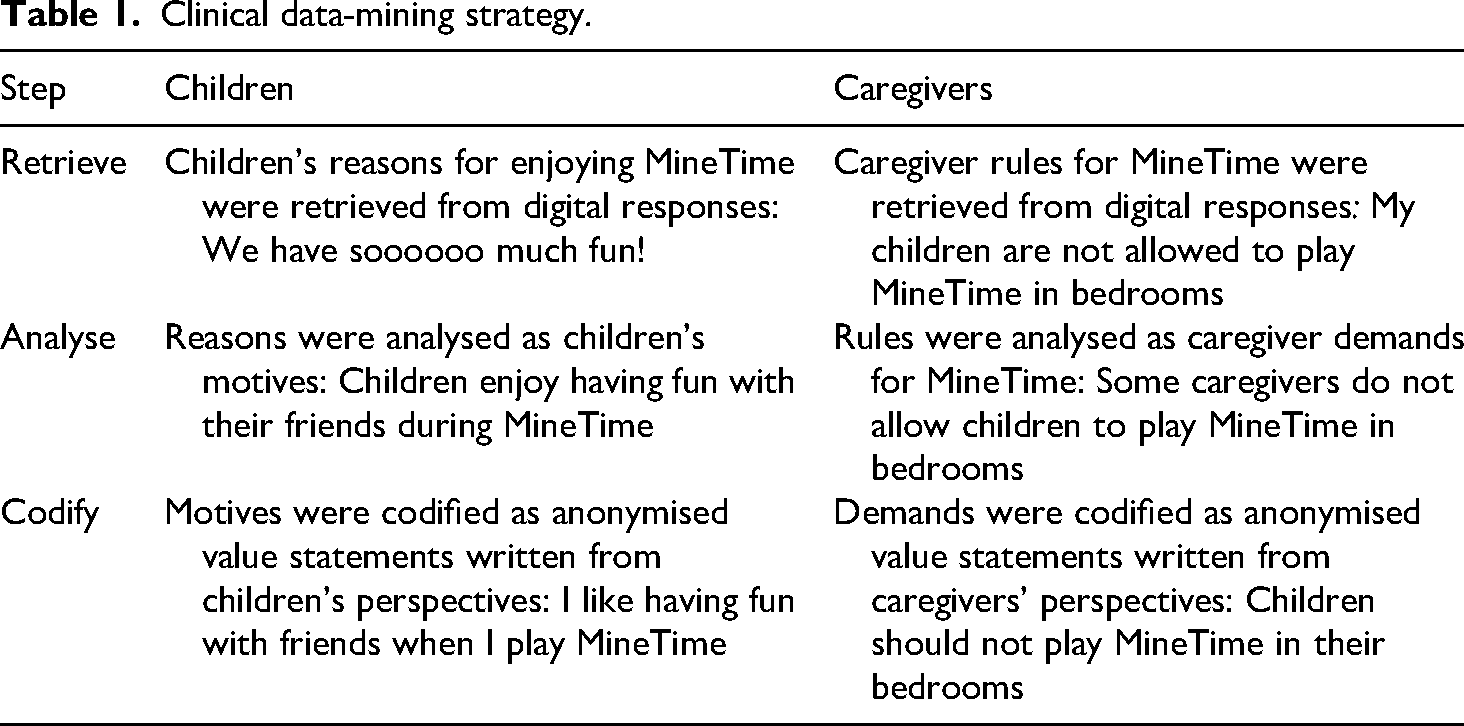
Interim data analysis was conducted on children's and caregivers’ phase 2 paper-based and digitised responses to inform the conduct of phase 3 (i.e. reflecting and evaluating on the co-researchers’ responses). Data analysis was conducted using a clinical data-mining strategy (Epstein, 2009) with the intention of identifying 15 to 20 anonymised value statements representing the respective lived experiences and perspectives of children and caregivers regarding online sociodramatic play. Guided by Hedegaard's (2009) theoretical model of child development, these value statements represented children's motives for engaging in online sociodramatic play and, for caregivers, these value statements represented their everyday rules for such play. Clinical data-mining involves three main steps – retrieving, analysing, and codifying data – with codified data leading to the final value statement. For example, children's reasons for enjoying MineTime were retrieved from their digital responses, analysed as ‘motives for play’, then codified via anonymised value statements from a child's perspective. Table 1 illustrates the three steps leading to a sample value statement for children and caregivers.
Clinical data-mining strategy.
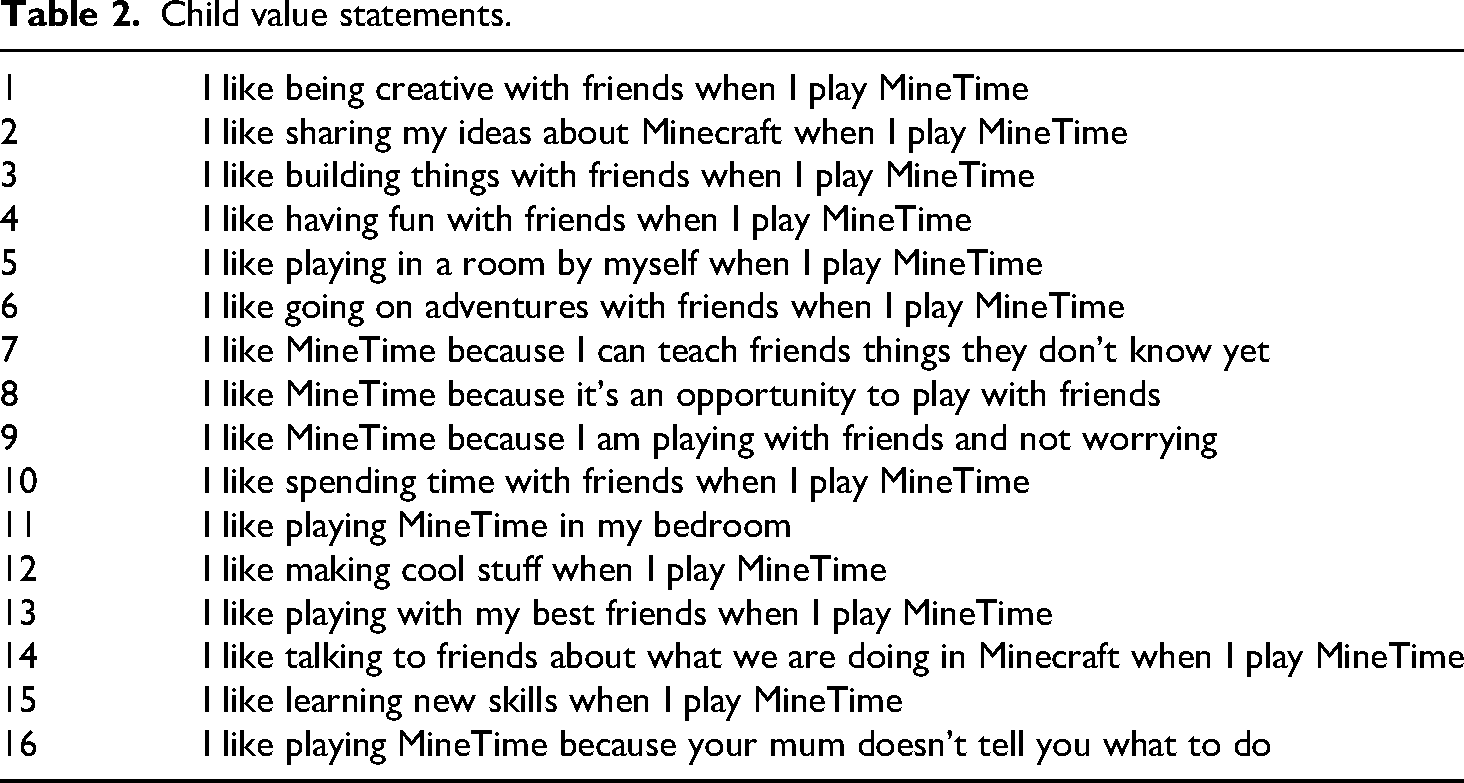
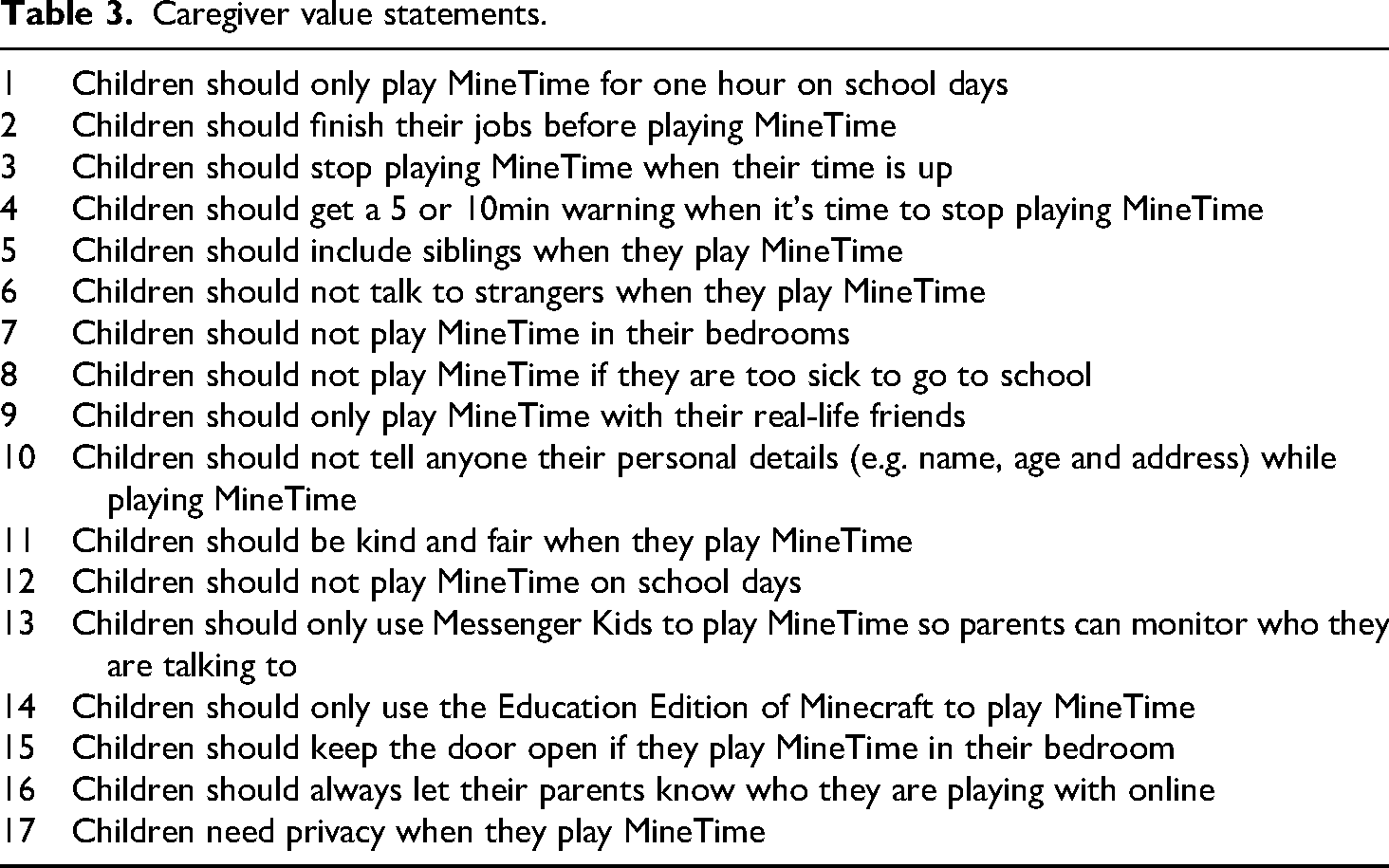
As a result of the interim data analysis, 16 child value statements (Table 2) and 17 caregiver value statements (Table 3) were generated for phase 3 of the co-design.
Child value statements.
Caregiver value statements.
Phase 3: Evaluating responses
During phase 3, children participated in a third MineTime Club session in which they were provided with copies of the caregiver value statements. Each caregiver value statement was displayed to children on a separate laminated poster. Children were invited to discuss whether they agreed or disagreed with each statement. Following this discussion, children created an individual Perspectives Poster by pasting paper-based strips of each caregiver value statement indicating ‘Agree’ or ‘Disagree’. If a child was unsure regarding their agreement or disagreement of a specific value statement, they pasted it in between the two options. After completing their Perspectives Posters, each child was offered a Feelings About MineTime activity sheet where they could draw and write about how they feel whilst playing MineTime then select whether they preferred ‘talking to friends’ or ‘learning new skills’ during MineTime. During their third audio-recorded individual interview, caregivers responded to children's value statements by sorting these from most important to least important and explaining reasons for their choices. Caregivers were also invited to confirm their finalised phase 2 digital responses detailing their lived experiences and perspectives of guiding their children's/grandchildren's participation in online sociodramatic play in their homes. Following these interviews, caregivers’ digital responses were reformatted by the first author (a former primary school teacher) to heighten their readability for 8- to 12-year-old children, then printed onto A4-sized paper and placed into a display folder for each family.
In the fourth MineTime Club session, children and caregivers attended jointly and evaluated and reflected on their respective digital (or paper-based) responses. To facilitate children's participation in these shared evaluations and reflections, each child shared their poster/e-book/slideshow (displaying their motives for playing MineTime) with their caregiver first, then each caregiver shared their display folder (describing their rules for MineTime and what influences these rules) with their child/grandchild. To heighten caregivers’ understanding about children's enjoyment of MineTime, each child was then invited to completed a MineTime Top Five activity sheet which guided them to identify their top five motives for playing MineTime (e.g. being creative with friends and teaching my friends new things).
During the fifth and final MineTime Club session, also jointly attended by children and caregivers, each family co-designed a paper-based Venn diagram poster illustrating similarities and differences between their lived experiences and perspectives of MineTime. To facilitate this process, each child's motives for engaging in MineTime (as per data generated during previous MineTime Club sessions) were printed onto small strips of paper. Caregiver rules for MineTime in each family (as per data generated during the first two interviews) were also printed onto paper strips. Caregiver rules with which children disagreed, however, were adapted to reflect the view indicated on each child's Perspectives Poster and printed onto paper strips. For example, if a child disagreed with the caregiver rule that ‘Children should not play MineTime in their bedrooms’, a paper strip was created for that child displaying the adapted rule ‘Play in bedrooms’. Some adapted rules displayed deliberately blank spaces so children could enter additional information reflecting their personal views. For example, children who disagreed with the caregiver rule that ‘Children should only play MineTime for one hour on school days’ were provided with a paper strip displaying the adapted rule ‘Play … times a week for … after school’. Each child was provided with a personalised envelope containing paper strips displaying the actual rules of their caregivers and the adapted caregiver rules with which they disagreed.
Caregivers from each family were also provided with personalised envelopes containing paper strips displaying their child's/grandchild's motives for playing MineTime. Caregivers were then invited to paste children's motive strips onto their family poster. If caregivers valued a particular motive, they pasted it under the heading ‘Things we agree on’ but if they did not, they pasted it under the heading ‘What children think’. Children then pasted the adapted caregiver rule strips under the heading ‘What children think’. Following this, children and caregivers jointly pasted the remaining caregiver rule strips onto the family poster. If children agreed with the rule, it was pasted in ‘Things we agree on’ but if children disagreed, the rule was pasted in ‘What parents think’ (see example in Figure 6).
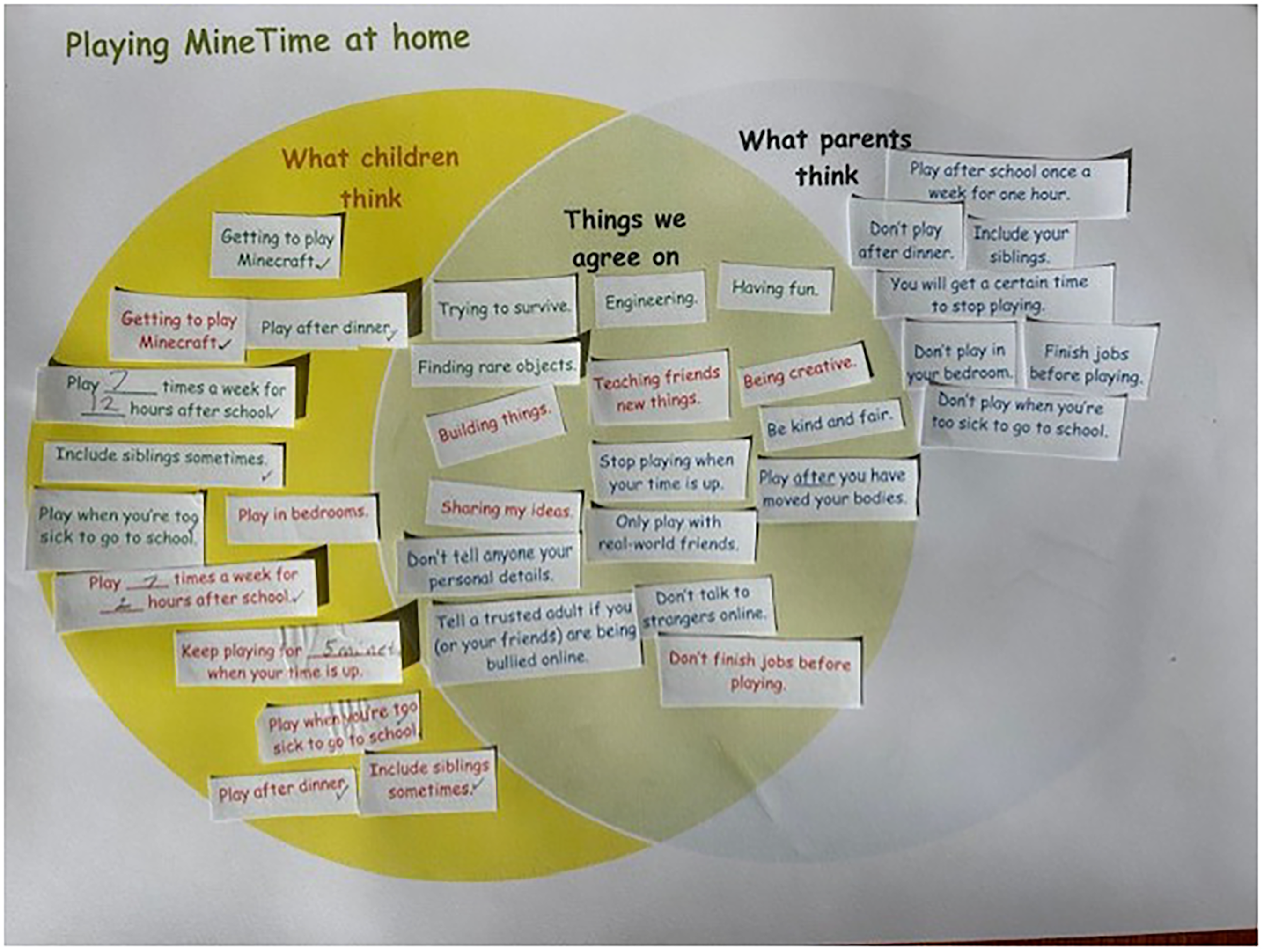
Example of a family co-design poster.
Data analysis
In studies guided by hermeneutic phenomenology, researchers often draw on pre-existing scientific theories and/or literature to help them analyse data gathered with their co-researchers (Neubauer et al., 2019). In alignment with this thinking, data were deductively analysed according to the state and individual perspectives of Hedegaard's (2009) model of child development using MAXQDA data analysis software. For the state perspective, data drawn from lifeworld-sensitive texts gathered with caregivers during individual interviews (i.e., interview transcripts and digital responses) and family group sessions (i.e. co-design posters and fieldnotes) were deductively analysed to identify caregiver practices guiding children's participating in online sociodramatic play (e.g. what they say, do, and how they relate to children whilst implementing household rules for online play) and culturally based traditions influencing these practices (e.g. societal resources about children's online play). For the individual perspective, data drawn from lifeworld-sensitive texts gathered with children during group sessions (i.e. paper-based interview schedules, digitised and paper-based responses, Perspectives Posters, activity sheets, family co-design posters, and fieldnotes) were deductively analysed to identify children's motives for engaging in online sociodramatic play and their perspectives of caregiver practices guiding their participation in such play.
Datasets describing ‘caregiver practices’, ‘cultural resources’, ‘children's motives’, and ‘children's perspectives’ were then exported from MAXQDA as separate Microsoft Word documents, reformatted into meaningful segments of information, and inductively labelled according to core themes. Inter-rater reliability for inductive labelling was achieved via shared agreement of core themes among the authors. The core themes were used to identify a range of notable commonalities and tensions occurring when children's motives for engaging in online sociodramatic play aligned or otherwise conflicted with caregiver demands for such play in the blended ecology of the family home. The commonalities and tensions enabled the research question to be answered via a phenomenological description encapsulating how the institution of online sociodramatic play appears and is brought into being for the participating families.
Findings
In alignment with the theoretical framework conceptualising the study, findings were reported according to the state and individual perspectives of Hedegaard's (2009) theoretical model of child development.
The state perspective
Within the state perspective, five predominant caregiver practices were identified as guiding children's participation in online sociodramatic play (MineTime). These practices are:
Scheduling online play (e.g. caregivers setting stricter screen time limits for MineTime on school days compared to weekends; caregivers disallowing children to play MineTime when they are too sick to attend school; caregivers extending screen time limits for MineTime during COVID-19 lockdowns). Signalling an end to online play (e.g. caregivers using verbal techniques and/or digital timers to signal to children that MineTime will be ending soon, or has ended). Specifying software platforms for online play (e.g. caregivers requesting that children use Minecraft: Education Edition and Messenger Kids for MineTime). Allocating household spaces for online play (e.g. caregivers requesting that children play MineTime in main living areas). Safeguarding online play (e.g. caregivers requesting that children adhere to online safety rules during MineTime, such as avoiding interactions with strangers and not disclosing personal information; caregivers requesting that children adhere to behavioural rules during MineTime, such as being kind and fair and including siblings).
At the state level, caregiver-related data indicated these five practices were influenced by a combination of long-established and recently established cultural resources. Long-established resources were defined as those existing prior to 2010, an historical era when software platforms 8- to 12-year-old children currently use for MineTime were unavailable. Long-established cultural resources influencing the five identified caregiver practices included child-centred philosophies (i.e. philosophies recognising children as autonomous individuals capable of acting with agency), academic socialisation (i.e. beliefs held by caregivers about equipping children with the competencies and skills they require for future success – see Taylor et al., 2004), traditional theories of play (i.e. theories suggesting that children reap developmental benefits through play), and family norms (i.e. patterns of behaviour guiding how members of the same family act and interact with each other).
Recently established cultural resources (i.e. those existing after 2010) influencing the five identified caregiver practices included digital learning policies (i.e. policies mandating that educators implement safe, responsible digital learning programs in schools and communicate information about these programs to families), parental discourses (i.e. discussions between caregivers from different families about children's participation in online play), parenting websites (i.e. websites disseminating online resources guiding caregivers with managing and monitoring children's use of networked devices), and mainstream media programs (i.e. television or radio episodes broadcast via free-to-air networks about children's use of digital technologies for online play).
The individual perspective
Within the individual perspective of Hedegaard's (2009) model, child-related data suggested that four motives drive 8- to 12-year-old children to engage in online sociodramatic play. These motives are:
Being creative with friends (e.g. building complex in-world Minecraft structures together, using virtual objects to creatively enhance in-world environments and/or dress their avatar). Learning play-related skills (e.g. those supporting children's ability to play Minecraft online with friends). Interacting with friends (e.g. having fun together in the Minecraft virtual environment, particularly during COVID-19 lockdowns). Sharing play-related ideas and knowledge with friends (e.g. teaching each other Minecraft-related skills, discussing in-world activities, sharing Minecraft-specific knowledge).
During MineTime Club sessions, children expressed their perspectives about MineTime and the caregiver value statements generated during the interim data analysis. In relation to Practice 1: Scheduling online play, most children strongly disagreed with having strict screen time limits (e.g. 1 h or less) for MineTime on school days (including when they are too sick to attend school) and would prefer at least 2 h for such play. In contrast, children agreed with the way their caregivers scheduled extended screen time limits for online play during COVID-19 lockdowns and expressed a clear enjoyment of having ‘more’ time to play online with their friends during these isolating times.
Many children also agreed with how their caregivers use timed reminders (e.g. giving a 5- or 10 min verbal warning and setting digital timers) to enact Practice 2: Signalling an end to online play because they appreciate having advanced notice about when their online play sessions with friends need to end. Similarly, most children agreed with the way their caregivers enact Practice 3: Specifying software platforms for online play because they enjoy using Minecraft for online play with friends. Some 10- to 12-children, however, disagreed with their caregivers’ request to use the heavily monitored software platform, Messenger Kids, for online play and indicated that they would prefer to use ‘normal’ Messenger instead.
Children's perspectives of Practice 4: Allocating household spaces for online play elicited mixed results depending on the child's age. For example, children who are allowed to play online in their bedrooms agreed with how their caregivers enact this practice. Children in the 10- to 12-year-old age group who are not allowed to play online in their bedrooms, however, strongly disagreed with this rule and expressed a clear preference for playing online in their bedrooms. Conversely, children in the 8- to 9-year-old age group who are not allowed to play online in their bedrooms generally agreed with their caregivers’ request to only play online in main living areas.
For Practice 5: Safeguarding online play, most children agreed with their caregivers’ requests to adhere to online safety rules (e.g. not disclosing personal information in online spaces, reporting negative experiences to trusted adults) and behavioural rules (e.g. being kind and fair) during online play with friends. Most children, however, disagreed with the ‘include your siblings’ behavioural rule and felt that siblings should only be included ‘sometimes’. Some 10- to 12-year-old children also expressed disagreement with the ‘avoid interacting with strangers’ rule because – despite household rules to the contrary – they have interacted with avatars controlled by strangers during online play. When invited to provide more information about these interactions, two children (aged 10 and 12) explained how they only interacted with avatars controlled by strangers whom they considered not ‘shady’ or ‘creepy’ (i.e. they did not ask for personal details) and/or they helped them achieve in-world goals (e.g. defeating hostile threats).
The institutional perspective
Collectively, caregiver practices identified at the state level and children's motives and perspectives identified at the individual level suggested a range of notable commonalties and tensions are occurring between 8- to 12-year-old children and their caregivers in relation to online sociodramatic play (MineTime) at the institutional level (Table 4).
Commonalities and tensions occurring at the institutional level.
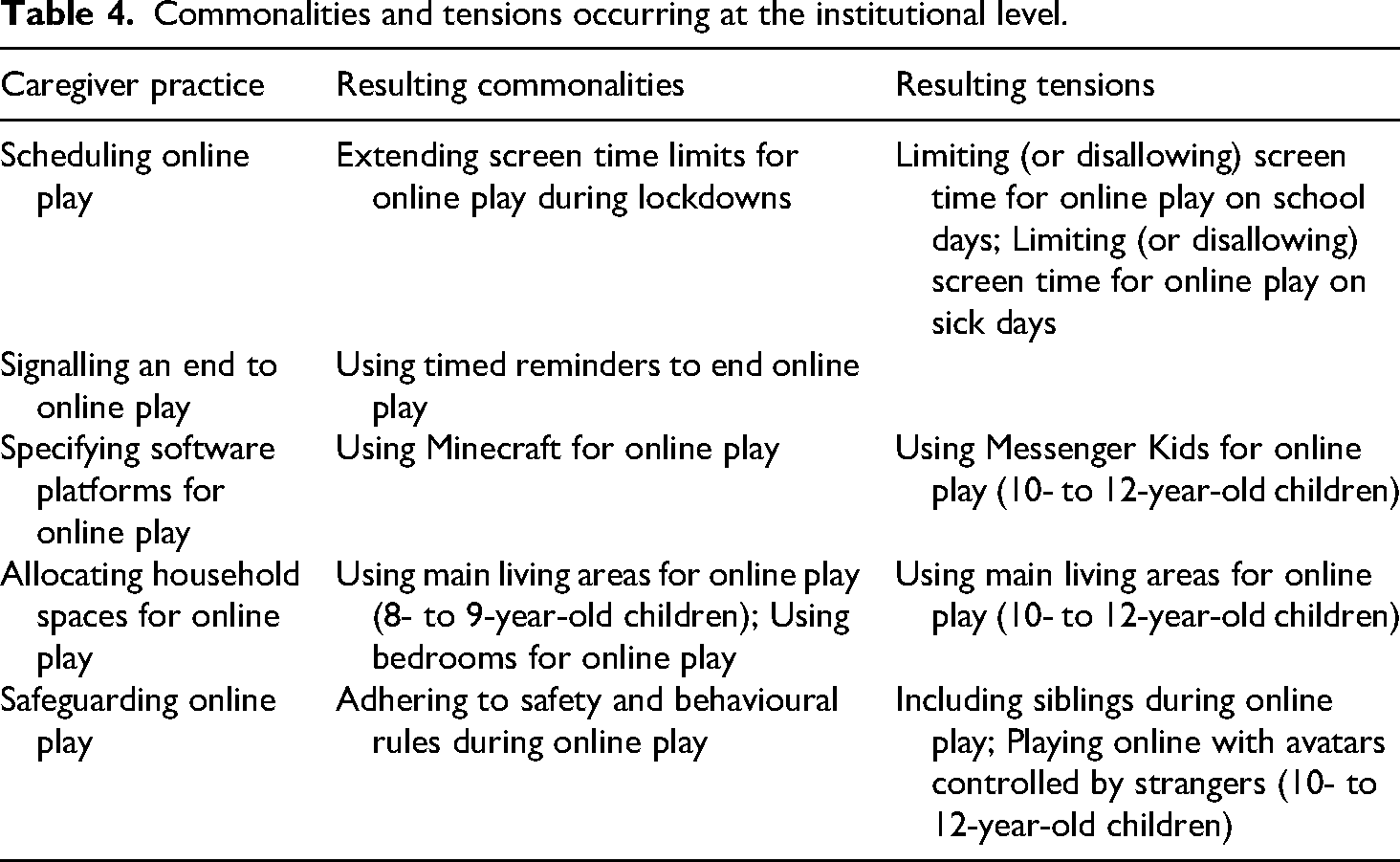
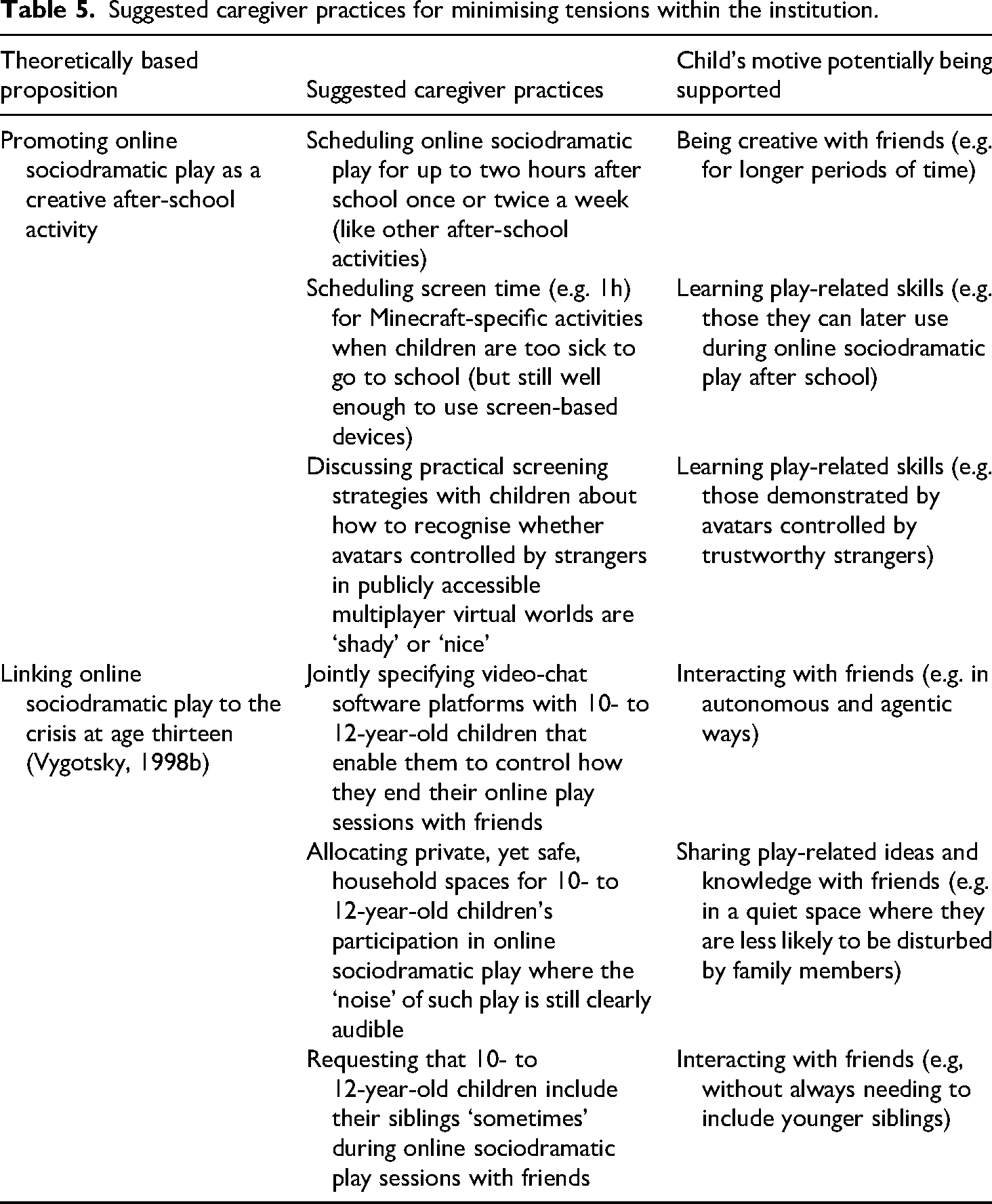
In the co-design study, the commonalities and tensions displayed in Table 4 were recognised as constituting the institution of online sociodramatic play and subsequently answered the main research question. In alignment with the practical purpose of co-designs, these findings were used to inform two theoretically based propositions to address the problem that children and caregivers have different lived experiences and perspectives of online sociodramatic play. These theoretically based propositions were: (1) promoting online sociodramatic play as a creative after-school activity; and (2) linking online sociodramatic play to the crisis at age 13 (Vygotsky, 1998b).
Informed by Vygotsky's (1998a) thinking about the periodisation of child development, the theoretically based propositions included three suggested caregiver practices to help minimise tensions occurring within the institution of online sociodramatic play by supporting children's motives for play (Table 5).
Suggested caregiver practices for minimising tensions within the institution.
Discussion
The purpose of this article is to examine the utility of co-design research approaches for understanding the institution of online sociodramatic play. Such insights are important because children and their caregivers have qualitatively different lived experiences of online sociodramatic play. Most caregivers did not engage in online sociodramatic play during their own childhoods, yet are now morally obliged to set rules for such play in ways that promote children's development and keep them safe. Meanwhile, children are highly motivated to engage in online sociodramatic play with their real-world friends.
Hermeneutic phenomenology promotes researcher use of pre-existing literature and/or theories to help shape studies exploring human lived experiences (Neubauer et al., 2019). As online sociodramatic play appears and is brought into being differently for children and their caregivers, Hedegaard's (2009) theoretical model allows for these differences in their joint manifestation of an ‘institution’. In the study described in this article, co-design informed by Hedegaard (2009) paved a viable pathway for initially working with respective groups of children and caregivers separately, then gradually bringing these groups together. Phases 1 and 2 focused on children's motives for play and caregiver practices for implementing household rules. Then, interim data analysis informing phase 3 enabled value statements from each respective group to be generated so agreements and disagreements within the institution of online sociodramatic play could be jointly constructed.
Benefits of this co-design research approach – compared to only focusing on children's perspectives or caregiver perspectives – enabled the respective lived experiences of both groups to inform how the institution of online sociodramatic play appears and is brought into being in the blended ecology of the participants’ family homes. In alignment with Sanders and Stappers (2008), positive aspects (i.e. commonalities) and negative aspects (i.e. tensions) within the institution were identified and, as a result, two theoretically based propositions were developed to address the real-world problem being explored in the study.
Importantly, suggested caregiver practices included in the two theoretically based propositions were detailed and sent via post or e-mail to the participating children (using age-appropriate language) and caregivers (in plain language), an ethically responsive process approved by the HREC. According to Robertson and Simonson (2012: 6), findings from a co-design study are more likely to be accepted, implemented, and sustained by participating co-researchers because they are ‘fundamentally linked to the different voices able to contribute to its design’. As such, participation in the study may lead to significant benefits for the child co-researchers (e.g. by having more time after school to be creative with their friends during MineTime) and their caregivers (e.g. by viewing online sociodramatic play as a creative after-school activity for children rather than ‘screen time’).
The dialectical possibilities of co-designs thus hold powerful potential to bridge divergent intergenerational perspectives about online play – a widespread phenomenon that has been highlighted in several recent studies (e.g. see Albarello et al., 2021; eSafety Commissioner, 2024a; Third and Moody, 2021) – and minimise apparent tensions occurring between children and their caregivers in the ‘new’ blended ecologies of contemporary family homes. While the tensions identified in the co-design described in this article are specific to the unique dynamics of four Australian families (two of whom were known to the first author), broader insights into such tensions may be similarly achieved via creative, collaborative workshops conducted across several continents (e.g. see Third and Moody, 2021).
Conclusion
Co-design research approaches represent a viable methodological option for exploring the different lived experiences of children and their caregivers in relation to online play. In alignment with its rights-based origins, the co-design study described in this article provided opportunities for children and caregivers to have a say in decisions affecting their respective digital and non-digital activities. By intentionally recruiting, and collaborating alongside, families who had informed understandings about the institution of online sociodramatic play, two practicable outputs (i.e. theoretically based propositions) were developed to inform future caregiver practices that may help bridge divergent intergenerational perspectives about such play. A highly significant (and democratic) pre-condition of this process was that the participating children were provided with a ‘safe space’ to express dissenting perspectives – which they did so with gusto. Guided by the co-design research approach, the use of participatory methods in the study fostered knowledge-sharing, mutual learning, and collective creativity, first among children themselves, then among children and their caregivers. Here, the two ‘spheres of action’ described by Bergold and Thomas (2012: 192) enabled the ‘science’ of Hedegaard's (2009) theoretical model and the ‘practice’ relating to the institution of online sociodramatic play to effectively come together so new knowledge about the blended ecology of this contemporary phenomenon was revealed.
Footnotes
Acknowledgements
The authors wish to sincerely thank the families participating in this study and gratefully acknowledge Dr Karen McLean for her valued contribution to the development of the study.

Ethical approval and informed consent statements
This study was approved by the Australian Catholic University Human Research Ethics Committee (approval no. 2022-2554H) on 6 June 2022. Caregivers completed written consent forms for their participation in three audio-recorded individual interviews and two group sessions and for their children's or grandchildren's participation in five group sessions. Children completed written age-appropriate assent forms to participate in five group sessions and have their physical data (e.g. posters and activity sheets) and digitised data (e.g. photographs of slideshows) retained by the researcher. Children also wrote their name on a sign-in sheet indicating assent to participate in each group session and their caregivers confirmed this assent by signing their names beside the name of their child/grandchild.
Author contributions
Jane Caughey was the primary researcher conducting the study as the basis for a traditional doctoral by thesis degree at Australian Catholic University. Kathy Mills was the co-supervisor for the doctoral study. Susan Edwards was the principal supervisor for the doctoral study.
Funding
The authors received no financial support for the research, authorship, and/or publication of this article.
Declaration of conflicting interests
The authors declared no potential conflicts of interest with respect to the research, authorship, and/or publication of this article.
Data availability statement
Data generated for this study is unavailable due to ethical procedures.
Author biographies
Jane Caughey is a Research Fellow at the Institute for Learning Sciences and Teacher Education at Australian Catholic University. Her research interests include online sociodramatic play, cultural-historical theories of play and child development, co-design research approaches, participatory methods, and children’s rights-based philosophies.
Kathy Mills is a Research Professor and Program Lead, AI and Digital Citizenship, at the Institute for Learning Sciences and Teacher Education at Australian Catholic University. A three-time Australian Research Council Fellow, her research applies a wide range of qualitative methods from sensory and critical ethnography, to cross-cultural participatory research. She has also published a book, book chapters, and articles on big data for qualitative research.
Susan Edwards is Professor of Early Childhood Education and Director of the Early Childhood Futures research program at the Institute for Learning Sciences and Teacher Education at Australian Catholic University. Her research interests include artificial intelligence (AI) pedagogies and literacies, philosophy of technology, cyber-safety and online safety education, design intervention, participatory design, and child-centred research methods.