



Abstract
This paper develops a phenomenological analysis approach to interview transcripts based on Erving Goffman's Frame Analysis: An Essay on the Organization of Experience (1974). Inspired by his concepts of frame, strip and primary framework, my approach explores participants’ accounts of their experiences while offering an analysis of collective meaning making and its academic study. The workings of this approach are demonstrated using the example of a research project exploring the urban lives of UK university students. While my approach – that I call transcript frame analysis – is Goffmanesque in character, it also deviates from his ideas to build an applicable and methodological-grounded analysis tool that is reflexive towards the generation of situated knowledge. A key contention of this paper is that transcript frame analysis offers two types of findings, keyings and fabrications, to illuminate the patterned as well as contradictory nature of social meaning making.
Keywords
Introduction
Erving Goffman is one of the most recognised sociologists of the twentieth century but there remains a lack of understanding of his methodological contributions although Goffman has much to offer in this respect. This article revisits Frame Analysis: An essay on the Organization of Experience (1974) 1 to demonstrate its relevance for data analysis. Frame Analysis has an ambivalent status in Goffman's portfolio. On the one hand, Goffman considered it his most important work (Persson, 2022) and the popularisation of the term frame in reference to the book makes it one of his most cited works. On the other hand, Frame Analysis has also received criticism (e.g., Denzin and Keller, 1981) and citations of the book are frequently characterised by little in-depth engagement with it. This context makes Frame Analysis one of the most cited but least understood works of Goffman (Jacobsen and Smith, 2022). In contrast to his meticulous study of face-to-face interactions, social roles and everyday occurrences (Goffman, 1966, 1973), Frame Analysis reads more like a philosophical exploration concerning the origin of experience. Methodologically tantalising, it explores how people create meaning structures around occurrences in their everyday life, how these can be studied empirically, and how meaning making is a complex social phenomenon.
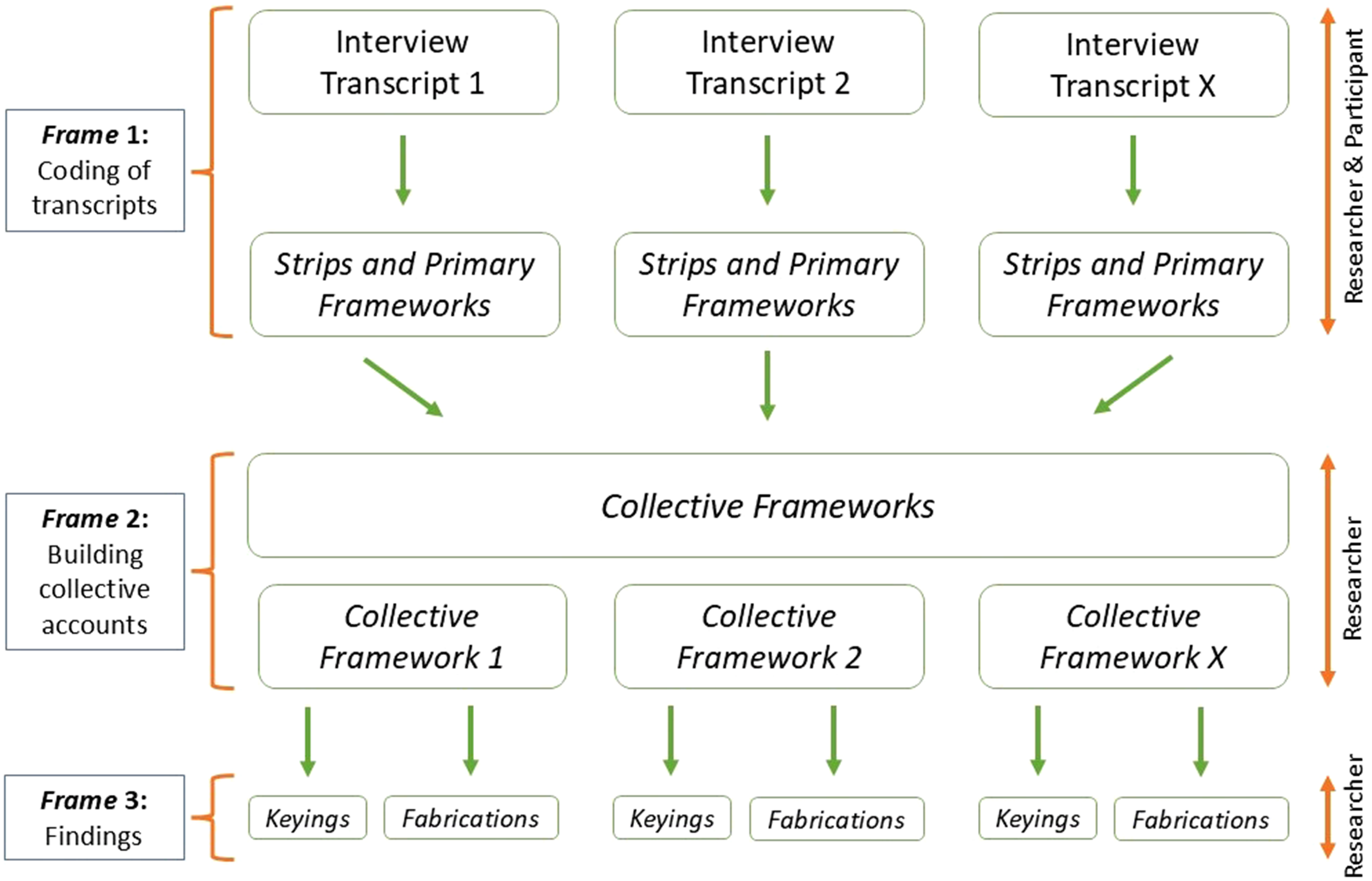
Model of transcript frame analysis.
This paper adds to the recent resurgence of ‘Goffman studies’ which has also sparked a renewed interests in understanding his ‘most puzzling’ work (Persson, 2022: 119). Inspired by the book, this paper develops a novel analysis approach to the coding of qualitative interview transcripts. The motivation for such was borne out of my sense of a disconnection between methodologies of fieldwork and data analysis. Whereas my methods had been embedded in phenomenological and constructionist philosophies (Aspers, 2009; Berger and Luckmann, 1991; Schutz, 1972), I felt a tension between how data analysis strategies struggled to link with this methodological grounding in my fieldwork. Considering the importance of the data analysis stage to the generation of knowledge, I sought to develop a method of analysis that connects more closely to the methodology of my research. To this end, I developed an approach that I shall refer to here as ‘transcript frame analysis’, drawing on Goffman's concepts of frames, strips, primary frameworks, keyings and fabrications. The development of this approach was profoundly inspired by Goffman, yet, in its refinement I also significantly simplify and alter his ideas to create an applicable analysis tool that can be used as a step-by-step (or frame-by-frame) guide towards the coding of interview transcripts.
Besides this Introduction and the Conclusion, the paper is in four main parts. Firstly, I will establish Goffman's ambiguous contemporary legacy, including an overview of the reception of Frame Analysis and current adaptations of it. Based on the observation that many uses of the ‘frame’ reflect Goffman's ideas only nominally, the next section explores the origins of Goffman's work with respect to the ‘frame’ and other core concepts in the book. The third part of the paper presents a model of the proposed transcript frame analysis approach. The workings of this approach will be demonstrated in the final section, where transcript frame analysis is brought to life through the example of a research project exploring the urban lives of UK undergraduate students. Overall, the article presents an analysis approach that highlights the generation of situated knowledges (Haraway, 1988) via an exploration and illumination of patterns and contradictions in group sense-making.
The ambiguous legacy of Erving Goffman and Frame Analysis
Erving Goffman has been referred to as the founder of microsociology, a sociologist of the situation (Jensen, 2006) and a scholar of everyday life (Smith, 2006). His ‘sociological microscopy’ (Smith, 2006: 127) entailed the meticulous study of face-to-face interactions and the physical and symbolic spaces in which they occur (Rawls, 1987), including the well-known application of dramaturgical analogies to the study of everyday life and how roles are enacted in private and in public, the back and front regions (Goffman, 1973). Through such analysis he gave rise to the concept of the ‘interaction order’ to describe the shared practices, norms and expectations that characterise social life and communication (Goffman, 1966). His descriptions of difference and deviance tell a strong narrative about the socially constructed nature of norms and values (Goffman, 1984) and although his work contains detailed analyses of everyday behaviour and its justifications, ‘Goffman never confuses doing the socially proper thing with the right thing to do’ (Smith, 2006: 41).
Despite occupying a unique role in the social science canon, Goffman has an ambiguous legacy; much critique has addressed the large number of concepts in his work and a lack of analysis of the structures and powers that call the roles he describes into being (Hacking, 2004; Scheff, 2005; Smith and Jacobsen, 2019). Despite these criticisms, Goffman's work has an important place in contemporary academia and since his death in 1982, numerous publications have been dedicated to his work to the degree that he has become a ‘global phenomenon with an international following’ (Jacobsen and Smith, 2022: 7). Scholars have applied, developed, criticised and extended his arguments to adapt them to the working of social categories that were not sufficiently foregrounded by him. For instance, Carol Brooks Gardner (1995) and Candace West (1996) have developed crucial feminist insights into gender and public space based on a Goffmanesque microsociology. Similar repositionings have occurred via the concepts of race (Howarth, 2006; Tyler, 2018), 2 class (Williams, 2009), sexuality (Orne, 2013) and disability (Barnartt, 2016). A particular resurgence of his work can be noted in the past years (Freidson, 2019) , emphasising the relevance but not timelessness of his contributions. Notably, in 2018 The Sociological Review published a special issue addressing the sociology of stigma, a key concept for Goffman (Tyler and Slater, 2018). In 2022, Jacobsen and Smith published The Routledge International Handbook of Goffman Studies and in 2024, coincidentally when the present paper was under review, Symbolic Interaction published a special issue addressed to Frame Analysis. Hence, while Goffman and his work are not without criticism, they remain relevant in research and teaching today.
Goffman considered Frame Analysis: An Essay on the Organization of Experience (1974) as his most important book; it took him ten years to write and is by far the longest of his publications (Persson, 2022). Arguably, it is also his least understood work. Frame Analysis has been referred to as his ‘most puzzling book’ (Persson, 2022: 119) with its initial reception enjoying a ‘shaky start’ (Smith, 2006: 126). Amongst critical reviews, the critique by Denzin and Keller (1981) was the only one Goffman (1981) ever formally replied to. His reply eluded to his own criticisms: There are lots of good grounds for doubting the kind of analysis about to be presented. I would do so myself if it weren’t my own. It is too bookish, too general, too removed from fieldwork to have a good chance of being anything more than another mentalistic adumbration. (1974: 13)
Although Frame Analysis is Goffman's third most cited work – over 48000 citations for the English-language version alone 3 – few in-depth attempts have been made to decipher it. This was already noted by Goffman when stating that ‘a paper can be written nowadays that focuses on the term “frame” and yet very little considers frame in my sense’ (1981: 67). This observation still holds true and since the book's publication, the ‘frame’ has taken on a life of its own. Numerous citations of the book can be ascribed to the loose adaptation of the term in reference to Goffman, though many of these show little engagement with Goffman's work and ideas (Koenig, 2006; Scheff, 2005; Smith, 2006).
For instance, the term ‘frame’, with an explicit reference to Goffman, is common across media and communication studies where frame analysis is a popular method to explore how content is created, transmitted and understood (Aarsand and Aarsand, 2019; Gamson, 1988; Kitzinger, 2007; Koenig, 2006; Vliegenthart and Van Zoonen, 2011). In this usage, the frame describes a process, perhaps similar to the idea of an ‘angle’, where selected aspects of an occurrence are emphasised and made salient while obscuring, neglecting or omitting others (Entman, 1993). Another widespread adaptation linked to Frame Analysis can be found in research on social movements (e.g., Benford and Snow, 2000; Johnston, 1995; Snow et al., 1986; Steinberg, 1998). Here the focus is on ‘collective action frames’ as a shared meaning-making mechanism with the goal of mobilising support for a specific cause (Johnston, 1995). With 243 occurrences of the word ‘frame’ in Benford and Snow (2000) alone, this strand of work is clearly centred on the ‘frame’ and cites Goffman as a primary influence. Although this work does not discuss Frame Analysis in detail, it is an important example of how Goffman's ideas and methodology can be deployed in variant and novel ways (Inglis and Thorpe, 2023).
Frame Analysis has been somewhat unaffected by a general resurgence of interest in Goffman. While the term ‘frame’ in reference to Goffman is still frequently used in its looser adaptation, detailed engagements with the book are rare. This said, a recent Symbolic Interaction special issue is solely dedicated to Frame Analysis, 50 years after it was first published. Contributions to this special issue emphasise that the book is more important than ever, tapping into debates about the social nature of meaning making and reality (Tavory, 2024). A significant clarification made in this issue is that there are more connections between the book and Goffman's other works than were previously understood. Frame Analysis is often referred to as a phenomenological turn in Goffman's work with its focus on experiences and meaning structures, rather than observable interaction (Davis, 1997; Frank, 1979; Jameson, 1976; Smith, 2005). It certainly shifts away from detailed situational descriptions towards the study of a deeper level of meaning and a quest to understand its structure; however, rather than seeing the book as distinct, Fine (2024: 513) argues that Frame Analysis ‘is Goffman's attempt to integrate internal comprehension with an interaction order’. This argument is built on the understanding that the interaction order refers to the sphere of face-to-face encounters, a micro-order with social situations as its unit of analysis (Goffman, 1983). Rather than treating situations sui generis, Goffman notes that the interaction order carries similar characteristics across groups and societies since all interactions contain an element of social stability where the actors rely on experiences and meanings that exist outside of the boundaries of the specific interaction (Fine, 2012). In other words, for Goffman, every interaction is shaped by social relations and meanings that exists outside of it. This repositioning of Frame Analysis thus suggests it as a study of how the meanings that play out in the interaction order come about. Accordingly, the book builds an important foundation for the discussion of face-to-face interactions, an internal perspective of what occurs when we engage in the world socially (Berger, 2024; Tavory, 2024).
A dissection of Frame Analysis
So, how do we make sense of what we do and how do we share our interpretations of what is going on in a way that is legible to others? These questions are at the core of Frame Analysis. Here, Goffman establishes a phenomenological starting point by postulating that he is ‘not addressing the structure of social life but the structure of experience people have at any moment of their social lives’ (1974: 13). Goffman is not analysing how society is organised but rather how people's perceptions of it are. He explains: This book is about the organization of experience – something that an individual actor can take into his [sic] mind – and not the organization of society. I make no claim whatsoever to be talking about the core matter of sociology – social organization and social structure. Those matters have been and can continue to be quite nicely studied without reference to frame at all. (Goffman, 1974: 13)
Linking this back to the interaction order (Goffman, 1983), Goffman emphasises the importance of studying the taken-for-granted character of everyday life when stating: ‘[t]he first object of social analysis ought, I think, to be ordinary, actual behaviour – its structure and its organization’ (1974: 564).
Although the ‘frame’ was the main break-out concept of the book, it is also the most elusive (Denzin and Keller, 1981; Entman, 1993; Frank, 1979; Koenig, 2006; Scheff, 2005; Vliegenthart and Van Zoonen, 2011). Goffman's first use of it is actually published in his essay Fun and Games (1961) and is inspired by anthropologist Gregory Bateson who suggests that a frame contains the signals that are necessary for people to interpret a situation (Bateson, 1955). The frame is thus a ‘situational definition’ that is not so much about the specific content of an interaction but about its form (Persson, 2022: 121; Tavory, 2024). The frame stipulates whether a situation is serious, playful, aggressive, etc. Yet, with the popularisation of the term, its specific meaning has been moved on to describe the frame as a wider sense-making template. The frame has been referred to as ‘an a priori definition of reality’ (Frank, 1979: 176), a way of seeing and making sense of the world (Verhoeven, 1985), a ‘problem-solving schemata’ used to make sense of situations (Johnston, 1995: 217), a ‘day-to-day sense making technique’ (Creed et al., 2002: 36) or an ‘epistemic bracket’ that marks what is socially relevant (Zerubavel, 2024: 532). Accordingly, the frame enables individuals to interpret a situation and to make sense of it (Benford and Snow, 2000; Creed et al., 2002; Jensen, 2006; Johnston, 1995; Koenig, 2006; Scheff, 2005; Verhoeven, 1985). Goffman's work then explores the layering of these frames, describing how even a small detail has the potential to change the definition of a situation, bringing another frame onto an existing one and supplementing established meanings by solidifying or changing them. Exploring the structure and content of these frames is the objective of Frame Analysis: I assume that when individuals attend to any current situation, they face the question: ‘What is it that's going on here?’ […] My aim is to try to isolate some of the basic frameworks of understanding available in our society for making sense out of events and to analyse the special vulnerabilities to which these frames of reference are subject. (Goffman, 1974: 8–10)
Besides the frame, there are several other concepts such as strips, primary frameworks, keyings and fabrications that build this complex structure of experience that allows us to render everyday happenings meaningful. Firstly, the foundational element of this structure is a ‘strip’,
4
that is: [A]ny arbitrary slice or cut from the stream of ongoing activity, including here sequences of happenings, real or fictive, as seen from the perspective of those subjectively involved in sustaining an interest in them […] It will be used only to refer to any raw batch of occurrence (of whatever status in reality) that one wants to draw attention to as a starting point for analysis. (Goffman, 1974: 10)
As such, a strip is an occurrence that the individual deems of interest for further analysis. By necessity, for a strip to feature consciously in our experience it needs to be framed as relevant. This occurs via a ‘primary framework’ whose main purpose is to initially inform occurrences in everyday life and to make sense of them. The concept captures what could also be described as the initial reading of what is going on. Primary frameworks are therefore ‘schemata of interpretation […] seen as rendering what would otherwise be a meaningless aspect of the scene into something that is meaningful’ (Goffman, 1974: 21). They contain taken for granted ways of acting and interacting and are the first ‘layer or lamination’ (Goffman, 1974: 82) of meaning to an occurrence, a strip.
Further adding to Goffman's analysis are other types of frames, ‘keyings’ and ‘fabrications’. A keying is a ‘set of conventions by which a given activity, one already meaningful in terms of some primary framework, is transformed into something patterned on this activity but seen by the participants to be something quite else’ (Goffman, 1974: 43–44). In other words, via a keying the initial interpretation (the primary framework) of an occurrence (a strip) is transformed from its original ‘face meaning’ into something different (Fine, 2024). For instance, Goffman (1974: 79, 44) uses the analogy of moving from an original to a copy or from serious action into play to describe the effect of a keying. It adds an additional layer of meaning, a further reading of what is going on, and in doing so can produce a transformation of meaning that can be closer or more removed from the occurrence's initial interpretation.
In contrast to a keying, a fabrication is a frame that involves a level of deception in which an occurrence is presented to be something it is not: ‘I refer to the intentional effort of one or more individuals to manage activity so that a party of one or more others will be induced to have a false belief about what it is that is going on’ (Goffman, 1974: 83). Those who believe in the deception are considered to be the contained and those responsible for the deception are the fabricators. Goffman distinguishes between different types of fabrications: benign fabrications are not harmful to those contained in it such as a surprise party or playful deceit (Goffman, 1974: 87). Exploitive fabrications on the other hand, serve the interest of the fabricator only, without considerations for the effects on the contained (Goffman, 1974: 103). The act of planting evidence against someone or lying to protect oneself are used by Goffman to illustrate the harmful effects of exploitative fabrications.
Keyings and fabrications thus add an additional layer of meaning to a strip already meaningful in its primary framework.
5
A structure made up out of strips, primary frameworks, keyings and fabrications is what Goffman refers to as the organisation of experience. In this structure, each layer constitutes a specific frame. Similar to the way in which the frame of a painting serves to focus attention and foreground phenomena, Goffman's use of ‘frame’ focuses on a specific aspect of reality. In turn, multiple frames, layered over each other, can create a complex definition of a situation. Goffman (1974: 10–11) elaborates: I assume that definitions of a situation are built up in accordance with principles of organization which govern events – at least social ones – and our subjective involvement in them; frame is the word I use to refer to such of these basic elements as I am able to identify. That is my definition of frame. My phrase ‘frame analysis’ is a slogan to refer to the examination in these terms of the organization of experience
A crucial point of the book is the social nature of the frame. Goffman is interested in how experiential worlds play out socially via the interaction order and links this to the social phenomenology of Schutz (Fine, 2024; Tavory, 2024). Fine (2024: 513) refers to Frame Analysis as a ‘phenomenology with a sociological soul’ whereas Davis (1997: 372) calls it a ‘book on the phenomenology of social life’ with an emphasis on first and second order experiences via the analogies of primary frameworks, keyings and fabrications. Goffman himself emphasises this point about collective meaning structures by arguing that groups share frameworks and belief systems as part of their ‘cosmology’ (1974: 27). The importance of understanding experience and meaning collectively links Goffman's work to other significant methodological pieces (e.g., Berger and Luckmann, 1991; Schutz, 1972). Goffman shows that frames can illuminate how groups develop a collective definition of the situation. The book thus treads a fine balance between ‘a personally grounded phenomenology and societally shared understandings’ (Fine, 2024: 521). This is also an important foundation for the transcript analysis approach introduced below which was developed to be sensitive to individual experience in its exploration of collective meaning making.
Transcript frame analysis
The methodological potential of Frame Analysis to build a bridge between theory and empirical research and refine how we do data analysis has already been noted (Zerubavel, 2024). Foregrounding the work of scholars who have used the book as an inspiration for the analysis of data helps to this end. For instance, Aarsand and Aarsand (2019) use Frame Analysis to explore research interviews by building on the notion of ‘activity frames’ to understand the effectiveness of interview openings. The book's potential for the analysis of textual data is demonstrated by Koenig (2006) who, similarly to this article, develops a novel step-by-step coding approach inspired by Goffman's ideas. An important methodological addition is made by Luhtakallio (2024) who proposes visual frame analysis that picks up on central concepts from the book. Interestingly, also this approach was borne out of a sense of disconnection with common analysis approach and the suggestion that Frame Analysis has more to offer methodologically. Based on the idea that there is merit in staying closer to Goffman's writings (Tavory, 2024), all of these scholars have in common that they study Frame Analysis in detail and explore core concepts. Yet, by creating an applicable analysis tool, they also significantly modify Goffman's ideas. Also the approach presented in this paper is Goffmanesque in character but significantly diverges from his ideas to constitute an applicable analysis tool.
The motivation to develop my own method of analysis, called transcript frame analysis, derived from a sense of disconnection between the methodology of respective stages of fieldwork and the data analysis phase (Pötschulat, 2018). In the cited project, my methodology built on the work of Alfred Schutz (1972) and the development of his ideas towards an ‘empirical phenomenology’ which explores collective meaning structures and academic theorising of such (Aspers, 2009). With its emphasis on intersubjectivity and shared meanings, empirical phenomenology also explores how our experiences of the world are impacted by social constructions (Berger and Luckmann, 1991; Sixsmith and Sixsmith, 1987). Whereas my choice of methods had been embedded in this methodology, I struggled to align various types of coding of my data with this methodological grounding of my research process. Considering the importance of the data analysis stage in the generation of knowledge, my aim was to develop a method of analysis that continues this phenomenological grounding and writes the researcher into the knowledge generation process. Similar to the scholars mentioned above, upon reading Goffman's work and its positioning as a ‘book on the phenomenology of social life’ (Davis, 1997: 372). I felt inspired to use it to develop my own approach for the coding of research data.
It is important to note that the starting point of transcript frame analysis is very different to the phenomenological foundation of Frame Analysis. My approach proposes an analysis of transcripts and is thus based on what people communicate in the setting of an interview and how the transcription of this interaction can be interpreted in light of this. Throughout, I am mindful that the interview process itself is a framed social setting that involves a focussed interaction and the ‘disciplined management of personal appearance or “personal front”’ (Goffman, 1966: 25). The interview situation inevitably involves impression management and cynical performance meaning that ‘the representation of an activity will vary in some degree from the activity itself and therefore inevitably misrepresent it’ (Goffman, 1973: 65). This links to a wider methodological puzzle of qualitative research regarding the types of experience that can be studied empirically by anyone other than the actor themselves.
In what follows below, I am outlining how I have adapted Goffman's concepts to fit into an empirical analysis tool. Although qualitative data comes in diverse formats, I focus on the most common type of qualitative data, the interview transcript, for the purpose of the initial establishment of the approach. It has been noted before that most applications of Frame Analysis bear little resemblance to Goffman's actual reflections (Scheff, 2005). Also the model proposed here constitutes a significant simplification, diversion and alteration to Goffman's original ideas and below I demonstrate how my usage of his concepts diverges. While the final section of the paper exemplifies the workings of this approach on a research example about the urban lives of UK undergraduate students, in this section I focus on the model in the abstract, which entails the following core concepts:
Strip: 6 Goffman describes a strip as ‘any raw batch of occurrence […] that one wants to draw attention to as a starting point for analysis’ (Goffman, 1974: 10). My analysis approach connects to this closely, a strip has been operationalised as an occurrence, that means an activity, an event, an observation, a thought, or any other type of happening that a research participant draws attention to within the context of an interview. Of course, as stated above, this constitutes a diversion from Goffman's work in the sense that the communication of an occurrence, for instance in a research interview, already assumes that is has been rendered meaningful via a combination of frames. In short, in transcript frame analysis, a strip refers to an occurrence that is mentioned by an interview participant.
Primary framework: The primary framework is the meaning that a participant discusses in relation to an occurrence that they brought up in the context of an interview. My usage of this term connects to Goffman's notion of it as ‘schemata of interpretation’ (Goffman, 1974: 21) that renders a strip meaningful. However, I diverge from Goffman by simplifying his suggestions around a layered structure of meaning where the primary framework is only the initial interpretation typically with more frames to follow. In transcript frame analysis, an occurrence (a strip) and its meaning (primary framework) constitute the simplified meaning structure of the participant.
Collective framework: This is a conceptual addition that is not found in Goffman's work but connects to other Frame Analysis-inspired approaches that include additional concepts to make it applicable (Koenig, 2006; Luhtakallio, 2024). With the proposition in mind that we should deploy a ‘group-level reading of Frame Analysis’ (Fine, 2024: 515), my approach is built on the understanding that it needs to be sensitive to individual experiences while offering insights into collective meaning making and the academic study of it (Jones, 2025). To build collective frameworks, the researcher looks across the data from all participants and scans it for similarities in occurrences and meanings. Each collective framework aggregates meanings and occurrence of a similar nature under an umbrella term with the purpose of enabling a social analysis of meaning making. By the end of this analysis stage, the researcher will be left with several collective frameworks, each containing all of the strips and primary frameworks that relate to its umbrella term.
Keying: My deployment of the term keying diverges significantly from Goffman's use. For Goffman, a keying is the re-coding of a taken for granted meaning that produces a different reading of what is going on. He also adds that it is a ‘set of conventions by which a given activity, one already meaningful in terms of some primary framework, is transformed into something patterned on this activity’ (Goffman, 1974: 43–44). My usage of the concept was largely inspired by the idea of a keying as a ‘patterned activity’. In transcript frame analysis, keyings are broader patterns and repetitions that the researcher has identified across the whole dataset. As such, keyings offer an additional layer of meaning through which the researcher can highlight shared occurrences and interpretations of multiple participants.
Fabrication: Goffman described how collective meaning making is impacted by intentional and unintentional elements of deception which may lead people to have a ‘false belief about what it is that is going on’ (1974: 83). Connected to the idea that human behaviour and sense-making is not always logical (Law, 2004), I thought there was much potential in an analytical concept that explores the ways in which our sense of the world can be contradictory and messy. For transcript frame analysis, a fabrication refers to the identification of a patterned contradiction between a strip and a primary framework, observed by the researcher in the accounts of multiple participants. 7 In other words, there is a shared inconsistency between occurrences of a similar nature and their attributed meaning. Importantly, fabrications are not about claiming that the participants’ account is in any way ‘false’ or ‘not true’ as the focus of the inquiry is to understand someone's representation of their reality (Jones, 2025; Lewis and Staehler, 2010). A fabrication is an analytical tool to illustrate how meaning making is not always rational. It offers an interesting reflection on social life more generally which is full of paradoxes and much of social research hinges on exploring the ostensibly counter-intuitive.
Frame: In contrast to Goffman's more specific use of the frame as a definition of the situation, I align myself with adaptations that see it as a broader sense-making template (e.g., Creed et al., 2002; Johnston, 1995; Verhoeven, 1985). In transcript frame analysis, each of the three analysis steps is referred to as a frame and constitutes a unique approach to the data. Frame 1 is the exploration of each transcript for strips and primary frameworks. Frame 2 constitutes the organisation of shared accounts via the collective frameworks and Frame 3 generates the findings in the form of keyings and fabrications. While this three-frame approach is inspired by Goffman's suggestion that the organisation of experience contains several layers of meaning, it also significantly diverges from his ideas, radically reducing the complexity of the participants’ sense-making structure and acknowledging the role of the researcher in the co-production of situated knowledge (Haraway, 1988).
Following their detailed establishment, below are the transcript frame analysis concepts in brief:
Strip: An occurrence the participant draws attention to. Primary Framework: The participant's description of how the occurrence is meaningful. Collective Frameworks: Looking across the data, the researcher groups strips and primary frameworks of a similar nature under umbrella terms. Keying: Identification of a broader pattern and repetitions within a collective framework. Fabrication: Identification of a shared contradiction between occurrences and their meanings within a collective framework. Frame: Each step in the analysis approach is a frame and constitutes a unique definition of the situation.
Figure 1 below shows how transcripts would move through the different frames of the analysis approach.
Interviews are held, recorded and subsequently turned into written transcripts. Each transcript is coded for strips and once a strip has been detected, the researcher continues by identifying the meaning that the participant attributes to the occurrence, the primary framework. This process should be repeated for all of the transcripts. Leaving the researcher with numerous strips and primary frameworks as marked in the individual transcripts.
To aggregate individual meanings from the transcripts into socialised positions, the second step of the data analysis involves my addition to Goffman's analysis approach, the collective frameworks. Here, the researcher collates all of the strips and primary frameworks across the transcripts with a focus on identifying similar occurrences and meanings and grouping them under an umbrella term. At the end of this process the researcher will have allocated most strips and primary frameworks to one of several collective frameworks.
Collective Frameworks help the researcher to analyse transcripts according to patterns and inconsistencies in the data. Keyings identify broader patterns within the data, occurrences and their meanings that are repetitive and shared amongst several participants. Fabrications, on the other hand, highlight conflicts between strips and the primary frameworks, patterned contradictions, that are shared by several participants. Working out the main keyings and fabrications constitutes the findings stage of transcript frame analysis. The researcher will be left with general patterns as well as shared contradictions that they can report on from the research. Foregrounding such draws attention to the social nature of the research findings.
In transcript frame analysis, all three frames account for the role of the researcher in the generation of findings. Central to Goffman's work is the idea that how people interpret the social world and the knowledge they create is based on their individual (yet socialised) perspective. He refers to the notion of ‘the anchoring of doings in the world’ (1974: 293) arguing that every framed occurrence has a place in the world, from which it originates and to where it goes back. Haraway's notion of situated knowledges and other related concepts such as reflexivity and positionality (England, 1994; Haraway, 1988; Rose, 1997), remind us that the researcher is never neutral with respect to knowledge. The power of the researcher is also foregrounded in empirical phenomenology and its distinction between first and second order constructs (Aspers, 2009; Sixsmith and Sixsmith, 1987). Throughout transcript frame analysis, it is important to stress the omnipresent influence of the researcher in the construction of data and findings. Stated bluntly, in my model, this has been implemented by highlighting the involvement of the researcher at every frame of the analysis approach.
Transcript frame analysis applied
This section focuses on a practical application of transcript frame analysis to demonstrate the workings of the approach, using an example from my doctoral research which involved analysis of the relationship between undergraduate students and their university city (Pötschulat, 2018). 8 In exploring students’ urban practices and sense-making, the research studied how the notion of the ‘student experience’ is constructed within UK higher education as well as the urban environment (Pötschulat et al., 2021). The research entailed a combination of methods including interviews, auto-photography, diaries and participant-led walks which resulted in a diverse data set ranging from traditional interview transcripts and field notes to images and maps (Pötschulat, 2023). Here though, I focus on the data derived from the transcripts and shall only mention the results of the research in as far as they are helpful for understanding the workings of the analysis approach. Original quotes from the research are used to exemplify the identification of strips, primary frameworks, keyings and fabrications.
The interviews of my research followed a semi-structured approach, were transcribed and then manually coded according to the occurrence of strips and primary frameworks.
9
To restate, strips refer to occurrences that the participant wants to draw attention to in the context of an interview and are typically identifiable in the transcripts via a description of an action, a situation, a thought or a circumstance which would often involve particular verbs such as: ‘I went’, ‘I did’, ‘I saw’, ‘I heard’, ‘I live’. Importantly, transcript frame analysis focuses on the communication of occurrences and their meanings. Not every occurrence mentioned in the interviews is also verbally connected to a meaning or followed by a description of why the occurrence is relevant. Accordingly, it is important to identify whether strips are accompanied by an attribution of meaning, a primary framework. Below is an example from a transcript that demonstrates this connection: In first year, I lived in Fairfields and I didn’t like it. I didn’t like the house. It was expensive, it was cold and the roof was leaking. I had like water in my house all the time and I had very serious health problems after it […]. And my landlord he was really harsh he’ll be like ‘if you move out you still have to pay’. (Karolina)
The quote demonstrates the workings of a strip and its primary framework. In this case, the strip that the participant wants to draw attention to is that she lived in a certain area of the city and certain type of home. The primary framework is detectable via the meanings that she attributes to this occurrence. She describes her aversion for the house and its state, how it has caused health issues and she flags the exploitative relationship with the landlord.
Throughout my interviews it became apparent that the description of the strip is often rather brief whereas the primary framework can take up much more space in a transcript. For exemplary purposes, the quotes here are shortened but the meaning of occurrences were often discussed in length in the interviews. The following demonstrates the relationship between a strip and its primary framework on the example of a participant's engagement with nightlife: We used to go out as like a hall so there’d be like however many people I knew […] and we would see them on nights-out all the time. So it was kind of like you go to dinner and people would be like ‘Oh are you coming out tonight?’ […] I think everyone just gets very not like wrapped up in it all but because everyone else is doing it and you don’t wanna miss out too much. (Laura)
Here, the strip is going out (and related activities) and the remainder of this shortened quote details the primary framework she assigns to this occurrence in terms of the social control and peer pressure of university halls. 10
Once all transcripts are coded, it is useful to make a note of all occurring strips and their primary frameworks. This is the part of the analysis where individual meanings are aggregated into a collective account. When cross-reading, it will become apparent that some strips and their primary frameworks occur in the accounts of several participants and can be allocated to a collective framework which groups related occurrences and meanings via an umbrella term. To illustrate this step, in my research, I identified three collective frameworks overall: ‘Living in the City’, ‘Studying in the City’ and ‘Consuming in the City’ which captured the vast majority of my data. Situating this within the structure of a research publication, the starting point of the discussion of the data would entail a detailed description of each collective framework and the types of strips and primary frameworks that are contained in it. In the case of my doctoral thesis, each collective framework was the foundation for one data analysis chapter.
The first collective framework – ‘Living in the city’ – described occurrences and meanings, i.e., strips and primary frameworks, that relate to the participants’ residential patterns covering topics such as their living situation, their residential neighbourhood and their housing choices. Discussing students’ living situations would often take up a lot of interview time with the participants providing detailed accounts of all the places they had resided as students and their experiences of sharing a student household. We also discussed their thoughts on the student housing market, the role of estate agents, developers and landlords as well as housing prices. Also, the immediate residential area was of relevance and students spoke about their engagement (or lack of) with the neighbourhood and their neighbours.
The second collective framework – ‘Studying in the City’ – contained any discussion of their engagement with the university overall and the built environment of the university campus. Conversations about this topic often started by students describing how they spent time on campus by attending lectures and visiting the library. Often the participants mentioned their involvement in non-teaching related activities for instance via the student union or the use of on-campus student pubs and cafés. We also discussed their engagement with their study programme and how this has changed over the years.
The third collective framework – ‘Consuming in the City’ – covered most of their urban practices that are not related to students’ living situations or their direct enrolment at a university. Typically, these focused on engagement with the city centre and were heavily consumption-focused. Going out was one of the most important practices here and students gave detailed accounts of their weekly nightlife schedules and the places they go to. Also shopping trips, eating out and visiting bars and cafes were frequently mentioned as meaningful urban activities.
Collating meaningful occurrences under collective frameworks helps the researcher to identify keyings and fabrications in the data. Essentially these constitute what is usually referred to as the ‘findings’ of an analysis approach. In transcript frame analysis, a keying involves the identification of a broader pattern. Typically, this can be established via a repetition in the data where several participants share a similar strip and primary framework. Examples of keyings in my research were, for instance, the social importance of consumption practices to obtain group membership. This keying was established via the ‘Consuming in the City’-collective framework and the numerous strips of where participants shop, eat, drink and dance and, in the discussion of the primary framework, the importance they place these activities for fitting in. Another example of a keying is the observation that students develop predictable residential pathways through the city. Their maturation on the undergraduate programme also reflected a spatial trajectory of their residential choices. This keying was established via the strips and primary frameworks contained in the collective framework of ‘Living in the city’. Here, the participants gave detailed accounts about where they have lived throughout their studies and why they made certain residential decisions.
The collective frameworks in my research delivered approximately three keyings each. Fabrications, on the other hand, were much rarer in the data. As a reminder, a fabrication describes a patterned contradiction between strips and primary frameworks shared by several participants. It is an analytical tool that emphasises how sense-making of the social can involve contradictions and paradoxes by highlighting that shared occurrences seem inconsistent to their attributed (shared) meanings. To illustrate this point, a fabrication that I came across in my research was the notion of ‘the poor student’, a primary framework that seemed to be in contradiction to the participants’ urban practices, their strips. The activities of my research participants suggested lives that were very consumption-focused, entailing frequent visits to night clubs, purchases of takeaways, shopping trips and often also ‘luxury’ student accommodation. Their consumption practices coupled with the willingness to compromise on life essentials such as bus passes or heating, meant that they had quite a sizable purchase power in the city and were courted by various leisure and accommodation providers (Chatterton, 2010). Yet, my participants repeatedly made sense of themselves as being poor, not as a result of all of these expenses but from the outset. The analytic device of the fabrication highlighted this contradiction between the economic practices of the participants and how they make sense of themselves. These in turn can then become lines of analysis for further research. Fabrications thus highlight how groups and cultures are part of complex sense-making processes that also contain shared contradictions and inconsistencies.
Keyings and fabrications constitute the end point of transcript frame analysis and would be reported on as the main findings of the research. Although I have focused on interview transcripts throughout this article, there is potential to develop this into an analysis tool for other types of qualitative data although I am limited by space to further explore this. With its emphasis on identifying occurrences and their meanings to develop broader patterns and contradictions, it is conceivable that field notes could be coded according to strips that the researcher observes and the primary framework that the researcher attaches to them. Similarly, also images, drawings or maps could be coded along the lines of (i) what is going on, (ii) what does it mean and (iii) how is this patterned.
Conclusion
Contemporary social science is characterised by a ‘persisting presence of Erving Goffman’ and his work continues to inspire scholars and their social analyses (Jacobsen and Smith, 2022, 1). Frame Analysis, one of his least explored works, has significant potential to sharpen methodological considerations concerning data analysis. Inspired by Goffman's ideas around the social organisation of experience, I have developed an approach that is inspired by his concepts of strips, primary frameworks, keyings, fabrications and frames and their operationalisation for the analysis of interview transcripts. In practice, the development of this approach has involved several analytical iterations, some of which took me further away from Goffman's original ideas. Here, I have demonstrated the many ways in my approach remains Goffmanesque in character but also contains significant changes, additions and simplifications that are not in keeping with his book. As such, the establishment of my approach connects to the argument that ‘[t]heorizing and designing methodology in ways inspired by, but not mechanically reproducing, Goffman's ways of doing such things, may yield new directions for both “social theory” and empirical research in interaction’ (Inglis and Thorpe, 2023: 10).
Qualitative research has several well-established analysis approaches and some of these have been popularised to the degree of being normalised. However, data analysis approaches are essential tools in the representation of social worlds and the generation of knowledge and cannot be taken for granted. Although they underlie the same epistemological and ontological assumptions that are applied to research methods, puzzlingly it is rare to see methodological considerations feature in the choice of analysis approach. This is unusual considering the important position of the data analysis stage with regards to representing the experiences of people and groups in question. Transcript frame analysis was built with the aim of more meaningfully connecting to methodological assumptions around the layered and socially constructed nature of experience (Aspers, 2009; Berger and Luckmann, 1991; Schutz, 1972) and how it is studied academically (Jones, 2025).
As social scientists, we commonly report on other people's experiences of the world and feminist scholars remind us of the importance of reflecting our own positionality in any findings that our research yields (England, 1994; Haraway, 1988; Rose, 1997). Understanding the power of the researcher in the generation of situated knowledge is a central element of transcript frame analysis. The approach offers an analysis of the representation of individual experiences in an interview setting by studying individual transcripts for occurrences and meanings. Yet, it also delivers a collective reading of these meanings and how they are shared via the concept of the collective framework. A core innovation of the approach is the development of two types of research findings, keyings and fabrications. While both of these highlight the ways in which meanings are social, a keying, referring to the identification of a broader pattern in the data, links to other analysis approaches that contain concepts that explore what is going on and how it is collectively made sense of. However, adding to that, there is much potential in the concept of the fabrication, deployed here as an alternative finding that identifies patterned contradictions across the data, to draw out the counter-intuitive, paradoxical and surprising aspects of our research. Transcript frame analysis is thus also an approach that is able to incorporate the many ways in which the social, our sense-making of it and its academic study is arbitrary, messy and contradictory (Law, 2004).
Footnotes

Acknowledgements
Special thanks go to Paul Jones, Joe Moran and Mary-Jane O'Leary for their encouragement and perceptive comments. I would also like to thank the research participants and anonymous reviewers for their contributions towards the development of this approach.
Funding
The authors disclosed receipt of the following financial support for the research, authorship, and/or publication of this article: An earlier version of this approach was developed while the author was in receipt of the ‘Changing Cultures' Studentship.
Declaration of conflicting interests
The author declared no potential conflicts of interest with respect to the research, authorship, and/or publication of this article.
Data accessibility statement
The data that support the findings of this study are available on request from the corresponding author. The data are not publicly available due to privacy or ethical restrictions.