




Abstract
In this methodological reflection, I illustrate how participant-generated photos take on different roles throughout the research process. The photos discussed form part of a study focusing on ‘sustainable’ everyday practices. I account for how the photos act as windows into meanings of sustainability, as windows into sustainable materialities and as artefacts influencing the research process. The aim is to share insights gained as a result of grappling with photos, in terms of their roles – as well as what the photos portray. By bringing materialities to the fore, the photos made me reconsider the role of material elements within everyday practices, which I have come to understand as dynamic and vibrant. I argue that photos, like material elements in practices, provoke and have effects and can help foreground the often taken for granted mundane materialities entangled with everyday life.
Keywords
Introduction
Photos are selective, they capture certain aspects while leaving others out. They are embedded in their social context and can be interpreted in different ways (Rose, 2016). Yet, materialities portrayed in photos were arguably there at the moment the photo was taken (Harper, 2004), while photos can indeed be manipulated in different ways. Simultaneously, the photos themselves are artefacts with the capacity to evoke effects (Woodward, 2020). These are some of the considerations I have given photos that were produced by research participants in a study focusing on sustainability in everyday life (Bäckman 2024). According to Rose (2014), photos are the most common type of visual material within the vast field of visual research methods, nevertheless the images themselves are typically given little attention. This is the case in particular within studies applying photo-elicitation techniques, where the focus tends to centre on talk about the photos rather than reflecting upon what the photos are and what kind of visuality they convey (Rose 2014). Photo-elicitation methods have received increased interest as part of the growing popularity of visual methods across social sciences within the last decades (Mannay, 2016; Pauwels, 2010; Rose, 2014; 2016). This popularity has sometimes been referred to as the visual turn (see for example Jay, 2002; Pyyry et al., 2021; Vassenden and Jonvik, 2022), yet using visual materials such as maps, diagrams and photos has a long history in fields such as anthropology and geography (Pyyry et al., 2021; Rose, 2016). The recent increase in methods including photos in some way or another has been explained by the prevalence of photos in contemporary culture, and by technological developments making both the production and distribution of images easy (Pauwels, 2010; Rose, 2014). Digital culture is only one explanation, and it seems photos have become common within visual research methods as their production require little prior skills as opposed to other participant-generated visual materials (Rose, 2014) and something people tend to do as part of everyday life regardless of being part of a research study (Pyyry et al., 2021). Despite their popularity, the role of photos within visual methods varies and they have therefore been described as ‘unstable’ devices (Rose, 2014).
The visual turn has to some extent taken place in conjunction with the material turn, which often focuses on foregrounding taken for granted mundane materialities (Hall and Holmes, 2020; Woodward, 2020). In this paper I methodologically reflect upon how I engaged in understanding what practices residents of a specific urban district associate with sustainability in everyday life, by starting out from mundane objects and things forming part of ‘sustainable’ everyday practices. I did so by asking research participants to take photos of things and places in their homes and living environments that they associate with sustainability. The visual method used can be referred to as participant-generated photo-elicitation (Drew and Guillemin, 2014; Soaita and MacKee, 2021), as the photos were discussed during semi-structured interviews. The aim of this paper is to share insights gained by focusing on participant-generated photos produced as part of a photo-elicitation study. I do so by reflecting upon the different roles of the photos and what the photos brought to the fore. I start out by giving a short background on how materials can be understood as part of everyday practices from a practice theoretical perspective. I then go on to discuss what I did and why, by introducing the way I applied photo-elicitation. Next, I turn to reflecting upon what the participant-generated photos made me see and grapple with, as well as how the method helped me re-consider the role of material elements within everyday practices.
As questions have been posed around the role of photos within photo-elicitation studies (Dockett et al., 2017; Richard and Lahman, 2015; Trombeta and Cox, 2022), I start the reflection of what the photos brought forth by discussing what a photo can be, and reflect upon the different ways I approached the photos in my study. Further, in light of criticism of how photo-elicitation projects tend to focus on talk about photos rather than the photos themselves (Drew and Guillemin, 2014; Rose, 2014), I discuss what the content of photos – in conjunction with the interviews – helped me understand regarding participants’ perspectives on sustainability in everyday life. In the last part of the reflection, I discuss how research methods are always part of shaping the phenomena of study (Coffey, 2022; Law, 2004; 2009; Woodward, 2016) and how the photo-elicitation method made me to re-consider the role of material elements within practices. Although materiality has been theorised in different ways, the development of methodology taking materiality into account has only just begun (Holmes, 2020; Woodward, 2016). This article contributes with a reflection on: how photos can be understood and approached when treated as data in a qualitative research study applying a photo-elicitation method; the insights gained about sustainability in everyday life based on the photos – in conjunction with the interviews; and how the photos part of the photo-elicitation method can bring taken for granted materialities to the fore and prompt a reconsideration of their role within everyday practices. I conclude by reflecting upon the insights gained and argue that photos, despite their unstable character (Rose, 2014), can foreground taken for granted everyday materialities and thus contribute to an increased understanding of how materiality is entangled with everyday life.
Background: material elements forming part of everyday practices
A small sea of photos is filling up the floor in my apartment. I have printed them out on A4 paper sheets a while back, and the edges of the sheets have folded in a way that shapes a wave-like structure as they are placed next to one another. Some of the photos have post-it notes on them, from when I sorted them into clusters depending on what everyday practices they were associated with. When I look at the photos the participants and their accounts come to mind. The way I interpret the photos is influenced by what they have told me about each picture. But the photos are also objects in themselves, they are here in my apartment as physical things in the form of paper sheets with printed colour-photos on them. They portray material elements participants associate with (un)sustainable everyday practices. These elements include, among other things, waste sorting compartments located in a kitchen drawer, a gravel path surrounded by greenery leading into a forest, a bathroom with a shower that is equipped with a low-flowing shower head and a set of bicycles in a bicycle storage room. There are also a few photos that are not linked to any specific everyday practice. For instance, one portrays a wooden building wall that I remember being told ‘feels’ sustainable. While the photos portray physical elements, they also come to represent certain perspectives on sustainability.
These photos on the floor in my apartment were taken by people living in an area called Rosendal, located in Uppsala, Sweden. This new urban district was chosen due to it being developed with the aim and ambition of becoming a ‘sustainable’ living environment. While acknowledging the districts’ sustainability profile, I wanted to focus on residents’ perspectives on sustainability in everyday life. Therefore, I invited a group of residents to participate in semi-structured interviews. Prior to the interviews, I asked them to send me photos of things and places in their homes and living environments that either enables or restricts them from making sustainable choices in their everyday lives. I did this due to an interest in both the participants perspectives on sustainability in everyday life, and due to my interest in practice theoretical approaches to consumption research, where physical elements are seen to contribute to shaping, reproducing and altering practices. In building upon Shove et al.'s (2012) conceptualisation, I was interested in the objects portrayed in the photos due to them being material elements forming part of specific everyday practices along with meanings and competences. According to Reckwitz (2002: 250) a practice is ‘a routinized way in which bodies are moved, objects are handled, subjects are treated, things are described and the world is understood’. He thus emphasizes the role of material elements and also states how ‘Carrying out a practice very often means using particular things in a certain way’ (Reckwitz, 2002: 252). Shove et al. (2012) build upon Reckwitz, among others, and describe their contribution to be a materialised theory of practice. It was due to their inclusion of materials in the practice itself, and not as material arrangements that interact with practices (Schatzki 2010), that I decided to side with Shove et al. (2012). Their way of taking materiality into account without granting material elements too much attention in relation to meanings and competences, resonated with my understanding of materiality at the time of interviewing people living in Rosendal.
Despite materiality receiving attention within contemporary theories of practice, the role of material elements remains rather static (Strengers and Maller, 2019). Having come across the idea that agency is distributed across elements within practices (Sahakian and Wilhite, 2014) and due to my interest in the role of material elements within specific practices, I read texts by authors such as Barad (2003, 2008), Hekman (2008) and Alaimo (2012, 2014) in order to get an insight into the different ways in which materiality can be understood. Thinking of materiality as something that holds agency in itself, was something I found difficult to grasp. I came to a point where I thought: maybe materiality is not that extraordinary or mysterious after all, maybe it is just one element within practices. So, I made up my mind and settled on approaching materials as static objects without agency, still holding onto the idea that materials guide practices in conjunction with other elements. However, the photos have brought the material elements to the fore over and over again and have forced me to reflect on their role within practices, along with the idea of agency as distributed across elements of practices. The photos have also made me reflect upon the role of the photo as an object in itself, as well as to critically consider why the photos portray the things that they do.
What I did: photo-elicitation with participant-generated photos
The photos taken by people living in Rosendal were included in semi-structured photo-elicitation interviews conducted in 2020. The interviews focused on what comes to count as ‘sustainable’ in the participants’ everyday lives. The majority of the participants were recruited by posting an interview invitation in a local Facebook group, where residents of Rosendal can share information about the area. A few participants were recruited via snowballing, while two participants responded to an invitation sent via an online communication channel used in a couple of the district's housing associations. Using online platforms when recruiting research participants certainly poses certain limitations, as there are likely to be inhabitants who do not use such platforms. However, at the time of recruiting interviwees, these platforms seemed to be the most commonly used communication channels in the area.
When asking participants to take photos of things and places that either enabled or hindered their sustainable choices in everyday life, I explained that it was up to themselves to decide what a sustainable choice is. I asked the participants to name their photos and write a short description of each photo when sending the pictures to me by e-mail. Due to the Covid-19 pandemic, I conducted the interviews during online video calls using the software Zoom. Based on the Swedish Ethical Review Authority's guidelines, the study did not require an ethical review, as no sensitive personal data was handled (Etikprövningsmyndigheten, n.d). However, to ensure the participants understood their role in the study, despite limited contact prior to the interviews, they received information about the research via e-mail. This followed an explanation of how the data was going to be treated and stored, that participation was voluntary, and that participants could opt out at any stage of the study. Consent for interviewing and using the interview data, including the photos, was verified at the beginning of each interview. The interviews lasted 40–60 min, they were recorded and transcribed verbatim.
During each interview, I shared my screen and showed the pictures the participant in question had sent me. We went through the photos one at a time, and I asked the participant to tell me about the photo, and to explain how the content of the photo relates to sustainability in everyday life. After having looked at the photos, I went on to pose questions from an interview guide that I had prepared. In some interviews, topics from the interview guide had been dealt with while we looked at the photos and could therefore be ignored, while the order of the questions varied from interview to interview. The semi-structured interview format allowed flexibility, and in most cases the interview became more of an informal discussion than a formal interview (Brinkman, 2020; Brinkmann and Kvale, 2018). In many of the interviews, interviewees would refer back to the photos to give concrete examples in the discussion that followed when we had stopped looking at the photos. Additionally, I allowed space for the interviewees to bring up topics that interested them and to ask questions about my research.
Photo-elicitation is the method of including photos as visual prompts in interviews (Harper, 2002; Prosser and Loxley, 2008; Soaita and McKee, 2021). In asking participants to take photos prior to the interviews, and by starting out from participants’ interpretations of the images, the photo-elicitation technique I applied relied on participant-generated photos (Drew and Guillemin, 2014). Asking research participants to take photos relating to a specific theme, can according to Kolb (2008) be a beneficial way to gain insight into participants’ perspectives on the everyday. Others echo this view by stating the advantage of participant-generated photos being the focus on and insight into participants’ perspectives, experiences and ideas (Clark-Ibáñez, 2004; Croghan et al., 2008; Glaw et al., 2017; Shaw, 2013; Wang, 2023). Gaining insight into the participants’ perspectives on sustainability in everyday life was one of my motivations for asking them to take photos in their homes and living environments. The photos also allowed insight into places that were inaccessible to me (Rose, 2016: 315) due to pandemic restrictions at the time of conducting the interviews in 2020. By starting out from the material elements forming part of everyday practices that participants associate with sustainability, I focused attention on mundane materialities early on in the research process. The photos worked as a way to frame aspects in the everyday that might otherwise go unnoticed (Pyyry et al., 2021), or as Mannay (2010) calls it: making the familiar strange.
In total, I interviewed 13 people, and eight of them took part in additional follow-up interviews. The participants were a mix of genders and ages (20–70 years), the majority were born in Sweden and most of them had professions that indicated academic degrees. As Rosendal is an area under development where houses are newly built, apartments are generally more expensive compared to other parts of Uppsala. This applies to both rental and privately owned apartments. The participants can thus be described as socioeconomically privileged in terms of professional status and access to housing. Although I was not an inhabitant of Rosendal myself, I was familiar with the area as I had been following its development for over a year before conducting the interviews. Additionally, I borrowed a colleague's apartment and test-lived in the area for a week in 2019, in order to get a better sense of the district's characteristics. Both my researcher status, and not being an inhabitant of Rosendal, positions me as an outsider in relation to the group of participants. Nevertheless, at the time of conducting the interviews, I was living in Uppsala and was one among the many highly educated professionals residing in the city. I thus share certain traits with the participants, something I will elaborate on later in this article.
All of the participants took photos prior to the first interview, and all except for one sent the pictures to me beforehand so I could have a look at them and read the short captions I had asked them to include. During the follow-up interviews I showed the photos from the first interview to each participant and gave them a short summary of what we had discussed the last time. They were asked to reflect on what came to mind when they saw the photos now and whether they thought something was missing. In most cases participants were content with the photos they had taken previously, and said they would most likely have included similar photos again. This might be explained due to the short amount of time in-between the interviews, as most follow-up interviews were held only 2–3 months after the first one. Another explanation might be that their understandings of sustainability in everyday life were established to the degree that they did not see the need to add other types of photos. Like others who have used photo-elicitation methods (see, e.g., Epstein et al., 2006; Leonard & McKnight, 2015; Samuels, 2004) I found that the photos worked as a way to provide a comfortable interview setting and helped break the ice. Additionally, when conducting the interviews, I thought the photos provided insight into participants’ perspectives (see for example Glaw et al., 2017; Wang, 2023) and guided the interview (van Auken et al., 2010). It was not until later, when I had printed out the photos on A4 paper sheets and continued interpreting the photos on my own after the interviews, that I began to question whose perspective was actually at stake.
Reflections on what the photos brought forth
After having conducted the interviews, the photos that were part of my data required me to seriously think through how to relate to them. Although photos are an integral part of the visual elements encountered in everyday life, how to understand photos – especially when they are part of research data, turned out to be a multilayered topic. In referring to Law's (2004: 29) definition of inscription device as ‘a set of arrangements for labelling, naming and counting’, Rose (2014) argues photos are instable inscription devices in that they do not have fixed roles within photo-elicitation projects. This instability showed itself through the different dimensions I distinguished when analysing the participant-generated photos forming part of the photo-elicitation study described above. Below, I reflect upon the different dimensions I found the photos to enact throughout my attempts at pinning down their role.
What is a photo: evidence of material reality, representation of meaning or an object in itself?
I am looking at the photos forming a sea of paper waves on the floor again. Each print-out portrays an image that could be interpreted in many different ways. I still remember how these photos were presented to me by the participants, and the meanings I attach to them are guided by the participants’ accounts. The photos are representations of what residents associate with sustainability, yet they are more than mere representations, they do things and evoke meanings. The photos are artefacts shaping part of my research data. Meanwhile, they portray objects, things and places – materialities that play certain roles within the everyday lives of participants.
In many photo-elicitation projects, the photos are simply used as a means for something else, as a way to elicit participants’ accounts (Bates et al., 2017; Harper, 2002; Rose, 2014). In line with my motivation to take the visual seriously, acknowledging that images have effects (Rose, 2016: 22), I wanted to include the photos as research data alongside the verbal interview accounts. The idea of asking participants to take photos was indeed a way to gain insight into their perspectives on sustainability in everyday life. However, when analysing the material generated before and during the interviews, the photos started playing a role as artefacts I had to decide on how to relate to. Photos, despite their mundane character, always carry the ‘dual qualities of recording the world seemingly without interpretation, and at the same time with profound subjectivity’ (Harper, 2004: 231). Taking a photo entails capturing certain aspects while leaving others out. Yet, photos are sometimes used as evidence in qualitative research (Byrne, 2012). For instance, Collier and Collier (1986: 10), refer to photos as ‘precise records of material reality’. This idea of photos as records of what was actually there reappears among researchers using photo-elicitation (Rose, 2016: 317). However, many researchers acknowledge that photos produced within photo-elicitation projects are products of a specific context and need to be interpreted as such (see, e.g., Drew and Guillemin, 2014; Schoepfer, 2014; Yates, 2010). Harper (2004) emphasizes how photos are always both socially and technically constructed, in that the social positions of photographers and subjects are at play, while photos are the product of specific framing and lightning. Additionally, the way a photo is seen and interpreted depends on the social position of the audience (Rose, 2016: 18–23).
I have approached the photos as socially produced, contextual and situated within a specific research project, acknowledging that the photos can be interpreted in different ways. At the same time, I have also been interested in the material elements portrayed in the photos. Although I would not go as far as viewing photos as evidence, I do take them to be representations of materiality (Holmes, 2020) portraying certain material elements that existed at the time the photo was taken. Yates (2010: 283) describes how photo-elicitation projects among young people can be categorised into two main orientations, where she calls the first one ‘windows to the world’ and the second ‘windows to identity’. The ‘window to identity’ is concerned with why certain images have been taken and what these pictures mean to the participants, whereas the ‘window to the world’ refers to an interest in ‘the world out there as experienced by the participants’ (Yates, 2010: 283). For the purpose of my research, I have chosen to call the two perspectives of interest windows into sustainable materialities and windows into meanings of sustainability. Yates (2010) explains how despite the two perspectives sometimes overlapping, most projects lean more towards one or the other. In my study, I find it difficult to state which perspective has been more central and contend that both are equally at play. The photos helped me understand what counts as sustainability in everyday life according to the residents. The photos thus worked as windows into the meanings of sustainability. Meanwhile, the material elements portrayed in the pictures are windows into sustainable materialities in that the elements portrayed are part of certain everyday practices associated with sustainability. Both perspectives need to be understood in conjunction with the interviews. Another aspect already touched upon in the vignette above, is that photos are in themselves artefacts with the capacity to influence the research process (see for example Warfield, 2017). As the photos in this project are of interest partly due to portraying material elements, each image needs to be considered both as a ‘photo of an object and photo as an object’ (Woodward, 2020: 38).
In summary, there are three main perspectives on photos that have been important when I have grappled with what a photo is and what role the photos play within my study that focused on residents’ perspectives on sustainability in everyday life. First, photos are subjective, socially constructed and open to multiple interpretations. Photos are always framed in specific ways and in the study described here, they portray material elements participants have chosen to foreground due to these elements forming part of specific everyday practices associated with sustainability in everyday life. Additionally, the photos are produced as part of a research project and are thus influenced by the research context, including me, the researcher. This perspective relates to the window into meanings of sustainability but is broader in that it considers not only what the photo means to the participants but also the meanings it conveys and how it is interpreted as embedded within a specific context. Second, photos represent material reality and are therefore seen as windows into sustainable materialities. The photos discussed here portray material elements that exist regardless of the project and have effects on the lives of the research participants. Third, the photo is an artefact and needs to be understood as an object with agency, in that it influences the research project.
Windows into meanings of sustainability: why are the photos so similar?
The photos on the floor portray bicycles, allotments, greenery, nature, litter caused by ‘others’, waste sorting compartments and waste sorting rooms, packages – to avoid and recycle carefully and several showers and taps which I have been told are there due to their low-flowing feature and due to water being a resource several participants ‘know’ one should consume less of, but find it difficult doing so. The pictures seem to contribute to a common understanding of sustainability in everyday life and the practices associated with these pictures are recurring across the interviews. Questions arise: Why did the participants not take photos of something more surprising? Do these photos really provide an accurate picture of what the participants think is ‘sustainable’ in everyday life? Have they decided to show me what they think I want to see? And since I find the photos rather predictable, what would I have photographed myself that would have been so much more surprising? (Figure 1).
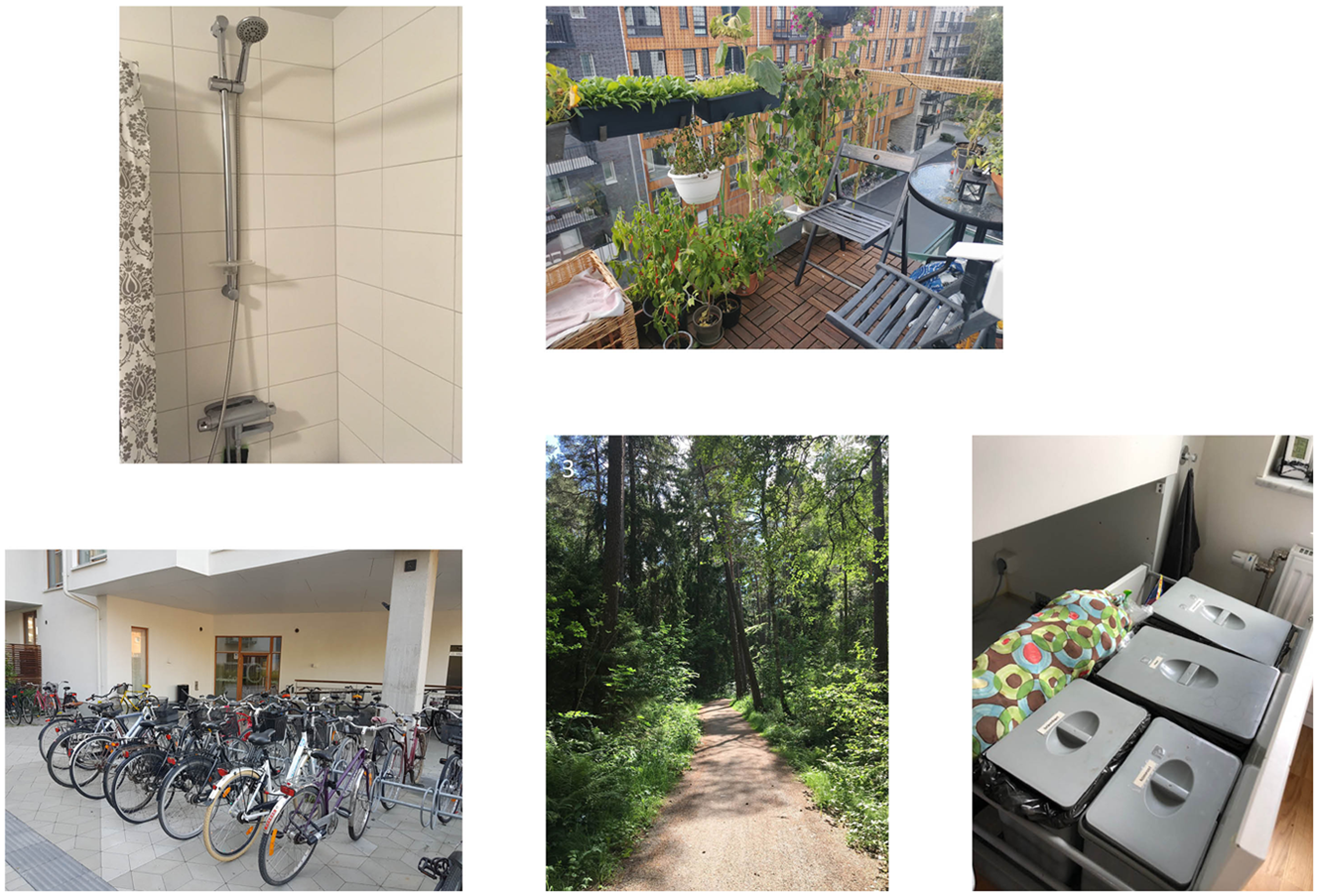
A selection of the participants’ photos portraying material elements part of everyday practices associated with sustainability.
When conducting the interviews, I was content that all participants took photos prior to the interviews and that looking at the photos together and talking about the pictures provided a comfortable interview setting (see for example Epstein et al., 2006) guided by – what I at first glance assumed were – the participants’ perspectives (see for example Wang, 2023). Gradually, when considering the photos as widows into meanings of sustainability, the rather similar motives in the photos started to bother me. I wondered why the participants seemed to reproduce largely similar perspectives of what sustainability in everyday life means to them, in that the everyday practices the photos linked to did not vary much from interview to interview. Photo-elicitation is commonly claimed to give participants voice (Allen, 2020; Gube, 2022; Richard and Lahman, 2015) and is seen to disrupt traditional researcher-participant power relations (Bates et al., 2017; Beilin, 2005; Rumpf, 2017) since the participants are seen to be given more agency in comparison to discussion-only interviews. But I was growing increasingly sceptical to whether it was really the participants’ perspectives that guided the setting.
In qualitative research where data is co-produced between participants and the researcher, the researcher always influences the research setting (Bjørnholt and Farstad, 2014; Ormston et al., 2014) – photo-elicitation is of course no exception (Gube, 2022; Yates, 2010). Already the way the task is framed; how and what kind of photos participants are asked to take, influences the data generation process (Drew and Guillemin, 2014; Holm, 2014). The photos need to be understood as situated in the research context and produced due to the participants’ engagement in this research. Despite the frequent mention of giving voice to participants in photo-elicitation projects, there is always a tension at play between the researcher and researched due to the data being co-produced (Drew and Guillemin, 2014; Yates, 2010). Certainly, the participants of this study had some agency over what photos they took and they could decide what to include and what to leave out. However, the photos do remain produced with a specific intent within a certain research context. Further, the verbal accounts generated during the interview setting were co-generated between the participants and me, the researcher.
According to Yates (2010), it may be difficult to know whether a photo is taken due to the participant wanting to convey a certain type of narrative, or whether they are simply trying to complete the task in what they think is an appropriate way. Participants may also reproduce certain norms and want to seem normal (Bates et al., 2017; Yates, 2010). In a study among young people, Bates et al. (2017) found that participants took very similar photos and the authors concluded it was due to how the participants wanted to be seen. Norms are certainly at play when it comes to what sustainability in everyday life means, and participants are likely to both consciously or unconsciously have reproduced certain ideas of what everyday practices link to sustainability. The practices brought forth by participants align with advice on what individuals can do in order to live more sustainably given by actors such as Uppsala municipality (Uppsala kommun, n.d.) and The Swedish Environmental Protection Agency (Naturvårdsverket, 2022). Meanwhile, advice on how to live sustainably can be found in newspapers, lifestyle magazines and on social media. Such advice tends to include cycling as a primary mode of transport, choosing locally produced food while avoiding meat, as well as avoiding excessive resource consumption in the home. As images are always part of broader narratives (Mannay, 2016), the images accompanying advice related to sustainability in everyday life are likely to have influenced ideas around what is seen to be associated with sustainability. There were indeed several bicycles portrayed in participants’ photos. Meanwhile, the common food-related advice connects to photos portraying allotments and balconies where edible vegetables were grown. Further, avoiding excessive resource consumption in the home aligns with the low-flowing showerheads and taps portrayed in participants’ photos.
What the photos portray has certainly been influenced by them being produced as part of a certain research project, and by ideas and images about ‘everyday sustainability’ circulating in society. However, other aspects than these two have arguably influenced the photos, their content and their framing. Although the similarities in the photos have bothered me, it has also made me reflect upon why they bother me and what photos I might have taken would I had been a participant in this study. One of the reasons I set out to study what comes to count as sustainability, is due to the concept's contested nature (Connelly, 2007; Frank, 2017; Rose and Cachelin, 2018). Since there could potentially be many different meanings associated with sustainability, I wanted to know what sustainabilities residents of Rosendal would bring forth. I used sustainabilities in the plural when I wrote about my research plans as a way to convey that the concept has many different meanings. What surprised me was how similar the photos were, and how the everyday practices discussed in relation to the pictures did not differ much in between the interviews. The most surprising photo was one portraying a plastic tub in a participant's bathroom. The person who took this photo told me how she would collect water while showering, which she then used for watering her edible plants that she cultivated at her balcony. The other photos portrayed what I have elsewhere (Bäckman, 2024) referred to as ‘usual suspects’, reproducing the idea that living sustainably commonly means cycling, recycling, growing vegetables, trying to avoid excessive resource consumption in the home, and spending time in nature. However, when I started to consider what I think is associated with sustainability in my own everyday life, similar practices and material elements as those brought forth by participants came to mind. I went back to my field notes from when I borrowed an apartment from a colleague and test-lived in Rosendal for approximately one week in August 2019. This week took place before conducting the interviews. During this week I was trying to figure out in what ways the built environment might play into my everyday practices if I would live in the area. I had considered how the big bathroom and spacious shower might encourage longer showers, how it was difficult to find the bicycle storage space in the building, how there was a lack of proper waste sorting facilities in the building and how cycling from the district to other parts of Uppsala was convenient. I had also noted how I was closer to an allotment garden located in Rosendal where I had a small-scale cultivation, as well as to green areas suitable for jogging in comparison to where my own apartment was located at that time. So the practices of showering, cycling, waste sorting, cultivating vegetables and spending time in nature also occurred in my own notes. Based on the interviews and my own field notes I started to regard these ‘usual suspects’ to reflect a common understanding of sustainability in everyday life.
Later on in the research process, I came across the notion of ecohabitus expressed by consumers with high cultural capital who are ethically and environmentally aware (Carfagna et al., 2014). They are described as ‘more female, whiter, richer, and much more educated than the general population’ (Carfagna et al., 2014: 163). With the exception from ‘more female’ the participants did display such characteristics, while being ‘whiter and more educated’ are also accurate descriptions when it comes to myself. Additionally, there was certainly an awareness involved among the people interviewed, however, it is unlikely their consumption levels or environmental impact are smaller than among the average population in Sweden. The same applies to me. Despite awareness and willingness to ‘live in a more sustainable way’, what someone living in an area similar to Rosendal can do in their everyday lives comes down to a set of practices – although important in their own right, these practices will most likely not transform nor disrupt current circumstances. Photo-elicitation has been described as a way of breaking the frame (Dam, 2022; Soaita and McKee, 2021; van Auken et al., 2010) where the researcher’s framing of the topic under study is challenged by the participants’ perspectives. Participant-generated photos have also been described as a way to ‘bridge the worlds of the researcher and the participants’ (Samuels, 2004; van Auken et al., 2010). In this research setting, the frame was broken mostly when it came to expectations. I thought there would be a plethora of perspectives on sustainability, instead, there seems to be a common understanding of what comes to count as sustainable in everyday life. This understanding is very similar to my own ideas and to those circulating in society. This realisation has made me critically reflect upon my own ‘frame’ and why the idea of everyday sustainability is so uniform. The perspectives of me and the participants were fairly similar due to us portraying the same type of eco-habitus characteristics. The photos thus bridge the perspectives of me and the participants through the realisation that this common understanding of sustainability in everyday life is due to us being part of a similar socioeconomic group. It is likely that other types of respondents with less interest in sustainability-related questions, or people living in another type of residential area might have displayed other types of practices. The photos are thus not only embedded in the research context, but in their social context (Rose, 2016) and can be seen as an expression of what a group of high cultural capital consumers displaying eco-habitus characteristics associate with sustainability in everyday life.
Elsewhere I have discussed how the way in which contemporary ‘sustainable’ living environments are organised makes it difficult for people to enact, let alone imagine sustainable everyday practices of another sort than the ‘usual suspects’ (Bäckman, 2024). As mentioned above, images included alongside text discussing sustainability contribute to shaping perceptions of what comes to count as sustainability in everyday life. In a similar vein that living environments shape perceptions of what comes to count as sustainability, so too are ideas and images related to sustainability likely to restrict participants from including photos pointing towards alternative and more transformative ideas of sustainability in everyday life. Additionally, photos produced by participants are also mirrored by conventions and norms related to both how and what to photograph (Alam et al., 2018; Kindon, 2016). The photos inevitably reflect the visual culture of which they form part – while the photos also contribute to this same visual culture (Rose, 2014). It is argued contemporary visual culture is convergent, and this is reflected in how images are circulated and used as communication devices (Rose, 2014). According to Rose (2014) photo-elicitation projects contribute to this convergence culture and tend to be concerned with a social that is visible rather than visual. This critique is central when it comes to my study. Although I have considered the visuality in reflecting upon how the photos are socially constructed (Rose, 2016), I have indeed been concerned with the visible – what material elements the participants have decided to portray.
One of the reasons for using the photo-elicitation method was to gain insight into the materialities of participants’ homes and living environments. Another type of participant-generated data could certainly have opened up for more abstract and imaginative ways of expressing what is associated with ‘sustainability in everyday life’. There are interesting examples of journalling, collage techniques and drawing (see for example Literat, 2013; Lupton and Watson, 2021; Mannay, 2010) where participants are less restricted to what the camera lens is capable of capturing. However, in this project, the visible was central, as I was interested in specific material elements as part of everyday practices that participants associate with sustainability. Although the photos were not considered in terms of their visual character such as lightning or framing, and despite the meanings of sustainability portrayed being influenced by several factors, in line with others who have applied photo-elicitation (Samuels, 2004; Soaita and McKee, 2021), I experienced the photos to link the abstract topic of sustainability with concrete mundane objects. This leads me to the third and last phase of this reflection; how the photos made me reconsider the role of material elements in everyday practices.
Windows into sustainable materialities: what role do the material elements play?
I return to looking at the photos spread out on the floor. Although they portray fairly similar things, where bikes, water taps, allotments, waste bins and forest paths recur, the material elements within the photos do not cease to intrigue me. These elements are portrayed due to them being part of certain everyday practices. Many of the material elements portrayed do not usually receive much attention. The photos include mundane objects that are often taken for granted. But all of the material elements do something. They have effects in the everyday lives of participants.
When I started out, one of my motives for using photo-elicitation was to gain insight into the material elements forming part of practices that participants associate with sustainability in everyday life. I was interested in what I have come to call the windows into sustainable materialities. I approached the material elements in the pictures as contributing to shaping practices in conjunction with meanings and competences (Shove et al., 2012). The materialities portrayed in the participant-generated photos are mostly ordinary objects that both enable some while restricting other practices. Despite my interest in their roles as part of practices, I thought I had made up my mind about not granting agency to material elements. Nonetheless, the photos kept bringing the materiality to the fore.
Materiality is a broad term used across different disciplines to denote that things and matter have effects (Haumann, 2020; Woodward, 2020). Despite being a contested term, it helps express how material elements are not only determined by the meanings given to them by humans. Woodward (2020:12) stresses that things are not passive, they do things as ‘entangled elements of everyday worlds’. The material elements in the photos, just like similar elements in my own everyday life started appearing differently to me the more attention I gave them. In a similar way as the seemingly mundane photos became artefacts with different properties and dimensions, I needed to find a way to relate to, so too were the things in the photos now starting to come alive. Seeing matter as simply one element within the practice did no longer seem sufficient. First, material elements play different roles within practices; Shove (2017) has described these as things in use, things being used up and things in the background. Second, the roles of material elements in practices are not fixed, they may change as an effect of the practices they are part of (Rinkinen et al., 2015; Rinkinen, 2019). Gradually, I started to accept the elusive character of material elements that at first glance had appeared static. Bennett (2010) illustrates matter as vibrant, in that it is alive and has agency. She explains that human and material agency are not the same. Still, acknowledging that humans are not the only ones with capacity to do things with effects is a way to go beyond the human/non-human binaries common in Western thinking. Humans are not alone in control of events taking place, as the agency is distributed across assemblages made up of different elements including humans and nonhumans (Bennett, 2010). Such a perspective relies on the presumption that the world is simultaneously both social and material (Woodward, 2020). The social and material are entangled and can be understood as sociomateriality, in that they are co-constitutive of one another (Gherardi, 2017). Understanding practices as sociomaterial (Gherardi, 2017; Orlikowski and Scott, 2008) has helped me come to terms with the role of materiality in practices. Additionally, Bennett's (2010) view of matter as vibrant has helped me maintain an understanding of materiality as something that, in Woodward's (2020) words provokes.
Methods are always part of shaping the phenomena one is studying (Coffey 2022; Law, 2004; 2009; Woodward, 2016). Law (2004, 2009) points to the difference between seeing methods as discovering and describing reality and of understanding methods as practices that contribute to shaping the world they describe. Understanding methods as enacting reality, means they are considered performative (Law, 2009). Similarly, St Pierre et al. (2016) argue that when moving away from human/non-human and mind/matter binaries and when agency is ascribed to matter, methods become central for what they do rather than for what they are or how to use them. In my case, starting out with a focus on material elements made me grapple with the role of materialities in everyday practices. Not only the method, and the researcher, but also the materialities part of the research process have an effect on how data is generated and interpreted (Fox and Alldred, 2015). What the method does is not completely controlled by the researcher (St Pierre et al., 2016) as the different actants and elements within the research process can be understood as forming part of a research assemblage (Fox and Alldred, 2015). Woodward's (2020) expression ‘photo of an object and photo as an object’ is suitable when describing how the photos (as objects) guided me to think about the objects in the photos (materialities). Material methods and mundane methods are terms applied to gather methods that are being developed with the intent of foregrounding and paying attention to materialities that are often taken for granted (Holmes and Hall, 2020; Woodward, 2020). One such method is the object interview, which goes beyond simply using objects as prompts to elicit stories (Woodward, 2020). There is a tendency among methods that engage with materialities to either focus on the objects and their trajectories or on the meanings humans attach to the objects in question (Holmes, 2020). At best, object interviews take the object, the person being interviewed as well as their entanglement into consideration (Holmes, 2020). Whereas interviews are always co-constructed among the researcher and the participant, within object interviews the objects contribute to generating the interview data (Holmes, 2020).
It was only after having conducted and analysed the interview data that I came across the work of Woodward (2020) and Holmes (2020) and realised that the windows into materialities – dimension of what interested me in the photos could be understood as object interviewing. Ideally, such interviews would include the object itself, but as I could not meet people in person due to pandemic restrictions, the photos of the material elements acted as substitutes. Relying on photos when bringing in everyday materialities and objects in the interview setting did not allow for the kind of tactile sensory experienced when holding and touching an object. However, Pink (2011) suggests photo-elicitation is to be understood as a multisensory method, as the photo is both taken and observed in contexts where participants and researchers are not solely relying on vision. Several senses are in use simultaneously, while due to the familiarity of the objects portrayed both participants and I, the researcher had previous experiences of using and interacting with the materialities portrayed. Another method considered prior to the interviews was the use of video diaries (see for example Bates, 2013). Such a method could have been more effective in bringing forth the embodied relationship between the participants and materialities, as well as how the everyday objects form part of assemblages. Despite certain limitations, the possibility to print the photos helped me understand them as objects with agency as part of the research assemblage, in a way that watching videos on a screen might not have allowed for. Further, I argue the photos gave participants agency over what to focus on during the interview as they could frame certain things and places in their homes and living environments. The photos thus helped frame and foreground the taken-for-granted materialities of everyday life, often left in the background.
Concluding discussion
In this article I have reflected upon a set of different ways in which photos may be understood when produced as part of a research study where a photo-elicitation method was used. In contrast to researchers who apply photo-elicitation with little attention to the photos (see for example Rose, 2014), I have focused on the photos and grappled with the different roles they may have. Additionally, I have discussed what the photos and their content have made me reconsider. I have shown how photos – which at first glance may seem mundane due to images being an integral part of everyday life – may reveal their complexity the more attention they are given. In building upon Yates (2010), I consider the participant-generated photos as windows into meanings of sustainability and as windows into sustainable materialities. Seeing photos as windows into meanings of sustainability relates to how I was interested in what everyday practices residents of Rosendal associate with sustainability. This was a way to understand what comes to count as sustainability in everyday life according to the research participants. When looking further into what everyday sustainability means according to participants, I was bothered by how similar the photos were. Practices such as cycling, recycling, growing vegetables, showering and spending time outdoors kept re-occurring. This made me critically reflect upon the different aspects that may have influenced what participants chose to include in their photos. Despite participant-generated photo-elicitation often being praised for bringing forth participants’ perspectives, my reflections take into account how these perspectives are bound up in a complex web of influences. These include ideas and images of sustainability circulating in society, conventions related to what and how to photograph, as well as both sociomaterial and socioeconomic factors influencing consumption taking place as part of everyday practices. Seeing the photos as windows into sustainable materialities relates to how I was interested in the material elements forming part of certain everyday practices – due to their role in shaping, sustaining and altering practices. Additionally, the photos themselves are artefacts and seen as photos of objects and photos as objects (Woodward, 2020), in that they portray material elements as part of practices and are material elements shaping the research practice. Photos are indeed unstable inscription devices (Law, 2004; Rose, 2014) due to the many different roles they may take as part of a qualitative research study, some of which I have considered in this paper. Despite their elusive character, photos have the capacity to frame certain objects and bring these to the fore, in a way that verbal-only interviews cannot. Of significance here is especially how the photos framing certain material elements made me re-consider the role of materials within everyday practices. The photos thus acted and had effects as part of the research practice, as they made me grapple with the role of the material elements portrayed over and over again. I started out having a hard time accepting that materiality can be understood to have agency, and decided to consider material elements as part of practices as static objects. Engaging with the participant-generated photos throughout this study has made me reconsider the role of material elements as vibrant (Bennett, 2010), in that they – much like the photos – provoke and have effects (Woodward, 2020). Photo-elicitation is certainly not the only method that has the capacity to bring forth material agency. While there are interesting methodological developments taking matter seriously, I argue there is a need to further this development due to the far-reaching consequences of human and material entanglements. Methods where the material agency of mundane objects is taken seriously can challenge the still dominating human-centred approaches to qualitative research. Engaging with methods where the material agency is brought to the fore requires considering the researcher as embedded in an assemblage of actants with effects beyond the researcher's full control.
Footnotes
Acknowledgements
I would like to thank the research participants who shared their perspectives on sustainability in everyday life, by taking photos and discussing them with me during interviews. I am grateful for the insights evoked by the photos, and the materialities portrayed within them. Additionally, I want to thank Katarina Pettersson and Lotten Westberg for their feedback on earlier versions of this paper, as well as the reviewers for their constructive comments.
Declaration of conflicting interests
The author declared no potential conflicts of interest with respect to the research, authorship, and/or publication of this article.
Funding
The author disclosed receipt of the following financial support for the research, authorship, and/or publication of this article: This work was supported by the Viable Cities (grant number: 2018-001888).

Author biography
Malin Bäckman is a postdoctoral researcher in Social and Public Policy at the University of Helsinki. Her PhD project focused on an urban district called Rosendal, located in Uppsala, Sweden. She approached the district as a sociomaterial assemblage and explored contested meanings of sustainability.