




Abstract
This article explores how multiple methodologies can create new spaces to reimagine anti-racism work and enhance engagement in anti-racist education. Through the combination of two methodologies, namely design-based research (DBR) and gamification, the paper describes the design formation of the game Quest for Equity, a collaborative and engaging speaking tool. The game improved player engagement and effective collaboration, while challenging performative and racist practices in higher education. This paper provides methodological contributions such as the unique use of facilitation observation and presents an interesting way to extract elements of multiple research approaches to suit contextual goals, reimagining new solutions to historical and contemporary problems.
Keywords
Introduction
As a UK researcher and practitioner in anti-racist education, I found myself frustrated with the lack of institutionally embedded engagement with long-term anti-racism learning. Clearly, the traditional training methods were not working, as anti-racist education labour continued to fall unevenly across racial lines (Ahmed, 2007), reflecting a need for higher education to reimagine new spaces of knowledge that pushed the boundaries of traditional learning strategies aimed at targeting these issues. The 2000 Race Relations Amendment Act and Equality Act 2010 both require higher education institutions in the UK to implement equality practices, but also risk promoting performative interventions within education to tick boxes required by policy to enhance a university’s reputation, rather than tackle structural disadvantage (Bhopal and Pitkin, 2020). Examples of performative anti-racism education can be seen through training initiatives such as unconscious bias training (Tate and Page, 2018), and single-day online anti-racism training (Chang et al., 2019). The continued perpetuation of performative practices in UK higher education risk harming racialised people within it. This is because they create a facade of addressing structural racism but avoid the long-term work that comes with being an anti-racist institution.
The institutional approach to anti-racism work often assumes individuals from racialised minority backgrounds possess expertise in matters of ‘race’, inadvertently neglecting the involvement of white staff and students who play a significant role in establishing anti-racist environments (Singh and Kwhali, 2015). It is also crucial to examine where the workload responsibility lies. In her examination of the work undertaken by equality, diversity, and inclusion (EDI) teams in universities, Ahmed (2007) discovered ‘the responsibility for writing the document was uneasily distributed along racial lines’ (p.593). In order to address this problem, there was a need to embed anti-racism into the pre-constructed structure and focus on how to engage staff and students who were not currently engaged in anti-racism work to continue to promote actionable change.
This article explores how multiple methodologies can create new spaces to reimagine anti-racism work and enhance engagement in anti-racist education. Through the combination of two methodologies, namely, design-based research (DBR) and gamification, the paper reflects on the design formation of the game Quest for Equity, a collaborative speaking tool designed to promote effective collaboration and engagement in the context of anti-racism education in UK universities. This work methodologically contributes to research attempting to extract elements of many research approaches to suit contextual goals and challenge performative and racist practices in higher education.
DBR, also known as ‘design-research’ or ‘development research’ (Conceiçã et al., 2004; Oha and Reeves, 2010), involves the designing and implementation of new forms of learning and suggesting educational interventions. DBR typically employs observation methods to actively observe how interventions are designed and relies on an iterative process to constantly improve the research design. The methodology inherently values collaborative efforts and is epistemologically focused on learning through mistakes (Anderson and Shattuck, 2012), encouraging researchers to approach design creation not through perfectionism, but iteration.
On the other hand, gamification does not have a universal definition but is defined in the context of this research as the use of these engaging game-based mechanics to promote attitude and behavioural change. It is used as methodology as games provide a good epistemological basis for academic thinking, promoting engagement as knowledge production. As entertainment is at its core, games engage millions in online games and fictional universes, providing clear goals and actionable next steps that reward engagement (McGonigal, 2011). Combined, this multiple methodological approach centres the iterative processes of DBR and utilises the engagement of gamification to create the Quest for Equity.
Quest for Equity is a gamified tool, created by the author to facilitate effective collaboration and engagement in the context of anti-racism education. It combines three main elements: Dungeons & Dragons (D&D), the anti-racism learning tool the Student Journey Game (SJG), and educational learning theories to reimagine the way UK higher education approaches anti-racism education. D&D is a popular tabletop role-playing game that embarks players on adventures in a fantasy world created by imagination and collaborative quests, facilitated by a Dungeon Master (DM) who guides the players through the narrative. The SJG is a boardgame designed to engage UK university staff in developing interventions to address everyday racial discrimination in higher education. It uses real student stories of campus discrimination to encourage effective and appropriate intervention. Moreover, the educational learning theories of dialogic narratives, the Six Thinking Hats, and positive social interdependence were selected to extract appropriate elements from D&D and the SJG to create Quest for Equity: the gamified speaking tool to facilitate engagement and collaboration in anti-racism education.
The research incorporates a range of methods. The methods include semi-structured interviews and facilitation observation. Facilitator observation is defined as a transitional role wherein the researcher operates as both the architect and facilitator of the research environment, simultaneously actively participating and observing the impact on participant engagement. In the paper, I assert that facilitation observation is a different methodological contribution to participant and nonparticipant research due to its creative and passive role. I aim to delve into the experiences of five participants representing diverse demographic backgrounds involved in the development and implementation of Quest for Equity to showcase its fluid iterative nature.
New creative approaches are essential for creating meaningful collaborative change within universities, and require us to move beyond traditional methods. There must be a different approach to anti-racism learning that focuses not only on the content, but on how that content is engaging staff and students in the long-term. To do this, I will firstly discuss the methodologies selected and the epistemological approaches used to form Quest for Equity. Second, I will provide a summary of the theoretical conceptualisation and creation of the game, describing the chosen elements to form the speaking tool. Third, I will outline the methods chosen, participant information, and researcher positionality. Fourth I briefly show how the participants experienced the gameplay and discuss why multiple methodologies were essential to the research process. Alongside this, I will also provide design principles for future educators and practitioners to take forward in future iterations of Quest for Equity. Finally, I conclude by asserting how multiple methodologies can reimagine approaches to learning.
Multiple methodologies
Methodologies in research are in constant evolution as researchers continue to push the boundaries of traditional methods for new modes of thinking (Taber, 2010). The use of multiple methodologies asserts that research should guide methodological choices, and not vice versa. This work attempts to extract the epistemological groundings of DBR based in iterative experimental learning through mistakes and combine it with the engaging nature of gamification to create a non-static and captive approach to anti-racism education. I assert the arguments of Bernal (2024) who argues that the use of multiple methodologies generates a new space of knowledge to understand unjust research and embarks on a new process of knowledge that challenges the old.
Design-based research
DBR as a research methodology primarily used in the field of education, combining aspects of research and design to develop innovative solutions to complex educational problems, effectively connecting theory and practice through evidence-based improvements. First introduced in the early 2000s, a significant contribution to the development of DBR has been attributed to the concept of ‘design experiments’ by Brown (1992), which focused on the creation and testing of new learning interventions in the classroom to advance learning theories.
In a review of DBR's progress over the past decade, Anderson and Shattuck (2012) outline how DBR typically utilises mixed method approaches using a variety of techniques. This can include the application of different methods, selecting them as needed, highlighting the flexibility and creativity in the methodology. Reeves (2005) states DBR can encourage new ways of thinking about problem-solving in educational contexts. He recommended four stages to the approach: the presenting of progress reports of the design research initiatives, maintaining numbered reports, making accessible versions of their reports, and summarising the methods, results, and design principals (p.50). Design principals are a key element of DBR, providing a set of suggestions by the researcher conducting the DBR for future iterations of the intervention design, including both what was successful and unsuccessful. The cyclical nature of DBR relies on the epistemological approach that knowledge is produced ‘through mistakes’, and the perfect design cannot be made on the first iteration (Anderson and Shattuck, 2012). Taking this epistemological approach to learning, higher education institutions can learn from this process of collaboration and cyclical improvement, as anti-racism education must change with societal shifts overtime.
Gamification
Despite originating in the corporate sector, gamification has been utilised as a form of methodology by scholars in the field of education. Gamification is the process of incorporating game elements in non-game contexts (Deterding et al., 2011) although it lacks a universal definition. Others have defined it as its ability to promote behaviour change, problem-solving skills, aesthetically pleasing mechanics, and entertainment (Fitz-Walter, 2015; Kapp, 2012; Zichermann and Cunningham, 2011). Despite the lack of stability of the term, gamification can benefit many contexts and environments, and its need for personalisation demands a fluid definition. For example, depending on its application, it has been described as bringing a gameful experience to the user to achieve engagement and improved performance, or educationally providing a process of learning through play where the primary goal is to learn (Squire, 2008; Toda et al., 2019).
This paper defines gamification as the use of game-based mechanics to promote attitude and behavioural change. Gamification is used as a methodology, as it epistemologically centres engagement and creativity as knowledge, responding to individual needs and promotes active learning and problem solving. Much like DBR, it provides a new way of thinking about knowledge production that challenges ‘traditional’ approaches.
Together, this paper aims to retrieve the iterative process and structural elements of DBR, and the engaging and collaborative nature of gamification to form a unique methodology that tackles the issues of performativity and lack of institutional engagement in anti-racism work.
Theoretical framework
This research employs educational learning theories to theoretically engender engagement and dialogic conversation. The need to partake in effective collaboration is an essential element of the university experience yet is often underused as a potential learning practice and not directly taught (Johnson et al., 2007). To engage effective collaboration, the work aims to facilitate dialogic discussions. Dialogic narratives are when two or more perspectives are held in tension, creating a ‘dialogic gap’ where learning can occur (Wegerif, 2011). The purpose of this gap is not to persuade others to think in the same way but to take a more empathetic stance and reflect on individual views through a new perspective, which is also important in anti-racism education. Group thinking can be enhanced by this process through simple questions and encouraging collective intelligence through the equal distribution of domination and contribution within group work settings (Fujita et al., 2019; Woolley et al., 2010), rather than expecting effective collaboration without intervention.
Practices, such as anti-racism training and teaching, often expect this effective dialogic collaboration to take place, without accounting for the unknown skillset of the group members to participate equally. Based on the literature on teaching thinking skills, the theory of the Six Thinking Hats was utilised to give each participant a different way of thinking and theoretically create equal participation (De Bono, 1985). The hats are a decision-making framework that provides a structured approach to making decisions including multiple perspectives. When wearing the ‘White Hat’, the user collects information that is known or needed, the ‘Yellow Hat’ provides an optimistic approach to a problem, the ‘Red Hat’ signifies emotions and feelings towards a problem, the ‘Black Hat’ engages with potential difficulties and barriers, the ‘Green Hat’ focuses on more creative approaches to the problem, and the ‘Blue Hat’ manages the thinking processes.
Often staff and students in anti-racism education have different reasons for participating. To facilitate effective collaboration, social interdependence was used to promote group engagement towards a shared goal. Positive social interdependence exists when the success of individual goals is met by the actions of others (Johnson et al., 2007), encouraging individuals to work as a collective as their goals are shared.
Conceptualisation: quest for equity creation
To promote effective engagement and collaboration in anti-racism education, I combined some enjoyable elements from the tabletop roleplaying game D&D and collaborative educational elements from the anti-racism education board game the SJG. The conceptualisation is further detailed visually in Figure 1.
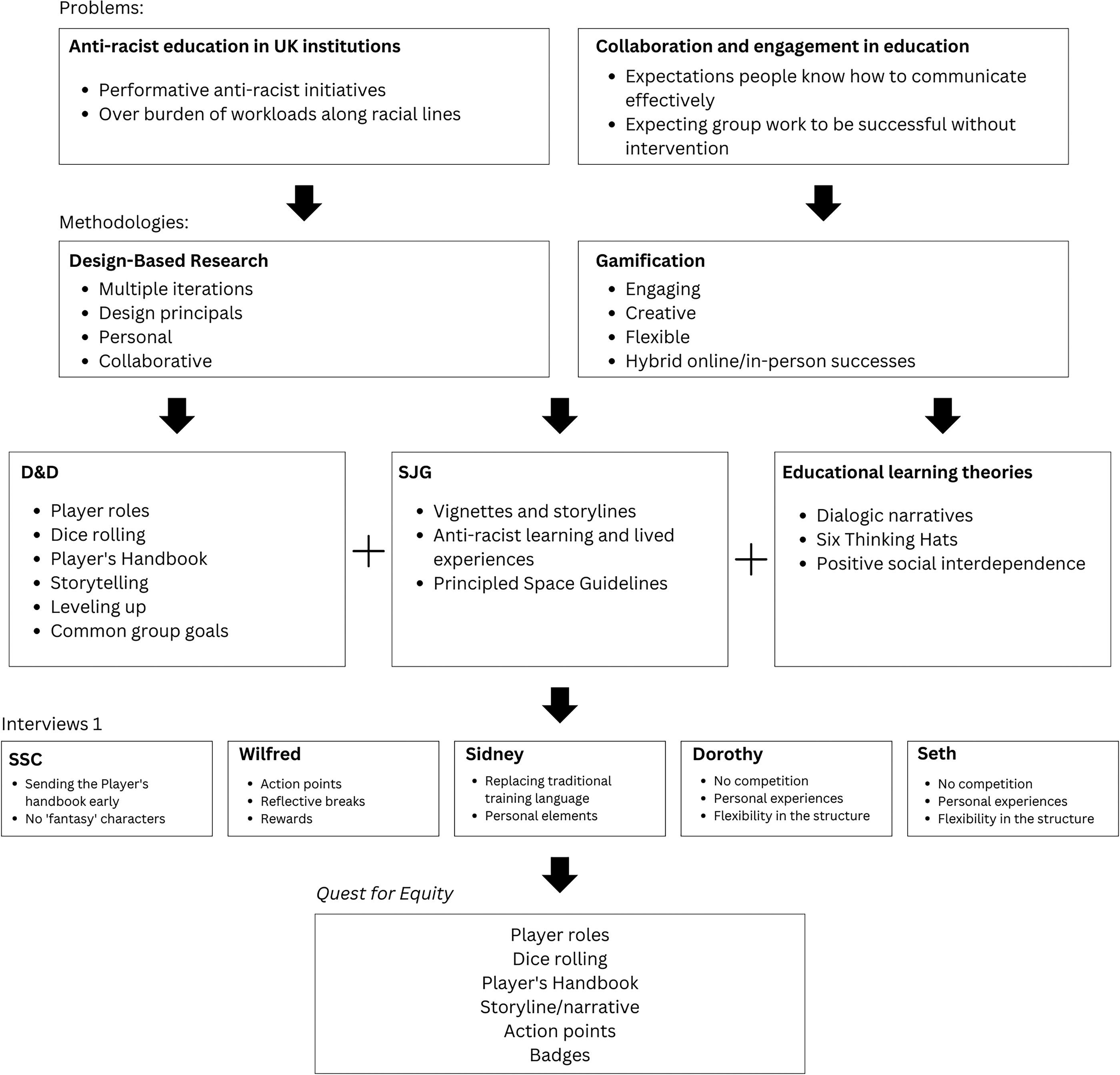
A visual representation of the conceptualisation of Quest for Equity.
Dungeons and Dragons
D&D is a popular tabletop role-playing game created in the 1970s that has been reintegrated into popular culture through television shows such as The Big Bang Theory and Stranger Things (Garcia, 2020). It is a cooperative storytelling game where the narrative is led by the DM, who leads a team of players with different roles and characters to complete a collective quest (Silverman, 2023). The game mainly uses imagination to world build, but it can also use in-person or online character sheets, dice, tokens, character miniatures, and more.
D&D centres collaboration, effective dialogue creation, and imagination, making it the ideal gamification foundation for Quest for Equity, but it was not without challenge. Scholarly discourse has engaged with the contention that the original construct of D&D inadvertently upholds and propagates racist stereotypes (Wizards of the Coast, 2020). Garcia (2020) underscores the profound influence of tabletop role-playing games, particularly D&D, in shaping broader societal perceptions concerning race, class, and power across both the gaming sphere and popular culture, a phenomenon spanning over four decades, which also makes it a potential space to challenge them. Despite portrayals in mainstream media which often depicts D&D enthusiasts as predominantly white male adolescents, it is important to recognise that the players’ community is diverse and multifaceted. However, Garcia contends that D&D's historical backdrop has been entrenched in a Eurocentric and misogynistic framework emblematic of medieval fantasy world construction. Reflecting on my dual role as a creator and a researcher, I openly acknowledge the racist historical context of the game and attempt to redirect its structure towards critically engaging with its past, and therefore do not call the game D&D, but merely extract features from its formation and centre anti-racism education at the new game’s core. By implementing DBR and gamification, it centres the creation of the game in mistakes, learning from them, and creating actionable anti-racist futures. From the conceptual framework of DBR, D&D becomes a space of iterative learning that can be improved upon for educational and socially just outcomes.
Student journey game
To centre discussions around ‘race’ and racism in the game, I implemented elements from the SJG. The SJG was created by Building the Anti-Racist Classroom (BARC, 2019), developed to create interventions that address racial discrimination in higher education. The game was designed to be an interactive way to centre the issues and voices of students of colour. The game commissioned artist Maria D’Amico to create a visual map to showcase the ‘zones of conflict’, each identified by students of colour. In each zone, players discuss and develop actions that individuals can enact within their institutions that centre people of colour in a meaningful way. The game was designed to understand the dynamics of racism in higher education, inspire collaboration, and relearn for anti-racist practice. It was intended to be played in person, over the course of one day, including elements such as the game-board, legend (with instructions), and game tokens. Quest for Equity differs in its use of collaboration elements and online facilitation but was inspired to centre anti-racist learning from the SJG. The game's story/narrative was taken from the SJG, with D&D inspired gamification elements to promote collaboration based on educational learning theory.
BARC (2019) also created the ‘principled space guidelines’ designed to address the creation of spaces we wish to develop and embed race and identity into the gameplay. They outline principles such as believing people's lived experiences and honouring vulnerability, being aware of privileges, maintaining confidentiality outside of the space, and recognition of the power structures that marginalise people of colour. This was used in Quest for Equity and always ensures the discussion centres on race or gives the facilitator something to refer to if participants decentre anti-racism from the conversation and goals.
Methods
Facilitation observation and semi-structured interviews were used in the creation and implementation of Quest for Equity. I assert that facilitation observation is different to participatory or non-participant research, as they both produce and do not produce the space; simultaneously it is an actor in the space while also passively observing. Participatory research works on principles of partnership, breaking down barriers between the researcher and the researched (Maiter et al., 2013). Participatory research distinguishes from action research as the researcher deliberately intervenes in the research context to achieve outcomes, rather than acting as a passive observer in non-participant research (Nandhakumar and Jones, 2002). Online participatory research is also not applicable as it actively observes the online space where the facilitator might be integrated in textual spaces or non-participate in online observations (Williams, 2007).
Issues that arise from participatory research is the risk of racial asymmetry, as it has been argued that the presence of a facilitator of colour can make participants of colour feel more comfortable in participatory spaces about anti-racism (Deliovsky, 2017; Gunaratnam, 2003; Roulston, 2019). However, they can also risk facilitators perpetuating their own experiences onto the experiences of the participants. Facilitation observation attempts to address issues around power relationships and facilitator positionality by encouraging facilitators of colour to be visible in session organisation without influencing their own arguments and racialised experiences onto the group.
This study consisted of ten semi-structured interviews, two for each participant before and after they played Quest for Equity. Semi-structured interviews were chosen to allow participants an element of autonomy over the direction of the conversation while remaining within the boundaries of the research context (Adams, 2015). The information gathered from the first interviews consisted of their previous anti-racism education experiences, their previous gamification experiences, signifiers of their engagement, any learning requirements or requests, and suggestions for gamification elements. The second interviews focused on their experiences of Quest for Equity and the success of the gamification elements, suggestions as to how they could be improved, and how engaged and collaborative themselves and the group appeared.
Data collection ran over the course of two months, and participant recruitment consisted of emailing staff and students involved in EDI work at the institution. Participants were required to hold previous experiences in EDI training to offer comparisons between their opinions on EDI-related education and Quest for Equity. This was due to time limitations to run multiple facilitation observation groups. Five participants were recruited due to these time constraints but also to ensure the gameplay group was not too large. The demographics of the group consisted of four students and one staff member. The student participants chose the pseudonyms Wilfred (racialised minority male), Sidney (white female), SSC (racialised minority female) and Seth (white male), and the staff participant chose Dorothy (white female). Each participant took part in two interviews, one before the gameplay and one after, and participated in facilitator observation as a group online. The interviews lasted approximately 60 min, and the gameplay was approximately 150 min long. All methods took place on the online platform Microsoft Teams, recorded, and fully transcribed and thematically analysed using NVIVO. This study investigated the following research questions:
How will adding gamification elements to higher education anti-racism education develop engagement and collaboration? How does using multiple methodologies affect the design and implementation of the game?
Researcher positionality
Research positionalities shape research directions, agendas, and construction due to my inherent subjective involvement in the world, therefore, making it important to outline within the research context (Rose, 1993). I define myself as a Chinese mxed-race woman from the UK. At the time of conducting the research I was considered a master's student, and at the time of writing this paper I am a PhD researcher and Research Fellow. I also describe myself as a scholar-activist, attempting to insert actionable changes into research outcomes. I am often racialised in different ways depending on the spaces I am in; for example, sometimes people racialise me as Chinese, sometimes white, and sometimes just ‘exotic’ or ‘different’. This will impact how participants interact with my racial identity. Finally, I am an avid D&D player with a love for the game, so risk holding a subjective leaning towards Quest for Equity being an enjoyable gamified experience.
Game elements
Each game element was informed and shaped by the participants’ first interviews. Pre-interviews, the game elements were created inspired by D&D and academic literature, then presented to the participants for their feedback. After the first interview, the elements were altered to suit their learning needs and used in the game facilitation observation. The second interview shaped the elements on how they appear in the design principles common in DBR.
The Player's Handbook: Inspired by D&D beginner's handbook, the Player's Handbook was created to guide players through their experience, including visuals and rules. It offered the principal space guidelines, instructions of the game play, an image of a map designed by the facilitator to visualise the journey based on BARC (2019), background information and contacts related to anti-racism at the participant’s institution, and a list of the badges they could earn along the way. This was sent two days before the game play.
The storyline/narrative: The storyline/narrative provided the main gamification element, connecting all the gamification elements together and engaged the participants in a shared journey. The participants were guided through three ‘areas of conflict’: student homelife, university, extra-curricular. Each area required participants to complete a challenge at the end, with the aim of collecting as much information in each area as possible. The narrative ended with a final challenge. The more information the group gathers, the better.
Roles: The roles were inspired by the Six Thinking Hats (De Bono, 1985) to solve the problem as a group and encourage different processes of thinking and renamed with D&D inspired names. The ‘White Hat or ‘the control’ collects information that is already known; the ‘Red Hat’ or ‘the scout’ describes feelings or emotions surrounding the task; the ‘Black Hat’ or ‘the observer’ presents risk assessments and spots points of difficulty to consider; the ‘Yellow Hat’ or ‘the support’ provides optimistic views on the group’s plans and positive values; the ‘Green Hat’ or ‘the healer’ gives the group new possibilities and alternatives they have not yet explored or considered; finally, due to the limited number of platers and the role of the ‘Blue Hat’ sharing the role of the facilitator as manager of thinking processes, it was removed. The gamified renaming of the roles made them more engaging than colours, but also removed the problematic connotations of the ‘Black Hat’ and its association with negative outcomes.
Dice rolling: The dice rolling was inspired by the dice mechanisms in D&D that determine player action outcomes. It used a 20-sided die that determined the success of a group action to a challenge. The participants receive a ‘positive’ response to an action when 10 or below was rolled, and a ‘difficult’ response when 11 or above was rolled. This creates an arena where participants can practice their responses to real-life scenarios and learn from previous mistakes, actions, and choices. This was to highlight how complex anti-racism action can be but can always be and should be reflected on and improved.
Action points: Based on D&D ‘experience points’, action points were rewarded to the players every time they provided an action that solved a problem. For the cost of three action points, the players could choose to roll the dice a second time and experience a different outcome. This was to provide the players with autonomy over their own educational choices and allow them to learn through mistakes.
Badges: The badges were awarded to players at the end of each section of the map, and certain areas of the map could not be accessed until certain badges were obtained. The badges were chosen to implement an extrinsic motivator and designed by the facilitator.
Gameplay
The game began with reading through the principled space guidelines created by BARC (2019). After this, I began Quest for Equity with a personal anecdote about my journey to becoming actively anti-racist post-2020 following the Black Lives Matter movement and gave a few examples of how I shifted to being passively anti-racist to being actively anti-racist. The purpose was to emphasise that the game promoted action, not just ideas. The use of a personal anecdote was an attempt to disrupt power imbalances as a facilitator, decentring myself as an ‘expert’ and highlighting my processes of learning and unlearning.
The rules were then explained to the participants; with reference to the Player's Handbook, the game followed a visual map I drew as shown in Figure 2, as participants were narrated through each level. Each level was based on vignettes created by SJG and became the storyline/narrative element.
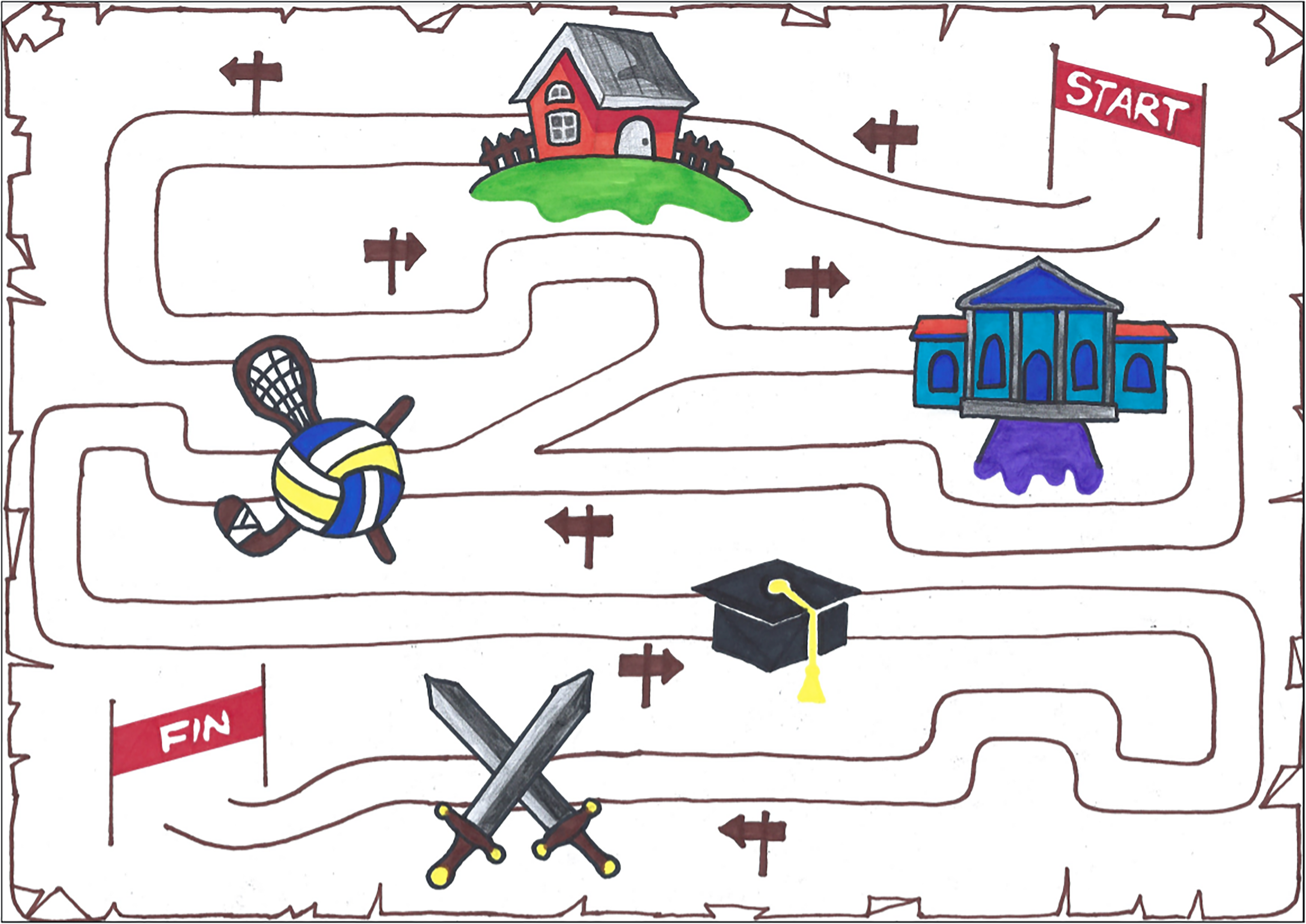
A drawing of the journey map used throughout the game of Quest for Equity.
The participants began with an ‘introduction’ where they indicate potential risks they recognise before the game began and created collective goals for the end of the session they hope to meet, encouraging interdependence and effective collaboration and communication (Johnson et al., 2007). For example, SSC, Sidney, and Seth all outlined how their previous EDI experiences lacked honest conversations about ‘race’ and racism, and all hope to honestly reflect on their own prejudices while also leaving with actionable goals after the session. They collectively agreed that their goals of the session were to understand lived experience, to better engage with how to support people, to conduct action not just thoughts, and to criticise university systems. This was collated on a shared Google Document to facilitate online collaboration. I then began explaining the ‘action points’, ‘dice rolling’, and the ‘roles’, and chose the roles for the participants, which alternated throughout the game.
Within each ‘zone of conflict’, there are a few vignettes to choose one from, aimed at giving participants a choice over which area they would like to discuss based on their goals. As one example, in our game, participants chose in the section ‘University’ ‘Extra Curricula’, and I as the facilitator read out the section information detailing experiences of racialised students within student extra curriculum spaces. An example of the section can be seen below:
The group also received a vignette based on racialised minority students who shared lived experiences in university societies:
The group then attempted to create actions that might make the institution more actively anti-racist. Once the action was collectively chosen, I rolled the dice to see the outcome and narrated it back to the participants. Depending on the number of action points collected, they had a choice whether to roll again to receive a new scenario in the same contexts or just reflectively discuss the outcome and what they would do differently next time. This happened two more times in different ‘zones of conflict’ before the final challenge. Challenges looked similar to the example below:
The game ends with a final challenge, where they all see the list of collective actions they have created together based on the fictional events and decide what actions they can take forward in real life and create a plan. The participants are encouraged to refer to the Player's Handbook which includes a list of all the personalised pre-existing anti-racist networks at that institution for reference.
Overall, their final plan, formed in an online Google Document, to take forward into anti-racist action was:
Learn and value the lived experiences of racialised minorities and their intersectional identities, without exploiting them Involve those in higher institutional positions in regular spaces of discussion to listen to the needs of the student and staff body. The burden of the work must be on them to publicise and communicate anti-racist education, events, and highlight the work of students and staff of colour working towards equity Consider the creation of inclusive spaces and how they are not just immediately created, such as having non-alcoholic drinks at networking events that were well considered as part of the planning process, such as mocktails and specialised non-alcoholic drinks Hold the university accountable towards the experiences of racialised students Make sure senior management recognises the issues and understands the importance of anti-racist education and action.
Once the game ended, I created an optional space after the game where I remained online, and we could discuss any topics the participants wanted, so it did not end abruptly.
Experience of Quest for Equity gameplay
The participants experienced an enhancement of engagement and collaboration in comparison to previous non-gamified EDI training experiences. Their engagement was specifically increased by the gamified elements, and their collaboration was fostered through dialogic narratives.
Participants articulated their positive experience with the gamified elements within Quest for Equity. Overall, they praised the game's ability to engage them for long periods of time, something previous EDI training had not achieved. Seth and Wilfred described not feeling ‘mentally fatigued’ after the discussion and felt they could continue discussions further if time permitted:
Individual gamified elements such as the Player's Handbook provided the participants with a tool to prepare for sessions prior to attending them in a creative way they related to in different ways, therefore increasing engagement with the game:
When gamified elements were unsuccessful, the participants offered iterative suggestions to improve them, in line with the iterative processes of DBR. For example, Seth recognised that the dice-rolling elements were not ‘as successful as they could have been’ as it seemed to just ‘mimic flipping a coin’. However, the participants offered alternative improvements to the dice rolling that could improve engagement such as adding more options to the dice rolling outcomes. The participants engagement with the gamification elements, and increased EDI engagement overall reflected their increased engaged experience with Quest for Equity over traditional EDI training. The impact of the game elements on the learner's experience did appear to depend on their previous exposure to gaming previously. For example, Wilfred was an avid gamer who understood and enjoyed the rewards-based system of badges, whereas Dorothy, a non-gamer, found it more difficult to engage with elements like badges and action points:
Collaboration was also facilitated through the increase of dialogic narratives in the game. For example, SSC taught Seth about a new lived experience as a ‘second-generation immigrant’ to challenge his previous arguments about those with her identity:
Through their effective collaboration, the participants were able to create actionable changes to their practices from the game discussions. For example, Dorothy learnt from collaborating with Sidney that not all events need to only have alcoholic and boring soft drink options, and should include more inclusive options that were not alcohol-centric for students who did not drink:
After the gameplay, Dorothy reflected on this conversation and said she had taken the advice forward when planning her student events and ensured non-alcoholic drinks got the same amount of funding and attention as the alcoholic beverages available. The game appeared to impactfully foster engagement towards EDI training and facilitate effective collaborative dialogic narratives, formed from the use of multiple, intentionally chosen methodologies.
Discussion
The use of multiple methodologies, namely DBR and gamification, proved essential to the success of Quest for Equity, as participants felt engaged in the epistemological iterative basis of DBR and gamification of the D&D elements. The ability of participants to learn through their own and the game mistakes reflected the core element of DBR that was extracted in order to encourage this form of learning (Anderson and Shattuck, 2012). The main goal of gamification is to learn, but the additional engaging elements such as the Player's Handbook and dice-rolling made the educational process enjoyable (Squire, 2008). It was also important to discuss with participants what they felt could have been improved in the gameplay, as different contextual situations, i.e., a different group of people might benefit from some elements more than others. It was essential to maintain an iterative process throughout and outline elements that did not work but could be improved upon. Anti-racism learning should be an iterative, educational, and enjoyable experience staff and students remember.
The perpetuation of dialogic narratives was fostered through the combined nature of the epistemological mistakes-based learning of DBR and game elements. The participants were collectively able to engage with each other's personal experiences as well as the gamified vignettes. The ability of participants to challenge ‘dialogic gaps’ (Wegerif, 2011) through collaboration and learn from one another's lived experiences reflected how the use of multiple methodologies generated new spaces of knowledge (Bernal, 2024), and imagine new higher educational practices and anti-racist futures.
The main goal of Quest for Equity was to promote engagement towards anti-racism education and decrease avoidance of performative anti-racist action that risks perpetuating inequalities. Using multiple methodologies, the participants could practice skills such as active listening, critical thinking, and inclusive intolerance; all elements argued to be essential in anti-racism educational learning processes (Ahmed, 2007). As a scholar-activist who engages intimately with anti-racist work, this form of education not only can improve skills for further higher education but can also integrate more people into anti-racist action to take the burden off those who are conducting the work. For example, the continued dissemination of one-day training modules can continue low engagement with the material or even create negative consequences (Chang et al., 2019); therefore, new approaches through multiple methodological combinations are essential to form new ways of thinking.
Finally, the importance of the role of the facilitator was highlighted through the use of multiple methodologies, as the facilitator had to understand the game from multiple perspectives. The facilitator must have the ability to engender effective collaboration between each individual participant to teach them how to think as a group, as we cannot assume participants will immediately have this skill (Johnson et al., 2007). They also must navigate complex ‘dialogic gaps’ yet ensure participants are equally contributing as a team, as imbalances can result in a decrease in engagement (Fujita et al., 2019; Wegerif, 2011). By utilising multiple methodologies, the facilitator has freedom to allow storylines of Quest for Equity to go in different directions without being left without a structure to follow.
Design principles
In line with the practice of DBR, I have produced several design principles as part of the iterative design of Quest for Equity for future practitioners and educators to learn from:
The Player's Handbook was the most successful element overall, as it provided immersive visuals and pre-discussion material. I would advise creating a physical copy of the handbook for players to interact with, to imitate a more immersive experience and potentially enhance engagement. I recommend adding ‘antidotes’ to the handbook to help students and staff understand the actions they can take. For reference, see Jones and Okun's (2001) paper on white supremacy. The storyline/narrative was the most essential part of the gamified experience and should not be overlooked. It needs to be clear, organised and bring together each individual gamification element in a race equity-based narrative. Ensure there is plenty of time to develop and immerse players into the story, as a lack of time can make it feel rushed. I would avoid sessions that only run once, as the model was created to be used after race equity training as a mediated discussion tool, with the ability to create long storylines that can last for multiple sessions. Whilst the narrative is vital, the ‘zones of conflict’ and the challenge scenarios can be easily changed to suit the personalised needs of individual institutions. Ensure you take time to read through and understand the Principled Space Guidelines (BARC, 2019) and always centre race in discussions. Choose your facilitator carefully. This role is a very subjective one, and the facilitator should possess qualities such as: empathy, awareness of social structures that create oppressive narratives, self-reflective, and empowering. I recommend funding students or staff advocates or scholars at your institution to do this work as paid facilitators. Sharing lived experiences of racism and structural discrimination can be traumatic for staff and students to share, which should be considered if the researcher creating the game wishes to conduct their own interviews to gain an insight into the lived experience of racialised students. If these interviews are conducted, to ensure the researcher is not exploiting students for information for their own gain, these students must be compensated. This can be monetary compensation or compensation towards a well-valued institutional system such as module credits. The badges and other reward systems should only be kept if the university offers to provide real external rewards such as monetary rewards or qualifications for their time and effort. For other gamification contexts, this may not be as necessary, but in the context of race equity training, it might need to be implemented to increase engagement, as scholars such as Bhopal and Henderson (2022) argue that race equality requires significant investment of resources at an institutional level. Player roles should be used if group membership has differing levels of race equity knowledge to equally contribute. The group I observed had backgrounds in race equity work and training, therefore did not require assistance when it came to effective collaboration. Early in the narrative, the roles became obsolete and could be a hindrance to collaboration if individuals feel boxed into certain frames of thinking. I recommend running a focus group to understand the group member dynamics in advance and see if they need assistance with collaboration with each other.
Conclusion
The purpose of this article was to explore how the use of multiple methodologies could be utilised to create new spaces to reimagine anti-racism work and increase engagement in anti-racist education. This was to tackle the issues higher educational institutions are facing around performative EDI work and EDI labour falling unevenly across racial lines. The game attempted to address these issues by epistemologically ‘gamifying’ approaches to anti-racism. For example, the issue of performative anti-racism education was transformed into a challenge to overcome in the game, and a goal of the game became to change the culture of the institution in their approach to anti-racism. It also engaged with uneven workloads by making a goal of the game to increase engagement with anti-racism education. By creating gamified ‘goals’ to address through the DBR intervention created, the game was able to focus on these two key issues in higher education and offer a potential future direction to tackle them. The approach also encourages researchers to not shy away from mistakes, but research through them.
An important reflection from the game design and facilitation observation experience was the importance of the role of the facilitator, much like the importance of the anti-racism educator. Similarly, to D&D, the role of the DM is the most significant element to the success of the gameplay, as they lead the players through their imaginary quest, world building in individual minds and responding to spontaneous and unknown action. The facilitator of Quest for Equity must have these skills, which are all present from anti-racism educators. They set up principled spaces and maintain those spaces, they handle sensitive discussions and turn them into learning opportunities, they can turn failures into dialogic gaps. If we are to reimagine anti-racism education through creativity, the facilitator is a significant element. I encourage future research to explore how the speaking tool works for different groups of people in higher education, such as those who have never experienced EDI training before, as well as experimenting with different research contexts such as engagement with gender safety or climate change.
The research faced limitations primarily due to the context of the COVID-19 pandemic and time constraints. The pandemic necessitated a shift to online research, disrupting the initial plans for in-person interviews and facilitation observation. This shift potentially hindered the research in terms of building deeper connections with participants, dedicating more active time to the game, and fostering a more collaborative community among participants. To address this challenge, Microsoft Teams, a platform familiar to all participants, was employed. Additionally, an introductory interview was conducted before the gameplay to establish some rapport with the facilitator. Online research did offer certain advantages, allowing participants to comfortably turn off cameras and microphones during challenging conversations or to take breaks as needed. Time constraints also posed an issue, as the allotted two and a half hours for gameplay fell short of the roughly 4 h required for more effective discussions and a more thorough exploration of explanations and ‘zones of conflict’. This limitation was addressed by omitting one of the ‘zones of conflict’ and implementing time limits for discussions. Despite the limitations that will always occur in this form of research, the flexible creation of Quest for Equity made it easier to make effective decisions.
If higher education in the UK wants to change the way it approaches anti-racism education in the future, educators and practitioners are encouraged to think creatively and imagine new methodologies that do not currently exist. As practitioners, we must not only engage with anti-racist materials but also interrogate how we are teaching this essential knowledge in higher educational spaces, continuously investigating how staff and students learn most effectively. By enhancing collaboration and engagement through gamified elements, researchers, educators, and practitioners not only can develop effective teaching content, but can also engage with how the content will be received and maintained. By using multiple methodologies, it pushes the boundaries of what is possible within a single research approach to allow us to see new possible futures to promote actionable change.
Footnotes
Acknowledgement
This paper is dedicated to my late advocacy partner and dear friend, Manan. Without his passion for anti-racism alongside his Law degree, and inspiring narratives of his own lived experiences, none of this work would have been possible. Thank you for inspiring myself, and many others who engage with this work.
Declaration of conflicting interests
The author declared no potential conflicts of interest with respect to the research, authorship, and/or publication of this article.
Funding
The author received no financial support for the research, authorship, and/or publication of this article.

Author biography
Rhianna Garrett is a doctoral researcher and Research Fellow at Lough borough University and Nottingham Trent University. Her work specialises in the interactions between careers, intersectional identities and spatial locations. Previously, her work has centred around engaging, equitable, and innovative pedagogies that aim to immerse learners in unique ways. Now, she focuses on global mixed-race identities to promote the movement towards an inclusive society. This paper was formed from her previous advocacy work entitled Active Together Exeter, provost-funded project designed to promote a zero-tolerance policy towards racism in sports clubs and societies.