




Abstract
This paper reflects on the use of objects in qualitative interview methods. We consider the use of objects in “single” research events and in longitudinal designs. This leads us to consider how using objects in interviews situates in relation to time. Emphasizing the materiality of objects as well as how objects help to materialize events, experiences, and accounts, we explore what objects do and how we can practically work with objects, especially in qualitative longitudinal research. Objects in interviews do not simply afford representations or elicitations of participant stories, but become dynamic actors that enable interviews to speak materially. Using vignettes from a longitudinal study investigating experiences of COVID-19 in time, we hone our attention towards the temporal affordances of object methods. We conclude with a list of practical suggestions for using objects in qualitative longitudinal research.
Introduction
There is increasing interest in the use of objects in qualitative research (Holmes, 2020; Woodward, 2020). In this paper, we map the affordances of object-oriented qualitative research, including in the context of longitudinal designs. We focus on how objects not only elicit narrative-storytelling but enable interviews to speak materially—in a moment and over time. We therefore attend to the material properties and capacities of objects (Bagnoli, 2009; Coffey, 2021; Sheridan et al., 2020). This shifts the focus of the object in research away from what objects are presumed to “represent” or “elicit,” and instead to what objects “materialize.” In this understanding, we emphasize the agentic capacities of objects as actors which materialize—rather than merely help to represent—events, experiences, and accounts.
While much qualitative research treats objects as inert mediators that represent the “pre-existing” world, we emphasize the co-constitutive relations between materials and practices, through which the world “becomes” and develops meaning (Barad, 2007; Coole and Frost, 2010). In such an approach, materials are made-with social worlds (Ingold, 2012; Miller, 1998), and attending to the material requires approaches that go beyond representation alone (Woodward, 2016; Barad, 2003).
We further contribute to the literature on object-oriented methods (and qualitative research more broadly) by presenting a methodological account of how to attend to what objects do when used in qualitative longitudinal research. Drawing from a longitudinal study investigating experiences of COVID-19, we illustrate how object methods materialize events, practices, bodies, and effects in relation with time (Mol, 2002; Clever and Ruberg, 2014). We thus explore what objects do in interviews—as part of “single” interview events and as part of a process of research that is enacted through time. We conclude with practical suggestions for how to do longitudinal object-oriented research.
What is object-oriented research?
Object-oriented research encompasses a vast range of materials, practices, and analytical techniques. Researchers can invite participants to bring an object to an interview (Schwarz, 2023; Thorpe et al., 2024; Willig, 2017; Sheridan and Chamberlain, 2011) or can introduce an object that might “elicit” a response from participants in the form of memories, emotions, and sensorial knowledges. Visual studies scholars have a long history of using elicitation objects such as photographs in ethnographic research (Harper, 2002), and in recent decades, sensory methods have expanded to include stimuli that engage participants via touch, taste, smell, and sound (Pink, 2009; Vokes, 2007). Researchers can also attend to objects in-place by visiting a space that is familiar to the participant (e.g. the home) (Hurdley, 2006; Owen, 2022; Miller, 2008), or by traveling to locations where researcher and participant can “discover” objects together, such as through a walking tour (De Leon and Cohen, 2005).
Object-oriented research can also be conducted via participatory and arts methods, where participants create (or transform or destroy) the research object. This might be done ahead of an interview. For example, diary solicitation and photovoice methods require participants to document experiences through making objects over time (Hurworth et al., 2005; Meth, 2003; Bernays et al., 2014). Objects can also be created in the moment of the research event, such as with body-mapping and cartography practices (Dennis, 2020; Watson et al., 2023; Fullagar, 2022) or arts practice workshops (Hickey-Moody and Harrison, 2018). Finally, object-oriented interviews can be undertaken through mixed-method approaches, combining many methods in a single research event or several events over time (Ravn, 2022; Fleetwood-Smith et al., 2022); alternatively, researchers can engage with different participants and methods over time, but in relation with a shared set of objects (Woodward, 2016).
What do objects do?
Objects in qualitative research function not only as foci or tools of study but as material actors that become-with research methods and events (Michael, 2012). This section maps the material affordances of object-oriented interviews—what objects can do, not must nor necessarily will do. We include examples from the literature to illustrate these practices and effects.
Objects enable more-than-verbal expression
Objects materialize stories. Objects enrich talk through sensorial relations (colors, smells, textures, etc.) but also move storytelling beyond talk. In a study of the life histories of old jeans, Woodward (2016) notes that participants could often recall specific “clothing disasters” or unpleasant sensations associated with their jeans, but lacked the vocabulary or memory to describe everyday experiences. Bringing jeans into the interview enabled participants and researchers to see and feel the details of the jeans and elicited richer participant accounts. This capacity for “moving beyond recall and verbal expression” is valuable when researching stories that are complex or difficult for participants to self-narrate (e.g. interviewing people with dementia) (Fleetwood-Smith et al., 2022: 266). In these cases, objects allow researchers to attend to the material and embodied ways that people come to know the world by materializing past stories, experiences, and feelings in the present.
Objects constitute spatiotemporal anchors
Objects materialize space and time by situating the interview in relation with other places, remembered histories, and imagined futures (Adams and Thompson, 2016). Objects are not bound to a single space or time, nor do they exist in singular life worlds and histories; they embody multiple places and events (Nordstrom, 2013). In a study of domestic mantlepiece displays, Hurdley (2006) describes a participant account of a gifted bronze statue, in which the materials of the object (its heaviness, visual appearance, and composition) became a way of knowing the participant's social identity and personal relationships. Hurdley argues that objects become “the material(s) with which people build stories of absent presences” and facilitate a narrativizing of the present (2006: 721). Objects thus constitute spatiotemporal “anchors” that connect other places and events to the here and now of the interview (Ravn, 2022; Owen, 2022).
Objects materialize practices
Objects materialize “what people do with things” (Woodward, 2016, 2020). This extends beyond the “intended” use of an object to how its material properties afford practices and are remade with practices (Holmes, 2020; Humphries and Smith, 2014; Marshall, 2020). Objects can also afford different things with different people and over time; Chamberlain and Lyons (2016) write that a trophy can celebrate achievement, memorialize the past, be used as a drinking vessel, and so on. Objects transform through practices and these transformations produce new material effects. In their exploration of an old copier machine, Humphries and Smith (2014) argue that the scratches, dents, and other signs of wear and tear generate a visual and tactile account of its history. The location and proximity of objects-in-place also produce knowledge about practices; for example, object-oriented interviews conducted via video conferencing software during the COVID-19 pandemic have drawn attention to “spontaneous” and “close-at-hand” objects in domestic spaces (Pottinger et al., 2022; Schwarz, 2023). The positions of these objects produce insights about the domestic practices of participants and how these practices become-with the material environment.
Objects validate stories (and storytellers)
Objects perform as “proof” of participant narratives. In a study of women who had experienced weight loss, Sheridan and Chamberlain (2011) describe “fat clothes” (clothes that had once fit the participant but are now too big) as documenting and evidencing participants’ bodily transformations. Objects thus make stories “real” and validate the participant's authority to speak about a topic. This is not to suggest that participant accounts require “proof,” nor does it take for granted the idea that objects can evidence “reality.” Rather, the evidencing capacities of objects are affective; objects can “bear witness” to a participant's experiences and generate talk by authorizing the participant as a legitimate storyteller (Sheridan and Chamberlain, 2011: 319). Furthermore, the choice of object and how it is made-as-evidence offer an account of what claims require (or are assumed capable of) material support.
Objects redirect focus
Objects bring ideas into clearer focus but can also constitute (productive) distractions. Objects “shift the frame and flow of an interview” (Sheridan and Chamberlain, 2011: 324), producing new temporal rhythms and taking the interview in unexpected directions (Woodward, 2020; Adams and Thompson, 2016). Objects also provide an external point of reference for the participant to focus on. The practice of using objects in this way is adapted from therapy and psychoanalysis contexts, but is useful in interview discussion about emotionally sensitive topics, allowing participants to focus on something outside the interviewer and subject matter (Mannay, 2020).
Objects unsettle narratives
Objects challenge accounts and disrupt the retelling of “known” stories. For example, Sheridan and Chamberlain describe participants being “confronted” with childhood photos that did not support their recollected experiences (2011). Objects that appear to contradict participant accounts “can forces changes and revisions in the narrative” (Chamberlain and Lyons, 2016: 173), eliciting new ways of relating with the story being told. These contradictions can also bring the object itself into question—objects are “capable of telling the truth but also of lying” (Sheridan and Chamberlain, 2011: 321). The object interview therefore invites the participant to actively negotiate the authoritative power of the object.
Objects invite participant agency
Objects allow participants to prepare ahead of the interview and make new meanings with the research. Inviting participants to choose an object redistributes control over how the interview method unfolds in practice. Willig (2017) argues that the selection of objects—their size, shape, and quantity—materially shapes the doing of the interview, as the interviewer and participant must accommodate and engage with the material presence and properties of the object. Participants might also decline to bring an object, forget their object, or choose only to describe it. The object invitation therefore enables greater participant agency over the content and method of interviews, including through creating new opportunities for resistance and refusal.
Objects make method
Thus far, we have presented an overview of the affordances of doing research with objects. Research practices and events are made in and by objects, from audio recorders and cameras, to computers, stationery, office furniture, and so on. Descriptions of such materials are usually confined to the methods sections of research papers or omitted entirely, but they are undeniably entangled in the making of research (MacLure, 2013b; 2013a; Ellingson and Sotirin, 2019). For example, Nordstrom (2015) argues that recorders in interviews are boundary-making devices that enact the temporal limits of the interview event while performatively evidencing the doing of the research (becoming “proof” that the interview took place). Research materials can also “fail” to facilitate the research, such as when technologies break or produce unexpected results (Michael, 2004). Research objects are thus constituted not only in the methods of the interview event but become-with all of the research assemblage.
What does qualitative longitudinal research do?
As the previous section highlights, the temporal relations of object-oriented methods extend far beyond the moment of the interview. Objects materialize pasts and futures, enable researchers to trace participant experiences in and over time, and offer different ways for participants and researchers to relate to the temporality of the interview event. However, in most literature on object interviews these methods enact the interview as a “single” research event, which re-orients the material effects of the object in relation with a demarcated moment of data generation. While some research has explored these effects through projects consisting of many research events (e.g. via multiple rounds of interviews) (Ravn, 2022; Nordstrom, 2013; Owen, 2022; Romano et al., 2012; Sheridan and Chamberlain, 2011), the affordances of enacting research methods through time is a relatively minor focus in these studies.
Qualitative longitudinal research encompasses many different methods and approaches, but it can be described as research “conducted through time [that] also engages with the temporal dimensions of experience” (Neale, 2016: 1). In this way, longitudinal methods not only take place over time or attend to temporality; time conspicuously shapes longitudinal research design, and the temporal unfolding of the method becomes a way of knowing and making the research. For example, designing qualitative longitudinal research requires researchers to consider the temporal orientation of the method (is research conducted prospectively, retrospectively, or as a hybrid?) and the duration and frequency of research “events” (how long does each event take and how often do they occur?) (Neale, 2016; Thomson and McLeod, 2015). Each of these elements in the research assemblage produces different analytical, praxiographic, and affective affordances.
While longitudinal approaches offer a different way of following the unfolding of stories with time, they do not produce a more “objective” account of participant experiences and histories. The constitutive effects of longitudinal research practices are enacted processually, enabling the researcher to attend to the ongoing materialization of research through a more dynamic range of temporal frames (Mauthner, 2015). For example, qualitative documenting practices (e.g. diary writing) produce an object made across many temporal events, thus enabling researchers to track participant experiences (Bagnoli, 2009; Bernays et al., 2014; Meth, 2003; Clark, 2011). However, while a representationalist approach presupposes the existence of these experiences as “out there” and capable of being measured in “real time,” a new materialist framework calls for researchers to attend to the materialization of such documents as relational and processual practices with performative effects (Mauthner, 2015; Stanley et al., 2013).
Affordances of objects in qualitative longitudinal research
In longitudinal research methods, objects materialize not only in time, but over and through time. We contend that the use of objects in longitudinal research requires analytical approaches that attend to what both objects and longitudinal designs afford research. This section thus extends on the affordances we have mapped thus far to consider how the invitation to identify and bring an object to an interview as part of a longitudinal study is enacted in, and troubles the temporal boundaries of, the interview event. We present vignettes from a qualitative longitudinal study to illustrate how we can attend to these affordances and their relationally constituted effects.
We draw on data from a prospective observational cohort study investigating the long-term experiences of people diagnosed with SARS-CoV-2 in early 2020 (Darley et al., 2021). As part of this study, we conducted recurring in-depth interviews with 39 participants at three intervals between September 2020 and July 2022. Given COVID-19 restrictions, interviews were conducted via telephone or video call and audio recorded and transcribed verbatim. Participants were invited to bring an object of their choosing to Interview 2 that related with their experiences between Interviews 1 and 2. The temporal gaze of our interviews was thus both prospective and retrospective, in that we followed participant journeys in time, while also using methods that enabled us to “look back” at the time that had passed (Neale, 2016). Participants were asked to show or describe their object during Interview 2 and to email a photograph or digital copy of the object to the research team after the interview.
We offer vignettes from our data to illustrate how the object invitation worked in practice and how we can think with the material and temporal affordances of these methods. Participants are introduced with pseudonyms with age (at Interview 2) in brackets.
Locating objects and practices in time
Objects enable, and are remade with, practices (Holmes, 2020; Humphries and Smith, 2014; Marshall, 2020) and the material properties of the objects make these practices knowable in qualitative research (Woodward, 2016, 2020). Using objects in longitudinal research situates the materials of objects in relation with multiple research events over time, offering additional ways of coming to know these practices.
Simon (62) was hospitalized in intensive care during his acute COVID-19 illness and had been undergoing rehabilitation since. By the time of Interview 2 (March 2021), Simon was still receiving regular care through the rehab clinic. He described walking as a significant part of this rehabilitation, with the length of his walks constituting a marker of progress in his recovery. He identified his walking stick as one of his interview objects. Simon: I have got a walking stick. […] It's still the original that I received [at rehab] because I got it brand new, but now it's getting worn […] and that's one of my best friends. Interviewer: […] And you take that walking stick on your daily walks? Simon: […] Yeah, and now I’ve got a plumber's plier in the kitchen that helps me opening new milk bottles. Interviewer: So tell me about that, how does it work? Simon: Well, you know when you try to open a milk bottle, my hand is not up to it because I don’t have enough strength, my hand doesn’t close fully. […] You grab hold of the lid and then turn and twist it open. But I need it only for opening new containers because you need more strength. […] Also, I have a splint. Interviewer: A splint? Simon: Yeah, that is made for me, because I have this trigger finger, and that trigger finger was given to me from my friend, the walking stick. Interviewer: [laughs] So you got the splint to deal with the trigger finger from the walking stick, it's all entangled. Simon: Yeah, yeah, that's right. They made connections.
Within an hour of the interview ending, Simon sent us an email with the subject “My new friends.” The email contained no text but included four photographs depicting his walking stick, adjustable plumber's pliers, splint, and a photo with all three objects placed next to each other. The objects were laid out on a table and photographed from above, with the photo metadata showing that photographs were taken a few minutes before the email was sent.
Simon's engagement with the object method, his choice of objects, and the emailed photographs all contribute to our understanding of his experience of recovery. Simon initially declined the object invitation in Interview 1 because he did not want to “preoccupy” himself by thinking about it between interviews. However, when the object invitation was extended again in Interview 2, he immediately identified three objects that had held significance in his experiences of COVID-19 illness and recovery. The photo metadata additionally indicates that these objects were readily accessible, as they were able to be located, photographed, and emailed shortly after he completed the interview. The apparent proximity of Simon's “new friends”’ helps us better understand how Simon's life has changed (or not changed) since the previous interview, and how he has adapted through domestic practices. Thus, the sharing of objects in a longitudinal study can relationally materialize changes in participants’ practices over time.
Documenting time between interviews
When extending the object invitation to participants, we suggested a diary as an example object. Diary solicitation is a well-established method for documenting participant experiences over time and constitutes a longitudinal research method in itself, offering in-the-moment insights into participant experiences (as opposed to a more distant and retrospective retelling through traditional interviewing methods) (Meth, 2003). Furthermore, “temporal leaps” in what might otherwise be a sequential account (e.g. absent entries in a “daily” diary) become part of the data (198).
We use the example of the diary here to show how attending to diary solicitation as an object method that is made through time stretches, connects, and multiplies the methods of data generation. Rather than diaries constituting representations of participant experiences over time, diaries operate as lively actors that materialize as an ongoing making of the research object through many moments in time—not only the moments of writing and the moments being written about, but moments of reading, annotating, reinterpreting, archiving, missed writing, and so on (Stanley et al., 2013). Enacting this method between multiple interview events produces additional moments of making and allows us to attend to the making of the diary through different temporal orientations. Using objects such as diaries to document the time between interviews in a longitudinal study thus transforms the events of data generation from a linear sequence of discrete interviews into many research events that unfold and multiply between and within the interviews.
In interview 2, Wendy (50) told us that she started her diary because she knew she would be having conversations about her experiences as part of the study. She read aloud from the diary during the interview, frequently pausing to add additional commentary and clarifications in the moment. Wendy: This is January 1st, so for New Year's I was home alone and it was crappy weather. I was still coughing, it was keeping me up at night—Oh, it was hacking! I actually … the cough was really bad, I was hacking and there were small bits of phlegm that was red brown orange color. […] January 8th, I was still coughing. My temperature was high for a few minutes—So my temperature is typically low, below normal generally, […] it was like 98.9, so that was higher for me, it's usually 97. […] January 12th, early morning phlegm, orange brown, went to the hub, I had—Oh, so I went to a co-working space and I was coughing and I had to suppress this coughing fit. Like, there was like guilt in, ‘Oh my god. I’m coughing.’ I think I had a mask on but that was something. I didn’t want other people to think I had it.
Elizabeth (56) also selected a diary-like object, but described herself as someone who had always kept a diary to track what is happening in her life and discussed this in her first interview (September 2020). The interviewer referenced this conversation in Interview 2 (May 2021): Elizabeth: I have my list of symptoms that I have tracked, which is just a little bit of paper and I add new things to it every time something new happens. […] It started on 16/02/21 because I was going through my diary trying to collate my symptoms. Interviewer: I remember your diary, are you still continuing on with that? Elizabeth: I had just used one, it is differently setup, that's my chaotic diary. […] And then after COVID it just gets really messy when I tried [to] write all my symptoms in like different color pens just to keep track. I don’t know whether it helps, but I can’t read half of it now anyway, like you know, it's all really blurred.
Elizabeth emailed us a photo of her symptom-tracking diary object after Interview 2. The page is lined, crumpled around the edges, and appears to be torn from a notebook. The top of the page is titled “Review of Symptoms” and dated “16/02/21.” The page is filled with annotations and observations written in red, orange, black, and pink ink, such as “Fatigue — 9–10 h sleep + naps,” or “Eyes often don’t work esp in morning.” The material object offers an account of symptoms as Elizabeth has described them, but the worn paper, scribbled lines, and different colored inks tell their own story—one in which Elizabeth has made meaning in her body through the documenting process. In this way, the page becomes a lively archive that materializes the documenting practices Elizabeth has engaged in over time.
We can glean an account of Elizabeth's adaptations through an analysis of the page alone. Yet attending to the process of diary-making as a longitudinal practice that is made in relation with the interview events and the material properties of Elizabeth's (multiple) diary objects transforms the research method from a simple and linear “tracking” of practices to a dynamic research assemblage that constitutes a particular enactment of adaptation (Mauthner, 2015): one in which the material objects and practices that once enabled Elizabeth to make sense of her everyday experiences have become insufficient in the context of her illness.
Materializing rhythms in and across interviews
Objects direct the focus of interviews and enable the interviewer to shape the pace and tone of discussion (Mannay, 2020; Sheridan and Chamberlain, 2011). The familiarity of the object enables the interviewer to bring the interview back to a common idea, becoming an affective bridge between conversations taking place several months or years apart. Bringing objects in and out of discussion also becomes a way of enacting time differently in relation with past experiences. The interviewer might re-introduce the object partway through the interview to “reset” talk, slow down the interview, create pauses, or bring a different energy to discussion. The familiarity of the re-introduced object can also strategically create a sense of comfort, or indeed discomfort, or constitute a point of reference that reshapes how a story might be told. The object thus reconfigures the space of the interview in relation with time by materializing past research experiences and affects in the present.
During Interview 2 (April 2021), Gordon (58) described his mother's old recipes as an object that had been meaningful in his COVID-19 journey. Gordon: I had all her recipe files and I did a book probably 5 years ago, sort of translated it, so I looked through the book during COVID and the errors, the mistakes, there's probably 3000 mistakes. You know there is a recipe there for strawberry ice cream, there is no strawberries in it. […] So just cleaning all that up actually, testing it as it is. Do they work? Do they not work? Interviewer: So was that a bit of an activity last year, to go through it? Gordon: Well, it's been a bit of comfort too and I guess the underlying thing about the COVID was for me personally, probably looking for a sense of stability and security which has been lost. […] It was the grounding. So, when I sit and talk to you and start to analyze it all, that's what my fear is, the uncertainty. What I have been looking for is that sort of grounding consistency and stability.
At the end of Interview 2, Gordon emailed us photos of his work-in-progress recipe book. These photos depict handwritten recipe files spread out across a dining room table and typed versions with red ink correcting measurements, adding ingredients, and presenting additional comments on sticky notes (e.g. “NEED TO CHECK FROSTING?”). Together, the narrated and photographed accounts of the recipe book materialize the slow and methodical process of testing recipes over time in the home, entangling these practices with a period of uncertainty, recovery, and isolation.
Gordon's third interview took place 10 months later (February 2022) with the same interviewer as Interview 2. Thirty-eight minutes into the interview, the interviewer asked Gordon for an update on the recipe book. Gordon: [laughs] I was doing them when you rang. I was testing another recipe out. Well, I think I’m just, you know, as you can see, it's never far out of my… Interviewer: Yeah. Oh, that's looking… yes, it's got the full binding. What are all the little sticky notes marking? Gordon: They’re pages that have got to be amended. […] I’ve almost got it ready for… I’ll say almost ready, but it’ll be ready for this Christmas, put it this way. It has to be ready for Christmas. Interviewer: What's the plan for it once it's ready? Gordon: Oh, just give it to friends and family that have it and do a replacement with all the corrections and all the mis-corrections. […] If you’re looking for a positive opposed to the 99 negatives, [COVID has] given me time to do this. Gordon: Do you think as a country, we’re in a better spot now, a clearer definition now than we were 2 years ago? Overall, you know, every region, every political party. Has anything really changed?
Temporal anchors and recurring actors
Objects act as anchorage points in interviews, grounding the interview in a particular event or place (Hurdley, 2006; Nordstrom, 2013). When used in longitudinal methods, the object can recur or be reintroduced across multiple rounds of interviews. While constituting a point of commonality across interviews, the recurring object is also a lively actor across the study and can never be reintroduced in the same way or with the same effects.
Changes in the object between interviews produce additional insights. As seen with Gordon's recipe book, shifts in how a participant ascribes meaning to an object across interviews can be instructive, but so can the location of the object (e.g. if an object is displayed prominently in one interview but is packed away in a drawer by the following interview) or the appearance of the object itself (e.g. if it shows signs of regular use or modifications). Tracing a common object across interviews can therefore become a way of investigating broader shifts in the participant's life over time.
Peter (74) is the son of World War 2 survivors and migrated to Australia as a child. He described himself as an active member of his community, including through involvement in a model ship building club. In his first interview (September 2020), Peter described being taken to hospital with COVID-19 and spending 2 weeks in a coma, followed by a period in intensive care on a ventilator. While recounting this time in intensive care, he referred to a model ship he had been working on: Peter: I would think to myself, ‘I have got this model ship that I promised to have finished by September and if I die, who is going to finish it?’ You know, not even the family, stupid things like that would come flooding through my brain. Peter: For the last 8 years or 7 years, I was building a model ship which I had promised to deliver to a survivor group, because it was a ship on which some German prisoners were transported from the UK to Australia. […] I was actually working on this model when I went down with COVID. It had probably about another 10–15 h of work left in it and I remember lying in my hospital bed thinking to myself, ‘Now who on earth is going to finish the job if I don't survive?’ And then I have now finished the job. This is an image of a ship that [Peter] built. He was building this on the day the ambulance came to take him into hospital, back in April last year. He has been building this ship for 8 years. […] A turning point in [Peter's] own story was his concern, while still in hospital, and on his ‘death bed’ as he put it, as to was who might finish the building of this ship, and he knew he just had to do it, had to get it done. This ship connects with his story of family survival […] and his recovering through COVID-19. […] All these objects connect/materialise [Peter's] story which orientates as a narrative of survival.
Peter's ship became a lively actor in the (multiple and entangled) histories he recounted, and facilitated a telling of stories that might not otherwise have been told during the interview. As an object in a longitudinal study, the recurring object tells us something about the importance of the object and the meaning it has enabled Peter to co-create through his storytelling. The object also worked as an anchorage point across interviews 6 months apart, which helped continue a (still-developing) story. There is thus the potential for objects to be strategically re-introduced in longitudinal studies with different performative effects.
Anticipatory objects
Both Gordon's recipe book and Peter's model ships show some of the ways in which objects can facilitate future narratives as well as historical accounts. By anchoring interviews in (and in relation with) time, objects materialize futures “in-the-making” and reveal the ways in which these futures might be unstable or uncertain (Ravn, 2022; Hurdley, 2006). In a longitudinal study, the object materializes an anticipated future that can be tracked over time and in relation to unexpected events.
Craig (38) is a musician in a popular band. Before the pandemic, live performances were an important part of his music career and income. At the beginning of Interview 2 (April 2021), Craig described his excitement at the prospect of returning to live performances: Craig: [I’m] feeling a bit more hopeful now that it seems like things are going to start opening and music festivals are going to go ahead again. Craig: One song that we wrote was about 2 months ago or so, it sort of felt like, ‘Oh this is a song that everyone is going to dance to when things open up again and we can’t wait to play this at music festivals and tour it.’ Interviewer: […] Well as part of our little collection of images and objects and notes and things that people have written, if there's something that you can send us, you know, to keep in our little archive… Craig: It's a demo of the song, like, it's not the actual recording. Interviewer: Yeah, yeah of course. Craig: But, it would be very important that it didn’t get out anywhere else. I might just check with my band members to see if it's okay to send that through.
The meaning of Craig's song as an object was explicitly connected with its anticipated function. Craig emailed the song to us with a note to “feel free to play it for people around the office.” This situates the song (in mp3 demo form) in a specific moment in time. The emailed song was ready-enough to be listened to and enjoyed by the research team and colleagues, but its release awaited an anticipated future in which the song could be danced to. The stressed confidentiality of the song additionally becomes another way of understanding its anticipated future as a commercial object—a song that would one day be remade, released, and played live when the music industry reopened.
Craig's third interview did not take place until almost a year later (March 2022). This followed lengthy lockdowns, which delayed Craig's ability to play music in the way he described looking forward to in Interview 2. In Interview 3, Craig explained the challenges of producing music during this time: Craig: There's something about being in the same room together, because emotion and energy doesn't quite translate through the screen. […] We wrote and released one song in the pandemic […] and then we sort of held off on the release until it looked like things were opening up and we released it so we could do some shows. Craig: When Omicron hit and our gig sort of had to get pushed back, I was like, ‘Alright, that's it, I'm getting a job. Not playing this game anymore. Like, I've got a wife, I've got a family now, like, I cannot be waiting around for the world to open up again and have uncertainty surrounding income.’ So I was like, ‘I'm getting a job.’ So now I have a full-time job. Interviewer: Yeah, what's the job? Craig: […] I’m a label manager at [company name] working on all their kids releases, yeah, all children's music, which is actually a dream job. […] Festivals are happening now, so on the weekends, we play, like, music festivals and do some shows from the tour and then through the week, I'm working at the [new job]. Interview: The first time that you played again after that lockdown, what was that like? Craig: It was so good, it was very exciting, yeah, the room was rammed full of like sweaty dancing people.
Lost objects and lost meanings
Objects afford ways of knowing the time between interviews differently, including through their absence. Objects that go missing, fail to show, or deviate from the “planned” interview method can be explored in relation with what they (fail to) materialize.
Several participants in our study declined to bring an object to the Interview 2. Some participants, such as Aaron (39), told us that they had tried to think of something to bring: Aaron: I had a COVID file and all the stuff from the doctor and appointments and all that kind of thing. […] At the start it was important to me because I was taking charge of it, like taking it seriously, taking charge so when people ask you, like when you have an illness, ‘When was your last check?’ ‘Oh, I had a … my viral load on this date was this …,’ you know, I had a bit of power because I felt powerless at the start because there was no information. […] So I tried to become more powerful by keeping that knowledge base together and then in the last 6 months I am like, ‘I don’t want anything to do with that.’ Interviewer: So, have you actually thrown it out? Aaron: It's in a file thing but you know back of the cupboard, it's no longer accessible. Interviewer: […] Was there a particular day that you decided not to engage with that anymore or was it more of a slow decision? Aaron: I think it was like halfway through when I started feeling kind of more positive days than negative days. By then, yeah, I felt like kind of burning it, just let that go.
Other participants declined to participate in the activity because of what they presumed identifying an object would signify. For example: Gary (62): I won’t say [COVID] didn’t sort of affect me in some ways, because obviously it has, but I guess I would say that I haven’t sort of let it affect me too much.
Reflections on object interviews
We have explored what objects do in qualitative research at two temporal scales: within a “singular” research event and as part of research methods enacted over time. Objects in interviews are more than prompts for talk or containers for stories (Brice et al., 2021; Mozeley et al., 2023; Nordstrom, 2015); they become a performative mode of data generation in that they make time “tellable” (Ravn, 2022: 617). Objects make and remake time in relation with the interview event; they materialize past experiences and anticipated futures and enact different temporalities and rhythms of research. Attending to objects in qualitative longitudinal research enacts these material(izing) effects as an ongoing process of research eventuation, forming bridges between multiple interviews, creating new or repeating moments of data generation, and generating affects that cascade through time and throughout the research assemblage.
Our vignettes illustrate some of the effects of attending to objects beyond a singular research event. While objects can operate as a temporal anchor within an interview, they also move and change with time, attract new meanings, generate new effects, and develop new material properties and capacities. This is not to suggest that the object functions as a slate on which these effects are inscribed (thus reflecting external changes over time). The ontological boundaries of objects can uphold a stability and legibility in a localized sense but are always being made and remade through material-discursive practices, just as they make and remake the world with which they relate. Just as longitudinal approaches to interviewing call for us to attend to the performative effects of time as a constitutive element in the making and doing of research, using objects in longitudinal research requires us to attend how to how objects are always made-with the extended temporalities of the study design. Here, the relational and processional (re)making of objects (in, across, and beyond the interviews) constitutes a crucial focus of qualitative longitudinal inquiry; the materializing affordances of objects must be attended to not only in relation with an interview event, but with many research events made across time.
The interviews in our empirical study were conducted online, which necessarily shaped what was possible when it comes to working with the materiality of invited objects. Attending to the material in research can involve working with our primary senses—what we see, feel, smell, and so on—and some of this remains possible during, for example, interviews conducted via video conferencing software. However, attending to the material can also be understood as attending to materialization—how objects cohere as objects and what the materials of objects do. The affordances we develop throughout this paper constitute an illustrative guide for how to attend to materialization. Our vignettes present various examples of what attending to materialization over time can look like, from Peter's model ship that materializes recent and distant histories of survival and fragile futures of hope and sociality, to the many missing objects that are made coherent in relation with effects and experiences that have not been felt.
Furthermore, as Watson et al. (2021) argue, exploring how the digital is made to matter through sociomaterial practices is not only possible, but increasingly vital work, especially in a (post-)pandemic world. One way of doing this work is by attending to the materiality of digital objects. For example, we present cases from our study where the digital materials of the object became a way of knowing the object (and participant narrative) in relation with time, such as in the metadata of Simon's digital photographs of his “new friends,” or Craig's digital recording of a demo version of a since-released and -remixed song. In each of these examples, the “object” is multiplied, existing as a coherent object out in the “real world” (a walking stick, a song), and as digital simulacra with digital properties (jpeg and mp3 files). Within a more traditional methodological framing, we could think about the interview as a mediating event through which we are able to attend to the objects being represented. However, bringing a longitudinal approach to object interviews enables us to attend to the object as many objects with many properties, which together offer a way of coming to know practices situated in and over time.
Our approach to using objects as part of a longitudinal study was originally developed as an experiment. None of the interviewers were sure how well the method would work and what these objects would do. In practice, the object interview sometimes enabled us to engage in the interview in ways that we did not anticipate and would not have been possible otherwise. At other times, the object interviews did not work as well, or (during later analysis) we identified how they might have been done better. The affordances we list throughout this paper point to what objects can do—as part of research methods and over time—but our approach was not always conducive to producing these effects in practice.
Yet “unsuccessful” experiments also generate new possibilities, defying our expectations for what methods should do and demanding new modes of relating (Moreira, 2023). For this reason, we conclude our paper with a list of practical suggestions for how to use objects in longitudinal interview methods (Figure 1). These suggestions bring together insights developed through our review of existing objects-oriented methods literature and through the process of conducting our empirical study.
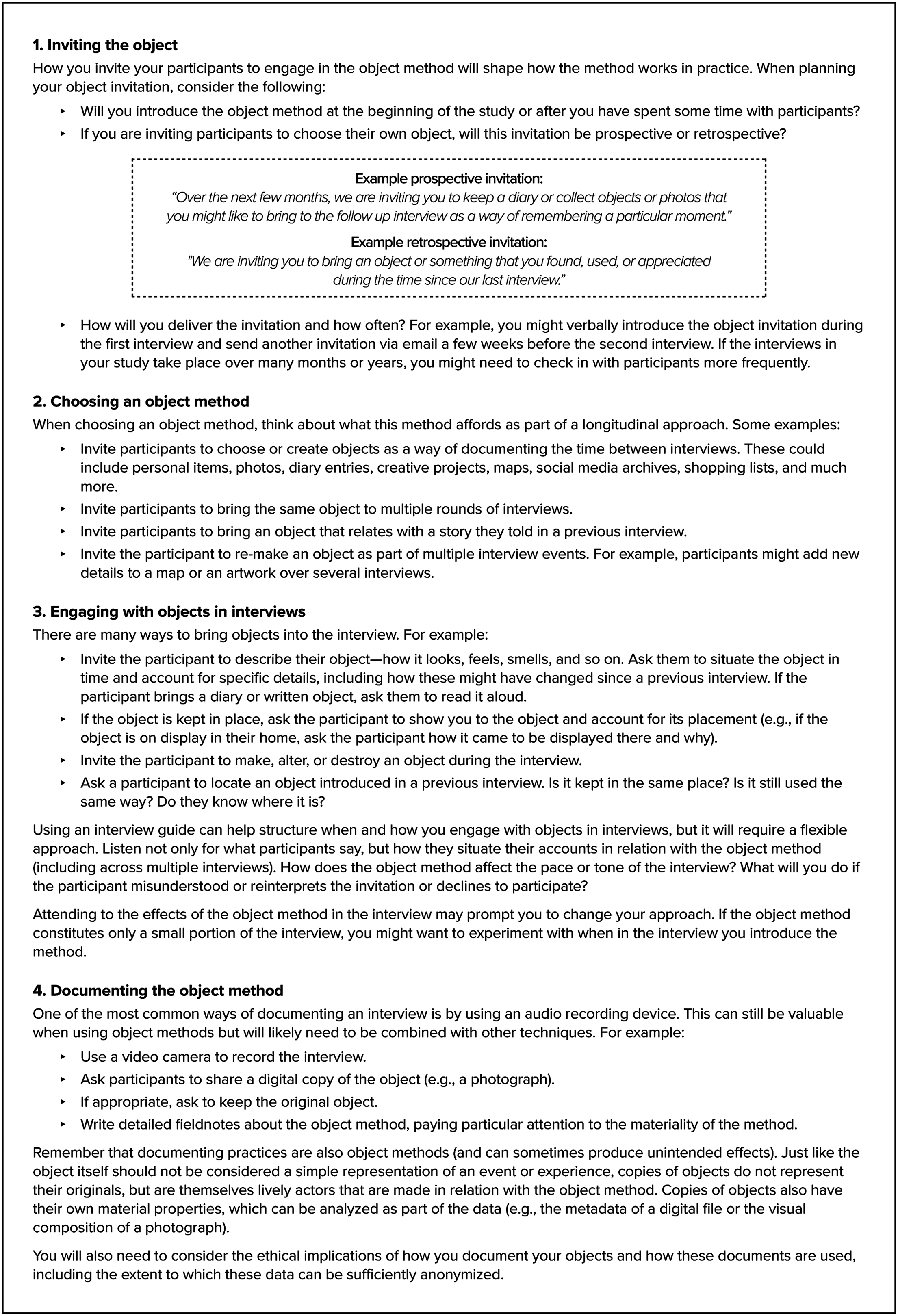
Practical considerations for using objects in qualitative longitudinal interview methods.
Footnotes
Acknowledgements
Our thanks go to the participants and researchers involved in the St Vincent's “ADAPT” COVID-19 study, and especially Professor Gail Matthews and Professor Greg Dore. The Centre for Social Research in Health at the University of New South Wales (UNSW) is supported by a grant from the Australian Government Department of Health. We are grateful for support from the UNSW SHARP (Professor Tim Rhodes) and Scientia Fellowship (Professor Kari Lancaster) schemes. Kari Lancaster is supported by an Australian Research Council DECRA Fellowship (DE230100642).
Declaration of conflicting interests
The authors declared no potential conflicts of interest with respect to the research, authorship, and/or publication of this article.
Funding
The authors received no financial support for the research, authorship, and/or publication of this article.

Author biographies
Mia Harrison is a postdoctoral researcher at the Centre for Social Research in Health at UNSW Sydney. Her research draws on approaches in science and technology studies (STS) and critical medical humanities to explore evidence-making practices and embodied experiences in health, with a particular focus on materialities and temporalities of health, illness, and care.
Tim Rhodes is a Professor of Public Health Sociology at the London School of Hygiene and Tropical Medicine, and SHARP Professor of the Sociology of Health at the Centre for Social Research in Health at the University of New South Wales. He uses qualitative methods to explore the social and material relations of evidence-making practices in health, especially in the fields of infectious disease, pandemics, and drug use.
Kari Lancaster is Professor in Sociology and University Research Leader – Health, Science & Planetary Change, at Goldsmiths University of London. She also holds honorary appointments at the London School of Hygiene and Tropical Medicine and the Burnet Institute. Informed by Science and Technology Studies, her programme of work investigates evidence-making practices, viral elimination, and outbreak science in the governance of health.